- Sink grease trap: DIY creation and installation
- Grease traps: device and principle of operation
- Making a do-it-yourself grease trap
- Features of the installation of the structure
- How to clean the grease trap?
- Grease traps for high volume wastewater treatment
- 6. KS-Zh-2V
- 7.ACO Lipator
- Editor's Choice
- What is a grease trap, its device and principle of operation
- Grease trap installation
- Installing a grease trap under the sink
- Installation of a grease trap in the garden
- What does the market offer?
- Equipment installation technology
- Installation of a street grease trap
- Installing the grease trap indoors
- How to clean the grease trap?
- How does it work?
- What are they made of?
- Types
- Performance
- Materials for the manufacture of grease traps
- Option #1: plastic ↑
- Option #2: fiberglass ↑
- Option #3: steel ↑
- Selection criteria and main manufacturers
- Conclusions and useful video on the topic
Sink grease trap: DIY creation and installation
Grease traps: device and principle of operation
The installation of grease traps at industrial and food facilities is due to the presence of relevant sanitary norms and rules, but as for domestic use, is this device really necessary in the house? To do this, you need to understand what effect fatty substances have on the sewer system:
- When cooled, fatty acids turn into a flaky mass, which settles on the walls of pipes and eventually leads to clogging, reducing the flow of water. Over time, the system becomes completely impassable and must be cleaned (in the worst case, repaired).
- Fats lead to the gradual formation of caustic substances that have a persistent fetid odor.
- Over time, fatty deposits oxidize and corrode the sewer system from the inside, completely rendering it unusable.
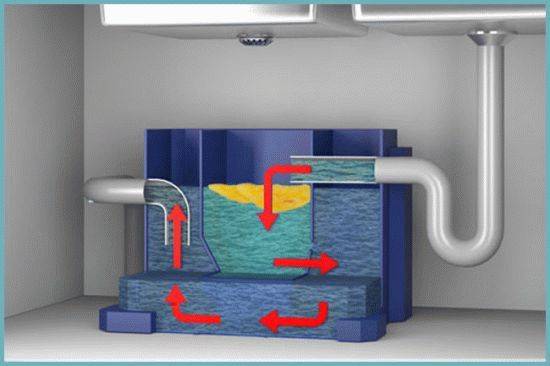
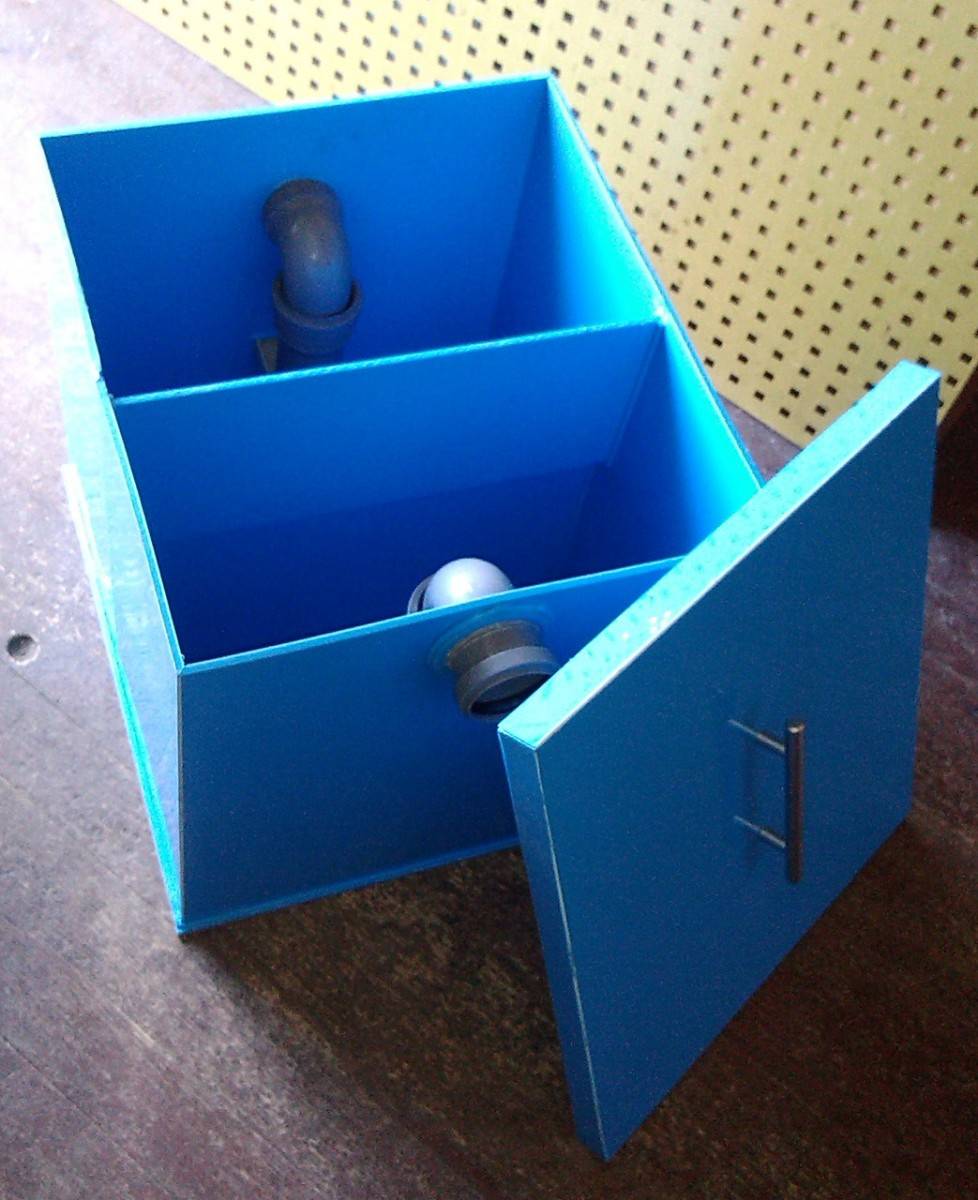
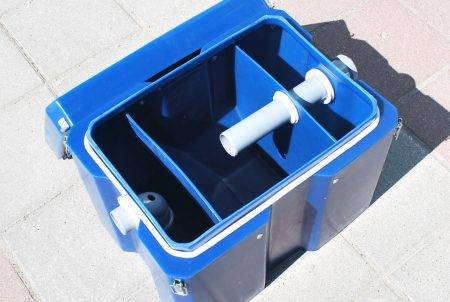
As you can see, the use of a grease trap is quite justified even at home. Let us briefly consider the device of a household installation. The grease trap is a completely sealed container with a removable lid, made of food-grade plastic and divided into several sections. Branch pipes are connected to the extreme ones, which cut into the sewer pipeline. Installed under the sink.
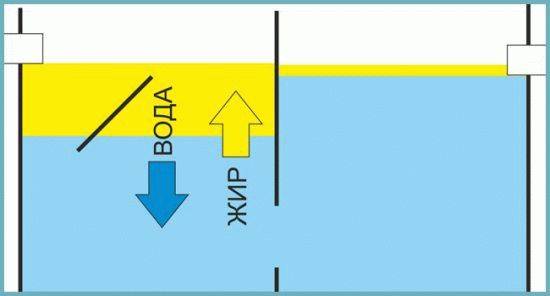
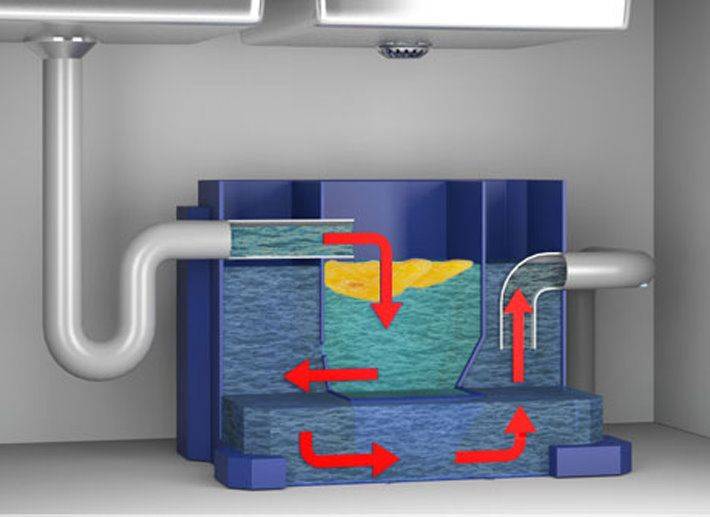
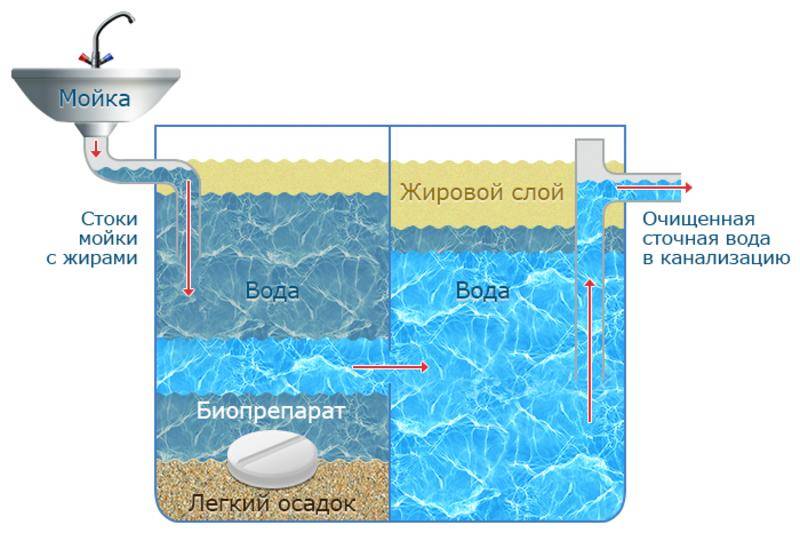
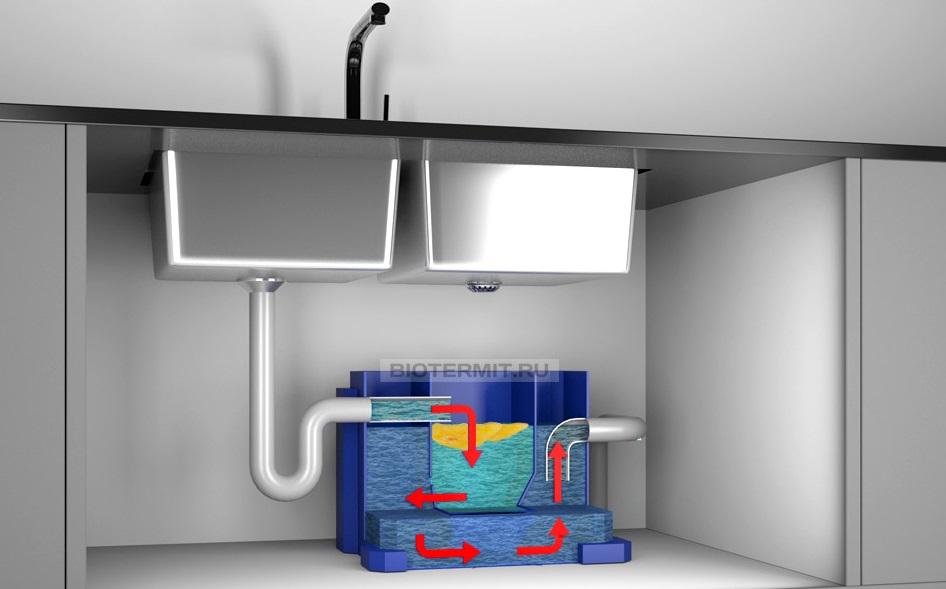
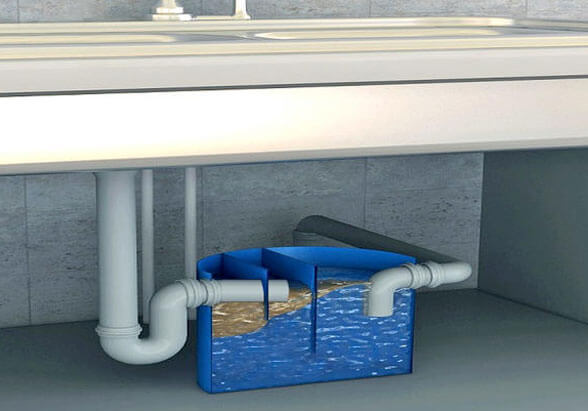
The grease trap is classified as a septic tank. All used water passes through it. The basic principle of operation of the installation is the difference between the densities of water and fat. First, the effluents enter the tank through the inlet pipe. Since fat is less dense, its particles float on the water surface and, thanks to the partitions installed across them, are removed from there to a special storage tank. The accumulated fat in the household grease trap can only be removed manually.
Making a do-it-yourself grease trap
Most often, materials such as steel, food-grade plastic, fiberglass and polypropylene are used for the manufacture of this unit. We will consider the simplest option - the manufacture of a plastic device.
Advice. If you have unnecessary products made of harmless plastic on the farm, then you can safely use them to create the capacity of the unit.
Before proceeding directly to the creation of the design, it is important to make basic calculations that will help calculate the optimal installation volume for a particular water supply system. First, let's calculate the performance of the created unit
So, we use the following formula: Р=nPs, where
- P - performance of the septic tank, l / s;
- n is the number of sinks in the room;
- Ps - water supply rate (usually equal to 0.1 l / s).
After we know the capacity of the unit being designed, we determine the required volume of the structure using the formula: V=60Pt, where
- t is the average duration of fatty acid sedimentation (about 6 minutes);
- P is the performance of the unit already known to us.
We make a drawing of the installation according to the dimensions obtained. Now you can start preparing the tool and materials:
- material for the body of the installation (in our case, food grade plastic);
- sanitary silicone;
- building glue;
- a piece of thermoplastic pipe with a diameter of 5 cm;
- thermoplastic elbow with a diameter of 5 cm;
- thermoplastic tee with a diameter of 5 cm.
The first step is to cut the parts for the body. We use a hacksaw for metal / jigsaw. First, we glue the sides (body) of our design, only after that we fix the bottom. Then we install internal partitions (their height should be 2/3 of the height of the side walls).Joints are sealed with silicone.
We install an elbow in the assembled structure (it will act as an inlet pipe). From a piece of pipe and a tee we make an outlet pipe. It remains the case for small - the top cover for the design. In places of its contact with the body, we fix the rubber seal. You can proceed to the installation of the unit in the working area.
Features of the installation of the structure
Installing a grease trap is a fairly simple process, but it requires certain rules to be followed:
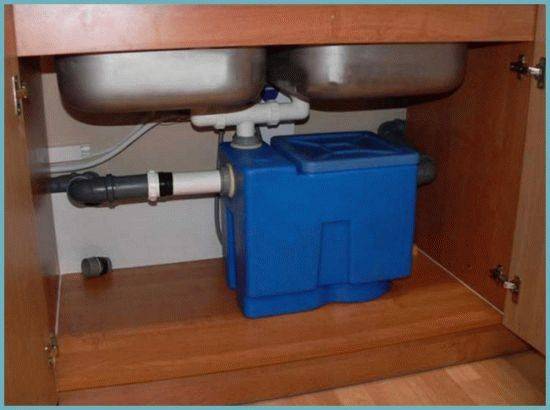
- First of all, we determine the place for installing the unit.
- We check and prepare the surface on which we will install the structure (it must be absolutely horizontal).
- We prepare all fasteners for fixing the unit to the pipeline (clamps, fittings, etc.).
- We bring the inlet pipe to the sewer drain, and the outlet pipe to the drainage system.
- We are testing the installation, waiting for the first cleaning. If the unit has passed the test, you can close the installation.
That, in fact, is all. In fact, as you can see, it is quite easy to build and install a grease trap for home use. The main thing is to be careful, attentive and accurate. Good luck!
How to clean the grease trap?
Household devices installed inside the house are cleaned manually. For this purpose, separators are equipped with a special blade. This process is quite simple, does not take much time, but is somewhat unpleasant. The algorithm of actions is as follows:
- Open the top cover.
- We collect the accumulated fat with a spatula.It should be noted that fat waste during unloading of grease traps is subject to mandatory disposal, but these standards do not yet apply to household appliances.
- We check the nozzles and, if necessary, remove accumulated large particles from them.
- We remove the accumulated sediment from the bottom. It can be cleaned using any detergent.
- We flush the system with hot water, which will remove grease and oil particles from the pipes that can lead to clogging.
- Close the lid and continue further operation of the separator.
To pump out the accumulation of fats from the street separator, special equipment will be required.
Cleaning should be carried out regularly, otherwise the system is likely to become clogged.
Grease traps for high volume wastewater treatment
A capacity of at least 2 m³ / h, impressive dimensions and the mandatory presence of electronics (from sensors to control units) distinguish industrial units. Indoor or outdoor models are connected to the sewer to prevent clogging of city sewers and provide wastewater treatment in stand-alone systems.
6. KS-Zh-2V
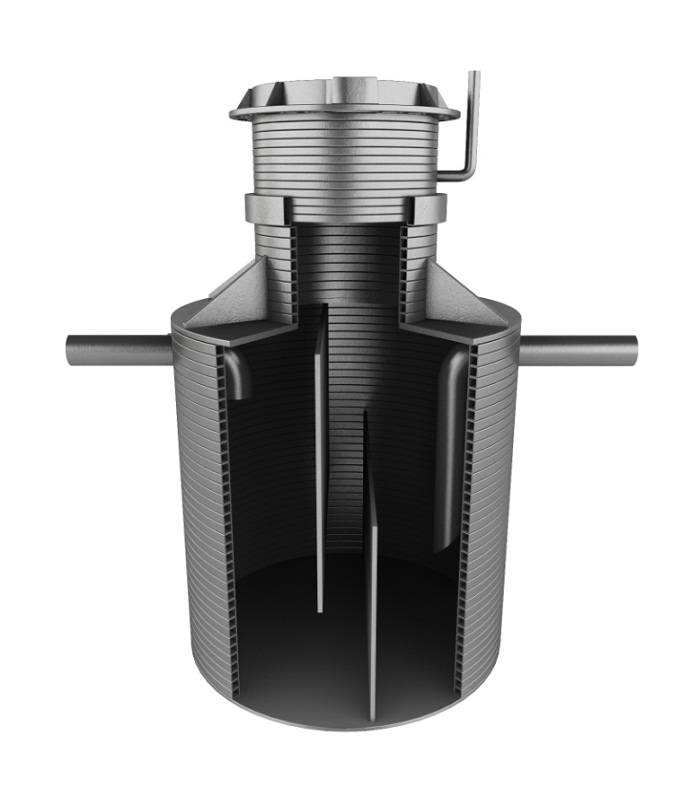
KS-Zh - a line of non-volatile well-type grease traps. Designed to treat industrial wastewater before being discharged into the city sewer. "2V" - vertical layout of the device. Installed in the ground, cleaned through the hatch.
The advantages of the "younger" model of the KS-Zh line are the performance and working volume of the device. Thanks to which the flow up to 300 liters per minute is effectively processed. The minimum service interval of the device is six months.
Of the minuses - constant investments will be required: for the calculation - to the designer, for the preparation of the site and installation of the device - to specialized craftsmen, for cleaning - to a professional vacuum cleaner.
To control the current level of fat, it is best to use a customizable sensor, which is offered by the manufacturer as an option.
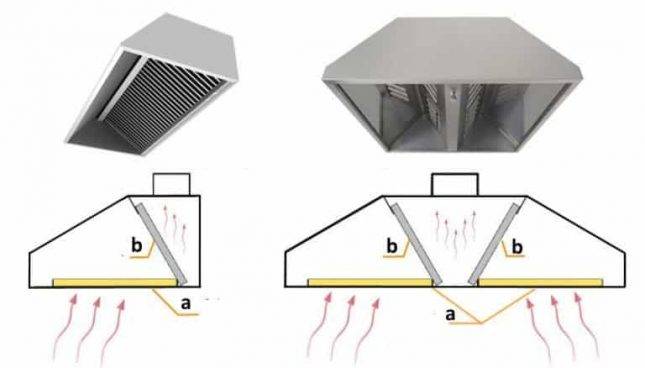


| Characteristic | Meaning |
|---|---|
| Productivity, m³/h | 7.2 |
| Peak discharge, l/min | 300 |
| Dimensions (height/diameter), mm | 1300/800 |
| electrical equipment | Non-volatile, medium density sensors are optionally mounted. |
| Producing country | Russia |
Industrial KS-Zh in the video from the manufacturer:
7.ACO Lipator
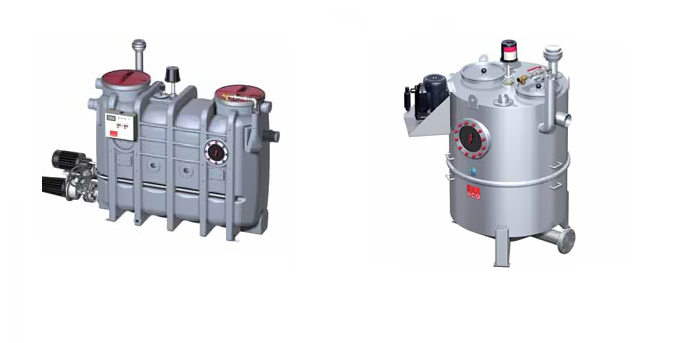
Autonomous, volatile equipment ACO Lipator in a stainless steel case. The sealed Lipator is designed for continuous operation in manufacturing and processing plants, restaurants and ship galleys. Suitable for catering establishments located on high floors or underground levels of buildings - where the disposal of untreated wastewater is prohibited, or it is not possible to organize an access road for a sewage truck.
The key advantage is that fat and sludge released from wastewater are pumped into 60-liter containers, in which they are transferred for disposal. The design of the device is collapsible, so there are no difficulties with delivery or installation. The only disadvantage of such equipment is the high cost.
Please note that ACO offers the Lipator in two configurations: with automatic or manual grease and sludge pumping equipment.
| Characteristic | Meaning |
|---|---|
| Productivity, m³/h | 72 |
| Peak discharge, l/min | 2080 |
| Weight, kg | 640 |
| Dimensions (diameter x height), mm | 1830x600 |
| Branch pipe height (inlet/outlet), mm | 1900x1830 |
| electrical equipment | Stirrer electric drive (230 V) |
| Producing country | Germany |
ACO Lipator battery diagram:
Editor's Choice
In a small typical kitchen with a sink and a household dishwasher, Onyx 0.5-15 would be the most cost-effective option. The main rule of operation is not to use all sanitary equipment at the same time.
The peak reset of the PE 1.5-100 “auto-collection” device allows you to simultaneously connect two washing baths and a professional dishwasher. A convenient model for the catering department of a cafe or a snack bar, suitable for the production premises of a culinary store.
The best conditions for the stable operation of a high-rise, underground or underwater restaurant are created by stand-alone ACO models of the Lipator line. Fats and sludge are collected for processing, the purified liquid is discharged into the local sewer system.
Given the features of the popular models described in the review, you will select the right equipment for specific operating conditions. After all, within the range offered in Russia, the technical characteristics and dimensions of the models change in small increments. For those cases when standard solutions are not justified, some manufacturers offer to make fat traps for the individual needs of your enterprise.
What is a grease trap, its device and principle of operation
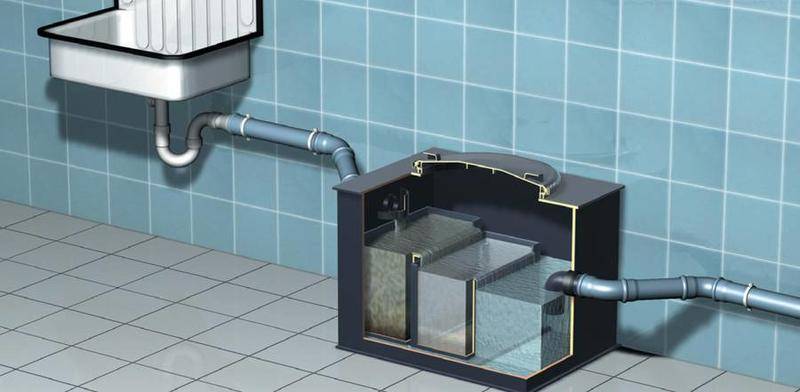
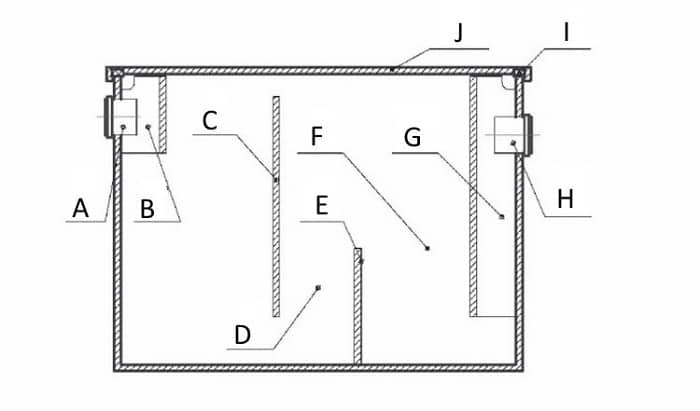
These are special tanks used to remove fats contained in drains. A simplified drawing of such a device is shown below.
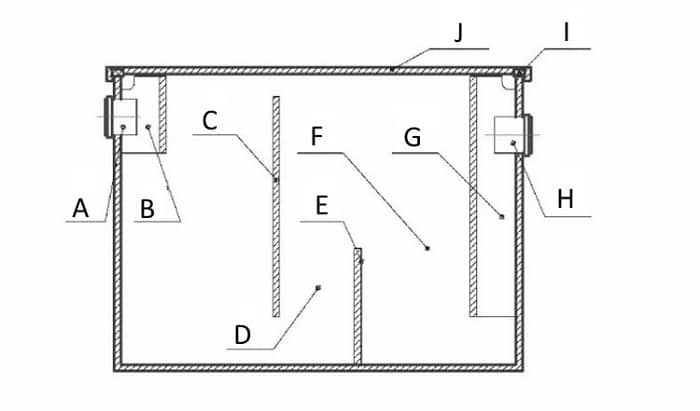 Grease trap design
Designations:
- A - pipe installed at the inlet;
- B - partition, plays the role of a flow damper;
- C - the first separation partition;
- D - separation chamber;
- E - the second separation partition;
- F - settling compartment;
- G - output distribution compartment;
- H - branch pipe for the removal of treated wastewater;
- I - a sealant that ensures the tightness of the structure;
- J - reservoir cover.
The most common method of separating fats is mechanical. Separator partitions are installed in the tank, which help to slow down the movement of effluents and cool them. As a result, the fatty formations contained in them, due to the transition to a non-emulsified state, are collected on the surface of the water. With the accumulation of a certain amount of fat, cleaning is performed. A visual diagram of the operation of the device is shown below.
 Scheme of operation of the grease trap
Designations:
- A - supply of wastewater to the tank;
- B - sediment from heavy pollution;
- C - fat accumulated on the surface of the water;
- D - separation partitions;
- E - water level line;
- F - outlet to the sewer.
The main technical characteristics of separators are determined by their dimensions, performance, peak discharge volume and installation method.
Grease trap installation
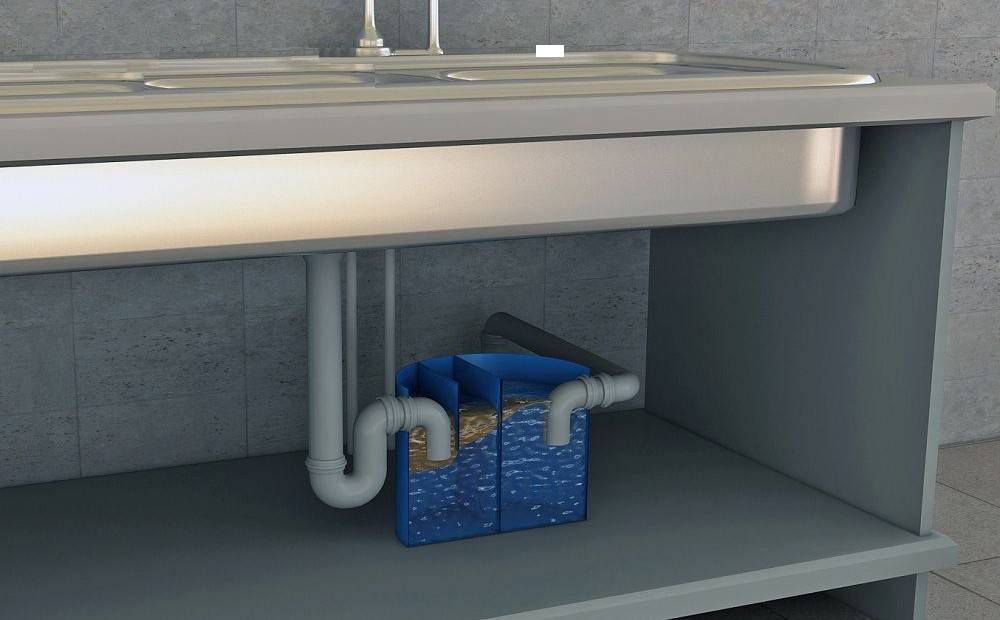
Installing a grease trap under the sink
Installing the grease trap is quite simple. To do-it-yourself mount the device, you must follow the instructions below:
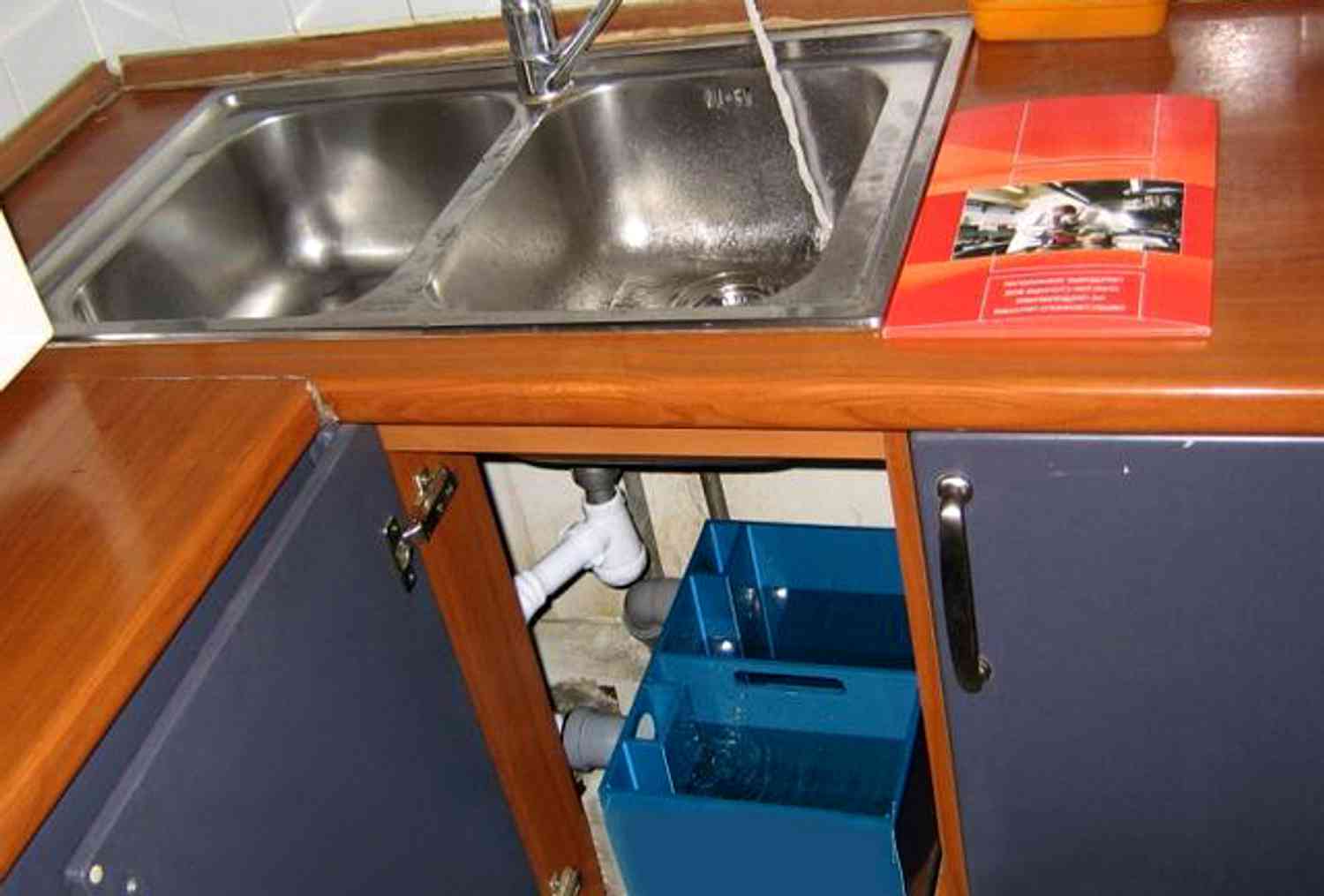
- The place for installation of a separator is chosen. It should be a level and solid surface that is easy to access. Most often, the grease trap is installed directly under the sink or near the dishwasher.
- A grease filter is installed.
- The inlet pipe of the separator is connected to the sewer pipe of the sink or the pipe where the sink and washing equipment are connected. At the connection point, a rubber gasket is used, which is supplied with the device.
- The outlet pipe is discharged into the sewer. To connect pipes, in the same way as in the previous paragraph, a gasket is used.
- The grease trap is filled with water to check the tightness of its connections with pipes.
- The system is closed by the lid of the device.

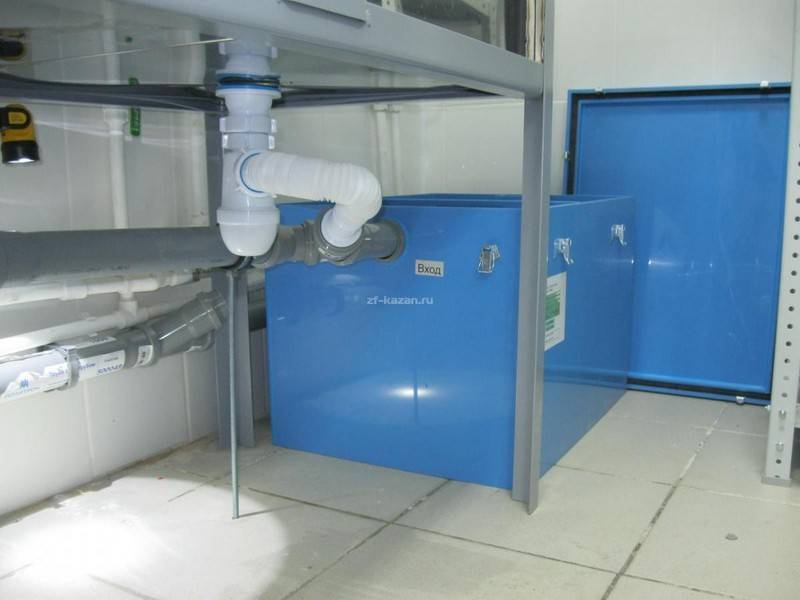
Example of a correctly installed instrument
The separator is connected and tested. The device can be used.
Installation of a grease trap in the garden
Installing a separator on a personal plot is a more difficult task than installing a device at home. In order to install it yourself, you must perform the following steps:
Initially, choose a place to install the filter
It is important to take into account the further planning of the site and possible landscape work.
A hole of the required size is dug. When carrying out this work, it should be taken into account that at the bottom of the recess there should be a solid backfill and the separator cover should protrude 3-4 cm above ground level.
At the bottom of the pit, a solid formwork is made from a mixture of sand and cement. If the site has sandy or loamy soils, then the mixture used is diluted in a ratio of 1: 5
If the soil is more unstable, then the amount of cement in the solution needs to be increased. After the prepared base has completely hardened, you can proceed with the further installation of the device.
The body of the grease trap, for stability and avoiding distortions, is attached to a solid base with anchor bolts.
Plywood formwork is constructed around the grease trap to prevent soil shedding.Use of the instrument in cold climates will require the use of any thermal insulation material such as mineral wool or foam.




If the site has sandy or loamy soils, then the mixture used is diluted in a ratio of 1:5. If the soil is more unstable, then the amount of cement in the solution needs to be increased. After the prepared base has completely hardened, you can proceed with the further installation of the device.
The body of the grease trap, for stability and avoiding distortions, is attached to a solid base with anchor bolts.
Plywood formwork is constructed around the grease trap to prevent soil shedding. Use of the instrument in cold climates will require the use of any thermal insulation material such as mineral wool or foam.
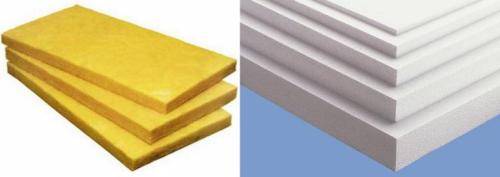
Mineral wool and foam plastic are suitable thermal insulation materials
- The inlet pipe of the device is connected to the sewer pipe. After connection, the joint is recommended to be treated with a sealant.
- The outlet pipe of the separator is connected to a further drainage system. The junction of the pipes is also treated with a sealant.
- The remaining space of the pit is covered with excavated soil (the backfilling method is used, in which the earth extracted from this particular place is used).
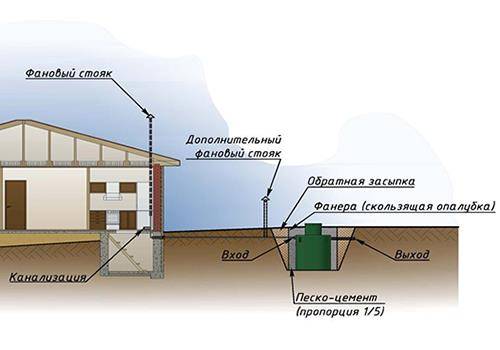
Outdoor grease trap installation
When installing the grease trap on the street, fan risers are required. These pipes are used to remove excess gas accumulations from the sewer system that can damage the equipment.If it is planned to spend a lot of time on the plot and in a large company, that is, there will be a lot of wastewater, then it is recommended to use not only the main, but also an additional fan pipe.
If during the installation of the grease trap all the basic rules and requirements are observed, then there will never be any problems with the operation and further maintenance of the device.
What does the market offer?
Today, there are quite a lot of products of enterprises that produce grease separators for kitchen sinks on the market of sanitary ware in the Russian Federation. Among them among the leaders:
- Products of the company "The Fifth Element".
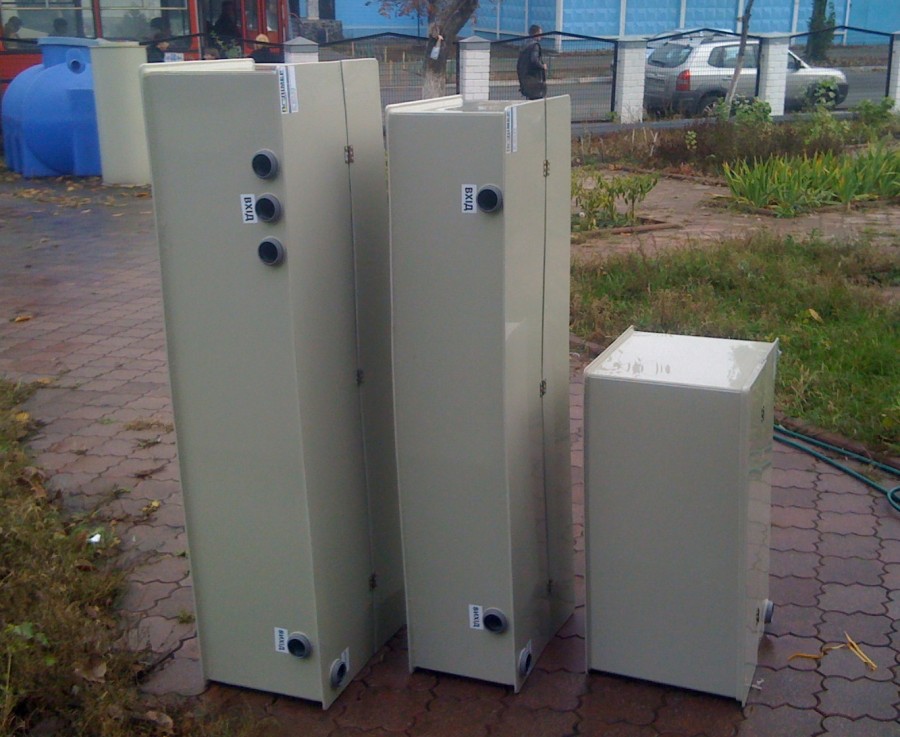
It can be found in four layout modifications "standard", "pro", "auto-assembly", "steel". In each of these arrangements, it is possible to choose a grease trap corresponding to the tasks assigned to it. The choice can be influenced by the following parameters: productivity - 0.5-1.5 m3 / h, peak water discharge - 25-175 l, the number of connected sinks - 1-3, the material of the working tank - polypropylene or steel. However, the ease of maintenance is also important, which is provided by removable plates or canisters for fat, as well as waste trays in separate modifications. The most compact device has dimensions of 420*320*370 mm (L*W*H). - Separators "Evostok OIL" are also represented by models - from the smallest, designed for installation under sinks in standard apartments, to large-sized, capable of cleaning the drains of large cottages, canteens, restaurants, etc. They are distinguished by the simplicity of the internal device, assembled in a polypropylene case according to a two-chamber scheme. Dimensions of the smallest model - 420 * 320 * 370 mm.
- The Termit trademark offers only four standard sizes of its separators, covering the most popular segment, installed under grease trap sinks. Instrument containers are made of high-pressure polyethylene in a three-chamber design. An additional option in their configuration may be a tray for garbage and large waste. This is a removable plastic container that is easy to remove and rinse when filled. The smallest installation is 450x350x395 mm.
- Triton-PM cleaners are reliable units of the Russian brand. Are issued in two-chamber cast polymeric cases. Their models occupy the entire functional range in terms of operating throughput and peak discharge for use in everyday life, as well as in mini-productions (cafes, canteens, restaurants). Although the dimensions of the smallest typical product are 420 * 320 * 370 mm, the manufacturer is ready to manufacture a separation plumbing installation for individual customer requests.
As a contrasting example, we can consider the Hydrig automatic grease trapping equipment. These are quite complex and expensive stainless steel products intended for use in mainly catering facilities.
Grease trap "Hydrig"
In them, the technological process of separation proceeds due to the electrical heating of wastewater, followed by mechanical separation and collection of fat. The equipment is volatile, but provides the highest degree of purification compared to the above-described gravitational installations. The dimensions of the main unit of the smallest model are 590*500*335 mm.
Equipment installation technology
The installation process of the fat separator can be carried out in various ways. It is necessary to choose the optimal type of installation depending on the type and characteristics of the fat trap. Consider several options for mounting separators.
Installation of a street grease trap
The procedure for mounting an industrial fat trap is complex and time-consuming. Therefore, most trap buyers prefer to entrust the installation of equipment to specialists.
In order to perform the installation yourself, you need to carry out a number of preparatory work:
- We select a place for installation. When choosing, one should take into account the features of the layout of the site, as well as the possibility of performing landscape work in the future.
- We determine the size of the pit for mounting the device - its depth should be such that the fat trap cover is about 4 cm higher than the ground surface.
- We dig a hole. At the very bottom, we equip a solid formwork into which we pour a mixture of sand and cement. For sandy soils and loams, a solution prepared in a ratio of 1: 5 is optimal.
- We wait until the solution hardens, at a minimum it is 14 days.
When the preparation of the base for installation is completed, you can proceed directly to the installation of equipment. To do this, we install the body of the fat trap on a concrete base and securely fasten the device to the loops embedded in a home-made concrete slab during the pouring period. If you forgot to put the hinges, then they can be fixed with anchor bolts.
Now we are building peculiar plywood walls around the equipment installed in the pit. This process is necessary to prevent soil shedding. If it is planned to operate the separator in a cold climate, then it must be covered with thermal insulation material.For this, mineral wool or polystyrene is suitable.
It remains to connect the fat trap to the communication networks. To do this, the outlet pipe of the equipment must be connected to the drainage system. Joints must be treated with sealant. And we connect the inlet pipe of the device to the sewer pipe. We coat the place of joining of the elements with sealant.
All free space formed between around the body of the grease trap is covered with soil. Backfilling is usually used, during which it is necessary to fill the opening with soil excavated from this place at the stage of digging a hole.
We must not forget about the need to install a fan riser. It is required to remove excess gases accumulated in the sewer system. If there is a heavy load on the wastewater disposal system, it is better to install several risers at once. The fat accumulation sensor, which is installed inside the equipment, will warn you about the need for a cleaning procedure.
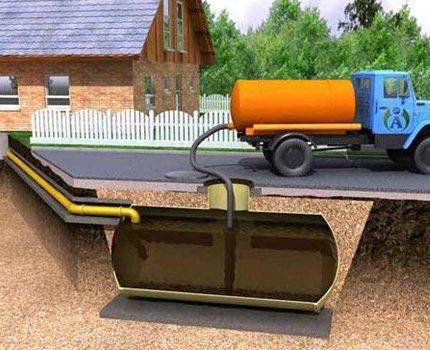
Street grease traps are more often cleaned by specialists of specialized companies using pumps or special equipment
Installation and installation of industrial fat traps is recommended to be carried out with the involvement of professional installers. They must also have permits to carry out the entire range of work.
Also, professional specialists have the necessary for mounting construction equipment, so they can carry out the necessary procedures for stable and long-term operation of the equipment.
Installing the grease trap indoors
Installing a domestic separator under the sink is an easier process than installing equipment outside. To do this, you first have to choose the optimal place for mounting the equipment.
It should be located on an easily accessible, hard and as level surface as possible, close to plumbing fixtures.
It remains to perform a series of sequential actions:
- We bring the outlet pipe of the equipment into the sewerage system. At the connection point, you need to install a rubber gasket that comes with the device.
- We connect the inlet pipe of the trap to the outlet pipe of the plumbing equipment or to the pipeline (at the junction of the sink and washing equipment), not forgetting to put a special gasket.
- We collect the required amount of water in the grease trap to check the device for leaks.
If the test was successful, you can install a cover on the fat trap. With the installation of the cover, the installation of the equipment can be considered complete.

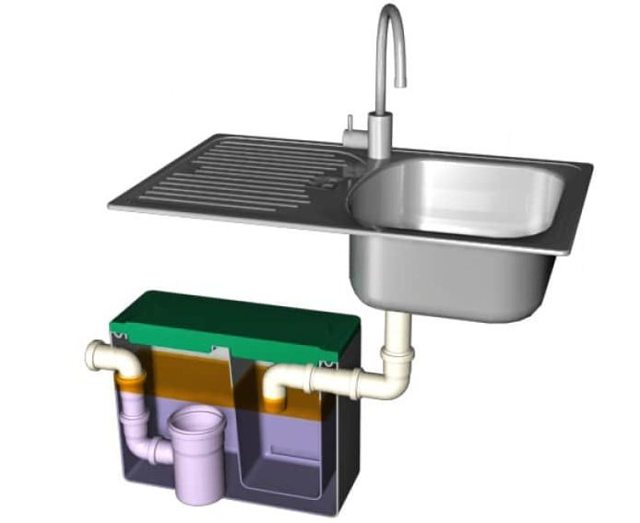
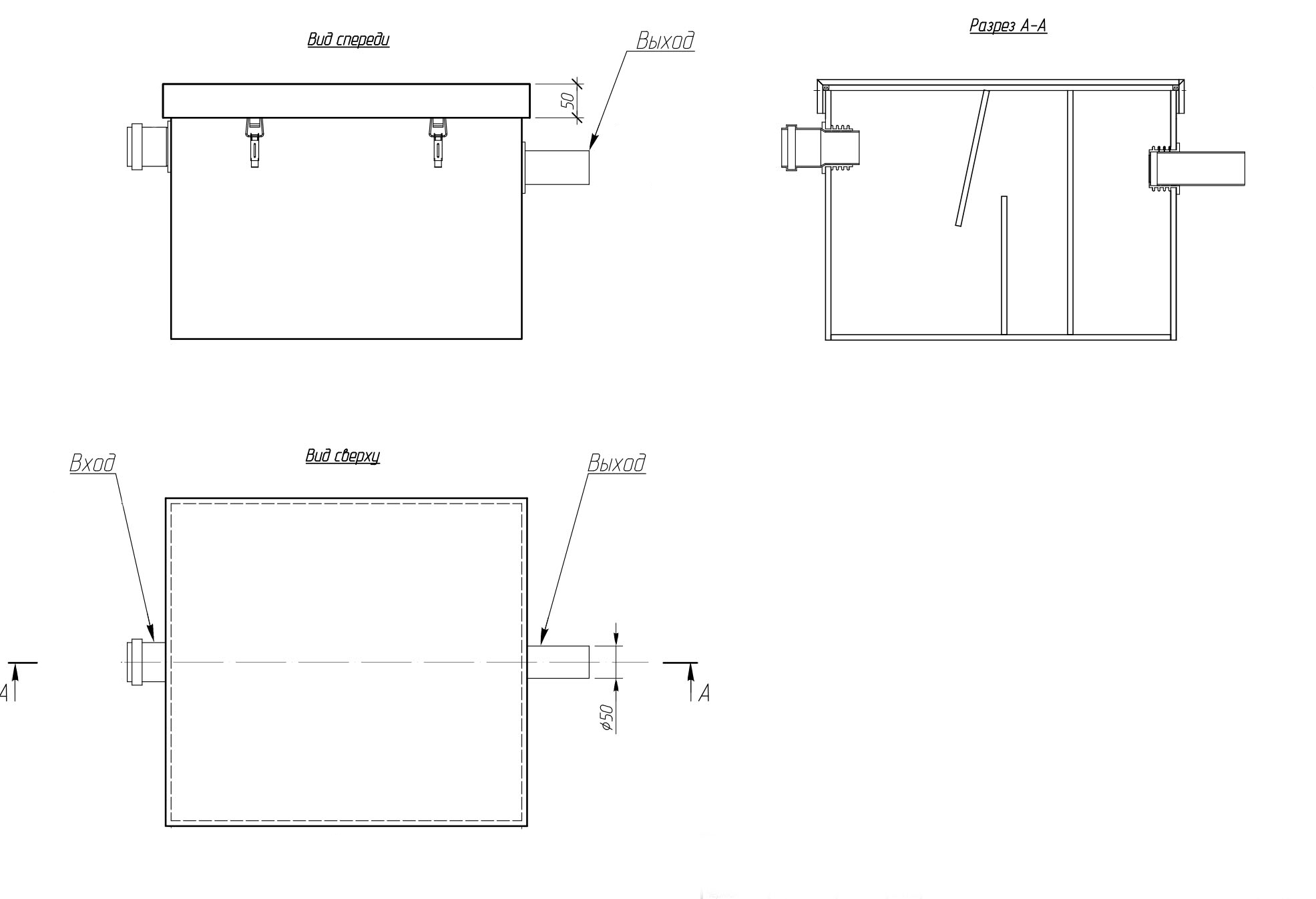




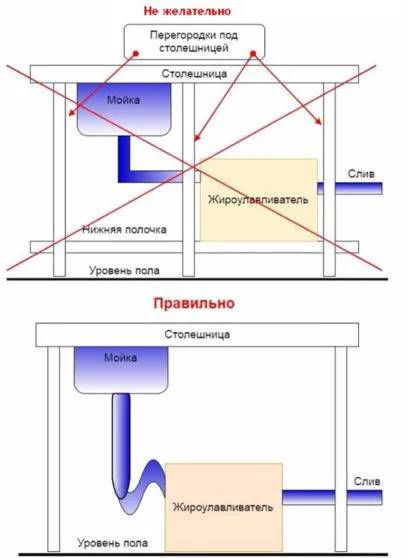
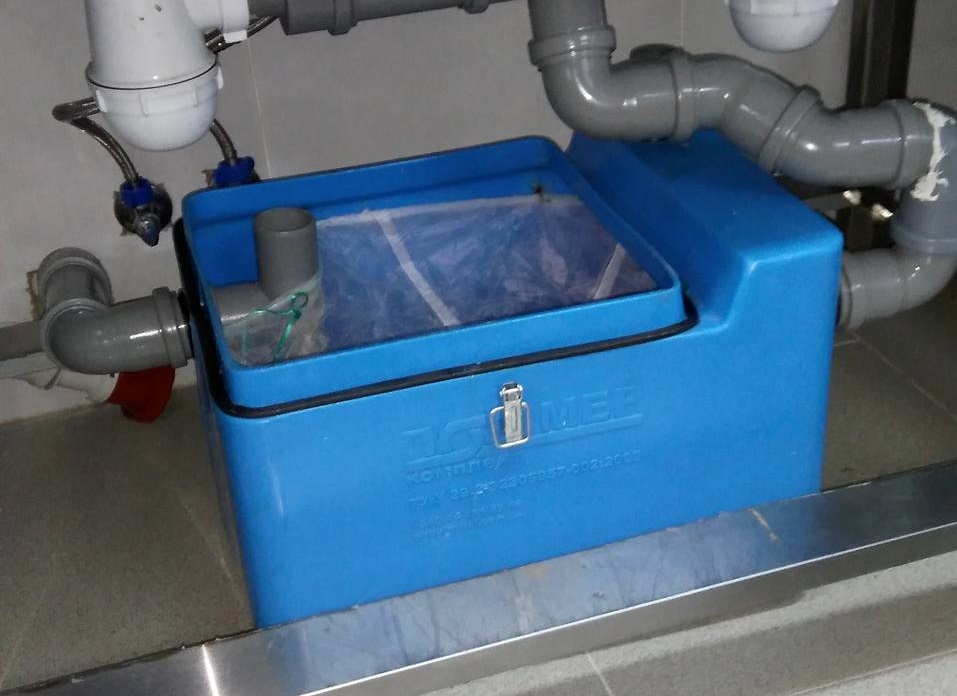
For more information on how to choose and install a grease trap under the sink, read this material.
How to clean the grease trap?
Household devices installed inside the house are cleaned manually. For this purpose, separators are equipped with a special blade. This process is quite simple, does not take much time, but is somewhat unpleasant. The algorithm of actions is as follows:
- Open the top cover.
- We collect the accumulated fat with a spatula. It should be noted that fat waste during unloading of grease traps is subject to mandatory disposal, but these standards do not yet apply to household appliances.
- We check the nozzles and, if necessary, remove accumulated large particles from them.
- We remove the accumulated sediment from the bottom. It can be cleaned using any detergent.
- We flush the system with hot water, which will remove grease and oil particles from the pipes that can lead to clogging.
- Close the lid and continue further operation of the separator.
To pump out the accumulation of fats from the street separator, special equipment will be required.
Cleaning should be carried out regularly, otherwise the system is likely to become clogged.
How does it work?
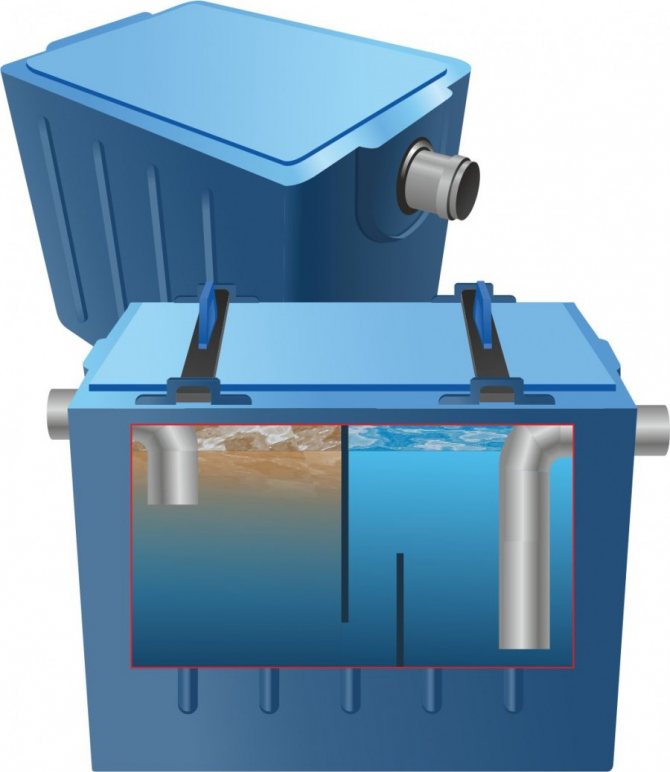
Grease traps work on the principle of gravitational settling. A household grease separator is a plastic container divided inside by partitions into chambers. In the first and last compartment there are branch pipes for connecting pipes.
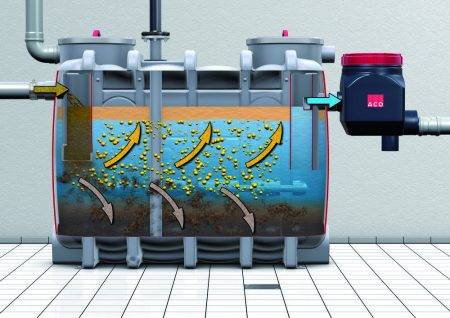
The design has a removable cover. The principle of separation is based on the fact that during settling, the liquid is divided into layers depending on the density. The process goes like this:
- the polluted liquid entering the sink drain enters the first chamber of the grease trap through the inlet pipe;
- separators installed in the transverse direction separate part of the fatty impurities rising up;
- the water flow moves to the next compartment, where fat removal continues;
- the collected fat is moved to the drive;
- from time to time the storage chamber must be freed from fat.
What are they made of?
Grease traps can be made from different materials:
- stainless steel;
- plastic;
- fiberglass.
Household models are made mainly from polymeric materials (polypropylene), since this material is the cheapest and most practical. Industrial grease traps can also be made of steel.
Types
According to the place of installation, the following options are distinguished:
- models for installation under the sink;
- grease traps for installation in the next room;
- option for installation at the outlet of the sewer from the house;
- outdoor devices.
Performance
An important criterion for choosing a grease trap is the performance of the model. The more consumption water, the greater should be the throughput of the grease trap. In domestic conditions, installations with a capacity of 0.1-2 liters per second are used. Models of higher productivity are classified as industrial.
Materials for the manufacture of grease traps
The most popular materials from which fat separators are made are fiberglass, plastic, galvanized or stainless steel. Devices from them differ in strength, durability, price. When choosing a device for a particular kitchen, you should decide on priorities and focus on operating conditions.
Grease trap plastic container
Option #1: plastic ↑
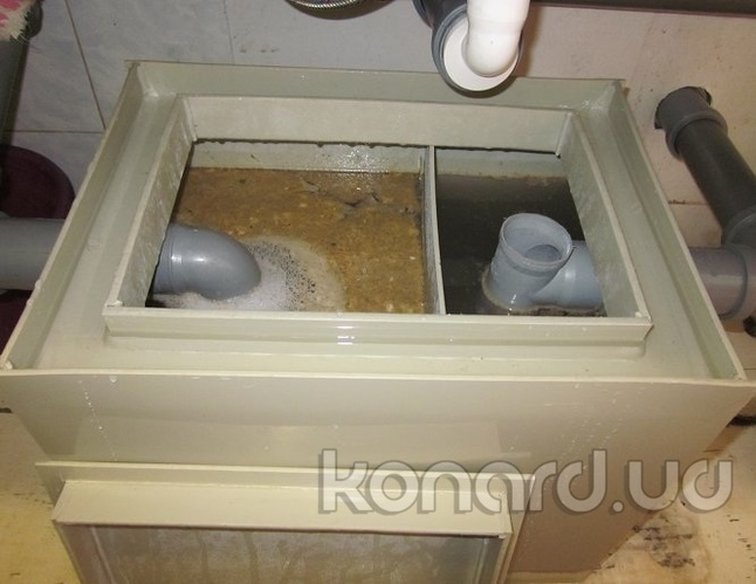
Household grease traps under the sink are most often made of plastic. This is an inexpensive material that is not afraid of corrosion, chemicals and can last up to 30 years. The advantages of plastic should also include ease of care. The disadvantages are poor resistance to mechanical damage.
There are models of various shapes, sizes, with different throughput. They are bought for installation in apartments, private houses, small restaurants, cafes, pubs. Plastic separators of fat of the domestic trademark "The Fifth Element" have proven themselves well.
Plastic grease trap
Option #2: fiberglass ↑
A good choice is grease traps for sinks made of fiberglass. This is an option for stand-alone sewerage systems in public catering establishments, industrial plants or private homes where a fat separator with a large capacity is needed.
The main advantage of fiberglass enclosures is their high resistance to external influences.The material is so durable that the devices can be installed outdoors. Fiberglass grease traps are lightweight. They are very easy to install, use and clean.
As for manufacturers, special attention should be paid to the models of the company "Ecoline"
Fiberglass grease trap
Option #3: steel ↑
Typically, fat separators are made of stainless steel, less often of galvanized steel. The advantages of the material are obvious: it is durable, resistant to mechanical damage, chemical attack. Stainless steel devices are more expensive, but they are also of better quality than appliances. made of galvanized steel.




Stainless steel model
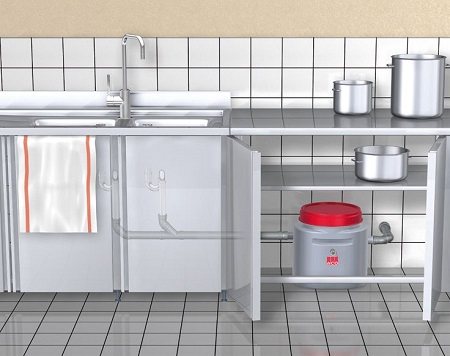
Stainless steel looks nice, so grease traps can be placed without masking not only under the sink, but also at a distance from it. These models are resistant to corrosion, so they can serve for decades without repairs. The disadvantages include a relatively large mass. Steel grease traps are more difficult to install than plastic and fiberglass ones.
When choosing a brand, you should pay attention to the products of ASO Group. These are not cheap fat separators, but there are no complaints about their quality.
The company's product range includes household and industrial models designed for both indoor and outdoor installation.
Steel model ASO
Selection criteria and main manufacturers
To select the necessary device, first of all, it is necessary to proceed from its purpose. The operating parameters of the separators depend on this. For example, for domestic purposes, performance will be sufficient in the range of 0.1-2 liters per second.But these characteristics are completely unsuitable for cleaning wastewater entering the sewer from a canteen, cafe or restaurant; industrial models with the appropriate technical characteristics will be required for this task.
It is worth noting that many industrial models (for example, for workshops where the production of dairy products is established) are equipped with additional equipment that increases service efficiency. These can be automatic pumps for pumping wastewater, fill sensors, etc.
An important factor is the material from which the tank body is made, it can be plastic, fiberglass or stainless steel. In industrial devices, the well is often made of concrete.
Household cleaners are usually made of plastic, which is explained by the low cost of the material, as well as its following useful properties:
- light weight, which greatly simplifies installation and maintenance;
- long service life (at least 30 years);
- harmlessness to humans.
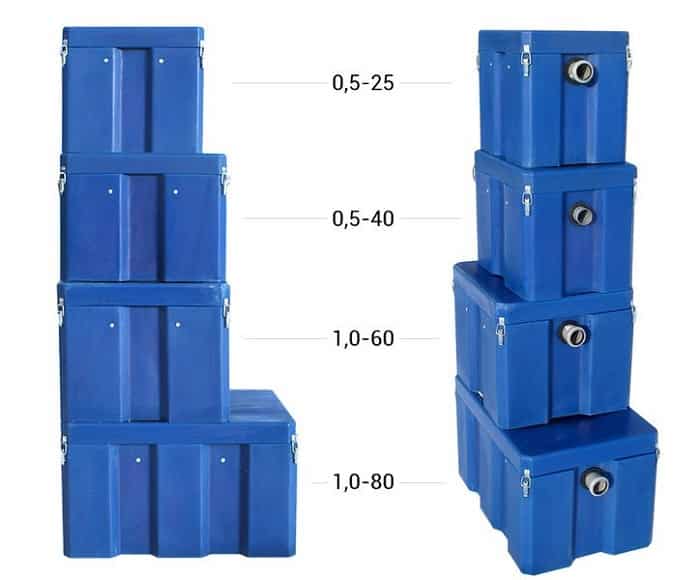
Such devices are designed for domestic use or installation in small catering establishments.
Fiberglass separators. A distinctive feature of such cases is high mechanical strength and resistance to aggressive chemicals.
Such characteristics are excellent for industrial models, especially taking into account the fact that outdoor installation is allowed.
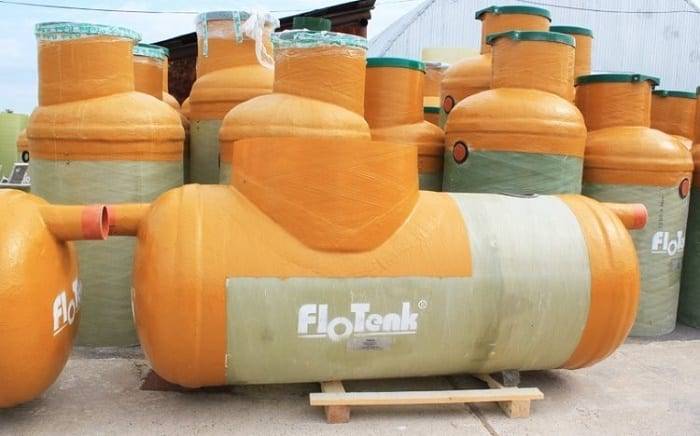
Fiberglass hulls are weather resistant, lightweight and easy to clean.
Stainless steel housings are typically used for industrial separators. Characteristics:
- long service life;
- high hygienic properties;
- presentable appearance.
These characteristics, as well as possible, meet the requirements of public catering establishments.
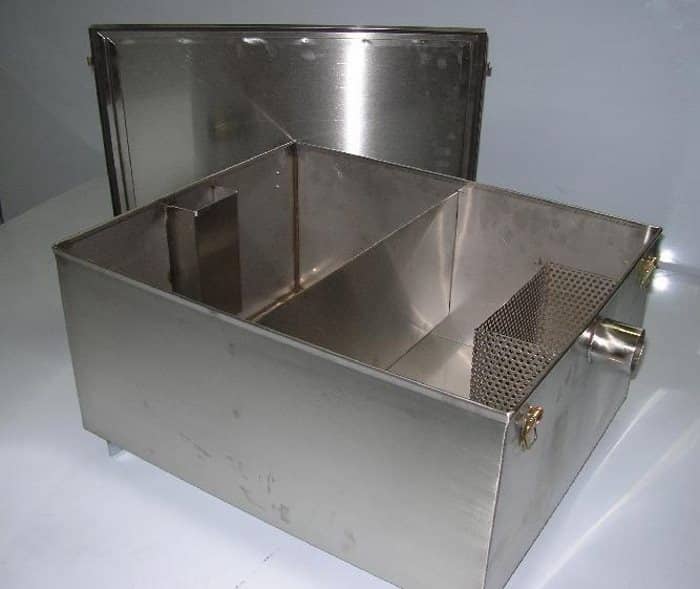
The only drawback that limits the use of such a case is the high price.
When choosing a manufacturer, we recommend giving preference to well-known brands, such as Ecoline, Alta, The Fifth Element, Thermite, etc. We also note that domestic products are not inferior in quality to foreign ones, but are significantly cheaper. As for unknown manufacturers from the Middle Kingdom, here, as always, the quality must be checked on the spot.
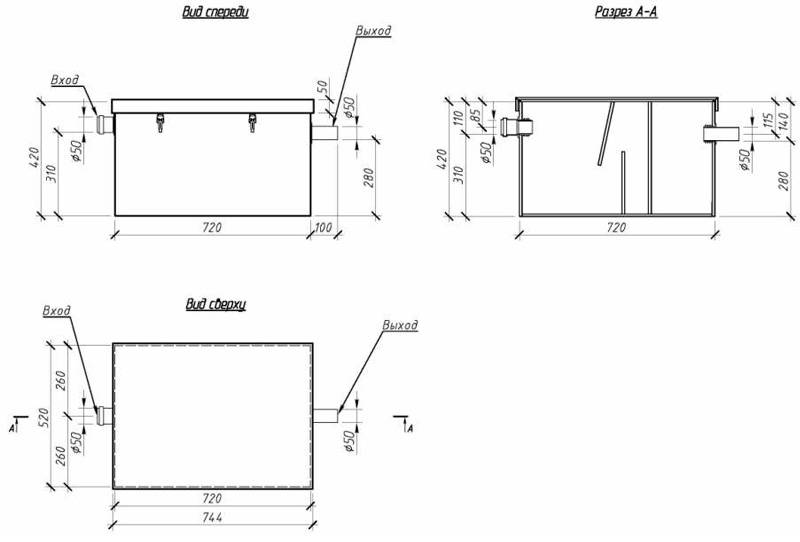


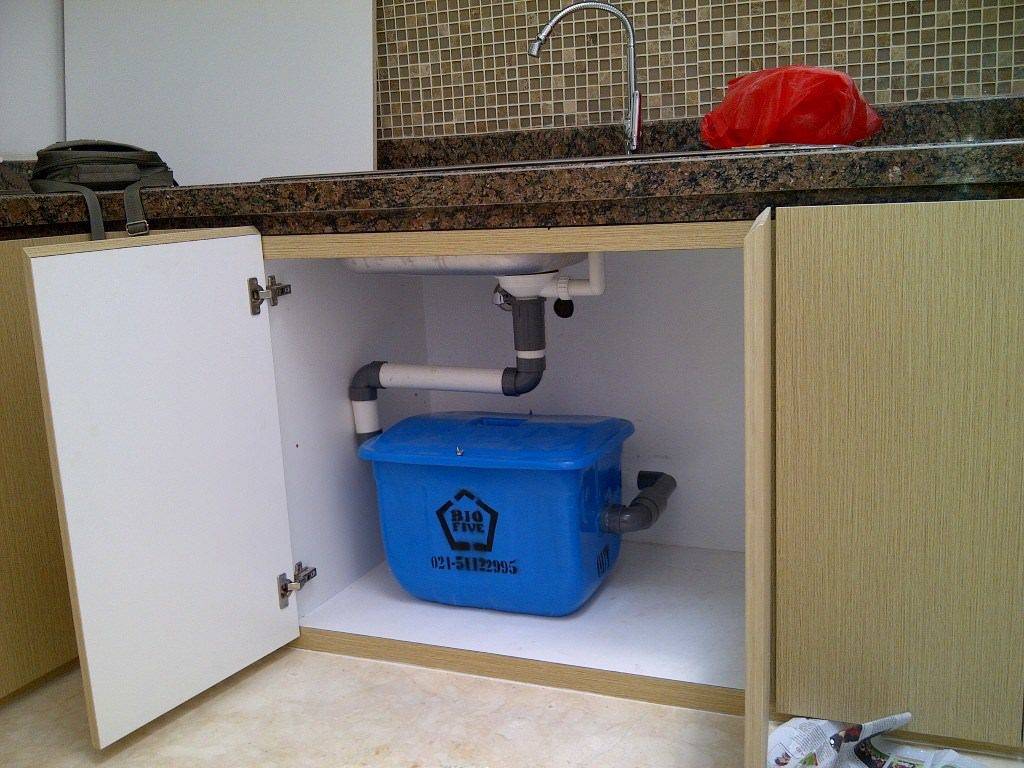


When choosing a separator model, it is necessary to take into account the place of its installation. There are models designed for installation indoors and/or outdoors.
There are three home installation options:
- under the sink or sink;
- in the basement;
- in the space provided for this purpose.
In everyday life, as a rule, use the first option. Briefly describe the sequence of actions when installing a household separator:
- Choose where the device will be located. For this, any surface with a smooth and hard coating is suitable. Since the grease trap requires regular cleaning during operation, it is necessary to provide free access to it. The best option is a place under the sink or next to it.
- We install the separator in the selected place.
- We connect the sink drain hose to the inlet pipe. To ensure the sealing of the joint, we use rubber gaskets (usually supplied with the device), as an additional security measure, you can use silicone sealant.
- We connect the drain pipe to the sewer (it is best to use a corrugated hose of the appropriate diameter for this purpose), without forgetting about rubber seals.
- We fill the structure with water in order to check the tightness. If a leak is found, fix it.
- Close the top cover, after which the device is ready for use.
An outdoor vertical or conventional grease trap is mounted in the ground according to the same principle as a septic tank, a description of this process can be found on our website.
Conclusions and useful video on the topic
Useful qualities of grease traps are described in the video:
The grease trap can be cleaned on your own. How to do this, tell the video clip:
The principles of operation of grease trapping equipment for production needs are described in the video:
The grease trap can significantly reduce the risk of corrosion on pipes and clogging of the sewer system. The equipment does not require special care, it is only necessary to clean the filter in a timely manner.
Competently selected and correctly installed the fat trap will effectively purify the water and protect the wastewater disposal system from global pollution.
Already have experience of personal use of grease traps for sewerage? Tell us which device you prefer Are you satisfied with his work?? Perhaps there are some features of using this device? Leave your comments, ask questions in the block below.