- The cost of heating and the cost of gas. Will the cost be the same if heated with cylinders or a gas tank?
- Which option is better to choose?
- Features of refilling and bunting
- What is main (natural) gas?
- Do I need a permit to install a gas tank
- When can a gas tank still explode?
- Heating with diesel fuel
- Disadvantages of heating with diesel fuel
- Brands of gas fuel for a gas tank
- Performance characteristics
- Is the gas inside the cylinders identical for the gas tank, car and cylinders?
- Preparation for refueling
- What to look for when choosing a gas supply system
- Price
- Comfort during operation
- Maintainability and durability
- Features of the use of diesel fuel
- Conclusions and useful video on the topic
- Conclusions and useful video on the topic
The cost of heating and the cost of gas. Will the cost be the same if heated with cylinders or a gas tank?
Not certainly in that way. Because, liquefied gas, which is ordered into the gas tank, is taken in a large batch. And not the client himself will carry this gas tank to the gas station, but a gas carrier arrives to him, a machine that pours gas into the gas tank, that is, there is no need to carry it anywhere.If a large volume is taken, it is at least 1000 or 2000 liters, then the gas discount will be completely different. For example, at the end of April 2020, gas at gas stations cost 22 rubles, approximately per liter. The gas carrier that carries this gas has already transported it for 13 rubles. That is, the difference is about 10 rubles per liter. That is, the gas is the same, but wholesale gas is much cheaper than buying it at retail for cylinders.
I was with you SKGAZ company!
Thumbs up, subscription is an invaluable support for our work.
You can SUBSCRIBE to our YouTube - channel
If the article was helpful, be sure to share it.
Which option is better to choose?
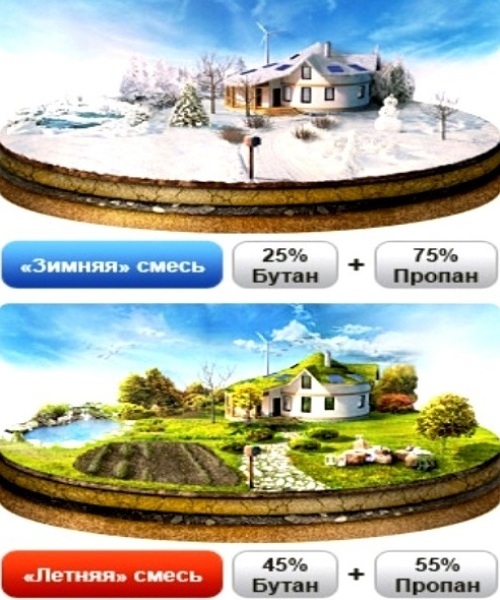
The more butane in LPG, the cheaper liquefied gas for a gas tank. But the efficiency and stability of the operation of gas equipment directly depends on the more expensive propane contained in the propane-butane mixture. Not always cheap is good. If you want to save on fuel, you can end up without heating at all in the cold.
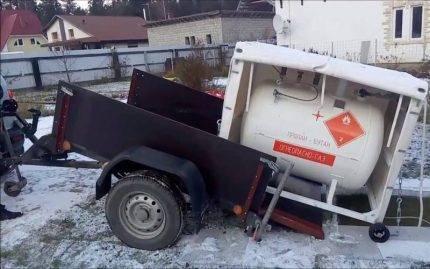 If a mobile gas tank is used without burying it in the ground, then by winter the summer LPG in it should definitely be changed to winter, otherwise you can be left without gas for the boiler and hob
In the case of a gas tank buried below the freezing level, the situation is not so unambiguous. In a warm region, the heat of the earth is usually more than enough to ensure high-quality evaporation of butane even during short-term frosts down to -15 ° C. As a result, there is no point in spending money on an expensive winter version of LPG.
In addition, 50% propane is a good reserve in case of short frosts. In frosts, it will be spent, and when it gets warmer, butane will again go into the boiler. It will not create any problems for gas equipment.
However, if a house with a gas tank is located in a cold or very cold climatic region, then the use of fuel with a high propane content is indispensable. In such a region, it is better to refuel the gas tank in advance in the fall with gas designed specifically for winter. You should not save here, otherwise you will have to freeze.
Features of refilling and bunting
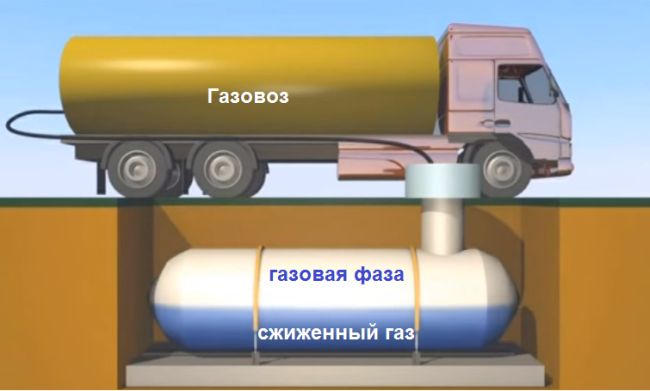
According to the norms, the gas tank is filled with liquefied gas not completely, but by 85%. The remaining 15% is needed for the liquid / vapor phase transition and the creation of pressure inside the vessel. If you fill the tank during the year only with a summer mixture, then in winter, butane in the form of a liquid will accumulate in it to the eyeballs. Then it will be simply impossible to add new fuel with propane, and the existing one will not be used for its intended purpose.
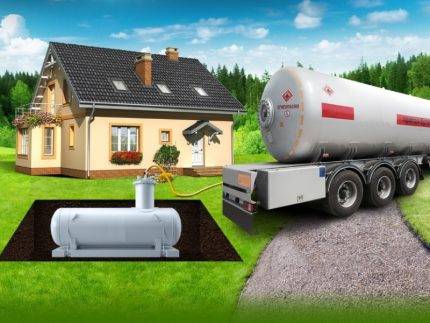 From the point of view of refueling, there is no difference between summer and winter gas - in both cases, the same gas carrier and the same gas tank are used
Clogging a gas tank is a serious problem. To pump out the formed "condensate", you will have to call the gas workers. At the same time, they will take a lot of money for pumping out, and then they will dilute the pumped-out butane with propane and pour it back into someone's gas tank. For the supplier, a double profit, and for the owner of an autonomous gas supply system, one cost. It is better not to allow such a situation in the first place.
To avoid bunting, one of three methods is used:
- By winter, in autumn, “winter” LPG is poured into the gas tank.
- A special evaporator is installed to force the conversion of liquefied butane into gas.
- The gas tank is wrapped around with a heating cable from the outside.
The first method is most often used. But the second two should not be excluded either.The work of the evaporator and the heating cable is the cost of electricity. But if such equipment is installed and used, then you can safely order cheap "summer" gas for the winter.
What is main (natural) gas?
For those who are far from oil and gas production, the analysis of all the nuances of the “gas” issue in detail often causes a headache. There is natural, liquefied, bottled, compressed, main gas, etc. Plus, there are a bunch of abbreviations (CPG, LNG, LPG, GMT, APG). And all this is about the fuel that we use in everyday life for heating water (coolant) and cooking.
It is rather difficult to understand from scratch in all types of this fuel, so familiar to many Russians.
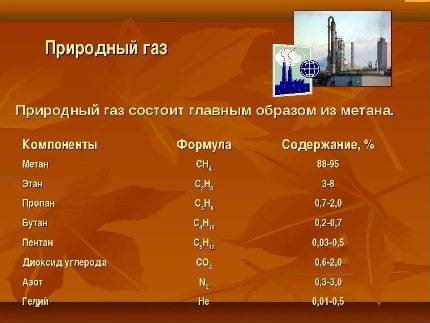
It is necessary to clearly distinguish between natural gas in the main pipeline and liquefied gas in the gas tank - they have different characteristics and composition
As such, natural gas extracted from the bowels of the earth is a mixture of:
- methane;
- heavy hydrocarbons (ethane, propane, butane, etc.);
- hydrogen and hydrogen sulfide;
- water vapor;
- nitrogen;
- helium and other inert gases.
Depending on the deposit, the proportion of the first component in this mixture reaches 70–98%.
However, the “natural gas” that enters apartments and houses through pipes is methane already purified from impurities with a meager amount of an odorant (a substance with a sharp unpleasant odor that makes it easier to detect leaks).
It is not safe to supply all the mixture extracted from the earth through gas pipelines for domestic needs without processing. It contains a lot of explosive and harmful components for humans. It is easier and safer to clean methane from everything else.

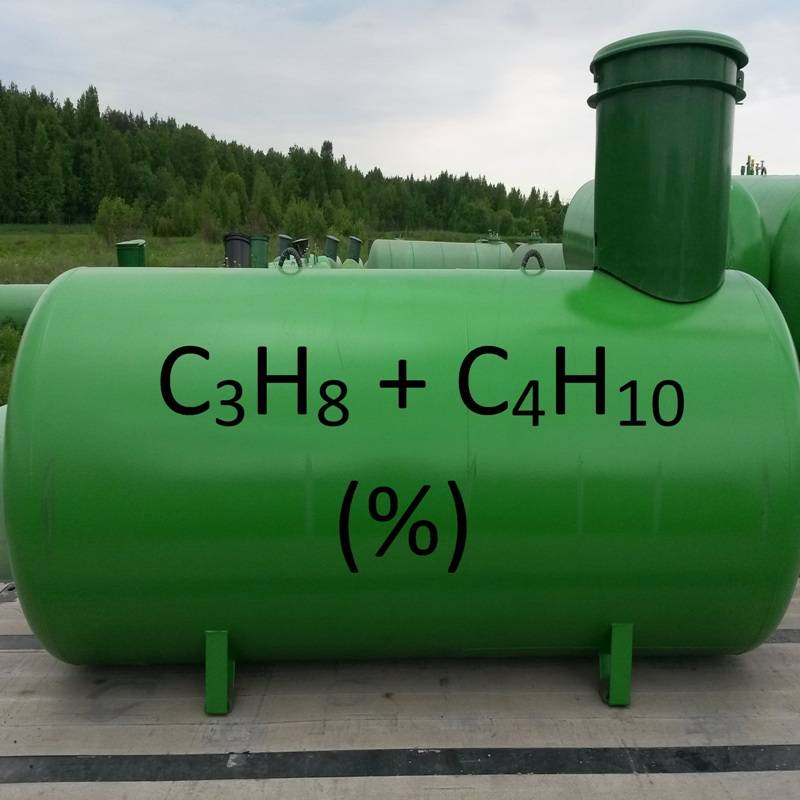


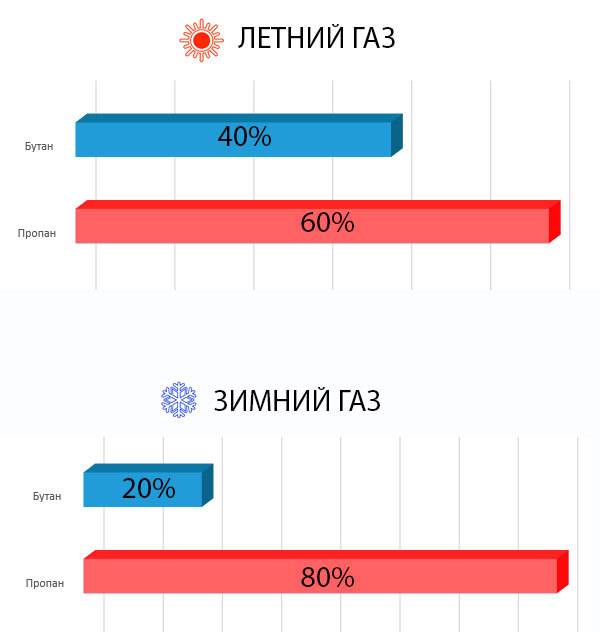


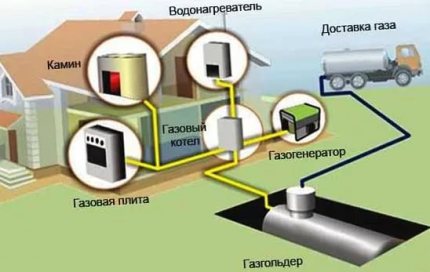
After purification at the field, this already purely methane gas enters the GTS (gas transmission system). And from it, through gas distribution and compressor stations, it is supplied through gas pipelines, first to settlements, and then to consumers.
This is how natural gas enters the homes of private owners and city apartments to be burned in gas stoves, boilers and boilers.
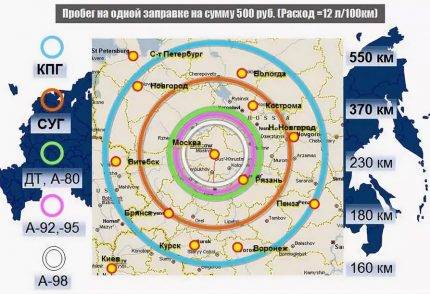 In addition to burning in gas boilers and stoves, methane is also used as a natural gas motor fuel (GMF), it is safer than a propane-butane mixture and is half the price of gasoline
The gas in the apartment and HMT based on methane are the same in composition. However, the first one “flows” in the gaseous state through the pipes. But the second one is pumped into the cylinders of cars in a form compressed to a pressure of 200–220 bar. Such gas motor fuel is called compressed (CNG). It is he who is sold at gas filling stations of Gazprom.
At the same time, there is also LPG (liquefied petroleum gas), which is also often used for filling cars. But it no longer consists of methane, but of a mixture of propane and butane. About him further - this is just what is pumped into gas tanks.
The methane class also includes natural gases:
- LNG (liquefied).
- APG (adsorbed).
The first one is liquefied by cooling at minus 160C to simplify transportation and storage. It is he who is transported in huge tankers across the oceans.
The second option is methane, which is adsorbed on a solid porous sorbent. Unlike LNG, its storage does not require equipment to maintain ultra-low temperatures.
At the same time, the pressure in the tank does not rise above 30-50 bar, so it is much easier and safer to store and transport it.However, this technology has not yet become widespread in Russia and the world, due to the high cost of adsorbent production.
Do I need a permit to install a gas tank
In one word, NO!
No need!
However, the rumors are circulating.
Many people confuse two concepts that are similar in sound, but different in meaning, legal interpretation of the concept:
- Autonomous gas supply of the site (country house, cottage, dacha).
- Documentary support of gas equipment with relevant certificates, verification acts, etc.
In the first case, the prerogative of the decision belongs only to you.
No agreements with neighbors, with local authorities, other authorities.
The only limitation is the capacity of the gas tank.
The volume is not more than 10,000 liters.
Given that the private sector uses gas tanks of just such a capacity, then all questions automatically disappear.
In the second case, a dilemma arises:
Option "A": you ordered the installation of gas equipment from a specialized company. Wisely. The solution of "paper issues" became the responsibility of the contractor.
Option "B": you have decided to become a "noble economy": you are ready to dig a pit, trenches for pipes with your own hands, and now you are looking for a cheaper container on the Internet. So to speak, used
It doesn't matter if it's from a herring or something. Would be more
At the same time permits become necessary.
Now there is a guiding tome called TS 032/2013. It regulates the rules for the use of high pressure equipment.


Professionals know and honor him.
Please read this document as well.
It will work out cheaper for you.
Individual certification required.
And this is not enough money.
And troublesome.
Saving money when buying who knows what, or ordering work from a dubious manufacturer, you will not only lose money, but also run the risk of getting acquainted with the Criminal Code.
Indeed, because of the "cunning" stinginess, others risk suffering.
Your container is with "blue gold", and not with another.
Be reasonable.
Order autonomous gasification of personal households only in a reputable company. This will save you the hassle of collecting permits.
Your business:
- Make an order (by phone).
- Make payment for the service.
When can a gas tank still explode?
In the event of a clear and gross violation of the prescribed operating rules:
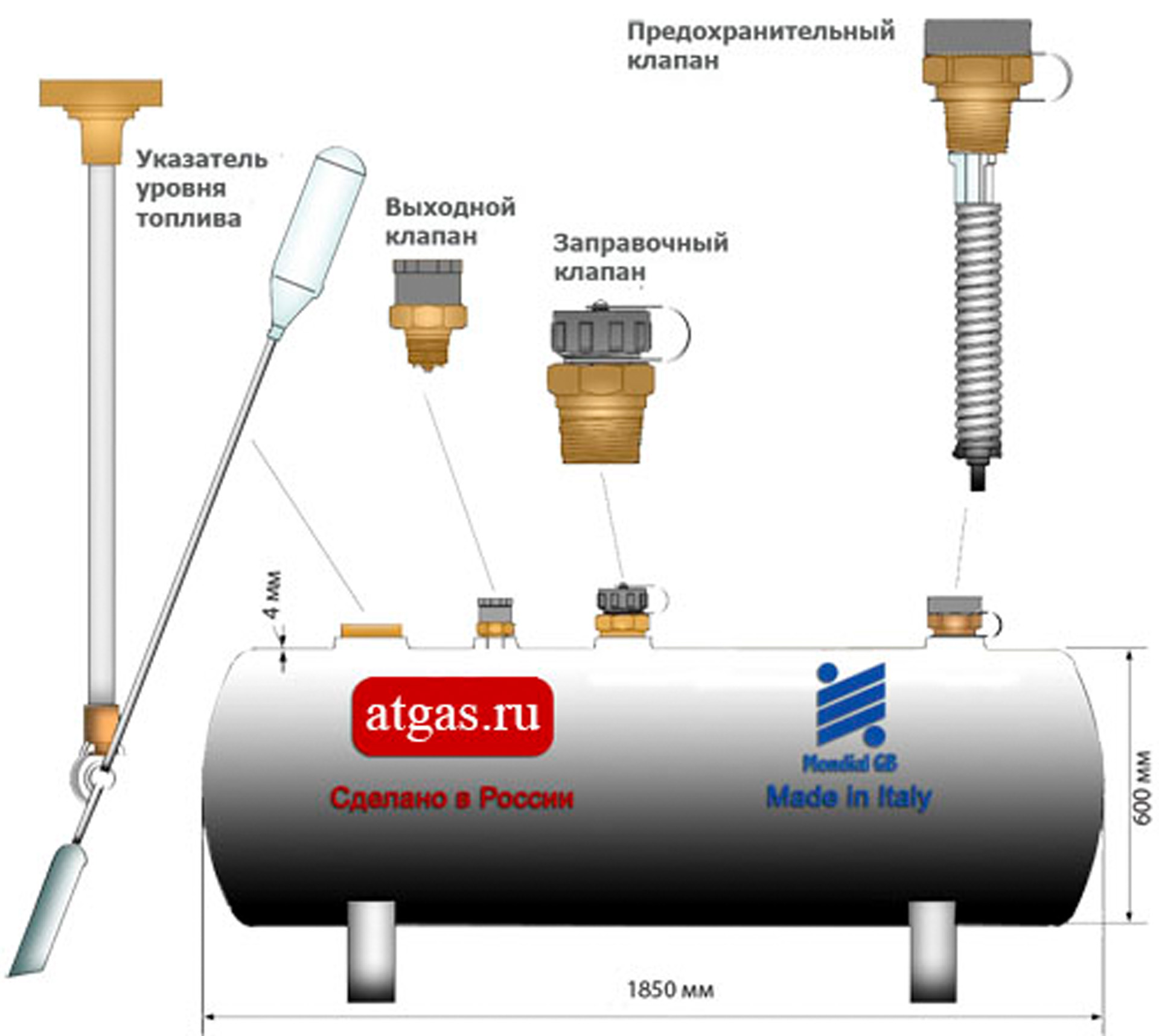
- An attempt to fill the gas tank poses the eyeballs, to the maximum limit. In modern devices, the pressure relief valve will prevent this. However, if the pressure is too high, the valve may be damaged.
- Breakage of the safety valve for reasons other than those indicated above. The probability of this is extremely small, all parts and the gas tank itself are carefully checked and tested before going on sale, but it cannot be completely ruled out.
- Hull overheating. This can happen, for example, during a fire.
- Injection into the gas tank of gas mixtures for which it is not designed (for example, more volatile gases than filling gases).
- Freezing of a significant amount of water in the tank or in the nozzles extending from it.
In all the cases mentioned above (with the exception of a fire), the rupture of the container is not associated with an explosion of gaseous fuel.
Fig.2
Heating with diesel fuel
For heating with diesel fuel, a tank will also be required, and the cost of installing it will be comparable to the cost of autonomous gasification of a house.At the same time, unlike propane-butane, diesel fuel cannot be called cheap.
High price. Diesel fuel is the most expensive source of energy used for autonomous heating of a private house. A kilowatt-hour of diesel fuel costs . Even electricity is a little cheaper. It will probably be difficult to spend more on heating.
Bad smell. This is an inevitable property of diesel fuel. A strong smell will follow the unfortunate owner of a diesel tank everywhere. The house will smell like a garage, and the yard will smell like a working tractor, and there's nothing you can do about it.
Problems when using low-quality fuel. Use of poor quality diesel fuel can lead to serious damage to the heating equipment. Those who use liquefied gas and gas tanks AvtonomGaz do not have such a problem: the quality of propane-butane does not affect its consumer properties.
Disadvantages of heating with diesel fuel
- High price.
- Sometimes you have to clean the snow for winter delivery.
- Strong smell in the house and on the site.
- Use of storage space.
Brands of gas fuel for a gas tank
Most importantly, one should clearly distinguish between main gas and gas tank. Both options are used for both heating and cooking on the stove. However, these are fundamentally different gas compositions. In the case of the pipe, we are dealing with methane CH4, and a mixture of propane C3H8 and butane C4H10. The second type of "blue" fuel will be discussed further.
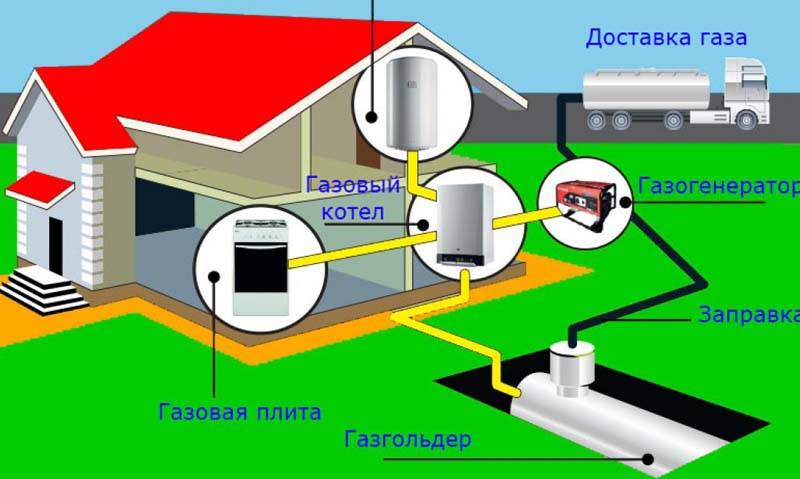
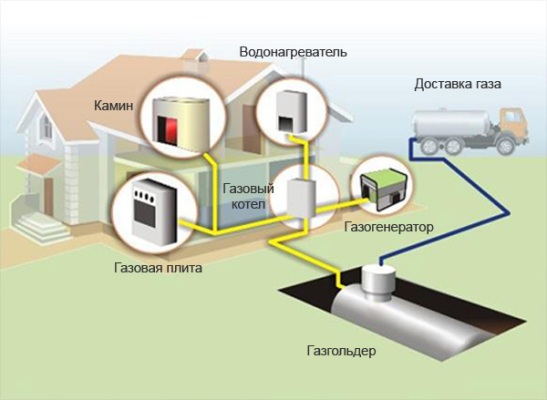
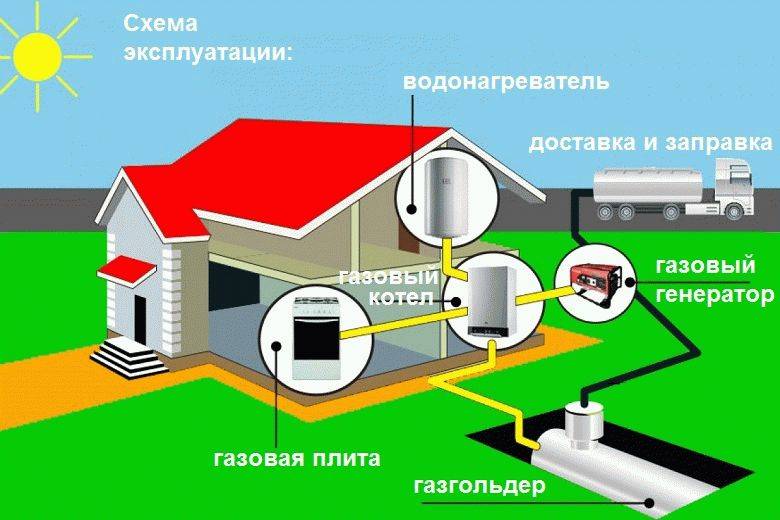
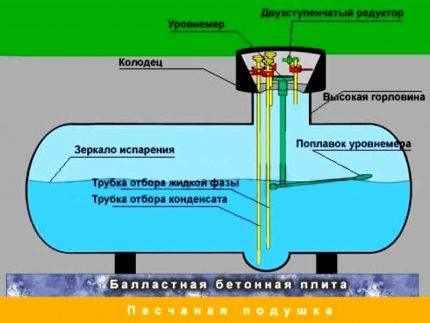 The gas tank is filled with liquefied hydrocarbon gases (LHG), which then first pass from the liquid phase to the steam phase, and then are already used as fuel for boilers and cooking furnaces
A propane-butane mixture with a small amount of impurities is poured into the gas tank. Methane is not used in this case, since it is too expensive to liquefy it for use in autonomous gas supply. To obtain liquefied natural gas, the methane fraction must be cooled to -160 °C. This is done at special plants, costs a lot of money and is used only for transporting LNG over long distances in large volumes.


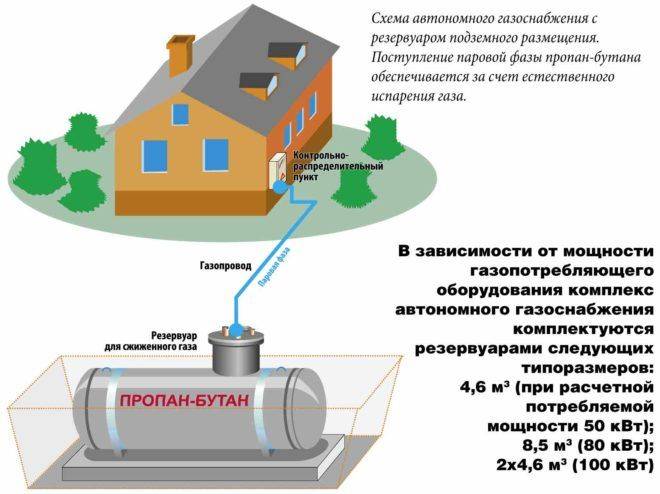
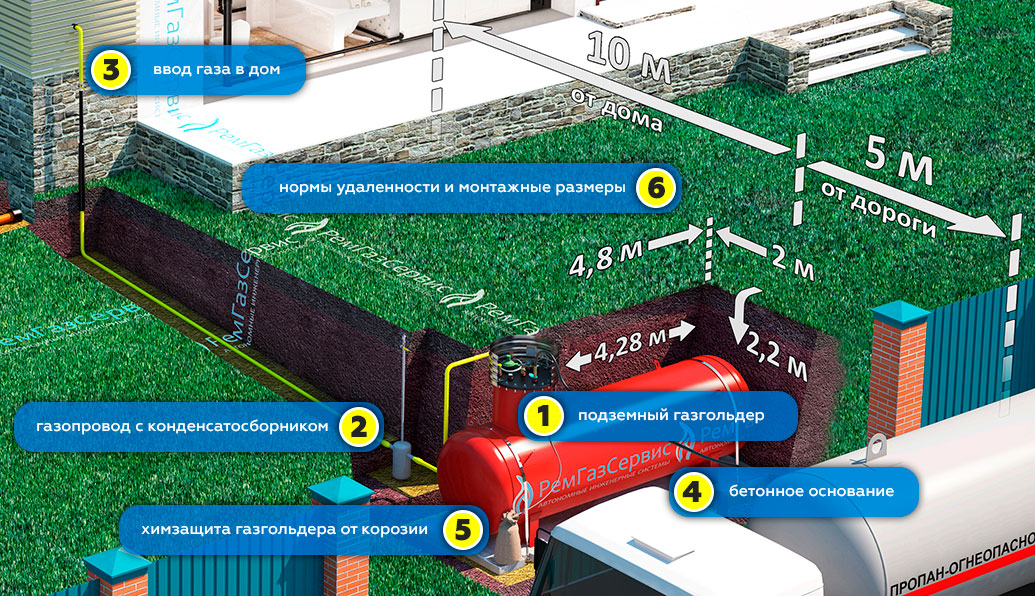
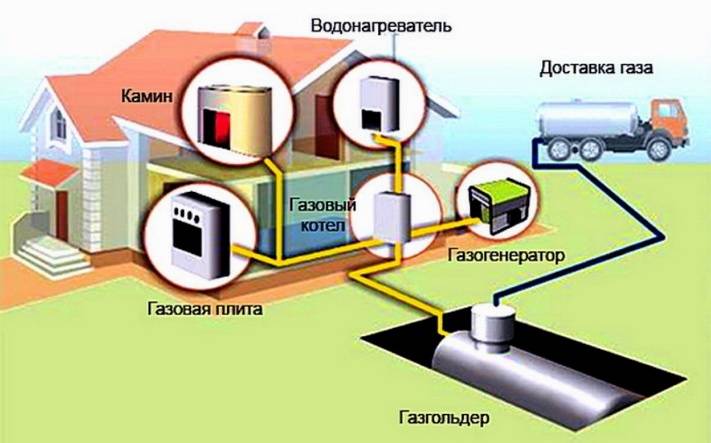


Liquefying propane with butane is a cheaper operation. To do this, they need to be cooled to much lower temperatures than methane. Plus, you can store LPG for a long time in a simple gas cylinder or gas tank without any special measures. That is why it is customary to use the propane-butane mixture in the autonomous gas supply of private households, as well as as fuel for cars.
GOST regulates the use of LPG in the form of:
- PT - technical propane;
- BT - technical butane;
- SPBT - mixtures of propane and butane technical.
The use of these brands in each specific case depends on the climatic conditions and the type of gas tank.
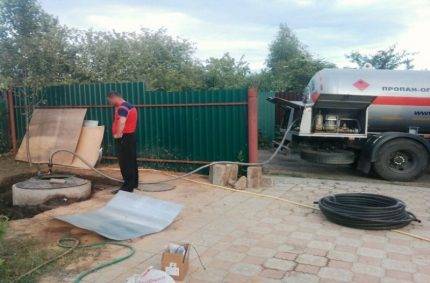 In addition to the main brands, there is also a butane-butylene fraction (BBF) on sale, which is SPBT diluted with industrial water
BBF is a cheap and low quality gas with condensate. When it is burned, approximately 10% less heat is released than when using conventional SPBT. It is quite acceptable to pump such fuel into a gas tank and burn it in boilers.However, its use does not have the best effect on the service life of gas equipment, significantly reducing it.
Performance characteristics
The main characteristics of cylinders for heating and other purposes include wall thickness, temperature during operation, gas tank volume and pressure. The walls of the containers cannot be thicker than 10 mm, while too thin are not designed for the storage of domestic gas mixtures. Cylinders for the Russian regions can store liquefied propane and butane, which do not need additional processing, which increases the requirements for design reliability.
The temperature also depends on the specific area, in most cases the cases are supplemented with frost-resistant coatings that can withstand up to -40 degrees. The indicators of volume and pressure are completely interconnected, therefore for the house it is better to choose tanks with a correction of up to 16 atm and a capacity in the range of 2000-5000 liters. The calculation of a gas tank for a private house depends on how much fuel is required in each individual case.
Is the gas inside the cylinders identical for the gas tank, car and cylinders?
Yes. It's the same gas. This is liquefied propane-butane. The same gas is filled in lighters. If you saw through the light a plastic lighter, the cheapest one, the liquid in it is the same liquefied propane-butane gas, and when you press the valve to light the fire, this liquefied gas in a gaseous state just comes out and it ignites . Some confuse liquefied gas with LNG, that is, with liquefied natural gas, namely liquefied petroleum gas - this is exactly the gas that is obtained during oil refining, that is, oil is extracted from underground, it enters to an oil refinery, where it is processed, oils, gasoline, diesel fuel, fuel oil, well, various components of oil are obtained there. And the liquefied gas that we use, and which is used in cylinders, is precisely the product of oil refining. That is, at a certain pressure, a certain temperature, it turns into a liquid, and this liquid can be safely transported and poured into different containers, of various types and formats. And, in fact, this is ease of use, which is why it allowed it to spread throughout Russia.
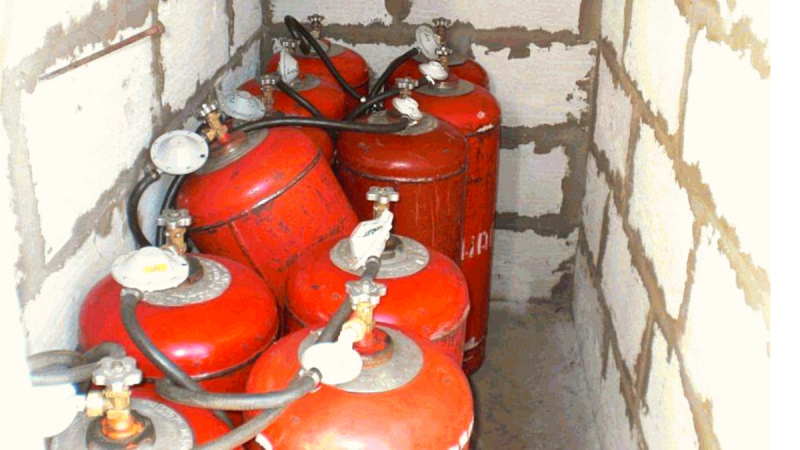
There is an opinion that cylinders are better and more popular, and minigas holders are an innovation that no one is interested in and does not need
The cardinal and fundamental differences between a gas cylinder and a gas tank are its volume, that is, the volume of gas stored in it. The pluses that can be attributed to the cylinders is that the cylinder itself is inexpensive. This is where its main advantage lies. But, when the question arises about heating the house, when you have a house of 100 squares, 200 squares, 300 squares, or any room that needs to be constantly heated, then this cylinder, due to the fact that it is small in volume, will be consumed very quickly. What happens next? You need to take this cylinder, go to a gas station, where these cylinders are either exchanged or filled. Refuel it, bring it back to you, plug it in. So it can get to the point that you have to drive every day and do it. This is the difference between a balloon and a gas tank. Because, by installing a gas tank, its volume allows the house to be provided with gas for a period of several months to several years.
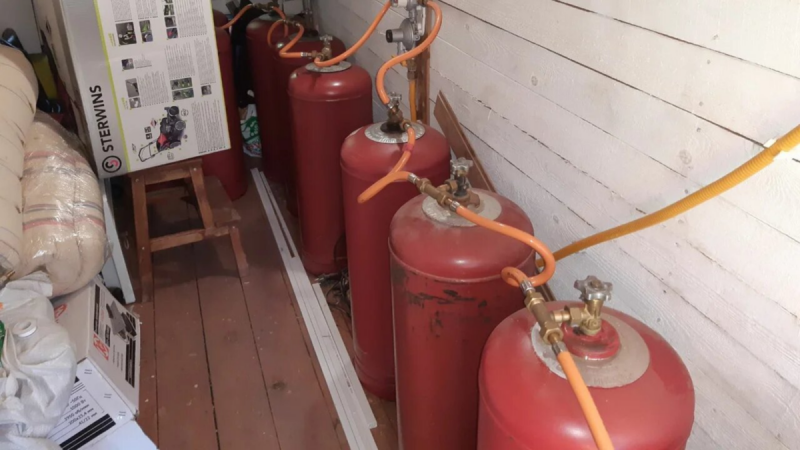
The main advantage of a gas tank in relation to a cylinder is time and ease of use.There is a group balloon installation, when several cylinders are installed in a row, for example, 10 cylinders or 5 cylinders. But the problem is that after some time they will have to be removed, taken to a gas station and returned to their place. That is, it is rather difficult for a physically not very strong person to do this, because such a balloon weighs 40-50 kilograms.
Preparation for refueling
You will not have any problems with this, since all work is carried out by representatives of the supplier company. You make a request or simply call the LPG supply company in your area and indicate the amount of fuel required. The main thing that is required from the owner of the gas tank is to create unhindered access to all working elements.
Currently, the supply of LPG is carried out in accordance with modern safety standards. Specialized vehicles are used, equipped with sensors, tracking devices, special systems for the safe filling of gas tanks. Due to the presence of a large number of instrumentation, specialists can know exactly how much was drained into the gas tank.
There is a technique that requires an additional connection to the power supply system, so the supplier company may ask you about it. Despite this, most specialized vehicles are autonomous and do not need such conditions.

What to look for when choosing a gas supply system
Consider the main aspects that determine the quality indicators of life in a country house:
Price
As a rule, connecting a common gas pipe, both in maintenance and in operation, is much cheaper than an installed gas tank. Depending on the length of the line, the total price of the kit can reach 135 thousand rubles. Most of the cost of gas equipment depends on the volume of the tank. As practice has shown, the total price of a ready-made package for a family is 200-240 thousand rubles.
Comfort during operation
Of course, a small gas station on its site requires periodic preventive inspections, while the repair of a system with a central gas supply is carried out by a service organization.
Maintainability and durability
If we consider it from the point of view of finances, then a pipe brought into the house practically does not require investments, but a gas tank, on the contrary, requires constant monitoring of sensors and a security system.

Connecting a heating pipe to a private house from the general gas distribution system of the village
Features of the use of diesel fuel
There are several grades of diesel fuel that differ in sulfur content, but their composition is not fundamental for the boiler.
But the division of diesel fuel into winter and summer is extremely important
The standard establishes three main grades of diesel fuel. The most common is summer (L), used at temperatures from 0 ° C and above. Winter diesel fuel (3) is used in frost down to -30°C. For colder temperatures, arctic (A) diesel fuel should be used.




A distinctive feature of diesel fuel is its cloud point. In fact, this is the temperature at which the paraffins contained in diesel fuel begin to crystallize.It really becomes cloudy, and with a further decrease in temperature, the fuel becomes like jelly or frozen fatty soup. The smallest crystals of paraffin clog the pores of fuel filters and safety nets, settle in the pipeline channels and paralyze its operation. For summer fuel, the cloud point is -5°C, and for winter fuel it is -25°C.
Another important indicator, which must be indicated in the passport for diesel fuel, is the maximum filterability temperature. Turbid diesel fuel can be used up to the filterability temperature. If you try to use it further, then a clogged filter and a fuel cut are inevitable.
The problem is that winter diesel fuel does not differ from summer diesel either in color or smell. Buying diesel fuel, especially cheap one, is always a risk. God alone (and the tanker) knows what is actually flooded.
However, replacing winter fuel with summer fuel is just flowers. There are "craftsmen" who mix summer diesel fuel with BGS (gasoline) and other vodka, achieving a decrease in the filterability temperature. At best, this can lead to pump failure. In the worst case, such experiments end in an explosion.
Sometimes light heating oil is sold under the guise of diesel. Outwardly, they do not differ, but there are more impurities in heating oil, and those that do not exist in diesel. This is fraught with contamination of the fuel equipment and decent cleaning costs.
Conclusions and useful video on the topic
Recommendations for refueling a minigas tank:
The process of pumping gas from the gas tank for its repair:
How they cheat when refueling a gas tank:
In summer, winter gas will burn without any problems. But the use of summer LPG in winter is not always possible. In order to avoid cold with low pressure in the gas tank due to delayed vaporization, it is best to fill it with liquefied fuel with a high propane content in the fall. But if the region is warm or special equipment is installed, then it is quite acceptable to fill the tank with a cheap summer propane-butane mixture all year round.
Leave your comments, ask questions, share your experience and participate in the discussion of this material. The contact block is located under the article.
Liquefied petroleum gas (LPG) is a versatile synthetic gas that is obtained from oil refining or from associated petroleum gas. Under normal conditions, LPG is in a gaseous state, and when the pressure increases, it turns into a liquid. In this state, the gas is suitable for storage and transportation. When the temperature rises or the pressure decreases, the liquefied gas begins to evaporate and this process stops when the saturation state is reached. The pressure of the obtained saturated vapors does not depend on the volume of the liquid phase, but depends entirely on the ambient temperature. One liter of LPG makes it possible to obtain about 0.25 m3 of a gaseous substance. In winter, when the ambient temperature drops, the gas pressure in the tank decreases, which leads to a decrease in the productivity of gas supply to the system.
Conclusions and useful video on the topic
The following selection of videos will help you understand all the nuances of choosing equipment for gasifying a cottage.
Video #1 Main gas connection step by step:
Video #2 Advantages of autonomous gasification:
Video #3All the nuances of installing a gas tank:


By all parameters, the main gas for connection and consumption will cost less than LPG from a gas tank. This is especially true for the issue of initial expenses. But if there is no gas main near the house, then pulling the pipe can also cost a lot of money.
Here it is better to prefer the option with a gas tank: it is expensive, but it is completely autonomous and you will not need to be afraid of accidents on the gas pipeline with it.
What do you think is better: installing a gas tank or connecting to a centralized gas supply? Please write your comments in the box below. Ask questions, post photos on the topic of the article, share useful technical nuances known only to you.