
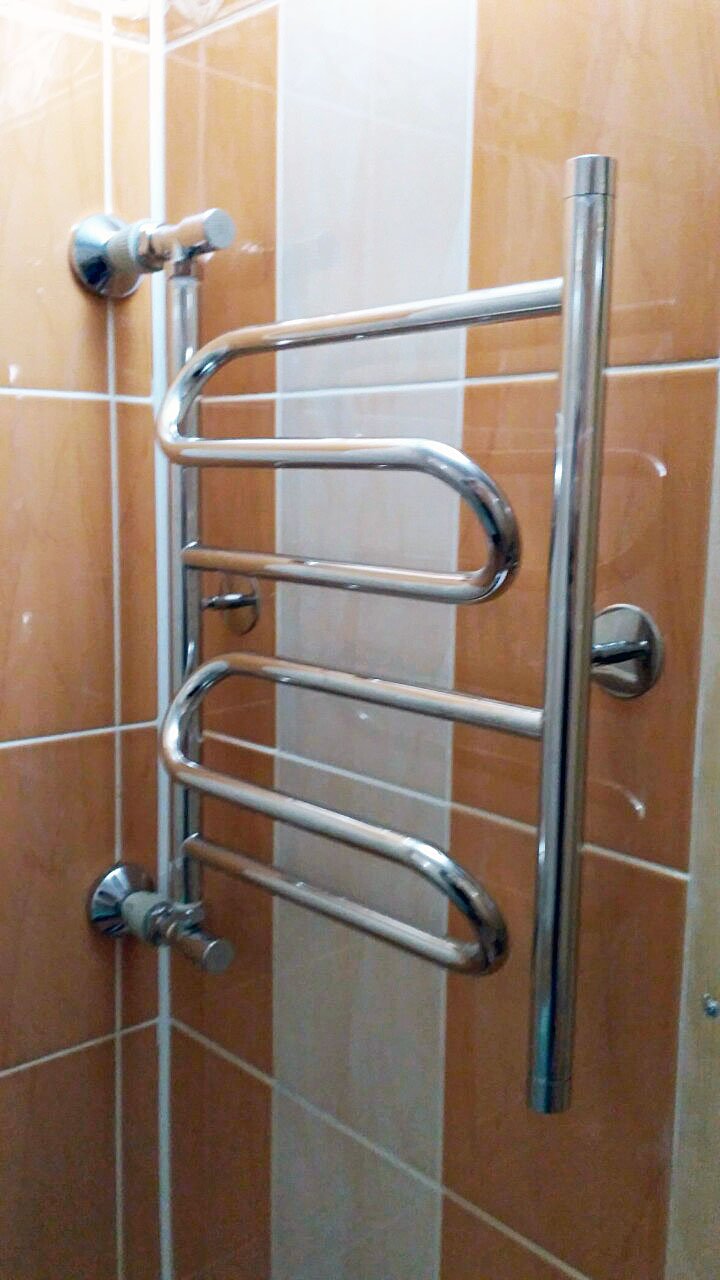
- What you need to know before installing a heated towel rail
- Choosing a heated towel rail
- How to install a new coil?
- Preparatory stages
- Organizational issues: who should replace and at whose expense
- Preparing instruments before changing
- Preparatory stage
- Tiered floor
- Connecting a heated towel rail in a country house
- Design features of coils
- Features of installation of electric drying
- Installing a heated towel rail
- Types of heated towel rails
- Types of heated towel rails
- What designs are
- Mounting types
- What is the value of modern heated towel rails?
- Faucet installation
What you need to know before installing a heated towel rail
-
- In our apartment buildings, the heated towel rail is not built into the heating system, as is customary in most foreign countries, but into the hot water supply system. Therefore, its installation has some features, since the dryer becomes a kind of "compensating pipeline loop". If the tie-in into the riser is not carried out correctly, then this can lead to problems with the water supply not only of the apartment, but of the whole house.

-
- For the same reason, most imported heated towel rails are not suitable for tapping into our water supply system.Therefore, it is recommended to purchase a device of domestic production, moreover, corresponding to certain GOSTs and SNiPs. This problem occurs only when installing in an apartment. For a private house, towel warmers of foreign brands are quite suitable.
- Parts from different materials cannot be used in the same system in order to avoid such a negative phenomenon as electrolytic corrosion. It leads to a quick failure of the device. Devices made of any materials can be connected to plastic pipes.

-
- The heated towel rail connected to the central system will only operate during the heating season. To ensure year-round operation of the device, a combined type of these devices should be installed.
- The power of the heated towel rail connected to the lower pipes of the system is reduced by 10%.
- Devices in the form of a "ladder" are connected by the method of diagonal, lateral or vertical connection to the pipeline (center-to-center distance - 500 mm).
-
- When installed during construction or overhaul, the landing distance is no problem, but when tapping into an already finished system, the geometry and dimensions of the existing wiring must be taken into account. Therefore, when buying a heated towel rail, you need to know and take into account the distance between the taps.
- If pipes of different diameters are used on the heated towel rail and on the system, adapters must be used. In this case, it is not allowed that the device has pipes of a smaller diameter than the pipes of the system. Otherwise, an increase in water pressure in the "bottleneck" can lead to an accident.
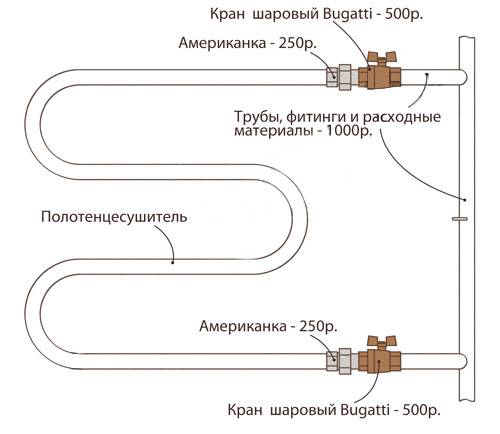
- For connections with a riser, it is recommended to use "American" - detachable connections that make it easy to remove the entire device.
- It is also desirable to equip the riser with ball valves and a jumper (bypass). In the presence of American women and this device, you can only turn off the heated towel rail without turning off the water in the apartment or entrance.
Choosing a heated towel rail
These systems are made of brass or stainless steel. Previously, dryers were shaped like the letter “P” or “M”, and modern designers offer, in addition to standard shapes, many different options from a chrome-plated “design-radiator” ladder to square designs.
When choosing a dryer, you should pay attention to the metal from which it is made.
The fact is that the pressure in domestic hot water supply systems can reach 8 bar, and foreign systems made of brass are not designed for such pressure, so beautiful “design radiators” made of brass are best used in private cottages, where the pressure is system does not exceed 5 bar. For multi-storey residential buildings, stainless steel heated towel rails that can withstand pressure up to 10 bar are best suited.
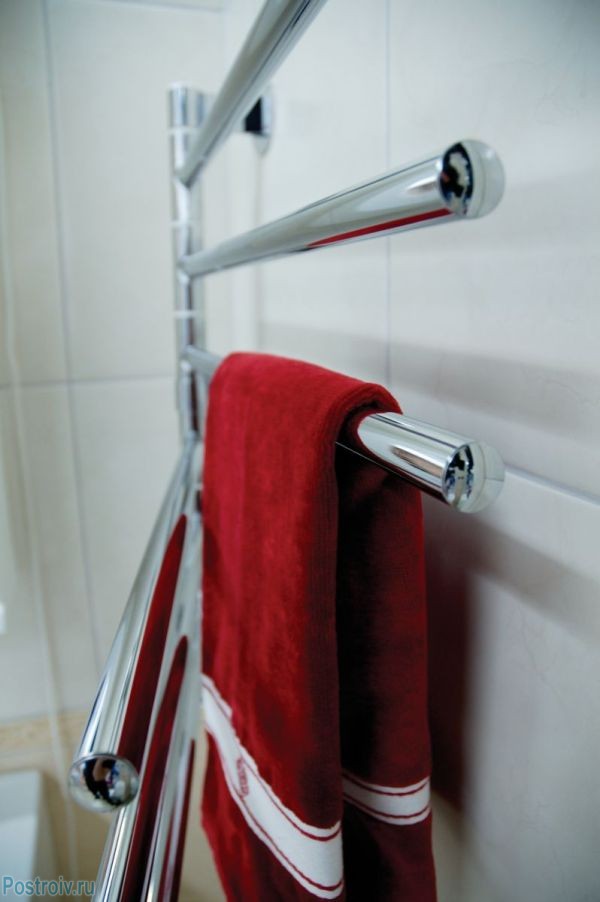
Stainless steel towel warmer - Photo 04
How to install a new coil?
Connecting a heated towel rail to hot water supply pipes, as noted earlier, is regulated by SNiP. What is this SNiP, and also what does it say about our problem.
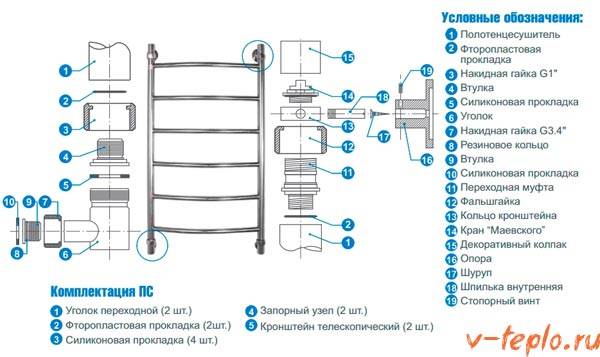
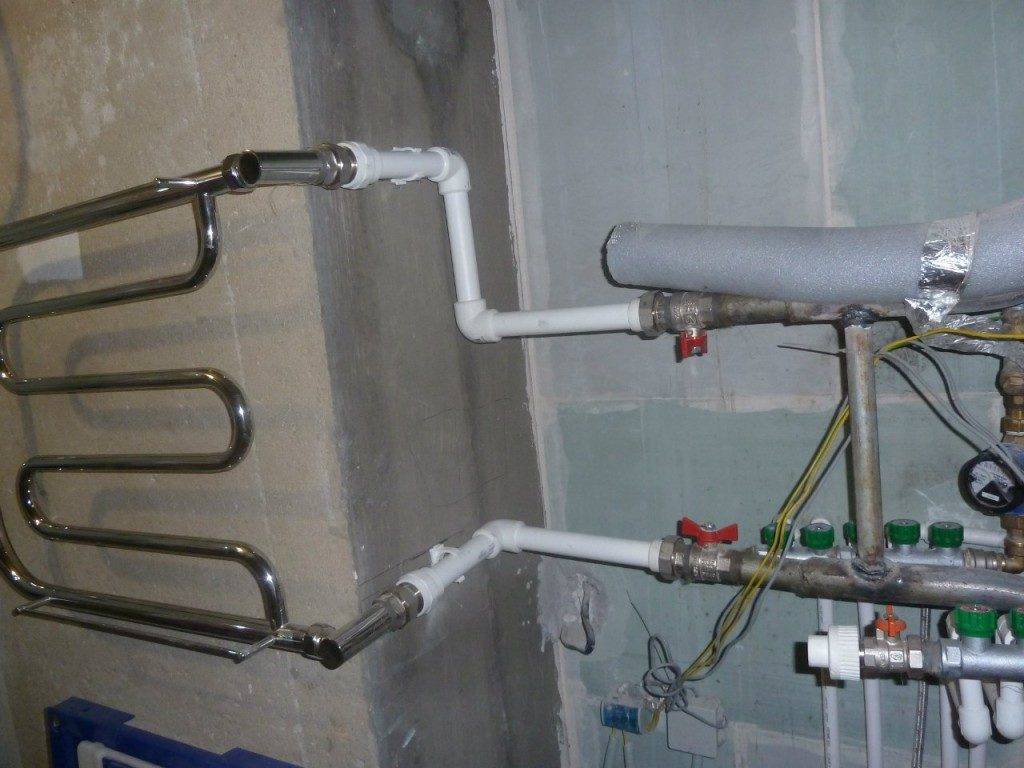
And if it is planned to install a new device, then segments of PP pipes should be attached to the pipeline, and already the coil itself should be attached to them. The connection procedure is not difficult. You just need to connect the ends using a special soldering iron for polypropylene pipes.
Note! At the same time, maintain a slight inclination of the supply pipe, directed towards the movement of hot liquid.The slope should be approximately 0.5-1 centimeter for the entire length of the segment
Water must move down the coil from top to bottom, for this reason the supply is connected to the upper socket of the product.
We also add that there are also limiting distances that must be maintained between the walls (both lined and finished with plaster) and the heated towel rail. They are listed below:
- 5 centimeters if the diameter of the pipes exceeds 2.3 centimeters;
- 3.5 centimeters if the diameter of the pipes is less than 2.3 centimeters.
So that the walls are not subjected to excessive loads caused by thermal deformations of the hot pipe, the structure is not fixed rigidly, but is hung on mounting brackets.
Once all steps are completed, carefully examine the connections - they should remain dry.
Preparatory stages
In addition to directly replacing the device, you should know how to properly prepare. To do this, do the following:
- Coordinate repair work with the Housing Office.
- Find the right new product.
- Get all the necessary tools.
- To study thoroughly the nuances of dismantling and installing a heated towel rail.
Organizational issues: who should replace and at whose expense
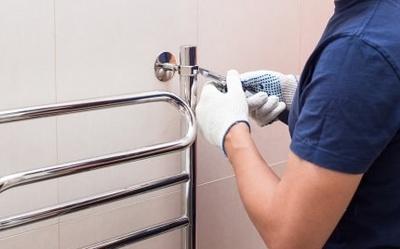
Before proceeding with the replacement, it will be necessary to coordinate the work through the Housing Office.
To do this, you need to contact the local housing office and write a statement, outlining your request, so that authorized persons turn off the hot water in the house on the appointed day.
If the device is replaced in the "Khrushchev", then at the same time you need to find out the pressure level in the pipeline. Depending on the pressure parameter, pipes are subsequently selected to connect the device.


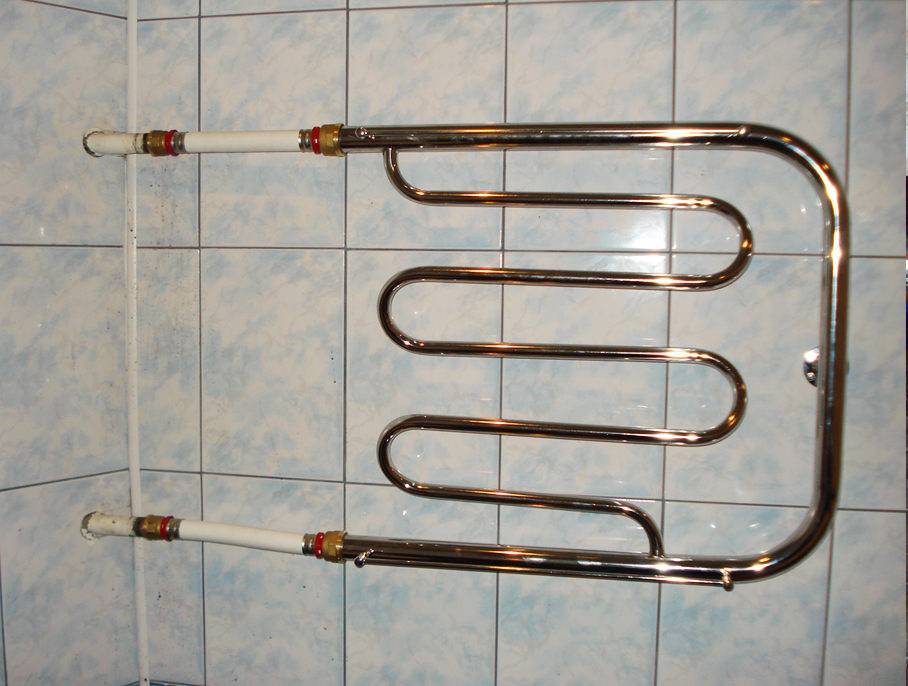
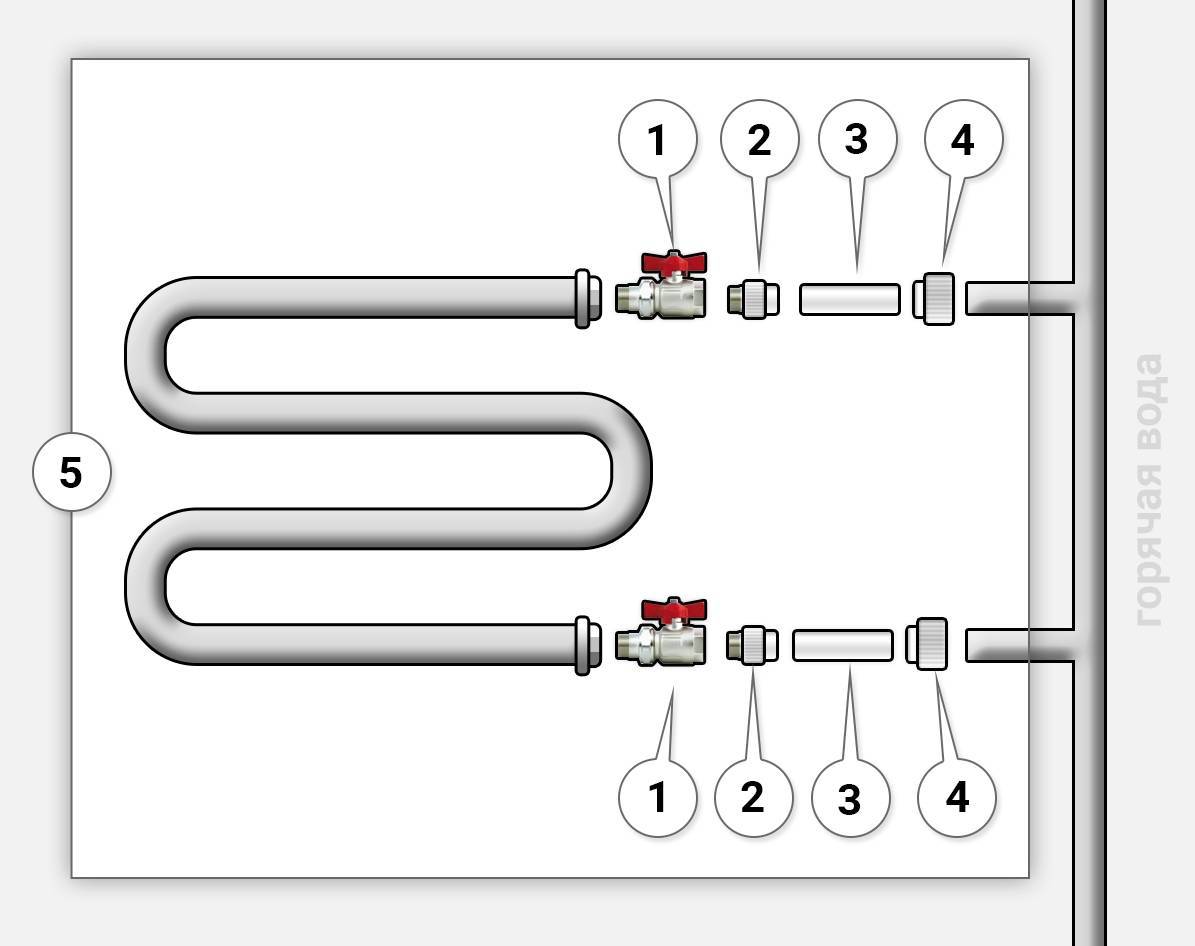
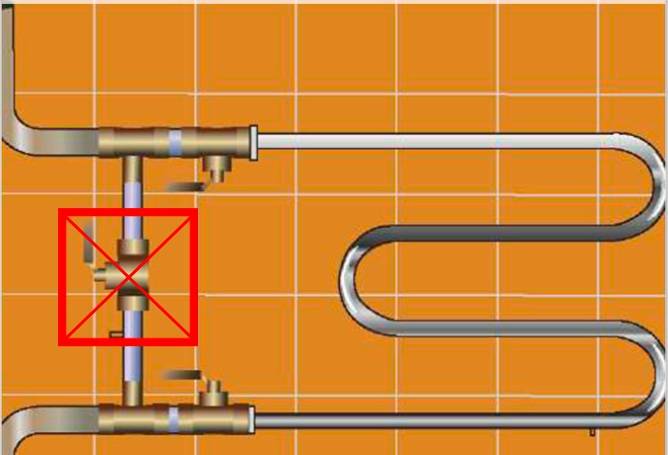
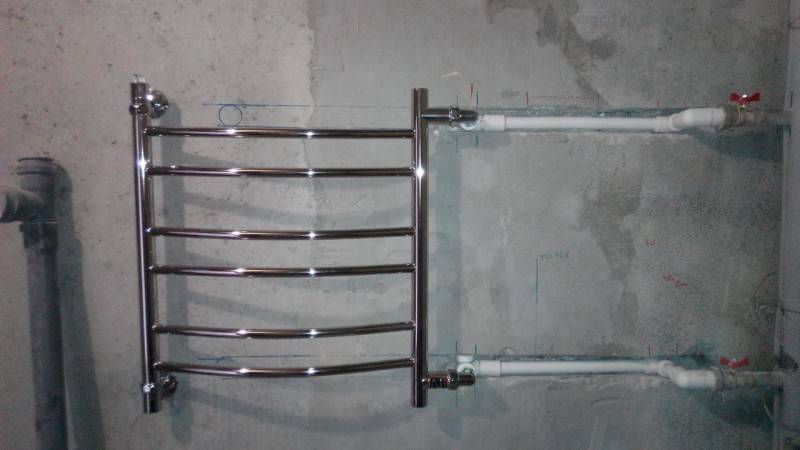

When a heated towel rail is changed in a privatized apartment, the owner of the apartment pays for the replacement and all work, if this device does not form an integral structure with a water supply or heating system. That is, if it has threaded connections, and it is disconnected from the water supply system, then housing and communal services employees are not required to change it for free.
Important! If the heated towel rail is an integral system with hot water, then all work for repair and replacement devices are carried out free of charge by housing and communal services workers
Preparing instruments before changing
Would need:
-
brackets;
- PVC pipes;
- apparatus for welding and soldering PVC pipes;
- perforator;
- spanners;
- level;
- roulette;
- marker;
- scissors for cutting PVC pipes;
- fittings and couplings for connection;
- ball valves, Mayevsky crane.
Preparatory stage
Replacing a heated towel rail involves, in addition to acquiring tools and materials, a number of small preparatory work (before directly dismantling an installation that has already exhausted its resource, in order to then reliably and easily install a new design):
-
Make or punch all the grooves (strobes) necessary for a new installation, because this process usually takes not a small amount of time, and if done in advance, it will significantly speed up the main installation work later.
-
Crush or expand a section of the wall (or concrete slab) near the wall pipes included in it.This is most often necessary in order to then freely weld or cut a thread to connect metal to plastic using transitional connecting fittings.
- Make sealing at the joints of ball valves with a heated towel rail, as well as adapter sleeves (from plastic to metal) with extension cords.
- Carefully and very carefully pack metal threaded connections so that later they do not have to be repacked, which will require re-draining the water from the line.
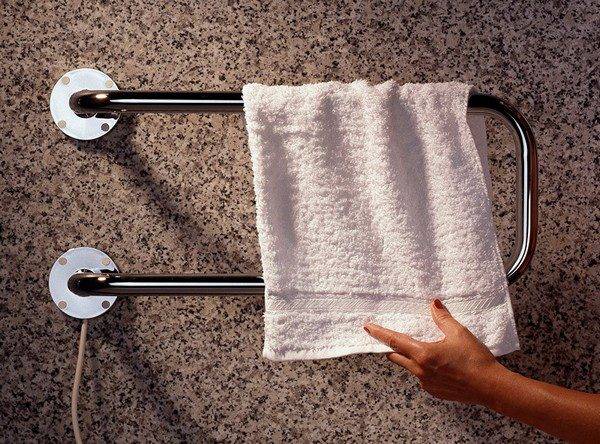
Independent transfer of a structure intended for drying towels to a remote distance is prohibited, because this entails a decrease in the pressure of the liquid in the heating system of the house, and the heated towel rail will work worse, i.e. heat the room. You can get permission in writing at the Housing Office after your estimate has been approved.
Before starting all the main work on the dismantling and installation of the structure, it is imperative to drain the water in the riser by means of a notifying written request-application to turn off the hot water supply system to the Housing Office, which, in turn, will have to send you to perform all legal actions of its specialist. As a rule, the procedure for replacing a heated towel rail is paid and is carried out only after the end of the heating season.
Tiered floor
For zoning the space, the craftsmen mount the floors at different levels. They advise installing a podium to distinguish between the kitchen and the dining room. This option is considered one of the most practical, because, among other things, the owners have an additional free space where you can hide something.
It is convenient to use boxes or boxes for this. Wicker baskets will look good.But such a space can remain free.
However, such a design should not be done if the family has small children, since the podium can become an obstacle for him. In addition, various floor coverings can be used.
They will zone the space between the living room and the kitchen and protect the podium from damage. For example, tiles are laid in the kitchen area, and laminate flooring is laid in the dining room. The main thing is to choose colors and textures, to correctly combine the finish.
Connecting a heated towel rail in a country house
The conditions of a private house are more favorable for installing a dryer. With an autonomous supply system, there is cleaner water. You can buy imported PS, which is afraid of sediment accumulation.
Usually in such a house a rather large room is allocated for a bath, which expands the boundaries unit selection by dimensions and shape. And connection work does not require permission from neighbors.
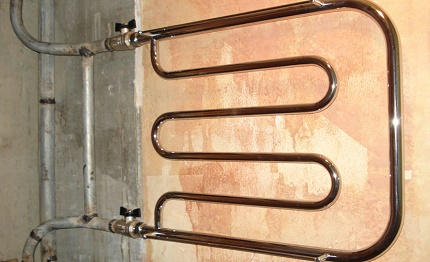
Regardless of where you are going to connect the heated towel rail - to the heating system or to the hot water supply at home, you cannot do without inserting the device into the pipes
The connection scheme itself is similar to that used in an apartment building. It must be remembered that the device should be connected exclusively in the direction of the water flow. With an eyeliner length of up to 50 cm, place the pipes horizontally, with a longer one, make a slope along the entire length.
Keep the distance between the wall and the water pipe. With a pipeline diameter of 4-5 cm, choose a distance from 5 to 5.5 cm. When the diameter value is less than 2.3 cm, this gap is reduced to 3.5 cm.
Considering the temperature deformations to which hot pipes are subject, it is impossible to fix the PS on the supports by welding, the fastening must be free.
Design features of coils
Even 5-7 years ago, hardware stores did not have such an assortment of fasteners for radiators, so the holder was a simple metal hook fixed in the wall.
Unfortunately, such an installation could not boast of reliability. In today's realities brackets are the best fastening element. They consist of the following elements:


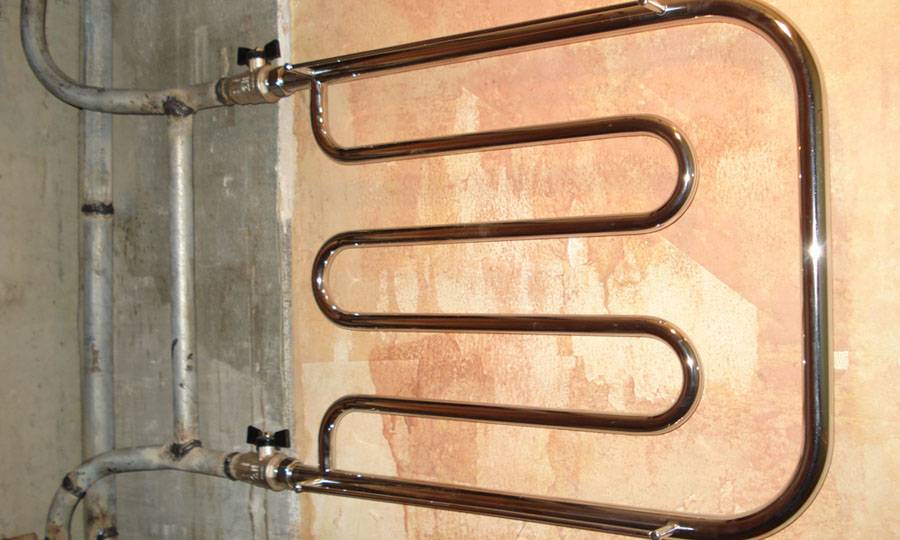

- Mounting shelf (shield with holes for screws) - at the base of the coil, a special shelf is implemented, which is directly mounted to the wall (for example, with self-tapping screws on the tile). For the most reliable fixation, 2 self-tapping screws are driven into each shelf.
- Shelf leg - on one side, the leg has a ring for fixing the heated towel rail, and the other side is firmly connected to the mounting shelf. The height of the legs is no more than 5 cm, and this is quite enough to firmly fix the heated towel rail to the wall. In rare cases (especially for a small bathtub), you can choose a fixture with a telescopic leg, which can be shortened or lengthened.
- Fixation ring – the ring is fixed on the pipe of the device to exclude its backlash.
Heavy serpentines and designer models require extra wall mounting points to evenly distribute the weight. Fasteners can be 28, 32, 38 mm and depend on the diameter of the pipe.
Features of installation of electric drying
The procedure for connecting an electrical type coil should be considered separately.In this case, the most important step in this procedure is the correct connection to the mains, so that the risk of fire or short circuit will be minimized. For this reason, the following steps are required:
- coil grounding;
- its connection through a special protective shutdown device, which in everyday life is simply called "automatic".
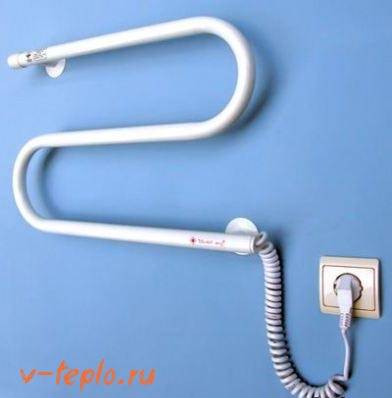
And if you plan to connect the product to an outlet that is located right in the bathroom, then it (the outlet) must necessarily be with a moisture-proof housing. Simply put, it should be sunk into the wall, and the hole left outside should be closed with a special insulating cap.
If you carefully read the information that was provided in this article, then installing a heated towel rail in the bathroom with your own hands will not cause any difficulties.
Installing a heated towel rail
Connecting a water heated towel rail begins with the removal of the old system, provided that the new model has already been purchased and all the necessary tools have been prepared. If you have planned this work in the autumn-winter period, when hot water is supplied to the main, then the first thing to do is to submit an application to the house management company to turn off the vertical hot water riser for the time you specified. This service is paid, and the amount depends on various factors. After turning off the water, you can get to work.
In old houses, such as Khrushchev, a heated towel rail is embedded in the heating system, and the bathroom is very small, so a new heater is usually put in place of the old one.Installing a heated towel rail in the bathroom of small apartments is convenient because you do not need to build up pipes, it is enough to remove the old system, cut the threads, install fittings and connect a new heated towel rail.
If the product is very old, then it will not be possible to unscrew it, then, with the help of a “grinder”, the old dryer is simply cut off, but it should be borne in mind that it is necessary to leave sufficient pipe sections for threading. With a file, carefully remove the burrs at the cut points, then, using a lerka, cut a new thread and install the fittings. To seal threaded connections, you can use FUM-tape made of thin Teflon or Tangit-Unilok thread.
Before installing a new system, you must also remove the old fastening systems, prepare holes with a puncher, hammer dowels into them and place fasteners at the right points. Installing a heated towel rail according to this scheme takes a little time.
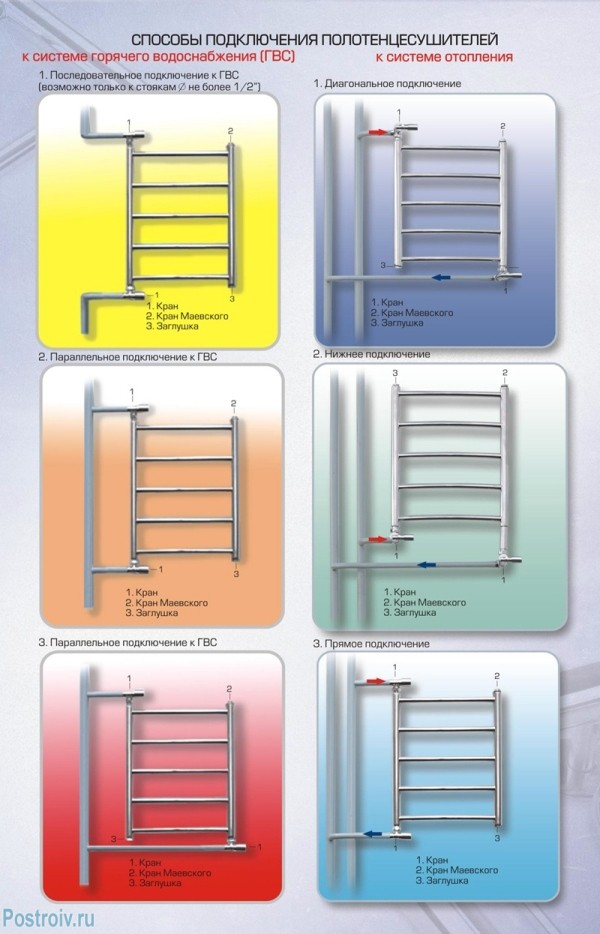
Installation options for heated towel rails - Photo 05
Connecting a water heated towel rail according to a more complex scheme will require the installation of additional plumbing equipment. Let's consider this option in more detail and sequentially:
- From the vertical riser of the hot water supply, remove the old heated towel rail
- We cut the thread and screw on the “L”-shaped fittings for the side connection of the heated towel rail
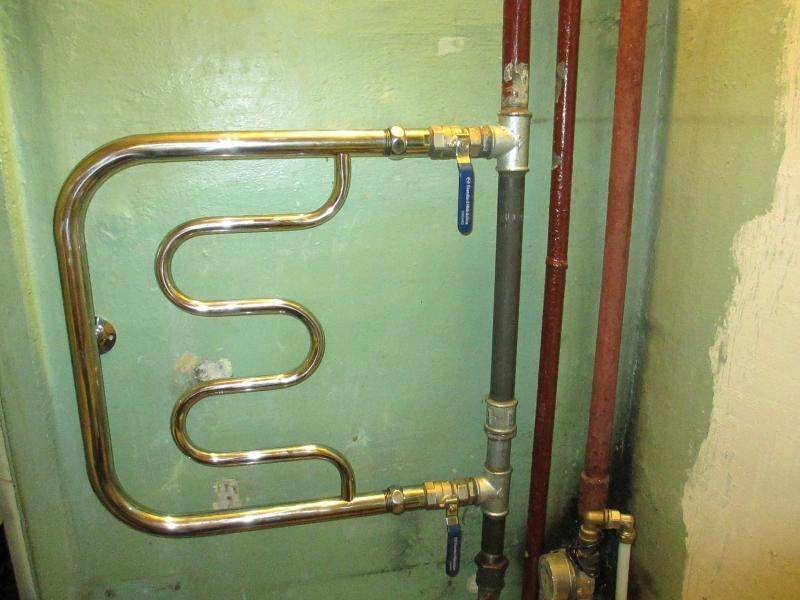
- We install tee fittings above and below, between which a bypass is placed parallel to the riser
- Ball valves are mounted on the free ends of the tees, to which the dryer is docked
If necessary, small pieces of pipe are installed between the fittings. Bypass (bypass) element is optional, but desirable.It is also equipped with a tap and is designed to exclude your dryer from the hot water supply system, if suddenly water begins to leak from the connection points or you decide to install a more interesting model. The diameter of the bypass pipe must match the diameter of the riser.
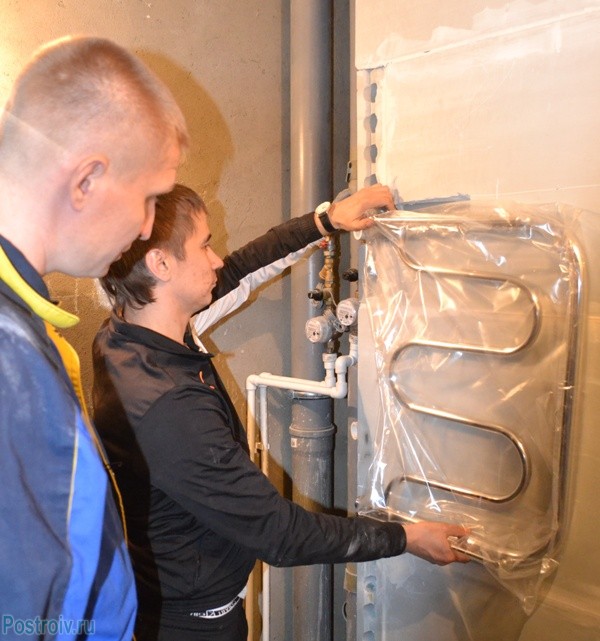
Installing a heated towel rail - Photo 06
Types of heated towel rails
A heated towel rail is a figured piece of a metal water pipe filled with hot water and performs the functions of not only a dryer for towels or linen, but also a heating system in the bathroom. In houses with centralized water supply, the dryer crashes into the hot water supply line, and in old-style houses, where hot water is produced by an autonomous gas water heater, the heated towel rail, if necessary, crashes into the heating system of the apartment.
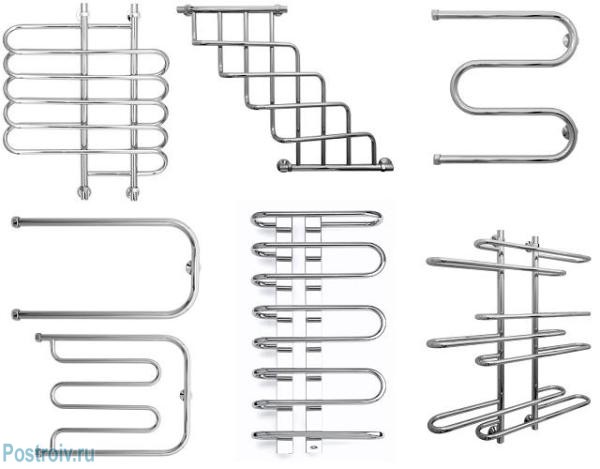
Types of heated towel rails - Photo 03
Both in the first and in the second case, the most convenient time to install a heated towel rail is summer, when all boiler rooms are closed for maintenance.
Types of heated towel rails
There are three types of modern heated towel rails:
water - connected to a central heating system, a hot water riser or a double-circuit boiler. Their main advantage is that they practically do not consume additional energy. The disadvantages include the fact that in the absence of hot water in the system, the heated towel rail will not work either. According to the connection method, they are divided into two-point and four-point;


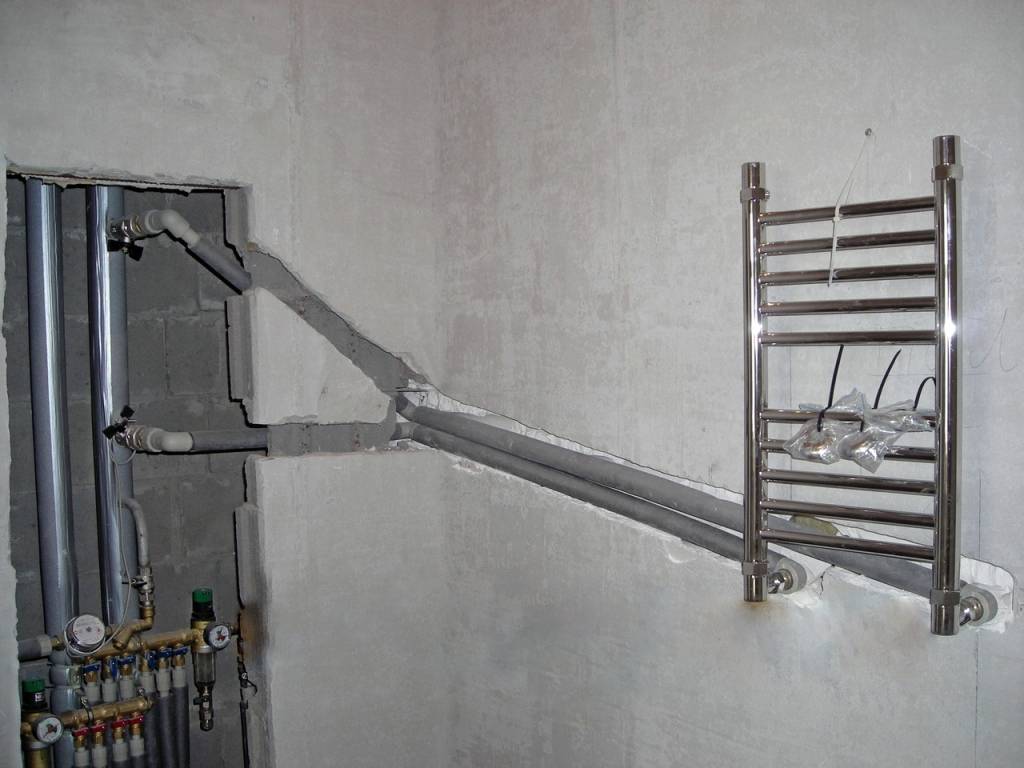
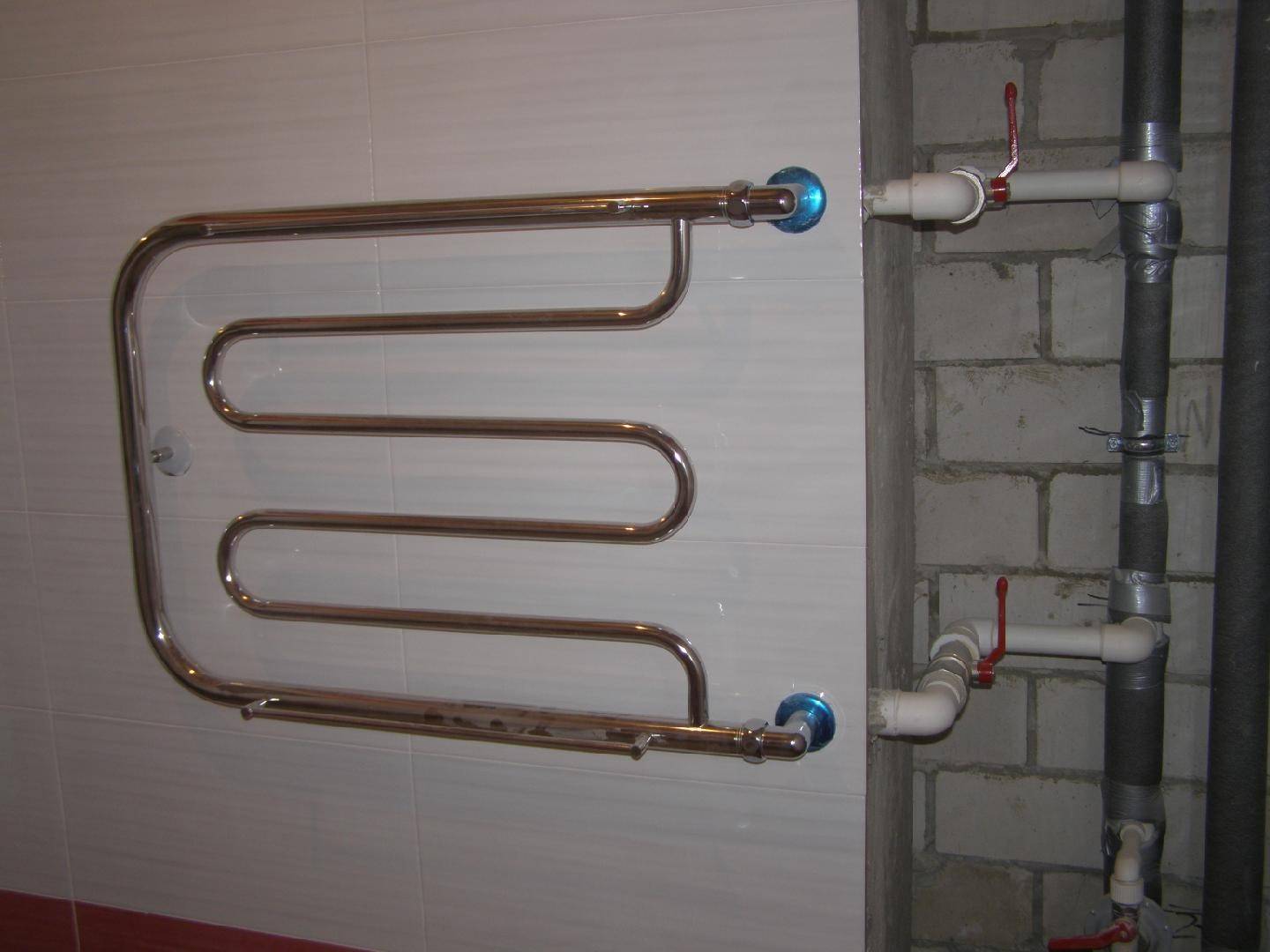


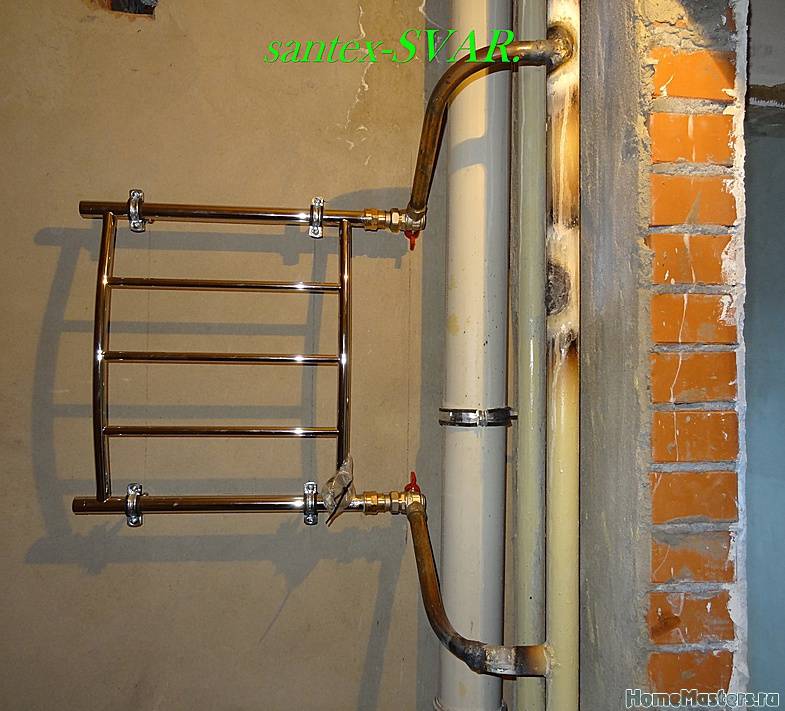
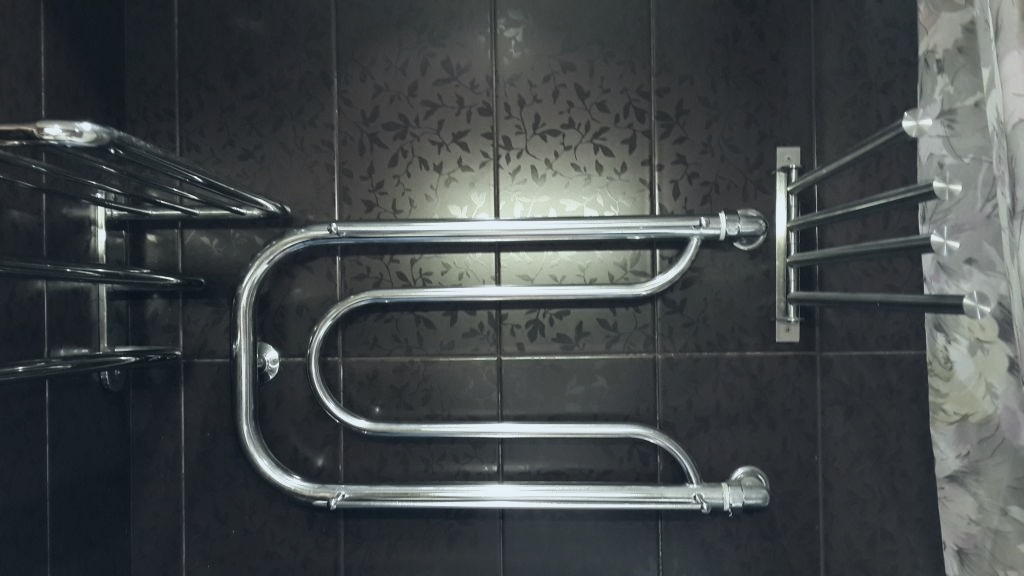
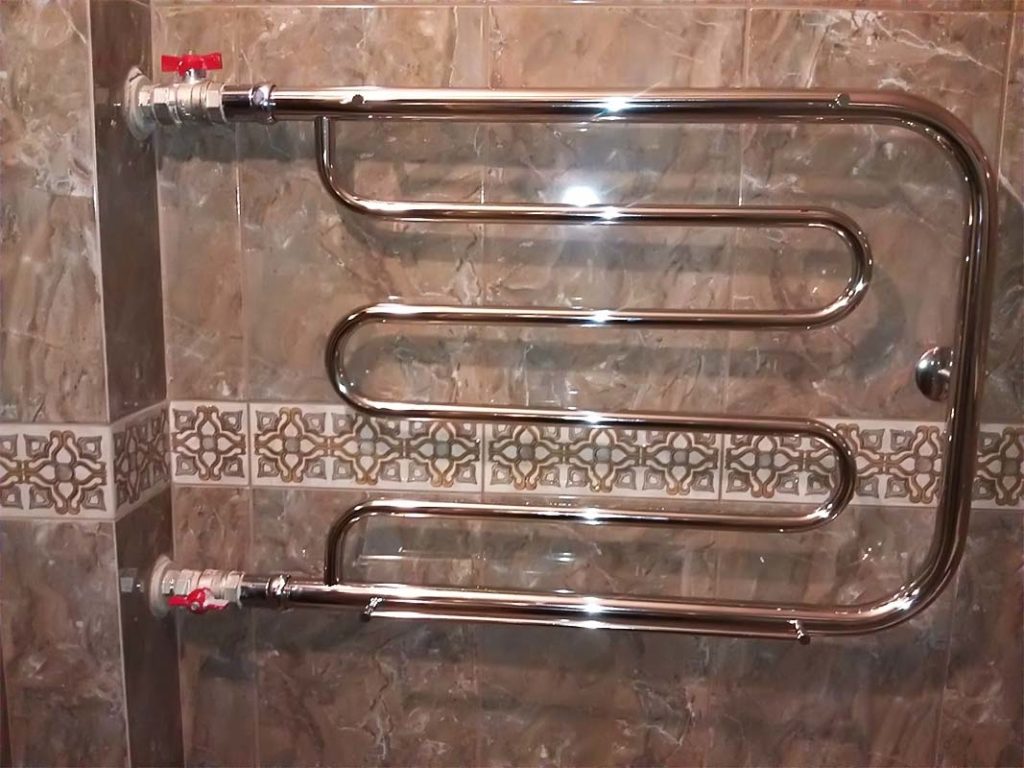
Water heated towel rails practically do not consume additional energy
electric ones are not connected to the heating system, but to the mains.Their undoubted advantages include maximum ease of installation and virtually uninterrupted operation. But along with these advantages, such models have a very significant drawback - the cost of the electricity necessary for the constant operation of the device is quite high;
Electric towel warmers are easy to install, but at the same time require energy costs
combined are connected to both the heating system and electricity, thereby combining the advantages of both models.
The best option for homes with "interruptions" in the supply of hot water are combined heated towel rails
Connecting water and electric heated towel rails is fundamentally different from each other, so we will consider each of these processes separately
But before that, we suggest that you familiarize yourself with the main points that you will need to pay attention to when choosing a suitable heated towel rail.
An important point is the choice of bath faucets. The SanTop company offers various types of faucets at very competitive prices, which can be found on the page.
What designs are
Towel warmers come in different shapes. When choosing them, people are often guided solely by aesthetics, which is not entirely justified. These devices work normally with good water circulation, but not all models provide such circulation. With some you have to be smart for a long time, looking for the right connection scheme, otherwise they simply refuse to work.
So, all heated towel rails can be divided into four groups:
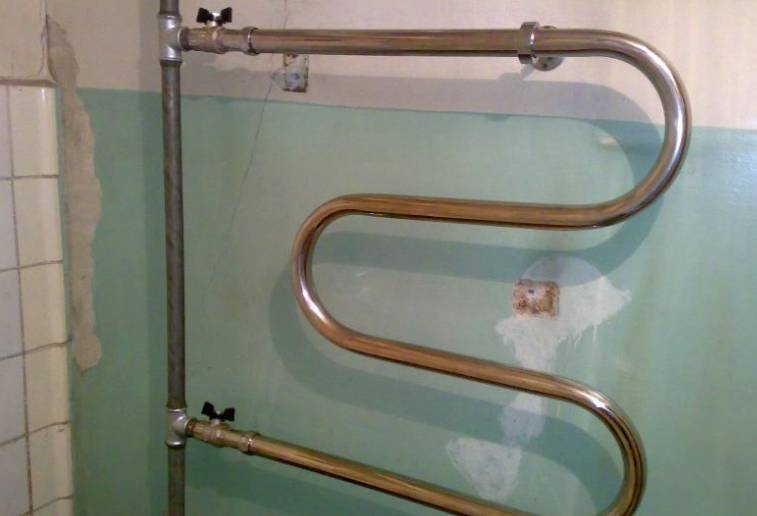
- U-shaped or U-shaped.The simplest models, elementary connection (side). Ideally, when replacing the old one, you find a model with the same center distance. Then, if you're lucky, you can even not redo the bends.
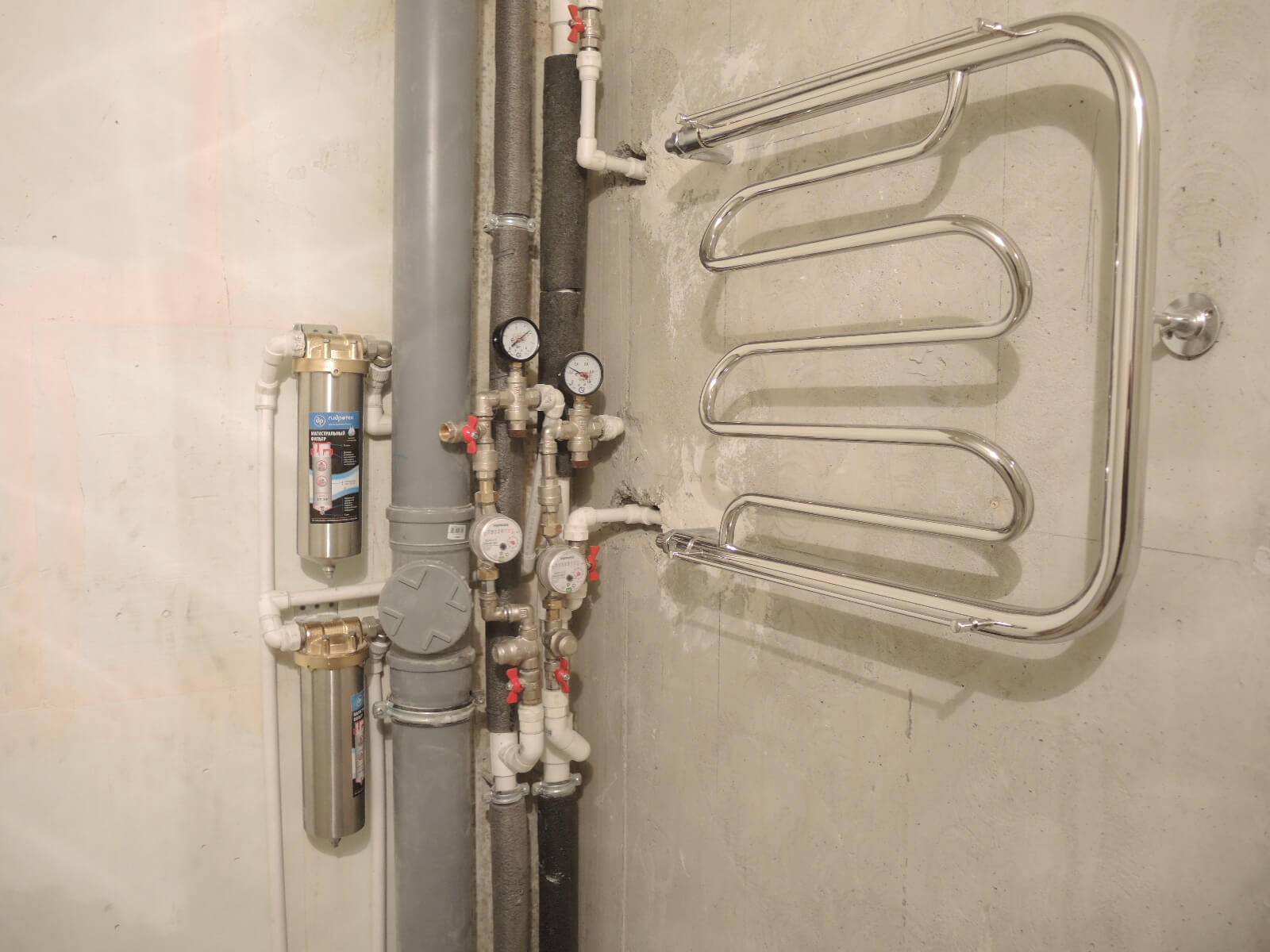
- Ladder. Modern designs with a number of crossbars. Also a good option in terms of hydraulics. The connection can be bottom, side or diagonal. But it is not chosen arbitrarily, but according to a combination of conditions (where the supply comes from, location relative to the riser).
-
snake. Another classic model with side connection. Installation of this type of heated towel rail, as a rule, does not present any problems.
- Complicated form. There are very unusual heated towel rails. They can even be an interior decoration, but their proper connection is a problem. As a rule, consultation of a competent specialist, a plumber who is well versed in hydraulics, is required. As you can imagine, finding one is not an easy task.
It often happens that after installing a heated towel rail, it simply does not work. If the error is serious, the riser to which it is connected also stops working. Therefore, it is necessary to know and follow the connection rules.
Mounting types
There are 3 placement options:
- installation of a floor heated towel rail;
- installation of equipment before laying wall tiles;
- connecting a heated towel rail to the laid tile.
Before starting installation, it is worth designating the installation site. When locating an electric heated towel rail, remember some safety rules:
- do not install it near plumbing fixtures so that water does not fall on the cable and switch;
- the socket must be used with a protective cover, there is also a hidden connection method;
- the cord of the product should not touch heated surfaces;
- the device itself must comply with safety parameters: have a moisture-resistant case and double insulation.
It is best to connect the heated towel rail directly to the mains, without using sockets. Since there is a large amount of steam in the bathroom, we should also not forget about the condensate that flows down the walls. You can put a waterproof outlet or purchase a residual current device, but even they will not provide 100% protection, and they are also expensive.
What is the value of modern heated towel rails?
Towel warmers have become a great boon for high-rise residents for many reasons.
The electrical basis of this equipment avoids the complexity of installation and repair. Water heated towel rails require a separate riser in the niche of the bathroom, which in old houses has long since rusted and practically rotted in cemented interfloor ceilings. Residents save time on appeals to the housing office to stop the supply of coolant when repairing a leaking water device.
Image gallery
Photo from
Electric heated towel rail in the lobby of the apartment
Device for rapid heating of the room
The presence of a temperature control device
Easy installation of electrical equipment
The aesthetics and hygiene of EPS is obvious. There are hundreds of models of this equipment that will allow you to choose the right size, desired appearance and convenient functionality. No need to paint pipes, clean seams and be afraid to ruin the fabric. In addition, impractical piping, which often runs through two walls, is eliminated from the wiring diagram.


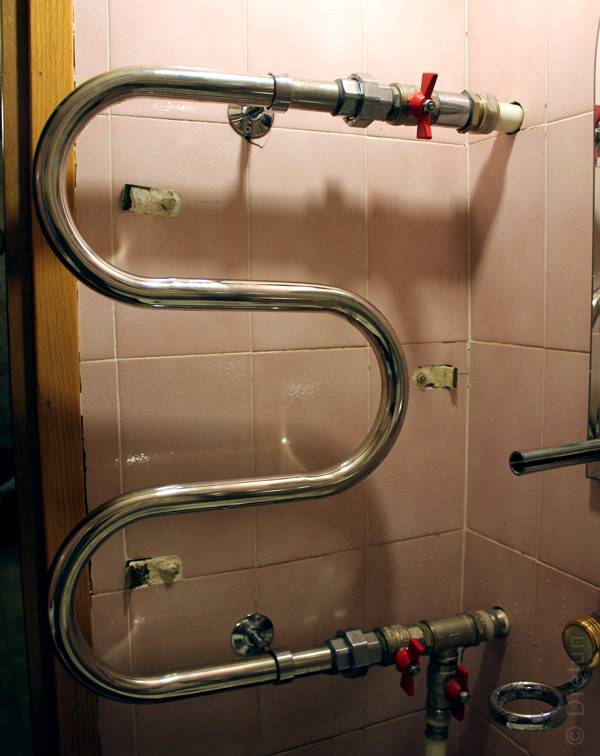

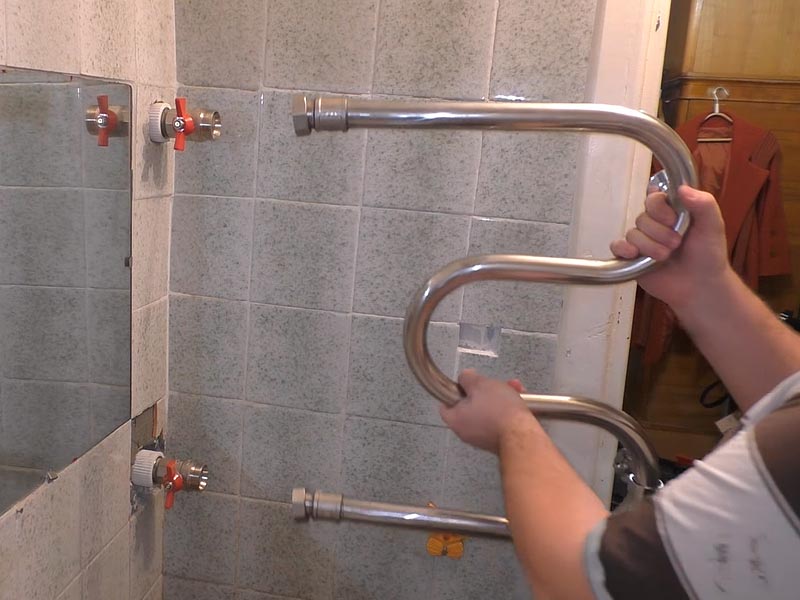


The possibility of using adjusting devices has lifted the functionality of electrical appliances to the skies. You can choose EPS with a timer, with temperature control, with backlight, with shelves. Although, to save money, you can also plug a simple heated towel rail into an outlet with an already built-in timer. Mounting heated towel rails on rotary axes to rotate the frame in the right direction is also a useful development of an engineering idea.
Electrical equipment allows for adjustable heating of bathrooms. In apartment buildings with individual heating, the bathroom is often a dead end in the heating distribution: pipes are allowed into the bathroom through the kitchen loaded with communications.
The use of an autonomous heated towel rail helps to remove unnecessary heating communications in the bathroom, to simplify the situation and increase ergonomics in the kitchen, improves the appearance of the room and significantly simplifies cleaning.
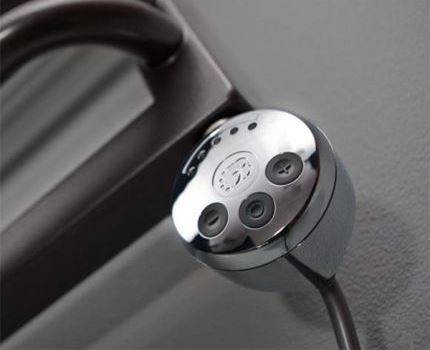
The regulator allows you to set the temperature required for various fabrics, and also makes it possible to save money on electricity by reducing the parameters
Electric heated towel rails with dignity perform their main job - drying towels and clothes. Chrome-plated tubes will never harm or leave marks even on delicate fabrics.
You can list further advantages of an electric heated towel rail, but it is better to install it in your bathroom and experience all the benefits yourself. The psychological effect of installing EPS is comparable to installing a modern washing machine after many years of hand washing!
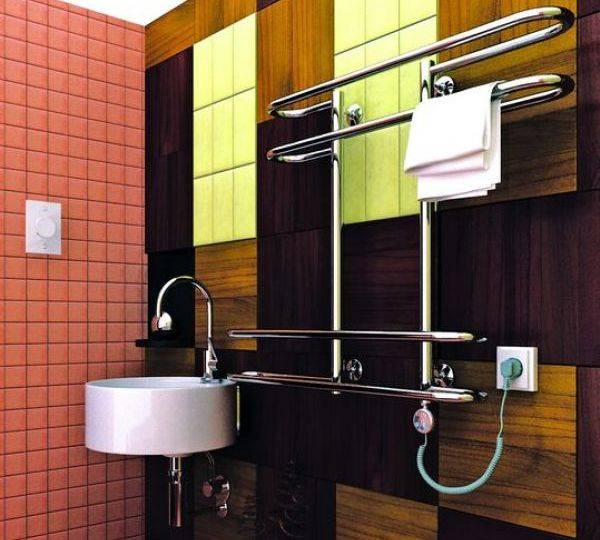
Exquisite designer models of heated towel rails are not only necessary equipment, but also an elegant decorative element of a bathroom or a combined bathroom.
This is interesting: Installing an electric oven yourself
Faucet installation
After that, you can proceed to the installation of cranes. If the old device was cut off, then on the remaining cut pipe sections a new thread, using a die of the required diameter for this. And if the coil was removed “civilized” and the thread remained in place, then simply “drive” it with the same die in order to improve the quality of the connection.
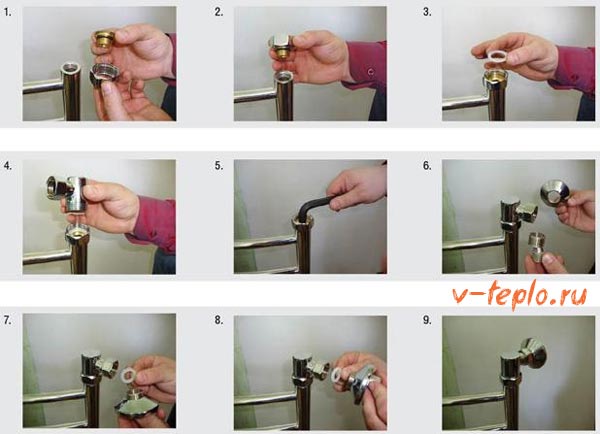
Once the threads are in order, install the shut-off valves (in other words, taps). This armature will perform two functions at once.
- Adjusting the intensity of the coil by closing / opening taps.
- Shutting off the water in case of need for repair or replacement of equipment in order to carry out the required actions.



