- Shutdown of the coolant supply
- Top filling
- bottom filling
- Sequence of work when replacing radiators
- Cons of replacing radiators
- Replacement of heating devices through ZhEK. Coordination of the replacement of system elements
- How to choose new batteries
- Cast iron batteries
- Steel panel and tubular batteries
- Aluminum batteries
- Durable bimetal radiators
- What should be considered in advance?
- Legal regulations
- Some interesting tips
- We demand new batteries from the local administration
- Radiator connection diagram.
- Who and when should be engaged in maintenance and repair?
- Miscellaneous schemes
- Why is it needed
Shutdown of the coolant supply
Let's move on to practice.
Before removing the radiator, you need to turn off the heating and drain the water. How to do it?
I will analyze the shutdown of heating in an apartment building. For autonomous heating systems, it is difficult to give any general recommendations because of their individuality.
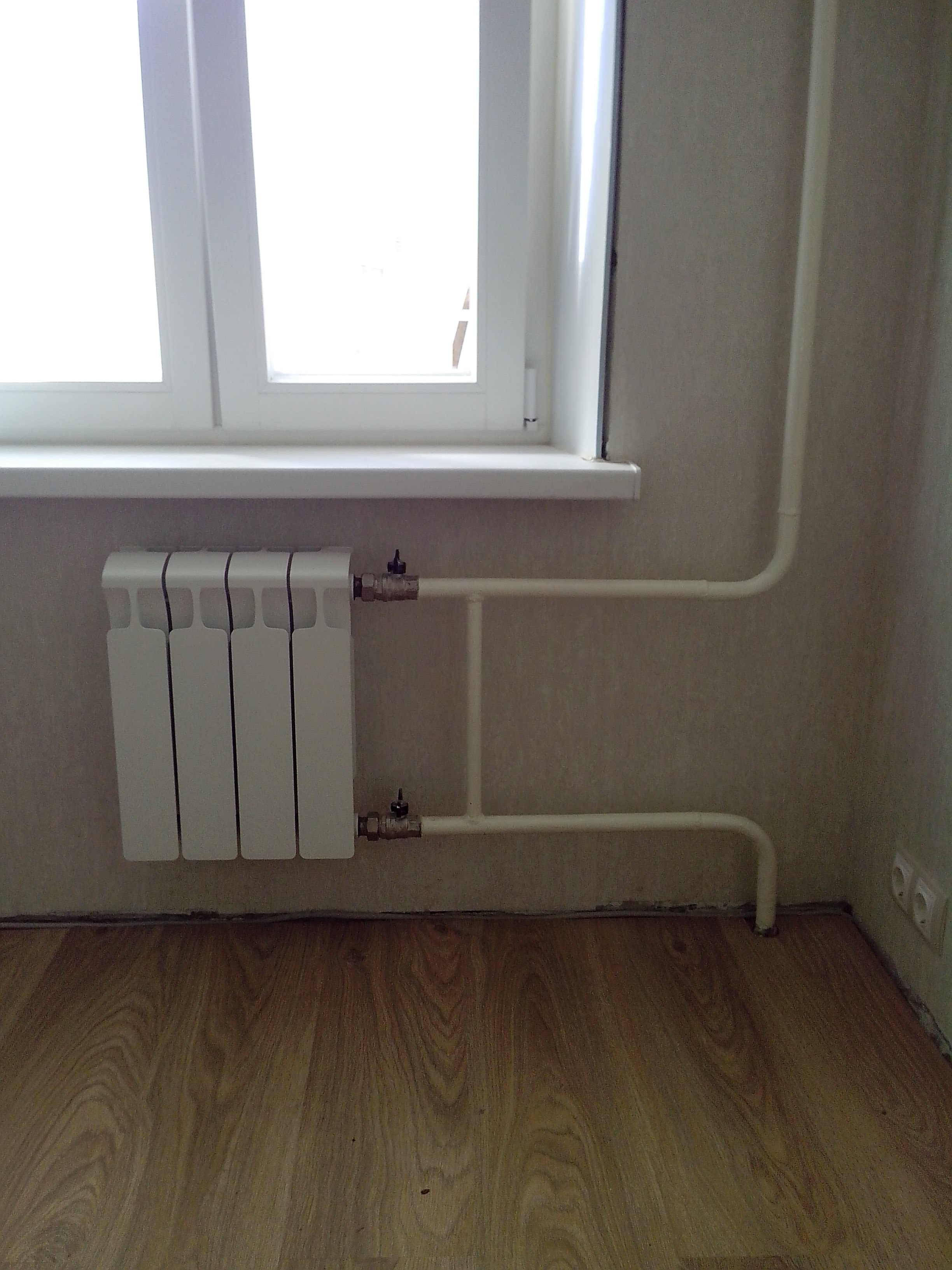
The simplest scenario is to turn off the water with valves, ball valves or throttles installed on the connections. It is enough to close the shut-off valves on both connections - and you can disassemble the connections on the radiator plugs, after substituting a basin or other container for draining water under them.
A jumper must be installed between the connections with shut-off valves. Without it, a closed throttle or valve will stop circulation in the entire riser. Very soon, neighbors will come to you and begin to question your high moral qualities aloud.
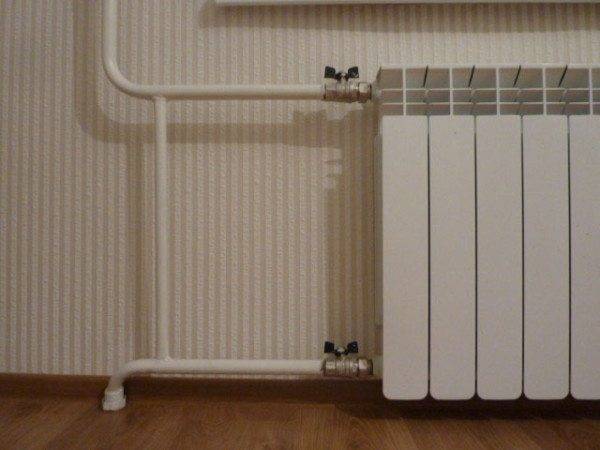
Correct connection: shut-off ball valves on the inlets and a jumper between them.
If the eyeliners are devoid of valves, you will have to look for and dump the riser. Here it is worth making a small lyrical digression.
In multi-apartment buildings with standing wiring, two filling arrangements are used:
Top bottling implies a feed placed in the attic. Risers connect it to a backfill located in the basement or underground. Each riser functions independently of the others and is turned off at two points - below and above;
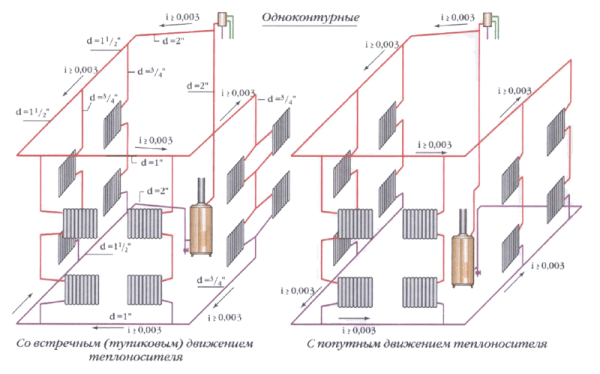
Pair of schemes heating with top filling.
In a house with bottom bottling, the supply and return wiring is made in the technical basement. The risers are alternately connected to both bottlings and are connected in pairs by jumpers on the top floor of the house. Accordingly, two risers will have to be turned off - supply and return.
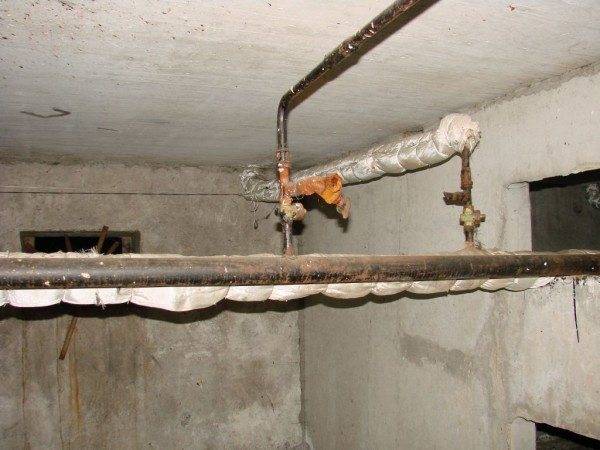
To determine the type of wiring, look into the basement. If two horizontal pipes in thermal insulation are laid along the perimeter of the house, you have a lower filling, one is an upper one.
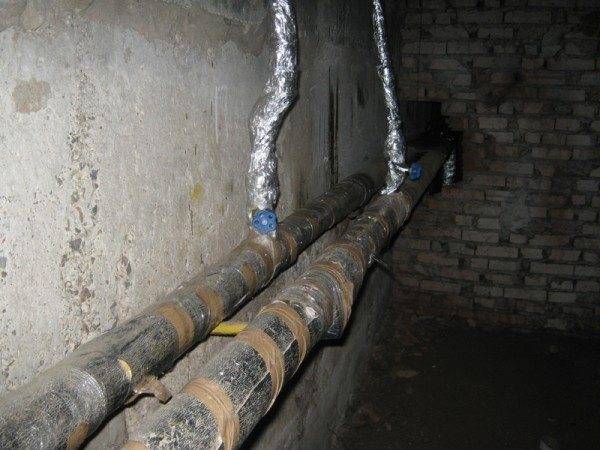
Lower bottling: along the perimeter of the house, both the return and the supply are laid.
First, find your stand. In the basement, it is easiest to navigate along the flights of stairs between the entrance and the landing of the first floor, in the attic - through the windows of the apartments. Further actions depend on the type of bottling.
Top filling
In the case of top filling, the shutdown procedure will be as follows:
- Turn off the valve in the attic. Do not unscrew the plug;
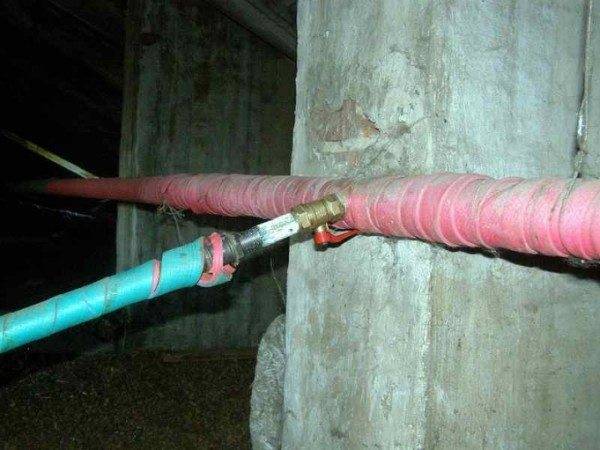
The removal of the riser from the bottling of the supply in the attic looks something like this.
- Shut off the valve in the basement;
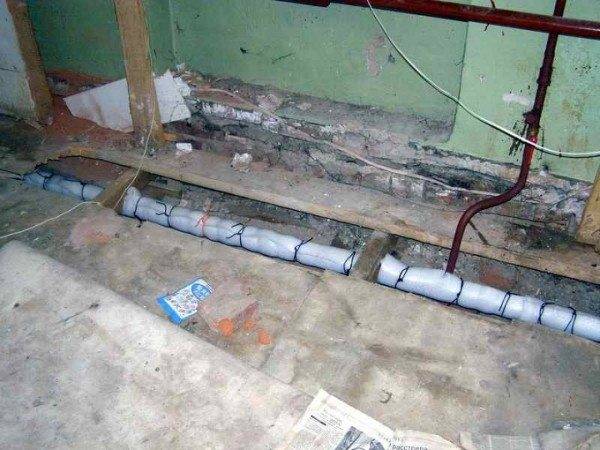
Riser and bottling return in the basement.
- Unscrew the plug one or two turns and wait for the pressure of the water jet hitting the thread to drop. So you make sure that the shut-off valves are in full working order;
- Unscrew the plug completely. The water hanging in the riser will pour out after you open the piping to the radiator.
bottom filling
Here is an instruction for turning off the heating riser in a house with a bottom bottling with your own hands:
- Block your riser and two adjacent to it;
- Unscrew the plug one or two turns;
If instead of a plug on the riser there is a vent, the task will be greatly simplified.
- Slowly open the valves on adjacent risers. So you will identify the riser associated with yours;
- Fully open the valve you do not need. Block your riser;
- Unscrew the plugs on your and associated risers.
Sequence of work when replacing radiators
To carry out the dismantling of old heating devices, it is necessary to drain the coolant from the heating system. The easiest way to perform this procedure is in a private house, using a tap, the presence of which is provided for at the design stage of an autonomous heating system. In an apartment building, you will need to call a representative of a service organization or management company.


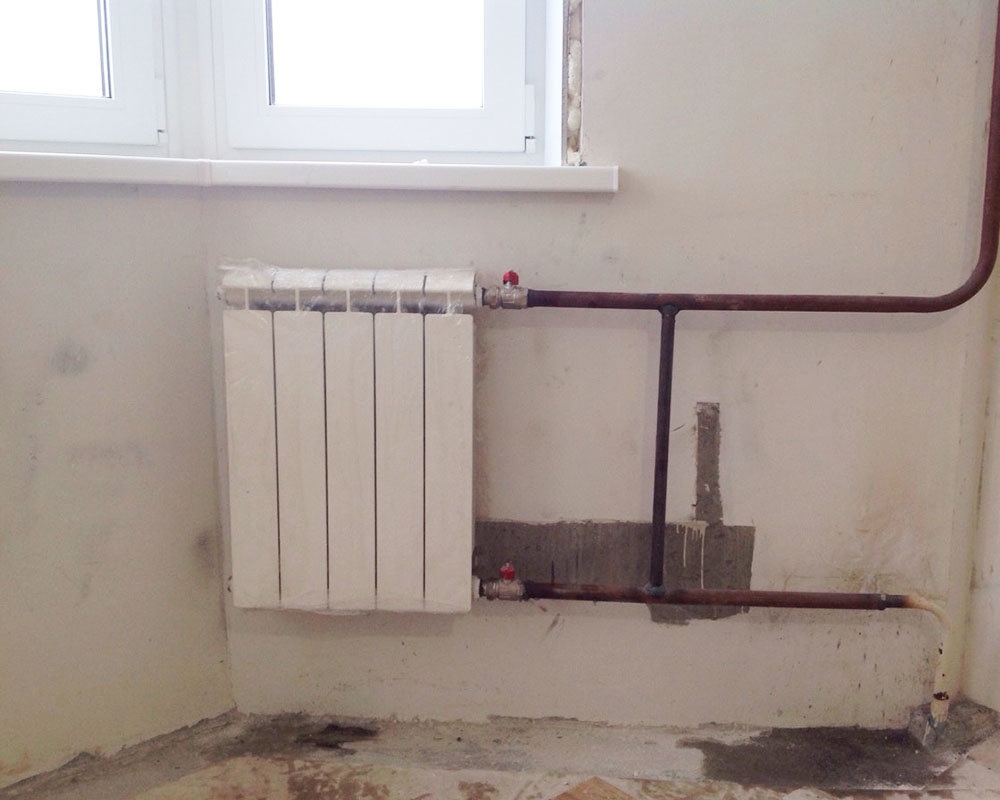
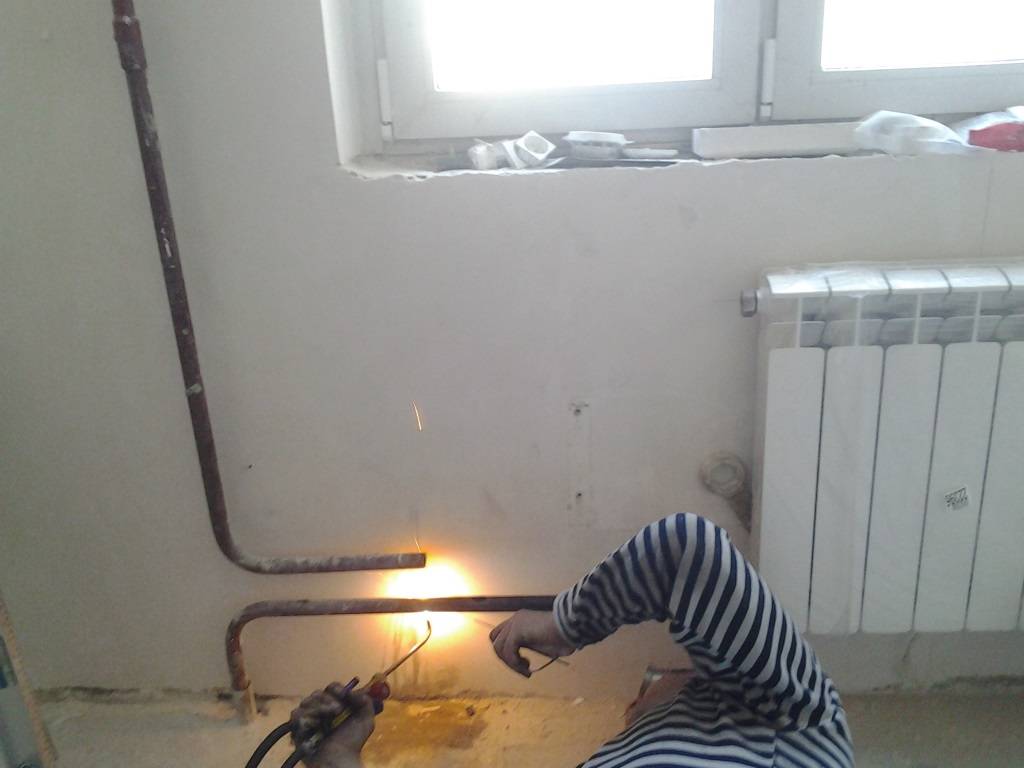


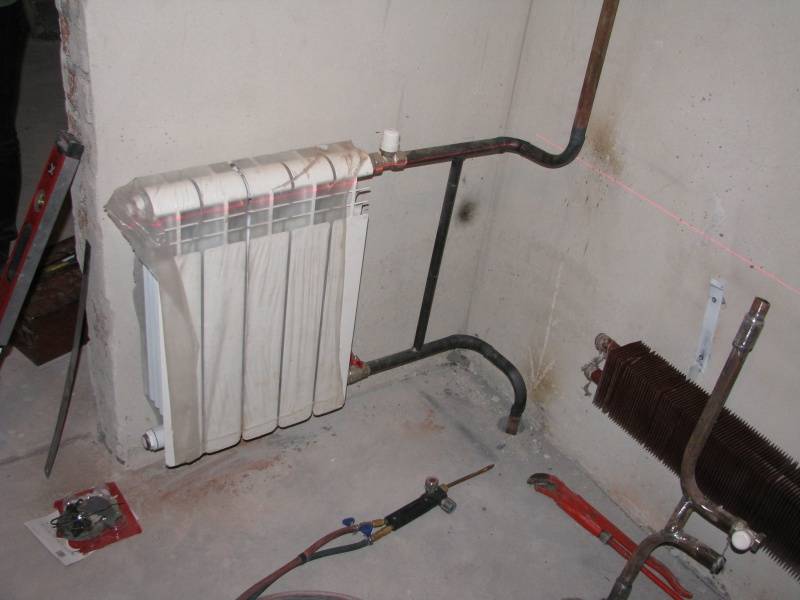

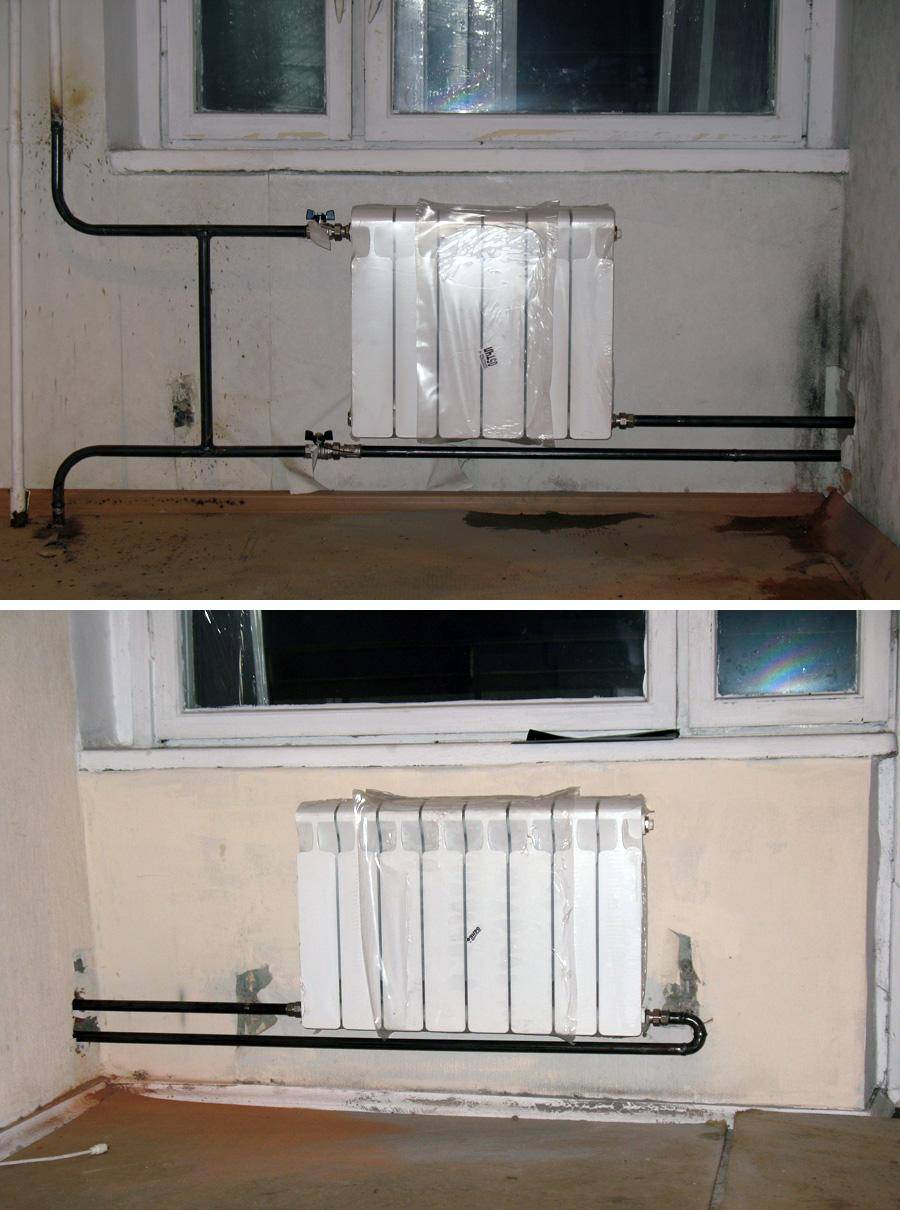
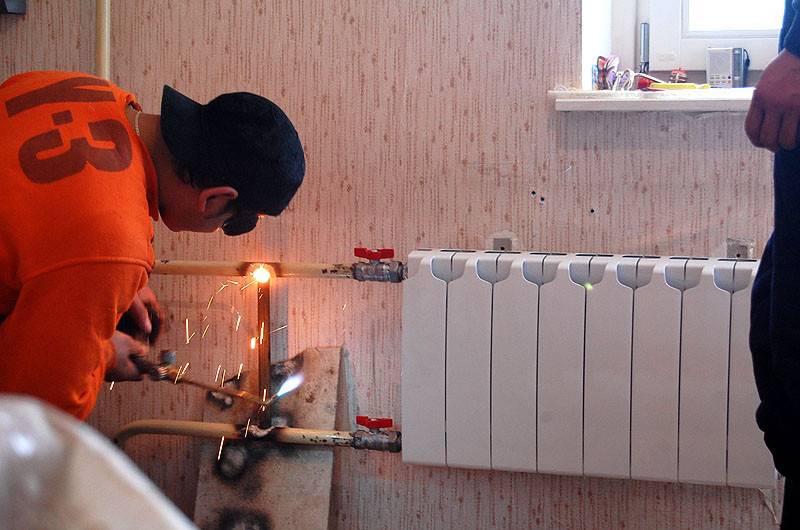
Dismantling the old heater with the help of a grinder, which every lover of do-it-yourself repair work has. In this case, the master works without protective equipment - this cannot be done
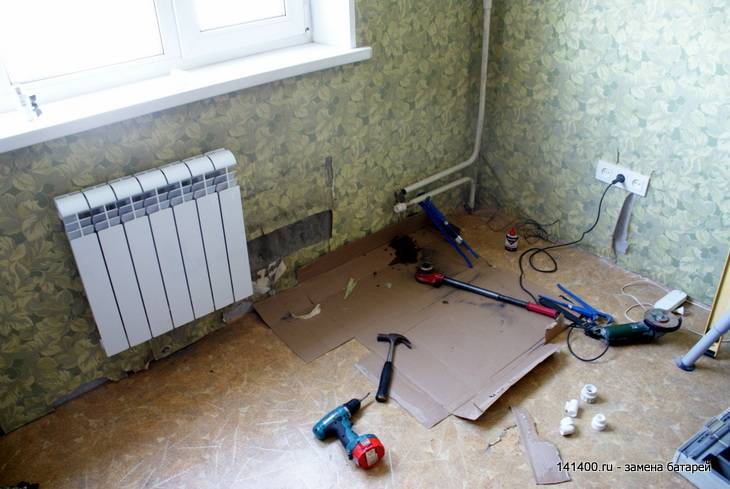
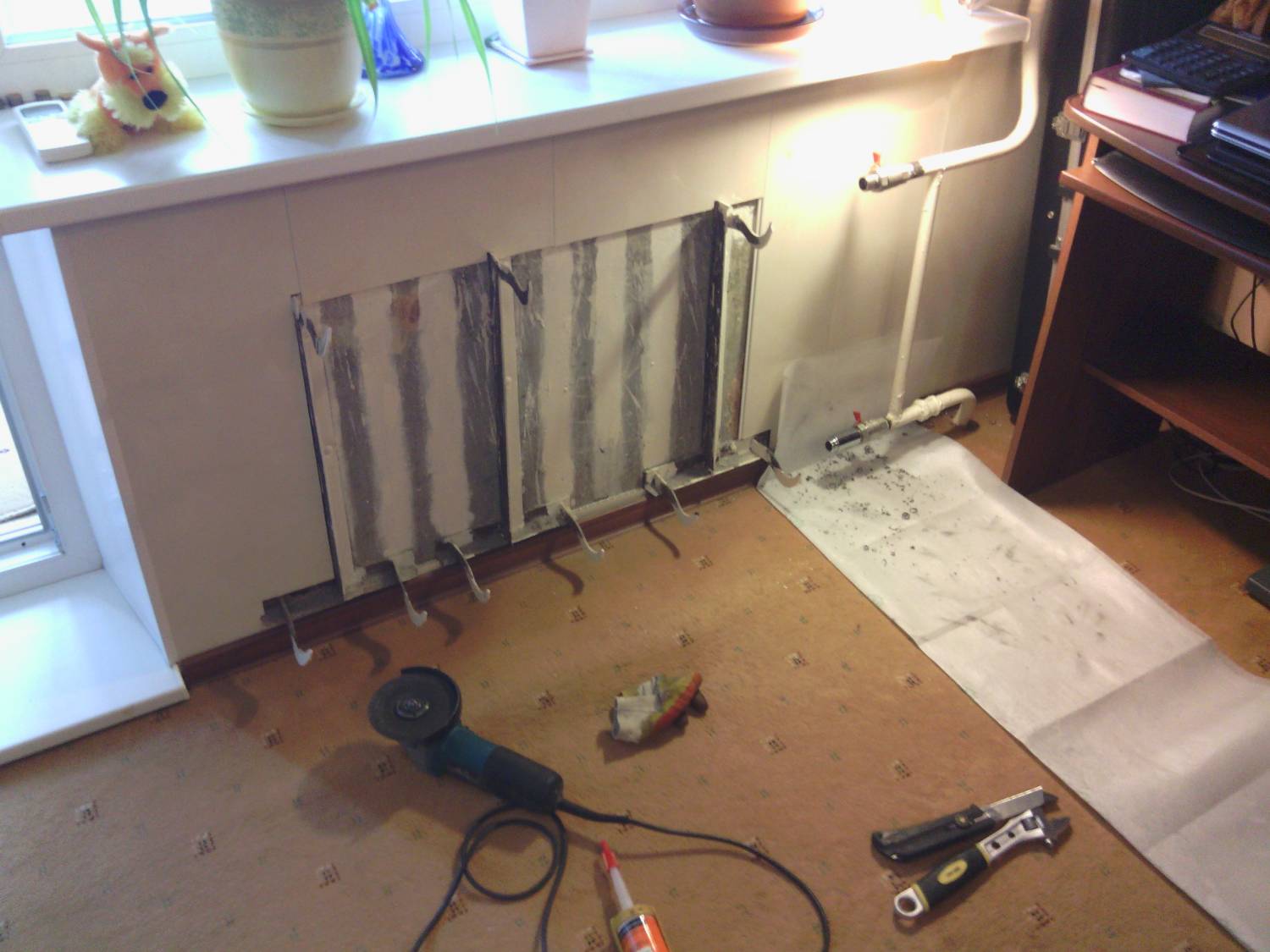
After draining the coolant, they begin to dismantle the batteries that have served their time. For cutting pipes use an ordinary angle grinder. The cut must be neat and straight so that the installation of new heaters can be carried out without unnecessary difficulties.
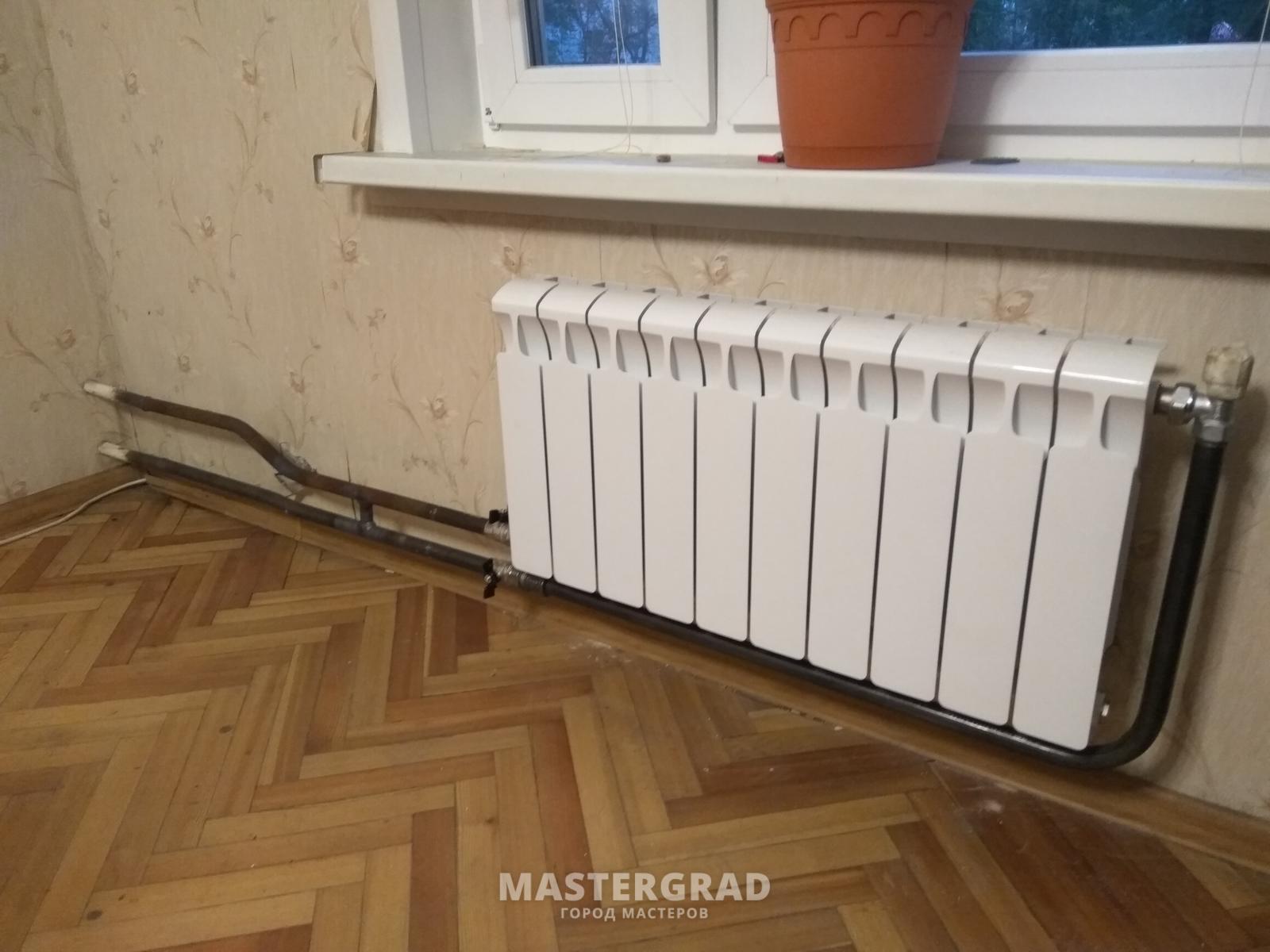
Then a new battery is packed, and this procedure can be performed by the owner of the apartment on his own. In this case, it is necessary to stock up on some materials: investment paste, flax, a set of nuts for pipes, an adjustable wrench. The nuts are sealed with flax, smeared with paste, and then they are screwed onto the pipes protruding from the radiator. Then, from the attachment side with pipes of the heating system, a ball valve with a drive, called an American, is installed, as well as a Mayevsky crane.
Assembly of a new bimetallic heating radiator from separate sections using sealed nipples
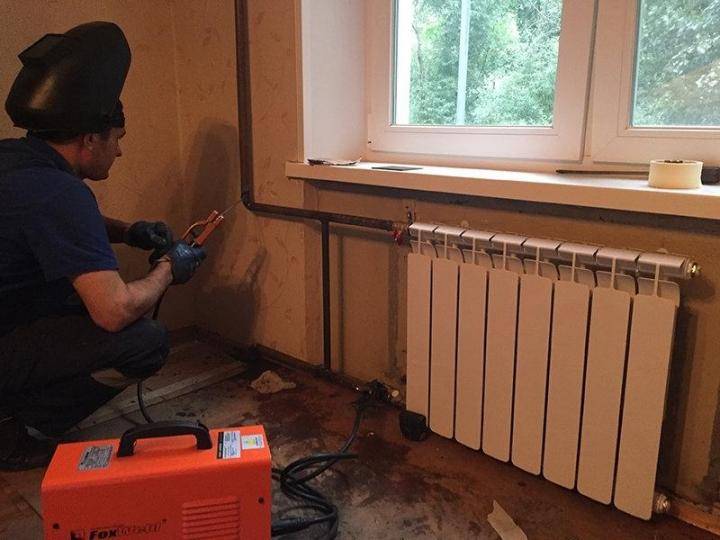
Next, the installation of a new battery begins, installing it in place of the old radiator. They start welding the drive, screwed into the battery, to the heating system. For better circulation of the coolant between the pipes (suitable for the battery and leaving it), a jumper pipe is welded.
A real master of his craft will carefully install a new battery like this. The owners can only paint the replaced pipe sections, after which no one will even guess about the installation work
As you can see, the process of replacing heating appliances is a serious and very responsible matter. Therefore, to carry out work, it is worth contacting the housing department in writing. The owner of the apartment writes a statement-request in which he describes the problem and the need to shut off the heating system in an apartment building. Employees of the housing office will consider the application, give permission and agree with the applicant on the date of installation work.Next, you need to wait for the plumber, who will be sent by the housing office to the address indicated in the application. The plumber will turn off the heating system and carry out all the necessary work. Upon completion of the radiator replacement procedure, the specialist will without fail test the system in test mode in order to verify the quality of the service provided to the applicant.
Some housing offices may require documents from which you can find out the technical characteristics of the installed heating elements. Such documents may include a technical passport, as well as a description of pipes and batteries.
Cons of replacing radiators
There are also downsides to this process. Many attribute these facts to them:
- availability of qualifications for welding work or remuneration of the relevant specialist;
- purchase, rental or availability of gas welding equipment;
- figuring out how much it costs to change a battery using welding, in some cases the price will be higher than other types of work.
However, all such shortcomings are compensated by the reliability and durability of the connection, when using high-quality consumables. The performance characteristics of this type of connection have proven their effectiveness over many years of their use.
Due to the physical and chemical processes occurring during welding, a strong seam is formed, which receives mechanical characteristics that exceed the reliability of the welded pipes. This corresponds to the fact that the occurrence of any rupture in the future along the received connection is excluded, and the replacement of the heating batteries will take place in normal mode.
Accordingly, gas welding, in the context of the question of how much it costs to change a heating battery in an apartment, is the most profitable and durable option for resolving the issue. This will leave a small aesthetic seam that will be easy to hide with paint.
Replacement of heating devices through ZhEK. Coordination of the replacement of system elements
Consider in detail replacement of heating appliances through housing office.
So, when the established operational period radiators exceeded, they are in emergency condition and cannot be repaired, replacement of heating appliances performed through the Housing Office only in those situations. In other cases, when batteries leak, minor repairs are performed.
According to current standards, the service life of a cast-iron radiator is 15-30 years when operating in an open system and 30-40 years in a closed one. But, even in the case of an apartment building where the batteries were installed more than 40 years ago, the operating company is often limited to only repairing the radiator, since the replacement is included in the list of major repairs, the timing of which may not yet be determined.
For a free replacement of emergency batteries, residents will need to contact the housing office with a corresponding application. It is suggested that you prepare two copies of the application and mark both copies of the acceptance by the responsible person of the housing office. The date and legible signature of the responsible person, a number is affixed to the application and its copy.
Duplicating the document will help if problems arise in the future due to the unwillingness of the management company to change emergency batteries at the expense of the overhaul budget.But the tenants must stand up for their rights, because they paid for the replacement of the old radiators at the expense of monthly contributions for housing, maintenance and overhaul of the common property of the house.
Now let's take a closer look coordination of replacement of system elements.
System replacement heating in the apartment will require approval from the company providing utilities. By contacting the administration of the operating organization serving the house, you need to obtain permission.
_
Organization - means legal entities under the laws of the Russian Federation (except for banks), including organizations whose main activities are financed from the budget.
Service - for taxation purposes, an activity is recognized, the results of which do not have a material expression, are realized and consumed in the process of carrying out this activity.
The volume and temperature of the coolant, etc., even at the design stage of an apartment building, the heating system is calculated - the quantity and power are determined appliances heating, their location. This provokes an emergency situation in case unauthorized replaced batteries heating do not match the calculated parameters. Battery replacement heating on a model with different performance characteristics may lead to a deterioration in system performance heating in the house.
If you plan to change radiators heating in the apartment on your own - at your own expense, you will need to submit a number of documents for consideration:
- A document confirming the ownership of the apartment.
- Certificates of conformity for all components (radiators, fittings, pipes, fittings, etc.).
- Application with attached technical passport for the apartment.
- Thermal calculation of new heating systems approved by the expert appliances.
_
Accounts - settlement (current) and other accounts in banks opened on the basis of a bank account agreement, to which funds of organizations and individual entrepreneurs can be credited and from which they can be spent.
An examination of the thermal calculation will be required if it is planned:
- move the device heating to another part of the room.
- having installed devices of a different type, with different technical characteristics, change the batteries heating;
- increase the power of an existing radiator by adding links;
Will upgrading the system break heating heat balance of the house, the expert should check. The examination is a paid service and is carried out at the expense of the owner of the apartment.





_
Thermal balance - housing and communal services. the result of the distribution of the amounts of thermal energy released by the heat source (sources), taking into account losses in the transmission and distribution of thermal energy up to the boundaries of operational responsibility and used by subscribers; (MDS 41-3.2000)
Modernization - introduction of improvements that meet modern requirements.
It can take up to 2 months from the moment the documents are submitted to the managing organization to the issuance of a permit. In the future, after obtaining permission, you need to file an application to turn off the riser and drain the coolant from the corresponding section of the system.
In the future, after replacing the batteries heating an application for technical expertise is submitted in the apartment - specialists and representatives of the management company check the correct installation and compliance appliances heating those that were allowed to installation.
How to choose new batteries
Replacing heating batteries begins with their purchase. In stores, we can find a variety of radiators, ranging from cast iron to bimetallic. Which of these is suitable for an apartment installation?
Cast iron batteries
It should be noted that cast-iron batteries are quite common in apartment buildings with a small number of storeys. And consumers are actively getting rid of them - they are obsolete and do not meet modern requirements. They withstand high pressure, but they are not suitable for installation in high-rise buildings. Even if you choose a modern design model, it will not be able to please you with high efficiency - low heat transfer and high heat capacity affect.
Steel panel and tubular batteries
Steel batteries are used to heat 9-16-storey buildings, but they cannot be called resistant to high pressure. In addition, they are often torn apart by water hammers that occur in centralized heating systems. Modern panel steel models are generally not recommended for apartment installation - they are only suitable for low-rise housing with autonomous heating, where there is no high coolant pressure. As for tubular models, they are quite hardy, but they are very rare on sale.
Aluminum batteries
Aluminum radiators are not suitable for heating apartments under any circumstances. The thing is that aluminum does not withstand high pressure and does not know how to endure water hammer at all. As a result, the batteries break already during the filling and initial check of the heating system.Aluminum is also susceptible to corrosion due to exposure to an aggressive coolant - in such conditions, the duration of their service life will not exceed 3-4 years.
Durable bimetal radiators
Bimetal radiators are the best choice for installation in apartments. Here are their benefits:
- Light weight and ease of installation;
- High heat transfer and minimum inertia;
- Resistance to aggressive coolant;
- Resistance to high pressure in pipes;
- Resistant to strong water hammer.
Many manufacturers of bimetallic batteries confidently declare that their products can withstand pressure surges up to 50 atmospheres. This indicator is really significant, so these batteries are recommended for residential installation.
The basis of bimetallic batteries are reliable and durable metal cores through which the coolant flows. An aluminum "shirt" is put on top of the cores, dissipating heat in the premises. Aluminum here does not come into contact with an aggressive coolant in any way and is not subject to pressure - strong and durable steel takes on all the hardships.
In addition, bimetallic radiators have an attractive appearance - they are much more beautiful and more compact than their cast-iron counterparts. As for heat transfer, it is 70-80% higher - the house will be warm and comfortable. Combined with ease of installation, all this makes bimetallic batteries the best solution for residential installation.
The only drawback of bimetallic batteries is their high cost.But on sale you can always find models from little-known manufacturers that practice a more affordable pricing policy and offer batteries at affordable prices.
Read about which heating batteries are better for a private house in another article on our website.
What should be considered in advance?
If the decision to carry out repairs of this type is made, a number of questions should be answered:
- When and by whom will the work be carried out?
- What type of radiators should be used?
- Is it necessary to replace the pipes leading from the battery to the riser?
- How many sections will be needed for each room?
It is best to carry out such an alteration in the summer, because to start work, you must obtain permission from the local housing office. In winter, officials are extremely reluctant to give such permissions, because they will have to block the common riser and leave other apartments without heating for some time.
But even outside the heating season, getting permission can be difficult. Those who have already solved similar problems talk about the need to wait for several days, trying to get an appointment with the right employees, etc. Some faced pressure: they were recommended to hire plumbers from the Housing Office to do all the work.
There are no restrictions on this issue. The main thing is that the replacement of heating batteries is performed by an experienced plumber with the appropriate qualifications. It is possible to identify all the flaws made during inept installation only during operation.
Old radiators get dirty inside and out over time, cleaning does not always solve the problem of insufficient heating, replacement is a more effective option
It is best to go to the housing office in the summer, and not in the fall, which is the peak of the queues.By this time, all the necessary materials need to be purchased, pre-assembly of radiators, tools prepared, agreed with the team, if necessary.

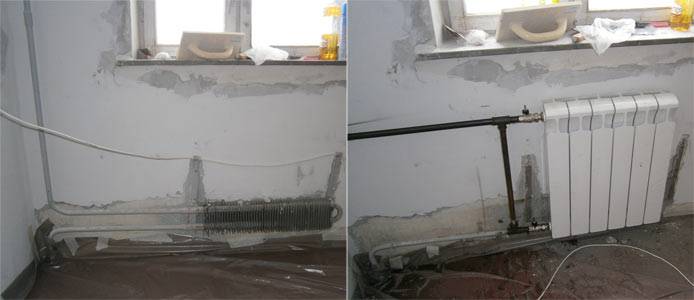




If the house is connected to a central heating system, you should contact the maintenance service to agree on the alteration. Here they can perform the necessary calculations to accurately name the number of radiator sections, as well as clarify other technical issues.
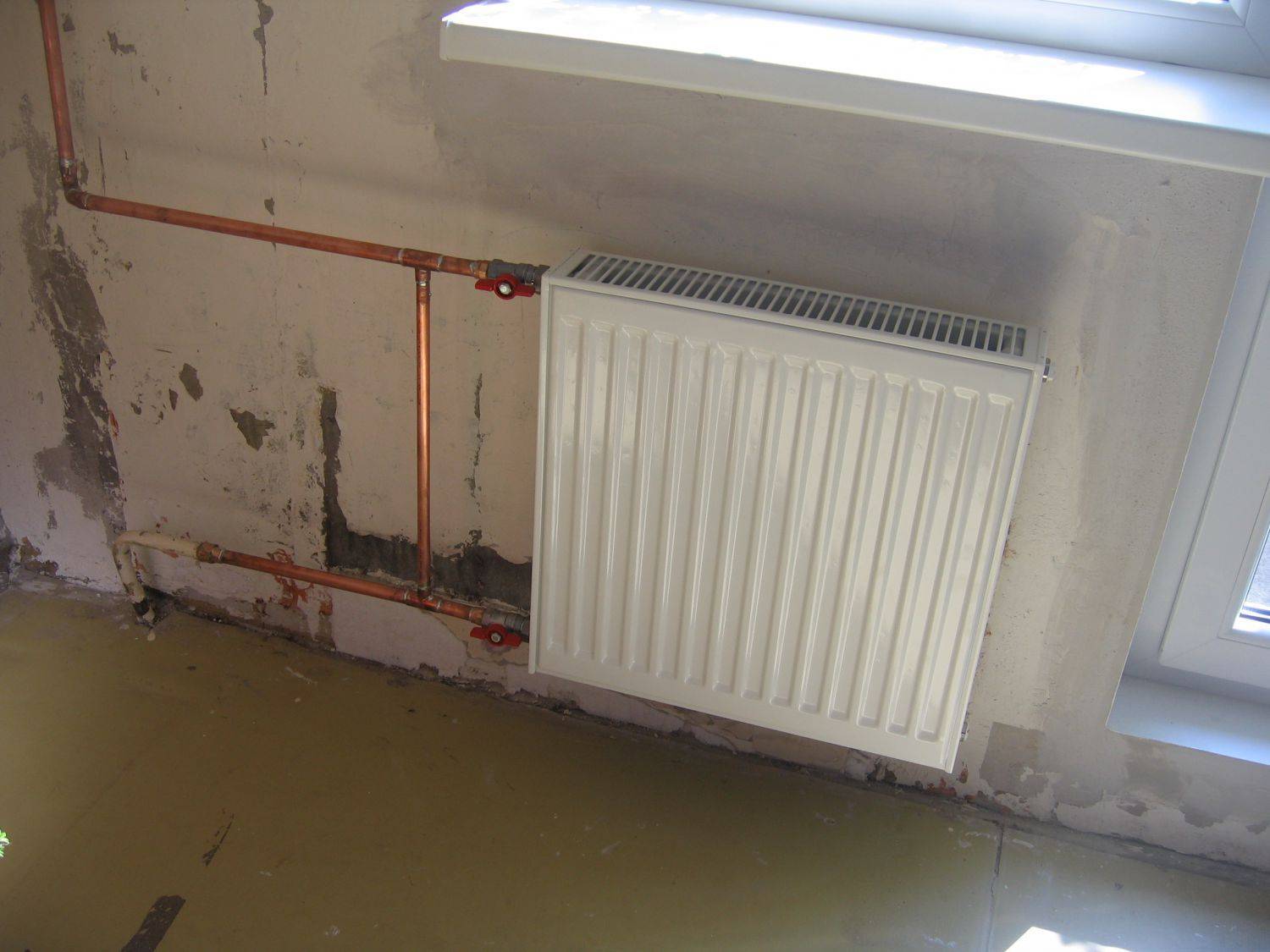
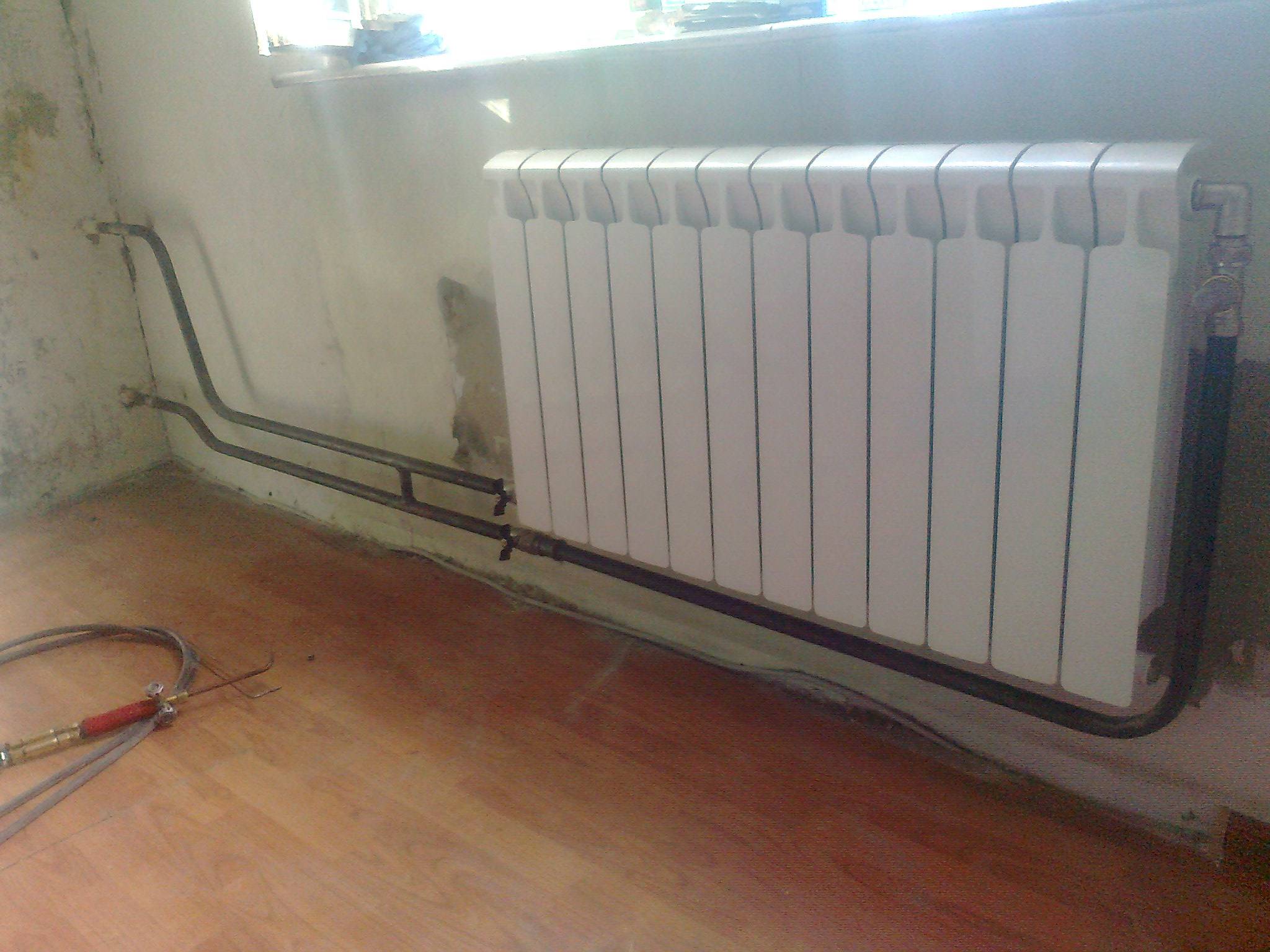
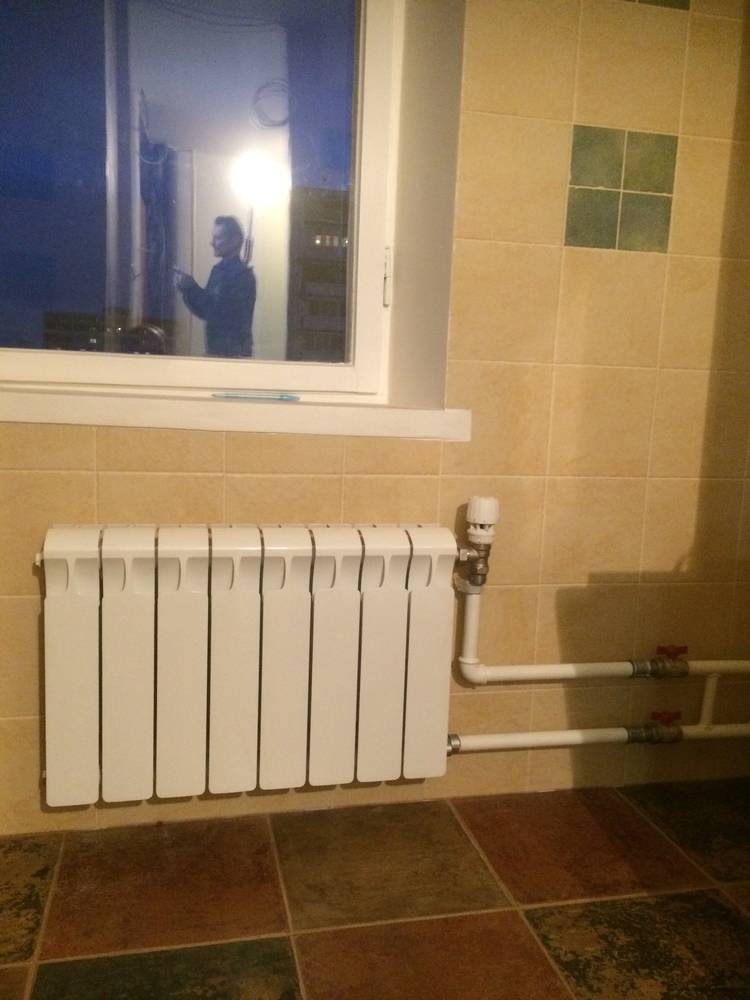
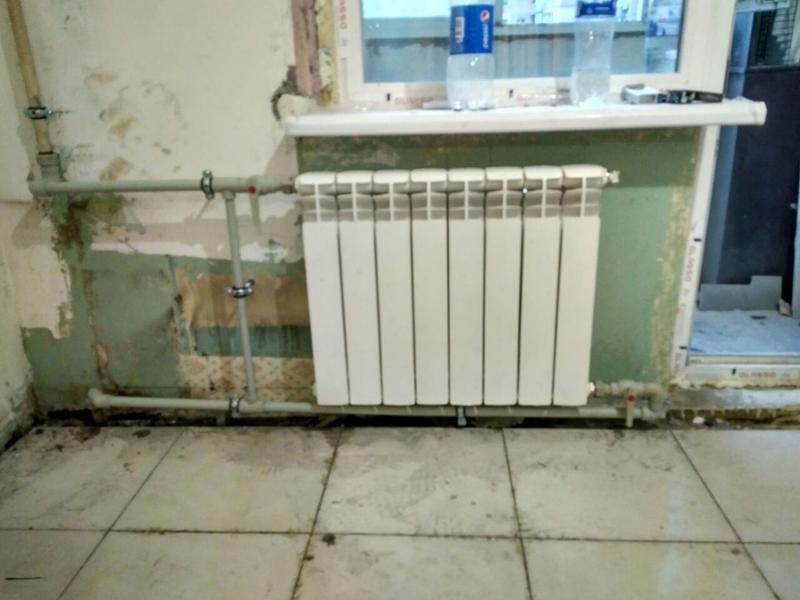
Shut-off valves that are installed on the “supply” and “return” are necessary so that at any time you can turn off the water and remove the battery for repair or replacement
The lack of correct calculations can lead to an imbalance in the home heating system.
Previously, for the calculations, you will need information that is in the DEZ:
Most often, old batteries are replaced with new modern models, usually aluminum or bimetallic. Although cast iron, copper and steel products are also on sale. The type of radiator is needed when performing calculations.
When choosing a suitable radiator for a house or apartment, you need to focus on its main characteristics, which are detailed in the product data sheet.
You will need such indicators as the pressure that the device can withstand, the maximum temperature of the coolant, heat transfer and other data. They can usually be found in the technical data sheet.
If not only radiators, but also pipes leading to them are to be replaced, a suitable material should be selected. Usually it is steel, metal-plastic or polypropylene. Some masters strongly recommend using only steel communications for centralized systems.
Depending on the type of pipes chosen, you will need the appropriate equipment for welding them.MP and PP pipes are easier to install than steel. To work with metal, you need not only a welding machine, but also a device for threading. Therefore, if the old pipes are clean enough, it is recommended to leave them and replace only the battery.
Old cast-iron radiators retain heat well, but slowly release it, in addition, they are heavy, which complicates installation, so bimetallic and aluminum models are more popular
The weak point of metal-plastic structures is connections. They must be performed very carefully, installation errors often lead to leaks. The popularity of MP pipes is explained by their relatively low price. Plastic is more expensive, but more reliable, if the welding is done correctly, the tightness of the joints will be very high.
Under the selected radiator, you need to select suitable fasteners. In this case, it is necessary to take into account both the type of radiator and the material of the wall on which the installation will be performed: brick, concrete, etc. Batteries are usually supplied with brackets of the appropriate type.
To install one radiator, two brackets are usually used at the top and one at the bottom. Their position is carefully checked by a level in order to eliminate the possibility of distortion during battery installation. However, some models are set with a slight slope to ensure the removal of air that has entered the system. If there are more than twelve sections, another top bracket may be needed.
Legal regulations
First, it is worth mentioning a couple of points that are not related to the technical side of the problem.
Often in print media and on legal forums the question is: “Who changes the heating radiators in the apartment?”.
We hasten to answer it:
If the apartment is in municipal ownership, all responsibility for the condition of the heating system (including in-house appliances) lies with the managing organization. At the same time, she has the right to independently decide on the degree of wear of the device and the need to replace it.
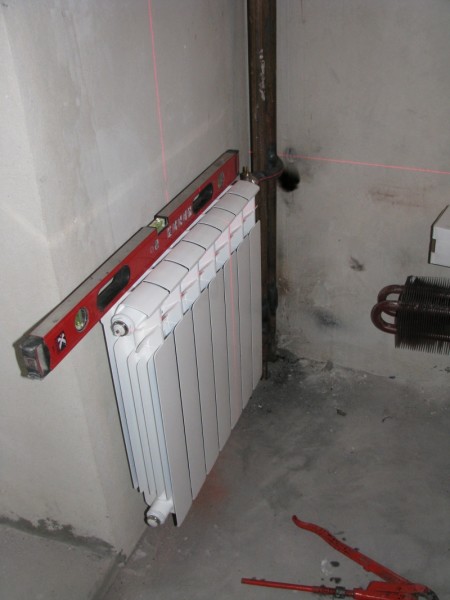
The planned replacement of exhausted batteries is carried out during the overhaul.
In a privatized apartment, the owner is responsible for the condition of all its property. In an emergency, a team (local housing organization or city emergency service) will fix the leak by plugging the lines, but will not replace the device or repair it.
Can the owner change heating radiators on his own, without coordinating the replacement with the managing organization? Yes, there are no restrictions here.
This work can be done by a hired team or by the owner himself - with two caveats:
- Responsibility for the damage caused to neighbors when their apartments are flooded also lies entirely with the owner of the housing. That is why after any operations associated with a violation of the tightness of the heating system, pressure testing is required.
- The power of the new heater cannot exceed the power provided by the project by more than 15%. Otherwise, your apartment will be heated at the expense of the neighbors: the heat flow transmitted by the riser is limited.
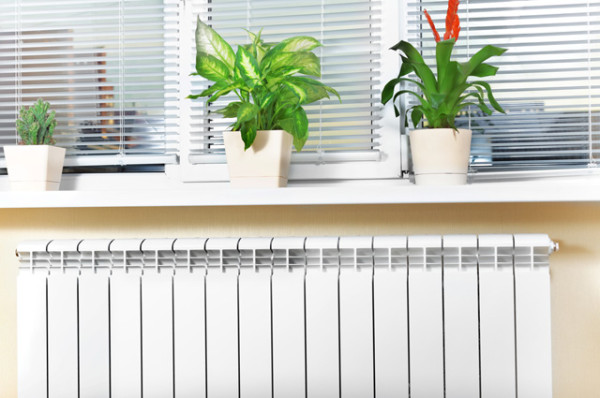
Excessive power from your battery will leave your neighbors without heat.
Some interesting tips
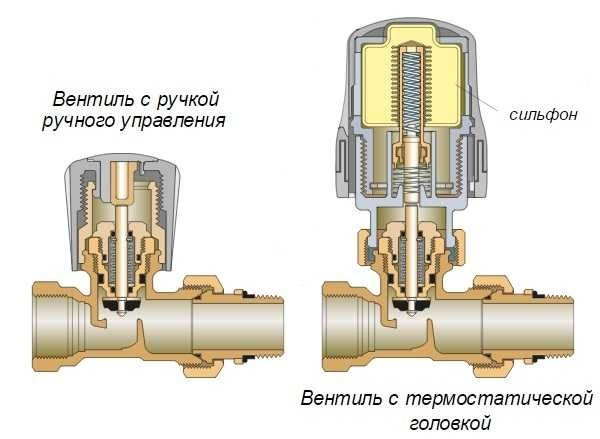
If the decision is made to change the used batteries, it does not hurt to think about installing a faucet, conventional or with a thermal head.In the first case, you can manually adjust the coolant flow, in the second, this will be done automatically. But if a thermostat is installed on the radiator, it does not need to be covered with a decorative screen.
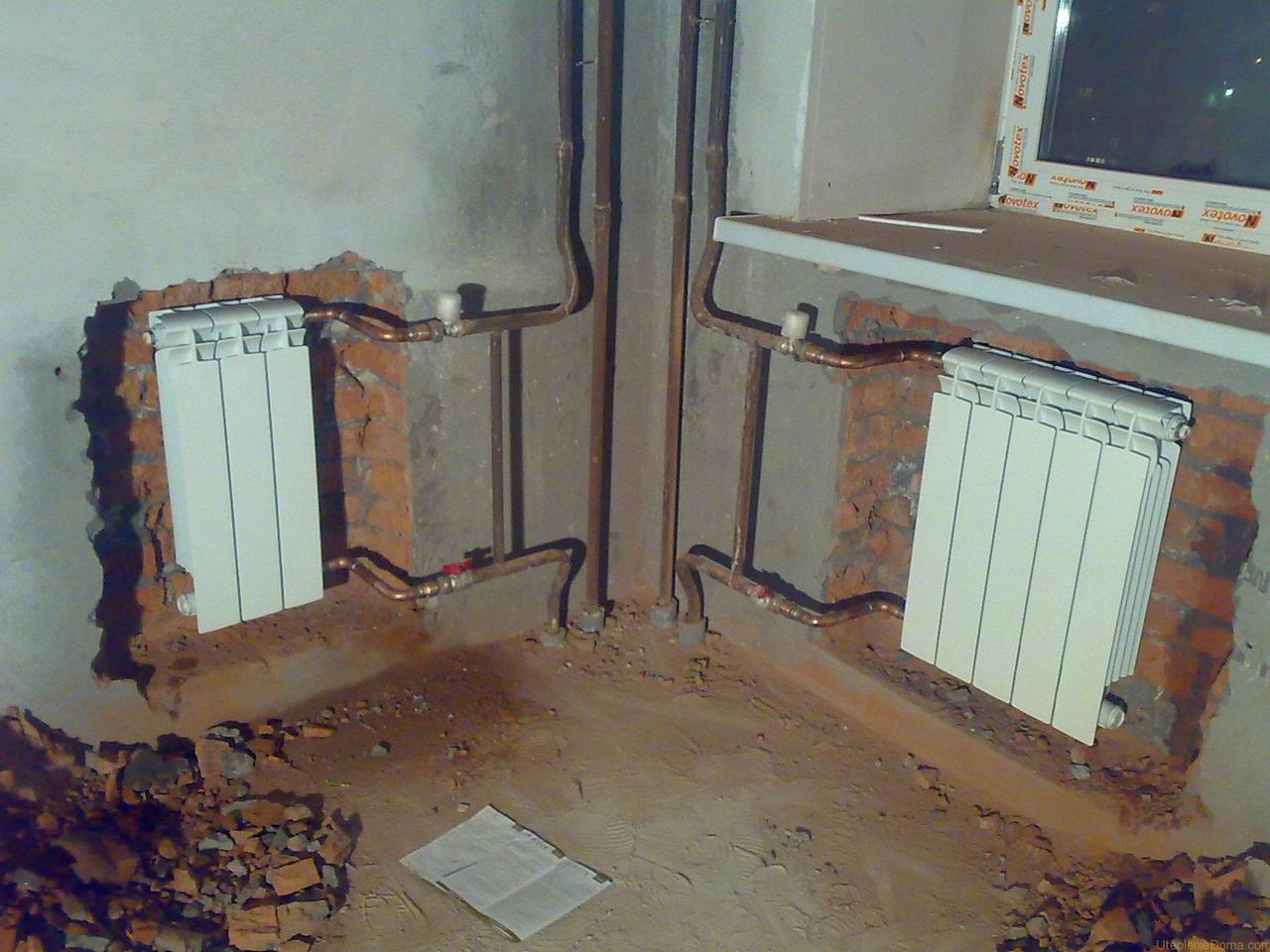


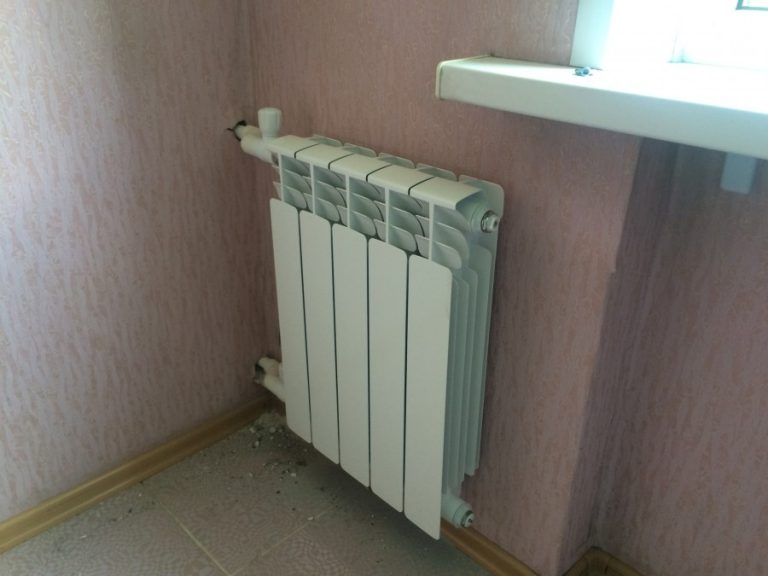
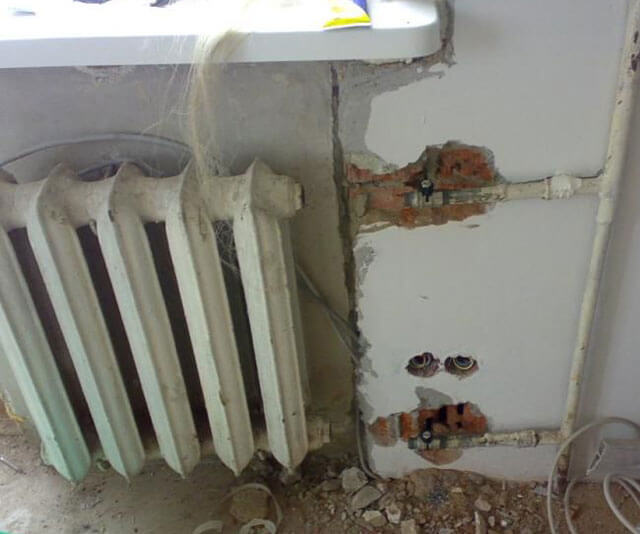


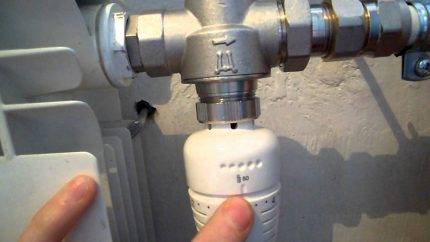 The thermal head on the stopcock makes it possible to change the amount of coolant so that the temperature in the room is always high enough
This will lead to data distortion when measuring temperature. It should be noted that thermostats can only be installed with single-pipe systems. In any case, at least stopcocks must be installed at the inlet and outlet of the radiator, if they are not available.
This will allow the radiator to be disconnected from the system in order to be cleaned or replaced, regardless of the season. The thermal power reflected in the data sheet of the battery does not always correspond to the declared one. If you increase the number of sections by 10%, you can improve the situation.
We demand new batteries from the local administration
This method is suitable for those whose apartment is not privatized. Decree of the Government of the Russian Federation of May 21, 2005 No. 315 approved the Standard Social Hiring Agreement, and it provides that:
- it is the responsibility of the tenant to carry out the current repair of the housing he occupies (which includes painting, pasting walls, ceilings, etc., as well as repair of in-house equipment),
- and all work related to a malfunction of common property or the need for major repairs is carried out at the expense of the landlord (i.e., the municipal administration).
Guided by the explanations of the Supreme Court of the Russian Federation that batteries without stopcocks belong to the common property of the house, it is possible to require the administration to replace the old batteries in the apartment with new ones.
Radiator connection diagram.
Taking into account the variety of options for laying risers and room shapes, as well as the presence of upper and lower coolant supply through risers, bimetallic radiator connection schemes are a separate story that is voluminous in content.
It is only important to note that due to the narrow channels of the vertical collectors of bimetallic radiators, they are sensitive to the direction of the coolant supply and, as indicated in the instructions of any manufacturer, it is important to connect the radiators in such a way that the cooled coolant always leaves the lower collector. With top feed, a standard side connection scheme is obtained.
But with a lower supply and side connection, the cooled coolant will exit the upper collector, while the vector of the gravitational pressure of the cooling coolant will be directed downward and prevent forced circulation from the side of the pumps, which leads to incomplete heating of the radiator, as a rule, only the first 2 sections work.
Therefore, with a lower supply, a bimetallic radiator should be connected either according to the bottom-bottom scheme.
Or according to a universal scheme, which does not depend on the direction of the coolant supply in the riser.
A feature of the universal scheme is the need to install a larger diameter pipe opposite the upper radiator outlet, in which, due to the principle of Bernoulli's law, increased pressure is created causing the coolant to flow into the upper radiator manifold.
You can read in detail about all the wiring diagrams for bimetallic radiators in my article “How to install a bimetallic radiator correctly” on my website, where I give examples of more than 50 different options from my practice.
Artist choice.
As it becomes clear from this article, a heating radiator installer must have a serious amount of knowledge, skills and tools for the quality provision of this service, taking into account all the above nuances. I also want to note that, taking into account the specifics of Internet marketing in the market for services for replacing heating radiators in apartments, unfortunately, there are a large number of unscrupulous performers, which I did a detailed review in my article comparing several proposals of those present at the request "replacing radiators" in the top 10 Yandex, the article "It's expensive for you!" on my site in the Master's Blog. Be careful.
Moderator of the Heating section, forum City of Masters, Sergey @k@ Olegovich, techcomfort.rf.
Who and when should be engaged in maintenance and repair?
According to the above standards, the repair and replacement of heating appliances belonging to common house property is assigned to the management companies, whose property is the entire heat supply system in the house, if this heat network does not have distinctions inside the apartments (shut-off valves).
The article “Maintenance and repair of common house property” can be found in the receipt for payment for services, according to which the owners of MKD pay a monthly fee for the maintenance of this property (how is the heating fee formed?). It is from this fund that the management company should seek funds for the repair and replacement of batteries and other communications included in the heating system.




Who should repair, we figured it out. Now about when such equipment should be changed or repaired. In case of emergencies - immediately.
The landlord does not have to pay for these services to plumbers or other persons.
The question of replacing radiators is more complicated.Here you should rely on GOSTs and other standards that determine the battery life.
We solve legal problems of any complexity. #Stay home and leave your question to our lawyer in the chat. It's safer that way.
Ask a Question
Miscellaneous schemes
There are fundamentally different schemes for filling the coolant. With the upper filling method, it is provided for the delivery of the supply to the attic of the house. With this system, the risers will be independent and they are turned off in the basement and in the attic. At the bottom bottling, the distributing pipes for supply and return are located in the basement technical floor. You will have to disconnect the supply and return risers.
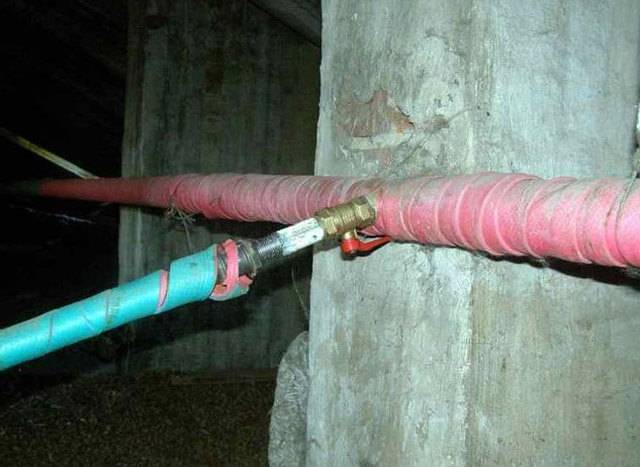
The type of wiring is determined as follows: when in the basement along the perimeter of the building there are two horizontally located pipes, covered with heat-insulating material, pouring the lower circuit. If there is only one pipe - the upper one.
You need to find a riser that goes to the apartment, while you can navigate along the flights of stairs between the entrance and the platform of the 1st floor, and in the attic - through the windows.
Why is it needed
But really, why change heating appliances?
This is practiced in the following cases:
If the heat output of the old appliance is insufficient to maintain a normal temperature in the room at the peak of cold weather. The temperature in different rooms of the apartment is regulated by the current SNiP and should be at least:
| room | Temperature, C |
| living rooms | 18 |
| Living rooms in regions with the coldest five-day temperature of -31C and below | 20 |
| Kitchen | 18 |
- If corrosion or erosion by suspensions contained in the coolant makes further operation of the device impossible. Soviet-style plate radiators are most typical in this regard: after 7-10 years of operation in the heating circuit, they begin to leak massively.
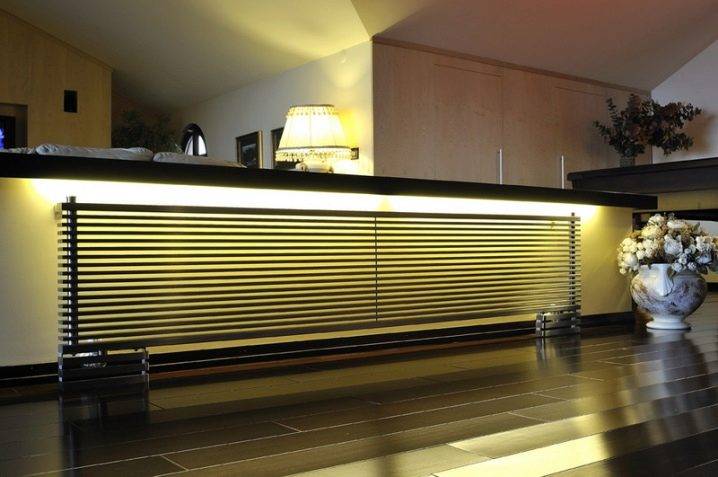
- If the appearance of old batteries does not fit into the design of the room.
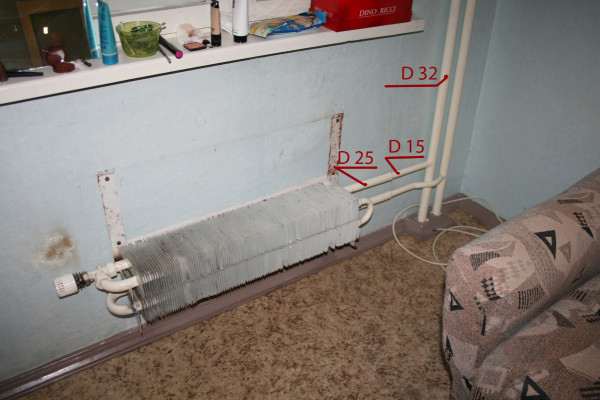
The old convector in the photo clearly does not decorate the room.