- The mechanism for replacing the heating riser of an apartment building
- Reasons for replacing the heating system
- aluminum batteries
- Sequence of work when replacing radiators
- Cons of replacing radiators
- Options for connecting heating systems
- Who can replace the batteries
- Type of heater.
- Sample Documents
- Battery replacement procedure
- Who pays for the replacement of old radiators with new ones?
- Scheme of the heating system - "Leningradka"
- At whose expense is the replacement of heating pipes in case of an accident
- Classification of district heating systems
- According to the mode of consumption of thermal energy
- Type of coolant used
- According to the method of connecting the heating system to the heat supply
- According to the method of connection to the hot water heating system
- We collect, install, connect the radiator
- Can I replace myself
- What you need to know when installing radiators
- The main laws of the Russian Federation in relation to heating and radiators
- Basic rules and regulations for the installation of heating appliances
The mechanism for replacing the heating riser of an apartment building
Consider the order in which replacement of all or part of the heating risers in an apartment building:
- Stops the access of water in the system. In the basement or in the attic, depending on the characteristics of the heating. Overlapping is performed by a locksmith of the housing office or your cooperative.When it comes to payment, things are different here. In case of an emergency - it's free, if planned, then some amount will be billed for payment.
- If pipes need to be replaced on several floors, then they are cut out so that they can be carefully removed. This is done with the help of a grinder.
- New wiring in the apartment is in progress. Think over, estimate everything in advance, because, in addition to warmth, aesthetics are also important. Yes, and putting a battery with a large number of sections of radiators also makes no sense. Excessive heat is poorly tolerated by children and people with problems of the cardiovascular system, the elderly.
- Batteries are assembled and fixed in the selected places. You need to install evenly, so you protect the radiators from the formation of air locks (sources of stagnation and cold).
- Heating pipes are connected from the upper to the lower floor.
- Mandatory in modern heating systems is the installation of a water supply tap. It is used only if necessary to stop water from entering the radiator in case of an accident.
- The locksmith turns on the water.
Reasons for replacing the heating system
In multi-apartment, private houses of the old building, radiators made of cast iron or steel were mounted. This material is prone to corrosion, dirt sticking to the walls, which leads to blockages and leaks. But even modern radiators installed in new homes can fail. There are a number of possible reasons why heating pipes may fail and need to be replaced.
 Replacement of old pipes with bimetallic ones
- Incorrectly installed circuit. There are a number of rules, technologies for assembling heating in an apartment, the order in which the main elements (faucets, pumps, expansion valves) are located.Trying to reduce the cost of housing, developers save on installing all the necessary fittings. For example, if the repairmen did not provide shutoff valves when connecting the radiator, then it will be impossible to remove it for repair or cleaning. You will need to turn off all water supply to the system. It also happens that some unscrupulous craftsmen make changes on their own, without thinking about the consequences, which then have to resort to a complete replacement of the riser and heating pipes
- Low temperature. This is a fairly common reason for redoing your design. The lack of heat can be completely corrected by simply replacing the batteries or increasing the diameter of the pipes.
- Incorrectly designed wiring system. It depends on the scheme how exactly the water will circulate in the radiators, whether the directions of supply and return coincide. If the scheme is chosen incorrectly, then you will have to completely redo the entire heating system.
- High breathability. For high-temperature structures, diffusion is a big problem. The material from which the pipeline is made can pass air. The presence of air accumulations in the hydraulic system can cause serious problems and lead to cavitation processes, that is, the occurrence of noise and water hammer. According to the established standards, it is allowed to use materials with an anti-diffusion coating, the penetration coefficient of which is not higher than 100 mg/m2 per day.
Nevertheless, experts identify two main problems when replacing heating pipes is required:
- Strong wear of the pipeline. This is especially true in old houses where metal structures predominate.Over a long service life, they become overgrown with deposits and cease to function effectively.
- Carrying out overhaul. If you have a private house, and you decide to redevelop, change the location of the boiler or boiler. If this is an apartment building, then a planned overhaul of the riser, pipes in the basement is carried out.
 Accumulation of rust and dirt in cast iron batteries
aluminum batteries
Aluminum batteries are cheaper and easier to install and maintain than their bimetal counterparts. At the same time, they are not without certain shortcomings.
The main one is the increased sensitivity to the acidity of the coolant. In order to maintain the working condition of such batteries, it is necessary to regularly carry out their anti-corrosion treatment. That is why it is not recommended to use them in a citywide network, because there are no guarantees that good quality water will go from a thermal power plant into your pipes. Aluminum radiators are the best choice for private houses and cottages, when it is possible to individually design the heating system.
To summarize the advantages of aluminum batteries:
- lungs;
- look attractive;
- heat up quickly;
- withstand great pressure
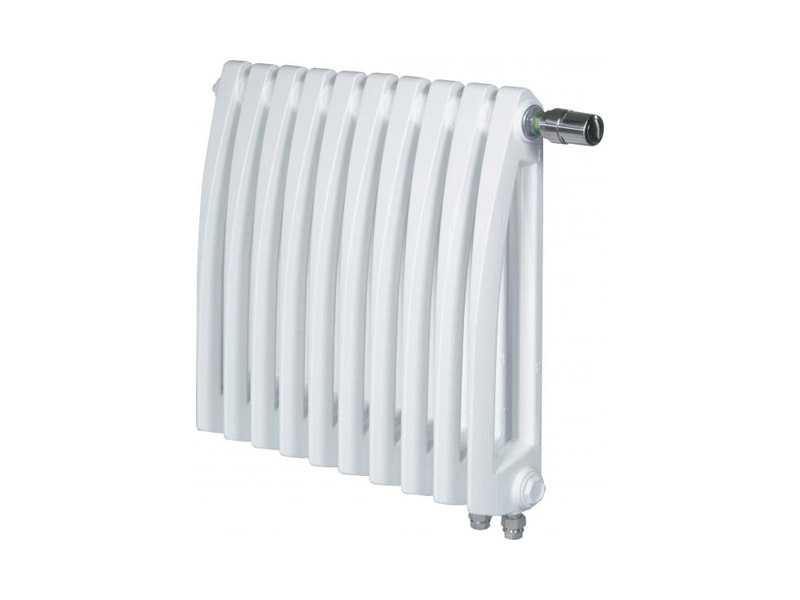
Of the minuses, as already mentioned, it is worth noting the sensitivity to the quality of the coolant and, in connection with this, the possible need to use special additives. However, modern manufacturers are aware of this feature of aluminum and reinforce it from the inside with special protective coatings.
The practical representatives of aluminum models include Alecord 350. Unlike the bimetallic counterpart, here the heat dissipation of the section is 155 W with a weight of 0.87 kg and a capacity of 0.2 liters.Working / maximum pressure is 16/25 atmospheres. The interior finish is highly resistant to corrosion.
When the time comes, it is better to change the heating batteries in the apartment for more modern options. Unless, of course, you are not eager to leave heavy and voluminous radiators - but there may really be reasons for that. Otherwise, modern cast iron, aluminum and bimetallic batteries win in almost everything. A huge selection, affordable price, smaller dimensions and weight - all this distinguishes them in a favorable way from old cast-iron radiators.
Sequence of work when replacing radiators
To carry out the dismantling of old heating devices, it is necessary to drain the coolant from the heating system. The easiest way to perform this procedure is in a private house, using a tap, the presence of which is provided for at the design stage of an autonomous heating system. In an apartment building, you will need to call a representative of a service organization or management company.
Dismantling the old heater with the help of a grinder, which every lover of do-it-yourself repair work has. In this case, the master works without protective equipment - this cannot be done
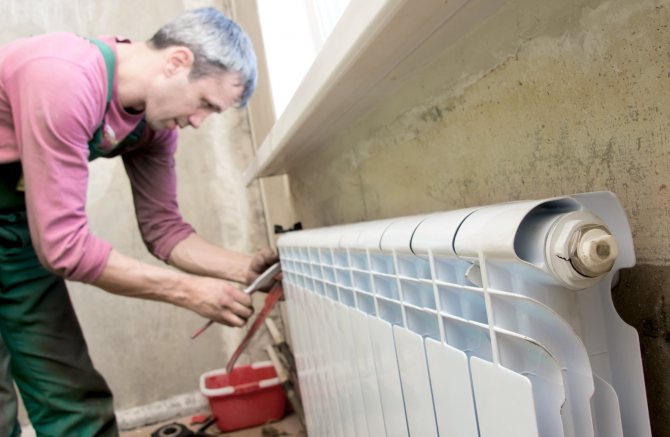
After draining the coolant, they begin to dismantle the batteries that have served their time. For cutting pipes use an ordinary angle grinder. The cut must be neat and straight so that the installation of new heaters can be carried out without unnecessary difficulties.
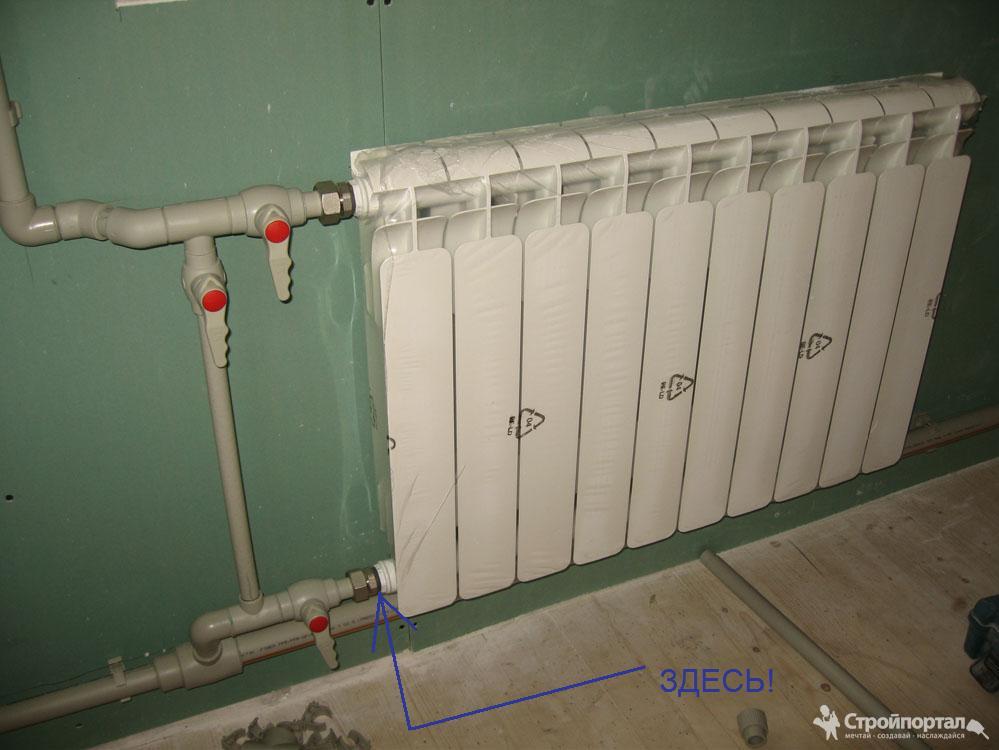
Then a new battery is packed, and this procedure can be performed by the owner of the apartment on his own. In this case, it is necessary to stock up on some materials: investment paste, flax, a set of nuts for pipes, an adjustable wrench.The nuts are sealed with flax, smeared with paste, and then they are screwed onto the pipes protruding from the radiator. Then, from the attachment side with pipes of the heating system, a ball valve with a drive, called an American, is installed, as well as a Mayevsky crane.
Assembly of a new bimetallic heating radiator from separate sections using sealed nipples
Next, the installation of a new battery begins, installing it in place of the old radiator. They start welding the drive, screwed into the battery, to the heating system. For better circulation of the coolant between the pipes (suitable for the battery and leaving it), a jumper pipe is welded.
A real master of his craft will carefully install a new battery like this. The owners can only paint the replaced pipe sections, after which no one will even guess about the installation work
As you can see, the process replacement of heating appliances is a serious matter and very responsible. Therefore, to carry out work, it is worth contacting the housing department in writing. The owner of the apartment writes a statement-request in which he describes the problem and the need to shut off the heating system in an apartment building. Employees of the housing office will consider the application, give permission and agree with the applicant on the date of installation work. Next, you need to wait for the plumber, who will be sent by the housing office to the address indicated in the application. The plumber will turn off the heating system and carry out all the necessary work. Upon completion of the radiator replacement procedure, the specialist will without fail test the system in test mode in order to verify the quality of the service provided to the applicant.
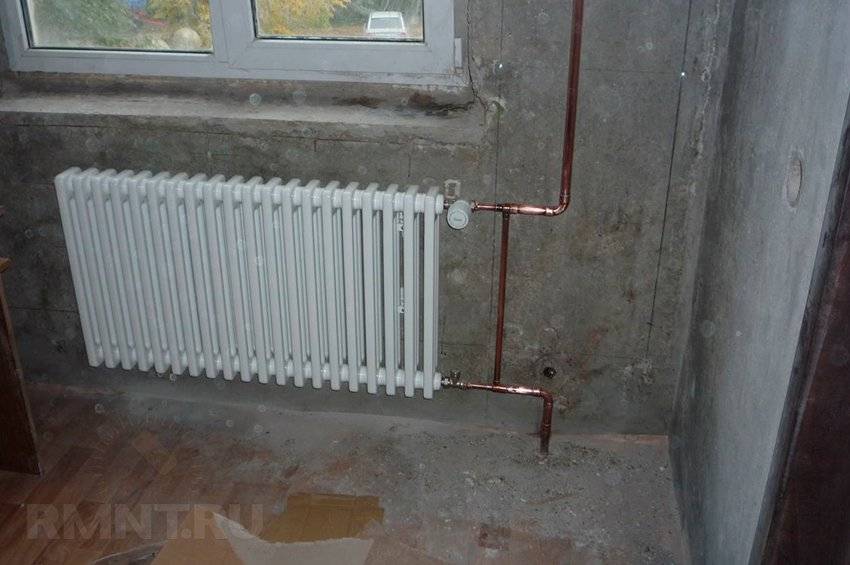
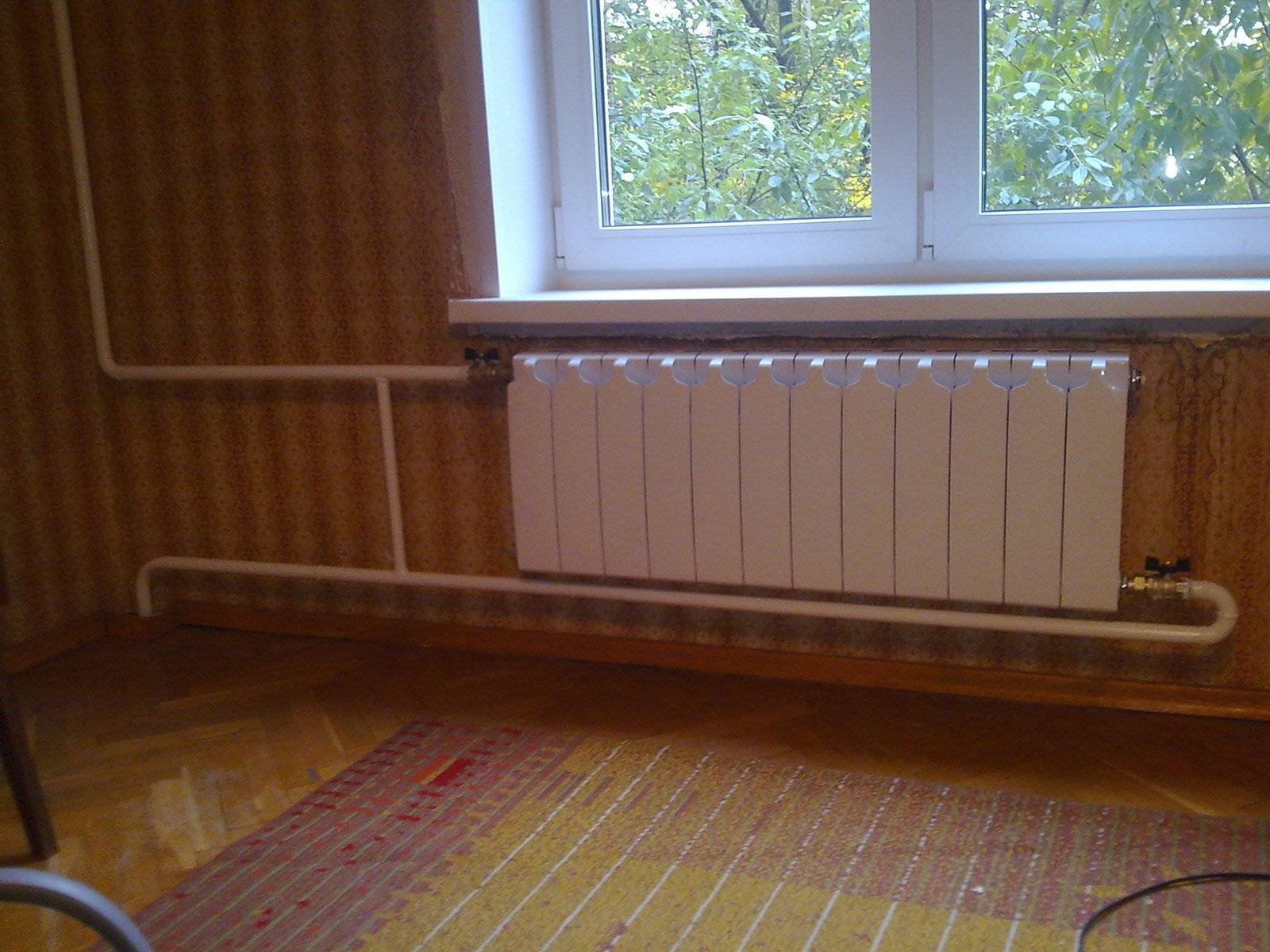
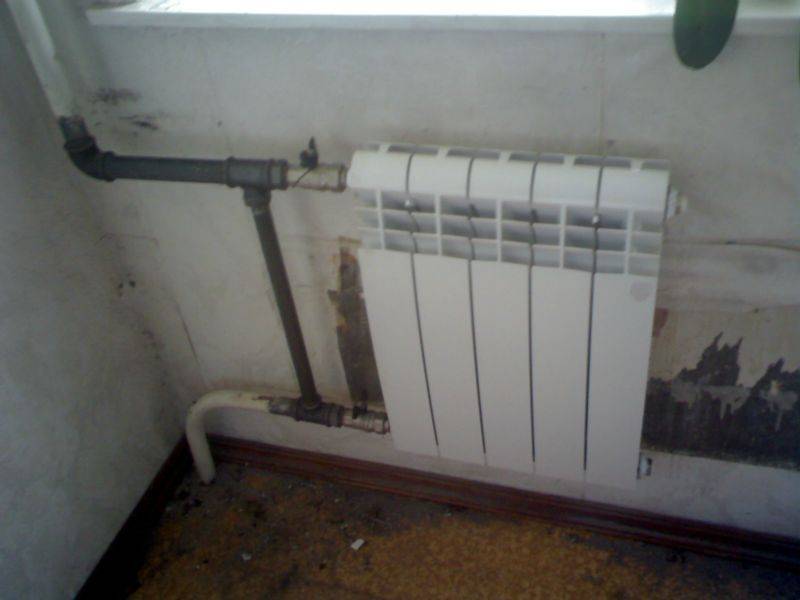
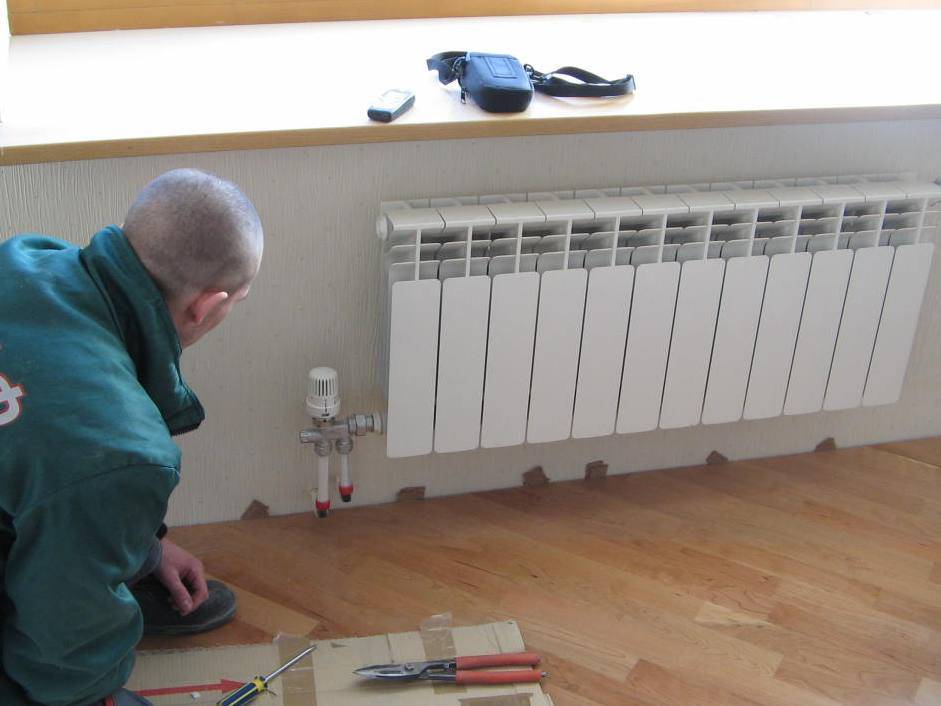


Some housing offices may require documents from which you can find out the technical characteristics of the installed heating elements. Such documents may include a technical passport, as well as a description of pipes and batteries.
Cons of replacing radiators
There are also downsides to this process. Many attribute these facts to them:
- availability of qualifications for welding work or remuneration of the relevant specialist;
- purchase, rental or availability of gas welding equipment;
- figuring out how much it costs to change a battery using welding, in some cases the price will be higher than other types of work.
However, all such shortcomings are compensated by the reliability and durability of the connection, when using high-quality consumables. The performance characteristics of this type of connection have proven their effectiveness over many years of their use.
Due to the physical and chemical processes occurring during welding, a strong seam is formed, which receives mechanical characteristics that exceed the reliability of the welded pipes. This corresponds to the fact that the occurrence of any gust in the future along the resulting connection is excluded, and replacement of heating batteries will run in a breeze.
Accordingly, gas welding, in the context of the question of how much it costs to change a heating battery in an apartment, is the most profitable and durable option for resolving the issue. This will leave a small aesthetic seam that will be easy to hide with paint.
Options for connecting heating systems
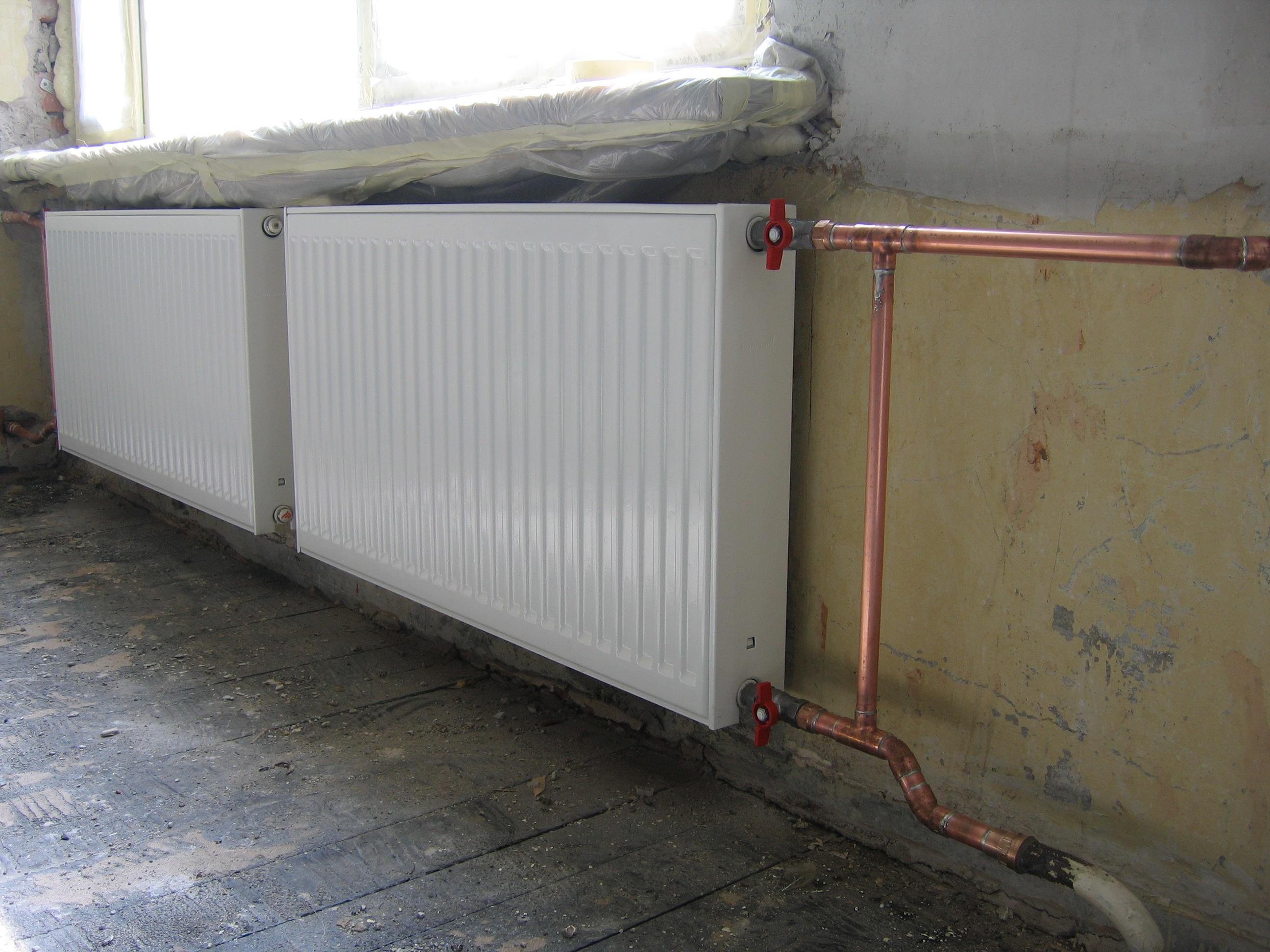
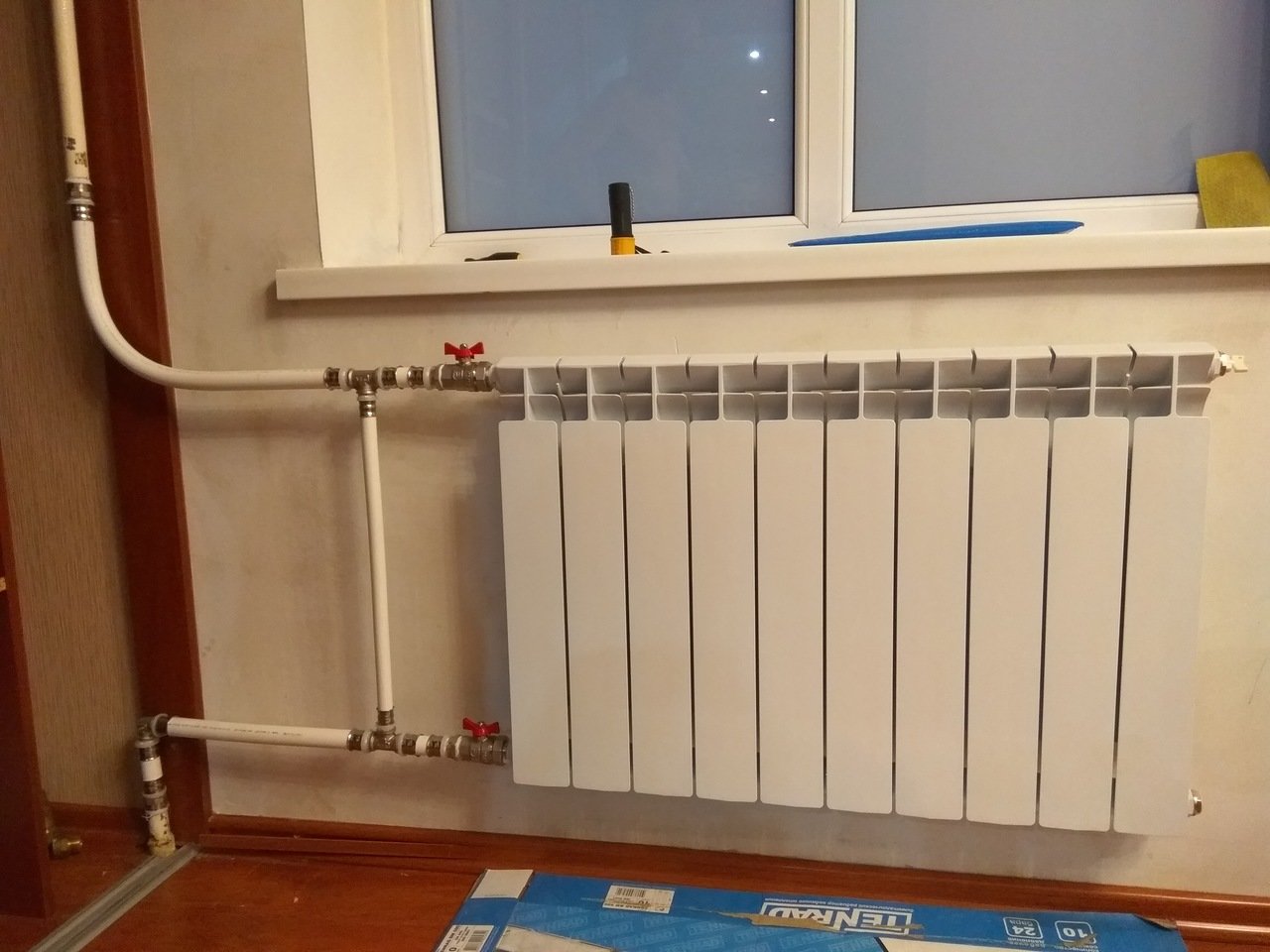
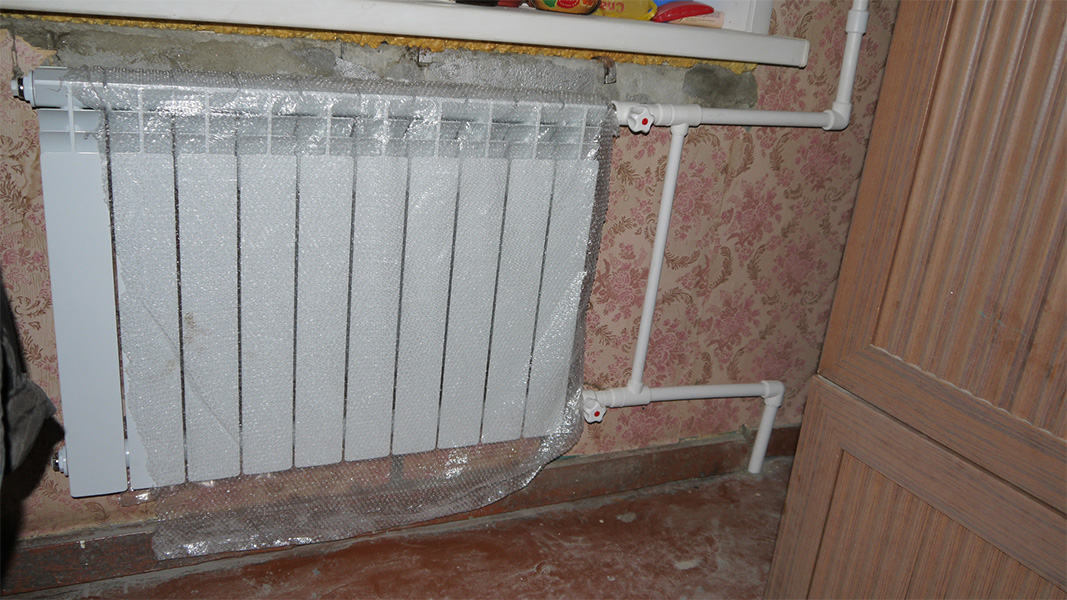
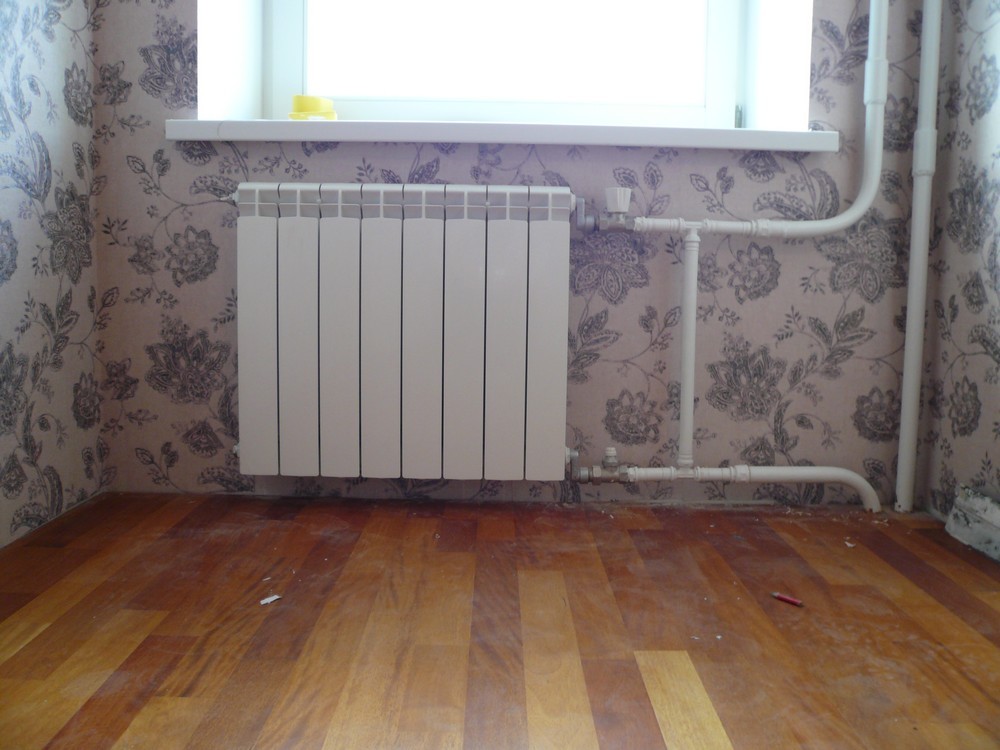
In addition to choosing the radiator itself, during installation you will also need to decide how to connect it to a centralized network.There are several different options available to you, each of which has its own scope of use:
diagonal connection. This scheme is the best choice for long multi-section radiators. It is distinguished by the fact that the water supply pipe is attached to the pipe from above on one edge of the radiator, while the outlet pipe is attached to the lower pipe on the other side. Among the disadvantages of such a system are heavy repairs in case of malfunctions: the scheme does not imply removing the battery without completely turning off the heating.
Radiator connection options
Important! When supplying water from below, you will lose about 10% of the possible heat
Bottom connection
This wiring diagram looks the most inconspicuous. It is used if the pipes are located inside the floor or hidden under skirting boards. The inlet and outlet pipes are directed perpendicular to the floor surface. The main disadvantage is that this system involves the greatest possible amount of heat loss. Lateral one-way connection. It is the most common and effective. Maximum heat transfer is ensured by connecting the inlet pipe from above, and the outlet pipe from below on the same side of the battery. When inverted, the heating power is significantly reduced, so it is not recommended to change the pipes in places.
- Bottom connection. This wiring diagram looks the most inconspicuous. It is used if the pipes are located inside the floor or hidden under skirting boards. The inlet and outlet pipes are directed perpendicular to the floor surface. The main disadvantage is that this system involves the largest possible amount of heat loss.
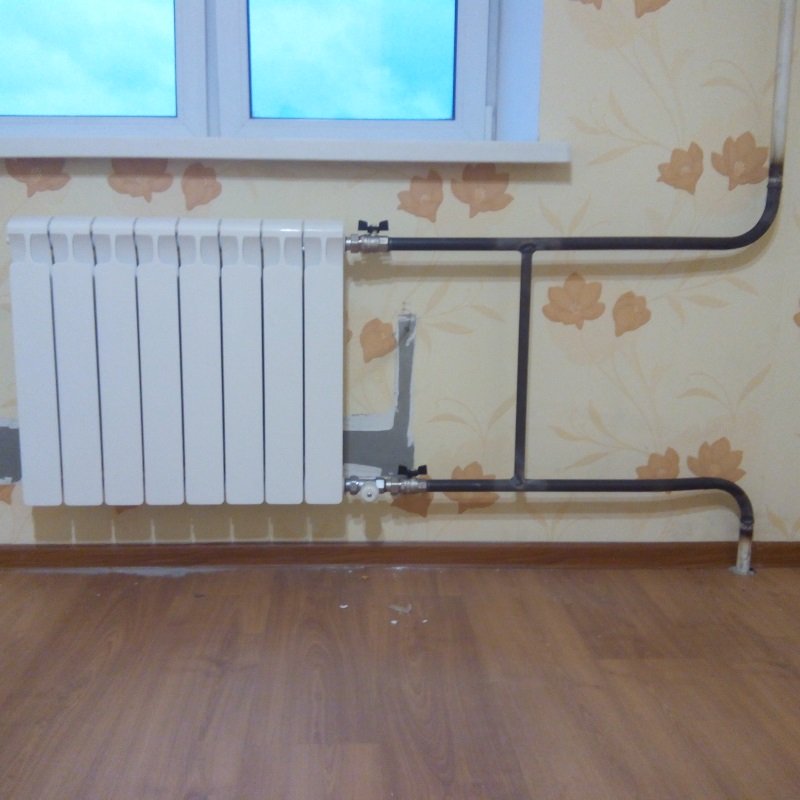
- Lateral one-way connection. It is the most common and effective.Maximum heat transfer is ensured by connecting the inlet pipe from above, and the outlet pipe from below on the same side of the battery. When inverted, the heating power is significantly reduced, so it is not recommended to change the pipes in places.
Important! In case of insufficient heating of the far sections of the battery, an extension of the water flow is used. Parallel connection
It occurs through a heat pipe built into the heating system. The withdrawal is implemented in the same way. Such a system allows you to replace batteries without turning off the central heating, but the main disadvantage is that with insufficient pressure in the system, the batteries do not warm up well.
Parallel connection. It occurs through a heat pipe built into the heating system. The withdrawal is implemented in the same way. Such a system allows you to replace batteries without turning off the central heating, but the main disadvantage is that with insufficient pressure in the system, the batteries do not warm up well.
Important! Connecting a heating radiator with your own hands in this way is quite difficult; it would be better to entrust this work to experienced installers. Serial connection
In this case, the heat transfer through the system occurs due to the air pressure in it. Excess air descends with the Mayevsky crane. The main disadvantage of such a system is also the impossibility of repair without shutting down the entire heating system.
Serial connection. In this case, the heat transfer through the system occurs due to the air pressure in it. Excess air descends with the Mayevsky crane. The main disadvantage of such a system is also the impossibility of repair without shutting down the entire heating system.
Who can replace the batteries
When replacing radiators with your own funds, you have to choose a direct contractor. Who has the right to do this work?
The choice is from the following options:
- Independently replace the battery in the apartment, if you have a professional skill.
- Hire a private person.
- Reach out to third-party specialized organizations.
- Calling a master from a service organization.
Note that the second and third options are not very practical. In the event of any unforeseen circumstances when replacing the battery in the apartment, at whose expense will the damage be repaired? That's right, for yours. And already you yourself will deal with third-party companies or a private trader.


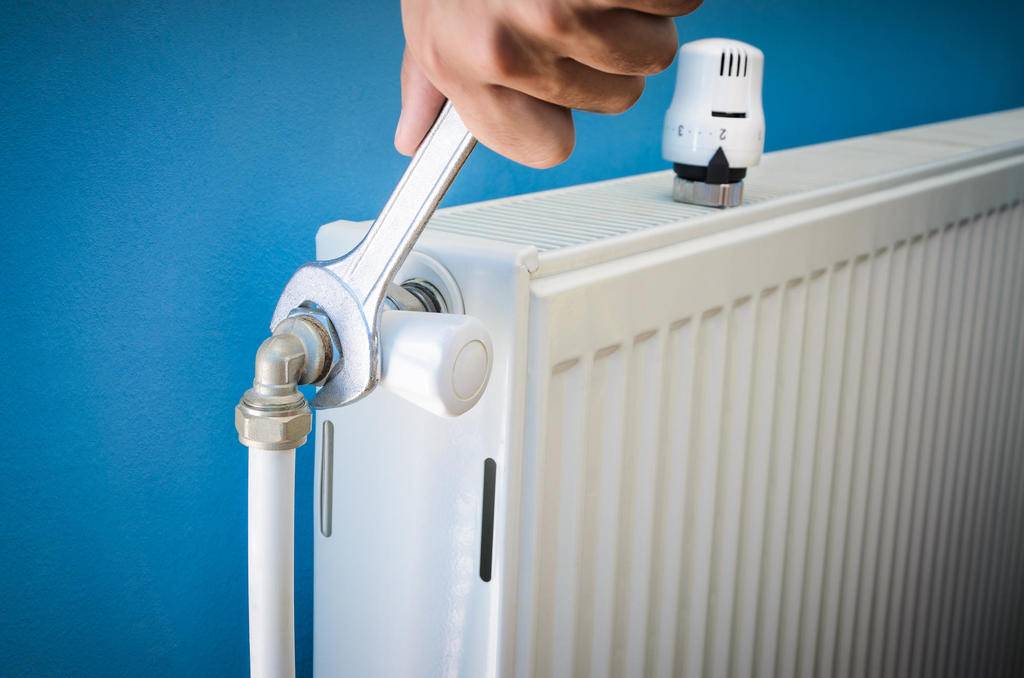

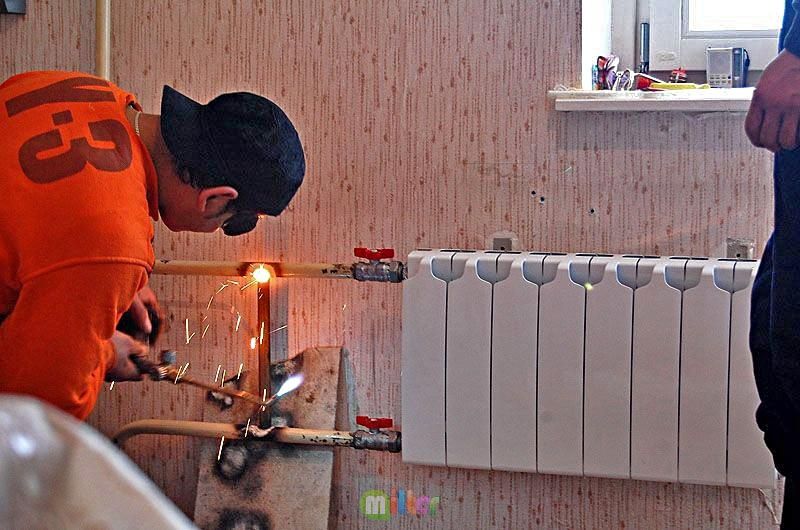


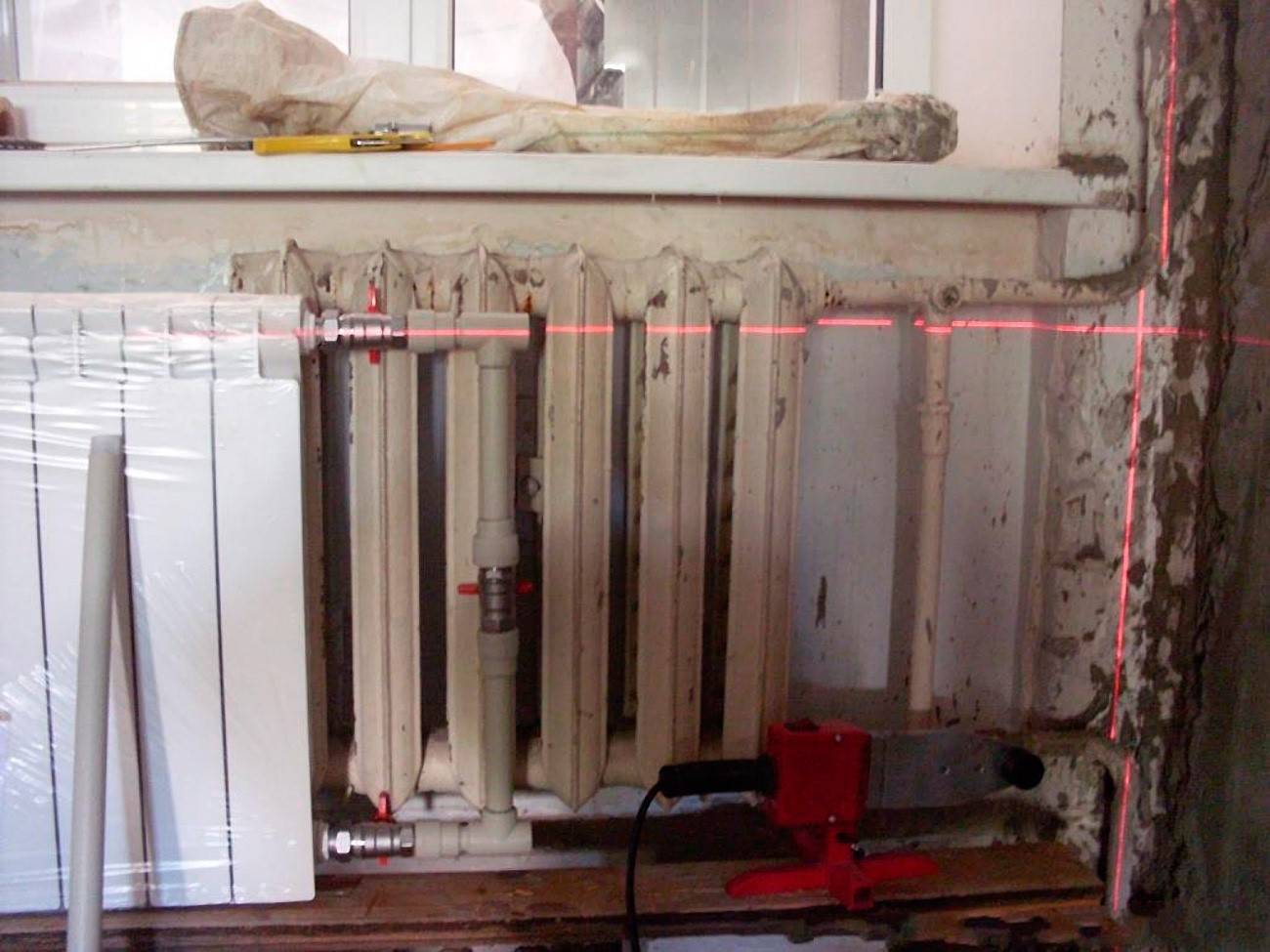

If you decide that you will carry out the replacement of the battery in the MKD apartment at your own expense, write an application to the organization serving your home.
Let's explain why:
- its specialists have all the wiring diagrams and are familiar with the features of central heating;
- have access to the points of shutdown and supply of heating to the apartments;
- they will also be responsible in case of force majeure.
Type of heater.
Three types of radiators are suitable for installation in the central heating system of an apartment building from modern heating devices:
- cast iron
- bimetallic
- steel tubular.
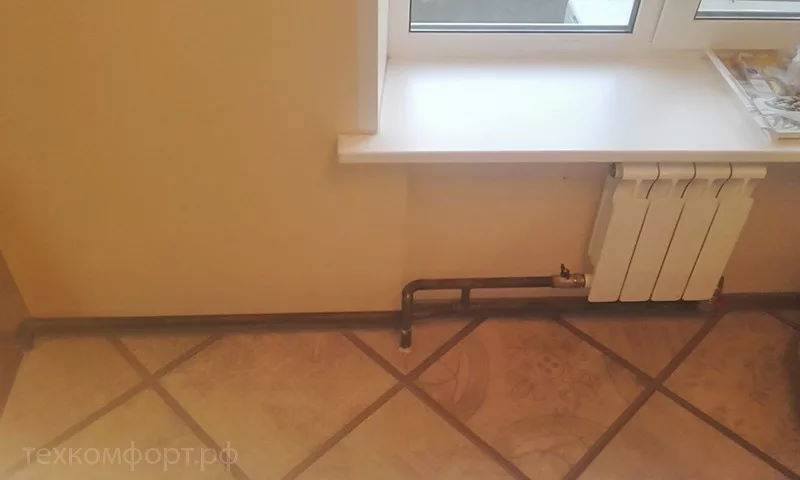
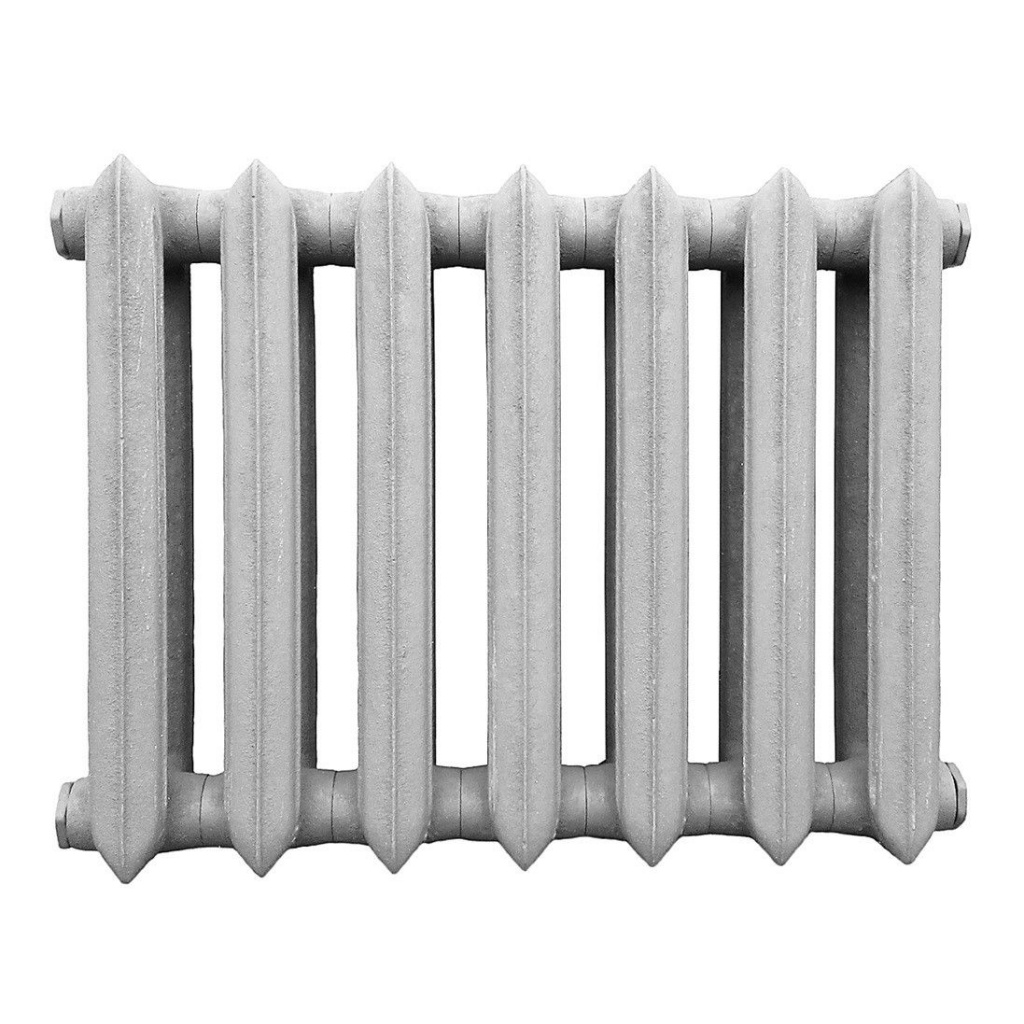
The advantage of cast iron radiators is their versatility, due to which their operation does not depend on the direction of the coolant supply through the riser, but there are 2 serious drawbacks. Cast iron is a brittle material, so it is not recommended to install them in high pressure systems, therefore, according to the project, you will never find cast iron radiators in modern high-rise buildings with more than 9 floors.And also cast iron is not amenable to such processing as steel and aluminum, so the surface of cast iron radiators is always rough and requires additional painting.

Of the bimetallic radiators, it is worth highlighting two models that compare favorably with the whole variety on the market due to their construction and design: Rifar Monolit and Rifar Supremo.
Rifar Monolith.

Rifar Supremo.
These two models, unlike all other bimetallic radiators, have several important design features:
-radiators have an all-welded collector, which excludes leakage between sections.
- inlet diameter to the manifold Du-20 (3/4″), which eliminates the need to install a transition sleeve mounted on a gasket, which may eventually lose its elasticity and cause leakage.
- wide seats for brackets, thanks to which the radiator slides without causing extraneous sounds during thermal expansions on the risers.
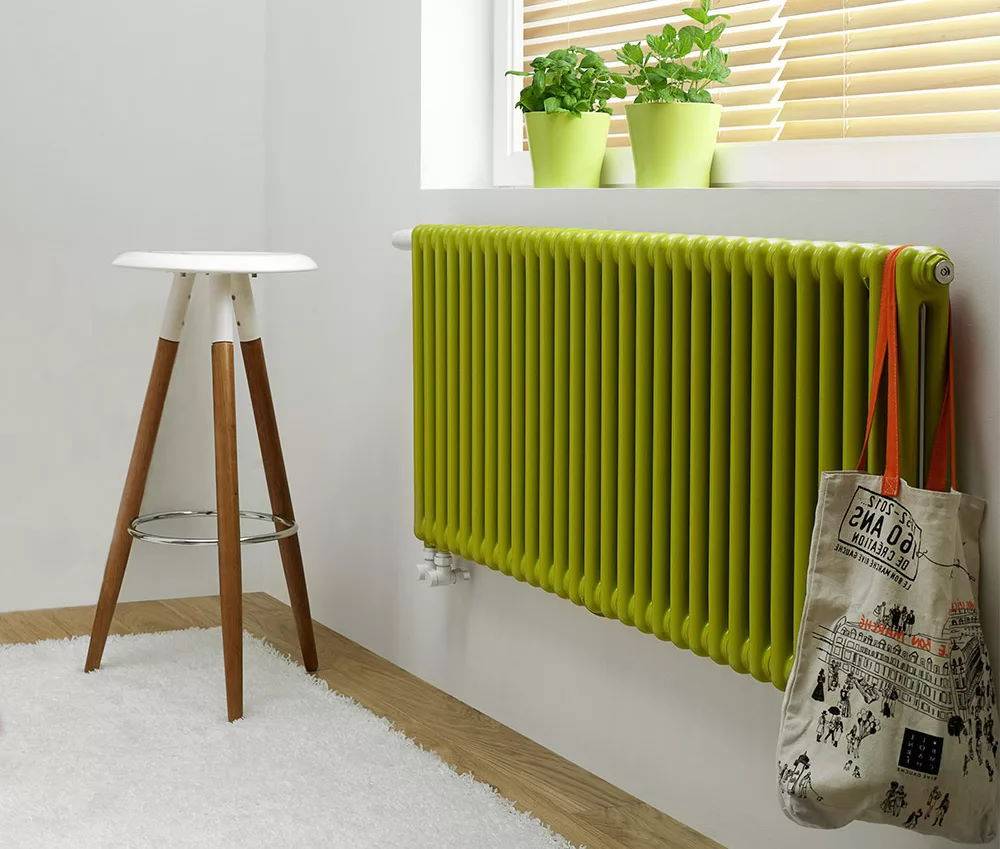
The advantage of steel tubulars, in contrast to bimetallic ones, is the absence of a large number of thin plates, which in rare cases can cause acoustic discomfort.
Steel tubular radiator Arbonia.

Sample Documents
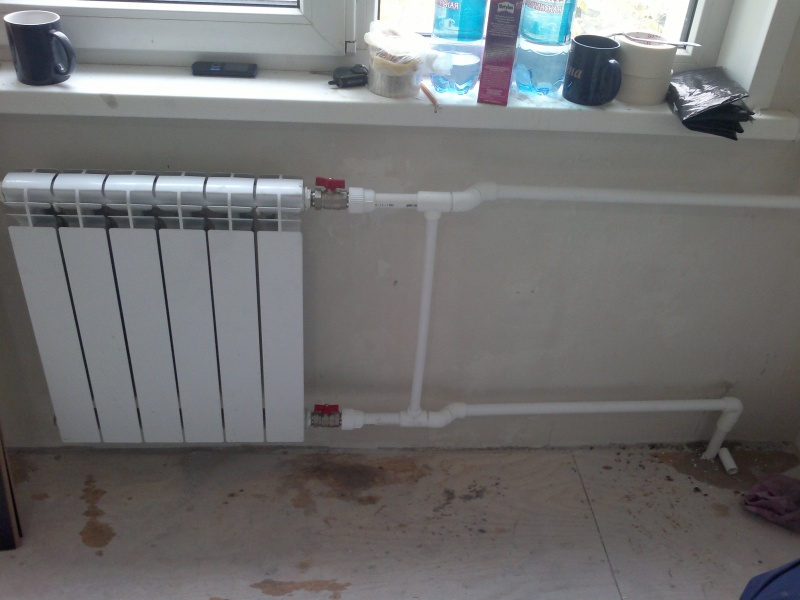
As mentioned earlier, a citizen will have to write an application to the Housing Office. The form of the document is not established in the current legislation. Therefore, it is permissible to write an application arbitrarily
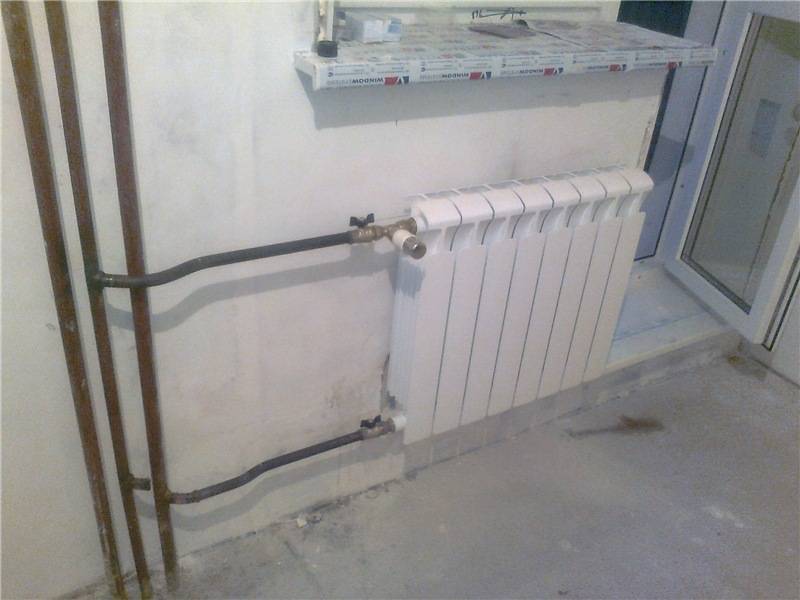


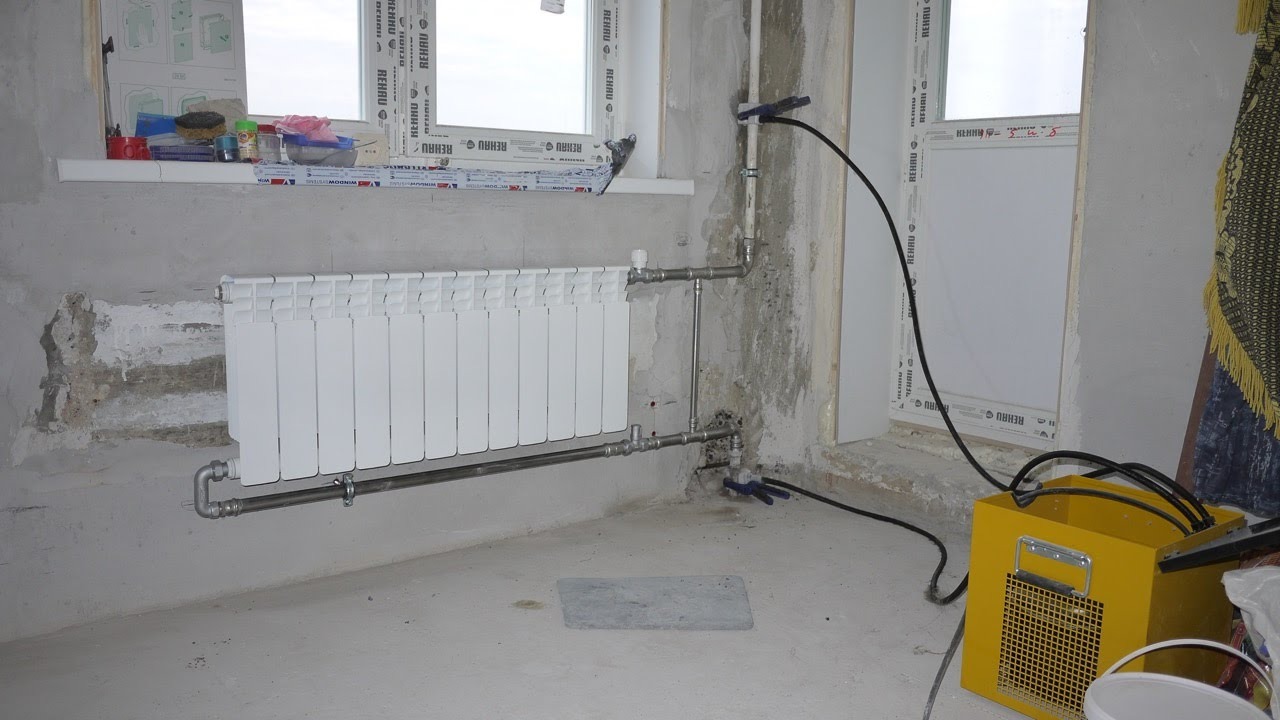
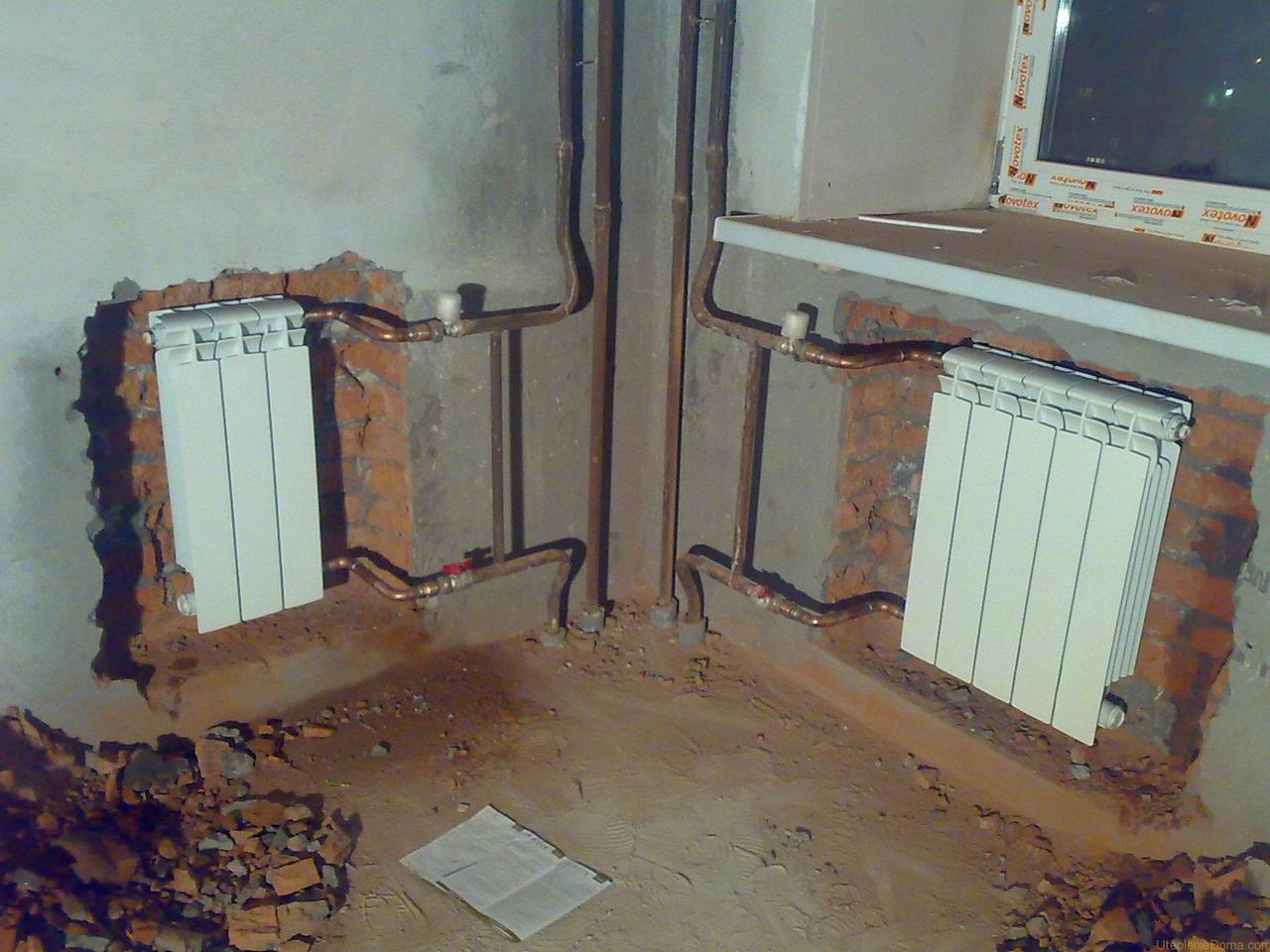


However, it is important to follow generally accepted business principles. Experts advise to reflect the following information in the document:
- information about the organization to which the appeal is sent;
- personal data of the applicant and address of residence;
- document's name;
- description of the specifics of the situation;
- a request made to the institution;
- date of preparation of the document and signature.
Handwritten paper is allowed. The signature is affixed by hand. Upon receiving the appeal, representatives of the authorized body are obliged to respond. If the decision is positive, it is permissible to turn off the heating.
Battery replacement procedure

To replace the old radiator, first close the riser, then cut the radiator, install a new radiator, remembering to install three taps into the system to simplify future maintenance of the system.
Replacing the heating batteries in the apartment begins with the fact that a specialist from the housing office turns off and drains the riser - all work is carried out in the absence of a coolant. As soon as the heating riser is drained, we get to work. With a welding machine or a grinder, we cut off the old radiators and send them to the scrap. We install new bimetallic batteries under the window sills, level them.
Next, we prepare the pipes - with their help, the connection will be made. If old steel tubular batteries were installed in the apartment, then the inlet and outlet pipes will be located too close to each other. Therefore, we need to space them out so that they correspond to the location of the inlets and outlets on the new radiators - this is done using segments of bent metal pipes.
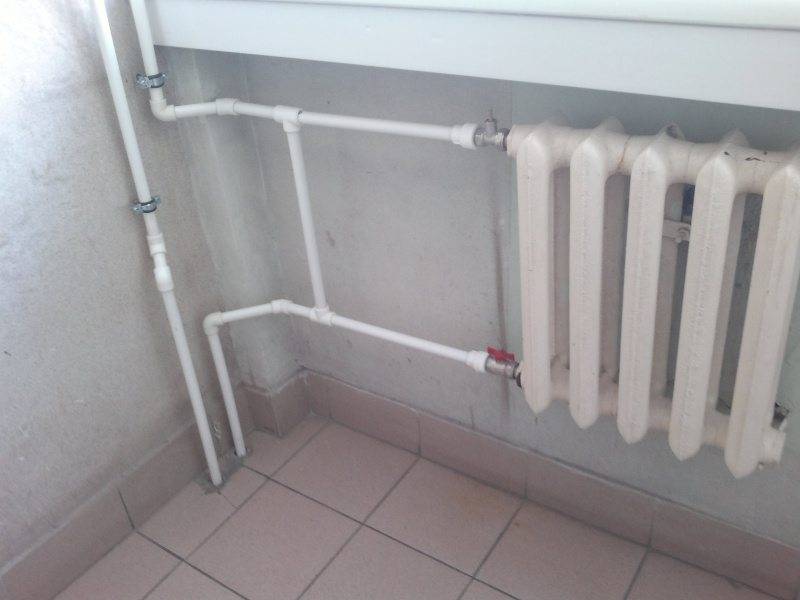
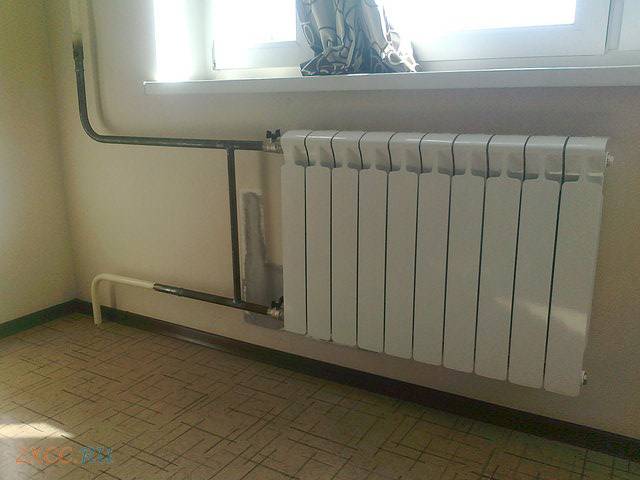
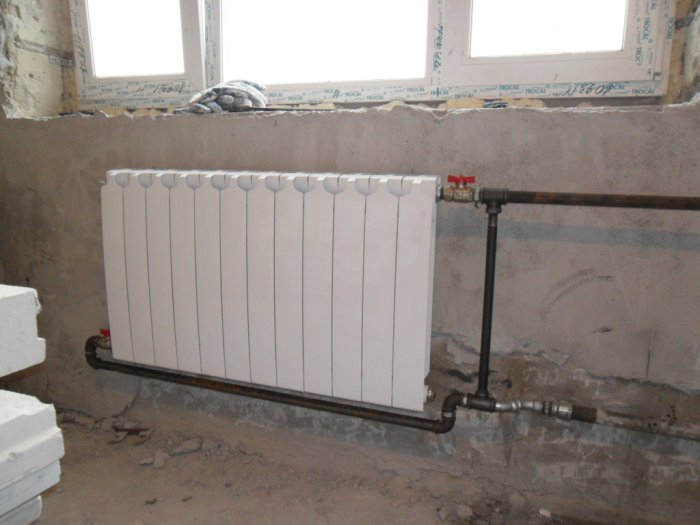
Together with radiators and pipes, we install taps that allow you to cut off the radiators from the heating system, even if it is on. To do this, we put a jumper on each battery, which will be responsible for the unhindered passage of the coolant. Three taps are also installed here - at the jumper, at the inlet to the battery and at the outlet.If the battery suddenly fails or starts to leak, you can replace it without notifying the Housing Office. Also, such a scheme will allow you to adjust the degree of heating of rooms - the presence of taps makes it possible to individually adjust the temperature in each room.
Please note that the installation of 3 taps by you imposes a responsibility on you. In no case do not block the taps in front of the heating radiator and the tap on the jumper at the same time. Otherwise, you will block the riser and stop the circulation of hot water in the pipes, which will lead to freezing of the entire heating system in your home.
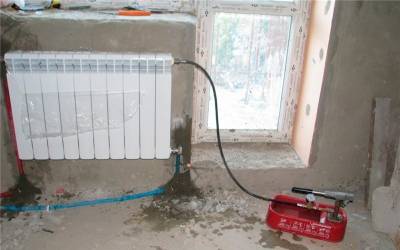
To check the heating in the apartment, a special pump is used, and the process itself is called pressure testing.
The presence of taps carries another plus - you can easily replace the section of the heating radiator. To do this, open the tap on the jumper / bypass, close the inlet and outlet taps, remove the battery and replace the section (valid for collapsible batteries).
As soon as the connection work is completed, you need to check the integrity of the system. Otherwise, the coolant will flood not only your apartment, but also the apartment of the neighbors below - it is unlikely that they will be torn apart with delight when they find yellow spots and dripping water on their ceiling. The inspection is carried out by a specialist of the Housing Office.
Do not throw away the documentation from the equipment used - remember that the housing office may require these documents even at the stage of applying and agreeing on the date of work. The thing is that the equipment used for replacement must meet certain requirements and not become an obstacle to the operation of the common house heating system.
Who pays for the replacement of old radiators with new ones?
The management company should change old batteries for new ones if they do not have shut-off valves and cannot be “cut off” from the general system with their help. The radiators themselves must also be paid for by the management company, since the new equipment will become their property.
In practice, management companies often refuse to buy, change or repair heating devices at their own expense. This is grounds for going to court.
Throughout the country, there are known cases of resolving such disputes in favor of homeowners.
If there are shut-off valves in the heating system, then you will have to change the batteries at your own expense. But to do without the participation of the UK still will not work. The rules for the operation of MKD establish (see clause 5.2.5) that you need to obtain permission to carry out these actions. In addition, you can choose the right batteries only after consulting with the specialists of the Criminal Code.
Before replacing batteries, you need to conduct an examination and calculate which radiators you need to buy (how many sections, etc.). Expertise, if the heating devices are not common property, is also paid by the owner of the apartment. It is not necessary to make changes to the data sheet - replacing batteries is not a redevelopment or re-equipment if they are installed in the same places where the old ones were.
Scheme of the heating system - "Leningradka"
The heating systems of multi-apartment residential buildings are most often built according to a single-pipe scheme - the so-called "Leningrad". Heating devices in this scheme are installed in series, a bypass is mounted next to them. At the same time, the installation of a ball valve is not approved by the management companies.
Through the bypass, part of the coolant bypasses the radiator and enters the next device in the group.This allows you to partially equalize the temperatures of the radiators, because the series connection entails a decrease in temperature by each subsequent in a row radiator (convector).
The main supply and return pipelines run in a horizontal plane in the basement or on the upper technical floor. From them, vertical heating risers pass through the premises of the apartments, radiators are connected to them in the apartments. Each riser at the same time has its own shut-off valves for shutting down.
At whose expense is the replacement of heating pipes in case of an accident
The battery broke, the neighbors were flooded - who is to blame What to do when the heating has become unusable and the neighbors have suffered? Where to look for the guilty? First you need to find out whose fault the accident occurred. Who is to blame: the owner of the apartment or the management company that monitors the condition of the heating pipes of the entire house. If the breakthrough of heating occurred through the fault of the owner, then he will compensate for the damage to the neighbors flooded from below.


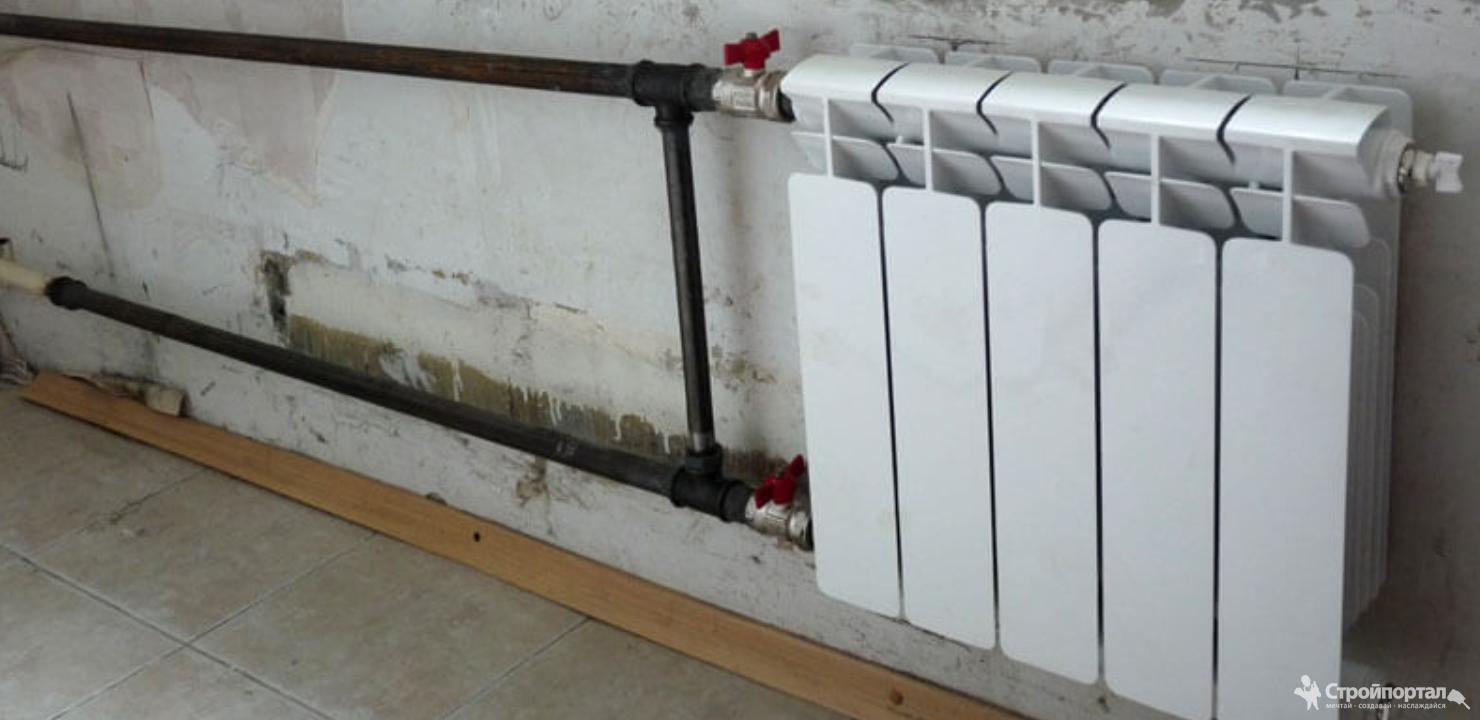

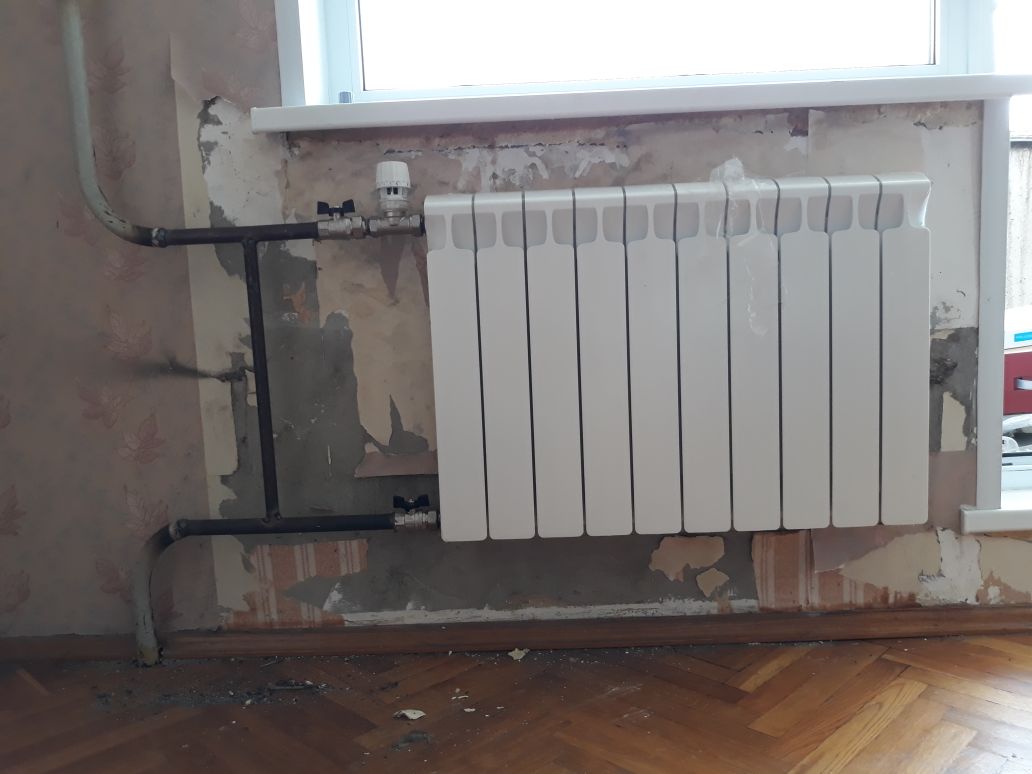

If it is the fault of the management company, then all the costs of repairing the premises will be borne by it. The Housing Code imposes on the owner of the apartment the obligation to keep the property in proper condition and to monitor the pipes. If necessary, he must make repairs. If the pipes are in poor condition, you need to contact the housing office and call the master. The invitation of a specialist must be formally issued. It is necessary to make an application, which will be registered and the repair time will be set.
Classification of district heating systems
The variety of schemes for organizing central heating that exists today makes it possible to rank them according to some classification criteria.
According to the mode of consumption of thermal energy
- seasonal.heat supply is required only during the cold season;
- year-round. requiring constant heat supply.
Type of coolant used
- water - this is the most common heating option used to heat an apartment building; such systems are easy to operate, allow transporting the coolant over long distances without deteriorating quality indicators and controlling the temperature at a centralized level, and are also characterized by good sanitary and hygienic qualities.
- air - these systems allow not only heating, but also ventilation of buildings; however, due to the high cost, such a scheme is not widely used;
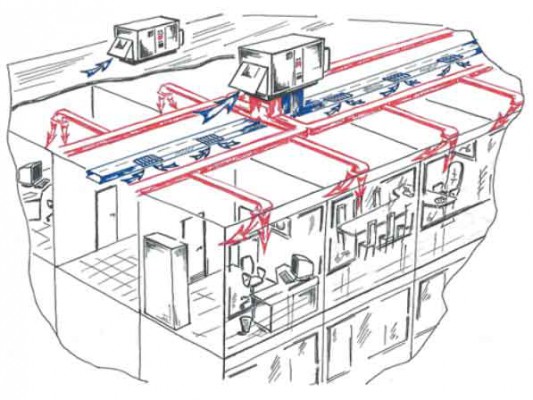
Figure 2 - Air scheme for heating and ventilation of buildings
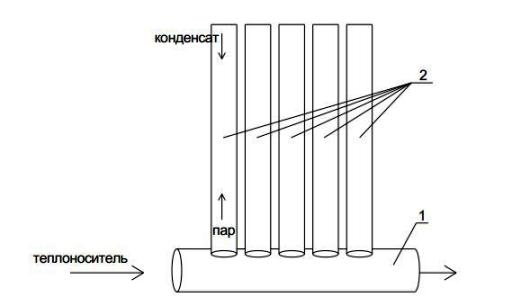
steam - are considered the most economical, because. small-diameter pipes are used to heat the house, and the hydrostatic pressure in the system is low, which facilitates its operation. But such a heat supply scheme is recommended for those objects that, in addition to heat, also require water vapor (mainly industrial enterprises).
According to the method of connecting the heating system to the heat supply
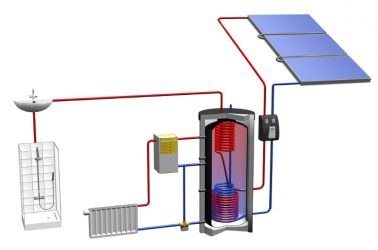
independent. in which the coolant (water or steam) circulating through the heating networks heats the coolant (water) supplied to the heating system in the heat exchanger;
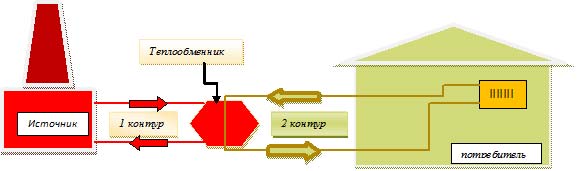
Picture 3 - Independent central heating system
dependent. in which the coolant heated in the heat generator is supplied directly to heat consumers through networks (see Figure 1).
According to the method of connection to the hot water heating system
open.hot water is taken directly from the heating network;
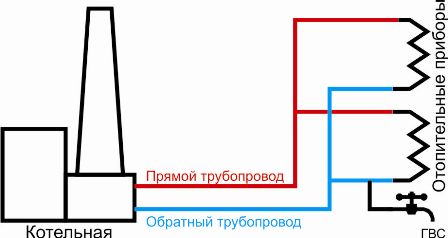
Picture 4 - Open heating system
closed. in such systems, water intake is provided from a common water supply, and its heating is carried out in the network heat exchanger of the central.
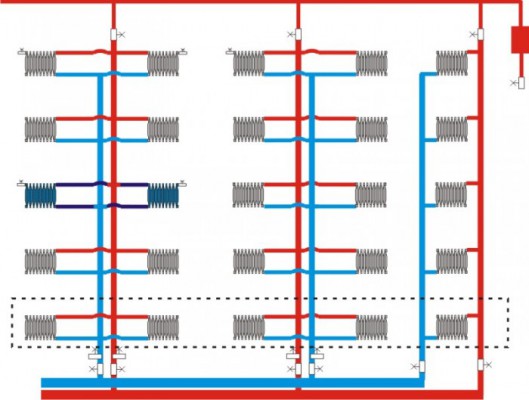
Figure 5 - Closed central heating system
We collect, install, connect the radiator
The process of assembling and installing a radiator is not complicated, but it requires special tools and equipment. Think it might be worth contacting a specialized organization.
The best option is to conclude a contract for the installation of radiators with the Criminal Code. They will make in accordance with the rules for installing heating batteries in an apartment, carry out pressure testing and sign an acceptance certificate for operation.
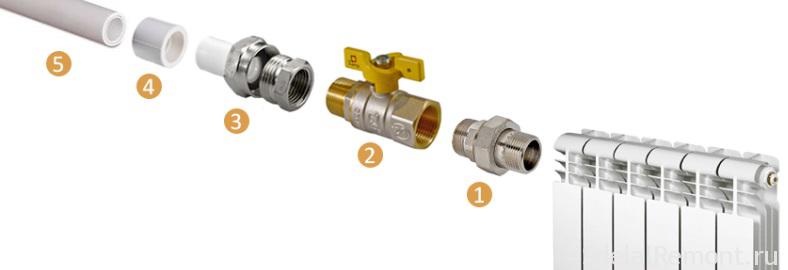
For those who decide to work on their own - a few tips on preparing and installing the heater.
- Do not forget to bleed the rest of the water from the system.
- Disconnect the old battery.
- Inspect the condition of the radiators, remove the plastic packaging, remove the protective film from the threads, if any.
- Open the universal battery connection kit. The kit is selected with a thread according to the diameter of the supply pipelines. The result should be: two fittings with a right-hand thread, two fittings with a left-hand thread, two American women with nuts, two taps, a plug, a Mayevsky tap, brackets or strips for attaching batteries. Internal thread standard is 3/4 inch, right hand. This is what you need to install a heating radiator in an apartment from the minimum standard.
- Remove the silicone gaskets from the fittings, screw into the radiator to check the threads. If there is no gap, unscrew the fittings, install gaskets. There is a gap - check, clean the threads, there may be a protective film left.
- Separately assemble the connections: fitting + American + tap for supply and return, fitting + plug, fitting + Mayevsky tap. Connections sit on a fum tape or tow. On the plug and Mayevsky's tap - gaskets, tow is not needed. Stretch connections.
- Screw the assembled kits into the radiator, do not forget to put silicone gaskets on the fittings. The battery is ready, you can install.
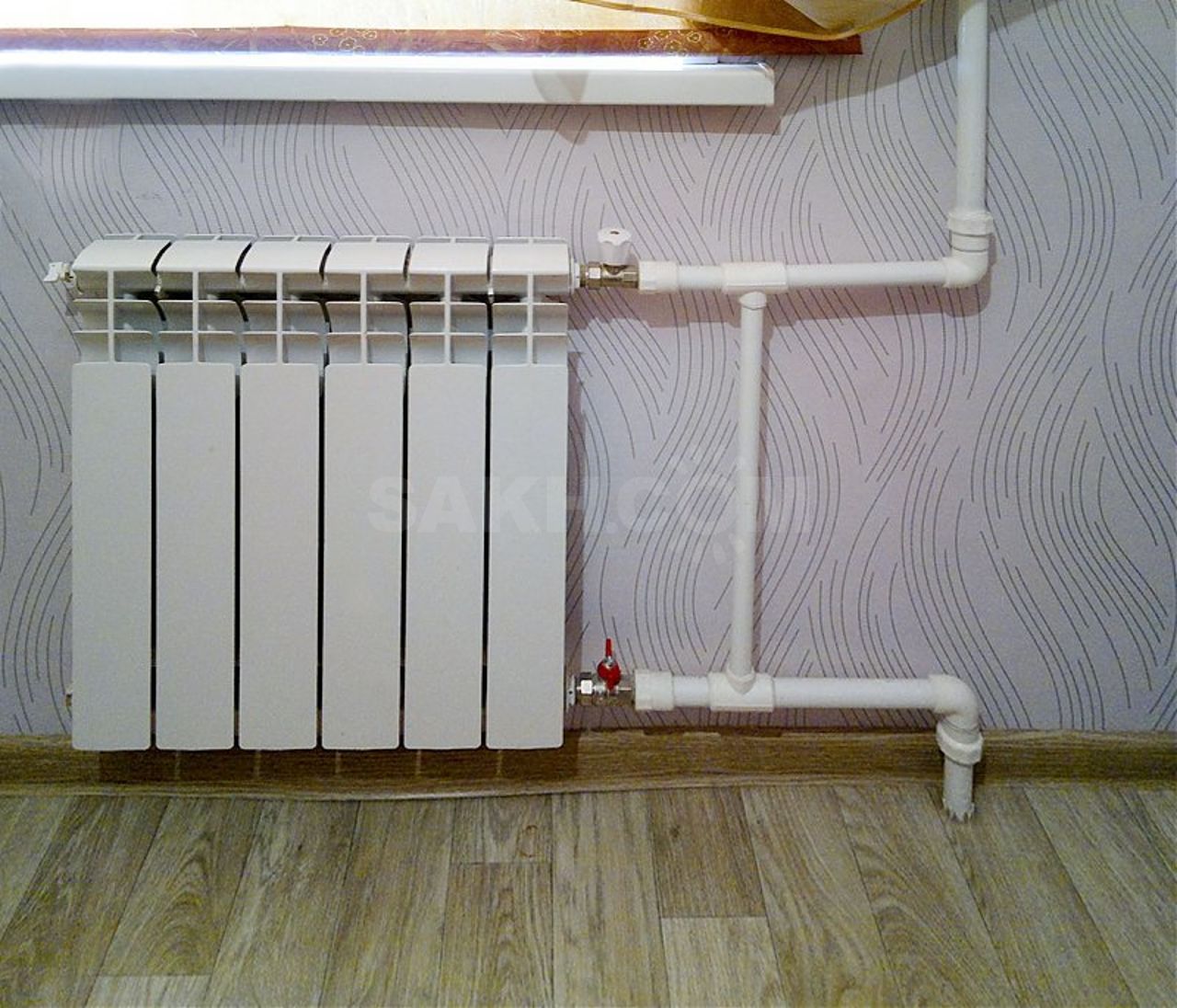
Put the heater in the design position, connect temporarily to the pipelines. If installation is being carried out to old pipes, the holes of the new radiator must be coaxial with the old battery, the common standard is 500 mm. - Mark the top of the heater, mark the mounting locations of the brackets. Remove the battery, mount the brackets, reinstall. The radiator should have a slope of 2-3 mm away from the Mayevsky crane, strictly vertically, and firmly rest on the brackets. Check by level. It remains to connect to the pipelines.
Observe the norms for installing heating batteries in the apartment, described above. After the installation is completed, call a representative from the Criminal Code for crimping and signing the acceptance certificate. This is an important stage of final work.





Video:
Video:
Can I replace myself
When figuring out how to change the heating battery yourself, a person will find out that there is no prohibition on the implementation of the action in the current legislation. If it is not necessary to block the riser for all apartments, a person has the right to perform the procedure without contacting the authorized bodies. The situation changes when, in order to replace the batteries, it is necessary to deprive the inhabitants of other premises of the heat.

Only representatives of the management company have the right to block the risers. It is better to use the services of specialists of the organization.Plumbers of the management company know better the features of engineering communications in the house, the location of the taps. As a result, specialists will be able to quickly make a replacement. Moreover, sometimes the application is approved only if the replacement is carried out by the plumber of the management company.
What you need to know when installing radiators
To do the installation of heating radiators in an apartment with your own hands, you need to know and comply with the regulatory requirements established by legislative acts in force on the territory of the Russian Federation.
The main laws of the Russian Federation in relation to heating and radiators
Requirements for the design and equipment of internal engineering heating systems in relation to radiators are described in SP 31-106-2002. These requirements are advisory in nature, but are prescribed by reference to the current standards corresponding to the SNiP profile.
The norms and rules for the design, installation of heating devices can be found in SNiP 2.05.91 or current changes - SP 60.13330.2016. Here are the basic requirements for the manufacture of components, parts.
When installing heaters, follow the provisions of SP 73.13330.2016 (choose the edition of SNiP 3.05. 01-85 of the next year of issue). It describes the parameters that allow you to correctly install a heating radiator in an apartment, the distance from walls, floors, window sills, risers. These rules normalize the number of support brackets, fasteners, the location of control and shutoff valves (section 6 of SP 73.13330.2016).
Basic rules and regulations for the installation of heating appliances
Below is a selection of the main provisions of the regulations in force on the territory of the Russian Federation. Some of the rules are advisory in nature.
- In zoned floor two-pipe heating systems, it is recommended to use a beam scheme to connect individual batteries. Additionally, a passing two-pipe wiring around the perimeter of the room is possible, closed with a protective casing (paragraph 7.2.2 of SP 31-106).
- The temperature of the open surface of the radiator should not exceed +70 degrees (7.2.4 SP 31-106).
- Heating devices should be installed, as a rule, under light apertures. Free access to radiators for inspection, repair, cleaning should be provided (7.2.7.1 SP 31-106).
- The supply pipelines to the heaters should be installed with a slope of 5-10 mm in the direction of the coolant flow. If the length of the liner is less than 500 mm, the slope is not required (6.4.1. SP 73-13330.2016).
- The materials of the devices used and the connections to them should not form a "galvanic couple" (6.4.1 SP73-13330).
- Minimum allowable distances when mounting devices: 60 mm from the floor; 50 mm from the bottom of the window sill, 25 mm from the wall surface to the plane of the device. In the absence of a window sill, the top of the battery is installed below the level of the opening by 50 mm (6.4.3).
- In a single-pipe system, the riser is located at a distance of 150-200 mm from the edge of the opening, the length of the connections should be <400 mm (6.4.7).
- The batteries are mounted strictly vertically and horizontally (a slope of up to 2 mm away from the Mayevsky crane is allowed). Fastening - at least two brackets (slats) on the top and one on the bottom. Instead of the bottom bracket, it is allowed to install the heater on stands (at least two with up to 10 sections). Do not use wooden plugs when attaching brackets (6.4.8).
- Valves, non-return valves are installed according to the arrow marked on the body in accordance with the direction of movement of the coolant. Mount strictly horizontally or vertically, depending on the design. Free access to locking elements and control shall be provided (6.4.12).
- Thermometers, sensors, thermostatic valves are mounted in accordance with the requirements specified by the manufacturer (6.4.14).
- Upon completion of the installation of heating elements, it is necessary to flush the pipes with water until no mechanical impurities remain at the outlet (6.1.13 SNiP 3.0.5.01).
At installation of heating radiators in an apartment with your own hands, be sure to follow the rules outlined above. This guarantees high-quality, correct installation, uninterrupted and long-term operation of the heater.