- Varieties and features of duct fans for exhaust
- Types of bathroom fans
- Axial models
- Radial fans
- Centrifugal plants
- Roof structures
- Varieties of exhaust fans
- Axial fans
- Duct fans
- Fan selection and start method
- Application
- Natural ventilation
- Forced ventilation
- Fan Installation Tips
- Instrument design
- Fan Selection Criteria
- Moisture resistance and temperature resistance
- Noise and power of the device
- Cost and extras
- Ways to combine two types of ventilation
- Extraction performance parameters
Varieties and features of duct fans for exhaust
Different models of devices can differ significantly from each other in a number of characteristics. For example, these may be differences in the shape of the case:
- Round - mounted in round ventilation ducts, they are the most common option for use in the kitchen or bathroom.
- Rectangular duct fans are installed in ventilation shafts with a rectangular or square section. As a rule, industrial fans are rectangular in shape, which are characterized by increased power.
- Square - just like rectangular exhaust axial fans, they are designed for installation in a square air duct shaft and are distinguished by high operating power. They are also often used for industrial purposes.

Round extractor fan
Duct devices for extracting air are distinguished by design features.
Axial - have a body in the form of a cylinder, inside of which there is a fan with blades mounted on the axis of an electric motor. With this design, air masses move along the axis of the device, and a special collector is often installed at the inlet, which improves the aerodynamic characteristics of the device. Among the advantages of axial fans for exhaust, one can single out a rather high efficiency - over 100 m³ of air per hour.
In addition, axial models are characterized by ease of installation, which is why they are often installed in the ventilation openings of bathrooms or kitchens. The disadvantages include low pressure characteristics and a high noise level - about 30-50 dB.

Axial exhaust fans
Radial - have a spiral body, inside of which there is a paddle wheel. When it rotates, the air masses move in the radial direction, the air is compressed under the action of centrifugal force and leaves the housing. The blades of the radial device can be directed back or forward, in the first case, during operation, the savings are up to 20% of electricity, and the noise of the device is significantly reduced. Forward curved blades increase fan power. Radial models are compact in size, so they can be easily installed in almost any duct.
Centrifugal is a relatively new model that has already gained great popularity among users. Centrifugal exhaust fans are well suited for installation in rooms larger than 15 m², they are characterized by high power and almost silent operation. The advantage of a centrifugal fan is that it can be installed not only in front of the air intake, but also in the middle of the ventilation shaft.

The principle of operation of a centrifugal fan
There are also specialized models such as smoke exhaust fans and explosion-proof ones. Axial smoke exhaust fans are designed to move air masses in which there is a certain amount of impurities. This is a good option not only for industrial premises, but also for kitchens in which large volumes of food are often prepared. In addition, these models of hoods are characterized by high power and allow you to quickly extract steam and smoke from the room.

Smoke exhaust fan
The explosion-proof axial fan is intended primarily for the organization of forced air exhaust with combustible or explosive impurities. Such models are rarely used in everyday life, but they are very popular in enterprises where there is an increased risk of fire or work with explosive substances.
Types of bathroom fans
Which of the fans on the market will be the best for arranging a bathroom? Pay attention to their varieties.
Axial models
The devices are designed as a wheel in a cylindrical body. Cantilever blades are located on the surface of the product.The design is fixed on an axial electric motor. The principle of operation is based on the rotation of the wheel, the capture of air by the blades and its movement. Axial fans are installed in the openings of the shaft.
Advantages:
- high efficiency - 100 cubic meters are cleared in 1 hour;
- ease of installation - in the surface of the wall;
- function without an air vent system;
- suitable for low pressure communications;
- effective under conditions of variable loads;
- compact dimensions.
Minuses:
- minimum pressure;
- risks of violation of air circulation during installation;
- work loudly - noise from 30 to 50 dB.
Advice! To increase the aerodynamic characteristics of the device, install a manifold first.
Radial fans
The devices are made in the form of a spiral casing (hollow cylinder) with a paddle wheel. depends on the shape of the blades efficiency the whole mechanism. Manufacturers produce several elements:
- bent forward in the direction of movement - high performance, but insufficient removal of mechanical impurities and gas;
- curved back - convenient speed control and good efficiency;
- "paddle wheel" - a direct design works in conditions of high pressure and dense impurities in the air.
Advice! Straight-blade models have high noise at low efficiency.
Radial fan for bathroom
The principle of operation of the fan is based on the ingress of air masses into the openings of the blades, its direction radially, compression and subsequent expulsion through the spiral casing into the supercharger.
Advantages:
- saving up to 20% of electricity;
- exclusion of electrical overload;
- treatment of 1 m3 of polluted air in 1 second;
- resistance to corrosion;
- the presence of a protection relay and a speed controller;
- connection to a network with a voltage of 220-240 V;
- ease of installation and maintenance;
- minimum noise level;
- take up almost no space.
Minuses:
the greatest efficiency only in spacious rooms.
Centrifugal plants
Powerful devices with a low noise level are installed on the flow part of the ventilation. The devices consist of a wheel with blades, channels with a circular or rectangular cross section, suction and discharge mechanisms. Air masses are sucked in to the blades in a centrifugal way and pushed out perpendicular to the new portion of air.





Important! For home communications, only channel models are suitable, designed for rooms from 15 squares. Installation of centrifugal fans - concealed
They are fixed under the ceiling and masked with drywall overlays.
Installation of centrifugal fans - hidden. They are fixed under the ceiling and masked with plasterboard overlays.
Advantages:
- reliability of rigid and semi-rigid air outlets;
- installation in the center of communication or in front of the air intake;
- work in highly polluted areas;
- withstand constant temperature fluctuations.
Minuses:
- little energy efficiency;
- risks of engine explosion due to voltage fluctuations;
- the need for additional installation of an anemostat.
Roof structures
The fans act as an exhaust fan. The design is a fan, gaskets with vibration isolation, an electric motor, automatic adjustment devices in a single housing. The main unit is axial or radial with blades sucking in air from one or both sides. Installation of the ventilation structure is carried out simultaneously with roofing work, it provides for the installation of deflectors, pipes, and passage elements.
Advantages:
- regular supply of fresh air;
- maintaining normal humidity;
- removal of specific odors and moisture;
- mold prevention;
- Eliminate sewer odors.
Minuses:
- the need for insulation in winter;
- the complexity of the installation work.
Varieties of exhaust fans
The design of the exhaust fan is quite simple: housing, motor, impeller with blades. There are models equipped with a check valve that does not allow foreign odors from other apartments to enter the room, which is very important for high-rise buildings.
Bathroom fan device
The air duct of the exhaust device is connected to the general ventilation system or is output separately through the wall to the outside. According to the mounting method, all exhaust fans are divided into ceiling and wall, as well as built-in and overhead.
Bathroom ceiling fan
Wall hood
Ceiling ones are less in demand, although they are distinguished by high performance and simple installation. Such a fan is capable of actively circulating a large volume of air, so it is great for spacious bathrooms. But most consumers still choose wall-mounted models, both built-in and overhead. They are easy to install, easy to use, easy to clean and replace. Due to their compact size and modern case design, they look quite aesthetically pleasing, fitting perfectly into any interiors.
Pictured is an axial fan for the bathroom
Depending on the internal device, fans are divided into:
- electric - simple models with a built-in or external switch. That is, the residents of the apartment must independently turn the device on and off as needed. A very common option is when such a fan is connected to a general switch in the bathroom, and then the hood turns on simultaneously with the lamps. True, in this case, moisture does not always have time to completely go into the ventilation, but electricity consumption is reduced;
- automatic - exhaust devices equipped with special sensors. Models with humidity sensors automatically turn on as soon as the moisture level exceeds the norm, and turn off when the condensate has completely evaporated. Models with motion sensors turn on when a person appears and turn off when the room is empty. There are also automatic fans with timers that operate only for a predetermined interval of time.
Hidden bathroom fan
Pictured exhaust fan with light
Exhaust fans are also classified according to the type of construction. In the domestic sphere, the most popular are axial and channel devices that are suitable for multi-storey and private houses.
Axial fans
In axial fans, the movement of air occurs along the axis of rotation of the blades, which is the reason for such a name. The design is very simple: a body (usually cylindrical), an impeller with blades, an electric motor. Many models have a front-mounted manifold that improves aerodynamic properties. The structure of the blades reduces the resistance to air flow, so the fan has a high efficiency. According to the type of installation, such devices can be both wall-mounted and ceiling-mounted.

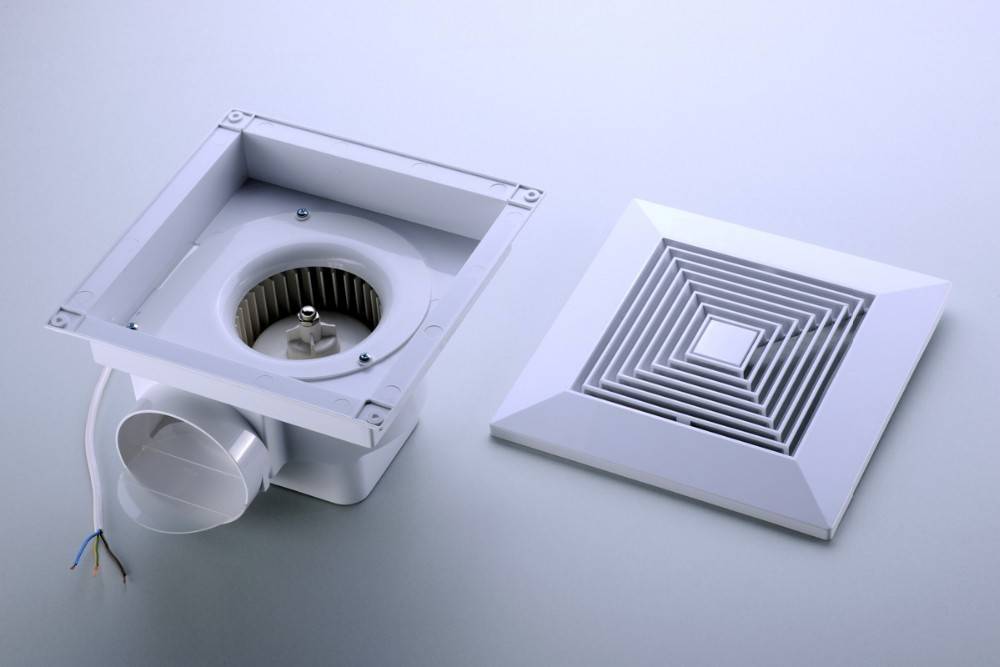


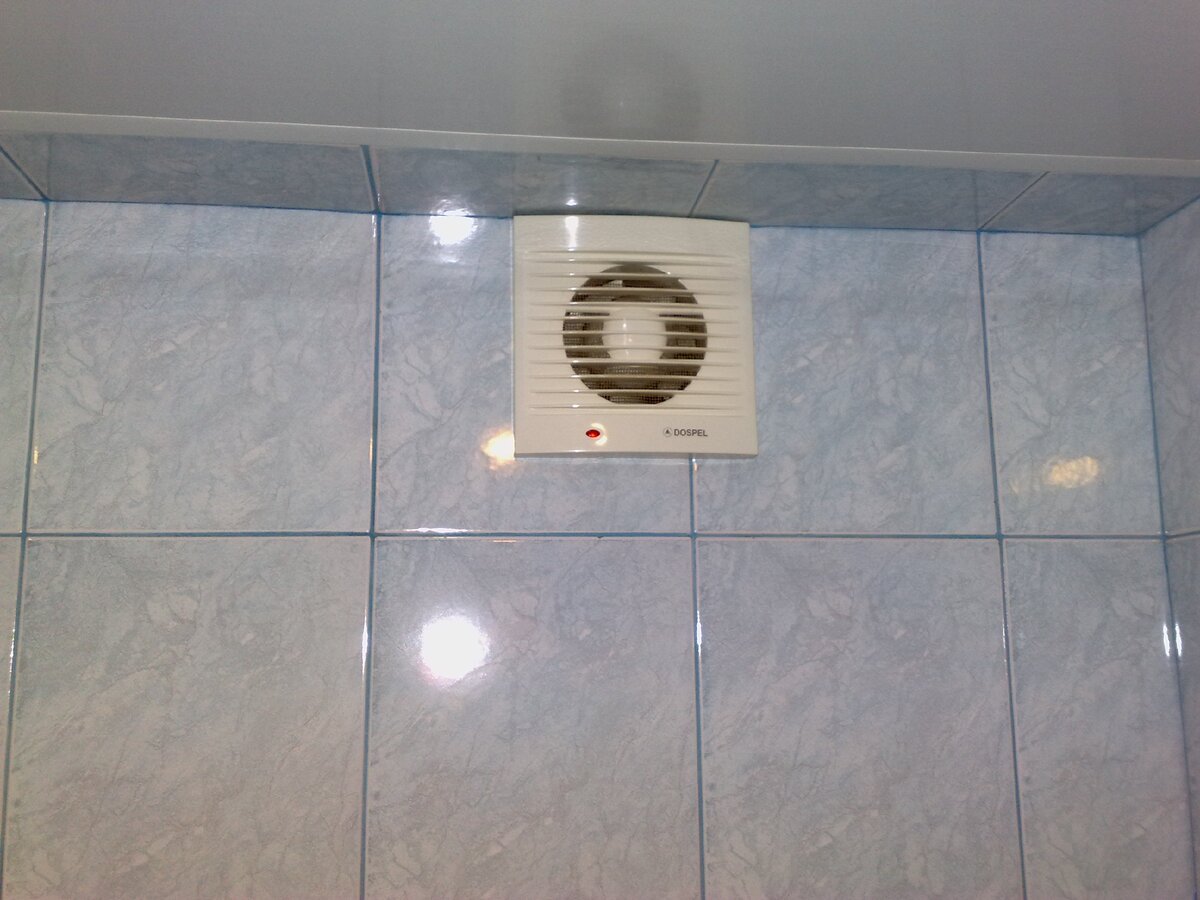


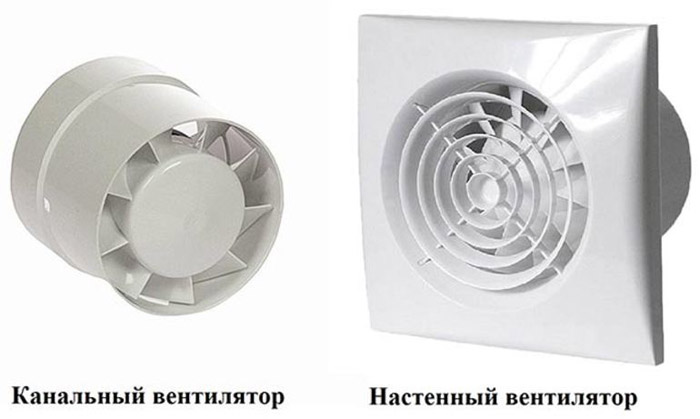


Axial fans
Most modern axial fans are characterized by low power consumption and reduced noise level, unlike the models of the previous generation. They can work for a long time without stopping, are easy to clean, and have an attractive design. For these devices to be effective, the length of the duct should not exceed 4 m. The same applies to the area of \u200b\u200bthe bathroom - the smaller the room, the more efficient the hood.
axial exhaust fan
Duct fans
duct fan
For bathrooms of a large area, ducted or centrifugal fans are best suited. Their design differs markedly from axial devices: inside the cylindrical body there is a drum with many narrow curved blades. With the help of the centrifugal force generated by the blades during rotation, the air is drawn inward and directed to the ventilation duct.
CAT fans for in-duct installation
Such fans work effectively with air ducts from 4 meters long, they are installed both on the ceiling and on the wall (depending on the modification). The extraction can be carried out continuously, but usually the device is connected to a switch in the bathroom or to a humidistat. This saves energy and extends the life of the fan. Many models are designed for concealed installation and are relatively quiet, so that they are almost invisible in the bathroom.
Exhaust diffuser in the bathroom
duct exhaust fan
Fan selection and start method
There are many models of exhaust fans on the market, including those for the bathroom. They differ not only in size and appearance.There are a number of characteristics that should be considered when choosing and buying.
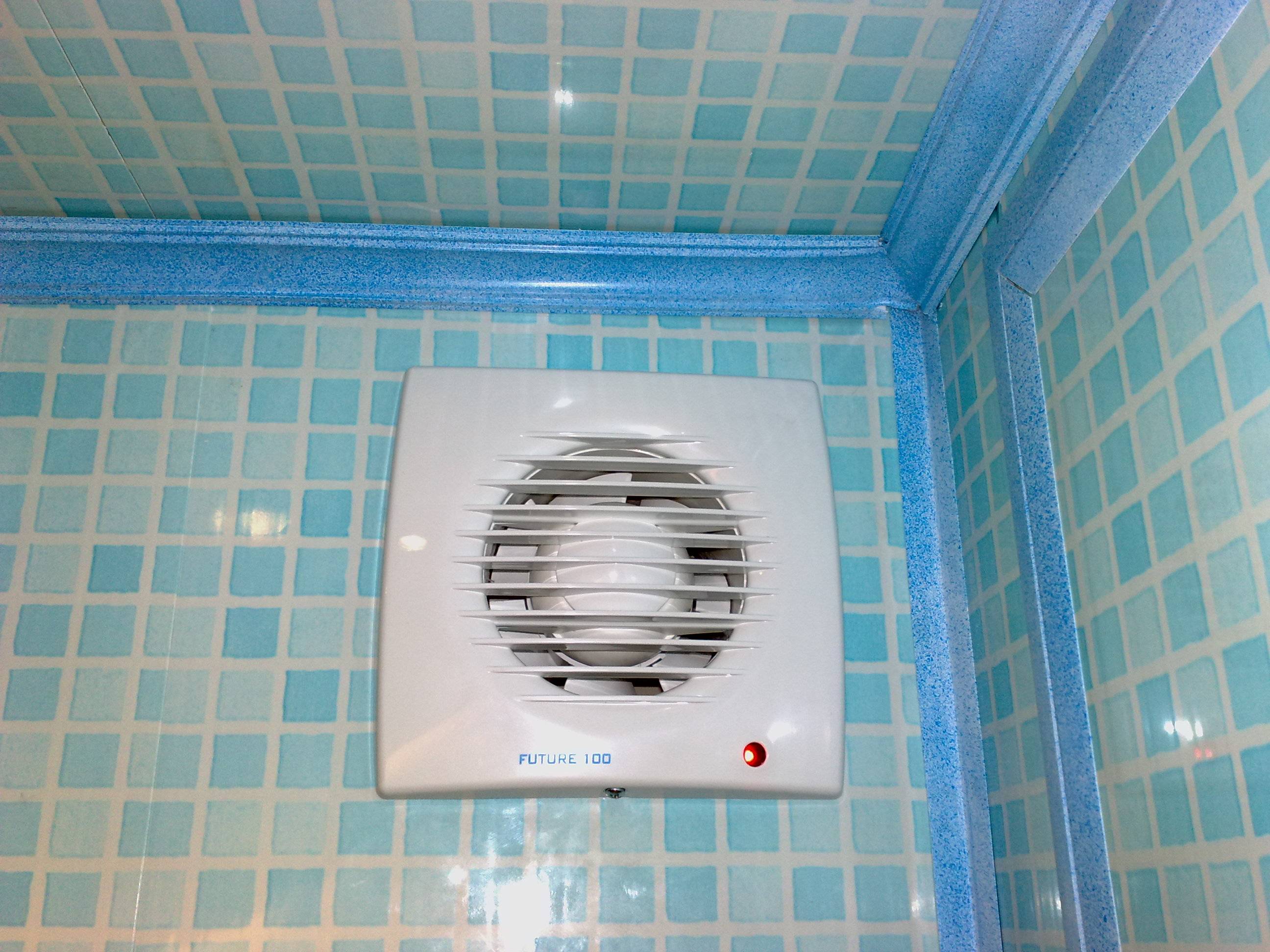
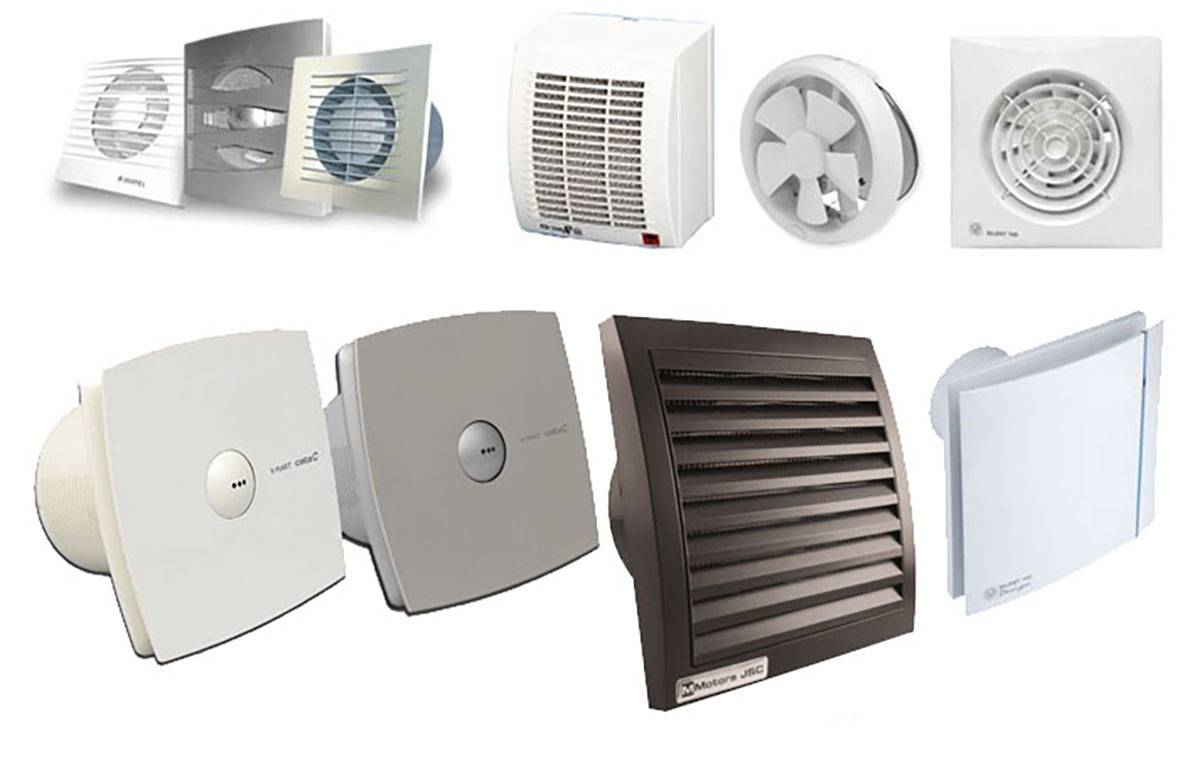
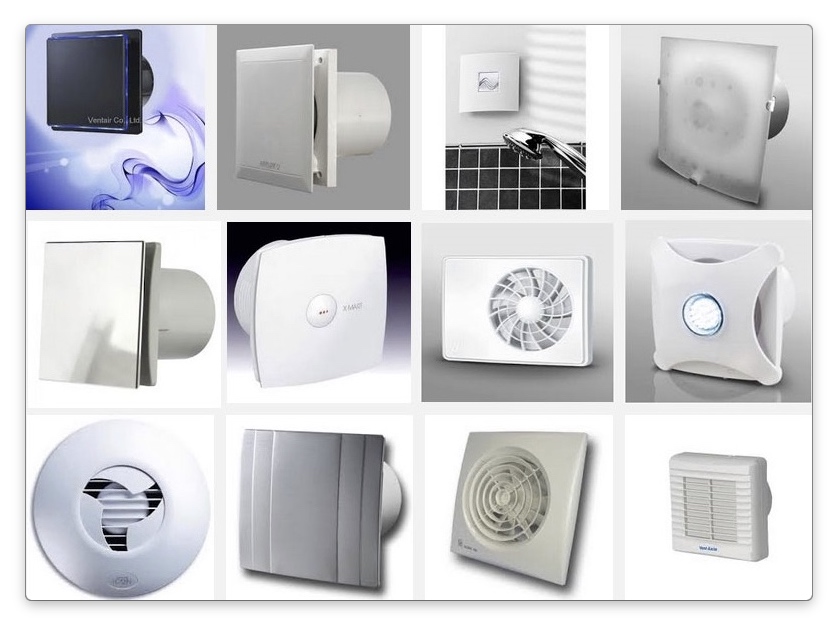
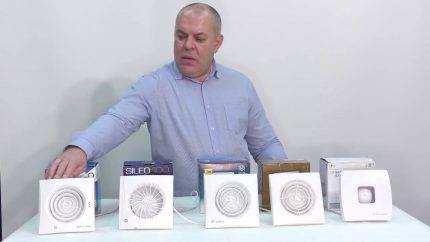 Bathroom fans are overhead and duct, with a solid front panel or grille, different colors and designs
The first thing that determines the connection scheme of the fan for extracting air from the bathroom is the way it is started.
Depending on the model, there are the following options:
- Turning on the fan on the case with a button or a cord - they are the easiest to connect, but each time reaching for the ceiling is not very convenient.
- Start by separate switch or in parallel with lighting. The fan itself also has only 2 wires, but the possible connection schemes are more complicated and varied. Including with an external timer or hygrometer, motion sensor or door opening.
- Control via built-in timer or hygrometer. Such models are connected with a three-wire wire.
- Remote control via remote control. These models combine the simplicity of connecting the first option and maximum ease of use, but they are also the most expensive of all.
In addition, not every exhaust fan is suitable for a bathroom. The fact is that this is electrical equipment, and in order to work in conditions of high humidity, the protection class must be at least IP45, which is confirmed in the documents.
In this case, each marking digit should be taken into account separately, that is, IP62 protection is not suitable, since the second digit indicates moisture resistance, it must be at least 5.
In practice, protection is implemented in the form of isolated connection contacts, a hidden or moisture-resistant control board, and a sealed motor housing.
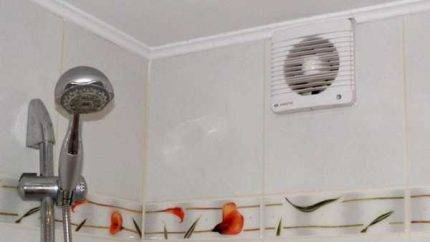 Even fans with high moisture protection characteristics are not recommended to be placed where water can get on them.
You should also decide on the type of device design. Axial models are cheaper but noisier because the air flows straight through them. Centrifugal fans form streams-vortices that push air in a circle - this is much quieter. In addition, for a private house, you can choose which are installed inside the ventilation duct, and not at the exit from it.
Another critical parameter is the power and performance of the fan. To do this, the volume of the room must be multiplied by 6 - 8, depending on the number of residents. The resulting figure is the minimum required volume of air exchange per hour.
A fan that is too weak will not do its job well, it will have to be left on for a long time. Too powerful will not only add strong drafts, but can also provoke a reverse flow of air from a common ventilation shaft, with all the neighboring smells.
Also pay attention to the diameter of the fan. If it does not match the diameter of the existing vent, the installation will additionally require a pipe and building foam or a perforator, as well as much more effort.
The comfort of use is significantly affected by the noise of the equipment. Quiet models produce no more than 25-30 dB, less successful solutions - about 50 dB, and sometimes more.

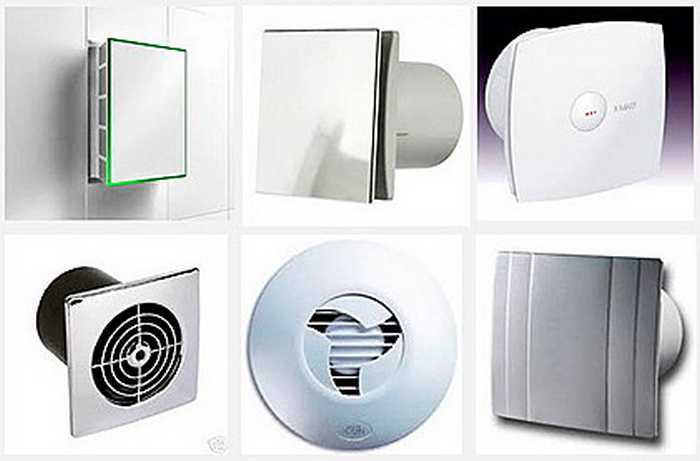


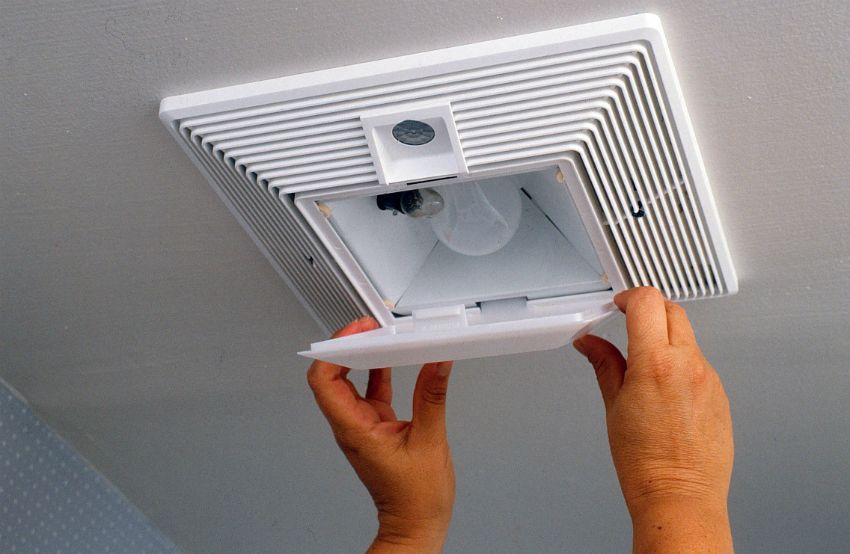
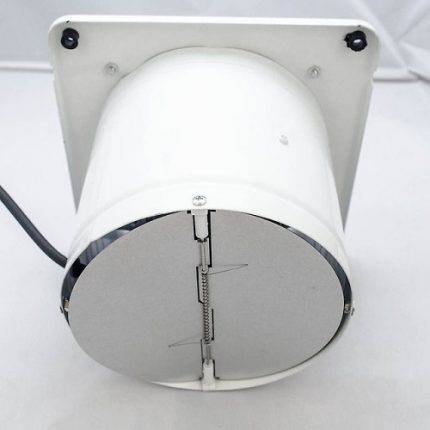 The non-return valve will protect you from odors and moisture from the neighboring bathroom when the fan is turned off. It also partially protects the device from dust in the mine.
In addition to the above parameters, pay attention to whether the fan is equipped with a check valve, a ventilation function, a mode switch, a display with temperature and humidity indication. Design solutions include original or replaceable protective panels, sometimes with backlight
Application

Shutter valve devices can be supply and exhaust, they are used both in natural and forced ventilation systems. An example of such a device in the kitchen is the exhaust valve.
Air inlets are used to bring air into the house from the outside and prevent heat from escaping. They are mounted in the outer wall below the window level.
Exhaust, on the contrary, remove the exhaust air from the room and counteract its return. Usually they are installed in exhaust ventilation ducts under the ceiling.
At the design stage, it is worth considering what kind of ventilation to make, natural or forced. Both options have their positives.
Natural and forced systems, although they have a common mission, cannot fully replace each other. It is advisable to combine both types of ventilation.
The forced system is an indispensable thing for the kitchen. And natural air exchange has proven itself well in residential premises. Natural ventilation guarantees safety during operation, and forced ventilation provides a more comfortable microclimate.
When combining two types of systems, it is imperative to install shut-off valve devices at each outlet. This ensures the full operation of both ventilation systems.
Natural ventilation

The natural ventilation system is well known to apartment owners through the ventilation ducts on the kitchen wall and in the bathroom, which lead to a common ventilation shaft.
Polluted air masses are removed through such an air duct, while fresh air enters through a window or a special channel with a check valve for natural ventilation, mounted in a wall or window blocks.
The warm air heated from the stove naturally rises to the ceiling and exits outside, where the temperature is somewhat lower. The shutter of the device is equipped with a very sensitive shutter.
Properly organized ventilation with gravitational draft removes a relatively small volume of air per unit of time, but performs this action incessantly.
The valve mechanism installed in the upper part of the kitchen is able to cope with the slightest leakage of natural gas. As you know, gas is lighter than air, so it tends to the ceiling.
Return springs in the design of the device should be absent. This is due to the fact that the natural air flow has a very low pressure. Such systems are equipped with single-leaf structures with increased shutter susceptibility.
Proper sizing and placement of inlet and outlet vents is critical in ventilation planning, and nothing should interfere with the movement of airflow from inlet to outlet (e.g. enclosed perimeter rooms).
It is necessary to periodically check the presence of the necessary draft in the ventilation duct. At home, this is checked with a sheet of paper - if it sticks to the hole, then everything is in order with the thrust.
Forced ventilation
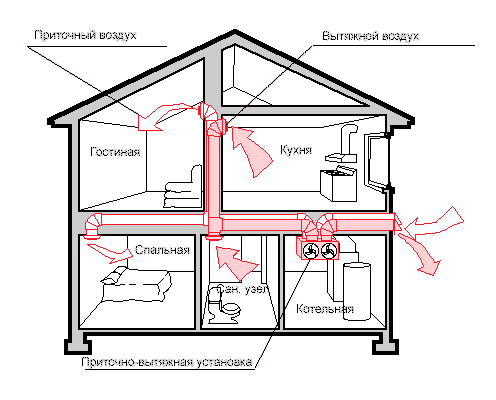
The ventilation system, in which polluted air is removed with the help of fans, is called forced.
Forced ventilation through the operation of an appropriate exhaust device has a high performance and can quickly and in large volumes remove the exhaust air.
A kitchen hood with a non-return valve will remove dirt before it enters the room. Air is pushed out by a running fan, and a non-return valve on the kitchen hood prevents it from returning.
Ventilation with a non-return valve in the bathroom is no less necessary than in the kitchen. Injection systems also find application in these types of premises.
The forced system is much more expensive than the gravitational one. The costs include the purchase of a fan or hood, their maintenance and payment for the energy consumed.


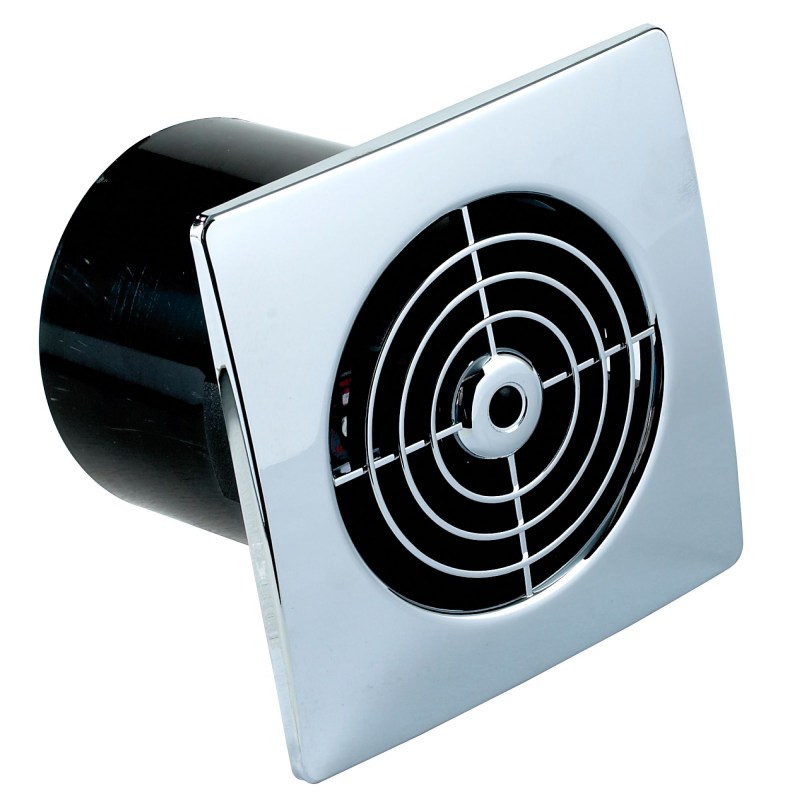

Usually forced ventilation is used in exhaust systems. In forced-type ventilation, the design of shutter devices can be different.
Petal valves, gravity gratings, butterfly valve assemblies can be used.
Fan Installation Tips
For reliability and efficiency, the device is best installed under the ceiling.
- Wiring is pulled to the installation site of the device, which is hidden in cable channels or corrugated pipes.
- In the wall opposite the ventilation duct, a grate is removed or a hole is made corresponding to the size of the fan.
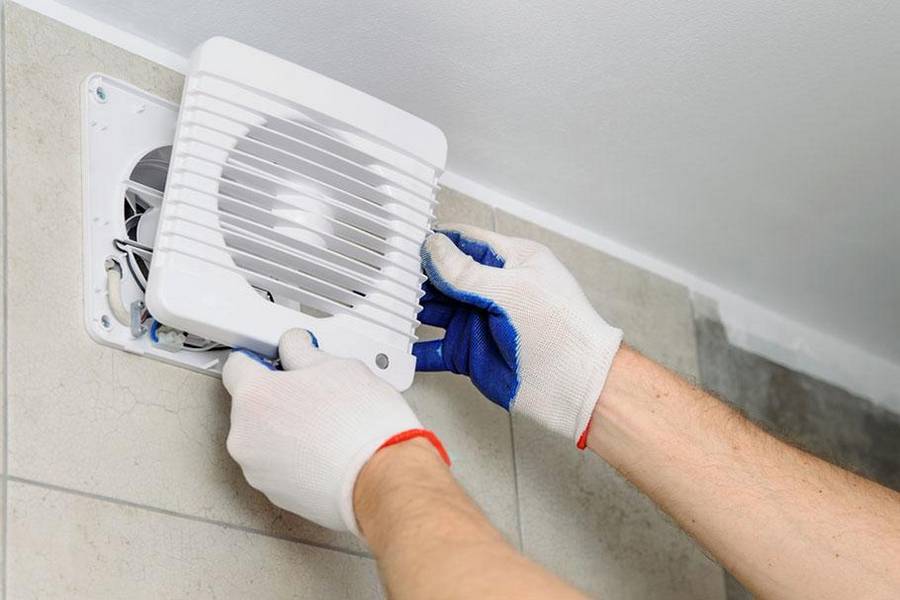
- The hood is inserted flush into the hole and fastened with glue or self-tapping screws.
- The gaps are sealed with sealant and electrical connections are made.
- A decorative grille is installed, which should be periodically cleaned of dust.
Thus, by installing a forced air exchange system, you can effectively and quickly solve the problem of high humidity in the bathroom.
Instrument design
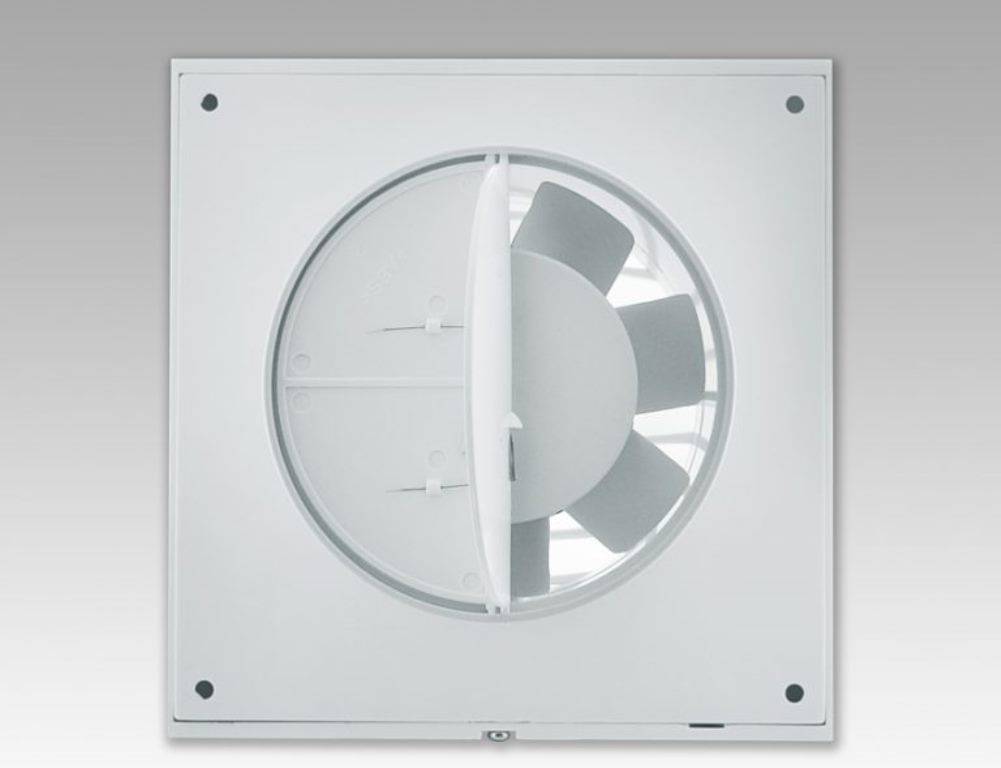
The check valve for all similar devices for home use is made of plastic. The specific design of the check valve is widely used in various exhaust systems for various rooms and kitchen hoods. It is based on the principle of butterfly wings: during the flight they straighten, and the rest of the time they are folded. Two equal halves reliably shut off the air supply to the inside of the room after the end of the fan operation with the help of special springs - they are opened by the air mass blown out.
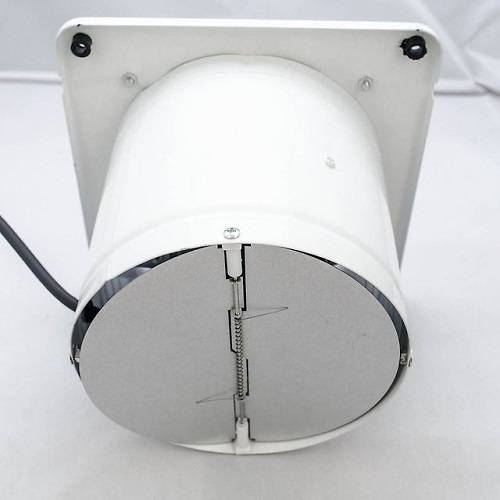
This design, along with clear advantages, has some disadvantages:
- motor energy is spent on opening the valve flaps, so the fan efficiency is slightly reduced;
- valve flaps do not have sufficient tightness.
But in everyday life, such a fan copes with all duties perfectly.
Fan Selection Criteria
Splashes of water, evaporation and condensation create an uncomfortable environment in the bathroom and spoil the external decor. Fungi and black mold form on the walls. There are unpleasant odors, small insects and household irritants appear.
You can fight these negative moments with the help of an exhaust fan.
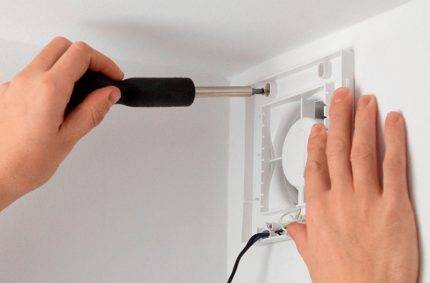 In apartment buildings, the installation of an exhaust fan in the bathroom is carried out in the wall, where a common air outlet shaft passes. In a private cottage, the device can be mounted where it is convenient, having previously brought the ventilation line to the location of the unit
The main thing is to take into account all the important parameters of the device and correctly carry out the installation.Then the room will be ventilated correctly and the finishing elements will not be affected by moisture.
Moisture resistance and temperature resistance
In the bathroom, splashes and steam do not appear occasionally, but are constantly present. Dampness is dangerous for electrical appliances and can cause a short circuit or an accident.
To prevent this from happening, it is necessary to install exhaust fans in such a room with a moisture-resistant housing that hermetically protects the working elements from moisture penetration. Such devices have a high degree of protection.
When buying, you need to pay attention to the labeling of the product. IP letters indicate ingress protection
The first digit after the letters means how the case is protected from solid objects / dust, the second - from water / moisture. The higher the second digit, the less likely it is that water and condensate, falling on electrical parts, will disrupt the operation of the unit (+)
If owners like to take a bath regularly or stand in a hot shower for a long time, you should pay attention to exhaust models that are not afraid of high temperatures. Such devices work correctly in the range of 70-180 ° C
Noise and power of the device
The exhaust fan makes a certain noise during operation. So that this does not irritate, it is advisable to choose devices that sound within 30-45 dB.
Especially clearly these parameters need to be maintained by the owners of compact apartments or small city studios, where the bathroom is located in close proximity to the living quarters. The rating of silent fans is presented in this review.
In large apartments and houses, this parameter can not be paid such close attention.
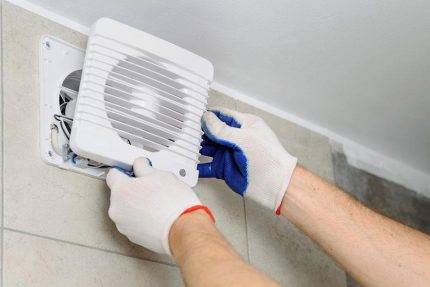 If 4-6 people take water procedures daily in a small-sized bathroom, it is better to choose a fan with a power of 15-25 W and an air exchange rate of at least 150 m³ / h. With such a load, a unit with smaller parameters will not be able to quickly and effectively remove moisture and dampness.
A very powerful device will quickly “pull” moisture out of the room, but it will consume a significant amount of energy and will make a lot of noise during operation. A fan that is too weak will not cope with the task, and the owners will not see the point in using it.
Therefore, to buy an exhaust fan in a spacious bathroom, you need one that performs air exchange better and faster and has more intense power.
To maintain a comfortable atmosphere in a small sanitary and hygienic area, a compact product with a medium or low speed of rotation of the blades is enough.
Cost and extras
The cost varies in a wide range and directly depends on the brand-manufacturer. Unlike domestic and Chinese devices, devices from famous European brands are sold at a higher price.


But "expensive" doesn't always mean "perfect," so you don't have to pay just for the brand name. It is better to carefully study the parameters of models and reviews of real buyers, and then, based on them, decide on the choice of the desired item of household appliances.
When the exhaust module is off, the non-return valve protects the room from the penetration of unpleasant odors, smoke and strong odors from the ventilation shaft.
This moment is especially important for residents of apartment buildings, where all rooms are connected to a single system of air vent communications.
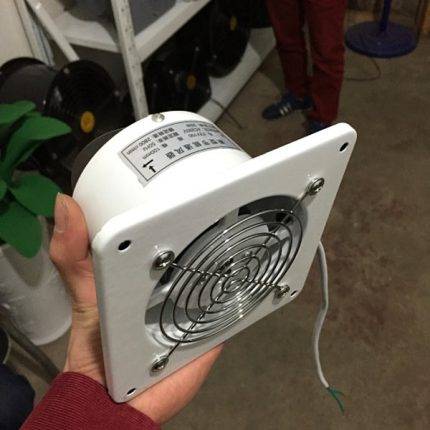 Exhaust fans differ from each other in the way they are connected. Some models have a direct connection to the mains with a separate external switch. Some products can be activated by pressing a normal bathroom light switch
A mosquito net is a useful and practical element of an exhaust ventilation device. Provides the internal parts of the device with reliable protection against clogging and penetration from the outside of small midges and insects.
Ways to combine two types of ventilation
When the hood is turned on, the volume of incoming and outgoing air increases. During the shutdown of the device, the process of ventilation of the living room is practically absent. This happens due to the fact that the fan housing completely blocks the lumen of the ventilation window. The propeller blades interfere with the natural outflow of air from the bathroom. The problem is solved in two ways.
We insert a double grille into a large ventilation window-hole, in which there is a round window for the fan and several additional slotted curtains for natural air outflow.
There are fans on the market with different case diameters, so you can choose a device that is smaller than the vent. When the fan is off, the air will escape through a simple grate located under the appliance.
If the ventilation window is small, then to ensure a natural outflow of air, they put a fan on legs of 1.5-2 cm. The legs do not allow the appliance grille to fit snugly against the wall. Air is drawn into the resulting space under the action of the traction force generated in the shaft, and leaves through openings that are not closed by the round fan casing.
The legs are made by hand from ordinary foam. Self-tapping screws go well through this material. The foam legs also serve as a shock absorber, reducing the degree of vibration of the operating hood.
An example of integrating two types of ventilation - forced and natural - in the bathroom of a private house
Having learned in detail about how to make a bathroom hood in a private house, you can decide for yourself whether this task is within your power or not. Perhaps the best solution would be to contact a company that provides services in your area for the installation of all known types of ventilation.
Extraction performance parameters
The main indicator of the fan is its performance. The higher it is, the better unpleasant odors are eliminated in the bathroom, and steam comes out. As a rule, standard systems have an output of fifty m3 per hour. Sometimes such an extract is not enough, and apartment owners additionally install a fan.
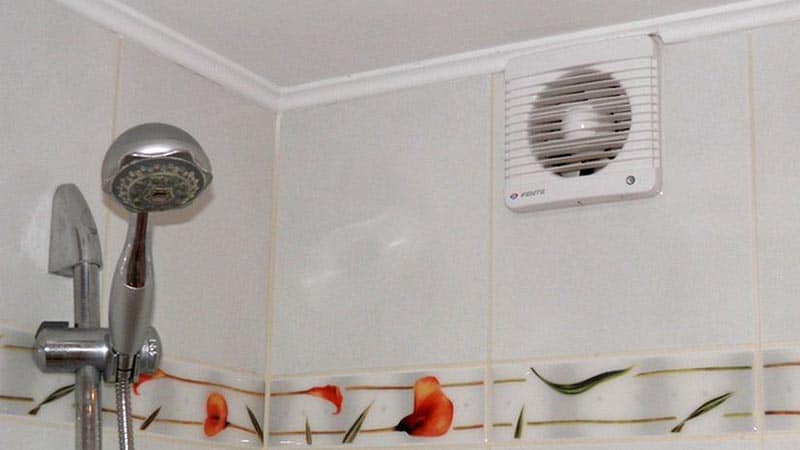 Fan in the interior of the bathroom
To calculate the performance, use the following formula: the volume of the room must be multiplied by the multiplicity. If the number of people living in the house is 1 or 3, the multiplicity is 6. If more than three people use the bathroom, the multiplicity is 8.
Let us give an example of such calculations. There are 3 people in the family. The length of the bathroom is 3 meters, width - 2 and a half meters, height - 3 m. We calculate the fan performance as follows: 3 * 2.5 * 3 * 6. We get the number 135 m3 / h. Thus, it is recommended to purchase a fan with this capacity.