- Causes of condensation on the glazed balcony
- Bad and good ventilation systems
- How to independently make ventilation on the balcony
- Why do you need ventilation on the balcony
- Reasons for installing an air conditioner on a balcony
- The main mistakes in the insulation of the balcony
- DIY installation
- Ventilation on the balcony with plastic windows
- In what cases is ventilation needed on the balcony?
- What will happen without her?
- Causes of condensation on the balcony?
- What can be done?
- Space organization
- Briefly about the main
- How to remove it: the windows on the loggia are sweating, what to do
- How to make a hood on the balcony and loggia with your own hands
Causes of condensation on the glazed balcony
Precipitation on glazed loggias most often occurs during the cold season. Why is this happening?
Let's remember the basics of physics. Warm air in a closed room comes into contact with windows, walls and ceilings, which are much cooler due to the influence of the external environment. As a result of this difference, the so-called "dew point" is reached, at which the air settles as droplets of moisture on surfaces in contact with the street.
Air is heated not only under the sun's rays.It is worth opening the door to the balcony in the cold season, as the heat from the apartment penetrates into the glazed room and quickly settles with droplets of moisture. An additional provoking factor can be high humidity - flowerpots with plants or seedlings, drying clothes with the windows closed.

Humidity level and temperature difference at which condensation forms
The problem can be partially solved if you regularly ventilate the room and carry out glazing in accordance with all the rules:
- Install double-glazed windows with 2 chambers (in mountainous areas and other regions that are characterized by sunny warm days and cold nights, 3-chamber windows are better suited).
- Use a good elastic seal and high-quality fittings.
- Make sure that during installation all seams and joints are carefully treated with foam and do not form gaps.
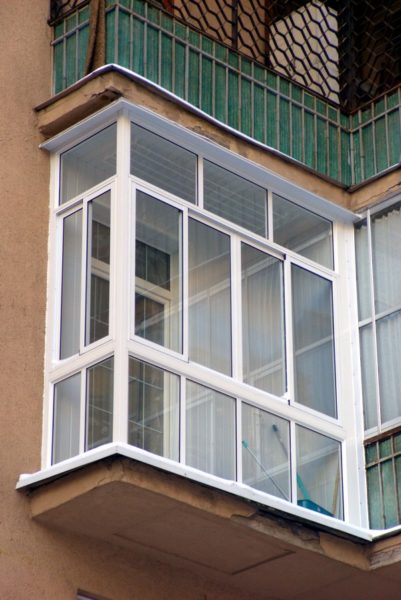
The larger the glass area, the colder it will be on the balcony
Even a loggia glazed in accordance with all the rules and building codes still needs ventilation. If you do not regularly ventilate the room, air with high humidity quickly forms condensation that settles on the windows and ceiling.
Bad and good ventilation systems
It is not necessary to explain that ventilation in an unheated room is a must. Everyone knows that without an influx of fresh air it will be impossible to stay indoors. It will be constantly stuffy here, the air will eventually become stale, as a result of which it becomes difficult to breathe. In addition, sooner or later, fungus and mold will begin to appear on the surfaces of the room. Of course, the sight of these growths is repulsive. However, this is not the worst.Formations such as fungus and mold cause irreparable harm to human health, so you need to immediately think about how to make ventilation on the loggia.
As is known from the laws of physics, mold forms most often on the ceiling and upper parts of the wall, since warm air masses tend to leave the room from above, accumulating there. Often, after warming the room and installing heating, mold begins to appear everywhere, in addition, the formed condensate flows down, unpleasant puddles appear. In the case when the walls of the loggia are painted or plaster is applied to them, under the influence of moisture, all this coating begins to swell, crack and fly around. All these negative factors are the causes of poor ventilation of the room.
Of course, good ventilation in the room guarantees a healthy climate for residents, where there is no place for mold and mustiness. However, if mold has already appeared, then it should be removed immediately, otherwise it will quickly spread over the entire surface. To eliminate it, it is recommended to purchase special formulations that are designed to fight fungus. The mold is well cleaned off, after which the surface is treated with a brush with this composition. Such a simple algorithm of actions allows you to get rid of malicious formations within a short time. However, it is more important to get rid of the cause as a result of which they appeared.
The installation of fans perfectly activates the air flow, thereby ensuring good and proper ventilation in the room. With their help, you can permanently get rid of not only fungi, but also mustiness.In addition, fans cope well with high humidity, expelling it outside in a timely manner, launching new clean air. A ventilation system that includes fans is a real find for owners of unheated premises. In addition, the incoming air in the presence of a radiator will be dried. Thus, the increased humidity content in the air will gradually decrease. As a result, this will help to avoid unpleasant diseases and normalize the microclimate in the room.
How to independently make ventilation on the balcony
Ventilation device for do-it-yourself balcony thing is quite feasible. In any case, you can’t do without it, so it’s better to start this work sooner rather than later.
It is better to calculate the air supply according to the norm - 3 m3 per hour per 1 m2. In terms of intensity of use, a balcony or a loggia, even glazed ones, is inferior to other rooms, but a supply will not hurt.
Breather. When buying a breather, you should entrust the installation to professionals, as this requires a certain skill. However, this does not mean that the installation cannot be done by yourself.
A template is supplied with the device. From it you can determine the optimal place for installation. Having outlined the area for the hole, a neat hole is constructed under the duct. The choice of penetration tool depends on the thickness of the wall. If the thickness is large, a drilling rig may be required.
The main work is done. It remains to bring an air duct into the hole, hang the device in place and connect it to the network. The outer part of the pipe should be protected with a grate, and the edges of the hole should be treated with sealant.
Diffuser. Installing a diffuser requires the construction of a nest for it.As such, a piece of ventilation pipe available at any specialized store can serve.
Having created a hole in the wall of the balcony, according to the diameter of the pipe, the nest is installed in the wall and fixed with mounting foam. After drying, the excess foam is cut off, the diffuser is put in place. You should make sure that the device has risen to the end with the latch fully fixed.
For a simple hood on the balcony, choosing a diffuser is the best option.
Fans. Creating air exchange with fans in the outer wall is one of the most affordable ways. Required for this:


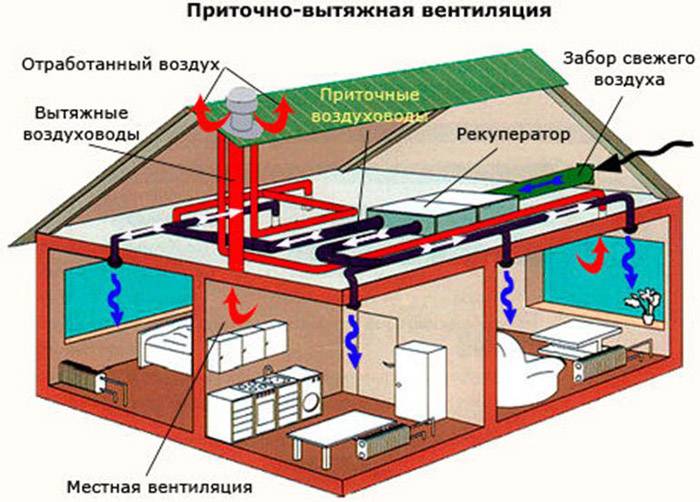

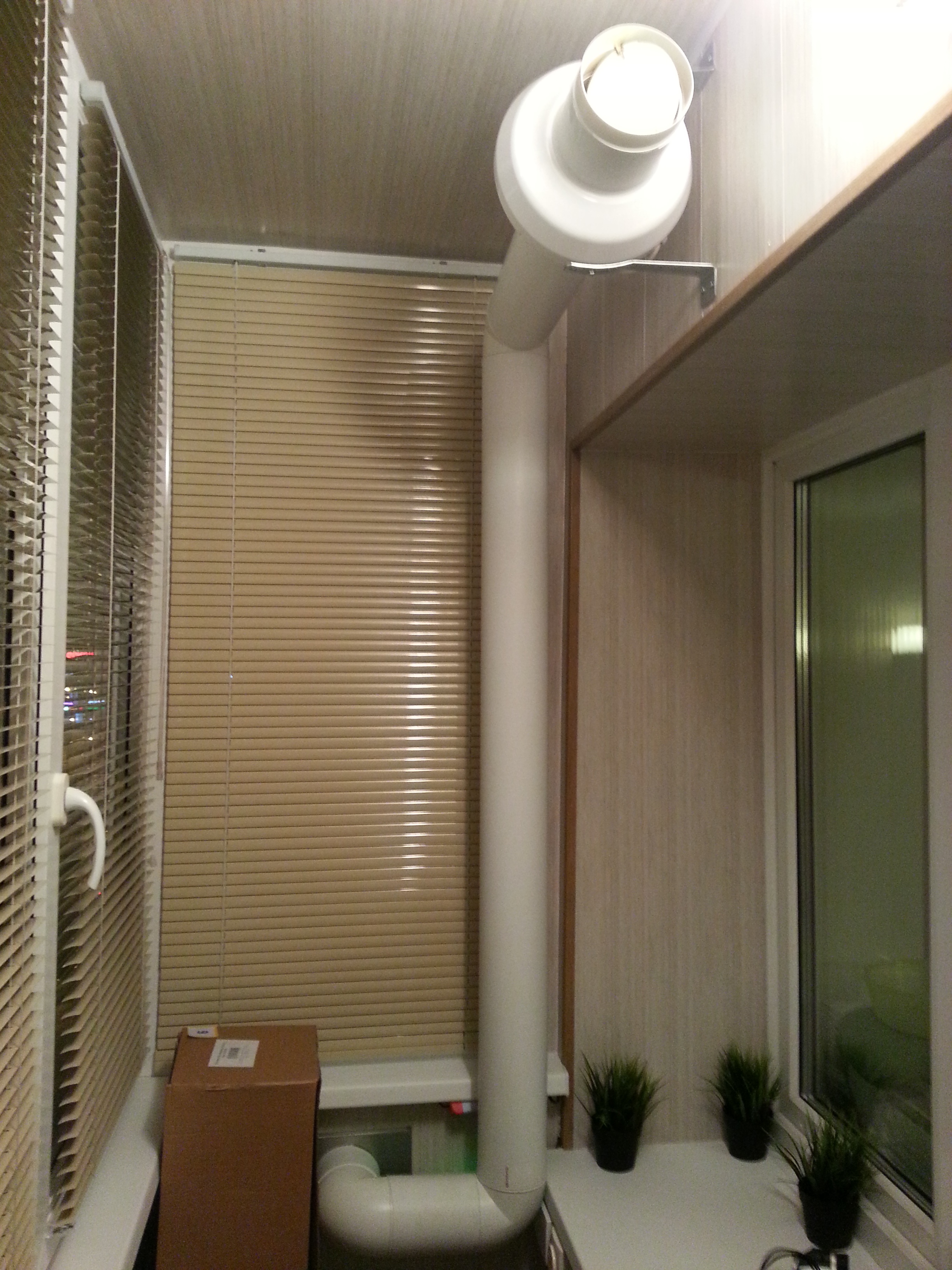
- drill (crown for concrete of the appropriate diameter);
- perforation mechanism;
- sealing material.
Plus the fans. Depending on the type of devices, it may be necessary to run wiring to the installation site. A puncher or a drill (depending on the material of the balcony wall) makes the necessary holes - for the hood at the top, for retraction at the bottom. Then the fans are fixed with sealant in the openings made. It remains only to power the devices.
If there is a fan that works both for exhaust and exhaust, you can get by with a single unit.
Forced ventilation. The inlet valve consists of:
- an intake block installed above the window from the outside (the ingress of precipitation is blocked by a visor);
- internal block, with a regulating mechanism, a filter and a nozzle;
- connecting part, in the form of telescopic sleeves passing through the frame through specially drilled holes.
Given the availability of valve varieties - mechanical and manual, the master needs to make sure that the appropriate option is selected. Mechanical ones are automatically adjusted, while manual ones require human adjustment.Separate members of the family are rebate valves, without the need to drill a frame for them
They are installed instead of a section of the window seal of the appropriate length.
Individual members of the family are seam valveswithout having to drill a frame for them. They are installed instead of a section of the window seal of the appropriate length.
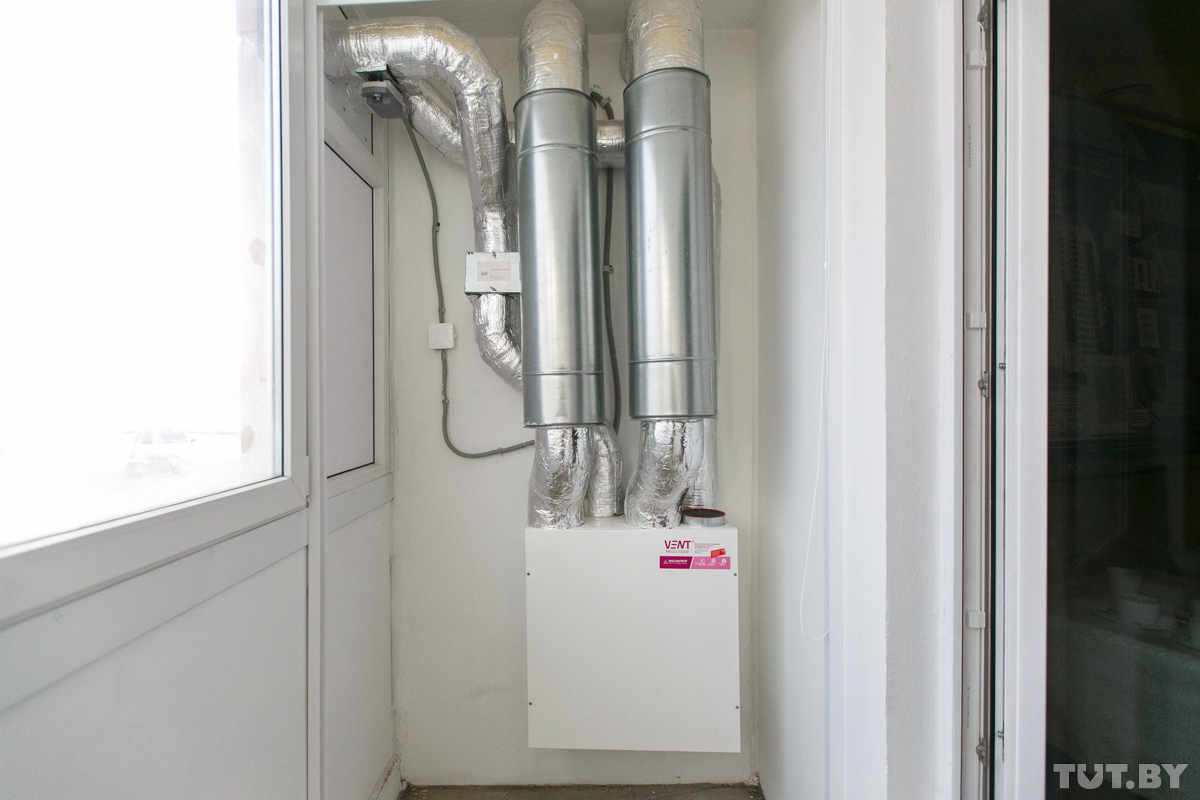
Recuperator. A universal mechanism that combines exhaust, supply and temperature control of air flows
When installing it, it is important to keep the distance from the heating devices, since the heat exchanger is mounted indoors
The sequence of steps roughly corresponds to other systems - perforating a hole for an air duct, supplying a pipe, fixing the case to the wall. The tightness of the junction of the pipe with the opening is provided with foam.
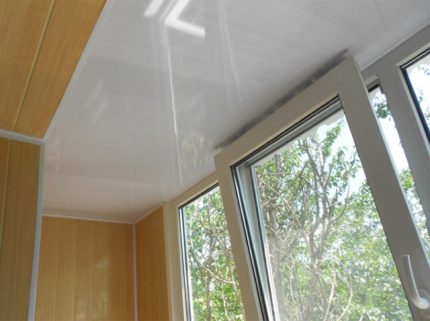
mixed method. In addition to the above methods, there is an option to make ventilation combining some of them. The fence will be carried out by a valve on the window. This allows you to maintain impermeability with a constant influx of outside air. The hood will be done by a fan.
The air circulation scheme should be calculated based on the purpose of the glazed loggia or balcony. Each apartment uses them differently. But in any case, the presence of ventilation, at least a simple hood, is necessary.

Why do you need ventilation on the balcony
Ventilation on the balcony will not be able to work fully if the balcony is not insulated
The question of why ventilation is needed on the balcony worries many, because the condensate that collects on the windows and walls of the balcony then turns into mold, which is very harmful to the human body.
Many may think that you can open the window and just ventilate the balcony.
But do not forget that the window will not be open all the time, but the ventilation always works and with its help not only fresh air does not enter the balcony, but it also removes all extraneous odors in the house.
In order to avoid condensation and mold, it is necessary to properly install ventilation.
If you decide to install ventilation on your loggia, you must remember that it will not be able to work fully if the balcony is not insulated.
Related video:
The first stage before installing ventilation is the mandatory insulation of the balcony. First of all, it is necessary to make external insulation of the room. To do this, you will need foam blocks 10 cm thick.




It is worth remembering that if the balcony is hermetically sealed with insulation on the street, then this will already prevent cold air from entering the room, and of course, the walls will not so insist on the balcony and the condensate will decrease.
Further, it is imperative to insulate the room from the inside, carry out all the finishing work, and then the appearance of condensate will be minimized. But its complete absence depends only on ventilation.
Someone will think that for ventilation on the loggia it will be enough just to open the window for constant ventilation and not bother about it.
But if the balcony overlooks the roadway or a busy street, then naturally noise and dust will constantly enter the room and create some discomfort for the residents.And then the installation of supply and exhaust valves can come to the rescue.
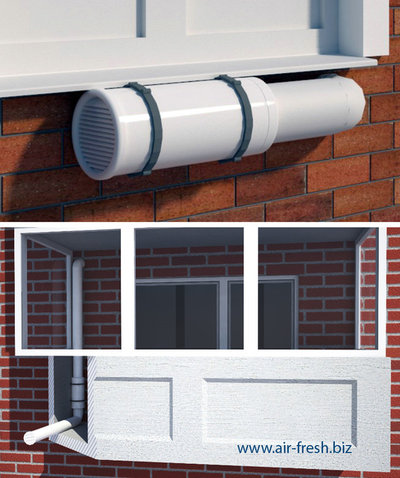
This is how the supply and exhaust valve looks like: on the left - from the inside, on the right - from the outside
Supply and exhaust valves create the necessary air exchange in the room, but in turn do not let dust and noise through, which is a huge plus. They can install on plastic windowsor just in the walls.
Supply and exhaust valves are a thin elongated design that does not immediately catch the eye, and in turn does not spoil the interior.
They are quite easy to install, everyone can install them, installation will take no more than one day, you will not have to wait long.
All models differ in volume and performance. Supply and exhaust valves do not create any drafts, do not depend on the mains, because they have a mechanical control.
This design is a quick solution to the problem of condensate on the balcony.
Installation video:
You can also install forced ventilation on the balcony, it is worth noting that it is more popular. You can install it yourself without resorting to the help of a wizard.
To do this, you need to buy two fans with the same power and put them on your insulated balcony.
To make a ventilation system, you need a fan to take dry air from the outside into the room, and a fan that will give humid air to the street.
It is also necessary to take the mounting system and electrical wiring. When installing supply ventilation, you must remember the simple laws of physics.
Humid air always tends to the top, so the ventilation for air extraction must be placed at the top, and ventilation for air from the street is best installed at the bottom of the room.
Scheme of operation of exhaust fans on the balcony
This system will constantly take all the moist air from the room, driving it diagonally.
It is worth noting that this ventilation is the most efficient among all existing ones, and is very popular.
It is also necessary to remember such a small nuance so that cold air enters the room less in winter, fans must be covered with makeshift doors.
Reasons for installing an air conditioner on a balcony
Unfortunately, sometimes there are situations when an external module cannot be installed on a facade:
- the air conditioning unit disturbs the appearance of the building;
- the building is classified as a historical monument;
- for technical reasons, it is impossible to install a remote unit on the outer walls of the building;
- there is no permission to install an air conditioner on the wall of an apartment building.
In the above cases, if the indoor unit of the air conditioner is installed in a room with a balcony, then its external unit is mounted on a balcony or on a loggia
And it does not matter - on open or glazed
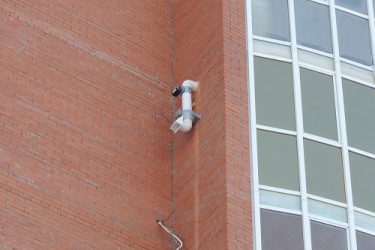
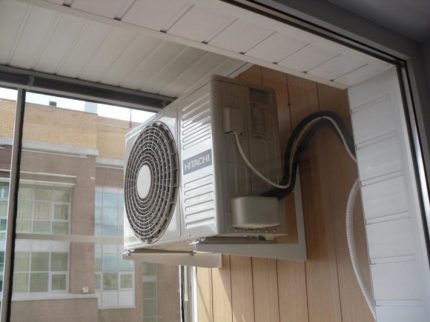 When the outdoor unit cannot be installed front air conditioner at home, they take it out to the balcony or loggia. Installation is carried out regardless of the presence or absence of glazing
Outdoor unit installation air conditioning on the loggia or on the balcony has a number of advantages:
- the installation process is less expensive: high-altitude work is not required;
- the body of the block is protected from negative weather factors: wind, snow, rain;
- the distance between the air conditioner modules is reduced;
- simplifies maintenance, cleaning and repair.
However, there are also disadvantages to this setup. Let's look at them in more detail.




The main mistakes in the insulation of the balcony
Since the apartment in an apartment building has a small area, the owners attach the balcony and loggia to the adjacent room or to the kitchen. In order for the area thus obtained to be useful, it should not be inferior to another room with its characteristics.
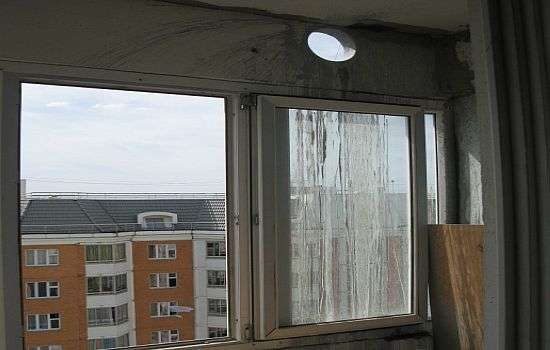
If you have equipped a balcony and, after some time, mold appears in the corners and water near the wall, it means that mistakes were made during the work on warming the room, such as:
- When finishing the walls and the floor, all the cracks and crevices were not sealed, and therefore it bleeds through on the balcony;
- If, when choosing rails and beams (for crates), they acquire not well-dried material, then it will be deformed.
The biggest mistake is the appearance of blackish-greenish mold and condensation, this can happen for the following reasons:
- Mistakes made when working on insulation;
- Incorrectly mounted ventilation;
- Poor heating system.
If the hood on the balcony is not installed correctly, then air will flow from the warm side of the room to its colder part and condensation and moisture will form on the coldest plane. In order to prevent this from happening, it is necessary to ensure air exchange, for example: if you install a door that divides the room into two parts with different humidity and temperature.
If the balcony was not properly insulated, then moisture will appear in that area, so it is necessary to follow the technological process of this operation. For example, if instead of mounting foam, gypsum putty is used and the joints of the insulation are sealed with it, then moisture will condense on the “cold bridges” that will be created by gypsum. This cannot be fought, and the alteration will be quite expensive.
In winter, moisture (steam) passing through the insulation enters the room and collides with a cold wall, and, once on its surface, the vapor condenses and turns into a liquid. After a while, the insulation gets wet, and then the wall, and mold and fungus appear on it. Since nothing holds moisture, leaks form, and the insulation loses its qualities.
DIY installation
You can make ventilation on the balcony yourself. There are three ways to place the supply system:
- only at the top;
- only below;
- immediately below and above.
The last option is the most optimal, as it provides maximum hood.
For work you will need to prepare:
Holes for fans are made in the walls. Devices are inserted into prepared openings. To ensure air flow, one fan needs to blow in air, and the second one blows it out. It is recommended to initially consider a removable installation option in order to remove the devices for the winter.
Ventilation on the balcony with plastic windows
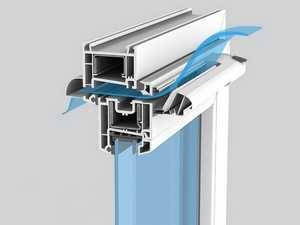
The best option to make a hood on a balcony with metal-plastic windows is to install a valve. Doing the work yourself is easy. The valve is a three-part device:
Air intake outdoor unit to be installed on the frame from the street side
It is important to install a visor on top to protect the block from precipitation.
Telescopic sleeves, which are located in the inner part. They need to be installed in the frame profile
To do this, you first need to drill a hole.
Inner block - it is considered the most difficult part. This element consists of a nozzle through which air will pass into the room, a filter and a special mechanism that regulates the throughput of the valve. The block is installed to the profile opposite the outer element.
If this method of ventilation is organized on the balcony, it is necessary that the exhaust riser function well.
Window valves are of two types:
The first are regulated by a built-in electric drive that opens and closes the valve, thereby regulating the air exchange. The manual valves are operated with a rope. They are considered the most difficult to manage, since it is difficult to find the necessary inflow the first time. Due to incorrect adjustment, the valve may freeze in winter.
Among the air valves, there are models that are not inserted into the holes, but instead of part of the sealing gum. Thus, air will pass through loose areas between the frame and the sash. This option is considered the most economical.
In what cases is ventilation needed on the balcony?
The ventilation system is needed for such problems:
- When the balcony is glazed and completely sealed. This can be easily understood if stale air is felt in the room with which it is combined (with the balcony windows closed).
- If condensation appears on the balcony in winter, moisture is felt and / or mold appears.
Even if there are no listed problems, or they do not cause much inconvenience, ventilation is still necessary if on the balcony:
- things often dry;
- some things / products are stored that do not tolerate high humidity;
- a working space / a place to relax / a living room is being equipped;
- often smoke;
- there is a brazier (yes, it happens);
- there is a mining farm.
What will happen without her?
If there is no normal ventilation on the balcony, the following problems may occur (with the windows closed):
- at any time of the year, both on the balcony and inside the living room that opens onto it, there will be stale air;
- humidity will increase in winter - because of which mold will occur and stored items (food, wood, metal, textiles) will deteriorate;
- washed linen will dry much longer, and it’s not a fact that it can dry completely at all (if there are fully sealed double-glazed windows);
- due to dampness, finishing and building materials can deteriorate (metal surfaces rust, boards become damp and rot, plaster crumbles, wallpaper peels off);
- if there is a mining farm there, it will heat up more, and, in addition, it may become unusable due to dampness (in winter) and condensate.
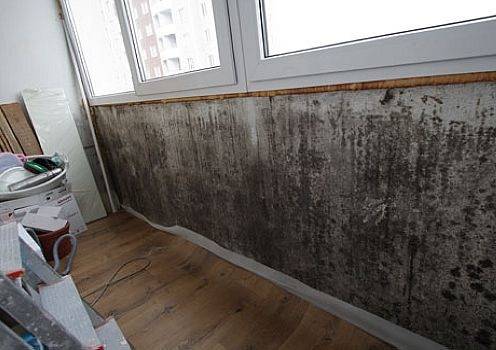
Other troubles are also possible - if mold starts on the balcony, then through drying things it can “move” to other rooms.
Causes of condensation on the balcony?
At a certain temperature, air vapor reaches such a state that water is formed from them, that is, water vapor condenses. This physical quantity is otherwise called the dew point.If mistakes were made during the insulation of the balcony adjacent to the room or kitchen, then no ventilation of the balcony will help. Mold and frozen water against the wall due to increased steam condensation will ruin all the functional attractiveness of modern housing. Here, most likely, there are mistakes made when working on the insulation of the balcony.
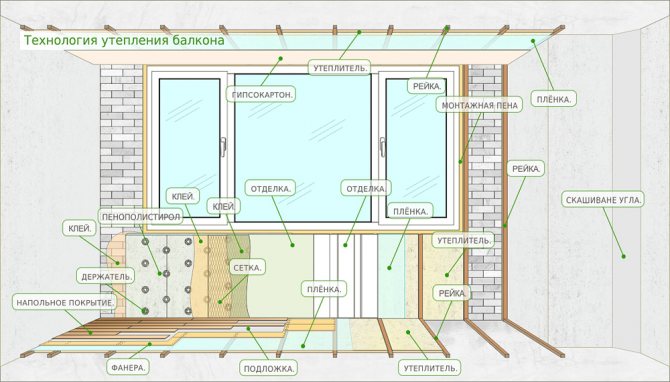
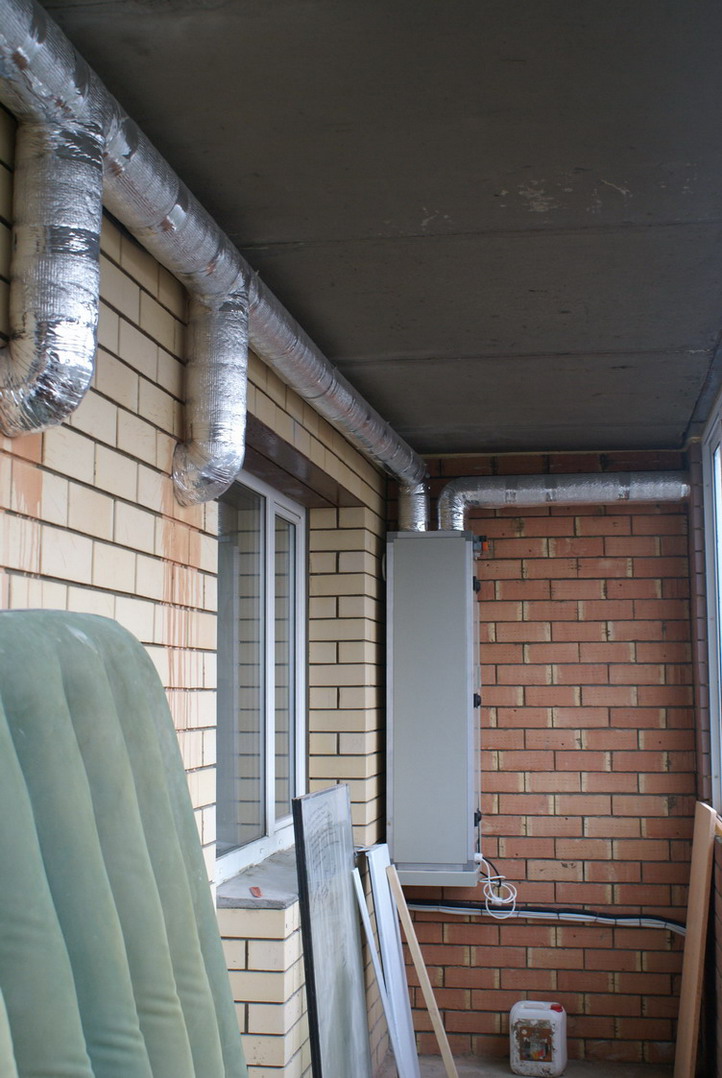
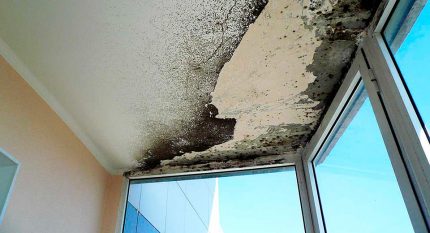



Possible errors during insulation:
- poor sealing of possible cracks and crevices, resulting in a draft;
- deformation of the crate, which may be associated with the use of undried beams and battens for construction work;
- ill-conceived heating design;
- improperly installed ventilation system.
If, as a result of an incorrectly mounted hood, places with different air temperatures and humidity are formed on the balcony, condensation and dampness accumulate in one of its coldest parts. To eliminate this process, it is necessary to change the air exchange or create conditions under which it was possible to divide the room into a cold and warm part, for example, through a door.
The appearance of strong condensation on walls, possibly due to technological violations. For example, if, while insulating a balcony, the joints are sealed with gypsum putty instead of mounting foam, in these places, precisely because of the gypsum, moisture will accumulate, in cold weather it will lead to freezing of the walls. The only way out in this situation is urgent repairs.
When steam from a warm room passes through the insulation, it collides with a frozen wall, resulting in condensation, which gradually turns into a liquid. After a while, the insulation itself gets wet, mold, fungi form, and the insulation loses all its original properties.
This is interesting: Proper insulation of the balcony
What can be done?
Before you make ventilation on the balcony, you need to decide what type of air exchange is suitable for the allotted room. Installing a plastic window leads to complete tightness of the internal space of the balcony. Therefore, you should consider all options for how and with what help you can ensure high-quality ventilation. On a glazed balcony of small size, you can get by with natural ventilation. If it's big, it's forced.
Forced air exchange is understood as the use of additional devices that make it possible to increase the volume of supply air masses. This is done using several types of equipment. Most often, a glazed balcony is installed:
- Fans. These devices are mounted in the wall and windows. Some models work in two directions, allowing not only to draw in fresh air masses, but also to remove “stale air”.
- Conditioners. They are one of the most effective climatic devices that allow you to set up a good microclimate not only on the balconies, but also in the rooms adjacent to them. But, there is one drawback - such equipment is expensive.
- Supply and exhaust hoods. These devices are small in size and can be installed not only in the wall, but also in the window frame. Their advantage is high-quality air exchange without the penetration of dust and dirt into the room.
Artificial ventilation is also needed for a space where things are often dried after washing. Only supply and exhaust scheme allows you to create favorable conditions not only for drying clothes, but also for staying on the balcony of a person.
When the balcony is glazed, you need to take care of installing certain climatic equipment. After all, some ventilation schemes and individual devices work due to their location in a window frame or in a double-glazed window.
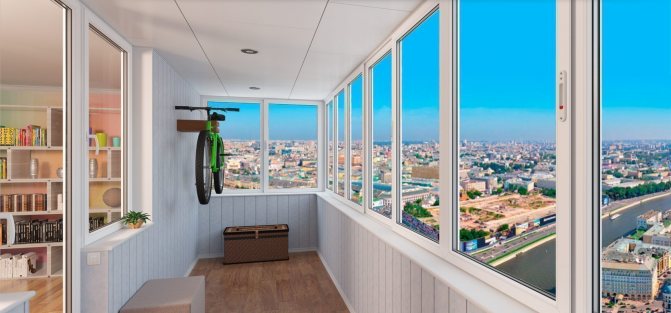
If the balcony is glazed, care should be taken to install the necessary climatic equipment
In addition, in winter, good insulation allows you to keep the apartment warm. Therefore, the first thing to take care of is work on the balcony itself.
Space organization
If it is planned to give a balcony or a loggia for a technical, secondary space, then one light source can be dispensed with. It is convenient to place it on the ceiling in the center to get uniform lighting. A good option would be a model on an adjustable suspension, which allows you to direct the light flux in the right direction and adjust the height of the lamp.
In other cases, to create a full-fledged backlight, a complex solution is needed, especially for a space with an elongated geometry. On a narrow long balcony, lighting can only be installed in the side part, but in order for it to be uniform, both sides will have to be used.

Lighting solution for narrow spaces
On the loggia, one source for improvement will also not be enough. If you use a ceiling model (chandelier or ceiling lamp) as the main one, then you will need your own light source for the resting place.
Furniture (for example, a table and an armchair) and suitable lighting will help to zone the space; on the loggia, the lighting design of the recreation area is selected based on convenience and personal tastes.It can be either a sconce or a table lamp or a model on a clothespin.

Winter garden on the loggia
Increasingly, the space of balconies and loggias is being sought to be made as useful as possible and equipped for specific tasks. In accordance with the improvement method, the type of lighting (main, local, decorative) and lamps are selected. The design of lighting fixtures is chosen based on the interior style. The following arrangements are popular:
Rest zone. Owners of a loggia stretched along the floor can zone it with accent light. To do this, it is enough to place a table and an armchair in the corners, complementing them with a sconce or a directional lamp. LED-garland of retro lamps, stretched along the load-bearing wall, will help make the space more comfortable; it will be economical and stylish.

Comfortable seating area
Under the office. An LED panel is suitable for arranging the working area. To make it convenient to work, you need to take care of protection from reflections on the screen. The replacement of the LED panel can be a top light with adjustable brightness and light direction. To prevent the glare of sunlight on the screen from interfering with work, blinds are hung on the window.

Work zone
- Winter Garden. Gardeners who fill all the free space with pots and containers of flowers will need light with certain characteristics in terms of power and color temperature. LED panels will become a universal solution, and individual LED lamps on a clothespin are suitable for exotic plants.
- Hobby. For a workshop or a mini-hall for sports, bright lamps are suitable. Above the desktop for doing what you love, you can additionally hang a source of directional light.

Gym lighting design
About LED strip lighting in the following video:





Briefly about the main
Lighting on the balcony is recommended for everyone who plans to make full use of this space. First of all, you need to choose the optimal connection scheme, then decide on the type of fixtures and lamps. To select suitable lighting devices, their technical characteristics, pros and cons, as well as compliance with the interior style are evaluated.
Lighting helps you create the home or work environment you want. If the size allows, several functional areas are arranged on the balcony or loggia, providing each with a suitable light source.
How to remove it: the windows on the loggia are sweating, what to do
You need to act according to the occasion; The problem, of course, can be solved by yourself. If only one side of the loggia / balcony is glazed, the other four surfaces can be insulated. If most of the room is glazed, you need to see what heating equipment is brought out to the balcony.
How to get rid of condensation:
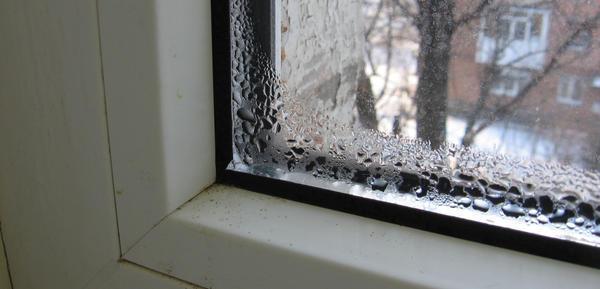
- To keep the windows from sweating, they just need to be aired often. At least twice a day for 5-10 minutes, even in cold weather, open the windows on the balcony. This increases the percentage of oxygen in the air.
- Sealing seams and crevices, as well as wall insulation, will also help. Fill the joints with mounting foam, sheathe the walls, for example, with foam plastic. Sheathed surfaces still need to be decorated somehow.
But not always the balcony can be insulated from the outside. Loggias on high floors have to be insulated from the inside, although this eats up a certain percentage of the usable area. The main thing is to insulate with high quality, and of course, you need to stop smoking on the balcony.Firstly, this is simply wrong, and secondly, smoke often eats into the finish.
How to make a hood on the balcony and loggia with your own hands
It is quite feasible to design a supply and exhaust system with your own hands. In fact, you just have to install two fans, one of which will work for the air supply, and the second for the output. And in order to place them correctly, let's recall the simplest law of physics: warm air moves up, cold air goes down. Therefore, the supply unit is mounted near the floor, and the outlet is closer to the ceiling.
It is advisable to design the ventilation openings diagonally to each other - this way the system is guaranteed to cover the entire room and prevent the formation of condensate.
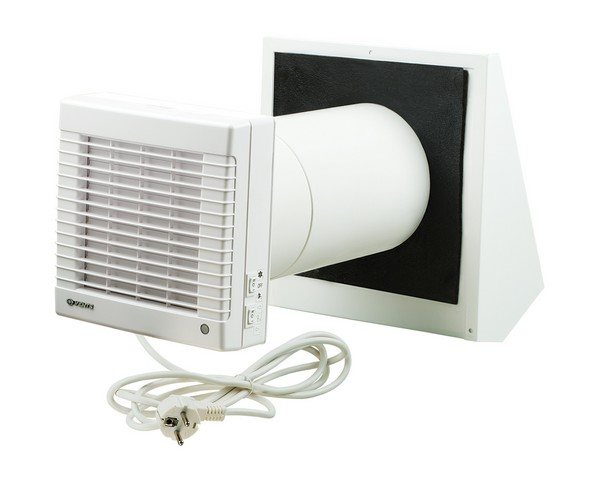
Compact multi-zone ventilator
For work you will need:
- 2 fans of the same power for air intake and exhaust. The best option is to choose models that are immediately equipped with plugs that block air access when the device is not working. Otherwise, in winter you will have to close the vent with makeshift partitions.
- Supply of electricity.
- Fastening systems.
- Perforator.
- Sealant, plaster mixture, spatula.
To install the fan, draw a markup for the diameter of its shaft, turn on the puncher to the jackhammer mode and make a through hole out. Then you need to connect the device to the pre-wired wiring, install it in the prepared passage and process it around the perimeter with plaster, masking the joints. When the mixture dries, a sealant can be applied around the perimeter to prevent air from penetrating from the micro-crevices.
On a small square loggia, you can get by with installing one supply and exhaust fan.If the room is long, it is better not to take risks and mount two devices.