
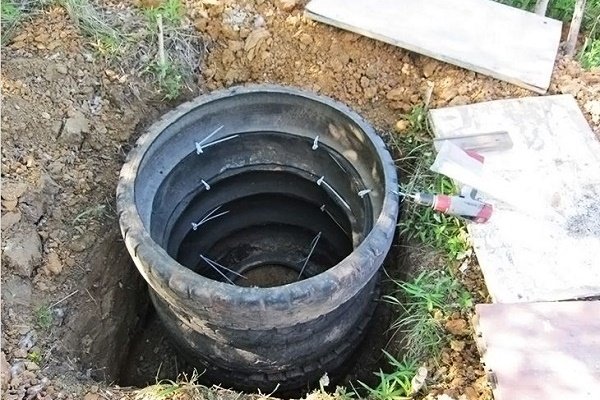
- Popular septic options
- No. 1 - design with a filter system
- No. 2 - a structure with a sump and filter system
- No. 3 - a septic tank from tires with a drainage pipe
- Characteristics and types
- Rules for building a structure
- What do you need to start building?
- The optimal location for the pit
- The sequence of building a cesspool from tires
- What are the disadvantages of the design?
- Difference from a cesspool
- Construction of a cesspool from tires
- We ennoble the hatch of the cesspool
- Cesspool of tires
- Nuances for installing a cesspool
- Location selection
- Volume calculation
- Cesspool made from old tires
- Requirements for the placement of a cesspool on the site
- How to build a hole with overflow
Popular septic options
Septic tanks assembled from worn tires are of three types:
- With filter system.
- With a sump and a filtering (absorption) well.
- With filter system and drainage pipe.
It is necessary to choose a design based on the volume of wastewater. For a family of three, a tire septic tank with a filter system is quite suitable. If the family is large, then such a septic tank will quickly become unusable due to congestion, so it is better to choose the option with a sump and a filter well.
No. 1 - design with a filter system
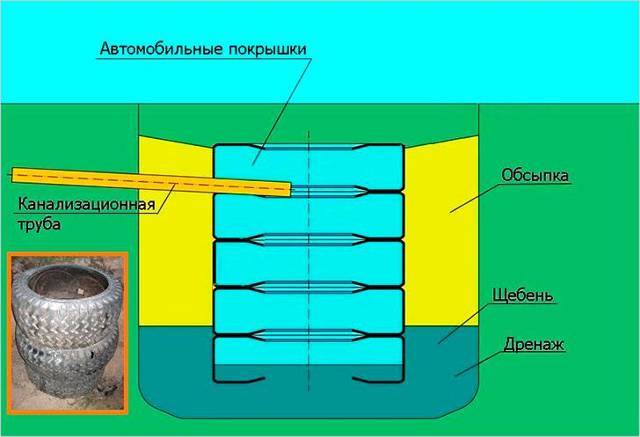
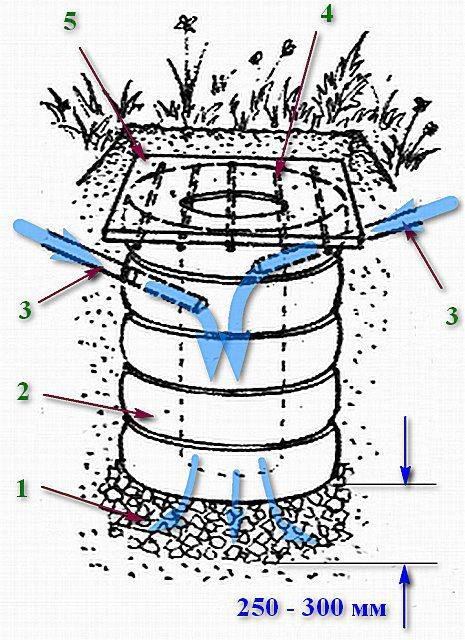
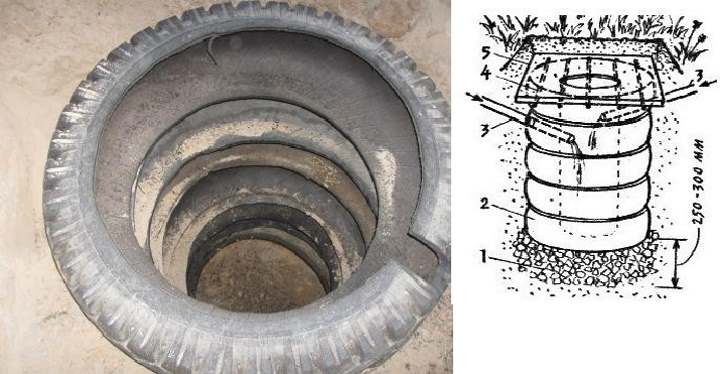
This is the most budgetary way for those who have planned to make a septic tank out of tires with their own hands. It is enough for him to dig a pit, prepare the bottom and lay the wheels.
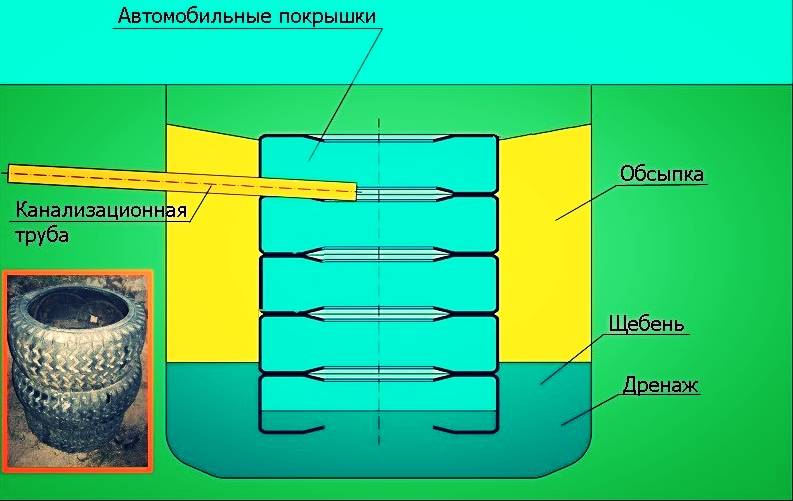
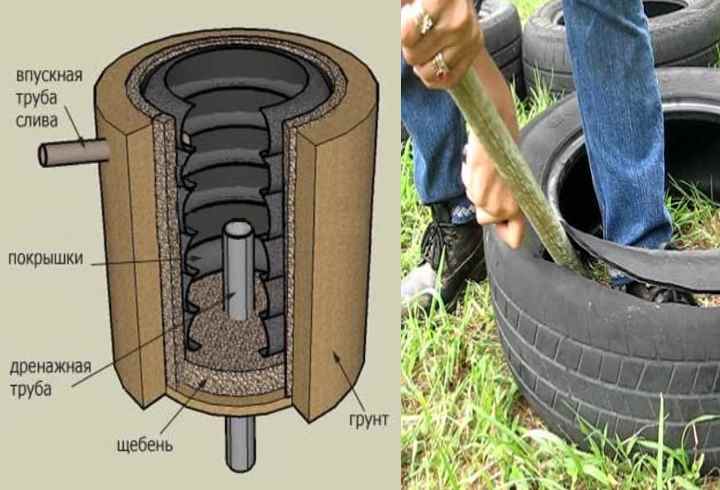
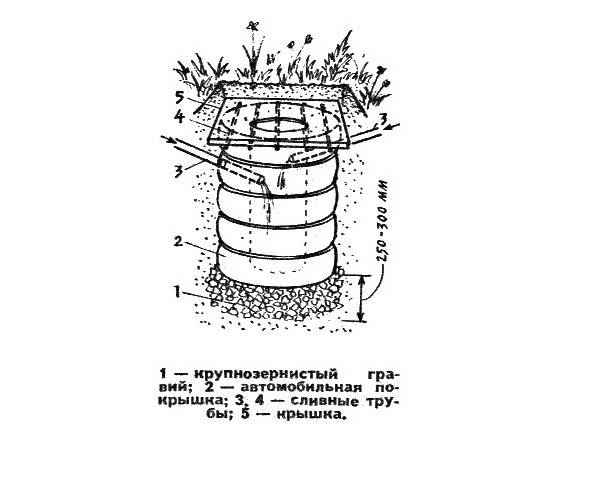
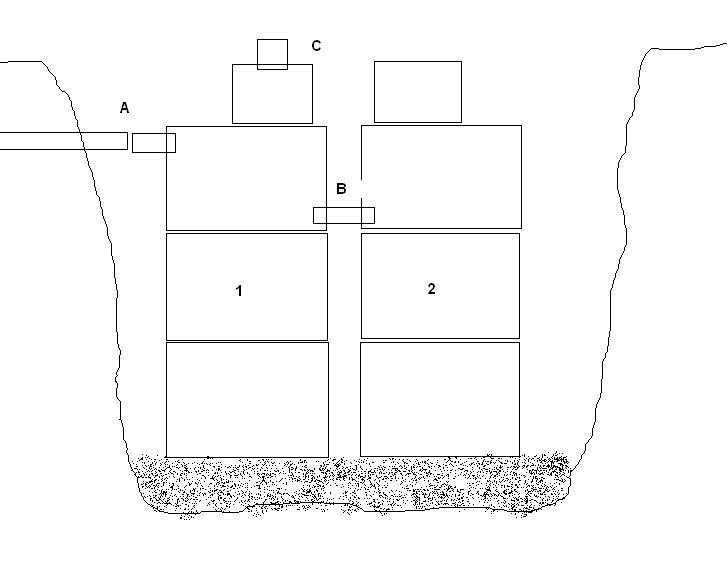
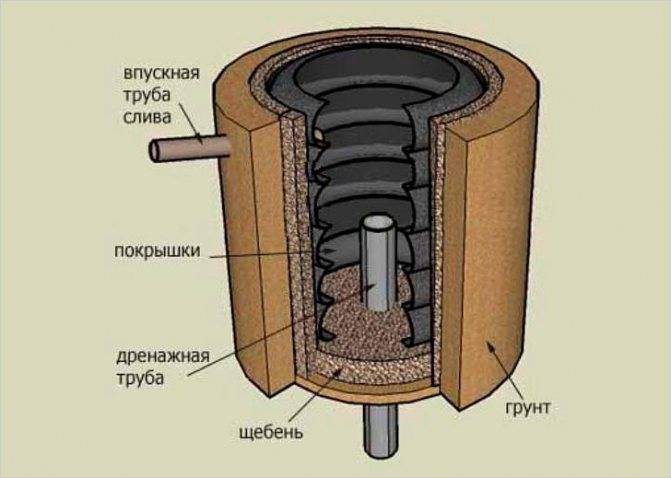
The principle of installing a simple facility for sewage treatment is clearly and clearly shown in the picture.
The capacity and associated operating capabilities of the septic tank will depend on the diameter of the wheels. It is better to take from large equipment
The principle of operation is simple:
- Effluent enters the container.
- The solid insoluble component of the effluent does not pass into the ground and settles on the surface of the drainage layer of crushed stone.
- The filtered water goes into the ground through the drain.
The downside of the structure is that this type is designed to collect and purify only gray drains: water contaminated during cooking, it is also from a shower room with a bathtub, from a washing machine and dishwasher.
Processing of fecal masses in a similar design is not performed.
However, if you arrange a sealed bottom instead of a drainage layer and ensure the tightness of the connection in the walls, this option can serve as a reservoir for collecting all types of wastewater that will be pumped out regularly.
The advantage of this system is its simplicity. As a sprinkle, you can choose expanded clay, sand and just plain earth. The disadvantages include the rapid formation of a viscous sludge residue at the bottom of the tank, which over time will make it difficult to drain the liquid.
If this happens, you will have to pump out the septic tank and clean the bottom, followed by replacing the gravel. Such a septic tank should not be located close to buildings or cellars.
No. 2 - a structure with a sump and filter system
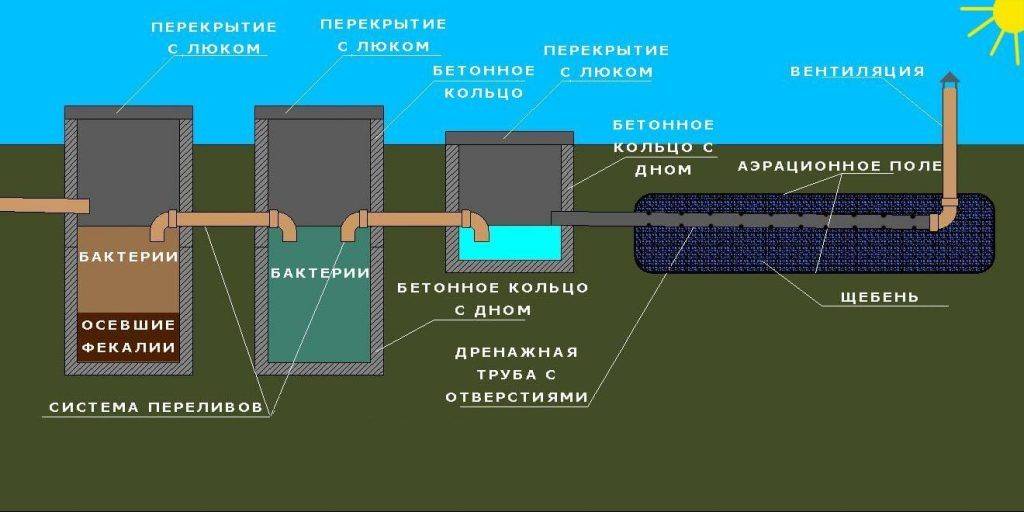
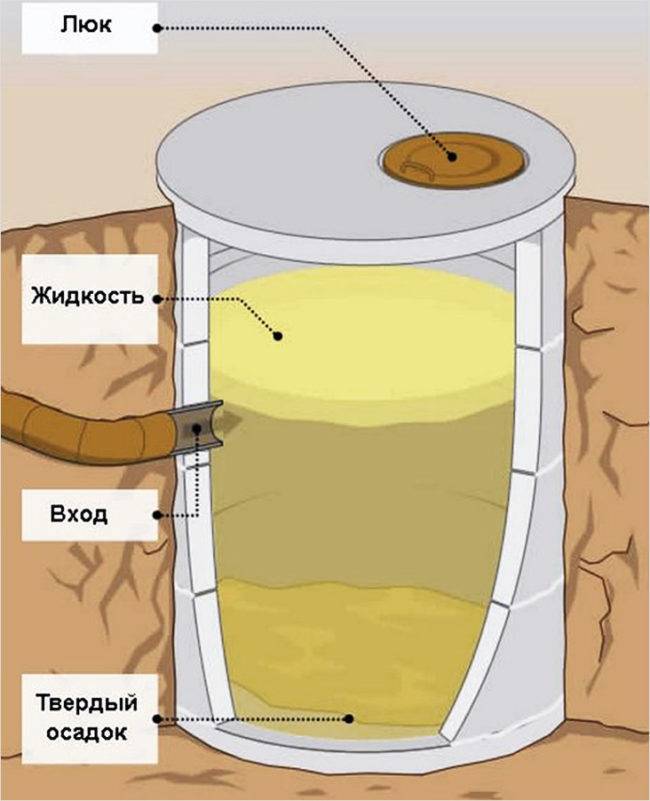
This option is more difficult than the previous one, but also more durable. The design consists of two containers.One serves to settle wastewater, and the other to filter it before it enters the ground.
This one differs from the previous version by the presence of a sump with a sealed bottom. In it, the effluents that have entered through the sewer pipe are settled. The insoluble component settles at the bottom, and the liquid component moves to the absorption well for further treatment by filtering through the drainage layer of crushed stone
Principle of operation:
- Waste water is drained through a pipe into the first tank.
- Large fractions settle at the bottom of the sump.
- Light fractions, together with the liquid component, enter the filter well through an adjacent pipe.
- Liquid effluents pass through a filtration system of gravel and sand, and then go into the ground. Light fractions settle at the bottom of the absorption well.
This septic tank design from old tires is the most environmentally friendly and cost-effective. Pumping out of it will need to be carried out no more than 4-5 times a year. Moreover, if the septic tank is constantly used, it is unnecessary to additionally insulate it.
No. 3 - a septic tank from tires with a drainage pipe
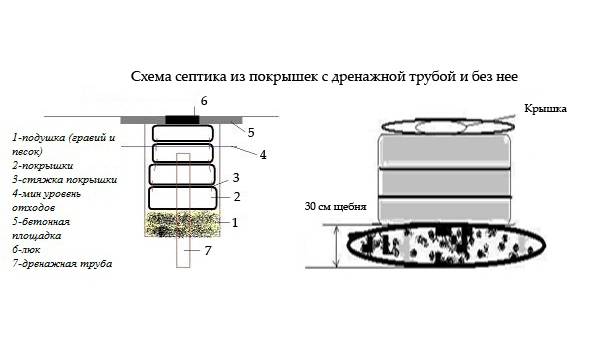
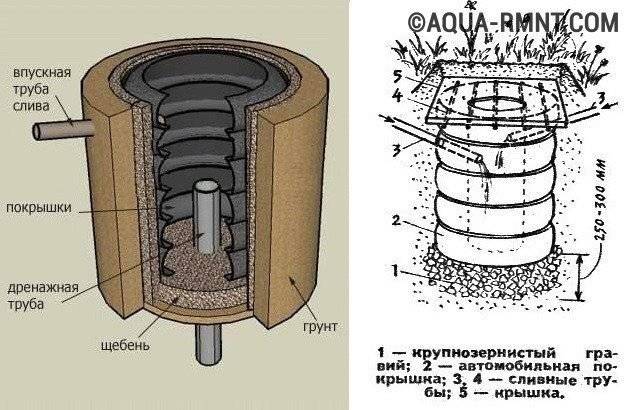
It's not the best design. The presence of a drainage pipe does not play a special role in the operation of the system.
Holes must be drilled in the pipe. To do this, use a drill with a drill that matches the material of the pipe. Do not forget to cool the drill, otherwise it will heat up and become brittle.
The principle of operation of this homemade septic tank system:
- Effluent enters the container.
- Insoluble sewage settles on rubble.
- Filtered water goes into the ground through a drainage pipe and crushed stone.
The purpose of the drainage pipe is to divert water, bypassing the bottom clogged with silt. But she also clogs them quickly and does not last long.
Characteristics and types
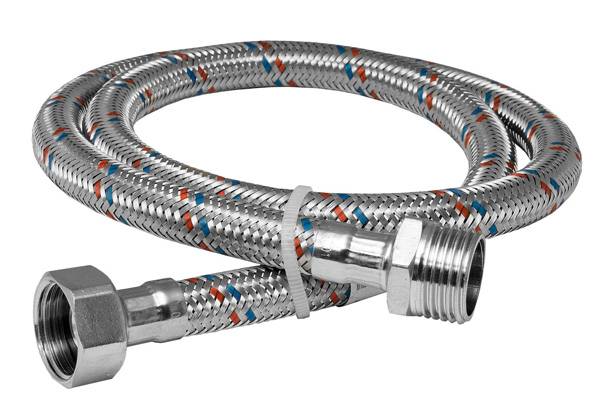
Flexible hose for plumbing is a hose of different lengths, made of non-toxic synthetic rubber. Due to the elasticity and softness of the material, it easily takes the desired position and allows installation in hard-to-reach places. To protect the flexible hose, the upper reinforcing layer is designed in the form of a braid, which is made of the following materials:




- aluminum. Such models withstand no more than +80 ° C and retain functionality for 3 years. In high humidity, aluminum braid is prone to rust.
- Of stainless steel. Thanks to this reinforcing layer, the service life of the flexible water supply is at least 10 years, and the maximum temperature of the transported medium is +95 °C.
- Nylon. Such a braid is used for the manufacture of reinforced models that can withstand temperatures up to +110 ° C and are designed for intensive use for 15 years.
Nut-nut and nut-nipple pairs are used as fasteners, which are made of brass or stainless steel. Devices with different indicators of permissible temperature differ in the color of the braid. The blue ones are used for cold water connections, and the red ones for hot water.
When choosing a water supply, you need to pay attention to its elasticity, reliability of fasteners and purpose. It is also mandatory to have a certificate that excludes the release of toxic components by rubber during operation.
Rules for building a structure
Do-it-yourself sewerage from tires is an excellent solution for those who do not want to spend big money on building a septic tank, but want to get an effective design that will last a long time.In order for the system to work as it should, certain rules must be observed during construction.
This will serve as a guarantor not only of the successful functioning of the sewer system from tires, but also reduce the risk of environmental problems that may arise due to ignoring the basic requirements for arranging a septic tank.
It is important to follow the following basic rules:
It is possible to start building a septic tank from wheels, provided that the groundwater passes at a level below the 2-meter mark. This will ensure reliable fixation of the structure, which will exclude shifts, erosion or deformation due to heaving of the soil. It is preferable to make a sewer on a site with sandy soil. As a result, optimal and fast drainage of purified water is achieved. When constructing a sewer, it is necessary to take into account how deep the ground freezes
It is important to follow this rule even when building a small tank into which household waste will fall. It should also be taken into account that the sewer from the wheels must be correctly positioned relative to other buildings and sources of drinking water located on a private plot.
So, the optimal distance between the house and the septic tank is 5 meters. Regarding water sources, it is necessary to locate the sewerage further from them by 20 meters or more. To minimize the risk of waste entering groundwater, it is recommended to place a septic tank from tires at the lowest point of the land. The level of water intake is necessarily lower than the level of the treatment plant.It is imperative to ensure unimpeded passage for the transport of the sewage treatment service.
Advantages:
- lack of large cash costs;
- short construction period of the sewerage;
- you can build on your own without attracting a lot of people;
- fit any tires, regardless of novelty and size;
- uncomplicated construction.
Flaws:
- poor performance;
- serves an average of 10-15 years;
- bad smell;
- Incomplete sealing of tires increases the risk of soil contamination with sewage.
What do you need to start building?
It is important to obtain permission to build a sewer network if the depth of the pit exceeds 5 meters. It is not difficult to get it, especially if you comply with all the conditions for surveying the site.
These conditions are detailed in the Land Code of the Russian Federation. If there is a cadastral passport obtained before 2014, they should be redone. The cost of surveying itself varies within 6000 rubles.
Watch the video
If a communication cable passes through the site, special permission must be obtained from its owner. A specialist should arrive at the site and use a metal detector to establish a point where it is forbidden to dig.
The optimal location for the pit
After obtaining permission from all authorities, it is necessary to choose a place for the sewer system. There are certain norms established by Sanpin that you need to focus on. So, if the localization of the sump is close to the place where drinking water is extracted, the risk of sewage getting into groundwater increases.
Also, you should not build a sewer in the vicinity of a house or a bathhouse, because otherwise the soil may settle during the construction of the pit, as a result of which the concrete base of the septic tank will be damaged. In addition, with blockages, it can get wet, which over time will lead to a decrease in its strength.




Too far location of the tank from the house is also a bad option. This will significantly increase the cash costs for the construction of the structure.
As a rule, at least one manhole is required for the external part of the sewer. In the event that the pipeline is longer than 25 meters, additional wells will have to be added.
If the water supply is too long, it is likely that blockages will often form inside. This should be taken into account even though a special pump will be installed that will allow wastewater to be removed from the sewer.
The sequence of building a cesspool from tires
It is difficult to find a simpler and cheaper way of self-arrangement cesspool for the sewer system of the house than a tank from old car tires. Each motorist can find such material in a garage autocooperative by asking neighbors for unnecessary tires. If this is not possible, then you need to go to the nearest car service, where you can always buy damaged car tires for a penny. After the building material is prepared, all work takes place according to a certain scheme.
- Depending on the expected average daily volumes of sewage, the number of automobile ramps of the same diameter is selected.
- The pit is dug by hand. For what you can use a bayonet shovel.The diameter of the prepared tank should be 250 mm larger than the tires. If the homeowner has a garden, then the first 50 cm of soil is usually fertile and can be used for its intended purpose.
- After the pit is prepared and its walls and bottom are leveled, a 20 cm layer of crushed stone is poured, which is compacted with high quality.
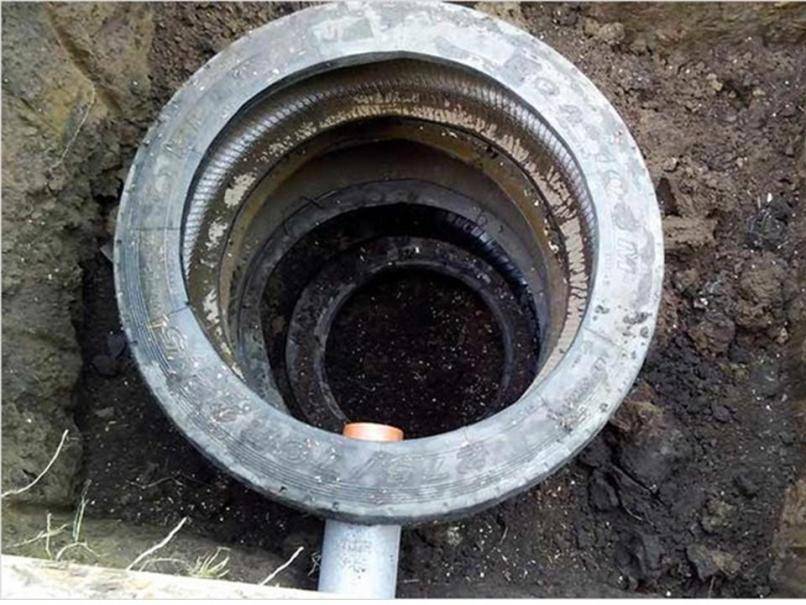
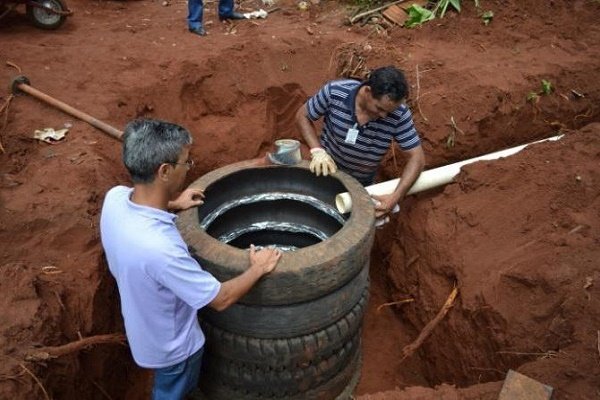
- At the next stage, the first automobile tire is laid on the bottom of the tank. All work is more convenient to perform with an assistant. Before laying the first slope, you need to cut it on one inner side. This is primarily necessary so that waste water does not accumulate in the tire.
Before laying the last or penultimate tire, depending on how deep the sewer pipes run, a hole is cut from any convenient edge of the car ramp to connect the sewer system coming from the housing construction.
What are the disadvantages of the design?
The simplicity and cheapness of septic tank construction are the only advantages that the design boasts, but, as a rule, they are enough for many homeowners. However, given the imperfection of such a cesspool, one should first consider the shortcomings of the structure in order to understand, with what you have to face:Short service life. The initial purpose of tires is completely different. Rubber, corroded by a microorganism, is destroyed, and metal is covered with corrosion. A cesspool from used tires will last no more than 10 or 15 years. Low tightness. Avoiding the presence of joints between elements is quite difficult. This can lead to the fact that the waste flowing into the pit seeps into the ground, the consequences of which do not bode well.This can also be facilitated by the light weight of tires, leading to a shift in products. The process of cleaning such a pit should not be overlooked. It is not difficult, but rather unpleasant. If these shortcomings are compensated by the price of the issue, then this design is simply ideal and the most economical of the possible options.
Difference from a cesspool
A drain pit and a septic tank are not the same thing. These are completely different objects and their purpose is different.
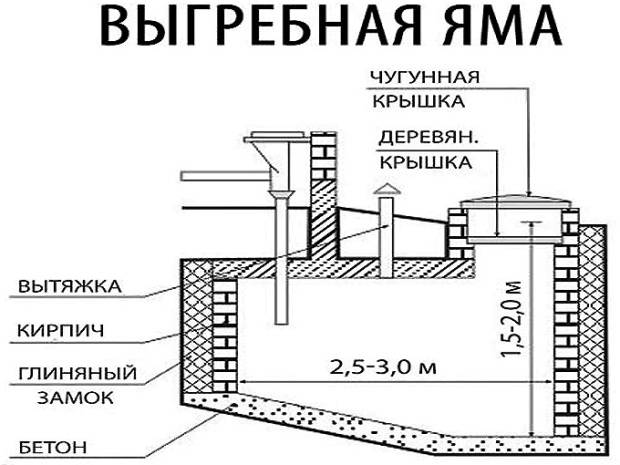
The cesspool is sealed and serves only for filling with sewage. When it is full, the operation of the structure is terminated. The owner calls a special sewage machine that pumps out the entire contents of the pit.
A septic tank is a completely different matter. This building is not airtight.
With a slight filling of the container, the owners do not even need to think about pumping out the contents.
More intensive use of water, frequent washing, filling the pool and visiting the sauna in the house still leads to the overflow of the septic tank. The water in it has to be pumped out, causing a sewage truck. However, this process is carried out much less frequently than in the presence of a cesspool.
The designs of septic tanks are very different. The walls are laid out of brick, cinder blocks, rubble stone, granite with holes for intensive water absorption.
The bottom is covered with crushed stone, broken brick, expanded clay, leaving a simple unrammed soil. An excellent material for the construction of a septic tank in a summer cottage, the courtyard of a cottage, your own house are bald car tires.
Construction of a cesspool from tires
- You will need about ten tractor or car tires, depending on the volume of the future cesspool. By itself, used tires are practically free material. You can go to a car workshop, where you will most likely be happy to give them.
- Tire sizes range from R13 passenger cars to truck tires over a meter in diameter. You can choose the sizes that suit you.
- After preparing the materials, it is necessary to dig a hole of the appropriate volume.
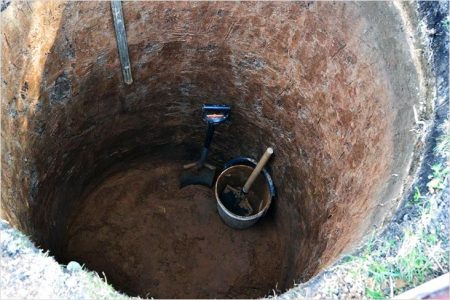
To do this, you will need the following tools:
- Bayonet and shovel;
- Roulette;
- Pegs to indicate the size of the pit and fencing in the process;
- Buckets;
- The ladder is not less than the depth of the pit;
- Building level.
Putting the tire on the ground, we outline the dimensions, and you can start digging. Note that the bottom should have a slope towards the future hatch. The top fertile layer of soil, which was obtained as a result of creating a pit, can be distributed over the site.
It will then come in handy for creating beds. Also, it is necessary to leave the ground in order to fill the hole from above. The rest of the land, if you do not need it, is best removed from the site:


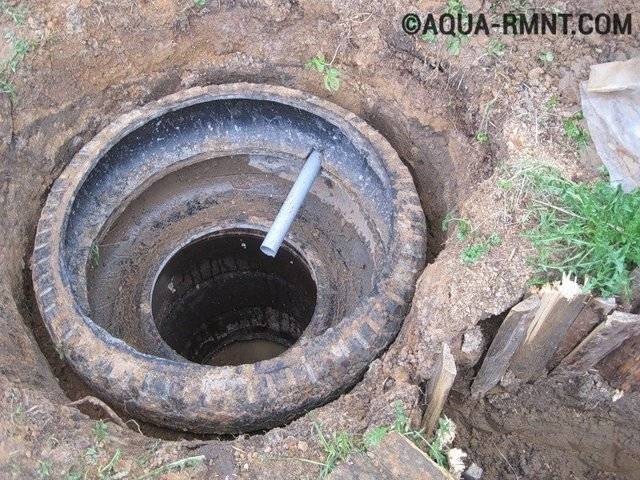


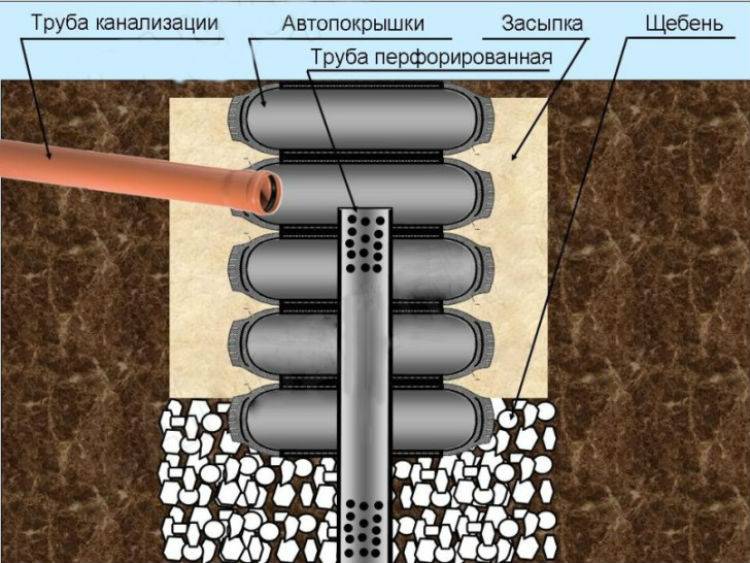
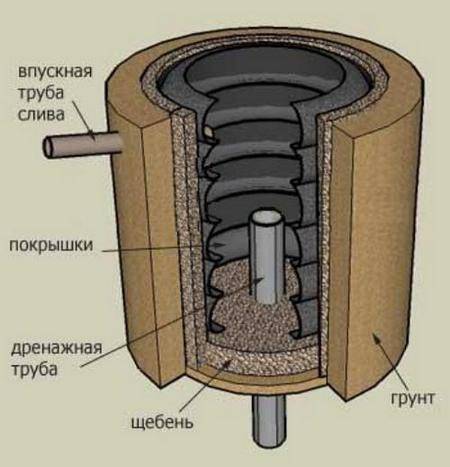
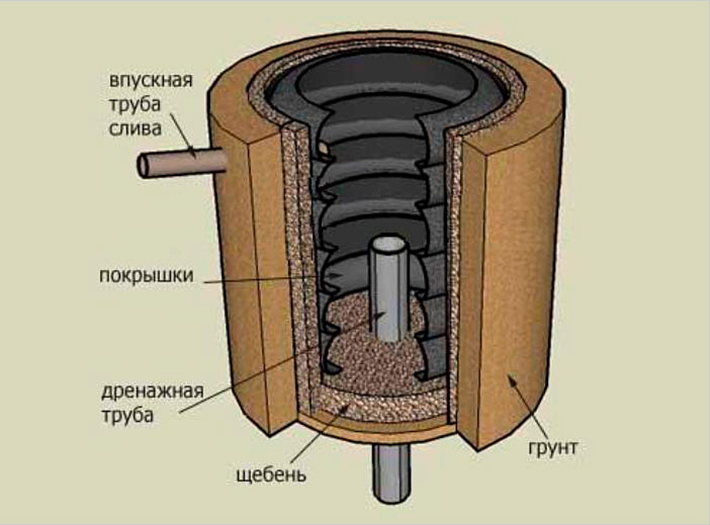
- When the required depth is reached, a drainage well is drilled in the center using a garden drill, which will allow you to “pierce” the waterproof layers and thereby speed up drainage.
- Then we lower the drainage pipe into the well, which will rise about 1 meter above the bottom. This is necessary so that large elements do not clog the pipe. Water will enter the pipe through the side holes covered with a polypropylene mesh. The top of the pipe is also covered with a mesh.
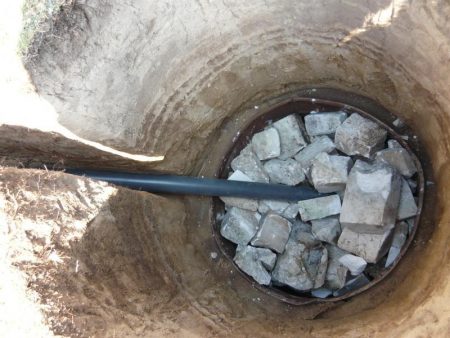
A layer of large rubble 10 centimeters thick is laid at the bottom. Tires can now be installed. This is done in the following way. Using an electric jigsaw, a part of the inner rim is cut off on one side of the tire. This will allow the liquid not to linger, but to drain completely down.
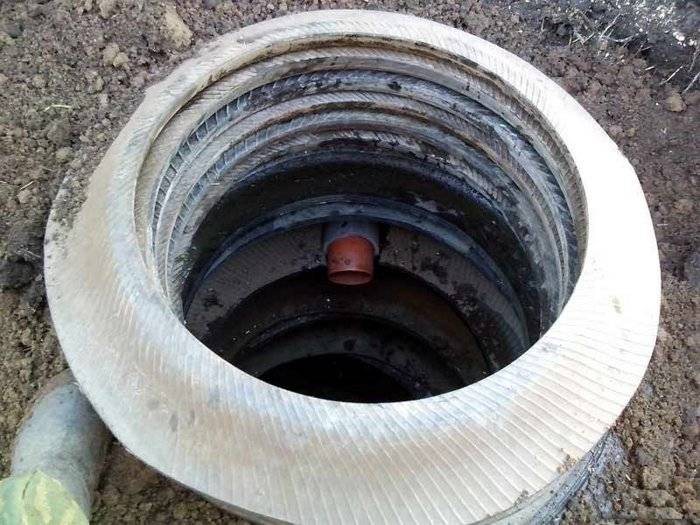
For the inlet pipe, using a jigsaw, we make a hole of the required diameter.
It is necessary to lay tires in such a way that the top one is slightly above the soil level. The gap between the tires and the walls of the pit is covered with soil. Joints from the inside must be sealed with sealant.
Then the top of the pit is closed with a lid made of some non-rotting material.
Outside, the pit is covered with soil, but it is very important that ventilation is maintained, so the hatch must be clear of the ground. A special ventilation pipe is also created, which should be 60 centimeters above the soil level.
The hatch is necessary in order to carry out periodic cleaning. It is best to use a hatch with two covers, with one installed at the level of the ceiling, and the second at ground level. The bottom should be at an angle to the hatch to allow more efficient cleaning.
We ennoble the hatch of the cesspool
The cesspool cover often looks like a foreign body against the background of a green lawn and flower beds. Therefore, many try to disguise it with something. There are many options, but you need to choose one so that the design of the site does not suffer, and if necessary, the decor can be easily removed.
On the hatch, you can put an artificial stone in the form of a boulder or small stones from which the slide is laid out. On sale there are stones with a recess where flowers are planted.
Manhole covers are made in standard sizes.By choosing a designer product, you will solve the issue of masking the hatch very simply
You can decorate the hatch with a decorative cover. Particularly beautiful look products made of polymer-sand composition. Their colors are very different. Sometimes their surface imitates various materials. There are covers with sculptural images in the form of stumps, anthills, animals, cartoon characters.
Cesspool of tires
It cannot even compare with the simplest septic tank, but it has one indisputable advantage - low cost. It requires minimal investment, since it is equipped with used tires from a tractor, car and other vehicles. Collecting wastewater through this design does not require complex installation. If a cesspool made of tires is equipped with your own hands, then such a structure costs mere pennies. Low costs are the main reason why the owners of dachas and even cottages, where there is no way to connect to central communications, prefer this wastewater collection system.
Nuances for installing a cesspool
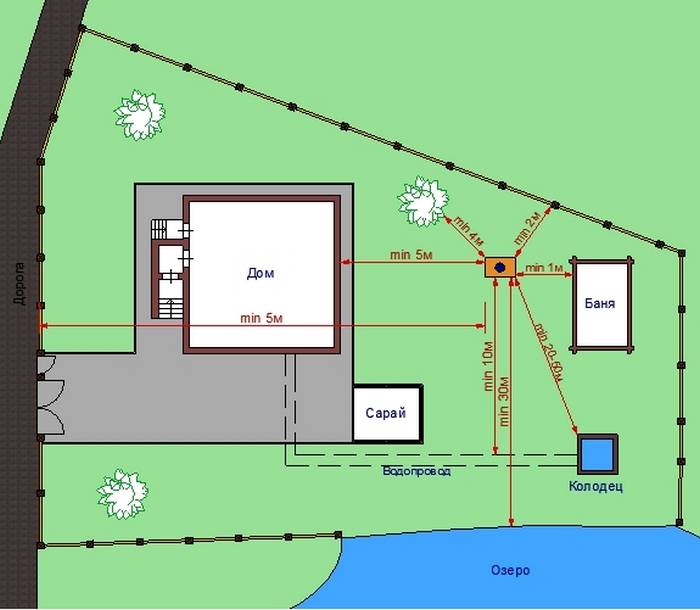
Before you build a cesspool, you need to decide on its location
Before you build a cesspool, you need to decide on its location. The distance from the house should be more than 5 meters, and from the fence 2 meters. There are many more rules, we will talk about them later.
If you are going to build a septic tank without a bottom, then in this case, it is possible to build it with a flow volume of no more than 1 cubic meter. Otherwise, the bacteria will not be able to cope with the work of cleaning, which will cause contamination of groundwater.In addition, various chemicals can enter the sewer system, which will slow down the functioning of biological cleaning.
For proper installation, we still need optimal calculations. The following scheme will help us with this: we take an average of half a cube of water per tenant and take into account that its level in the pit should be at a distance of a meter from the soil cover of the earth.
Attention! If you do not adhere to these standards, then you can get serious problems due to waste overflow.
Location selection
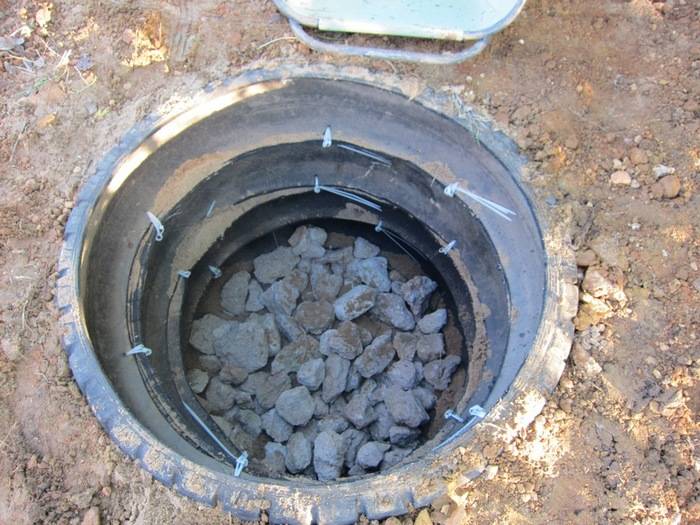
A drain pit made of tires can be used as a local sewer in a summer cottage
A drain pit made of tires can be used as a local sewage system in a summer cottage if the following rules are observed:
- It is forbidden to install a tire pit if the volume of wastewater exceeds one cube. If you do not take this into account, then the bacteria will not cope with the treatment of wastewater, which can clog groundwater.
- It is impossible to drain chemicals and substances into the sewer system, as they will reduce the work of biological treatment;
- The distance from the country house should be more than 5 meters, and from the water intake - 2 meters;
- In the event that the septic tank is without a bottom, then the device must have a distance to the well of more than 30 meters.
Advice! After studying multiple recommendations from the literature, videos and photos, we concluded that it is best to place the pit one meter lower than the well. This will provide protection if a runoff occurs.



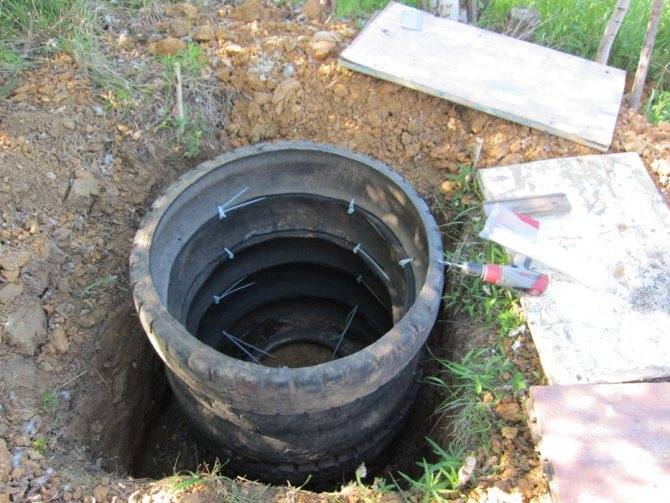


Sewerage in a private house must be connected to a septic tank with special pipes. Their diameter must be 10 cm.It is worth noting that the most popular pipeline material is PVC and they are laid at a depth of more than 1.2 of the ground freezing level.
Attention! When laying the system, there should be no trees or other objects on the path that may interfere with work. Otherwise, the repair process will be very difficult.
Volume calculation
In the event that the pit is being built in the country, where you will come once a week, then its volume should be 1 cubic meter
Consider the option of calculating a pit for three people to live in a house or cottage. Today there are many variations in the definition of this value, which are found in the scientific literature, video and photo recommendations, but we will tell you the simplest method of calculation. To do this, you need to take the daily volume of one person - 0.5 cubic meters and multiply by the number of people living in the building - in this case 3. Thus, we got the calculation of the pit - 1.5 cubic meters.
Important! In the event that the pit is being built in the country, where you will come once a week, then its volume should be 1 cubic meter
Cesspool made from old tires
For the construction of such a structure, it is necessary to find several used tires of heavy vehicles or tractors. Then dig a hole to a certain depth, which should be slightly wider than the diameter of the tires.
Further, it is recommended to treat the joints of the tires with a waterproofing compound outside and inside. Bitumen-based materials are best suited for this. It is not necessary to cover the seams with a solution of cement and sand, since the device will not have a rigid shape, and the mixture will fall out of the cracks.
Pit under the cesspool of tires
Outside, it is desirable to wrap the resulting container with roofing felt and glue it with hot bitumen. Then, the hole must be covered with earth or a mixture of sand and gravel. If possible, then the same mixture should be laid on the bottom of the pit with a thickness of about one meter. This will be a natural kind of filter that will slightly reduce soil pollution. For the top tire, you need to make and install a hatch.
Before filling the pit with soil, an inlet pipe from the house with a diameter of 100 millimeters should be installed in it. In order to make a hole in the tire for the pipe, it will be necessary to show ingenuity and ingenuity. To do this, you can use a grinder and a large sharp knife. Tires, especially tractor tires, are very durable.
Pipe supply to the cesspool
Requirements for the placement of a cesspool on the site
The cesspool should be located at least 5 meters from the residential building. And the distance from the water supply to the cesspool should be at least 30 meters. Otherwise, drinking water sources may be poisoned. To the border of the site, this distance is at least 2 meters.
In this case, it is necessary to build a septic tank with an insulated bottom and an additional filter for sewerage.
The cesspool should have a convenient passage for the sewer truck, because periodically, as it fills up, it will be necessary to remove waste from it. Every year this procedure will need to be done more and more often.



In order to prevent unpleasant odors from the pit from spreading throughout the area of \u200b\u200bthe country house, ventilation should be done using a pipe and placed as high as possible. According to the rules, the height of the ventilation pipe should be within 4 meters.
Cesspool with overflow
To reduce the frequency of pumping out sewage and waste, a cesspool with overflow is used. It consists of two parts. A pipe should go out of the first container into the second part of the pit, or you need to make holes in the wall of the first. When the first part of the cesspool is full, the wastewater will go to the next part of the device.
The second part of the pit is best made from old brick, which will be much cheaper than new products. And instead of holes for draining water in the wall, you can not put a brick in certain places, that is, arrange it in a checkerboard pattern. The bottom of the second container should be made of a layer of sand and gravel, which will be an additional filter.
For permanent residence in a private house or in the country, such a hole should not be made. If the stay of people in the house is temporary or seasonal, then a similar version of a cesspool made of tires will cope with the task of removing sewage and waste. The cost of such a device is much less than the construction of a septic tank from concrete rings and bricks.
A cesspool from old vehicle tires has many disadvantages:
- short service life due to rapid filling, no more than 10 years;
- unpleasant odors on the site of a country house or cottage;
- the tightness of the tire tank will not last long, as a result, the site will be contaminated with harmful substances that will enter the soil;
- difficulties in repair and the impossibility of dismantling will lead to the fact that over time a similar sewage system or a new, more advanced device will have to be done elsewhere.
A tire cesspool is relatively cheap compared to other sewer systems.This is its only advantage, and the disadvantages will not create comfortable living conditions for people. It is better to spend money on a modern septic tank with biological wastewater treatment once than to redo a cesspool in the future.
Published: 23.07.2013
How to build a hole with overflow
With the help of tires, cesspools with overflows are built to purify wastewater on the territory of the house. The work is done in a similar way, but still has small nuances:
- The gravel is laid on the very bottom in a thick layer, about 40 centimeters, but the hole is not drilled, and there is no drainage pipe.
- After placing the tires, a pipe of concrete material is placed vertically in the middle, with a circumference half the size of the tires, and 15 centimeters in height below the surface.
- On the upper section of the concrete pipe, holes are made through which water flows. And also prepare a branch for the sewer pipe.
- The lower section of the pipe is poured with concrete.
- The structure is covered with a lid with a ventilation hole. Such a hole will have to be periodically cleaned on its own or hire a special machine.



