
- Features of the design of a cesspool from a barrel
- How does a homemade sewer sump work
- Features of the cesspool device in a private house
- Location selection
- Size calculation
- Types and materials for manufacturing
- Types of structures
- Materials for the device
- Arrangement of a simple cesspool from a 200 l barrel
- The choice of a barrel for a cesspool device
- Types of containers by material
- Calculation of the volume of the cesspool
- Hermetically sealed device
- Carrying out land and construction works
- How to choose the right place to install a bathroom?
Features of the design of a cesspool from a barrel
Living in a country house or in a private house in a rural area involves the use of an autonomous sewer system for the disposal of household waste. To collect sewage, a design of barrels and sewer pipes is often used.
There are several types of such drives. Their differences are shown in the table:
| Type of waste pit | Advantages | Flaws | Application |
| Sealed | Does not pollute the soil | Requires periodic cleaning | Any place |
| without bottom | Increases the period between cleaning | Pollutes the site | Areas with low groundwater levels |
| From multiple tanks | Improved wastewater treatment | Uncomfortable to download content | Loose soils |
Sealed tank has advantages over a pit without a bottom - sewage does not pollute the garden plot. For such purposes, one-piece factory-made plastic or metal tanks are often used, which are designed to collect wastewater. They have the qualities characteristic of settling tanks - strength and tightness.
Drain a pit from a barrel without a bottom cannot be called a reservoir, because part of the liquid seeps through the soil. Usually it is made of metal products, for which holes are drilled in the walls.
Over time, the drain pit from the barrel fills up, and you have to call a sewage machine to clean it. It has a tank and a vacuum pump, with which the contents are freed from dirt.
Such small sedimentation tanks are used in summer cottages or country houses, where the owners occasionally come. Drainage pits from barrels are suitable for a family of 1-2 people.
The volume of the tank is calculated depending on the number of people living in the house and water consumption points. Water consumption for each person is very individual. Without a washing machine, a washing unit and a bathroom, it can reach 0.5 m3 per month.
Before you make a cesspool from a barrel, calculate its volume. Suppose 1 person has 100 liters of water per day. A family of 3 people will spend 9000 liters per month. If you plan to call a sewage truck once a month, the volume of the tank must be more than 9 m3.
To create a drain pit, it is allowed to use several barrels of small sizes, but it is convenient to pump out sewage from one, but large. The shape of the barrel can be any - round, square, rectangular.
If you have a choice, buy plastic products that are designed for sewer systems. They are made from polyethylene, polypropylene and PVC.
The use of metal barrels for the construction of a cesspool is not welcome and is forced. Usually they are used if there are no ready-made plastic containers on sale.
Metal tanks that were used to store or transport fuels and lubricants are suitable for a drain pit. These are 200 l containers for the transportation of chemical liquids by rail. Their wall thickness is 16 mm.
Cesspools made of metal barrels are inferior in many respects to structures from plastic barrels:
- They are subject to corrosion and serve only 4-5 years.
- These tanks are expensive.
- Products are heavier than plastic, which can complicate the process of their installation. A crane is required for installation.
How does a homemade sewer sump work
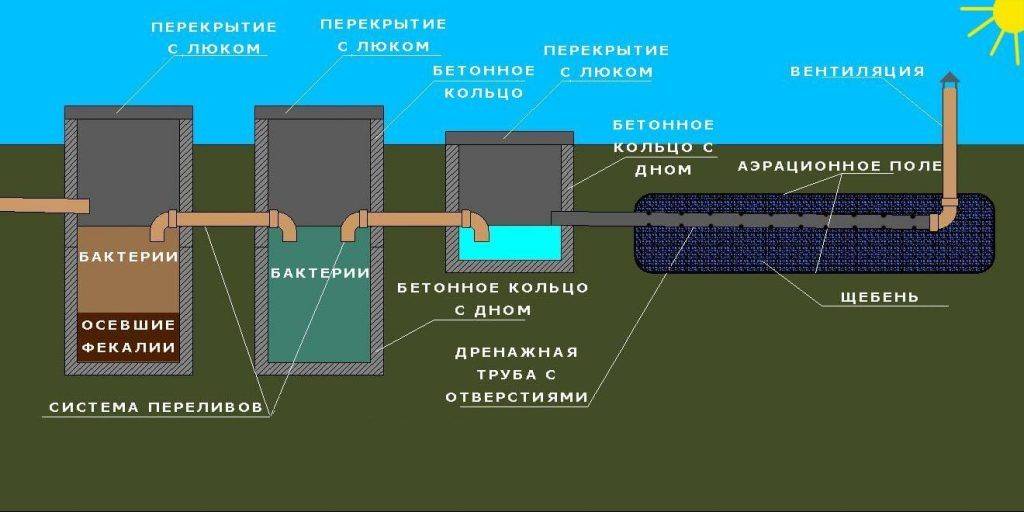
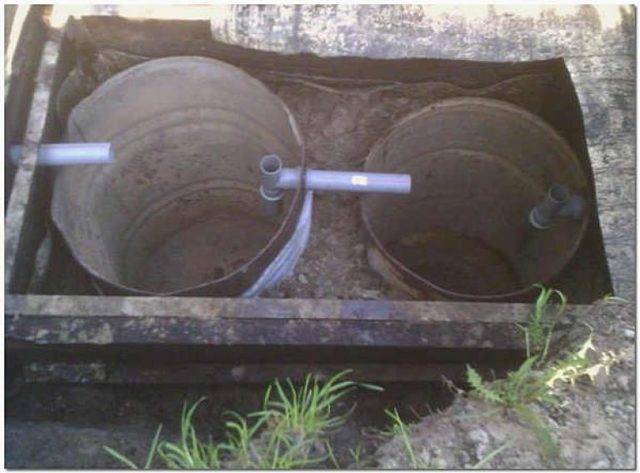
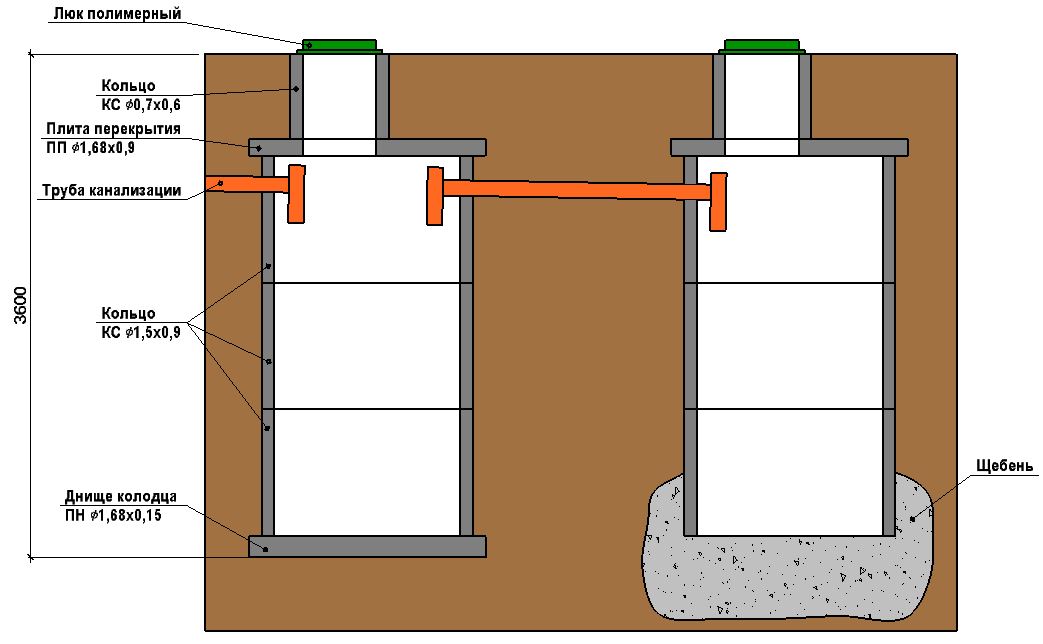
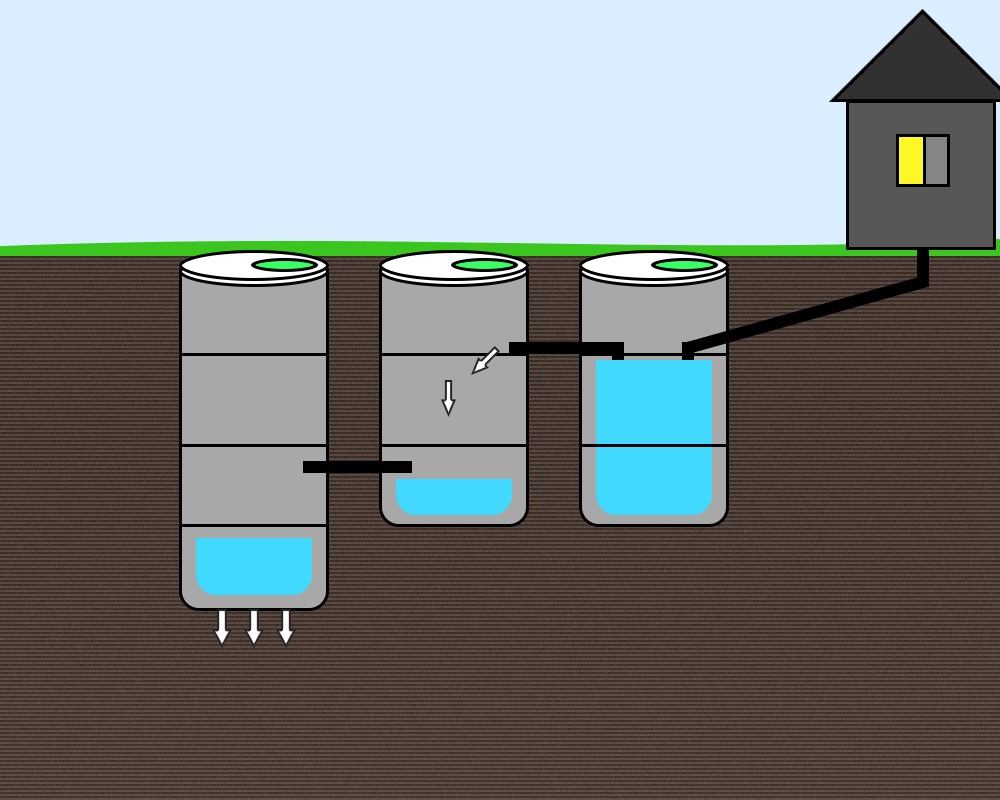
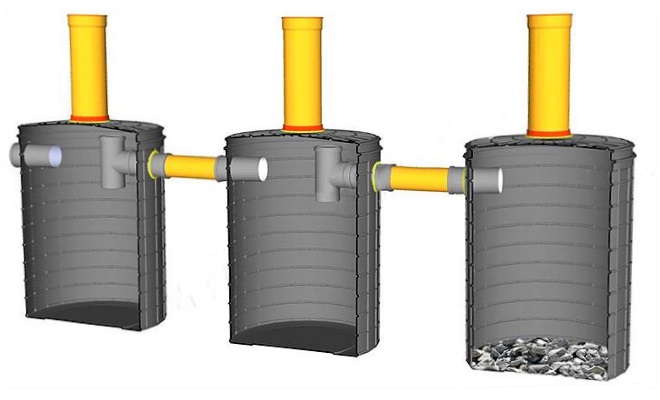
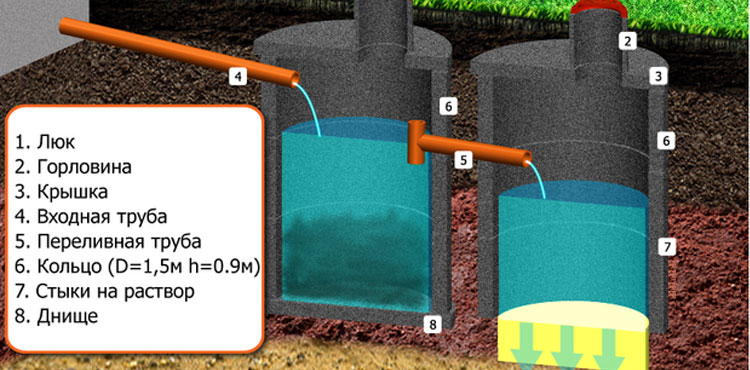
All drains enter the sewer lines, and from there into the reservoir, the so-called pit. In this barrel, wastewater is "filtered", most of the pollutants settle. Through the connecting pipe, wastewater from the first tank enters the second tank. The process of filling the sections takes place in a strictly regulated manner, which is achieved by placing containers with a ladder at different levels.
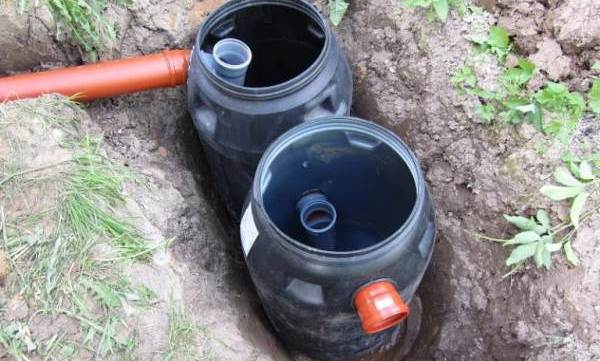
The outlet and inlet are positioned in such a way that water enters the next tank before its level rises to the inlet pipe. Gradually, the heaviest particles of dirt fall to the bottom, while small and light ones continue to move along the structure. In order for the waste stream to move freely along the sewer lines, a home-made septic tank from barrels is made with a slope.
In addition to mechanical cleaning, colonies of microorganisms are also involved in the process, which form in containers after 2-5 weeks and process organic pollution.
After processing in the second chamber, wastewater is sent to a storage or drainage system. In the first case, the accumulated water is drained after a while. If a drainage well is used, the liquid is discharged into the ground. In the sump, discharges are cleaned by 65-80%. If a higher level of purification is needed, a third barrel is used. The more compartments are discharged, the higher the degree of purification becomes. For a suburban area, a double level is sufficient.
Methane generated during wastewater treatment is removed by ventilation. It is placed vertically at the exit of the sewer from the house or near the last section of autonomous equipment. To get rid of unpleasant odors, a siphon is installed, it is possible in the form of a “knee”.
Features of the cesspool device in a private house
Location selection
A cesspool is such a container into which domestic wastewater is drained and accumulated in it. To determine the optimal location for its location, you will need to analyze the land and find the most suitable site.



A schematic plan of a private plot can help in this case, in which the locations of the following important elements are necessarily indicated:
- residential building
- Household The buildings
- Water wells
- gas pipeline
- Water supply pipes
Also, on this scheme, the elements of the landscape available on the site should be indicated.For an easier location of the cesspool, it is necessary to put on the plan neighboring buildings and other structures located in neighboring areas, including wells and all communications.
When planning the location of the pit, you need to consider the direction of movement of groundwater. This information can be obtained from the relevant authorities.
At the moment, some sanitary standards have been agreed on the remoteness of this building from other structures:
- The neighboring building and adjacent buildings - 10-12 m.
- From the boundaries of your site - 1.5 meters
- Own house - 8-10 m.
- Wells for water intake - at least 20 m.
- Water supply networks - at 25 m.
- Ground water - at least 25 m.
- Gas pipes - about 5 meters
When arranging a cesspool, it will be necessary to take into account the condition of the soil in which this structure will be placed. In clay soil, water wells should be at least 20 meters from the pit. With loamy soil, this distance increases by 10 m and will be 30 meters from the cesspool. With sandy or super sandy soil - at least 50 meters.
Also, it is necessary to take into account another extremely important point. Cesspools are strictly forbidden to build along the flow of groundwater, as in this case they may become contaminated.
Size calculation
The first value that needs to be calculated before building a cesspool is its volume, since the efficiency of the entire sewer system and the frequency with which it will be necessary to clean the drain will depend on it. This value can be calculated based on the number of people living on the site.For example, only 4 people live in a private house, 3 of which are adults, and the last is a child.
As a rule, one adult produces at least 0.5 cubic meters of waste, and for a child, this value is reduced by exactly half - 0.25. In the case of connecting water-consuming devices to the drain in the cesspool, they are also taken into account. In this example, they are not involved.
As a result, 1.75 m3 of waste goes to the cesspool (0.5+0.5+0.5+0.25). The resulting number should always be rounded up, which will help to avoid overfilling the waste tanks. In this example, the number will be 2 cubic meters.
The total volume of the cesspool tank should be 3 times the volume of sewage. That is, 3*2=6 m3. This is the optimal volume of the tank cesspool for a family from 3 adults and 1 child.
For the construction of a similar structure for a summer cottage, it is necessary to use a different construction scheme. For such a case, you can take 1-2 cubic meters as the optimal value, since such areas are visited not so often and not by very large groups of people. But, in the presence of other circumstances, it is possible to increase the volume of the reservoir for the summer cottage.
Having the required volume of the tank, it will be necessary to determine its structural dimensions. The depth of the structure is determined by determining the level of groundwater and the features of further maintenance of the cesspool. To periodically clean the tank from accumulated liquid and solid growths on the walls and bottom, you will need to use the services of vacuum trucks.
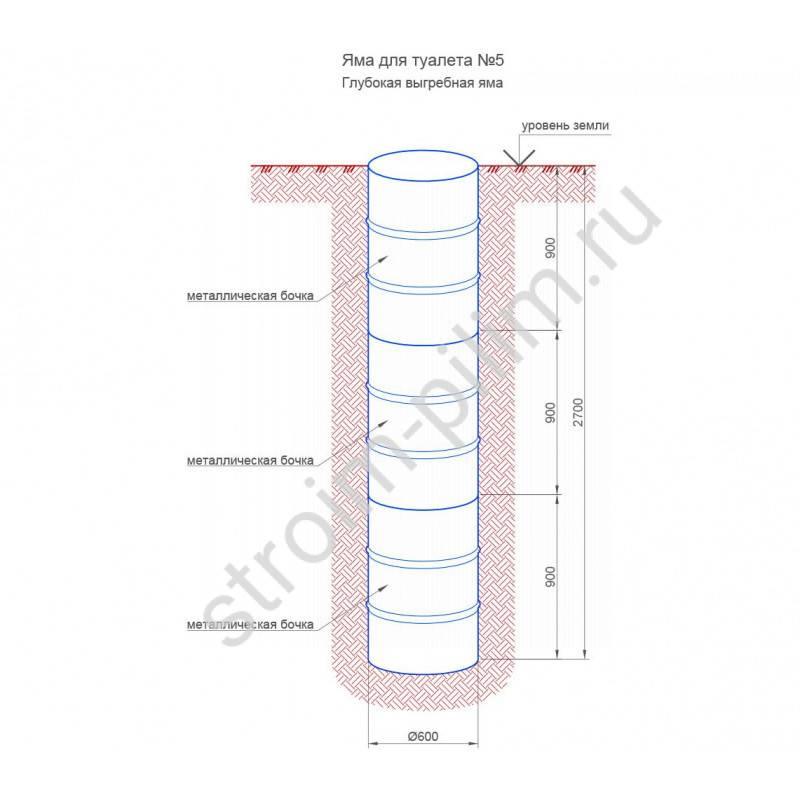
The hose of the sewer truck rarely exceeds a length of 3 meters, so you should not make the depth of the tank exceeding this value. Otherwise, this may affect the quality of cleaning the cesspool. The most popular pit depths are 2.5 and 2.7 m. The maximum depth of 3 m is used extremely infrequently, but this depth can be compensated with a sand and gravel cushion. This is most relevant for leaky drains.
Also, it is worth remembering that when underground groundwater is above 2 meters, there is no point in arranging a cesspool, as this can lead to filling the reservoir with groundwater. This will mean a drop in the efficiency of the entire sewer.
In this case, septic tanks or barrels of the required size will be the most suitable options, but it will be necessary to protect them with a casing of cement or metal solution.
Types and materials for manufacturing
For the collection and disposal of liquid household waste, it is difficult to imagine something simpler than a drain hole dug in the ground. This is the oldest sewer structure used by people to equip toilets. The liquid sewage that got into it was partially absorbed into the soil, and the residues not processed by bacteria accumulated. The filled pit was dug in, and the toilet was transferred to another place.
With modern requirements for comfort, this option has lost its relevance and is occasionally used only in summer cottages with seasonal accommodation. Today, the question of how to make a cesspool is being solved in accordance with the multiply increased volume of wastewater, which is collected all year round from several points: kitchen, toilet, bathroom, laundry room, home sauna, etc.
Of course, a small depression in the ground is not enough to collect them. A volumetric storage with reliable walls is needed, into which the pipe is led out of the house.
So schematically looks like a modern cesspool
Types of structures
According to the method of waste disposal, these facilities are divided into 2 types: sealed storage tanks and filter wells. Before you make a drain pit, you need to decide on its design:
- In sealed facilities, sewage is simply accumulated, periodically pumped out by sewage equipment and transported to treatment facilities or to specially designated places. Such structures can be mounted in any soil and at any level of groundwater. Their operation is associated with some inconveniences: you need to constantly monitor the filling level of the tank and pump out in a timely manner.
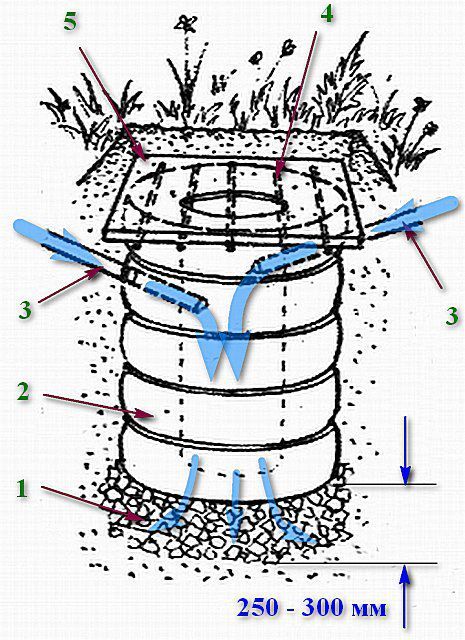
- The filtering structures do not have a bottom as such, and often holes are made in the walls. Through them, part of the effluent leaves the well, is filtered through a layer of sand and gravel backfill and seeps into the ground. With an equal volume with a hermetic type structure, they fill up more slowly, so pumping is not required so often.
Scheme of the device of the filter cesspool
When choosing one or another type, first of all you need to find out at what distance from the surface of the earth the upper level of groundwater is located on the site. If it is less than 100 cm from it to the bottom of the well, then it is impossible to arrange a filtering structure, as this threatens to pollute the soil and groundwater. It will not "work" in clay or rocky soils that do not allow water to pass through.




It is also worth calculating the approximate volume of stocks for a certain period of time.If it is small, the advantage should be given to a sealed container. Especially if the site is small and it is impossible to place a water well, fruit trees and other plantations on it at a safe distance from the cesspool.
Materials for the device
Since it is right to make a drain hole in a private house, it means to provide its long service life without reducing performance, then the material for its device must be chosen resistant to moisture and soil pressure. Therefore, most often it is built from red brick, concrete rings or monolithic reinforced concrete.
Monolithic structures are made by pouring concrete into the formwork
Depending on the type of structure chosen, the walls are made solid or perforated:
- In the case of a brick, the masonry is carried out with holes in half a brick;
- In concrete rings, holes are made using a puncher or special perforated products are bought;
- To ensure filtration through monolithic concrete walls, pipe cuttings are placed in the formwork during the pouring of the solution.
You can also purchase ready-made metal or plastic containers. They are produced specifically for this purpose and have a hatch with a lid, as well as holes for mounting drain pipes. Their use greatly simplifies the task of how to make a sewer in a private house with your own hands with a cesspool, since such containers, with good strength, are light in weight and do not require sealing work.
Plastic container for a cesspool with stiffeners
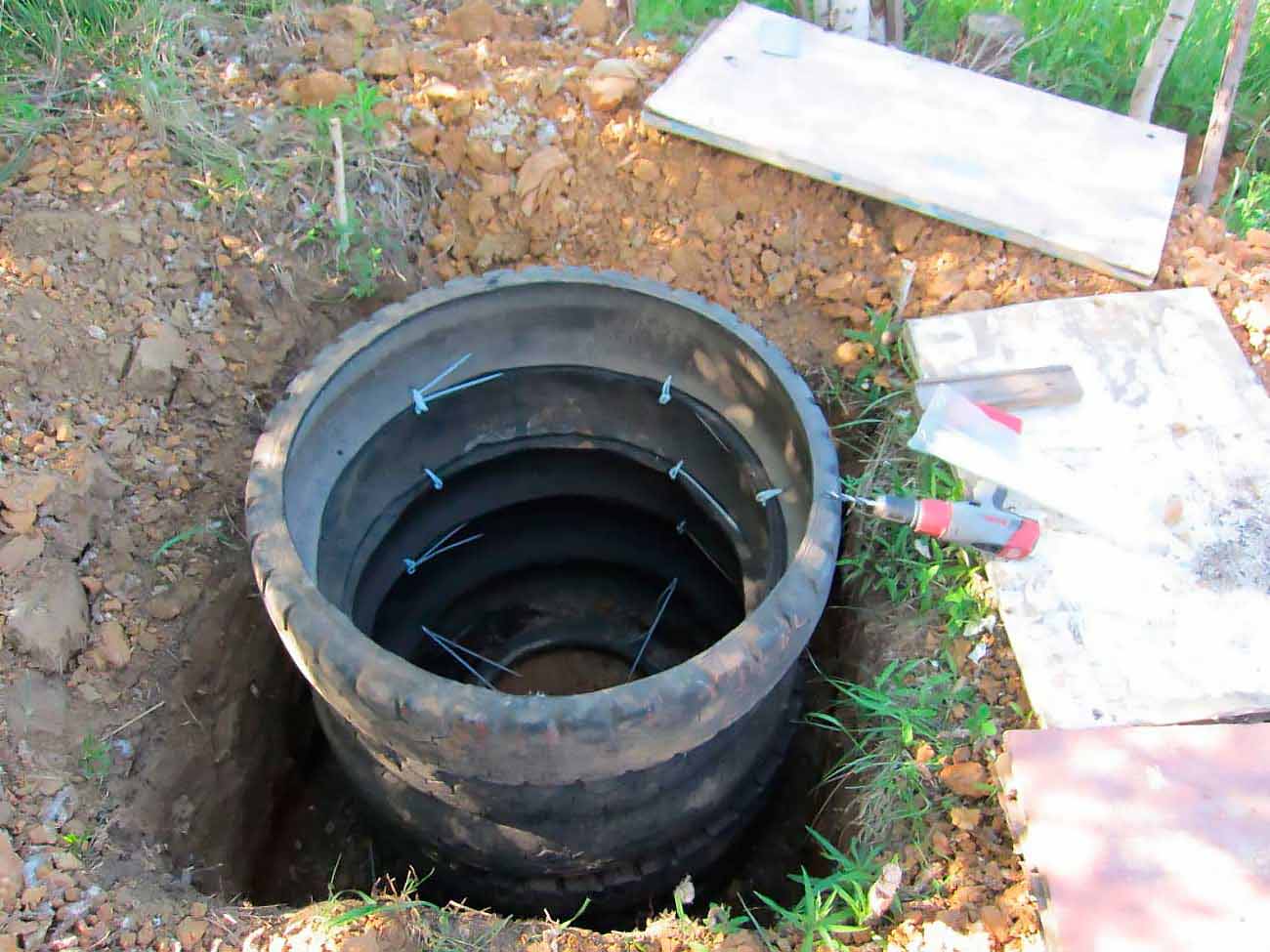
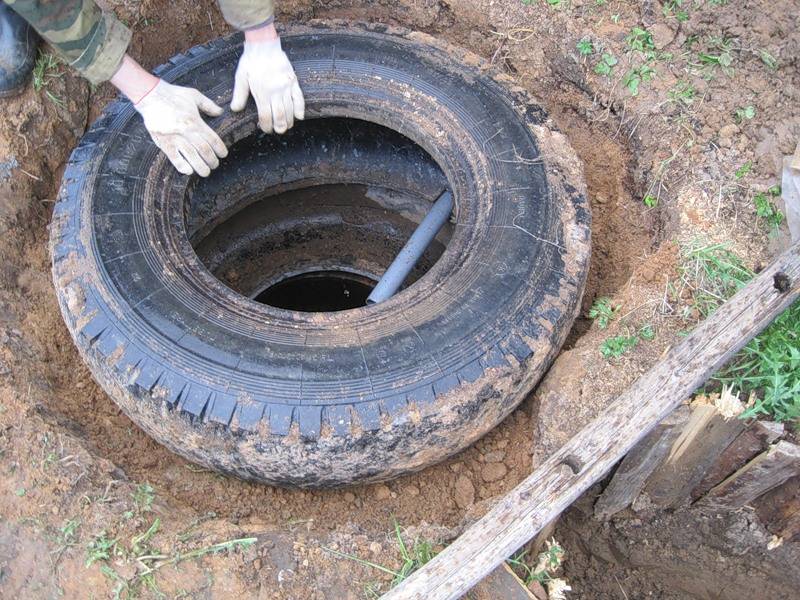
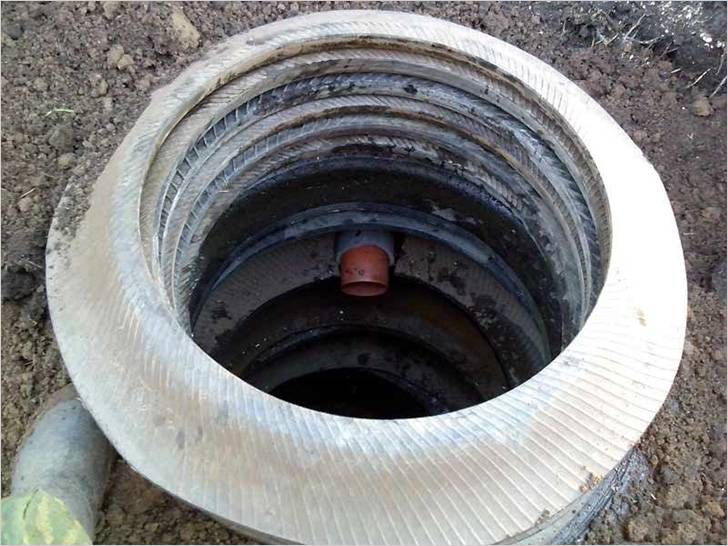
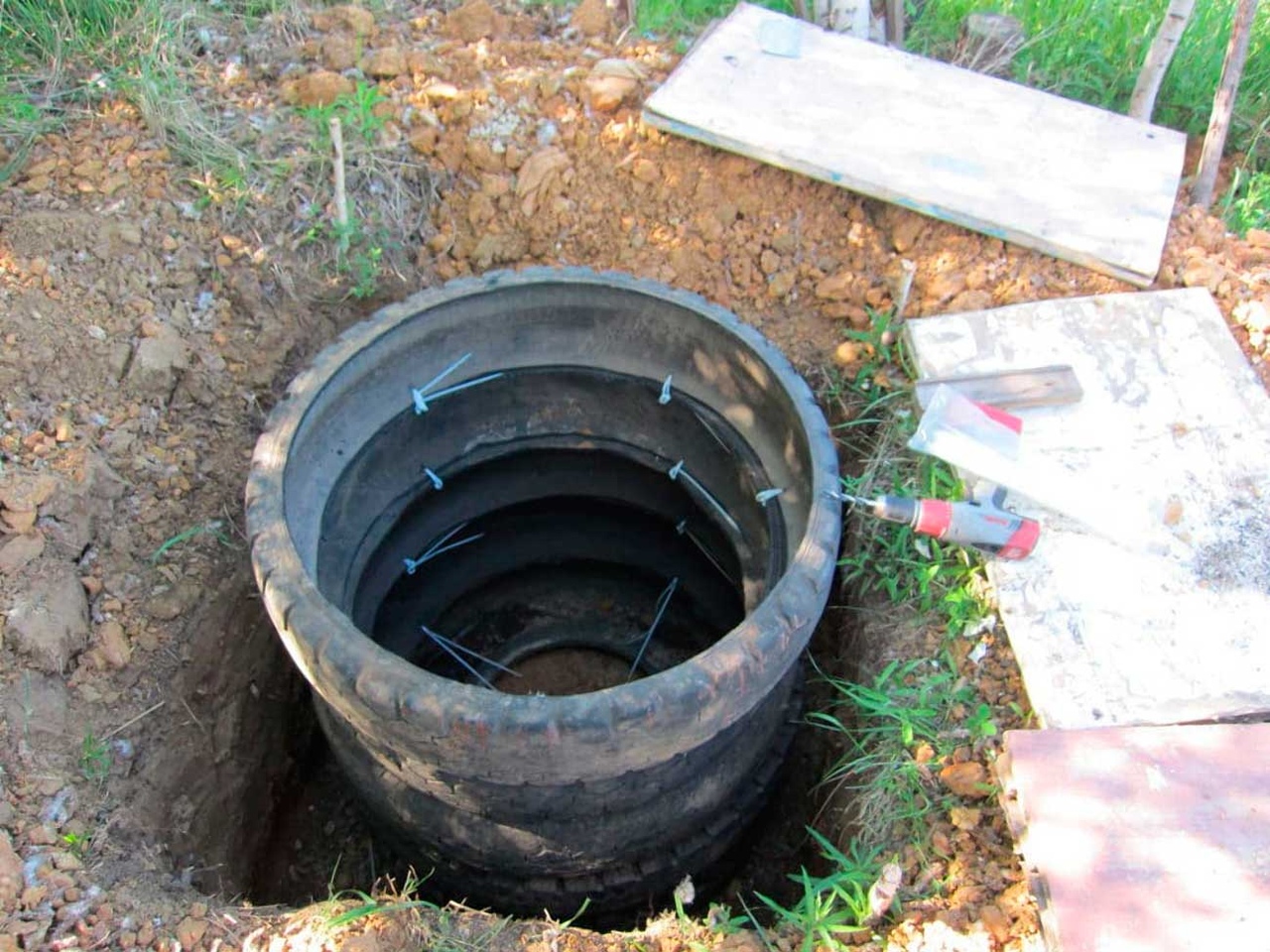
A small amount of relatively clean wastewater can be discharged into a pit, the walls of which are made of car tires. This is an almost free option for its arrangement, often used in the construction of free-standing baths.
Arrangement of a simple cesspool from a 200 l barrel
A cesspool from a 200 l barrel is easily made by hand. For its arrangement it is better to choose plastic containers. Compared to metal products, they have the following advantages:
- excellent resistance to aggressive chemical environments;
- longer service life;
- simplified installation due to low weight;
- no need for anti-corrosion treatment;
- high levels of tightness.
A plastic barrel as a cesspool can last a long time
When buried in the ground, plastic containers should be securely fastened with cables pulled to a concrete slab installed as the base of the structure. Otherwise, a homemade septic tank can “float” to the surface at the most inconvenient moment. The plastic barrels installed in the pit should be filled very carefully so as not to damage them.
The choice of a barrel for a cesspool device
In order for the cesspool to serve for a long time, not require repairs and have maximum functionality, two factors must be taken into account when constructing it: the material of manufacture and volume. Let's take a closer look at each.
Types of containers by material
Tanks are selected based on two basic requirements for the material: strength and tightness. These qualities correspond to metal and plastic barrels. Consider their advantages and disadvantages.
Both types are great for all types of soil.These are sealed containers without a filter bottom, so it doesn’t matter what is under the barrel - sand with high bandwidth or waterproof clay.
The type of soil will become important if you decide to build a more complex structure of 2 or 3 barrels, the last of which will act as a soaking well.
For a sealed reservoir, it also does not matter where the aquifers are located. Proper observance of the cesspool installation technology guarantees safety for high groundwater
There is only one way for the waste that has entered the storage tank - to the tank of the sewage truck.
Thus, barrels made of metal and plastic are united by tightness. If we talk about durability, then plastic products win. Modern types of plastic, intended for sewer tanks, can serve up to 50 years, easily resist the effects of household chemicals, and do not corrode.
The only disadvantage of plastic is freezing at very low temperatures if the tank is close to the surface. The problem is solved by additional insulation.
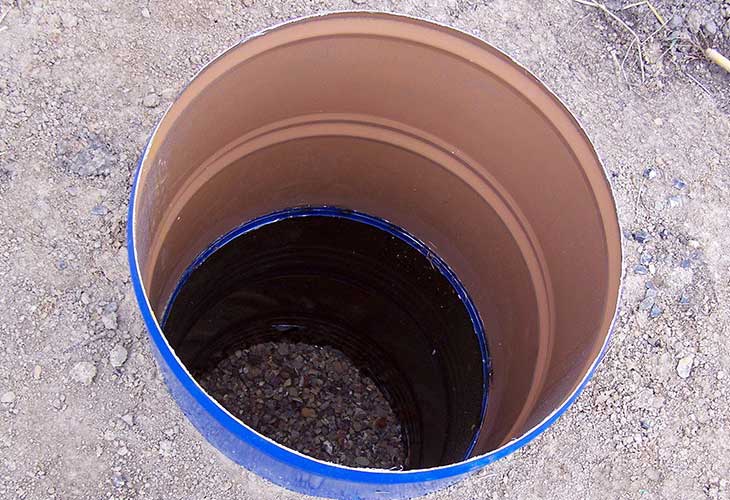
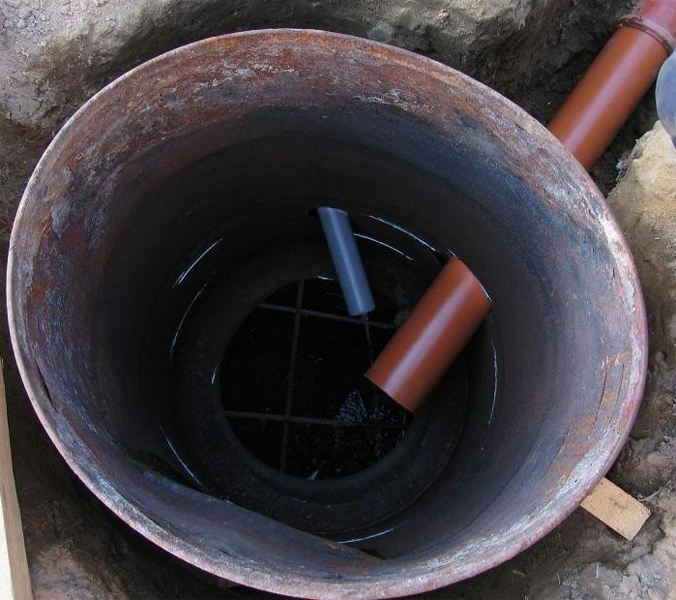

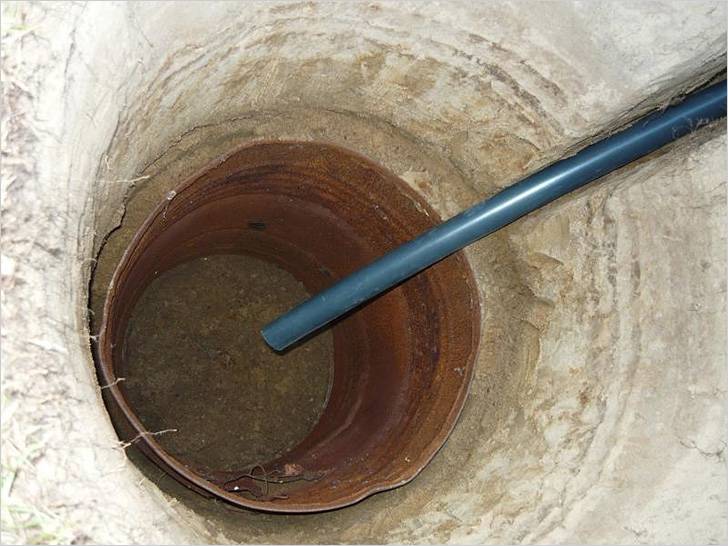


Disadvantages of metal barrels:
- heavy weight, causing difficulties with transportation and installation;
- the inability to resist corrosion that can break the tightness;
- the need for additional processing on both sides;
- high cost of new products.
It can be concluded that the best option in terms of price / quality ratio is a plastic container specially made for sewerage systems.
Calculation of the volume of the cesspool
The size of the barrel depends on the volume of wastewater, and their quantity, in turn, on the number of people living in the house and the availability of water consumption points.If a couple periodically comes to the dacha, who does not use either the washing machine or the bathroom, the amount of waste will be much less than that of a family of 4-5 people who constantly live in the house.
The easiest way to calculate the volume of a container is to use the following formula:
Suppose there are 3 people living in a house, each of whom receives 100 liters (on average) of sewage waste daily. According to the contract, vacuum trucks come once a month (30 days). We get 3 x 100 x 30 = 9000 liters. Therefore, a sufficiently large tank with a volume of 9 m³ is required.
If you decide to use small tanks, you will need several, but for ease of pumping and installation, it is better to purchase one large tank.
Hermetically sealed device
There are many options for making a cesspool. It is convenient to meet the various needs of summer cottage owners. Use factory products so that the sewer pit will serve you for many years. The scheme of the cesspool of concrete rings involves the use of circles and base plates. Installation is fast. A cesspool in a private house can fully satisfy the needs of residents: concrete rings on the market are sold in a large assortment. You can easily pick up circles with the desired diameter.
During installation, the following order must be observed:
- Dig a hole. An excavator is usually hired to perform earthworks;
- Lay the main circle. Install subsequent rings. This work will be handled by experts. This requires the involvement of special equipment. An excavator is needed to set up the bottom, the rings will be lowered down by a crane.It is preferable to use solid products in construction;
- The last circle should rise above the ground by 20 or 30 cm.
The device of a cesspool from concrete rings requires the involvement of experienced professionals and special equipment.
A cesspool with overflow is an excellent replacement for a central sewer in areas where it does not exist. The building has the following advantages:
- rare pumping with the help of sewage equipment;
- the ability to use water a second time to water green spaces;
- no bad odors;
- the ability to use water in large volumes;
- the absence of gurgling and other unpleasant sounds from the sewer system if the pit overflows.
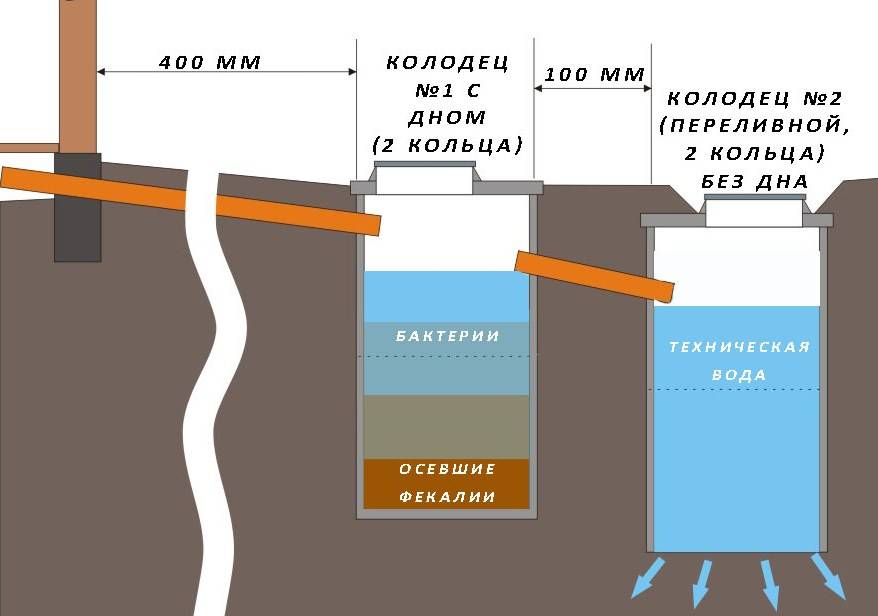
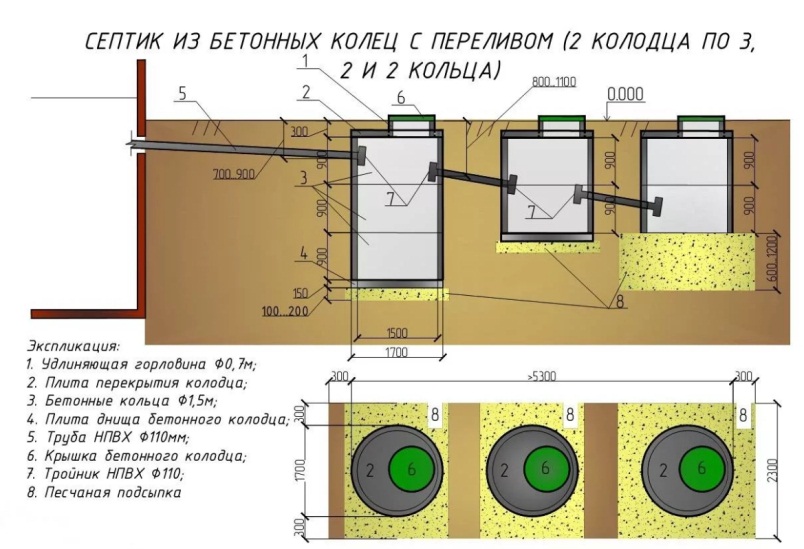
If desired, the master will build a cesspool overflow structure on his own. To do this, you need to understand its device. 2 settling pits are connected to each other with a special pipe in the form of the letter "T".
The first container is connected to the house by a pipeline at an angle of 1.5 or 2 degrees towards the drain. Large particles sink to the bottom of the sump. Wastewater flows through a T-pipe into another container. This sump does not have a bottom. It is filled with geotextiles mixed with layers of sand, as well as rubble with broken bricks. Waste water passes through all layers. After purification, it goes into the ground without harming the environment. Loose or sandy soil makes it possible to fill the second hole with one rubble. Lay geotextile with a layer of black earth on top. Plant plants with a short root system.
The addition of special preparations containing bacteria to the first septic tank helps to improve the breakdown of organic waste. If oxygen enters the container, the biological product works better.Therefore, it is recommended to leave a hole in the lid of the septic tank.
The first sump is built from concrete rings, and the second from red brick. You will need sewer pipes made of plastic and a T-shaped pipe. Instead of the latter, you can take a corner. This is necessary to prevent the entry of sewage from the first container into the second.
If you have to dig a ditch by hand, then use this method. Install the first concrete ring in the place where the settling pit will be. Climb inside the product and dig in a circle. The weight of the ring will cause it to drop. When the concrete product is level with the ground, a second one is installed on it. Keep digging. Unnecessary earth is poured into a bucket, which is lifted by your assistant standing on top. After completing the installation of the rings, bring the pipes to the containers. A chisel and hammer will help you make holes in the concrete rings.
A plastic cesspool is a structure that the master creates without outside help. When installing, avoid pipe drops and sharp turns. When it is impossible to lay a straight pipeline, then make the angle of rotation obtuse. This design avoids blockages. Make sure that it is convenient for the sewer truck to drive up when the drains accumulate and you need to pump out the cesspool. The drawn diagram will help create a competent project for local sewage.
Do-it-yourself sewer pit from used car tires is a budget way to create comfortable living conditions. If the volume of wastewater is small, then this design is ideal: it is affordable and practical. Installation is not difficult.However, it is difficult to disassemble the construction of tires with your own hands. Homemade will last no more than 15 years.
It is difficult to shape a circle on your own from gas silicate blocks. Therefore, it is made in the form of a square or rectangle. Sealing is carried out using a special adhesive or cement mortar.
WATCH VIDEO





Carrying out land and construction works
In any case, the construction of drain pits begins with earthworks, since it is necessary to prepare a reservoir for the construction of a sump.
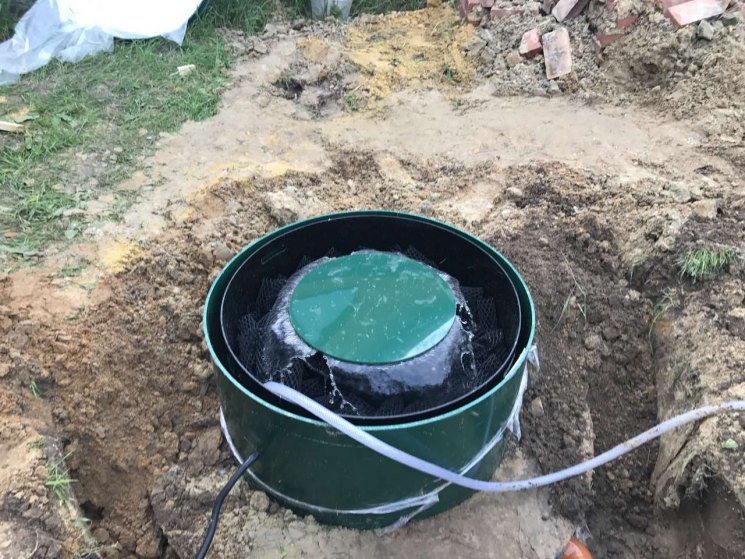
The easiest construction option is to install a sealed plastic container. To do this, dig a tank of the required depth and trenches for laying sewers.
The top of the soil should be saved for backfilling or spreading over the site. But loam, stones and sand will have to be removed from the site.
Then a container is installed in the finished pit, to which pipes are connected.
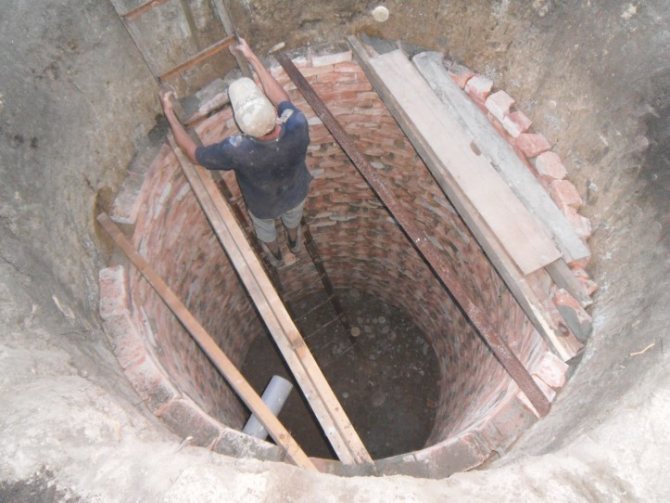
It is somewhat more difficult to build a drain pit out of brick.
In this case, it is also necessary to prepare the tank first.
In the event that a sealed drain pit is being built (and in most cases, it is allowed to build just this type of storage tanks in residential villages), it is necessary to concrete the bottom.
To do this, the lower part of the tank is qualitatively compacted, then filled with a solution prepared from crushed stone, sand, cement and water.
Further construction can only be started after the solution has completely hardened.
In the event that a drain pit with filtration is being built (for example, when building a bathhouse in which there will be no toilet), a layer of sand and gravel is laid on the bottom so that water can pass freely.
Further, the construction of the drain pit continues with the laying of brick walls.
Moreover, the best option is ceramic brick, which does not collapse under the influence of water.
When building a filter pit, the brick is laid so that holes of about 5 cm are formed between the rows.
If the construction of an airtight pit is required, then the walls from the inside are additionally covered with a solution that prevents water leakage.
The space between the walls of the pit and the pit is filled with clay (for sealed pits) or sand and gravel (for filter pits).
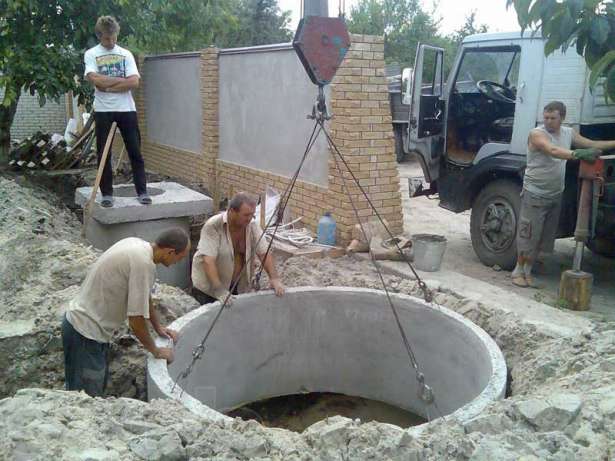
A fairly common construction option is a drain pit made of rings.
In this case, you do not have to do the masonry, that is, the construction process is accelerated.
The only drawback of this option is the weight of the rings. To install them, you have to involve a crane or other lifting equipment.
How is the installation of the drain pit when using well rings?
All work can be divided into stages:
- A hole is dug one meter deep and of such a diameter that the ring can freely stand in it.
- The first ring is lowered into it (using lifting equipment).
- From above, the installed ring is smeared with cement mortar and a second ring is installed on it. The number of rings depends on the planned depth of the drain pit.
Standard rings are one meter high, so if you plan to build a hole three meters deep, you will need to purchase three rings. - A concrete cover and a hatch hole will be installed on the upper ring.
As a result of these works, a kind of “tower” of rings is obtained, which must be lowered down. When performing work manually, at least one assistant is required.
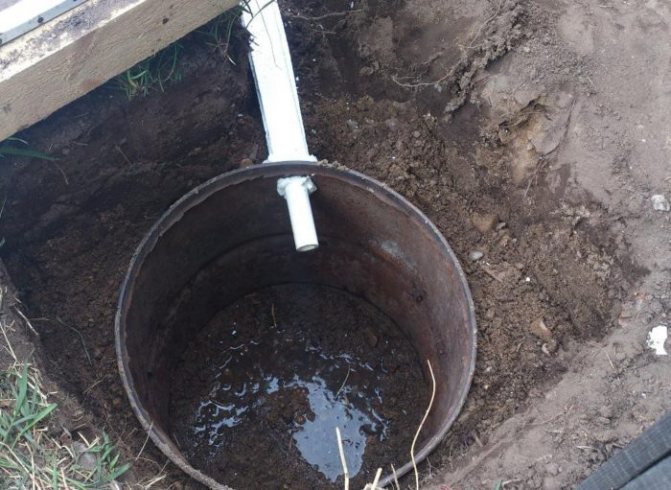


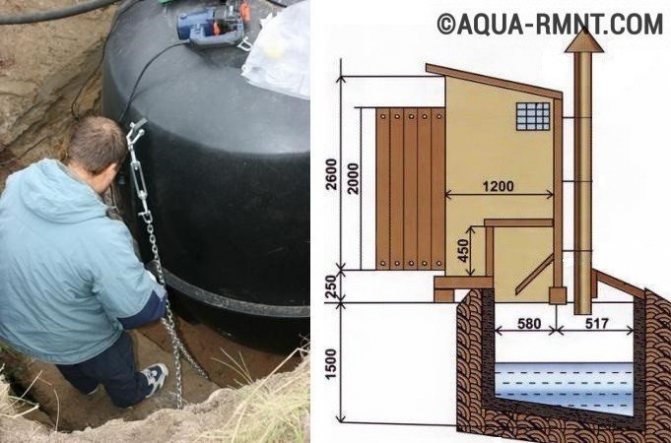
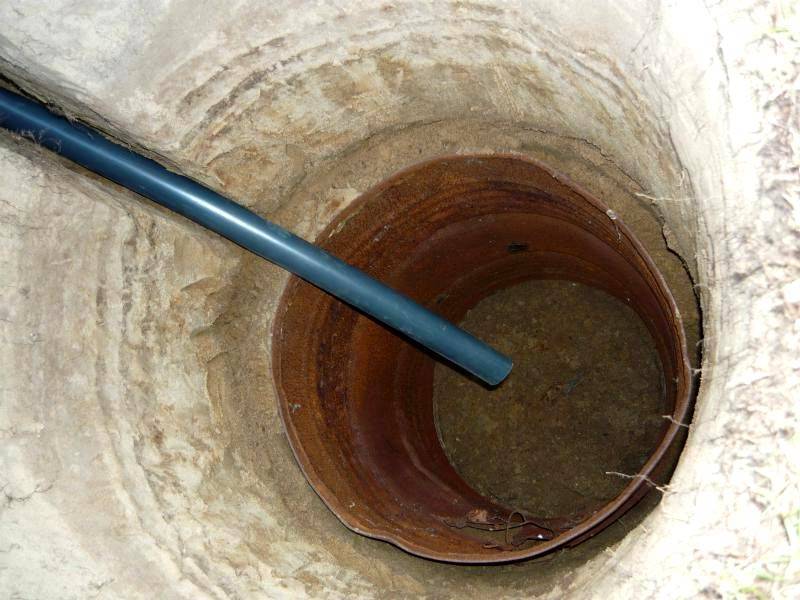
The first builder descends to the bottom of the pit and starts digging the pit.
The second, remaining at the top, will receive buckets of soil.
As the soil is extracted, the tower of the rings will begin to sag under its own weight. As a result, the entire tank will be at the bottom.
To seal the joints between the rings and the bottom of the pit, cement mortar is used and the surfaces are treated with bitumen.
When constructing filter pits, ready-made rings with perforations in the walls should be used. In this case, additional waterproofing of the bottom and walls is not required.
The final stage of construction is the laying of the floor slab and the installation of the hatch.
How to choose the right place to install a bathroom?
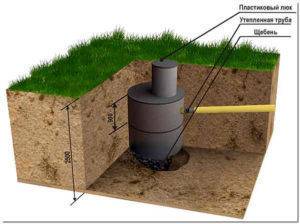 Cesspool from a barrel
When choosing a location for installation DIY toilet in the country, you must adhere to the following rules:
- the cesspool should be located at a distance of at least 10 m from residential buildings. This is due to the fact that biological waste, penetrating into the soil, can cause the formation of fungus and an unpleasant odor inside the building. It also negatively affects the strength of the foundation, which is in a too humid environment;
- do not place it in close proximity to other non-residential outbuildings. It can also cause the formation of high humidity in the room, the formation of fungus, mold and unpleasant odors;
- taking into account the prevailing wind directions on the site, place the outdoor bathroom on the leeward side;
- the place of the device of the cesspool with a container should be located at a distance of 10 m from the water supply, and 20 m from the well with drinking water;
- the distance from the bathroom with a cesspool from the tank to the fence that limits the site should be at least 1 m.



