
- Norms of the distance of treatment facilities on the site
- How is a cesspool different from a septic tank?
- Interior arrangement of a street bathroom
- How to install
- Drainage pit - part of an autonomous sewer
- The simplest inexpensive ways
- Calculations for a cesspool without a bottom with sewage filtration
- Types and materials for manufacturing
- Types of structures
- Materials for the device
- The simplest drainage sewer for a summer residence.
- Where can I find or purchase a suitable barrel
- Arrangement and start-up of the pit
Norms of the distance of treatment facilities on the site
According to SNiP, treatment facilities and pits should be located at a considerable distance from the house, aquifer and other engineering facilities.
- From a residential building - at least 5 m to a septic tank, VOC, cesspool to avoid unpleasant odors entering the room. And also to prevent in advance the possible deplorable consequences of the influence of a humid environment on the foundation of the house.
- To a well with water - 30-50 m. Of course, it is very difficult to follow this rule, since the size of the plots is very limited. It is still necessary to remove the septic tank from the water supply as much as possible, as far as the technical possibility allows.
- To the borders of the neighboring plot - at least 2 m.
- From the collector to plants and trees - the location is 2-4 m, if the roots of the tree are large.
How is a cesspool different from a septic tank?
Previously, the word "septic tank" was unknown, and the cesspool played the role of the only possible place for collecting waste.
Structurally, all cesspools were similar, the difference concerned the presence or absence of any capacity. Often an ordinary hole was dug in the ground, and a wooden house was built over it- "birdhouse". Such outdoor toilets can still be found in old summer cottages.

The modern version of the toilet, which is located "in the yard" - a beautiful house, neatly painted and decorated with flowers. A sewer tank with a neck for pumping is buried under it.
A pit without a sealed container is an environmental threat to a garden plot. If the owners of the house are interested in the purity of the soil and water, they must place a reservoir in the cesspool.
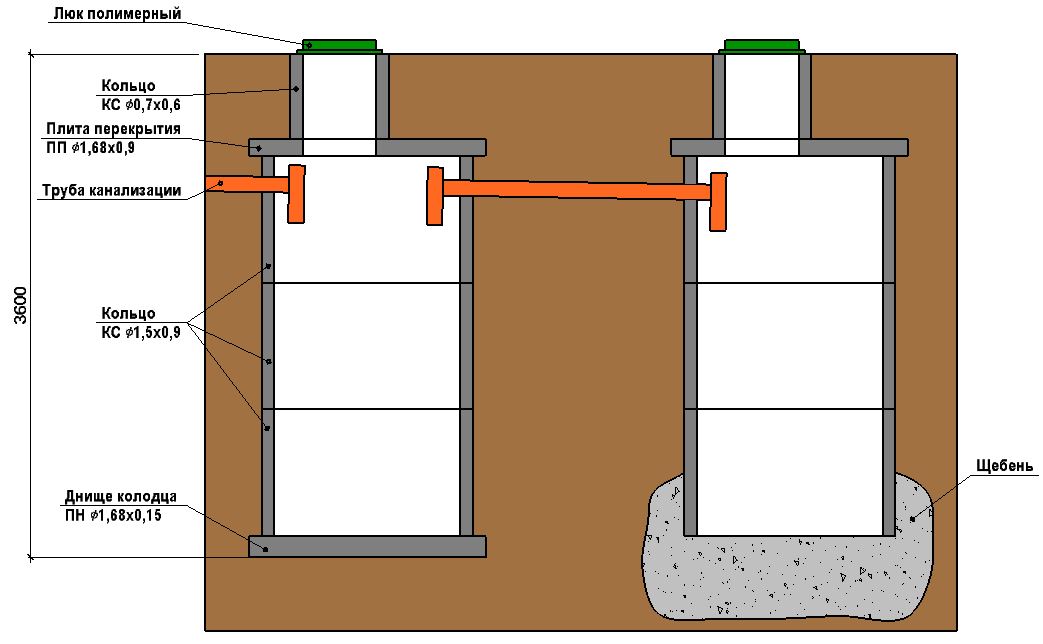
Previously, it was made of boards or bricks, now it is made of concrete rings or monolithic concrete. Often used and barrels, metal or plastic, specially designed for arranging sewers.
Even a large sealed reservoir made of modified plastic is just a reservoir that fills up quickly and needs to be pumped out regularly. It is for this reason that cesspools are absolutely not suitable for family cottages.
To make the sewer system more efficient, a septic tank is installed instead of a cesspool, which not only collects drains, but partially cleans them. Pumping out solid sediment from a septic tank is much less common than from a pit.
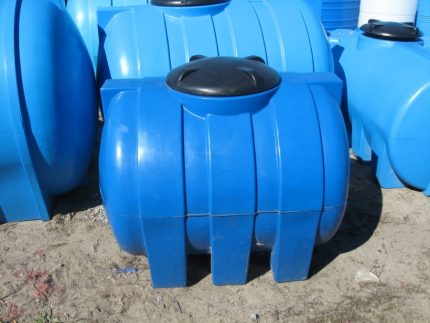
Volumetric container made of modified plastic is the best option for a cesspool. A large tank with a volume of 6-8 m³ will easily replace 3-4 standard metal barrels
The installation of biological treatment stations is recognized as the most perfect way to collect and process sewage. Due to the special design and principle of operation, the block, consisting of several sections, purifies the liquid up to 98%.
After such a thorough filtration, the water enters the reservoir, into the ground or into a storage well for household needs.
Interior arrangement of a street bathroom
Before carrying out internal work indoors, it is necessary to lay a cable for the lighting device. This can be done with your own hands by entering the electrical wiring through the mast, which must be attached to the back wall of the bathroom. At the same time, its height is 2.5 m. Carry out the cable wiring in an open way. The cross section of the wire must be at least 2.5 mm 2. Use a 40W lamp or less for illumination.

For the construction of the seat, use bars with a section of 30x60 cm. Build a frame 400 mm high from them, and attach with self-tapping screws. The finished structure must be sheathed with plywood or OSB board. In this case, do not forget to leave a hole in the place where the plastic container is installed. At the final stage, attach the seat with a lid, which is used for a conventional toilet. When you're done, paint the interior and exterior surfaces of the bathroom with paint or varnish, which will prolong its life and help keep the wood intact.
In such a simple way, you can independently build an outdoor toilet using a conventional plastic or metal container.
How to install
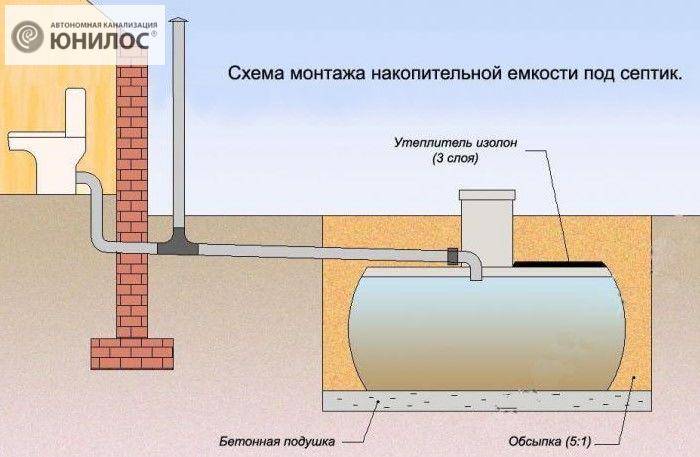
Before starting work, a layout of the barrel and its calculation are drawn up.According to the requirements of SNiP, a closed-type cesspool should be located at a distance of up to 30 meters from the facade of the house and more than 40 from the nearest body of water (whether it be a well or a lake). After that, a plan is developed for branching pipes from the house.
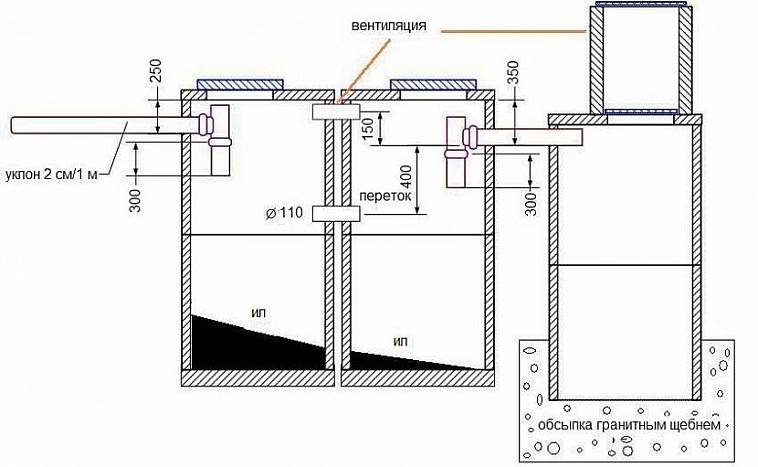
They should be at a slight slope relative to the source. On average, from 2 to 4 centimeters is taken per 1 linear meter. This will protect the sewer system from stagnation.

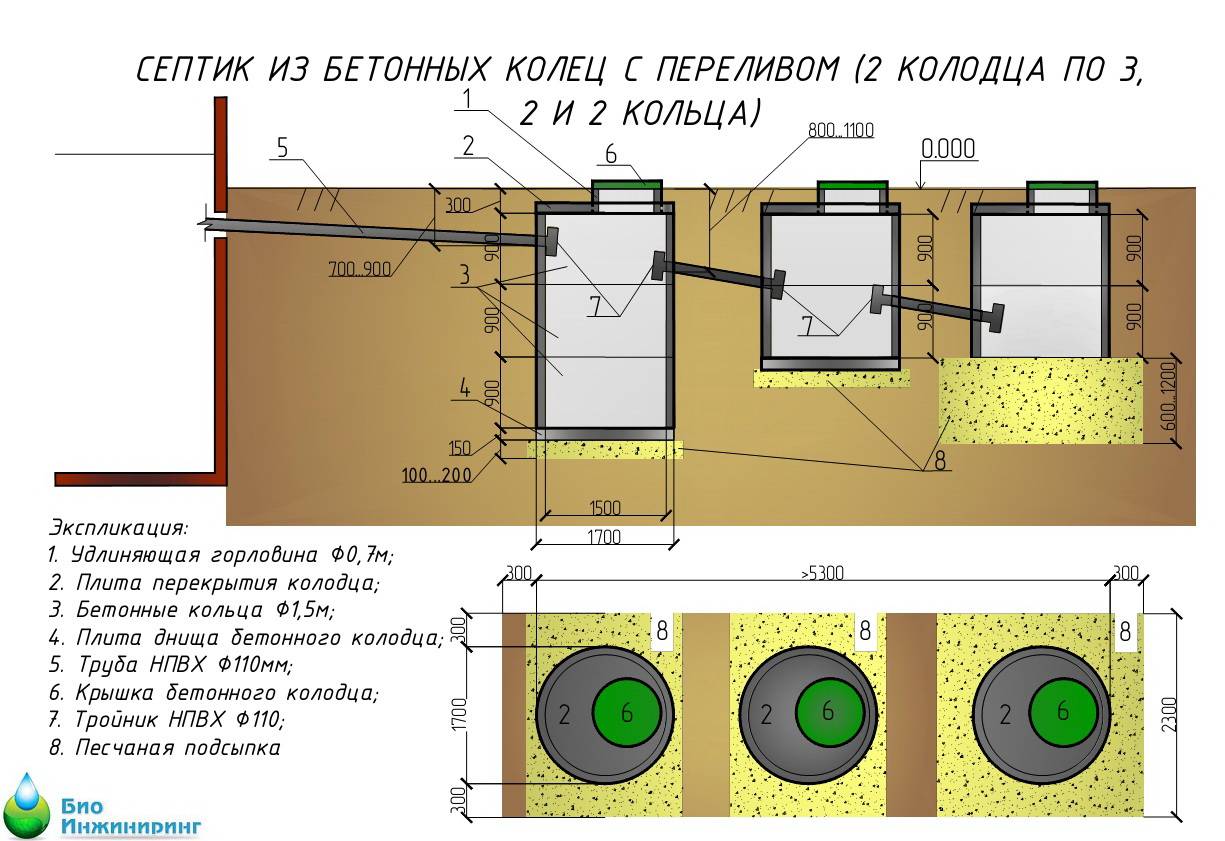

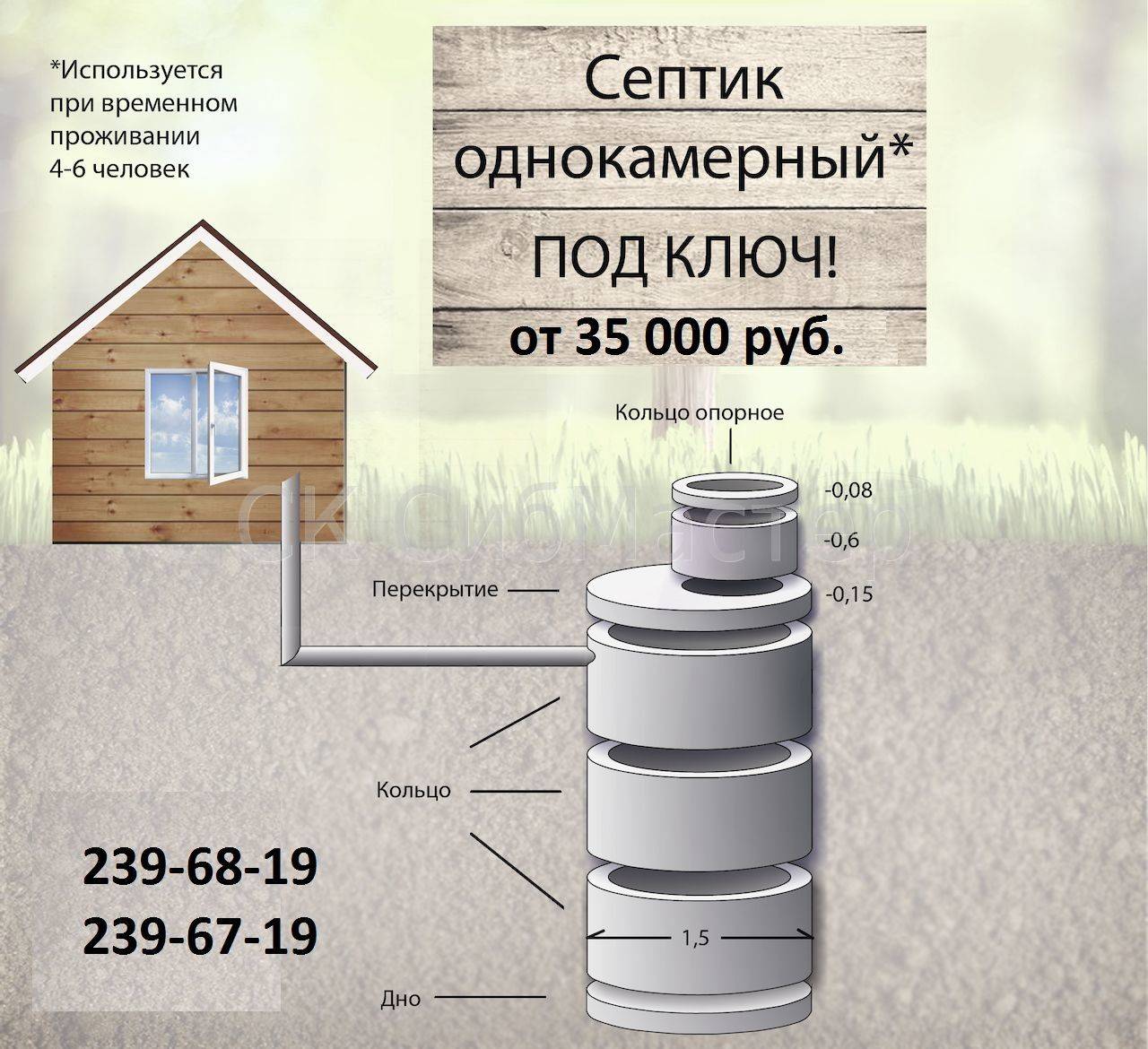


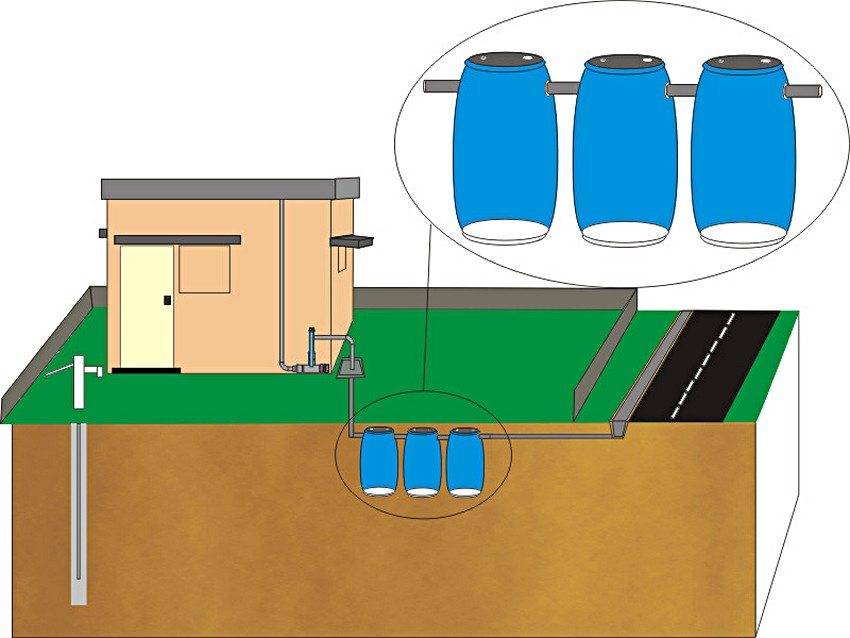

After the pit is prepared. Rules for preparing a pit for installing a plastic sealed barrel:
- The place of the future pit is thoroughly cleaned of litter and grass. It is best to choose a site in a lowland - it will be less prone to deep freezing due to the heat of groundwater;
- The width of the earthen hole should slightly exceed the dimensions of the selected container. This is necessary to strengthen the walls with a casing or backfill them with sand, gravel. A pillow of small crushed stone or gravel is necessarily laid at the bottom of the pit. Groundwater will constantly wash away the bottom of the barrel, in order to protect it from premature wear, it is necessary to reduce the impact of these currents. The average pillow height is 30 centimeters;
- The height of the pit is calculated from the height of the barrel and the gravel pad. In the northern regions, it is recommended to organize the drain so that it is all underground - this will help prevent freezing of waste and stopping the sewerage. At the same time, it should not exceed three meters, because this is the average length of the hose of a sewage machine;
-
On heaving soils, it would be advisable to organize a concrete casing. In loamy, a metal mesh must be installed (clay is very mobile in spring).
After that, a barrel is installed in the cesspool. Its installation is carried out in an empty form, so that it is more convenient to level the tank. The level of capacity must be regulated by special devices.
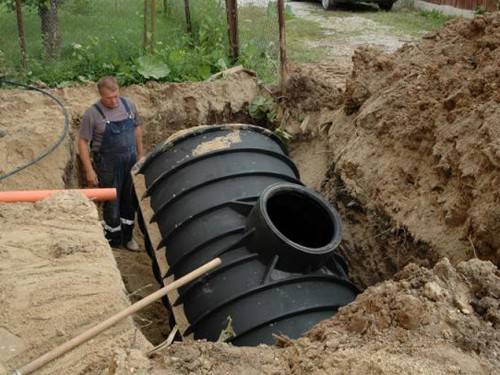 The process of installing a barrel in a pit
Next, the pipes are connected. Holes of the required diameter are cut at the places of their installation, after which the outlet is connected to the sewer outlet using a flexible coupling.
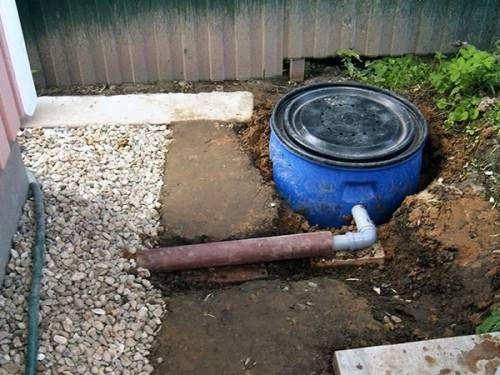 Connecting a barrel with a sewer outlet
When the process of installation and connection of taps is completed, it is necessary to seal the walls of the pit. There should be no gaps between the barrel and the ground, otherwise deformation is almost inevitable. To fill these gaps, the tank is filled to the top with water. Only then does the filling process begin. Only sections of the barrel are left open for installing a hatch or ventilation (if the tank is horizontal or completely closed).
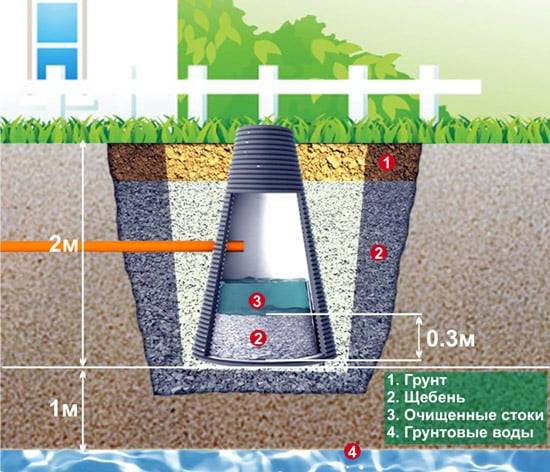 The process of backfilling a cesspool
On average, a closed cesspool from a metal or plastic barrel requires cleaning no earlier than 60 days (although a lot depends on the correct calculation of its volume). If you do not want to deal with frequent pumping, then it is more practical to install a structure consisting of several chambers.
Drainage pit - part of an autonomous sewer
To collect household and household waste, a storage tank is required, which must be regularly emptied using special equipment. Usually this is a large container or structure buried in the ground.
The sizes and shapes of cesspools may vary, but some components must be present in all structures:
- a tank, the volume of which meets the needs of the owners of the house;
- a drain inlet through which sewage flows into the tank;
- technical hatch necessary for control and maintenance;
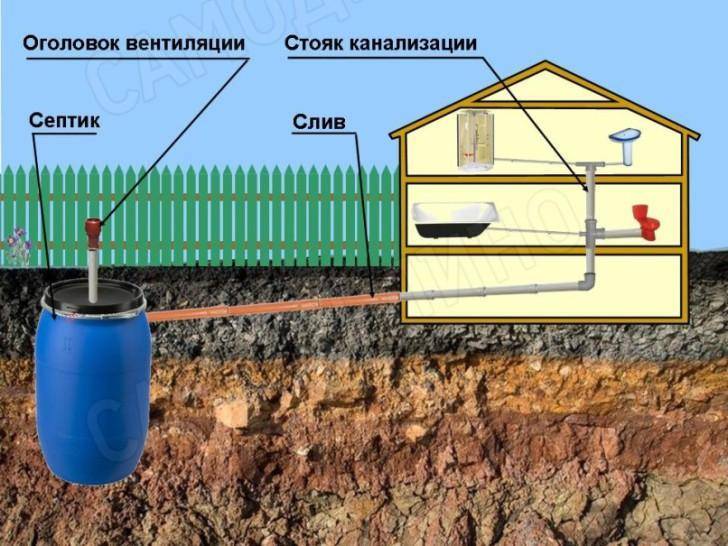
- a ventilation pipe that removes harmful gases to a safe height.
The ventilation device is often neglected, leaving a hole or slot for air to enter, or even tightly clogging the pit. This is wrong: the unpleasant smell of gases at a certain concentration is also dangerous.
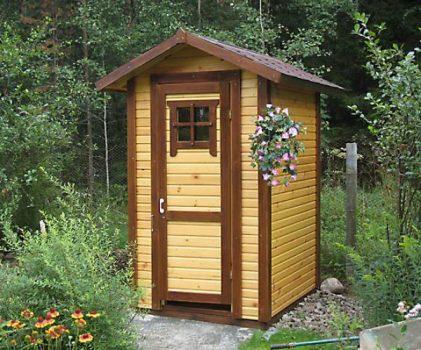
Until now, there are street toilets, "birdhouses", which completely replace the country sewerage system: they are both a latrine and a storage for food waste.
Everyone who feels discomfort from walking in the morning chill has long been equipped with a full-fledged sewer network. It includes connections to the toilet, sinks, bathtub or shower, and a pipeline connecting points inside the house to a reservoir buried nearby.
The minimum "country" set that allows you to regularly wash and keep the house clean is a toilet + shower + sink in the kitchen. Accordingly, the sewer system inside the building connects plumbing fixtures.
The outer part of the system is a pipe from the wall of the house to the storage tank. A straight and relatively short pipe (but no shorter than 5 m according to SNiP standards) is an ideal scheme for moving wastewater.
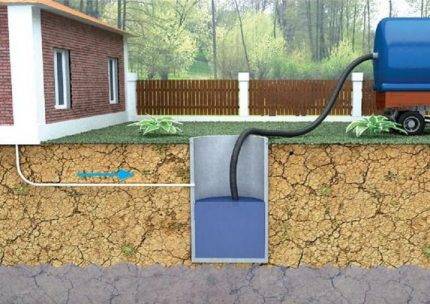
The simplest scheme for the device of a country sewer system with a drain pit. A mandatory addition is the arrangement of the road - an entrance for a sewage truck
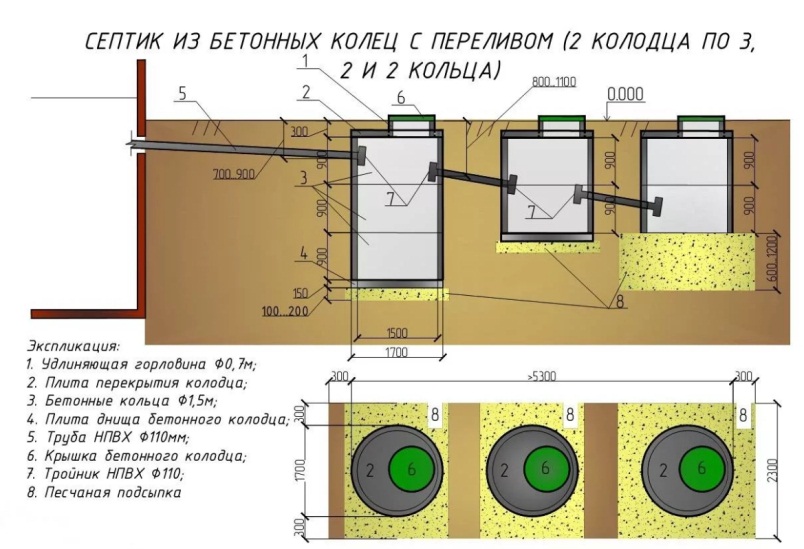
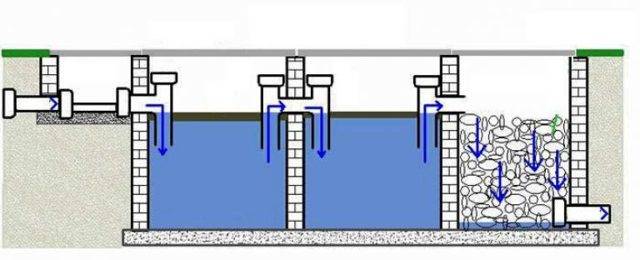
Sometimes it is necessary to equip complex communications connecting several sleeves, for example, to drain drains from a house, bathhouse, garage or summer kitchen.But in this case, instead of the usual drain pit, a septic tank is installed, which, in addition to collecting and accumulating, also purifies the water, and then brings it to the ground (well, ditch) for further purification.



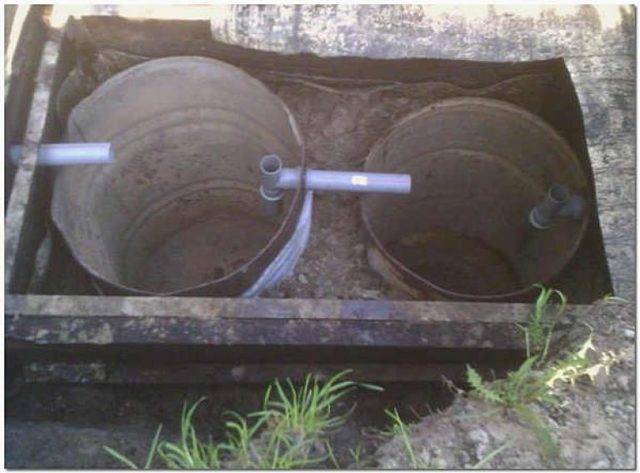
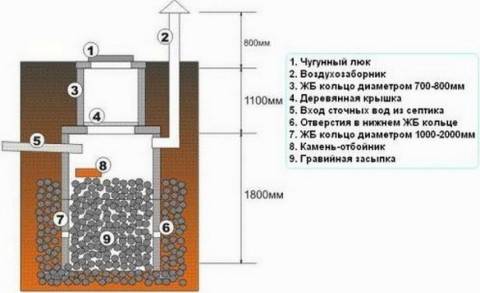
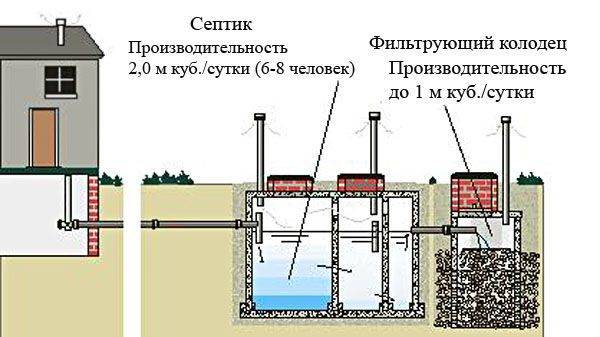
The simplest inexpensive ways
In the old days, as a typical rural sewer, a do-it-yourself drain pit was built in a private house. To increase the strength, its walls were coated with clay or reinforced with boards. A little later, they began to practice burying old barrels, tanks and cisterns into the ground. As practice has shown, a system of a series of tanks in which wastewater is collected and partially filtered is able to cope with waste volumes of the order of 1 m3 per day.
Using a simple do-it-yourself cesspool without pumping out, you can fill the need for draining country houses with non-permanent residence. However, from the point of view of current sanitary standards, such structures are on the list of undesirable and even prohibited options. Violators are subject to fines and other administrative penalties.
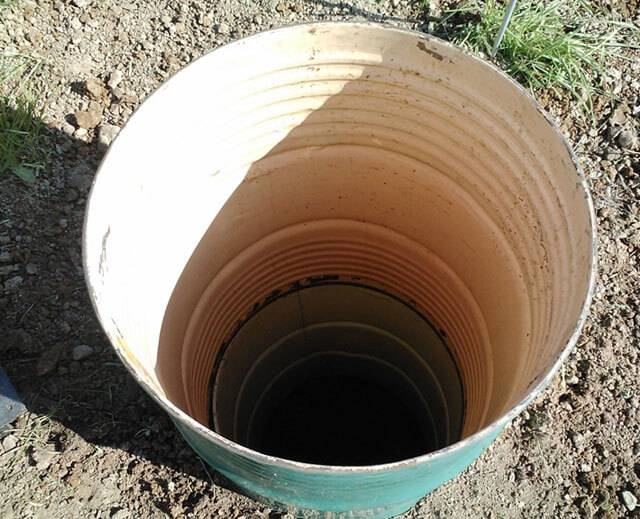
There are several recommendations on how to properly make a cesspool:
- It is necessary to dig 1 m higher than the level rises in spring and autumn. At this time, this indicator has a maximum value.
- A good budget option for a solid drain shaft involves the use of old car tires for this. They simply fit inside the finished barrel and are fastened together with screw jumpers.
- In cases where the cesspool for a permanent residence is located at some distance from the dwelling or toilet cubicle, the top cover is equipped with a side cutout for switching the sewer pipeline.
- The required amount of earth is poured into the gaps between the tires and the shaft (it is desirable to compact it). For safety, a concrete slab is usually laid over the pit. A hole is made in it for a ventilation pipe and a hatch for pumping out sewage.
Calculations for a cesspool without a bottom with sewage filtration
Such a pit, which does not have a bottom, differs from a simple, completely sealed one. Effluent in the filter pit is cleaned by anaerobic bacteria, after which some of the content goes through the ground. It is possible to postpone calling a car for pumping out if you use special biological products.
Calculate just how much of a cesspool will be optimal, perhaps like this:
We take into account that about 150 liters of water are consumed per day per person. And suddenly use household appliances, the drains from which will rush into the pit, then the volume per day can also increase up to 500 liters
It is fundamentally important to remember that such a number of drains is calculated, which will be as huge as possible. When deciding what kind of drain pit to make, it must be taken into account that its smallest volume should be three times the daily volume of all wastewater flowing into the pit
The size of the designed cesspool is calculated, as well as the dimensions of a simple sealed pit. There is no relationship between length and width and height. Indeed, it is better to adhere to the fact that the depth is somewhere twice as large as the length or width (or diameter, in the case of a cylindrical container).
Types and materials for manufacturing
For the collection and disposal of liquid household waste, it is difficult to imagine something simpler than a drain hole dug in the ground. This is the oldest sewer structure used by people to equip toilets. The liquid sewage that got into it was partially absorbed into the soil, and the residues not processed by bacteria accumulated. The filled pit was dug in, and the toilet was transferred to another place.
With modern requirements for comfort, this option has lost its relevance and is occasionally used only in summer cottages with seasonal accommodation. Today, the question of how to make a cesspool is being solved in accordance with the multiply increased volume of wastewater, which is collected all year round from several points: kitchen, toilet, bathroom, laundry room, home sauna, etc.
Of course, a small depression in the ground is not enough to collect them. A volumetric storage with reliable walls is needed, into which the pipe is led out of the house.
So schematically looks like a modern cesspool
Types of structures
According to the method of waste disposal, these facilities are divided into 2 types: sealed storage tanks and filter wells. Before you make a drain pit, you need to decide on its design:
- In sealed facilities, sewage is simply accumulated, periodically pumped out by sewage equipment and transported to treatment facilities or to specially designated places. Such structures can be mounted in any soil and at any level of groundwater. Their operation is associated with some inconveniences: you need to constantly monitor the filling level of the tank and pump out in a timely manner.
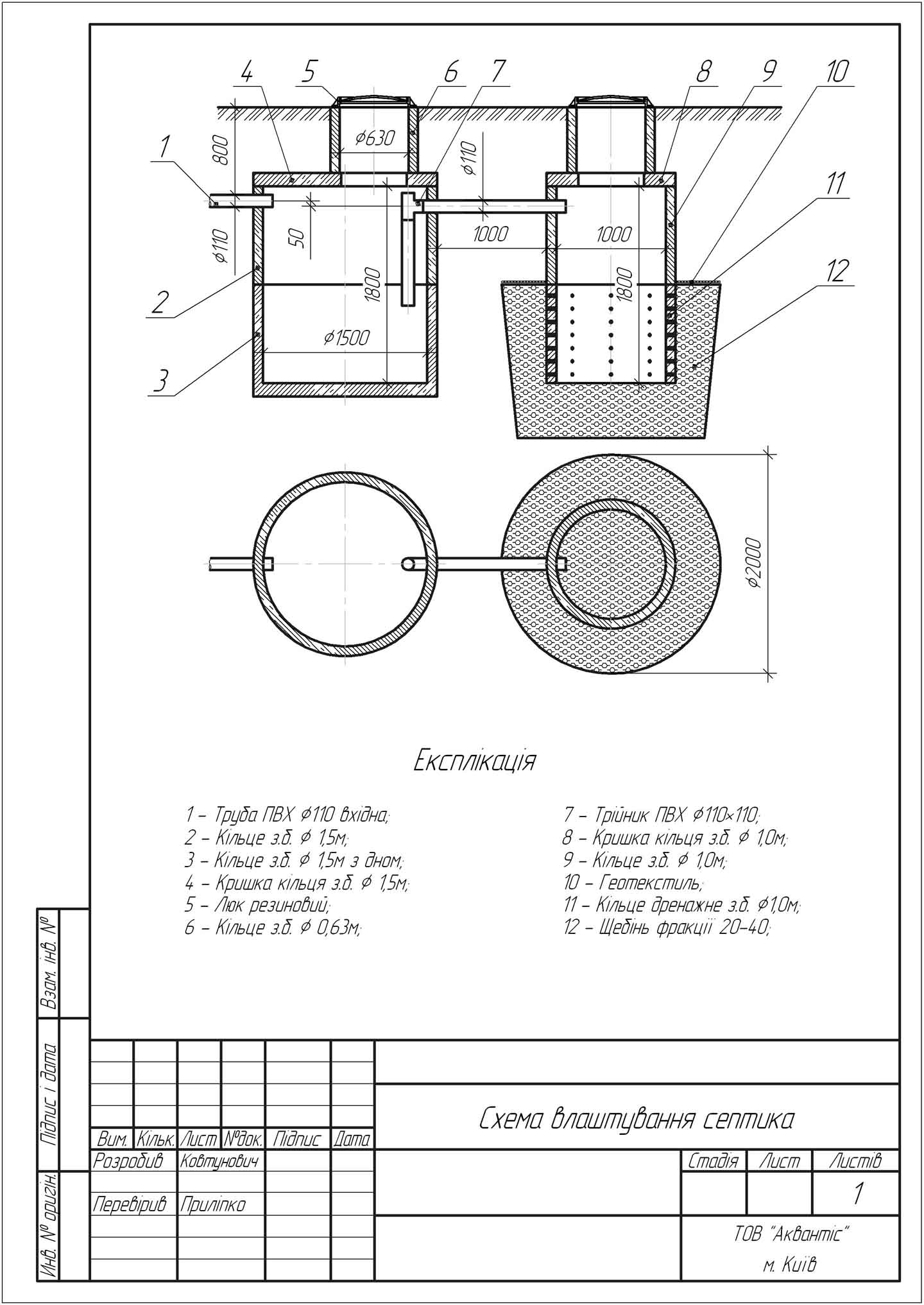
- The filtering structures do not have a bottom as such, and often holes are made in the walls.Through them, part of the effluent leaves the well, is filtered through a layer of sand and gravel backfill and seeps into the ground. With an equal volume with a hermetic type structure, they fill up more slowly, so pumping is not required so often.
Scheme of the device of the filter cesspool
When choosing one or another type, first of all you need to find out at what distance from the surface of the earth the upper level of groundwater is located on the site. If it is less than 100 cm from it to the bottom of the well, then it is impossible to arrange a filtering structure, as this threatens to pollute the soil and groundwater. It will not "work" in clay or rocky soils that do not allow water to pass through.
It is also worth calculating the approximate volume of stocks for a certain period of time. If it is small, the advantage should be given to a sealed container. Especially if the site is small and it is impossible to place a water well, fruit trees and other plantations on it at a safe distance from the cesspool.





Materials for the device
Since it is correct to make a drain pit in a private house means to ensure its long service life without reducing its performance, the material for its device must be chosen resistant to moisture and soil pressure. Therefore, most often it is built from red brick, concrete rings or monolithic reinforced concrete.
Monolithic structures are made by pouring concrete into the formwork
Depending on the type of structure chosen, the walls are made solid or perforated:
- In the case of a brick, the masonry is carried out with holes in half a brick;
- In concrete rings, holes are made using a puncher or special perforated products are bought;
- To ensure filtration through monolithic concrete walls, pipe cuttings are placed in the formwork during the pouring of the solution.
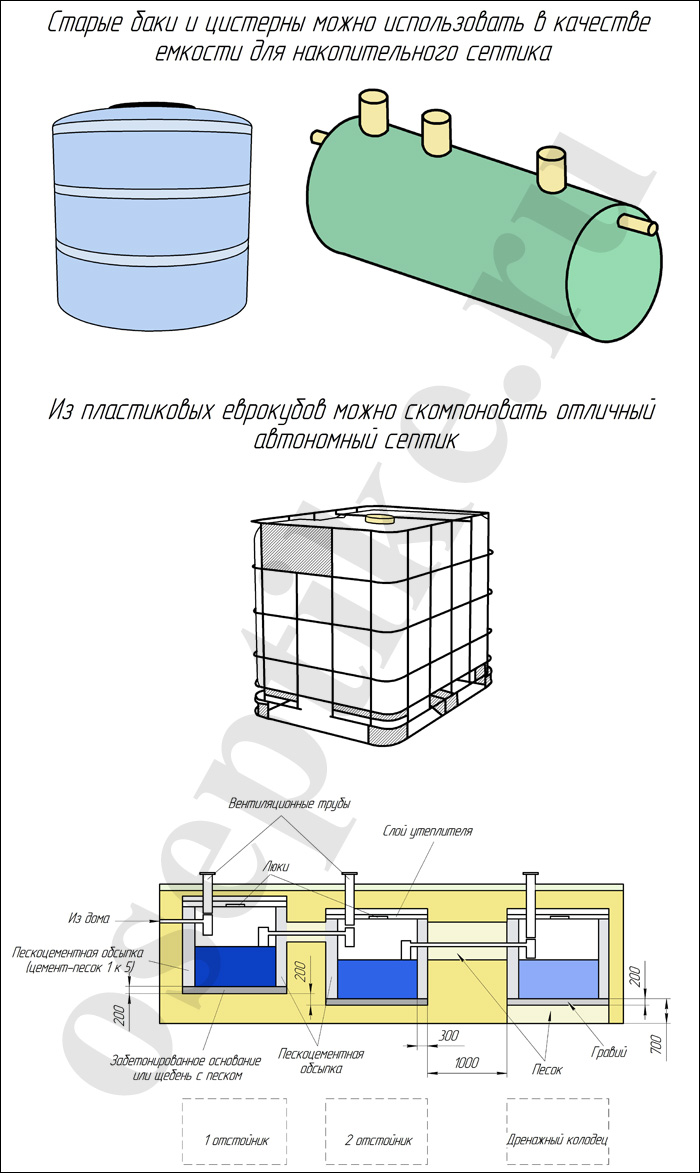
You can also purchase ready-made metal or plastic containers. They are produced specifically for this purpose and have a hatch with a lid, as well as holes for mounting drain pipes. Their use greatly simplifies the task of how to make a sewer in a private house with your own hands with a cesspool, since such containers, with good strength, are light in weight and do not require sealing work.
Plastic container for a cesspool with stiffeners
A small amount of relatively clean wastewater can be discharged into a pit, the walls of which are made of car tires. This is an almost free option for its arrangement, often used in the construction of free-standing baths.
The simplest drainage sewer for a summer residence.
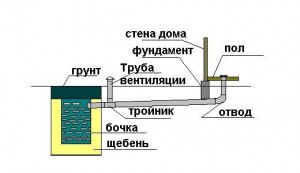
Simple drainage sewer for a summer residence
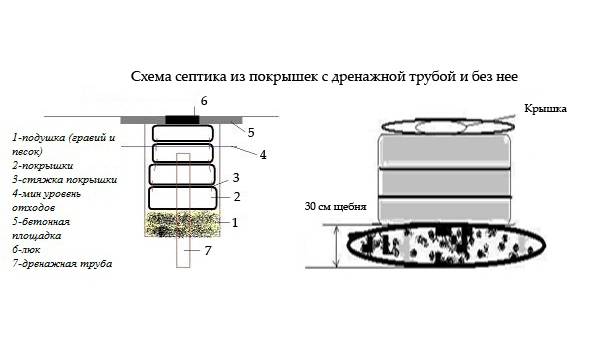
It is not enough to bring water into the house, after use it needs to be put somewhere. It’s hard to take out buckets, and it’s somehow pointless: water comes into the house by itself, and then it is taken out on foot. At least elementary sewerage is needed for a house or a summer residence. The option to simply remove the pipe from the house and drain the water to the ground or a small hole will not suit everyone. It doesn't look very good, and an unpleasant smell from this puddle or pit is almost guaranteed. What to do? So, we will need: an old metal or plastic barrel, a certain amount of sewer pipes (at least 6 meters, preferably PVC 110mm), a tee, a branch, about 0.5 cubic meters of medium fraction crushed stone, a shovel and a few hours of our precious time. We choose a place for our drainage well.Preferably, no closer than 5 meters from the house, no closer than 20-25 meters from a well or well and downstream of them downstream of groundwater. We dig a hole with a diameter greater than the diameter of the barrel by at least 0.5 m (diameter of a standard barrel is 0.6 m, height 0.9 m, volume 0.2 cubic meters) and a depth of about 1.5 m (preferably deeper). We make holes in the walls of the barrel, if metal, then with a grinder, if plastic, then with a hacksaw for wood with a small tooth. We make a hole for the incoming sewer pipe in the wall, not far from the bottom of the barrel. We fill at least 20 cm of gravel at the bottom of the pit and put the barrel upside down, orienting the hole under the pipe towards the house. Now you need to dig a trench under the sewer pipe, leading it to the place you need. The pipe must be laid with a slope of at least 3 mm per meter towards the barrel. It can be brought into the house either under the foundation, or through a hole in it. There is no need to insulate the pipe, the water flowing through it will warm it perfectly. Not far from the barrel, we put a tee with a small piece of pipe coming out above the ground to circulate air inside the barrel and let air out of the sewer when it is filled from the house (so that the air from the barrel does not go into your house). We lead the pipe into the barrel through the hole made for this. We fill the gap between the barrel and the wall of the pit with gravel to the entire height of the barrel. At the bottom of the barrel, it is advisable to put some non-rotting material (a piece of old slate is perfect). We fill both the trench and the pit with soil, carefully tamping it down. We make a hole in the floor or wall of the house, finally leading the sewer into the house. Further at your discretion. On a piece of pipe sticking out of the ground near a buried barrel, you can put on a plastic fungus, which is difficult, but can be found in stores.And now the nuances. This is an exclusively drainage sewer for the house, it will not cope with fecal effluents, it cannot be cleaned or serviced in any way, and it is not intended for this. This sewer can be used for drains from the kitchen or from the bath. The same device has drainage wells from a septic tank. The microclimate for bacteria that process wastewater depends on the depth of the pit. Ideally, the depth of the pit should be: the depth of soil freezing + the height of the barrel + the height of the crushed stone cushion (for the Leningrad region: 1.2m + 0.9m + 0.2m = 2.3m). But digging so deep is hard and not necessary. Drains also heat the barrel.
A simple drainage sewer for a summer residence with a drain
If the soil at the installation site of the sewer is clayey, and the water from the barrel leaves slowly, then the sewer for the house can be slightly improved. To do this, you need to lay another sewer, and preferably a drainage pipe. This pipe may lead water to a drainage ditch at the boundary of the site, or it may not lead anywhere, ending in a dead end. The task of this pipe is to remove excess water from the barrel, thus increasing the area of water absorption into the soil (irrigation area). The pipe is laid in a trench on a crushed stone pillow and is also covered with crushed stone, and then with soil. The depth of the trench is greater than that of the supply pipe, and the slope is directed away from the barrel. Naturally, the sewer pipe will have to be spoiled with a certain number of holes in the lower part to improve the flow of water, making it look like a drainage pipe. This is not required if the pipe is led into a drainage ditch.
You may be interested in similar articles:
- What to do if the sewer freezes.To be honest, I'm a little surprised that someone's sewer can freeze. Sewer pipes, in principle, cannot freeze there.
«>
Where can I find or purchase a suitable barrel
Of course, it is best to use plastic containers, since they are perfectly adapted and not exposed to aggressive environments and their service life can exceed 50 years, since they are not subject to corrosive damage and decay, which cannot be said about metal barrels.
Agree, this is an excellent indicator.
The easiest way is to buy a ready-made plastic barrel, since it contains all the necessary components for a septic tank.
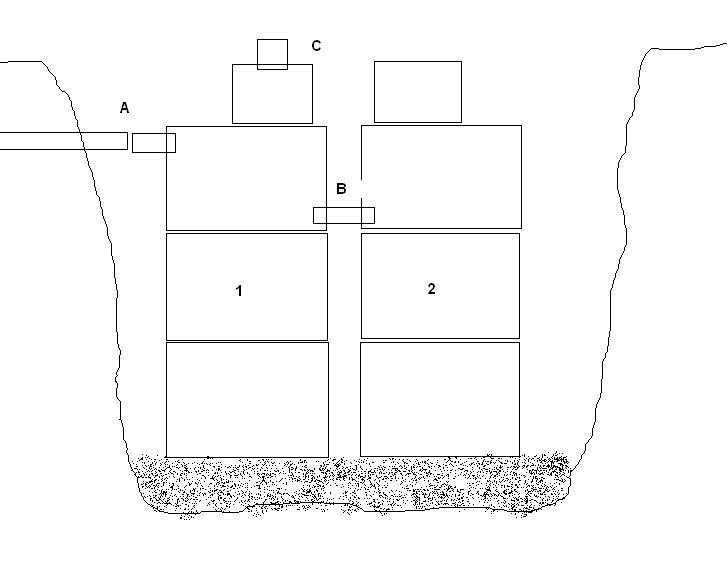
In particular, this is a hatch, a vent, and so on. If, while living in the country, you notice that your family uses a fairly large amount of water, then you should consider purchasing two barrels and connecting them together.




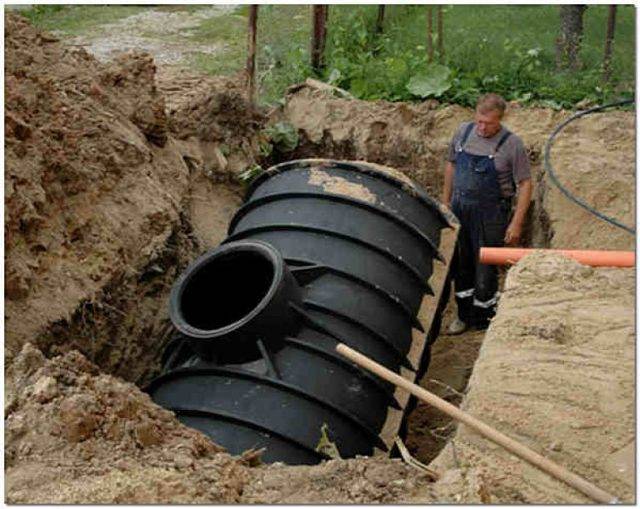
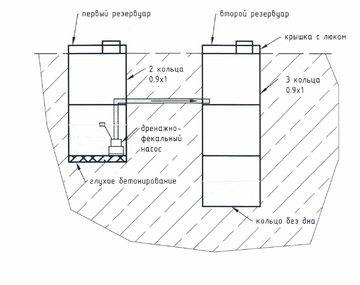
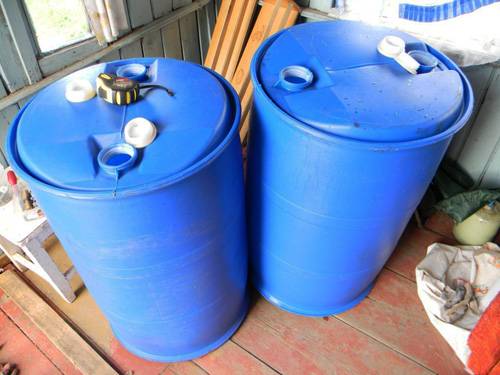
Ready-made barrels for a septic tank made of plastic
If the funds do not allow you to buy a plastic barrel, then, of course, you can get by with a metal barrel of 200 liters, but be prepared for the fact that it will fail very soon.
You can try to find containers from decommissioned vehicles in which chemical liquids, gasoline and other things were transported.
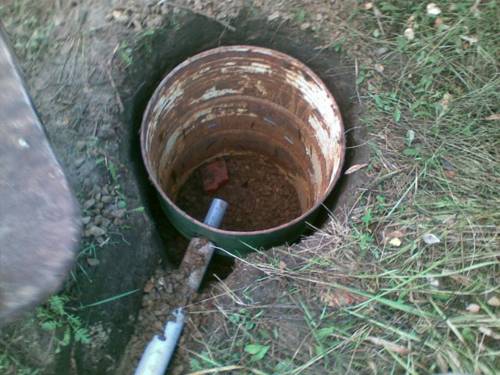
Metal tank for a septic tank
Arrangement and start-up of the pit
Independent arrangement of an autonomous sewage system must be carried out in accordance with sanitary standards:
- The diameter of the sewer pipe is 10 cm.
- The depth of laying in the soil is not less than 120 cm.
- The slope of the pipe towards the waste pit is 3-4%.
- The bottom of the drive is arranged towards the hatch.A mandatory requirement is the installation of a gas outlet pipe with a diameter of 10 cm to a height of 60 cm above the soil level.
- Mandatory waterproofing of sealed sewage pits.
The choice of location for the installation of an autonomous treatment plant should be justified by soil science and geodetic data, characteristics of soil samples
It is also important to take into account the level of aquifers .. Subject to all requirements, autonomous sewage will ensure environmental safety, the absence of unpleasant odors, and convenient maintenance
If all requirements are met, an autonomous sewage system will ensure environmental safety, the absence of unpleasant odors, and convenient maintenance.
Regular sanitation and additional preventive measures will eliminate the difficulties in cesspool operation any type.
How to clean a cesspool or toilet in a private house with your own hands
How to pump out a cesspool - order and cost of the machine
What to do with the rapid filling of the cesspool
About bacteria for cesspools and toilets - which are better for septic tanks
Submersible fecal pump with grinder - description, characteristics
Rules for burning garbage in the yard of a private house and solid waste at the plant



