
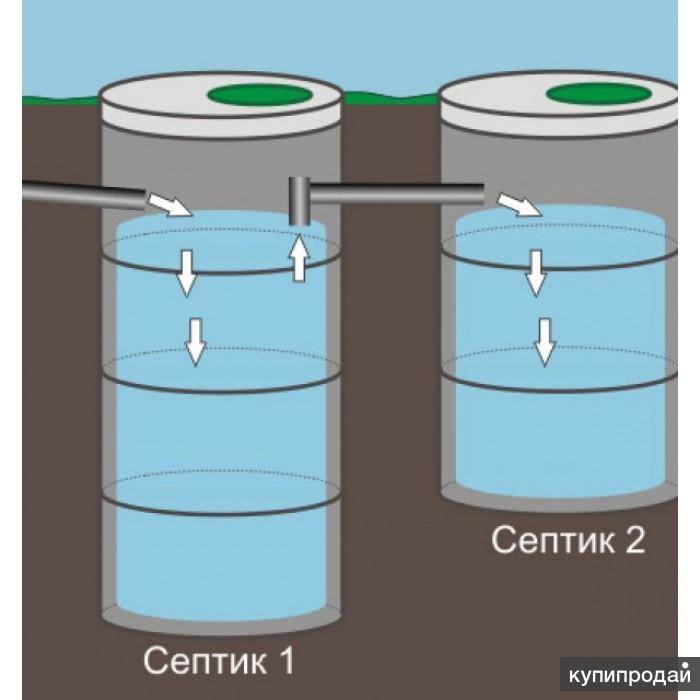
- Cesspool, sanitary standards
- Filtration system
- Design features
- Distance from house to pit
- Distance from the water supply to the pit
- How to make a cesspool with your own hands
- Step by step instructions, diagram
- Correct calculation of the volume of the pit
- Calculations and technical standards
- Do-it-yourself construction stages
- Preparation of materials and tools
- Location selection
- Pit preparation
- Installation of rings, piping
- Sealing
- Waterproofing
- Covering and backfilling the well
- Construction stages
- Video description
- How to choose the best place for a septic tank
- Pit preparation
- Installation of rings and sewer pipes
- Sealing and waterproofing
- Manhole installation and backfill
- How does the septic tank start up
- What rules must be observed when maintaining a septic tank
- Septic tank made of concrete rings: construction stages
- Preparatory stage
- Excavation
- Delivery and installation of reinforced concrete rings
- Waterproofing
- Ventilation
- Overlapping a septic tank
- How to make a septic tank
- Installation technology of plastic containers for sewerage
Cesspool, sanitary standards
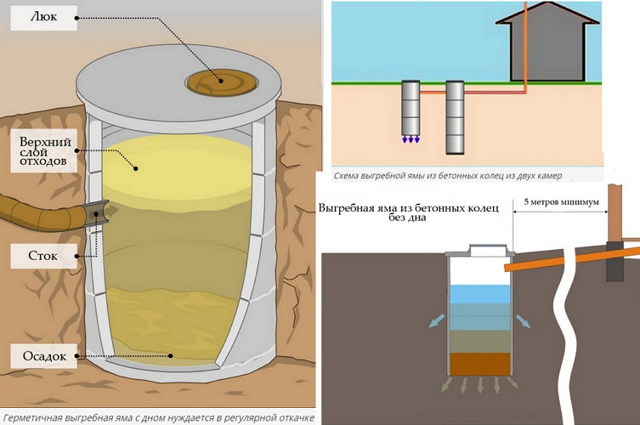
Structural features provide wastewater treatment due to natural filters
When arranging such a pit, it is important to take into account sanitary standards (SanPiN) and building codes (SNiP), according to which the cesspool should be located at a distance:
- From residential buildings - 10-15 m;
- From the boundaries of your site - 2 m;
- From the well - 20 m;
- From the gas main - over 5 m;
- The depth of the cesspool depends on the level of groundwater and should be no more than 3 m.
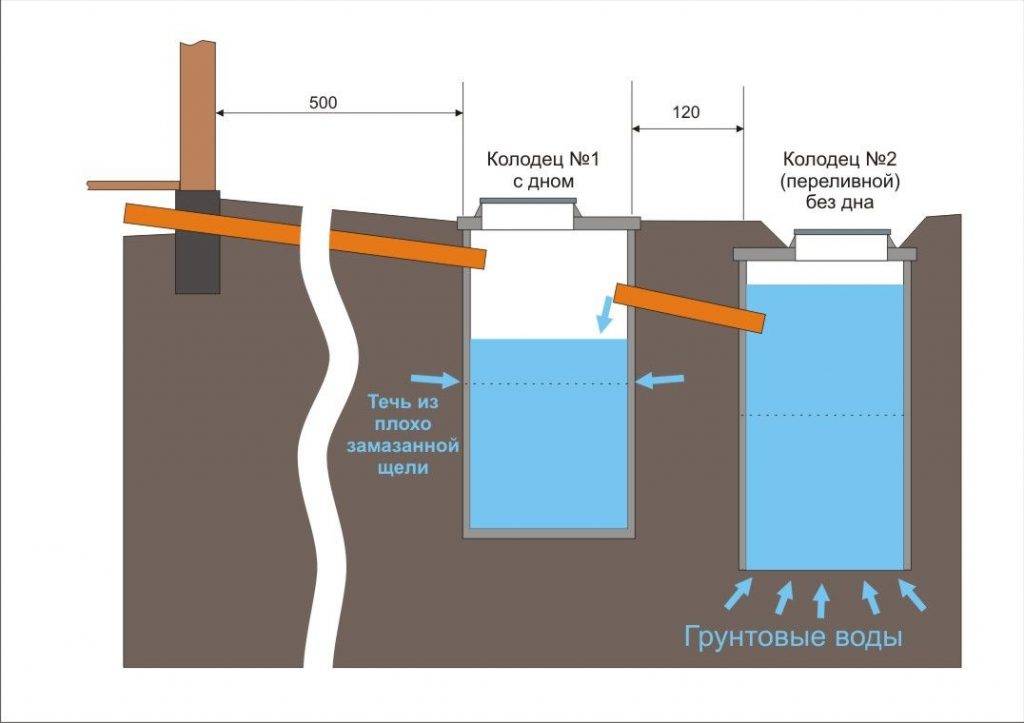
If the relief of the site is complex, then it is better not to arrange a sewer pit in the lowland. During spring floods, there is a high probability of its flooding, which will cause contamination of groundwater.
Filtration system
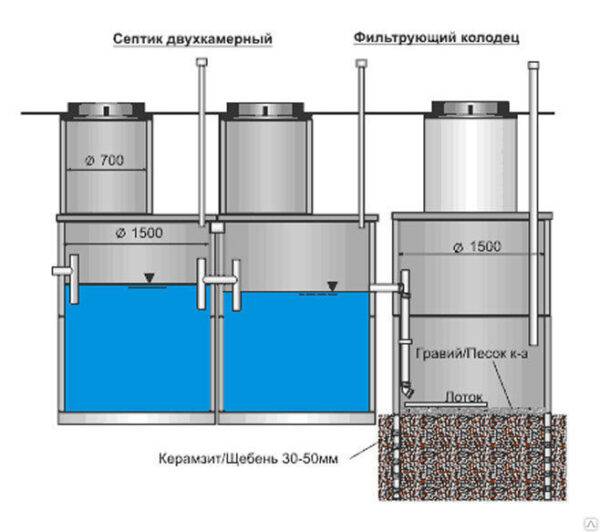
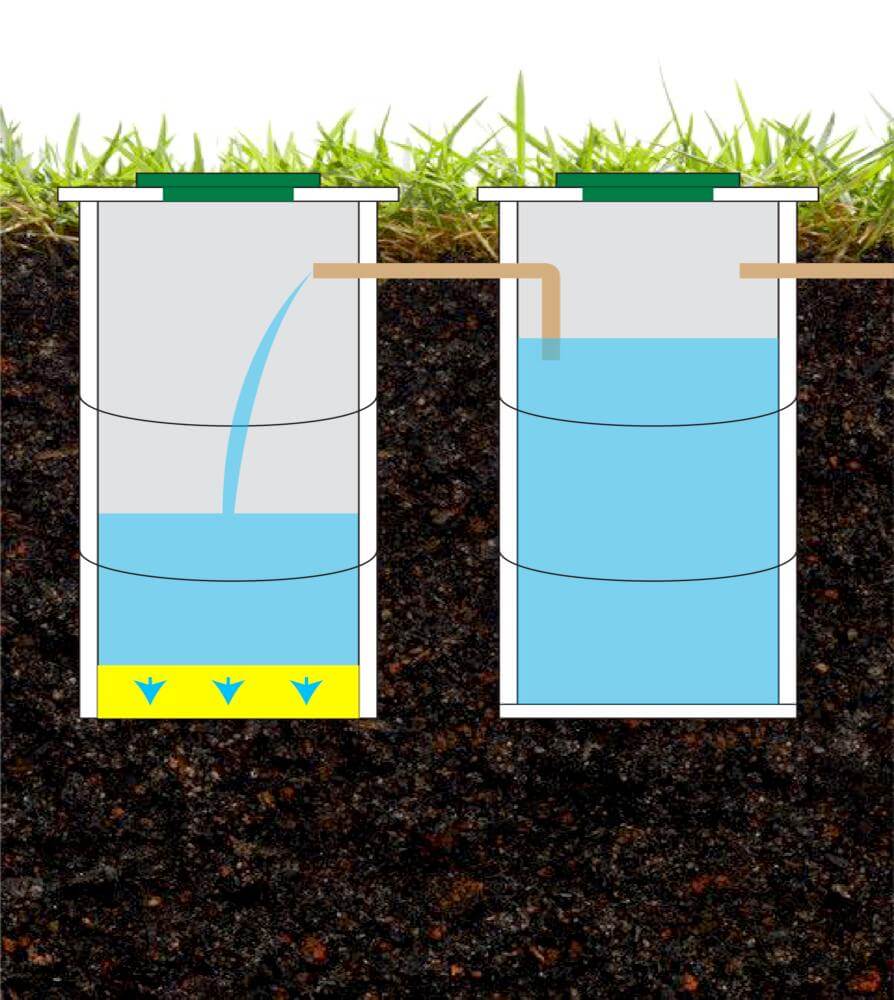
In areas without central sewerage, two main methods can be used to filter wastewater - mechanical and biological. The simplest option for a coarse filter is the formation of a drainage layer of gravel, broken bricks and sand inside the cesspool.
The organization of such filtration is not very difficult, but the type of initial soil should be taken into account. Ideally, these are sandy and peaty soils. The allowable volume of effluents will depend on the filtering capacity of the soil. Also, in accordance with sanitary standards, the bottom of the well for filtering waste liquids must be at least one meter above the groundwater level.
Design features
Strict requirements for the design of the cesspool are not provided. However, there are installation rules that must be followed. They are necessary to exclude the possibility of pollution of the environment, groundwater and the site. Compliance with the recommendations will avoid the inconvenience associated with subsequent operation.
Consider the design features using the example of a do-it-yourself cesspool without a bottom. It makes sense to do such a cesspool in summer cottages, where people rarely live and the volume of sewage does not exceed one cubic meter per day.The design is a filter well with side walls without a bottom, to which a sewer pipe is connected.
It is important to control the slope of the drain so that the wastewater flows into the well by gravity.
At the last stage, the drainage of the bottom and the overlap are made, in which a hatch is provided for inspection and pumping out the liquid as needed. If there are voids between the dug hole and the walls of the well, it makes sense to also fill them with a drainage mixture.
Distance from house to pit
Before installing a septic tank at the selected site, you should familiarize yourself with the requirements reflected in SanPiN 42-128-4690-88, SNiP 2.04.03-85, SNiP 2.04.01-85 and SNiP 30-02-97, which determine the construction procedure and the location of the sewer . A permit for the installation of a cesspool is issued by the SES on the basis of the provided project and the scheme of the treatment plant.
If sewerage will be installed for a full-fledged housing, then its design must be agreed with the BTI.
In accordance with the regulations, the distance from the cesspool to nearby houses should not be less than 15 m. However, if the distance to the houses of neighboring sites is strictly defined, then there are discrepancies in relation to the distance from the autonomous sewer to your residential building located on the same site. In some editions of regulatory documents, a distance of 5 m is allowed.





Distance from the water supply to the pit
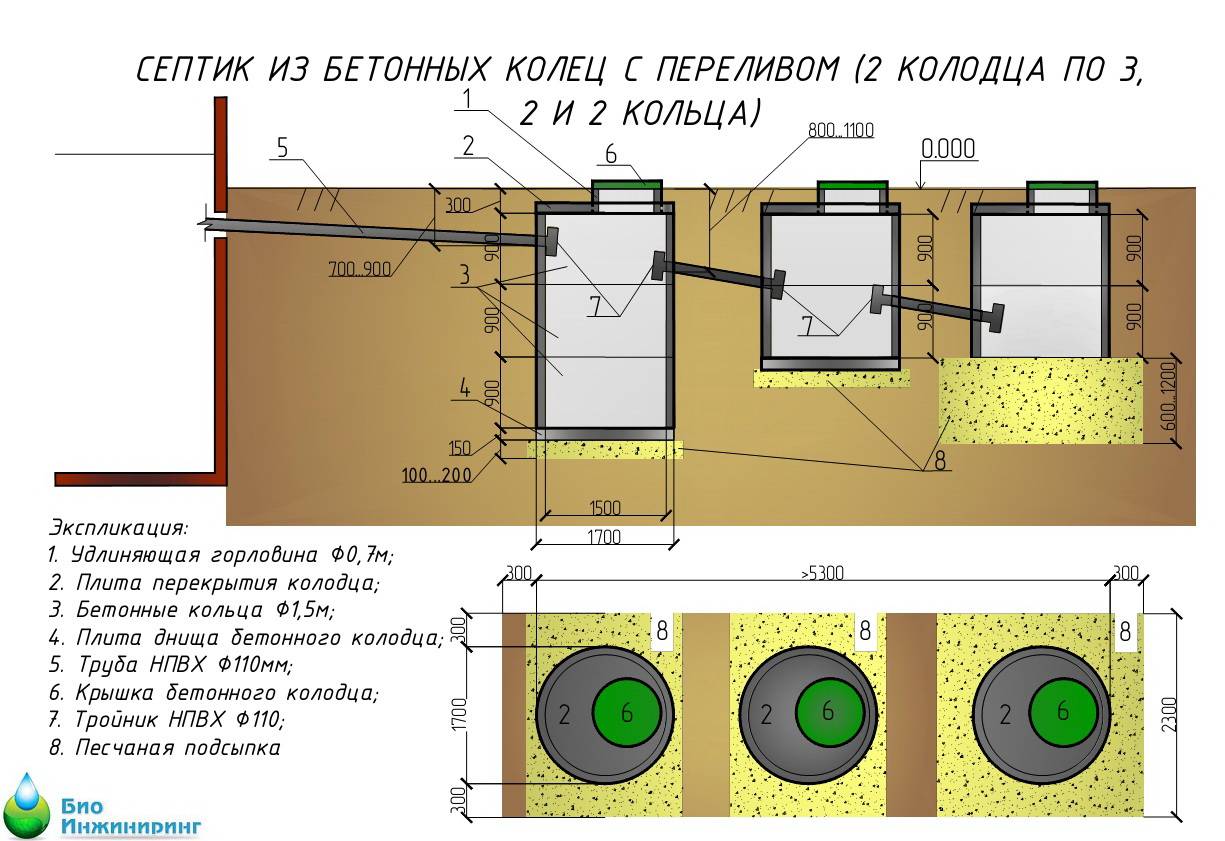
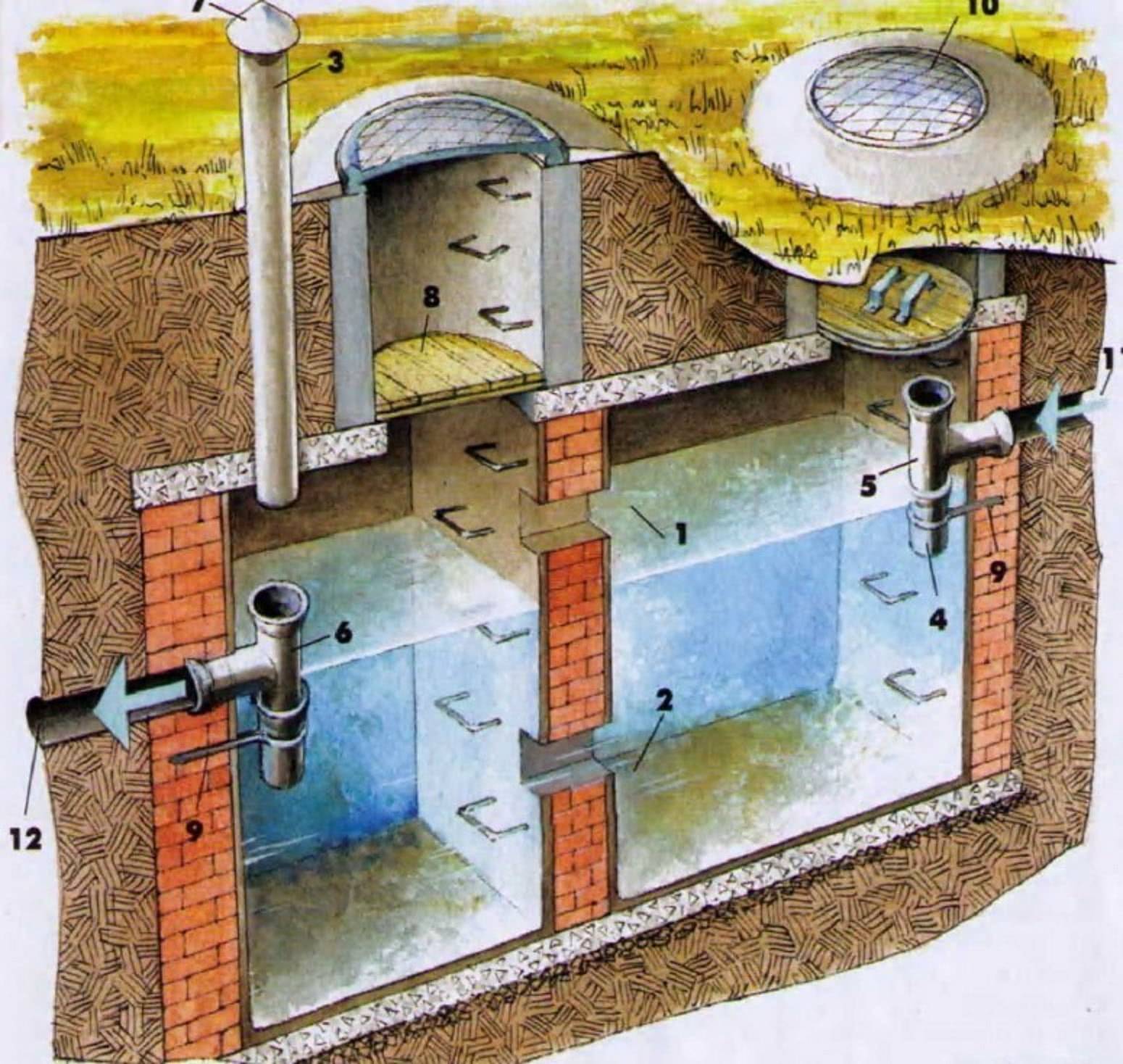
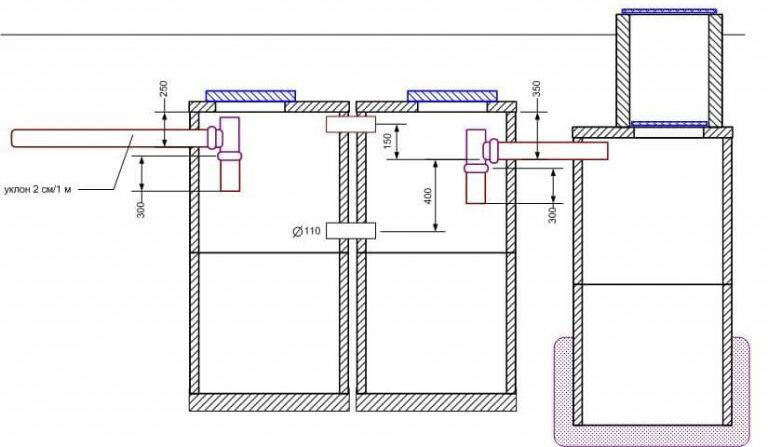
Scheme 1. An example of the location of a septic tank
When creating a cesspool on the site, it is important to take into account the distance from it to the water supply, prescribed by the regulatory documents of the SES service and Law No. 52-FZ of the Russian Federation. It is allowed to find a cesspool in relation to a well or a well at a distance of 20 m
The distance to the water supply is from 10 m.
The type of soil also matters.With clay soil, the distance of the cesspool from the well should be 20 meters or more. With loamy - 30 m. In the case of sandy soils - 50 m. If there is a reservoir near the site, then the distance from it should be from 3 m.
How to make a cesspool with your own hands
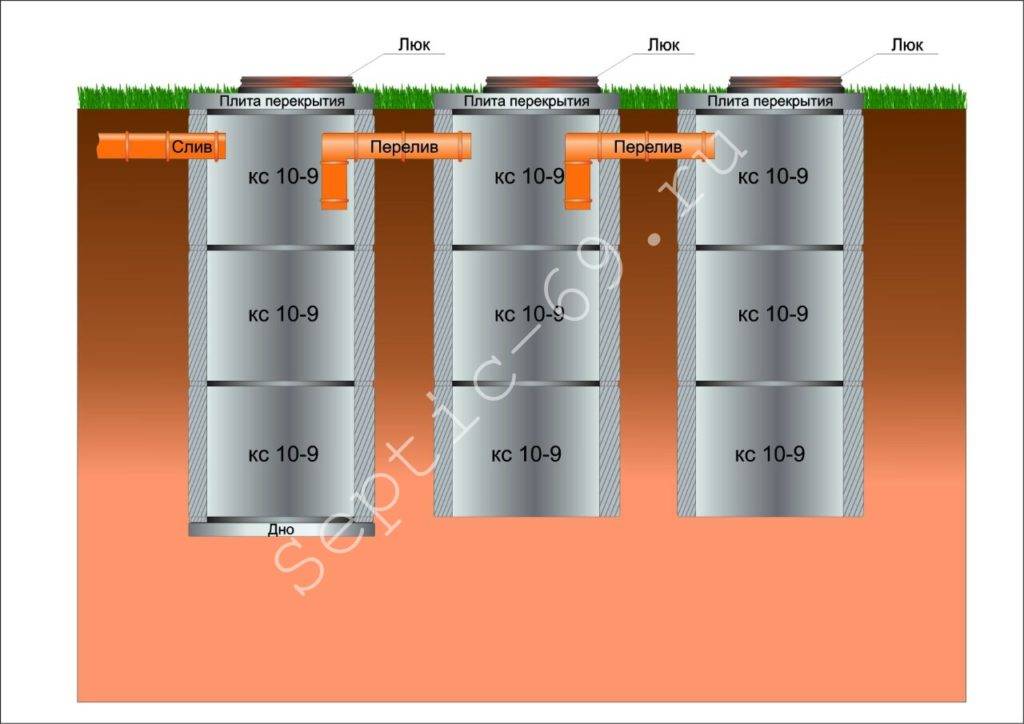
A bottomless drain pit in a private house with your own hands is an option that is convenient for summer cottages. It features a lightweight design. To strengthen the walls of the excavation dug under the pit, you can use gas silicate blocks, brick or concrete. The use of ready-made reinforced concrete rings speeds up the installation of the structure.
Step by step instructions, diagram
Work order:
- Preparation of the pit shaft. The optimal depth is 2-3 m, the width is equal to the diameter of the concrete ring + 80 cm.
- Installation and preliminary insulation of the pipeline.
- Pouring concrete screed along the perimeter of the pit. The central part of the mine is left free.
- With the help of a concrete crown, a series of holes with a diameter of 50 mm in increments of 10 cm is made in the lower reinforced concrete ring. This will allow the liquid fraction of wastewater to flow beyond the shaft.
- The lower perforated ring is installed on the pre-tamped bottom. The level is set. Then one or two whole ones are placed on top (depending on the height of the shaft).
- Backfilling of gravel, broken bricks and sand inside concrete rings to a height of 100 cm. This stage of work allows you to make a coarse filter.
- Waterproofing is lined around the perimeter of the pit, which will prevent groundwater from entering the pit.
- The pit is backfilled with the same materials that were used as a filter in the rings.
Example cesspool from reinforced concrete rings
Correct calculation of the volume of the pit
The volume of the cesspool is determined by the number of adults and children living in the house. For calculation, the following formula is applied: V = K x D x N, where:
V is the volume of the tank.
K is the number of adults living in the house. Per child - 0.5k.
D - Time interval between pit cleanings (usually 15-30 days).
N- Water consumption rate per person (approximately 200 l/day)
Calculations and technical standards
In order for the cesspool to function correctly, you need to correctly select a place and calculate the volume of the container. To begin with, it should be remembered that, according to sanitary standards, such a structure cannot be used in areas where groundwater runs high. The bottom of the tank must be at least 1 m above this level.
An approximate calculation of the volume of the pit can be performed on the basis of the average standard: 0.5 cubic meters. m for each person who lives in the house permanently. The depth of the cesspool usually varies within two to three meters. This is dictated by the peculiarities of the work of the sludge pumps, which do not serve structures deeper than three meters.
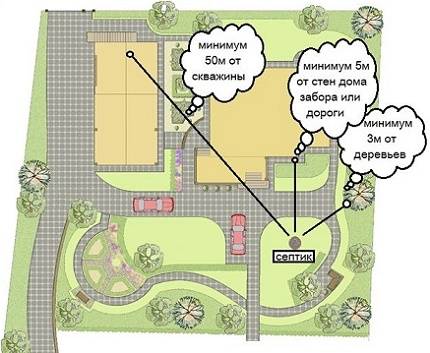
The distance at which a cesspool without a bottom should be from various objects on the site is dictated by safety considerations in case drains enter the ground
It is also necessary to take into account the following point: the pit is cleaned when the container is filled by two-thirds of the total volume, and not to the very top. The dimensions of these two-thirds are best made in multiples of the dimensions of the sludge tank.





This is beneficial, since the sewers charge not for the amount of sewage pumped out, but for each specific exit, i.e. you will have to pay even the removal of a small amount of wastewater at full cost.
On different soils, there are different standards for the placement of a cesspool. It is usually recommended to place this structure at least five meters from a residential building and at least 25-50 meters from a source of drinking water.
The standards are dictated by the danger of contamination of the soil or source by effluents. This can happen during the spring flood, improper installation of the sewer can also cause such troubles.
The greater the filtration qualities of the soil, the faster the sewage penetrates inside, and the more stringent standards should be followed when designing a cesspool.
The best option is to install a structure with a conditional deepening of the bottom into sandy soil. Filtration of wastewater into clay soils is not possible, therefore, in areas with a loamy or sandy loam base, pits without a bottom are not installed.
When installing the structure on silty or clayey sand, similar in properties to sandy loam, the rate of penetration of effluents into the soil is increased by using perforated rings. The result is a variation of the cesspool without a bottom with permeable walls.
And one moment. If special equipment is used to clean the cesspool, convenient access roads must be provided. The maximum allowable distance between the vacuum cleaner and the object is no more than four meters, but the smaller this distance, the more convenient it will be for the vacuum cleaners to work.
Do-it-yourself construction stages
Installation for the construction of a septic tank on its site includes several stages. All calculations have been carried out, the schemes have been approved - we are preparing materials.
Preparation of materials and tools
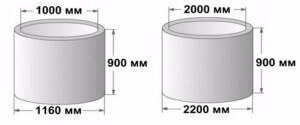 Dimensions of concrete rings for a septic tank.
When preparing a list for the purchase of materials, we write down concrete structures in the first paragraph. Knowing the number and height of the tanks, it is easy to calculate the required number of rings (height 90 cm). Purchasing lower rings with a ready-made bottom will make the job easier. Required tools:
- plastic pipes;
- corners, tees;
- asbestos, ventilation pipes;
- cement;
- waterproofing material;
- crushed stone;
- shovel, perforator, ladder, hacksaw, trowel.
Location selection
The location of the septic tanks is of great importance. The decision is influenced by sanitary-epidemiological and construction requirements:
- correct calculation of the distance from the house, the source of drinking water;
- low location of groundwater;
- availability of free access for transport.
It is worth knowing that the sewerage device at a distance of more than 20 m requires additional costs for the supply pipeline and the arrangement of revision wells.
Pit preparation
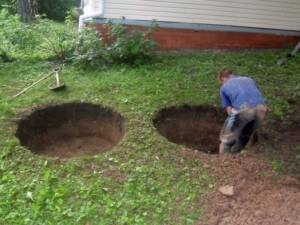 Preparation of a pit for a septic tank.
All preparatory work has been carried out - a swarm of pits. To dig a hole, it is worth using special equipment, which will save time, or dig a hole yourself. The advantage of manual digging is that the required dimensions are immediately observed, no adjustment of these dimensions is required. The depth of the pit is at least two meters, dig the width with a margin so that the sides of the moat do not cling to the concrete rings.
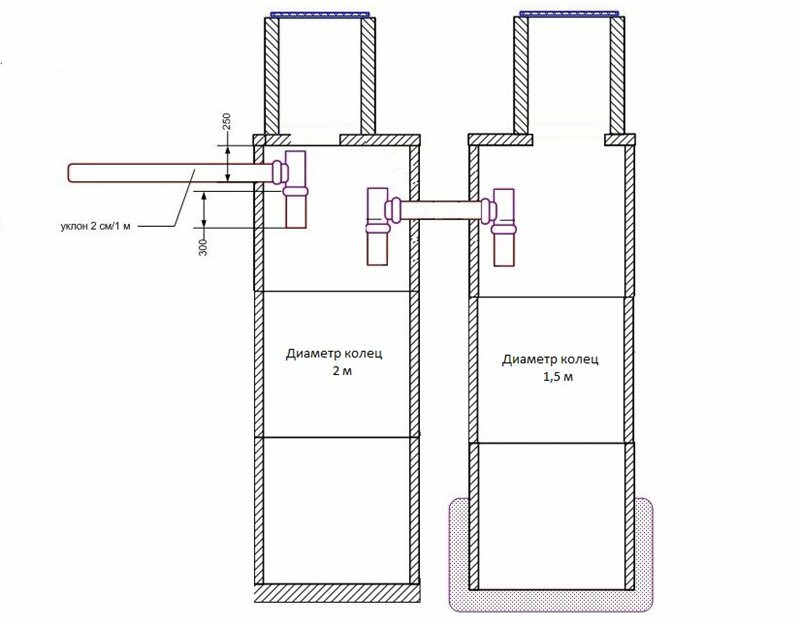
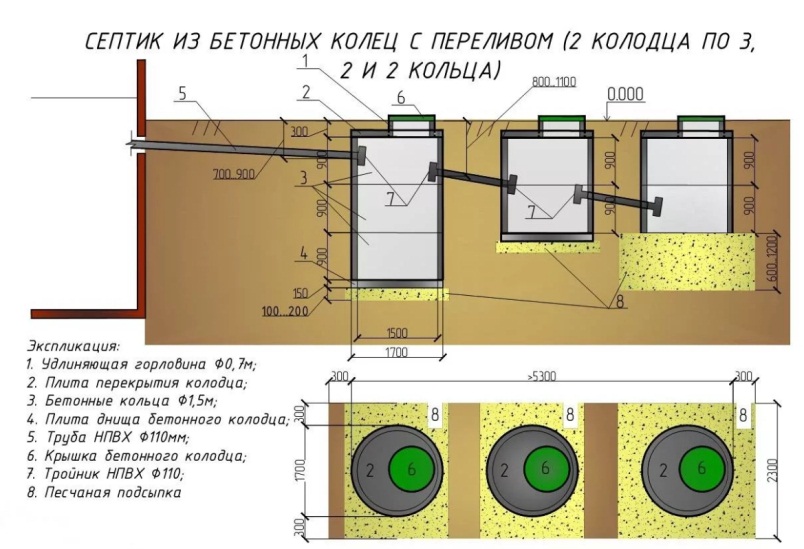
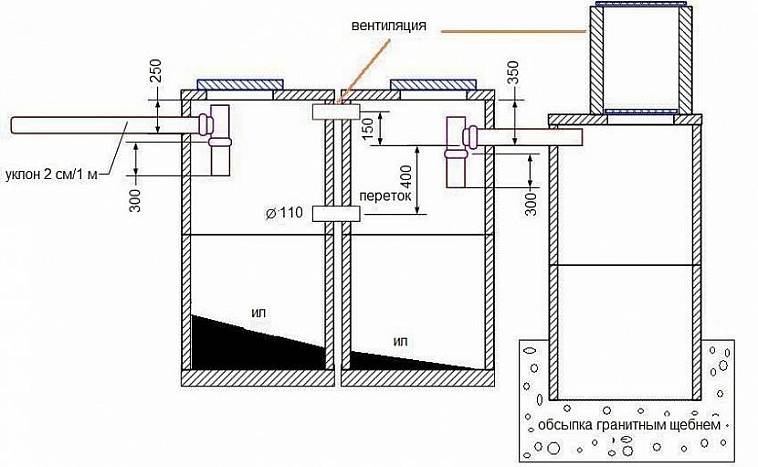
It is considered to be a classic version of the pit - a round shape. This claim is easy to refute. A square-shaped pit is excellent, it is easier to dig it, and a square-shaped concrete slab will lie more freely. With a three-chamber septic tank, we dig three holes, with a two-chamber septic tank - two.We place each subsequent hole 20-30 cm lower.
Installation of rings, piping
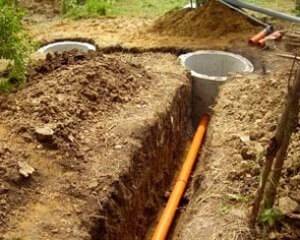 Plumbing to a septic tank.
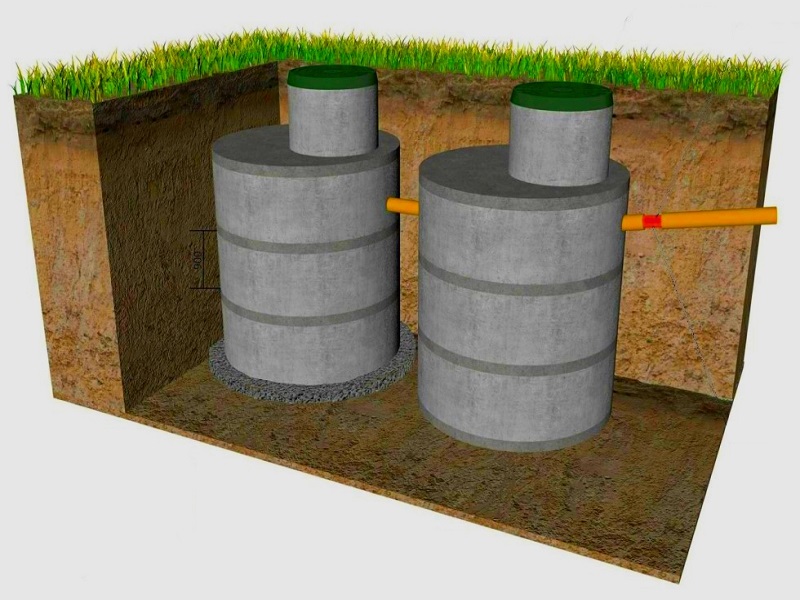
It is forbidden to roll the rings on the surface; cracks appear from such transportation. It is worthwhile to involve specialized equipment in the installation, which will ensure that the rings are fed in a vertical position. Before installation, it is worth preparing the base: a sand cushion 30 cm high and a concrete screed 20 cm high. The base prevents runoff from entering the soil. The screed can be replaced with a solid concrete slab or rings with a concrete bottom. Single-chamber septic tanks are not concreted, a drainage cushion is sufficient.



Sealing
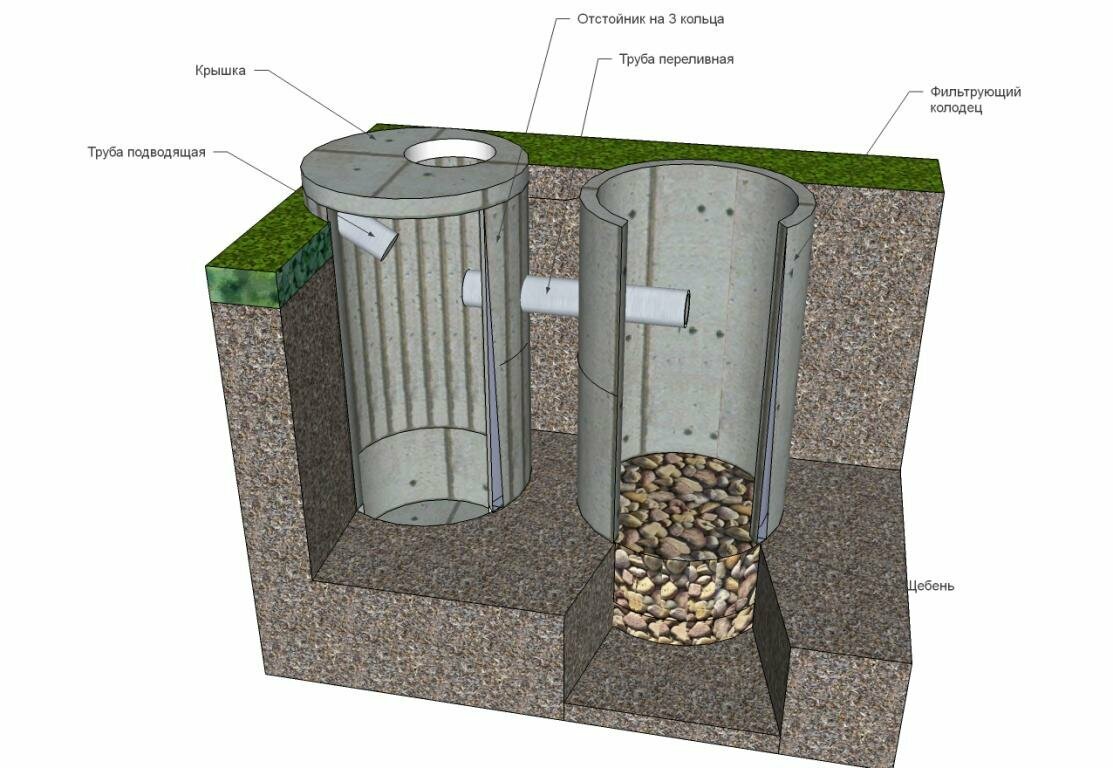
Rings are placed on the concreted bottom. Holes for the overflow pipe are punched in the ring, connecting lines are carefully sealed with cement. Coating protective solutions are used for exterior finishes. If there is financial potential, it is worth buying plastic cylinders and putting them inside the well to prevent contaminants from entering the soil. You can start the stage of waterproofing.
Waterproofing
Protecting the structure from water penetration is perhaps the most crucial stage. Despite the belief that concrete does not absorb water, the well is completely waterproofed. Liquid glass. bitumen or polymer mastic, concrete mix with additives - great for responsible work. Ring joints are carefully processed.
Covering and backfilling the well
The final factor of the main work is the installation of overlappings on the rings. The containers are covered with a concrete slab with a hole for the hatch. The well is covered with previously excavated earth mixed with sand.Spread evenly over the entire surface and compact thoroughly.
Construction stages
Installation is carried out in the following order:
- A place is selected, an installation scheme is built, and the parameters of the septic tank are calculated.
- A hole is being dug.
- Rings are installed, pipes are connected.
- Sealing and waterproofing works are underway.
- Covers are installed.
- Backfilling is underway.
Video description
The order of work and the installation of a septic tank from concrete rings on the video:
How to choose the best place for a septic tank
The structure is mounted above the groundwater level. The best location is at the maximum distance from the house (at least 7 meters, but not more than 20, so as not to increase the cost of pipeline construction). It is logical to have a septic tank on the border of the site, next to the road. This will reduce operating costs, since the cost of leaving the tanker-vacuum truck is affected by access to the system and the length of the hose. In addition, with the correct location, the sewage truck does not need to drive into the yard, and the hoses will not roll on the beds or paths (otherwise, when the hose is rolled up, the waste can get into the garden).
Pit preparation
Ground work using an excavator takes 2-3 hours. The size of the pit should be slightly larger than the dimensions of the wells. This is necessary for the smooth installation of rings and their waterproofing. The bottom is covered with rubble and concreted.

Preparing a pit for a septic tank from concrete rings
Installation of rings and sewer pipes
Rings for a septic tank are installed using lifting equipment, which saves a lot of time (when compared with manual installation). Fixation of the seams is provided with cement mortar, metal ties (brackets, plates) are additionally placed.
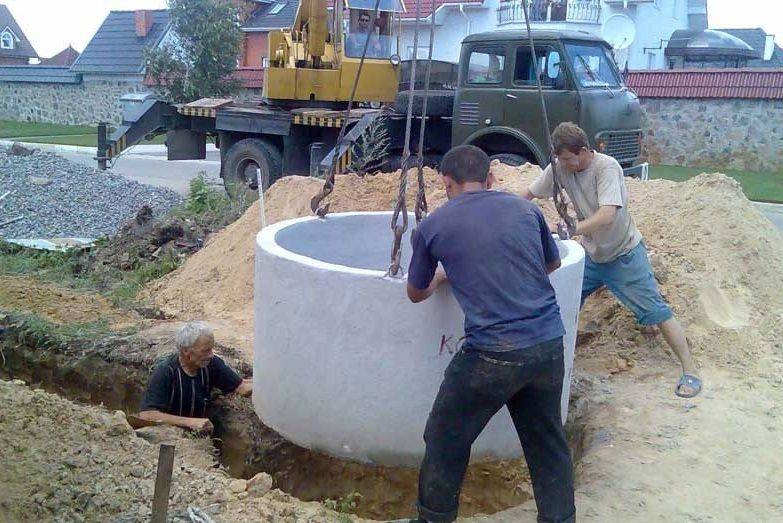
The crucial moment is the process of installing rings
Sealing and waterproofing
Sealing the seams of the septic tank from concrete rings is carried out on both sides of the structure. For this, cement and coating protective solutions are used. Inside the well, you can install ready-made plastic cylinders. Such additional costs will make the system 100% hermetic.
In the process of waterproofing concrete rings for a septic tank, the joints are treated with liquid glass, mastic based on bitumen or polymer, concrete mix. To prevent freezing (and destruction) of the structure in winter, it is recommended to insulate it with a layer of polystyrene foam.

Sealing joints and waterproofing a septic tank from concrete rings
Manhole installation and backfill
The wells are covered with concrete slabs, with holes for manholes. In the first two wells, ventilation is necessary to remove methane (gas appears as a result of the vital activity of anaerobic bacteria). To backfill the installed floors, use the soil taken out of the pit (backfill).

Backfilling of finished wells
How does the septic tank start up
In order for the system to begin to function effectively, the erected septic tank must be saturated with anaerobic microflora. The natural accumulation process takes several months, so it is accelerated by saturating the septic tank with imported microflora. You can do this in two ways:

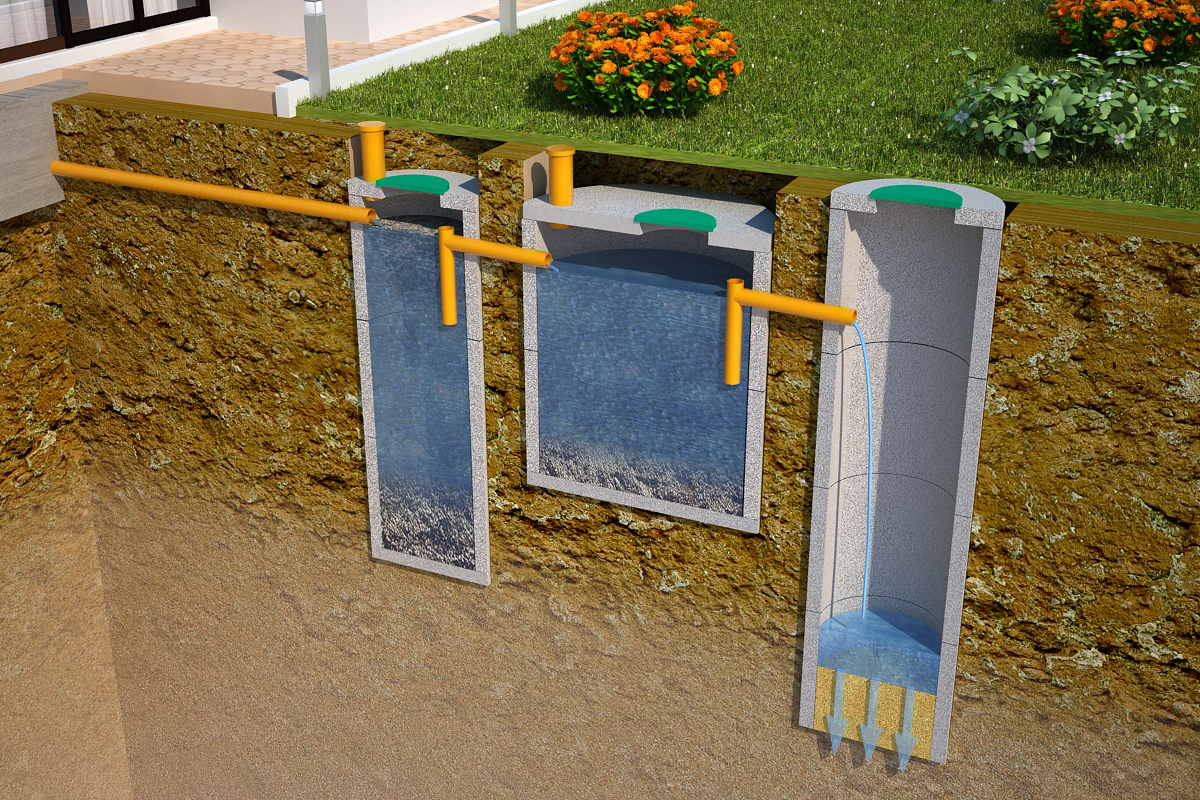


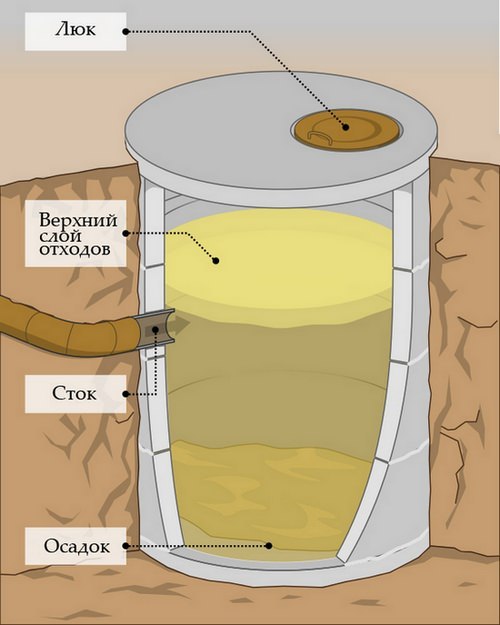


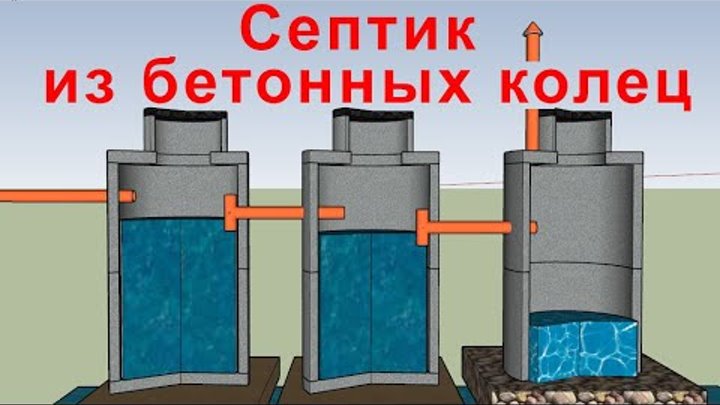
- A new septic tank is filled with wastewater and defended for 10-14 days. Then it is loaded with sludge from an operating anaerobic septic tank (2 buckets per cubic meter).
- You can buy ready-made bioactivators (bacterial strains) in the store (the main thing here is not to confuse them with aerobes that are intended for other treatment systems).
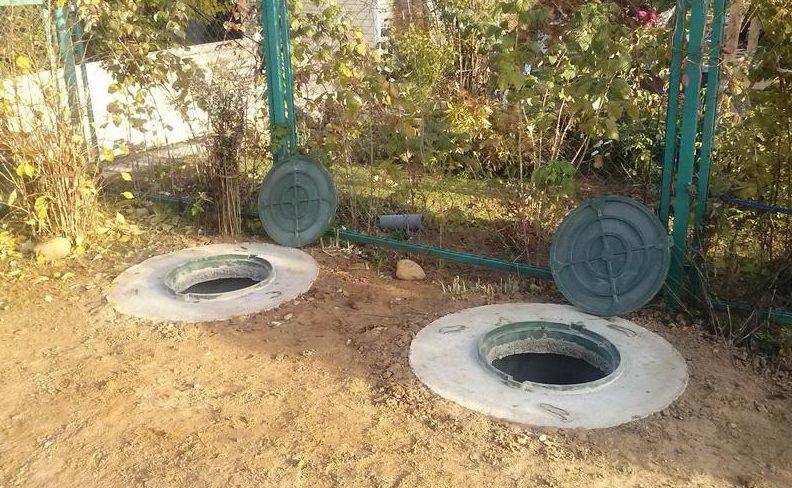
Ready to run septic tank from the rings
What rules must be observed when maintaining a septic tank
There are simple rules that support the quality of the system.
- Cleaning. Twice a year, in addition to cleaning the drains, the septic tank must be inspected and the pipelines cleaned. Once every 5 years (and preferably in 2-3 years), bottom heavy fats are cleaned. The volume of sludge must not exceed 25% of the volume of the tank. During cleaning, part of the sludge is left to restore the microflora.
- Quality of work. Effluent at the outlet of the system must be cleaned by 70%. Analysis of wastewater in the laboratory will determine the acidity index, which will allow you to know the quality of the drainage system.
- Security measures:
- Work inside the septic tank is allowed only after enhanced ventilation and using a safety belt (gases formed inside can be dangerous to human life).
- Increased safety measures are required when working with power tools (wet environment).
A septic tank made of concrete rings makes private housing more autonomous and, despite its shortcomings, it is one of the most reliable and durable options for treatment facilities for suburban real estate.
Septic tank made of concrete rings: construction stages
Sewerage with a septic tank made of concrete rings is distinguished by reliability, durability and a high level of cleaning of household sewage. The price of such a structure will be relatively low, and with excellent waterproofing and the correct scheme, it will not be necessary to pump out the tanks often. The difficulties of construction include the need to attract heavy equipment and the peculiarities of installing pipes between concrete sections.
Preparatory stage
Installation of a septic tank is carried out in compliance with all sanitary, building rules and regulations.They think over the design of the treatment plant, the location on a private site and coordinate the plan with the relevant authorities. They decide which septic tank is better to install so that the sewerage system in a private house is made as comfortable as possible. Correctly calculate the volume of the septic tank and proceed to construction.
Excavation
The pit for the sewage treatment plant in a private house should be so large that nothing interferes with the installation of the rings. The bottom of the cesspools, at the installation site of the sedimentation tanks, is concreted. This prevents the ingress of untreated water into the soil.
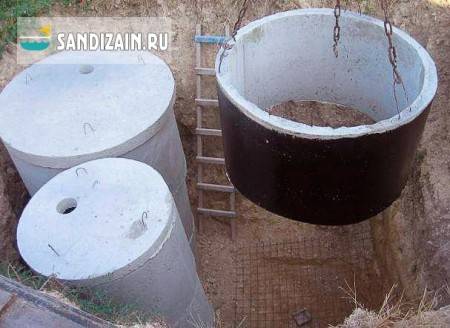 Pit for a septic tank
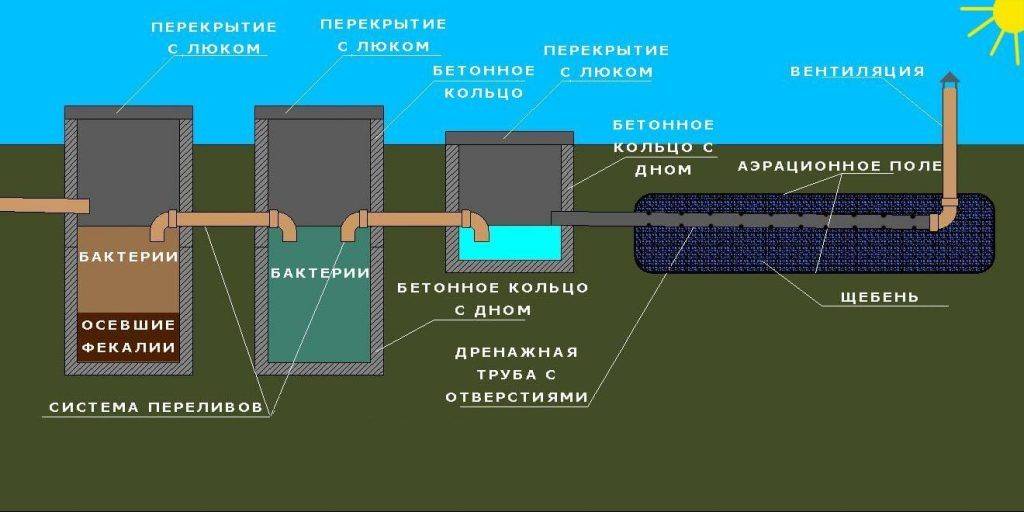
The base for the second or subsequent chambers is made in such a way that water can go into the soil. To do this, make a filtration pad up to 1 meter deep from gravel and sand.
Advice! If, during the installation of a septic tank, the pit under the filtration well reaches the sandy layer of soil, the water will leave it as quickly and easily as possible.
The shape of the pit does not have to be round, a standard, square one is also suitable, the main thing is that the rings go into it freely. In addition, a ready-made concrete slab can be laid on the bottom of a square pit, while only a cement screed can be made in a round pit. At this stage of work, it is also worth remembering that if each subsequent well is located 20-30 cm lower than the previous one, the septic tank and the sewage system itself will be more functional.
Delivery and installation of reinforced concrete rings
The rings are delivered and installed by freight transport, so it is worthwhile to provide access to the construction site in advance, take into account additional economic costs and the turning radius of the crane boom, gas, telephone or electrical communications should not interfere with it. Between themselves, the rings are usually connected with metal brackets, the joints are coated with a solution of cement and sand.
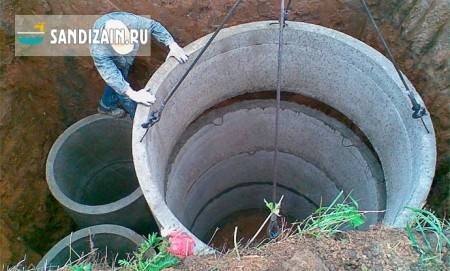 Installation of reinforced concrete rings
When all the wells are installed, holes are made in them and overflow pipes are installed, the external sewage system is connected to the treatment plant through a drain pipe entering the first tank. Pipe entry points must be sealed. The space between the installed rings and the walls of the pit is covered with soil and carefully compacted in layers. If the septic tank is installed above the freezing level of the soil, it is insulated, otherwise the sewage system will be non-functional during the cold season.
Waterproofing
Good waterproofing of a septic tank is fundamental to its proper operation. Each builder determines which sealant is best for this purpose. Usually, rubber-bitumen mastic is used to process seams, polymer mixtures are less common. For a longer operation of cesspool structures, internal waterproofing of the seams of the tank is also performed.
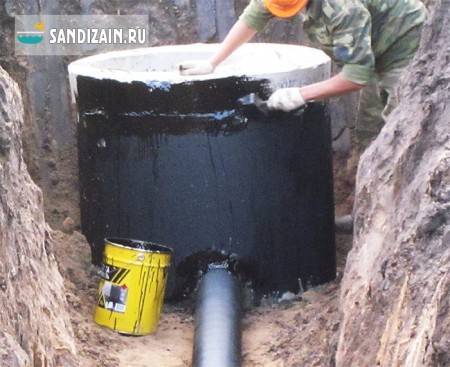 Waterproofing of well rings
If the sealing is done poorly, then the ingress of untreated drains into the ground will be the lesser of the evils. The septic tanks, especially during the spring thaw, will be filled with water, and all its contents will flow out through the plumbing in the house, repeated pumping will be required.
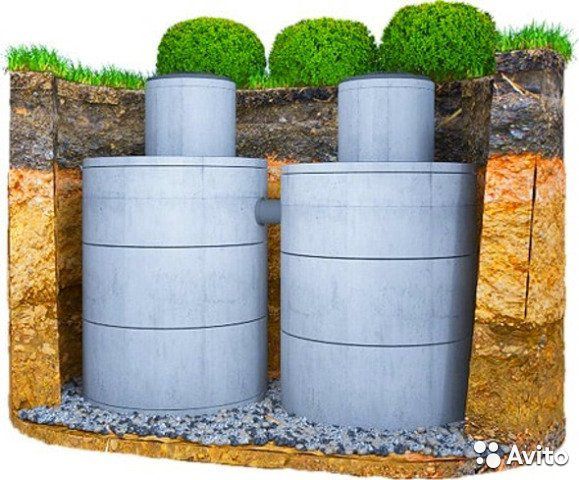

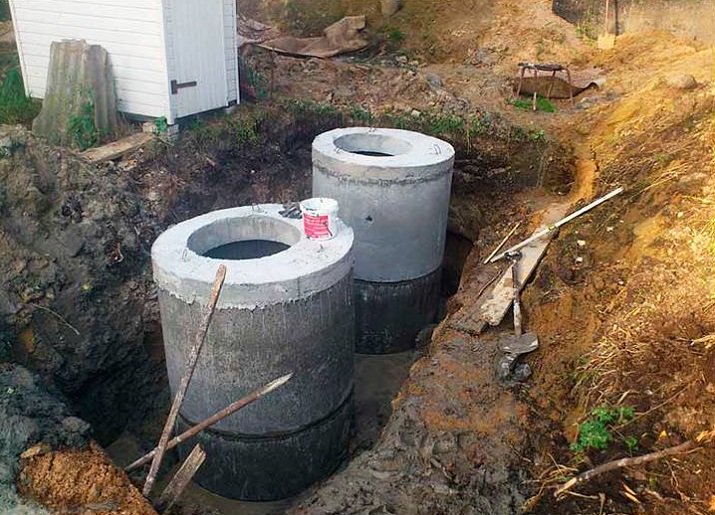




Ventilation
An exhaust pipe up to 4 meters high above the level of the septic tank must be installed on the first tank.It is necessary so that the gases formed as a result of the fermentation of effluents can escape, and there are no unpleasant odors on the site. If possible, ventilation pipes are installed on each well.
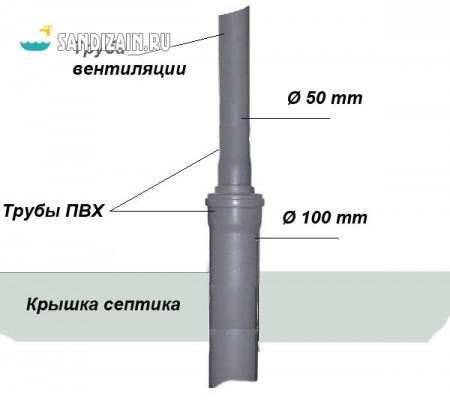 Septic tank ventilation
Overlapping a septic tank
The task of overlapping is not only to close the pit, it must ensure the tightness of the containers. As a rule, the chambers are covered with ready-made reinforced concrete slabs, on which there is a hole for a hatch made of cast iron or thick plastic. Then the structure is covered with a small layer of soil. Manholes on each of the wells will help monitor the condition and filling of the septic tank, and will also make it possible to periodically add a mixture of active bacteria for cesspools.
How to make a septic tank
To equip a strong and durable cleaning system in a private house, you need to have information regarding the basic rules of this process:
- The distance between the rings of the septic tank - wells should be no less than half a meter. At the same time, the gap filled with bitumen will act as a buffer in the event of ground movements.
- Mandatory is the presence of gravel-sand or crushed stone cushion. Thanks to this layer, the immobility of the septic tank is ensured, even if the soil under the tanks is unstable. A cushion is also needed to drain fluid if the well is leaking.
- Do not neglect the creation of waterproofing. In order to equip the correct septic tank from concrete rings, it is necessary to seal the seams between adjacent products, for which several different types of insulating materials are used, which process the inner surface of the chambers and their outer walls.
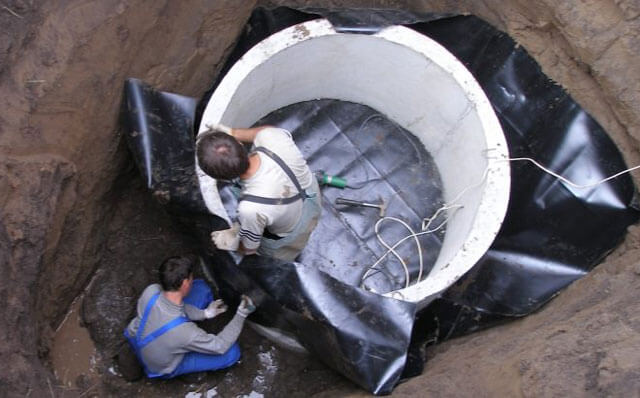
If you adhere to the technology, how to properly make a septic tank from concrete rings, and carefully observe all installation conditions, then you will not often have to invite specialists to clean and repair the storage tank.
Installation technology of plastic containers for sewerage
With the seeming simplicity of the ongoing construction operations, it is not so easy to install a plastic tank:
- A pit is dug to fit the size and shape of the container. The dimensions of the pit are 50 cm larger on each side. Digging is carried out manually with shovels or an excavator.
- The bottom is leveled and covered with sand, which is compacted.
- A trench is dug from the house to the pit.
- The barrel is being installed inside the pit.
- The gaps between the tank and the walls are filled with sand. At the same time, as the filling is carried out, water is poured into the barrel. This is done so that the walls of the tank do not bend inwards under the action of the sand backfill, thereby reducing the volume of the drain pit. After completion of work, the water is pumped out, releasing it into the garden or outside the site.
- Sewer pipes are being installed from the house to the pit.
- The pipe is connected to the tank by means of a two-way coupling or a socket method.
- Bury the trench with soil.
- The upper part of the sewer plastic container is also covered with soil, leaving only a hatch with a lid on the surface.
- Install the ventilation pipe.

Installation of a plastic container under the cesspool
Often, the upper part of the tank is insulated using one of the modern thermal insulation materials. For example, polystyrene boards. This is in case that in severe winters the water inside the barrel does not freeze.If the groundwater level is high at the site, then the plastic container must be fixed so that it does not float in the spring with an increase in water under the ground. They do it like this:
- below the bottom of the pit, at least two holes are dug on opposite sides with dimensions of 40x40x40 cm;
- a concrete solution is poured into them, into which a rod is inserted, bent into hooks on both sides;
- after the cabinets have dried, the tank is mounted, which is attached to the hooks with chains, steel cables or any other materials that do not rot in the ground, that is, they are thrown over the barrel from one to the other, which is why the cabinets are built on opposite sides of the pit.

Fastening the barrel with straps



