- Installation work
- Machine body
- Choice
- How to choose a circuit breaker for current?
- Unacceptable purchase errors
- Tripping characteristics of protective circuit breakers
- Machine type MA
- Class A appliances
- Class B protective devices
- Automatic machines of category C
- Category D circuit breakers
- Protective devices of category K and Z
- How to choose an automatic machine by the magnitude of the current strength
- Types of protection devices
- Circuit breakers
- RCD and differential automata
- Voltage relay
- Automatic wiring protection
- Circuit breaker functions
- How to choose the right circuit breaker?
Installation work
An accessible place is selected under the shield. Usually it is installed in the hallway, close to the input of the power cable. The installation height is 1.5-1.7 m. A counter is placed in a special shield box with a viewing window. Holes are made in the wall to secure the box to dowels or screws.
When the shield is installed on the wall, it can be assembled as follows:
- All groups of wires of the apartment are brought to the shield in advance, where the installation will be carried out. They should be marked to make it easier to assemble the circuit.
- Self-tapping screws are used to fasten DIN-rails for installation of devices.
- A busbar for neutral is installed at the top, and for grounding at the bottom.
- An automatic input is installed on top.
- In a separate box, as well as for the counter, an introductory machine can be placed.
- Groups of automata are placed from top to bottom, as power decreases. A special bus is used as jumpers between them or they are made of copper wire with a cross section of 4 mm. It is more convenient when the location of the devices in the shield and on the electrical circuit is the same.
- Cables and wires are inserted through the holes in the box. The outer braid is cut off from them and the gasket is made according to the color to the connection points. There should always be a reserve for further repairs. Connect the neutral wires to the top bus. Power is supplied to the upper terminals of the machines, and loads are connected to the lower terminals (connecting the phase to the electrical groups). The cross section of the wires decreases, starting from the input and up to the sections with loads. The cross section of the ground wire must not be less than that of the phase wire at the input. Twisting and the formation of coils should not be allowed. Power and neutral wires are bred on opposite sides of the shield.
- If a new meter is not connected, power for power tools and lighting can be supplied from the old one. The wires are brought out close to the meter so that the controller can later make the connection and seal the device.
- After connecting each group, it is advisable to check its performance by applying voltage through the temporary connection circuit.
First, you should assemble the shield without switching, marking the installation locations of the devices (trial assembly in the figure below). In this case, it should be possible to quickly turn off the power from the inside and outside.
Trial assembly of the shield without switching
When the shield is closed, it must be possible to quickly check the presence of voltage using an indicator screwdriver or a light bulb.
Machine body
When choosing a modular machine, pay attention to how the case itself is assembled. It is always a non-separable construction with rivets
So, when buying, it will not be superfluous to count the number of such rivets. On conventional switches, there are usually at least 5 of them.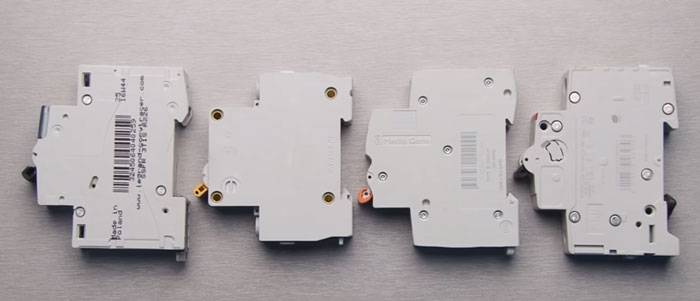
Although often comes across even with four.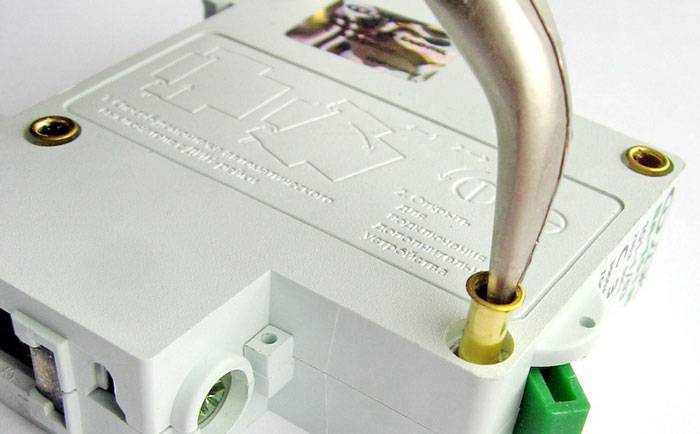
However, there are models (for example, from Schneider Electric, ABB and others) where there are six rivets!
What does this extra rivet provide? When the circuit breaker trips against a short circuit, an arc is formed in the housing.
It's like a miniature explosion trying to rip the machine apart from the inside. So, an additional rivet prevents the possibility of any change in the geometry of the device.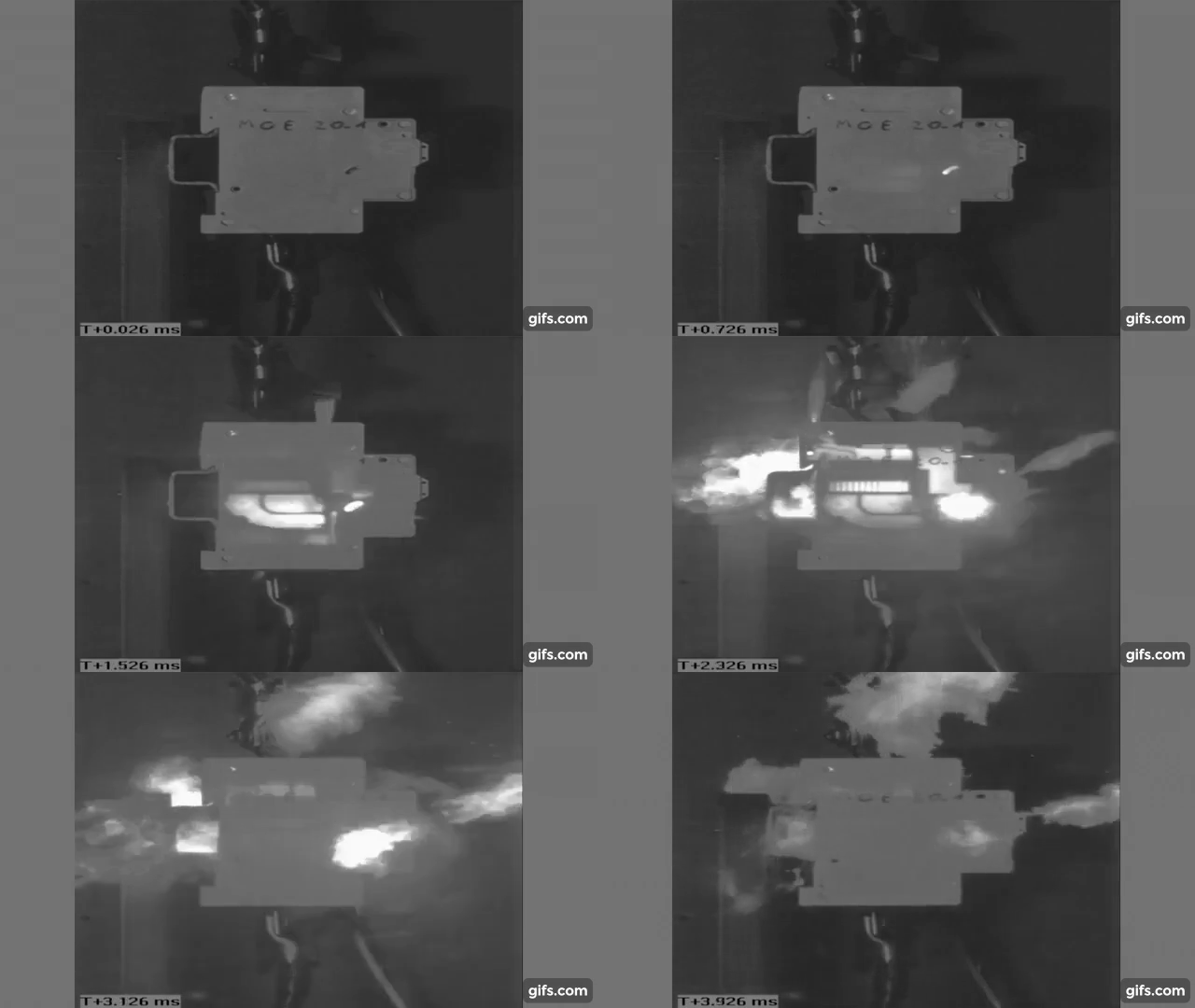
On 4 or 5 riveted, the switch may not break, but from a few short circuits, the geometry and location of the internal components will change and they will move a couple of millimeters relative to their normal location. This will gradually lead to the fact that the device will work out badly and at one fine moment it will jam.
In fact, all the mechanisms inside the circuit breaker seem to “hang” on the case. It's like the frame of a car.
Therefore, any change in geometry leads to the fact that the device stops working normally. For example, it starts buzzing or buzzing.
As for the case, sometimes it does not hurt to pay attention and compare their sizes. Some models of different brands and manufacturers, having the same rated current, slightly differ in size
For those where the case is several millimeters larger, the cooling will be better, respectively.
This is especially important with a dense arrangement of machines in one row.
Choice
Selection criteria for circuit breakers:
- Rated current. If it is exceeded, the overload protection will trip. You can choose the correct current according to the cross section of the wiring into which the machine is embedded. First, the permissible maximum current of the wires is found, and the nominal current for the machine is taken 10-15% lower, then leading to a standard series. The coil hums when the load is exceeded. This can be checked by decreasing it. If the current is normal, and the machine is buzzing, there is no danger.
- Operation current. The operating current rating is selected depending on the load. For electronics, a switching class of type A or Z is selected, for lighting - B, for a heating boiler - C, and a powerful electric motor of a machine with a large starting current - D. In this case, all electrical equipment is reliably protected, and the machines will not work due to starting the engine or operation of the welding machine.
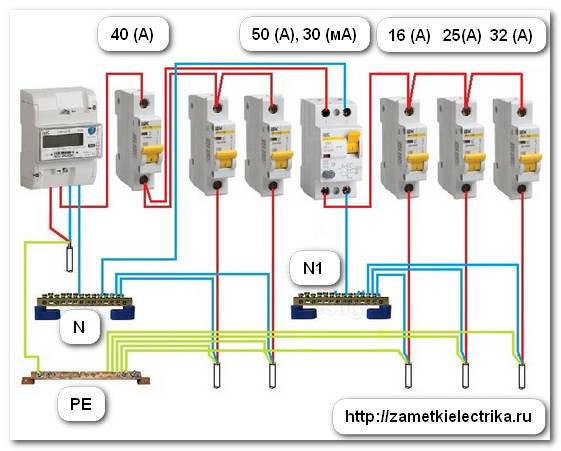
- Selectivity. The current ratings of the automata are selected depending on the load of each line. The main input should not exceed the maximum permissible total load on the input cable. According to the rated current, the devices are selected mainly as follows: main switch - 40 A, electric stove - 32 A, powerful electrical appliances - 25 A, lighting - 10 A, sockets - 16 A. A general approach is shown here, but the diagram may differ. If an electrical appliance requires 25 A, and the connection is made through a socket, then it must also be selected for the same power.
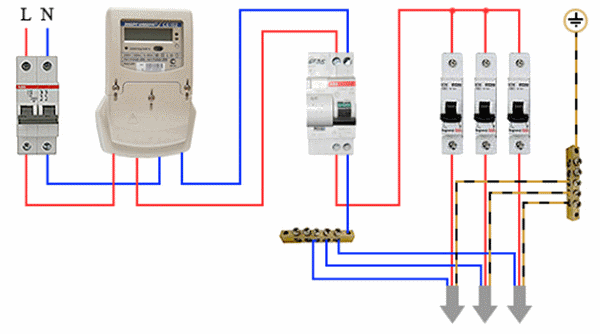
Scheme of connecting machines to the wiring of a typical apartment
The figure above shows a common scheme for connecting automatic machines in an ordinary apartment.A main two-pole input is installed in front of the meter, then a fire-fighting RCD is connected (from left to right), and after it, wiring is done to consumers with single-pole machines. Red indicates phase, blue indicates zero, and brown indicates ground. The neutral wire and ground busbars are connected separately.


On single-pole machines, it is imperative to connect the phase wire, not the neutral.
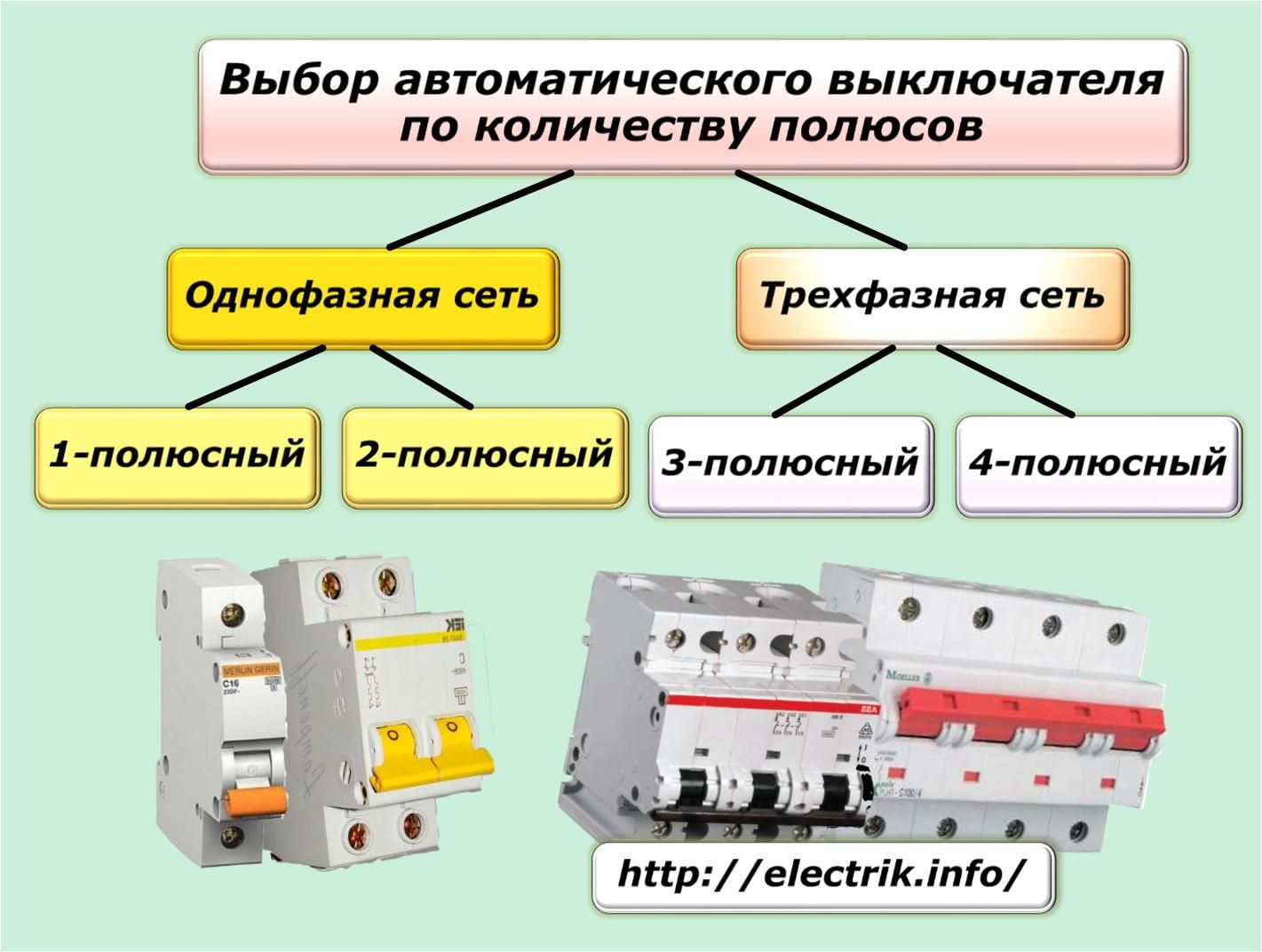
- Number of poles. For the main three-phase input, an automatic machine with four poles is selected, and for a single-phase network - with two. For household appliances and lighting, single-pole switches are suitable, and for a three-phase electric motor or electric boiler, you need a three-pole machine.
- Manufacturer. Since the use of a circuit breaker is related to safety, products from well-known companies should be selected. Not always the declared parameters are the same in fact. You should buy devices in specialized stores where they have documentation. Leading manufacturers do not sell bad goods. Even fakes of such devices can be of normal quality.
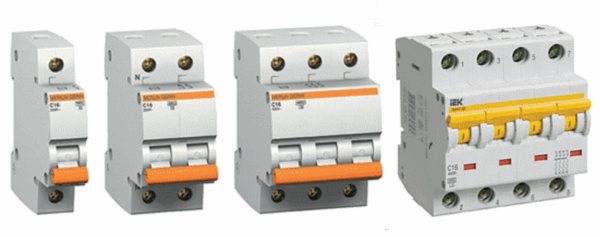
Automatic machines with different number of poles
Devices are calculated for a certain number of operations. It is not recommended to use them as load break switches. The mechanism wears out quickly, and the contacts burn out. According to the rules, the load is switched using relays or contactors (magnetic starters).
It is important to choose the right number of machines.Usually, an automatic input is installed, and then to wiring to sockets, lighting lines and separately to each powerful consumer (if it does not have its own built-in protection)
Different manufacturers of machines differ from each other in the ways of fastening and connecting conductors. Therefore, it is recommended to replace the devices with similar ones that are in the shield.
How to choose a circuit breaker for current?
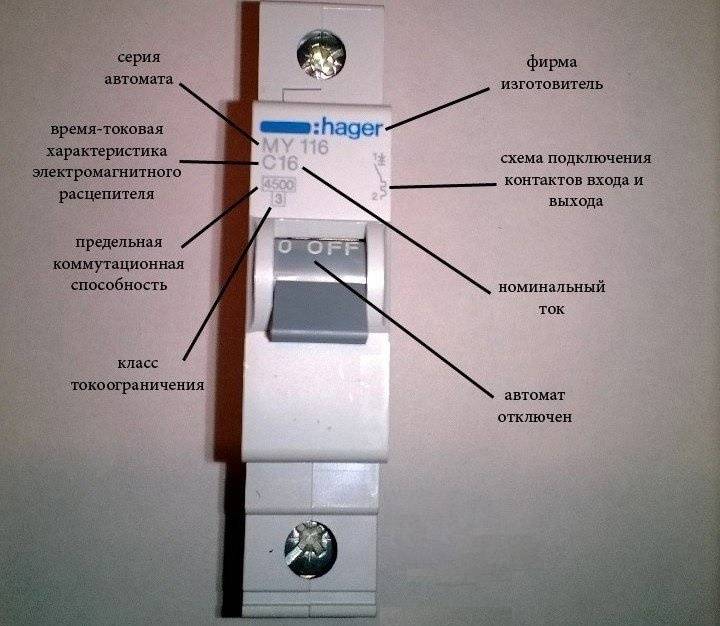
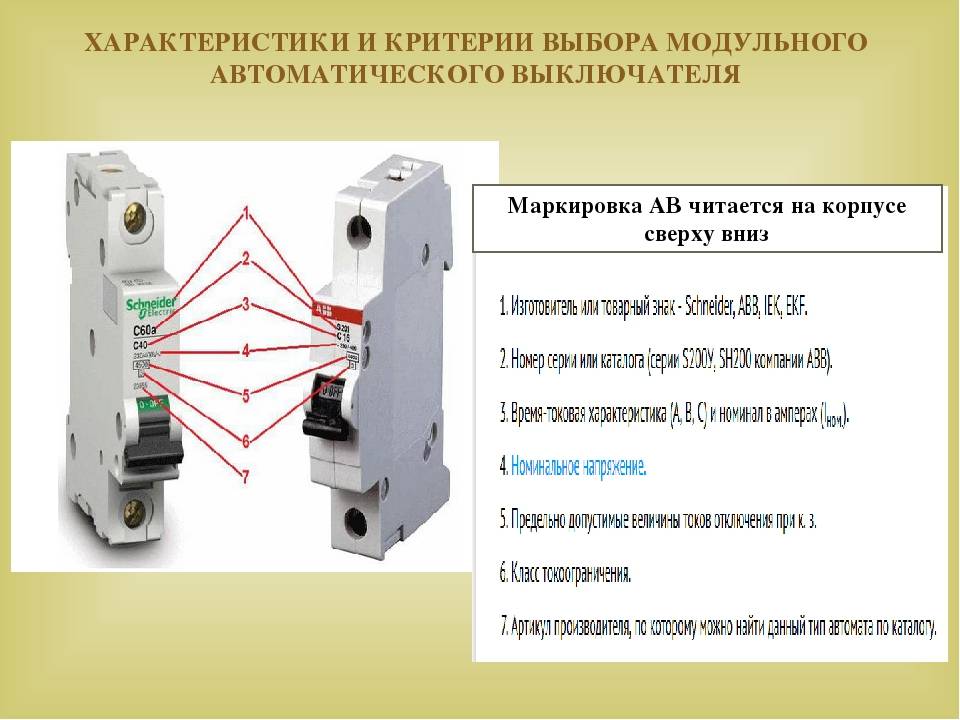
On the front side of the case of circuit breakers, manufacturers indicate important and at the same time incomprehensible designations for the average person. In the photo below, I specially circled it with a red frame, the designation indicates the rated current of the machine, which is measured in amperes
This is the most important parameter that you need to pay attention to first of all.
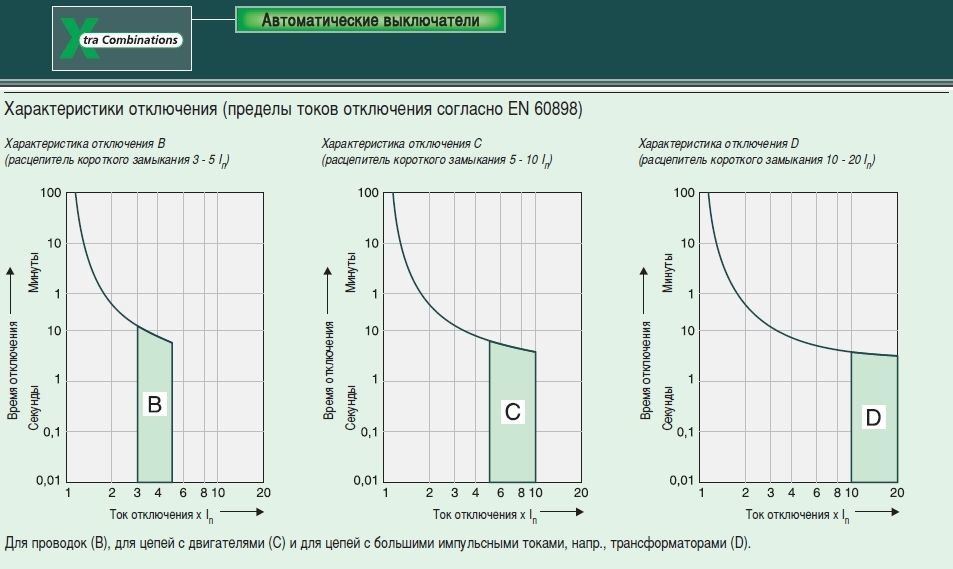
The letter located to the left of the rated current indicates the multiplicity of the EMR cutoff current (Iotc) in relation to the rated current of the machine. That is, in simple terms, when a short circuit current occurs, the EMR indicates the time of instantaneous operation of the machine. These letters are different, the most popular are the letters "B" Iots = 3 ... 5In, "C" Iots = 5 ... 10In, and "D" Iots = 10 ... 20In.
Machines with the letter "B". They are mainly used in old residential buildings in which the electrical wiring has not been reconstructed. They are often used in summer cottages and rural houses, which receive power from overhead lines that are very long.
I also want to draw your attention to the fact that the price of such machines with the letter "B" is slightly higher than with the letter "C" and they are not on free sale, only on order.
Machines with the letter "C". They are the most common and commercially available.They can be used in electrical networks that are in a satisfactory (good) condition.
Machines with the letter "D". Due to the high cutoff current ratio (10 ... 20In), such machines are used in industry to protect lines that have large inrush currents that occur, for example, when starting powerful electric motors. Therefore, they have no place in residential buildings!
So, we figured out the letter, now we move on. Before choosing a current machine, you need to take into account the cross section of the wires, that is, the cross section of the electrical wiring cable, which is located in your house or apartment.
Stick to the following ratios:
Calculation of the machine for the cross section of the wiring.
If the cross section of the copper core is 1.5 mm square (aluminum 2.5), we select the nominal value of the machine 10A, the area of \u200b\u200buse, lighting.
If the cross section of the copper core is 2.5 mm square (aluminum 4.0), we select the nominal value of the machine 16A, the area of \u200b\u200buse, sockets.
If the cross section of the copper core is 4 mm square (aluminum 6.0), we select the nominal value of the machine 25A, the area of \u200b\u200buse, water heaters up to 5 kW.
If the cross section of the copper core is 6 mm square (aluminum 10), we select the nominal value of the machine 32A, the area of \u200b\u200buse, water heaters more than 5 kW, electric stoves.
If the cross section of the copper core is 10 mm square (aluminum 16), we select the nominal value of the machine 50A, the area of \u200b\u200buse, input into apartments with electric stoves.
Unacceptable purchase errors
There are several mistakes that novice electricians can make when choosing a circuit breaker based on amperage and load.If you choose the wrong automatics, even slightly “overshooting” the rating, this can lead to many adverse consequences: the machine trips when the appliance is turned on, the wiring will not withstand current loads, the life of the switch will quickly decrease, etc.


To prevent this from happening, we recommend that you familiarize yourself with the following errors, which will allow you to choose the right circuit breaker for your house or apartment in the future:
The first and most important thing you should know is that at the time of conclusion of the contract, new subscribers order the energy capacity of their connection. From this, the technical department makes a calculation and chooses where the connection will take place and whether the equipment, lines, TP will be able to withstand the load
Also, according to the declared power, the cable cross-section and the rating of the circuit breaker are calculated. It is unacceptable for residential subscribers to increase the load on the input without its modernization, since the capacity has already been declared under the project and the supply cable has been laid. In general, the value of the introductory machine is not chosen by you, but by the technical department. If in the end you want to choose a more powerful circuit breaker, everything should be consistent.
Always focus not on the power of household appliances, but on electrical wiring. You should not select the machine only according to the characteristics of electrical appliances, if the wiring is old. The danger is that if, for example, you choose a 32A model to protect the electric stove, and the cross section of the old aluminum cable can only withstand a current of 10A, then your wiring will not withstand and quickly melt, which will cause a short circuit in the network.If you need to choose a powerful switching device for protection, first of all, replace the electrical wiring in the apartment with a new, more powerful one.
If, for example, when calculating the appropriate rating of the machine for the operating current, you get the average value between the two characteristics - 13.9A (not 10 and not 16A), give preference to a larger value only if you know that the wiring will withstand the current load at 16A.
For a summer residence and a garage, it is better to choose a more powerful circuit breaker, because. a welding machine, a powerful submersible pump, an asynchronous motor, etc. can be used here. It is better to foresee the connection of powerful consumers in advance, so that later you do not overpay for the purchase of a switching device of a larger denomination. As a rule, 40A is enough to protect the line in domestic applications.
It is advisable to pick up all the automation from one, high-quality manufacturer. In this case, the likelihood of any inconsistency is minimized.
Buy goods only in specialized stores, and even better - from an authorized distributor. In this case, you are unlikely to choose a fake, and besides, the cost of products from a direct supplier, as a rule, is slightly lower than that of intermediaries.
That's the whole method of choosing the right machine for your own home, apartment and cottage! We hope that now you know how to choose a circuit breaker for current, load and other equally important characteristics, as well as what mistakes you should not make when buying!
How to choose the right value of the switching device for the house and apartment?
4 ways to check the performance of the RCD
Connection diagram of a differential machine
Show more
Tripping characteristics of protective circuit breakers
Class AB, determined by this parameter, is indicated by a Latin letter and is affixed on the body of the machine in front of the number corresponding to the rated current.
In accordance with the classification established by the PUE, circuit breakers are divided into several categories.
Machine type MA
A distinctive feature of such devices is the absence of a thermal release in them. Devices of this class are installed in the connection circuits of electric motors and other powerful units.
Class A appliances
Automata type A, as was said, have the highest sensitivity. The thermal release in devices with time-current characteristic A most often trips when the current exceeds the nominal value AB by 30%.
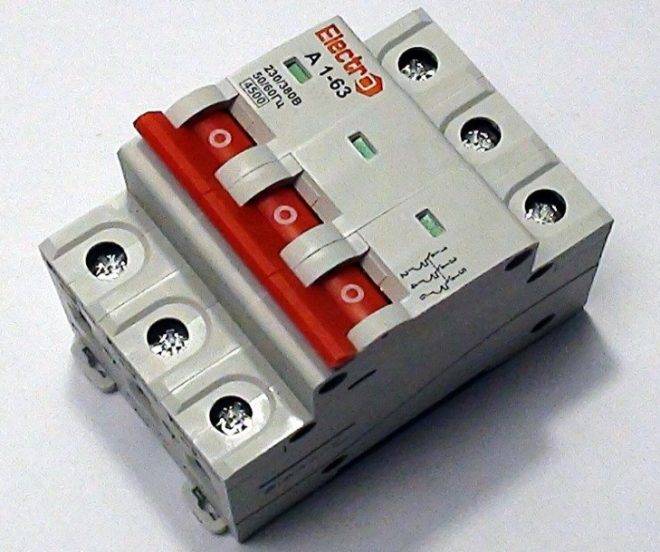
The electromagnetic trip coil de-energizes the network for approximately 0.05 seconds if the electric current in the circuit exceeds the rated current by 100%. If, for any reason, after doubling the strength of the electron flow, the electromagnetic solenoid does not work, the bimetallic release turns off the power within 20 - 30 seconds.
Automatic machines with a time-current characteristic A are included in the lines, during which even short-term overloads are unacceptable. These include circuits with semiconductor elements included in them.
Class B protective devices
Category B devices are less sensitive than those of type A. The electromagnetic release in them is triggered when the rated current is exceeded by 200%, and the response time is 0.015 seconds.The operation of a bimetallic plate in a circuit breaker with characteristic B, with a similar excess of the AB rating, takes 4-5 seconds.
Equipment of this type is intended for installation in lines that include sockets, lighting devices and in other circuits where there is no starting increase in electric current or has a minimum value.
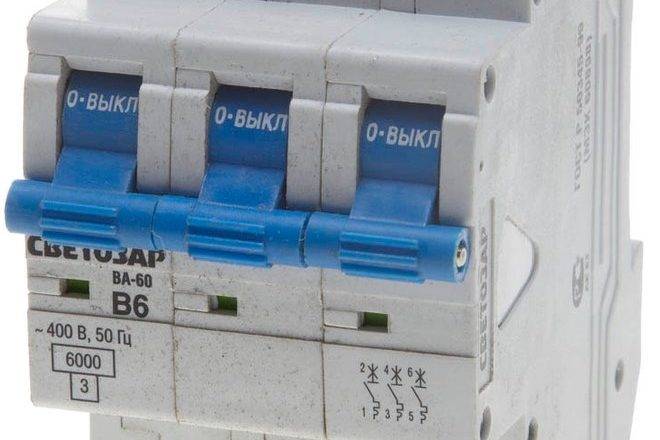
Automatic machines of category C
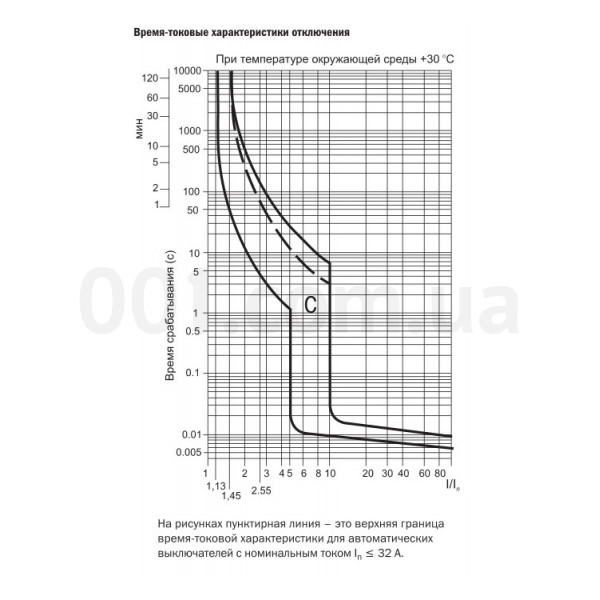
Type C devices are most common in household networks. Their overload capacity is even higher than those previously described. For it to happen solenoid actuation tripping, installed in such a device, it is necessary that the flow of electrons passing through it exceeds the nominal value by 5 times. The operation of the thermal release when the rating of the protection device is exceeded five times occurs after 1.5 seconds.


The installation of circuit breakers with a time-current characteristic C, as we said, is usually carried out in domestic networks. They perfectly cope with the role of input devices for protecting the general network, while category B devices are well suited for individual branches to which groups of outlets and lighting devices are connected.
Category D circuit breakers
These devices have the highest overload capacity. For the operation of an electromagnetic coil installed in an apparatus of this type, it is necessary that the current rating of the circuit breaker be exceeded by at least 10 times.
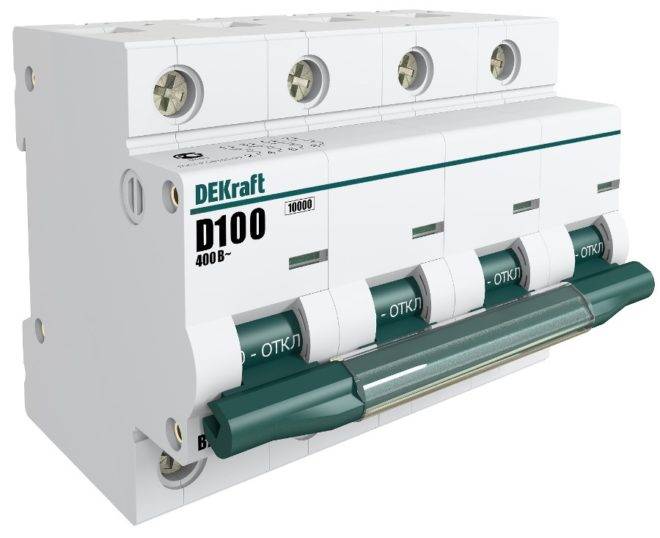
The operation of the thermal release in this case occurs after 0.4 sec.
Devices with characteristic D are most often used in general networks of buildings and structures, where they play a safety net.Their operation occurs if there is no timely power outage by circuit breakers in separate rooms. They are also installed in circuits with a large amount of starting currents, to which, for example, electric motors are connected.
Protective devices of category K and Z
Automata of these types are much less common than those described above. Type K devices have a large variation in the current required for electromagnetic tripping. So, for an alternating current circuit, this indicator should exceed the nominal value by 12 times, and for a constant current - by 18 times. The electromagnetic solenoid is activated in no more than 0.02 seconds. The operation of the thermal release in such equipment can occur when the rated current is exceeded by only 5%.
These features determine the use of type K devices in circuits with an exclusively inductive load.
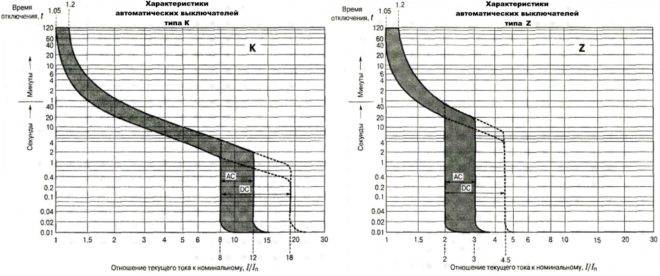
Type Z devices also have different actuation currents of the electromagnetic trip solenoid, but the spread is not as large as in category K AB. 4.5 times more than the nominal.
Devices with characteristic Z are used only in lines to which electronic devices are connected.
Clearly about the categories of slot machines in the video:
How to choose an automatic machine by the magnitude of the current strength
We already know that all the electrical current will flow through this switch to power the object. According to Ohm's law, it is clear that the load should be summed up based on all consumers in the house (apartment). Calculating this value is quite simple.
Of course, you can turn on the boiler, electric oven, air conditioner and iron at the same time. But for such a "celebration of life" you need a powerful electrical wiring. Yes, and the technical conditions for such an input power will cost significantly more. For power supply organizations, the tariffs for connection approval grow linearly depending on the number of kilowatts.
For a typical apartment, one can assume the simultaneous operation of a refrigerator, TV, computer, air conditioner. In addition to them, it is permissible to turn on one of the powerful appliances: a boiler, an oven or an iron. That is, the total power of electrical appliances will not exceed 3 kW. We do not take lighting into account; today, economical lamps are installed in every dwelling.
Usually, for a power reserve (force majeure circumstances are possible), 20–30% are added to the calculations. If you forget to turn off the boiler and start using the iron while the air conditioner is running, you won't have to run to the electrical panel to restore power. It turns out: we divide 4 kW by 220 V (according to Ohm's law), the current consumption is 18 A. The nearest circuit breaker with a rating of 20 A.
The marking is in the product passport, and always on the case.
With a more accurate selection of the device, especially when used in conjunction with a non-standard load (motors or other load with significant starting currents), it is necessary to make a choice not only for the rated current, but also for the time-current characteristic.
For example, the introductory machine shown below in the picture has a rated current of 16A and a “C” type characteristic (the “C” variety is well suited for the usual standard load - our apartments).
We will talk more about the time-current characteristic later.
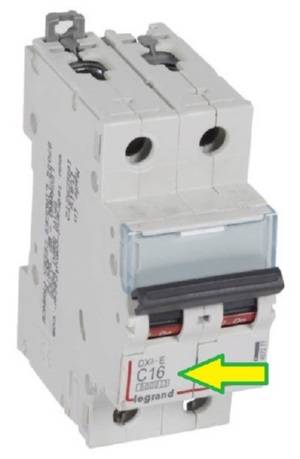
We are not interested in higher currents, this exceeds the power of 15 kW. No one will agree on such a connection to the apartment. Typically, residential input is limited to automatic machines with a response time of about 32 A.

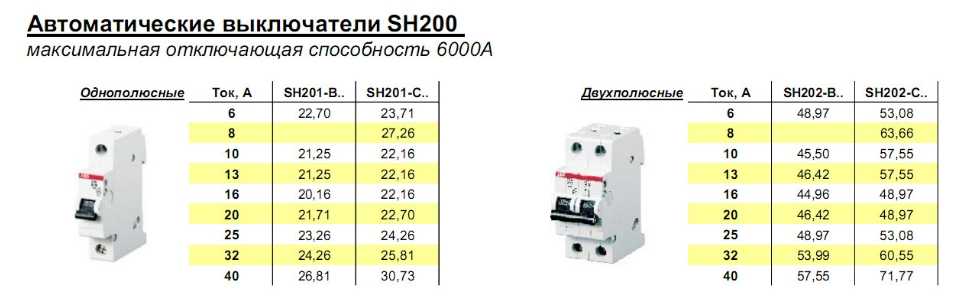
For a private house, the figures may be higher. The calculation includes an increased living area, the presence of outbuildings with power supply, a garage, a workshop, powerful power tools. An introductory machine for supplying power to a private house usually has a trip current of 50 A or 63 A.
Types of protection devices
In protection systems, devices of various types are used for different purposes.
Circuit breakers
These are devices designed to automatically disconnect consumers in emergency situations, accompanied by an excess of current above a certain value. Such situations arise when the load is exceeded or a short circuit occurs.
Can be used as switches. Replaces a knife switch and fuses with fusible links. Switching on and off is carried out manually or remotely, using the built-in mechanism.
RCD and differential automata
Violation of the insulation and touching a person to live parts that are energized can lead to electric shock. To prevent such situations, an RCD or a differential machine is used.
These devices work on the principle of comparing the currents passing through all the wires of the line. Under normal conditions, the sum is “0”, and when the insulation breaks down on a grounded case or a person gets under voltage, a leak appears, and the equality of currents in the wires is violated. This triggers the protection.
Voltage relay
Electrical equipment is designed for a certain mains voltage. If these parameters go beyond the permissible limits, the equipment will break down. A voltage relay is used to protect consumers.
These devices contain an electronic circuit and a relay. When the network parameters go beyond the allowable limits, the circuit turns off the relay and turns it on again after a certain predetermined time when the voltage returns to allowable values.
Automatic wiring protection
A circuit breaker is installed to protect electrical wiring from destruction. Such an automaton is chosen, focusing on the cross section of the wire, which depends on the magnitude of the maximum current consumed by electrical appliances. The direct protection of the devices themselves are the fuses installed in them.
Circuit breaker functions
The machine is designed to perform two protective functions:
- instantaneous current surge, exceeding the nominal value several times;
- slow thermal protection. It will trip if the rated load current is slightly exceeded in the range from 15 to 60 minutes.
instantaneous current surge
The first protection option will work in case of a short circuit in the electrical wiring or in the device connected to the mains. In this case, the current can be 100 A, and in the absence of automatic shutdown, the insulation would first completely melt, and then the wires. Thus, the electrical wiring would become completely unusable for further use.
Slow thermal protection
In order to exclude false alarms of the machine, a slow thermal protection option is provided.If for a short period of time the current passing through the machine (with a rating of 25 A) is 30 A, then due to the inertia of the thermal protection, the circuit breaker will not work.
For example, turning on a vacuum cleaner in a network loaded with a current of 15 A will add its own 10 A to it, plus another 5 A at the start of the engine. As a result, for a short period of time, the machine, designed for 25 A, passes a current of 30 A through itself without turning off the power supply.
How to choose the right circuit breaker?
When choosing a machine for protecting household electrical wiring, only the cross section of the wire serves as a guide. In general, in the distribution network you can purchase a machine designed for the following protection currents (in accordance with the standard): 1, 2, 3, 6, 10, 16, 20, 25, 32, 40, 50, 63. The specific rating of the machine shutdowns are set using a special table. In addition to the protection current, the machine must be suitable for use on an alternating current network with a voltage value of 220 volts at a frequency of 50 Hz, with a type C tripping characteristic and class 3.
When choosing circuit breakers for all these characteristics, it is desirable to obtain appropriate explanations from experienced professionals providing services for the installation of electrical equipment.
It should be noted that the choice of the machine will be correct provided that the cross section of the electrical wiring suitable for the meter from the outside is also taken into account. For example, if, after repair, an electrical wiring with a cross section of 2.5 mm2 was carried out to the apartment, and a wire with a cross section of 1.5 mm2 was connected from the shield installed in the entrance, then it is necessary to purchase an automatic machine, focusing on a smaller wire cross section.You can also replace the wires suitable for the meter from the electrical panel in the entrance with large wires.
Work related to the assembly and installation of an electrical panel, meter or circuit breakers can be performed independently, without forgetting to comply with the PES (rules for electrical installations). However, in practice, you may encounter many nuances of the workflow, which are familiar in detail only to specialists working in the field of electrical networks.