
- Possible correction of the conductor cross section for line resistance
- Long Line Voltage Drop Calculator
- Rated current and time characteristic
- Why do you need an automatic
- Deciding on a denomination
- Example
- Power calculation
- Calculation of the permissible current strength by heating the conductors
- Voltage
- Weak link protection
- Indoor wiring device
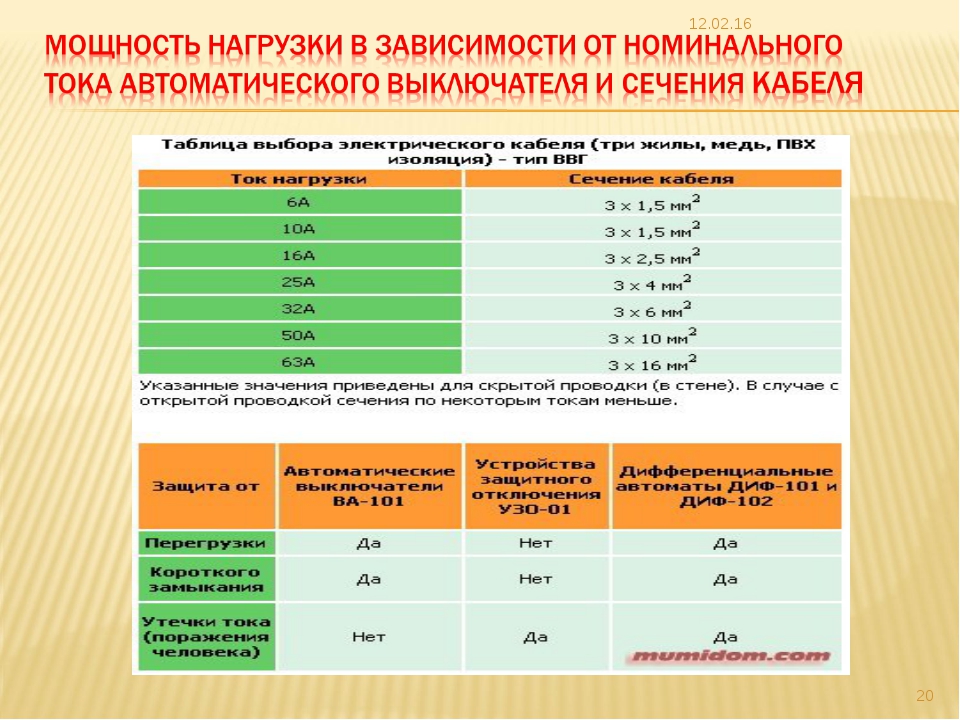
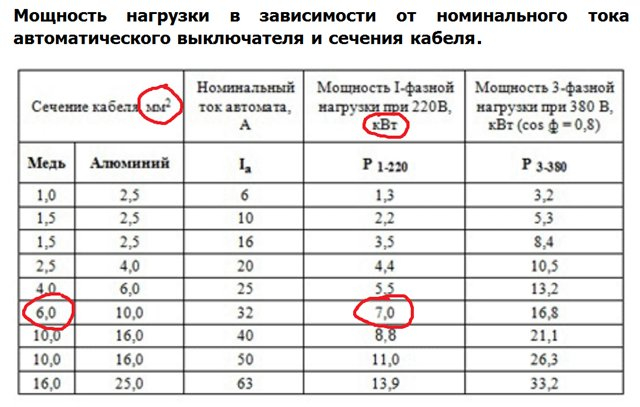
- Ratings of automatic machines for current table
- Ratings of circuit breakers for current
- Denomination selection rules
Possible correction of the conductor cross section for line resistance
Any conductor has its own resistance - we talked about this at the very beginning of the article, when we gave the values of the resistivity of materials, copper and aluminum.
Both of these metals have a very decent conductivity, and in sections of a small extent, the line's own resistance does not have any significant effect on the overall parameters of the circuit. But if it is planned to lay a long line, or, for example, a long carrying extension cord is made to work at a considerable distance from home, then it is advisable to calculate its own resistance and compare the voltage drop caused by it with the supply voltage.If the voltage drop is more than 5% of the nominal voltage in the circuit, the rules for the operation of electrical installations prescribe to take a cable with larger cross-section conductors.
For example, a carrier for a welding inverter is being made. If the resistance of the cable itself is excessive, the wires under load will overheat greatly, and the voltage may not be enough for the correct operation of the device.
The self-resistance of the cable can be calculated using the formula:
Rk = 2 × ρ × L / S
Rk is the intrinsic resistance of the cable (line), Ohm;
2 - the cable length is doubled, since the entire current path is taken into account, that is, "back and forth";
ρ is the specific resistance of the material of the cable cores;
L is the cable length, m;
S is the cross-sectional area of the core, mm².
It is assumed that we already know what current we will have to deal with when connecting the load - this has already been discussed more than once in this article.
Knowing the current strength, it is easy to calculate the voltage drop using Ohm's law, and then compare it with the nominal value.
Ur = Rk × I
ΔU (%) = (Ur / Unom) × 100
If the test result is more than 5%, then the cross section of the cable cores should be increased by one step.
Another online calculator will help you quickly conduct such a check. It does not seem to require further explanation.
Long Line Voltage Drop Calculator
As already mentioned, with a value of up to 5%, you can not change anything. If it turns out more, the cross section of the cable core increases, also with a subsequent check.
* * * * * * *
So, the main issues related to the required cable cross-section depending on the planned load on it were considered.The reader is free to choose any of the proposed methods of calculation, which he likes best.
We will end the article with a video on the same topic.
Rated current and time characteristic
This is followed by one of the main inscriptions - the rated current of the machine. For example C25 or C16.




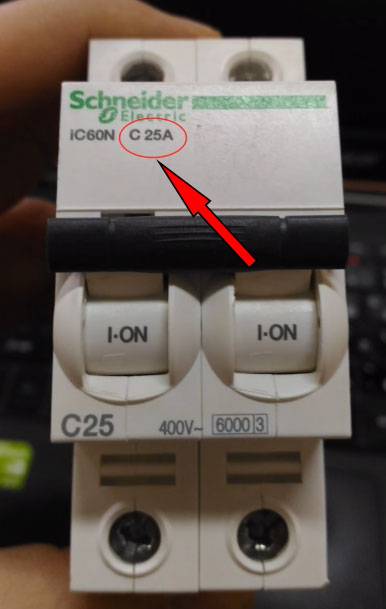
The first letter indicates the time-current characteristic "C". The number after the letter is the value of the rated current.
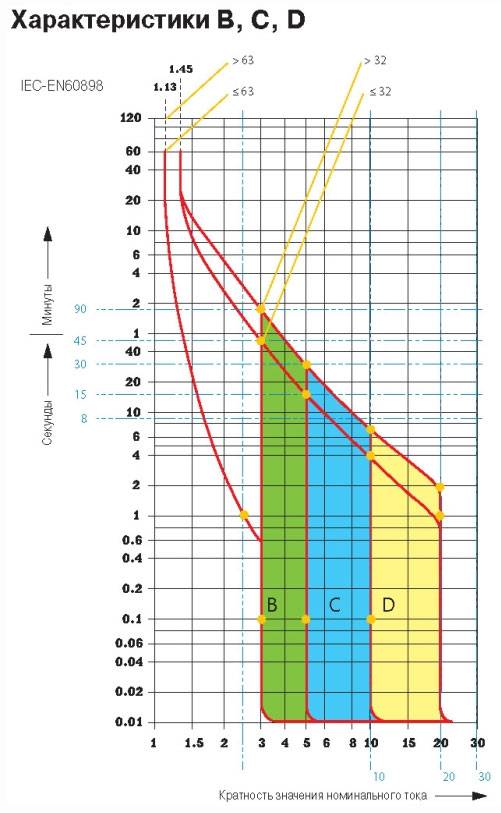
The most common characteristics are "B, C, D, Z, K". They determine the tripping time, depending on the short-circuit current passing through the machine. In short, then:
B
the machine will turn off "conditionally instantly" at a short-circuit current 3-5 times more than the nominal
Basically they are placed in lighting circuits.
C
at a short-circuit current 5-10 times more than the nominal
Universal application in networks with mixed loads.
D
10-20 times more Inom
Used to connect electric motors.

Z
2-3 times
Actual in circuits with electronic devices.
K
8-12 times
Only suitable for equipment with inductive load.
All such devices have thermal and electromagnetic protection. Although thermal sometimes may not be set. But more on that later.
Electromagnetic - in the range of the above parameters, depending on the type of characteristic.
Please note that with a value of C25, the machine will not turn off the load of 26 Amperes. This will happen only at a current value 1.13 times greater than 25A. And even then, after a fairly long period of time (more than 1 hour)
And even then, after a rather long period of time (more than 1 hour).
There is such a thing as:
operation current — 1,45*Inom
The machine is guaranteed to work within an hour.
non-operating current - 1.13 * Inom
The machine should not work within an hour, but only after this time has elapsed.
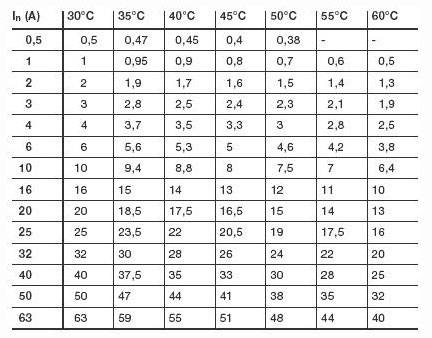
Also, do not forget that the value of the rated current on the case is indicated for an ambient temperature of +30C. If you put the device in a bathhouse or on the facade of a house, directly under the rays of the sun, then a 16 Amp automatic machine, on a hot summer day, can work at a current that is even less than the nominal one!
Why do you need an automatic
Circuit breakers for an apartment, townhouse, small industrial facility have a general principle of operation.
They are equipped with a two-stage protection system:
- Thermal. The thermal release is made of a bimetallic plate. With prolonged action from the high current side, the flexibility of the plate increases, due to which it touches the switch.
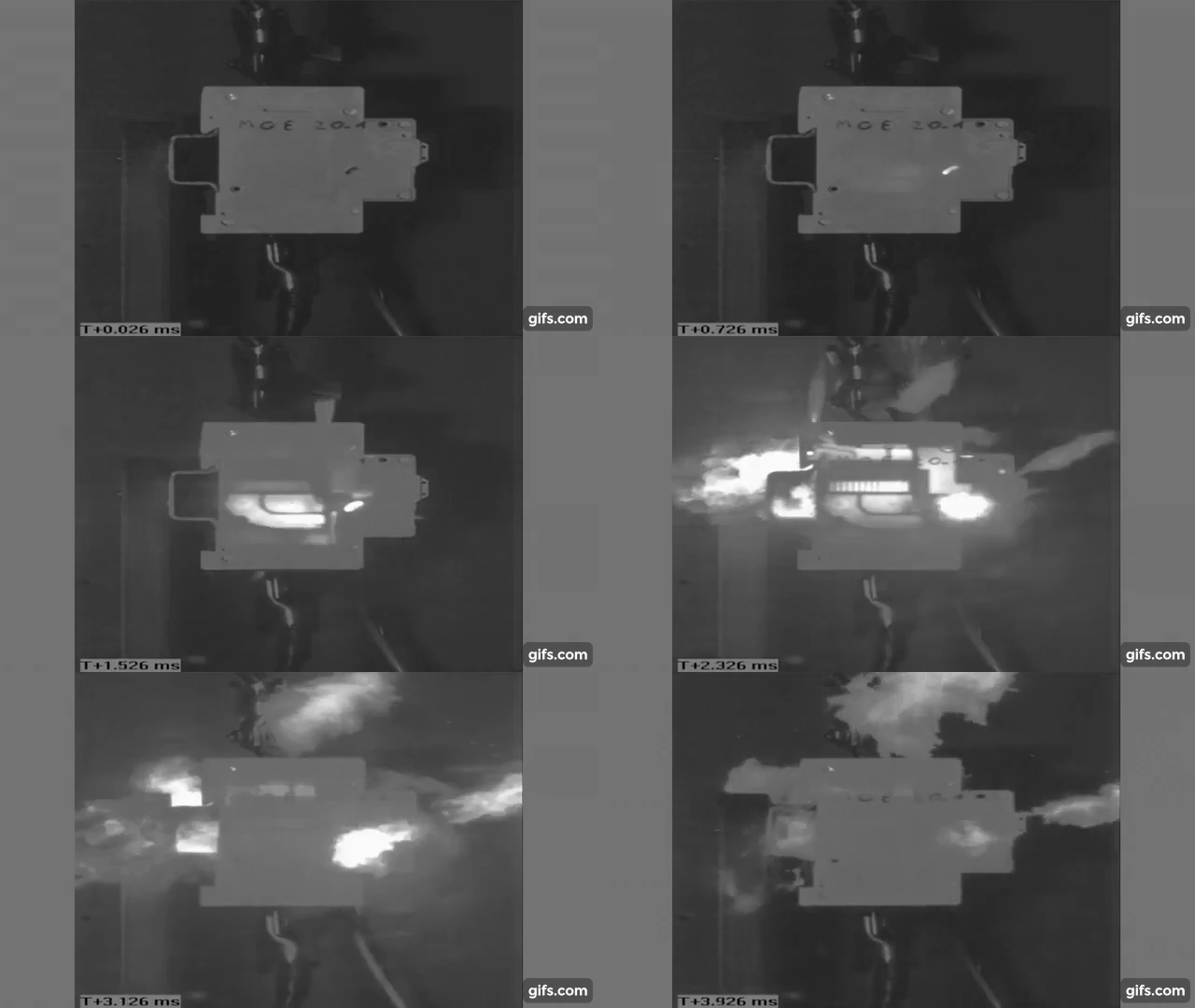
- Electromagnetic. The role of the electromagnetic release is played by the solenoid. When registering an increased current power, for which the machine and the cable are not designed, the switch also trips. This is short circuit protection.
AB (common abbreviation) protects the electrical network from heating insulation and fire
It is precisely because of this scheme of work that it is important to know how many amperes to put the machine in the apartment: if you choose the wrong device, it will not be able to block the current that is inappropriate in power, and a fire will occur. Selected according to all recommendations, AB will protect against fires, electric shocks, heating and combustion of home appliance chips
Deciding on a denomination
Actually, from the functions of the circuit breaker, the rule for determining the rating of the circuit breaker follows: it must operate until the current exceeds the wiring capabilities.And this means that the current rating of the machine must be less than the maximum current that the wiring can withstand.




For each line, you need to choose the right circuit breaker
Based on this, the algorithm for choosing a circuit breaker is simple:
- Calculate the cross section of the wiring for a specific area.
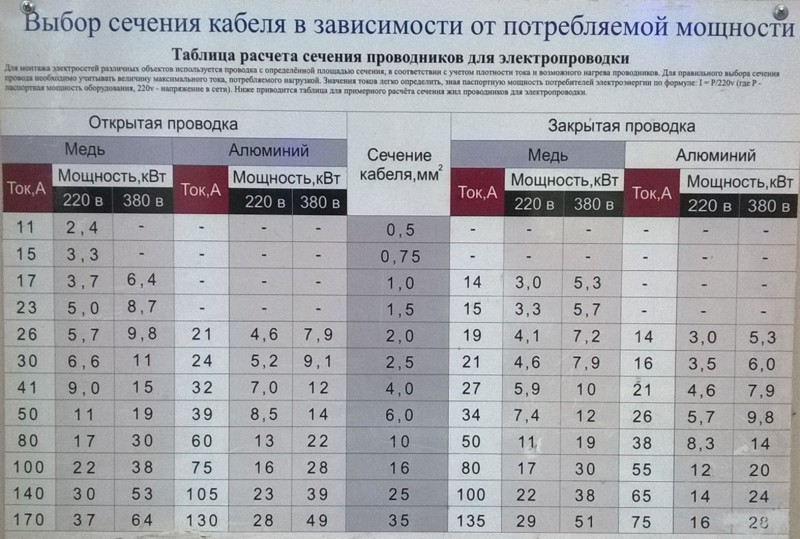
- See what maximum current this cable can withstand (there is in the table).
- Further, from all the denominations of circuit breakers, we select the nearest smaller one. The ratings of the machines are tied to the permissible continuous load currents for a particular cable - they have a slightly lower rating (there is in the table). The list of ratings looks like this: 16 A, 25 A, 32 A, 40 A, 63 A. From this list, choose the right one. There are denominations and less, but they are practically not used anymore - we have too many electrical appliances and they have considerable power.
Example
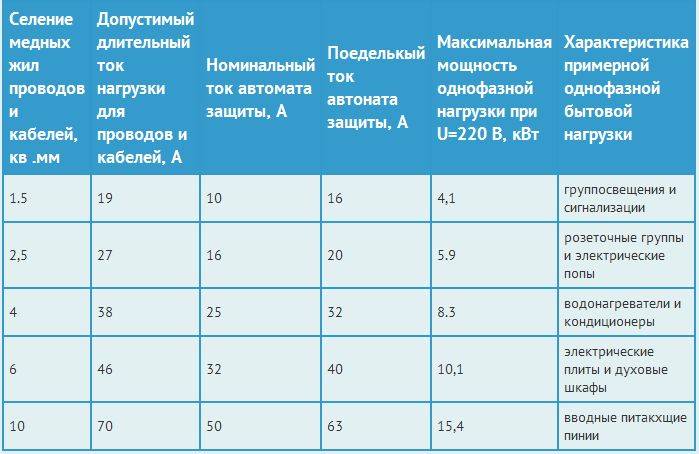
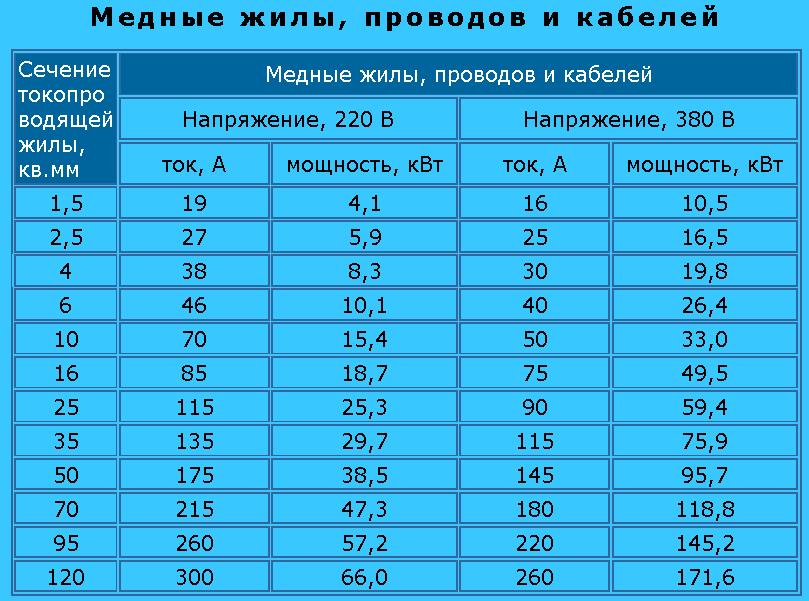
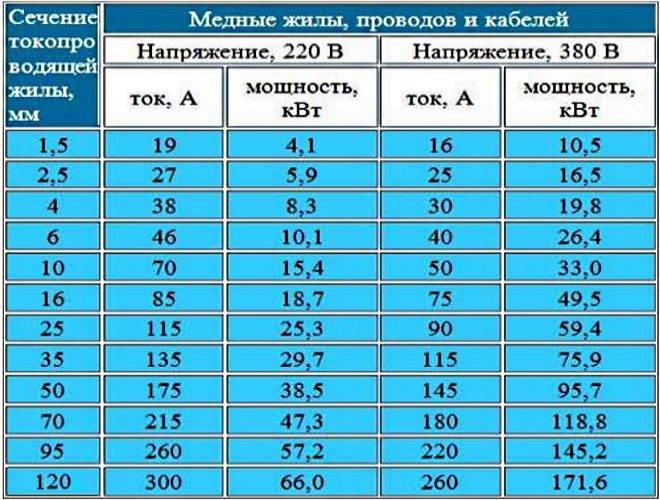
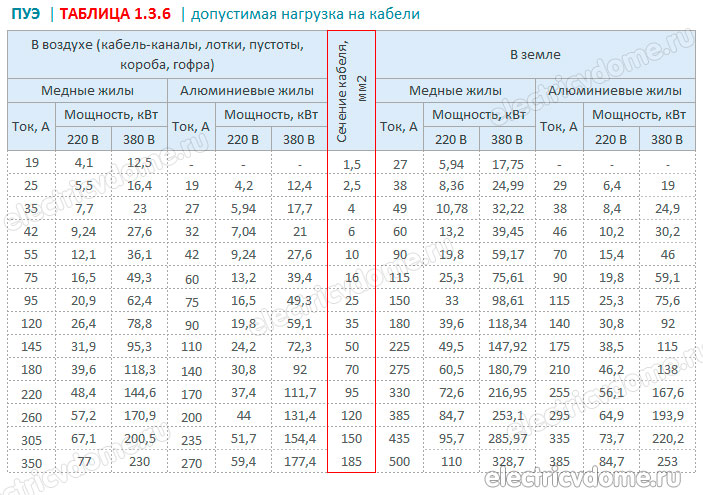
The algorithm is very simple, but it works flawlessly. To make it clearer, let's look at an example. Below is a table that indicates the maximum allowable current for conductors that are used when laying wiring in a house and apartment. There are also recommendations regarding the use of machines. They are given in the column "Rated current of the circuit breaker". It is there that we are looking for denominations - it is slightly less than the maximum allowable, so that the wiring works in normal mode.
| Cross section of copper wires | Permissible continuous load current | Maximum load power for a single-phase network 220 V | Rated current of the circuit breaker | Circuit breaker current limit | Approximate load for a single-phase circuit |
|---|---|---|---|---|---|
| 1.5 sq. mm | 19 A | 4.1 kW | 10 A | 16 A | lighting and signaling |
| 2.5 sq. mm | 27 A | 5.9 kW | 16 A | 25 A | socket groups and electric underfloor heating |
| 4 sq. mm | 38 A | 8.3 kW | 25 A | 32 A | air conditioners and water heaters |
| 6 sq. mm | 46 A | 10.1 kW | 32 A | 40 A | electric stoves and ovens |
| 10 sq. mm | 70 A | 15.4 kW | 50 A | 63 A | introductory lines |
In the table we find the selected wire section for this line. Suppose we need to lay a cable with a cross section of 2.5 mm2 (the most common when laying to medium power devices). A conductor with such a cross section can withstand a current of 27 A, and the recommended rating of the machine is 16 A.
How will the chain work then? As long as the current does not exceed 25 A, the machine does not turn off, everything works in normal mode - the conductor heats up, but not to critical values. When the load current begins to increase and exceeds 25 A, the machine does not turn off for some time - perhaps these are starting currents and they are short-lived. It turns off if the current exceeds 25 A by 13% for a sufficiently long time. In this case, if it reaches 28.25 A. Then the electric bag will work, de-energize the branch, since this current already poses a threat to the conductor and its insulation.
Power calculation
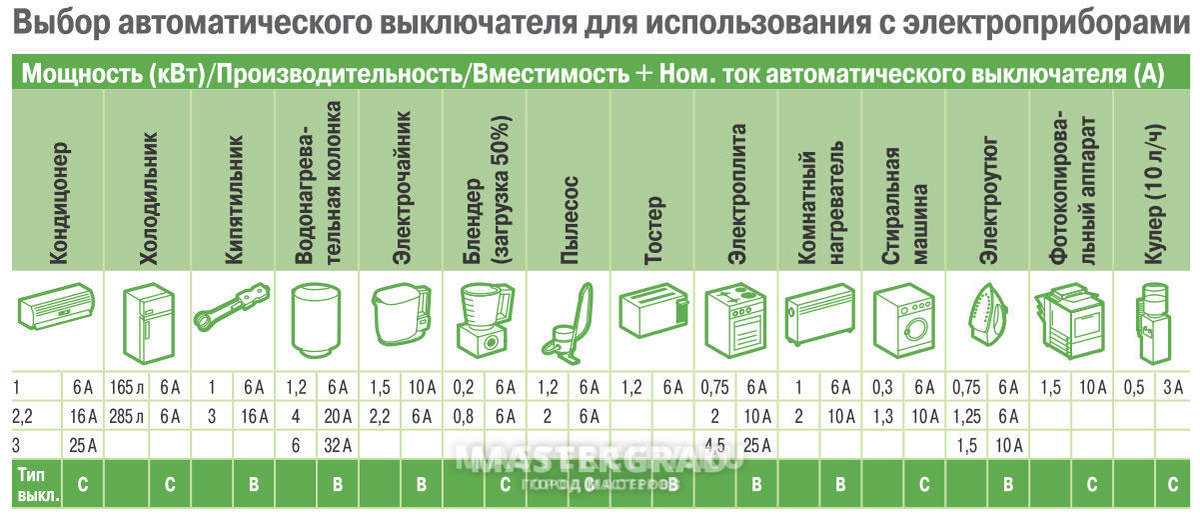
Is it possible to choose an automatic machine according to the load power? If only one device is connected to the power line (usually it is a large household appliance with a large power consumption), then it is permissible to make a calculation based on the power of this equipment. Also in terms of power, you can choose an introductory machine, which is installed at the entrance to a house or apartment.
If we are looking for the value of the introductory machine, it is necessary to add up the power of all devices that will be connected to the home network. Then the found total power is substituted into the formula, the operating current for this load is found.
Formula for calculating current from total power
After we have found the current, select the value. It can be either a little more or a little less than the found value. The main thing is that its tripping current does not exceed the maximum allowable current for this wiring.
When can this method be used? If the wiring is laid with a large margin (this is not bad, by the way). Then, in order to save money, you can install automatically switches corresponding to the load, and not to the cross section of the conductors
But once again we pay attention that the long-term permissible current for the load must be greater than the limiting current of the circuit breaker. Only then the choice of automatic protection will be correct
Calculation of the permissible current strength by heating the conductors
If a conductor of a suitable cross section is selected, this will eliminate voltage drops and overheating of the line. Thus, the section determines how optimal and economical the mode of operation of the electrical network will be. It would seem that you can just take and install a huge cable section. But the cost of copper conductors is proportional to their cross section, and the difference when installing electrical wiring in one room can be several thousand rubles.
Therefore, it is important to be able to correctly calculate the cable cross-section: on the one hand, you guarantee the safety of network operation, on the other hand, do not spend extra money on purchasing an overly “thick” conductor
To select the wire section, two important criteria must be taken into account - permissible heating and voltage loss. Having obtained two values of the cross-sectional area of \u200b\u200bthe conductor using different formulas, choose a larger value by rounding it up to the standard. Overhead power lines are especially sensitive to voltage loss.
At the same time, for underground lines and cables placed in corrugated pipes, it is important to take into account the allowable heating. Thus, the cross section should be determined depending on the type of wiring
Permissible heating temperatures of conductors of cables
Id - permissible load on the cable (heating current). This value corresponds to the current flowing through the conductor for a long time. In the process of this, the established, long-term permissible temperature (Td) appears. The calculated current strength (Ir) must correspond to the permissible one (Id), and to determine it, you need to use the formula:


Ir \u003d (1000 * Pn * kz) / √ (3 * Un * hd * cos j),
where:
- Pn - rated power, kW;
- Kz - load factor (0.85-0.9);
- Un - rated voltage of the equipment;
- hd - equipment efficiency;
- cos j - equipment power factor (0.85-0.92).
Even if we take into account the same current values, the heat output will be different depending on the ambient temperature. The lower the temperature, the more efficient the heat transfer.
Cable correction factors depending on the ambient temperature
The temperature differs depending on the region and season, so tables for specific values \u200b\u200bcan be found in the PUE. If the temperature differs significantly from the calculated one, correction factors will have to be used. The base temperature for indoor or outdoor is 25 degrees Celsius. If the cable is laid underground, the temperature changes by 15 degrees Celsius. However, it is underground that it remains constant.
Voltage
230/400V - inscriptions of the rated voltage where this machine can be used.

If there is a 230V icon (without 400V), these devices should only be used in single-phase networks. You can't put two or three single-phase switches in a row and supply 380V to a motor load or a three-phase pump or fan in this way.
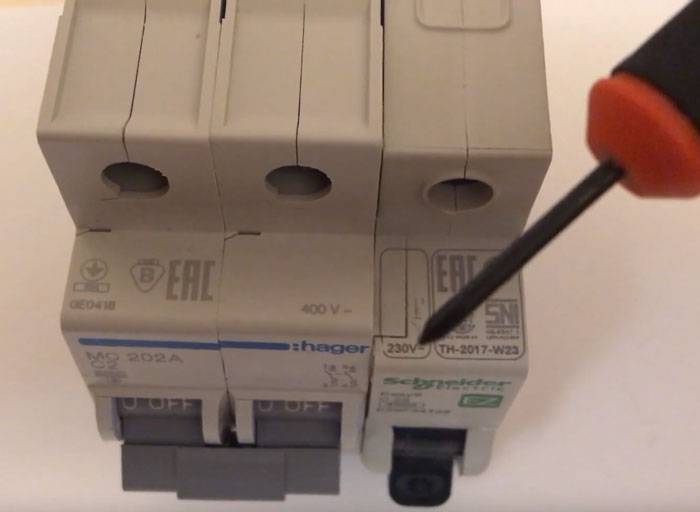
Also carefully study the bipolar models. If they have the letter “N” written on one of the poles (not only difavtomatov), then it is here that the zero core is connected, and not the phase one.
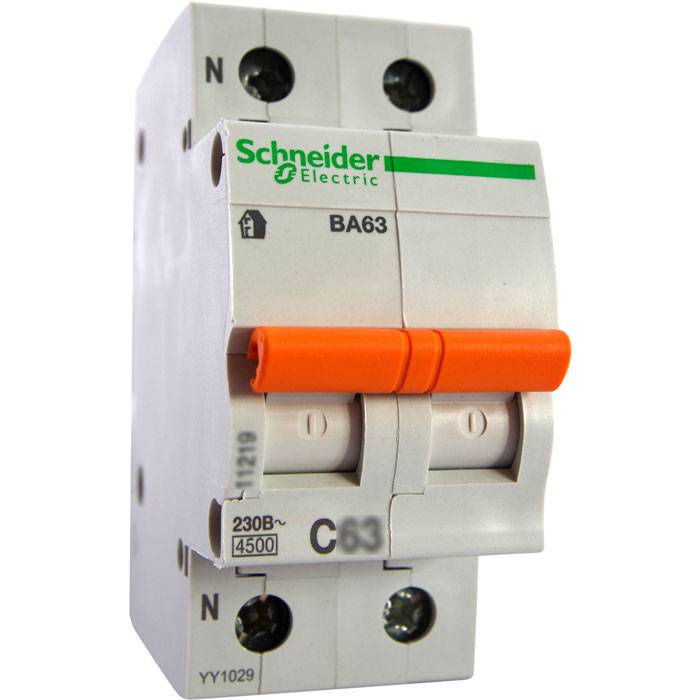
They are called somewhat differently. For example VA63 1P+N.
The wave icon means - for operation in alternating voltage networks.
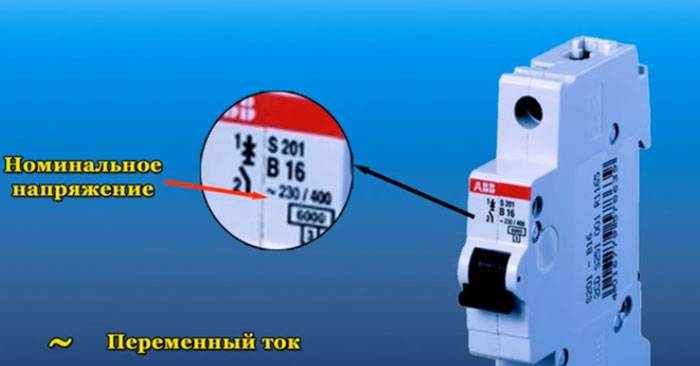
For direct voltage and current, it is better not to install such devices. The characteristics of its shutdown and the result of work during a short circuit will not be predictable.
Switches for direct current and voltage, in addition to the icon in the form of a straight line, may have characteristic inscriptions “+” (plus) and “-” (minus) on their terminals.
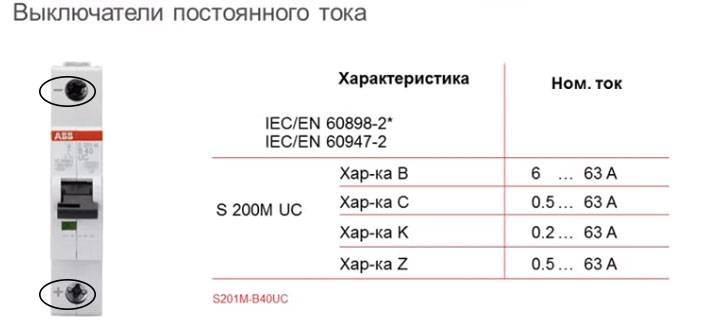
Moreover, the correct connection of the poles is critical here. This is due to the fact that the conditions for extinguishing the arc at direct current are somewhat more difficult.
If at a break there is a natural extinction of the arc when the sinusoid passes through zero, then at a constant, there is no sinusoid as such. For stable arc extinguishing, a magnet is used in them, which is installed near the arc chute.


Which will lead to the inevitable destruction of the hull.
Weak link protection
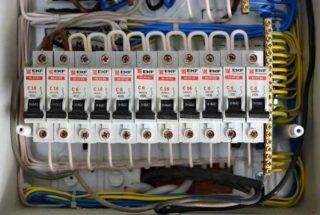
In addition to the section, when choosing a suitable cable product, pay attention to the actual operating conditions. Normalized values are given for heating up to a temperature not exceeding +60°C
When installing the line on a site near a country house, it is necessary to provide protection from moisture and other adverse external influences.
Carefully check all parts of the electrical network. The basic rule is reliable protection, taking into account the performance of the site with the worst parameters. It should be borne in mind that copper is designed with the same cross section for greater loads compared to aluminum. The purity of the metal is of particular importance. As impurities increase, conductivity deteriorates, and losses for useless and dangerous heating increase.
Indoor wiring device
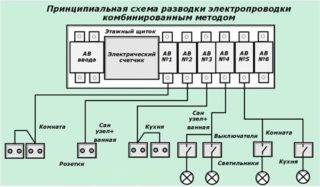
- the introductory machine must be placed before the counter;
- a common residual current device (RCD) is mounted behind the control device;
- then separate lines are equipped with circuit breakers (AB).
RCD prevents accidents that provoke leakage currents. Prevents electric shock in some situations. However, complex protective measures are performed using circuit breakers. Be sure to use effective grounding.
As a rule, it is convenient to put several groups in the kitchen to evenly distribute the loads. Especially carefully it is recommended to select the distribution of powerful consumers:
- hobs;
- ovens;
- heating boilers, boilers, flow heaters;
- electric convectors, heat guns;
- air conditioners.
The wiring diagram has a tree structure. From the center line of the "trunk" make the necessary branches of the "branches" for connecting sockets and switches.
Ratings of automatic machines for current table
In order to protect the line from overload and short circuit, you must carefully and correctly select the current rating of the circuit breaker.Here, for example, if you protect the line with a 2.5 sq. mm cable. automatic at 25A and at the same time turned on several powerful household appliances, then the current may exceed the nominal value of the machine, but at a value of less than 1.45, the machine can work for about an hour.
If the current is 28 A, then the cable insulation will begin to melt (since the permissible current is only 25A), this will lead to failure, fire and other unfortunate consequences.
Therefore, the table of automata for power and current is as follows:
Ratings of circuit breakers for current
- specify the scheme of connection of consumers;
- collect passport data of equipment, measure voltage;
- according to the presented scheme, they are calculated separately, summing up the currents in separate circuits;
- for each group, it is necessary to select an automatic machine that will withstand the corresponding load;
- determine cable products with a suitable conductor cross-section.
Denomination selection rules
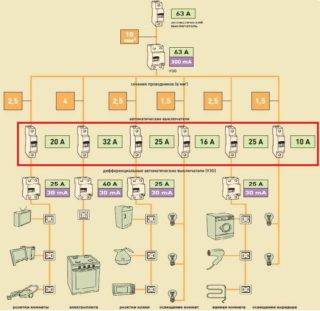
For correct conclusions, it is necessary to take into account the features of the connected equipment. If, according to the calculation, the total current is 19 amperes, users prefer to buy a 25A device. This solution assumes the possibility of applying additional loads without significant restrictions.


However, in some situations it is better to choose a 20A circuit breaker. This provides a relatively shorter time to turn off the power with an increase in current (temperature increase) by a bimetallic disconnector
Such a precaution will help maintain the integrity of the motor winding when the rotor is blocked by a jammed drive.
Different response times are useful to ensure the selective operation of protective equipment. Devices with a lower delay are installed on the lines.In an emergency, only the damaged part is disconnected from the electricity. The introductory machine will not have time to turn off. Power from other circuits is useful for maintaining lighting, alarms, and other engineering systems in working condition.



