
- What are retractable recessed sockets, their advantages and disadvantages
- Types of retractable sockets
- Features of corner sockets
- Advantages and disadvantages
- Types and features of retractable sockets
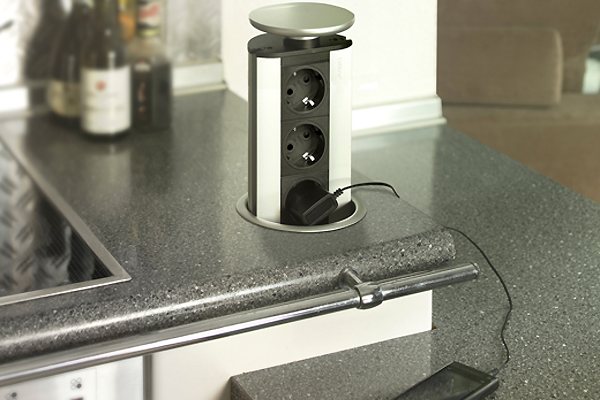
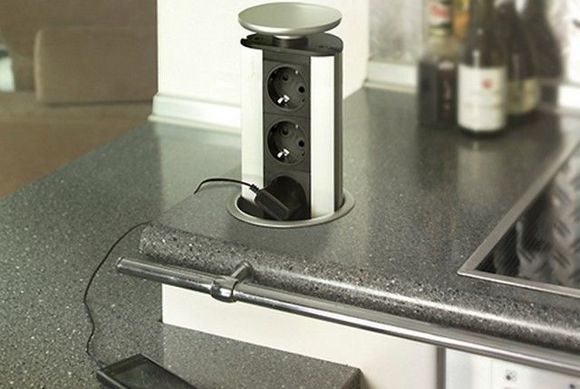
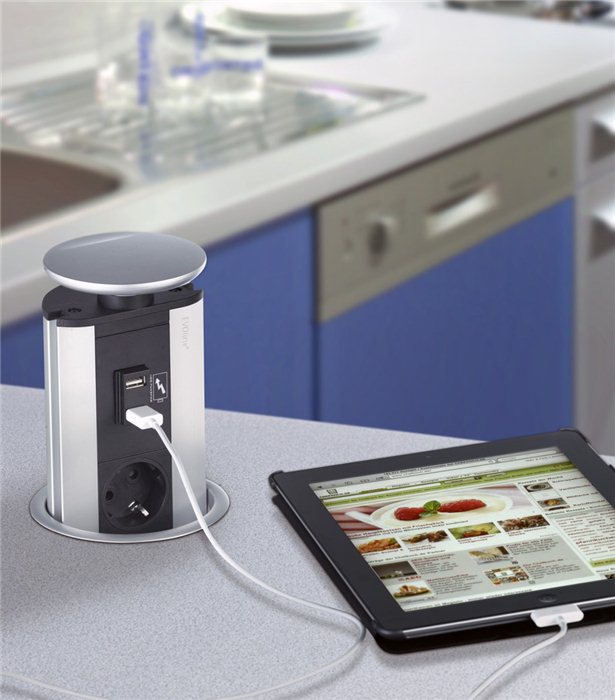
- Vertical retractable countertop rosette
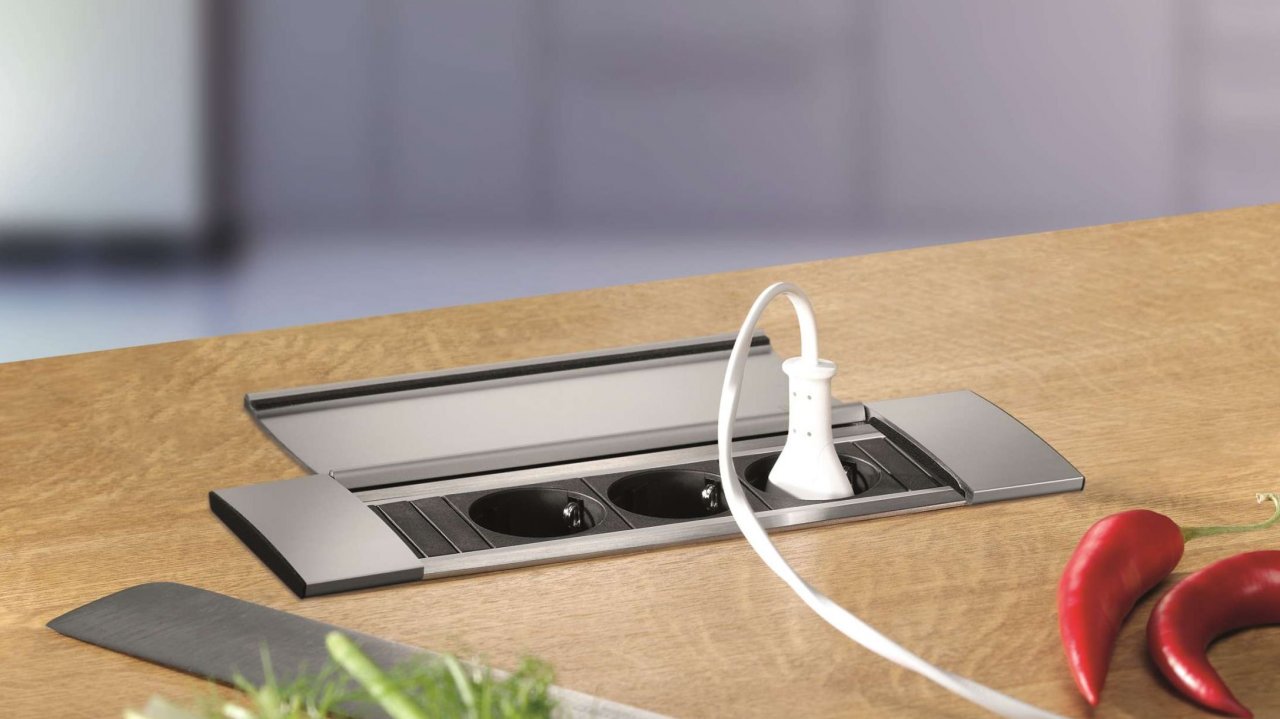
- Horizontal retractable socket
- Retractable swivel socket block
- Hidden sockets
- Where to install sockets in the apartment
- Where to install sockets in the kitchen?
- Where to install sockets in the bedroom?
- Where to install sockets in the bathroom?
- Selection criteria and rules
- Protective curtains
- Hinged lid
- Plug release device
- Norms and standards for the placement of plinth and floor electrical outlets
- Advantages and disadvantages
- Installation process
- The main mistakes that are made when planning outlets in the kitchen
- Distances and placements
- Fridge
- Sockets in the work area and above the countertop
- Hood
- Cooker and oven
- Dishwasher
- Key Rules
- Recommendations for wiring and machines
What are retractable recessed sockets, their advantages and disadvantages
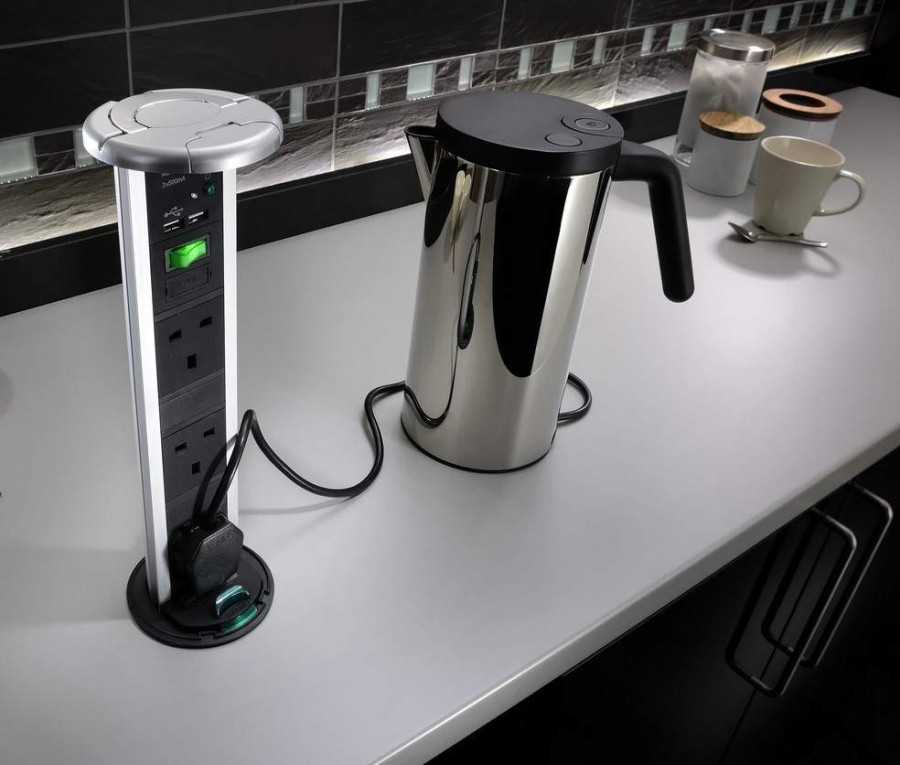
The design is a stationary extension cord, which is installed so that it is practically invisible. If it is necessary to connect an electrical appliance, the carrier is removed from the shelter with a slight movement of the hand, and disappears again as unnecessary.The wire is also invisible. It is fixed to the inner walls of the cabinet and is connected to an outlet in the distance.
In addition to the main advantage of hidden sockets - their complete invisibility, there are many more positive aspects:
- stylish design allows you to choose a socket that best suits the overall style of the interior and the color of the surface in which the accessory is hidden;
- a variety of configurations makes it possible to choose a device that fully meets your needs;
- the ability to install on absolutely any surface in any convenient place;
- the presence of backlight, child protection and additional sockets for USB devices, TV, phone or Internet cable;
- quick installation and connection compared to traditional options.
Why are built-in power supplies bad? Some see the need for surface and cabinet space for mounting these small electrical installations as a clear disadvantage. It will not work to mount a hidden extension in the countertop, under which there are drawers - for obvious reasons.
Like any electrical appliance, over time, the accessory may fail or its retractable mechanism may be broken.
If you look at things adequately, then the real disadvantages of hidden power supplies include their high cost (compared to conventional extension cords).
Types of retractable sockets
Hidden sockets are supplied by manufacturers in three interpretations - vertical, horizontal and rotary retractable blocks.
Let's consider them in more detail:
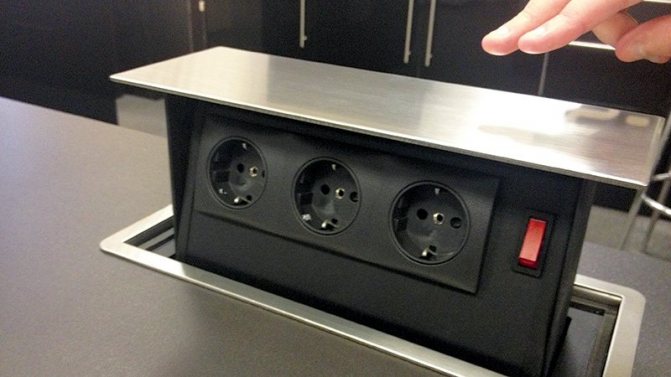
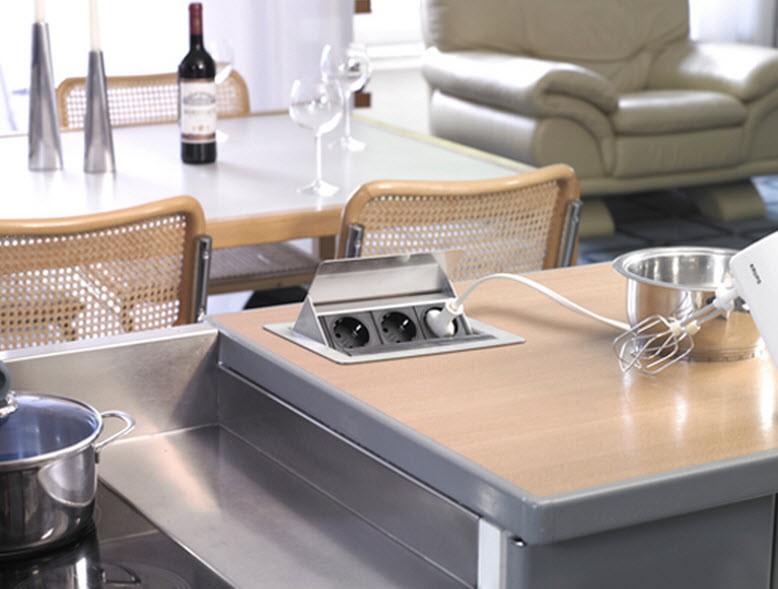
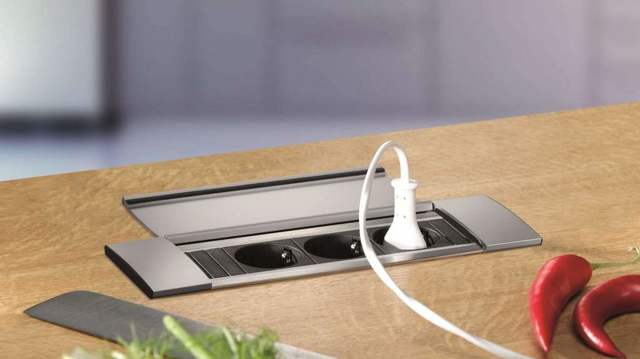
- The horizontal version is considered more practical and reliable, durable and resistant to mechanical stress.The block is located parallel to the floor, when you press the cover, the sockets recline at an angle.
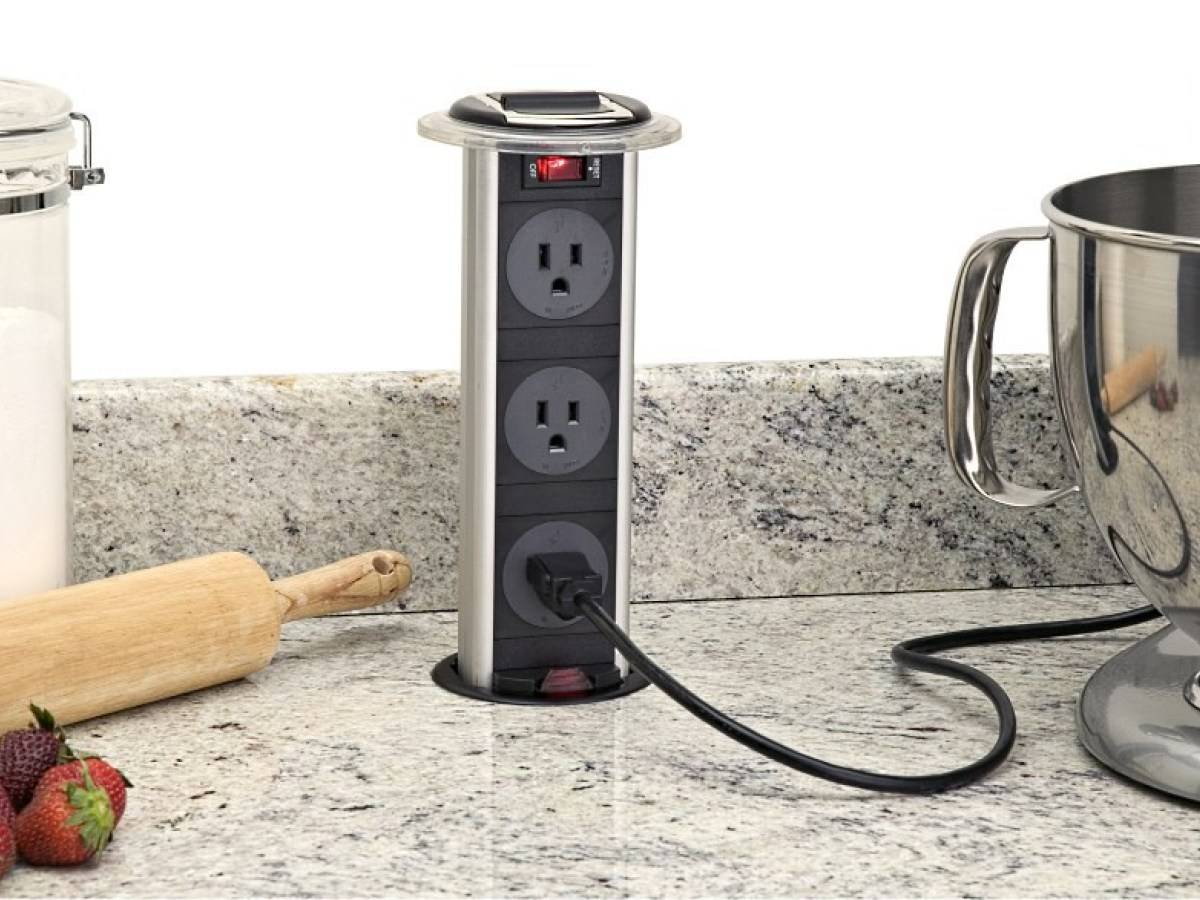
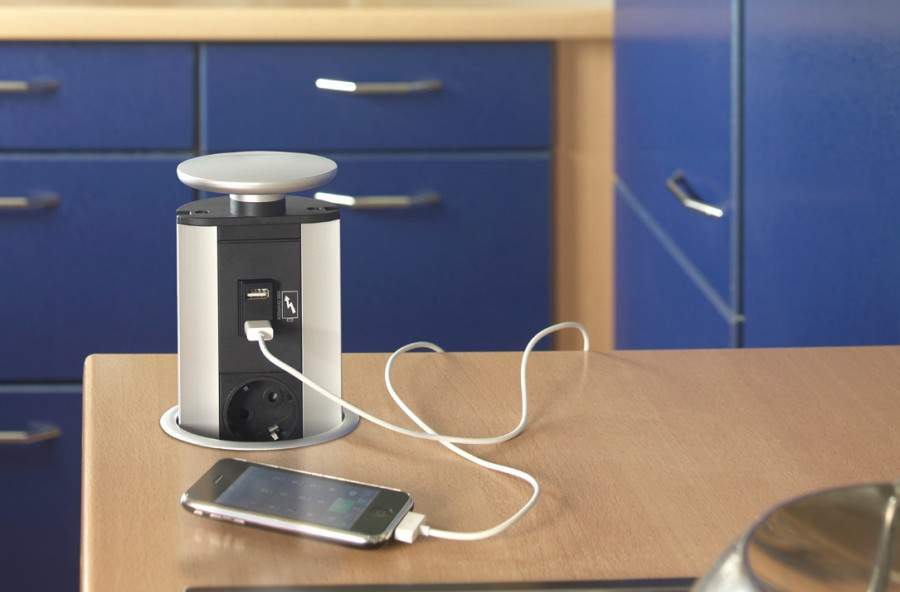
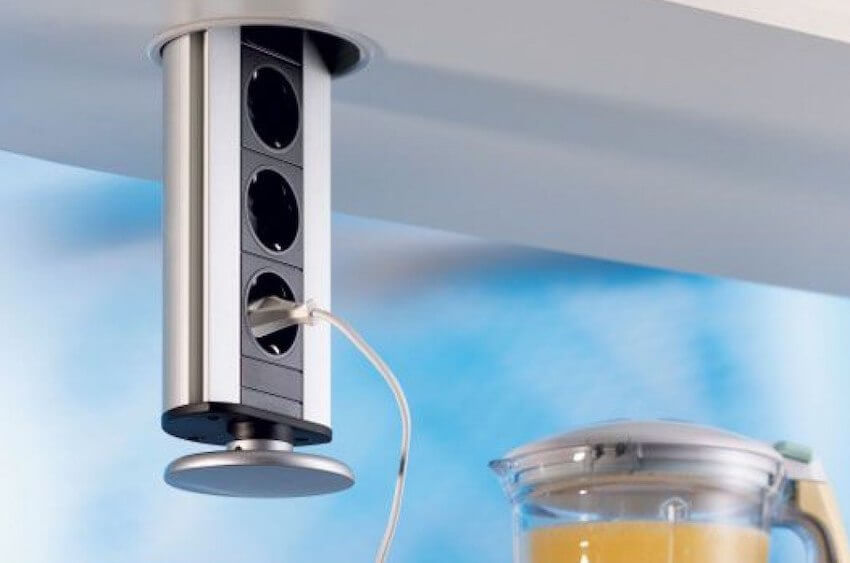
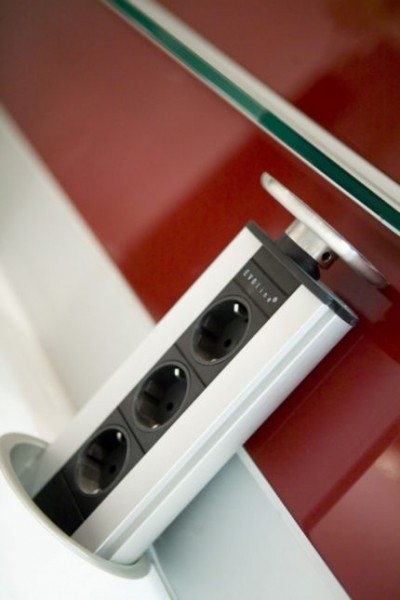
- The vertical variety wins in that it looks more modern and occupies a minimum of surface space, although the design is more wobbly. The unit is pulled out by pressing the housing cover, sockets and modules are arranged vertically. In some models, contact connections may not be located in height, but along the perimeter. In this case, the block extends only to the height of one module.
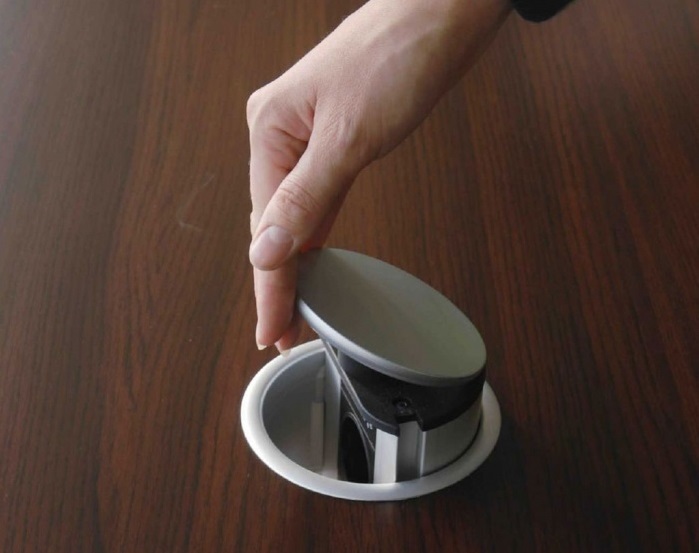
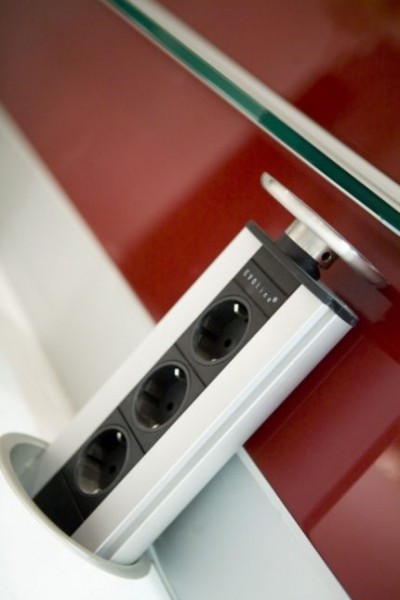
- The swivel extension is located horizontally in the tabletop. If it is necessary to connect the device, it overturns by half a circle, while remaining flush with the surface.
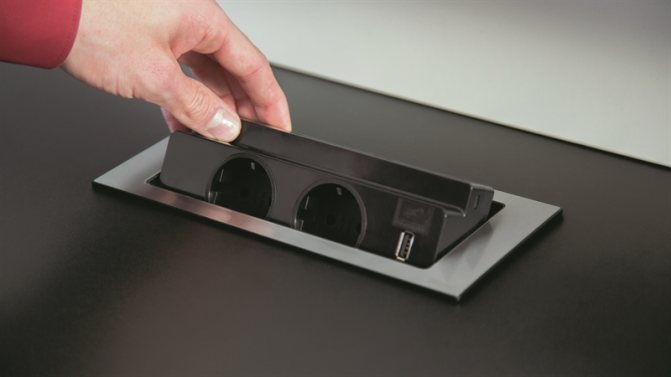
Similar designs are installed, as a rule, in a kitchen worktop for connecting electrical appliances for temporary use, for example:
- mixer;
- yogurt makers;
- electric meat grinders;
- blender
- steamers;
- juicers;
- coffee grinders;
- multicookers;
- toaster, etc.
For a spacious kitchen with a large working area, it would be more appropriate to install several hidden blocks at a distance of 2 m from each other.
You can take a closer look at the built-in models of modern extension cords in order to make a choice in the future, in the following video:
Features of corner sockets
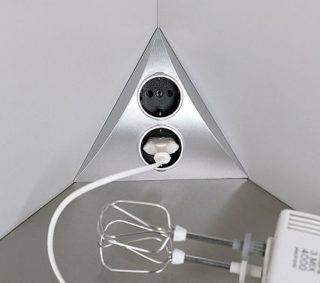 Corner block Luxor ST with 2 sockets
The angular type of sockets is available in a durable plastic case. Double, single, combined modules are suitable for location between the countertop and the wall, under the cabinets, at the joints. Products look elegant and do not take up much space.
Device design:
- base made of plastic or ceramic with fasteners in the form of paws or ears;
- front panel - selected by color;
- current-carrying elements - terminals (self-regulating or screw), grounding contacts.
The socket is designed for integration with hidden or open wiring. In the first case, it is placed in a strobe, in the second - in a socket.
Advantages and disadvantages
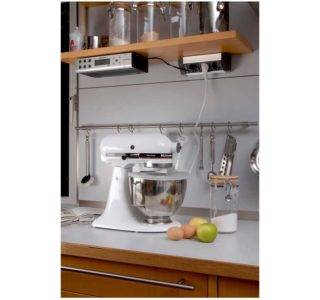 Corner sockets significantly save space
The advantages of corner devices include:
- elegant appearance;
- saving space in the kitchen;
- the presence of several modules for ease of use;
- compliance with European standards and Russian GOST;
- good dust and moisture protection;
- equipment with a timer, wattmeter, backlight.
When operating and installing sockets in the corner, there are some disadvantages:
- with poor-quality fastening to drywall, they can come off;
- high power - not always suitable for Soviet buildings;
- connecting no more than two devices - the plugs of the rest will interfere;
- inability to use for powering lighting.
Types and features of retractable sockets
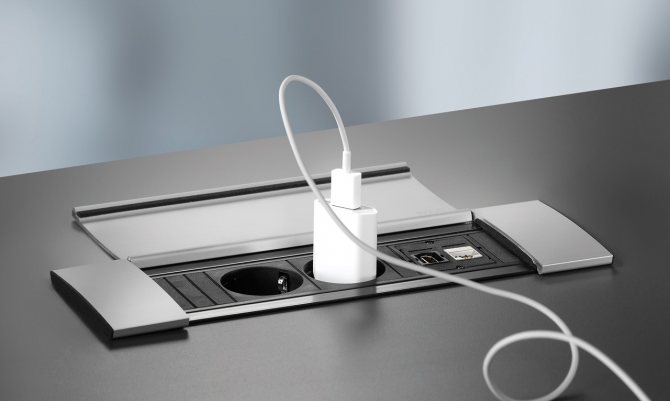
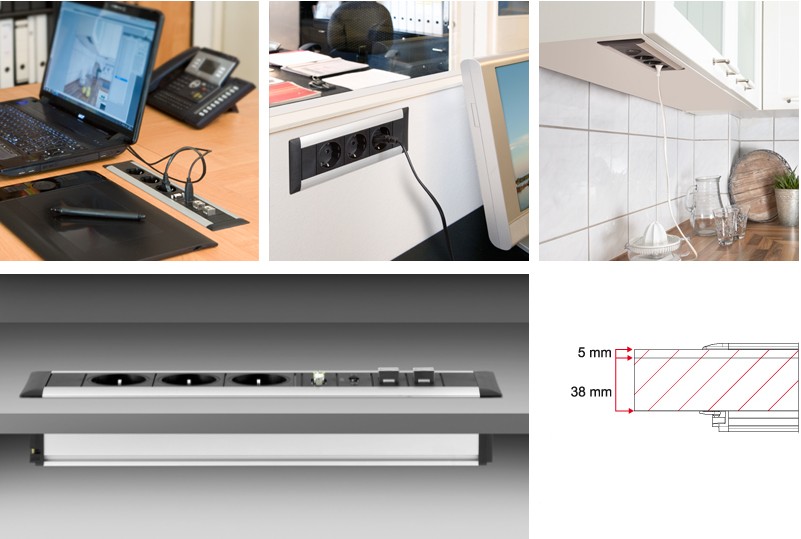
Built-in sockets in the countertop - a block of 2 or more sockets, mounted in a metal or plastic case, which is equipped with a retractable mechanism. The device is removed from the countertop by means of light pressure and is just as easily immersed in it when pressed. A device of this type is a kind of surge protector, but it does not have wiring bundles that look so unaesthetically. The modern market offers users several varieties of retractable devices.
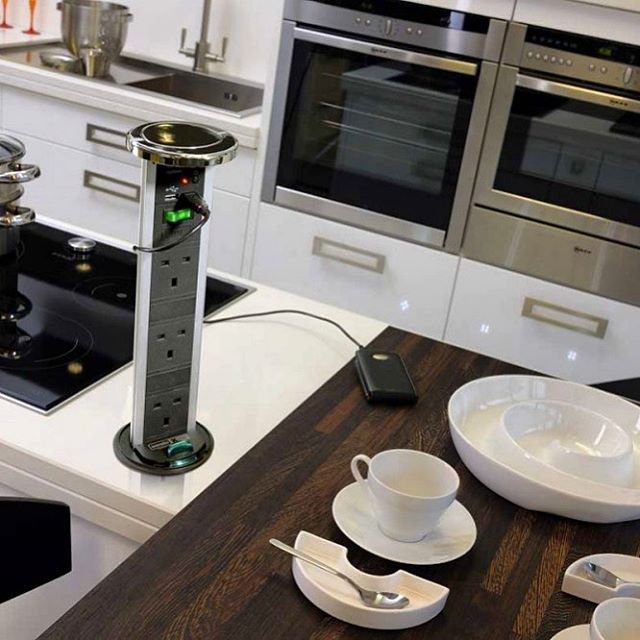
Vertical retractable countertop rosette
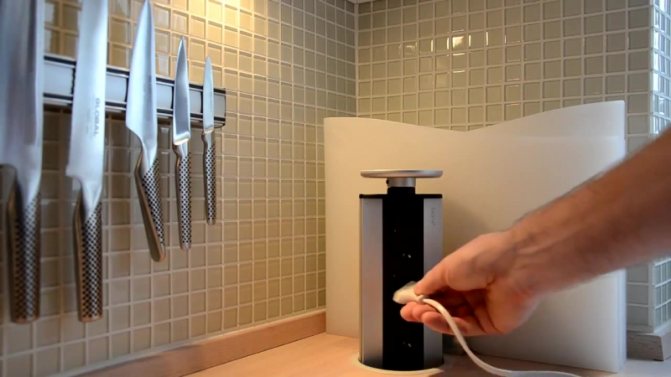
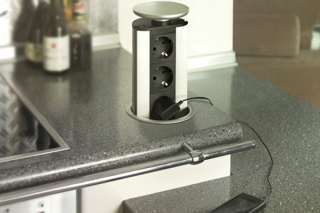 Vertical retractable socket
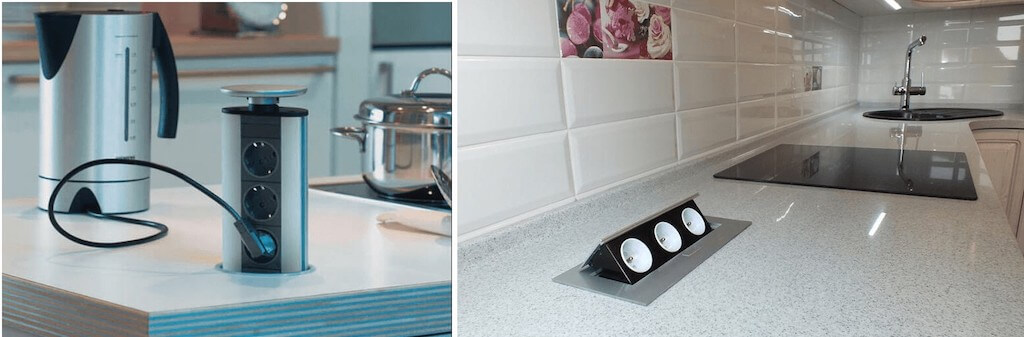
This type of socket is used most often.At the same time, their design is not the most practical and durable, since the “tower” towering above the tabletop can be accidentally hurt and easily damaged. In addition, the retractable vertical unit is prone to loosening, because when inserting the fork, you need to apply some force.




Horizontal retractable socket
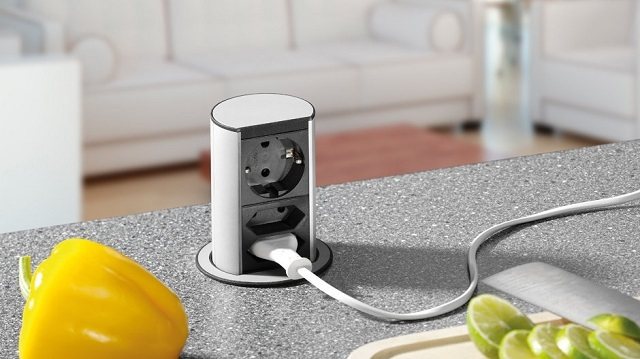
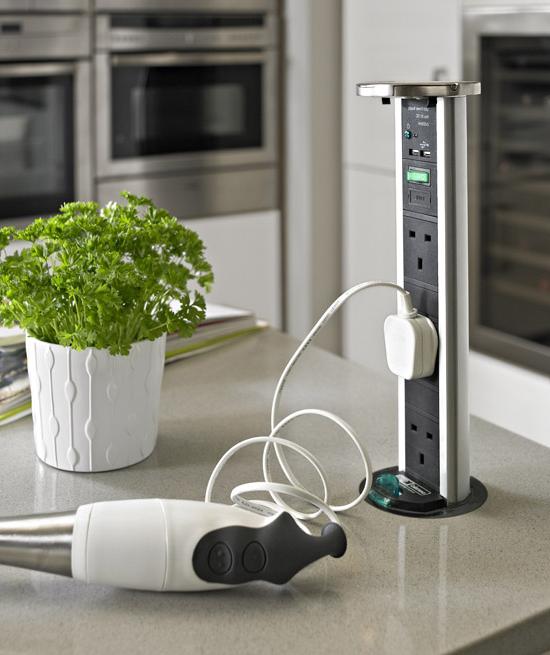
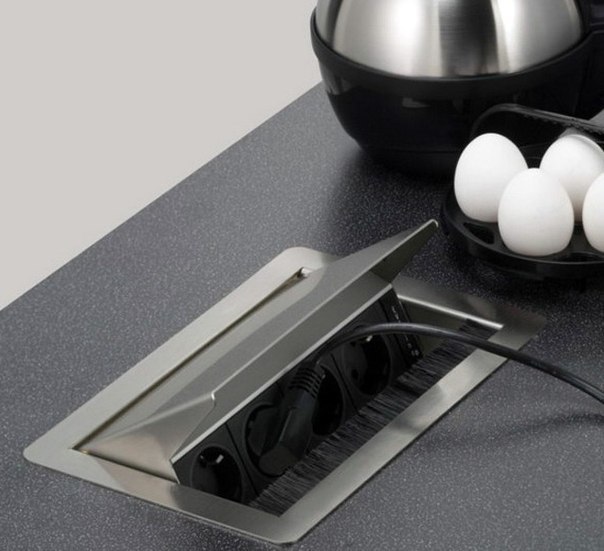
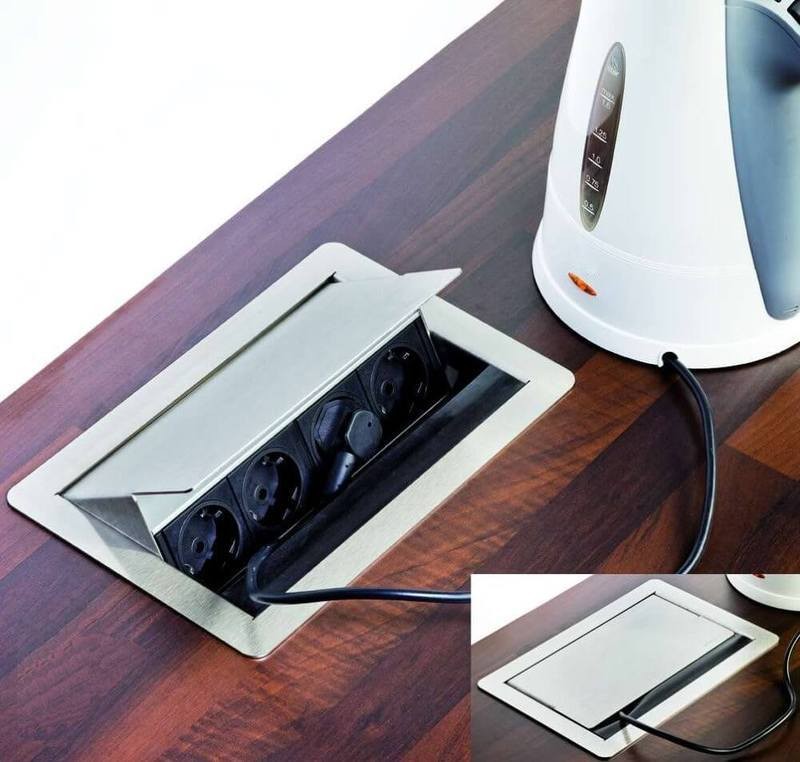
It differs from other retractable devices in the horizontal placement of the socket block and the height indicator of the retractable part. This design has high strength, and is also more convenient to use. Horizontal blocks also have a significant minus - the problematic connection of equipment with a side-type fork.
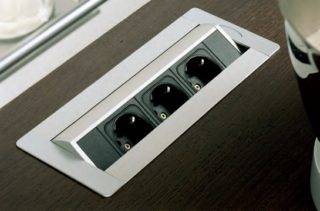
Retractable swivel socket block
 Retractable swivel socket block
Built-in swivel-type sockets are the most versatile among retractable designs. They are ideal for arranging kitchen worktops, therefore they are very reliable and demonstrate a high level of ergonomics. Swivel blocks are tightly fixed in the plane and withstand frequent insertion / pulling out of the forks, which means they are durable.
Unlike traditional pull-out units, this design is equipped with a swivel mechanism. It is triggered by pressing a finger on a certain area of the front cover. After opening the sockets, the device is fixed at an angle of 45 degrees.
According to the type of installation, rotary blocks are divided into 2 types:
- mortise - installed directly into the plane of the tabletop;
- corner - mounted in 90-degree corners (wall joints, wall / hanging cabinet combination).
Hidden sockets
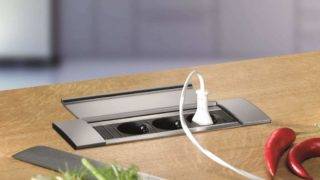 Socket built into the worktop
The secret block of sockets is considered the most reliable and durable, since it is devoid of movable mechanisms. In fact, this is a classic extension that is recessed into the furniture body or the plane of the tabletops. Such devices are unable to change their position. A decorative cover protects the unit from penetration of dust and moisture. To connect electrical equipment, the cover must be lifted up or moved to the side. This is the only disadvantage of hidden devices - the space on the work surface is hidden from the lid.
Where to install sockets in the apartment
Here is a small list of places where it is simply necessary to install sockets in the apartment. It is also necessary to measure how many outlets should be in the group and can be used simultaneously.
Everything needs a measure and remember that each additionally supplied outlet will cost you money. It will hit your pocket especially hard if you choose expensive mechanisms from such manufacturers as: Gira, ABB, Legrand, Siemens ...
Where to install sockets in the kitchen?
The kitchen is the most energy-rich place in the apartment. There are few sockets that are at the “standard” height from the floor of 300 mm. First place, where to install the socket in the kitchen - at the entrance to the left or right. This socket is required to turn on the vacuum cleaner. If the door opens into the kitchen, then it is necessary to take into account its width so that when it is opened it does not cover the outlet.
Next, in the kitchen, you need to mark up outlets for household appliances.
The most powerful energy consumer is the hob under it in the center, we bring out only the cable and leave it. There is no need to install an outlet. She performs very strongly and is of little use.In addition, most hobs come without a plug and the cable runs directly. The cable required is 3*6 mm2 for a single phase input and 5*2.5 if you have a three phase input.
We install the socket for the refrigerator behind the refrigerator in the center at a height of 100 mm from the floor. In this place, usually all refrigerators have a compressor, not a radiator.
We install the socket for the oven in the center at a height of 100 mm with a standard kitchen layout.
The dishwasher socket must be installed under the sink at a height of 300 mm from the floor. And best of all double. Under the sink, you can also connect a waste chopper or a filter with a pump that increases the pressure. Maybe a small water heater.
We install a socket under the hood at a height of 2100 mm in the center of the plate and retreating from it by 40 mm to the left or right. This arrangement will allow us not to get on the duct.
To connect other household appliances, we place sockets above the tabletop, height 1100 mm
Where to install sockets in the bedroom?
In the bedroom, we install sockets on both sides of the bed at a height of 700 mm. With this arrangement, they will be above the bedside tables. These sockets are needed to charge the phone and to connect floor lamps.
Also, the socket should be installed at the entrance, stepping back the width of the door if it opens inward for a vacuum cleaner.
We install sockets for the TV at a height of 1200-1400 mm in front of the bed in the center of its axis. For a TV, it is desirable to install a 220 V socket, TV and IP.
Also, do not forget to install sockets where the desktop will be. The best place will be to the right of the window. The number of outlets here can reach five under the table, one IP and 3-4 220 V. At least two above the table - for connecting a laptop, phone.





Where to install sockets in the bathroom?
For a washing machine, the height is possible in two versions: the first option is when the socket is permanently hidden or when there is constant access to it and it is located above the washing machine. Height 750 and 1050 mm respectively.
There is a GOST requirement, which regulates that sockets must be installed no closer than 600 mm from the tap. Also, they should not be placed above the bathroom.
Selection criteria and rules
The determining factor in the choice is the reliability of the design, which means that the materials from which it is made are of great importance.
Thus, the plastic base is less resistant to overheating, which can occur due to overloading or the use of a plug with an unnoticed defect.
Sockets with a ceramic base are less common on the market, however, they are more reliable in this regard.
Sockets with a protective case made of impact-resistant plastic are somewhat more expensive, however, the high quality of the material and its resistance to mechanical stress allow you to be sure of safety and exclude the possibility of frequent replacement of broken sockets.
You should also pay attention to the device for fixing the wires. Screw terminals are reliable and practically do not require any subsequent actions from the user.
Designed to improve ease of installation, key clips do not always hold wires tightly enough and often loosen over time. Loose keyboard clips will have to be tightened to ensure a normal connection between the socket and the electrical wiring.
A single, double or even triple socket will be chosen for installation in a particular place - depending on the number of connected consumers.
The parameters listed above affect reliability, but there are products on the market with "add-ons" that can make the use of sockets more comfortable, and their presence can also affect the choice.
Protective curtains
Very convenient sockets with insulating shutters that cover the contacts. In an apartment where small children live, they are almost irreplaceable. Unlike the "plugs" used to secure outlets, curtains cannot be removed, which virtually eliminates the risk of an accident.
Hinged lid
The cover is equipped with sockets that are installed in wet rooms: bathroom, bath, laundry.
When the outlet is not in use, the cover prevents moisture from entering inside.
Plug release device
A plug that fits snugly into an outlet requires effort to remove. In addition, in order to prevent the fastening of the socket to the plane from loosening from constant impact, it is necessary, when removing the plug, to carefully hold the socket with your hand. The pull-out device allows you to quickly loosen the grip by pressing the key, at the same time the spring device pushes the plug out.
Norms and standards for the placement of plinth and floor electrical outlets
When making power in the baseboard, you still need to take into account the regulations and standards for the placement of electrical outlets. Although there are no uniform standards. When laying hidden wiring, sockets are mounted at a distance of 90 or 30 cm from the floor, and this does not suit us.
But still, simple recommendations should be followed:
- install the outlet so that it has unhindered access
This is especially important in the children's room; - the socket should be used to power only one appliance. Better not to use tees; - placing sockets at the bottom of the wall saves space and reduces labor costs for laying wiring hidden in the wall
So, there are no uniform standards for the arrangement of floor sockets, and the best option would be to combine their high and low placement in the apartment.
Advantages and disadvantages
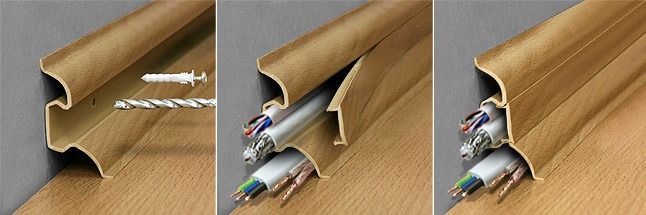
Installation of a plinth with wiring takes less time than laying wires in strobes
Plinth sockets have a number of positive aspects for the master:
- With the help of the multibox, you can place additional power points in a compact and organic way.
- Due to the low location relative to the floor, the sockets are not conspicuous, they do not visually cut a solid wall, and sometimes they are completely hidden behind furniture.
- The rich color range of multiboxes gives the master the opportunity to choose the product exactly to match the color of the wall border.
Varieties of plinth sockets
- All wiring is securely hidden by the cable channel, does not lie on the floor and does not stretch along the walls.
- No risk of running into old cables in the wall when installing new ones - safety for the master.
- No dusty work.
- The ability to install an additional outlet anywhere in the room without reference to norms and standards when chasing walls.
Plinth sockets also have some disadvantages. These include:
- Moderate impact resistance. With frequent mechanical damage, the multibox may break.
- Accessibility for children. In a house where there are kids, it is better not to install such sockets or mount them taking into account the arrangement of high furniture in order to block access to the power point.
- The negative impact of moisture on all wiring in the event of an accidental flood in the house or a spilled bucket of water directly on the outlet.
Installation process
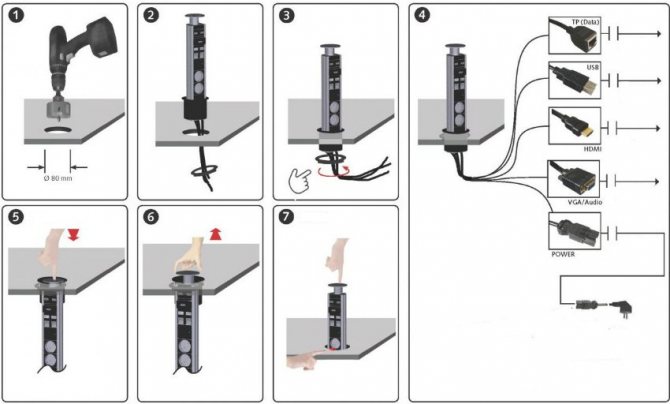
Consider the installation of a built-in outlet using the most common example - in a worktop:
- We make markings on the surface. We outline the inner contour of the block to be installed so that when it is immersed in the table, the sides fix it on the surface. Do not forget that the minimum distance from the back edge of the tabletop is 3 cm.
- Using a drill with a nozzle or a screwdriver, we drill a hole in accordance with the marked contour.
- We immerse the block in the hole and fix it with fixing bolts.
- We carefully attach the wire hidden in the cabinet body to the cabinet walls with clips so that it does not get tangled in the dishes during the use of the table.
- We connect the plug to a free outlet, check the operation of the unit.
If the nearest outlet is used by another constantly running electrical appliance, there are three connection options: either install a socket with two sockets, or use a double (which is highly undesirable), or cut off the plug and connect the wire directly to the outlet.
The main mistakes that are made when planning outlets in the kitchen
Minor errors are due to the fact that sockets are installed in inconvenient places. The owner either cannot reach them, or access to them is complicated and blocked. The absence of several additional power points can also be attributed to this group. They may be needed for additional equipment (for example, for charging a phone or laptop, connecting a vacuum cleaner or a table lamp).


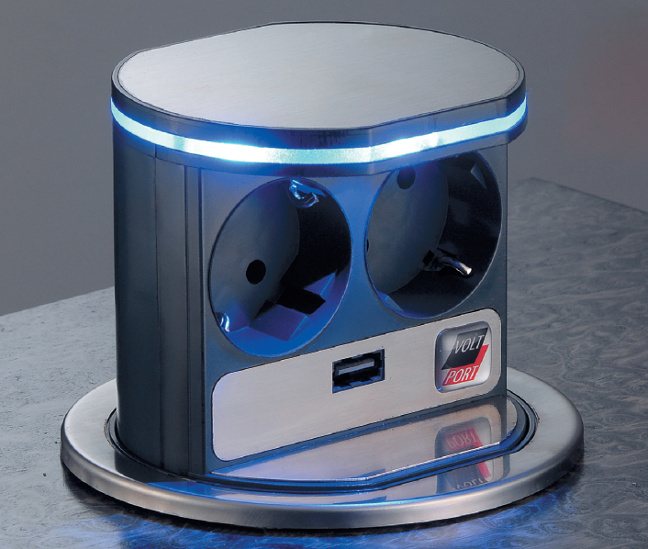

The main mistake is non-compliance with safety regulations.The installation location of the outlet may be incorrectly chosen - in the immediate vicinity of water sources or stoves. Also, the cross-sections of cables for connection or the power of devices may be incorrectly calculated. Possibility of breaking the insulation of the conductors
All these reasons can lead to serious consequences, so it is important to follow the safety rules.
Powerful appliances require separate lines that go to the shield. When designing, some people forget about this, and as a result, the electrical wiring cannot cope with the applied load.
A separate difficulty lies in connecting the refrigerator. It is forbidden to power them through an extension cord, and the wire from the device has a length of 1 m. This must be taken into account when designing the power point.
When choosing electrical products for the kitchen, you should not forget about the design component. The color of the appliances should not stand out from the overall style of the kitchen.
On the line with powerful electrical appliances, it is advised to install separate machines. In the event of a breakdown in the electrical wiring, the circuit breakers will trip and turn off the electricity.
Proper placement of electrical outlets in the kitchen is a guarantee of not only comfortable, but also safe work. A separate power point should be installed for each group of devices, and for products with increased load, a separate line to the switchboard is allocated. Before buying sockets, you need to draw up a layout plan, calculate the total load from household appliances and make sure that the electrical wiring can withstand such power.
Distances and placements
 When you have decided on the quantity, it's time to move on to calculating the required dimensions and indents.To do this, draw something like a sweep of the walls where the furniture will stand.
Here you will already need the exact dimensions of the kitchen - the length, height of the room. Gradually, in the form of rectangles, draw the equipment and all the cabinets.
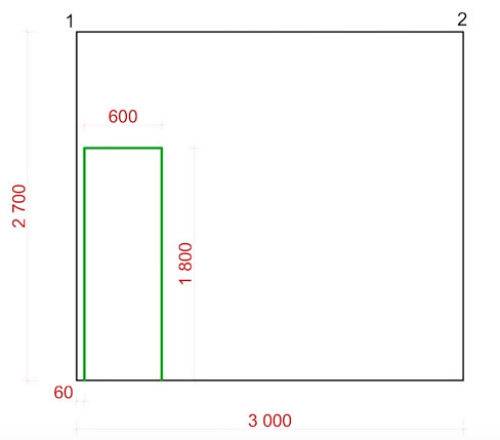
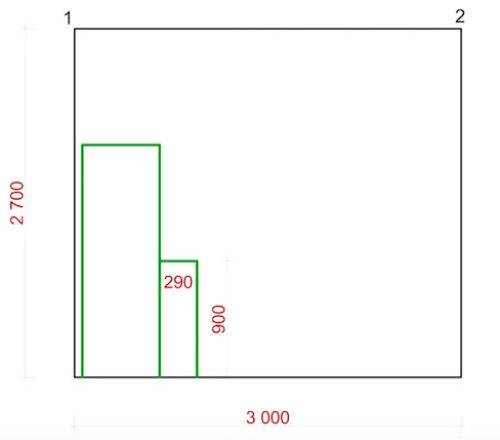
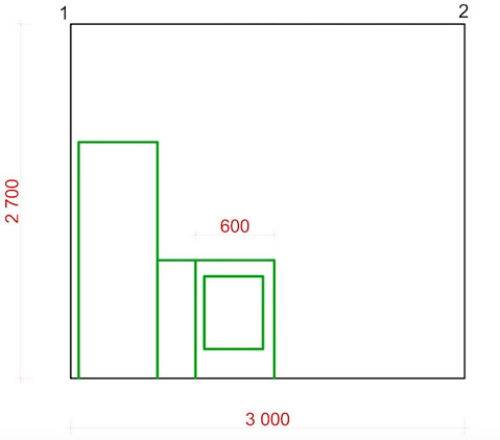
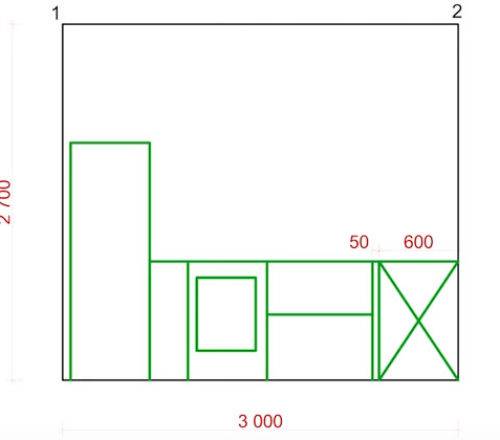
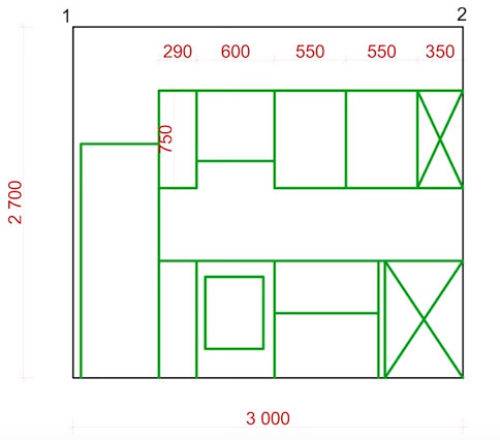
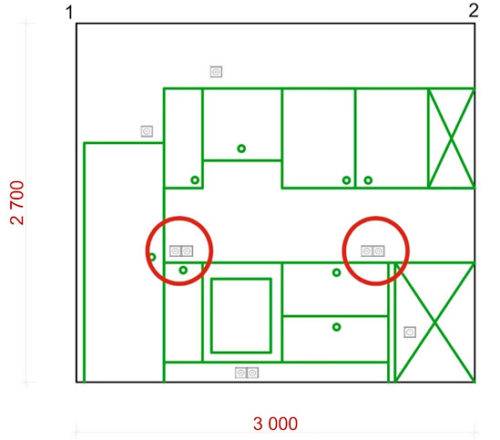
If the kitchen is corner, do the same with the adjacent wall.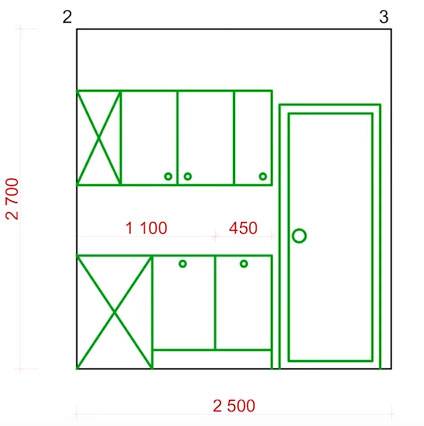
Next, take your plan with the number of outlets and transfer them to the wall sweeps. For each technique, follow your own rules.
Fridge
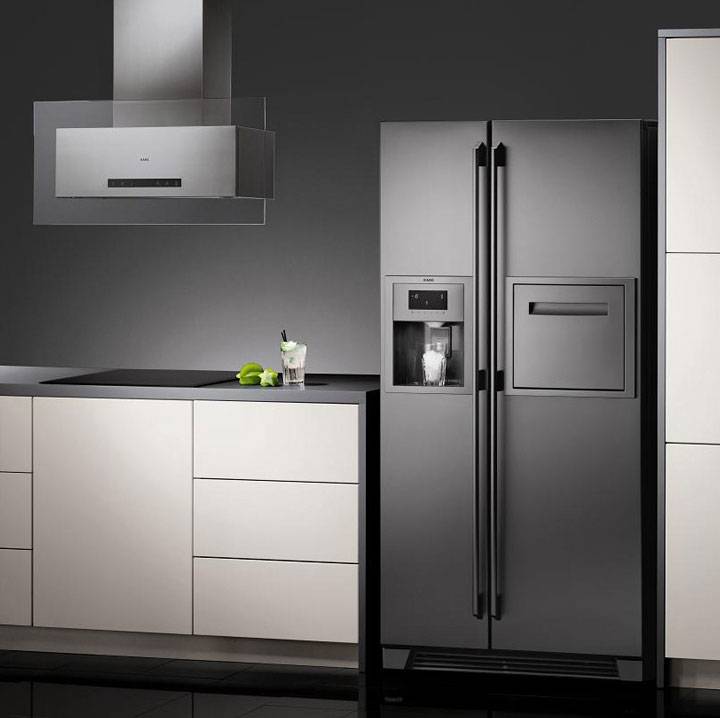 For refrigerators, manufacturers recommend placing the socket group under the appliance itself, that is, in the bottom row so that the connection is not visible.
It is impossible to say unequivocally with 100% certainty at what height the bottom row of sockets should be made.
Based on the recommendations of IKEA, they advise them to be placed at a height of about 10 cm from the floor, i.e. flush with cabinet legs.
This is explained by the fact that if you set it higher, then the embedded appliances will rest against the plugs.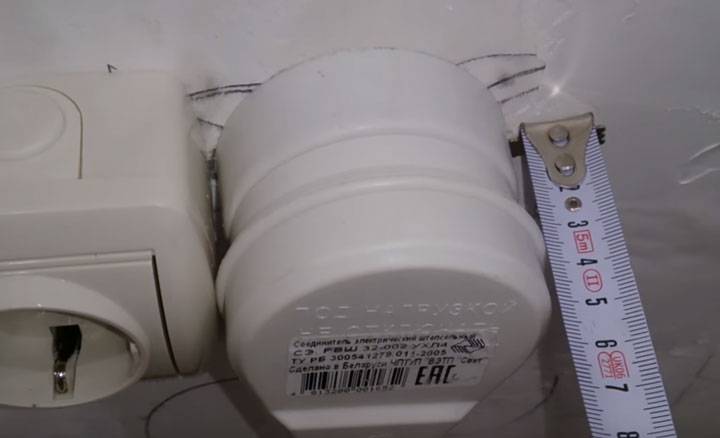
If you intend to turn off the plug quite often, then the bottom connection for the refrigerator is not always convenient. In this case, you can place the whole thing at the height of the working area.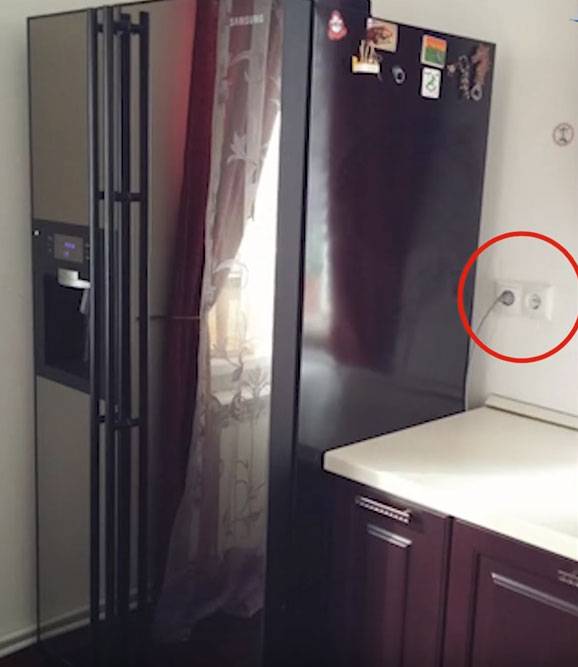
Sockets in the work area and above the countertop
The height of the tabletop is usually 85cm, maximum 90cm. Then there is a wall with a height of 550-600mm and then cabinets.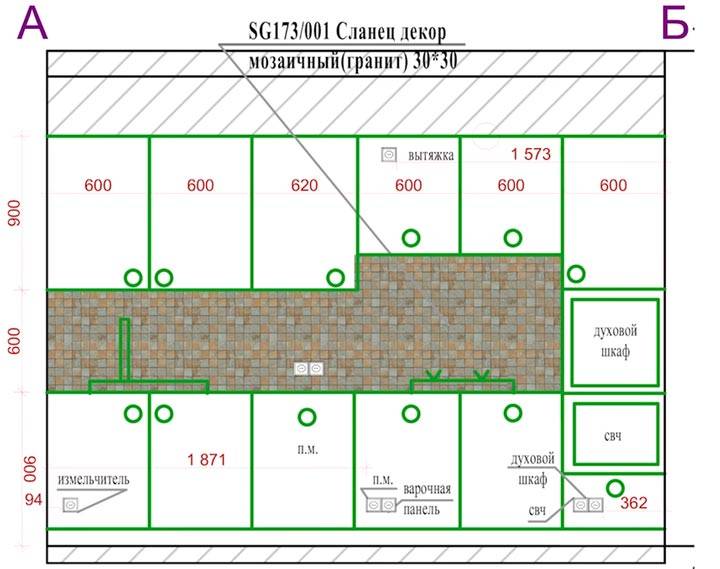
Place outlets in this area 105cm from the floor.
In this case, they will not be in the middle of the wall, and it will be convenient to cover them with the same microwave.
The minimum distance from the countertop must be at least 5 cm so that the kitchen plinth does not touch them. Locations - one set in any corner, plus between the hob and sink.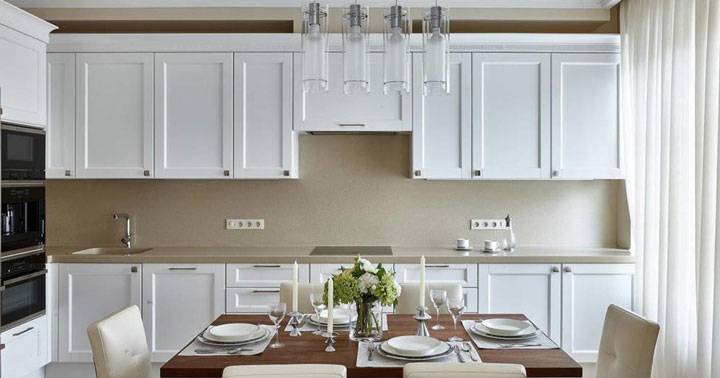

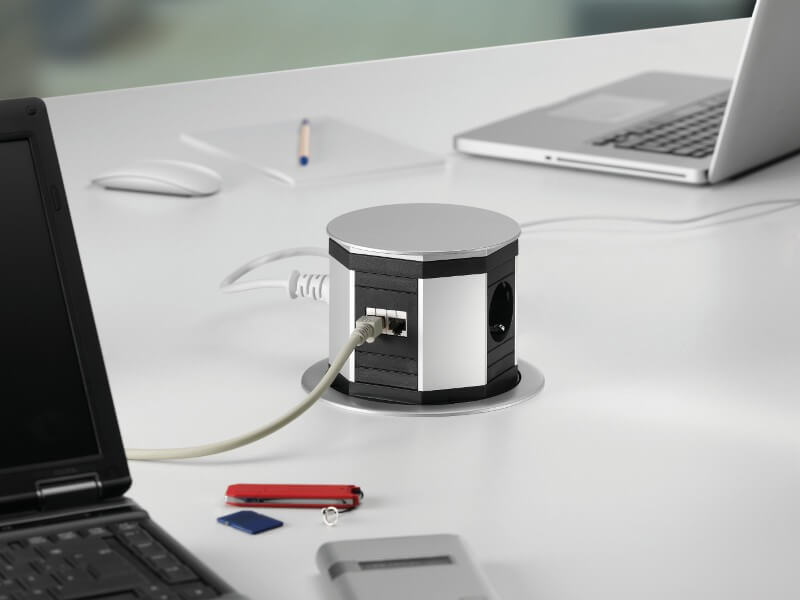


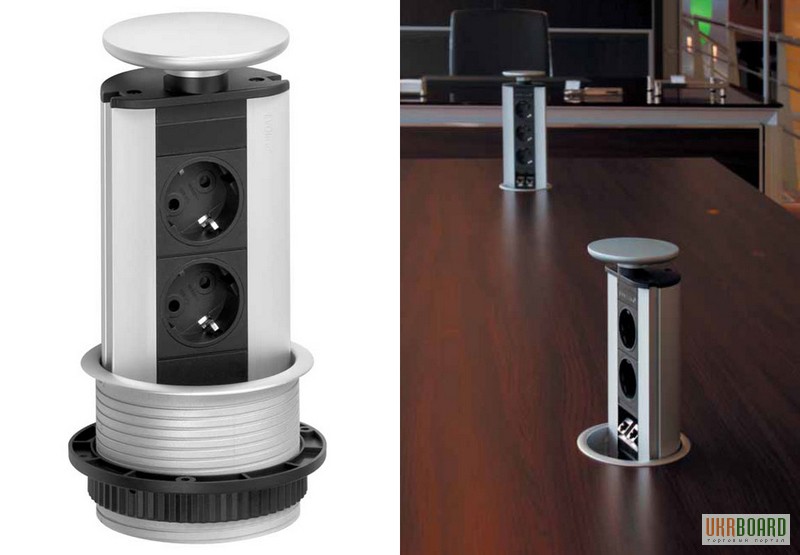
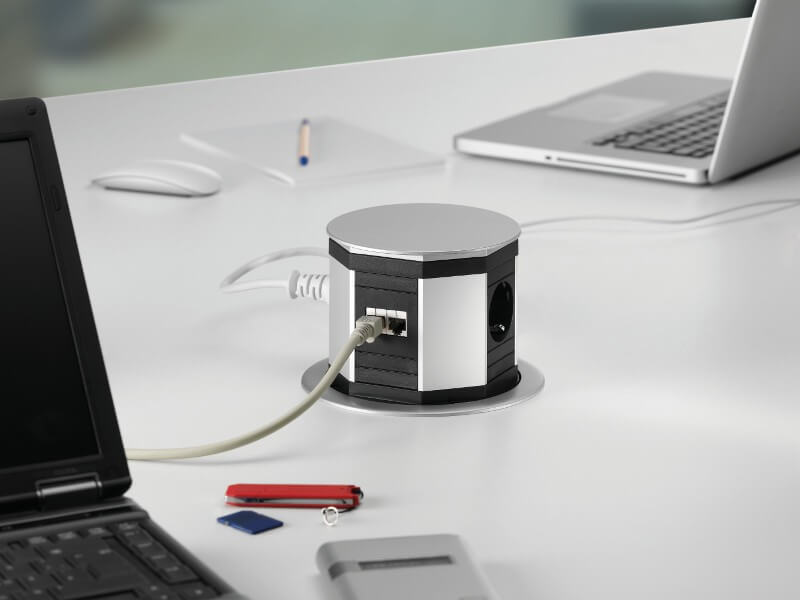


As mentioned above, at least two pieces.If you don't like the look of outlets above your kitchen backsplash, consider a pull-out unit from the countertop.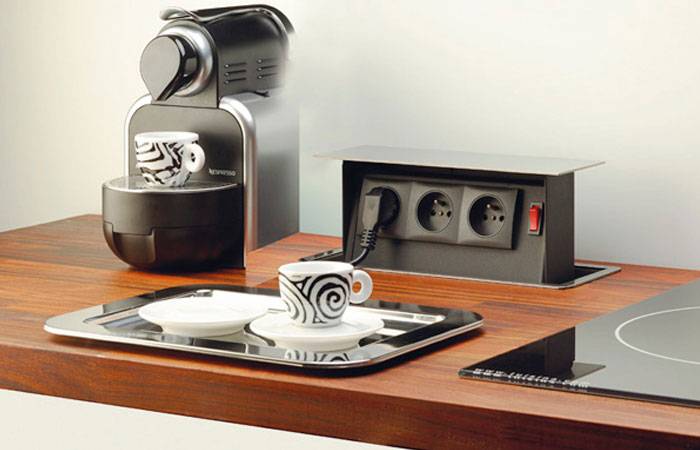
Be sure to consider whether there will be built-in appliances in the upper cabinets. For example, a microwave.
Under it, you will also have to make a separate outlet. Pull the cords from above to the countertop area not according to Feng Shui.
Hood
 Also at the top, at a height of 1.9m-2.0m, there is a socket under the hood. However, a lot depends on the brand. If this is a cheap option, then you can get by with the output of the cable and then connect it right inside the equipment.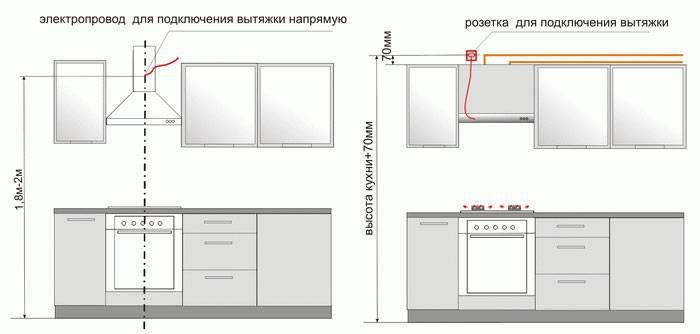
But if this is an expensive model, then it comes with its own fork. Cutting off the factory plug will void the warranty.
Cooker and oven
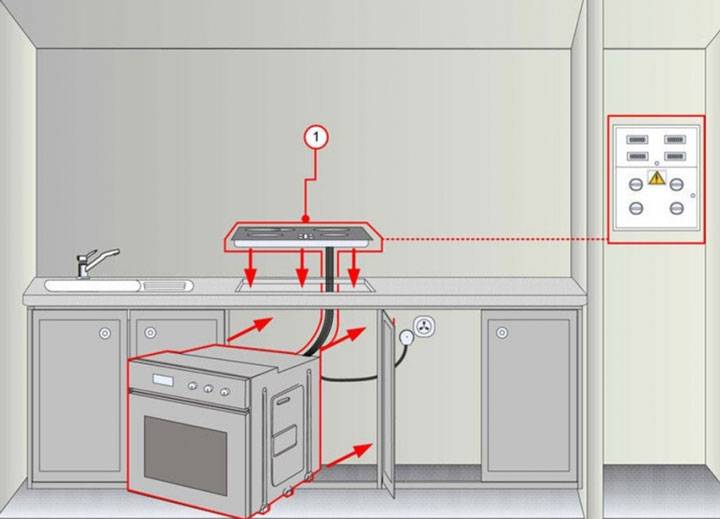 In the presence of a powerful hob, either a cable output is made, followed by a connection directly under the panel's terminal blocks, or a special power outlet is installed.
Ovens, unlike cooking ovens, come with ordinary forks, so there is no need to be smart here. Plug them into simple sockets. 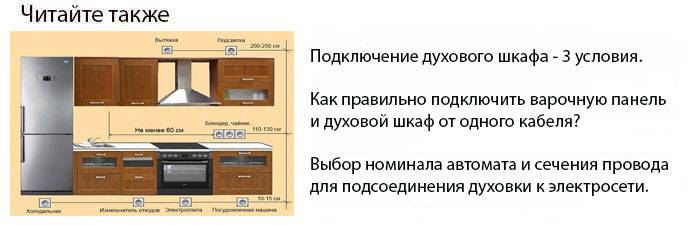
When cabinets with hinged doors are located to the left or right of the hob and oven, it is very convenient to place sockets right inside them. Step back 15-20cm from the edge and mount.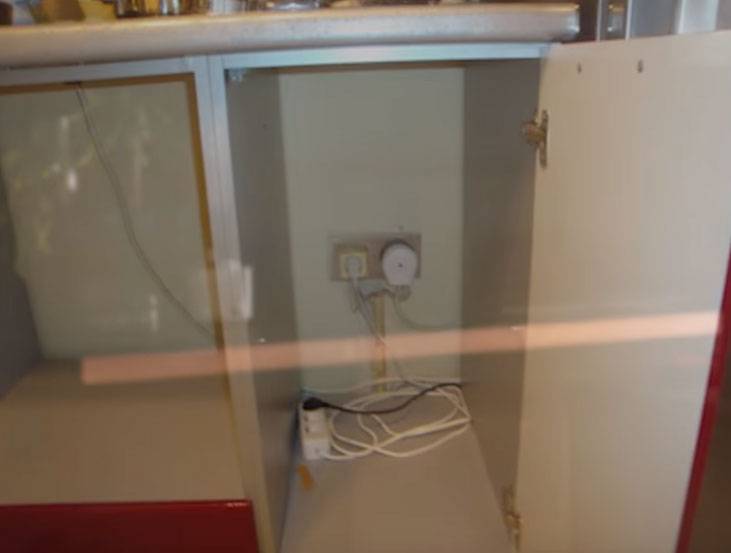
If this is not possible, then you will have to connect from the lower group.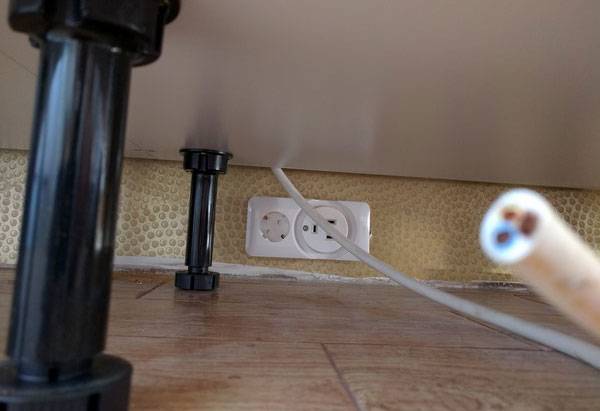
In the case of a separate installation of the oven from the hob, for example, at chest height, make a socket for it in the lower cabinet at a height of up to 750 mm.
Dishwasher
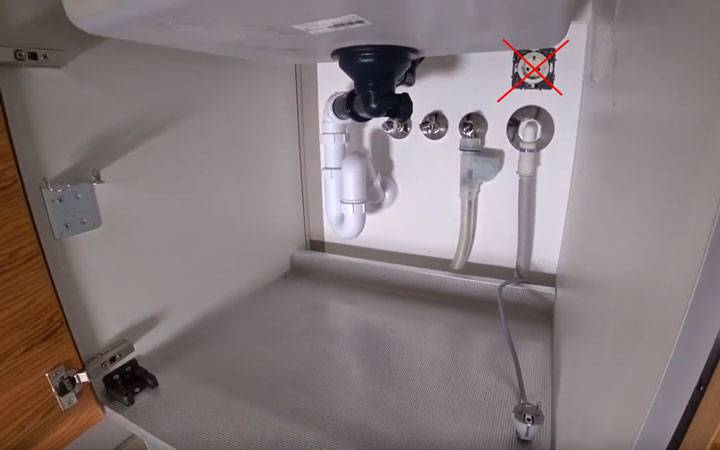 According to SP 31-110 2003 p.14.29, it is forbidden to make any sockets under and above sinks or sinks. Therefore, always retreat a few centimeters when installing the socket group near this plumbing. This applies to both the lower placement and the working area at the top.
It is also forbidden to place sockets behind the dishwasher and washing machine.
Near the dining table (if it is near the wall, and not in the center of the kitchen), it is advisable to plan one outlet.
On big holidays, with an influx of guests and relatives in the apartment, you will definitely need to connect something on the table - a mixer, juicer, food processor, etc.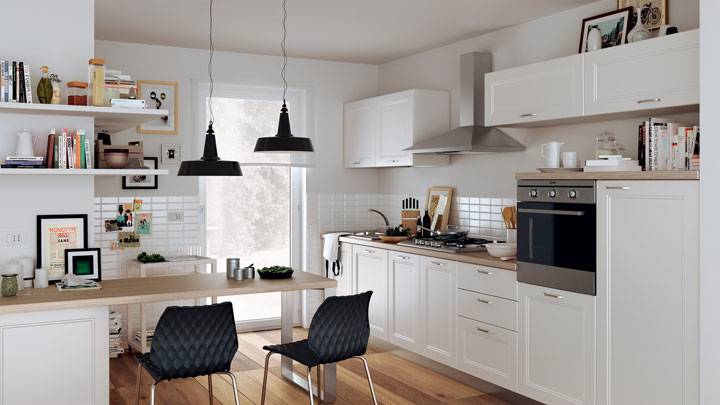
And on simple days, you can easily attach a laptop there when working in the kitchen.
Key Rules
The approved state regulations will help answer many questions on the correct installation of sockets, which must be relied upon in the process of performing electrical work. It is recommended to start with calculations that take into account the operation of specific devices and their estimated power.
It should be noted that in each case the relevant indicators are of an individual nature, however, in general, the following information will provide an approximate idea of the expected load:
- washing machine 1.5–2.5 kW;
- refrigerator up to 1.0 kW;
- boiler from 1 to 2.5 kW;
- dishwasher 1.5–2.5 kW;
- hob up to 7–8 kW;
- electric oven up to 2.5–3 kW;
- microwave oven up to 1.5 kW;
- kettle - 1-2 kW.
These items create the main load, and it is on it that you need to rely in the calculations. Other small household appliances, such as a mixer, coffee maker, toaster, etc., consume on average 250 to 800 kW and will not significantly affect the final picture.



Recommendations for wiring and machines
for a group of sockets into which devices up to 3.5 kW are connected, a 16A automatic machine is mounted
for devices up to 5.5 kW automatic 25A.Moreover, it is better to extend a separate group to this current collector
You can also navigate according to the following table for choosing machines and cables when connecting the hob: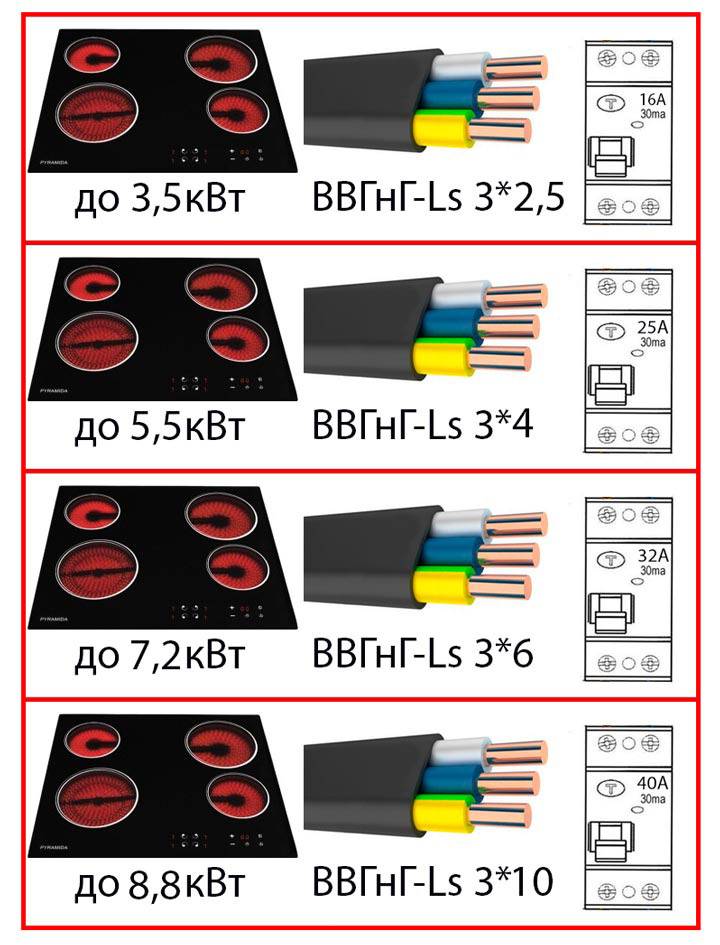
since the kitchen is a wet room, plus a huge number of items with a metal case, it is mandatory to install an introductory RCD for a current of 30mA in the shield in front of all machines
all sockets must have a grounding contact, for a rated current up to 16A, for hidden wiring
a separate socket is placed on each current collector
do not use carriers and extension cords in the kitchen
This is not only an additional load on the wiring, but also a potential short circuit (due to spilled tea or other liquid).



