
- Types and features of systems
- Closed drainage
- Open storm sewer
- Combined system
- Stormwater types
- The principle of operation of drainage and storm sewers
- Features of a domestic wastewater system
- Helpful Installation Tips
- Combined or separate system
- Open sewerage
- Point sewerage
- Mixed storm sewer
- Combined variant
- Hatch over the well
- The principle of operation of drainage and storm sewers
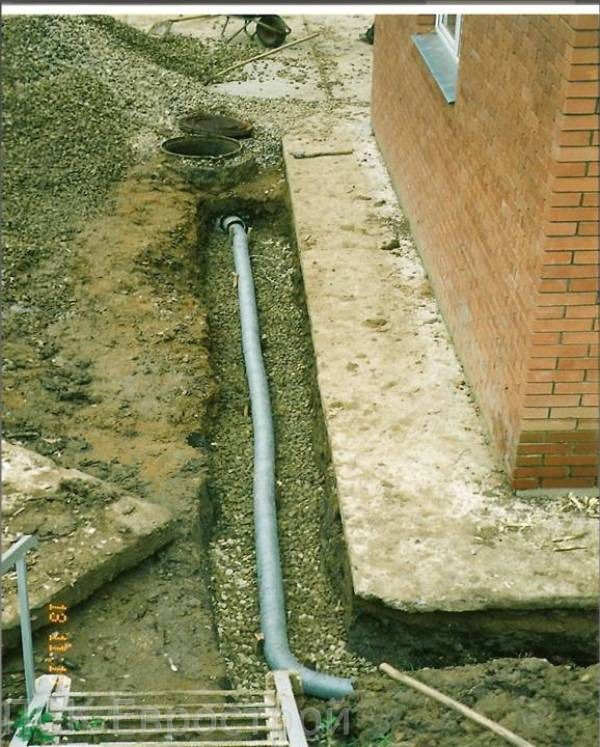
- Instructions for laying drainage pipes
- What is storm sewer
- Legislation
- Drainage
- Combination of storm and drainage sewers
- Plot lift
- How to make storm drainage of the site and around a country house
- Functions of the water drainage facility
Types and features of systems
Drainage and storm systems
has its own characteristics. They differ in tasks and specifics of installation,
operation and maintenance. There are also combined designs that can
combine the functions of both
types. The creation of these systems requires knowledge of the intricacies of their operation and maintenance.
Let's consider each of them separately:
Closed drainage
sewerage drainage system
necessary in cases where the soil is not able to absorb quickly enough
large amounts of moisture. The reasons for this are:
- high level of soil water occurrence;
- layers of clay that do not let water into the depths;
- the possibility of floods in the area of the site;
- a recessed type of foundation was used.
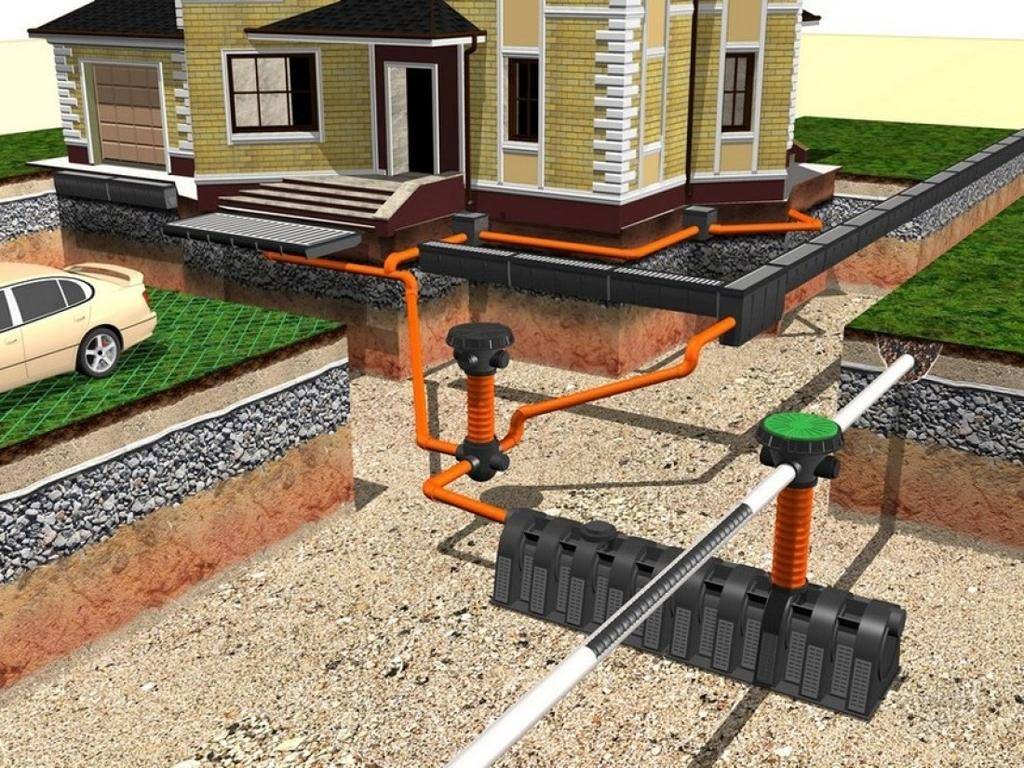
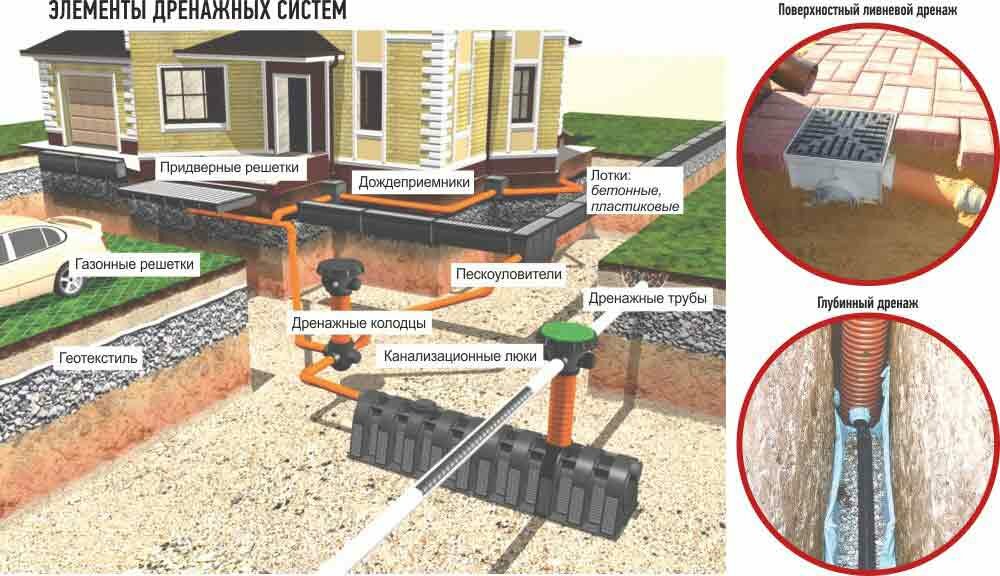
The composition of the drainage system
normal type:
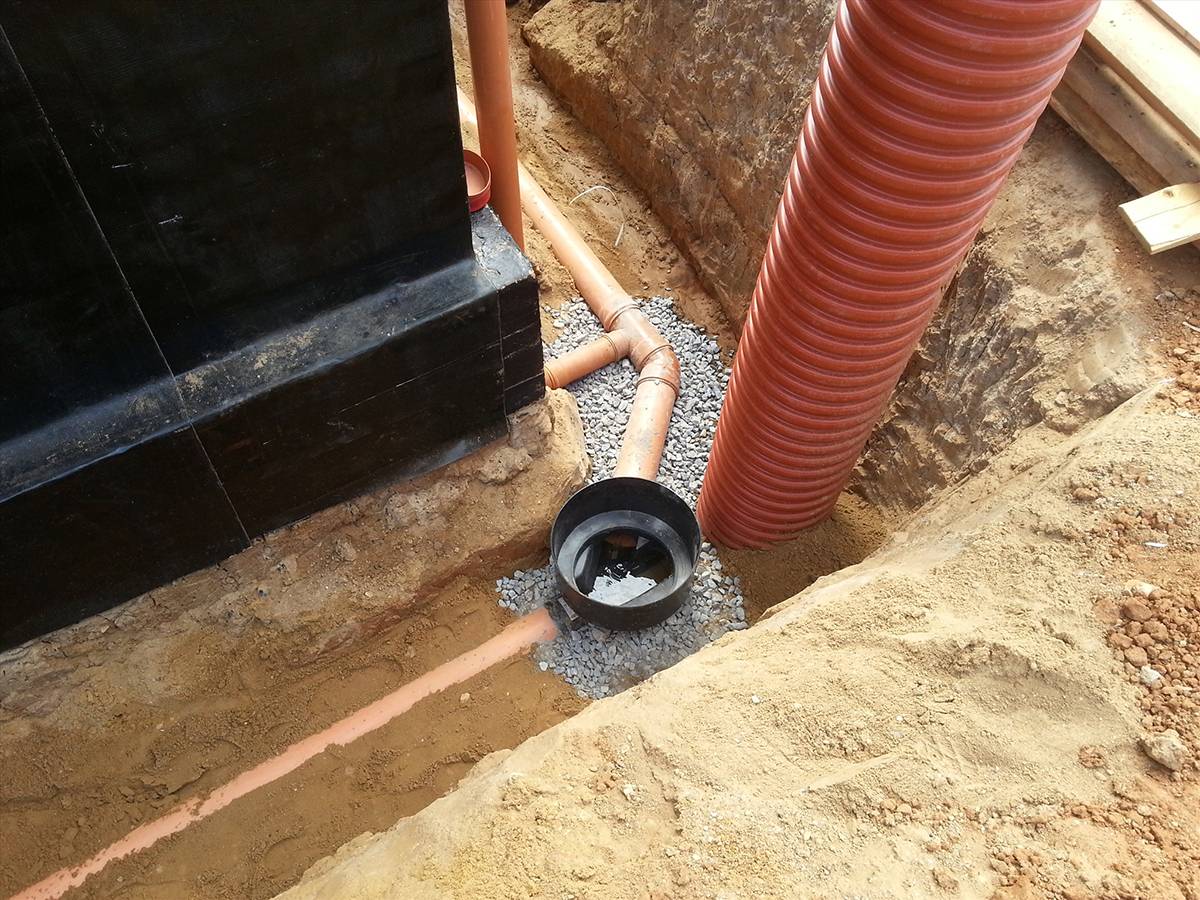
- drainage pipes for sewerage (drains);
- special containers - sand traps;
- drainage pipelines supplying moisture to wells;
- receiving wells.
From the wells, water flows into the common
reservoir, from where it is either discharged into the general network of storm sewers, or
used for own needs. In some regions, rainwater
represents a rather high value and is actively used for household
needs - watering plants, water for technical needs, etc.
The principle of the network is
collection of excess water by drains, supply to receiving wells and removal of moisture to the general
capacity. Sand and other solid particles settle to the bottom of the sand traps, which
need periodic cleaning. Minimum distance between drains (at
presence of clay soils) is 7-10 m, the immersion depth is from 1.8
m and less (the easier it is to absorb, the less the depth of immersion).
The sewer drain pipe is
the plastic pipeline punched on all length. It is usually sold
immediately wrapped with geotextiles, but sometimes you have to do it yourself. They are
laid in trenches
at a certain angle, providing an unhindered flow of moisture. Aggregate
pipelines serving the territory of a certain area, called a drainage field for sewage.
It is clear that its value corresponds to the size and configuration of the site. For
creating an effective system, first a diagram is created on which the optimal lines are determined
pipe laying, collector and storage tank locations.
The best option for creating a drainage system is parallel
construction of all types of sewerage during the construction of the house. Otherwise more
later work will destroy all the elements of improvement.
Open storm sewer
Storm water
sewerage is designed to collect moisture from the surface of the roof and soil. She is
consists of the following components:
- roof drainage system - gutters, receiving funnels, vertical pipes;
- open and closed channels;
- receiving wells - collectors;
- pipelines transporting effluent to the main storm sewer or to drain points.
The composition of the elements of the storm
sewerage is close to the set of components on which the sewerage drainage system works.
The differences between them are in the way wastewater is collected. The design differs
pipes - drainage perforated along the entire length, and sewer -
solid, forming a sealed cavity. The similarity in the method of purifying water from
sand (by settling in sand collectors) and further transportation to
dumping or disposal sites.
Combined system
Exist
combined systems that combine drainage and storm sewers into a single
complex. This option is convenient for creating in small areas where
there is not enough space for two independent networks. Usually use one trench under
installation of both pipes. They do not interfere with each other, are at the required angle,
perform their functions without hindrance. Stormwater pipelines
are laid only in separate trenches, since they fill all the drainage
field is inappropriate. Often
combined systems with forced pumping of wastewater are being created. This is right
for areas located in depressions of the relief.
Stormwater types
Sewerage, designed to drain melt and rainwater, is of two types:
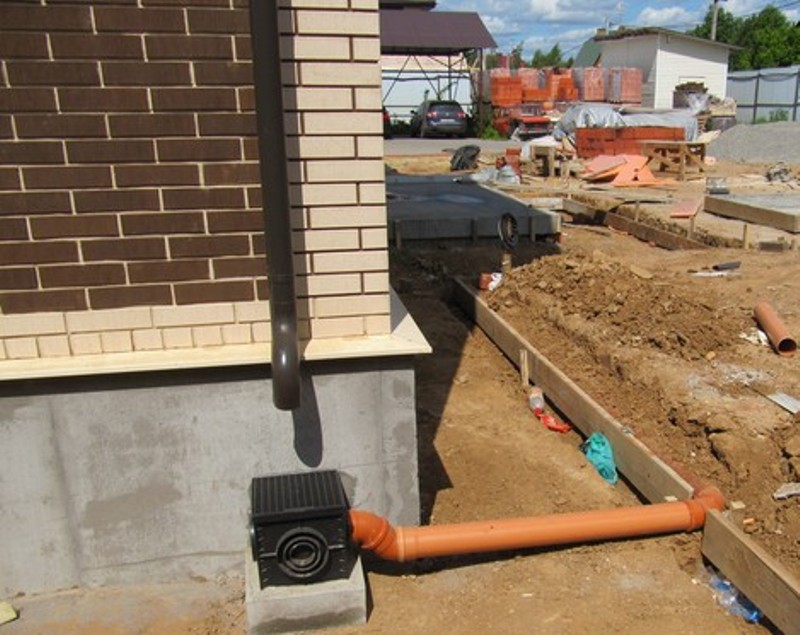
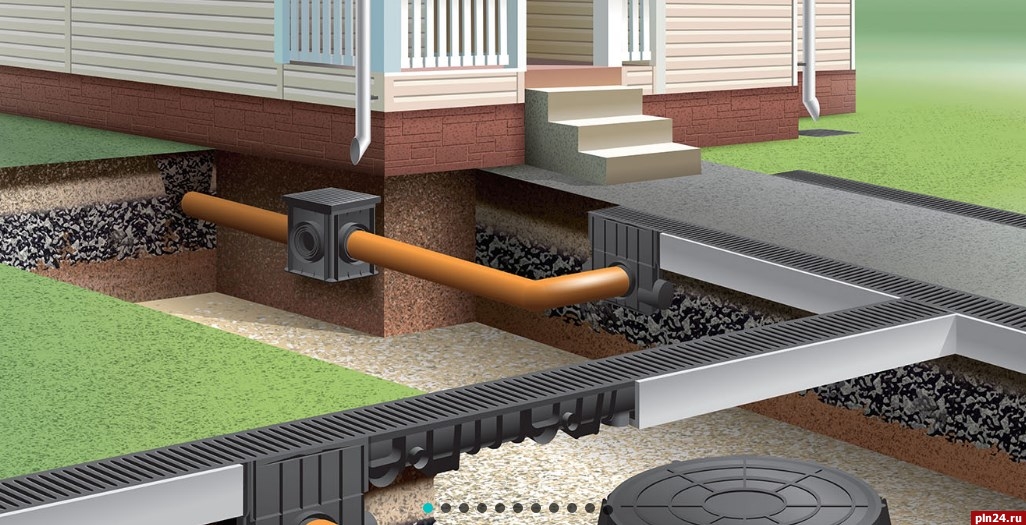
Point provides collection of water from the roofs of buildings. Its main elements are rain inlets located directly under the downpipes. All catchment points are provided with special sedimentation tanks for sand (sand traps) and are interconnected by a single highway. Such a sewerage system is a relatively inexpensive engineering structure that can cope with the removal of yards from roofs and yards.
Linear - a more complex type of sewer designed to collect water from the entire site. The system includes a network of ground and underground drains located along the perimeter of the site, along the footpaths and the yard. Usually, water from drainage systems placed along the foundation or protecting the garden and garden beds is diverted into the common collector of a linear storm. The system is extremely sensitive to slope towards the collectors. If it is not observed, the water will stagnate in the pipes and the drainage system will not be able to perform its functions.
According to the method of water drainage, stormwater is divided into:
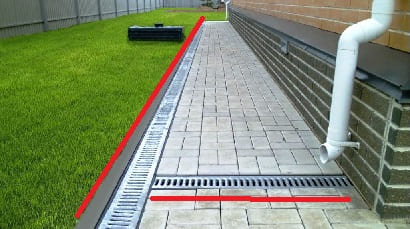
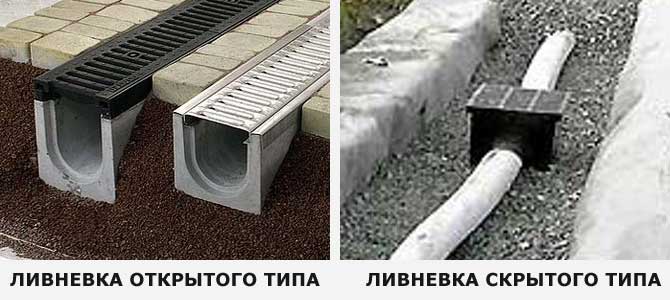
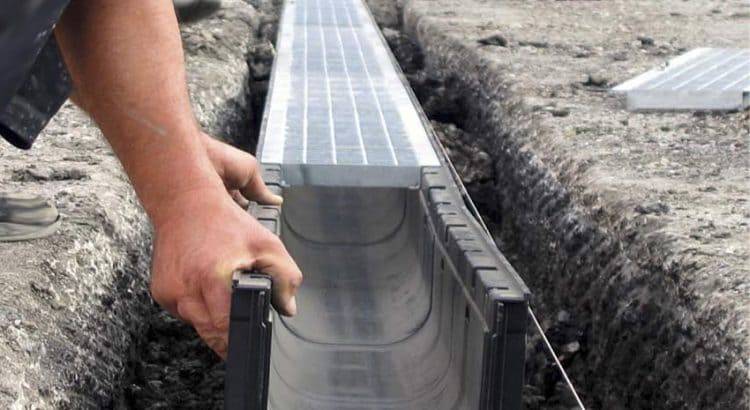
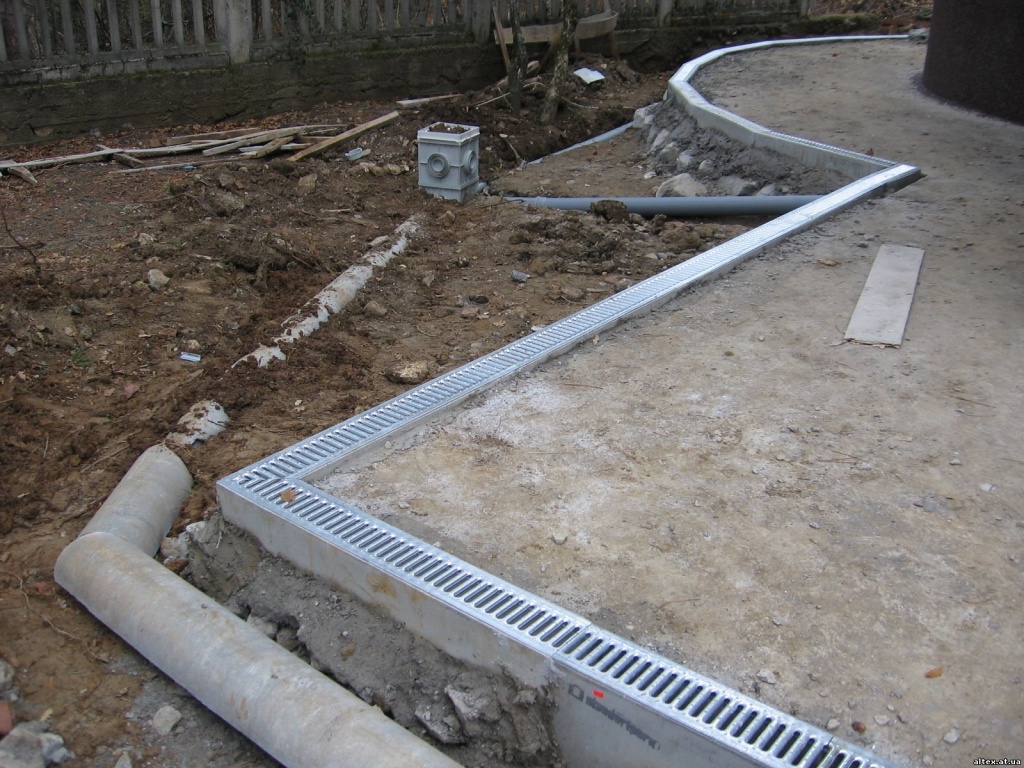
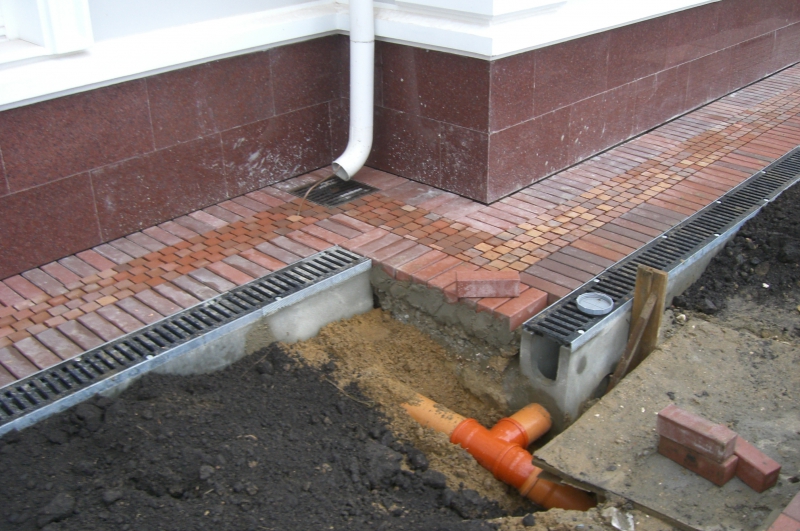
On open systems that collect water through trays and deliver it to collectors. The trays are covered with shaped gratings on top, which perfectly complement the landscape design and provide protection from debris. Such systems are mounted in small private areas.
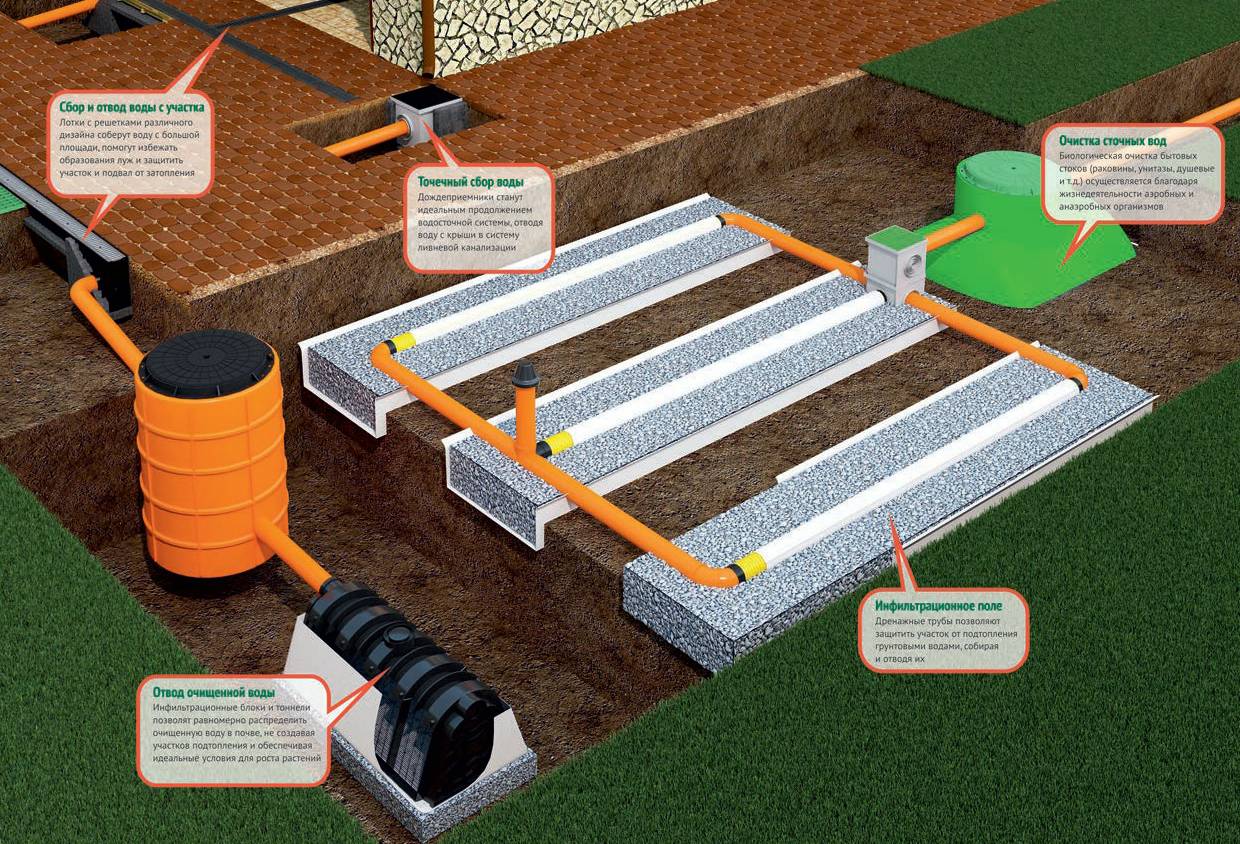
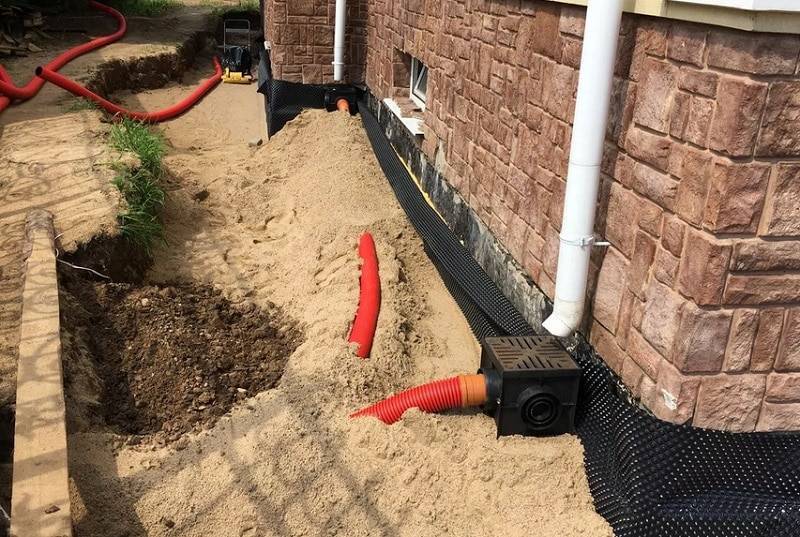
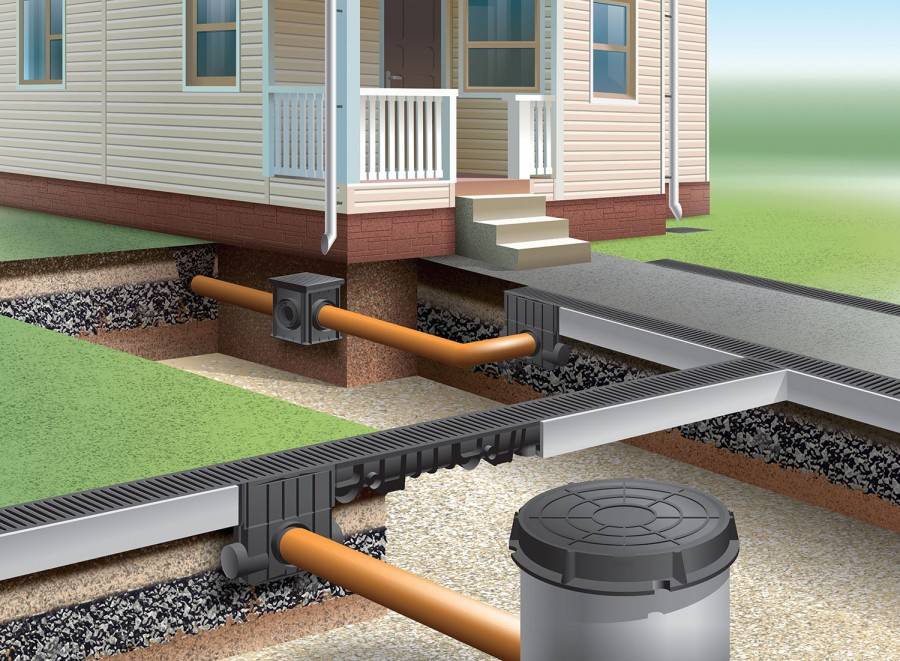
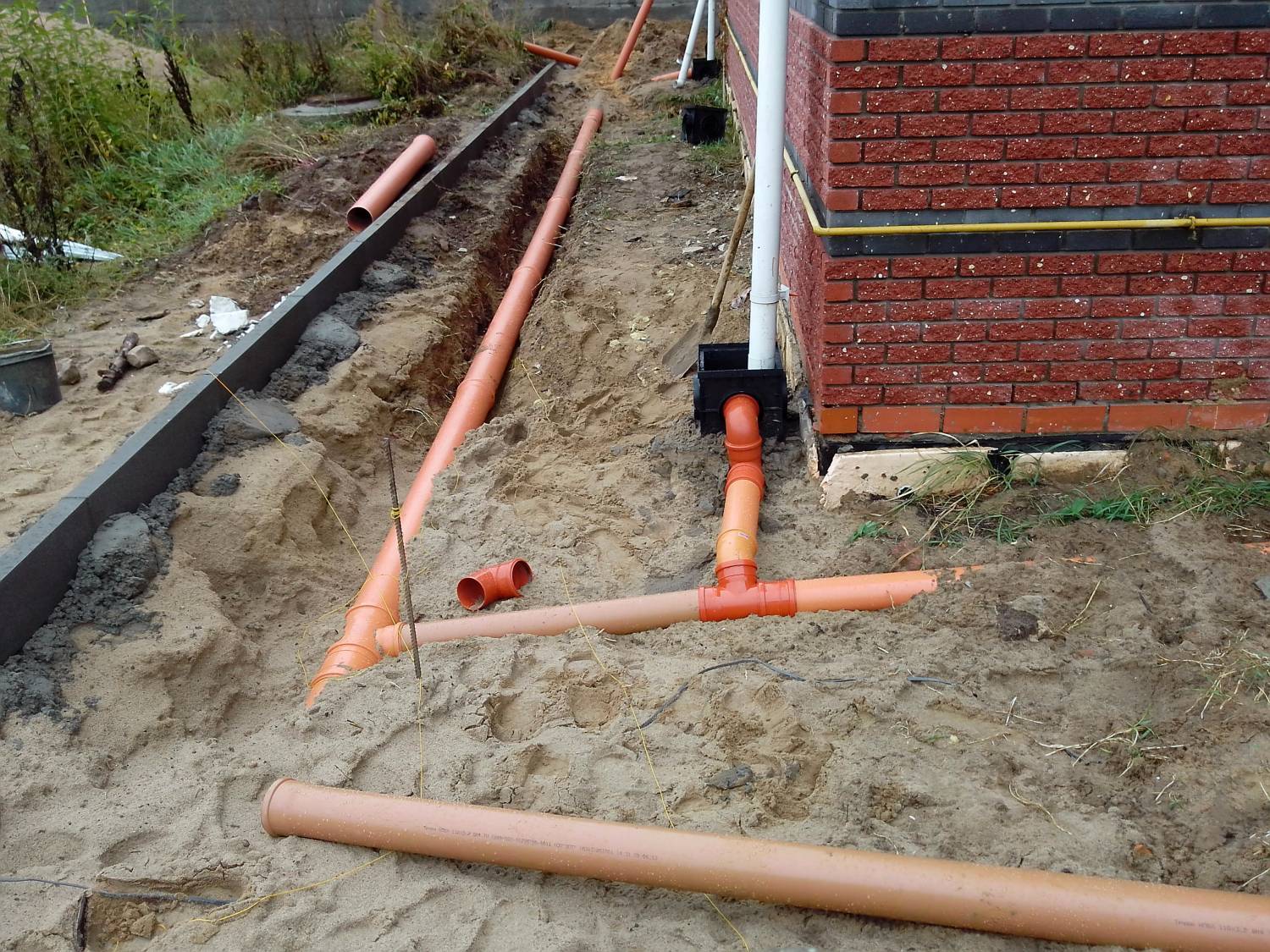


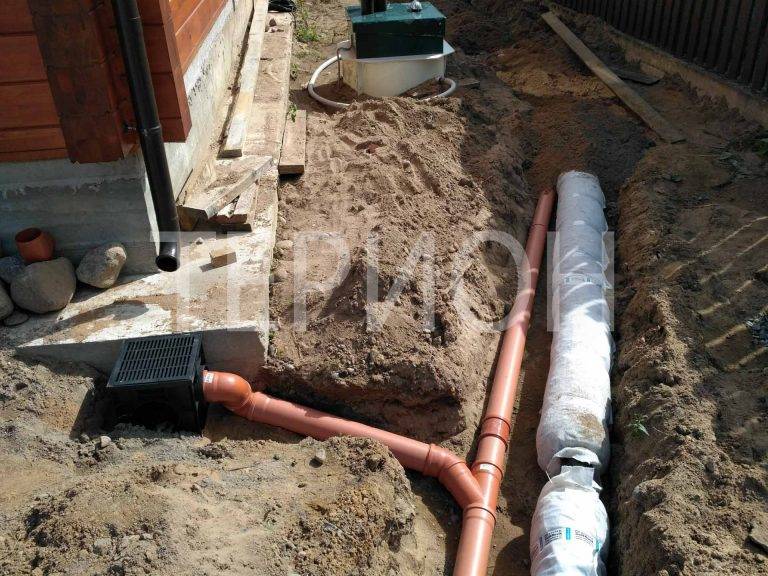
Such a project is implemented in practice by constructing canals that connect the catchment trays to each other and, ultimately, divert the collected water outside the designated area.
For mixed-type drainage systems - hybrid systems that include elements of closed and open systems. They are built most often to save the family budget. Outdoor elements are easier to install and cost less.
For closed systems consisting of storm water inlets, flumes, a pipeline and a collector that opens into a ravine or reservoir. This is an ideal solution for draining streets, industrial sites and suburban areas with a large area.
On the sewerage of open type in industrial execution. The main structural elements are concrete trays, on top of which lattice metal sheets are superimposed. By the same principle, open stormwater schemes for private housing construction are built.
The collected water is discharged through networks of pipelines laid and hidden underground. As a rule, the collected precipitation products are discharged to treatment facilities and further into the water area of natural reservoirs.
Separately, it is necessary to highlight the ditch (tray) system for collecting and discharging rainwater. This storm sewer scheme, along with a simple scheme for its manufacture, is inherent in the versatility of operation.
Ditch storm sewerage has the advantage that, together with the function of removing rainwater, it can play the role of a supplier of moisture for agricultural plantations. It is also an economical construction option compared to other projects.
Thanks to the ditch design, it is possible to organize not only quite effective drainage of atmospheric precipitation products.The same system can be successfully used as an irrigation structure, for example, for the needs of a household (dacha) economy.
The principle of operation of drainage and storm sewers
Storm sewerage: point drainage system. Point elements are needed to collect precipitation, whether it be rain, melted snow, melted hail. Water can be sent through the gutters to the drainage system, and then sent to special ditches with gratings, through which water will be removed from the site. It is very important when the building is located on a slope, since when choosing the right angle, it will not be necessary to build additional gutters, but to drain water directly into the ditches.
With linear drainage, water is discharged through gutters, funnels into a special main system consisting of pipes that are suitable for drainage and storm sewers. Further along this main system, the effluents enter the collector, and then, depending on the project, the water may go into the reservoir, or maybe beyond the site.
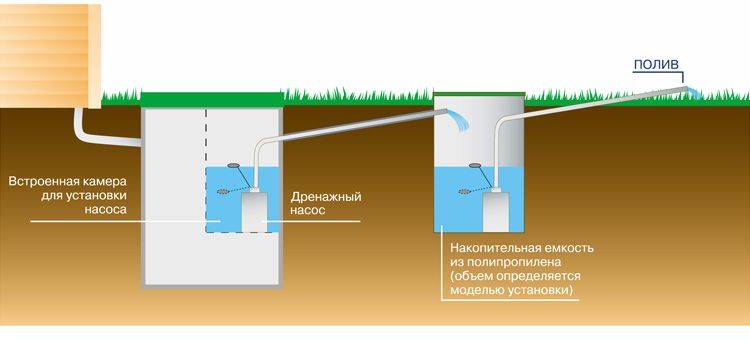
Drainage system with storage tank and site irrigation
With deep drainage, water from rising groundwater is gradually, in separate parts, discharged into the well, and from there it is pumped out and discharged. Such a system has 3 types:
- Horizontal;
- Vertical;
- Wall mounted. If there is a basement or basement in the house, it is required to divert groundwater from them. Wall drainage copes most effectively - a moisture collector is arranged near the walls, and the wall itself is carefully waterproofed.
Features of a domestic wastewater system
Household (K1, fecal)
wastewater systems are designed to remove waste products
of people. The composition of domestic wastewater is considered the most difficult, since the sewer
the residential sector pour everything that is horrible. Waste collection is not random, pipelines
connected to plumbing drain sets, kitchen sinks, washing machines and dishwashers
machines.


Household systems are divided into
internal and external. The first are connected to the plumbing and are inside
buildings. The latter receive effluents from internal sections and supply them to the OS. Discharge of fecal water into storm water
sewerage is basically impossible. Most rain systems are open,
pass through grooves on the surface of the earth. In addition, in winter, rain
nets are empty. Effluent cannot be transported through them, since
how the liquid freezes. This is the main difference between the two systems.
Another
The difference between the storm and domestic networks is the uneven load. household
runoff flows more evenly, and storm flows occur only during
precipitation or spring snowmelt.
Helpful Installation Tips
- Despite the fact that it rains mostly downhill and vertical rain is rare, you should not skimp on the less flooded side. A complete and reliable stormwater system in everything is an effective protection of the foundation of the house and the entire site as a whole.
- In order to check the performance of the system, you need to pour several buckets of water from the roof. It is advisable to carry out this procedure before the start of each rainy season.
- Water from the drainage well (collector), already purified, can be used to water the garden or vegetable garden.
- In places where the pipeline "turns", it is recommended to install manholes for visual control of the system.
Combined or separate system
In a private house, storm sewers are open, point and mixed.Each of them has its own purpose, and they differ in device.
Open sewerage
This design is efficient and easy to manufacture. The system is made as a network of plastic, concrete or steel gutters placed on the soil surface. With their help, water from downpipes enters a special container or a common sewer. The gutters must be covered from above with special decorative gratings to prevent debris from entering them. Parts of the gutter are connected and treated with a sealant. This type of storm drain is able to collect moisture from a very large area; water can be directed into it not only from the roof of a residential building, but also from different sites, sidewalks and garden paths.
Point sewerage
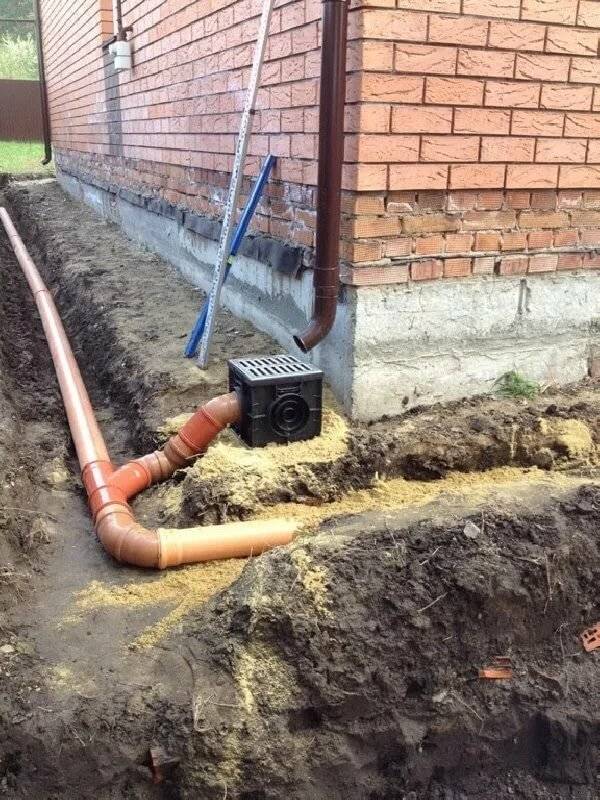
When using point storm sewers in a private house, all pipelines must be placed under the surface of the earth. The water coming from the roofs flows into the storm water inlets, protected by decorative gratings, and from them it enters the underground pipeline. On them, she goes to the places of collection, or beyond the boundaries of the homestead territory.
Mixed storm sewer
These systems are used when you want to reduce labor and money costs. It can use elements of any storm sewer systems.
Often, different sewer systems are located nearby or are located in parallel, so there is a desire to save money and combine different systems. For example, connect all systems to an existing well. It must be warned that this is not worth doing, with heavy rain a lot of water enters the well - about 10 m2 per hour, and it will fill up very quickly, sometimes the water even starts to overflow.If the sewer from the house is connected to it, then the water will flow into the sewer pipes, as a result, your drains will not leave the plumbing fixtures. When the water level in the well drops, there will be a lot of garbage inside, it will have to be cleaned, otherwise the sewerage from the house will not be able to work normally.
When rainwater enters the drainage well, everything will be even worse. Rainwater during a downpour enters the system, all pipes will be filled, and it will begin to flow under the foundation. The consequences will not please you, in addition there will be silting of the drainage. It is unrealistic to clean this system, and a lot of money will have to be spent to replace the pipes.
There is only one conclusion - for storm sewers, it is imperative to make your own capacious well.
Combined variant
Since both systems are responsible for their work area, the choice in favor of drainage or storm water is made in accordance with the characteristics of the site. In regions with infrequent rains and dry soil, stormwater will suffice. If the soil is wet, and there is little rain, they stop at the drainage sewer.

A plot with high groundwater in a zone with a humid climate is a headache for the owner. There is also storm water and drainage. You can reduce the amount of work and reduce financial investments by building a combined system.
Loading …
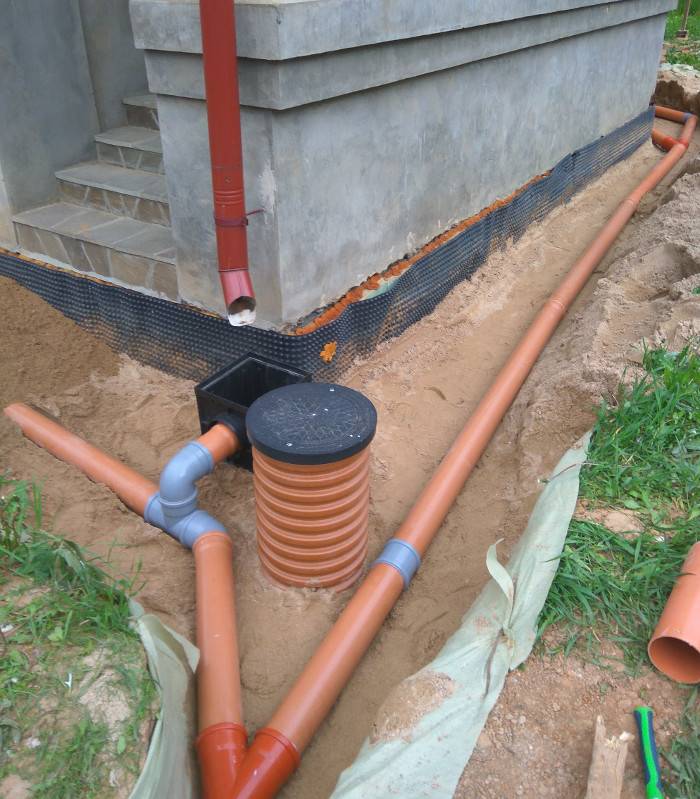
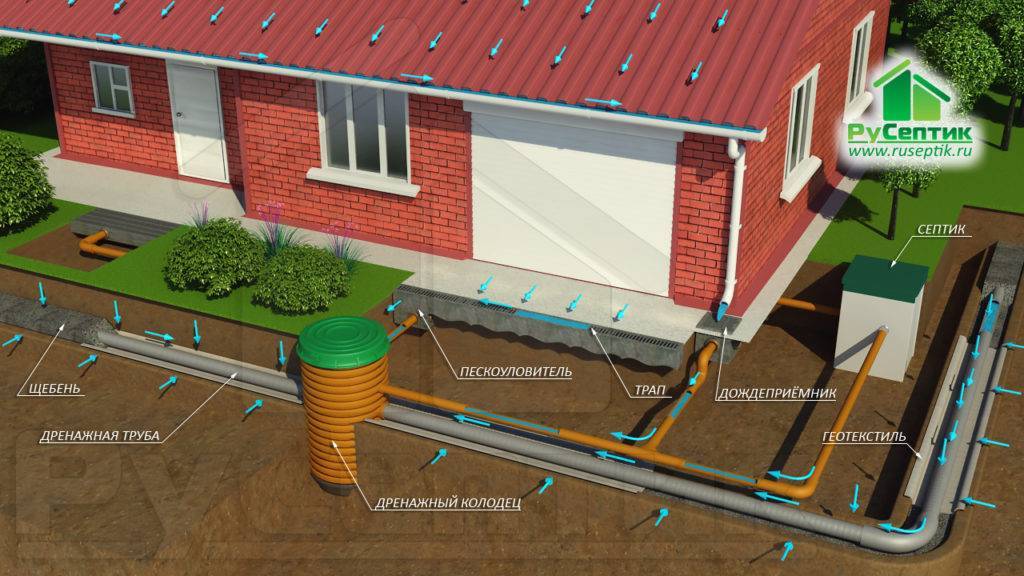
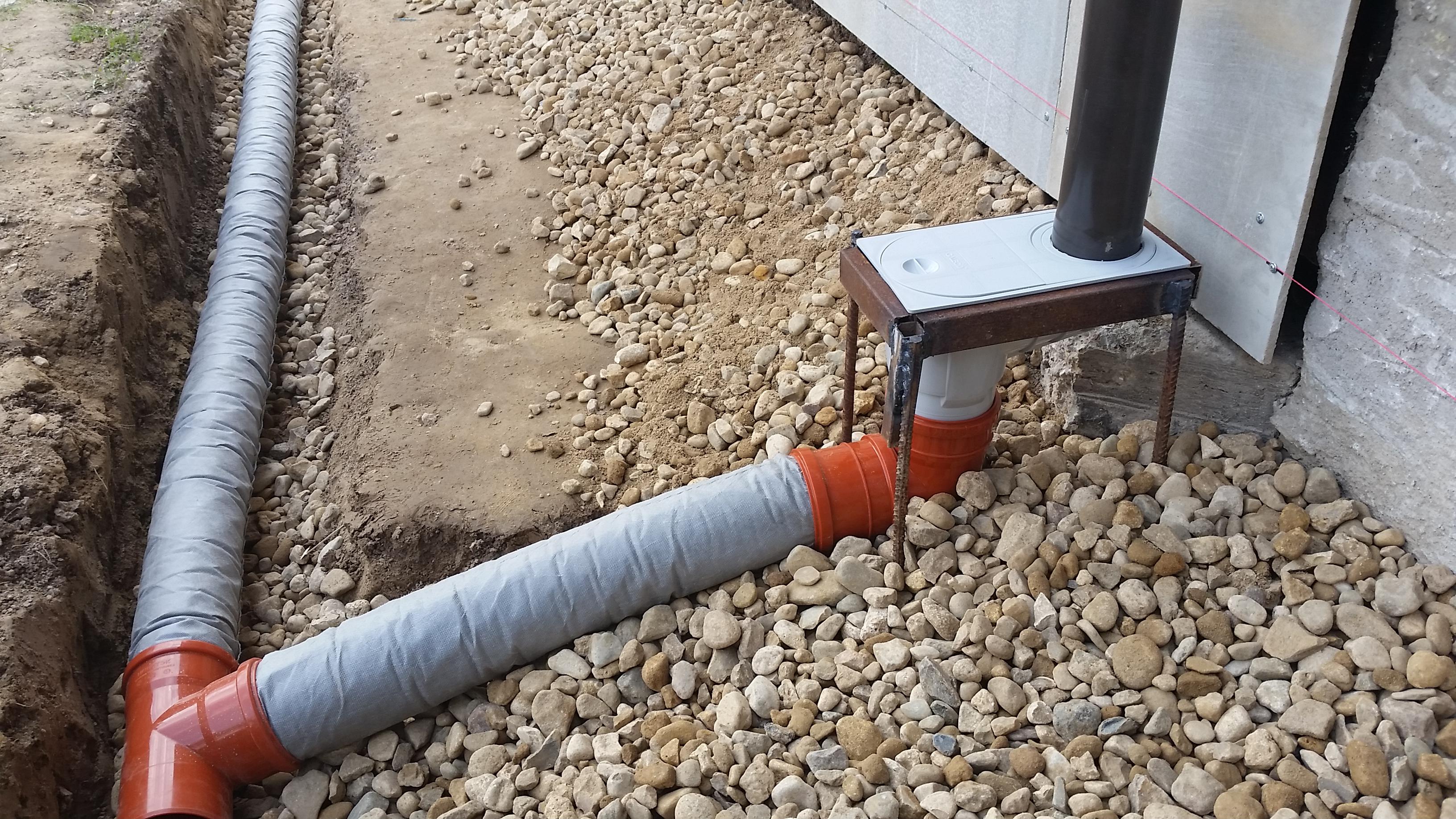
- through a nodal tee, water from the outside and from the inside is drained into a drainage well;
- pipes for drainage are laid out throughout the site (digging trenches) so that they collect water at all points;
- the end of the drainage pipes is led into the wells or outside the site;
- a storm drain collects water and also diverts it into drainage trenches or directly into a water collection well.


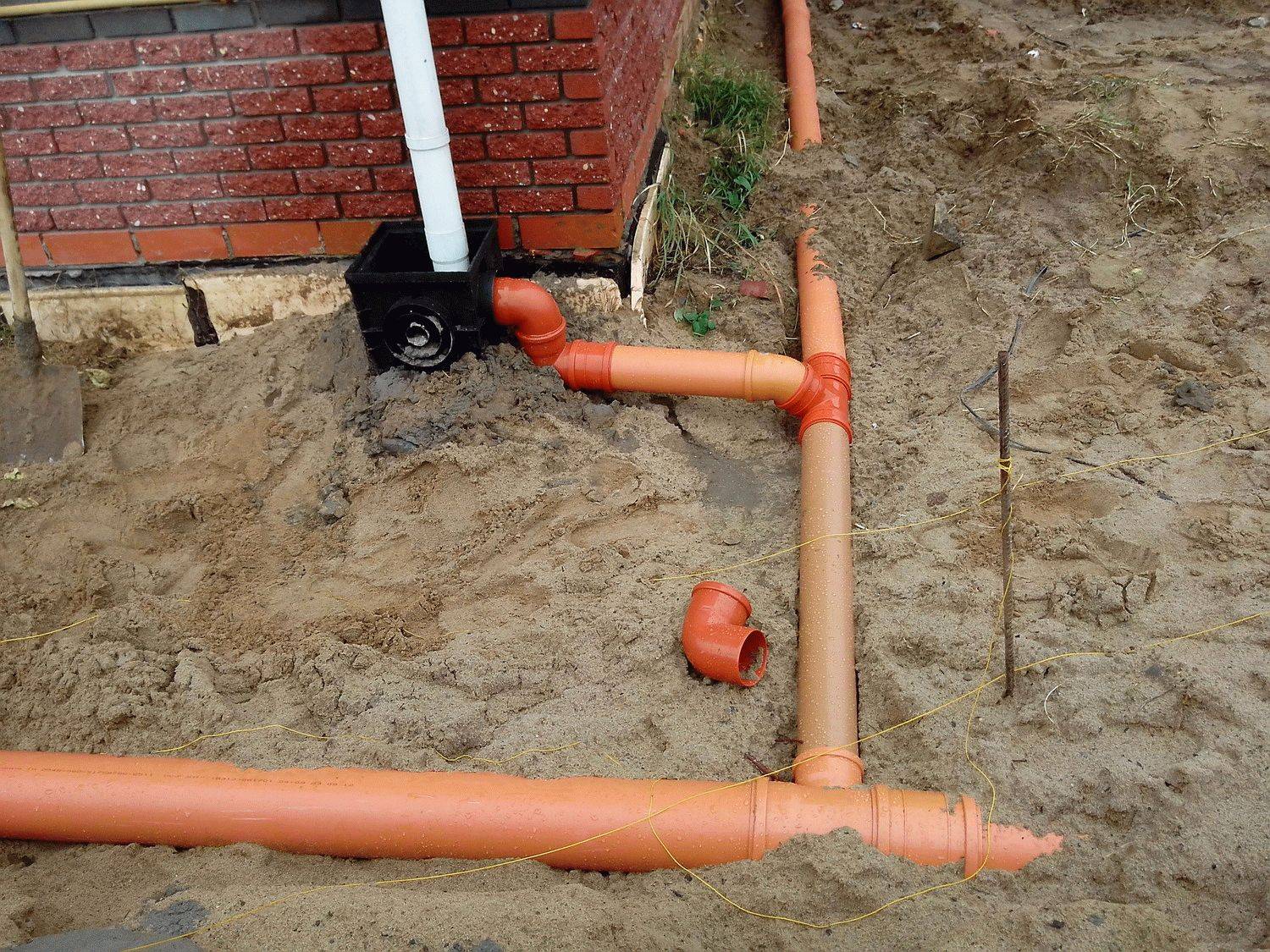
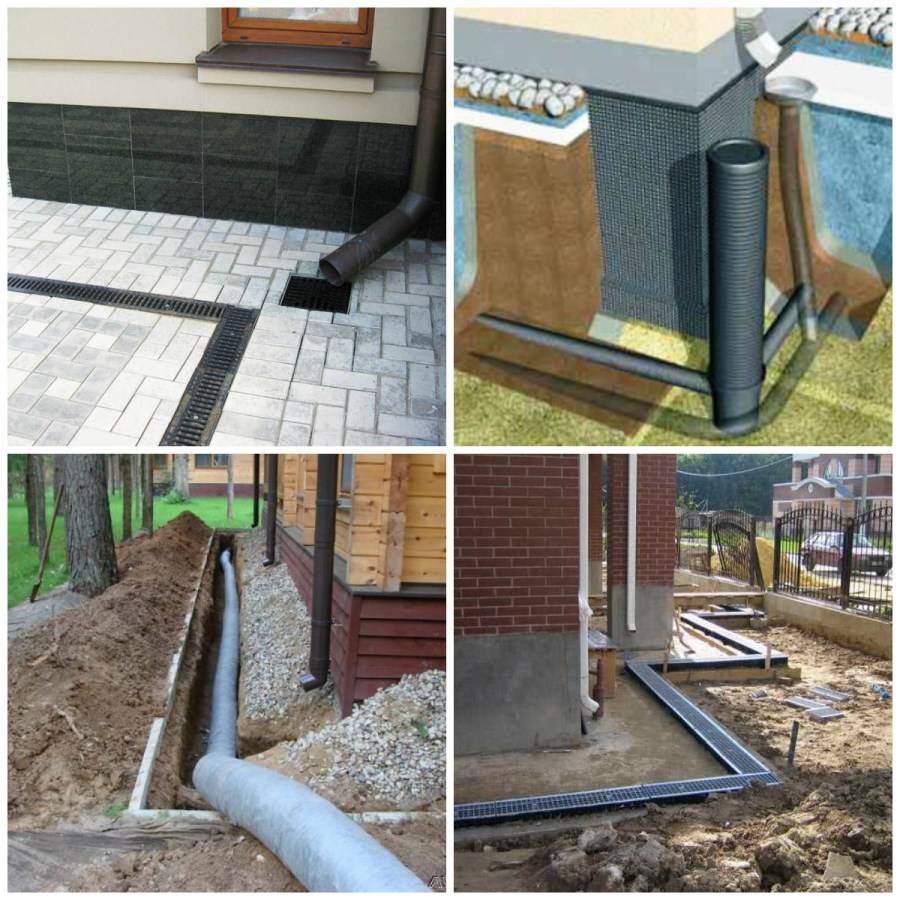
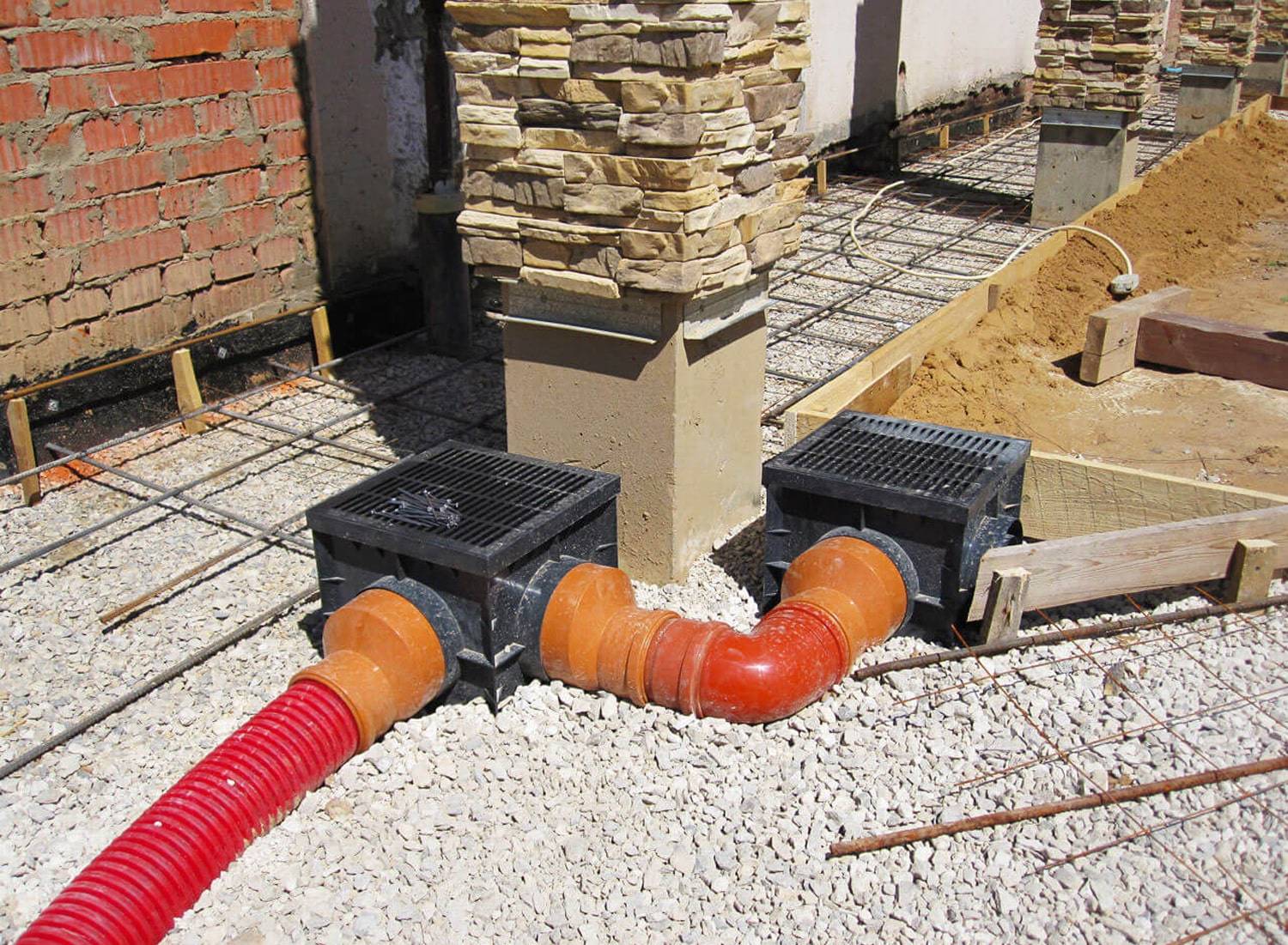
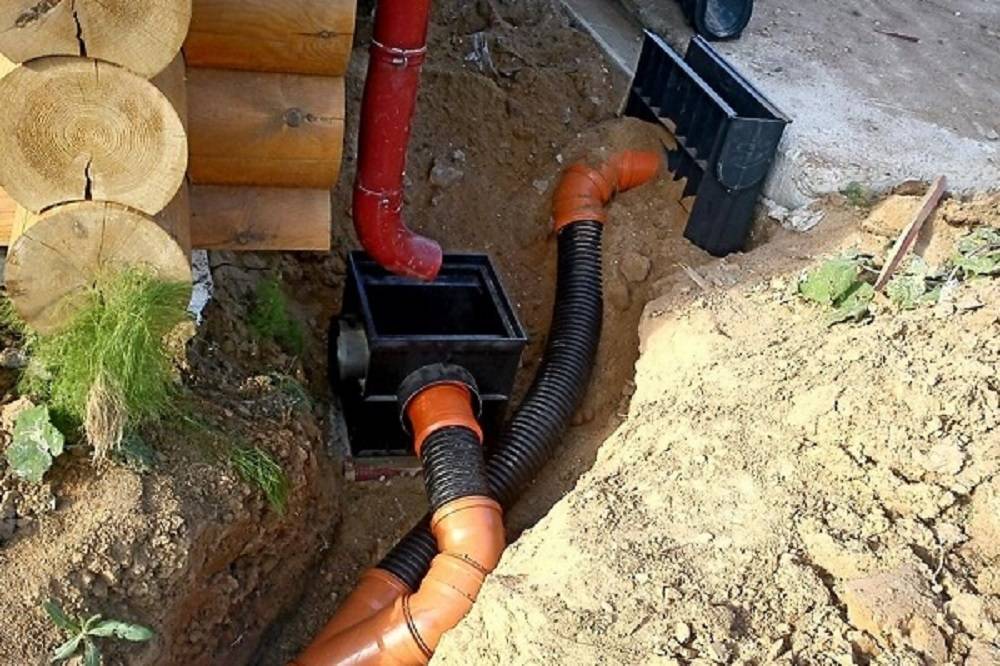


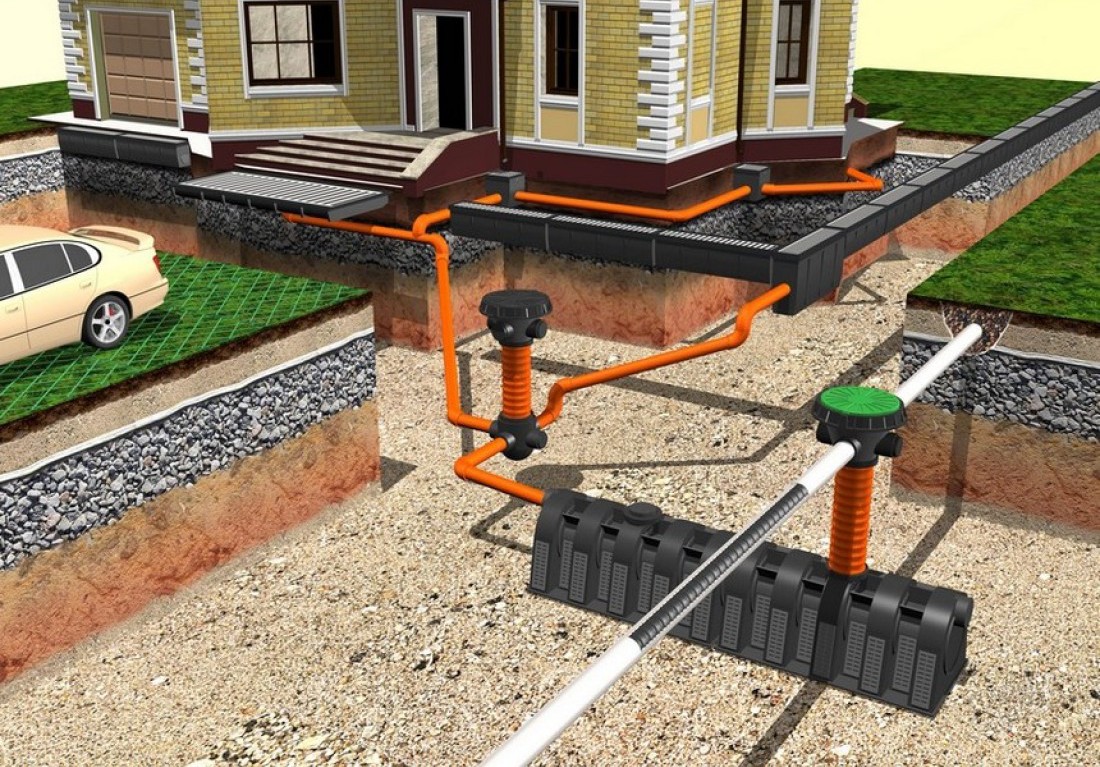

All it takes is a wide trench. If precipitation and groundwater are plentiful, drainage and storm water are allowed through different pipes, but they are laid in one trench. For a storm system, perforation is not needed. Water enters the bypass well, from where it is pumped out by a pump.
Expert opinion
Vladislav Ponomarev
Design engineer, inventor
When constructing systems in different pipes, they designate a place for a diversion line, where water from the systems will be directed along different paths so as not to overload the networks. To drain into one drainage well of sedimentary and groundwater, a nodal tee is installed.
Hatch over the well
For the manufacture of the hatch, you can use any material. This element storm sewer systems can be rubber, plastic or metal. The choice is made by the owner, guided by personal preferences. When arranging the deck, it must be taken into account that the lid should be located 15-20 cm below ground level.
In most cases, the hatch is laid on a neck previously made of bricks, so flowers can be planted around the well or lawn grass can be sown. Plantings will hide the hatch, and the site will not stand out against the general background
You can purchase a ready-made cover with a hatch, but in this case, the cover is located at a level of 4-5 cm below the ground surface, which makes the hatch more visible and draws attention to the inside of the well
Hatch for storm sewer well at home it is most often black, but you can find red and yellow options.
The principle of operation of drainage and storm sewers
Storm sewerage: point drainage system.Point elements are needed to collect precipitation, whether it be rain, melted snow, melted hail. Water can be sent through the gutters to the drainage system, and then sent to special ditches with gratings, through which water will be removed from the site. It is very important when the building is located on a slope, since when choosing the right angle, it will not be necessary to build additional gutters, but to drain water directly into the ditches.
With linear drainage, water is discharged through gutters, funnels into a special main system consisting of pipes that are suitable for drainage and storm sewers. Further along this main system, the effluents enter the collector, and then, depending on the project, the water may go into the reservoir, or maybe beyond the site.
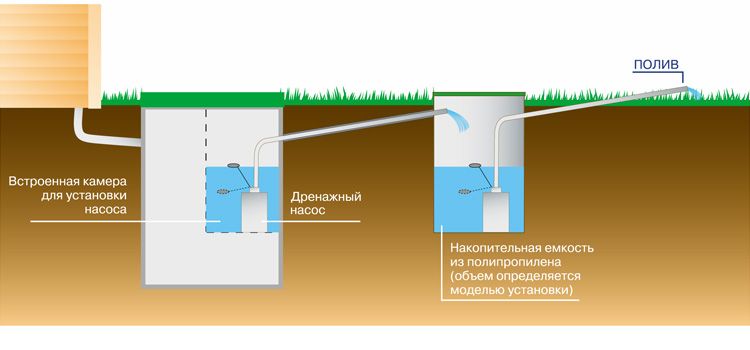
Drainage system with storage tank and site irrigation
With deep drainage, water from rising groundwater is gradually, in separate parts, discharged into the well, and from there it is pumped out and discharged. Such a system has 3 types:
-
Horizontal;
-
Vertical;
-
Wall mounted. If there is a basement or basement in the house, it is required to divert groundwater from them. Wall drainage copes most effectively - a moisture collector is arranged near the walls, and the wall itself is carefully waterproofed.
-




Instructions for laying drainage pipes
To independently perform a simple drainage system, you need to perform work in several stages:
- First, the site is marked for the location of ditches or trenches for drainage according to the planned plan. A special laser construction rangefinder greatly facilitates the process of marking.
- A trench is dug with the necessary slope for quick and unhindered drainage.
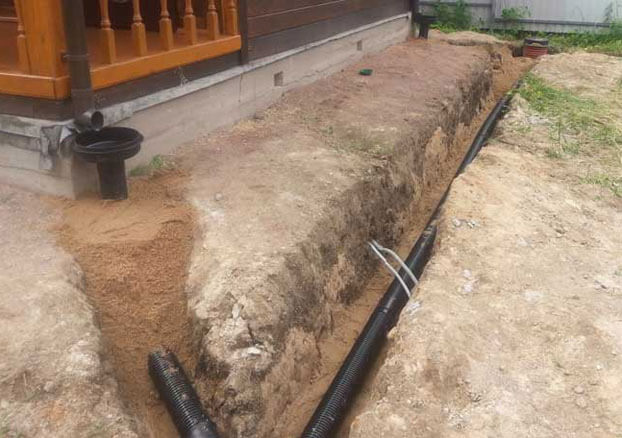
- The bottom of the trench is carefully compacted and filled with filter material such as geotextile, the ends of which must necessarily extend beyond the edges of the trench. Then, bulk materials are poured to a height of not more than 200 mm.
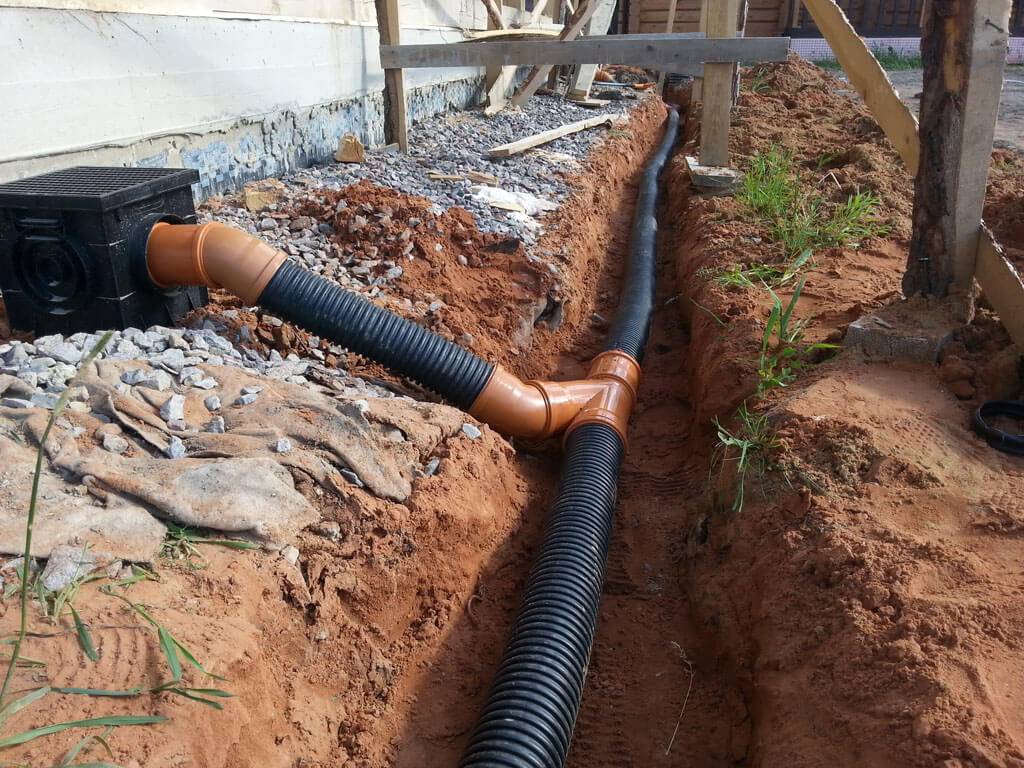
- Drainage pipes according to the executive scheme are cut into the required segments and laid on the prepared bottom of the trench, carefully docking and connecting individual elements.
- After laying the drainage pipes, it is recommended to wrap them with geotextile-type roll material with additional fastening with a rope or thin wire. As you know, geotextiles are able to protect the perforation of drainage pipes from clogging and allow water to pass into the pipe.
- Drainage pipes are laid with the required slope, the ends of the pipes are connected to a water intake well or are led into a ditch or ravine.
- The final step will be backfilling with crushed stone or sand.
Video example of laying drainage pipes:
Drainage or storm sewers require periodic inspection and cleaning. In spring, during the period of active snowmelt and in autumn, before preparing for winter, the system is regularly inspected and debris is removed from the grids of water intakes and channels. Otherwise, silting of the pipeline will occur, and the working drainage system will cease to function normally.
What is storm sewer

Storm sewer (technical designation K2, in everyday life just a storm drain) is a system for receiving and transporting rainwater to a discharge point. Precipitation flows from the roof of buildings or from the surface of the earth into special receivers. Through them, water moves to the collector, enters the treatment plant (OS), after which it is discharged into the reservoir.The question - is it necessary to have a storm sewer - always follows an affirmative answer. The presence of a properly equipped storm drain is a mandatory requirement for the improvement of the settlement. Rainwater collection must be properly organized, as required by applicable law. Tasks of K2 systems:
- removal of excess rain and melt water;
- protection of foundations and other supporting structures of buildings, structures;
- exclusion of flooding of basements, tunnels, metro and other objects.
Discharge of storm sewer into a water body
(drinking reservoir) without cleaning is prohibited. However, extreme
discharges in case of a strong excess of wastewater volumes during prolonged downpours. How
as a rule, the volume of water does not increase immediately, so the first surface flush
undergoing cleaning. The following volumes of wastewater are considered conditionally clean, so they are allowed
throw into water
object without cleaning. This justifies the discharge of stormwater into the sewer if the rainwater is not received from
industrial sites, parking lots and other polluting facilities. However,
each case of such a discharge must have a technical justification and
appropriate permissions.
Legislation
Mandatory presence of a storm
sewerage is defined by law.
Discharge of untreated wastewater into water bodies entails administrative and criminal
responsibility of leaders or guilty persons. Mass influx of waste into
the reservoir is equated to an ecological catastrophe. The main danger comes from
industrial enterprises, but also storm systems are able to endure large
amounts of harmful substances. Surface washouts carry oil products, lubricants
materials, fuels of various types. If these components are not removed,
overload of central treatment facilities, untreated effluents will flow into
reservoirs.
The obligatory nature of storm sewers is due to SNiP 2-07-01-89. The discharge of wastewater into water bodies must be agreed with the Federal Agency for Fishery and other environmental organizations. Within the boundaries of the serviced area, there should be local treatment plants (VTPs) that ensure the preparation of storm drains for supply to the central wastewater treatment plants.
Drainage
Storm sewers also include drainage networks. They remove excess moisture from the upper layers of the soil. Drainage pipelines are connected to storm sewers after passing through special treatment tanks. These are sand traps, gratings and other filtering devices. Similar equipment is also available on storm systems. The main difference between drainage networks is the underground placement of pipelines. If the immersion depth is too great, it is necessary to build a pumping station and raise the drains under pressure into a higher reservoir. From there they flow by gravity into the collector.
Combination of storm and drainage sewers
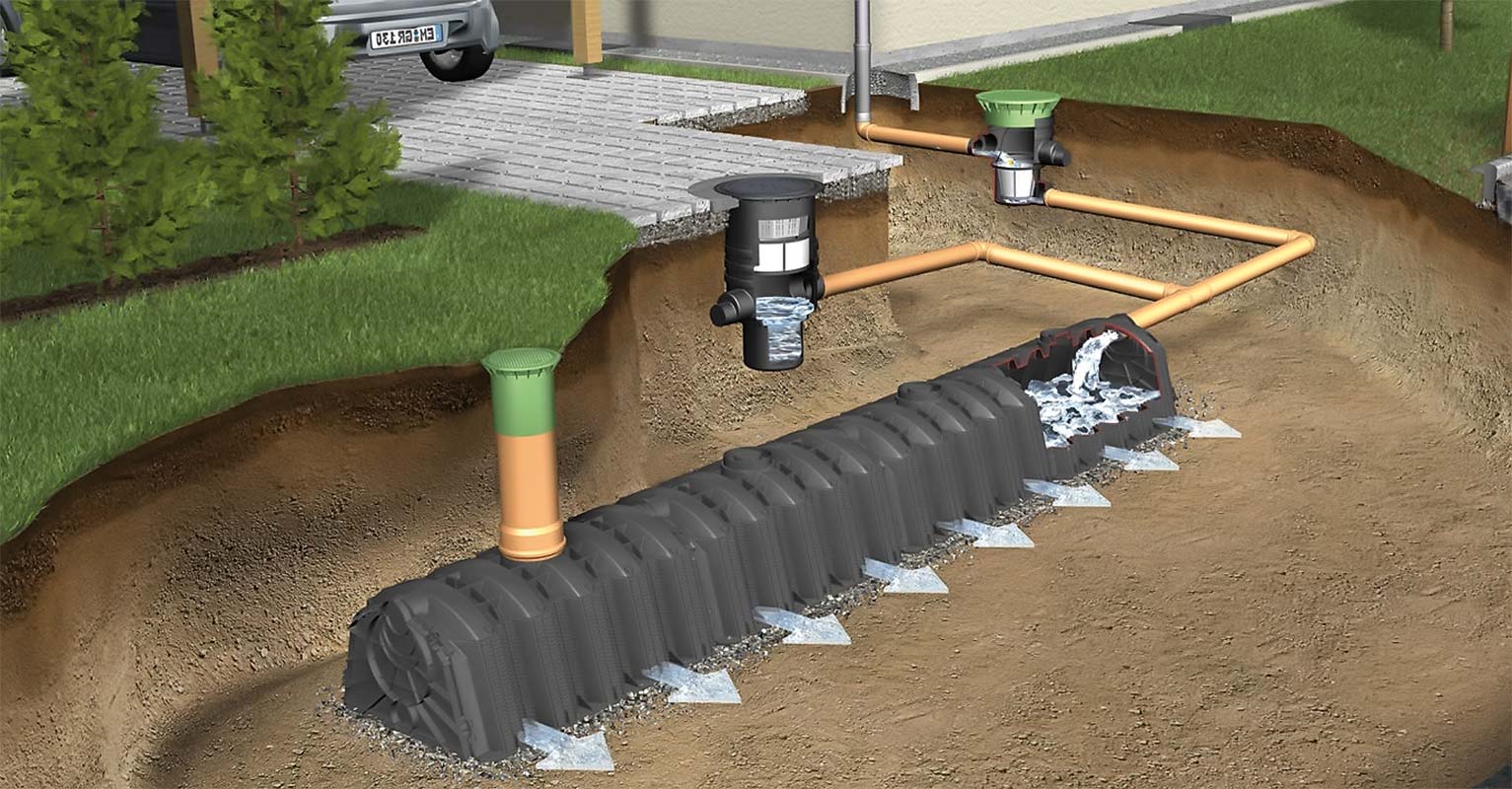
The task that is set for the builders is to bring wastewater through autonomous schemes into one drainage well. For this, a nodal tee is used, which combines external rainwater flows with groundwater drainage.
Drains buried in the area collect the risen groundwater and lead it through pipes to a well, from which they are pumped out and discharged to a designated place.
Usually, storm drains are collected in a collector, which is located in the same trench with a drainage pipeline, from the collector water enters the main network, then into a bypass well, from where it is also pumped out.
Plot lift
Even if deep drainage did not help to completely get rid of the negative manifestations of GWL, you will have to deal with the planning and backfilling of a site with a high level of groundwater.
This method is expensive, but provides a real and lasting effect. Regardless of the elevation of the site, the work plan is approximately the same.
- Territory planning. A detailed plan of the site is drawn up with the designation of the level of heights, the location of the surface aquifer, the thickness of the fertile layer. This will help determine where, how much and what exactly to add. If the geology of the area is complex (bogginess is combined with a high GWL, there is a clay layer or voids), it is better to entrust the planning to a specialist.
- Demolition of old buildings (if any).
- Site clearing. It is freed from vegetation, debris, roots are uprooted.
- Laying the drainage system (if it does not already exist). Dumping alone will not solve the problem of excess moisture. It still needs to be removed in a closed or open way, as described earlier.
- Site clearing. A low strip foundation is laid around the territory so that the poured material is not washed away by rains. After the concrete hardens, layer-by-layer dumping of materials (10-15 cm each) is carried out. Each layer is compacted with a vibrotamper. After laying all the lower layers, they withstand a couple of weeks for natural shrinkage by 2-3 cm, only then comes the turn of fertile soil. So that the layers do not mix, they are separated by geotextiles.
How to make storm drainage of the site and around a country house
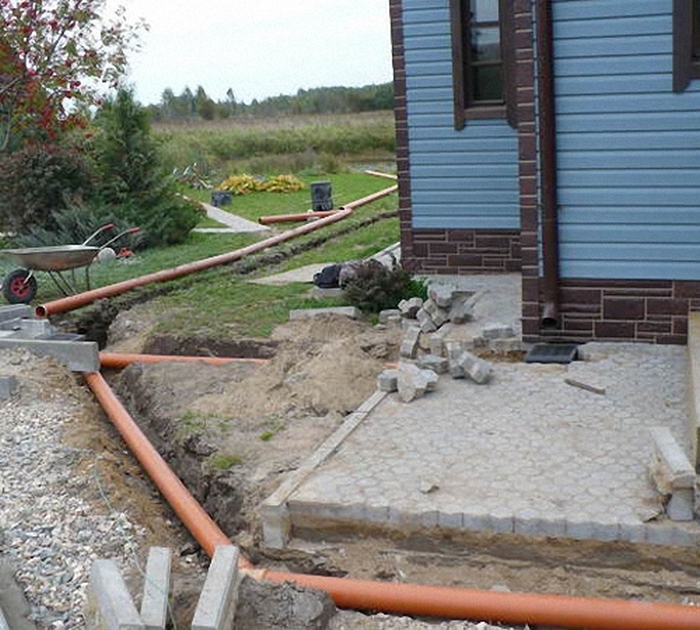
Storm drainage is a surface system that does not require extensive earthworks and digging deep trenches, so you can do a simple wiring yourself. Before starting work, the places of mandatory arrangement of lines and water collection points are determined, and the drainage trajectory is planned. It is possible to detect all places where natural outflow is not enough during heavy rainfall and after the snow melts. It also requires the installation of a branched linear storm drainage area with clayey, moisture-saturated soil that does not absorb water from the surface.
For preliminary calculations of the amount of required materials it is worth drawing a diagram of the channels on the site plan.
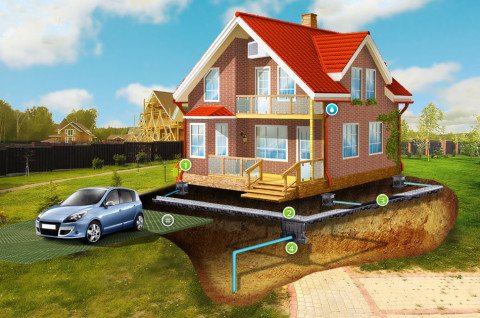
Storm drain installation plan
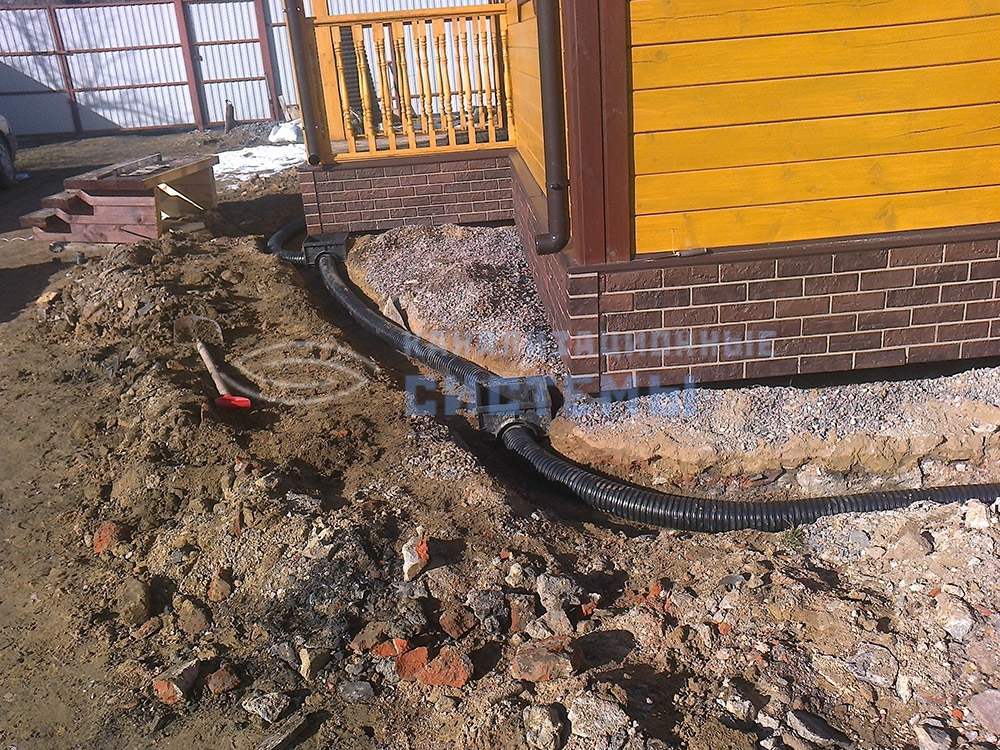





Functions of the water drainage facility
The main function of such a system is to remove moisture from the soil surface. However, there are cases when its installation is required:
- The plot of land is uneven, which is why excess moisture constantly accumulates in the recesses.
- On the site there are buildings with a basement.
- The soil is predominantly swampy, waterlogged.
- The groundwater level is above the established norm, which leads to frequent flooding.
- The earth does not pass water.
With a high level of groundwater, basements are constantly flooded, mold, fungus, etc.
By arranging a drainage trench on the site, you can solve many problems and prevent premature destruction of buildings, destruction of plantings and other adverse effects caused by waterlogging of the soil.
Drainage does an excellent job of removing melt and rainwater, which destroys the foundation and roof of the building, and also leads to the formation of puddles and ice. Usually, storm drains are built for this, which remove rain or melt water from the roofs into the collector. In simple words, these are vertical pipes installed on every house.
The device consists of several sealed housings through which the liquid gradually passes. All dirt and harmful impurities are retained in special partitions.



