- Heating a private house with solar thermal collectors
- Comparison of costs of different heating systems
- Cottage gas heating
- Choosing a boiler to complete the heating system of the cottage
- Additional heating equipment for the cottage
- Equipment
- One- and two-pipe heating systems
- Advantages
- High efficiency
- Additional functions
- Traditional systems
- Underfloor heating system
- Warm baseboard and infrared heating
- Design and calculation of an air heating system
- How to calculate an air heating system
- The main elements of the water heating system
- Boiler selection by the number of circuits
- Boiler selection by type of fuel
- Boiler selection by power
- Pipe wiring
- Single pipe
- Two-pipe
- Description
- Do-it-yourself air heating. Installation of an air heating unit AVH with a return manifold.
- Types of air heating
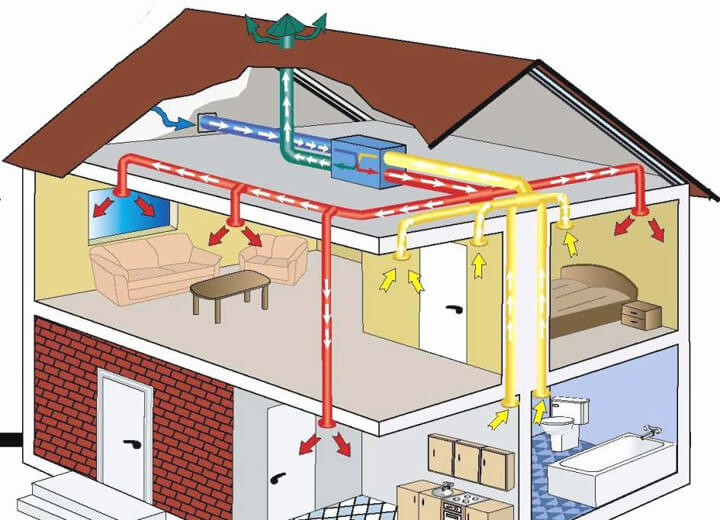
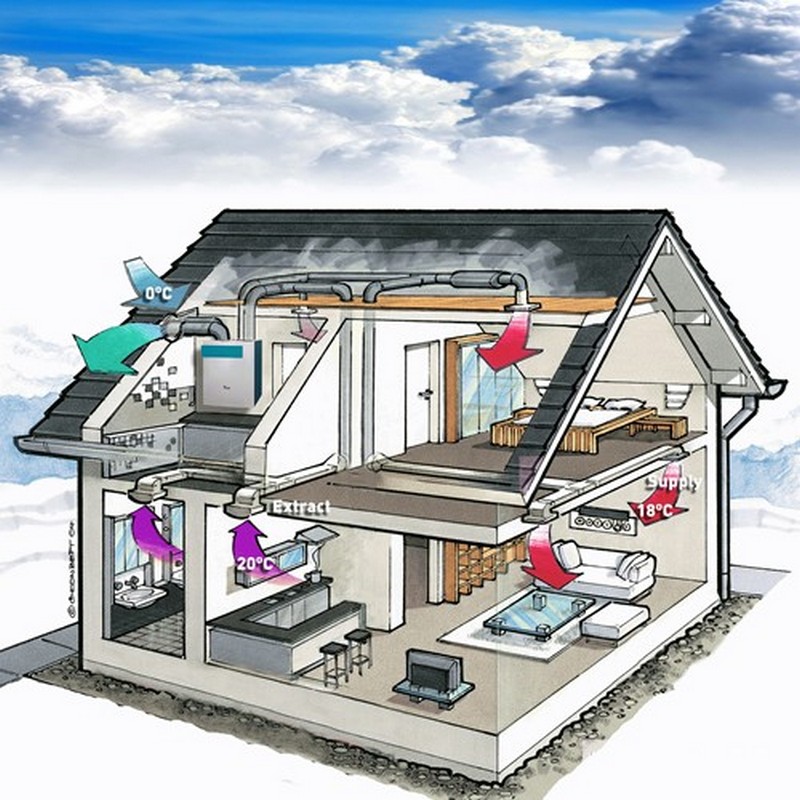
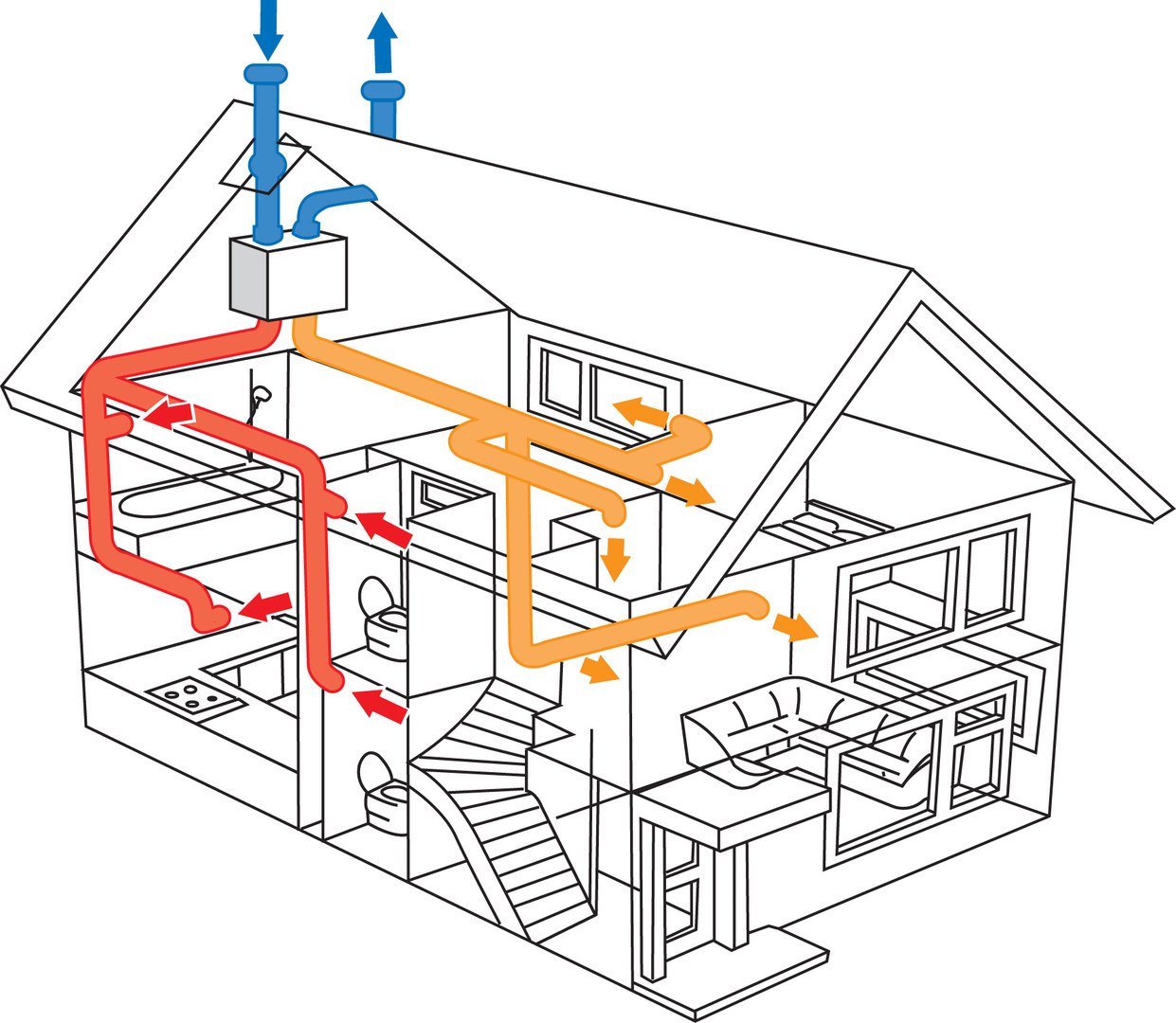
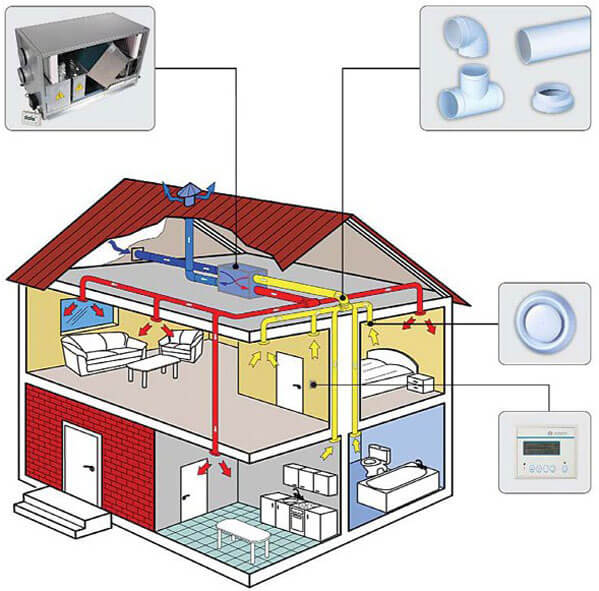
- Air heating combined with ventilation
- Characteristics of the most popular heating systems
- Water heating
- Electric heating of a country house (electric convectors)
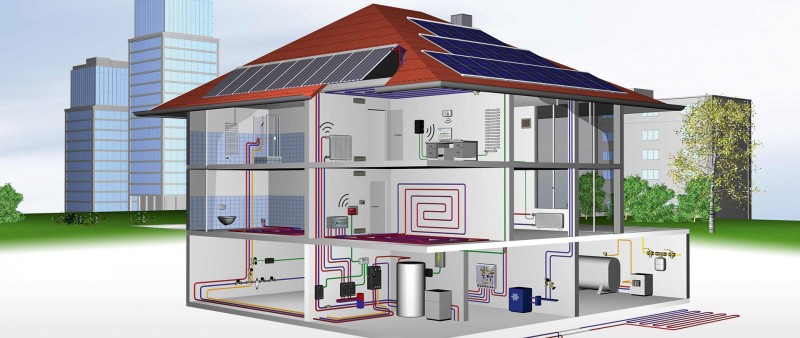
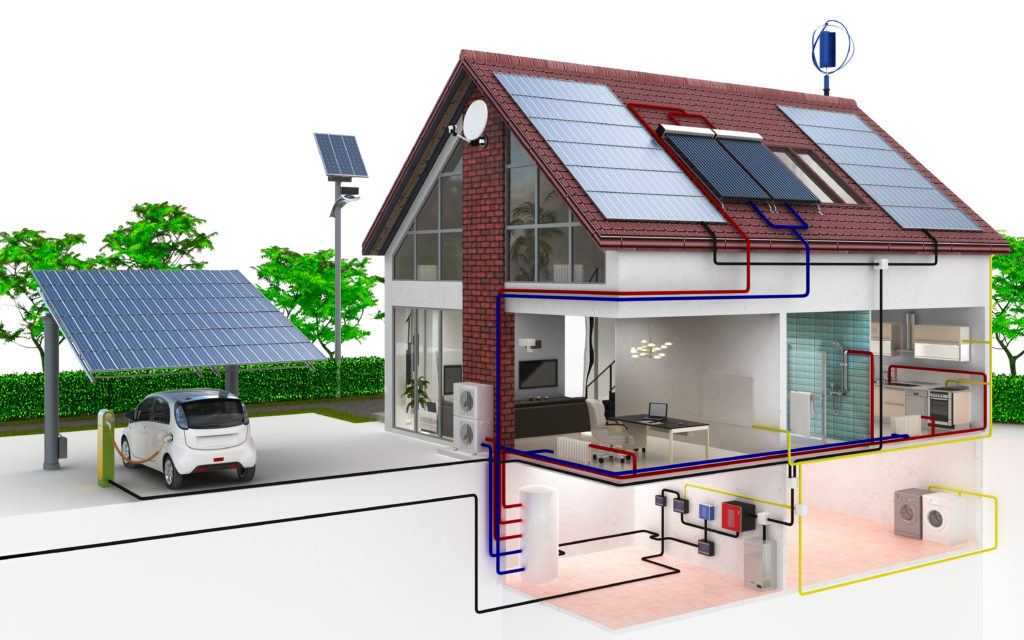
Heating a private house with solar thermal collectors
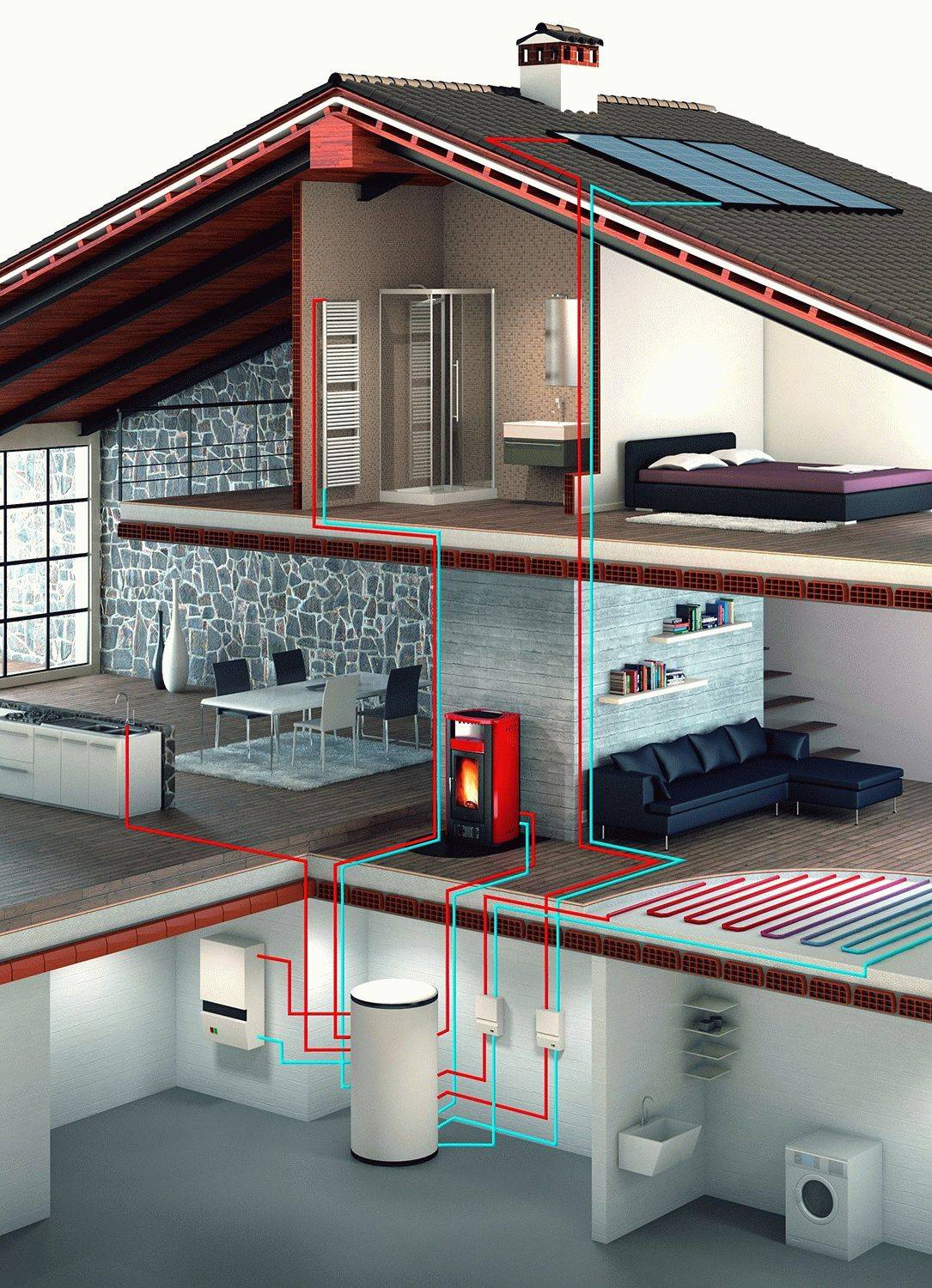
A comparison of the heating systems of a country house showed that such a heating system will largely depend on how intense the rays of the sun are in different periods of the year. If the weather is cloudy or at night, the collectors will not be able to receive solar energy.
Solar panels can also be an additional source of heat energy for heating in biovalent storage tanks or for systems through which water is heated.
Solar collectors can be divided into two types:
- Equipped with a vacuum pipe;
- Flat.
Vacuum tube collectors are ideal for use during the winter months. Such collectors are able to withstand temperatures up to -35 degrees. Through flat-plate collectors, air can be heated to a temperature of + 60 degrees, and the second type of collectors allows you to heat the air up to +90 degrees. Collectors equipped with vacuum pipes are ideal for optimal heating of a country house. Such devices can heat not only air, but also water at the same time.
Comparison of costs of different heating systems
Often the choice of a particular heating system is based on the starting cost of the equipment and its subsequent installation. Based on this indicator, we obtain the following data:
-
Electricity. Initial investment up to 20,000 rubles.
-
solid fuel. The purchase of equipment will require from 15 to 25 thousand rubles.
-
Oil boilers. Installation will cost 40-50 thousand.
-
Gas heating with own storage. The price is 100-120 thousand rubles.
-
Centralized gas pipeline. Due to the high cost of communication and connection, the cost exceeds 300,000 rubles.
Cottage gas heating
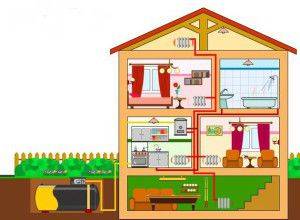 Heating scheme with a gas tank
One of the best options for creating a scheme for maintaining a comfortable temperature in a country house is heating the cottage with gas. To do this, you need to connect to a central distribution line or arrange a place to store cylinders. An alternative to such an organization is the installation of a gas tank - a special gas storage.
But at the first stage it is necessary to choose the right boiler for heating the cottage. It must provide optimal power for the entire system, be reliable and functional.
Choosing a boiler to complete the heating system of the cottage
The main parameter of any heating review is its rated power. The same applies to boilers for heating the cottage. To calculate this parameter, it is best to use special software systems. The heat loss of the building must first be calculated.
After determining the nominal power of the boiler, you should select its model. The main parameters are its functional and operational characteristics:
- Installation method - floor or wall. If a heating scheme for a small cottage is chosen, you can stop at wall models. For houses with a large area, it is necessary to install powerful gas boilers. They are mostly floor mounted;
- The presence of a second water heating circuit for organizing hot water supply;
- Boiler control and safety devices. They will ensure optimal pressure in the heating system of the cottage.This parameter for a closed system with forced circulation varies from 3 to 6 atm.
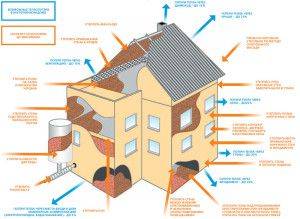 heat loss in the cottage
An important point is the preliminary calculation of gas consumption for heating the cottage. This parameter is indicated by the manufacturer in the passport. For appliances with a power of 24 kW, the average consumption is 1.12 m³ per hour. Accordingly, in order to obtain a preliminary gas consumption for heating the cottage, this value must be multiplied first by 24, and then by the number of days in the heating season.
Additional heating equipment for the cottage
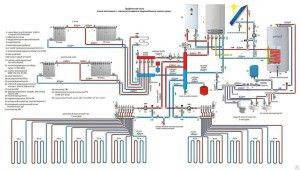 Scheme heating and hot water supply of the cottage
Professional heating planning in a cottage involves the selection of all system components according to pre-calculated parameters. Otherwise, even when installing a modern and economical gas boiler for heating the cottage, the efficiency of the entire system will be unsatisfactory.
It should be borne in mind that when purchasing a turnkey cottage heating project, it will be problematic to change any characteristics of the system components. Therefore, you need to familiarize yourself with the contents of the technical documentation in advance. To do this, you need to know the basic technical properties of the heating elements of the cottage:
- Radiators. With their help, heat energy is transferred from hot water to the room. An important parameter is specific power - W. This total value of the radiators installed in the room must correspond to the calculated value for the room;
- Pipelines. Their diameter and material of manufacture is affected by the thermal mode of operation of heating. Effective heating of the cottage with a gas boiler implies a low-temperature mode of operation - 55/40 or 65/50.This will reduce the gas consumption for heating the cottage. For such schemes, polymer pipes can be used;
- Security group. These include an expansion tank, air vents and bleed valves. It is mandatory to provide for the installation of shut-off valves in critical sections of the highway - branchings, when connecting radiators.
In practice, the configuration of the heating system largely depends on the characteristics of the building - its area, the degree of thermal insulation, the selected heating scheme. The parameters of each device must be pre-calculated.
Equipment
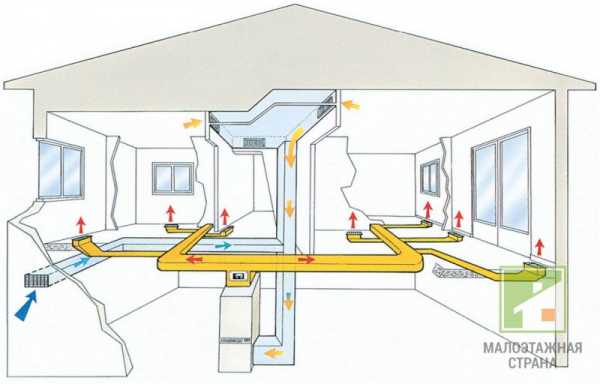
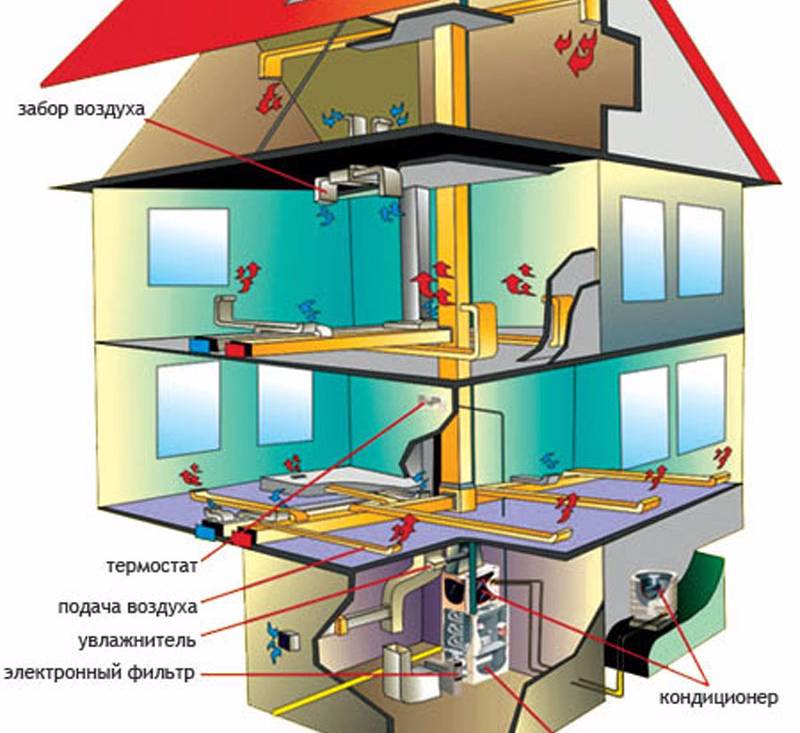
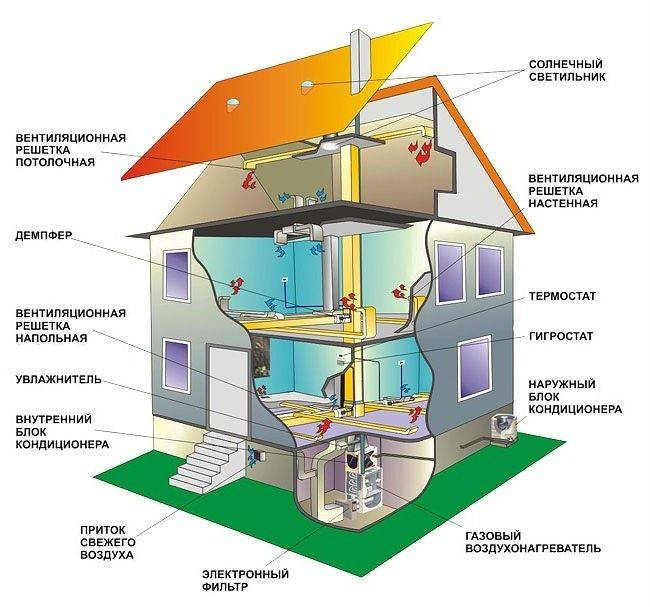
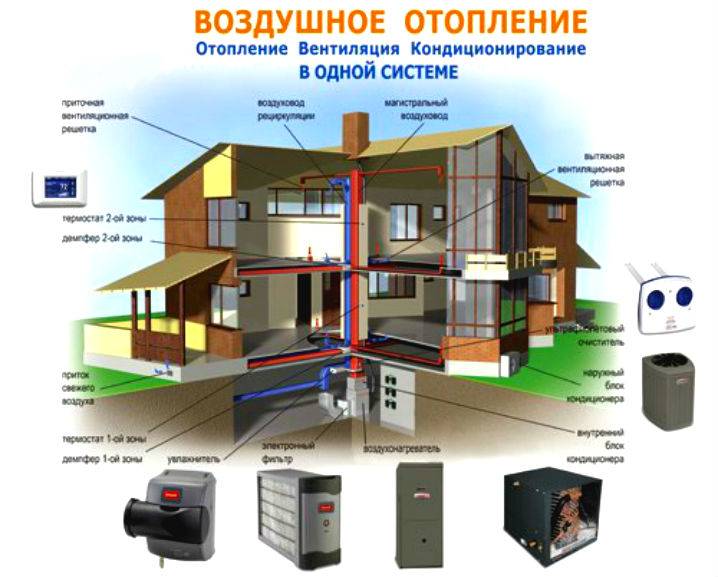
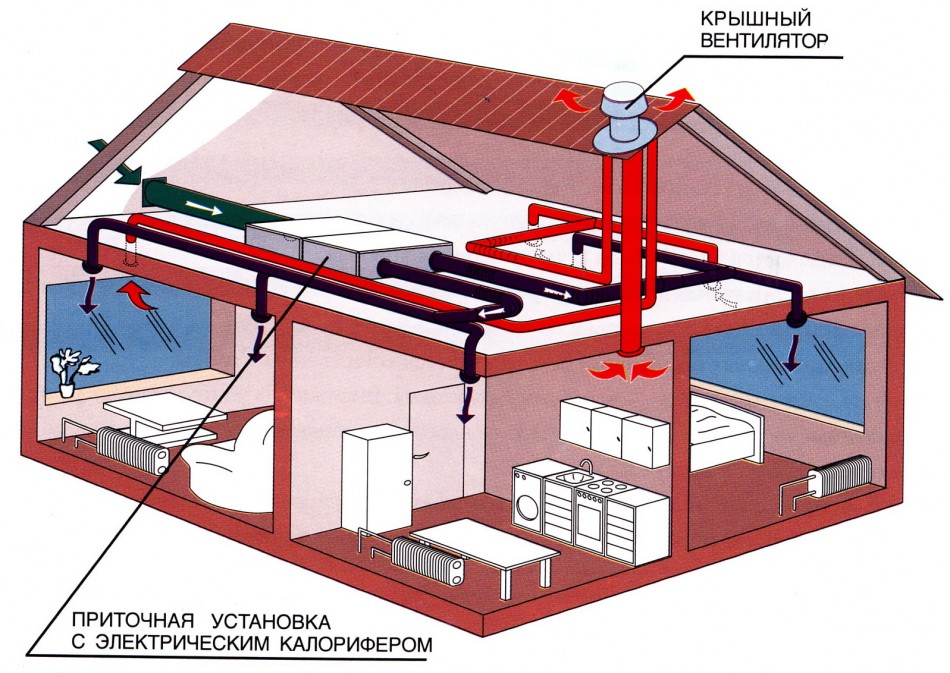
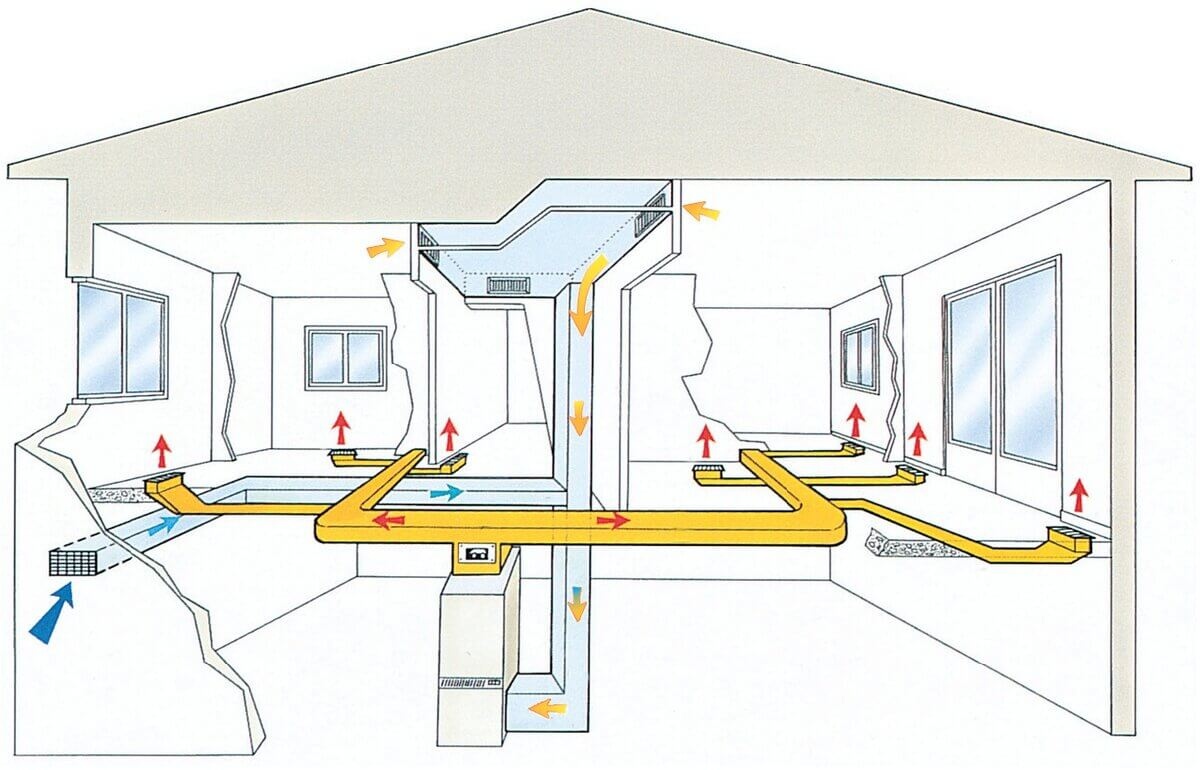
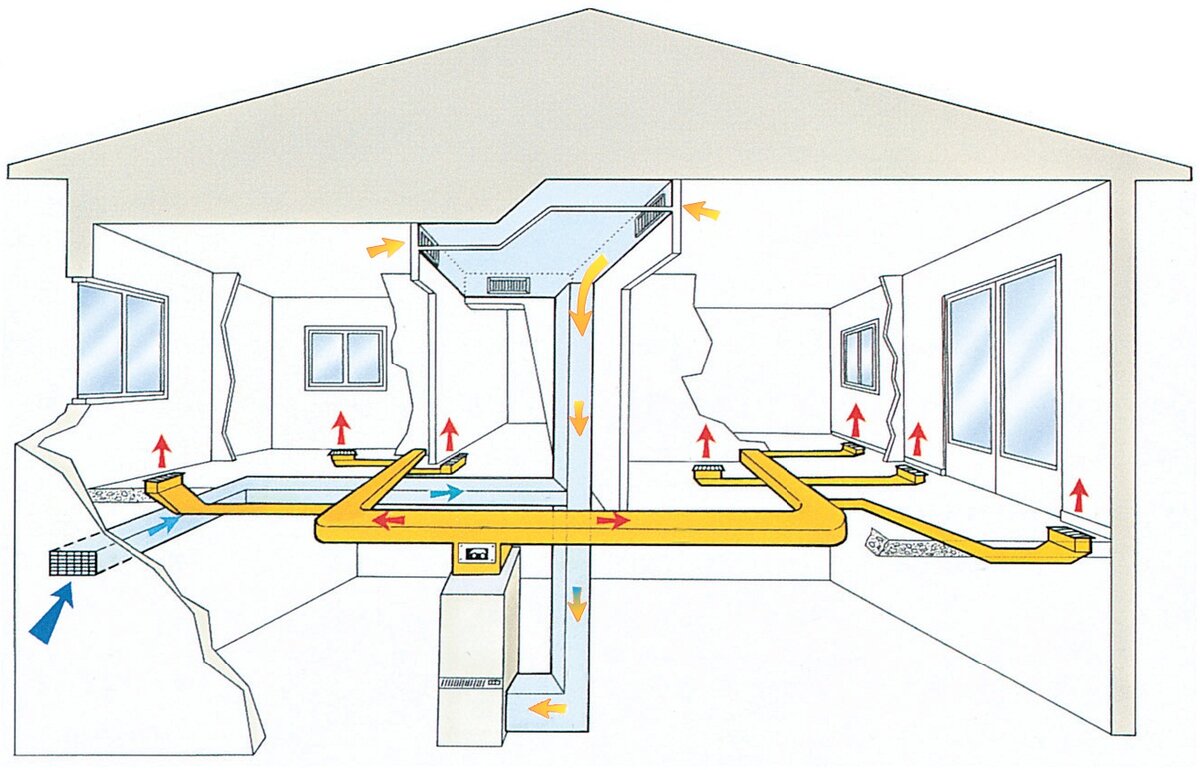
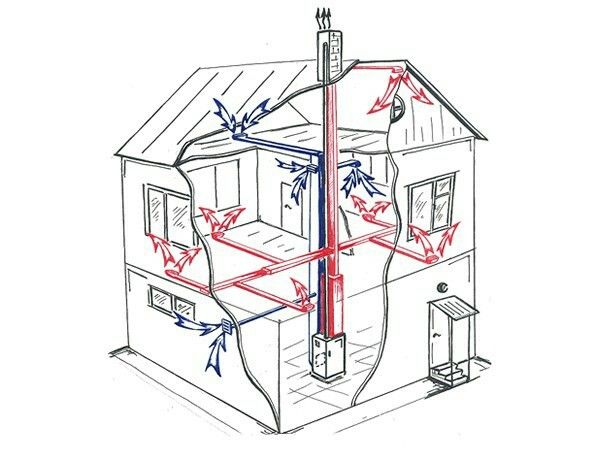
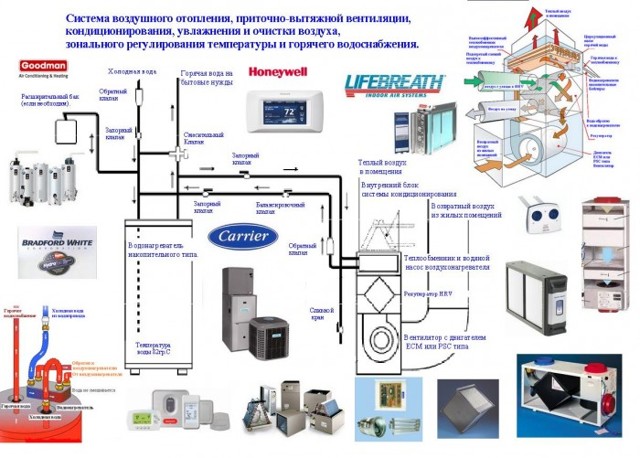
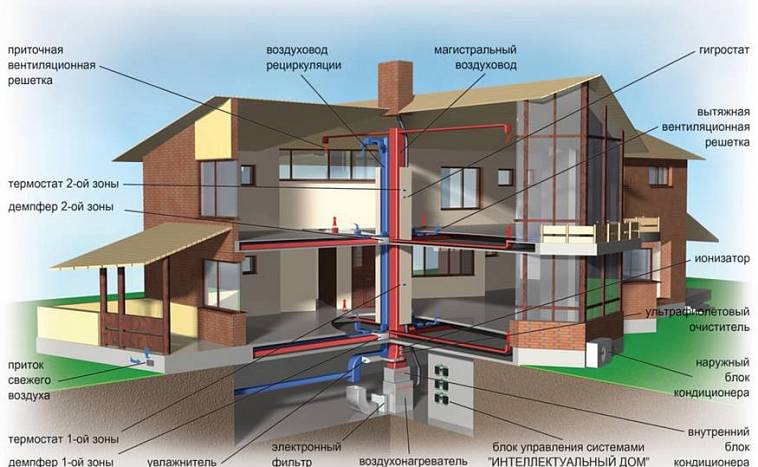
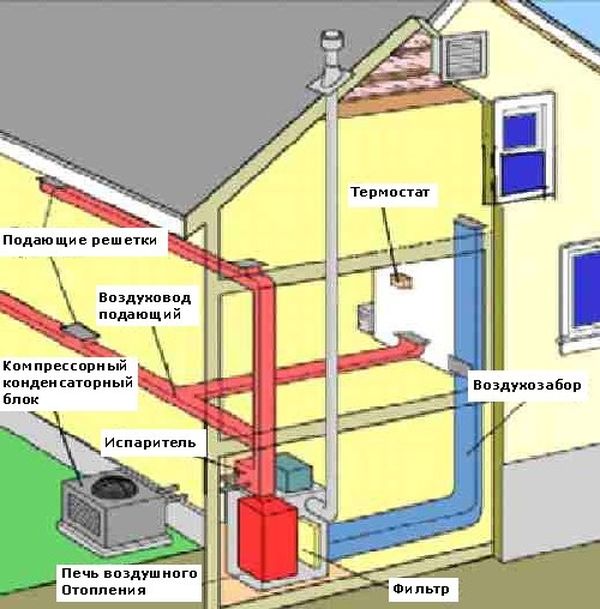
Work air heating systems is based on heating the air and redirecting it to heat the premises. To do this, the system is equipped with the following equipment:
- gas air heater (or other model depending on fuel) - the main source of heat;
- heat exchanger - heats the passing air, and does not allow mixing of flows with exhaust gases;
- air ducts - redirect the flow of warm air to the interior;
- filter, humidifier and freshener - maintain air quality by cleaning it from dust and bacteria;
- central air conditioning - used to maintain comfort inside the building through the existing duct system in summer;
- automation system - monitors the temperature regime of the room, controls the temperature, the mode of operation of the heat generator.
One- and two-pipe heating systems
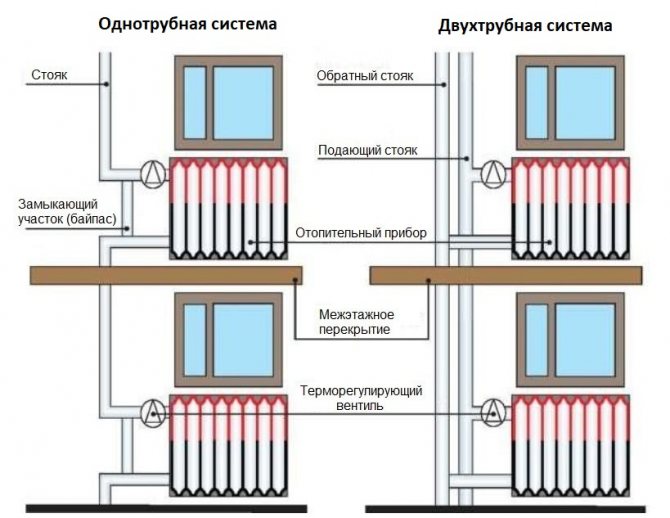
AT single-pipe water heating system cottage, the circulation of the coolant from the boiler and back is carried out along one line, which simultaneously plays the role of both supply and return. The whole scheme eventually closes into one large ring encircling the building.And to this ring, along the entire length of the pipe, the installation of heating radiators begins, with the help of which the coolant gives off energy to the living quarters.
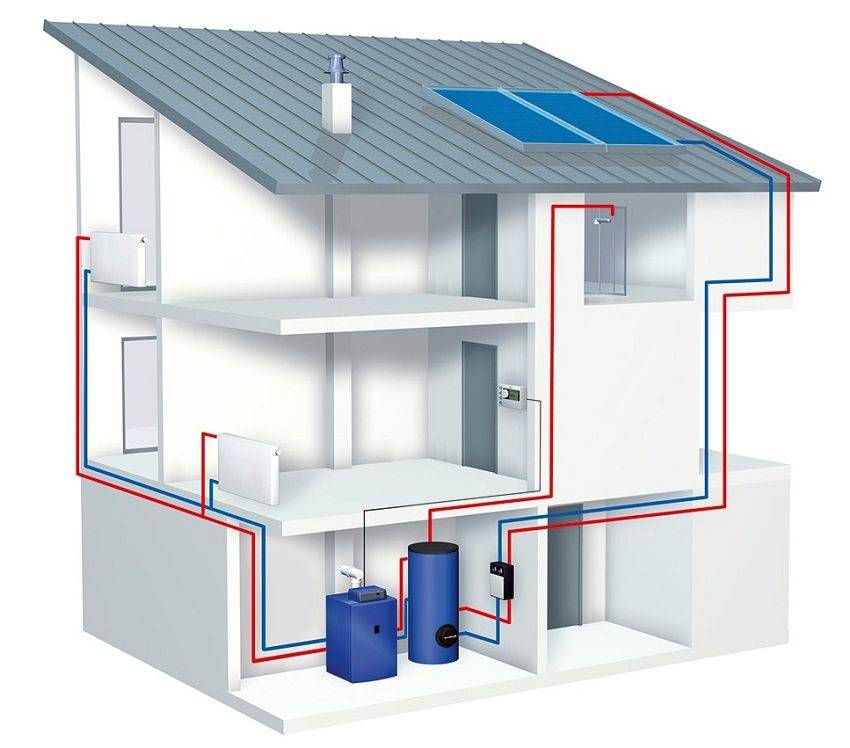
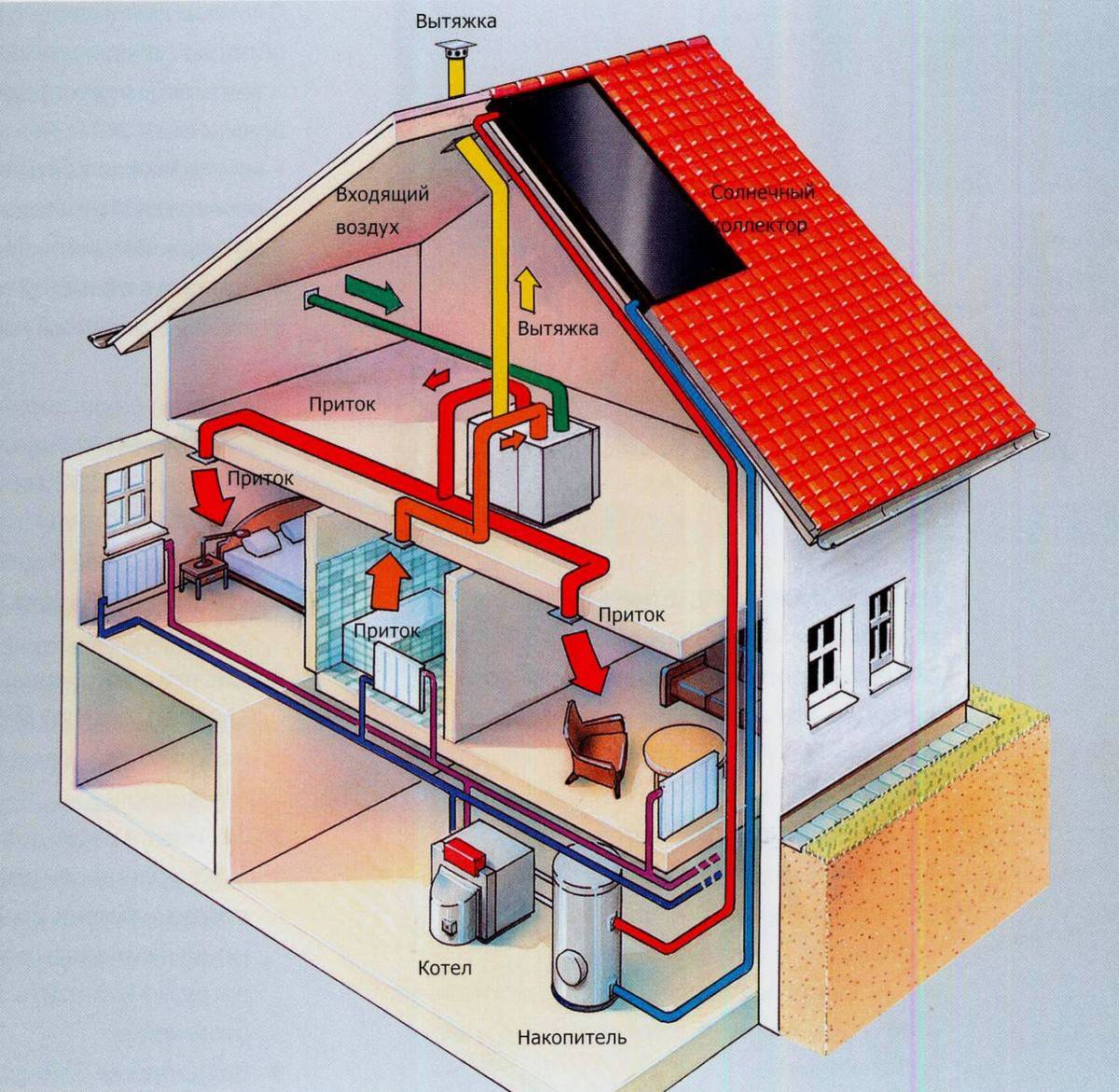
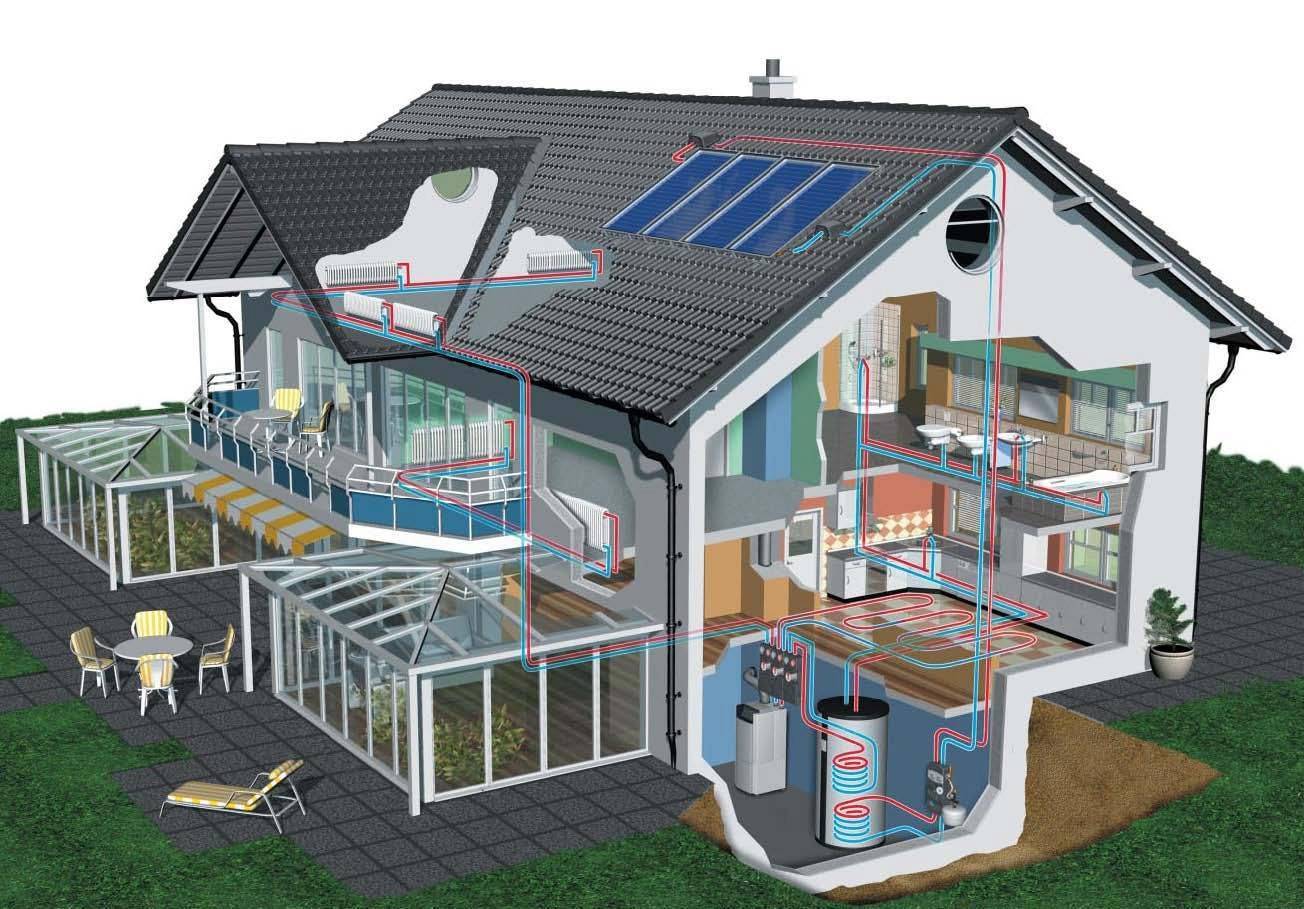
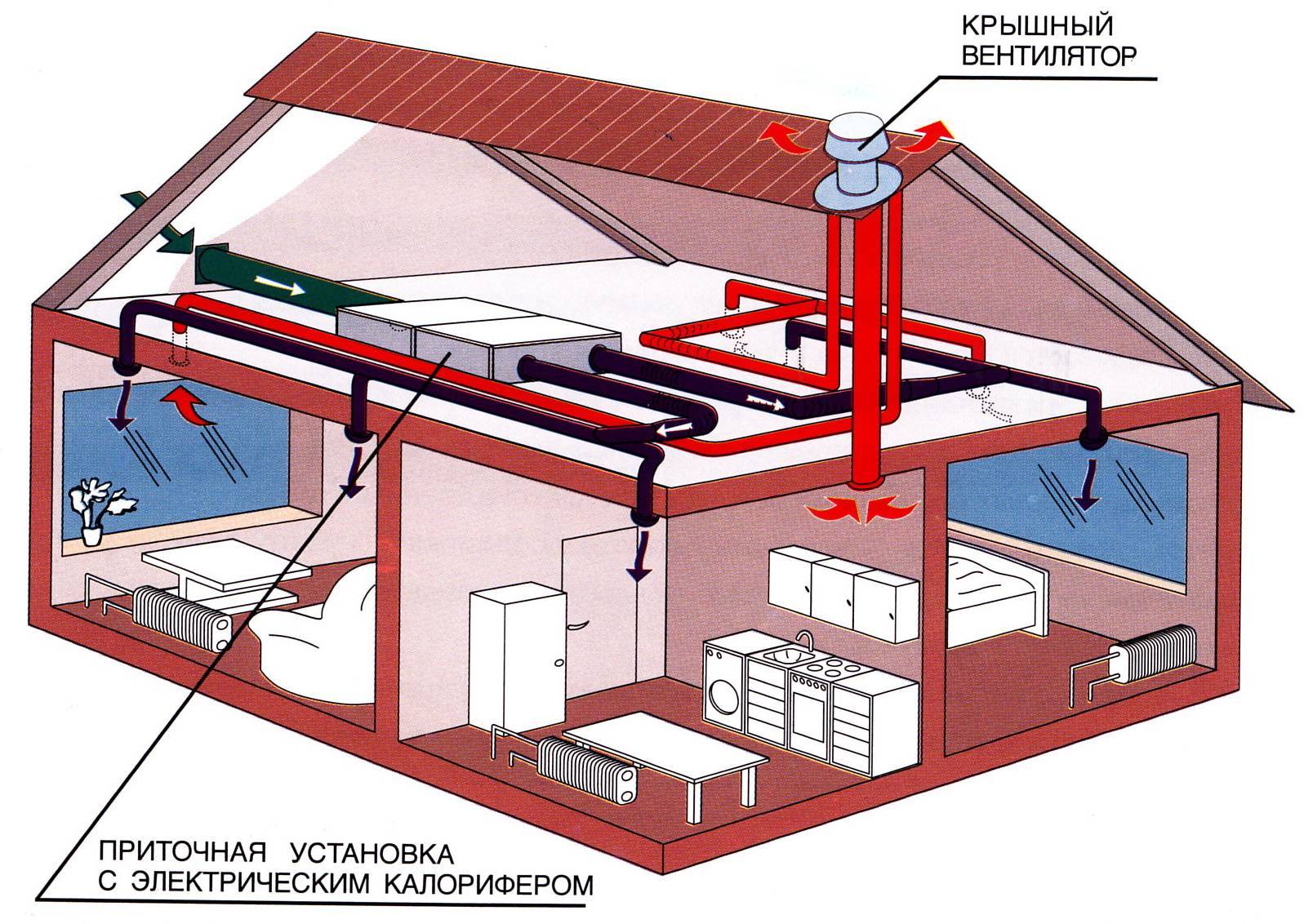
The simplest diagram illustrating the principle of operation of a single-pipe wiring of a heating system
Like any other complex system, single-pipe heating distribution has its advantages and disadvantages. What is a program for calculating the power of a heating boiler, you can read in our article.
Its advantages include the following.
- Savings on material - with a similar heating scheme for housing, a third less pipes are required. Consequently, the cost of arranging the heating system will be lower.
- Due to the line, which simultaneously performs both the role of supply and the role of return, the time and effort spent on installing the entire system as a whole is reduced.
- Compactness - with single-pipe wiring, heating systems take up less space. They are much easier to hide in a wall or behind a decorative box.
- Simplicity - it is much easier to equip such a heating system for your cottage on your own.
Single pipe heating with bottom wiring
But for a low price and simplicity, one has to put up with one, but a very significant drawback of such a scheme - the impossibility of achieving uniform heat distribution across all radiators. At the beginning of the heating pipe, the batteries will be excessively hot, and at the end, on the contrary, barely warm.
Vertical wiring of a single-pipe circuit is suitable for apartment buildings or with natural circulation of the coolant. For a cottage, it makes sense to give preference to a horizontal system.Often, the main line is “hidden” by a wall or under the floor surface.
"Leningradka" is the most advanced of the one-pipe heating systems. Each radiator is connected through tees and bends and is equipped with shut-off valves. With its help, the owner of a house with a single-pipe system can disconnect a separate battery from the main without turning off the entire circuit.
A more modern and perfect scheme for arranging a heating system is a two-pipe wiring. Here, instead of one line, two are used - the first to supply the coolant to the radiators, the second to drain it back to the boiler. These pipes are called respectively - "supply" and "return".
A picture illustrating the principle of operation of a two-pipe heating system
In many ways, the advantages and disadvantages of one- and two-pipe heating systems are mutually opposite. So, the advantages of the scheme with "supply" and "return" include the following.
- More uniform distribution of thermal energy over radiators. With a competent approach to regulation on the supply line, all radiators in the cottage will have approximately the same temperature. The situation when there is boiling water in the first radiator, and barely warm water in the second, does not occur here.
- The smaller diameter of the pipes required for laying such a heating system.
- Possibility to regulate the temperature in each individual room with a thermostat and a tap on the supply line to the battery.
The two-pipe heating system has its drawbacks, two of them are increased costs for materials and the need to spend more time and effort on laying heating.Moreover, the first drawback is considered controversial by many owners of country houses - yes, more pipes are needed for heating with "supply" and "return", but their diameter is smaller. You will also need smaller (and therefore cheaper) fittings, connectors and valves.
An example of vertical and horizontal heating schemes
With this diagram, you can easily understand the difference between one- and two-pipe water heating pipes.
An example of a radial two-pipe wiring of a heating system from a distribution manifold
Advantages
The air heating system has a number of beneficial advantages. Let's consider the main ones:
High efficiency
The efficiency of such a device is high, while a large area of \u200b\u200bpremises is heated as efficiently and quickly as possible. The heated air is evenly distributed throughout the rooms, which makes it easy to maintain the desired temperature throughout the house.
Additional functions
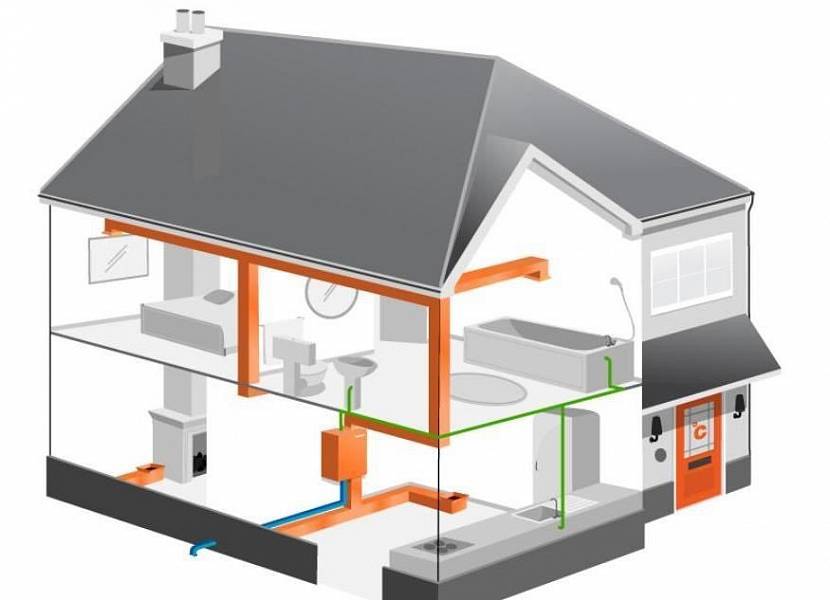
For example, in the summer, air heating of a country house will be an excellent solution, since it is possible to ventilate the room, and when an air conditioner is connected, air conditioning.
When using additional filters, humidifiers, air fresheners, heating performs the general functions of the climate system and maintains comfort in the house. Thus, a complex air treatment center is created in the house, which, in addition to heating, processes and purifies it.
Traditional systems
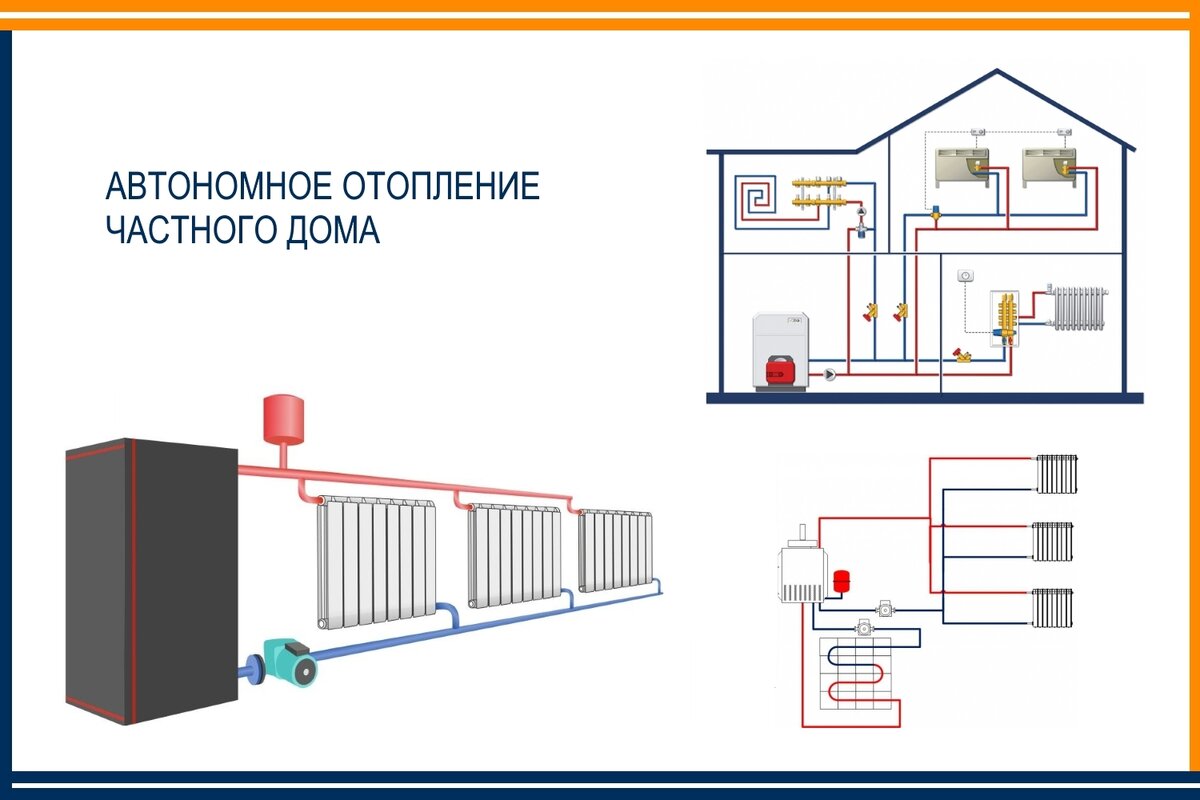
Modern heating systems in private houses and cottages stand out for their diversity. They can be classified according to criteria such as the method of heat transfer and the type of fuel used.If you do not take into account such systems that heat the room through a fireplace or stove, then water heating systems are considered the most popular. Such heating systems of country houses heat the air in the house due to the contact of air with hot radiators and pipes. The heated air begins to move upward and heats up with colder air and thus the space in the house begins to heat up. Such heating is called contact. Contact heating is more efficient when the air circulates more or less freely near the radiator. Heating appliances must be placed in each room.
The movement of heated air when using a contact heating system
During the drafting of the water heating system of a private house, it is necessary to adhere to such calculations as the area of \u200b\u200bthe house and the number of floors. Heating systems for one-story houses can differ significantly from heating systems for houses with two or more floors. The differences relate to the types of boilers, as well as the selection of the necessary equipment.
However, not all private sectors have access to the gas pipeline. If a gas pipe passes near a private house, then it is best to organize a heating system that will run on fuel such as gas. Plain water will also serve as a coolant in a gas heating system, sometimes antifreeze can also be used. The boiler, as well as its piping, must be designed for gas combustion.
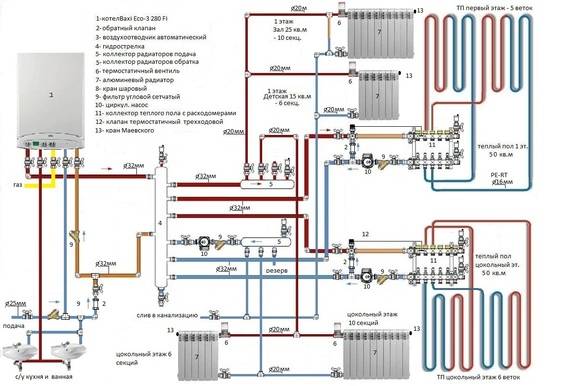 Gas heating system
The choice of a heating system for a country house powered by the mains is a rather controversial issue.The advantages of such a system can be called its safety from an environmental point of view and a fairly simple installation. But the disadvantages include the high price of electricity and the fact that various interruptions can often occur in the supply of electricity. This forces the owners of cottages and country houses to install alternative heating methods.
Underfloor heating system
Such a scheme would be the most successful solution for heating a private or country house. During the installation of such a system, there is no need to make additional redevelopment. Such a system also allows you to save money on organizing heating. Such a system is mounted under the floor covering.
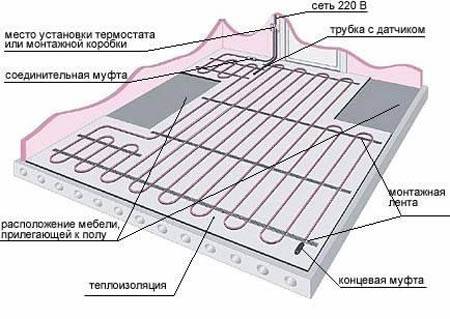 Warm electric floor
Warm baseboard and infrared heating
Increasingly popular in recent years is infrared efficient heating of a country house. Infrared systems of the modern type are based on the fact that infrared rays heat objects in the vicinity, and not the air. They are not able to harm the residents of the house, are safe for the environment, and can quickly bring the temperature in the room to optimal parameters. Through such a system, you can heat the house, and very efficiently and with minimal financial costs. Another advantage of this system is the ease of installation.
Infrared film, which is used for a system such as "warm floor", is also in great demand recently. Such a film can be laid under the floor covering, and this somewhat facilitates its installation. No complex repairs required.All that needs to be done is to remove the flooring, place an infrared film under it and then re-lay the flooring.
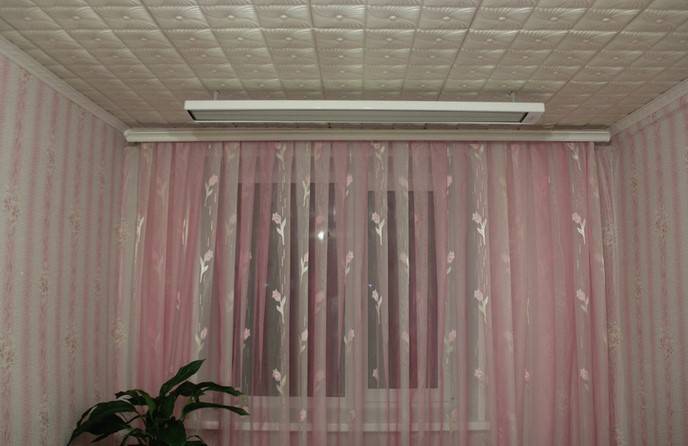 Infrared Ceiling Heater
The "warm baseboard" system has also been very popular recently among owners of private or country houses. Such types of heating of a country house are installed along the walls. The walls are the first heated elements and already, in turn, heat the air in the room. They also prevent warm air from escaping outside.
Such an alternative method of organizing the heating system of a private house is also not expensive and is quite effective.
It does not require the installation of additional communications, which means that the interior of the room will not suffer at all. The use of such a heating system allows you to maintain the most optimal humidity for a person in the room.
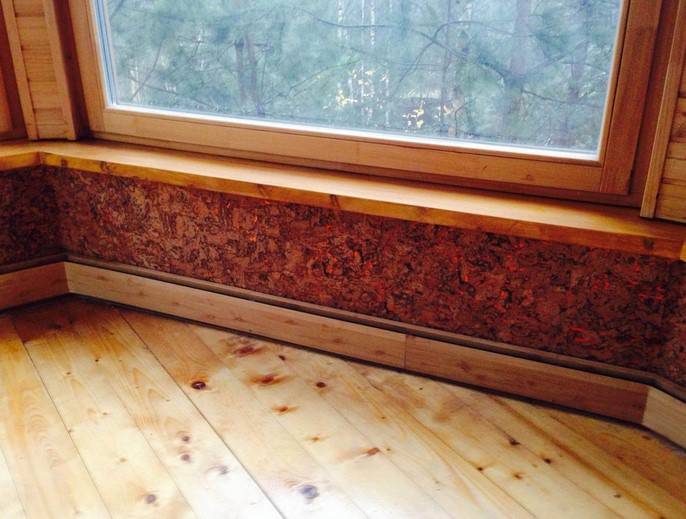 Heating system "warm plinth"
Design and calculation of an air heating system
To install air heating, it is necessary to draw up a preliminary project.
To do this, you need to calculate the following indicators:
- heat loss of the room;
- the required power of the heat generator;
— speed of heated air supply;
— diameter and aerodynamic characteristics of air outlets.
Professional calculation by our specialists will help you avoid drafts in the room, noise and vibration in the house, as well as overheating of the heat generator.
It is better to think over the place of installation of the equipment in advance.
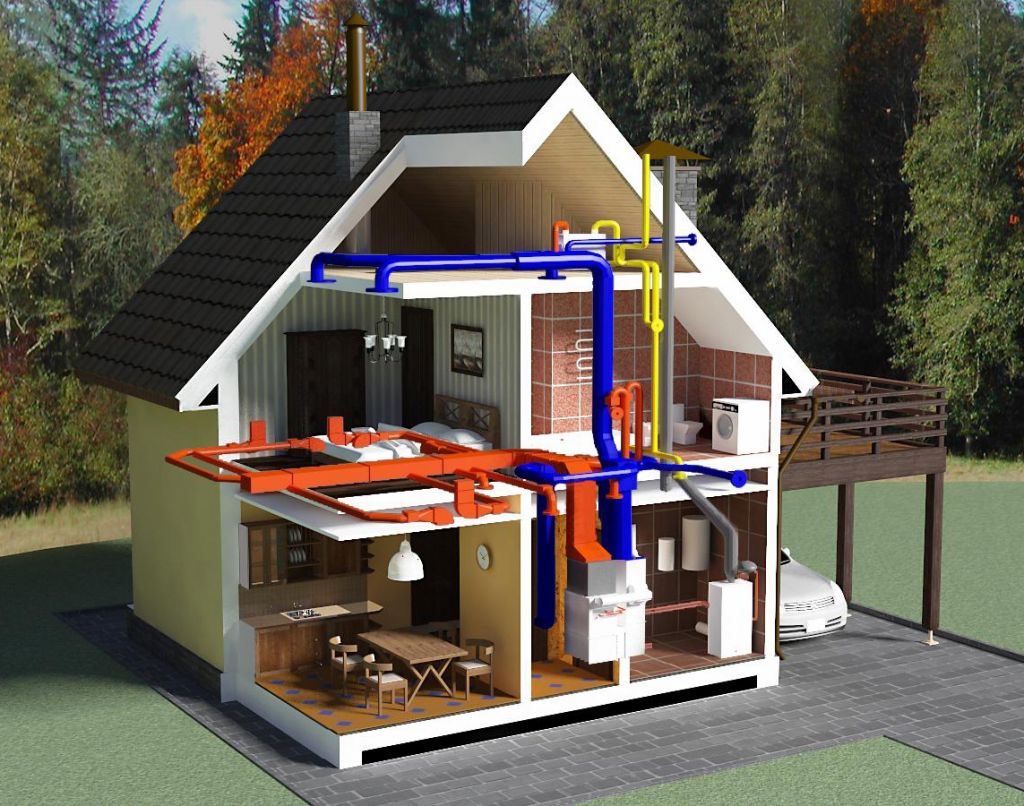
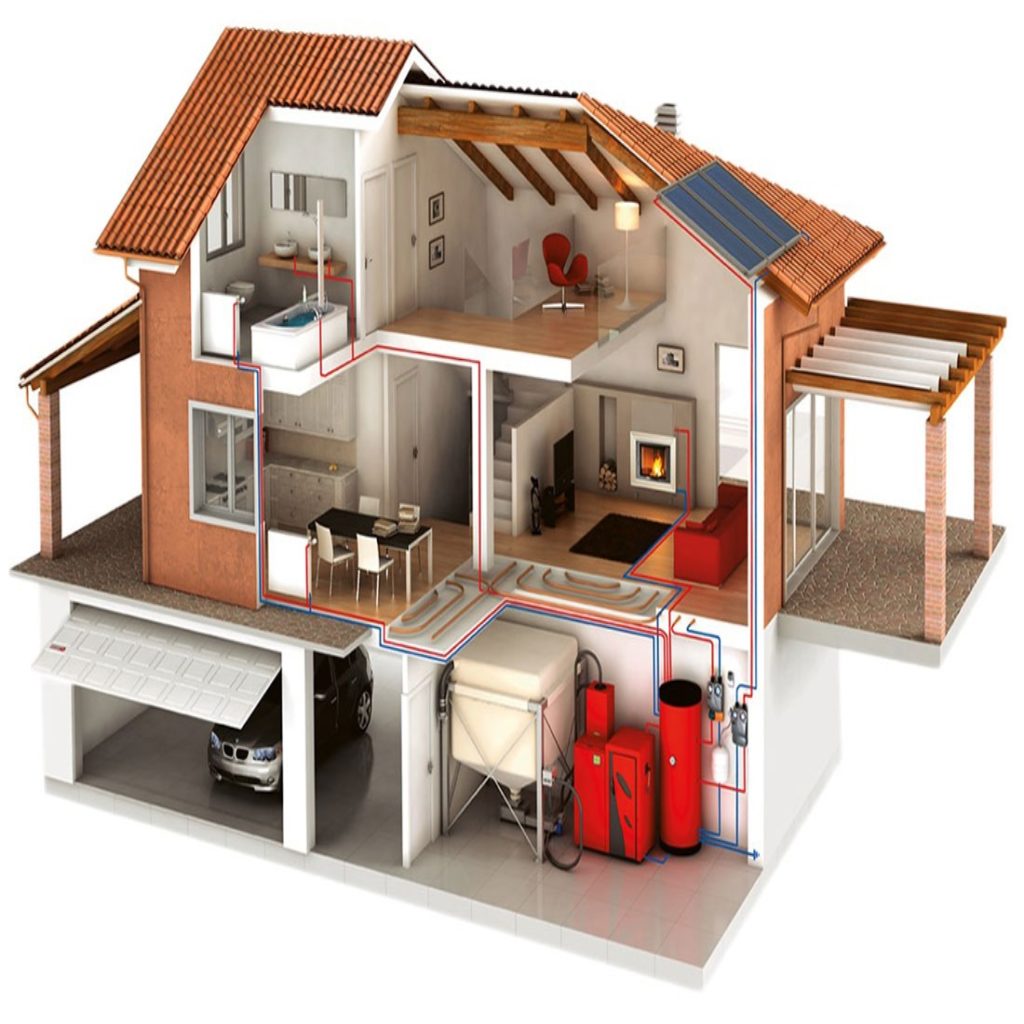
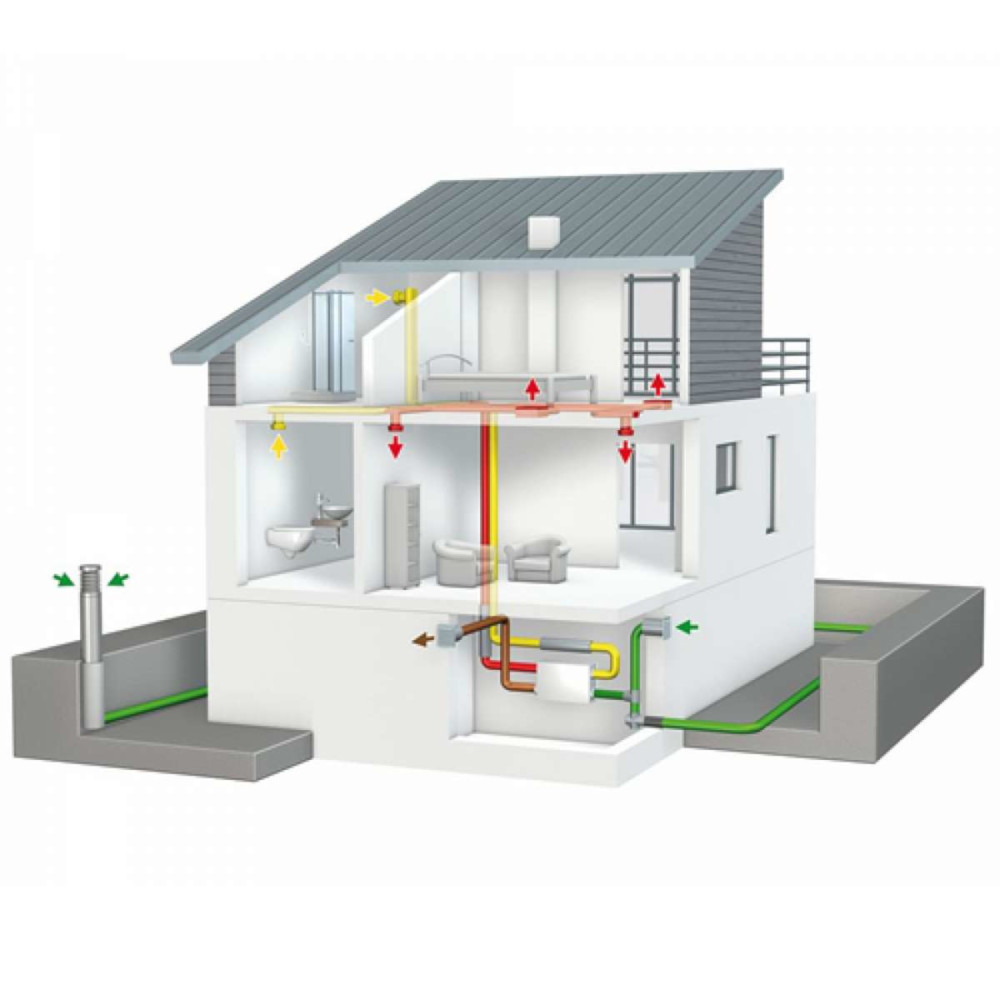
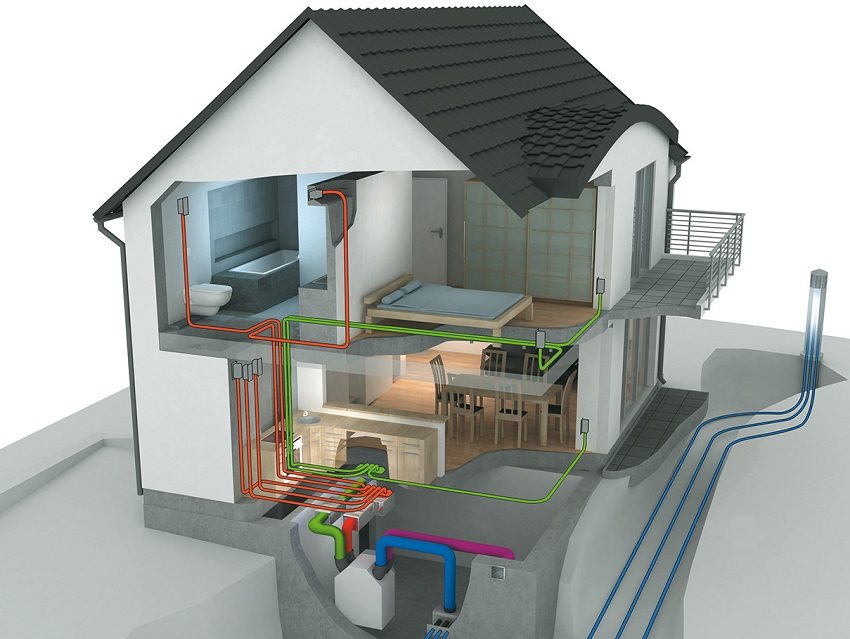
At air heating from a single heat generator the issue of ducting needs to be addressed.
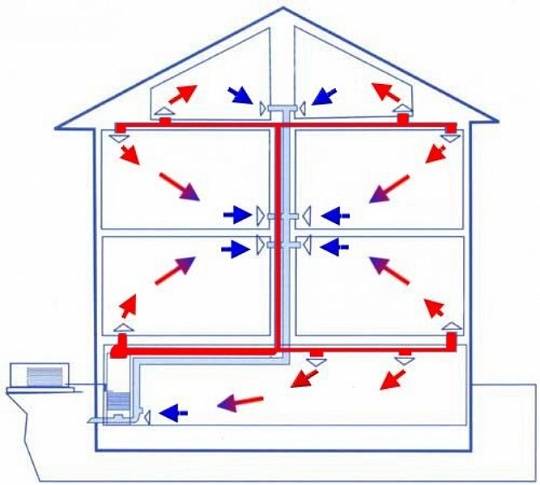
To achieve the most efficient distribution of heat in the room, it is necessary to place the inflow of warm air as close to the floor as possible, since in this case the effective distribution of heat by convection is achieved at a low air flow rate.
The heated air itself tends to rise from the floor to the ceiling, evenly warming the entire volume of the room.
But, since the air intake comes from below, the air ducts have to be covered with decorative coatings or laid under the floors between the lag.
Is it possible to separate air ducts under the ceiling? Can. Technically, it's much easier. But then you will face the following problem: in order to "shove" the heated air into the room to the very floor, you will have to significantly increase the pressure in the system and increase the air flow rate.
At the same time, energy costs increase sharply, as well as acoustic effects in the air ducts (noise, whistle, knock, vibration). Additional discomfort will be created by the noise of the air flow at the outlet of the distribution grilles (remember the thermal curtains at the entrance to shopping centers and imagine that they make noise in your room).
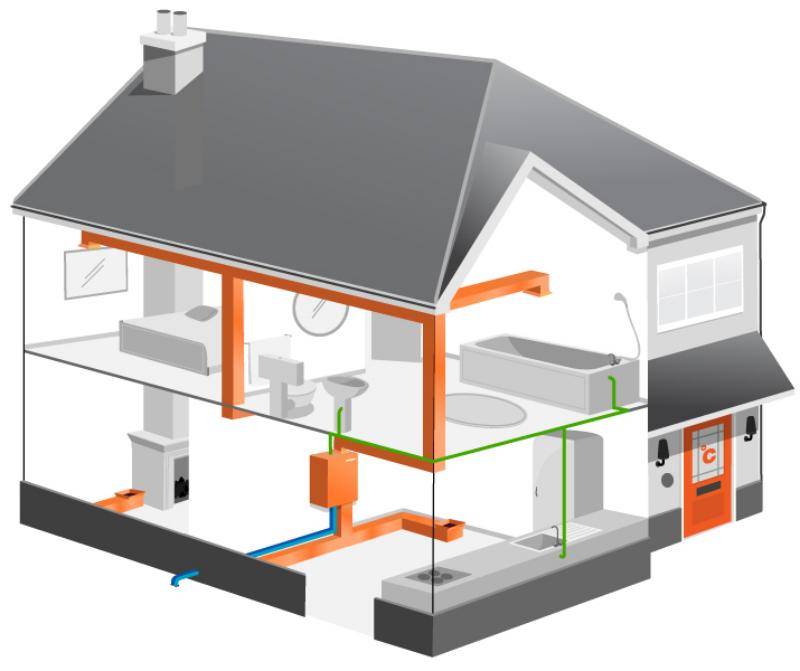
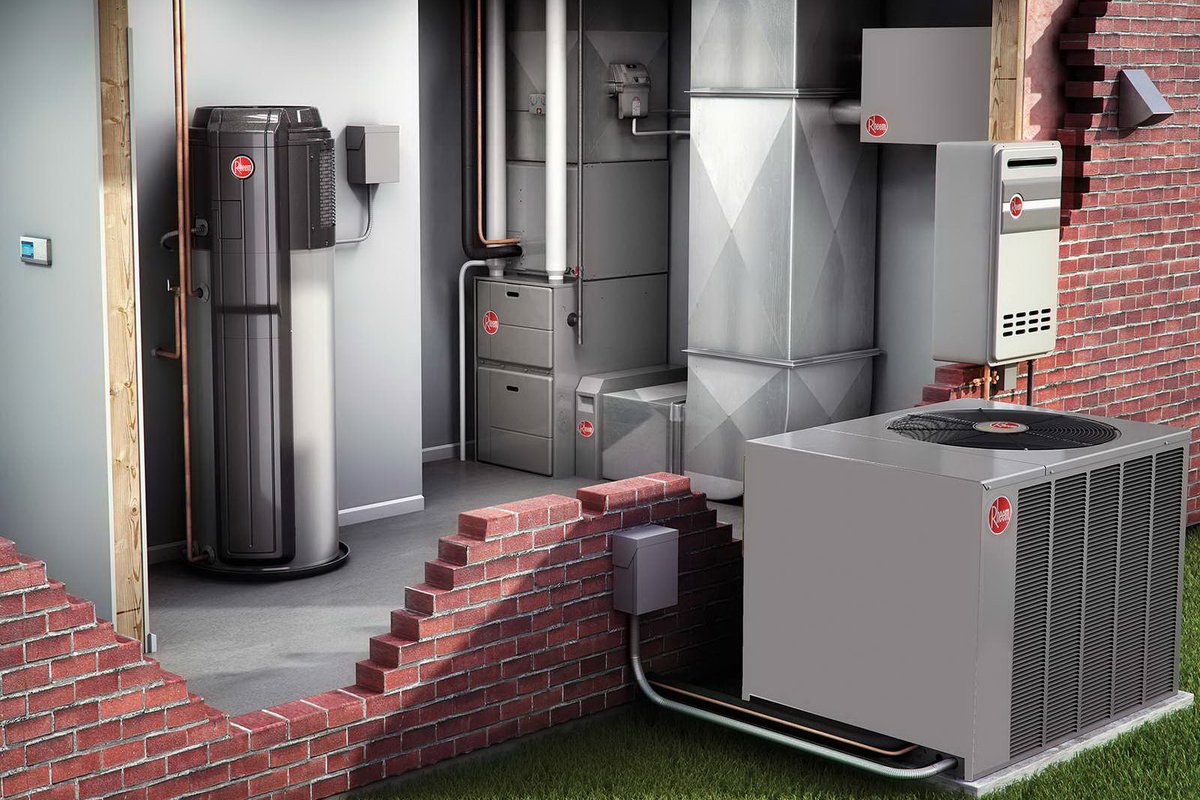
A somewhat easier installation option is when air conditioners or heat pumps are used for air heating. In this case, warm air is produced by the machine directly in the room, so no ducts are needed. Freon lines are used here for heat exchange. They are much thinner than air ducts and are easy to place under the ceiling.
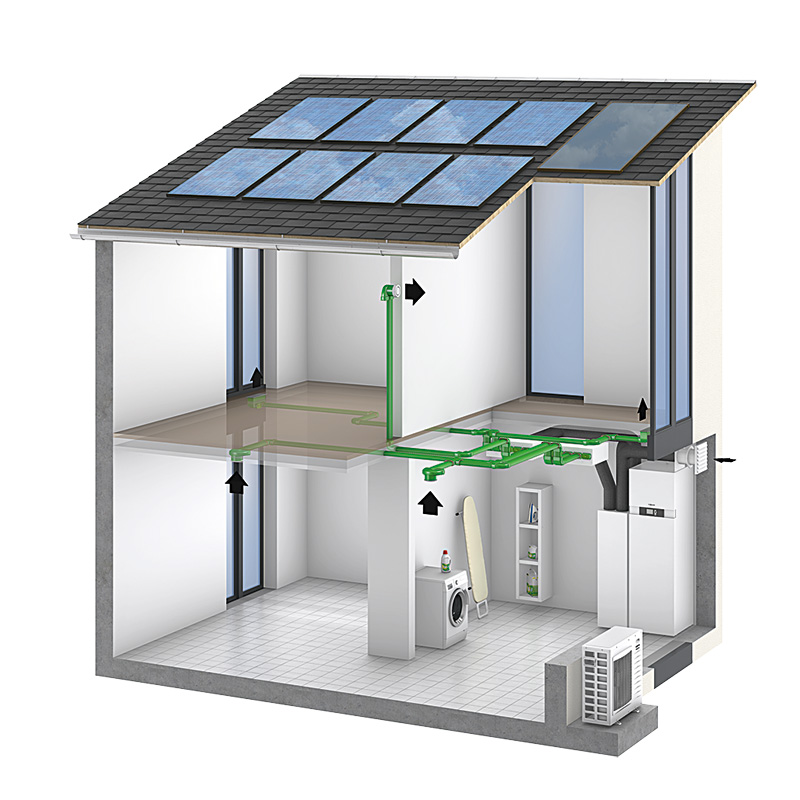
How to calculate an air heating system
To make a thermotechnical air heating calculation - combined with ventilation or made by separate wiring - heat engineers take into account many parameters:
• Heat loss of the room (depends on the material and thickness of the walls, the number and area of windows, etc.);
• The number of people who will be in the room;
• Quantity and power of additional heat sources;
• Heat gains from operating equipment or appliances, etc.
The simplest scheme looks like this: 40 watts of thermal power per cubic meter of heated space. For the regions of the Far North, taking into account extreme temperatures in winter, a coefficient of 1.5-2.0 is accepted.
Another approximate scheme for buildings with a ceiling height of no higher than 2.5 - 2.7 m. Here, a heat generator with a power of approximately 1 kW is taken to heat 10 m2 of the building area. For areas with severe frosts, increasing coefficients are taken into account.
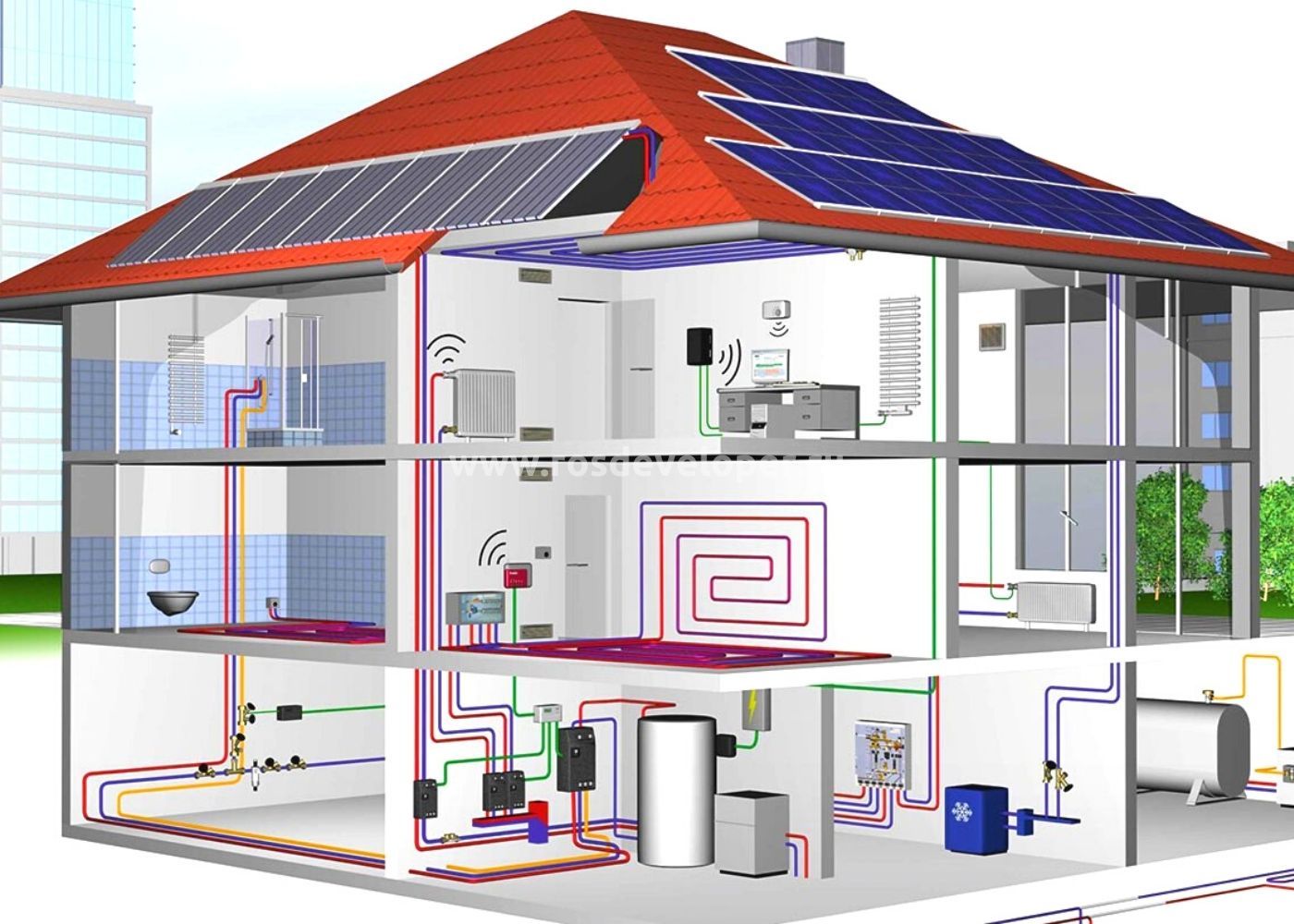
The main elements of the water heating system
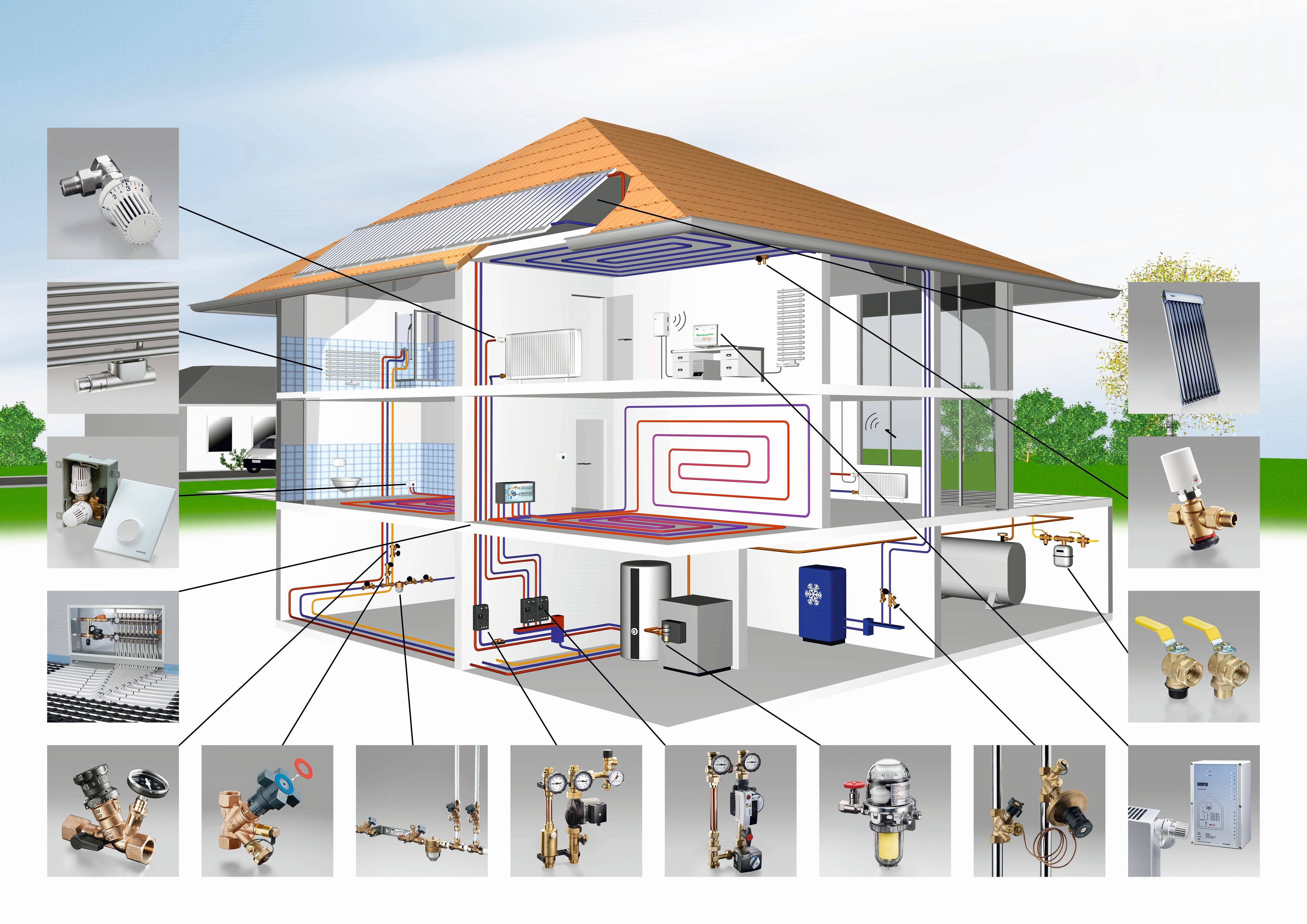
The main elements of the water heating system include:
- boiler;
- a device that supplies air to the combustion chamber;
- equipment responsible for the removal of combustion products;
- pumping units that ensure the circulation of the coolant through the heating circuit;
- pipelines and fittings (fittings, shut-off valves, etc.);
- radiators (cast iron, steel, aluminum, etc.).
Boiler selection by the number of circuits
For heating the cottage, you can choose a single-circuit or double-circuit boiler. What is the difference between these models of boiler equipment? A single-circuit boiler is designed only for heating the coolant intended for circulation through the heating system. Indirect heating boilers are connected to single-circuit models, which supply the facility with hot water for technical purposes.In dual-circuit models, the operation of the unit is provided in two directions that do not intersect with each other. One circuit is responsible only for heating, the other for hot water supply.
Boiler selection by type of fuel
The most economical and convenient type of fuel for modern boilers has always been and remains main gas. The efficiency of gas boilers is not disputed, since their efficiency is 95%, and in some models this figure goes off scale for 100%. We are talking about condensing units capable of "pulling" heat from the products of combustion, flying away in other models simply "into the pipe".
Heating a country cottage with a wall-mounted gas boiler is one of the most popular ways to heat living space in gasified regions.
However, not all territories are gasified, therefore, boiler equipment operating on solid and liquid fuels, as well as on electricity, is very popular. It is even more convenient and safer to use electric boilers for heating a cottage than gas, provided that the stable operation of the power grid is established in the region. Many owners are stopped by the cost of electricity, as well as the limitation of the rate of its release for one object. The requirement to connect an electric boiler to a three-phase network with a voltage of 380 V is also not to everyone's liking and affordability. It is possible to make electric heating of cottages more economical by using alternative sources of electricity (windmills, solar panels, etc.).
In cottages built in remote regions, cut off from gas and electric mains, liquid fuel boilers are installed.As fuel in these units, diesel fuel (diesel oil) or used oil is used, if there is a source of its constant replenishment. Solid fuel units operating on coal, wood, peat briquettes, pellets, etc. are very common.
Heating a country cottage with a solid fuel boiler that runs on pellets - granulated wood pellets that have a cylindrical shape and a certain size
Boiler selection by power
Having decided on the type of boiler equipment according to the fuel criterion, they begin to select a boiler of the required power. The higher this indicator, the more expensive the model, so you should not miscalculate when determining the power of the unit purchased for a particular cottage. You can't follow the path: the less, the better. Since in this case the equipment cannot fully cope with the task of heating the entire area of a country house to a comfortable temperature.
Pipe wiring
In order for the cottage heating system to be operated for a long time, it is better to use special polypropylene pipes.
Their service life is about 50 years and requires virtually no technical support or replacement of failed elements, which often happens with metal pipelines - they rust and can even provoke an emergency. Installation of cottage heating is carried out according to one- or two-pipe scheme.
Single pipe
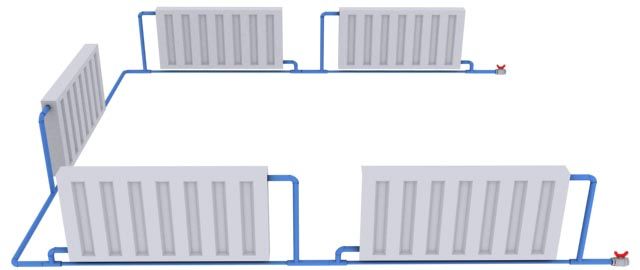
Such a scheme uses the sequential passage of the coolant through the heating radiators, so the temperature at the system inlet differs significantly from the outlet temperature, which further complicates its adjustment in the premises.
Two-pipe
Two-pipe wiring, although it requires a larger footage of pipes, but there are more possibilities for adjusting the temperature indicators of each room, as a result, the reduction in fuel costs compensates for this disadvantage. Hence the conclusion - for heating cottages it is better to use a two-pipe forced circulation scheme.
Description
Air heating is a modern thermoregulation system, which ensures the supply of warm air to the premises. Unlike other types of heating, this installation has many advantages. It prevails over radiator and stove heating, so it is often chosen for a private house.
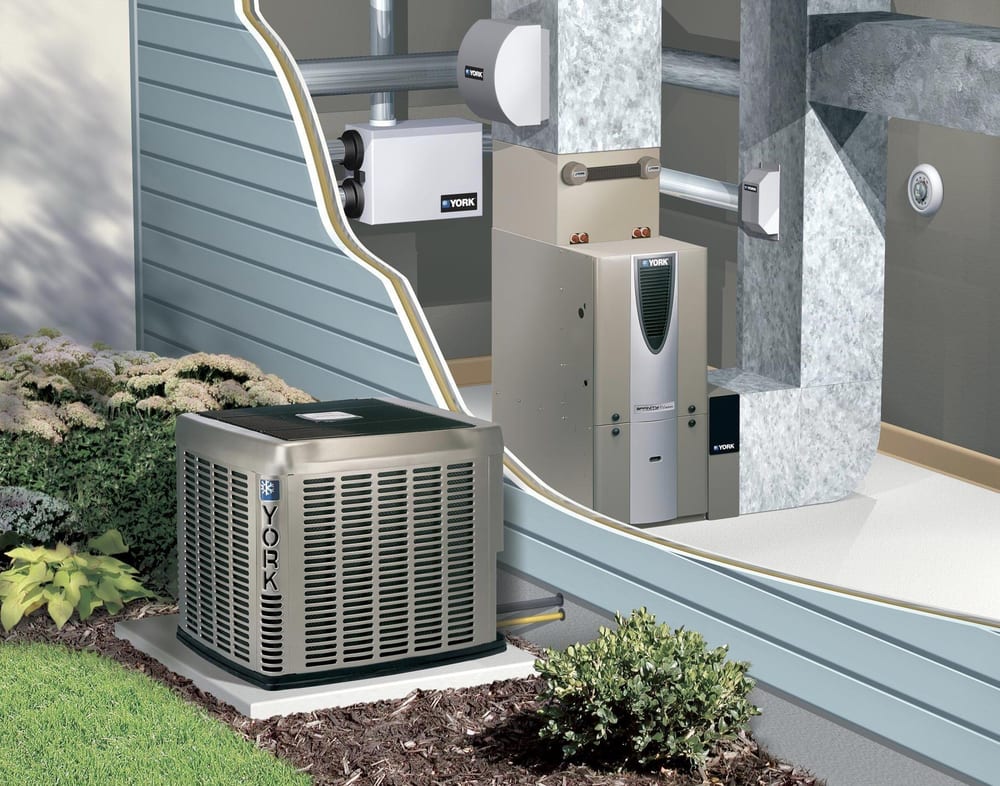
The air system consists of various components, the main ones being:
- a network of channels responsible for the transfer of heated air to all rooms of the building;
- heat generator or water heater;
- fans that control the passage of air masses around the house;
- air filters.
In addition, the design of the heat exchanger also includes a special combustion chamber. Heat generators are floor and wall type, some of their models can be installed outdoors. The device in sectional design usually produces power up to 100 kW, and in monoblock - up to 400 kW. Since the heat generator can run on liquid, solid fuels and natural gas, air heating is ideal not only for apartments, but also for suburban housing.
Do-it-yourself air heating.Installation of an air heating unit AVH with a return manifold.
Installation of the AVN air heating unit, the return manifold air filter - more precisely, installing them on the floor and docking with each other - is also quite possible to do it yourself. It is worth saying that, generally speaking, AVN consists of two separate blocks - a fan BV block (it is placed on the floor), and a CBN heater block, which is simply placed on the fan block. Separately, each unit weighs less than 30 kg, so it is quite possible for one adult to install them.
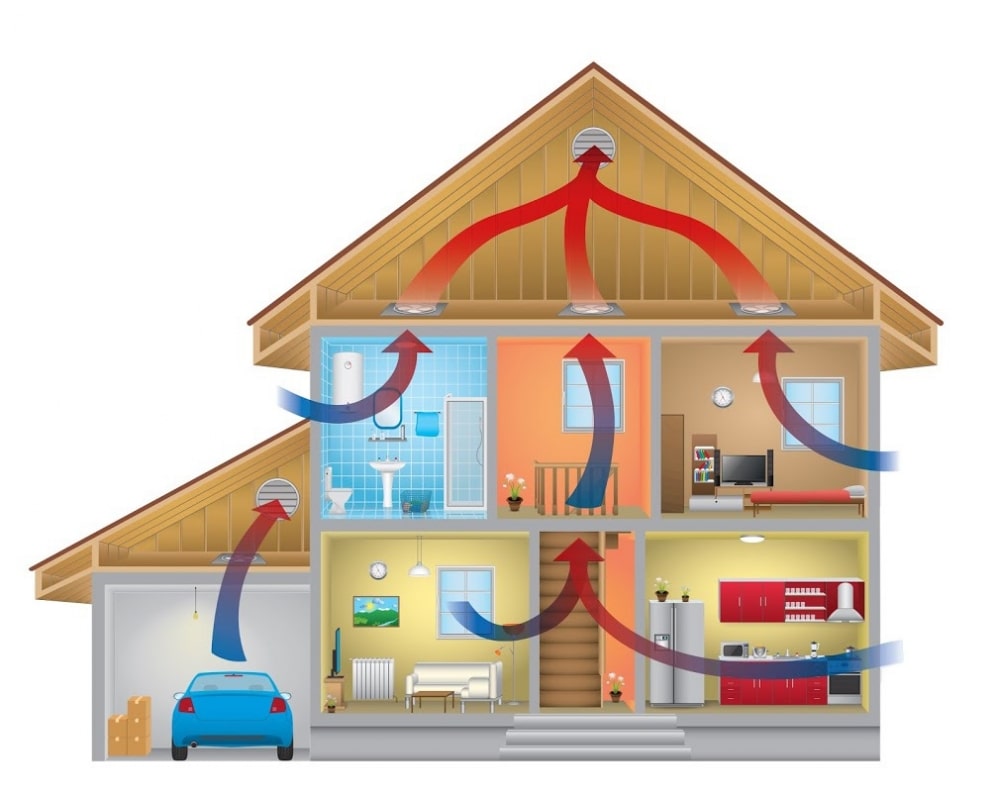
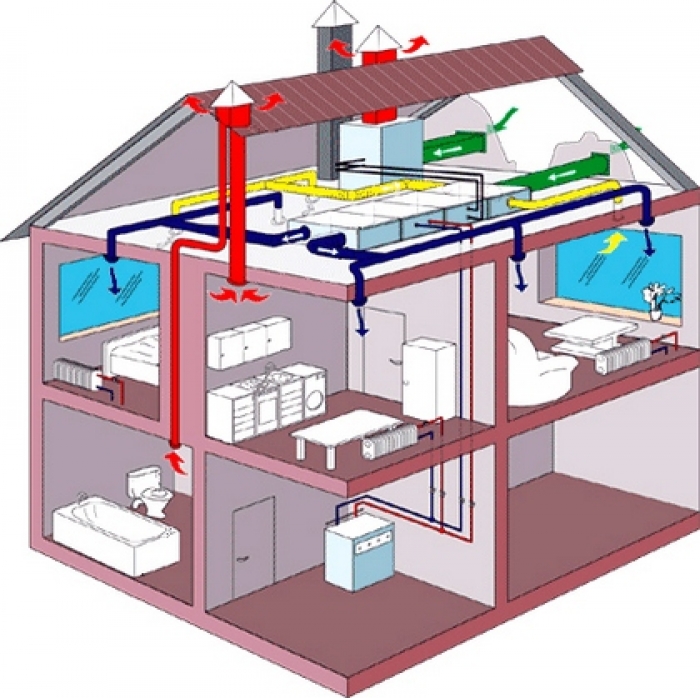
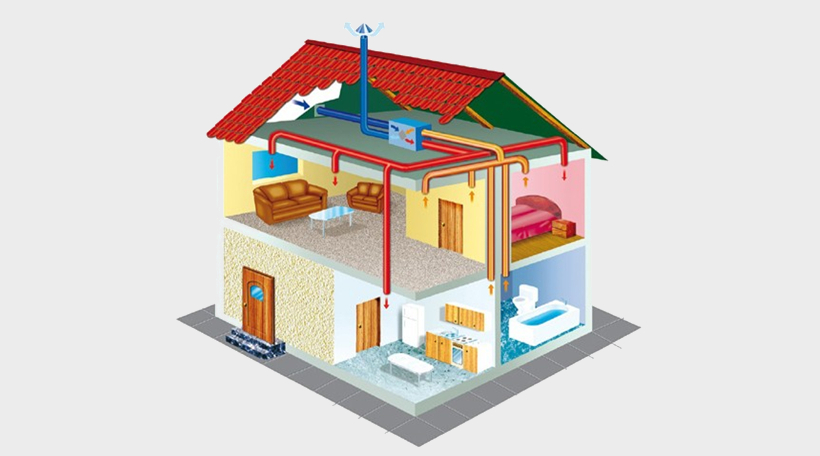
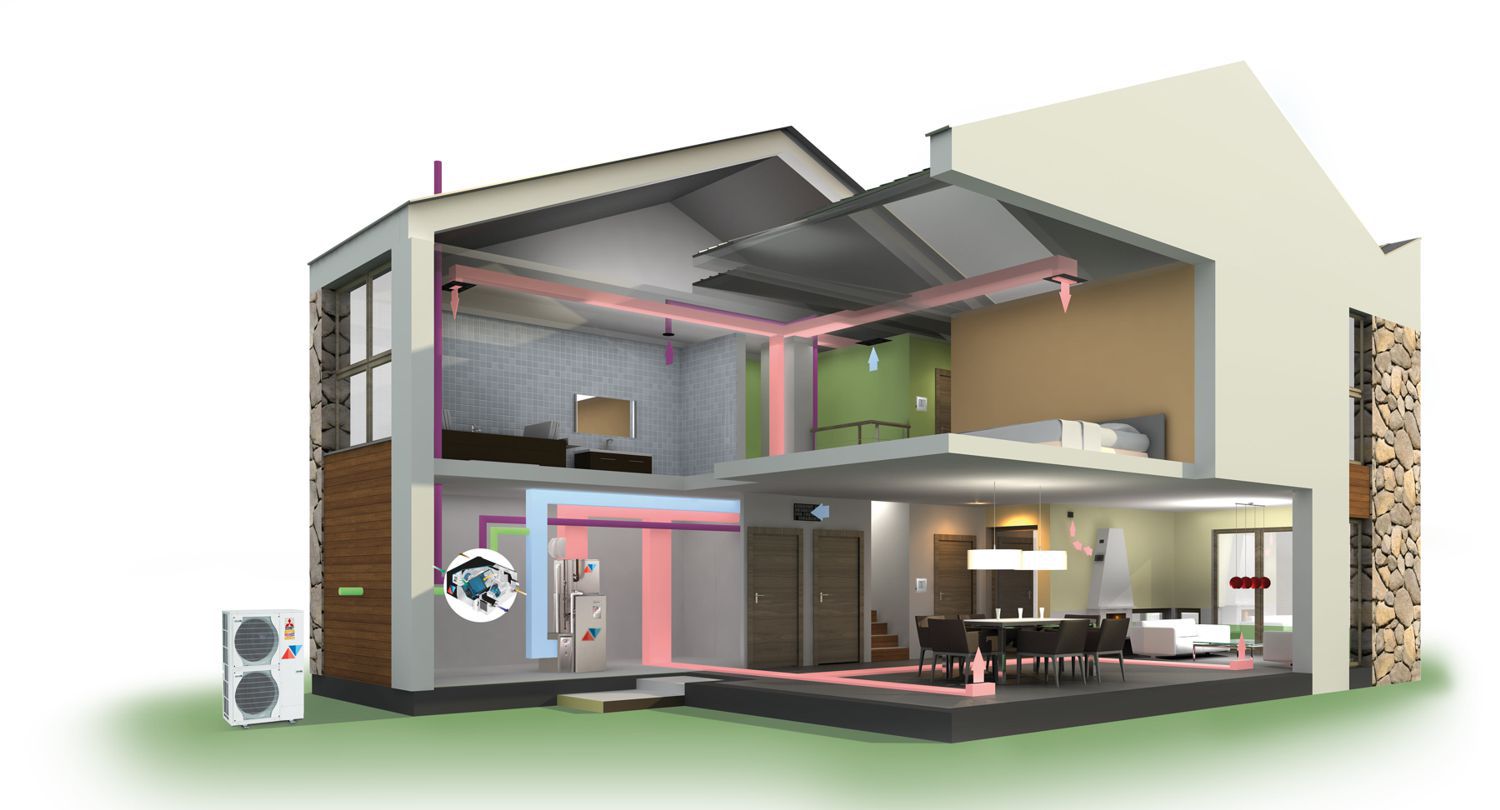
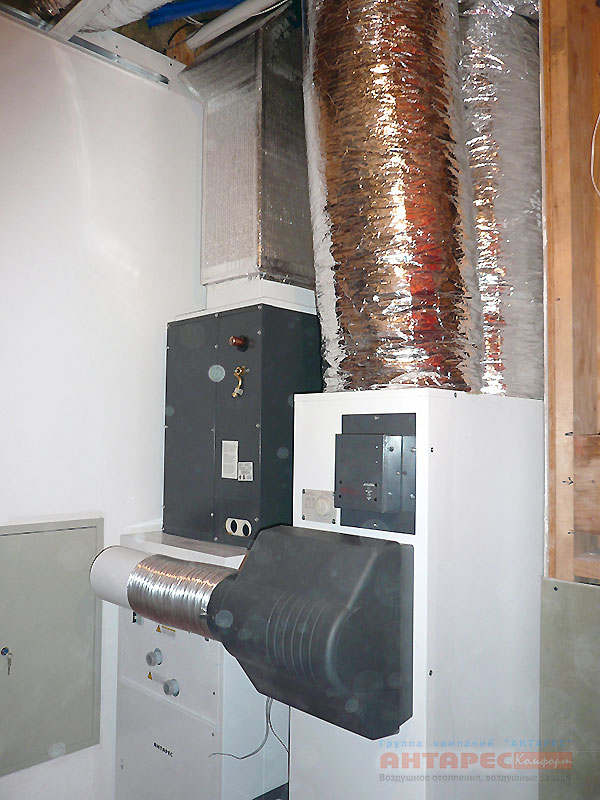
The air filter housing is attached to the side of the fan assembly.
The return manifold also consists of two lightweight blocks (in fact, these are just empty boxes made of a thin steel sheet, designed to facilitate the installation of return air ducts and a humidifier with a sterilizer) - the lower outlet-transition OP (it is placed on the floor) and the upper block OK ( it is placed on the branch-transition). In this case, the transition outlet is connected on one side to the air filter, which we have already connected to the BV fan unit on the other side.
The humidifier and ultraviolet air sterilizer are placed on self-tapping screws into special slots in the return manifold housing, and the air conditioner is placed on top of the CBN heater block. To avoid air leaks (and as a result, whistle), it is advisable to pre-lubricate the seats for the above equipment with sealant.
The HE electric heater and the HB water heat exchanger are screwed into the body of the heater block in the corresponding slots (HB - in the lower, NE - in the top).
A certain difficulty can only be the connection of an external unit of an air conditioner for refrigerant, the connection of a humidifier for water and sewerage, the connection of an electronic filter, a humidifier, an external unit of an air conditioner and an air heater to an electrical switchboard. Detailed connection diagrams are given in the Antares Comfort Air Heating User Manual.
Types of air heating
There are two fundamentally different schemes for this type of heating.
Air heating combined with ventilation
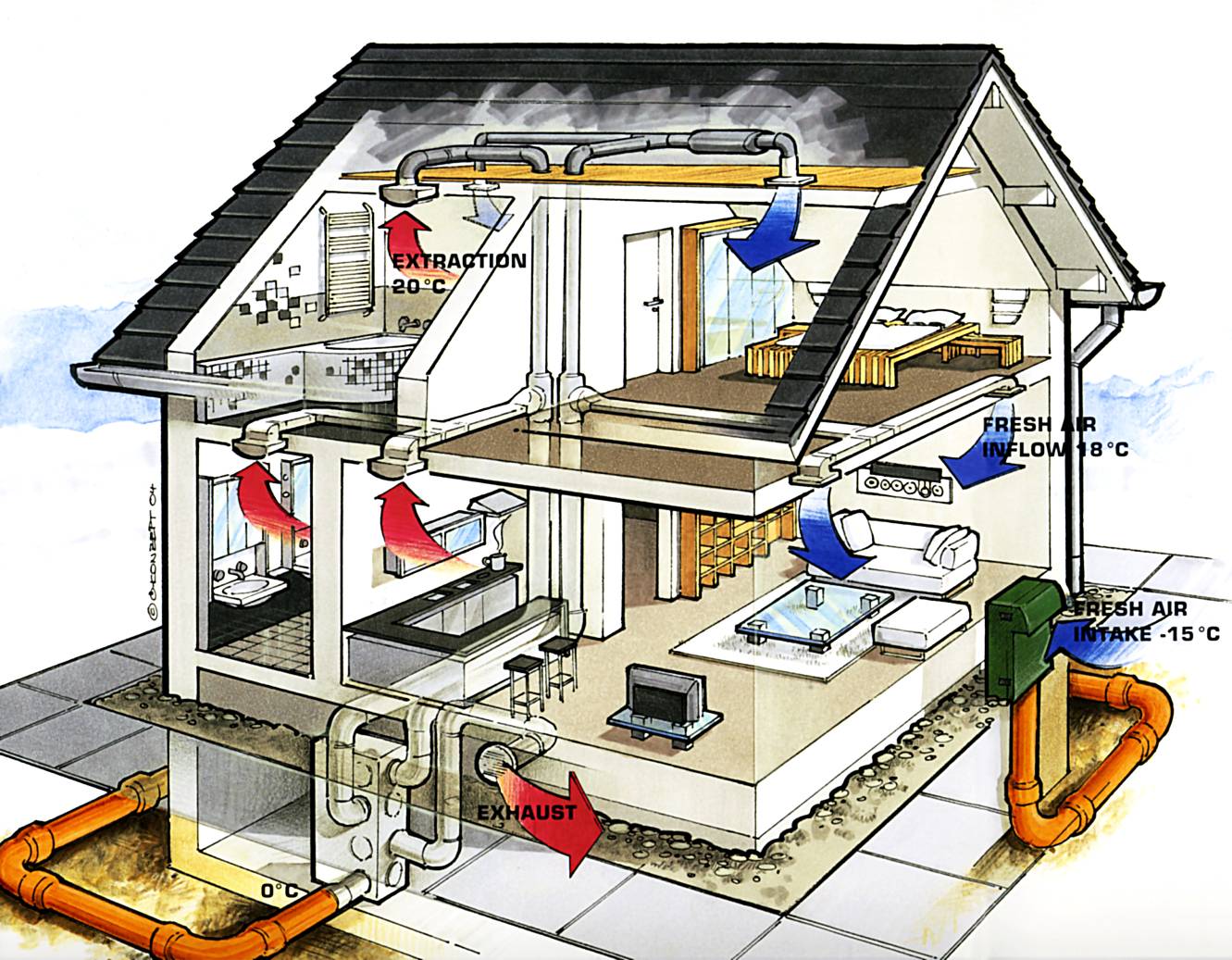
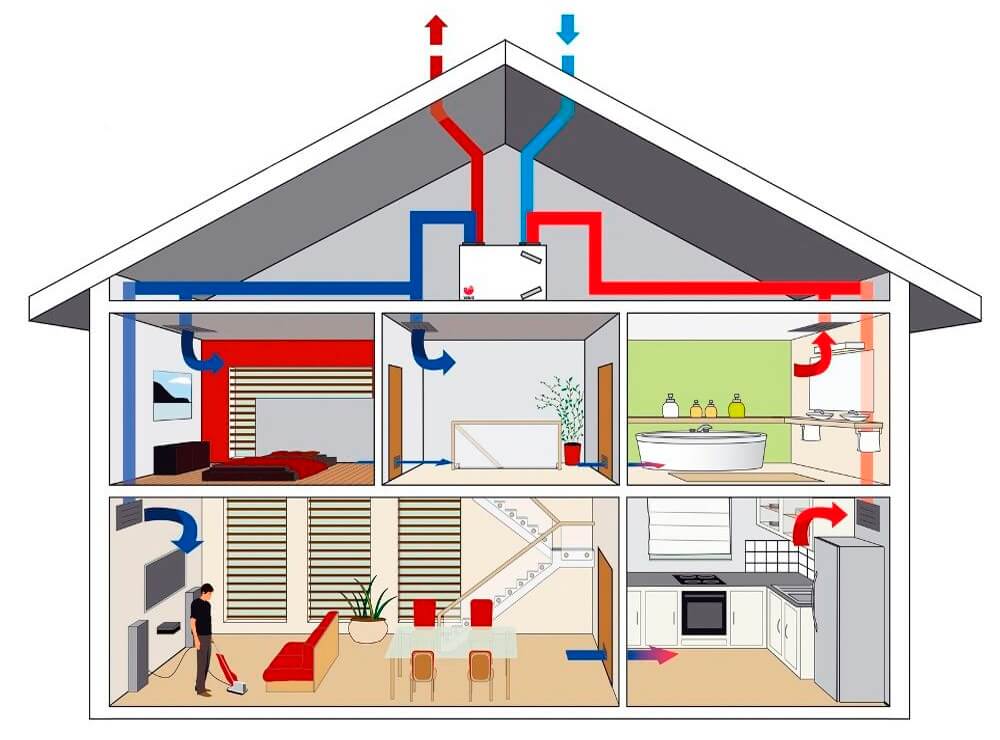
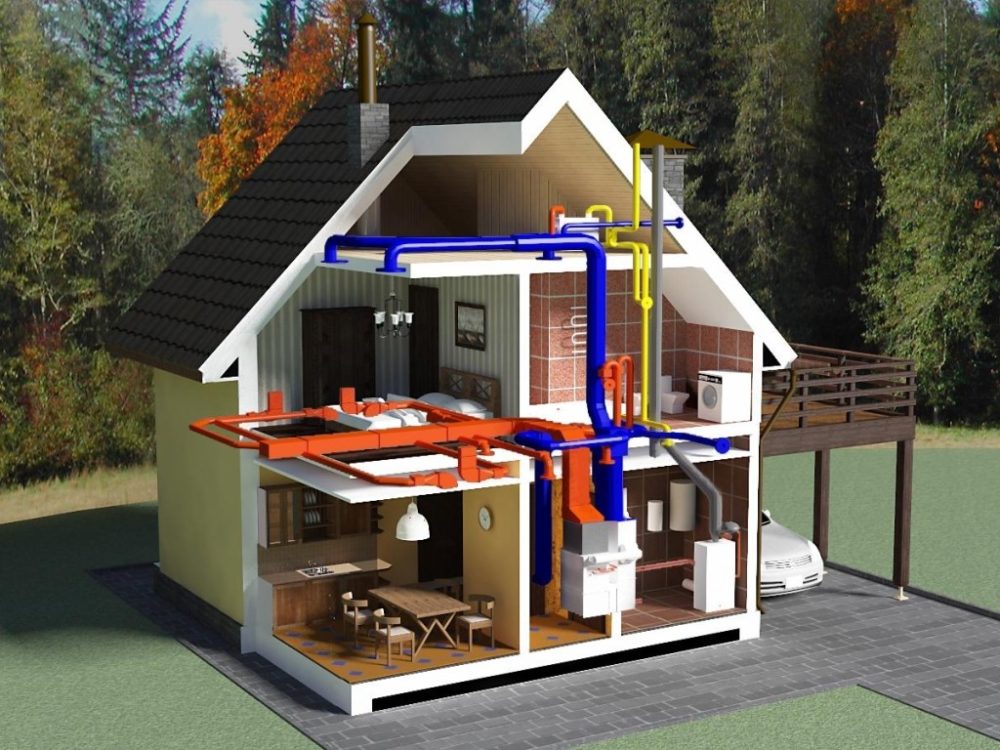
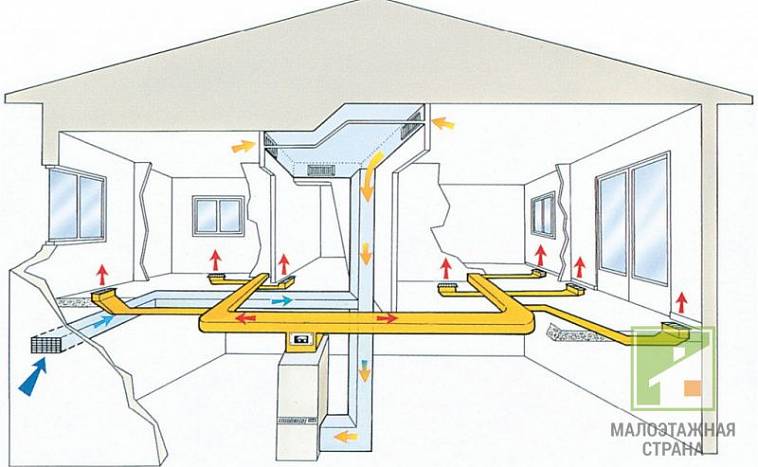
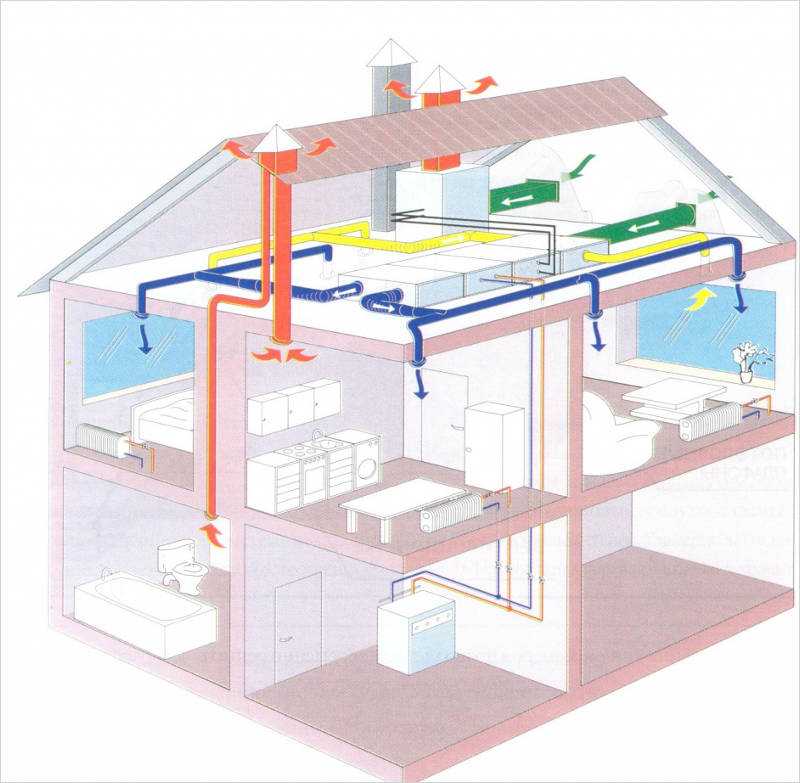
The transfer of heated air is carried out using elements of supply and exhaust ventilation. In this case, the operating parameter is not only the temperature in the room, but also the set air exchange rate.
Heat is generated by boilers or gas heat generators. A system of air ducts is connected to them, through which warm air is distributed over all areas of the heated premises. The system can be supplemented with filtration, humidifier, recuperator.
Characteristics of the most popular heating systems
The choice of a specific type of heating is not limited to connecting to a central line or autonomous operation, they are divided into several options that are suitable in a given situation.
Water heating
Many consumers choose water heating of a country house, the options and prices of which make it possible to provide the building with heat and hot water with minimal initial investment and an acceptable level of current costs.
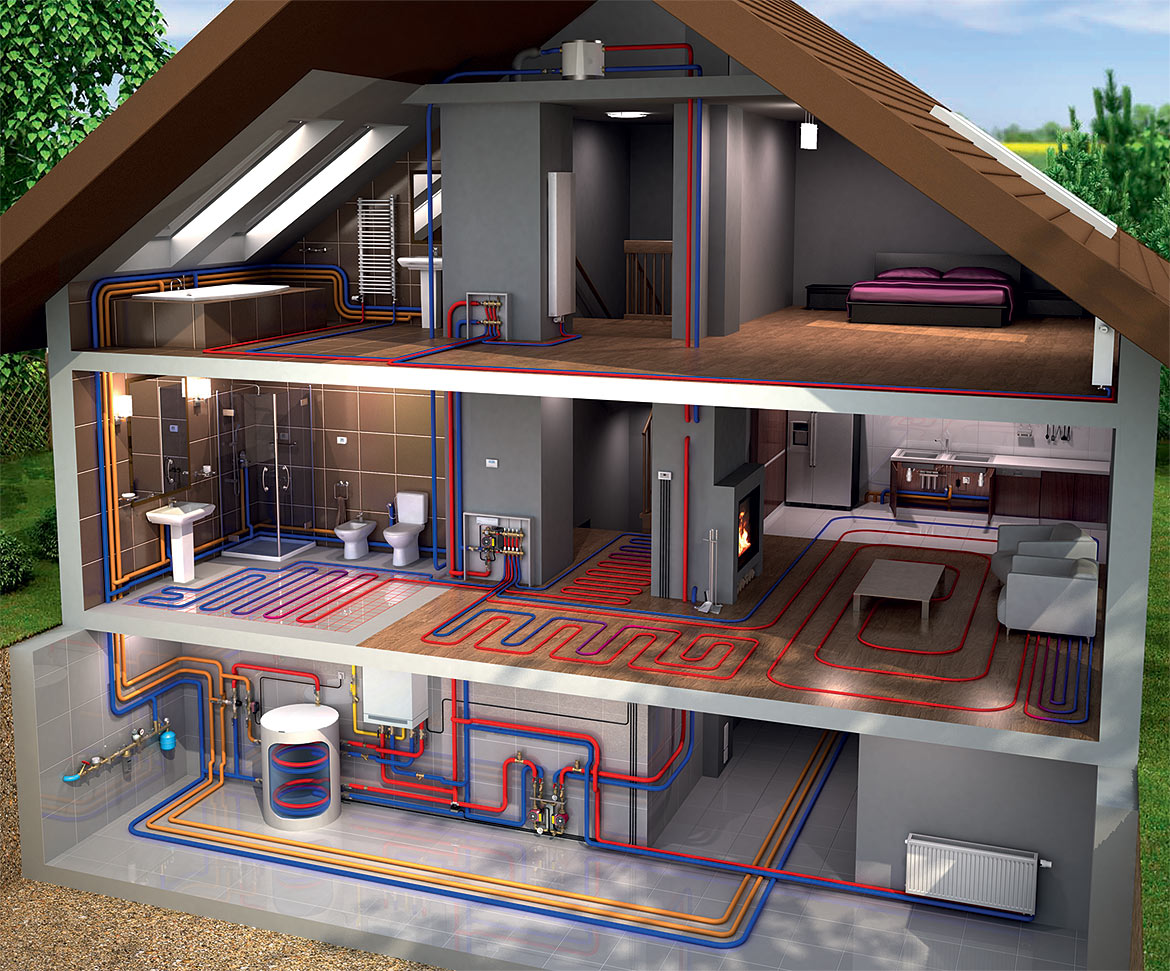
It is a closed loop system that consists of three main components:
-
heating boiler, which can operate on suitable gas, liquid or solid fuels and electricity.
-
Tru systemsb, which ensures the delivery of the coolant (heated water) to each room.
-
heating batteriesacting as heat sources in the room.
To ensure the quality of the functions, a constant circulation of water in the pipes is necessary, it can be forced or natural.
Schematic representation of a water heating system
The first option requires the connection of a pump of sufficient power, which will ensure the movement of the coolant in utilities. The second one is obtained due to a change in the density and degree of heating of water in different parts of the heating system, the heated coolant moves up, squeezing out colder water.
Despite the advantages, there are disadvantages:
-
Uneven heating - rooms located closer to the boiler heat up more than remote ones.
-
The rate of temperature increase is quite slow and it will take a while for the whole house to warm up.
-
impact on the interior. If the pipes are laid in the walls at the construction stage, then for their repair it will be necessary to remove the coatings. In the case of installing water heating after repair, it is difficult to naturally fit them into the design of the room.
-
-
The need to maintain a certain coolant temperature increases operating costs.

Despite this, water heating is the most popular.
Electric heating of a country house (electric convectors)
If only efficiency is taken into account, then electricity has the highest rate among all heating elements, so it is most often chosen if it is possible to connect to a common energy highway.
Electric heating radiator
The advantages of this type of heating include:
-
Relative ease of installation, which, with basic knowledge and skills, can be done independently.
-
High heating rate.
-
Lack of noise accompanying the operation of devices.
-
A wide range of devices based on a variety of operating principles, which allows you to use the most optimal option for yourself.
-
A wide range of different design solutions provides an opportunity to choose an electric heating device for a specific interior.
But there are a number of conditions that limit or make it impossible to use such equipment in some cases:
-
High cost per 1 kW of heat.
-
There are certain wiring requirements. It must be rated for the appropriate power.
-
An uninterrupted supply of electricity is required. If there are problems with this in the region, then another option should be sought.
Subject to these parameters, the installation of electric heating will bring only pluses.