- Using a well for organizing water supply
- Organization of winter water supply
- Step # 1 - insulate the pump for water supply
- Step # 2 - insulate the accumulator
- Step #3 - Taking care of the water pipes
- Step # 4 - put the drain valve and pressure switch
- Water supply by surface pump
- Hydraulic tank or barrel-tank
- Where is it installed? Tank installation requirements:
- How to connect
- List of required materials and tools:
- Base mounting
- Supply hose
- Plumbing installation
- The principle of laying pipelines with a submersible pump
- What to buy:
- Pros and cons of the "well" option
- Wiring diagrams for the plumbing system around the house
- Serial, tee connection
- Parallel, collector connection
- System Installation Recommendations
- Scheme of a country well water supply
- How to properly maintain the system
- Conclusion
- Approximate cost of work
- Pumping stations
- Prices for popular models of pumping stations
- How to choose a pumping station
- Water supply of a private house from a well and a well: pipe laying
- deep laying
- close to the surface
- Sealing the entrance to the well
Using a well for organizing water supply
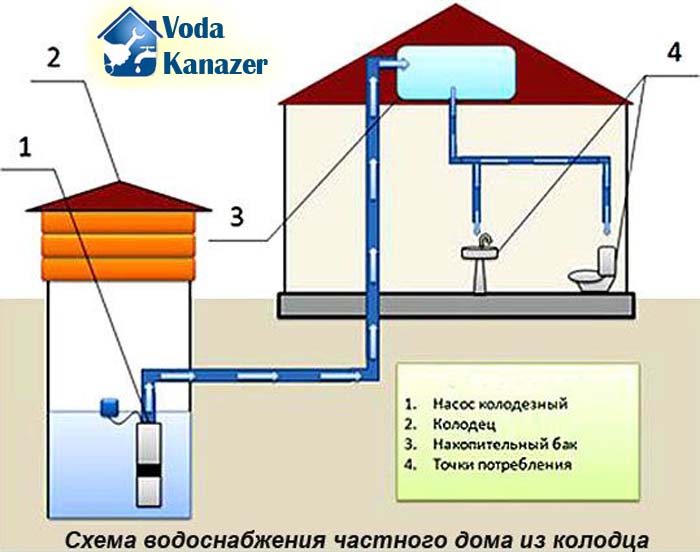
If there is no central water supply, the choice is up to the well.But this plumbing scheme has several options.
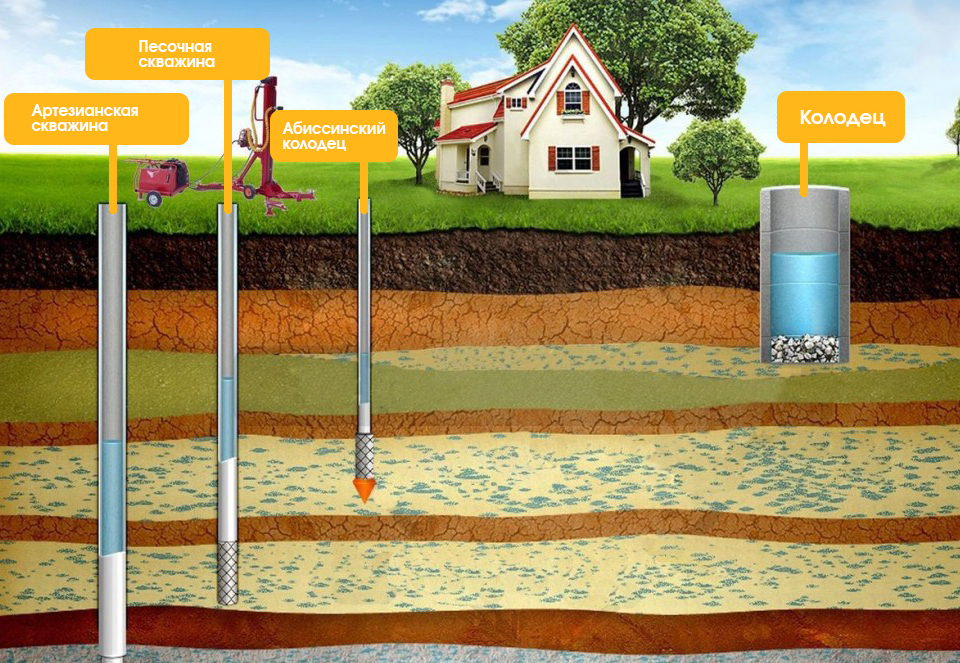
The soil is a natural natural filter. Seeping into the depths, polluted water is purified, changes its composition, can be released from some chemical compounds that react with other chemical elements in the soil. Therefore, the deeper water is taken from, the higher quality it will be.
The soil also contains layers of clay or loam. They do not pass water well. Moisture, accumulating over such a layer, forms an aquifer. From which water can be taken through a well. But the water seeping through the clay has a much higher degree of purification. And having met with the second layer of clay, it forms the second aquifer.
The water that is taken from the third aquifer is the most purified and it is called artesian. In different areas, it can occur at different depths. On average, from 25 to 50 meters or more.
The water taken from the second aquifer, less purified, is called sandy, and the well is “on sand”.
The water taken from the first layer can also be sandy if there is a water-saturated layer above, called a perch. Such a well is called an Abyssinian. And its depth is from 8 to 16 meters. Sometimes the first layer of water and perched water are combined, if they are not separated by a clay layer. Verkhovodka can lose water during the dry season. It all depends on the structure of the soil in a particular area.
Tip: for a country house intended for year-round use, it is better to drill an artesian well, but you can get by with a well from the second aquifer. The choice again depends on the composition of the water of this layer.For a summer cottage, you can get by with an Abyssinian well, but a sandy well is better.
Organization of winter water supply
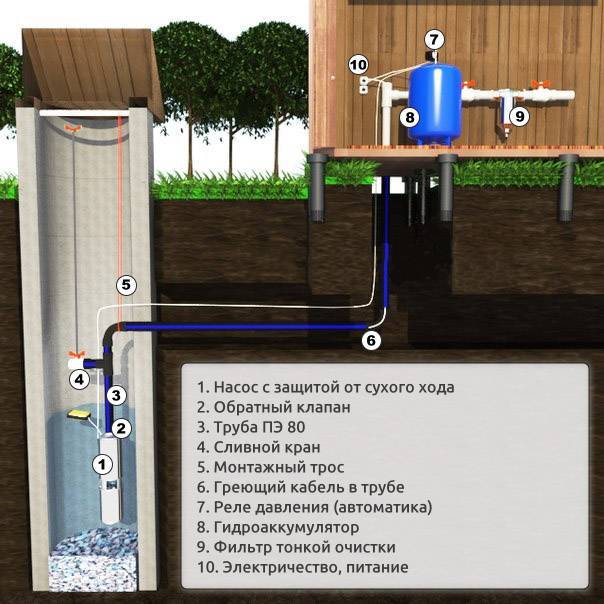
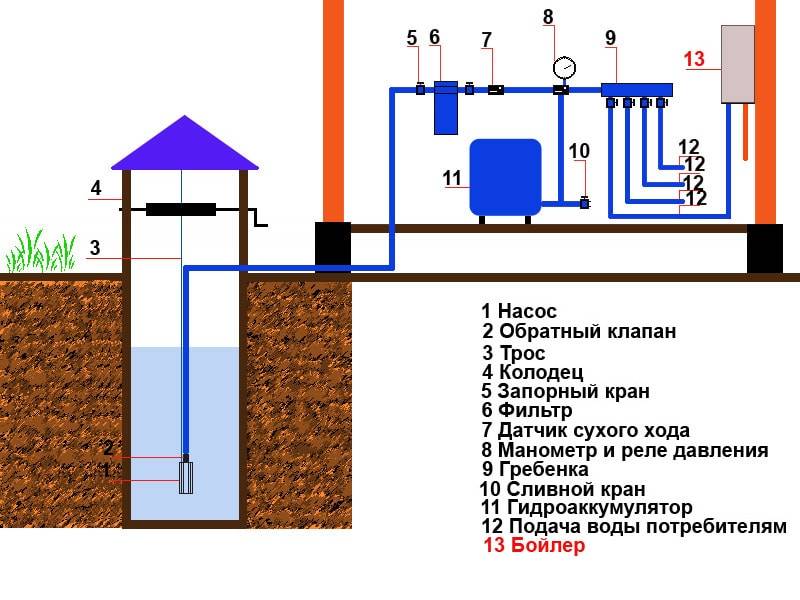
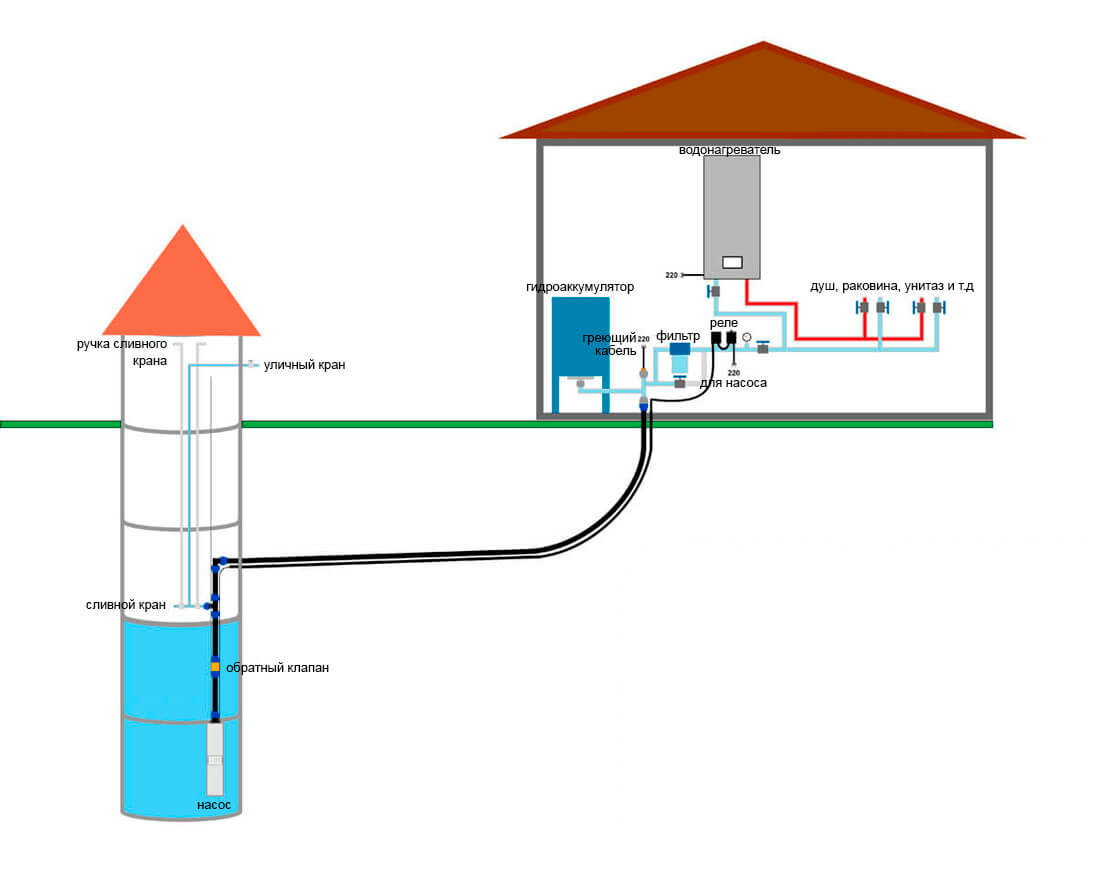
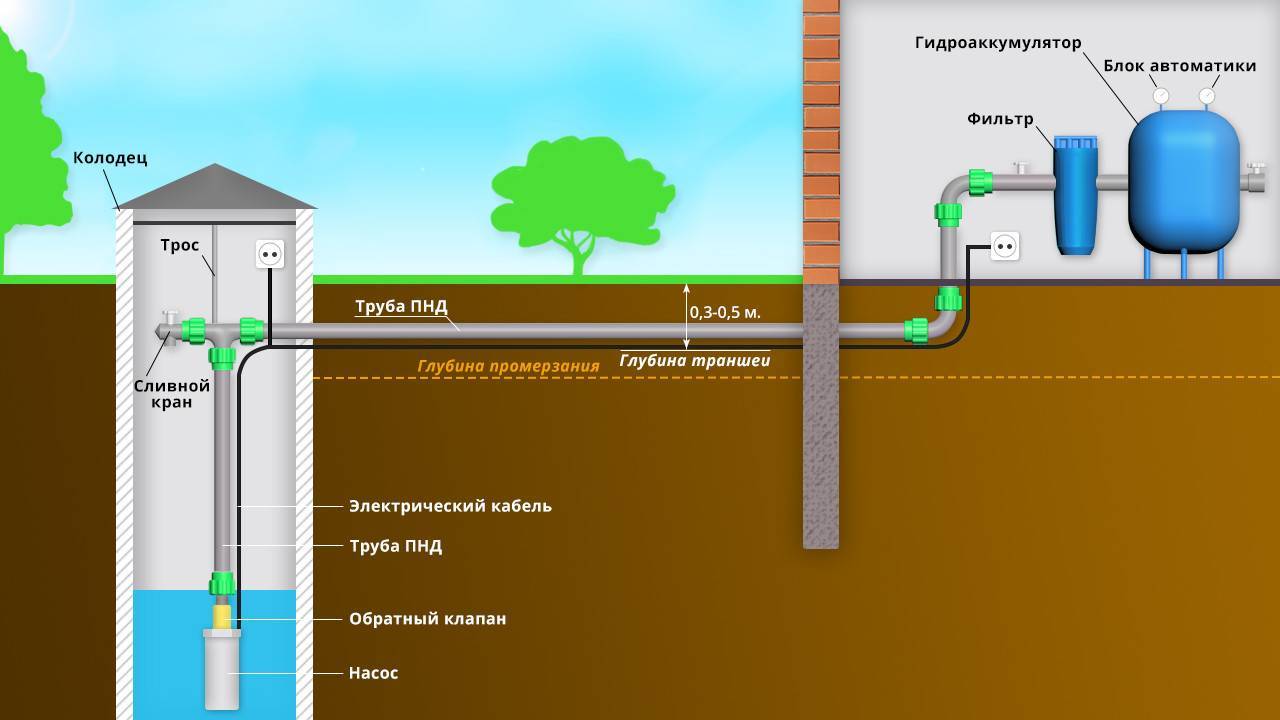
The composition of the winter water supply system is not much different from the summer water supply system. It also includes the following elements: pump, water pipes, storage tank or hydraulic accumulator, drain valve.
At the same time, the installation of a winter system requires compliance with certain rules.
Step # 1 - insulate the pump for water supply
The pump and the cable that feeds it needs to be insulated. For thermal insulation of the pumping station, you can use ready-made thermal insulation systems or build a casing yourself using mineral wool, foam plastic or other heaters.
The junction of the pump and water pipes (pit) also requires insulation. Typically, the dimensions of the pit are 0.5 x 0.5 x 1.0 m. The walls of the pit are faced with bricks, and the floor is covered with a layer of crushed stone or a concrete screed.
The equipment included in the winter water supply system does not need to be insulated if it is located in a pit below the level of soil freezing
Step # 2 - insulate the accumulator
The storage tank or accumulator must also be insulated. The tank acts as a storage tank, allowing the water supply system to work smoothly.
In the absence of a storage tank, the system will periodically turn off, which will lead to wear of all its elements.
For thermal insulation of the accumulator, the following types of heaters can be used:
- polystyrene or polystyrene foam;
- mineral and basalt wool;
- polyurethane foam and polyethylene foam;
- rolled fine-mesh heaters with a foil layer.
The process of insulation consists in the device of the outer casing of the accumulator, followed by finishing with the final material, if necessary.
If possible, it is desirable to insulate the technical room in which the accumulator is located. This step will be additional preparation for winter.
Step #3 - Taking care of the water pipes
For an insulated winter water supply system with a laying depth of 40-60 cm, the best option would be to choose low-pressure polyethylene pipes.
Compared to metal, they have the following advantages:
- not subject to corrosion;
- low specific gravity;
- easy to install;
- much cheaper in cost.
The diameter of the pipes is calculated based on the planned water consumption at the design stage of the water supply system.
Water consumption depends on the number of people living in the house, the availability of water-consuming devices, the volume of water used for irrigation and animal care, and other factors.
For example, a pipe with a diameter of 25 mm has a capacity of 30 l / min, 32 mm - 50 ml / min, 38 mm - 75 l / min. Most often, HDPE pipes with a diameter of 32 mm are used for country and country houses up to 200 m².


And read more about how to choose a heater for water pipes.
Step # 4 - put the drain valve and pressure switch
The drain valve is necessary for the conservation of the system, thanks to which water can be drained into the well. With a short length of water supply, the drain valve can be replaced with a bypass drain pipe.
The relay performs the function of maintaining pressure in the water supply, ensuring its uninterrupted operation and preventing breaks and stagnation of water. When the maximum indicator of fullness of the pipes is reached, the pressure switch will turn off the pump.
Installation of the pressure switch and drain valve is not difficult, the main thing is to follow the scheme recommended by the equipment manufacturer
Water supply by surface pump
Surface pumps are installed outside the well, these are inexpensive, reliable devices, but are more suitable for operation in the summer.
It is installed next to the well into which the hose is lowered. The pump is connected to the mains.

To make an independent water supply to the house you will need:
- Surface pump.
- Hydraulic tank.
- Pressure switch.
- Additional mounting elements.

If you have a tank, you can make a supply of water and the system itself will not run idle, which will significantly extend the operation of the pump. If there is no pressure gauge in the hydraulic tank, it is placed separately.

Hydraulic tank or barrel-tank
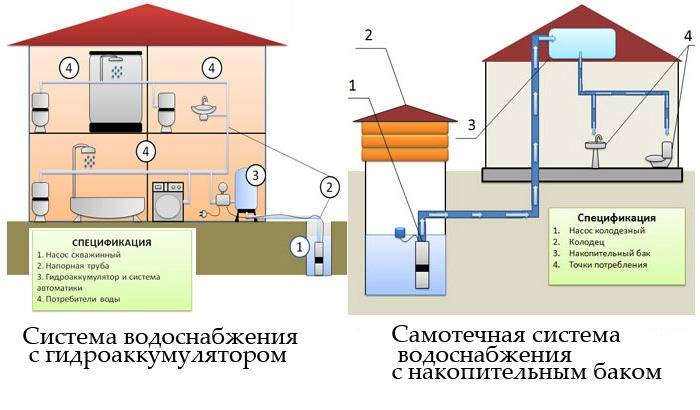
Instead of a hydraulic accumulator with a surface pump, you can put a regular plastic barrel tank. Install it on a stand, as high as possible from the ground, so that there is good pressure in the house.
To make the system automatic, a float sensor is mounted in the storage tank, it shows the water level and, if it has dropped significantly, sends a signal to the switch. Then the pump starts to work until the tank is full.
Where is it installed? Tank installation requirements:
- Close to water.
- The surface pump is placed in a shelter. For summer use, it is enough to make a cap (roof), but for year-round use, the construction of a warm, heated room will be required.
- The place where the pump is located must be well ventilated, with a low level of humidity, so that the metal does not corrode.
- The room is removed from the house and from the neighbors, the surface pump is noisy, and even in the basement one cannot do without soundproofing.
For year-round use of a surface pump, it is better to build a mini-boiler room next to the well.
How to connect
The hassle of a surface design is less than a submersible, but a number of conditions will need to be met in order for the work to be effective.
List of required materials and tools:
- Pipes from the pump to the tank.
- Fitting (connects the hose and the pump).
- 2nd input adapter.
- Hoses: intake and for watering.
- Check valve and filter.
- Various fasteners.
If the system is equipped with a hydraulic tank, they buy a pressure gauge, a pressure switch. A float sensor is needed when installing a storage tank.
From the tools you will need:
- a set of wrenches, adjustable wrenches;
- roulette;
- insulating materials;
- building level;
- device for soldering plastic pipes, etc.
Base mounting
The entire installation with the pump is mounted on a solid, stable base to eliminate the slightest roll or vibration. As a substrate, there can be a solid wood shelf, fastening to a brick or concrete wall using metal brackets.
Anchor bolts are used to fix it, and it is better to place a rubber gasket under the body. It acts as a shock absorber and dampens vibration.

Supply hose
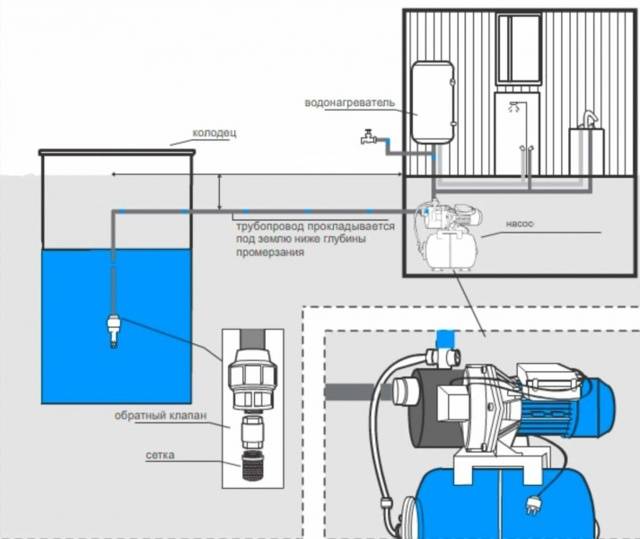
A non-return valve and a filter are attached to it from one (lower) side using a coupling with an external thread. You can buy a finished design with a coarse filter.

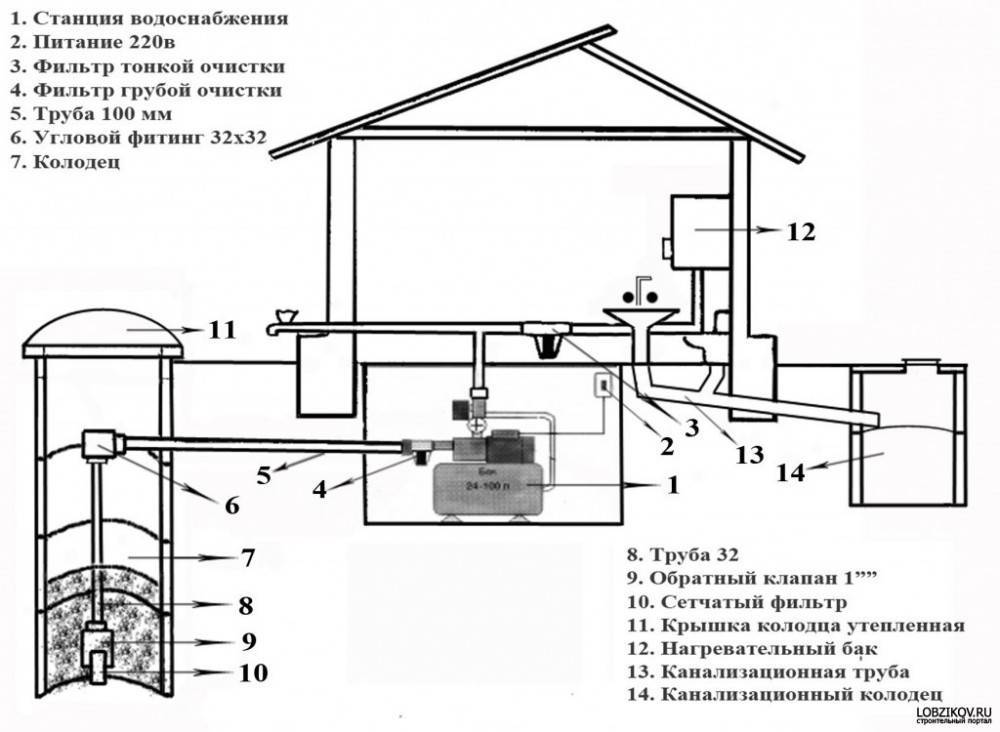
The upper end of the 32 mm hose or pipe is attached to the pump with a fitting. The finished hose is lowered into the well, the check valve should be immersed in water by 30-50 cm.
Plumbing installation
When the wiring around the house is done, the pump with the hydraulic barrel is installed, you need to remember that the horizontal part of the hose is placed with a slight slope. All connections made on the thread are sealed with FUM tape.
Pipes from the pump to the house can be made surface or laid in the ground with mandatory insulation.
The principle of laying pipelines with a submersible pump
In order for the water in the country to be constantly choosing the water supply of a private house from a well with a submersible pump. It is better to immediately buy good polypropylene pipes (or polyethylene pipes with a wall width of 3 mm.) For cold water supply, rather than laying a regular hose that will last 1-3 seasons.
If a column is installed in the house, then pipes for hot water supply are removed from it, more durable with a layer of aluminum foil or fiberglass.
The diameter of the pipes is optimally 32 mm, they are laid out in the ground, at an angle, and every 15-20 cm slightly increase it, if you look in the direction from the building to the well.
What to buy:
- Submersible pump.
- Cable (suspended) with a diameter of 3 mm.
- Relay (type RDM-5) that runs dry. Fittings, ball valves.
- Filters for cleaning coarse and fine impurities.
- A pressure gauge to monitor the functioning of the pump.
Pros and cons of the "well" option
Before starting such a large-scale project, you should evaluate its pros and cons. In addition to the relatively low construction costs, it is worth noting the ability to use the well even during power outages, simply by collecting water with a bucket. In addition, a well does not need permits, it can simply be dug in a suitable place.
But do not ignore some of the problems associated with water supply from the well.The water in the upper horizon is rarely of high quality, which will invariably affect the operation of the equipment. For technical needs, it is quite acceptable, but it is usually not suitable for drinking and cooking.
To provide the house with clean water, you will have to dig a fairly deep well. Unlike a well, a well needs regular cleaning, which should be done once or twice a year. To improve the quality of well water, it is recommended to install a reliable filter system.
Flood and sewage pollution is a familiar problem for many well owners. To avoid it, you need special protective measures. Another problem is the seasonal change in the groundwater level, which can be very significant.
Sometimes the appearance of a well on the site changes the nature of the groundwater flow under the surface of the site in such a way that there may be a threat to the integrity of the foundation. To prevent such a problem, it is worth consulting with a specialist or discussing the situation with neighbors who already have a well.
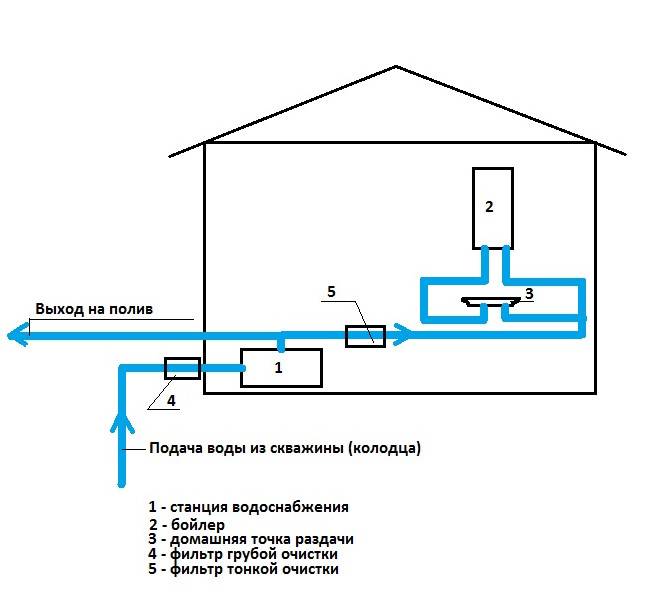
Wiring diagrams for the plumbing system around the house
The plumbing scheme provides for two ways of piping:
- Sequential.
- Parallel.
The choice of one or another option depends on the operational features of the intra-house network - the number of residents, water intake points, the intensity of water consumption, etc.
Serial, tee connection
A sequential water supply scheme in a private house involves the division of one common water supply branch into several "sleeves" using tees.
Therefore, such a scheme is also called a tee. Each branch of the pipeline goes to its point of consumption - kitchen, bathroom, toilet.
Among the advantages of this option, one can note a more budgetary cost due to lower pipe consumption. The disadvantage of the tee connection is the unequal pressure in each of the pipeline sleeves.






With a large number of branches, the water pressure in them decreases. A sequential scheme is recommended for use in houses with a small number of water points.
Parallel, collector connection
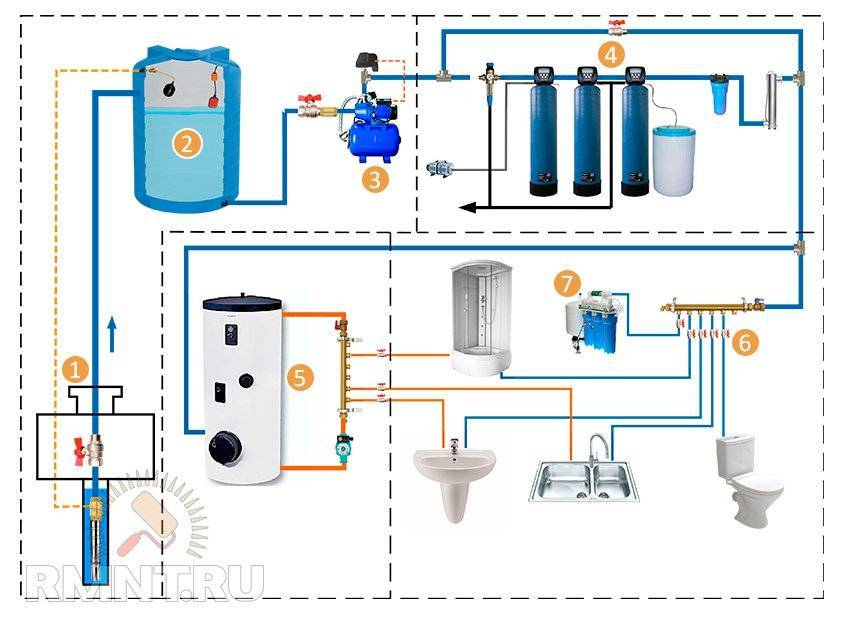
A distinctive feature of the parallel water supply scheme is the installed collector. This is a special water distribution node, separate branches are derived from it to each point of consumption.
The advantage of the collector connection is the ability to provide uniform pressure at each point of water consumption. The disadvantage of parallel connection is the increased consumption of materials compared to the serial version.
System Installation Recommendations
Water supply is installed in the cottage in seven steps:
- Marking the distribution of pipes, as well as installation sites for equipment and plumbing.
- Making holes in the walls for pipelines to be laid.
- Connecting pipes with fittings or welding.
- Connecting shutoff valves.
- Installation of a water heater (boiler) and pumps with their connection to the assembled water supply.
- Plumbing installation.
- Start water and check for leaks.
Between the wall and the pipe, it is recommended to leave about 15–20 mm of empty space. This will make it easier to repair the plumbing later if necessary. Also, on each branch from the riser to the plumbing, you should put your own stopcock. So, in an emergency, you won’t have to turn off all the water in a private house, leaving the household without it for several hours or even a couple of days.
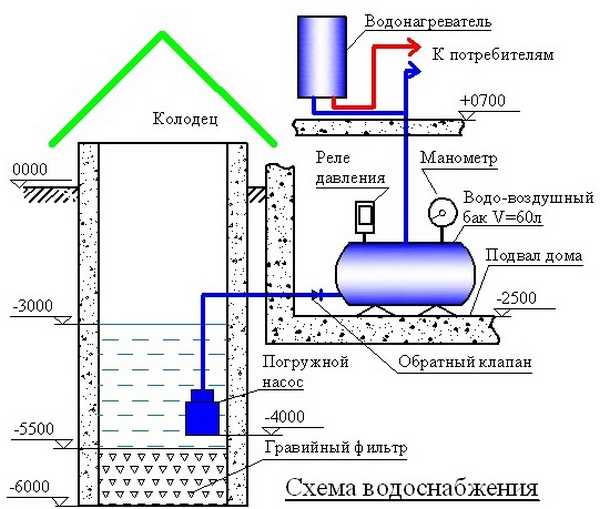
Scheme of a country well water supply
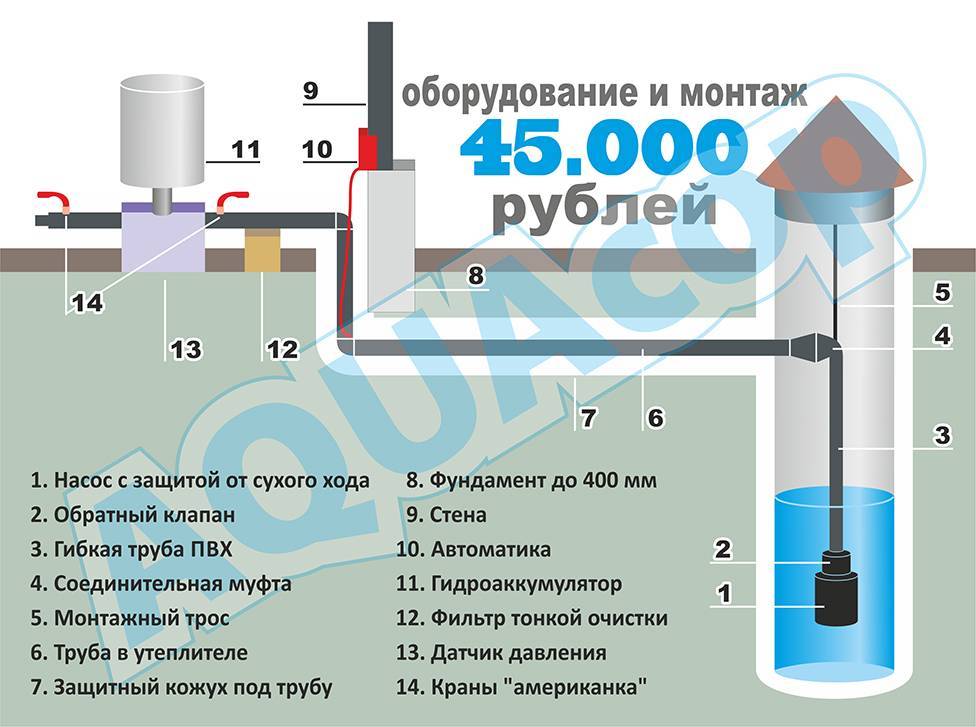
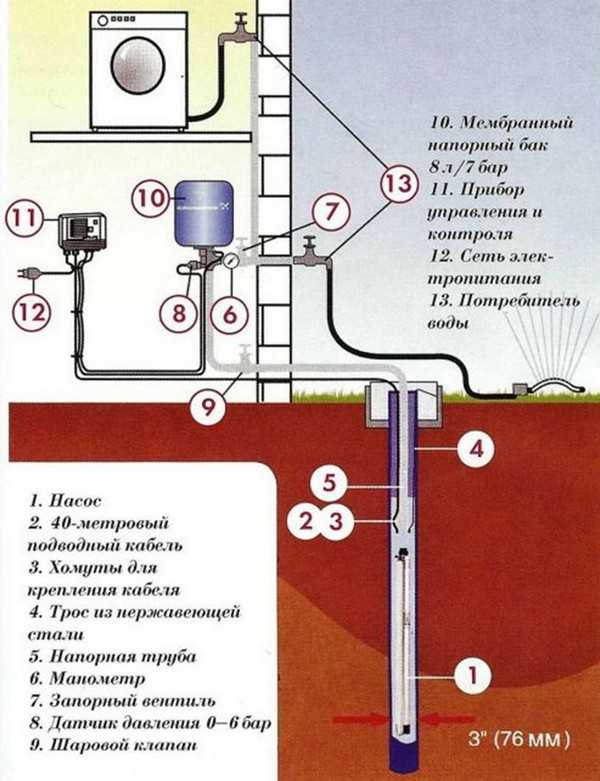
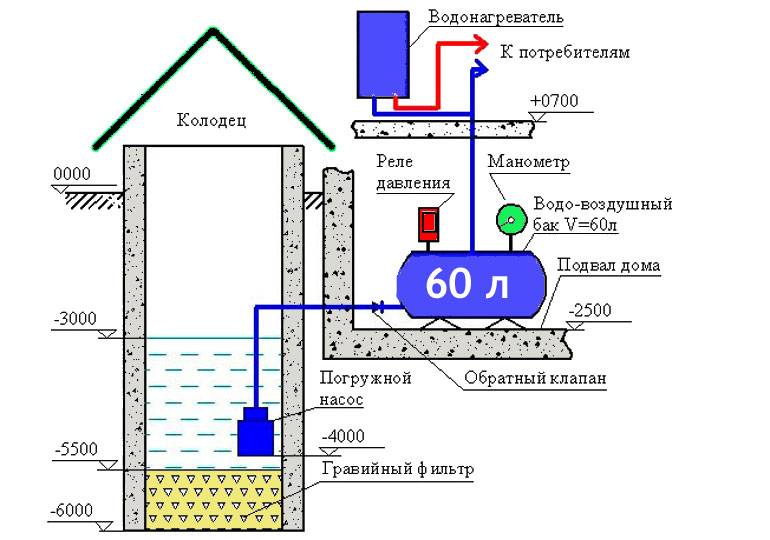
To present the scope of work, we will analyze the scheme of autonomous water supply throughout - from the source to the points of water use.
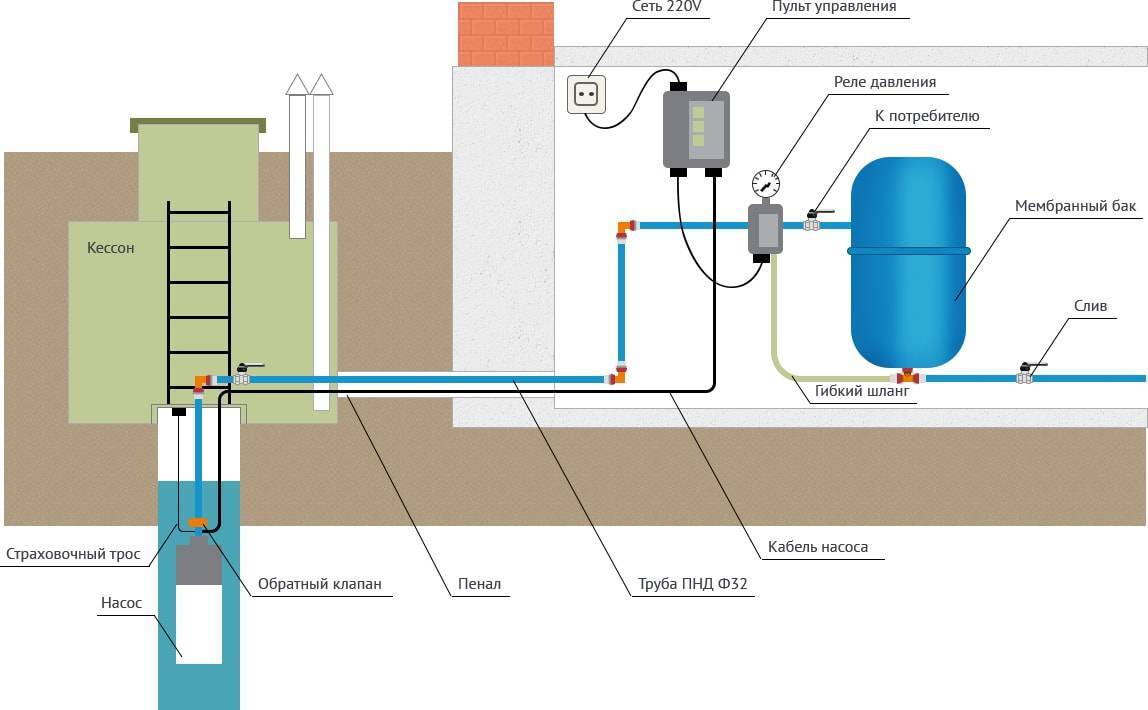
The main mechanism for pumping water - submersible or surface pump. The submersible option is at a sufficient depth, but not at the very bottom (no closer than 50 cm).
It is hung on a strong cable, to which an electric cable is also attached. In addition to the electric wire, a pipe is connected to the pump, through which water enters the house.
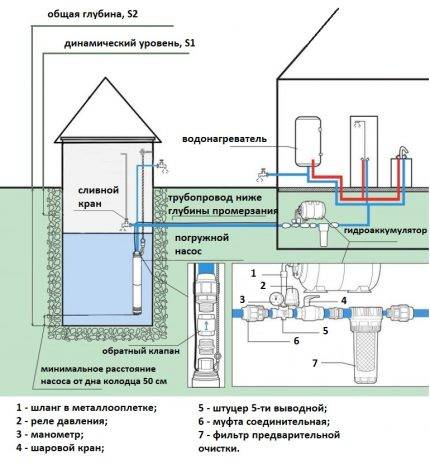 The pump and house equipment are connected by means of pipes. The shorter the distance between the extreme points, the higher the performance of the pumping station
Inside the residential building, wiring is installed so that water flows to various points. The “heart” of the system is the boiler room, where a hydraulic accumulator and a heating boiler are usually installed.
The hydraulic accumulator controls the water pressure, with the help of a relay it balances the pressure and protects the structure from water hammer. The indicators can be monitored on the manometer. For conservation, a drain valve is provided, mounted at the lowest point.
Communications depart from the broiler room to water intake points - to the kitchen, to the shower room, etc. In buildings with permanent residence, a heating boiler is installed that heats water for use and heating systems.
There are many options for building circuits, their assembly depends on the needs of homeowners. Having drawn up a diagram, it is easy to calculate the cost of technical equipment and building material.
How to properly maintain the system
Failure of one of the plumbing components will leave the entire house without water. To prevent this from happening, you need to follow some rules:
- Clean the pump regularly, change gaskets in time.Check the integrity of the power cable.
- Having noticed impurities in the input, it is necessary to check the sealing of the well shaft.
- Install pressure gauges.
- Do not skimp on filters capable of screening out solid particles. This will protect the system from mechanical damage.
- Use relays and other automation that can turn off the system and protect it from destruction even in your absence.

Modern automation Unipunp
The process of connecting from the well to the house in the video:
Conclusion
We hope that these simple and simple tips will allow you to decide on the type of water supply, its scheme, and also save you from various mistakes, which will allow the system to work for a very long time and without failures. Your comfort is in your hands. Be careful and patient. Remember that the stingy and lazy pay twice.
Approximate cost of work
When supplying water from a well, you need to know how much the necessary materials and equipment cost. The cost may vary. A pump with a small capacity is in the middle price category. It will cost 8000-9000 rubles. You will have to pay 2000-4000 rubles for the accumulator. You will also need a filter. To lay a pipeline, you need 5000-6000 rubles.

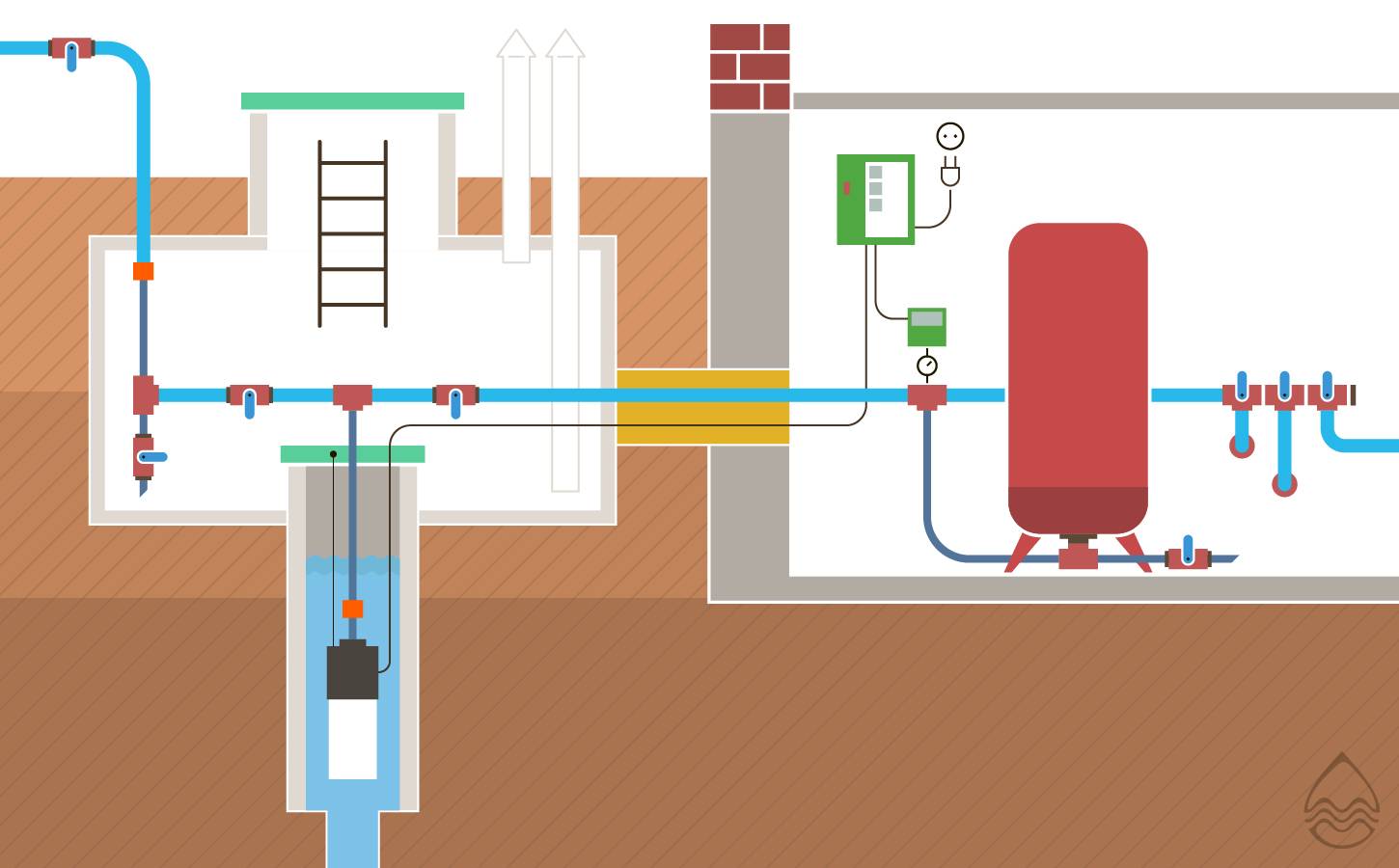
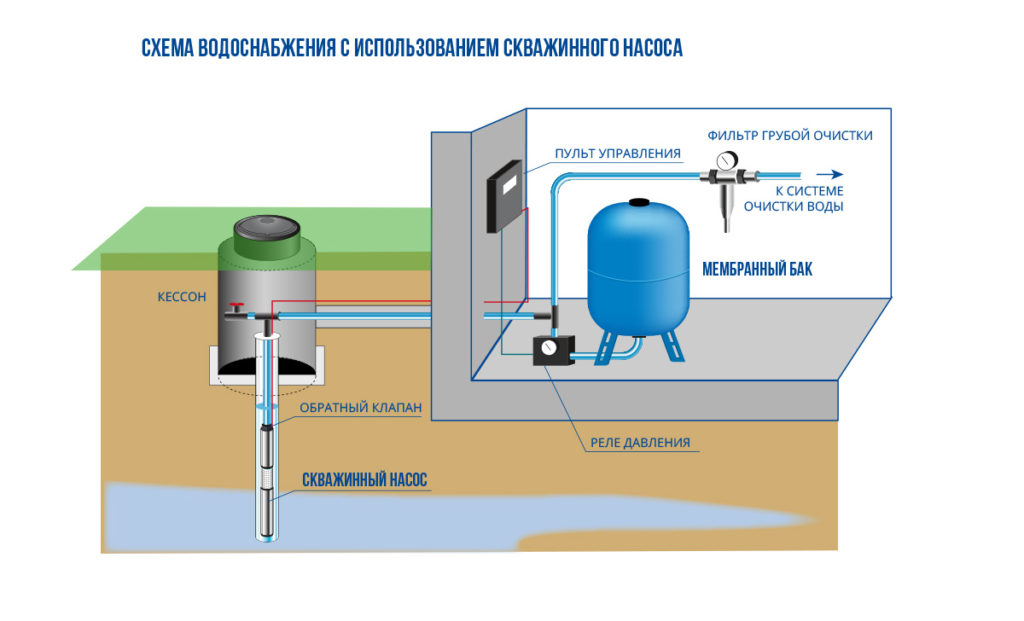
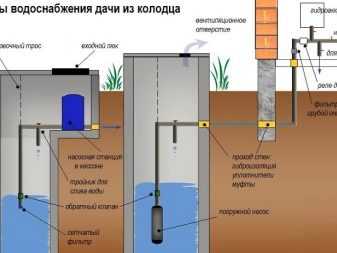


So, the approximate estimate for laying the pipeline:
- Pump - 9000 rubles;
- Hydraulic accumulator - 3000 rubles;
- Filter - 1000 rubles;
- Pipeline - 6000 rubles.
All costs are approximate. The cost of equipment depends on various factors, even on the region of residence. There is always an opportunity to save on something, buy more profitable or at a discount.
Do-it-yourself wiring of a water or sewer pipe requires a properly dug trench. When filling a water pipe with earth, it is necessary to carry out its insulation in advance.The water supply is provided by a pump. The main thing is to choose the right equipment. Subject to all the rules, conducting water is not difficult.
Pumping stations
Pumping stations are the easiest way to ensure the nominal pressure and pressure in the water supply of a private house. The best option for their location is at a distance of up to 8 - 10 meters from the water intake point. With a greater distance (for example, if the pump is installed in the house), the load on the electric motor will be increased, which will lead to its faster failure.
Prices for popular models of pumping stations
Pumping stations
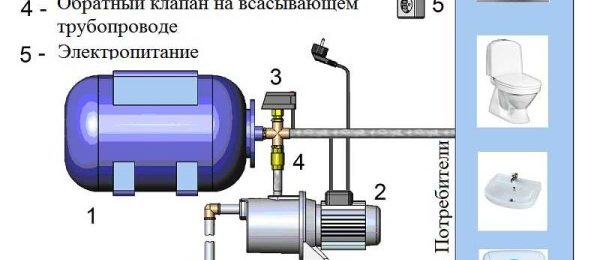
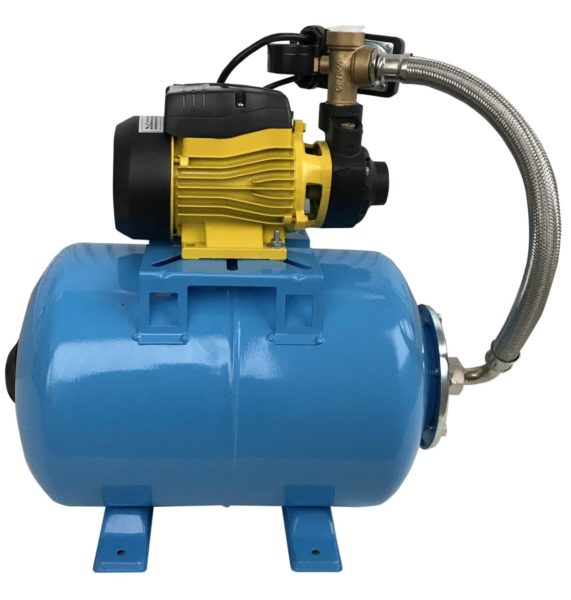 Pumping station. Consists of a relay that responds to pressure and a hydraulic accumulator that provides a smooth change in pressure in the water supply system
If it is planned to install a filter station, then the pump is placed directly at the point of water intake (in the caisson, having previously provided it with waterproofing). Only in this case, the station will be able to provide the required pressure in the system without drawdowns at the time of switching on/off.
But from the pumping stations without accumulator (pressure switch) is recommended to be abandoned. Although they are cheap, they do not provide stable pressure inside the water supply, and at the same time they fail quite quickly (and they are also vulnerable to voltage drops).
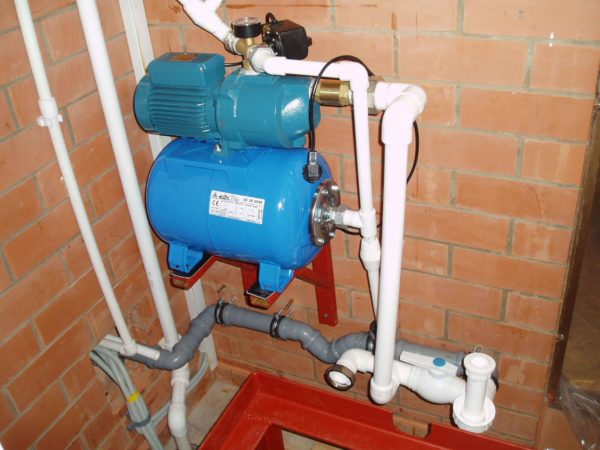 It is recommended to place pumping stations in the house only if there is no more than 10 meters to the source of water intake. In other cases - in the caisson right next to the well or well
How to choose a pumping station
When choosing a pumping station, you should focus only on its technical characteristics (namely, productivity and the maximum possible pressure in the system), as well as the size of the accumulator (sometimes called "hydrobox").
Table 1. The most popular pumping stations (according to reviews on thematic forums).
| Name | Basic characteristics | Average price, rub |
|---|---|---|
| Werk XKJ-1104 SA5 | Up to 3.3 thousand liters per hour, maximum delivery height 45 meters, pressure up to 6 atmospheres | 7.2 thousand |
| Karcher BP 3 Home | Up to 3 thousand liters per hour, delivery height up to 35 meters, pressure - 5 atmospheres | 10 thousand |
| AL-KO HW 3500 Inox Classic | Up to 3.5 thousand liters per hour, delivery height up to 36 meters, pressure up to 5.5 atmospheres, 2 control sensors are installed | 12 thousand |
| WILO HWJ 201 EM | Up to 2.5 thousand liters per hour, delivery height up to 32 meters, pressure up to 4 atmospheres | 16.3 thousand |
| SPRUT AUJSP 100A | Up to 2.7 thousand liters per hour, delivery height up to 27 meters, pressure up to 5 atmospheres | 6.5 thousand |
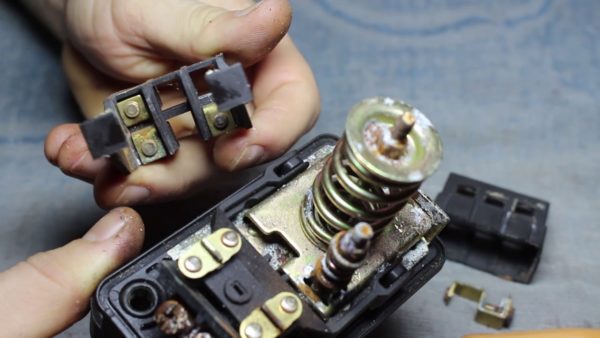 Relay for switching on the pumping station. It is with its help that the pressure at which the pump turns on and off is regulated. Relays should be cleaned of rust regularly if the station is located in a place with high humidity
For most household needs, including watering a small plot of land, these pumping stations will be more than enough. They have an outlet under the pipe from 25 to 50 mm, if necessary, an adapter is installed (such as "American"), and then there is a connection to the water supply.
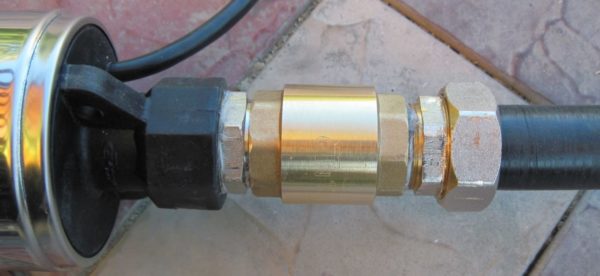 Reverse valve. It is installed before entering the pumping station. Without it, after turning off the pump, all water will be “discharged” back
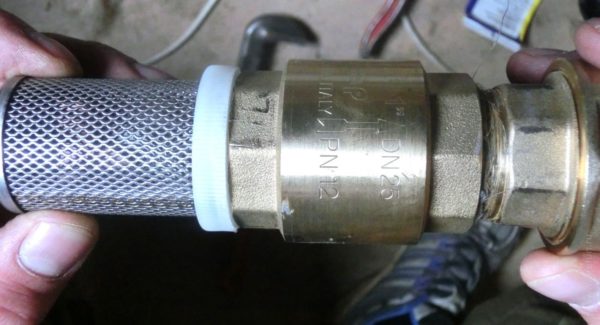 Such valves, which come with a mesh for pre-cleaning, should not be installed either. Often clogged with debris, jammed. It is better to mount a full-fledged coarse filter
Water supply of a private house from a well and a well: pipe laying
Any of the described water supply schemes for a private house is implemented using a pump that supplies water to the house. In this case, a pipeline must be built connecting the well or well with a pumping station or storage tank. There are two options for laying pipes - only for summer use or for all-weather (winter).
A section of a horizontal pipe may be located either below the freezing depth of the soil or it needs to be insulated
When installing a summer water supply system (for summer cottages), pipes can be laid on top or in shallow ditches. At the same time, you must not forget to make a tap at the lowest point - drain the water before winter so that frozen water does not break the system in frost. Or make the system collapsible - from pipes that can be rolled up on threaded fittings - and these are HDPE pipes. Then in the fall everything can be disassembled, twisted and put into storage. Return everything in the spring.
Laying water pipes in the area for winter use requires a lot of time, effort and money. Even in the most severe frosts, they should not freeze. And there are two solutions:
- lay them below the freezing depth of the soil;
- bury shallowly, but be sure to heat or insulate (or you can do both).
deep laying
It makes sense to dig water pipes deep if it freezes no more than 1.8 m.You will have to dig another 20 cm deeper, and then pour sand into the bottom, in which to lay pipes in a protective sheath: they will be subjected to a solid load, because there is almost a two-meter layer of soil on top. Previously, asbestos pipes were used as a protective shell. Today there is also a plastic corrugated sleeve. It is cheaper and lighter, it is easier to lay pipes in it and give it the desired shape.

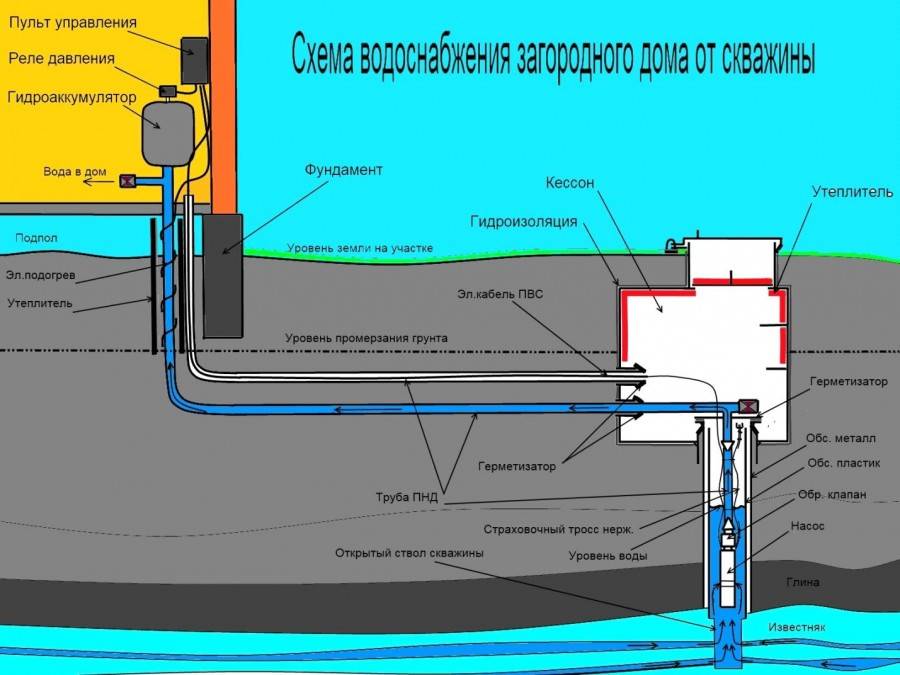


When laying the pipeline below the freezing depth, it is necessary to dig a deep trench that is long for the entire route
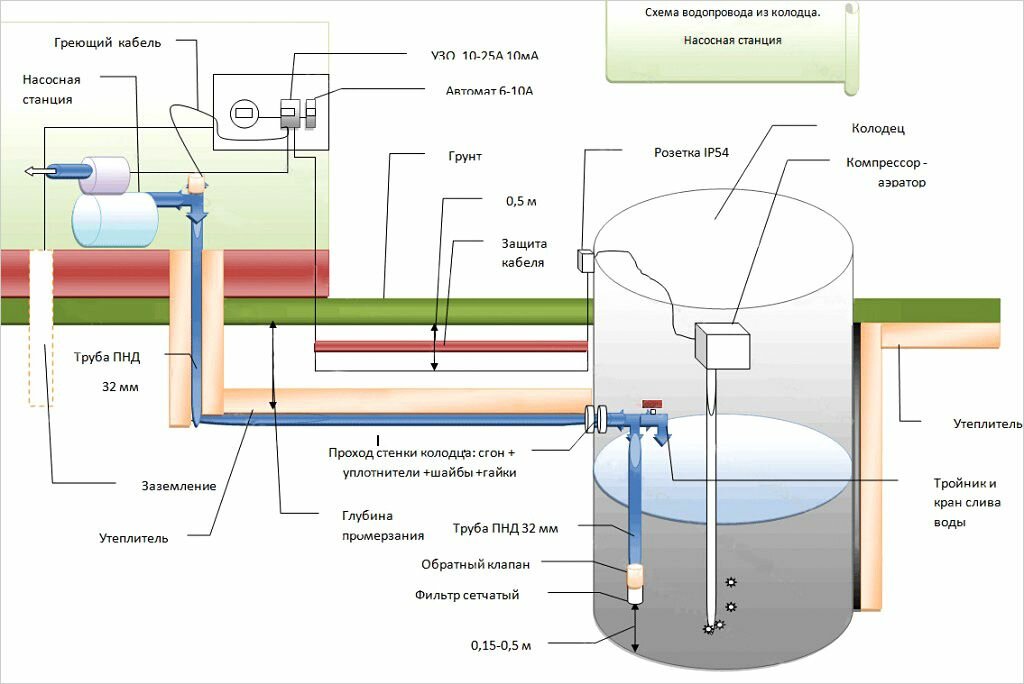
Although this method requires a lot of labor, it is used because it is reliable. In any case, they try to lay the section of the water supply system between the well or well and the house exactly below the freezing depth. The pipe is led out through the wall of the well below the depth of freezing of the soil and is led into the trench under the house, where it is raised higher. The most problematic place is the exit from the ground into the house, you can additionally heat it with an electric heating cable. It works in automatic mode maintaining the set heating temperature - it works only if the temperature is below the set one.
When using a well and a pumping station as a source of water, a caisson is installed. It is buried below the freezing depth of the soil, and equipment is placed in it - a pumping station. The casing pipe is cut so that it is above the bottom of the caisson, and the pipeline is led out through the wall of the caisson, also below the freezing depth.
Laying water pipes in a private house from a well when constructing a caisson
A water pipe buried in the ground is difficult to repair: you have to dig in. Therefore, try to lay a solid pipe without joints and welds: they are the ones that give the most problems.
close to the surface
With a shallow foundation, there is less earthwork, but in this case it makes sense to make a full-fledged route: lay out a trench with bricks, thin concrete slabs, etc. At the construction stage, the costs are significant, but the operation is convenient, repair and modernization are no problems.
In this case, the water supply pipes of a private house from the well and well rise to the level of the trench and are brought out there. They are laid in thermal insulation to prevent them from freezing. For insurance, they can also be heated - use heating cables.
One practical tip: if a power cable runs from a submersible or borehole pump to the house, it can be hidden in a protective sheath made of PVC or other material, and then attached to the pipe. Fasten every meter with a piece of adhesive tape. So you will be sure that the electrical part is safe for you, the cable will not fray or break: when the ground moves, the load will be on the pipe, and not on the cable.
Sealing the entrance to the well
When organizing the water supply of a private house from a well with your own hands, pay attention to the termination of the exit point of the water pipe from the mine. It is from here that most often the dirty top water gets inside
It is important that the outlet of the water pipe of their well shaft is well sealed
If the hole in the wall of the shaft is not much larger than the diameter of the pipe, the gap can be sealed with sealant. If the gap is large, it is covered with a solution, and after drying, it is coated with a waterproofing compound (bituminous impregnation, for example, or a cement-based compound). Lubricate preferably both outside and inside.