- Pumping stations
- Prices for popular models of pumping stations
- How to choose a pumping station
- Water supply of a private house from a well and a well: pipe laying
- deep laying
- close to the surface
- Sealing the entrance to the well
- Kinds
- Individual
- membrane tank
- storage tank
- centralized
- Choose the best source device
- Kinds
- Location selection
- Decentralized water supply
- Features of water supply from a well
- Well for water supply
- Water heating
- Plumbing schemes
- Scheme #1. Serial (tee) connection
- Scheme #2. Parallel (collector) connection
- Types of wells for a private water supply
- Installation rules
- How to create your own plumbing for a private house
- Plumbing in private homes
- How to deliver water to the house
Pumping stations
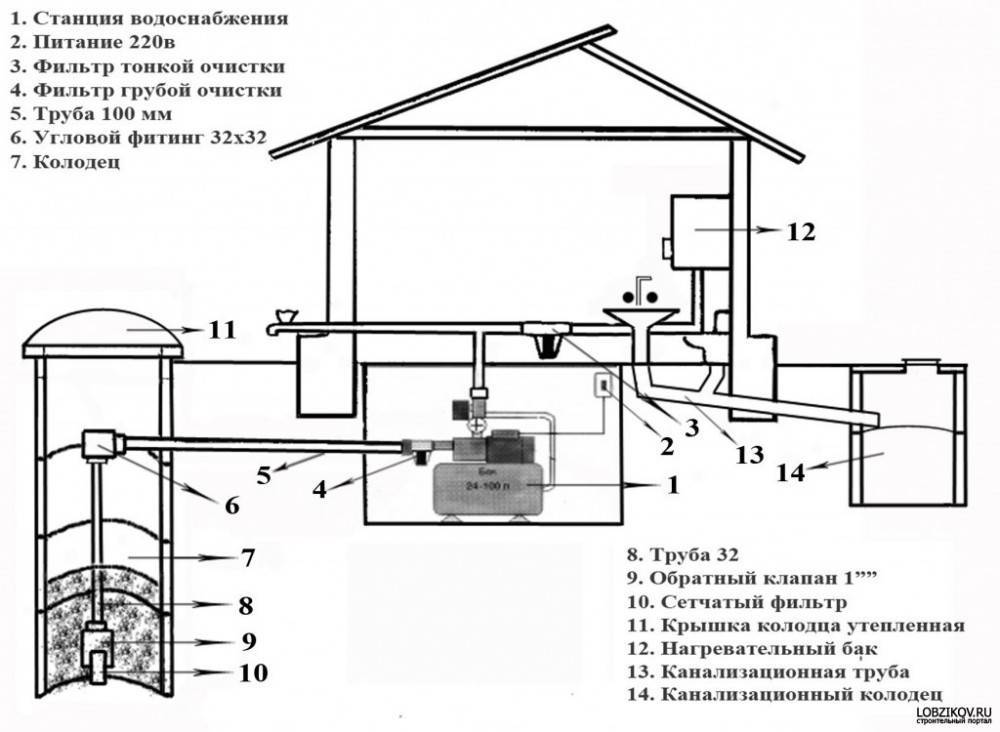
Pumping stations are the simplest option for providing nominal pressure and pressure in private house plumbing. The best option for their location is at a distance of up to 8 - 10 meters from the water intake point. With a greater distance (for example, if the pump is installed in the house), the load on the electric motor will be increased, which will lead to its faster failure.
Prices for popular models of pumping stations
Pumping stations
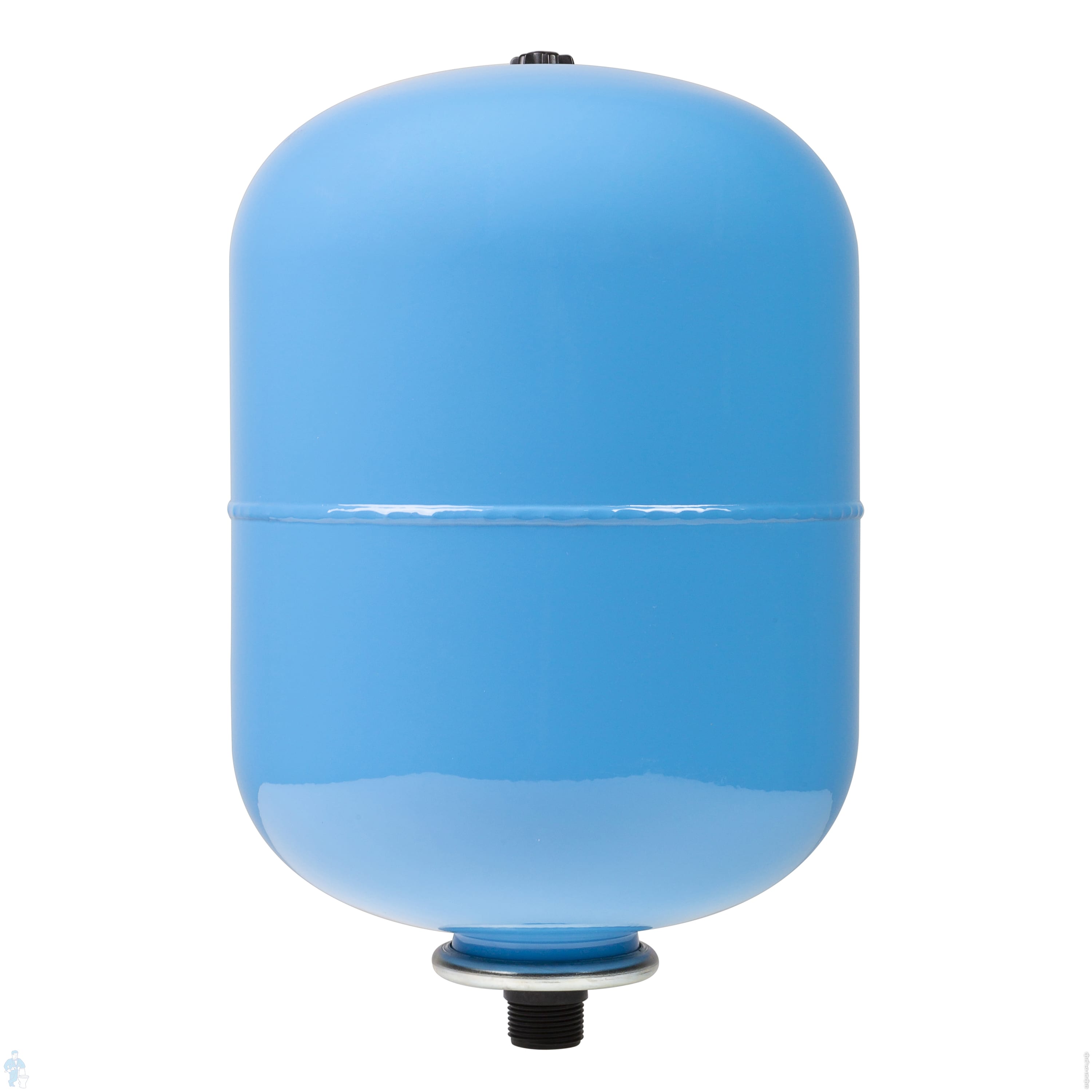
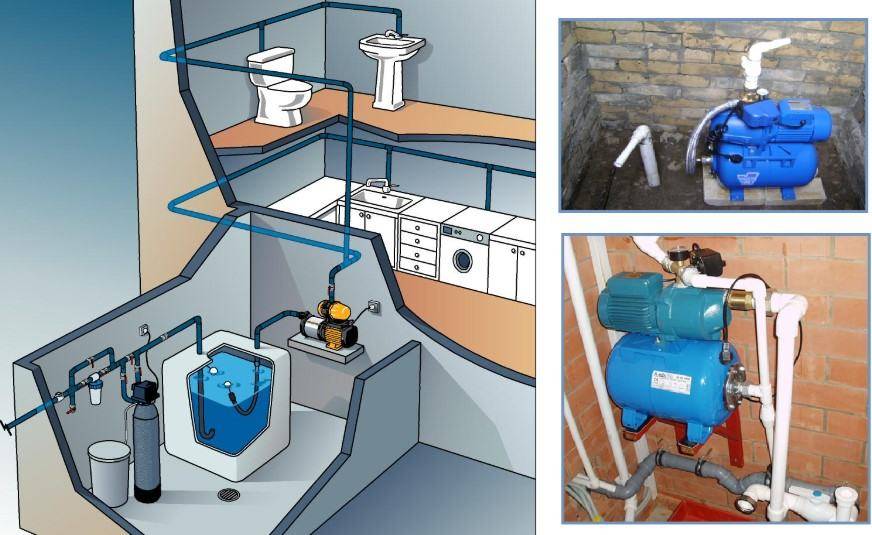
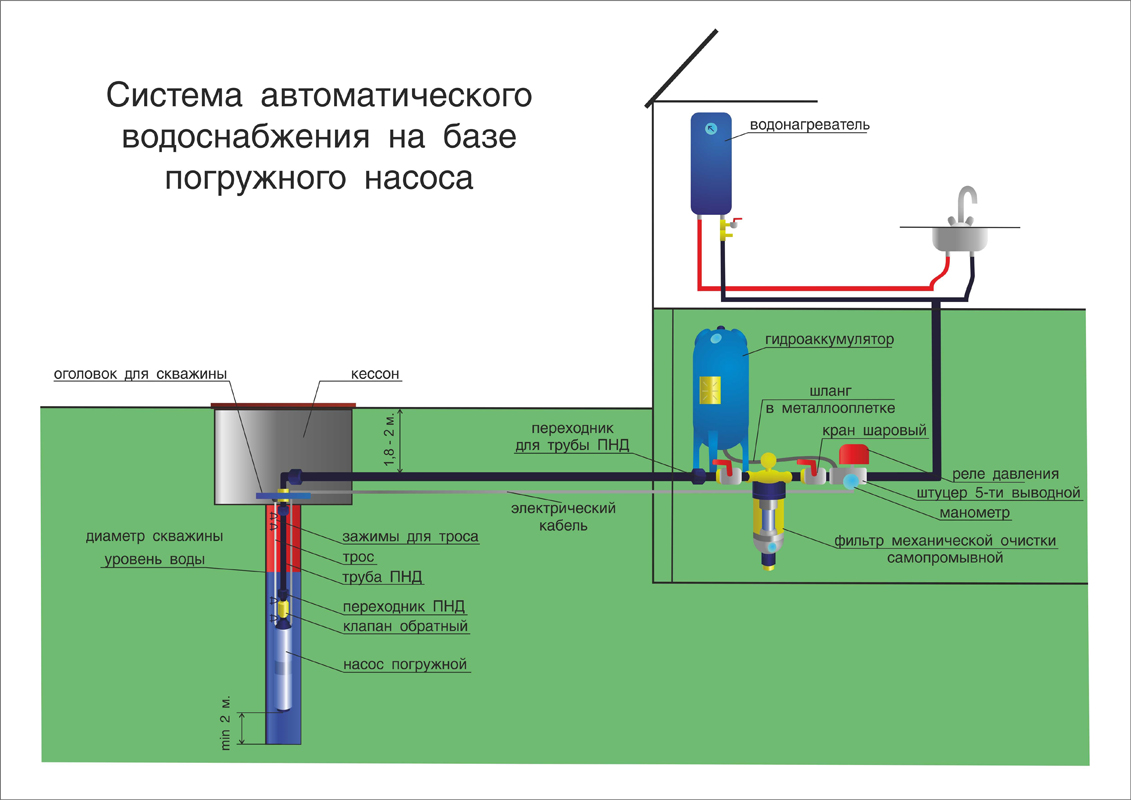
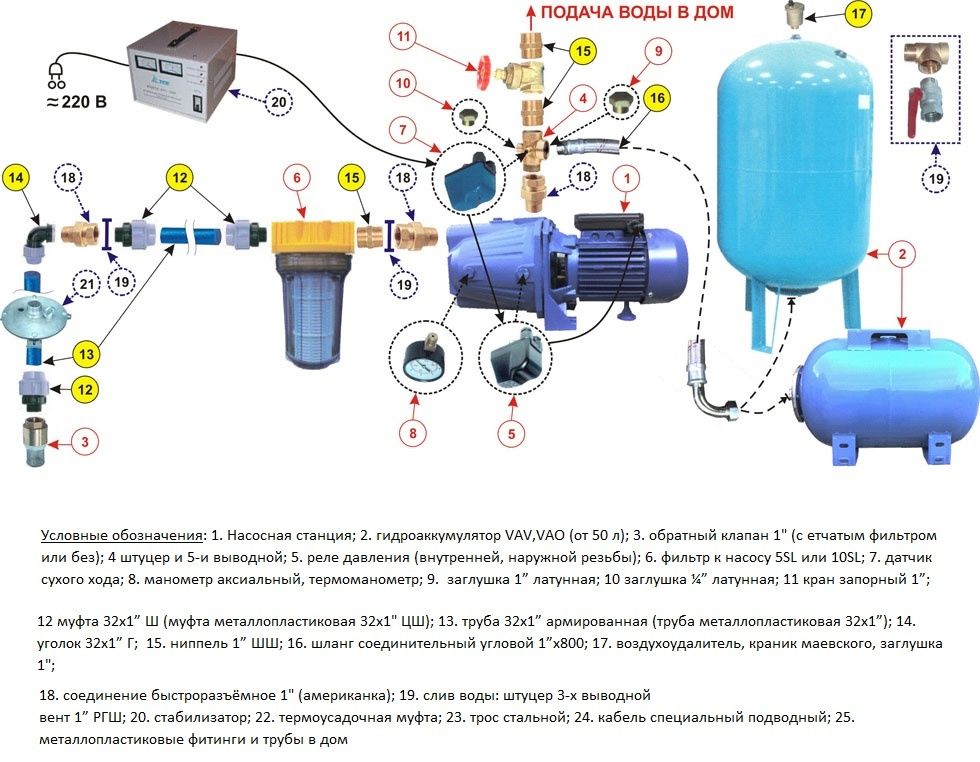
Pumping station.Consists of a relay that responds to pressure and a hydraulic accumulator that provides a smooth change in pressure in the water supply system
If it is planned to install a filter station, then the pump is placed directly at the point of water intake (in the caisson, having previously provided it with waterproofing). Only in this case, the station will be able to provide the required pressure in the system without drawdowns at the time of switching on/off.
But it is recommended to refuse pumping stations without a hydraulic accumulator (pressure switch). Although they are cheap, they do not provide stable pressure inside the water supply, and at the same time they fail quite quickly (and they are also vulnerable to voltage drops).
It is recommended to place pumping stations in the house only if there is no more than 10 meters to the source of water intake. In other cases - in the caisson right next to the well or well
How to choose a pumping station
When choosing a pumping station, you should focus only on its technical characteristics (namely, productivity and the maximum possible pressure in the system), as well as the size of the accumulator (sometimes called "hydrobox").
Table 1. The most popular pumping stations (according to reviews on thematic forums).
| Name | Basic characteristics | Average price, rub |
|---|---|---|
| Werk XKJ-1104 SA5 | Up to 3.3 thousand liters per hour, maximum delivery height 45 meters, pressure up to 6 atmospheres | 7.2 thousand |
| Karcher BP 3 Home | Up to 3 thousand liters per hour, delivery height up to 35 meters, pressure - 5 atmospheres | 10 thousand |
| AL-KO HW 3500 Inox Classic | Up to 3.5 thousand liters per hour, delivery height up to 36 meters, pressure up to 5.5 atmospheres, 2 control sensors are installed | 12 thousand |
| WILO HWJ 201 EM | Up to 2.5 thousand liters per hour, delivery height up to 32 meters, pressure up to 4 atmospheres | 16.3 thousand |
| SPRUT AUJSP 100A | Up to 2.7 thousand liters per hour, delivery height up to 27 meters, pressure up to 5 atmospheres | 6.5 thousand |
Relay for switching on the pumping station. It is with its help that the pressure at which the pump turns on and off is regulated. Relays should be cleaned of rust regularly if the station is located in a place with high humidity
For most household needs, including watering a small plot of land, these pumping stations will be more than enough. They have an outlet under the pipe from 25 to 50 mm, if necessary, an adapter is installed (such as "American"), and then there is a connection to the water supply.
Reverse valve. It is installed before entering the pumping station. Without it, after turning off the pump, all water will be “discharged” back
Such valves, which come with a mesh for pre-cleaning, should not be installed either. Often clogged with debris, jammed. It is better to mount a full-fledged coarse filter
Water supply of a private house from a well and a well: pipe laying
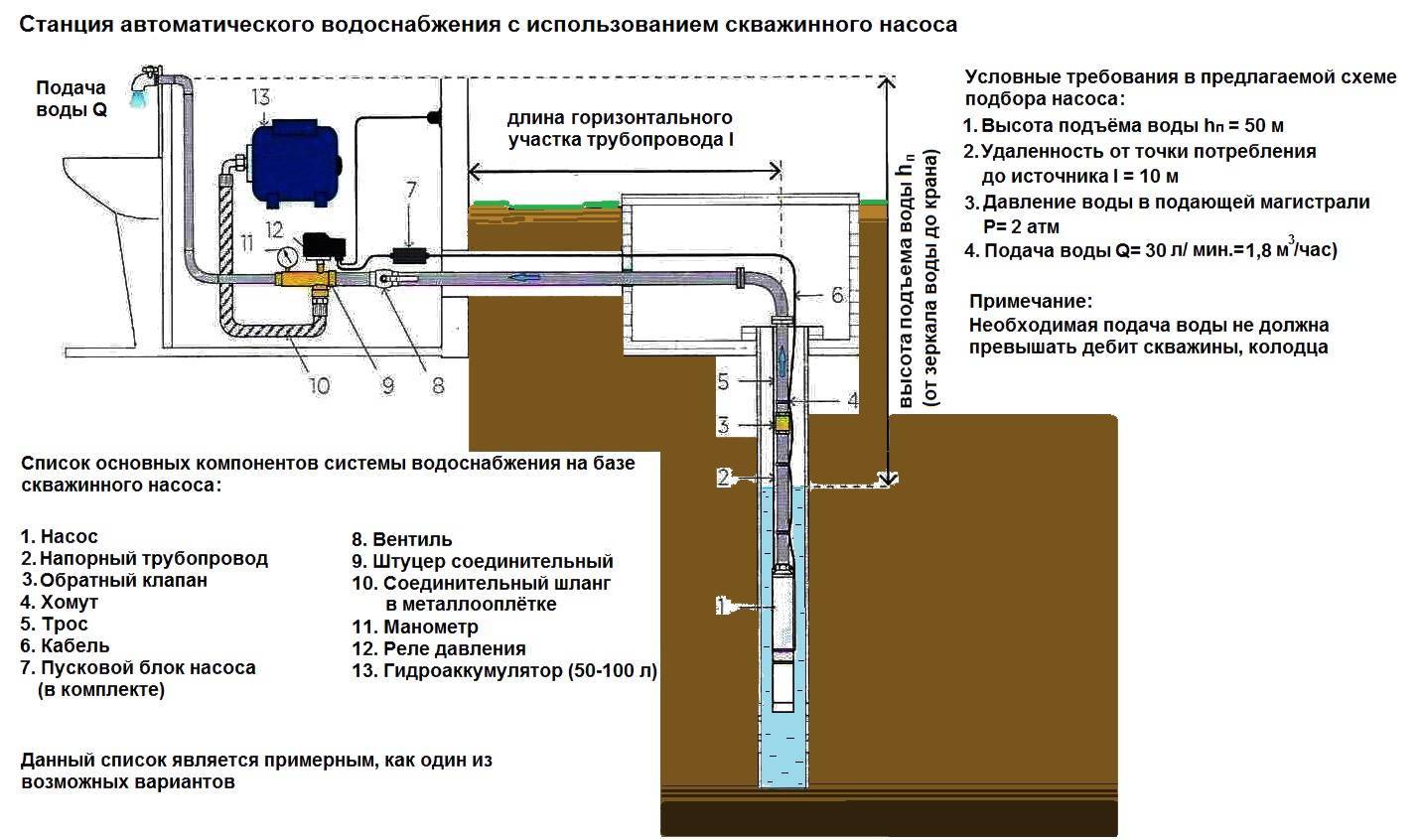
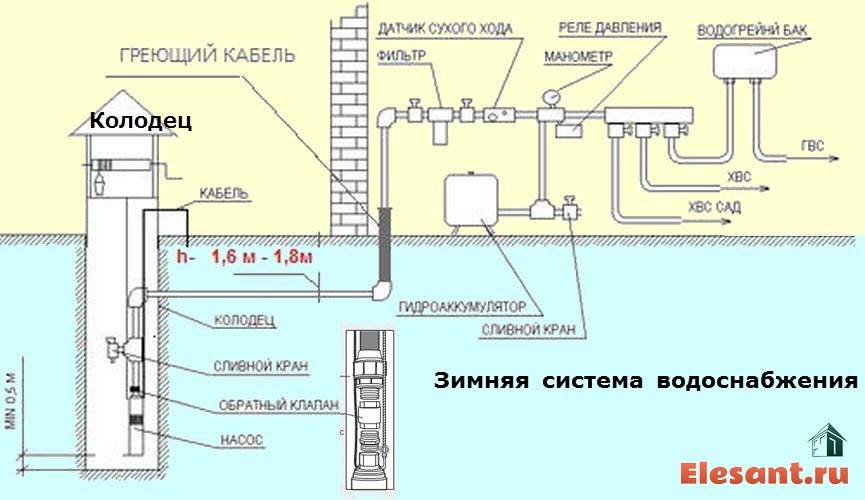
Any of the described water supply schemes for a private house is implemented using a pump that supplies water to the house. In this case, a pipeline must be built connecting the well or well with a pumping station or storage tank. There are two options for laying pipes - only for summer use or for all-weather (winter).
A section of a horizontal pipe may be located either below the freezing depth of the soil or it needs to be insulated
When installing a summer water supply system (for summer cottages), pipes can be laid on top or in shallow ditches.At the same time, you must not forget to make a tap at the lowest point - drain the water before winter so that frozen water does not break the system in frost. Or make the system collapsible - from pipes that can be rolled up on threaded fittings - and these are HDPE pipes. Then in the fall everything can be disassembled, twisted and put into storage. Return everything in the spring.
Laying water pipes in the area for winter use requires a lot of time, effort and money. Even in the most severe frosts, they should not freeze. And there are two solutions:
- lay them below the freezing depth of the soil;
- bury shallowly, but be sure to heat or insulate (or you can do both).
deep laying
It makes sense to bury water pipes deeply if it freezes no more than 1.8 m. almost a two-meter layer of soil. Previously, asbestos pipes were used as a protective shell. Today there is also a plastic corrugated sleeve. It is cheaper and lighter, it is easier to lay pipes in it and give it the desired shape.
When laying the pipeline below the freezing depth, it is necessary to dig a deep trench that is long for the entire route. But the water supply of a private house from a well and a well will not freeze in winter
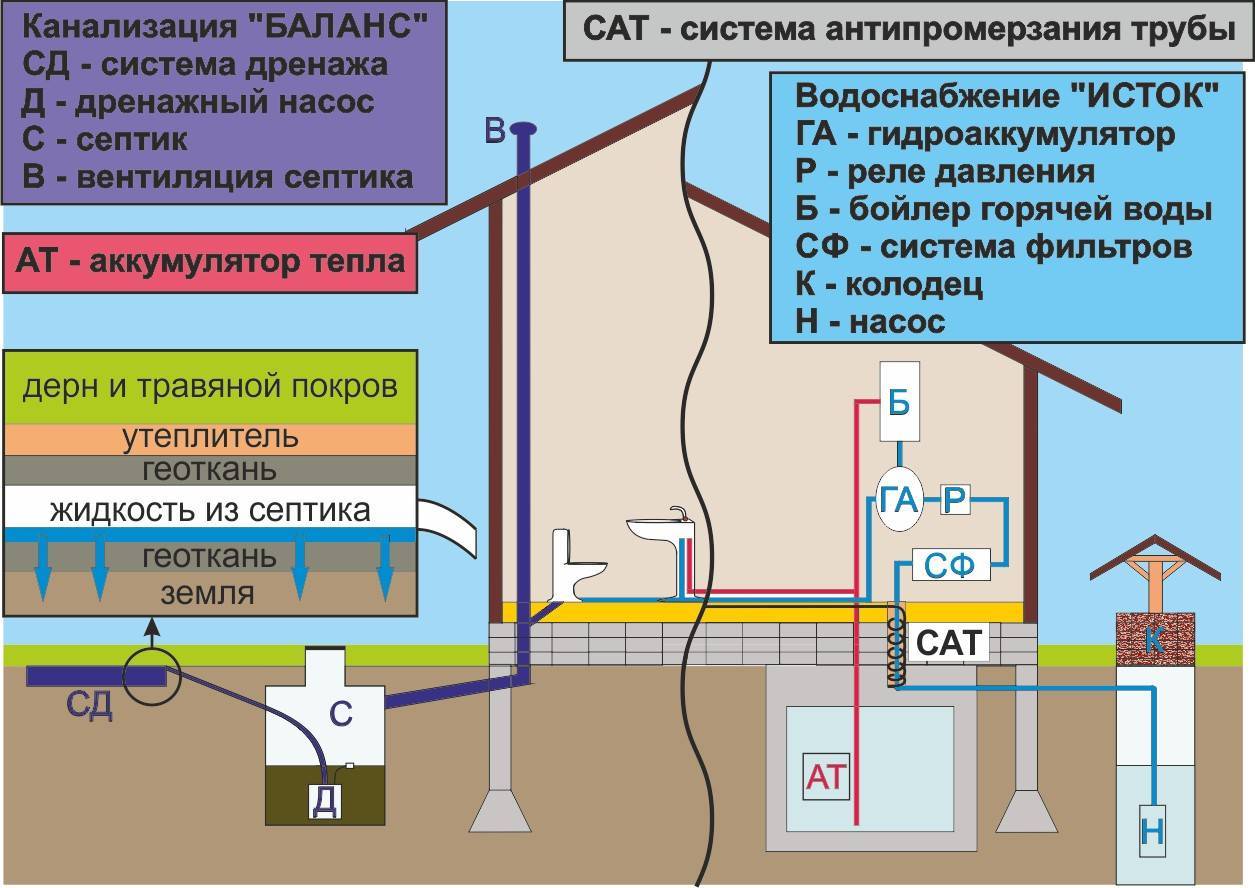
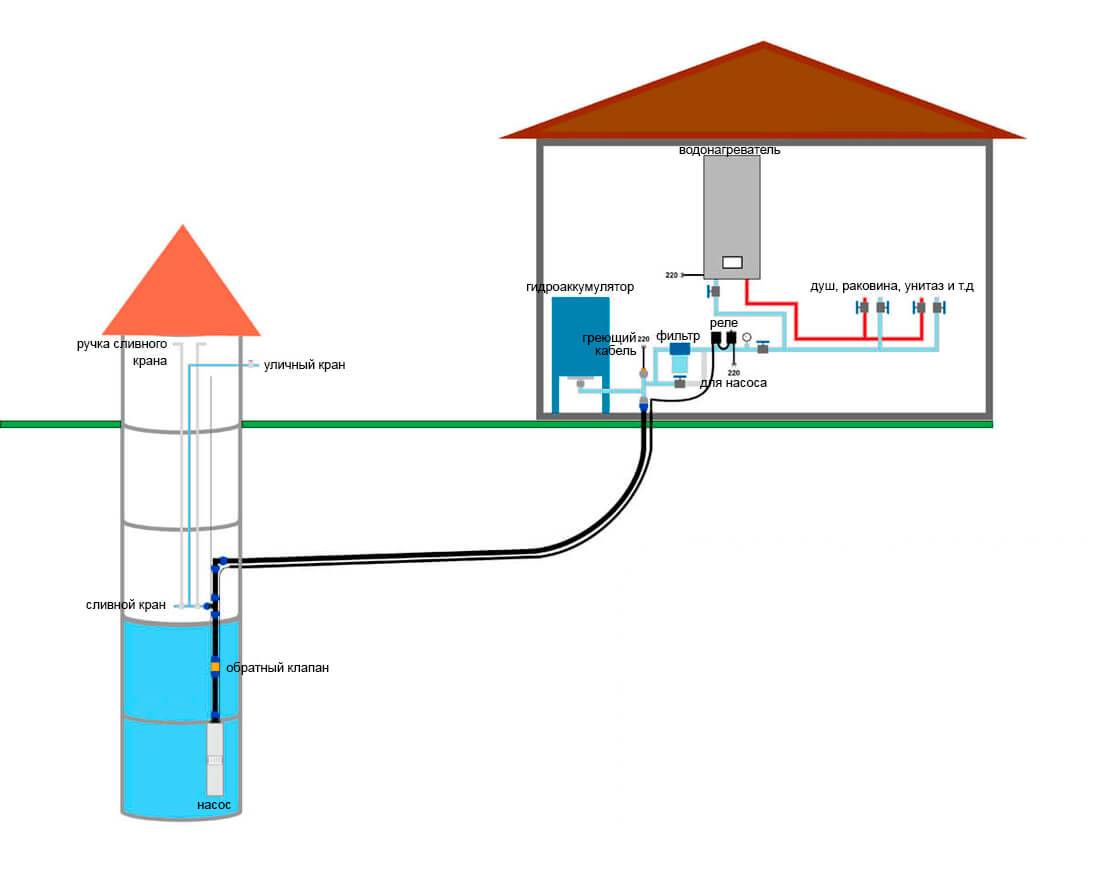
Although this method requires a lot of labor, it is used because it is reliable. In any case, they try to lay the section of the water supply system between the well or well and the house exactly below the freezing depth. The pipe is led out through the wall of the well below the depth of freezing of the soil and is led into the trench under the house, where it is raised higher.The most problematic place is the exit from the ground into the house, you can additionally heat it with an electric heating cable. It works in automatic mode maintaining the set heating temperature - it works only if the temperature is below the set one.
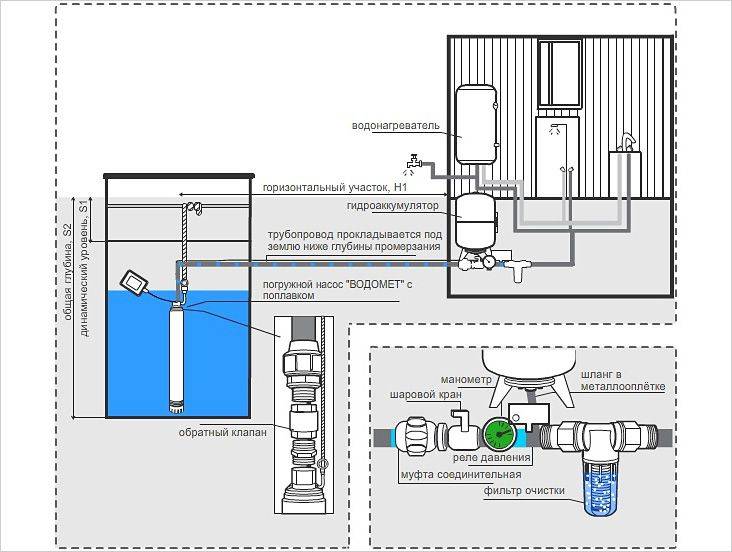
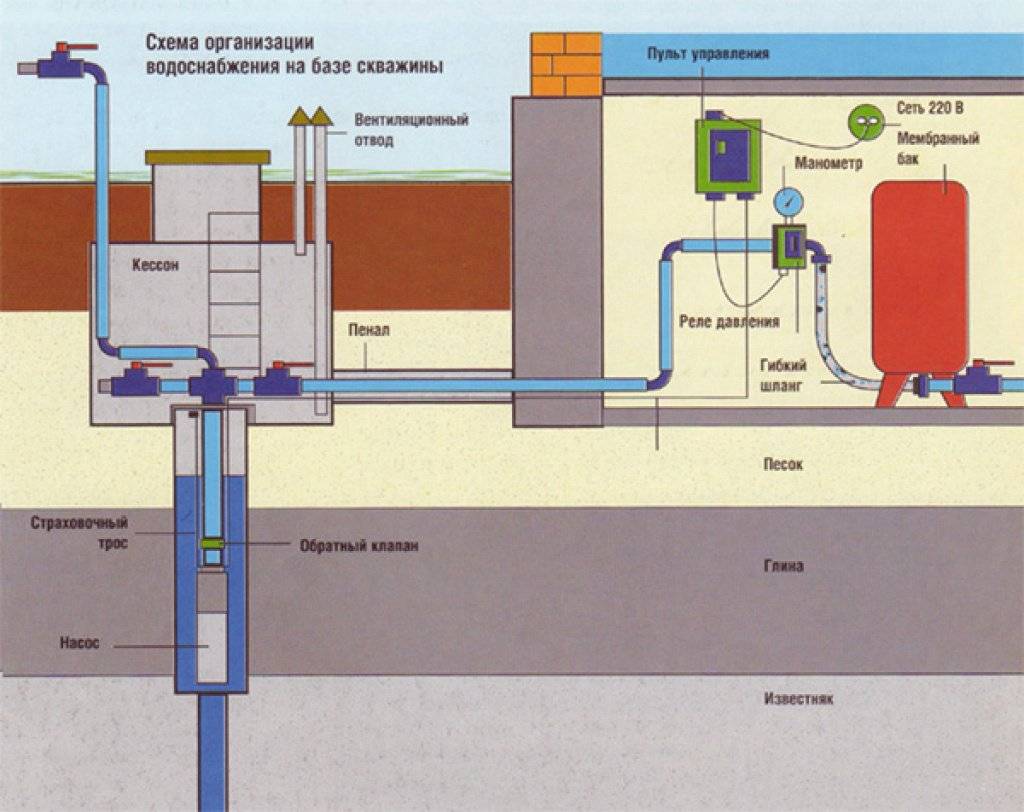
When using a well and a pumping station as a source of water, a caisson is installed. It is buried below the freezing depth of the soil, and equipment is placed in it - a pumping station. The casing pipe is cut so that it is above the bottom of the caisson, and the pipeline is led out through the wall of the caisson, also below the freezing depth.
Laying water pipes in a private house from a well when constructing a caisson
A water pipe buried in the ground is difficult to repair: you have to dig in. Therefore, try to lay a solid pipe without joints and welds: they are the ones that give the most problems.



close to the surface
With a shallow foundation, there is less earthwork, but in this case it makes sense to make a full-fledged route: lay out a trench with bricks, thin concrete slabs, etc. At the construction stage, the costs are significant, but the operation is convenient, repair and modernization are no problems.
In this case, the water supply pipes of a private house from the well and well rise to the level of the trench and are brought out there. They are laid in thermal insulation to prevent them from freezing. For insurance, they can also be heated - use heating cables.
One practical tip: if a power cable runs from a submersible or borehole pump to the house, it can be hidden in a protective sheath made of PVC or other material, and then attached to the pipe. Fasten every meter with a piece of adhesive tape.So you will be sure that the electrical part is safe for you, the cable will not fray or break: when the ground moves, the load will be on the pipe, and not on the cable.
Sealing the entrance to the well
When organizing the water supply of a private house from a well with your own hands, pay attention to the termination of the exit point of the water pipe from the mine. It is from here that most often the dirty top water gets inside
It is important that the outlet of the water pipe of their well shaft is well sealed
If the hole in the wall of the shaft is not much larger than the diameter of the pipe, the gap can be sealed with sealant. If the gap is large, it is covered with a solution, and after drying, it is coated with a waterproofing compound (bituminous impregnation, for example, or a cement-based compound). Lubricate preferably both outside and inside.
Kinds
There are two types of water supply - individual and centralized, which are created for internal and external provision of consumers with water.
Individual
For country houses, an autonomous water supply system is used, which is an integral part of the life of any person. This also includes a water supply system with a membrane tank, which is called a hydraulic accumulator.
membrane tank
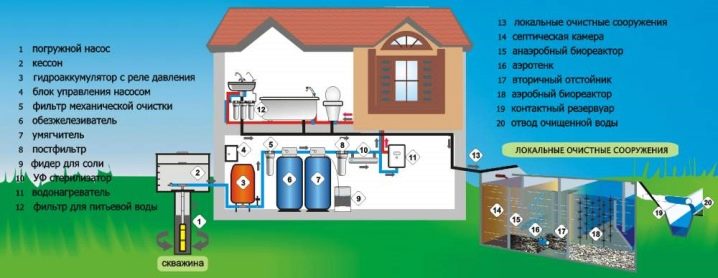
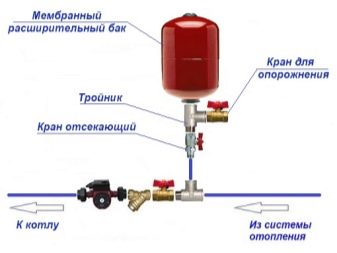
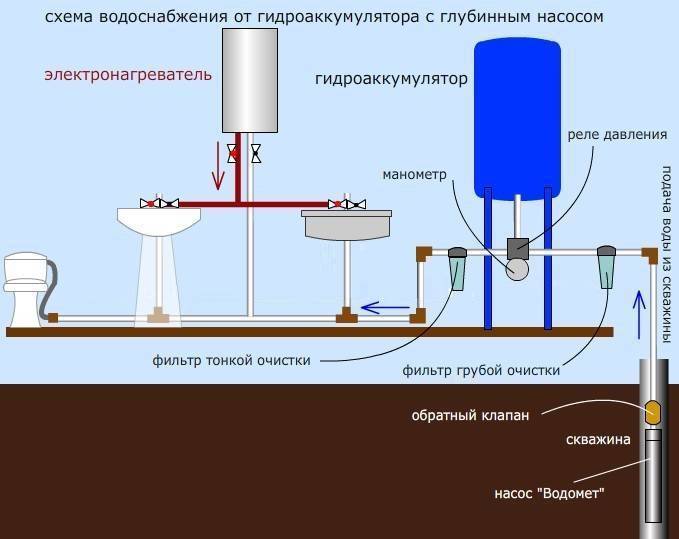
Such a system is used in the construction of both cottages and private houses or summer cottages. The principle of operation of such a system is as follows. A pump is installed in an already finished well, a pipeline system is connected to it. Next, pipes are drawn that need to be connected to cleaning filters, and only then to a hydraulic accumulator and an automatic closed relay that maintains the desired pressure. All this is called a control system that distributes water between different collapsible points.Such a system maintains very high pressure all the time for a long time.
storage tank
This system is often used for plumbing in a new building, where there are interruptions in water supply or even its absence. His work is as follows.
- In the house, it is necessary to install a storage tank with an overflow valve. Most often it is installed in the attic.
- Then the pump is installed in a well or well, from which the pipeline is laid into the house, and already there it is connected below to the bulk tank. After switching on, the pump pumps water into the storage tank.
- When the maximum level is reached, the pump is turned off, and at the minimum level, on the contrary, it is connected. It turns out the automation of the system.
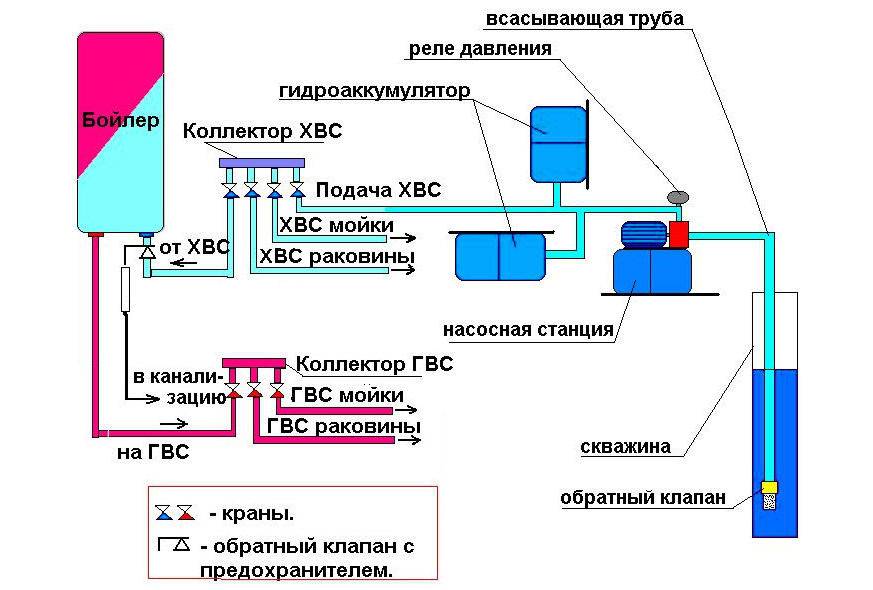
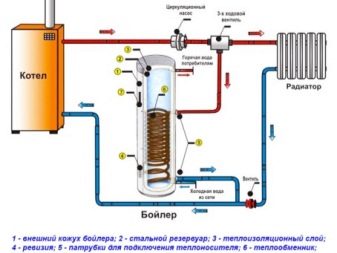
Since more houses have independent sources of water supply in the form of a well or well, the internal water supply in the house begins with a pumping station. And if it is correct to say, then from the first valve that cuts off the pressure unit. Behind such a valve is a branching of cold and hot water supply. Hot water discharge comes from the cold pipeline and enters the heater, which generates already warm water.
centralized
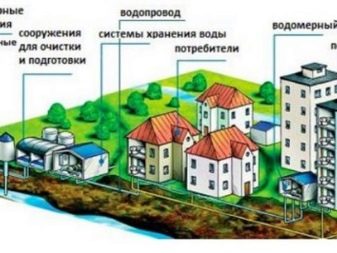
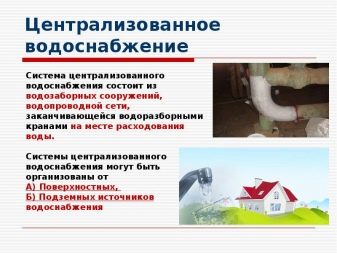
For cities, this source is the central highway, which serves a huge number of people. It includes both underground and surface pipes. With their help, water is supplied to the entire city or district at the same time. The use of such a system is possible both in cities and in urban-type settlements or even in developed villages.
Such a water supply system is a structure where water is supplied simultaneously from several sources to one.This allows consumers to receive it from one plumbing system.
Choose the best source device
Even before starting work, it is necessary to choose the most suitable system for supplying water to the house.
At the planning stage, it is important to solve 2 tasks:
- selection of the most appropriate source;
- the search for the optimal place for installation - the fluid supply scheme will depend on this.
Kinds
Water supply to the house can be provided by a sand or artesian well. These options differ in the type of equipment, performance and cost, so before you bring water into the house, you should study all the main characteristics.
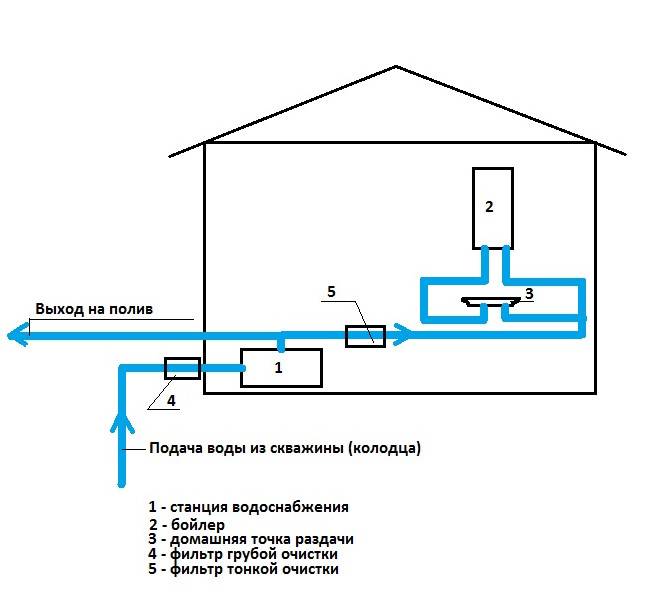
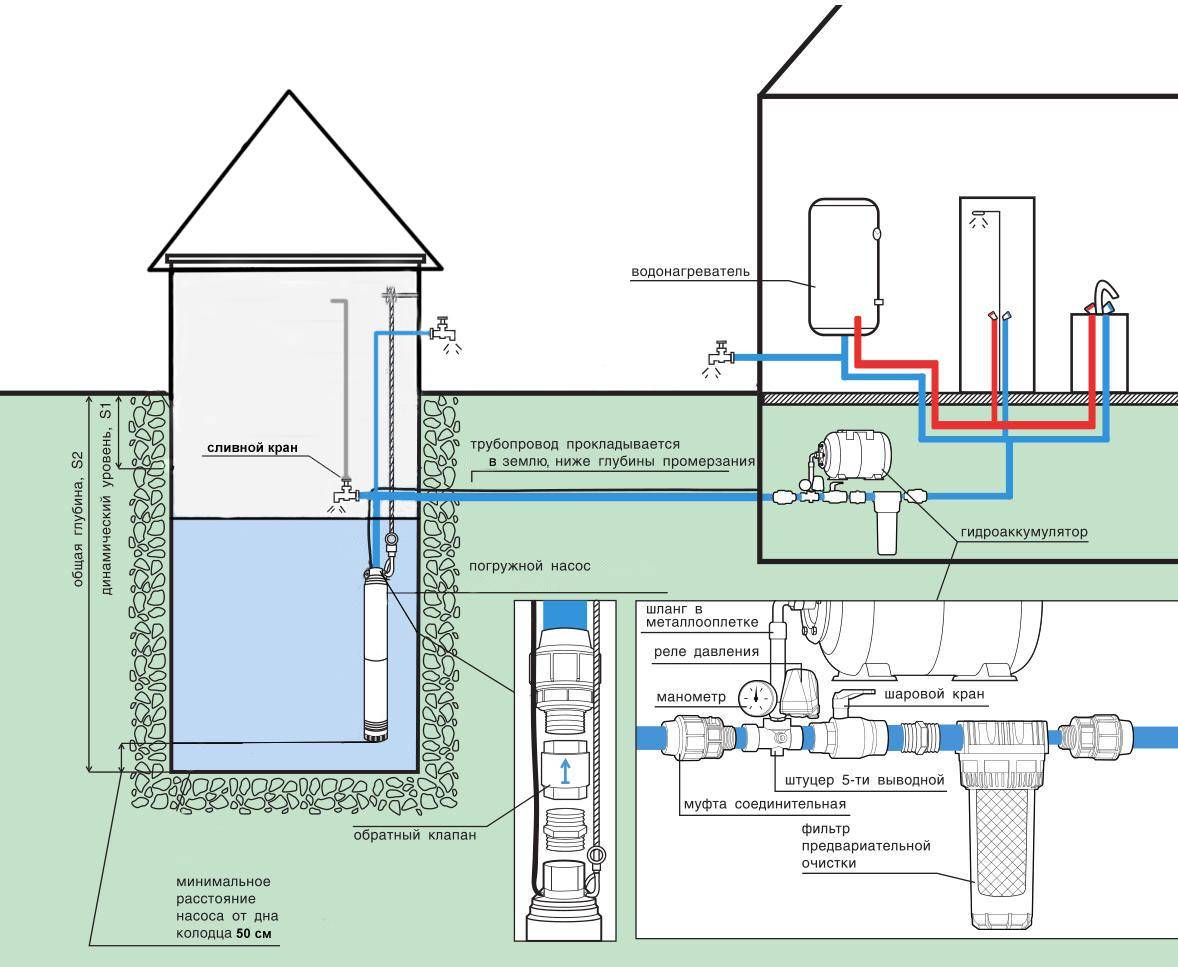
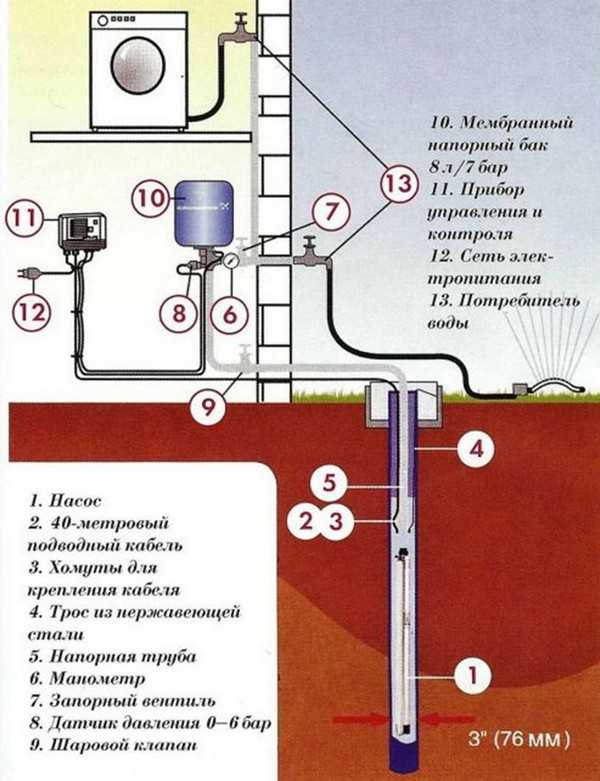
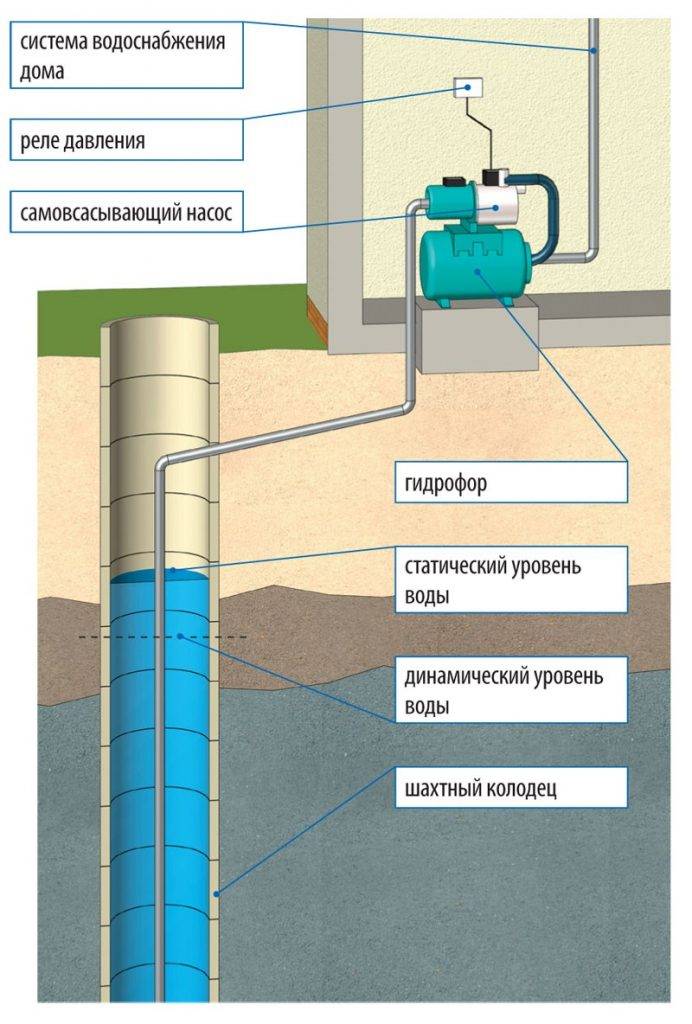
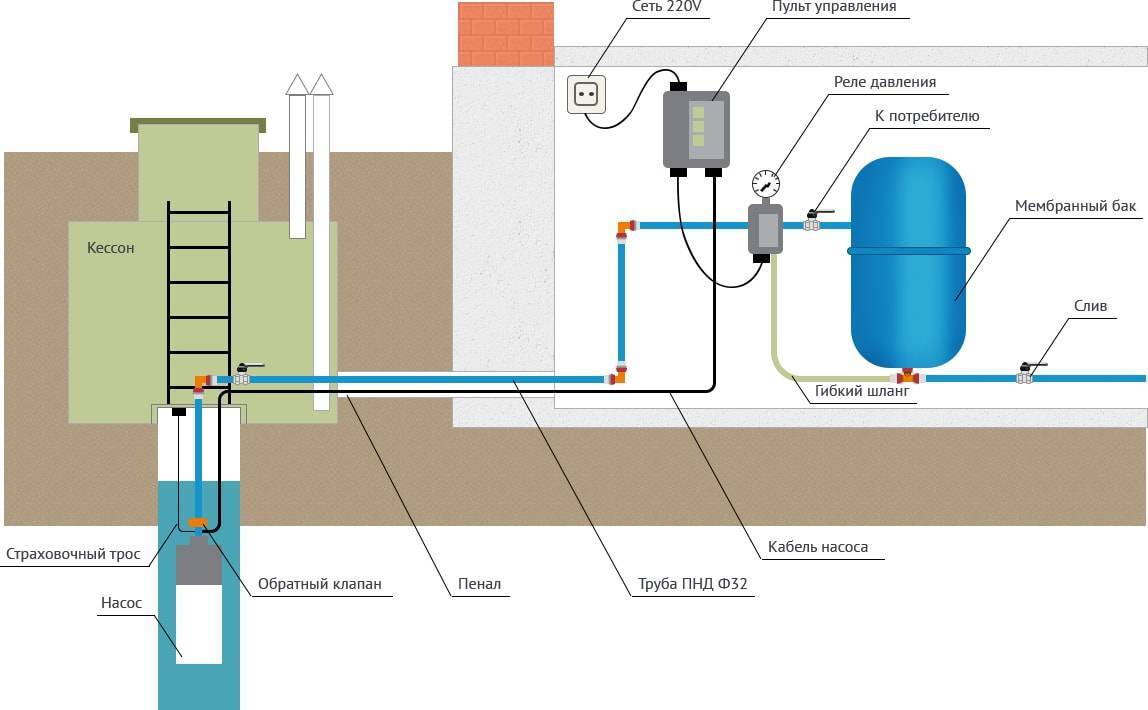
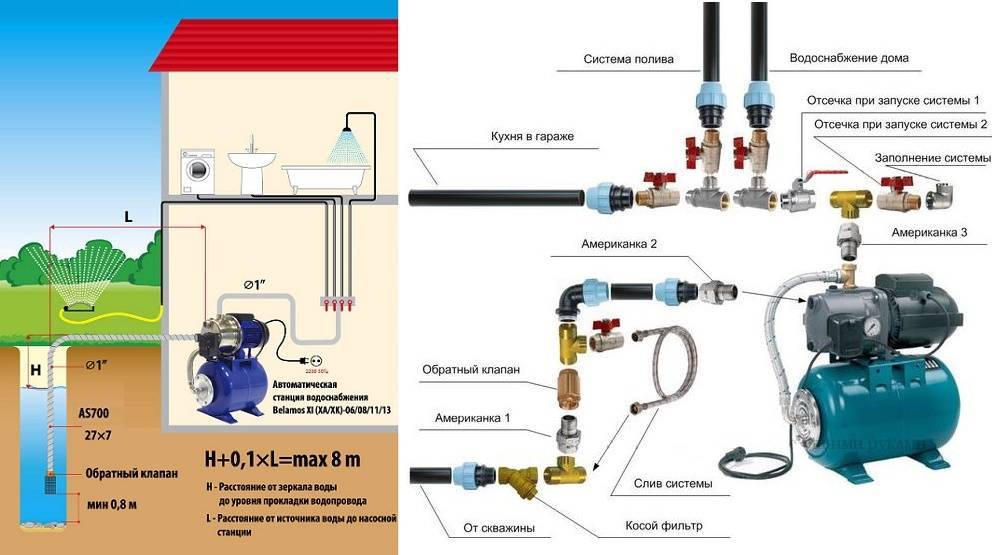

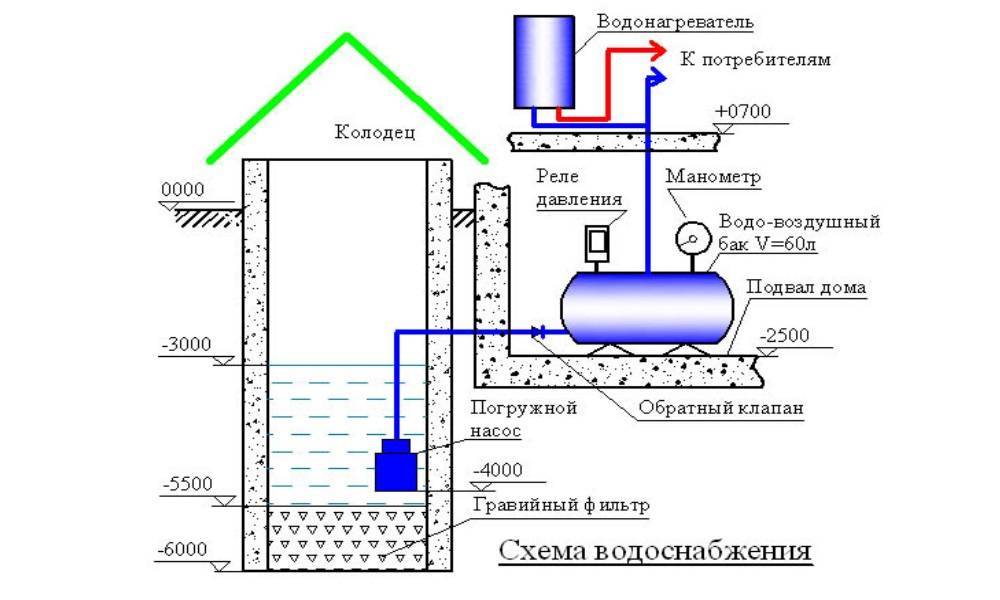
Sandy. Such a well has a relatively shallow depth - within 10-50 m. Clean water can be extracted from this layer, but filters cannot be dispensed with. This is explained by the possible presence of various impurities in the liquid.
Of the advantages, it is worth mentioning the relatively small costs for the purchase of equipment and drilling. The list of disadvantages includes a short service life (about 10-15 years) and low productivity. Such a water supply device can supply no more than 5 cubic meters / hour. Most often, sand wells are recommended for installation in a country house or in a small cottage where 1-3 people live.
Artesian. For such a source, it is necessary to make a well with a depth of 100 m or more. Such a well in a private house has pros and cons. Among the advantages are:
- High productivity - about 10 cubic meters / h. Thanks to such indicators, the source can provide water to a plot and a cottage with 4-6 residents.
- Pure water.
- Long service life up to 50 years.
Location selection
The location of the well is extremely important, as this scheme affects the usability and service life. Several indicators are the most important
- In the house or out of the house. A few years ago, a well was in demand inside the house. This option is the most convenient in those cottages where the kitchen is located in the basement. The disadvantage is the difficulty of flushing the equipment in case of clogging. If the first source fails, it will not work to drill a well next to it a second time. To facilitate access to the main equipment, it is worth choosing a place outside the house.
- Distance from a septic tank or cesspool. On sandy and loamy soils, water pumping equipment should be located at a distance of 20 m or more from cesspools. If we are talking about sandy soil, then household drains should be at a distance of 50 m or more.
- Distance to foundation. A small well for water supply in a private house should be at a distance of 5 meters or more from the foundation. This is explained by the fact that when fluid is sucked from the well, the pump will also draw out small particles of loose soil. If an artesian source is planned to be installed on the territory, then it has little effect on the soil layers.
- Price. The farther from the cottage the well will be, the more investments will be required for laying the water supply.
Decentralized water supply
If you are going to switch to decentralized water supply, consider the properties of the soil, the depth and condition of inland waters. And also be prepared to install pumping equipment and water filters.
IMPORTANT! You do not need to pay for using an autonomous system, however, pumping equipment and the arrangement of a well or well are expensive. Tips for choosing a place for water intake facilities:
Tips for choosing a place for water intake facilities:
- It should be installed at a distance of 20-30 meters from sewage treatment systems, compost pits and other potential sources of pollution.
- The site must be without flooding.
- There should be a special blind area around the well or well (no more than 2 meters). The surface part should be at a distance of 80 cm from the ground, covered with a lid from above.
Features of water supply from a well
Well water
There are two types of wells for home water supply:
- Well "on the sand".
- Depth from 15 to 40-50 m, service life - from 8 to 20 years.
- If the water carrier is not deep, you can drill it manually.
- To supply water, you will need to install pumping equipment and filters.
- Artesian well.
- Depth up to 150 m, service life - up to 50 years.
- Only special equipment drills.
- Water rises by itself, due to its own pressure.
- Pumps are used only for transportation.
- Such a well is registered and a passport is issued for it.
Well advantages:
- stable volume of water;
- high water quality;
- do not need to be regularly repaired.
Well cons:
- drilling is an expensive procedure;
- the service life is less than that of a well;
- need to use additional expensive pumps.
Most often, wells consist of a mouth and an aboveground part. The mouth is built in an underground chamber - a caisson. Also, the water intake device has a barrel.Its walls are reinforced with steel casing pipes. and the water intake part (consists of a sump and a filter).
Well for water supply
This is the simplest solution for autonomous water supply if the aquifer is powerful and located at a level of 4-15 m.
Water supply from a well
Most often, a well is constructed from concrete rings or bricks. It consists of an above-ground part with a ventilation pipe, a shaft, a water intake and a water-containing part.
Water enters the well through the bottom or walls. In the first case, a gravel bottom filter is placed at the bottom for additional water purification.
If water enters through the walls, special “windows” are made and gravel is poured into them, which also serves as a filter.
Well advantages:
- easy to build;
- you can manually raise the water if the electricity is turned off;
- low cost of pumps;
- long service life - more than 50 years.
Well cons:
- Water quality: groundwater with particles of earth and silt can penetrate there.
- To prevent water from overflowing, the well must be cleaned regularly.
- The water level varies with the season, so in hot weather, shallow springs can dry up.
You can build a well with your own hands, for this you will need reinforced concrete rings, a tripod with a winch, buckets and shovels. The well is unpretentious in maintenance, access to the water source is convenient.

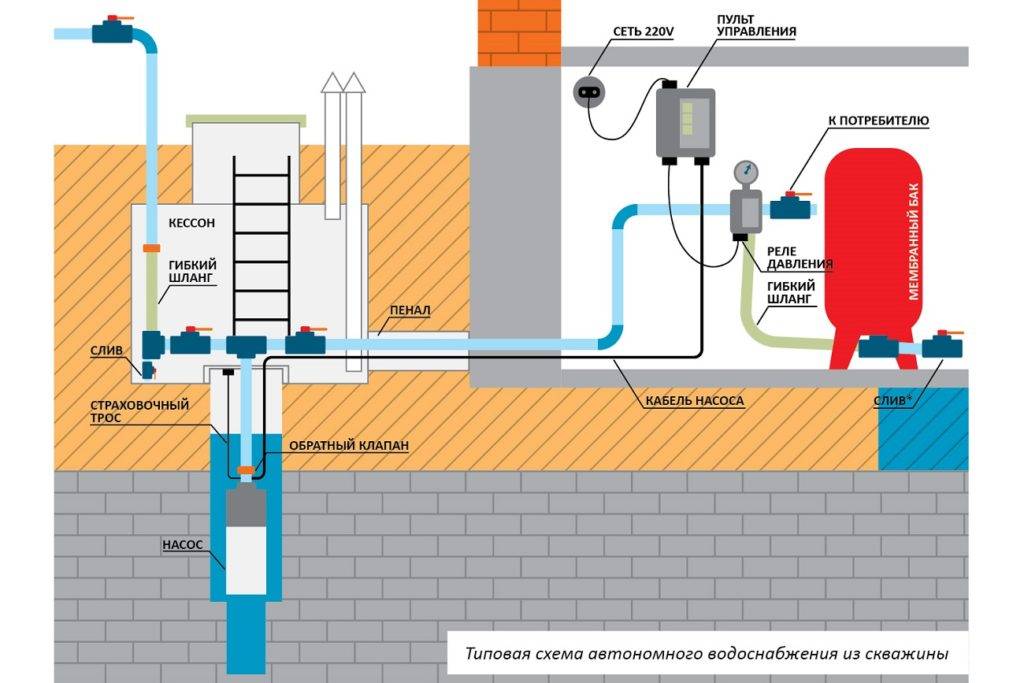
The option with a well is suitable in the following cases:
- if the level of water consumption among the residents of the house is low;
- there is a powerful protected spring with good water;
- if there are no other options.
Sequence in the organization of the water supply system
In the process of arranging water supply at home, a certain sequence must be observed. After the water source is ready, mount:
- external and internal pipeline;
- pumping and additional equipment;
- filters for water purification;
- distribution manifold;
- water heating device.
At the end, plumbing fixtures are connected.
Water heating
What equipment is able to provide the house with hot water? Here is a list of current solutions.
| Image | Description |
|
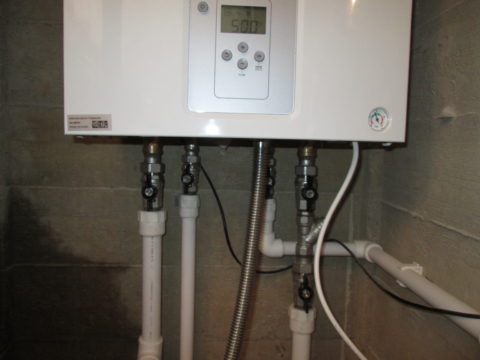
Gas double-circuit boiler or column | The main advantage is the minimum price of a kilowatt-hour of thermal energy (from 50 kopecks). The disadvantage is the low accuracy of setting the water temperature for models with a mechanical thermostat. Connected between cold water and hot water connections; it is recommended to install a mechanical filter in front of the heat exchanger (unless, of course, it is absent at the inlet for some reason). |
|
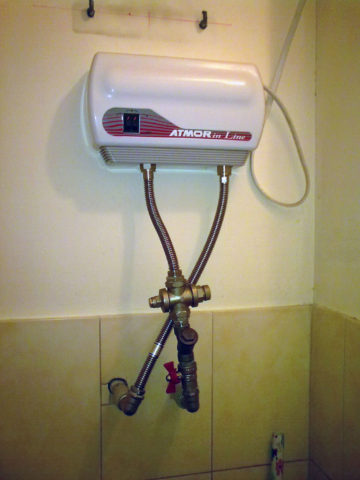
Electric flow heater | The advantage is compactness. Disadvantages - expensive thermal energy and a large load on the electrical network (from 3.5 to 24 kW). The water temperature is regulated by manual switching on / off of individual heating elements or automatically, using an electronic thermostat (thermocouple). The connection method is the same as for a gas boiler. |
|
Electric boiler | Creates a significant supply of water with a stable temperature, exactly corresponding to the value set by the owner. It has a relatively low electrical power (1-3 kW). Less economical compared to an electric flow through heat loss through a heat-insulated housing. A safety group is installed in front of the boiler, including a check and safety (releasing water in case of excess pressure) valves. |
|
Indirect heating boiler | A tank with an internal heat exchanger is connected to a heating boiler or central heating system and uses the energy of the heat carrier to heat water. In summer, the boiler only works to heat water in the boiler. The connection diagram is the same as that of an electric boiler, however, with a large volume of the tank, along with a safety valve, an expansion tank is placed in the DHW circuit. |
|
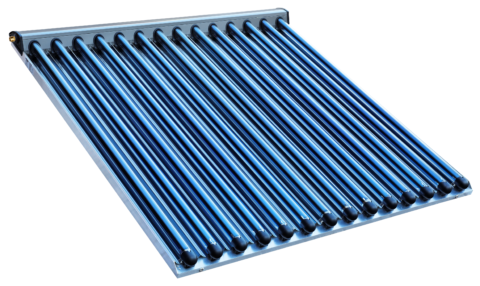
solar collector | Uses solar radiation to heat water. The advantage is free heat. The disadvantage is unstable thermal power, depending on the weather and season. It is connected to the DHW circulation circuit in combination with an indirect heating boiler and a backup heat source. |


Plumbing schemes
Plumbing can be carried out in two ways - with serial and parallel connection. The choice of water supply scheme depends on the number of residents, periodic or permanent stay in the house or on the intensity of use of tap water.
There is also a mixed type of wiring, in which the faucets are connected to the plumbing system through a manifold, and the rest of the plumbing points and household appliances are connected using the serial connection method.
Scheme #1. Serial (tee) connection
It is an alternate supply of pipes from a riser or water heater to plumbing fixtures. First, common pipes are diverted, and then, with the help of tees, branches are led to places of consumption.
This method of connection is more economical, it requires fewer pipes, fittings, it is easy to install. Pipe routing with a tee system is more compact, it is easier to hide it under finishing materials.
With a sequential scheme for connecting a pipeline with hot water, discomfort is especially noticeable - the water temperature changes dramatically if several people use the water supply at once
But a series connection is more suitable for municipal apartments, for houses with periodic residence or with a small number of residents. It cannot provide uniform pressure in the system when it is used by several users at the same time - at the most remote point, the water pressure will change dramatically.
In addition, if it is necessary to carry out repairs or connect a plumbing fixture, you will have to disconnect the entire house from the water supply. Therefore, for private houses with high water consumption and permanent residence, it is better to choose a scheme with parallel plumbing.
Scheme #2. Parallel (collector) connection
Parallel connection is based on the supply of individual pipes from the main collector to the water intake points. For cold and hot mains, their collector nodes are installed.
This method requires laying a large number of pipes and, accordingly, creates difficulties in masking them. But on the other hand, each draw-off point will have a stable water pressure, and with the simultaneous use of several plumbing fixtures, changes in water pressure will be insignificant.
A collector is a device with one water inlet and several outlets, the number of which depends on the number of plumbing units, household appliances that use tap water for operation.
The collector for cold water is mounted closer to the pipe entering the house, and for hot water - at the outlet of the water heater. A cleaning filter and a pressure regulating reducer are installed in front of the collector.
Each output from the collector is equipped with a shut-off valve, which allows you to turn off a specific water intake point, while other outputs will work in normal mode. In addition, each of them can be equipped with a regulator to maintain a certain pressure for individual devices.
Types of wells for a private water supply
An undrinkable perch is quite suitable for watering the garden, cleaning and similar needs. It is easier and cheaper to get it by arranging a well-needle, also called the Abyssinian well. It is a column of thick-walled pipes VGP Ø from 25 to 40 mm.
Abyssinian well - the easiest and cheapest way to get water for temporary supply of a summer cottage
This is the cheapest and easiest way to get water for temporary water supply. For summer residents who need exclusively technical water and only in the summer.


- The needle well, otherwise the Abyssinian well, is the easiest and cheapest way to create a water source for a private house.
- You can drill an Abyssinian well in one day. The only drawback is the average depth of 10-12 m, which rarely allows the use of water for drinking purposes.
- An Abyssinian well can be arranged within the house by placing pumping equipment in the basement or utility room.
- The needle well is great for extracting water for watering a garden with a vegetable garden and caring for a suburban area.
- Sand wells can supply water for both technical and drinking purposes. It all depends on the specific hydrogeological situation in the suburban area.
- If the water carrier covers the layer of water-resistant soils from above, then the water may well turn out to be a drinking discharge.
The soils of the aquiclude, which prevent the penetration of water, prevent the penetration of domestic wastewater. If the water-containing sand does not have natural protection in the form of loam or solid sandy loam, the drinking purpose will most likely have to be forgotten.
The walls of the well are strengthened with a string of steel casing pipes connected to each other by couplings or a welded seam. Recently, polymer casing has been actively used, which is in demand by private traders because of its affordable price and corrosion resistance.
The design of the sand well provides for the installation of a filter that excludes the penetration of gravel and large sand suspension into the wellbore.
The construction of a sand well will cost much more than an Abyssinian well, but cheaper than drilling a working in rocky soils
The working part of the well filter should protrude beyond the aquifer from above and below by at least 50 cm. its length must be equal to the sum of the thickness of the aquifer and at least 1 m of margin.
The filter diameter must be 50 mm smaller than the casing diameter so that it can be freely loaded and removed from the hole for cleaning or repair.
Wells, the trunk of which is buried in rocky limestone, can do without a filter and partially without casing. These are the deepest water intake workings, extracting water from cracks in the bedrock.
They serve longer than analogues buried in the sand. They are not characterized by the process of siltation, because. in the thickness of the water-containing soils there is no clay suspension and fine grains of sand.
The risk of drilling an artesian well is that the fracture zone with underground water may not be detected.
At a depth of more than 100 m, it is permissible to use asbestos-cement pipes or drill a well without casing at all, if there is no need to strengthen the rocky walls of the hydraulic structure.
If an artesian well has passed more than 10 m of fractured rock containing groundwater, then a filter is installed. Its working part is obliged to block the entire thickness supplying water.
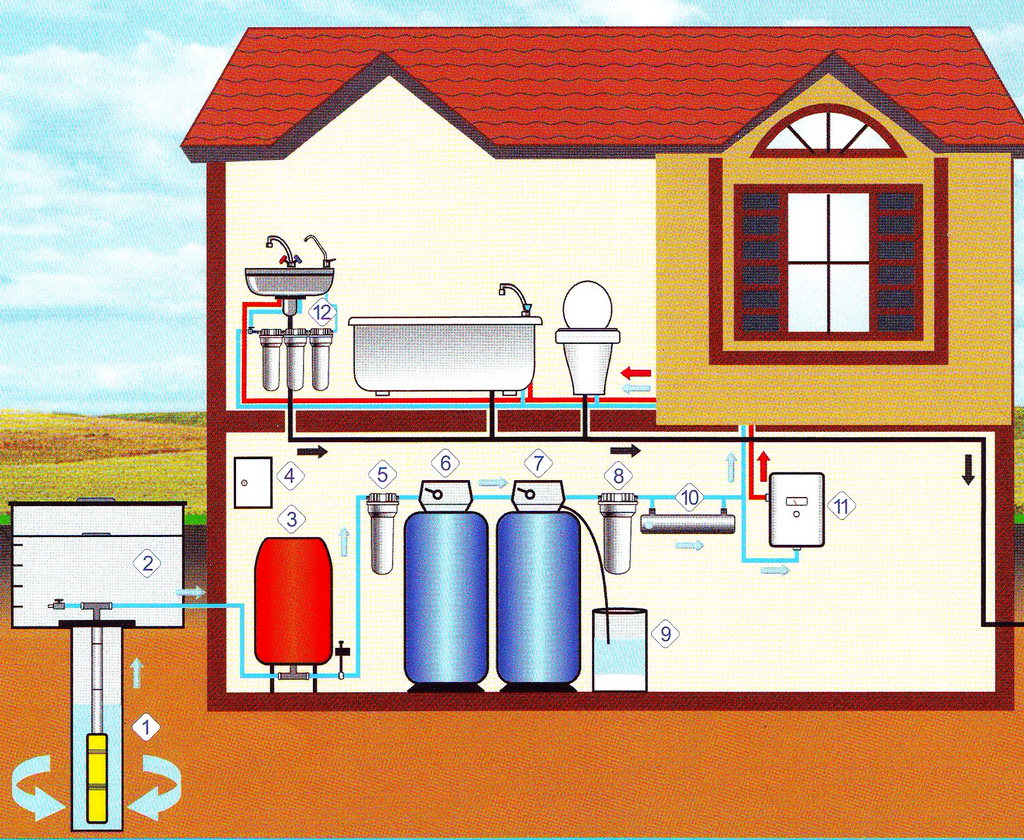
The scheme of the water supply system of an autonomous house with one filter is typical for artesian wells that do not require multi-stage water purification
Installation rules
Before starting work, you need to draw up a diagram, mark on it all the necessary fittings and elements of the system (meters, filters, taps, etc.), put down the dimensions of the pipe sections between them. According to this scheme, we then consider what and how much is needed.
When purchasing a pipe, take it with some margin (a meter or two), fittings can be taken exactly according to the list. It does not hurt to agree on the possibility of a return or exchange. This may be necessary, since often in the process, the installation of a water supply system from polypropylene pipes throws up some surprises. They are mainly due to lack of experience, not to the material itself, and happen quite often even with masters.
Plastic clips take the same color
In addition to pipes and fittings, you will also need clips that attach everything to the walls. They are installed on the pipeline after 50 cm, as well as near the end of each branch. These clips are plastic, there are metal - staples and clamps with a rubber gasket.
For open laying of pipelines in technical rooms it is more convenient to use brackets, for better aesthetics - for open laying of pipes in the bathroom or in the kitchen - they use plastic clips of the same color as the pipes themselves.
Metal clamps are good in technical rooms
Now a little about assembly rules. The system itself can be assembled immediately by cutting pipe sections of the required length, constantly referring to the diagram. So it is more convenient to solder. But, with a lack of experience, this is fraught with errors - you must accurately measure and do not forget to add 15-18 millimeters (depending on the diameter of the pipes) that go into the fitting.
Therefore, it is more rational to draw a system on the wall, designate all fittings and elements. You can even attach them and trace the contours. This will make it easier to evaluate the system itself and identify shortcomings and errors, if any. This approach is more correct, as it gives greater accuracy.
Next, the pipes are cut as needed, fragments of several elements are connected on the floor or desktop. Then the finished fragment is set in place. This sequence of actions is the most rational.


And about how to quickly and correctly cut pipe sections of the desired length and not be mistaken.
How to create your own plumbing for a private house
It all depends on where the water comes from. If this is a well, then autonomous water supply involves the use of a deep pump. The quality of such water does not always meet the standards of suitability for drinking. Filters are required. For irrigation, this is a great way to aerate if the water arrives quickly enough.
The system of autonomous water supply from an artesian well is characterized by high quality drinking water. Special pumps are used. Drilling costs more, but when it comes to health, it's worth it. If a country house is connected to a centralized system, but you want to organize irrigation, you can install a large capacity tank and pump water out of it.
Plumbing in private homes
- Prepared pipes are laid in the house, starting from water consumers.
- The pipes are connected to the consuming point with an adapter so that a tap can be installed to shut off the water.
- Pipes are laid to the collector. It is advisable not to pass pipes through walls, as well as partitions, and if this has to be done, enclose them in glasses.
For easier repairs, place pipes 20-25 mm from wall surfaces. When installing drain taps, create a slight slope in their direction. Pipes are attached to the walls with special clips, installing them on straight sections every 1.5-2 meters, as well as in all corner joints. Fittings, as well as tees, are used to combine pipes at angles.
When connecting pipes to the collector, shut-off valves are always installed (it is needed for repairs and the possibility of turning off water consumption).
How to deliver water to the house
In some cases, it is possible to arrange a well right in the house. To do this, a well is made even before the construction of the house, which makes it possible to carefully equip everything and supply the house with water without any problems. This approach is the most rational, however, most people drill a well at a certain distance from the building. This makes it possible to irrigate the site, as well as supply water to the house, but here it becomes necessary to deliver water to the house, that is, water supply is needed.
Plumbing can be made in three types:
1. internal plumbing that functions in the house;
2. plumbing, acting before entering the house;
3. a system designed to draw water from a well.
The internal water supply device will include a whole set of various pipes, adapters, taps, as well as other devices and appliances that are needed for comfortable use.
The water supply, which is in operation before entering the house, will have to ensure the delivery of the liquid, that is, it will connect the well equipment, as well as the internal water supply. The equipment will be a borehole pump, as well as other elements necessary to supply fluid from the well to the water supply.