- Plumbing
- Pumping station
- Hydraulic accumulator
- Water purification and preparation
- Installing a collector and boiler
- Installation of water supply system components
- Source for water supply: which one to prefer
- Scheme of the water supply system in the house
- Laying methods - hidden and open system
- Main nuances and errors
- Water supply of a private house from a well and a well: pipe laying
- deep laying
- close to the surface
- Sealing the entrance to the well
- The sequence of connection to the central water supply
- How to create a project yourself
- DHW circulation
- How to create your own plumbing for a private house
- Step-by-step laying of an external highway
- We develop a water supply scheme
- Pipes
- External and internal plumbing
- Types and methods of water supply of a private house
- Centralized water supply at home
- Connecting the house to the central water supply
- Autonomous water supply at home
- Using the container (water tank)
- Using the automatic water supply system
- 1. Water from open sources
Plumbing
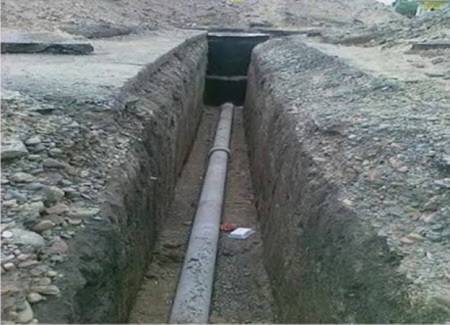
The outer part of the water supply can be laid openly or hidden in a trench
If an underground option is chosen, then it is important to install communications taking into account the depth of soil freezing.When installing the pipeline above the freezing level or above the ground, you should take care of thermal insulation
Pumping station
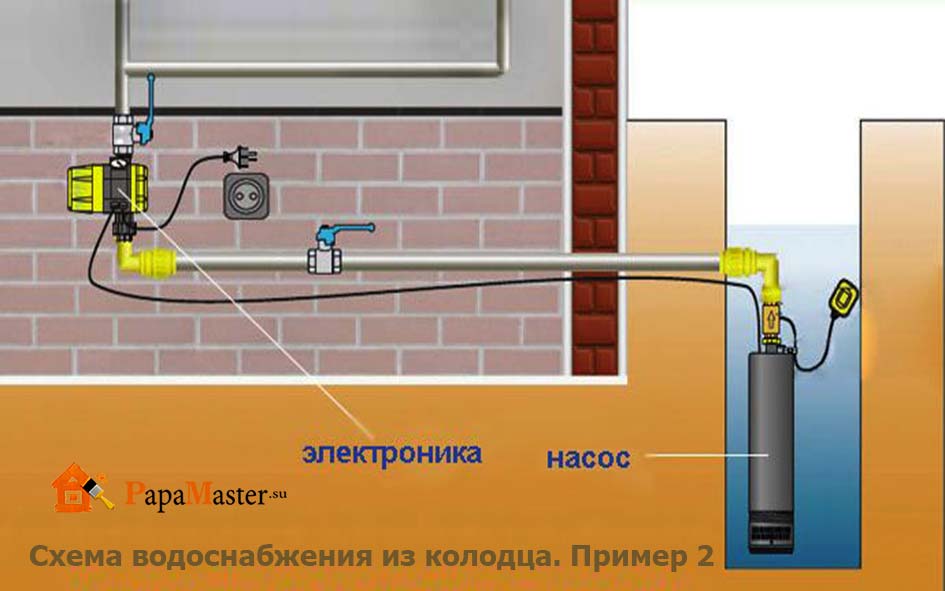
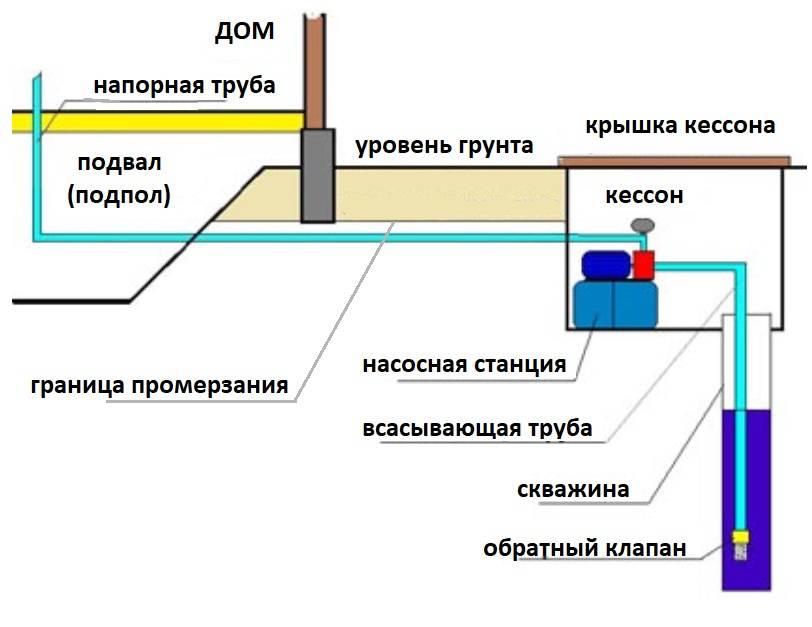
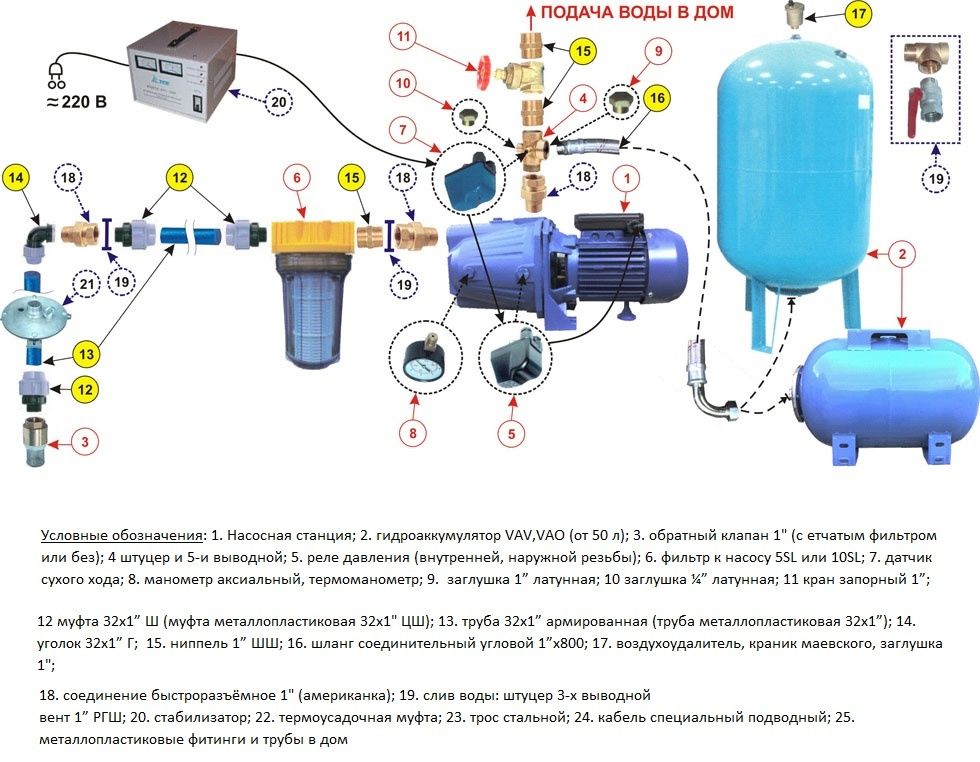
From the source, water is pumped by a pumping station, which is usually located in the basement, on the 1st floor or in the basement. It is advisable to place the station in a room with heating so that the water supply system functions in winter. A fitting is placed on the pipe from the source, suitable for the pumping station, so that when repairing the water supply, the water can be turned off. A check valve is also connected.
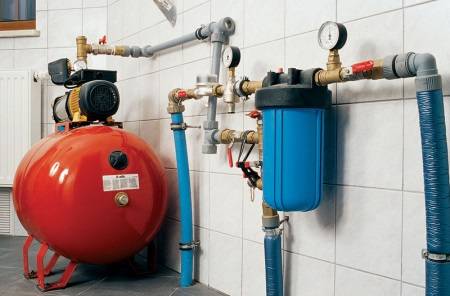
If it is necessary to turn the pipe, you need to use a corner. After that, with a quick connection, we install a ball valve, a coarse filter, a pressure switch, a hydraulic accumulator (if the pump is located in a well or in a well), an anti-dry running sensor, a fine filter and an adapter. In conclusion, check the serviceability by starting the pump.
Hydraulic accumulator
It is represented by a sealed 2-section tank with water in one compartment and pressurized air in another compartment. Such a device is necessary for the stability of the pressure in the system, turning the pump on / off. When you open a faucet in a building, the water leaves this apparatus, which reduces the pressure. The result will be that the relay will trip and turn on the pump to increase the pressure.
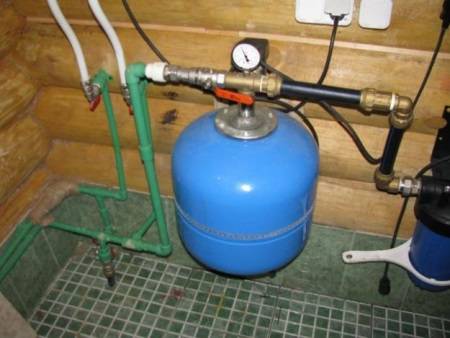
The volume of the tank is selected taking into account the needs of the people living in the house. It can be 25-500 liters. Installing a hydraulic accumulator is not a prerequisite - you can use a storage tank on the top floor or attic, then the pressure for water supply will be created by the weight of this tank. However, such a system will not work if there is a washing machine in the house.
Water purification and preparation
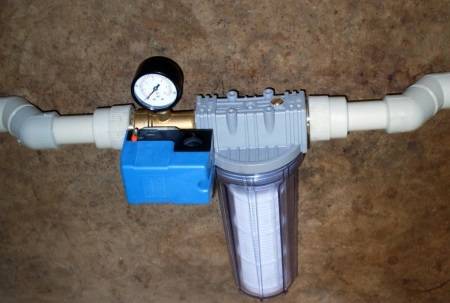
Your source water will need to be laboratory tested for soluble salts and other impurities. This is necessary for the selection of filter systems. After passing the accumulator, the water enters the water purification system, located 0.5-1 meter from it.
Installing a collector and boiler
After the purification system, the water is separated into 2 streams. One is for cold water and goes to the collector, and the second is for hot water and goes to the heater. On all pipes of the collector and in front of it, it is obligatory to install a drain cock, as well as shut-off valves. The number of pipes will be determined by the number of water users.
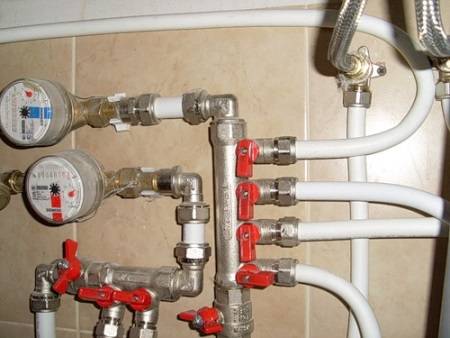
A drain cock, a safety valve, and an expansion tank must be installed on the pipe leading to the heater. Also, a drain tap will be needed in the place where hot water will come out. After that, the pipe goes to the collector, in which there will be hot water.
Installation of water supply system components
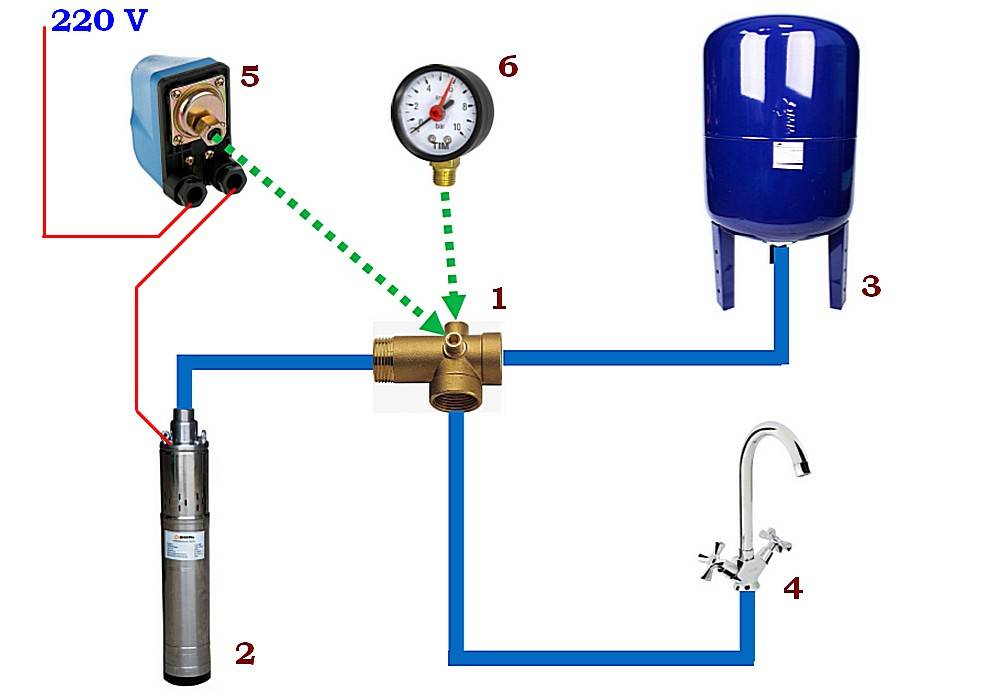
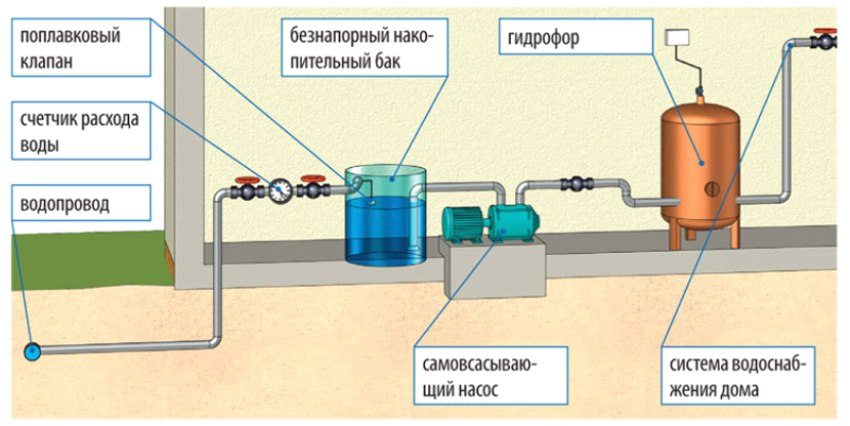
A typical layout of a plumbing system with a well or a well can be used for serial pipeline wiring.
It consists of the following nodes:
- Pump equipment. For a deep well over 8 meters or a well, only a submersible pump is suitable. For shallow sources, assembled pumping stations or surface pumps can be used.
- Transition nipple. Needed for connection with the following elements of the system, which in most cases have a diameter different from the outlet from the pump.
- Check valve. Prevents water from flowing out of the system when the pump is idle, the water pressure drops.
- Pipe. Pipes made of polypropylene, steel, metal-plastic or other materials are used.The choice depends on the wiring (external or internal, hidden or open), the price of the material itself, ease of installation. The pipeline that brings water to the house is supplied with a heat-insulating layer.
- Water fittings. It is used to connect pipes, shut off the water supply, install the pipeline at an angle, etc. It includes: fittings, taps, water sockets, tees, etc.
- Filter group. Designed to protect equipment from ingress of solid and abrasive particles, reduce the iron content in water and soften it.
- Hydraulic tank. Required to create and maintain a stable water pressure, to prevent frequent operation of the pump.
- Security group. It is necessary to control the pressure in the system - a pressure switch, a pressure gauge and a dry-running switch. Automatic control devices help maintain a stable pressure in the system and extend the life of the equipment.
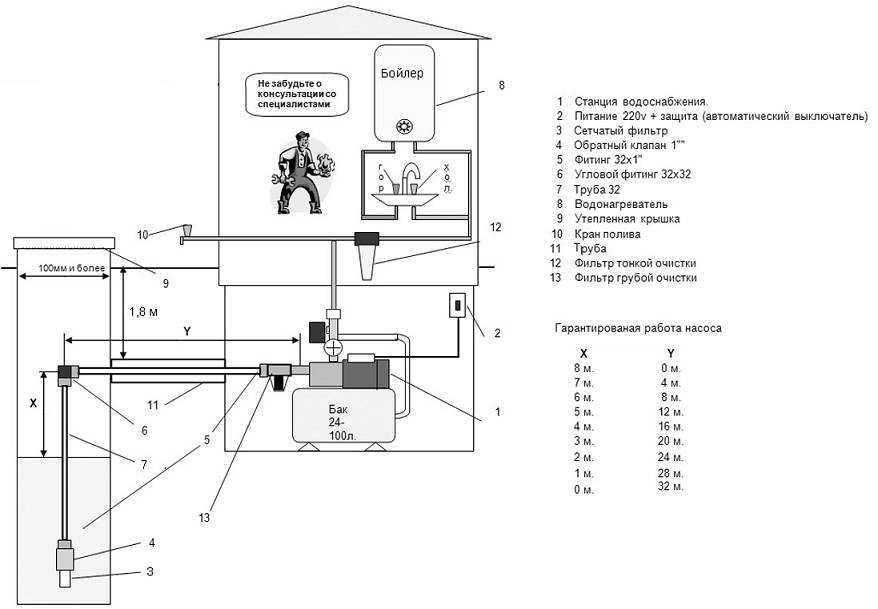
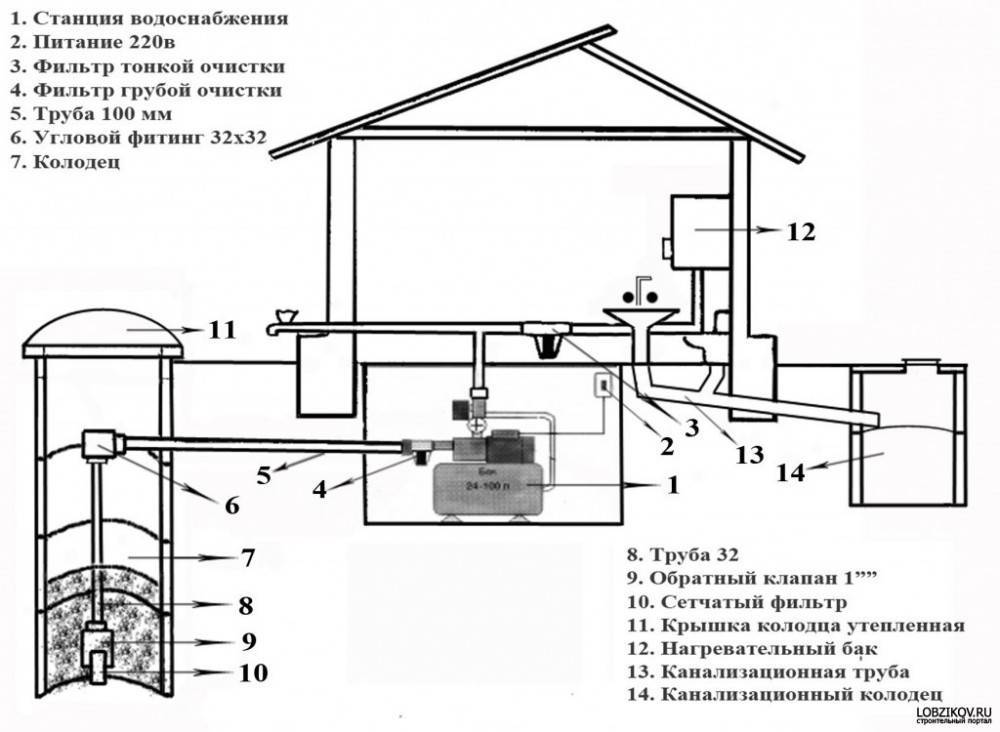
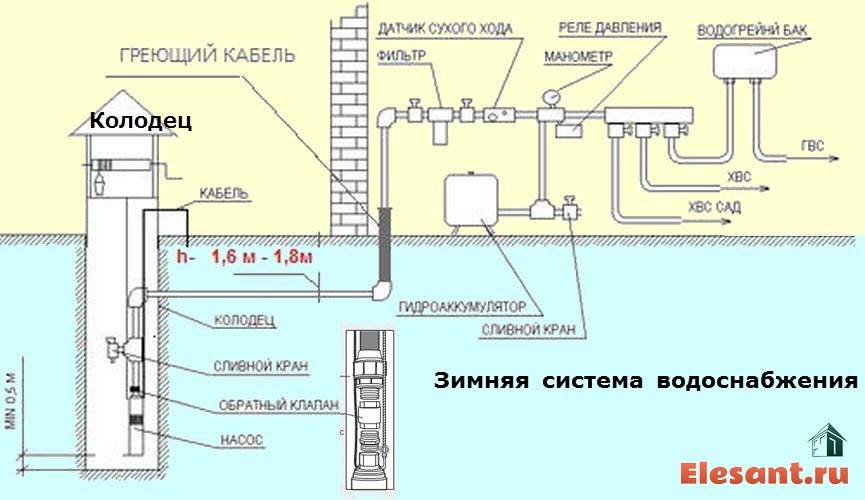
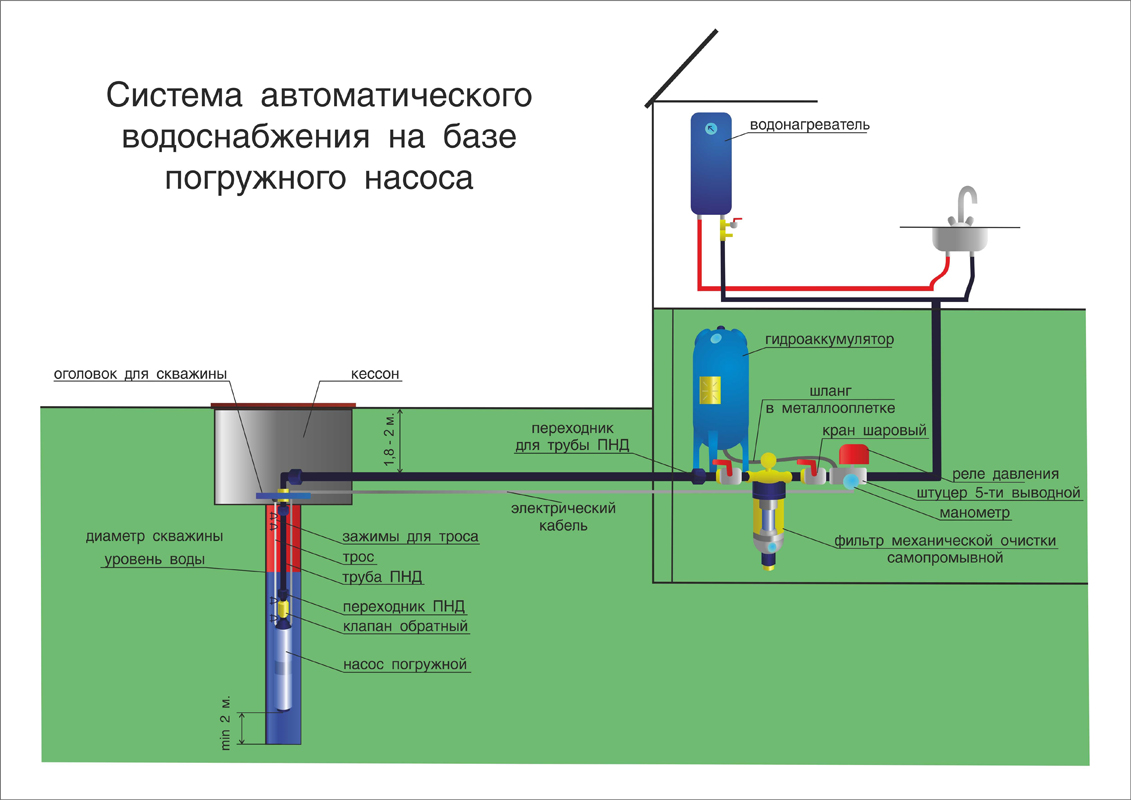
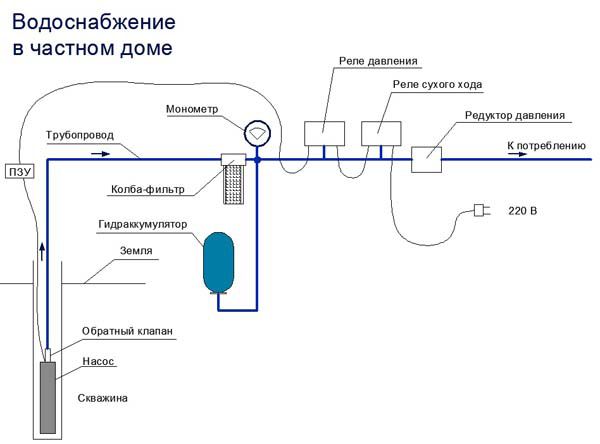
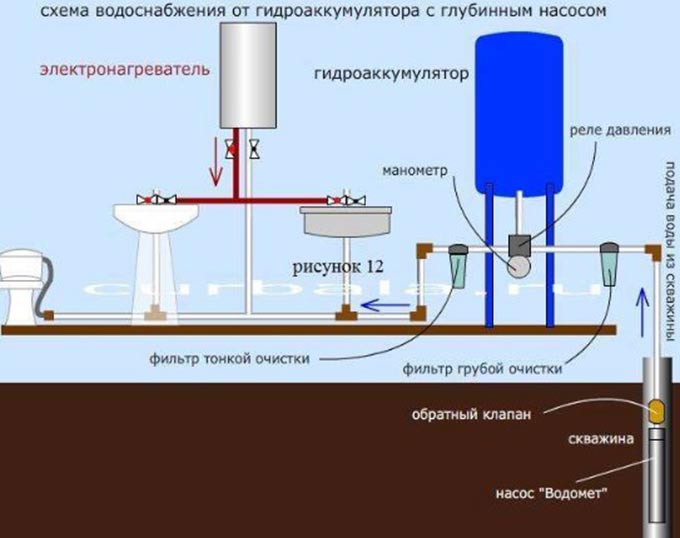
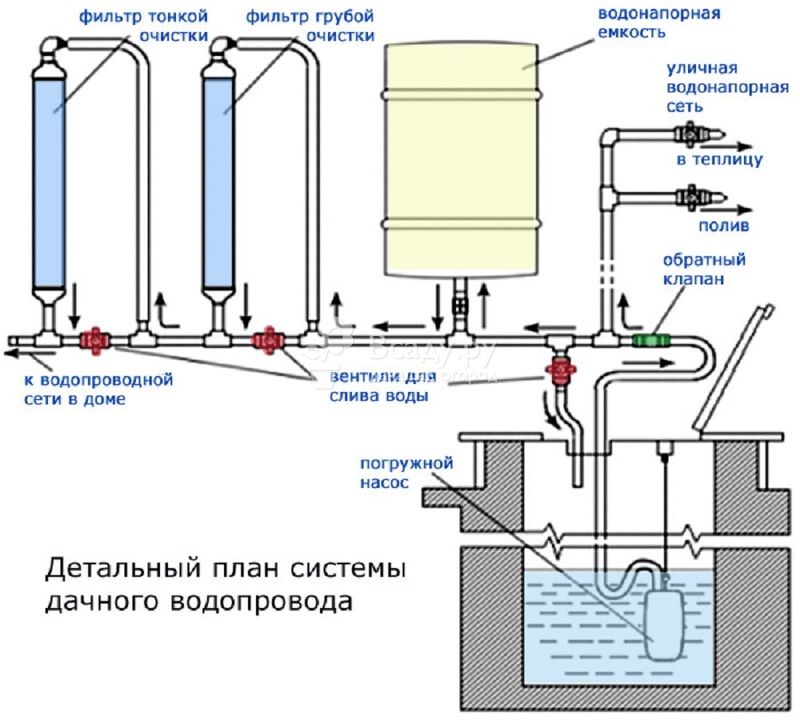
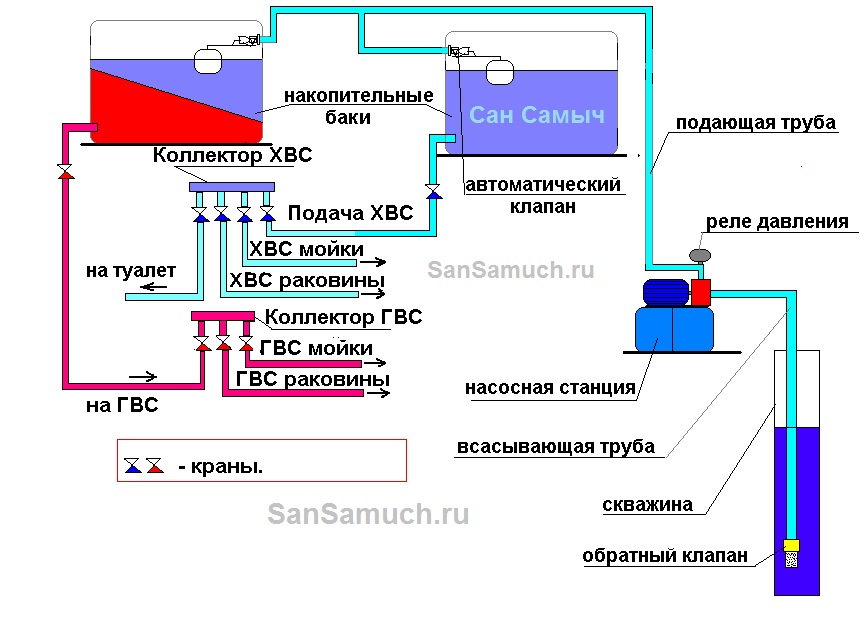
All elements of the system are connected in a certain sequence. More details can be seen in the diagram. Further, the installation of the system is described using the example of collector wiring, as more complex.
A simple diagram of the water supply system makes it possible to imagine how the wiring should be carried out from the source to the extreme point of consumption (+)
The collector unit in a private house is installed in special rooms - boiler rooms or boiler rooms - specially designated rooms of a residential building, in basements and semi-basements.
In storey buildings, collectors are installed on each floor. In smaller homes, the system can be placed behind a cistern in a toilet or hidden in a dedicated closet.To save water pipes, the collector is placed closer to more plumbing fixtures, at about the same distance from them.
Installation of the collector assembly, if you follow the direction of the water, is carried out in the following order:
- At the connection site of the collector with the main water supply pipe, a shut-off valve is installed to turn off the entire system if necessary.
- Next, a sediment filter is mounted, which traps large mechanical suspensions that can lead to equipment failure.
- Then another filter is installed, which will remove smaller inclusions from the water (depending on the model, particles from 10 to 150 microns).
- The next in the installation diagram is a check valve. It blocks the return flow of water when the pressure drops.
After installing the above equipment, a collector is connected to the water supply pipe with a number of leads that corresponds to the number of water consumption points in the house. If not all plumbing fixtures are connected in the house yet, then plugs are placed on the unclaimed conclusions of the collector assembly.
Installation of water branches of hot and cold water supply systems is the same for central water supply. Installation in the house is a little different: one of the cold water outlets of the collector is connected to a water heater, from where hot water is sent to a separate collector unit
Source for water supply: which one to prefer
The water supply scheme of a private house can be implemented in several ways:
- From the central highway;
- From the well.
Connection to the central water supply requires permission from the relevant authority, and this is not always possible for private houses.If you decide to use this option, please note that the pressure in the central water supply has already been determined initially, and when using several devices at the same time, the water pressure in the far one will be lower than in the closer one. Therefore, try to place consumers as compactly as possible.
The well makes it possible to provide the site with water without the official permission of the state services, but this option is only suitable for seasonal use, therefore it is not suitable for permanent residences.
Water supply system of a private house from a well allows you to use better quality water than a well. But to lift it, you need good pressure, so you will have to use more powerful equipment, for example, the OPTIMA (Optima) 4SDm 3/18 1.5kW deep electric pump pumps liquid with a high sand content, filtering it out without threatening the unit.
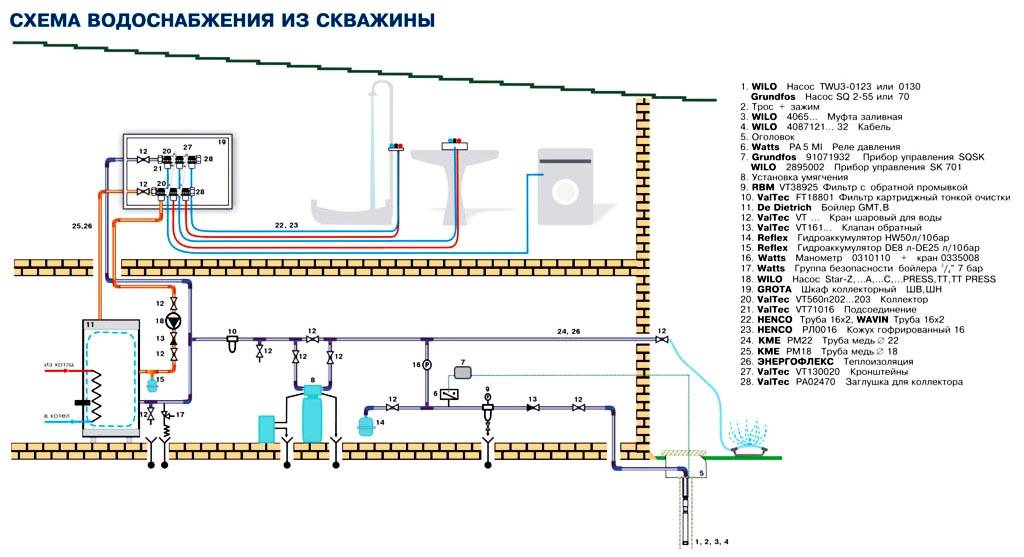
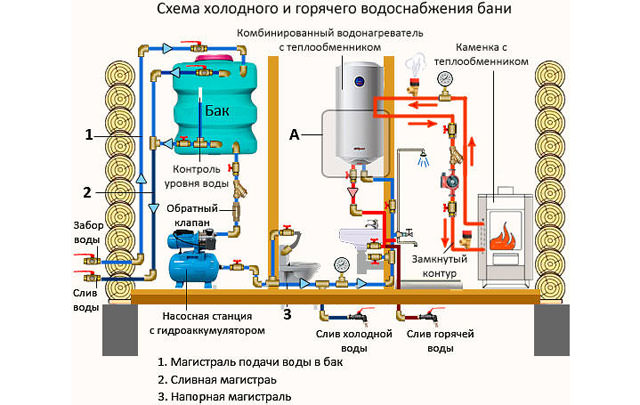

Scheme of the water supply system in the house
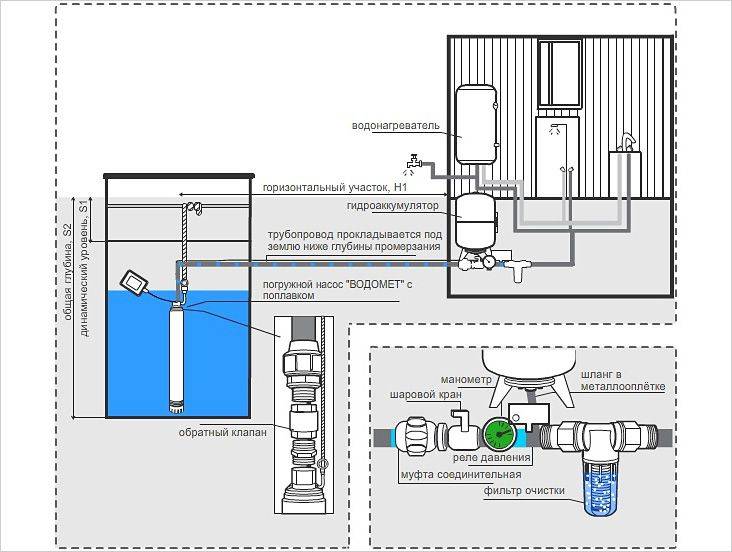
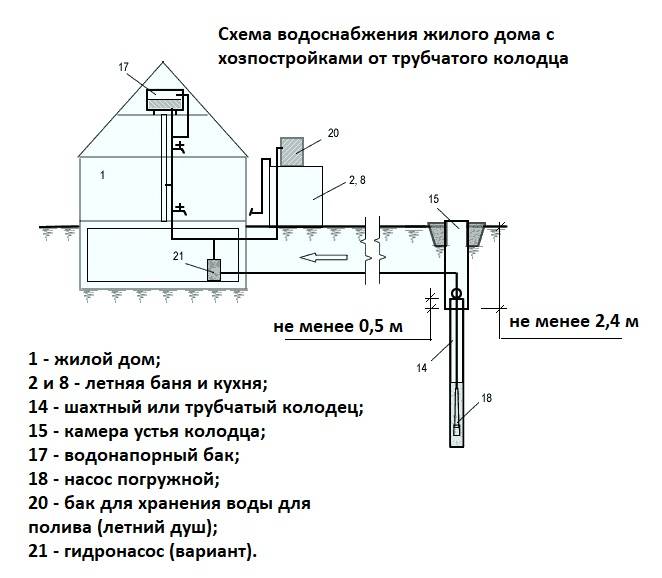
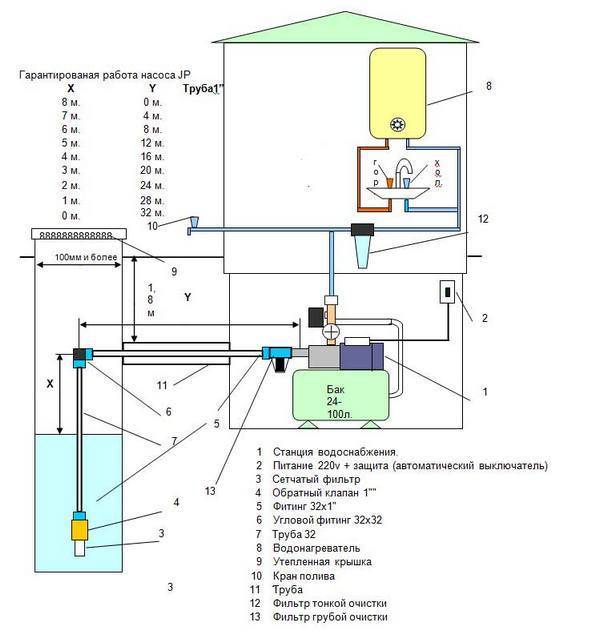
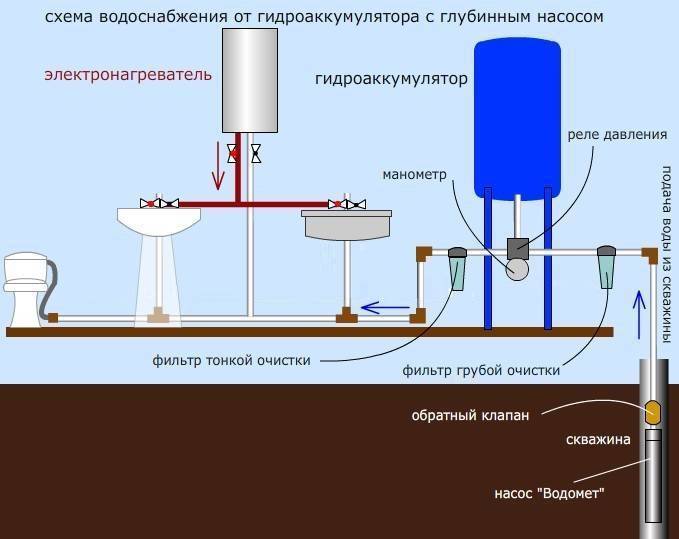
In short, the water supply scheme from the well consists of the following components:
- The actual source of water.
- Liquid transfer pump.
- Hydraulic accumulator to create pressure.
- Cleaning filters. In order for the equipment to be selected correctly, it is necessary to take fluid samples and analyze them. Water that will be used for various technical needs (watering, car washing, etc.) does not have to be purified, so it is supplied through a pipe separately from the system.
- To obtain hot water, special equipment is installed (boiler, boiler, column, etc.).
- A system of water collectors is being created.
A few more options for schemes:
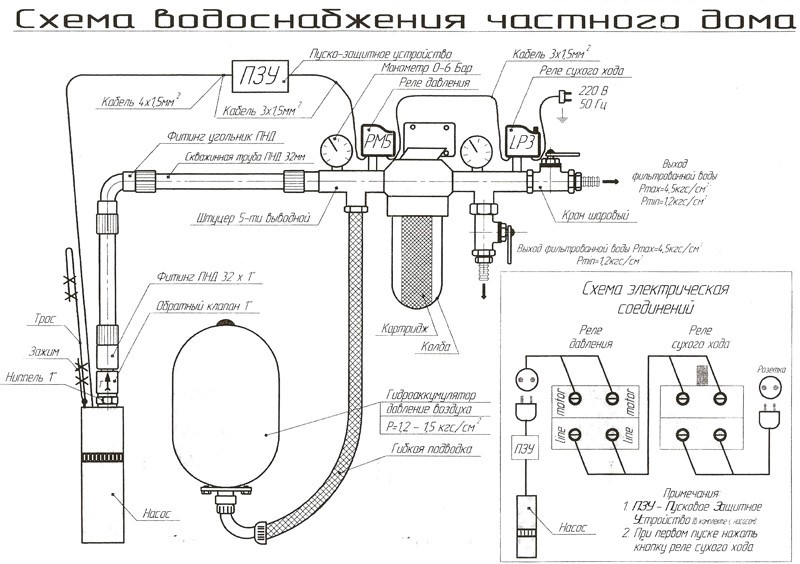
Laying methods - hidden and open system
Pipes in the water supply system can be laid in a closed and open way. The choice of one of the methods does not affect either the quality of the connections or the functionality of the entire system and depends only on personal preferences.
It would seem that it is not difficult to decide and the closed method is preferable as more aesthetic and allows you to save up to 10 cm of usable space. Why is an open pipeline still used in the installation of a water supply system? Let's try to give an answer.
Hidden wiring allows you to hide pipes and not spoil the aesthetic perception of the interior of a house or apartment. The hidden method is used when assembling a water pipe from PP pipes. They hide the contour behind a decorative wall, for example, made of drywall, or ditch the walls and lead the pipes into the formed niches, sealing them with facing material or plaster along the grid.
The disadvantage of the method manifests itself when it becomes necessary to repair or replace the hidden elements of the system - the plaster or tiling has to be opened and then re-decorated.
In addition, in the event of damage and leaks, the problem may not be detected immediately and lead first to the loss of operational technical characteristics of structures, then to flooding of the premises.
It is better to proceed with the installation of the water supply system with a pre-drawn scheme - otherwise, errors in calculations or assembly will lead to the fact that you have to cut new grooves and re-mount the pipes.
To avoid such difficulties, when installing the wiring, only whole sections of the pipe are hidden, placing the docking fittings in open areas. In places of installation of shutoff valves, invisible doors are made.This gives access for maintenance to pipe connections, which are the weakest links in the system.
Pipe laying in an open way is carried out after finishing is completed. The method involves the uncovered laying of pipes and water supply elements. It looks ugly, reduces the usable area of the room, but at the same time this method is very convenient for maintenance, repair and dismantling of elements.
Redevelopment and rearrangement of plumbing in the house with such a plumbing device will also not cause difficulties.
Open wiring makes it possible to quickly detect a leak and eliminate the cause of breakage or damage to system elements
Main nuances and errors
With self-assembly, oversights can be made already at the design stage. Without special knowledge, it is difficult to correctly calculate all the parameters and select electrical equipment. Installation of the pipeline from the source to the house also has a number of features that need to be considered.
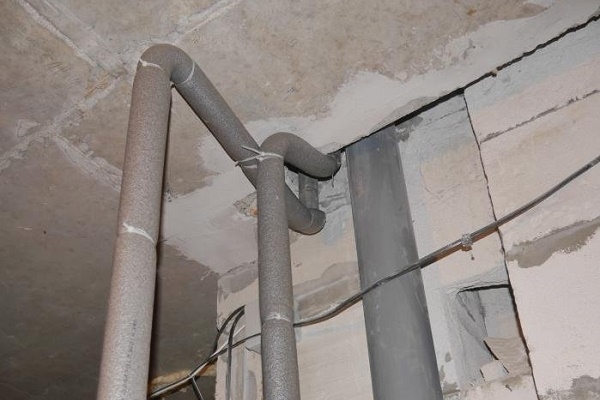
If the track is not deep (above the freezing level of the soil), it must be insulated. A waterproof film and a protective shell are laid on top of the insulation. In places where the pipes are turned, manholes are installed. This is in case the water supply becomes clogged and you have to clean it mechanically.
It is necessary to choose the right diameter and material of the pipe. Combination is allowed, but in this case it is necessary to buy adapters. Plastic pipes must not be used to transfer hot water. Joints and connections are depressurized. The iron ones need to be monitored (painted). Metal plastic does not require maintenance.
Water supply of a private house from a well and a well: pipe laying
Any of the described water supply schemes for a private house is implemented using a pump that supplies water to the house. In this case, a pipeline must be built connecting the well or well with a pumping station or storage tank. There are two options for laying pipes - only for summer use or for all-weather (winter).
A section of a horizontal pipe may be located either below the freezing depth of the soil or it needs to be insulated
When installing a summer water supply system (for summer cottages), pipes can be laid on top or in shallow ditches. At the same time, you must not forget to make a tap at the lowest point - drain the water before winter so that frozen water does not break the system in frost. Or make the system collapsible - from pipes that can be rolled up on threaded fittings - and these are HDPE pipes. Then in the fall everything can be disassembled, twisted and put into storage. Return everything in the spring.
Laying water pipes in the area for winter use requires a lot of time, effort and money. Even in the most severe frosts, they should not freeze. And there are two solutions:
- lay them below the freezing depth of the soil;
- bury shallowly, but be sure to heat or insulate (or you can do both).
deep laying
It makes sense to bury water pipes deeply if it freezes no more than 1.8 m. almost a two-meter layer of soil. Previously, asbestos pipes were used as a protective shell. Today there is also a plastic corrugated sleeve. It is cheaper and lighter, it is easier to lay pipes in it and give it the desired shape.
When laying the pipeline below the freezing depth, it is necessary to dig a deep trench that is long for the entire route
Although this method requires a lot of labor, it is used because it is reliable. In any case, they try to lay the section of the water supply system between the well or well and the house exactly below the freezing depth. The pipe is led out through the wall of the well below the depth of freezing of the soil and is led into the trench under the house, where it is raised higher. The most problematic place is the exit from the ground into the house, you can additionally heat it with an electric heating cable. It works in automatic mode maintaining the set heating temperature - it works only if the temperature is below the set one.
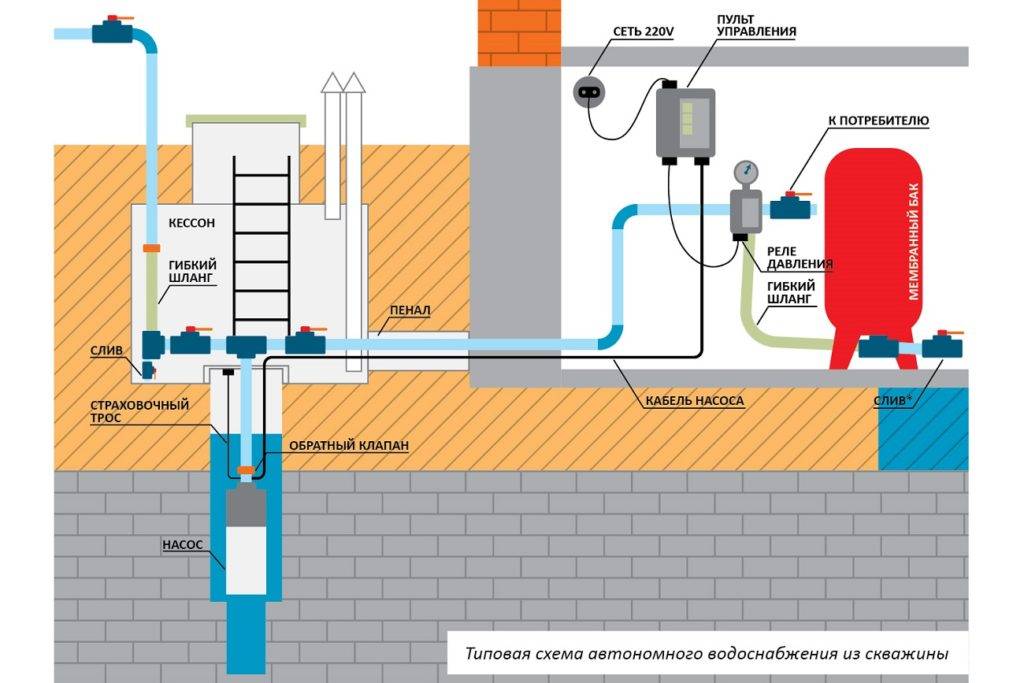
When using a well and a pumping station as a source of water, a caisson is installed. It is buried below the freezing depth of the soil, and equipment is placed in it - a pumping station. The casing pipe is cut so that it is above the bottom of the caisson, and the pipeline is led out through the wall of the caisson, also below the freezing depth.
Laying water pipes in a private house from a well when constructing a caisson
A water pipe buried in the ground is difficult to repair: you have to dig in. Therefore, try to lay a solid pipe without joints and welds: they are the ones that give the most problems.
close to the surface
With a shallow foundation, there is less earthwork, but in this case it makes sense to make a full-fledged route: lay out a trench with bricks, thin concrete slabs, etc. At the construction stage, the costs are significant, but the operation is convenient, repair and modernization are no problems.
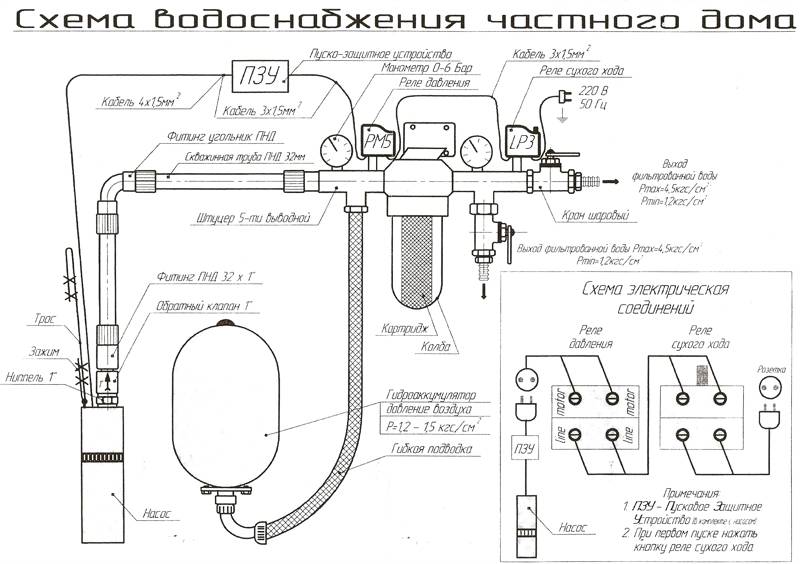
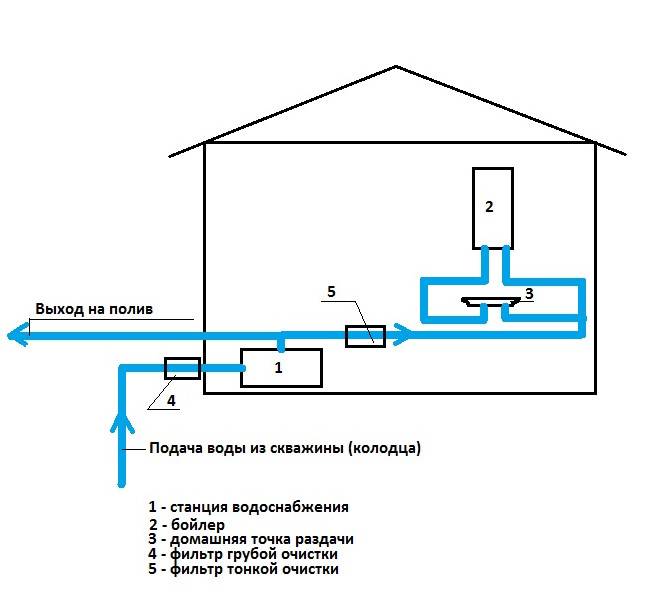
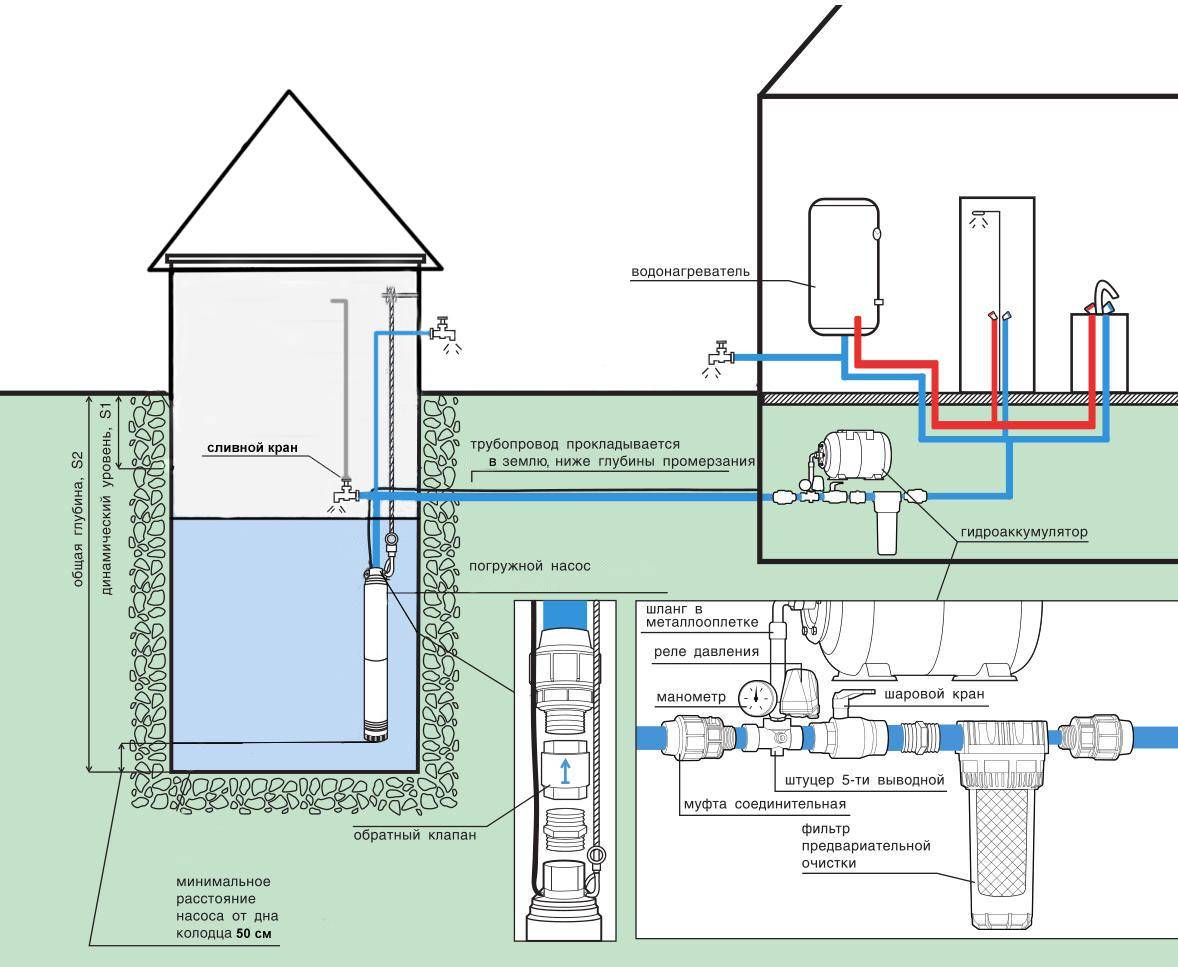
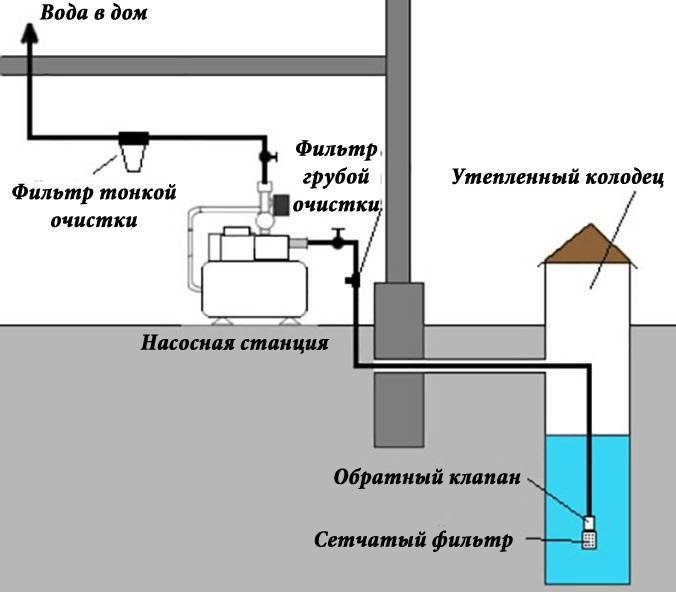
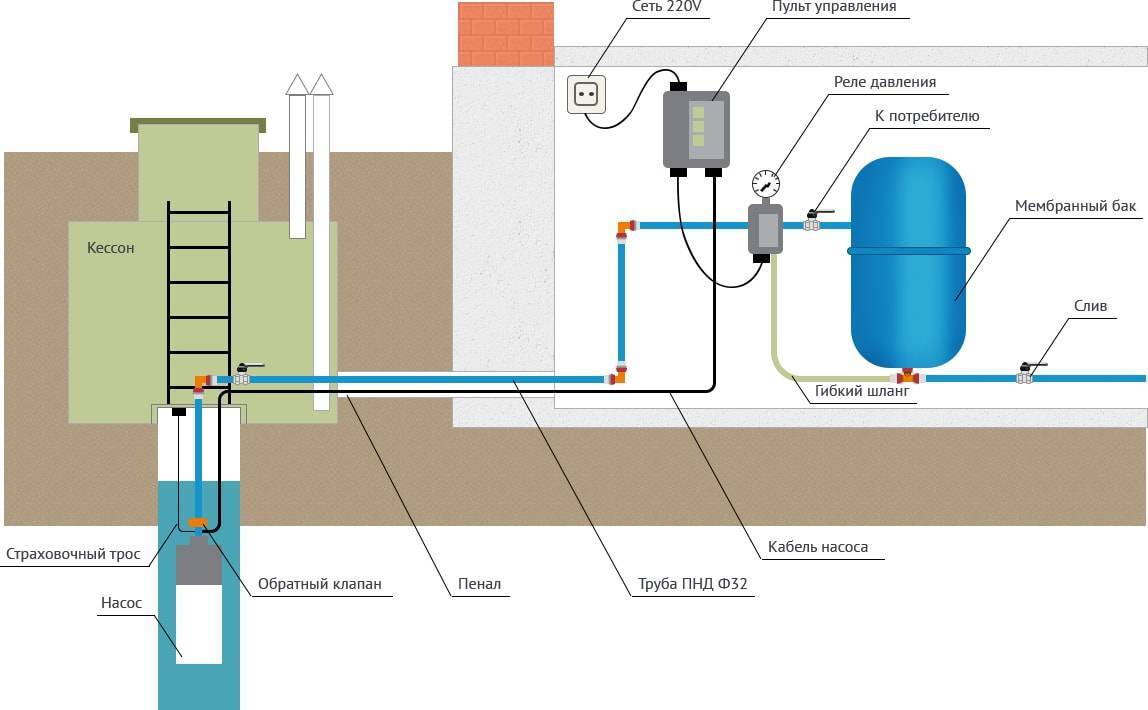
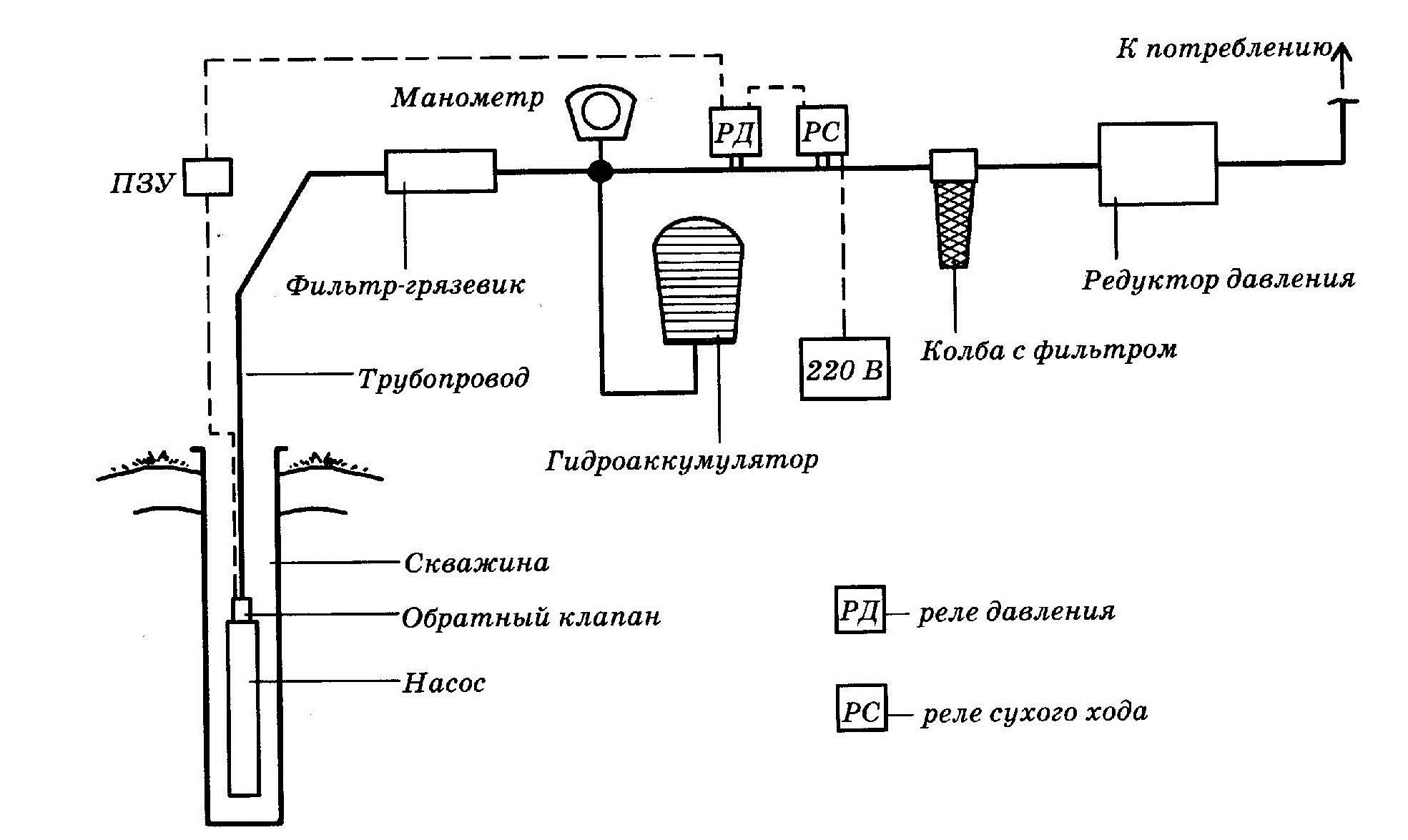
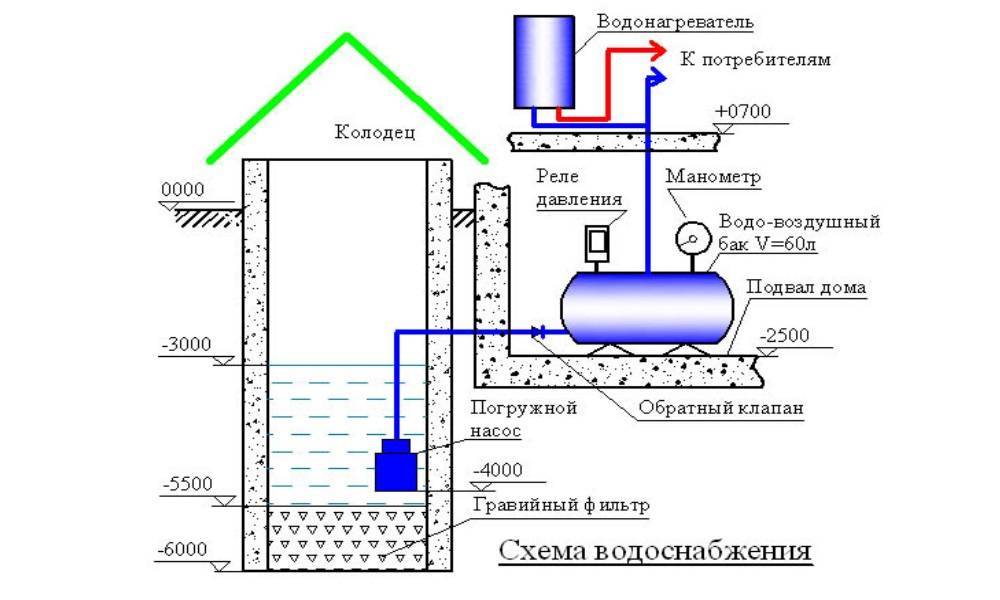
In this case, the water supply pipes of a private house from the well and well rise to the level of the trench and are brought out there.They are laid in thermal insulation to prevent them from freezing. For insurance, they can also be heated - use heating cables.
One practical tip: if a power cable runs from a submersible or borehole pump to the house, it can be hidden in a protective sheath made of PVC or other material, and then attached to the pipe. Fasten every meter with a piece of adhesive tape. So you will be sure that the electrical part is safe for you, the cable will not fray or break: when the ground moves, the load will be on the pipe, and not on the cable.
Sealing the entrance to the well
When organizing the water supply of a private house from a well with your own hands, pay attention to the termination of the exit point of the water pipe from the mine. It is from here that most often the dirty top water gets inside
It is important that the outlet of the water pipe of their well shaft is well sealed
If the hole in the wall of the shaft is not much larger than the diameter of the pipe, the gap can be sealed with sealant. If the gap is large, it is covered with a solution, and after drying, it is coated with a waterproofing compound (bituminous impregnation, for example, or a cement-based compound). Lubricate preferably both outside and inside.
The sequence of connection to the central water supply
According to the rules, tie-in into the central pipe, which is located outside the site, is carried out by organizations with the appropriate license. Their privileged position allows them to set high prices for services. Many private traders break the rules and connect on their own - the fine is less than the cost of the work performed by the organization.The main thing is to adhere to the technical conditions and the project, not to damage any communications.
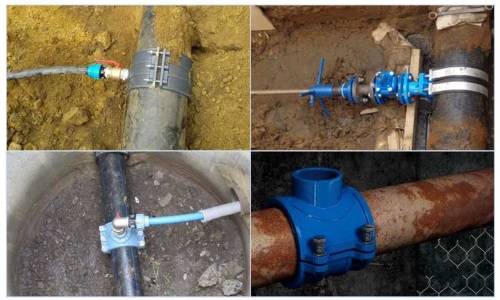
Connecting a private house to the central water supply.
Determined with the method of connection to the water supply. A simple do-it-yourself option is to use overhead clamps that are used for steel and plastic pipes. Tapping into the existing water supply under pressure is carried out by special devices. The electric drill is not suitable - it will be flooded with water.
For tie-in, perform a few simple steps:
- mount the clamp;
- a pipe is drilled through a hole in it;
- turn the valve open, then close it.
It is preferable to first install a ball valve on the clamp, then you can drill through the hole in it.
If there is no well at the tie-in place, they dig out the main and arrange it with their own hands. A cheap and affordable option is to use red brick, make a hatch with a lid. It must support the weight of the vehicle if it is on the roadway. A hole is being dug at the place where the pipe enters next to the house. Now it needs to be connected to the well on the central highway. Dig a pit deep below the freezing point of the soil.
All sharp objects that can damage the pipe are removed from the trench. The bottom is covered with rubble and sand, which form a shock-absorbing cushion. Soil water is also drained through it, the main is not subject to icing. Now you need to connect a pipe to the tap in the well and bring the other end into the house.
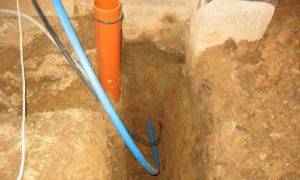
Particular attention is paid to the place where water is supplied to the house. Sometimes it is impossible to dig a trench of the required depth
Then use various options for protecting the water main from freezing:
Sometimes it is impossible to dig a trench of the required depth.Then use various options for protecting the water main from freezing:
- heating with a special electric cable;
- winding with heat-insulating materials;
- backfill with expanded clay.
The trench is not immediately filled up: first, internal installation is done, then they are checked for leaks.
How to create a project yourself
The installation of a water supply system in a private house involves the preliminary creation of a design and drawing document, where the passage of the pipeline route will be noted both outside and inside the house.
Some people consider drawing up a scheme a waste of time and effort, relying on their experience and intuition. In fact, the refusal to draw up a project turns into a delay in work, frequent errors and alterations.
When drawing up a design scheme, it indicates the main technical data of the future pipeline:
- type of internal wiring.
- The route of the pipes in each room.
- Number and location of collectors, pumps, water heaters and filters.
- Locations of water taps.
- Types of water pipes for each water supply branch, indicating their diameters.
DHW circulation
Installation of a DHW circulation system is justified in two cases:
- If the distance between the far points of water intake and the water heater exceeds 6-8 meters;
- If you plan to organize a full-fledged heating of bathrooms or bathrooms using heated towel rails.
The circulation in a closed circuit is provided by a low-power pump. For direct connection of a circuit with recirculation, the water heater must have an additional branch pipe.
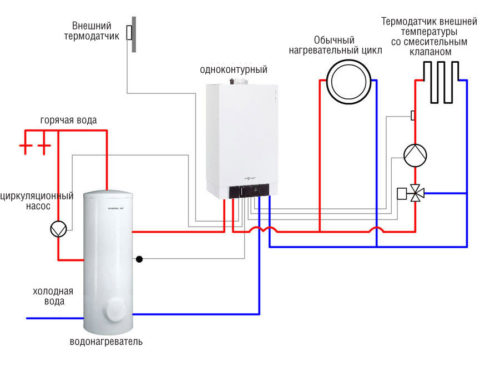
Circulating hot water supply of the cottage from an indirect source with an additional branch pipe
If it is not there, a simple circuit is assembled with the circuit fed from cold water and a thermomixing unit.
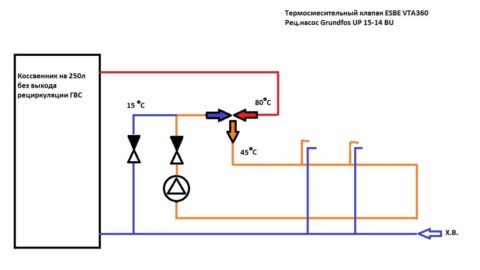
Scheme with a thermal mixer
How to create your own plumbing for a private house
It all depends on where the water comes from. If this is a well, then autonomous water supply involves the use of a deep pump. The quality of such water does not always meet the standards of suitability for drinking. Filters are required. For irrigation, this is a great way to aerate if the water arrives quickly enough.
The system of autonomous water supply from an artesian well is characterized by high quality drinking water. Special pumps are used. Drilling costs more, but when it comes to health, it's worth it. If a country house is connected to a centralized system, but you want to organize irrigation, you can install a large capacity tank and pump water out of it.
Step-by-step laying of an external highway
When installing a water supply system in a private house with your own hands, laying an external line is carried out in the following order:
- The source and the place where the pipe enters the building are connected by a trench, which is desirable to be laid in a straight line with a slope towards the source. A depth of one and a half to two meters will be sufficient for the pipe to lie below the usual level to which the soil freezes. The bottom of the trench is compacted, covered with a layer of sand and gravel.
- In a hole with a diameter of 40-50 mm, made in the wall in the upper ring of the caisson (well), a special glass is installed for the pipe entry.
- The foundation of the house must be provided with the same hole, which is equipped with an insulated and waterproofed sleeve into which the pipe will be inserted.
- A pipe with a diameter of 32 mm is brought into the house to be connected to a pumping station, and the other end is fed to the source, placing a filter at its end.
- Having laid the pipe along the bottom of the trench, they cover it with a heater, after which backfilling is performed.
For laying water pipes, you can choose one of two wiring schemes
We develop a water supply scheme
In fact, there are plenty of plumbing schemes, but there are two different methods for connecting consumers:
- Trinity inclusion.
- Collector or parallel connection.
For residents of small private houses, a serial connection will meet their requirements; the plan for such a water supply is simpler. From the source itself, water in order goes from one consumer to the next from one pipeline with a tee outlet (1 inlet, 2 outlets) for each consumer.
Such a switching scheme is characterized by a lack of pressure at the last consumer, during the launch of the previous ones, if several such links are involved in the chain.
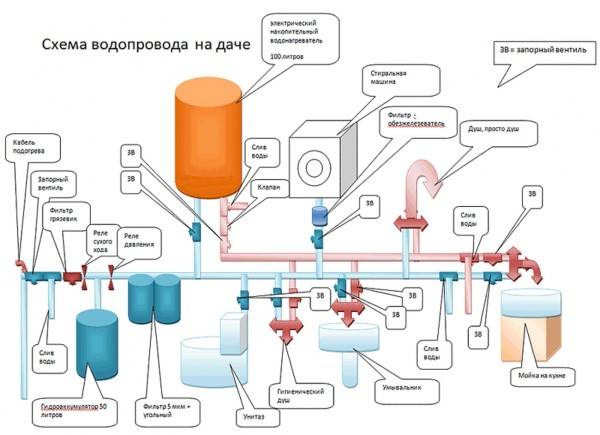
The collector inclusion plan looks fundamentally different.
Firstly, when making such a connection, you will need a collector. From it, a water pipe is laid directly to each consumer. Thanks to this, you will be able to create more or less the same pressure in any link in the pipeline chain.
Please note that serial connection will cost you more.
Any water supply system consists of a well, a pump, a hydraulic accumulator to protect the pump. And if desired, a filter or several filters before or after the accumulator.

Pipes for water supply are of several types, the most common materials for them are polypropylene, polyethylene (crosslinked), steel. The most expensive ones are made of copper, because they last the longest.
In case of mounting them, you will have to call a specialist. The best choice is polypropylene in terms of price-quality ratio
Please note that plastic as a material is absolutely not suitable, as it releases harmful elements into the water.
Next on the list, you will need a submersible pump, as it is more durable and more productive than a pumping station. The height of the pump is measured along with the hose and then they are connected by a threaded connection. The pump can be placed in any position on stainless steel cables. It hangs from the top of the well.
Water from the pump enters the filter to the accumulator, which is the next element of the circuit. It creates a stable pressure and allows you to turn the pump on and off as needed. The volume depends on the amount of water consumed.
The water is again filtered and divided into two streams: one of them will go to the boiler and heat up, and the second will remain cold in the collector.
It is necessary to mount shut-off valves up to the collector, as well as install a drain cock.
The pipe going to the water heater is equipped with a fuse, an expansion tank, and a drain valve is also installed. The same tap is mounted at the outlet of the water heater, and after that the pipe is connected to a collector with hot water and then distributed to all points in the house.
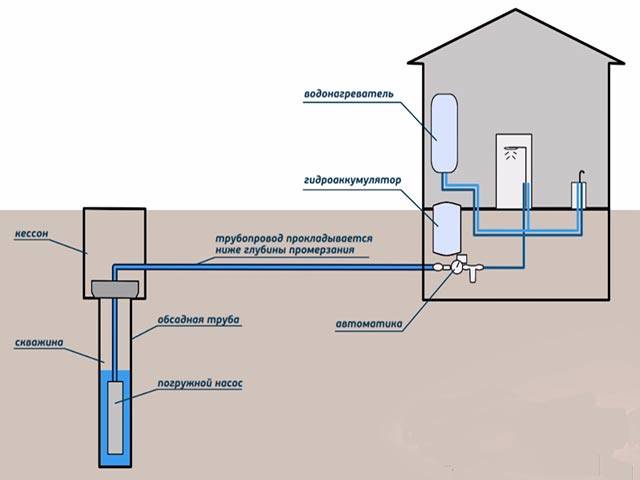
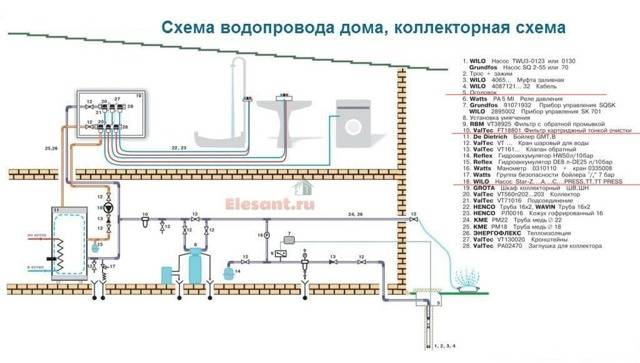
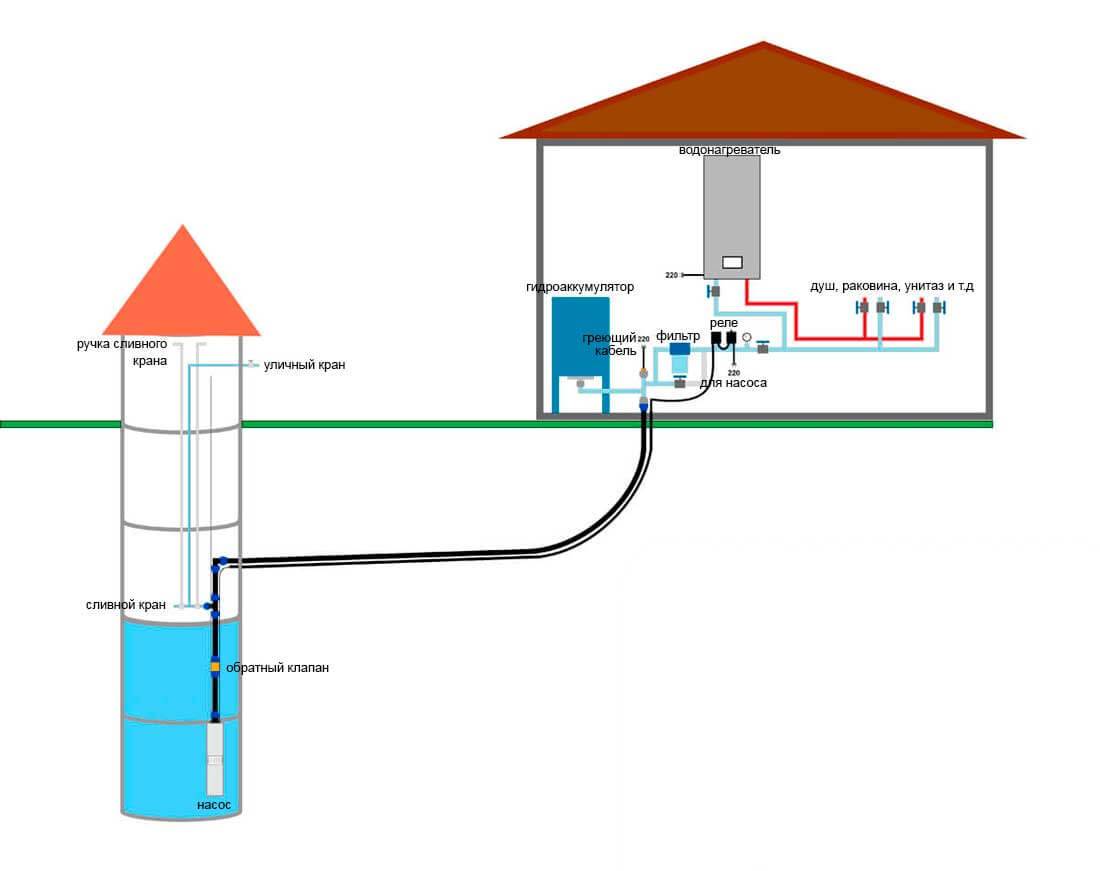
Boilers may vary. Water can be heated by gas or electricity. A gas instantaneous water heater differs from an electric one in that the water is constantly heated.
Pipes
What pipes to use in the cottage's water supply system?
All parameters of cold water and hot water in the autonomous system are completely controlled by the owner of the house.Force majeure in the form of water hammer or overheating is practically excluded, and if so, the pipes do not need a large margin of safety.
That is why the de facto standard for autonomous water supply is the use of polypropylene and metal-plastic pipes: durable, having very little hydraulic resistance and extremely easy to install.
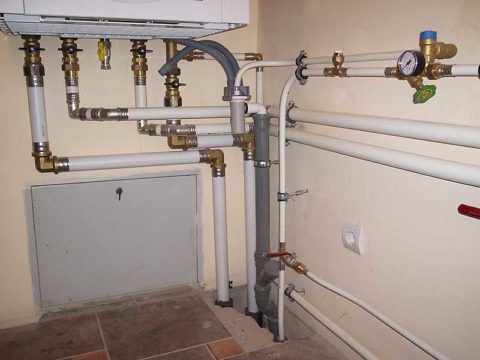
Water distribution with metal-plastic on press fittings
External and internal plumbing
If the choice between the storage tank and the pumping station is made, it's time to start performing the necessary set of works. Regardless of the system chosen, it is necessary to carry out the installation of the plumbing system, namely its external and internal parts.
Outside, a trench should be dug in such a way that the pipe runs below the freezing level of the soil in this particular area. At the same time, a slope of 3 cm is observed for each meter of the highway.
To insulate a water pipe located above ground level, you can use both ordinary mineral wool and modern heat-insulating materials.
The pipe in the area above the freezing horizon before entering the house must be insulated. In cases where the pipeline is laid above the seasonal freezing horizon, the problem is solved with the help of a heating cable. It is convenient to place the electric cable of the pump in the trench under the pipeline. If its length is not enough, the cable can be “stretched”.
But it is best to entrust this operation to an experienced electrician, since in the event of a breakdown, you will have to carry out large-scale earthworks or even completely replace part of the damaged equipment.
For outdoor plumbing, plastic pipes are quite suitable. A trench is brought to the well, a hole is made in its wall through which a pipe is inserted. The pipeline branch inside the well is increased with the help of fittings, which at the same time will provide the cross section necessary for a stable flow of water.
If a submersible pump is included in the water supply scheme, it is attached to the edge of the pipe and lowered into the well. If a pumping station will pump water, the edge of the pipe is equipped with a filter and a check valve.
The distance between the bottom of the well and the lowest point of the pumping system must be at least a meter so that grains of sand stirred up by the operation of the machine do not fall into it.
The hole around the pipe inlet is carefully sealed with cement mortar. To prevent sand and dirt from entering the system, a regular mesh filter is placed at the lower end of the pipe.
For laying the outer part of the water supply, a trench of sufficient depth should be dug to prevent the pipes from freezing in winter.
A long pin is driven into the bottom of the well. A pipe is attached to it to securely fix its position. The other end of the pipe is connected to a hydraulic accumulator or storage tank, depending on the type of system chosen.
After the trench is dug in, a clay lock should be installed around the well with the following parameters: depth - 40-50 cm, radius - about 150 cm. The lock will protect the well from the penetration of melt and groundwater.
Water supply is introduced into the house in such a way that this place is hidden under the floor. To do this, it is necessary to partially excavate the foundation in order to make a hole in it.
Installation of an internal water supply can be done from metal pipes, but the owners of country houses almost always choose modern plastic structures. They weigh lighter and are easier to install.
A soldering iron for PVC pipes is needed, with which the ends of the pipes are heated and securely connected. Even a beginner can perform such soldering on their own, however, you should familiarize yourself with common mistakes when soldering PVC pipes in order to ensure a really reliable connection.
Here are some helpful rules:
- soldering work should be carried out in a clean room;
- joints, as well as pipes as a whole, should be thoroughly cleaned of any contamination;
- any moisture from the outer and inner parts of the pipes must be carefully removed;
- do not keep the pipes on the soldering iron for a long time to avoid overheating;
- heated pipes should be immediately connected and held in the correct position for several seconds to prevent deformation at the junction;
- possible sagging and excess material is best removed after the pipes have cooled.
If these rules are observed, a really reliable and durable connection is obtained. If the soldering is poor quality, soon such a connection may leak, which will lead to the need for large-scale repair work.
Types and methods of water supply of a private house
From the standpoint of the dependence of the source of water supply on external factors, two fundamentally different types of water delivery to the user can be distinguished:
Centralized water supply at home
In fact, the same autonomous, but within the region. In this case, the user does not need to take care of arranging the source of water supply.It is enough to connect (crash) to the central water main.
Connecting the house to the central water supply
All actions are reduced to the phased implementation of a number of requirements, including:
appeal to the regional municipal organization MPUVKH KP "Vodokanal" (Municipal enterprise "Department of water supply and sewerage"), which controls the central highway;
obtaining the technical characteristics of the tie-in. The document contains data on the place where the user's pipe system is connected to the main and its depth. In addition, the diameter of the main pipes is indicated there and, accordingly, instructions for choosing home piping. It also indicates the water pressure indicator (guaranteed water pressure);
get an estimate for connection, which is developed by a utility or contractor;
control the execution of work. Which are also commonly performed by UPKH;
perform a system test.
Advantages of central water supply: convenience, simplicity.
Disadvantages: fluctuations in water pressure, questionable quality of incoming water, dependence on central supplies, high cost of water.
Autonomous water supply at home
It is possible to independently provide water supply to a summer house, private or country house using autonomous water supply. In fact, this is an integrated approach, which includes activities for the installation of a water supply system, starting with providing a source of water supply, ending with its discharge into the sewer.
An autonomous water supply system can be represented as two component subsystems:
water delivery: imported, groundwater, from an open source;
supply to consumption points: gravity, using a pump, with the arrangement of a pumping station.
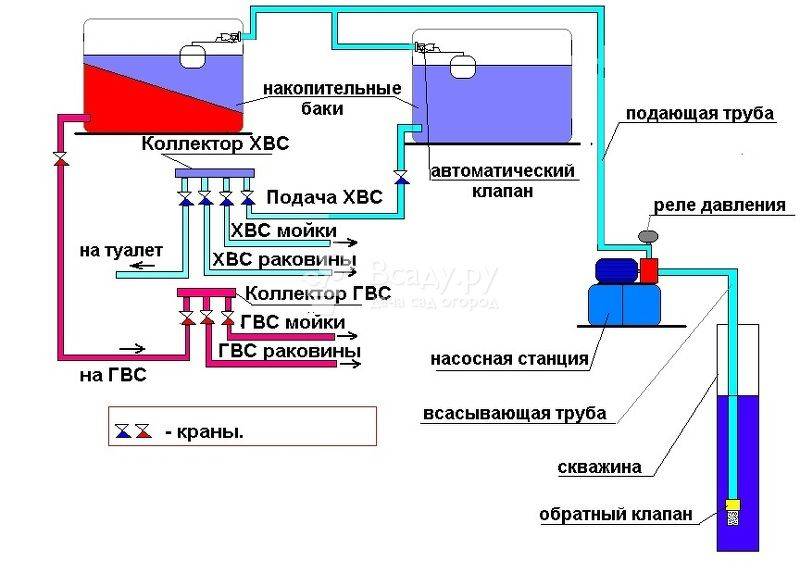
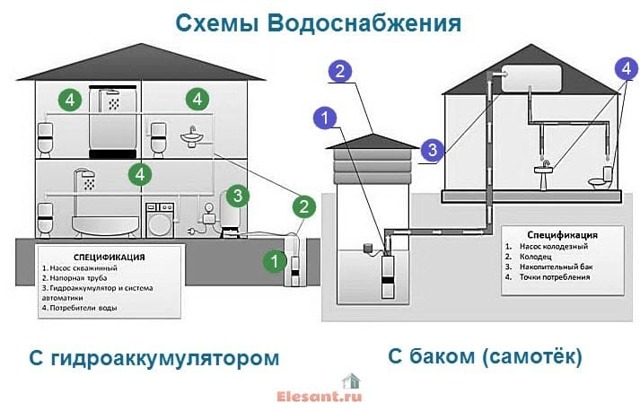
Therefore, in a generalized form, two water supply schemes can be distinguished: gravity (storage tank with water) and automatic water supply.
Using the container (water tank)
The essence of the autonomous water supply scheme at home is that water is supplied to the tank using a pump or filled manually.
Water flows to the user by gravity. After all the water from the tank has been used, it is refilled to the maximum possible level.
Gravity water supply system - water supply scheme from the storage tank
Its simplicity speaks in favor of this method, it is suitable if water is required from time to time. For example, in a dacha that is not often visited or in a utility room.
Such a water supply scheme, despite its simplicity and cheapness, is too primitive, inconvenient and, moreover, creates significant weight on the interfloor (attic) floor. As a result, the system has not found wide distribution, it is more suitable as a temporary option.
Using the automatic water supply system
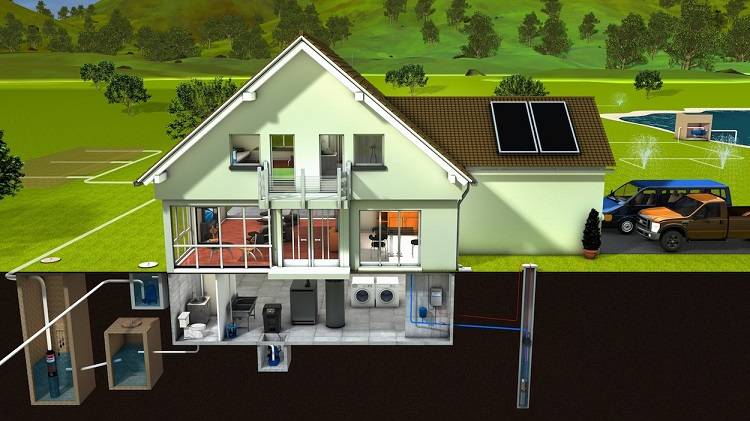
Scheme of automatic water supply of a private house
This diagram demonstrates the operation of a completely autonomous water supply system for a private house. Water is supplied to the system and to the user using a system of components.
It is about her that we will talk in more detail.
You can implement a completely autonomous water supply of a private house on your own by implementing one of the schemes. There are several device options to choose from:
1. Water from open sources
Important! Water from most open sources is not suitable for drinking.It can only be used for irrigation or other technical needs. Obtaining water from an open source requires the creation of sanitary protection of water intake points and is regulated by the provisions of SanPiN 2.1.4.027-9 "Zones of sanitary protection of water supply sources and drinking water pipelines"
Obtaining water from an open source requires the creation of sanitary protection of water intake points and is regulated by the provisions of SanPiN 2.1.4.027-9 "Zones of sanitary protection of water supply sources and water pipes for domestic and drinking purposes."