- Equipment for the arrangement of the water supply system
- Water supply of a private house from a well and a well: pipe laying
- deep laying
- close to the surface
- Sealing the entrance to the well
- Water supply from a well - automation without problems
- Water source
- Well types
- Pump selection
- Well equipment
- Types of drainage systems
- Decentralized water supply
- Features of water supply from a well
- Well for water supply
- Types of wells for a private water supply
- Standard arrangement of the water supply system
- The right choice of location
- Generic Schema Definition
- Layout and location of equipment
- Pipe laying features
- What equipment is needed for arranging the structure
- Centralized water supply: pros and cons
- Choose a source
- Well
- What is good and what is bad
- Well "on the sand"
- Artesian well
- Find out the productivity of the well
Equipment for the arrangement of the water supply system
The technology for arranging water supply from a well with your own hands depends on the depth of the source and its characteristics.
An autonomous water supply scheme can be developed using the services of specialists, or you can take a suitable ready-made option from the network
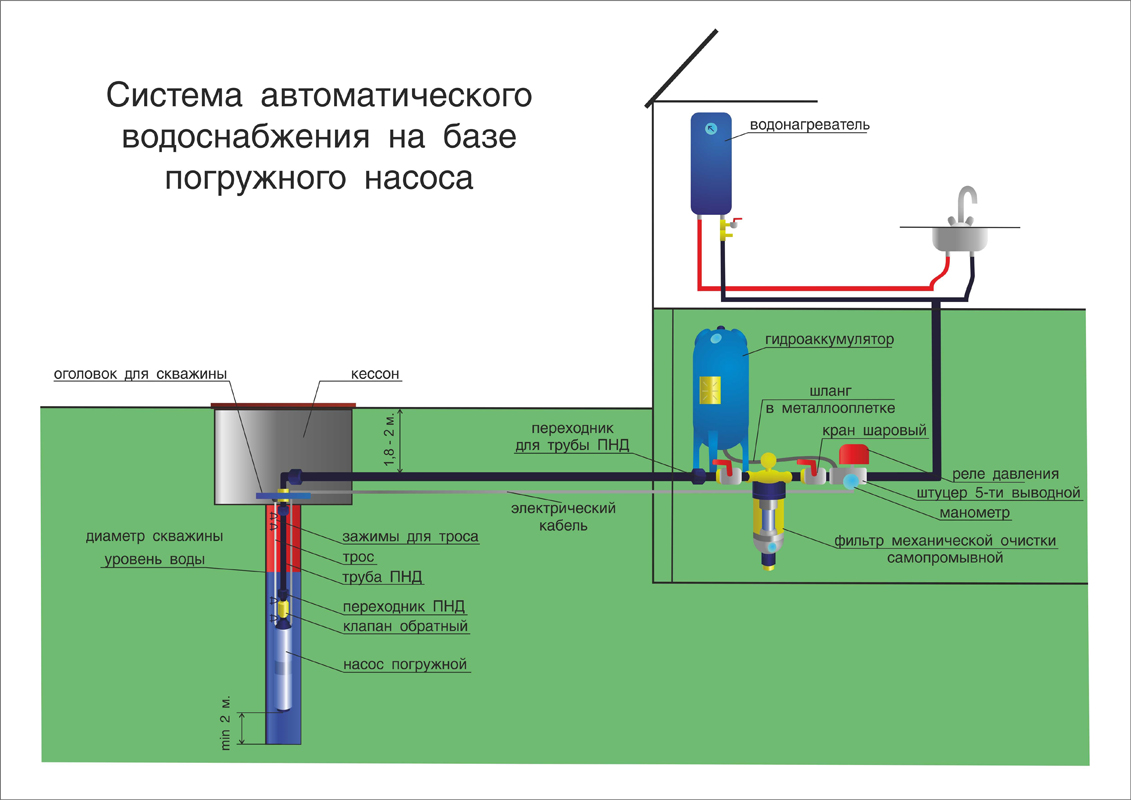
One of the key elements in arranging the water supply system on the site is a pump that will ensure uninterrupted lifting and supply of water to the house from the well. To equip an autonomous well, it is enough to install a unit with a diameter of 3 or 4″, equipped with additional protection against "dry running". This will prevent overheating and damage to the pump if the minimum water level in the source is reached.
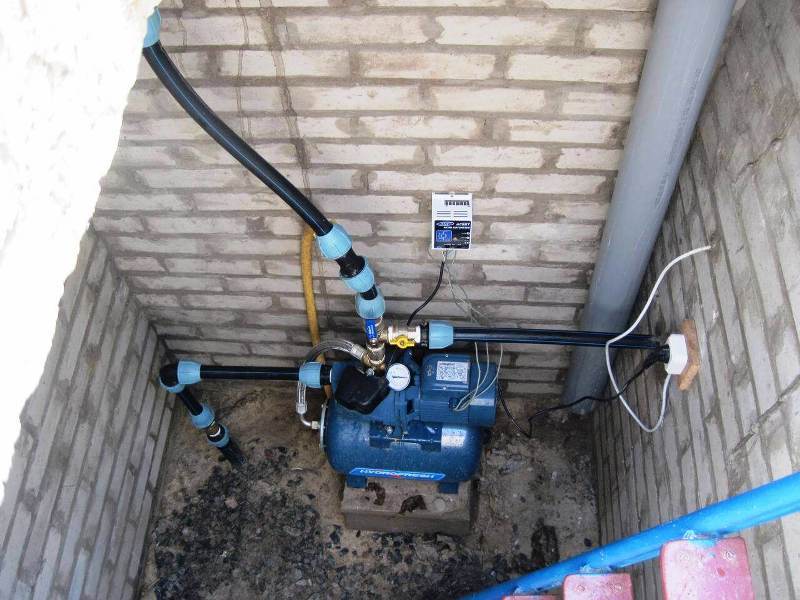
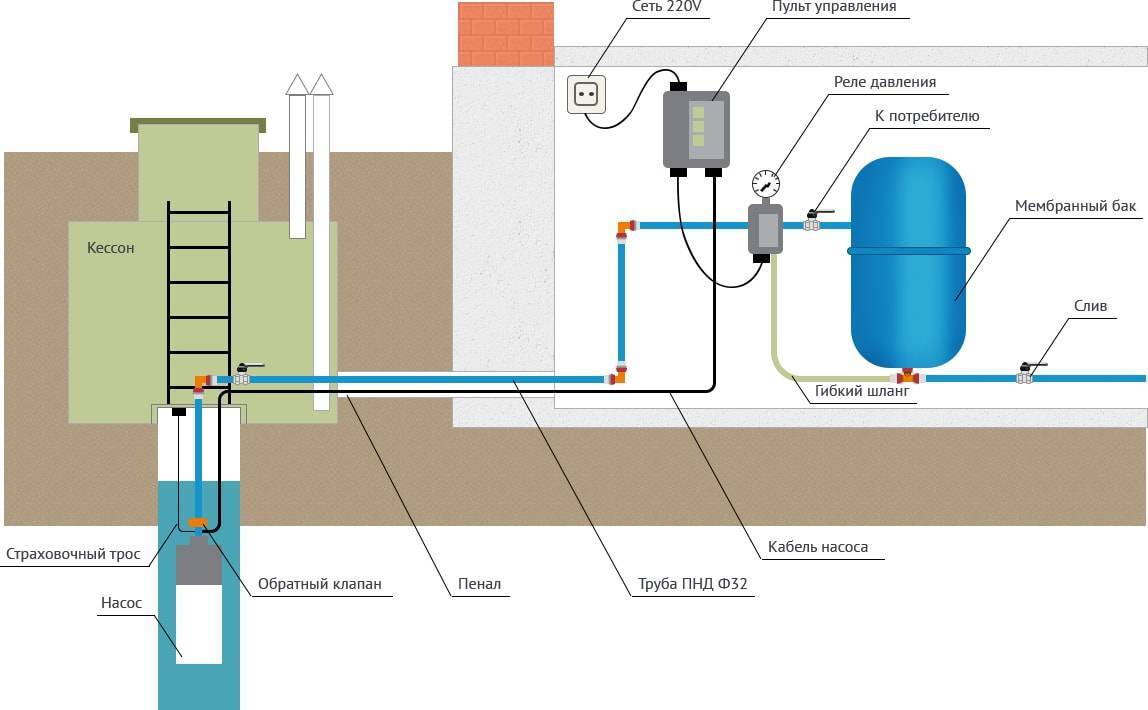
The technology of water supply from a well also provides for the installation of a plastic or metal tank - a caisson, which is placed so as to have free access to it, but at the same time prevent the ingress of dirt or water from the external environment. It is necessary to connect the pump in the well and further control it during operation.
When arranging a water supply system from a well to a house, it is most often used pipes with a diameter of 25-32 mm made of metal-plastic - a polymer material that bends easily and is highly resistant to corrosion.
Water pipes are laid from the source to the house, deepening below the level of soil freezing (at least 30-50 cm)
The arrangement of water supply is impossible without a sewerage system, which provides for the installation of a septic tank with receiving chambers and a wastewater treatment system. The technology for arranging the sewerage system is described in detail in a separate article.
new entries
English rose varieties with strong resistance to powdery mildew and black spotFrom Gagarin to Jackie Chan: Varieties of garden flowers named after famous people7 varieties of unpretentious barberry that can be planted in any soil
Water supply of a private house from a well and a well: pipe laying
Any of the described water supply schemes for a private house is implemented using a pump that supplies water to the house. In this case, a pipeline must be built connecting the well or well with a pumping station or storage tank. There are two options for laying pipes - only for summer use or for all-weather (winter).
A section of a horizontal pipe may be located either below the freezing depth of the soil or it needs to be insulated
When installing a summer water supply system (for summer cottages), pipes can be laid on top or in shallow ditches. At the same time, you must not forget to make a tap at the lowest point - drain the water before winter so that frozen water does not break the system in frost. Or make the system collapsible - from pipes that can be rolled up on threaded fittings - and these are HDPE pipes. Then in the fall everything can be disassembled, twisted and put into storage. Return everything in the spring.
Laying water pipes in the area for winter use requires a lot of time, effort and money. Even in the most severe frosts, they should not freeze. And there are two solutions:
- lay them below the freezing depth of the soil;
- bury shallowly, but be sure to heat or insulate (or you can do both).
deep laying
It makes sense to bury water pipes deeply if it freezes no more than 1.8 m. almost a two-meter layer of soil. Previously, asbestos pipes were used as a protective shell. Today there is also a plastic corrugated sleeve. It is cheaper and lighter, it is easier to lay pipes in it and give it the desired shape.
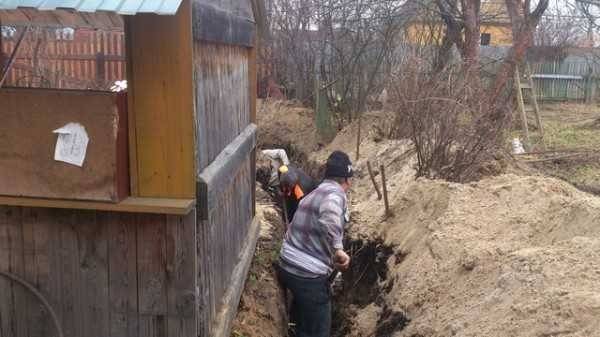
When laying the pipeline below the freezing depth, it is necessary to dig a deep trench that is long for the entire route. But the water supply of a private house from a well and a well will not freeze in winter
Although this method requires a lot of labor, it is used because it is reliable. In any case, they try to lay the section of the water supply system between the well or well and the house exactly below the freezing depth. The pipe is led out through the wall of the well below the depth of freezing of the soil and is led into the trench under the house, where it is raised higher. The most problematic place is the exit from the ground into the house, you can additionally heat it with an electric heating cable. It works in automatic mode maintaining the set heating temperature - it works only if the temperature is below the set one.
When using a well and a pumping station as a source of water, a caisson is installed. It is buried below the freezing depth of the soil, and equipment is placed in it - a pumping station. The casing pipe is cut so that it is above the bottom of the caisson, and the pipeline is led out through the wall of the caisson, also below the freezing depth.
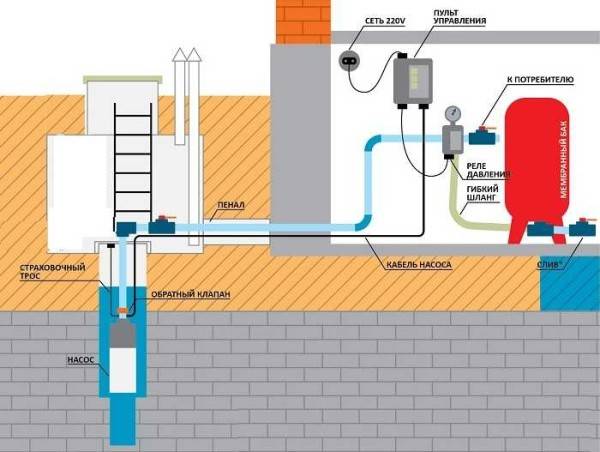
Laying water pipes in a private house from a well when constructing a caisson
A water pipe buried in the ground is difficult to repair: you have to dig in. Therefore, try to lay a solid pipe without joints and welds: they are the ones that give the most problems.
close to the surface
With a shallow foundation, there is less earthwork, but in this case it makes sense to make a full-fledged route: lay out a trench with bricks, thin concrete slabs, etc. At the construction stage, the costs are significant, but the operation is convenient, repair and modernization are no problems.
In this case, the water supply pipes of a private house from the well and well rise to the level of the trench and are brought out there. They are laid in thermal insulation to prevent them from freezing. For insurance, they can also be heated - use heating cables.
One practical tip: if a power cable runs from a submersible or borehole pump to the house, it can be hidden in a protective sheath made of PVC or other material, and then attached to the pipe. Fasten every meter with a piece of adhesive tape. So you will be sure that the electrical part is safe for you, the cable will not fray or break: when the ground moves, the load will be on the pipe, and not on the cable.
Sealing the entrance to the well
When organizing the water supply of a private house from a well with your own hands, pay attention to the termination of the exit point of the water pipe from the mine. It is from here that most often the dirty top water gets inside
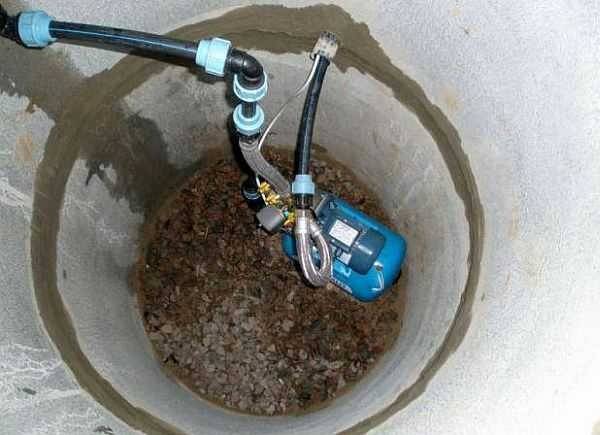
It is important that the outlet of the water pipe of their well shaft is well sealed
If the hole in the wall of the shaft is not much larger than the diameter of the pipe, the gap can be sealed with sealant. If the gap is large, it is covered with a solution, and after drying, it is coated with a waterproofing compound (bituminous impregnation, for example, or a cement-based compound). Lubricate preferably both outside and inside.
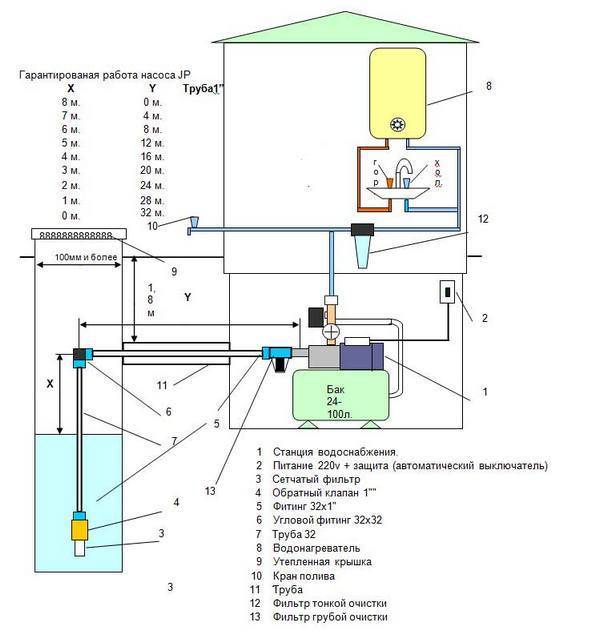
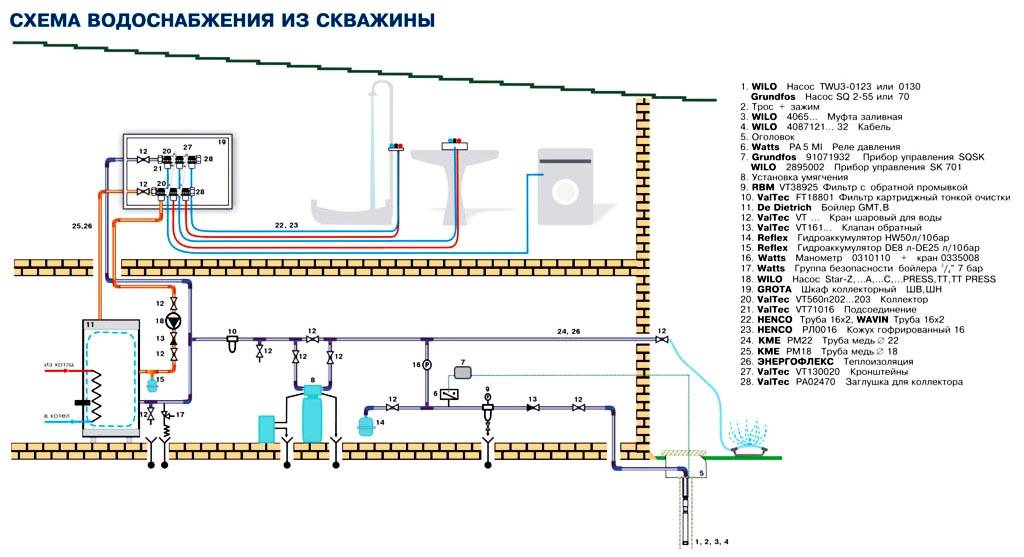


Water supply from a well - automation without problems
A well in a private yard is necessary, even if there is a connection to the central water supply or a private well. First, get well water it is possible even with the electricity turned off, with the help of an ordinary bucket and rope - this is impossible with a well.And secondly, even if the house is connected to the water supply, the well will save on water bills - you can pump water from it for irrigation, for pets.
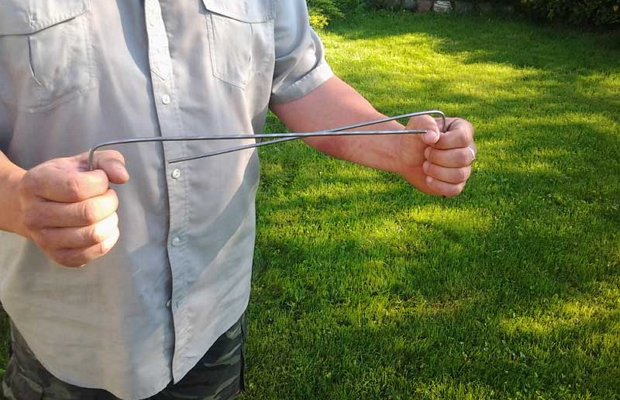
To choose a place for a well, you do not need to have psychic abilities
It is enough to be observant - to pay attention to where there is the most dew on the site, where fog swirls over the soil in the morning, where moisture-loving plants grow. If there is no time for long-term observations, use the most accurate method - exploratory drilling
Do not forget to take into account sanitary requirements - there should not be any compost heaps, cesspools and toilets around the well at a distance of 50 meters.
Choosing a location for a well
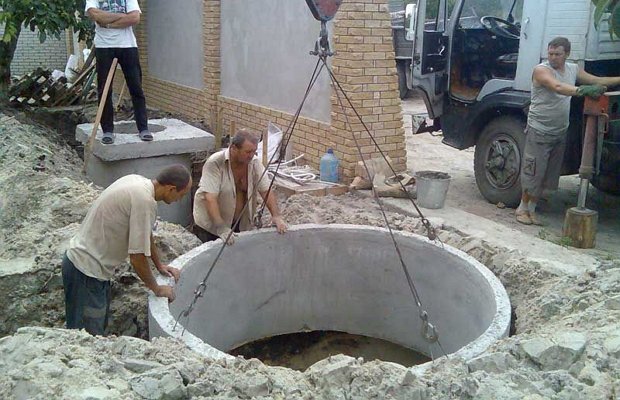
Installation of reinforced concrete well rings
We install the first ring when the pit is a meter deep. Then we dig again, gradually deepening and deepening the ring, until there is room in the pit for another ring, and so on. An important point - if you plan to make an autonomous water supply of a country house from a well, then in the second ring from above for the pipe you will need to punch or drill a hole of a suitable diameter.
Usually at a depth of 6–9 meters, water begins to flow very intensively. Pump it out and keep digging until you notice at least three sources of water replenishment. Ideally, the water in the well should cover at least one and a half rings - this will already be enough for regular use. To find out the exact water level, leave the shah for a day - the water will reach its maximum and become transparent, which will allow you to assess the depth even visually.If the water level satisfies you, empty the well again with a pump and lay more medium stones on the bottom, which should be covered with rubble from above with a layer of 30 see - it will sand and silt filter.
Water source
Well types
Any scheme for supplying water to a house from a well is built on the basis of a key component - the water source itself.
To date, all wells, depending on the characteristics of the substrate, are conditionally divided into three groups:
- Sandy - the simplest and cheapest in the arrangement. The disadvantage is a relatively short service life (up to ten years), and fairly rapid siltation. Suitable for garden installation.
- Clayey ones require a little more responsibility when drilling a well, but otherwise they have the same advantages and disadvantages as sandy ones. Should be used regularly, since after about a year without operation, it will be very difficult and expensive to restore a silted well.
- Limestone (artesian) wells are considered to be the best. The scheme for drilling a well for water in limestone involves deepening to a level of 50 to 150 meters. This provides a margin of reliability and durability of the water source, and in addition - improves the quality of natural filtration.
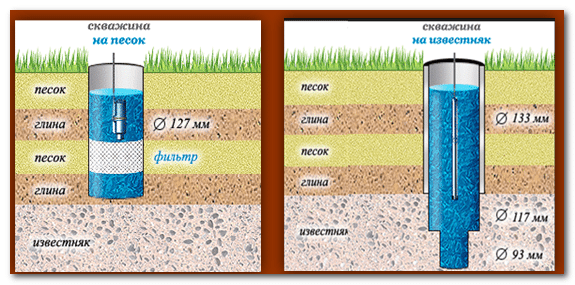
Main varieties
When choosing the type of well, one should not pay all attention to such a parameter as price. The fact is that the arrangement of an autonomous water supply is a very expensive task in itself, and it is better to invest in this project once (by choosing high-quality equipment and inviting professional craftsmen) than to reap the dubious “fruits of savings” in a few years in the form of impressive bills for repairs and source recovery
Pump selection
The next step in building a water supply system is the selection of pumping equipment.
Here the instruction recommends paying attention to such points:
- As a rule, high-performance models are not required for small cottages. Knowing that approximately 0.5-0.6 m3 of water is needed to operate one tap for an hour, a pump is usually installed that can provide an inflow of 2.5-3.5 m3 / h.
- The highest points of water withdrawal should also be taken into account. In some cases, to provide the necessary pressure on the upper floors, the installation of an additional pump is required, since the downhole water-lifting device cannot cope.
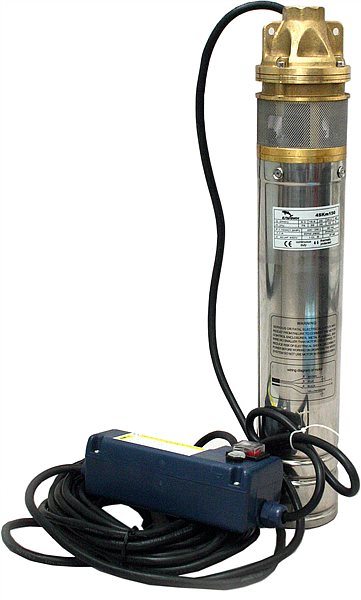
Small diameter pump for lifting water from great depths
Almost all models of borehole pumps are characterized by a fairly high level of energy consumption.
Taking into account this fact, it is worth taking care of the power stabilizer in advance. And if the electricity in your village is often cut off, then the generator will not be superfluous
Well equipment
The equipment process itself is usually carried out by the same company that did the drilling.
However, you should also study it - at least in order to ensure quality control of the execution of work operations:
- We lower the selected pump to the design depth and hang it on a cable or a strong cord.
- Through the neck of the well with the head installed (a special sealing part), we bring out the water supply hose and the cable that provides power to the pump.
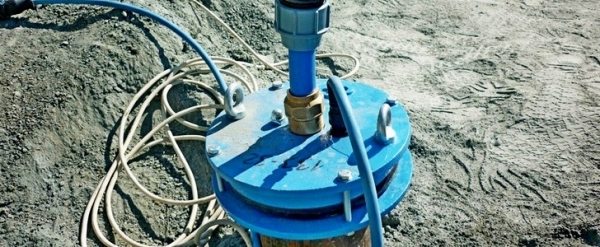
Head mounted
- Some experts advise connecting the hose to the cable. This is quite convenient, but you need to remember that in no case should the hose be pinched at the connection points!
- Also, a lifting device is mounted near the neck - a manual or electric winch. You can do without it only at very shallow depths, because the deeper, the stronger will be felt not only the weight of the pump itself, but also the weight of the hose with the power cable, and the weight of the cable.
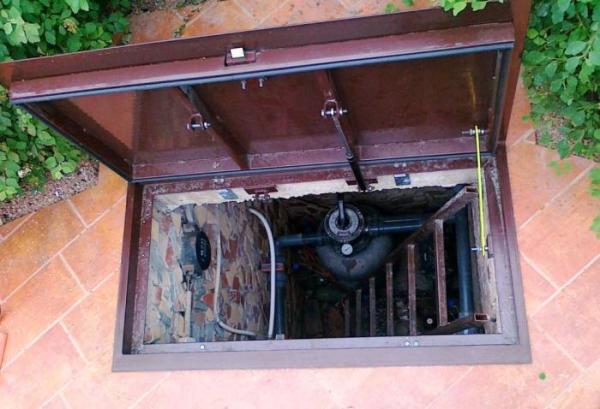
Photo of the main pit
This is the view of the scheme of the well device for water. However, this is not even half the battle: we need to assemble an entire system on this base.

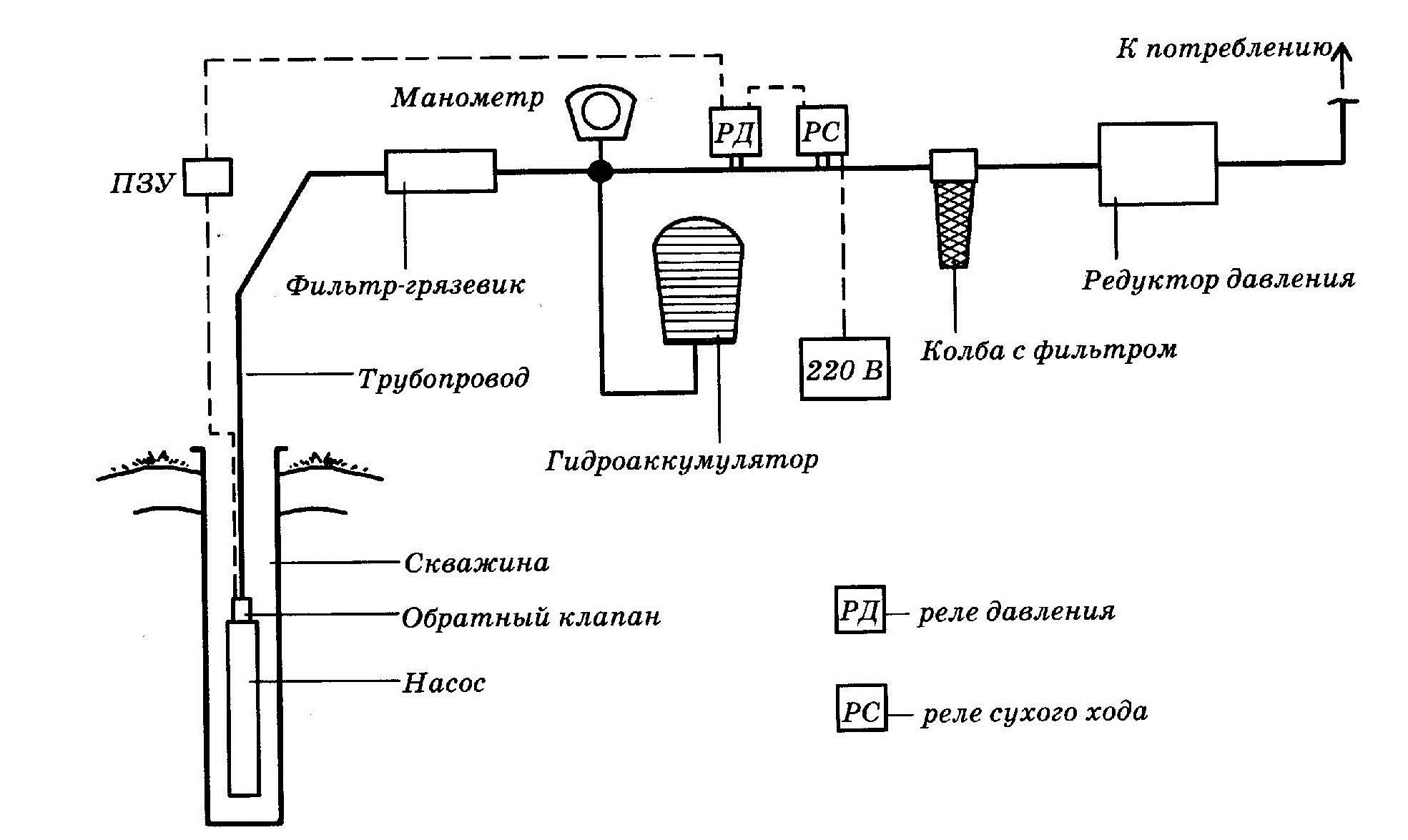

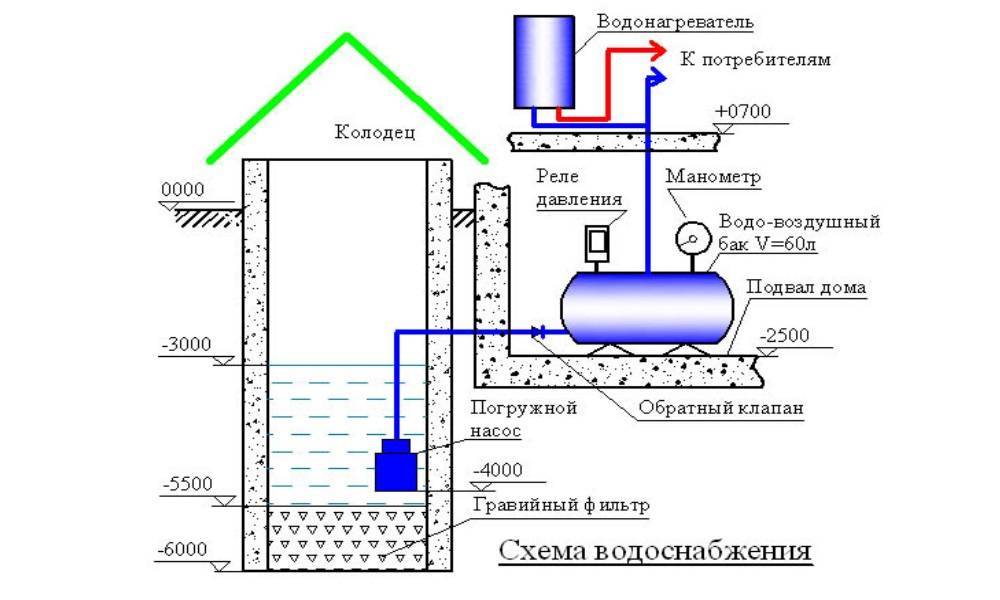
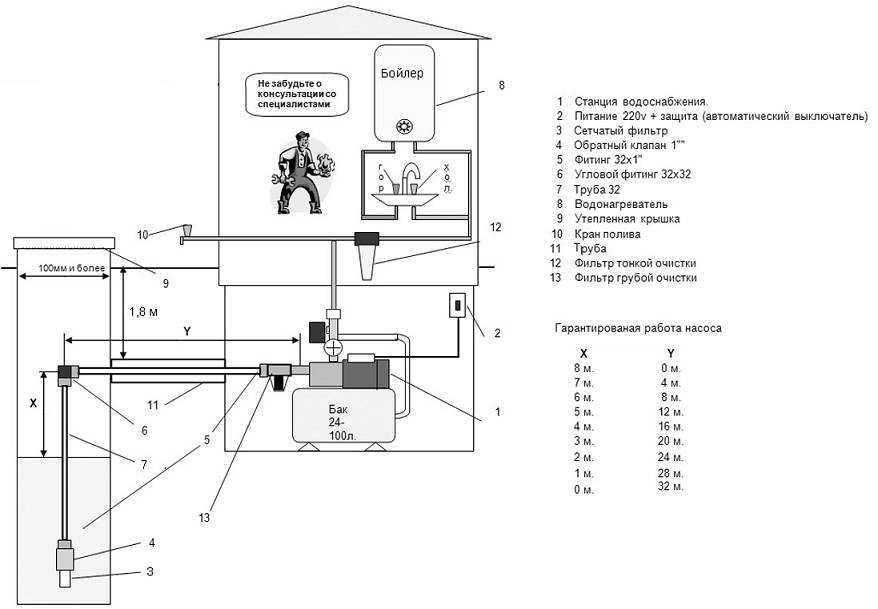
Types of drainage systems
When taking water from a direct source, one must not forget that the used water must be diverted somewhere. Today there are three types of drainage system:
- City or local sewer network;
- Individual or local treatment facilities with subsequent discharge onto the terrain or into a reservoir;
- Storage tanks with further removal by sewage trucks.
In the direct arrangement of cottage settlements, it is often necessary to deal with local treatment facilities, a certain area is allocated for them, and discharge is agreed upon. In the form of treatment facilities, in this case, deep cleaning stations are used that help purify water with aerobic bacteria (active sludge).
Activated sludge is used as an oxidizing agent for organic compounds. The essence of deep cleaning is the removal of suspended particles from wastewater, the oxidation of organic compounds, the removal of nitrogen and phosphorus. Disinfection is performed at the moment of water discharge onto the relief and into the reservoir. The performance of the station determines the daily intake of effluents. It should be noted that from one cottage it is possible to discharge 1-1.5 m³ of wastewater.
The implementation of the reception of wastewater treatment facilities is impossible without a sewer network, which is divided into intra-quarter (collector), local (cottage area).
It is desirable that the entire sewer network be designed by gravity, from the house to the sewage pumping station of the treatment plant. Wells are installed at turns, junctions and for the purpose of control on the sewer network. If it is not possible to provide a slope for gravity drainage in certain areas, a pressure branch can be used. In order to collect and pump wastewater, a pumping well is installed at the very beginning of the pressure branch.
Water from a residential building can be supplied to a sewer well through a pressure branch. To ensure pressure sewerage from each individual house, compact pumping stations are used, which are installed directly in the basement, or a pumping station is provided. well at the outlet from one house or another.
Thus, water supply and sanitation are indispensable utilities. The drainage system contributes to the maintenance of the necessary sanitary standards in a particular settlement. After all, water disposal is a guarantee of cleanliness and an important element of our modern life, both in the city and in the countryside.
Decentralized water supply
If you are going to switch to decentralized water supply, consider the properties of the soil, the depth and condition of inland waters. Also be prepared install pumping equipment and water filters.
IMPORTANT! You do not need to pay for using an autonomous system, however, pumping equipment and the arrangement of a well or well are expensive.Tips for choosing a place for water intake facilities:
Tips for choosing a place for water intake facilities:
- It should be installed at a distance of 20-30 meters from sewage treatment systems, compost pits and other potential sources of pollution.
- The site must be without flooding.
- There should be a special blind area around the well or well (no more than 2 meters). The surface part should be at a distance of 80 cm from the ground, covered with a lid from above.
Features of water supply from a well
Well water
There are two types of wells for home water supply:
- Well "on the sand".
- Depth from 15 to 40-50 m, service life - from 8 to 20 years.
- If the water carrier is not deep, you can drill it manually.
- To supply water, you will need to install pumping equipment and filters.
- Artesian well.
- Depth up to 150 m, service life - up to 50 years.
- Only special equipment drills.
- Water rises by itself, due to its own pressure.
- Pumps are used only for transportation.
- Such a well is registered and a passport is issued for it.
Well advantages:
- stable volume of water;
- high water quality;
- do not need to be regularly repaired.
Well cons:
- drilling is an expensive procedure;
- the service life is less than that of a well;
- need to use additional expensive pumps.
Most often, wells consist of a mouth and an aboveground part. The mouth is built in an underground chamber - a caisson. Also, the water intake device has a barrel. Its walls are reinforced with steel casing pipes. and the water intake part (consists of a sump and a filter).
Well for water supply
This is the simplest solution for autonomous water supply if the aquifer is powerful and located at a level of 4-15 m.

Water supply from a well
Most often, a well is constructed from concrete rings or bricks. It consists of an above-ground part with a ventilation pipe, a shaft, a water intake and a water-containing part.
Water enters the well through the bottom or walls. In the first case, a gravel bottom filter is placed at the bottom for additional water purification.
If water enters through the walls, special “windows” are made and gravel is poured into them, which also serves as a filter.
Well advantages:
- easy to build;
- you can manually raise the water if the electricity is turned off;
- low cost of pumps;
- long service life - more than 50 years.
Well cons:
- Water quality: groundwater with particles of earth and silt can penetrate there.
- To prevent water from overflowing, the well must be cleaned regularly.
- The water level varies with the season, so in hot weather, shallow springs can dry up.
You can build a well with your own hands, for this you will need reinforced concrete rings, a tripod with a winch, buckets and shovels. The well is unpretentious in maintenance, access to the water source is convenient.
The option with a well is suitable in the following cases:
- if the level of water consumption among the residents of the house is low;
- there is a powerful protected spring with good water;
- if there are no other options.
Sequence in the organization of the water supply system
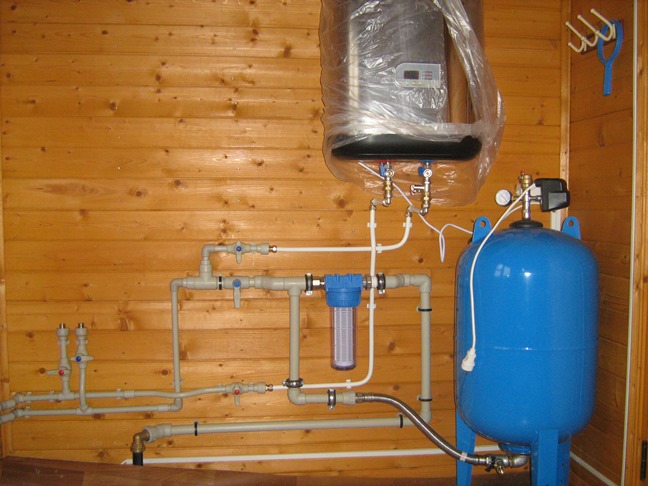
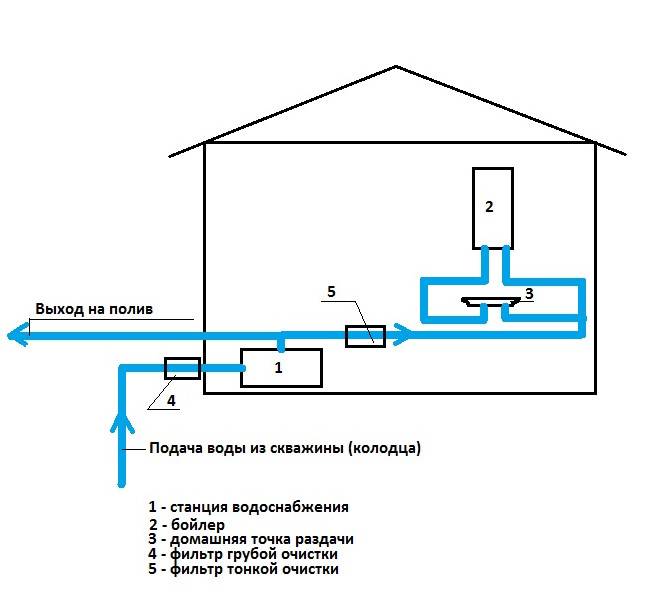
In the process of arranging water supply at home, a certain sequence must be observed. After the water source is ready, mount:
- external and internal pipeline;
- pumping and additional equipment;
- filters for water purification;
- distribution manifold;
- water heating device.
At the end, plumbing fixtures are connected.
Types of wells for a private water supply
Based on the variety of groundwater, the methods of their extraction differ. The arrangement of a well for water in a private house depends on this, there are several types of them:

- Needle - driven into the ground for several meters for the extraction of top water. A pipe with a diameter of 25-40 mm is used. The first link has a tip and a coarse filter, which is equipped in the pipe walls. This is the simplest, seasonal way to provide technical water intake for watering plants in a summer cottage.
- The next option is wells in the sand, which can provide technical and drinking water supply. Much depends on the state of the soil, its types, the presence of nearby enterprises that dump hazardous waste into the soil. If there is no negative human impact nearby, and the soil is able to provide high-quality filtration, this design is able to meet the requirements of drinking water intake. For full-fledged work, its filter must penetrate the entire aquifer and go beyond its limits from below and from above by 50 cm.
- Artesian - implies sufficient depth and high-quality natural filtration. It is installed according to the telescopic principle, each lower tier has a 50 mm smaller diameter. When passing rocks with groundwater, a filter is installed, which should block the entire thickness of the water reservoir.
As you can see, the arrangement of water supply in a private house from a well is different, in each case its own scheme is provided.
Standard arrangement of the water supply system
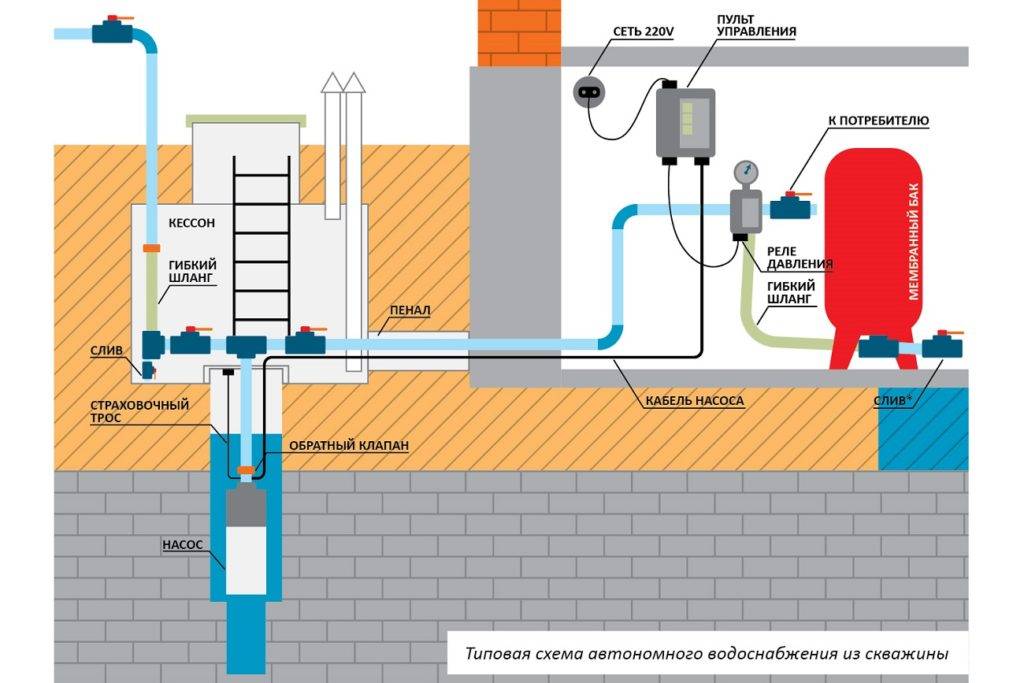
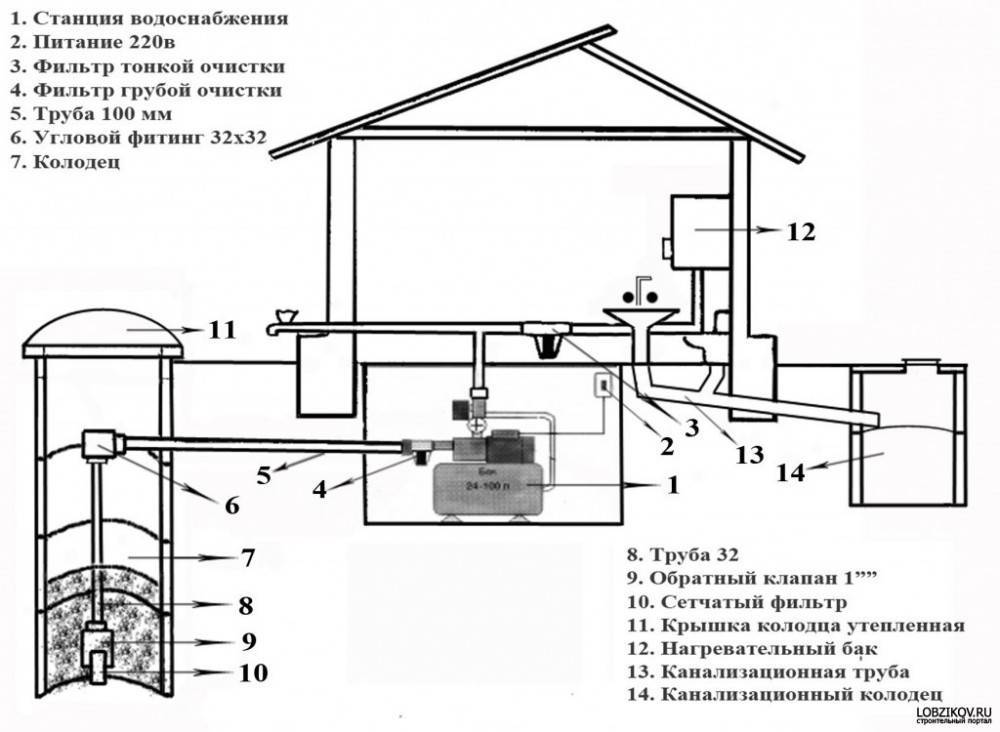
Laying the water supply system of a private house from a well has its own characteristics. Let's take a closer look at the steps of this process.
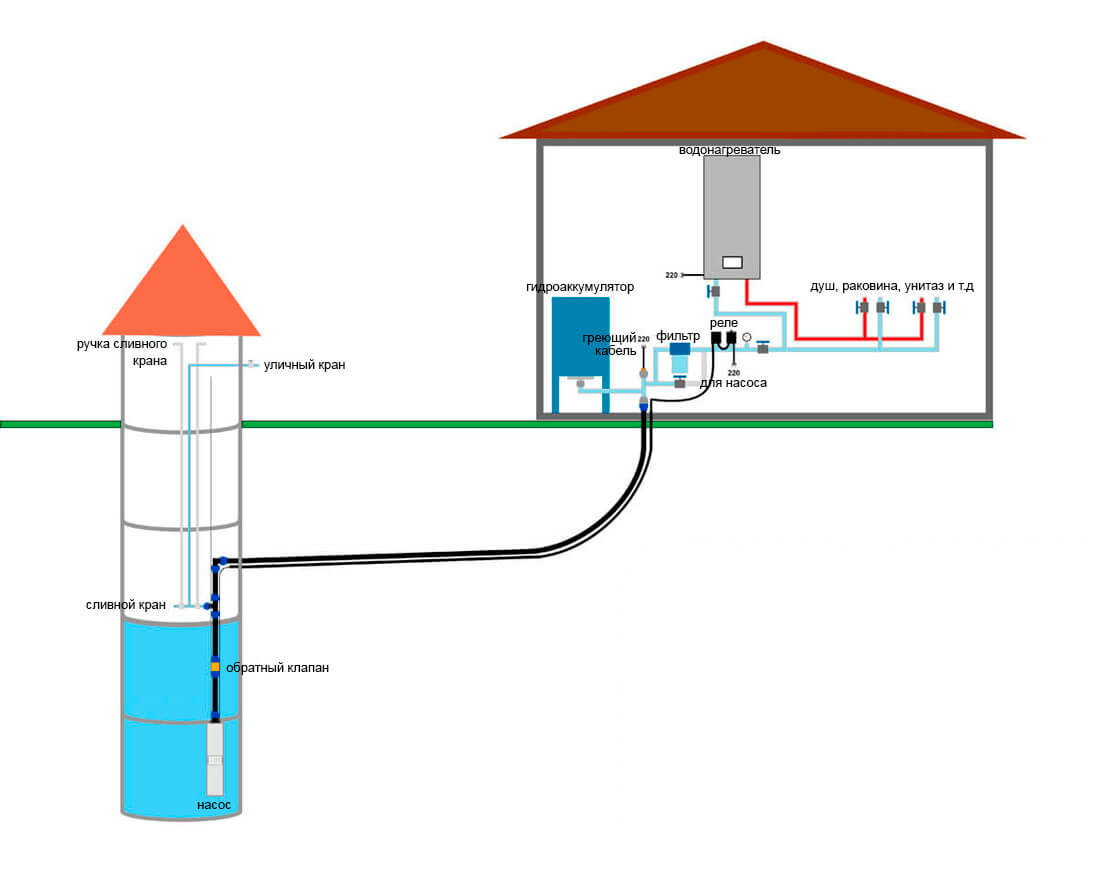

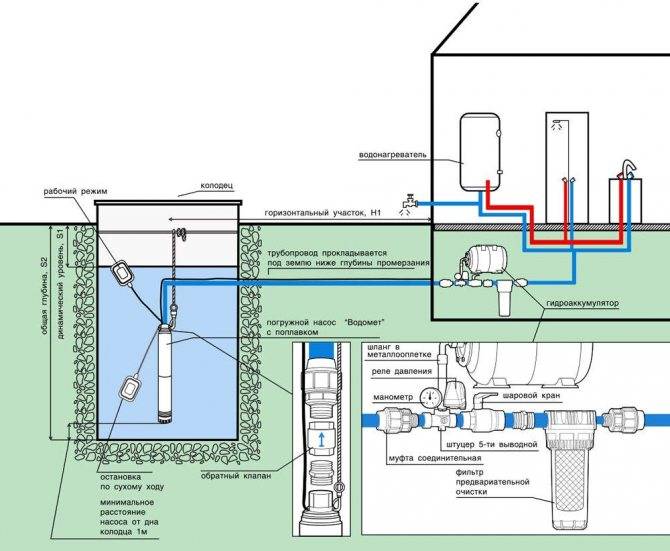
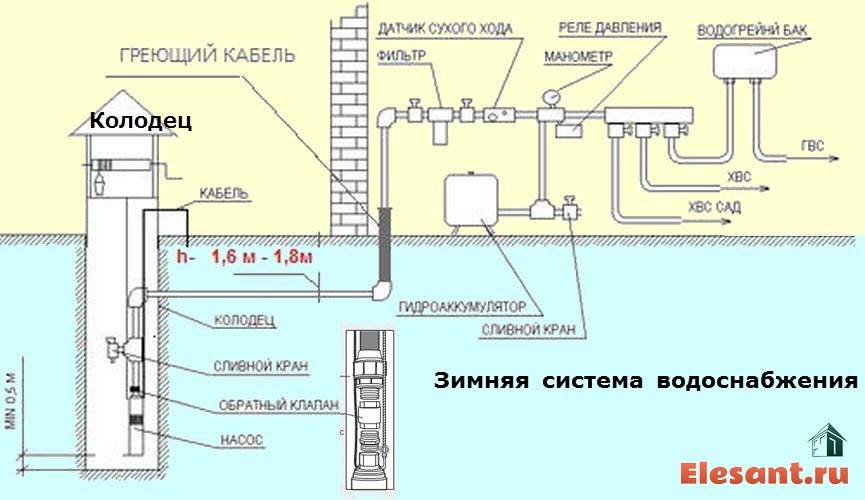

The right choice of location
First of all, it is necessary to determine the place of drilling. Based on financial costs, it should be as close as possible to the point of consumption.
Well location:
- no closer than 5 meters from capital buildings;
- at the maximum distance from the cesspool and septic tank, the minimum distance is 20 meters;
- the location should be convenient for drilling and maintenance.
With the right choice of location, the water from the well to the house will meet the requirements of drinking water supply.
Generic Schema Definition
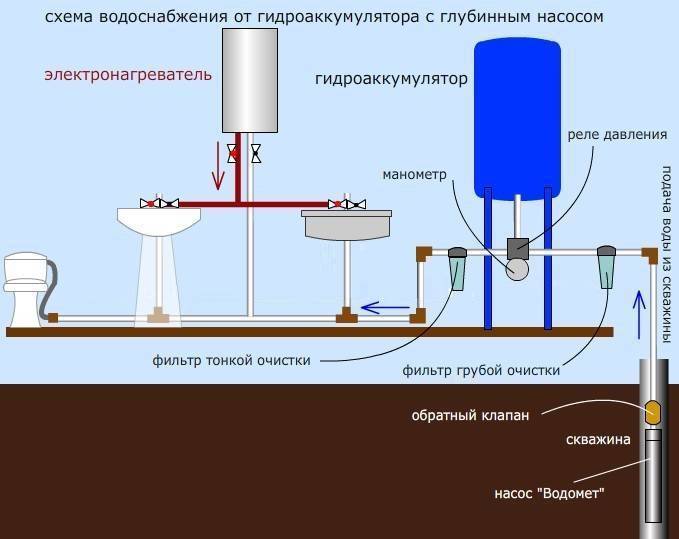
The water supply of a private house from a well with a hydraulic accumulator has its own characteristics.

Let us consider in more detail the elements used and the scheme of their connection:
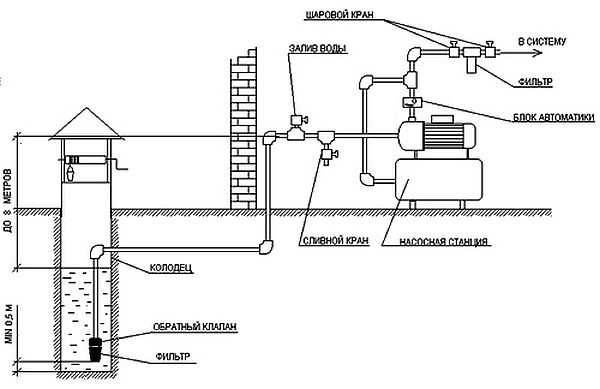
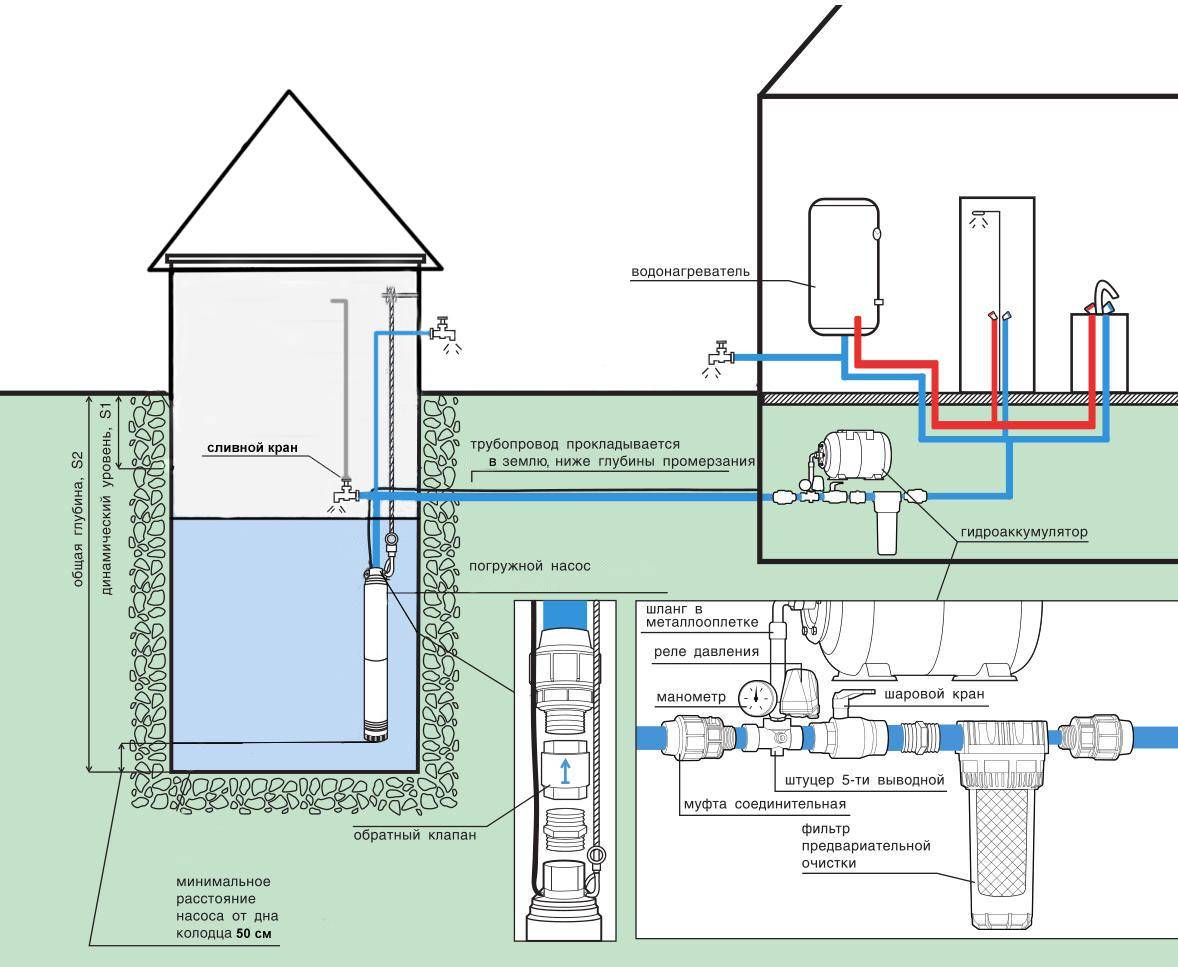
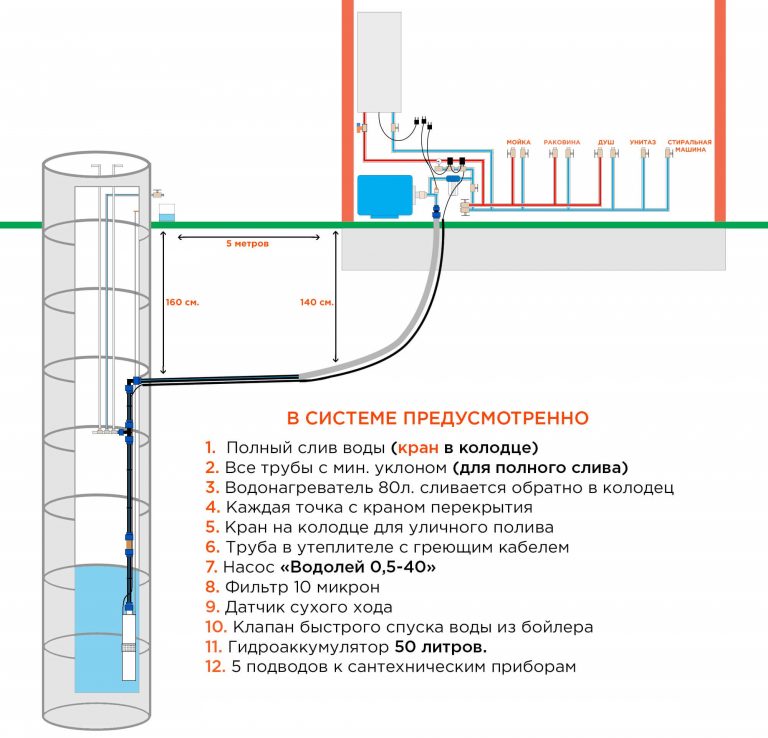
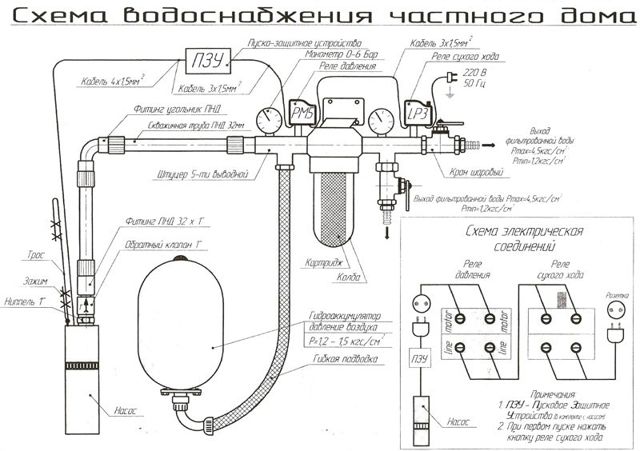
- The main element that creates the movement of water to the surface is the pump. It can be surface and located indoors, or submersible and be in the water. The first option is used with a small lifting depth of up to 8 meters. The second type of pump is more popular and is used for depths of 100 meters or more.
- Installation of a hydraulic accumulator, which is a tank made of a rigid case, in which there is a rubber container for filling with air. The constant pressure in the system depends on this element.
- Automation is responsible for the smooth operation of the system and independently turns on and off the pump if necessary. The pump power and the volume of the storage tank are calculated with a margin, depending on all points of water consumption.
- Coarse filters are located at the water intake site, which cut off large fragments from their entry into the water supply system. Next, a fine filter is installed in front of the pump, which is selected depending on the composition of the water.
Layout and location of equipment
An important point remains the correct location of the equipment used in the water supply from the well. The most acceptable option is the arrangement of a caisson well, which is located above the well and allows you to provide comfortable conditions for the operation of the equipment used.

Rationality is as follows:
- the equipment is located in close proximity to the water intake, which contributes to the maximum efficiency of its use;
- soundproofing materials are used in the well to ensure the noiselessness of the pump;
- the equipment is located in one place and protected from mechanical damage;
- high-quality thermal insulation allows uninterrupted use of water supply throughout the year.
Of course, this equipment can be placed in the bathroom or in another room, but the presence of a caisson is certainly a big advantage.
Pipe laying features
The most suitable are low-density polyethylene pipes. They are distinguished by their durability and unpretentiousness, as well as their ease of construction and ease of installation:
it is possible to lay them directly into the ground, but it is recommended to dig a trench to a depth that excludes freezing; a technical pipe is installed in it, in which the pipeline itself is located; it is important to use heat-insulating materials, it is desirable to have a heating cable; in inaccessible places, unnecessary connections should be avoided, which is facilitated by the HDPE pipe. Indoors, the pipeline can be constructed from other materials: copper and steel
Indoors, the pipeline can be constructed from other materials: copper and steel.
What equipment is needed for arranging the structure
To equip an artesian well with your own hands, you will need:
- water lifting equipment;
- cap;
- hydraulic tank;
- additional equipment for pressure, level, water flow control;
- frost protection: pit, caisson or adapter.
When buying a submersible pump, it is important to correctly calculate the required power. The model is selected according to performance and diameter. You can’t save on this equipment, because
the performance of the entire water supply system of the site depends on it
You can’t save on this equipment, because. the performance of the entire water supply system of the site depends on it.
The best option is a model in a high-strength hermetic case, equipped with sensors, filter units, and automation. As for brands, Grundfos water-lifting equipment deserves special attention.
Typically, a submersible pump is installed at a height of about 1-1.5 m from the bottom of the hydraulic structure, however, in an artesian well, it can be located much higher, because.pressure waters rise above the horizon.
The immersion depth for an artesian source should be calculated based on the indicators of static and dynamic water levels.
To keep artesian water crystal clear, the production pipe must be protected from debris, surface water and other adverse environmental factors. This structural element is used to securely fasten the submersible pump cable.
The head consists of a cover, clamps, carabiner, flange and seal. Models of industrial production do not need to be welded to the casing, they are fastened with bolts that press the cover against the seal, thus ensuring a complete seal of the wellhead. Features of mounting homemade heads depend on the design of the devices.
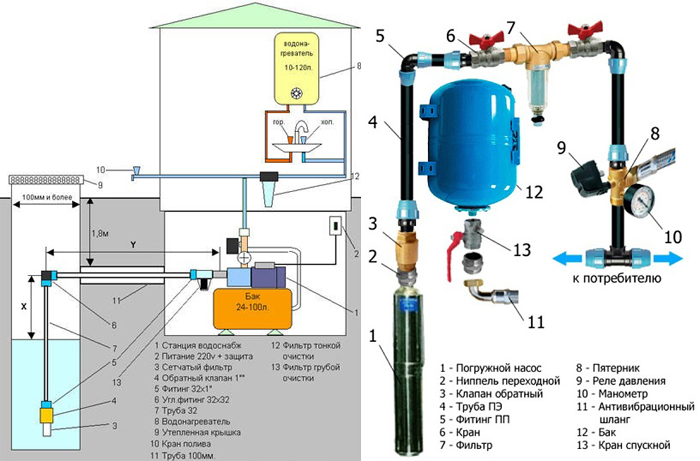
The hydraulic accumulator is an important unit of an autonomous water supply system. It is necessary to ensure the normal operation of the water supply, protect the pump from constant on-off and prevent water hammer. The battery is a water tank, additionally equipped with pressure sensors and automation.
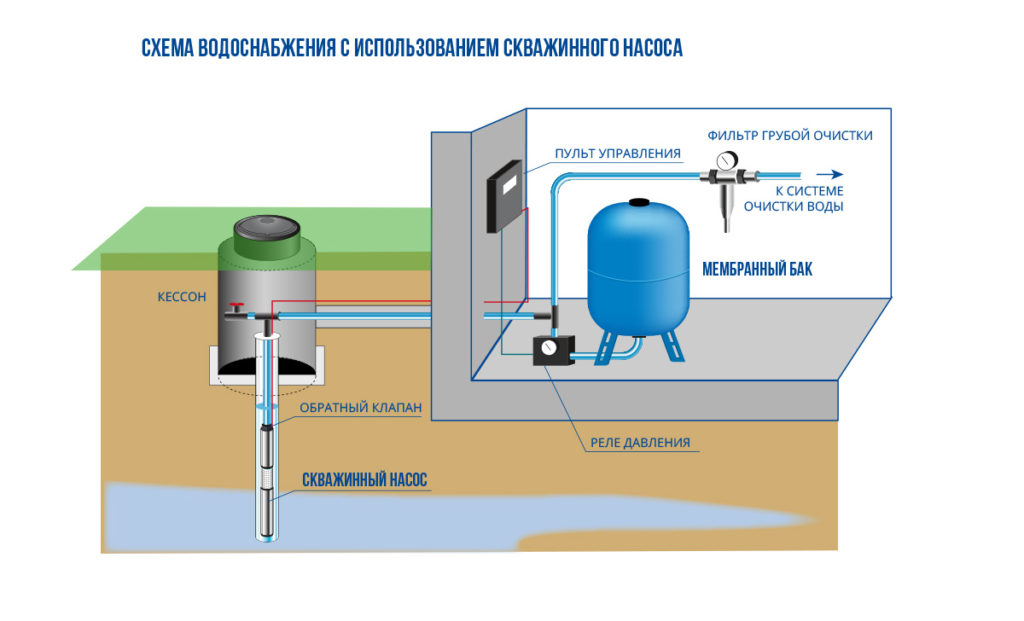
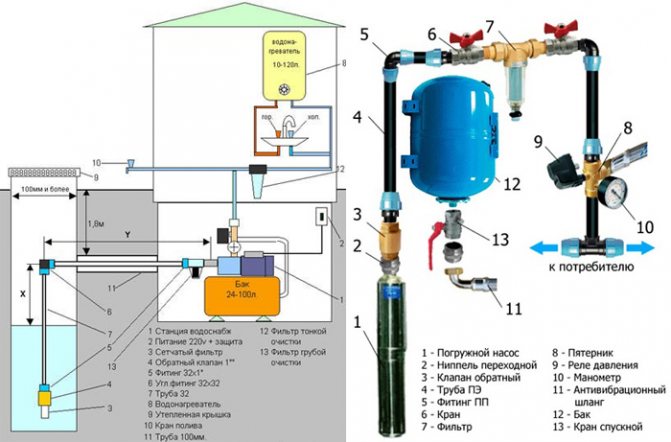


When the pump is turned on, water first enters the tank, and from it is supplied to the draw-off points. The water levels at which the pump turns on and off can be controlled using pressure sensors. On sale there are hydraulic tanks with a capacity of 10 to 1000 liters. Each well owner can choose the model that best suits their system.
The well must be protected from freezing. For these purposes, you can make a pit, install a caisson, an adapter. The traditional option is a pit. It is a small pit, the walls of which are reinforced with concrete or brickwork.From above, the structure is closed with a heavy lid with a hatch. It is undesirable to install any equipment in the pit, because even with good waterproofing, the walls still let moisture through, the design is not airtight.
A more modern and technological analogue of the pit is the caisson. This design is best purchased at a specialized store. Industrial production caissons are pre-designed to accommodate all the necessary equipment. Plastic models are well insulated and airtight. Metal caissons often need additional insulation.
For a single-pipe artesian well, an arrangement using a pitless adapter is suitable. In this case, the function of the protective structure is performed by the casing pipe itself. The adapter can only be installed if the column is made of metal. There are serious difficulties with the operation of a plastic pipe, and the service life of the structure may be short-lived.
Centralized water supply: pros and cons
If there is a centralized water supply near the house, the easiest way to bring water into the house is to connect to it.

Connection to the central water supply
With documents that confirm that the land is owned, you need to go to the local water utility. They will issue a document with technical specifications. The specifications indicate the tie-in point, pipe section and other nuances. Based on the technical specifications, an organization with a special license will draw up a project. It, together with the estimate, must be certified by the Sanitary and Epidemiological Station. Connection to the central water supply will be carried out by a company with a license for the installation of water supply.
After tie-in and connection of the pipeline with internal communications, the employees of the water utility will act of commissioning. The consumer enters into an agreement with the water utility to pay for services.
Design and installation will take time, but the result will please the owner of the house. The centralized water supply system has its drawbacks:
- If there is a gust, the house will be left without water.
- Not always uniform water pressure.
- Monthly water bill.
- The quality of the water needs to be further purified.
A clear plus of connecting to the central water supply is the cost. It always costs much less compared to organizing an autonomous water supply.
Choose a source
A well or a central water supply can be chosen as a source, but a supply from a well can also be made and it will not cost much. This must be considered on a case-by-case basis.
It is good if there is a high-quality well or well on the territory of the summer cottage that you purchased. But if it doesn't exist, it needs to be created.
Well
A well is the most ancient artificial source that provides a person with water.
What is good and what is bad
Before equipping a well, make sure that the volume of water is sufficient for your family:
- This option is cheaper than creating a well.
- It is not necessary to resort to the services of specialists, you can purchase the necessary materials and do all the work yourself. This will save you a lot of money. The price of the entire structure will be significantly lower;
- A well lasts longer than a well. The maximum period of its operation is 50 years. In addition, the well is independent of electricity, unlike the well.
- But there is one drawback: it may contain perched water, which significantly reduces the quality of water.But this happens only if the waterproofing is performed incorrectly (see Waterproofing the well: methods and methods of work).
In some regions, well drilling is preferred. The reasons can be very different.
Perhaps there is a source or an underground river with high-quality water nearby, or maybe the groundwater is at a depth of more than 15 m.
Well "on the sand"
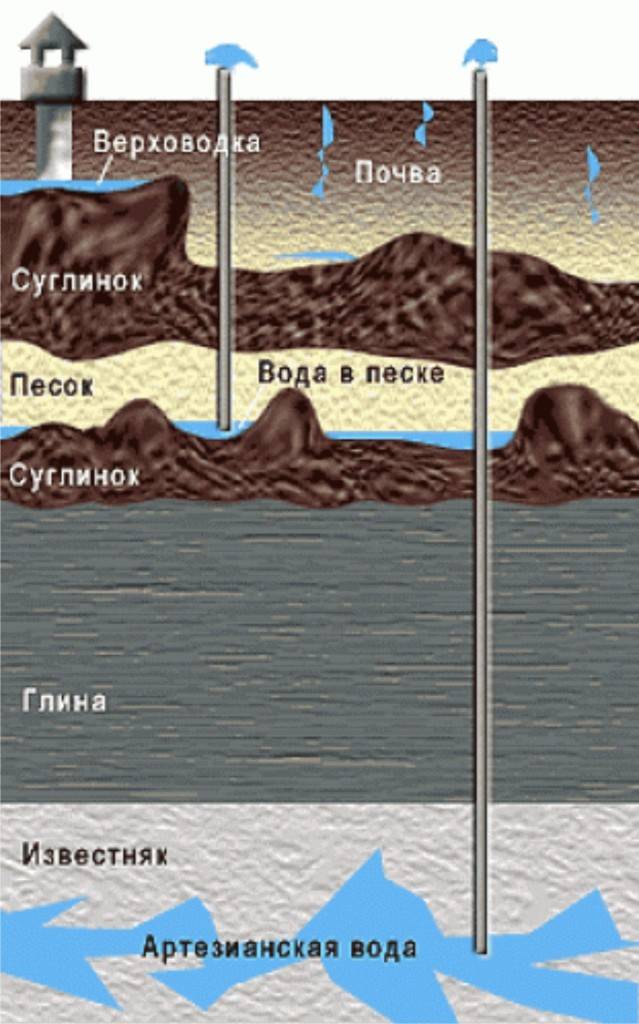
When it is created, water is taken in the upper layers of the soil. the first is reached. In this variant, it is only necessary to reach the first layer of water, which is suitable for consumption. Above it is dense loam, which filters rain, melt and groundwater.
Scheme sand wells
So:
- In each region, the aquifer lies at different depths, so the depth of the well "on the sand" can be 10 - 50 meters.
- This type of well contains 500 liters of water. Since well filters become clogged with silt and sand over time, such a source can be used for about 5 years.
- Of great importance is the area on which the well is located. The source may turn out to be inexhaustible, because even with a low occurrence of groundwater (deeper than 15 m), you can stumble upon an underground river. In this situation, the filters will not clog, and the well will last more than 20 years.
3 id="artezianskaya-skvazhina">Artesian well
In this case, it is necessary to drill to limestone rock, which lies at a depth of 35-1000 meters or more. An artesian well is a reliable and durable source with a minimum volume of 1500 liters.
So:
The water in the limestone layer of the soil is of high quality.Usually, wells “for limestone” are not created for personal needs, and if they are created, then the depth is not more than 135 m.
- Its arrangement takes from several days to a month. At the same time, much more money is spent than when creating a well "on sand".
- Groundwater and perched water cannot enter an artesian-type well. Its service life is approximately the same as that of a well.
If desired build a water source how well, ask for a debit calculation. This way you can choose the right pump for you. And if you do it together, then a pumping station. And these are costs that can be avoided.


Find out the productivity of the well
In order to find out the performance of a water source, you need:
- Pump out water using a surface pump or motor pump;
- Then you need to measure its amount. Tie a string to the nut and lower it into a source of water, then measure the length.
Thus, you will recognize the mirror of water. Having received the necessary data, you can proceed to the purchase of the pumping station itself.
To get acquainted with the parameters, use the system passport
Pay special attention to the presence of an inlet filter and check valve