- Receiver connection
- External and internal plumbing
- Well water supply
- General requirements for the area for drilling an artesian well:
- Financial instruments
- Basic parameters for pump selection
- Device and principle of operation
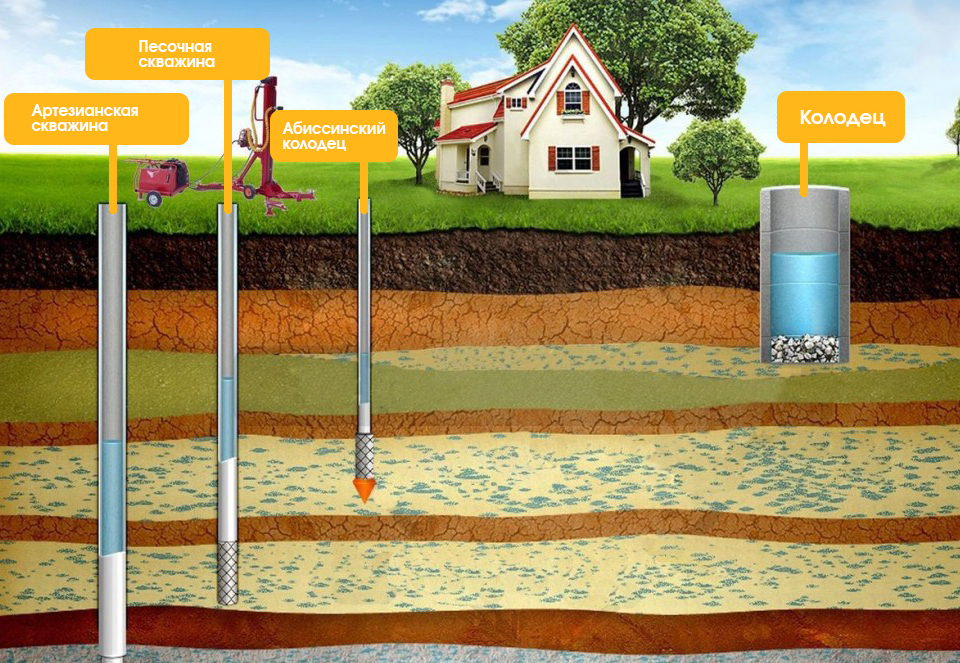
- Types of wells for a private water supply
- Installation of plumbing system components
- Second step
- Third step
- Fourth step
- Fifth step
- sixth step
- seventh step
- Choosing a place to install
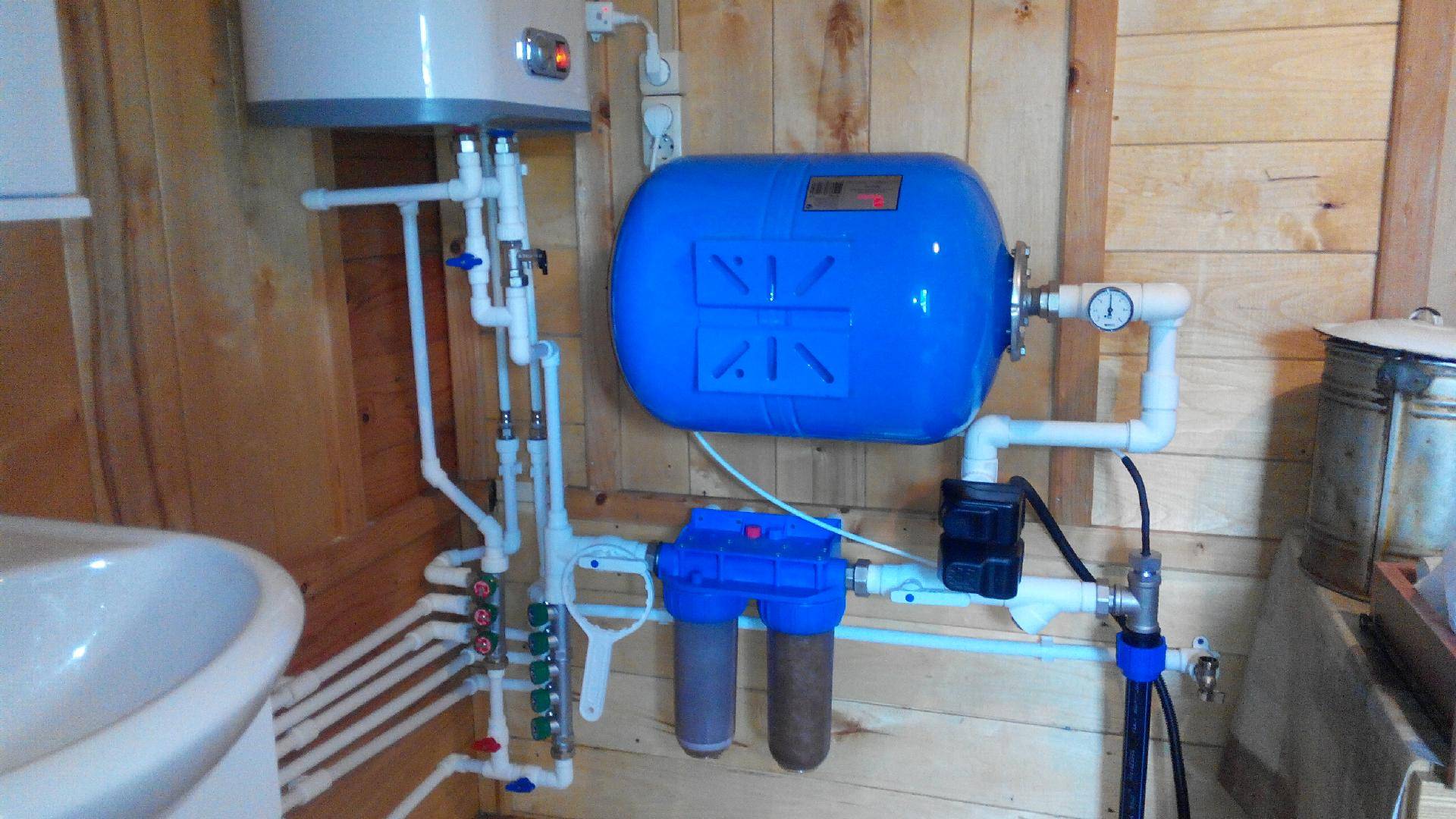
Receiver connection
As we have already said, the water supply system must not only deliver water to the consumer, but also provide performance and pressure acceptable for the normal operation of plumbing equipment. A submersible pump is capable of creating high pressure, but it will be unstable, and when the tap is suddenly closed, a water hammer can occur.
In addition, if the pump is connected directly to the water supply, then every time the tap is opened in any plumbing fixture (sink, sink, bathroom, toilet, etc.), the pump motor will turn on. This will adversely affect the life of the engine, the mechanics of the pump, and the power-off nodes on the relay or starter.
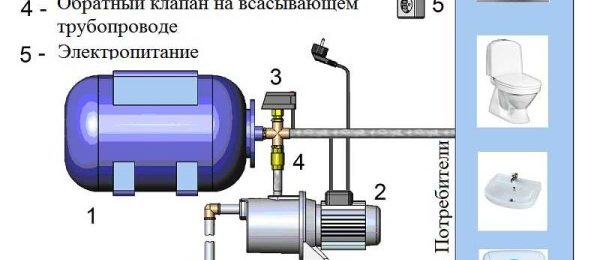
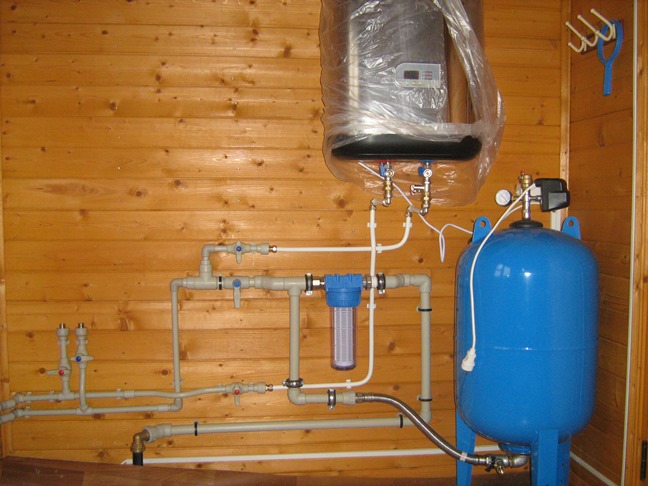
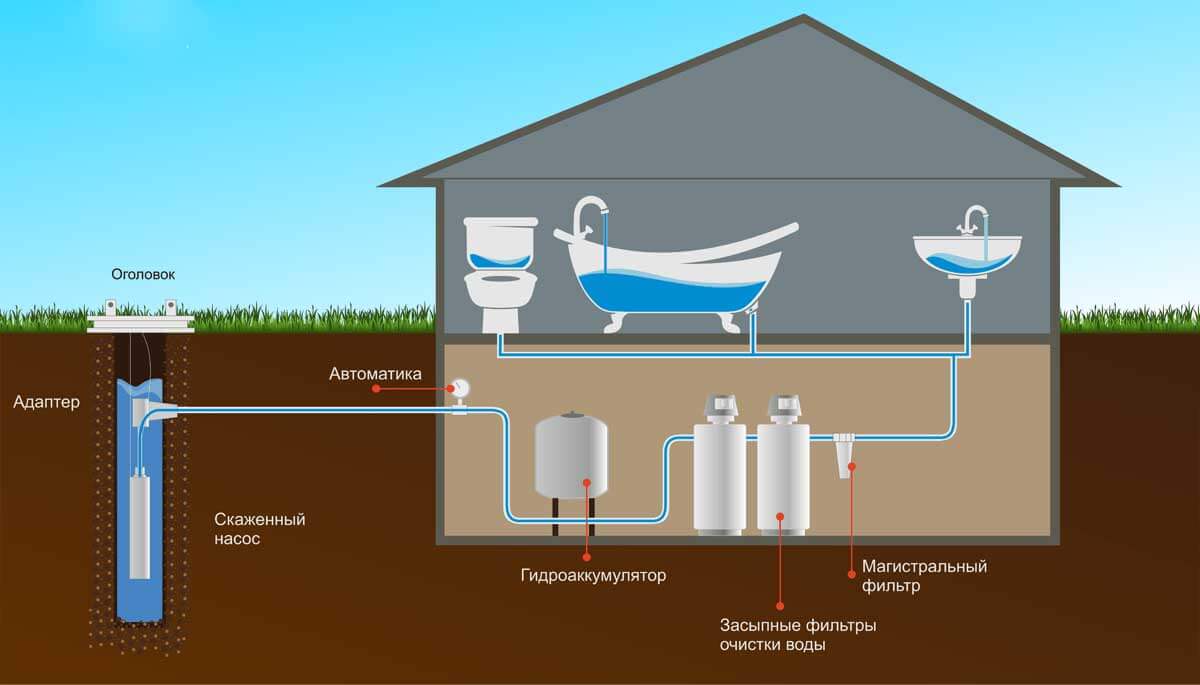
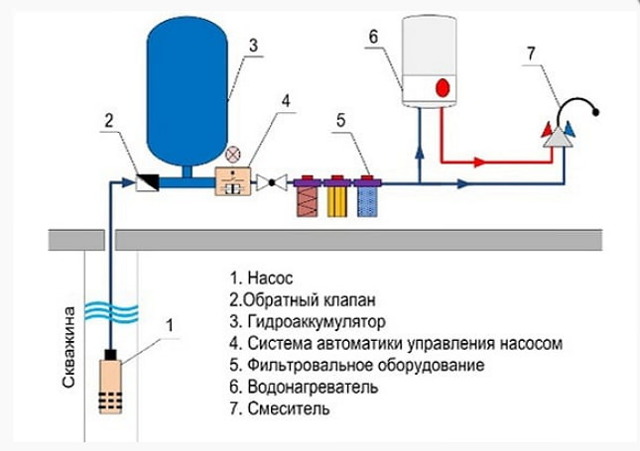
Based on this, a hydraulic accumulator is needed, which will accumulate water under pressure and supply it to the consumer.At a time when the pressure in the tank of the device drops below a certain level, the pressure switch will work, which will close the power supply circuit of the pump motor, and it will pump the required amount of water. If the tank capacity is 100 liters or more, then for a medium-sized family, the number of pump starts will be small, and it will last a long time.
We stopped at the pipe entry into the house. Move on:
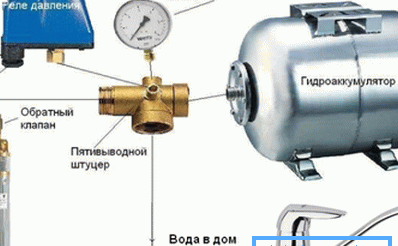
We connect the pipe inlet through a coupling with a five-outlet fitting. We wind the coupling onto an inch hole through a nipple with a union nut;
We wind an angled elbow onto the inlet of the receiver, which we extend with a piece of pipe of the required length. If possible, instead of a pipe and an elbow, we use a flexible hose with a tap;
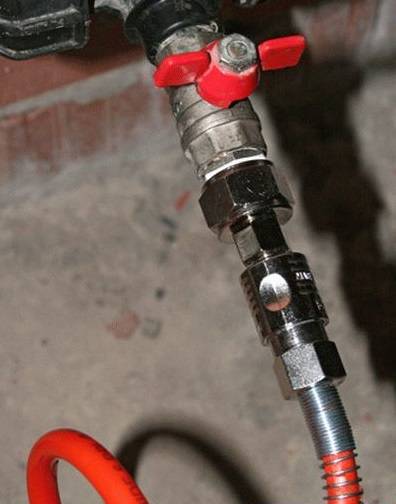
We connect the end of the receiver pipe through a ball valve with a union nut to any free inch hole of the fitting. If a hose with a tap is used, then its end through an adapter ("American") to the fitting hole;
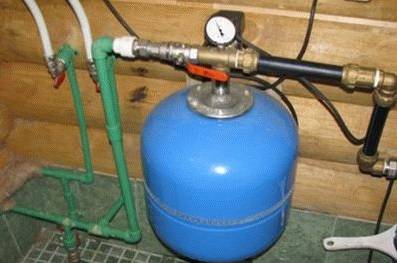
- We connect a pressure gauge to the inch hole;
- We connect a pressure switch to an unoccupied hole in an inch;
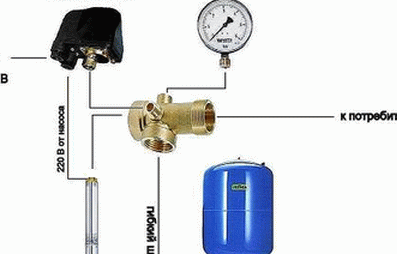
The remaining unoccupied inch hole of the distribution sleeve is connected through a tap with a union nut to the water supply going to the consumer;
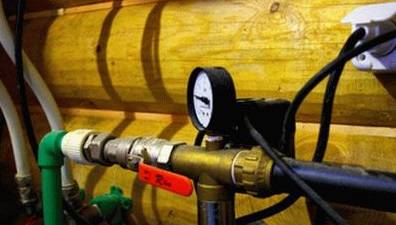
- We connect the pump power cable to the relay terminals, which will create a shutdown and start. The switching scheme is simple and is outlined in the instructions for the relay. If a starter is needed, then its coil is powered through the relay, and the pump is connected to the starter terminals;
- Separately, we power the pump cable through a manual switch, designed for the starting current of the motor with a double margin;
By means of a manual toggle switch, we start the pumping equipment and wait until the tank is full, and the system will automatically turn off the power to the pump motor. We detect the shutdown pressure on the manometer. After that, we open a couple of taps and drain the water until the system starts the pump again, in addition, we fix the pressure value;
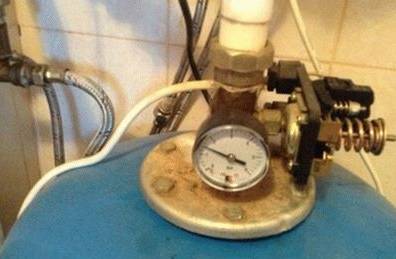
We compare the obtained values \u200b\u200bwith the passport features of the receiver, and, if necessary, set up the relay.
External and internal plumbing
If the choice between the storage tank and the pumping station is made, it's time to start performing the necessary set of works. Regardless of the system chosen, it is necessary to carry out the installation of the plumbing system, namely its external and internal parts.
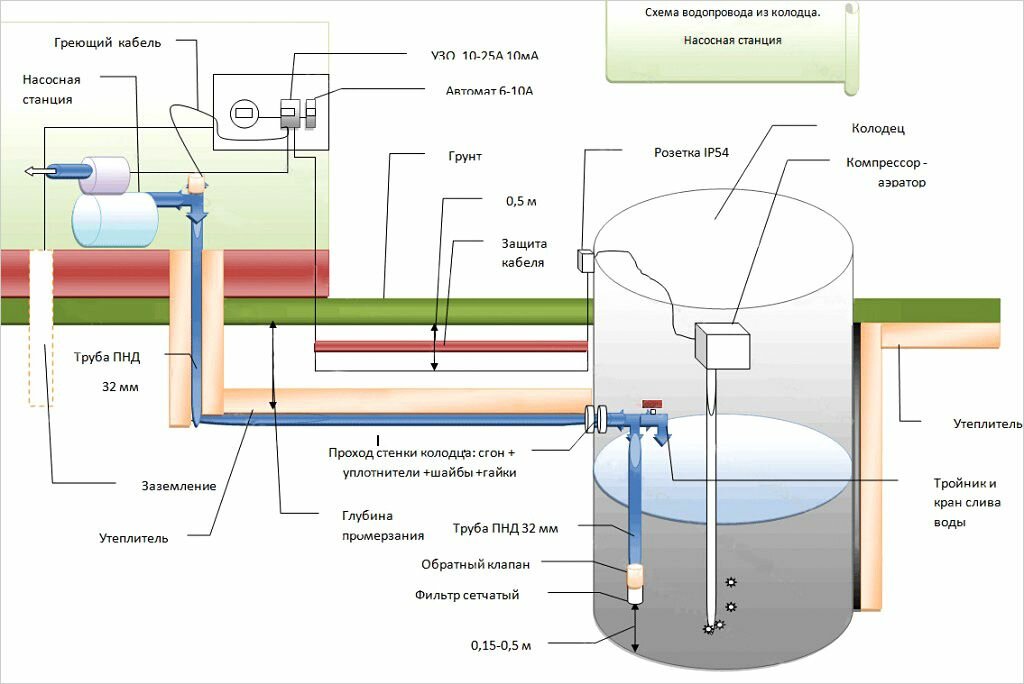
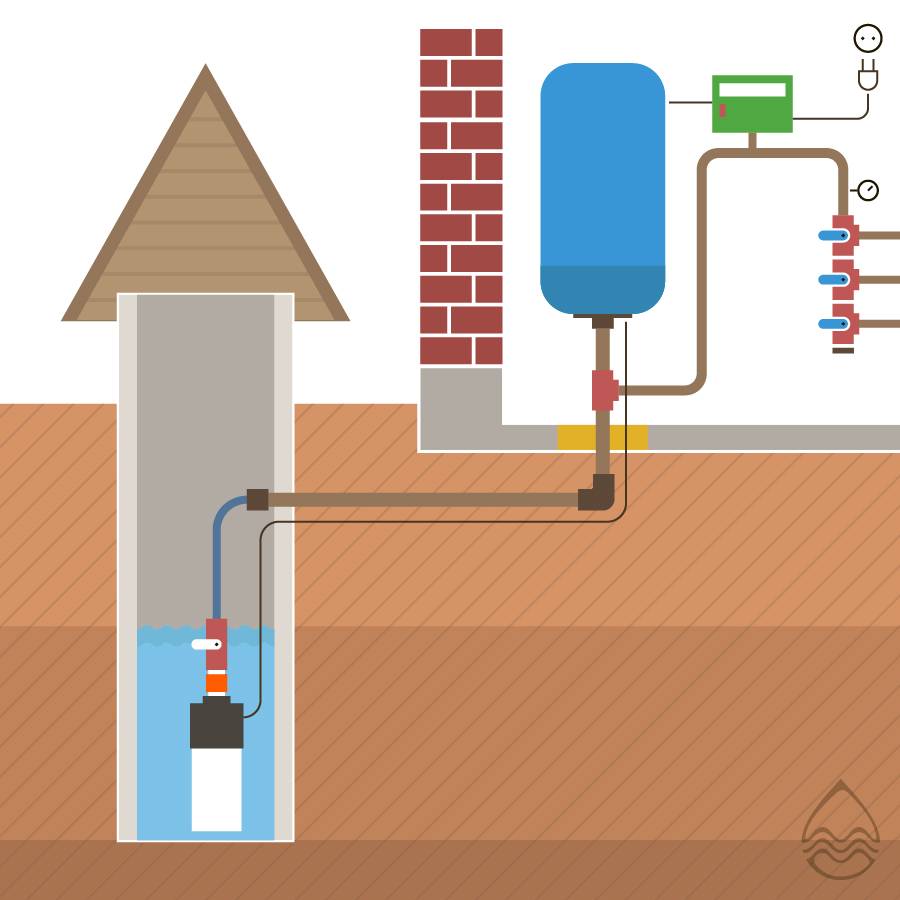
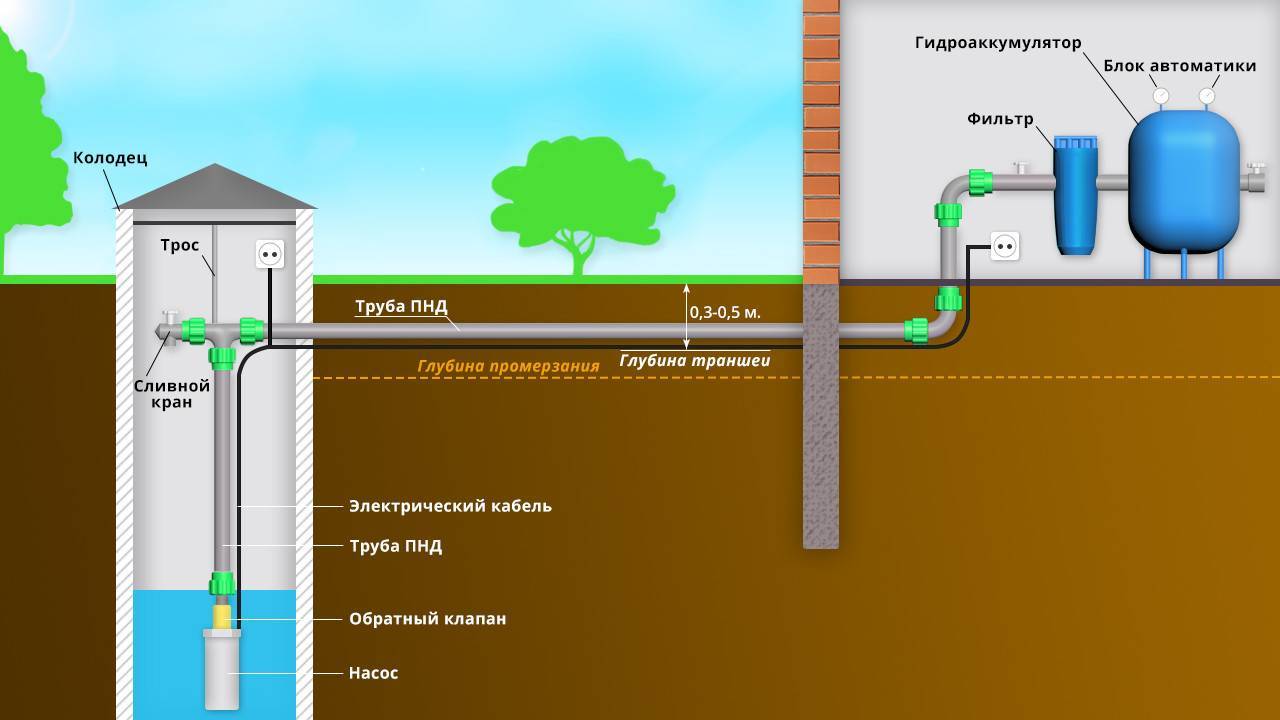
Outside, a trench should be dug in such a way that the pipe runs below the freezing level of the soil in this particular area. At the same time, a slope of 3 cm is observed for each meter of the highway.
To insulate a water pipe located above ground level, you can use both ordinary mineral wool and modern heat-insulating materials.
The pipe in the area above the freezing horizon before entering the house must be insulated. In cases where the pipeline is laid above the seasonal freezing horizon, the problem is solved with the help of a heating cable. It is convenient to place the electric cable of the pump in the trench under the pipeline. If its length is not enough, the cable can be “stretched”.



But it is best to entrust this operation to an experienced electrician, since in the event of a breakdown, you will have to carry out large-scale earthworks or even completely replace part of the damaged equipment.
For outdoor plumbing, plastic pipes are quite suitable.A trench is brought to the well, a hole is made in its wall through which a pipe is inserted. The pipeline branch inside the well is increased with the help of fittings, which at the same time will provide the cross section necessary for a stable flow of water.
If a submersible pump is included in the water supply scheme, it is attached to the edge of the pipe and lowered into the well. If a pumping station will pump water, the edge of the pipe is equipped with a filter and a check valve.
The distance between the bottom of the well and the lowest point of the pumping system must be at least a meter so that grains of sand stirred up by the operation of the machine do not fall into it.
The hole around the pipe inlet is carefully sealed with cement mortar. To prevent sand and dirt from entering the system, a regular mesh filter is placed at the lower end of the pipe.
For laying the outer part of the water supply, a trench of sufficient depth should be dug to prevent the pipes from freezing in winter.
A long pin is driven into the bottom of the well. A pipe is attached to it to securely fix its position. The other end of the pipe is connected to a hydraulic accumulator or storage tank, depending on the type of system chosen.
After the trench is dug in, a clay lock should be installed around the well with the following parameters: depth - 40-50 cm, radius - about 150 cm. The lock will protect the well from the penetration of melt and groundwater.
Water supply is introduced into the house in such a way that this place is hidden under the floor. To do this, it is necessary to partially excavate the foundation in order to make a hole in it.
Installation of an internal water supply can be done from metal pipes, but the owners of country houses almost always choose modern plastic structures.They weigh lighter and are easier to install.
A soldering iron for PVC pipes is needed, with which the ends of the pipes are heated and securely connected. Even a beginner can perform such soldering on their own, however, you should familiarize yourself with common mistakes when soldering PVC pipes in order to ensure a really reliable connection.
Here are some helpful rules:
- soldering work should be carried out in a clean room;
- joints, as well as pipes as a whole, should be thoroughly cleaned of any contamination;
- any moisture from the outer and inner parts of the pipes must be carefully removed;
- do not keep the pipes on the soldering iron for a long time to avoid overheating;
- heated pipes should be immediately connected and held in the correct position for several seconds to prevent deformation at the junction;
- possible sagging and excess material is best removed after the pipes have cooled.
If these rules are observed, a really reliable and durable connection is obtained. If the soldering is poor quality, soon such a connection may leak, which will lead to the need for large-scale repair work.
Well water supply
Wells "on the sand" are so called due to the fact that during the device they dig the upper layers of sandy soil, following the layer of loam, which serves as an excellent filter for groundwater. The depth of such a well reaches 50 meters. If, when drilling a source, 15 meters fall into the bed of an underwater river, this is considered a great success. After all, now the filters and pipes will not clog with sand due to the fact that this layer consists exclusively of pebbles.
Drilling takes place in the following ways:
-
By hand, you can drill a well up to 10 meters deep;
-
Percussion drilling;
-
Mechanized method of well clogging;
-
Percussion-rotary drilling;
-
hydrodynamic method.
Scheme and difference between two types of wells
After drilling a well, a metal or plastic pipe is lowered into it, which fits snugly to the ground and prevents it from crumbling. Further, the arrangement of water supply based on a sand well is being carried out. The service life of such sources is about 10 years.
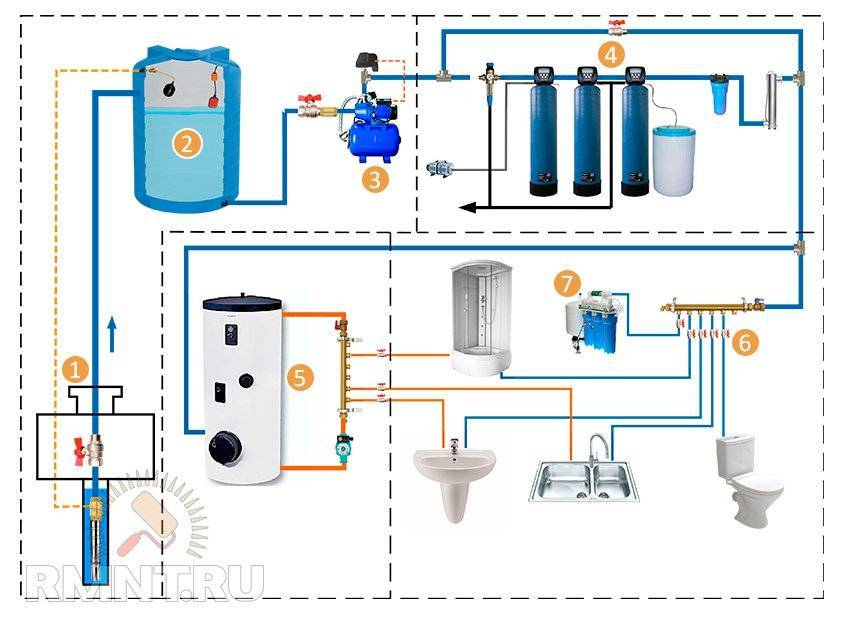
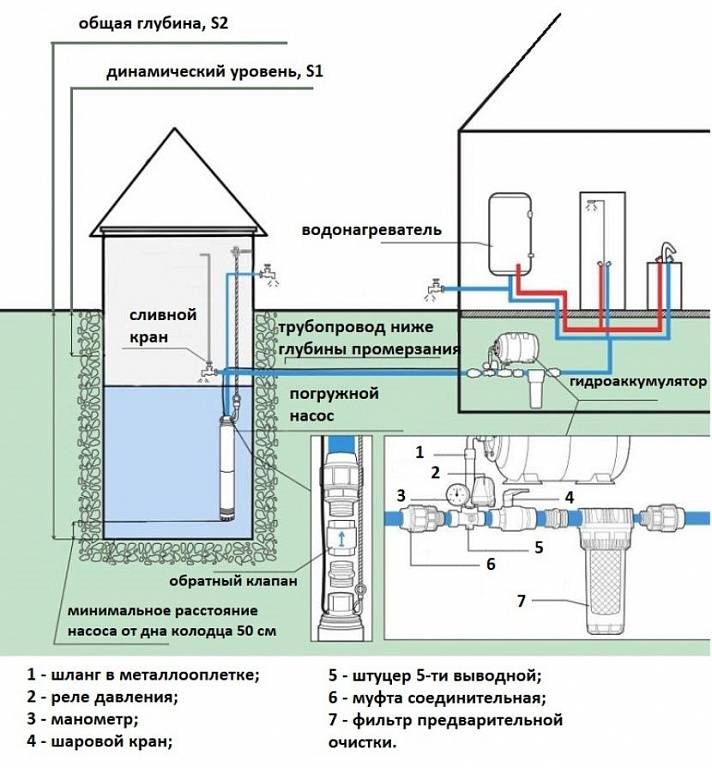
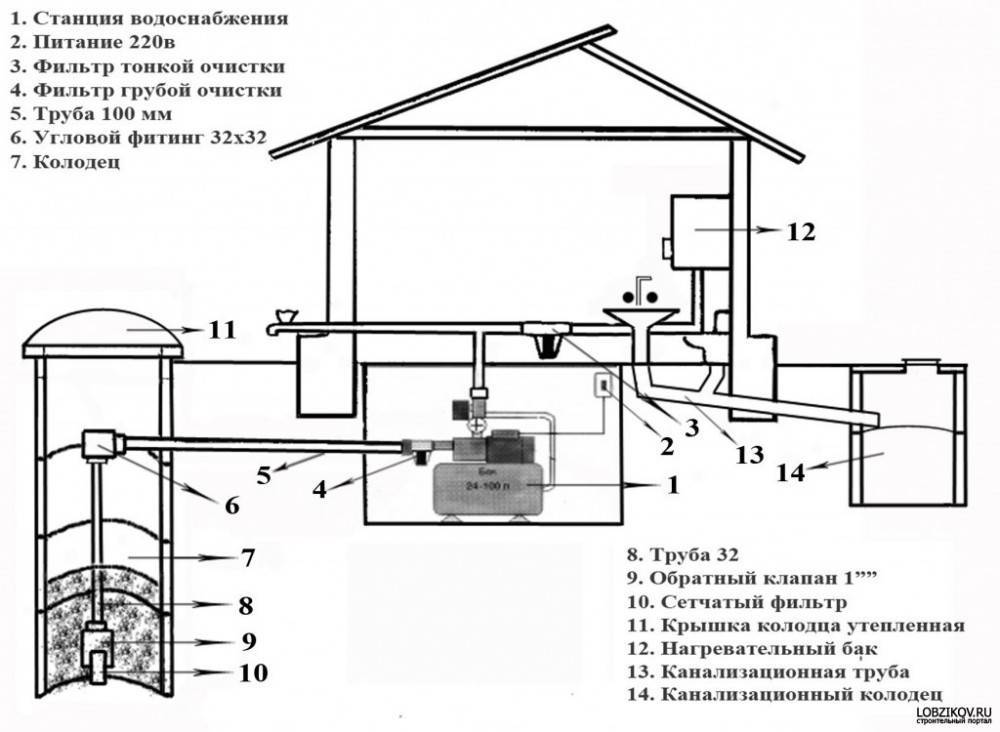
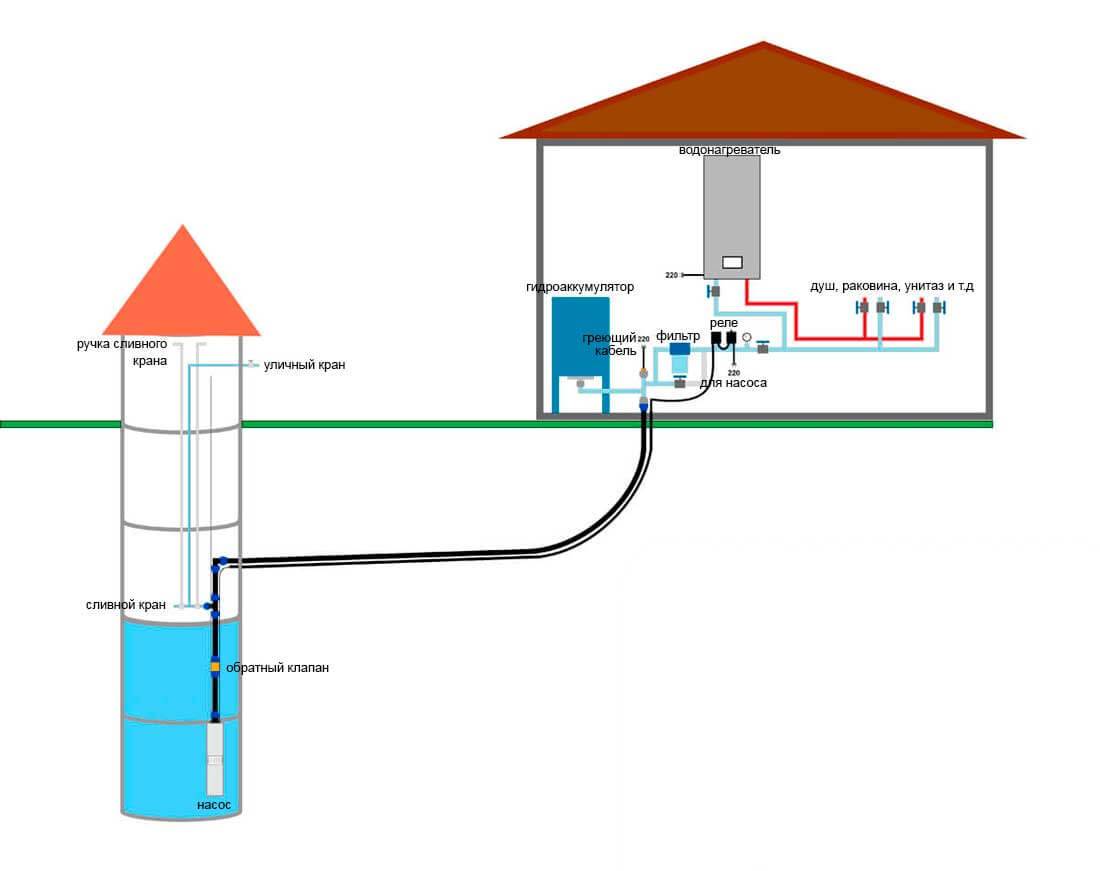
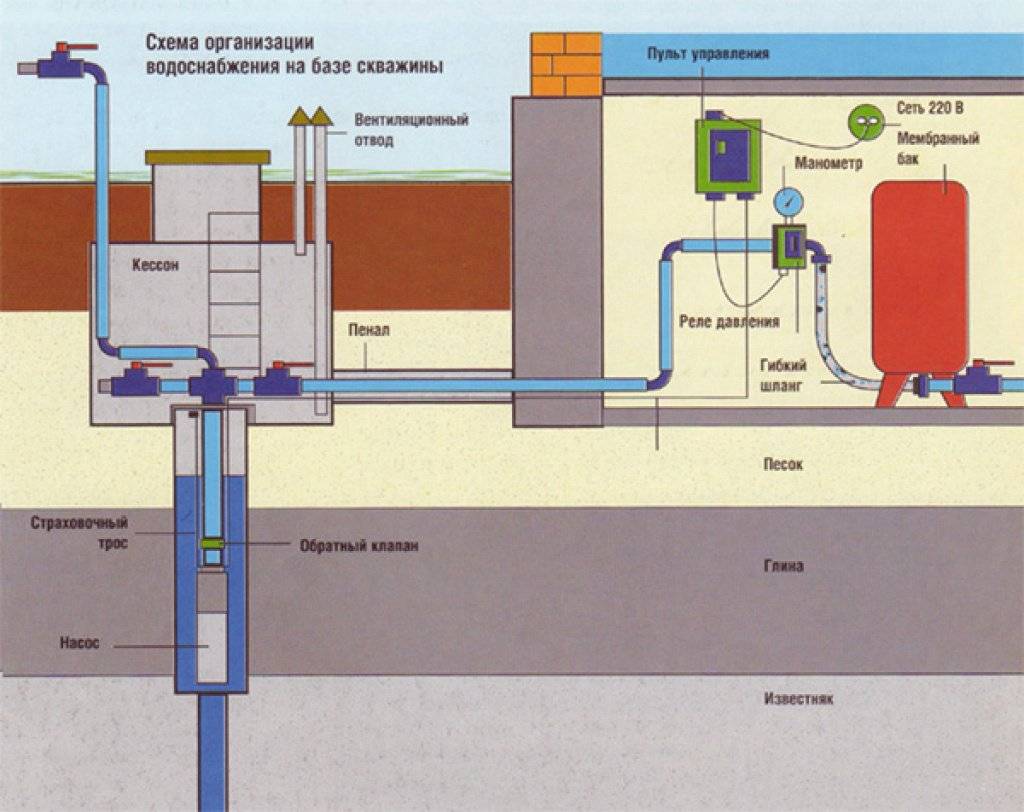
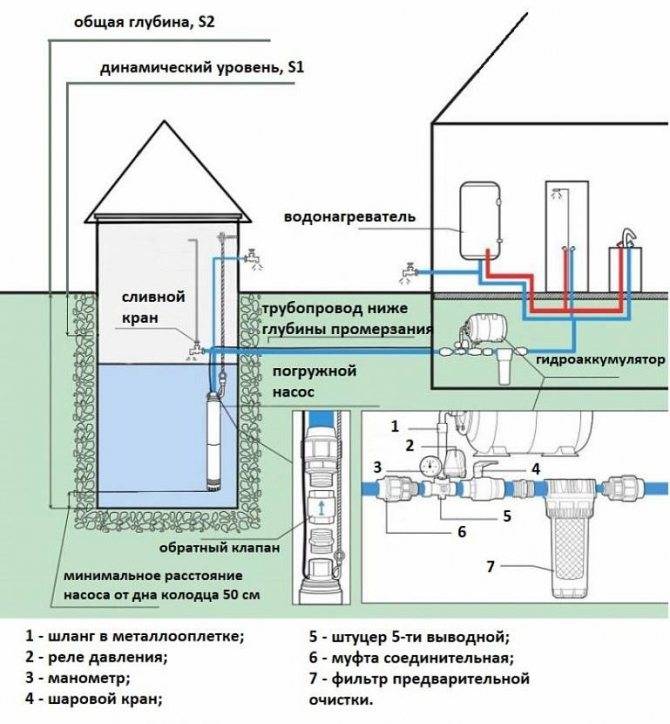
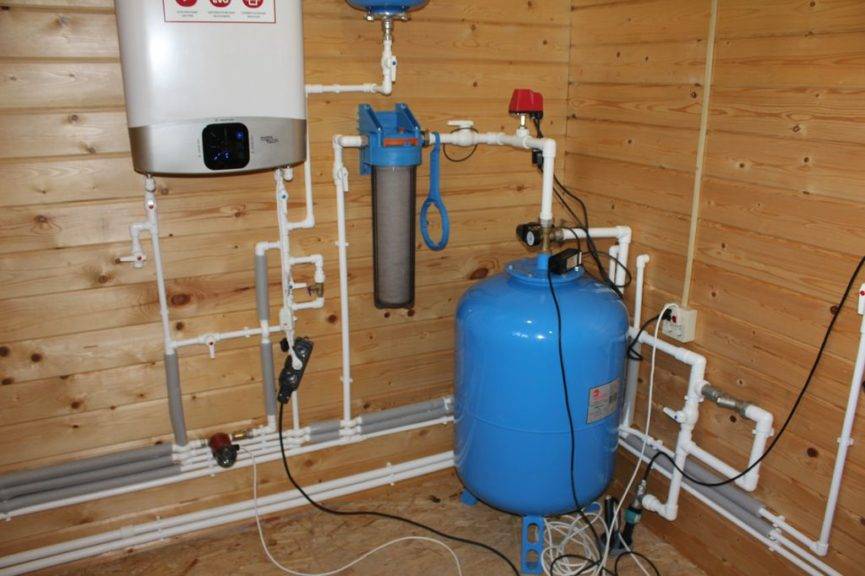
It will be much more difficult to supply water to a private house using an artesian well than in previous cases. However, such a source will last up to 50 years. In addition, an artesian well does not depend on climatic conditions and always has a consistently high debit. Any natural and technological pollution does not penetrate into artesian water, as the layer of impervious clay is a reliable natural filter. Such a source can be drilled in any part of a country house, unlike a sandy well. Choosing an artesian well as a source of water supply in a private house, it is necessary to ensure free passage of the drilling machine to the head.
General requirements for the area for drilling an artesian well:
-
Availability of free territory for drilling with a size of 4 × 12 m;
-
Ensuring a free height of 10 meters (no tree branches and electrical wires);
-
Absence in the next 50-100 meters of sewage, landfills, toilets;
-
Gates in the yard must be at least three meters wide.
Several main advantages of water supply of a country house with the help of an artesian well: high debit - from 500 to 1000 liters per hour, uninterrupted supply of high quality water, long-term operation of the source. Among the shortcomings can be identified the high cost of drilling. But it all depends on the season (drilling is cheaper in winter) and the depth of the selected equipment.
Financial instruments
In the Russian Federation, there are a large number of federal and regional targeted programs directly or indirectly aimed at modernizing the water supply and sewerage system.
- The Clean Water Program for 2011-2017
- Housing program for 2011-2015
- Sub-program "Modernization of public infrastructure facilities"
- Program "Development of the water management complex of the Russian Federation in 2012-2020"
- Other federal and regional programs.
Also, at the moment, European financial corporations and banks are actively working on the territory of the Russian Federation, for example, for objects related to reducing the negative impact on the ecological state of water resources, it is possible to attract concessional European loans and gratuitous grants from such international financial organizations as NEFCO and the EBRD, as well as European environmental funds such as NDEP, cross-border cooperation programs are actively developing, European and already Russian banks are implementing preferential lending programs and leasing agreements for production modernization projects aimed at reducing energy costs.
The legislation of the Russian Federation, with appropriate justification, allows you to temporarily stop the imposition of penalties for violations of environmental and sanitary legislation of the Russian Federation and direct these funds to the modernization of technological processes.
With a joint, comprehensive analysis of all financial instruments, taking into account their target indicators, as well as a unified approach, on the scale of municipal districts, when considering the problems of WSS facilities, it is possible to build a comprehensive investment program for the modernization of WSS facilities, which would allow targeted distribution of funding for programs between "WSS Objects" and fulfill all the conditions of the Target Programs: ensure the achievement of the required targets, optimize the financial burden on the municipal and regional budgets, and most importantly, provide the population with quality services in the field of WSS and give a significant impetus to the development of agriculture and production. See the concept of the Program Allocation Scheme above.
Basic parameters for pump selection
So, about the height to which you need to raise water, we already wrote
What else should you pay attention to when choosing? We need to know exactly the distance of the well from the house, and the volume of pumped liquid, which will depend on the total volume of the water supply network and the maximum possible water consumption at any given moment. A banal example: we open the tap closest to the entry point to the building - we get good pressure, we open the second one - the pressure drops, and at the remote point the water flow will be the smallest.The calculations here, in principle, are not complicated, you can do them yourself using an online calculator, or simply by studying the instructions from the manufacturer
The calculations here, in principle, are not complicated, you can do them yourself using an online calculator, or simply by studying the instructions from the manufacturer.
What determines the pressure in the system? From the power of the pump and the volume of the accumulator - the larger it is, the more stable the average pressure in the water supply system. The fact is that when turned on, the pump does not work constantly, since it needs cooling, and when the operating pressure is reached, it should not continue to increase it. The system is designed in such a way that it pumps water into the accumulator, in which a check valve is installed that prevents water from flowing back when the pump is turned off. When the pressure in the tank reaches the set threshold, the pump stops. If at the same time the water intake continues, it will gradually fall, reaching the minimum mark, which is a signal to turn on the pump again.
That is, the smaller the accumulator, the more often the pump is forced to turn on and off, the more often the pressure will either rise or fall. This leads to accelerated wear of the engine starting equipment - in this mode, the pumps do not last long. Therefore, if you plan to use water from the well all the time, buy a tank with a larger capacity for the pumping station.
When arranging a well, a casing pipe is installed in it, through which water rises up. This pipe can be of different diameters, that is, it may have a different throughput.According to the cross section of the casing, you can also choose the right equipment for your home.
All the necessary information will be in the instructions for the purchased pump. You can also get recommendations from specialists who drill your well. They will know exactly the optimal operating parameters. It will not be superfluous to also make some reserve in terms of the power of the unit, so that the pressure in the system rises faster to a comfortable threshold, otherwise the water will constantly flow sluggishly from the tap.
Device and principle of operation
Most wells serving summer cottages and residential country houses have a water supply depth of no more than 20 m. This depth is ideal for the use of automatic pumping stations.

This device is a set of equipment designed to fulfill two main purposes:
- Water supply from a water supply source to the intra-house network.
- Maintaining the pressure in the plumbing system necessary for the smooth functioning of plumbing fixtures and household appliances.
In the absence of water in the house, the functioning of such benefits of civilization as showers, washing machines, kitchen faucets, and a sewer system is impossible. Therefore, a pumping station for a private house acts as the basis for its improvement.
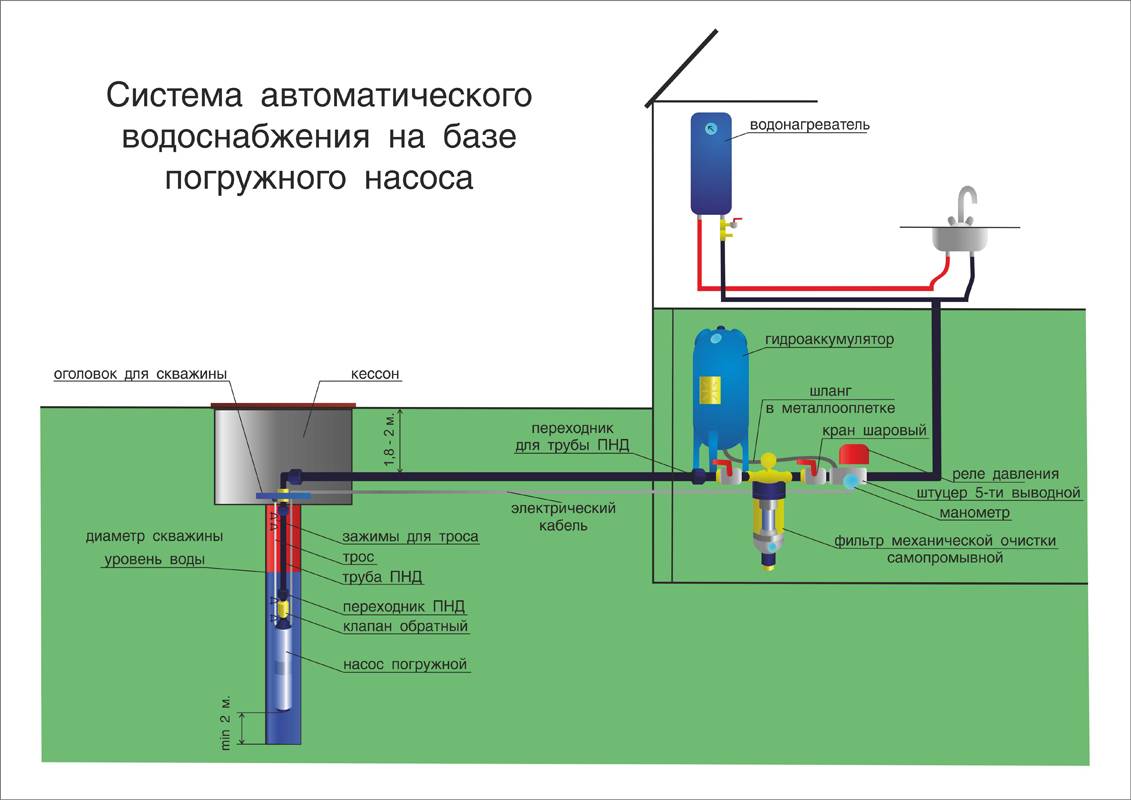
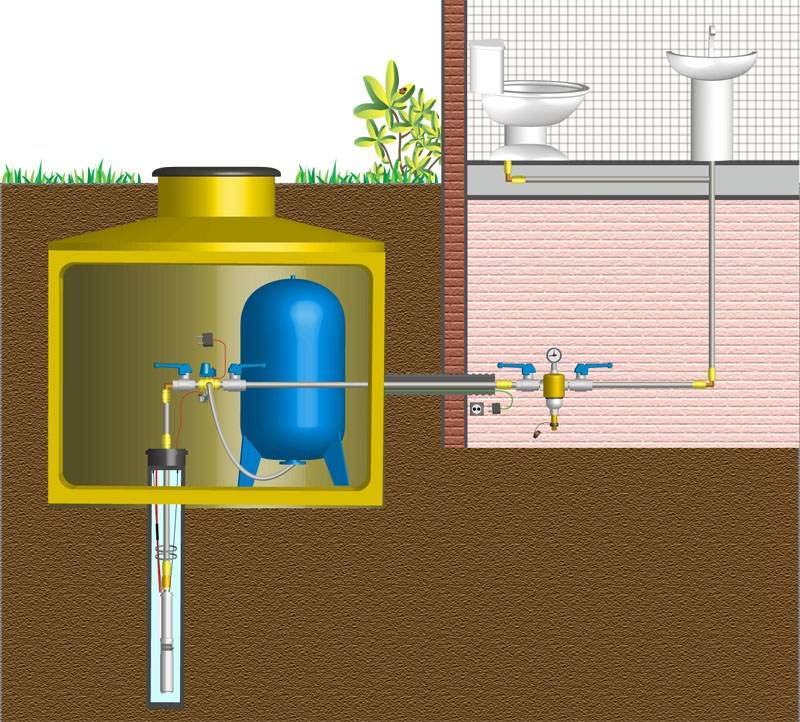

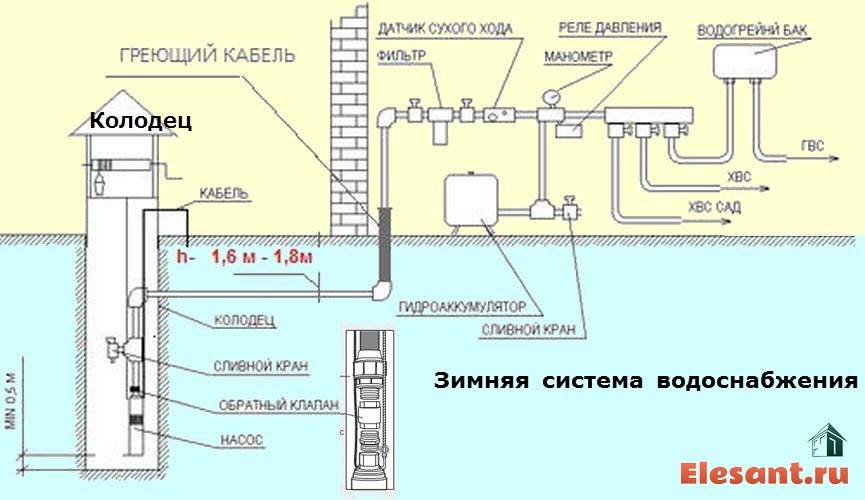
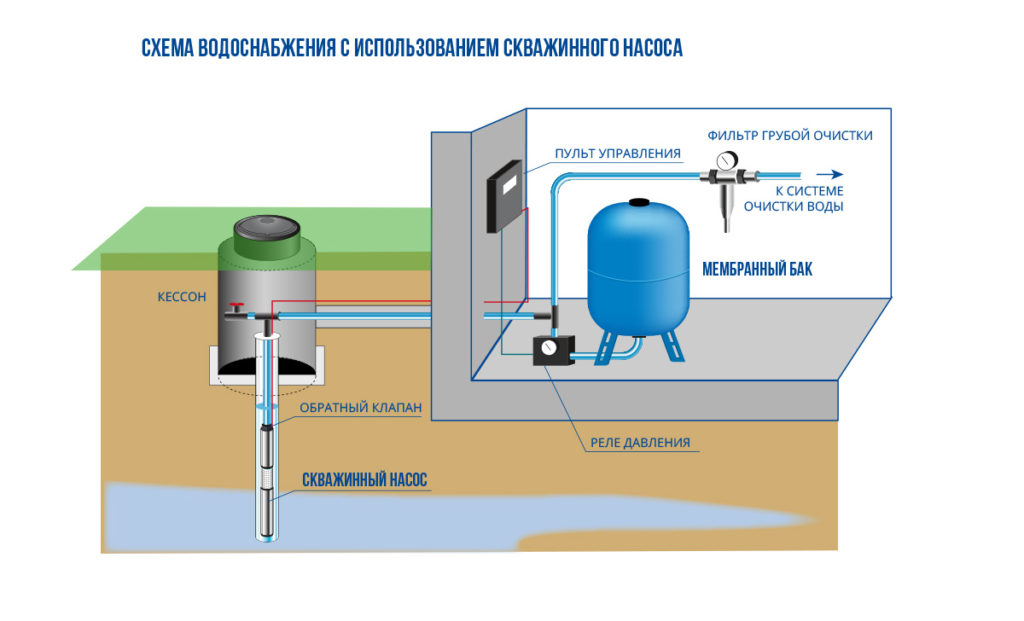
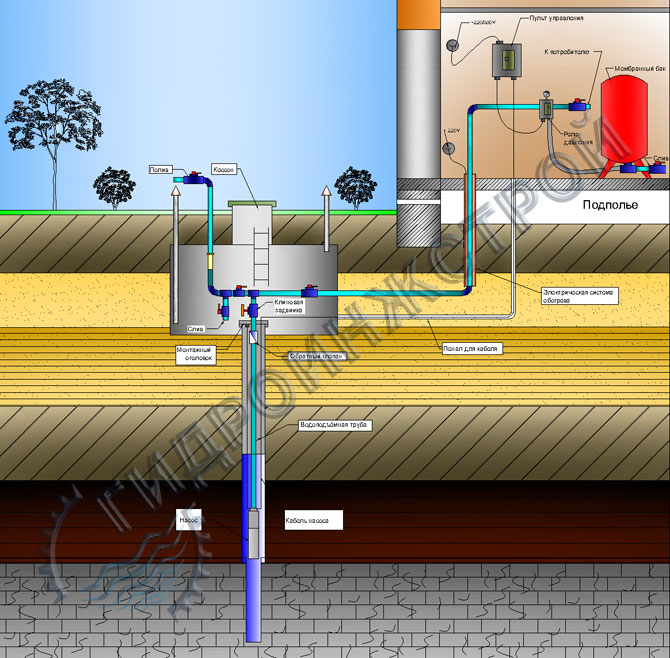
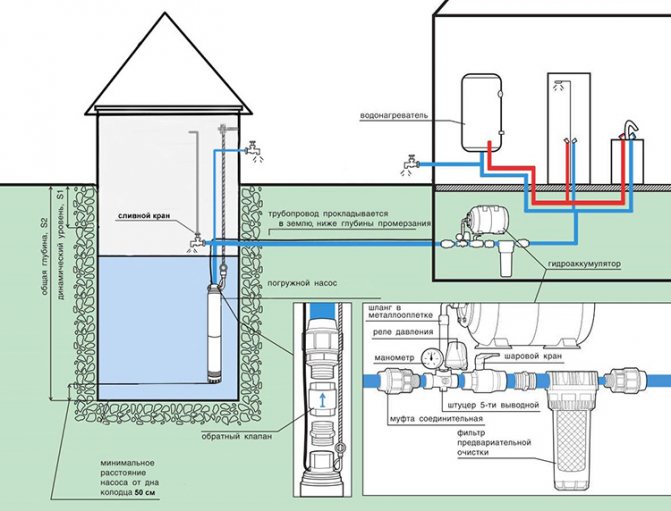
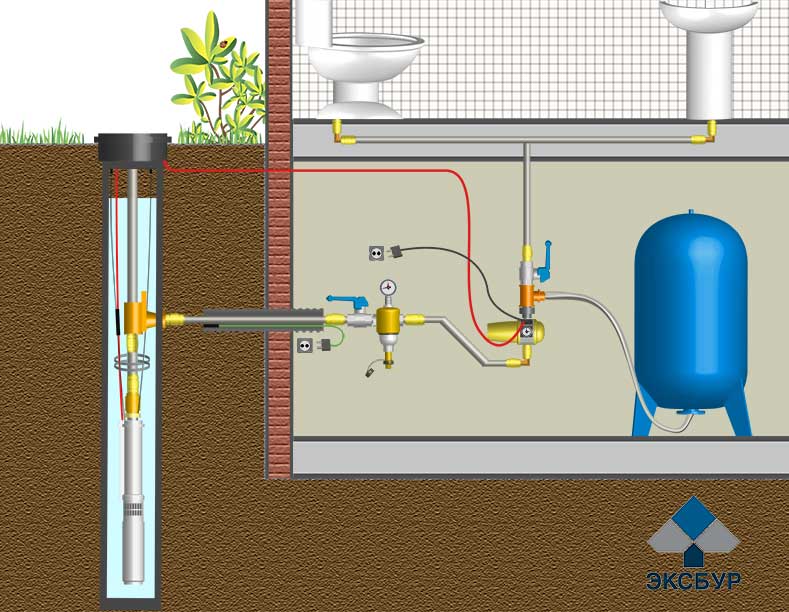
In the modern domestic market, you can find a significant number of different automatic water supply devices designed for installation in a private house. But, despite some design differences, all these models have the same principle of operation, and a similar device.

The main functional units of water pumping stations:
- A suction pump for lifting water from a well and supplying it under a certain pressure to the internal pipeline system. Most often, a surface pump is used here. But, if it is required to pump water from a deep artesian well, deep submersible pumps are used as part of the stations.
- Damper storage tank or hydraulic accumulator. This device is intended to create a certain water reserve just in case. For example, in the event of a pump breakdown, a power outage, the accumulator will be able to maintain pressure for some time, allowing residents to use the main plumbing fixtures.
- Pressure sensors (pressure gauges) connected to the relay, and those, in turn, to the pump motor. In case of motor overheating, or emergency disappearance of water in the supply system, the control equipment must independently stop the pump in order to avoid its breakdown.
- Pump station control unit. There are on / off buttons, as well as devices for adjusting the operation of the station. With their help, you can set the indicators of the highest and lowest pressure, at which the device will automatically turn on or off.
- Check valve. It is installed on the water intake pipeline, and does not allow water to roll back into the supply well.
Types of wells for a private water supply
An undrinkable perch is quite suitable for watering the garden, cleaning and similar needs. It is easier and cheaper to get it by arranging a well-needle, also called the Abyssinian well. It is a column of thick-walled pipes VGP Ø from 25 to 40 mm.
Abyssinian well - the easiest and cheapest way to get water for temporary supply of a summer cottage
This is the cheapest and easiest way to get water for temporary water supply. For summer residents who need exclusively technical water and only in the summer.
- The needle well, otherwise the Abyssinian well, is the easiest and cheapest way to create a water source for a private house.
- You can drill an Abyssinian well in one day. The only drawback is the average depth of 10-12 m, which rarely allows the use of water for drinking purposes.
- An Abyssinian well can be arranged within the house by placing pumping equipment in the basement or utility room.
- The needle well is great for extracting water for watering a garden with a vegetable garden and caring for a suburban area.
- Sand wells can supply water for both technical and drinking purposes. It all depends on the specific hydrogeological situation in the suburban area.
- If the water carrier covers the layer of water-resistant soils from above, then the water may well turn out to be a drinking discharge.
The soils of the aquiclude, which prevent the penetration of water, prevent the penetration of domestic wastewater. If the water-containing sand does not have natural protection in the form of loam or solid sandy loam, the drinking purpose will most likely have to be forgotten.
The walls of the well are strengthened with a string of steel casing pipes connected to each other by couplings or a welded seam. Recently, polymer casing has been actively used, which is in demand by private traders because of its affordable price and corrosion resistance.
The design of the sand well provides for the installation of a filter that excludes the penetration of gravel and large sand suspension into the wellbore.
The construction of a sand well will cost much more than an Abyssinian well, but cheaper than drilling a working in rocky soils
The working part of the well filter should protrude beyond the aquifer from above and below by at least 50 cm. its length must be equal to the sum of the thickness of the aquifer and at least 1 m of margin.
The filter diameter must be 50 mm smaller than the casing diameter so that it can be freely loaded and removed from the hole for cleaning or repair.
Wells, the trunk of which is buried in rocky limestone, can do without a filter and partially without casing. These are the deepest water intake workings, extracting water from cracks in the bedrock.
They serve longer than analogues buried in the sand. They are not characterized by the process of siltation, because. in the thickness of the water-containing soils there is no clay suspension and fine grains of sand.
The risk of drilling an artesian well is that the fracture zone with underground water may not be detected.
At a depth of more than 100 m, it is permissible to use asbestos-cement pipes or drill a well without casing at all, if there is no need to strengthen the rocky walls of the hydraulic structure.
If an artesian well has passed more than 10 m of fractured rock containing groundwater, then a filter is installed. Its working part is obliged to block the entire thickness supplying water.
The scheme of the water supply system of an autonomous house with one filter is typical for artesian wells that do not require multi-stage water purification
Installation of plumbing system components
Second step
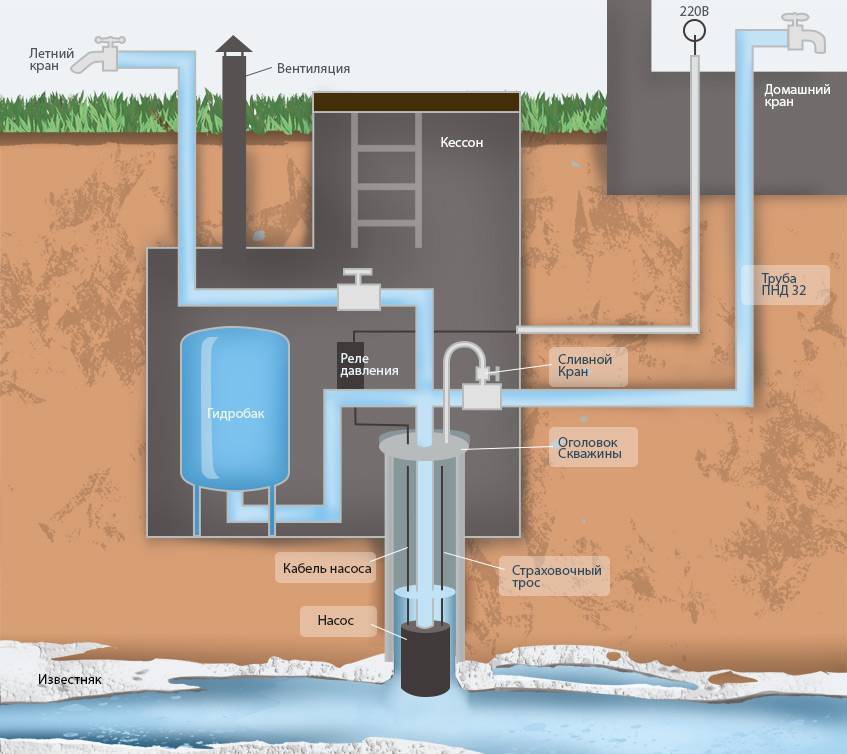
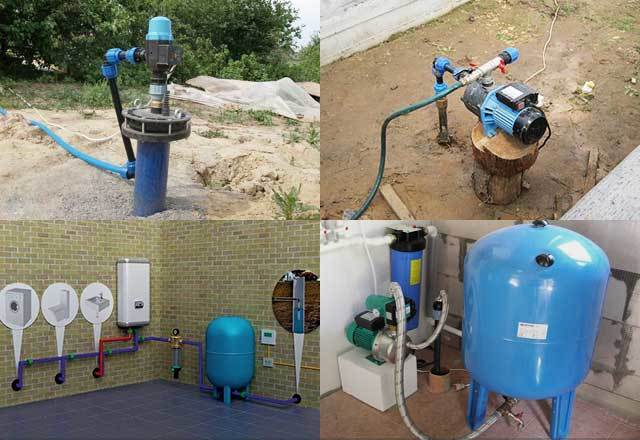
Install the pump.Deep-type equipment is lowered into the water supply source. Surface pumps are mounted next to the well or well. The pump is installed in a heated room or in a caisson.
Pumping station
Third step
Connect the water pipe to the installed pump. Attach the free end of the connected pipe to the five-pin fitting.

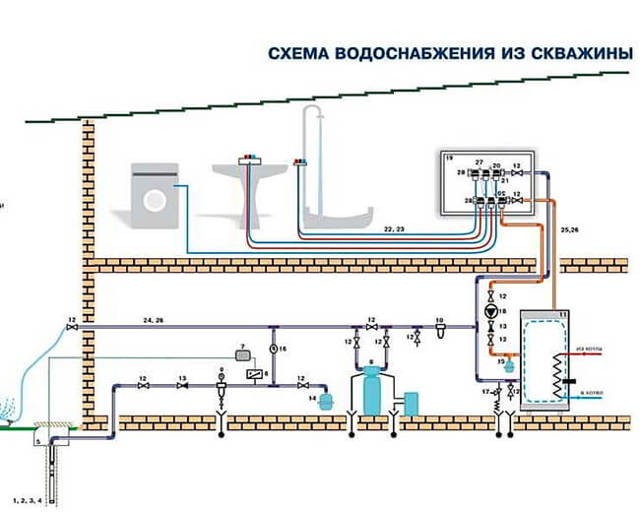
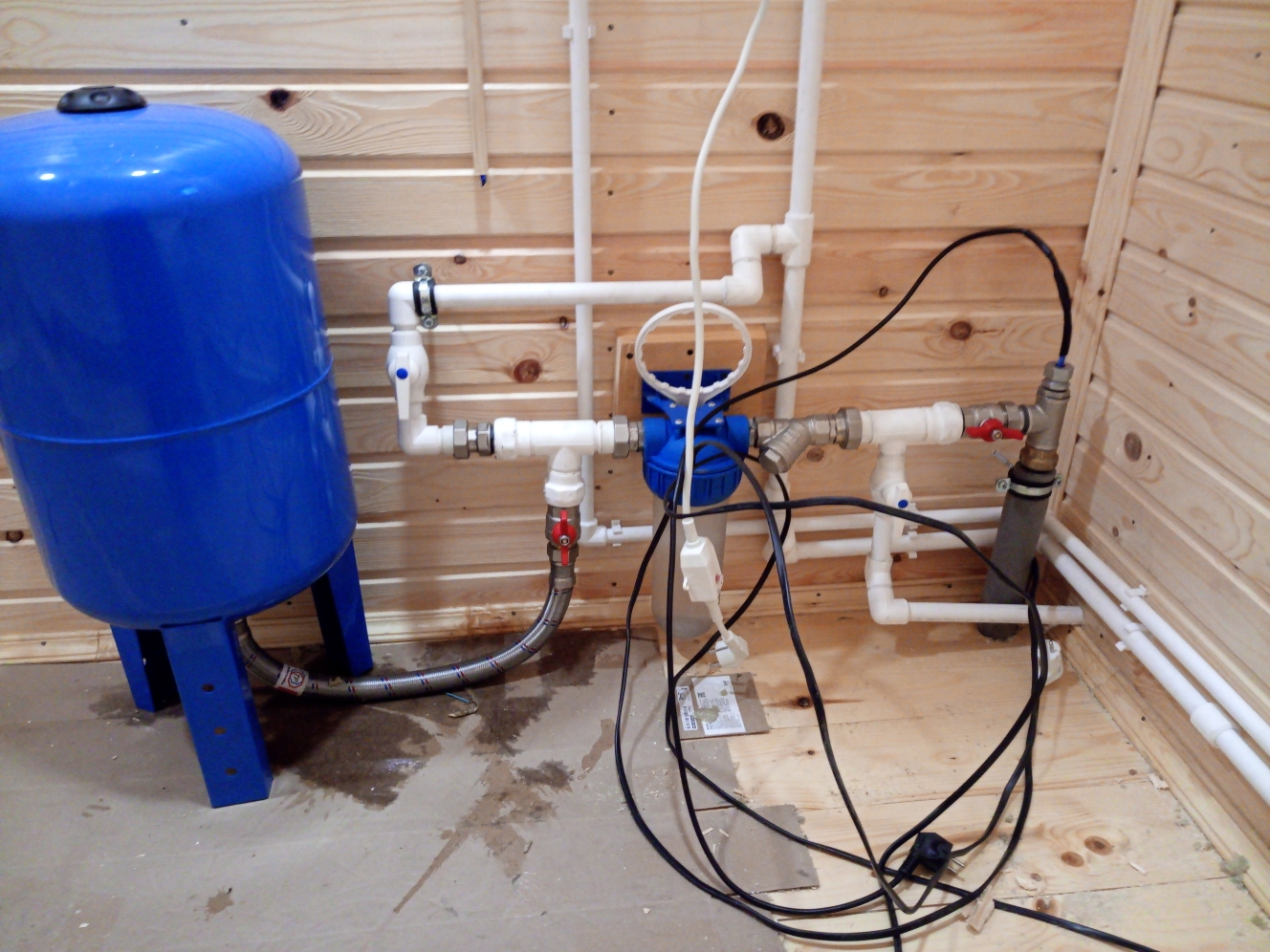
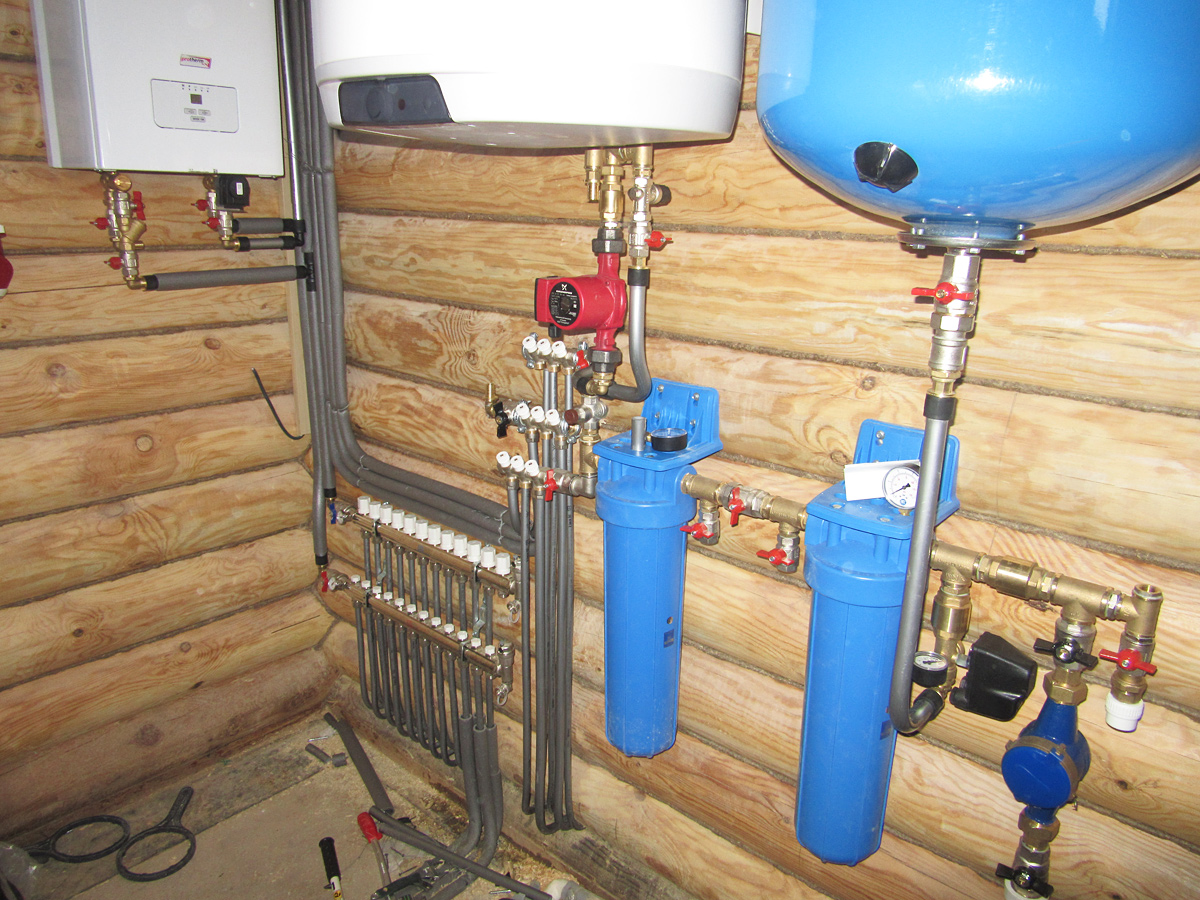

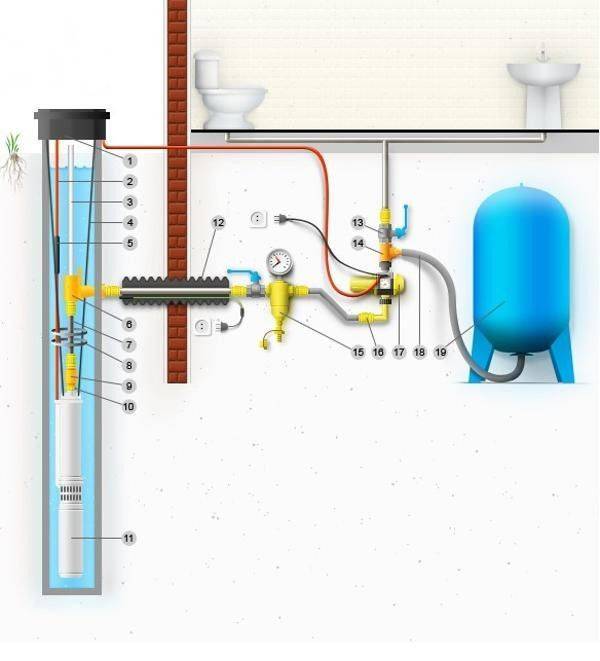
Fourth step
Installation of the water supply system
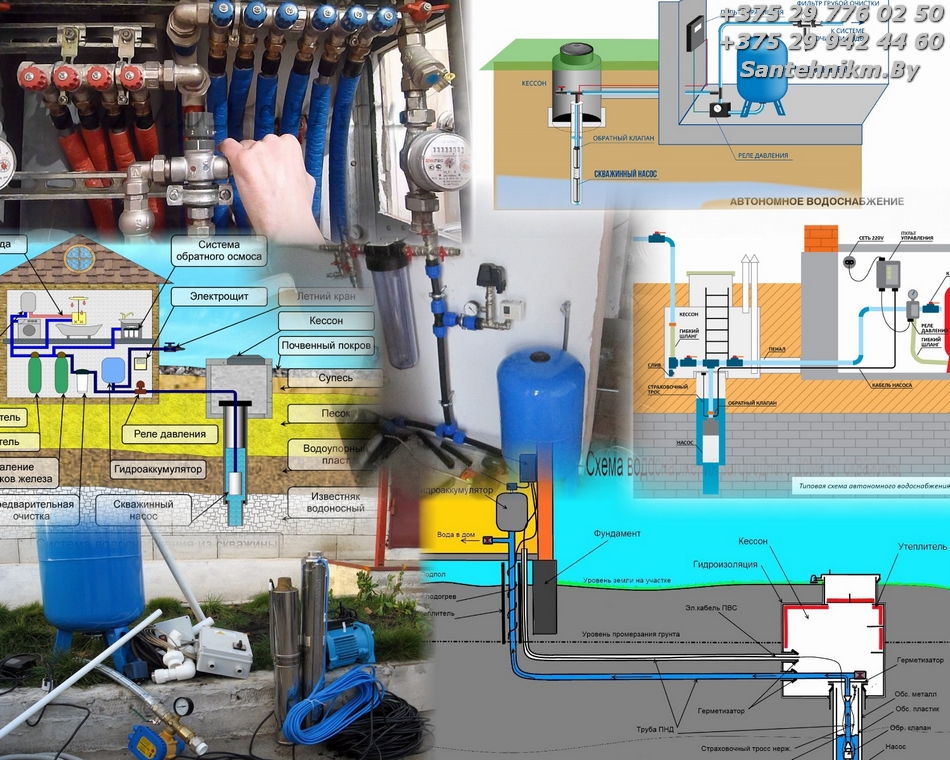
Connect the storage tank, pressure gauge, and pressure switch to the free outlets of the fitting. The volume of the storage tank can reach 400-500 liters and even more. Thanks to this device, optimal pressure in the plumbing system will be ensured. In addition, you can store water in the storage tank in case of unforeseen situations.
Fifth step
Connect the pipe to the remaining free fitting outlet, and then run the line along the previously leveled bottom of the dug trench straight into the house. Also, along the bottom of the pit, you need to lay a protected cable to connect the pump and accumulator.
It is important that the socket intended for switching on the units mentioned above is properly grounded.
sixth step
Installation of plumbing in the country
Install a shut-off valve in front of the pipe entry point into the building. It will allow you to shut off the water supply if necessary.
seventh step
After making sure that the external pipeline is working correctly, fill in the hole and proceed to installation of internal wiring.
Regardless of the chosen source of water supply, it is strongly recommended that the water supply system be equipped with cleaning devices.
Perform internal wiring in accordance with the previously prepared diagram.At this point, focus on your preferences. Do everything so that in the future it is convenient for you to use the connected water supply.
Installation of internal plumbing in the country
In conclusion, you will have to equip the water intake points by connecting faucets, appliances, etc.
Choosing a place to install
It is not difficult to make a pumping unit for a private house or cottage with your own hands. However, at the same time, it is necessary to solve the question of how and where to install the pumping station correctly. The place for installing a pumping station, on the correct choice and arrangement of which the efficiency of the equipment will depend, must meet certain requirements.
- If drilling a well or arranging a well on a personal plot has already been completed, then the pumping station is mounted as close as possible to the source of water supply.
- In order to protect pumping equipment from water freezing during the cold season, the installation site must be characterized by comfortable temperature conditions.
- Since pumping units require regular maintenance, free access must be provided to their installation site.
Based on the above requirements, a caisson or a separate and specially equipped room is used as a place to install a pumping station in a country house or in a private house.
Ideally, a place for a pumping station should be provided at the stage of building a house, allocating a separate room for this
Sometimes they install pumping units in buildings that already exist on the territory of the infield. Each of these options has its pros and cons, which should be discussed in more detail.
Placing a pumping station in a separate room in a building with a well drilled under the house
The scheme for installing a pumping station in the basement of a house is an almost ideal option for locating such equipment. With this installation scheme, easy access to the equipment is provided, and the issue of reducing the noise level generated during the operation of the station is also easily solved. This option will be most successful if the pump room is heated.

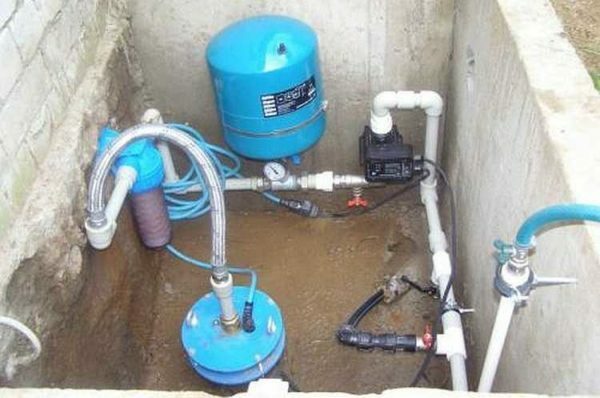
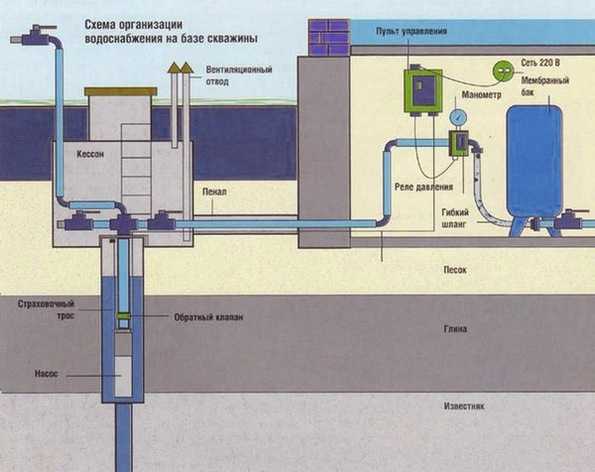
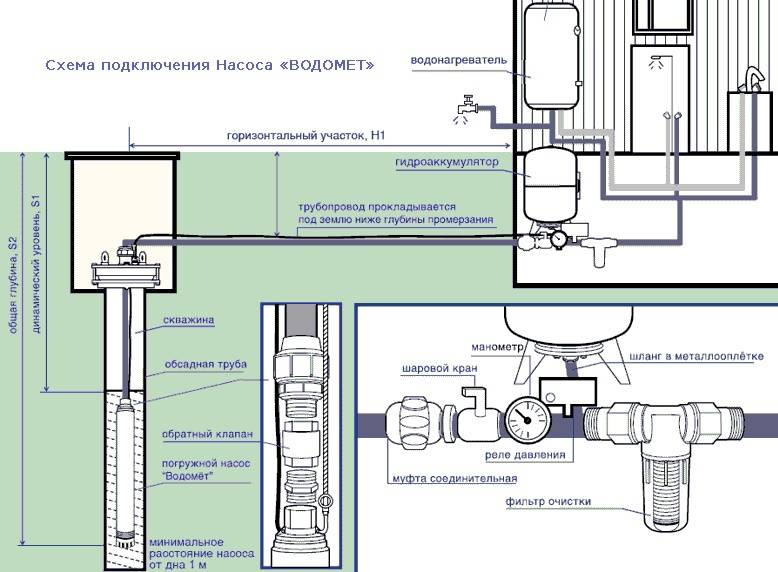
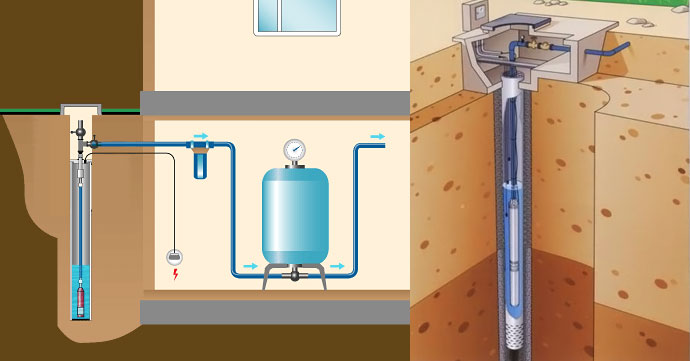

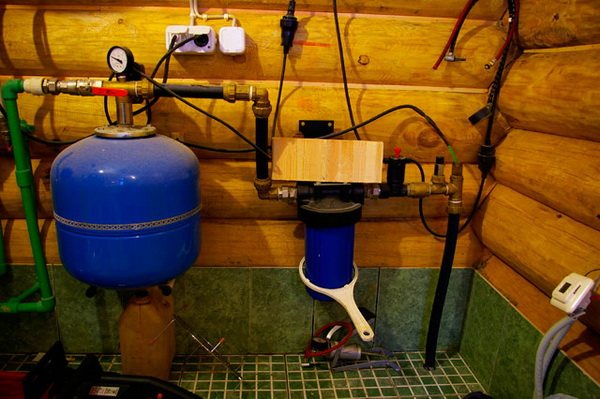

Placing a pumping station in a warm equipped basement
If the pumping unit is located in an outbuilding, quick access to it is somewhat difficult. But with such a scheme for connecting a pumping station, the problem with noise from the operation of the equipment is radically solved.
The station can be installed on a bracket in a sufficiently wide and deep well
Installing the station in a caisson will provide frost protection and complete sound insulation
Quite often, pumping stations are mounted in a caisson - a special tank that is installed above the head of the well, directly into the pit. A caisson can be either a plastic or metal container buried in the ground below its freezing level, or a permanent underground structure, the walls and base of which are made of concrete or finished with brickwork. It should be borne in mind that when installing a pumping station in a caisson, access to equipment is rather limited.In addition, if a connection scheme of this type is used for a pumping station, then the pipeline section between the pumping equipment and the building it serves must be carefully insulated or placed in the ground at a depth below the freezing level.