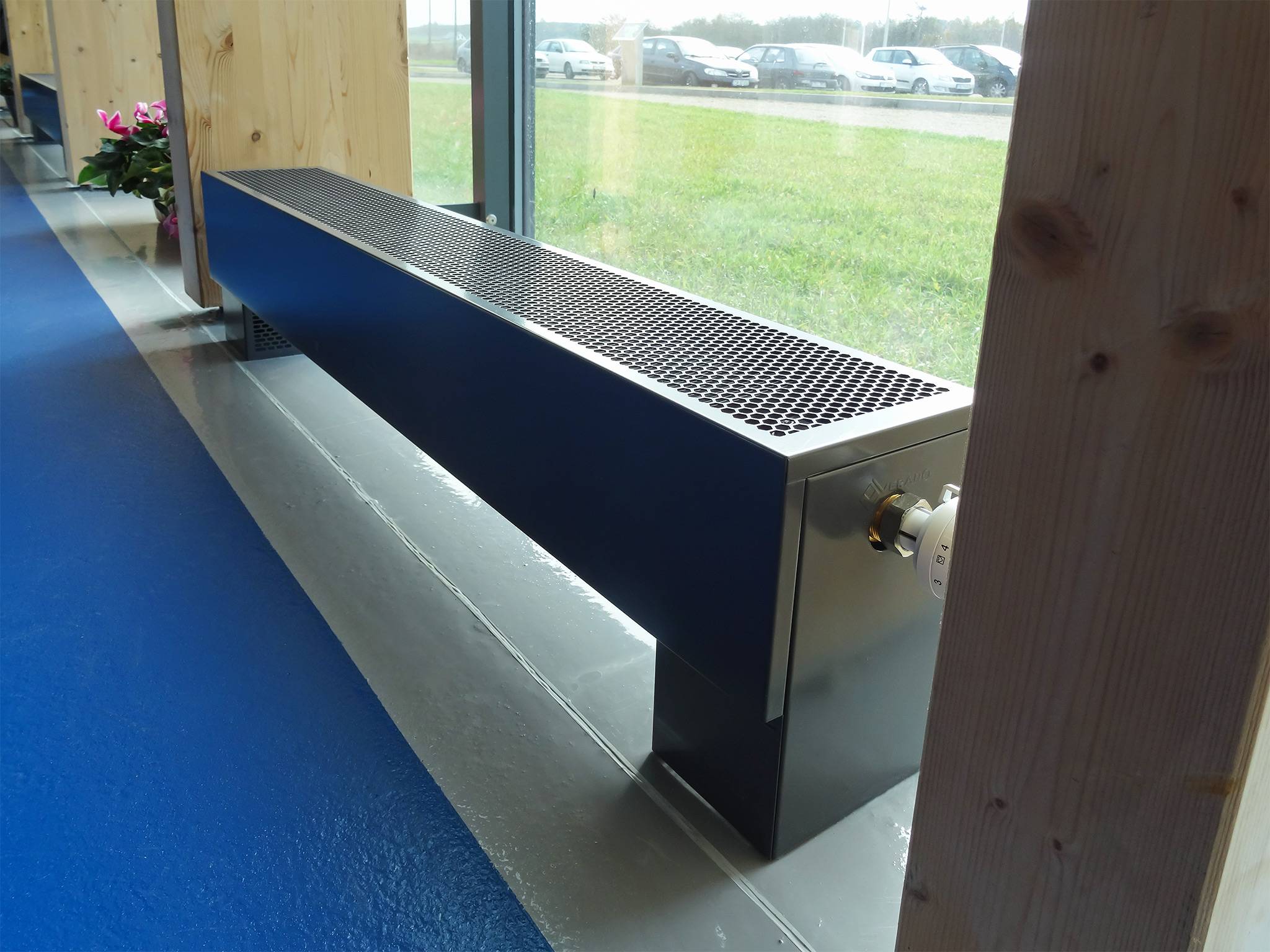
- Characteristics of floor water convectors
- The design and principle of operation of the device
- Types of floor convectors
- Advantages and disadvantages of devices
- What to look for when choosing floor convectors
- Kinds
- Water
- Gas
- Electrical
- Steel
- Cast iron
- Bimetal
- Designer
- Pros and cons of water heating convectors built into the floor
- Types of water convectors
- Floor convectors
- Wall convectors
- Skirting convectors
- Floor convectors
- Ground convectors
- Popular brands
- Kermi
- Isotherm
- elegant
- Standard
- Eva
- Itermic
- Purmo
- Water heating convectors built into the floor
- How to choose a floor water convector
Characteristics of floor water convectors
Heating appliances offered by domestic and foreign manufacturers differ significantly in appearance, material, variety of models and, of course, cost.
To choose the right option for your home, you have to take a closer look at convector-type water heating equipment.
The design and principle of operation of the device
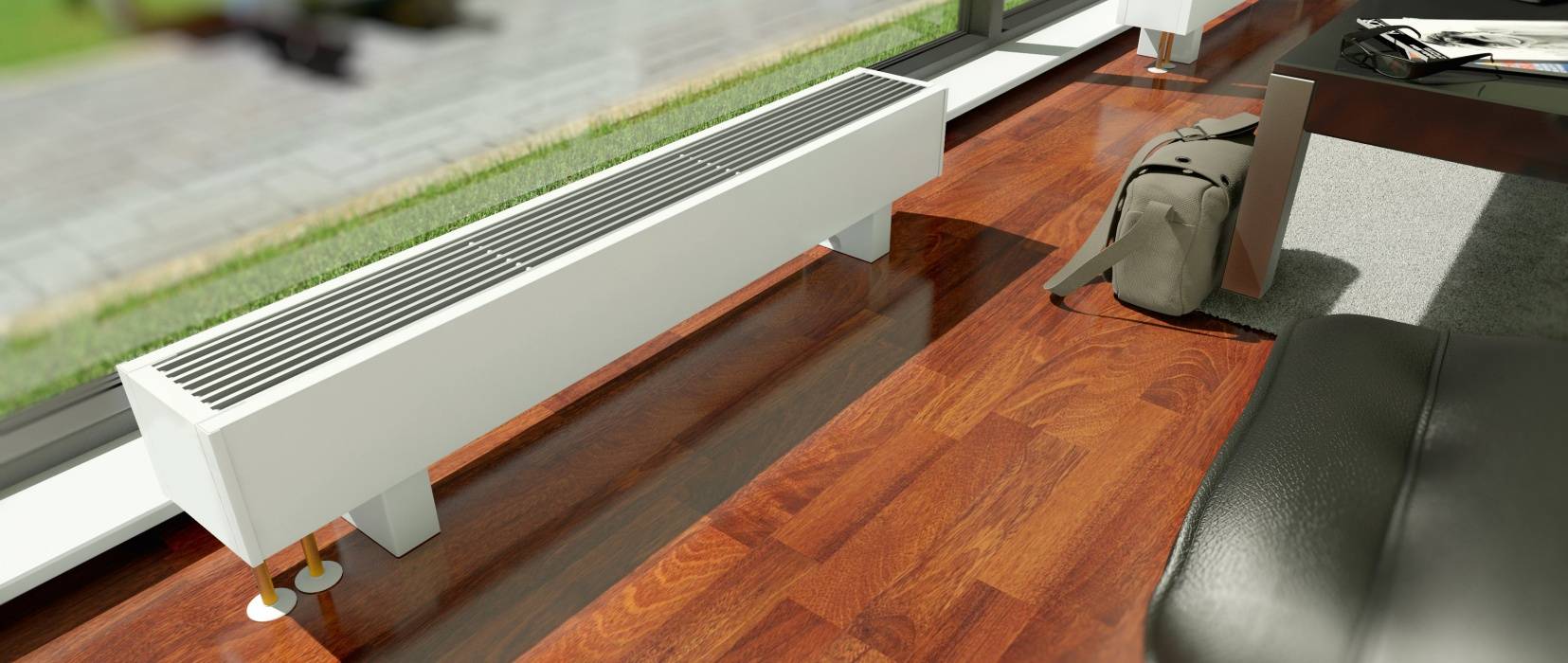
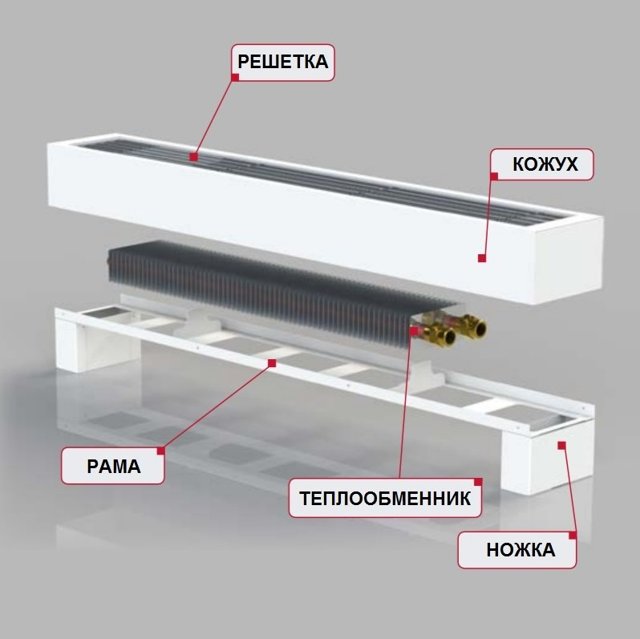
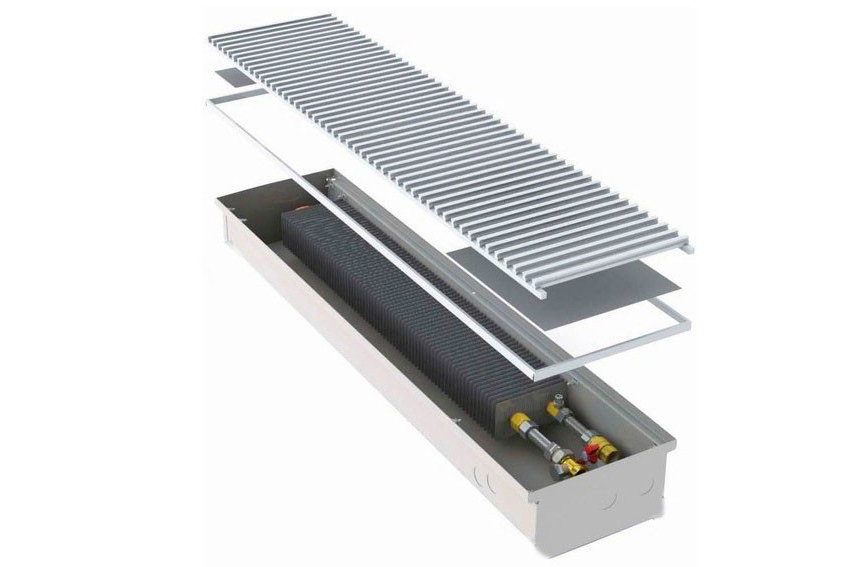
The floor convector has an elongated galvanized body 1-2.5 m long. Inside, one or more pipes are placed in a protective casing, which act as a heat exchanger.They are made of brass or copper and connected to aluminum plates. These materials are chosen for a reason - they quickly heat up and give off heat.
Thermal energy is distributed due to the circulation of air masses. Corrugated tubes are connected to the side or end inlets in the system, through which water is supplied, which heats the heat exchanger.
Air enters the holes made in the lower part of the device, contacts with the heating element and, increasing in volume, exits into the room through the upper lattice panel.
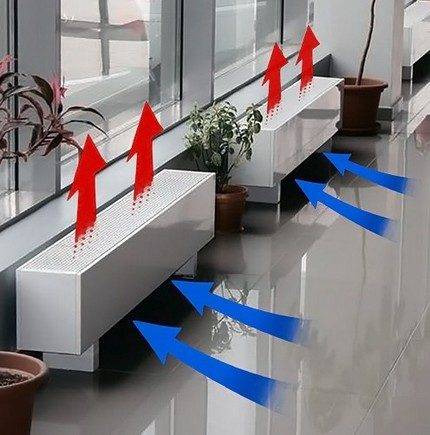
The principle of operation of the convector is simple: air passes through the heater from the bottom up, heats up and exits the room, instantly spreading heat
The heating process is carried out continuously. One cycle takes approximately 15 minutes. The convector heating system is practically silent - the sounds emitted do not exceed 20-23 dB.
Types of floor convectors
There are several types of underfloor water heaters on the market. They differ in the way of heating and purpose.
Conventionally, there are two types of equipment:
- with natural convection;
- with forced convection.
The first option provides for natural convection in the devices according to the classical scheme: air enters from below, passes through the heat exchanger and is pushed into the room.
Efficiency in this case depends on the traction force and the size of the device. The longer the length, the higher the power. Appliances with natural convection can serve as an additional source of heat and form a heat shield near windows.
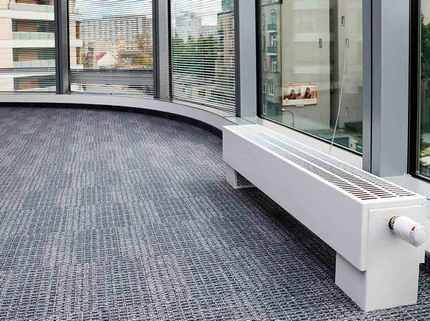
Floor convectors are indispensable in rooms with a large number of windows: they stop the flow of cold air seeping through them and prevent the accumulation of condensate on surfaces
Models operating on the principle of forced convection are additionally equipped with a fan that increases the efficiency of the device. It speeds up the heating process by pumping air and pushing it more intensively into the room.
The power of such equipment is determined by the fan speed.
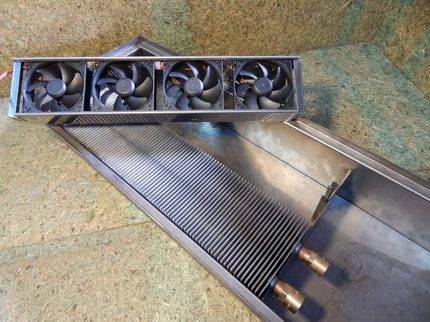
Devices equipped with one or more fans are characterized by greater power. They easily heat large rooms.
Devices with forced convection are used in both combined and autonomous heating systems of residential apartments, houses, offices, trading floors.
In the lines of trade offers of most manufacturers there are models designed for especially wet rooms.
Advantages and disadvantages of devices
With the help of floor-type water convectors, it is possible to organize a heating system that provides fast, uniform and high-quality heating of rooms of different sizes. And this is far from the only advantage.
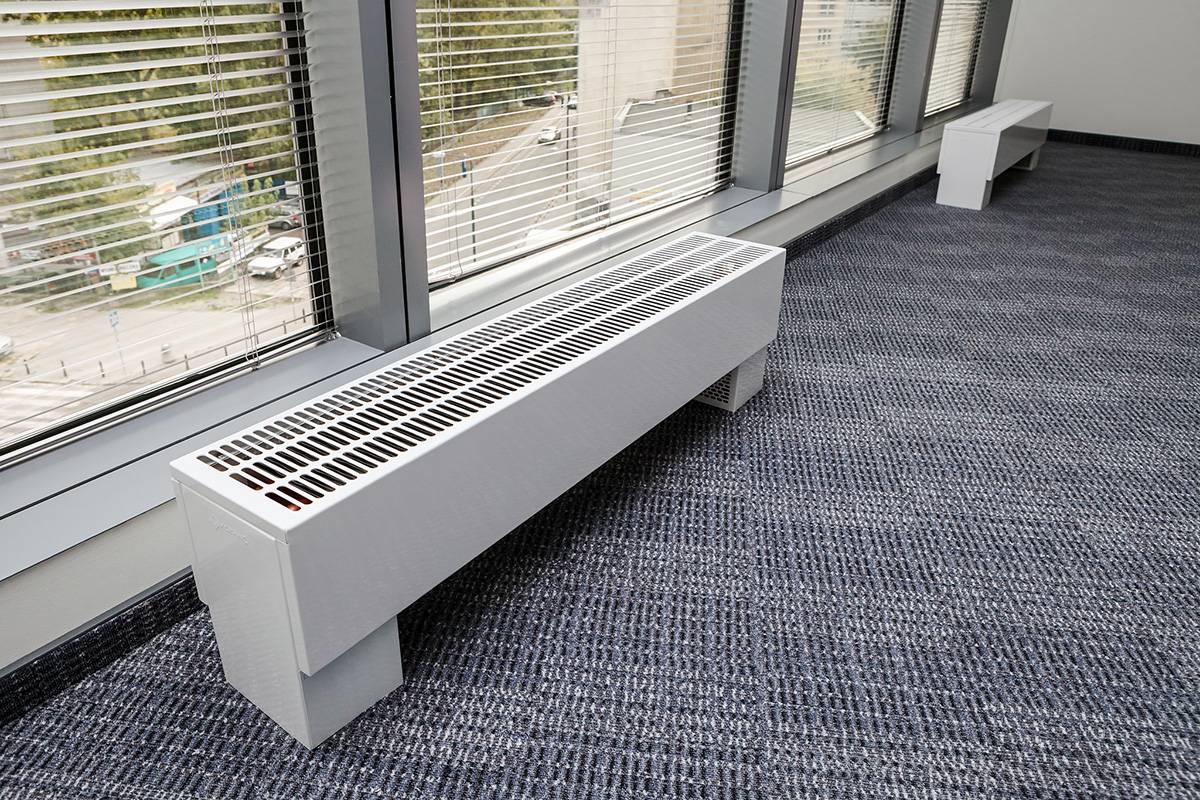

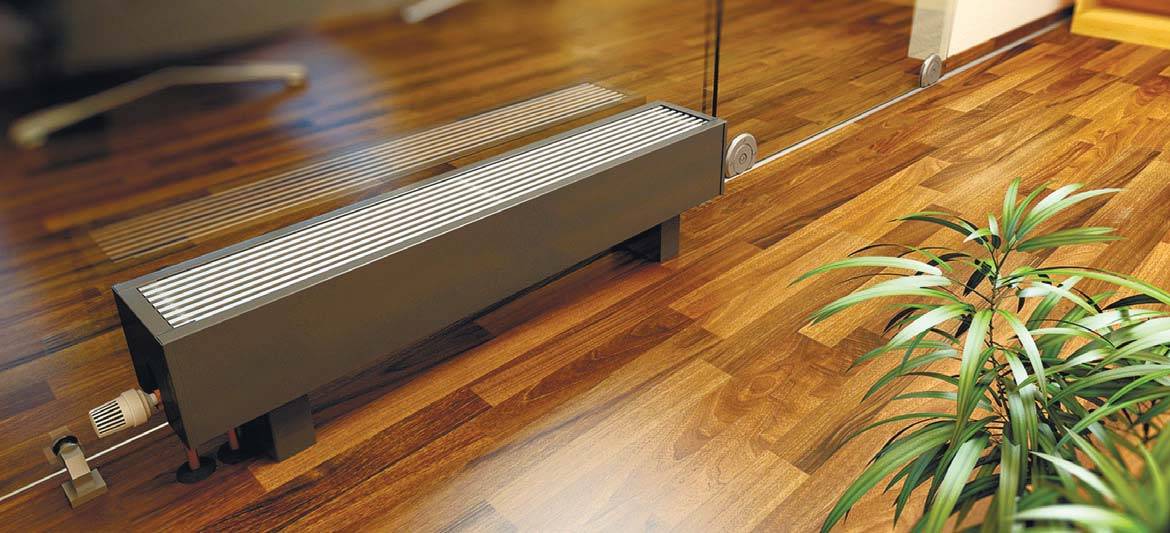


This equipment is different:
- stylish design and compact dimensions;
- fire safety;
- ease of installation and maintenance;
- economical consumption of electricity;
- low heating temperature of the coolant;
- the possibility of forming a reliable thermal curtain;
- long service life.
The equipment allows you to create and maintain an optimal comfortable climate and control the temperature using a thermostat.
Most manufacturers integrate special cleaning systems into floor convectors.They destroy viruses, bacteria and prevent the spread of infections in the air.
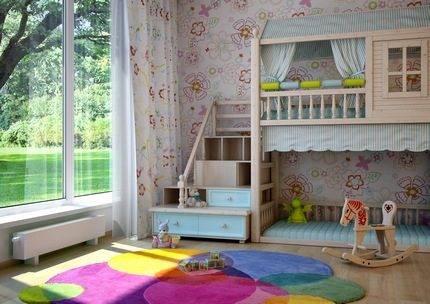
Floor water heaters do not dry out the air and are completely safe for health. They are safely installed even in children's rooms.
The devices also have disadvantages. First, they are incompatible with artificial ventilation. Secondly, convection currents provoke excessive dustiness.
In addition, it is undesirable to install convectors in rooms where the ceiling height is less than 2.2 meters. This is due to the fact that the heated air will not have time to cool down to the parameters that ensure its downward movement. Because of this, circulation will slow down, and the air flow will begin to stagnate under the ceiling.
What to look for when choosing floor convectors
The selection of the thermal power of floor convectors is no different from the same calculations for classic heating radiators. Approximately 40 W of thermal energy is required per 1 cubic meter of room volume. If you count from the area, then for 1 sq.m. should account for 100 W of convector power.
However, the following factors should be taken into account:
- in the absence of wall insulation - 1.1;
- windows with double-glazed windows - 0.9;
- corner room - 1.2;
- ceiling height from 2.8 m - 1.05.
It must be understood that the power of the built-in water convector indicated in the characteristics corresponds to a coolant temperature of + 75 ° C. In electrical versions, the maximum possible power is indicated. The number of convectors depends entirely on the heat loss of the room and is calculated at the design stage of the heating system.
The total number of devices, as well as their dimensions, directly depend on the heat demand and are calculated at the design stage of the heating system, taking into account the expected heat losses. Thermostatic heads are used to control the output or, as a cheaper option, manual valves.
Kinds
Despite the fact that the principle of operation is approximately the same for many models, they are divided into three types, namely: water, gas and electric.
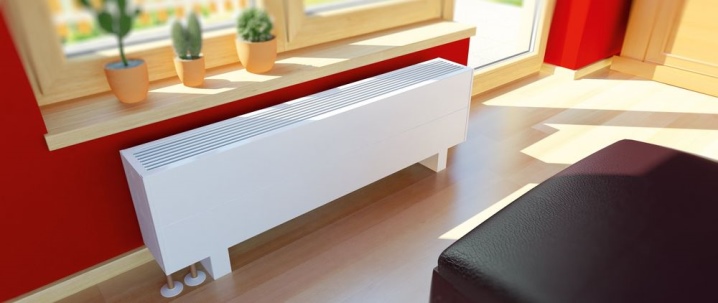
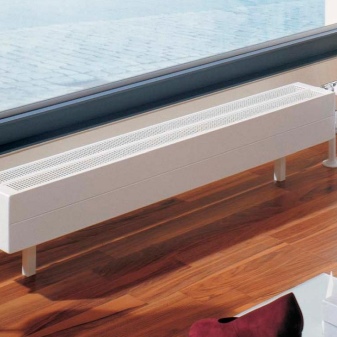
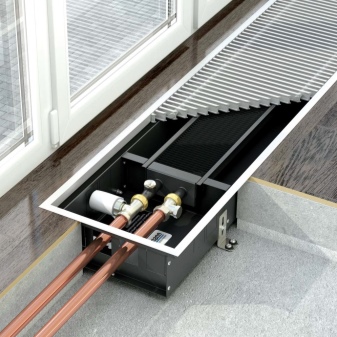
Water
Such heaters have a basic structure and are connected to the heating system. Due to the fact that the heating element treats water, the temperature can reach +50…60°С. If we compare a water convector with a radiator, then the smaller amount of coolant that is required can be called an advantage.
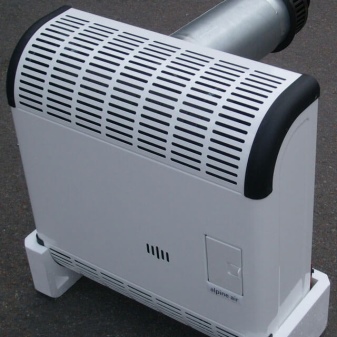
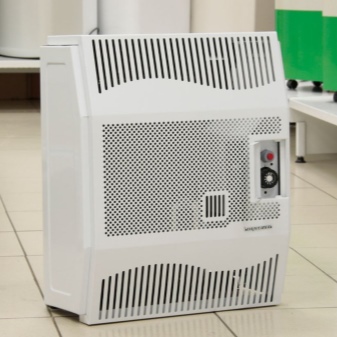
Gas
They differ in their structure. In addition to the heat exchanger, under the body of such heaters there is also a smoke exhaust system, a burner, a combination valve (it determines the gas pressure in the unit) and an automation system. This system monitors the operation of the burner and the chimney and, in the event of a system failure, switches it off. The gas on which these types of equipment operate can be bottled or main. Due to the fact that fuel must be purchased separately, the cost of such floor heaters is low.
Electrical
They are special in that they do not need to be connected to any pipeline, which makes installation much easier. And also the difference from other types can be called the fact that the electric convector has more functions. Do not forget that there is no combustion of fuel. This makes the device environmentally friendly.
Power is supplied through the mains with a voltage of 220 V. The set may include wheels on which you can move the device. This adds portability compared to ceiling and wall mounted heaters. If your device is powerful, then it can heat several rooms in series. Among the additional functions that this type of heater has are the anti-freeze function, overheat protection and tip-over protection.
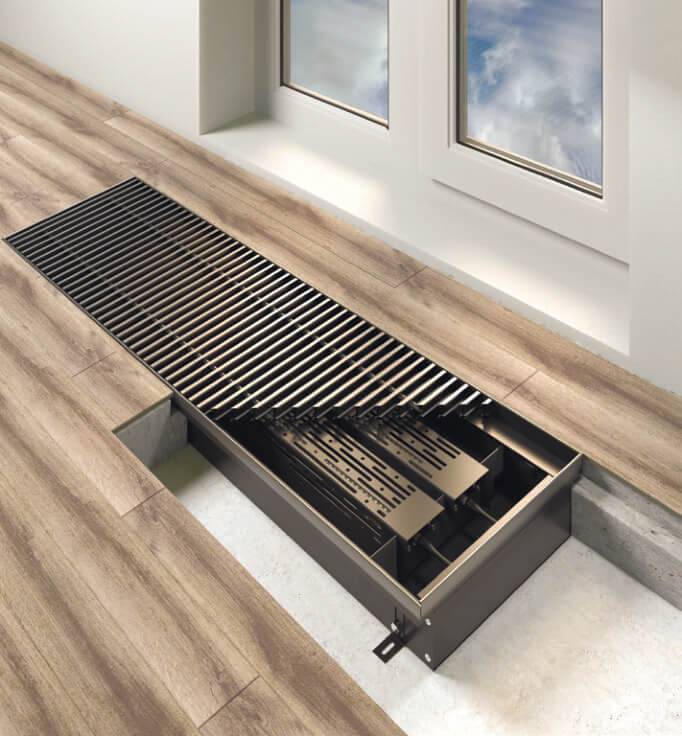
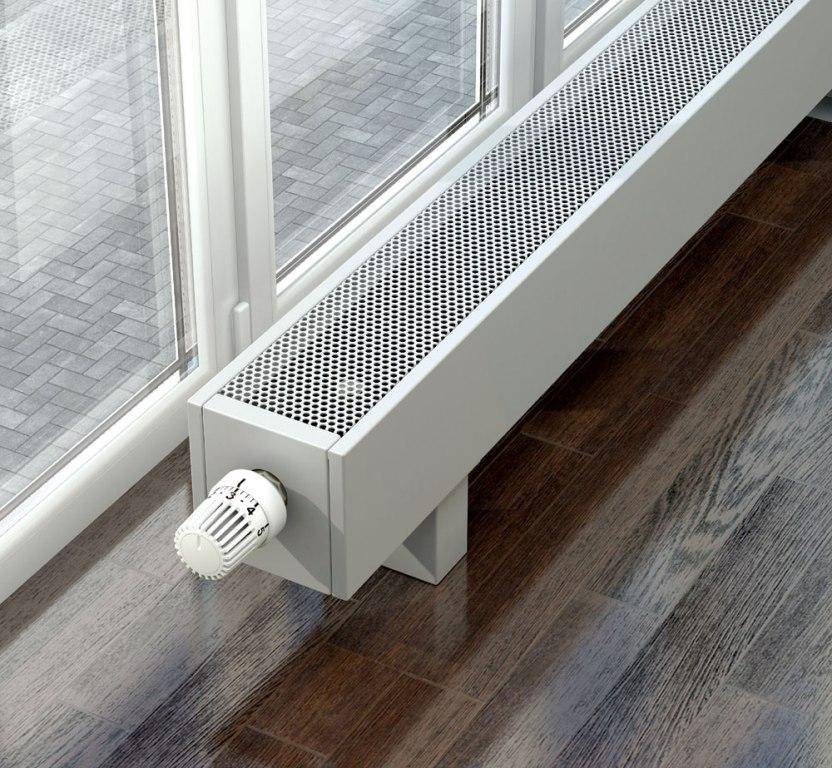

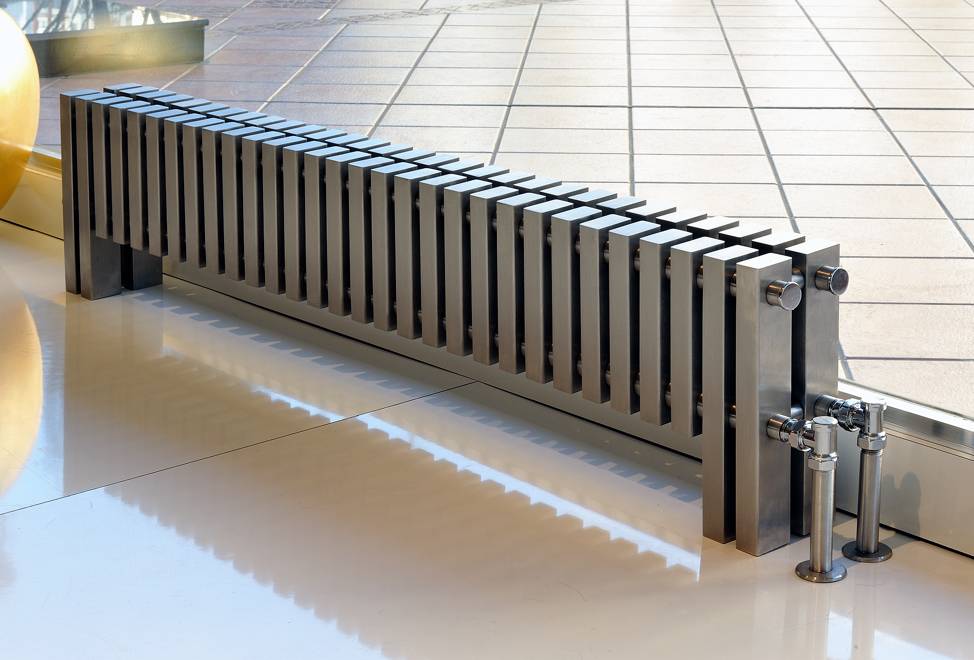
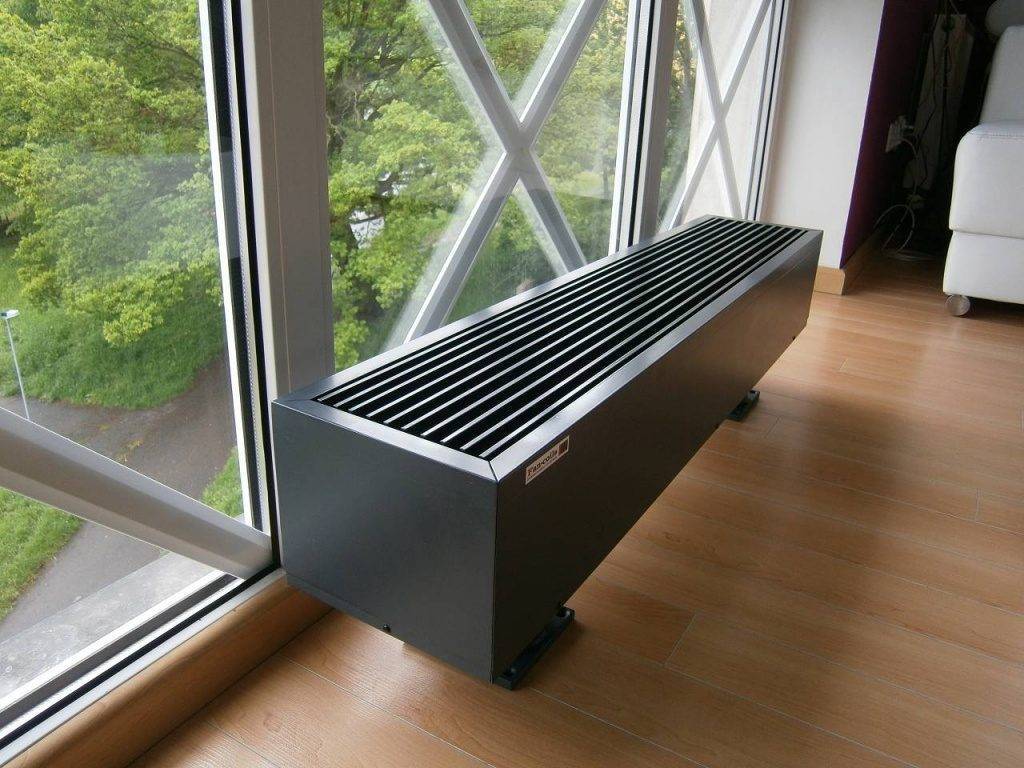


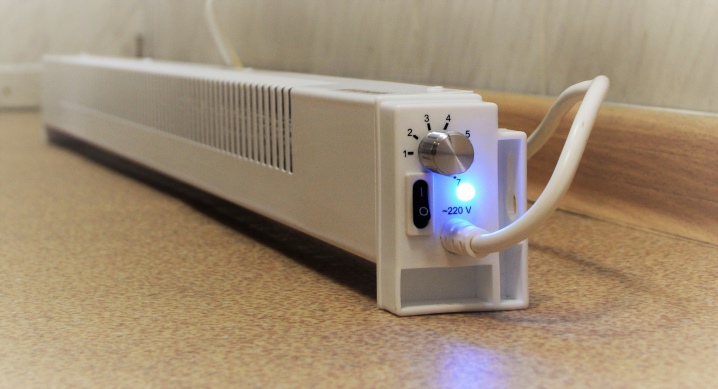
The system of protection against drops in the network makes a very big difference. Gas and water counterparts do not have a protection function in case of power supply failure, so the electric representative is safer. They are also best purchased in families with small children. In addition to being environmentally friendly, there is no way to stick your fingers or other objects into the grate. The material from which the casing and the protective device are made can also be of several types.

Steel
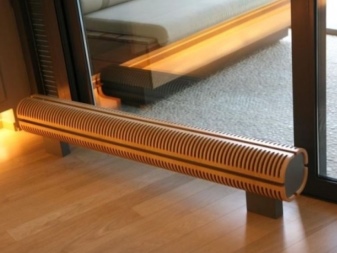
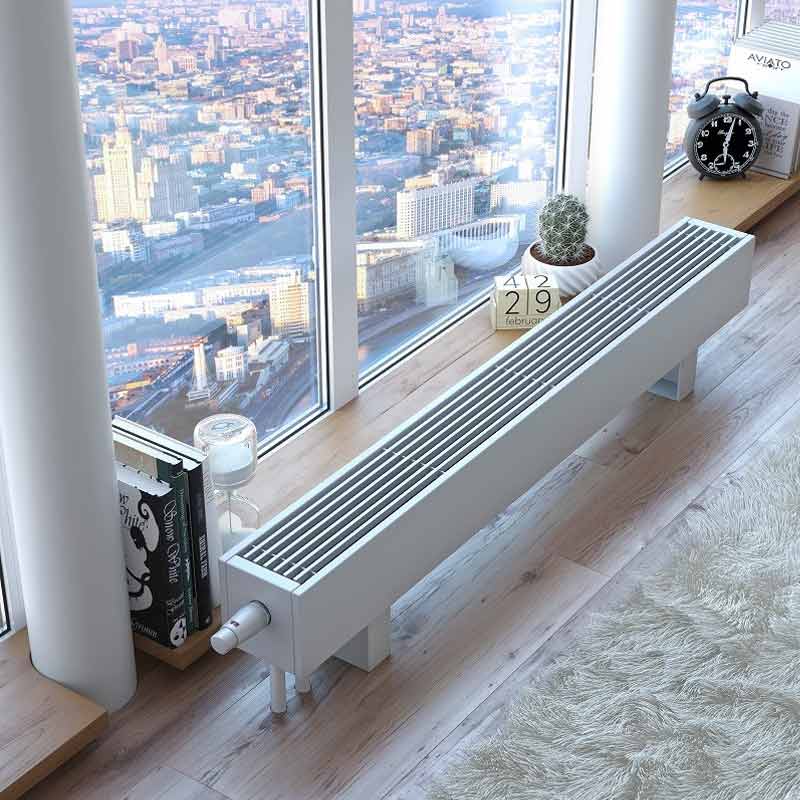
Steel cases are very durable, and the presence of a stainless coating increases service life and reduces wear. The bulk of the products are made from this material. The low weight and high heating area can also be called an advantage. Such a heater can supply heat even to trade pavilions. Another plus is that they are ideal for those people who have panoramic windows. Such equipment can be built into the floor, and it will not block the view from the windows.
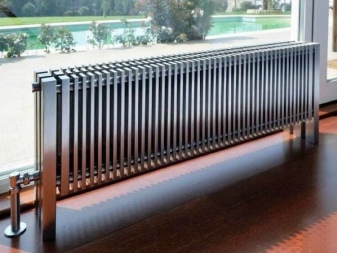
Cast iron
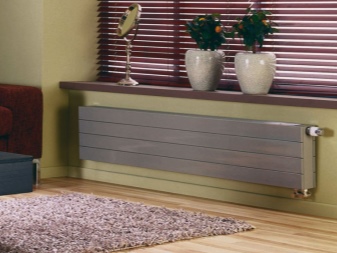
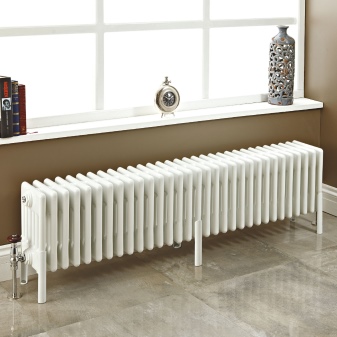
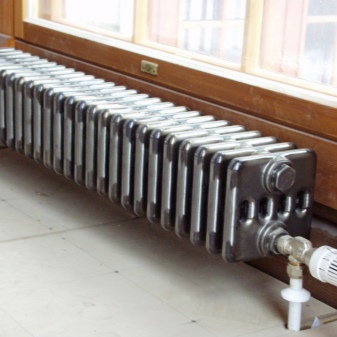
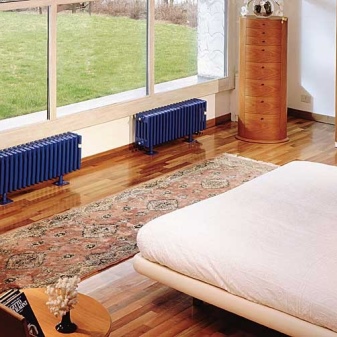
Very strong, but at the same time fragile material. Heaters made of this material are much cheaper than those made of steel. If there is any heavy impact or damage, the case may begin to crack. But the advantage can be called the fact that heat is generated due not only to heat transfer, but also to thermal radiation.Outwardly, they look like old batteries that were connected to a water heating system. As a rule, they are installed in apartments, and adjustable legs allow them to be placed even under the window.
Bimetal
Such devices are made of several metals. They can combine the positive qualities of these metals, while complementing each other. For example, you can use a steel case, which is very strong and light, and make some components and parts from copper to improve thermal conductivity. This will speed up the heating process of the device and the overall amount of heat so that it spreads over a larger area. Such units, of course, will be more expensive, but they allow you to combine the positive characteristics of several materials.
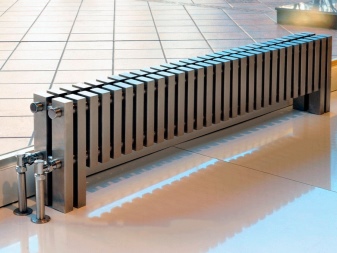
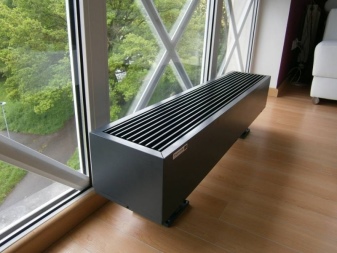
Designer
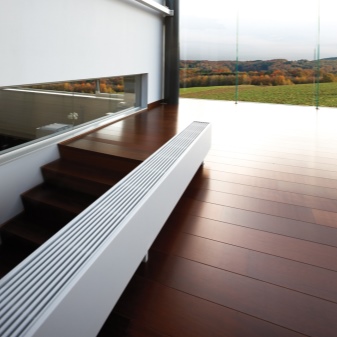
Convectors that come under special order. Given the current trend in high-tech style, most of the models are made in it. The material may optionally be metallic on the outside
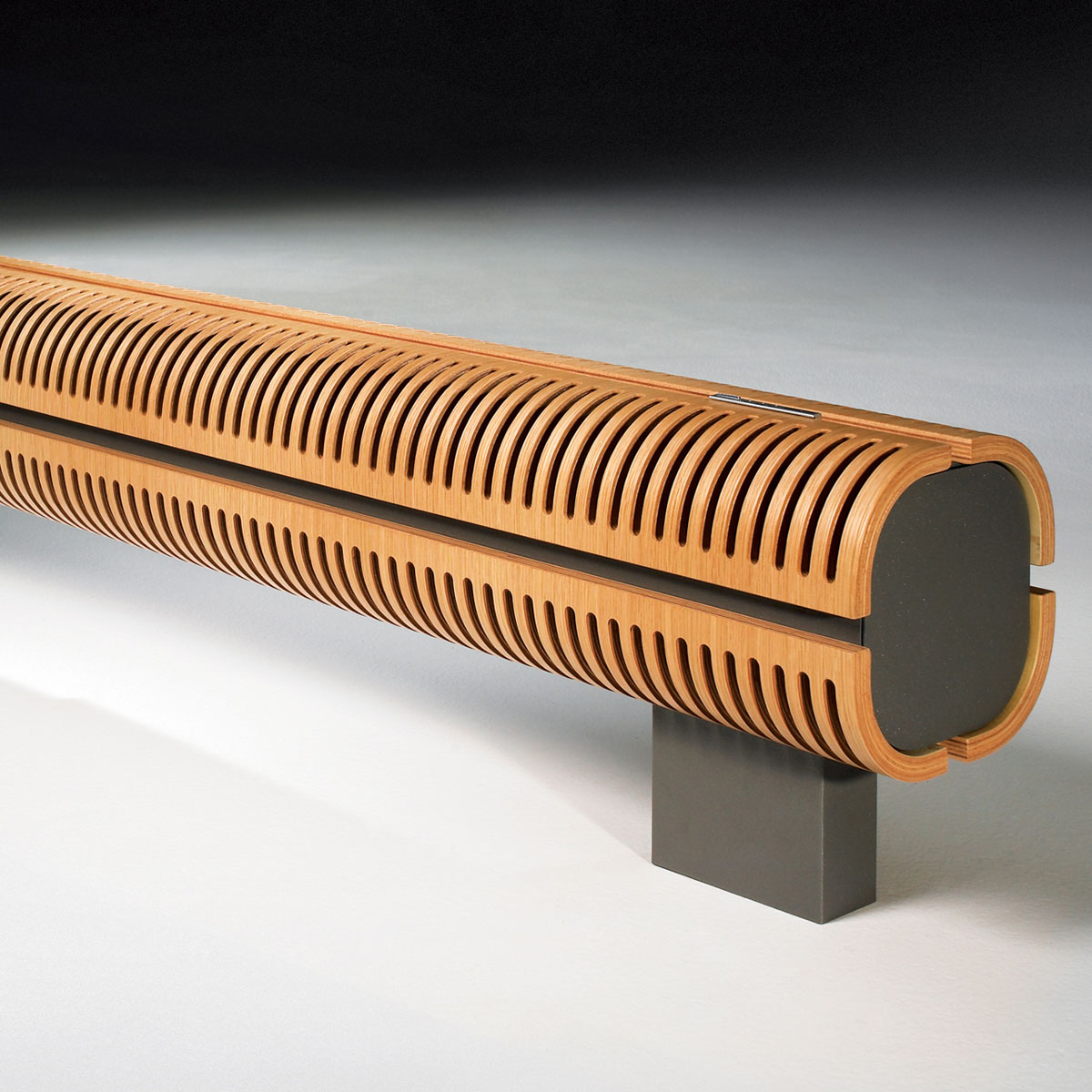
Attention is focused on not only warming with high quality, but also having an original appearance. The color palette can also differ from the usual white and black colors that are predominantly found in cast iron and steel models.
Pros and cons of water heating convectors built into the floor
Underfloor heating convectors are an ideal solution for almost any interior. In aesthetic terms, such convectors have the same advantages as built-in household appliances. Performing their functions, they do not occupy living space and are quite easy to hide with decorative elements.
Like any heating device, water floor heating convectors have their advantages and disadvantages.The advantages include the following aspects:
- Such devices have a fairly high efficiency compared to floor and wall counterparts, as they heat the air from the floor itself. As a result, much less heat energy is required and, as a result, lower heating costs.
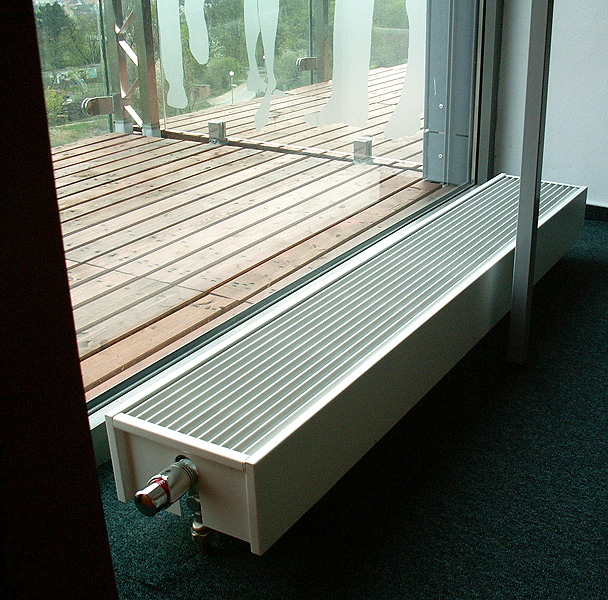
- Floor convectors free up free space in the room and allow you to install them with panoramic windows or terrace exits.
- The large area of the heat exchanger also contributes to more efficient heating of the room.
- The light weight and simplicity of the design make it possible for non-professionals to install such devices, subject to safety precautions and installation rules.
- Stylish and modern look. By choosing a suitable decorative grille, you can successfully fit floor convectors into the style of your interior.
In addition to the advantages, such devices have a number of serious disadvantages:
- The need for a thick layer of concrete screed to ensure the installation of the convector. Due to their design, such devices require a large amount of space from the level of the subfloor. This limitation makes it impossible to use floor convectors in many houses and apartments.
- The need to accurately adjust the level of the finished floor to the level of the decorative grilles of convectors throughout the house.
- The high price of such heaters compared to standard wall and floor types.
- The need for frequent cleaning of the premises due to the fact that the air currents passing through the floor itself often raise dust.
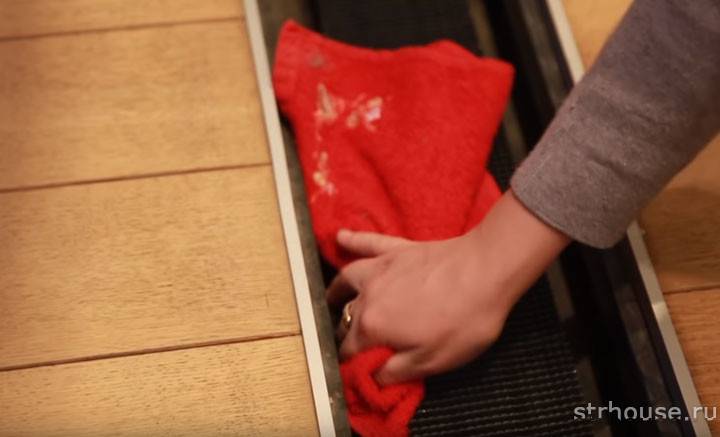
- The inconvenience of cleaning the floor convector itself and the clogging of dust and dirt into it.
- One of the most serious drawbacks of convectors located in the floor is the inconvenience of maintenance in the event of an accident. In the event of leaks or emergency failure, the convector niche will quickly fill with hot coolant, which will hinder access to shut-off valves and may lead to injury. In the presence of central heating, such an accident can lead to the impossibility of stopping the supply of coolant.
Types of water convectors
Now we will talk about the most interesting - about the types of convector heaters on the water. On sale are:
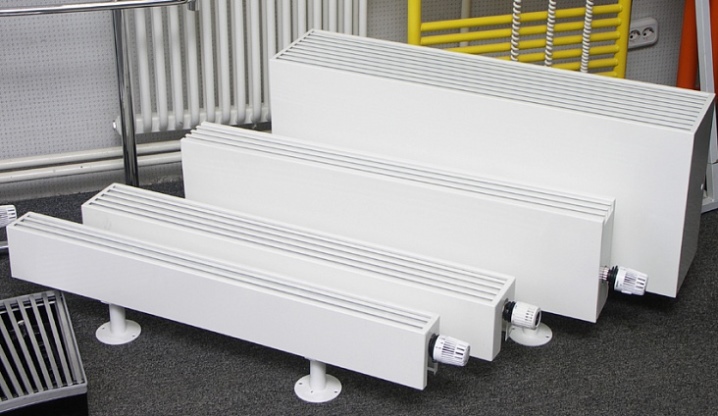
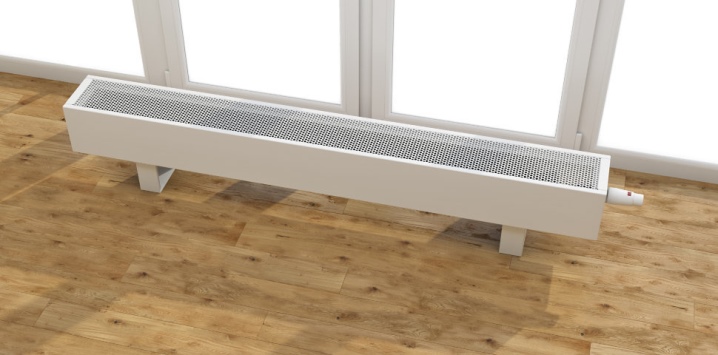
- floor models - they are mounted on the floors;
- wall models - the most popular and common variety;
- plinth models - an innovation in the modern heating market;
- floor - devices for hidden installation in floors;
- plinth models - devices for embedding in walls, niches and even stairs.
Consider all types in more detail.
Floor convectors
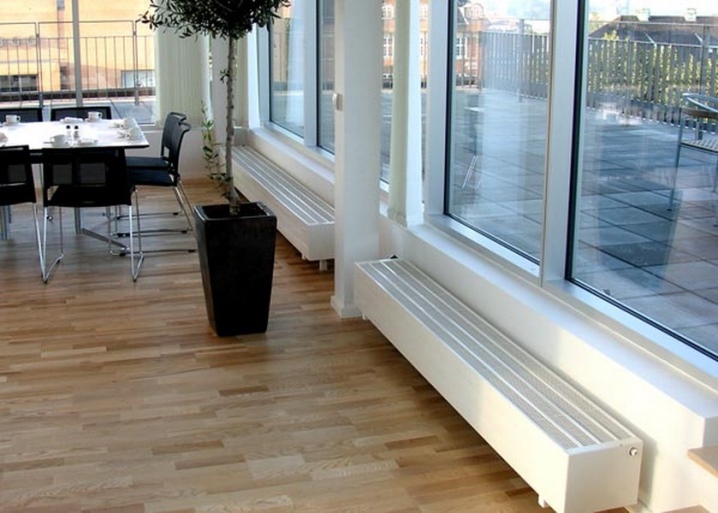
Floor convectors are often used in rooms with panoramic windows. In this case, pipes for supplying hot coolant are laid in the floor. Installation of heaters is reduced to their fixing and connection to the heating system. Using the lowest and most compact models, you can achieve an ideal view from the window and high-quality space heating.


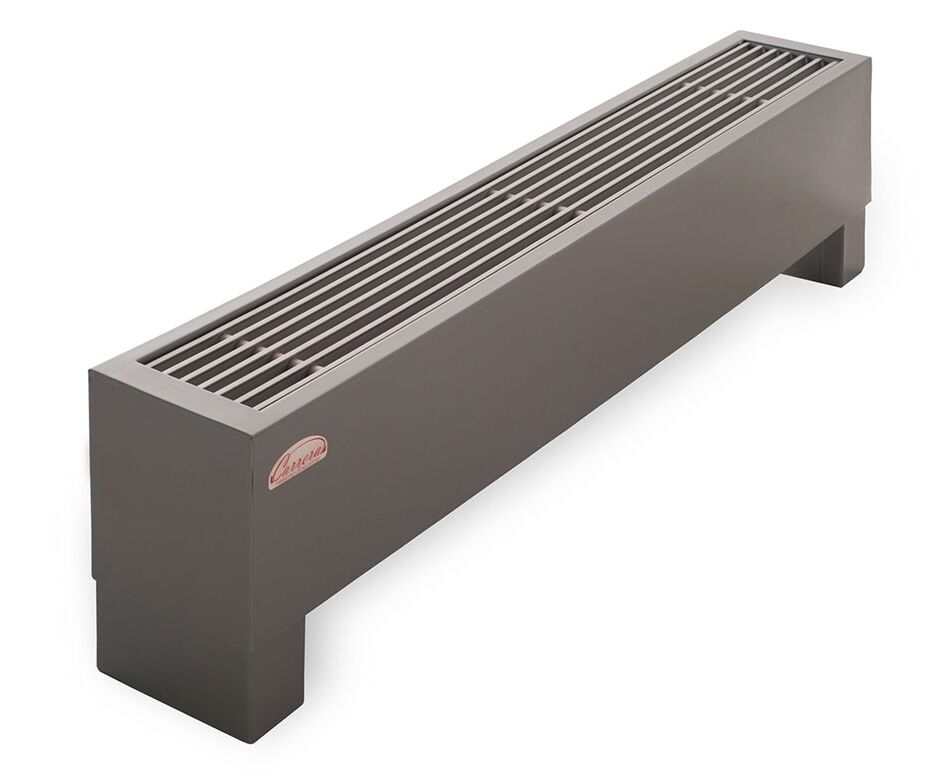

Underfloor water heating convectors are considered as an ideal solution for cinemas, exhibition pavilions and other buildings with high floor-to-ceiling panoramic windows.
Wall convectors
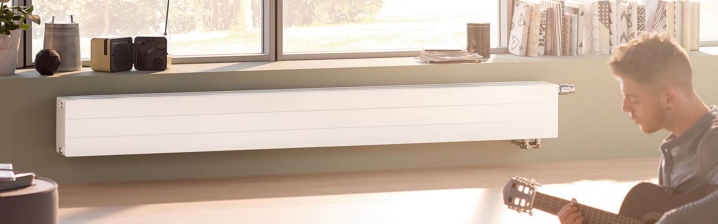
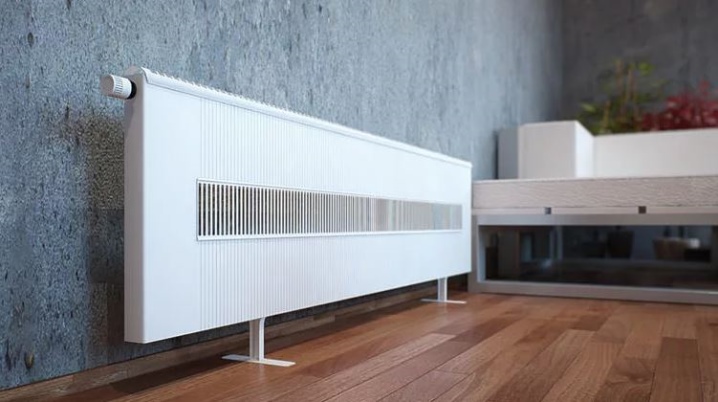
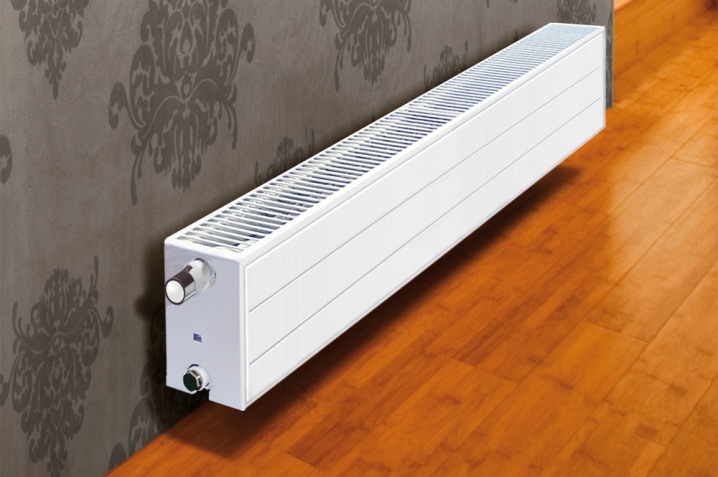
Wall-mounted convector heaters on water are characterized by minimal thickness and compactness.In size, they resemble electric convectors or conventional batteries. High models are installed under ordinary window sills, and miniature varieties of small height are suitable for windows with low window sills. Due to their design, they provide efficient heating. In addition, they can be installed along blank walls.
Wall mounted water convectors are used for heating premises for various purposes - these are ordinary living rooms, offices, industrial buildings, trading floors of shops, warehouses and much more. They do not clutter up the space and provide a soft and almost imperceptible circulation of heated air. For designer interiors, devices with decorative trim are produced.
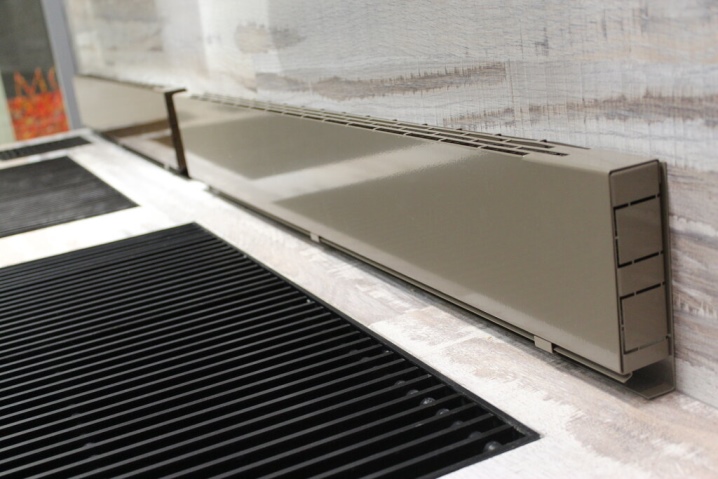
Skirting convectors
Skirting heating convectors are comparatively new. They are miniature and designed for installation of baseboard heating. Their advantages:
- uniform heating of the air over the entire height of the room;
- extremely compact dimensions;
- high heating efficiency.
Despite their diminutiveness, floor heating devices warm up living spaces well, creating a comfortable atmosphere.
Floor convectors
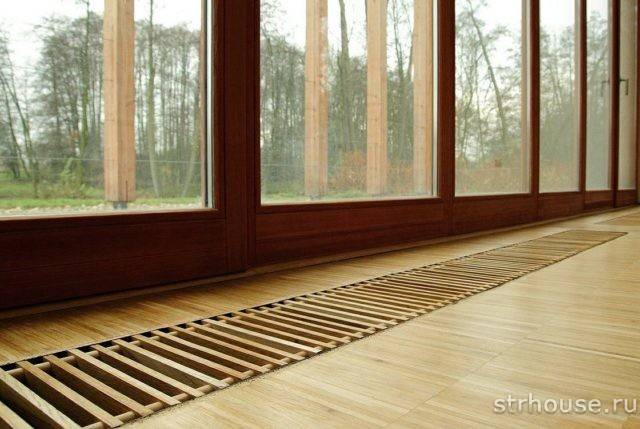
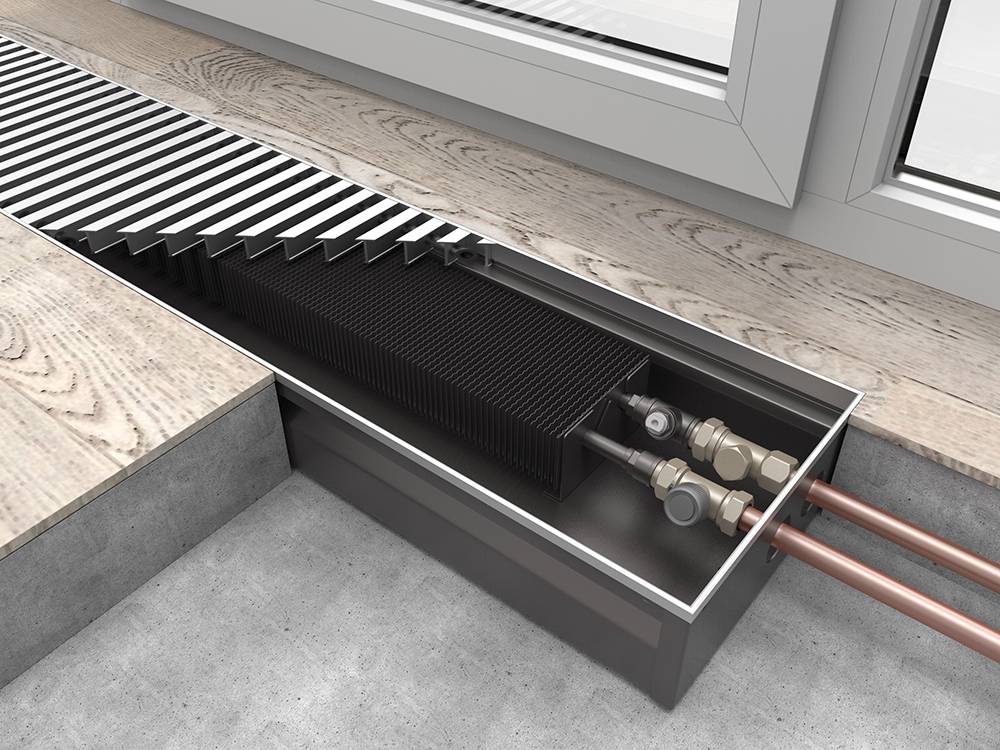
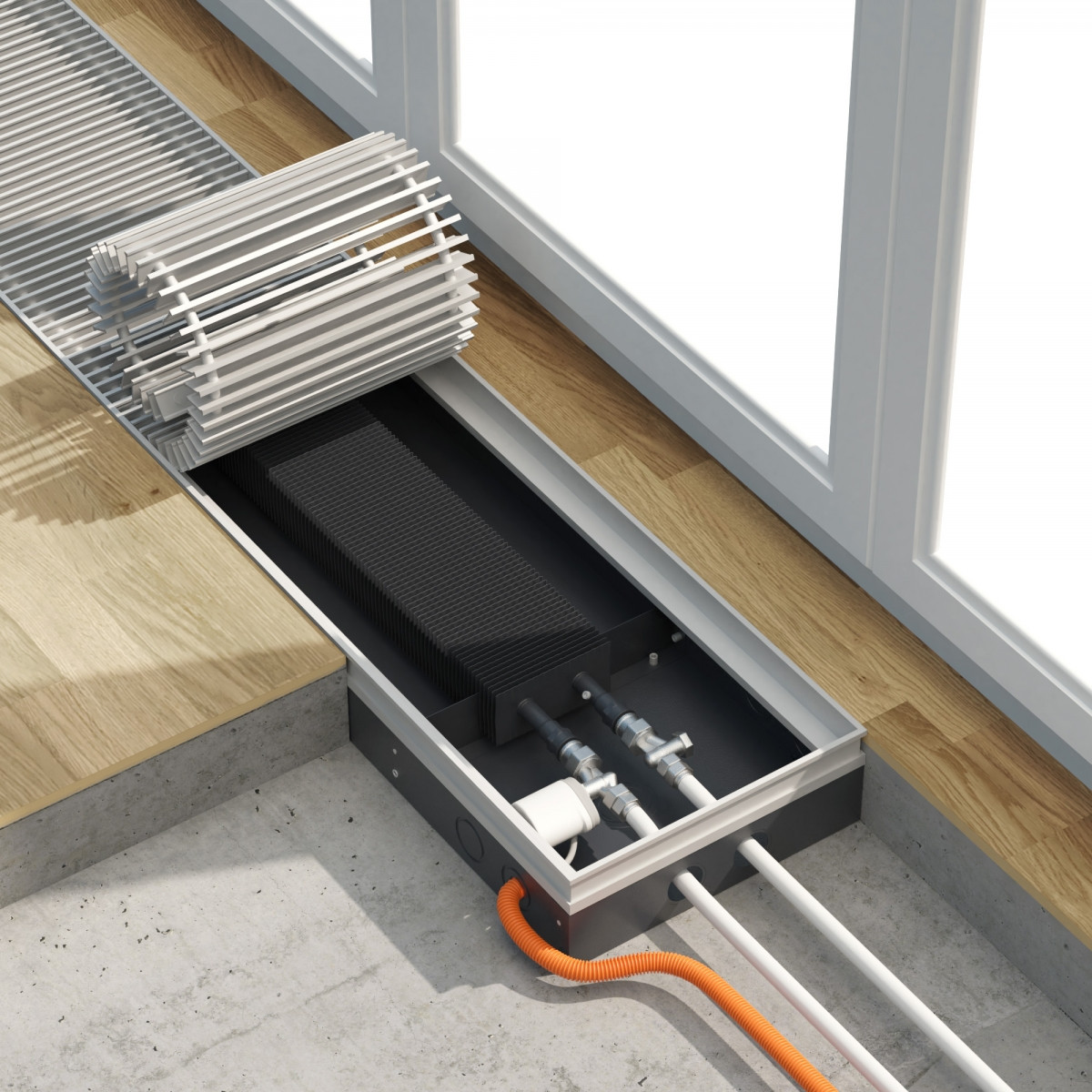
Underfloor water heating convectors will be a godsend for those who want to create the most hidden heating system. As their name implies, they are recessed directly into the floors, where special niches are created for them. Pipes are laid there, through which the coolant circulates.One floor water convector of a large width will provide high-quality heating and will not spoil the interior with its appearance - you can only guess about the presence of such a heater by a masking grate in the floor.
Where are floor water convectors used? They are indispensable for installation in rooms with panoramic windows - unlike low floor devices, they do not block the view from the windows, even partially. Being completely recessed into the floor, convector heaters do not interfere with the movement of people, so they can even be installed in doorways, creating a barrier to cold air flows.
Underfloor heating convectors are indispensable in interiors that are subject to increased requirements for finishing. These can be exhibition halls, concert halls, museums and other places where heaters sticking out of the floors or their wall-mounted counterparts would be inappropriate. They are also used to heat private houses - the absence of visible elements of heating systems allows you to create interesting interiors.
Ground convectors
Another novelty in the world of heating equipment is basement water convectors. They are relatives of floor devices, as they are designed for flush mounting. Their installation is carried out in small niches, in walls, in stair steps, in partitions between rooms. Basement convectors allow you to create an invisible heating system that is highly efficient. They will be an excellent choice for those who want to create an exclusive interior in which heating devices will not be found.
Basement heating convectors require connection to the electrical network.Electricity is needed here to rotate fans that create forced convection. In order to make them less noisy, manufacturers use low-noise fans. Thanks to this, they can work even at night without creating discomfort for the household.
Popular brands
On sale you can find floor convectors from many manufacturers. Consider the most common brands and their products.
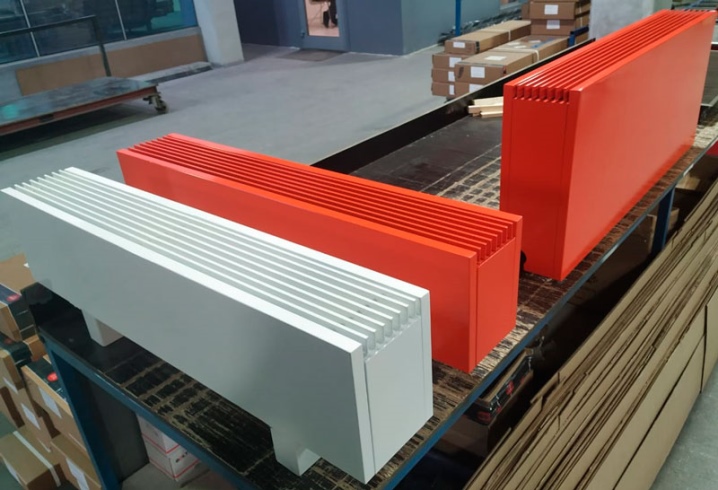
Kermi
German manufacturer specializing in valve convectors. In assortment brand many different models.
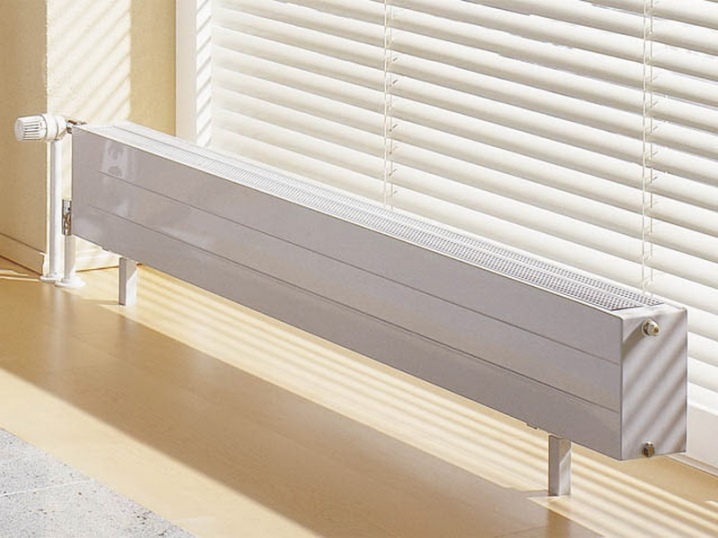
Kermi KNV is a heater that is equipped with a valve block. The presence of wheels and power adjustment will allow you to use this unit in several rooms.
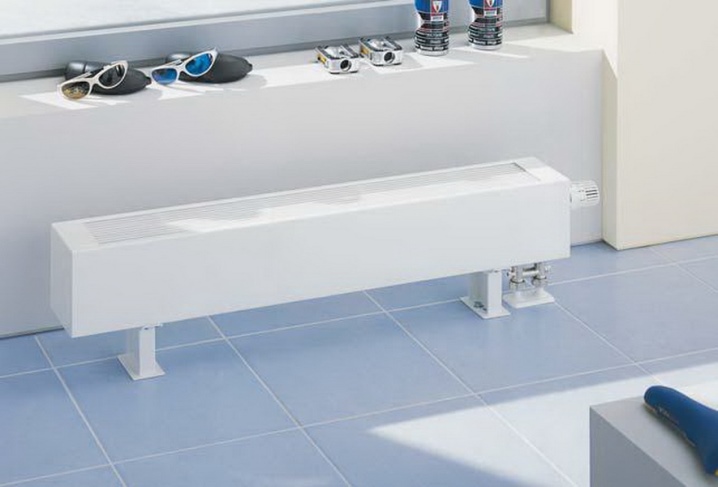
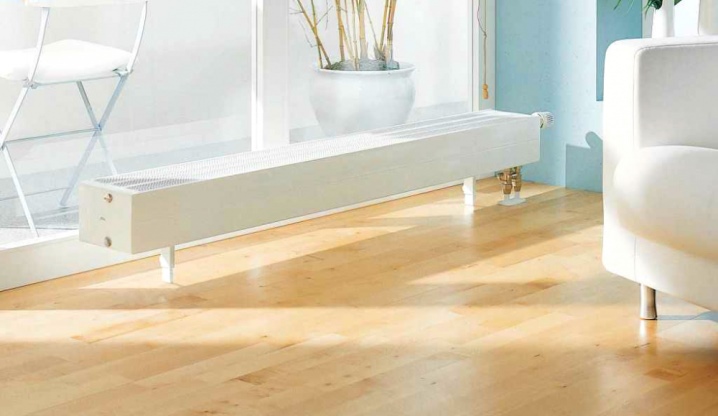
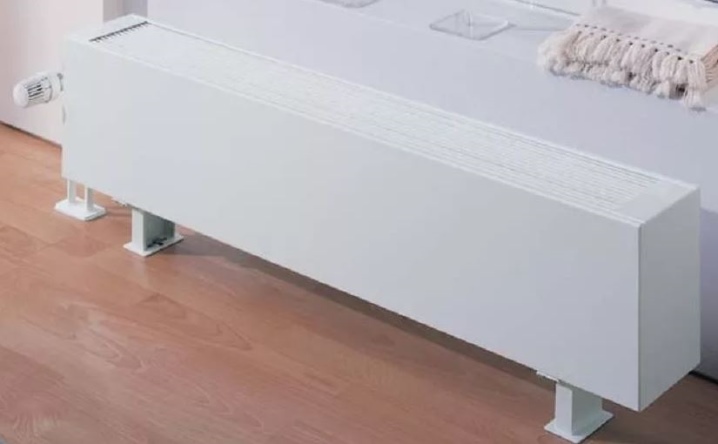
Isotherm
Domestic manufacturer, whose products are inexpensive, while it is not inferior to other firms in quality. Among the models, the main line is the Atoll convector, consisting of the Atoll, Atoll 2, Atoll Pro and Atoll Pro 2 models. Convenient location, small size and modern appearance make these devices one of the best for their price.





In addition to the main and additional models, the Novoterm model is produced - an economy class device. It has no special features, except for its small size and low power. It is these parameters that make this device cheap. Basically, the maximum length of these devices ranges from 2.5 to 3 meters, and the service life is 10 years.
elegant
Russian manufacturer, which has three main lines: "Elegant", "Elegant mini" and "Elegant Plus".
- "Elegant" is made in accordance with European standards and has characteristics that can satisfy the needs for warmth. In addition to floor models, there are also wall models.
- "Elegant mini" is similar to the standard version, but has a smaller size and low power. Such a device will be conveniently placed indoors.
- "Elegant Plus" is distinguished by high power and heating area. The price is higher, but the quality and efficiency are much better.
Standard
Model from the Russian manufacturer "Termal". It has several sections that can heat the room with a powerful radiator. For installation, you need to separately purchase several brackets, and for installation, you need 1 mounting kit and 2 cranes. The disadvantage is that the components for installation must be purchased separately.
Eva
Moscow manufacturer of convectors, which have an extensive package. It includes adjustable legs, a removable aluminum heat exchanger, a set of fittings, brackets and coolant inlets. Basic models Eva KH-H. 440.155, Eva KH-H. 195.155, Eva KH-H. 270.155 have several heaters, and the maximum temperature in the devices themselves can reach +115°C. Such high rates allow you to generate a large amount of heat and heat large rooms.
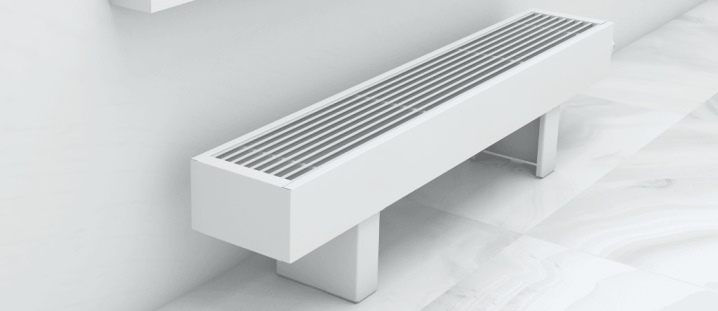
Itermic
A domestic manufacturer whose floor convectors come in the ITF series. These units are made of galvanized stainless steel, which increases the service life, which is 10 years. It is possible to order automation additionally to the delivery set. Bottom connection, aluminum plates and copper tubes provide high thermal conductivity and heating throughout the entire area of the room.

Purmo
The Finnish company produces goods of European quality. Among the products, the Narbonne model stands out, which is the most advanced and most popular among all products. This line of convectors is distinguished by its modern appearance, manufacturability and a large selection of equipment. Small dimensions allow you to place this device on the floor, so you will not need to worry about the placement.
Water heating convectors built into the floor
There is another type of heating convectors, which is very different from those discussed above and therefore stands apart. They are unusual in their place of installation - in a niche located below the floor level. With a high degree of probability, such heating devices can be found in commercial or office premises with large panoramic windows, against which ordinary radiators or convectors will not look quite appropriate.
In cottages and apartments, such convectors are also installed, but usually only in cases where the lower edge of the window is located no higher than 150-300 mm from the floor level. It is allowed to embed heating convectors in the window sill.
Water heating convector built into the floor.
The height of the body of convectors built into the floor can vary from 50 to 130 mm, and the length can reach 3 m. floor through which heated air rises.
Most often, such gratings are made of steel, aluminum or plastic, but sometimes you can find cast iron, marble or, for example, wood.Whatever material the grate is made of, it must be strong enough so that you, passing by, are not afraid to step on it.


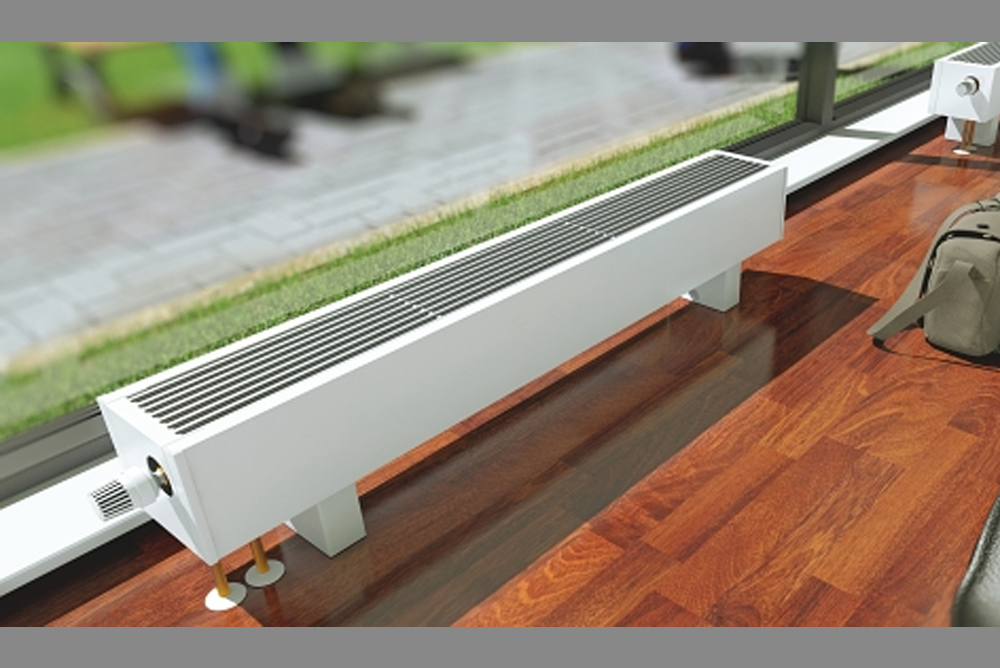


In the case of large French windows, floor convectors are an indispensable option for heating equipment. On the one hand, and we have already mentioned this, they, being located below the floor level, do not interfere with the review. On the other hand, it is these convectors that most effectively heat a room with floor-to-ceiling windows. Cold air from the window enters the convector through the grate, and from there it exits in the same way already warm.
To install a floor convector, it is necessary to prepare in advance a niche in the floor with a depth of 100 to 300 mm. However, installation can also be carried out at the stage of floor screeding. It should be borne in mind that not every convector can be used for floor installation.
The limiting factor in this case will be the height of the instrument case. Powerful models with a height of several tens of centimeters are not intended for installation in rooms located on the upper floors of the building. Of course, the installation of floor convectors should be planned in advance - even at the stage of building construction. The exception is low-power low models that allow installation in a screed.
Underfloor water heating convectors, unlike wall-mounted or floor-mounted ones, often have in their design a fan for forced air supply to the heat exchanger, as well as a drainage system for collecting and removing condensate from the device case.
How to choose a floor water convector
In order for a house or apartment to be warm and energy costs economical, a water floor convector must be selected correctly.
Parameters to consider when choosing a device:
- heating area;
- height of the heated room;
- the expected temperature level of the coolant in the heating system;
- type of heating (central or individual);
- availability of additional heat sources;
- the value of the thermal power of the convector;
- the material from which the convector parts are made;
- device dimensions.
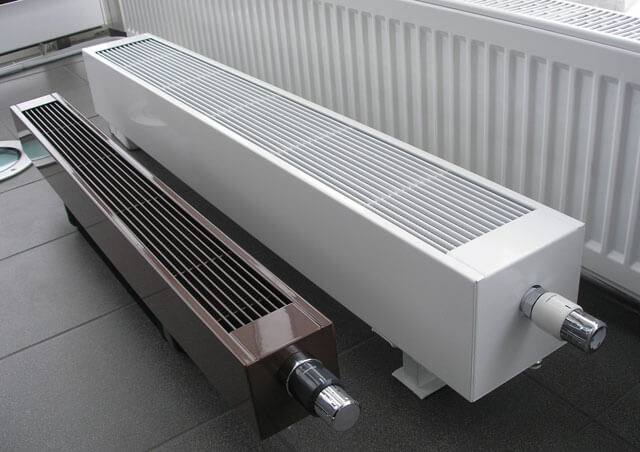
It must be borne in mind that the use of water floor heating convectors is especially beneficial if there are many glass windows in the room.
The casing material is preferably stainless steel, which is not deformed and durable.