- Water convectors: efficient and effective
- Varieties of water devices
- Features of various equipment modifications
- Heating element for convector
- Which brand of convector is better to choose
- Manufacturers overview
- Selection Tips
- Water heating convectors built into the floor
- Design
- Types of floor convectors
- Advantages
- What to look for when choosing floor convectors
- Basic requirements for the body of the device
- Positive and negative sides
- Types of execution of water convectors
- Wall mounted water convectors
- Floor water convectors
- Floor water convectors
- Skirting water convectors
- Basement water convectors
- Advantages and disadvantages
- Installation of convectors
- Material of manufacture is always important
- Advantages of convector heating at home
- The device of electric heating convectors
- Types of heating elements for electric convectors
- Types of thermostats and controls
Water convectors: efficient and effective
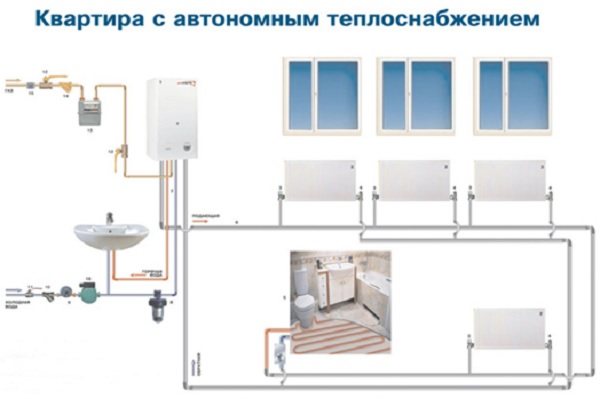
Water-type convectors are modern devices that are an excellent alternative to standard radiators. The devices are successfully used in autonomous heating systems of private houses and apartments, as well as in centralized heating networks.Water convectors are reliable, economical and durable, their efficiency is about 95%.
Varieties of water devices
Water convector devices are an ideal solution for rooms with a large glass area. Depending on the model, a water convector can be either an independent heating unit or a source of additional heating.
Thanks to various form factors of equipment, the issue of heating can be solved not only efficiently, but also effectively.
Water convectors are:
- floor;
- wall;
- plinth;
- intrafloor;
- embedded.
All of them occupy a minimum of space, and in the case of a hidden installation, they even save usable space. Installation into the wall, floor, steps, under furniture allows you to save such valuable square meters and provide comfortable heating. Underfloor devices with drainage can be successfully used in rooms with swimming pools, greenhouses, winter gardens, etc.
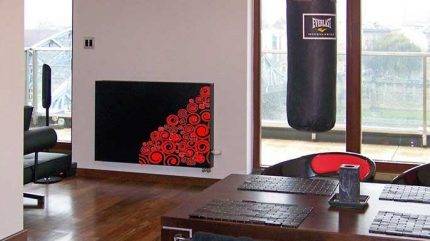
At the individual request of the customer, the body of the water convector can be painted in almost any color, as well as decorated with wood or other materials.
A variety of design - from laconic classic to bright modern - allows you to easily fit the units into any interior.
Features of various equipment modifications
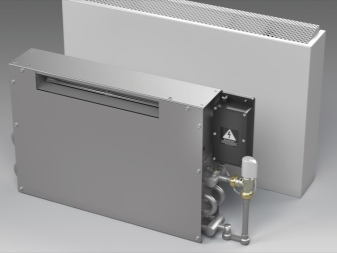
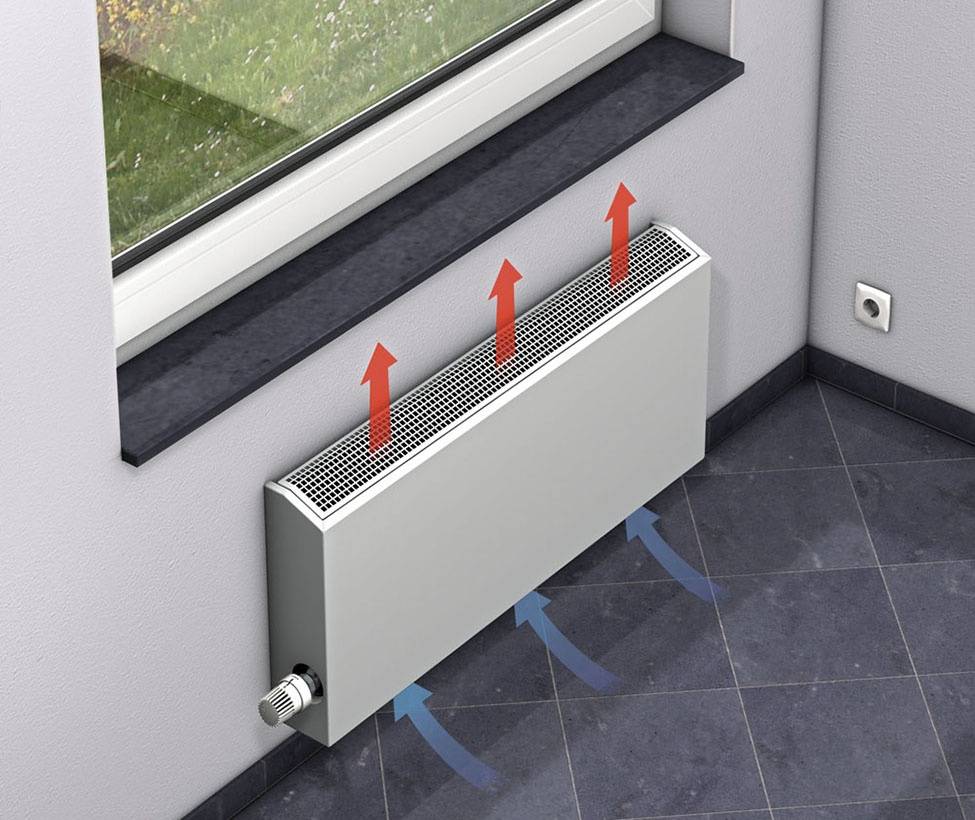
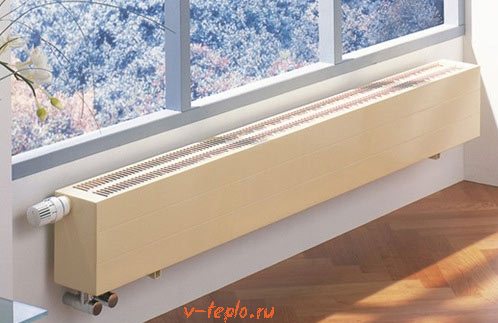
Water wall convectors are a steel case with a perforated grate located on top, in which a copper-aluminum heat exchanger is placed. The devices are mounted using a special mounting kit, which is necessarily included in their factory package.
Wall mounted convectors are an excellent choice for rooms that need fast and efficient heating and have enough free space for wall mounting.This is the best solution for children's rooms and bedrooms. Not suitable for heating continuous glazing that goes into the floor.
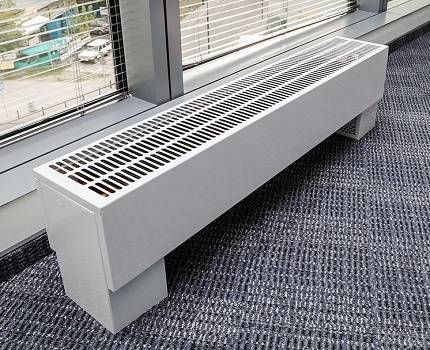
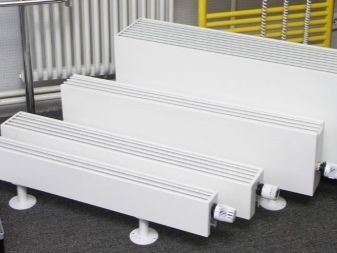
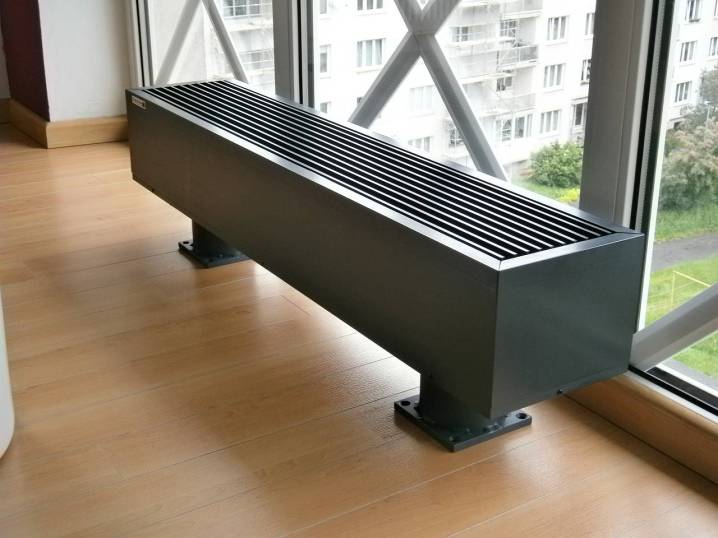
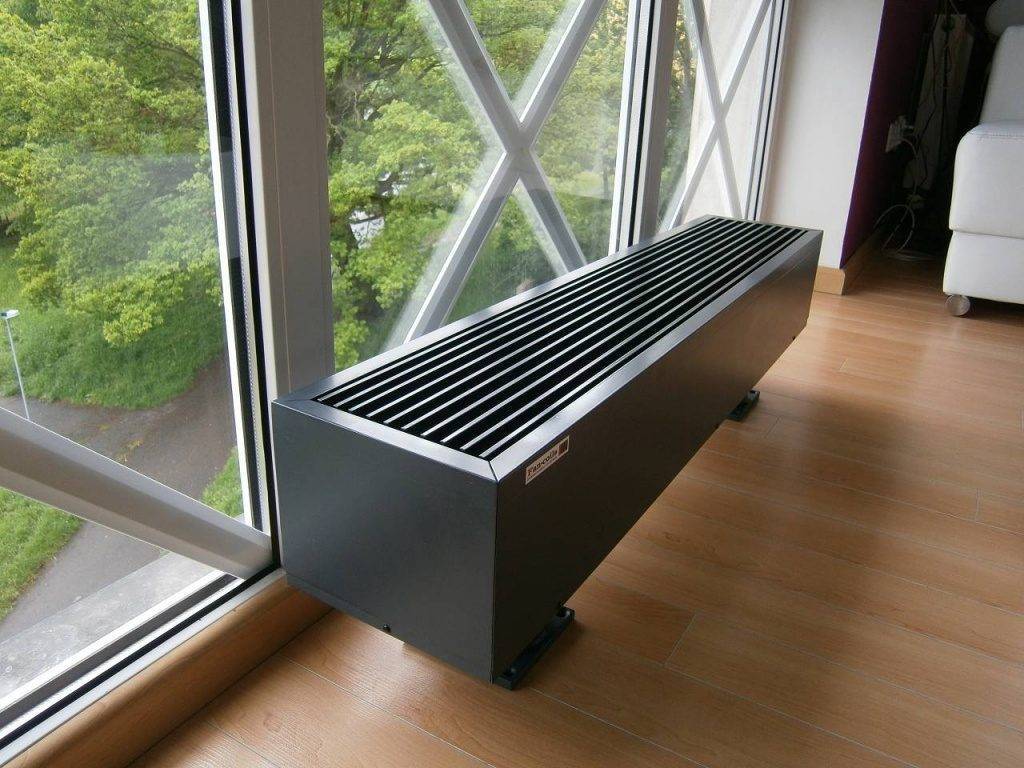
Floor water convectors usually installed in rooms with a low window sill space. They can also be installed near panoramic windows if, due to the low height of the screed, it is not possible to mount the underfloor unit. In addition to the housing with a heat exchanger, such devices are structurally supplemented with a steel supporting base.
Some manufacturers offer water convectors with air conditioning. Thanks to this 2 in 1 equipment, you can heat the room during the cold season, and cool it in the summer.
Such convectors somewhat clutter up the space, however, they fit perfectly into rooms with a modern interior in the style of a loft, modern, high-tech, avant-garde.
Plinth water heaters are practical and compact. The low thermal tension of such convectors allows them to be mounted right next to furniture and various decorative elements. This gives a huge advantage in terms of space organization.
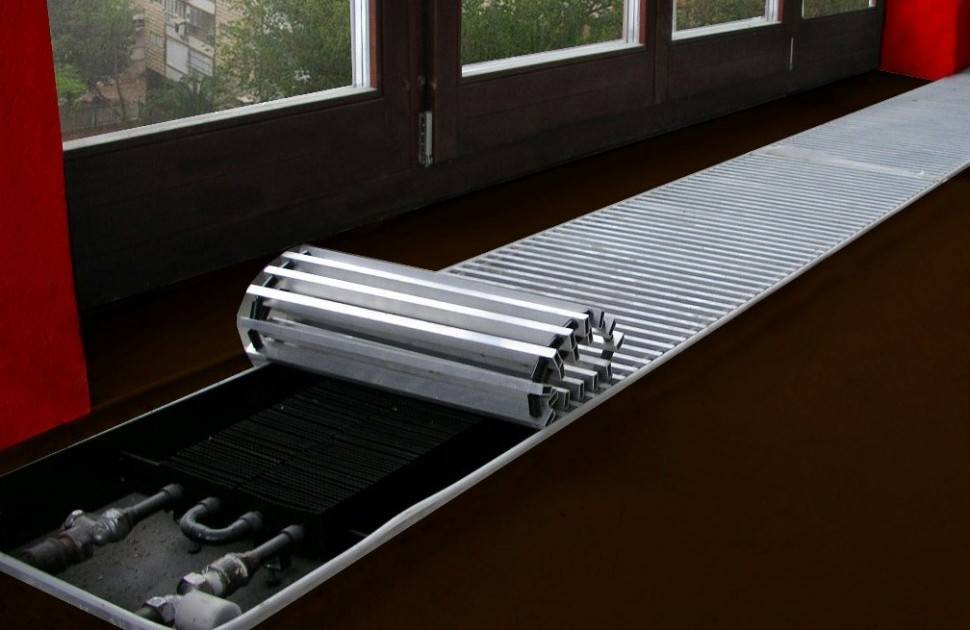
Floor-mounted structures are used to cut off cold air flows coming from windows. The units allow you to effectively solve the problem of condensation on large window glazing (“weeping windows”). Built into the floor level, they do not take up space at all and do not interfere with enjoying a panoramic view.
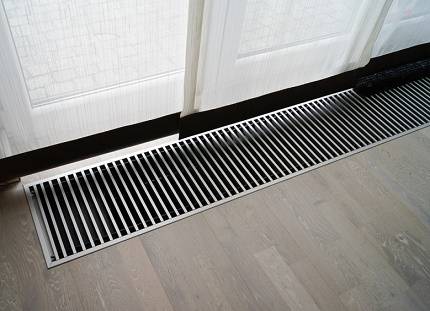
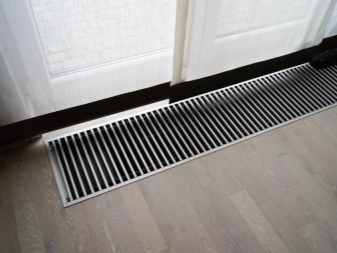
After installation, floor convectors are covered with a special grating that performs a protective and decorative role.
Heating element for convector
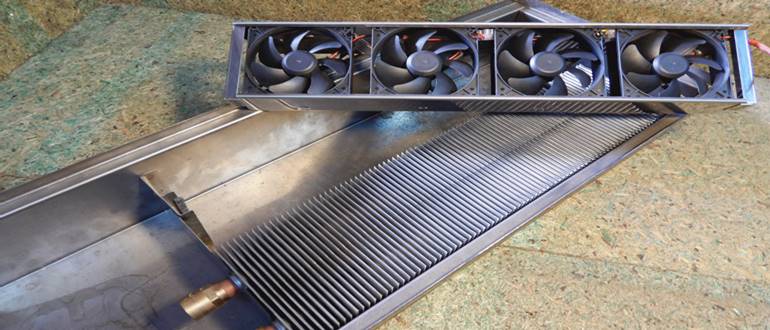
Convector heating element
Almost all modern electric convectors are equipped with a tubular heating element, which is made in the form of a steel tube filled with ceramics or quartz, with a nichrome thread passing inside. The outer part of the tube is finned with aluminum to increase heat transfer and enhance convection. This design is quite reliable, but it is worth noting that it has a drawback due to the difference in thermal expansion of steel and aluminum (the value of aluminum is greater). During operation, these metals begin to rub against each other, which as a result leads to their wear, disruption of heat transfer and burnout of the heating element. Some more modern models of convectors use an aluminum tube (or silumin) with fins made of the same metal. Thus, the same values of thermal expansion of the elements are achieved to increase the service life of the heating element (up to 20 years).
Which brand of convector is better to choose
Companies producing convectors, as a rule, are engaged in a narrowly focused activity - the production of heating appliances. Surveys show that users prefer reliable, trusted companies that have a lot of positive reviews and a decent reputation. For review, brief characteristics were collected for each brand:
- Noirot Spot, a brand from France that produces heaters, manufactures and develops them only at its own facilities, importing heat sources to more than 90 countries.
- Stiebel Eltron is a brand from Germany that produces electric heating equipment. It has many subsidiaries in the territories of Asian and European countries, is a sponsor of sports and charity events, and is one of the market leaders in the field of heating.
- Electrolux is a popular company from Sweden that produces household appliances for the home, produces climatic and professional equipment. The company's products belong to the middle and low price segment.
- Timberk is another large corporation from Sweden that produces climate equipment. Focuses on the production of a wide range of products, from simple water heaters to functional split systems.
- Resanta is a Latvian brand that manufactures electrical goods. Offers a large selection of convectors, heaters, voltage stabilizers at average prices. Every year the company participates in international exhibitions, where it presents its own developments.
- Hyundai is a large holding from South Korea that manufactures consumer electronics. In creating its products, the company uses only modern innovative systems aimed at making the use of products more comfortable.
- Ballu is a Russian brand that produces climate control equipment for industrial and domestic purposes. It has production facilities not only in Russia, but also in China, uses only high-quality raw materials.
- Scoole is a manufacturer from Russia that produces climate equipment for the home, offering a large range of air conditioners, split systems, and fans. It sells goods on the territory of the Russian Federation and the CIS countries, in compliance with strict international quality standards.
- Power KVZ is another Russian company producing climate equipment. In production, components of well-known brands are used, which ensure the reliability, safety, and quality of devices.
- Varmann is the largest brand producing convectors, heat exchangers, facade heating systems.It sells goods to Russian and European markets, gives long warranty periods for all products, accepting orders for individual projects.
- KZTO Breeze is a plant for the production of thermal equipment, which has been a leader among Russian manufacturers for 20 years. The advantages of the company include reliability, style, reasonable price for premium goods.
- iThermic ITTZ is a trademark of the Rada-M company, which produces heating devices. It manufactures premium products, provides long-term guarantees, and uses high-quality raw materials in production.
Manufacturers overview
Those who wish to purchase such a water convector are often faced with the fact that they do not know which manufacturer's product should be preferred. Many companies today are engaged in the manufacture and sale of such radiators.
Convector Licon Okioc - Czech production. This is a modern and rather expensive device. The manufacturer offers unique water convectors that are designed for low-temperature systems. That is, such radiators are better suited for cooling the room than for heating it.
Producers from Russia are in no way inferior to their foreign competitors. Russian-made water convectors of the following brands are in high demand.




Varmann Planokon. The manufacturer's assortment includes convectors of all types and various capacities. The brand also has a flexible pricing policy, which allows each customer to purchase a water radiator at an affordable cost. Each model is made in accordance with all safety and quality requirements.On average, the maximum heating level of the heat exchanger is 130 degrees. The minimum cost of one convector is 120 thousand rubles.
Selection Tips
But it’s not enough just to find out which manufacturer’s product you should pay attention to in the first place. There are a few other important selection criteria to keep in mind.
- Type of heating in the room - autonomous or centralized. In the first case, the pressure power should not exceed 4 bar, and in the second case, not less than 8 and not more than 14 bar.
- The required temperature in the room, as well as the presence of constantly working electrical appliances in it. The fact is that each device in the process of its operation emits a certain amount of heat. The choice of power of the water convector itself should be carried out in accordance with the indicator of this heat transfer.
- The humidity level in the room. The type of convector purchased also depends on this indicator - with forced convection or with adapted one.
- The heated area is an important factor that has a direct impact on deciding whether it is necessary to purchase a water convector with natural circulation or artificial circulation.
When choosing this heater, you must also remember the rules for choosing the convector itself.
- The heat exchanger is placed in a protective casing, and it is made of copper, brass or their alloy. It is best to refuse models with steel pipes - they do not conduct heat well.
- The outer case must be steel or made of any other strong and durable material that is not afraid of corrosion.
- All edges of the water convector must be smooth, without chips and notches.
Water heating convectors built into the floor
Convectors built into the floor are installed in apartments and private houses, in car dealerships, entertainment venues, hospitals, shops and other organizations. In rooms with a large glass area - swimming pools, greenhouses, airport buildings, on the terraces of country houses and cottages - the best choice would be underfloor heating convector.
The price of a floor water convector depends on the manufacturer of the device, its dimensions and type, design features and technical characteristics.
Design
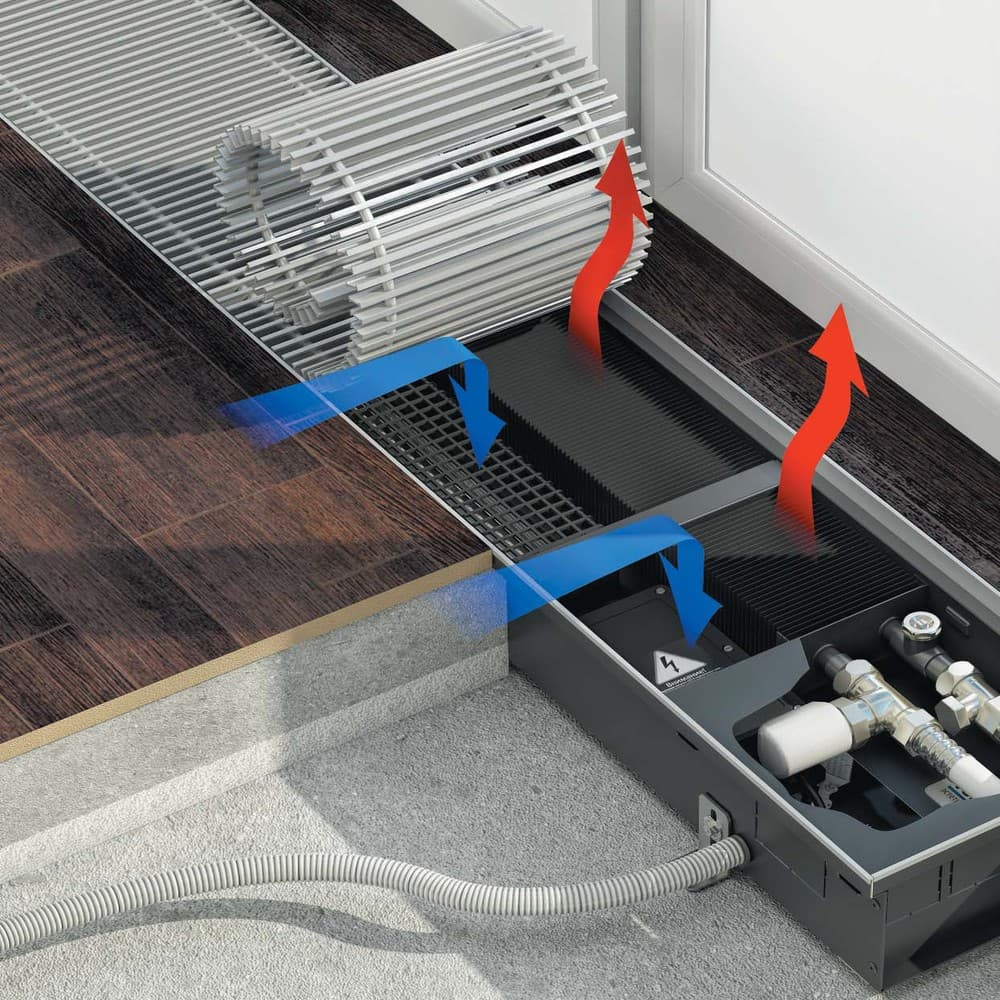
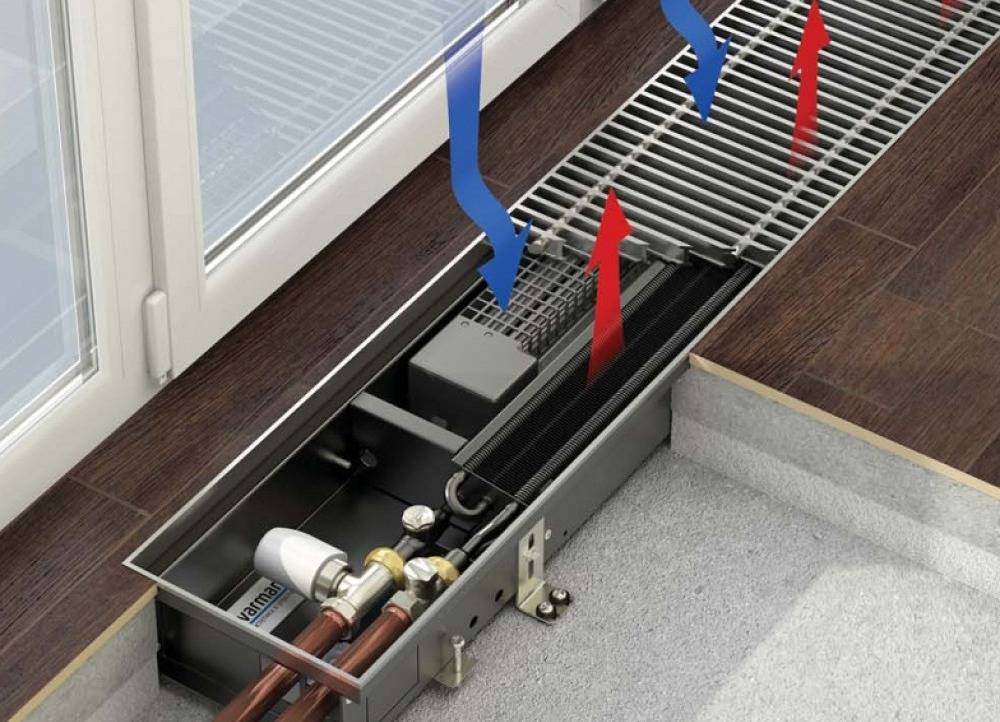
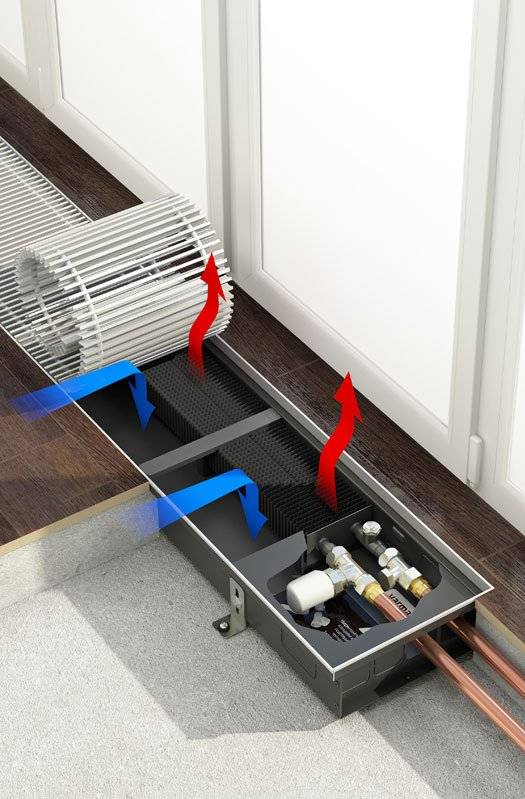
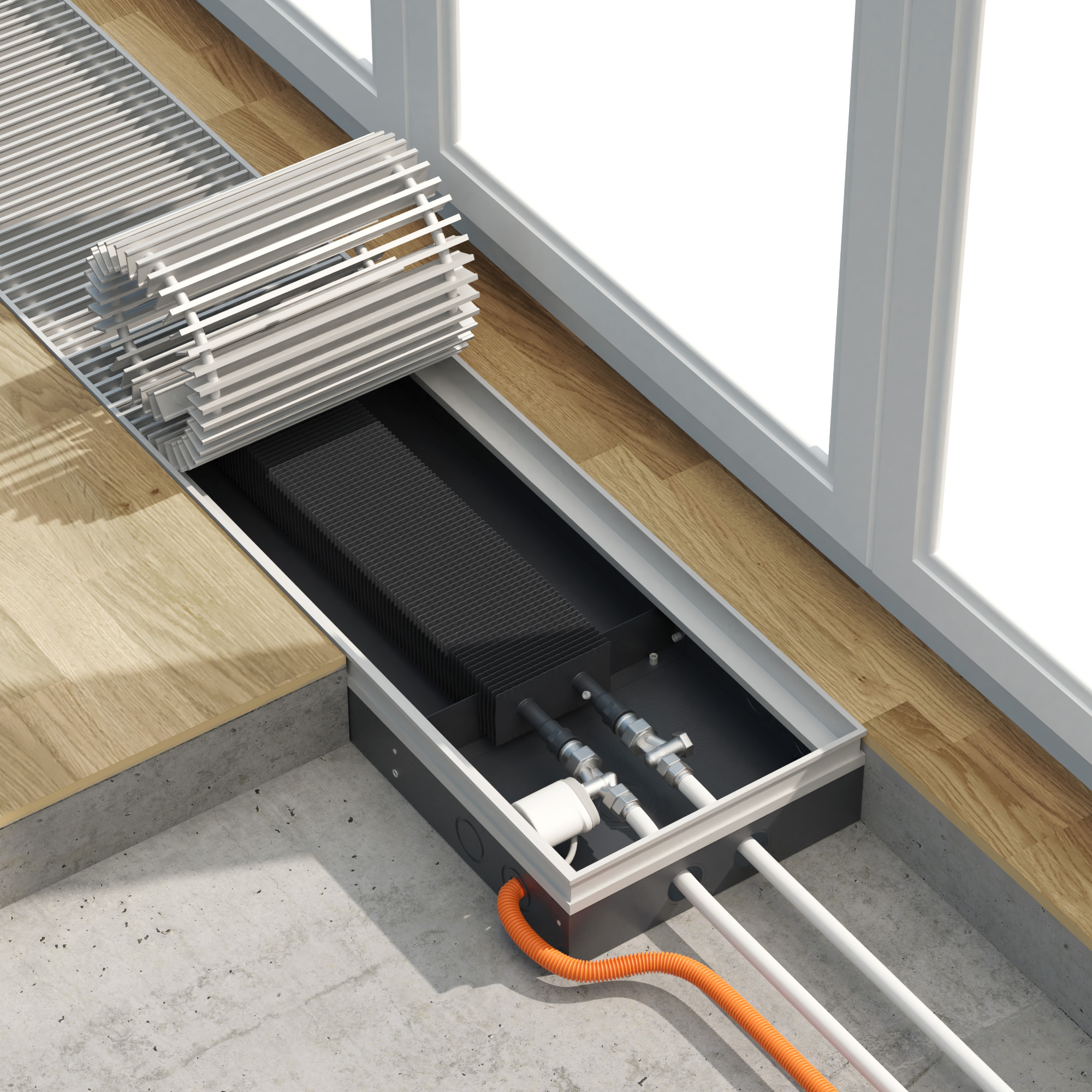
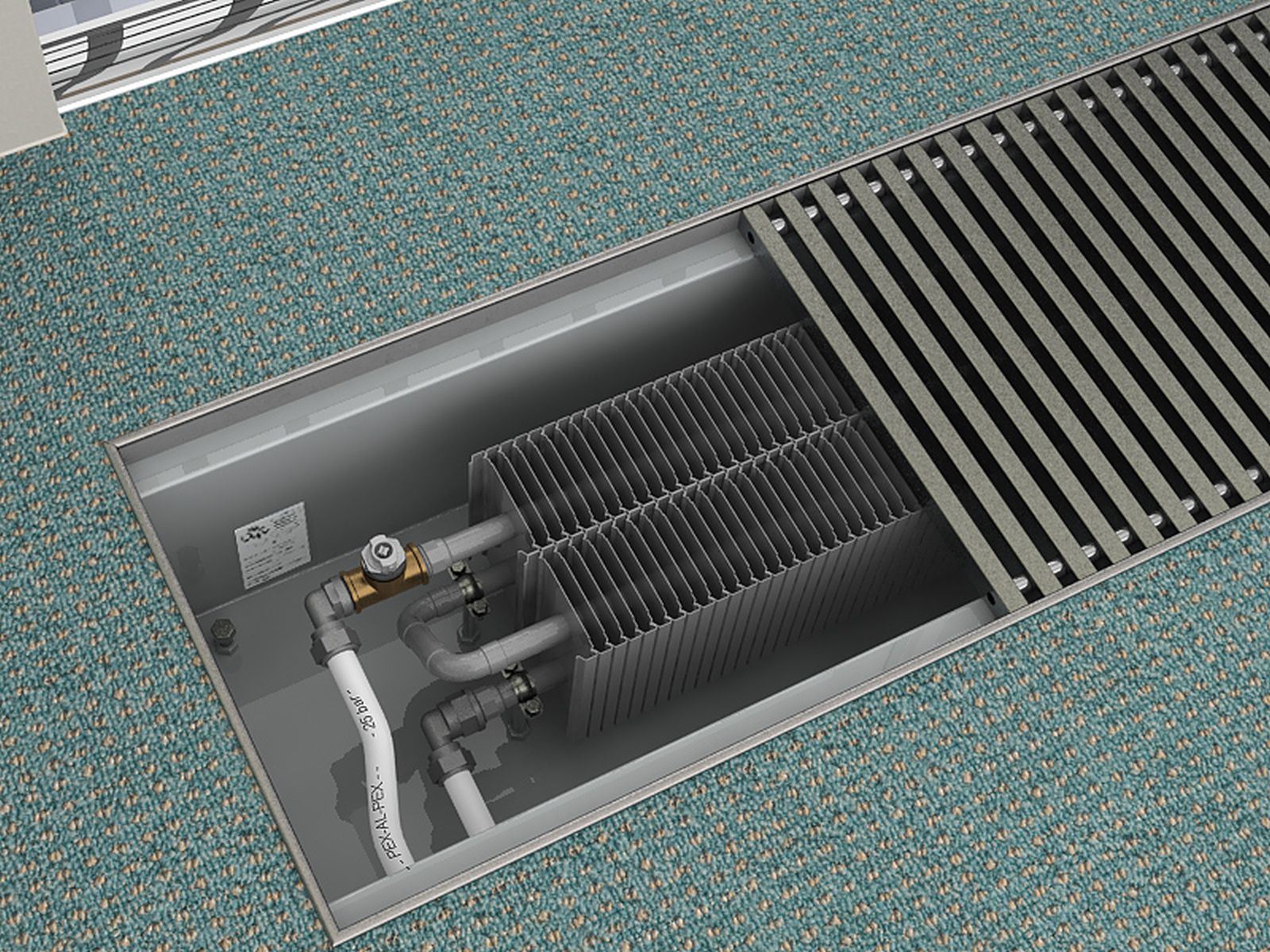
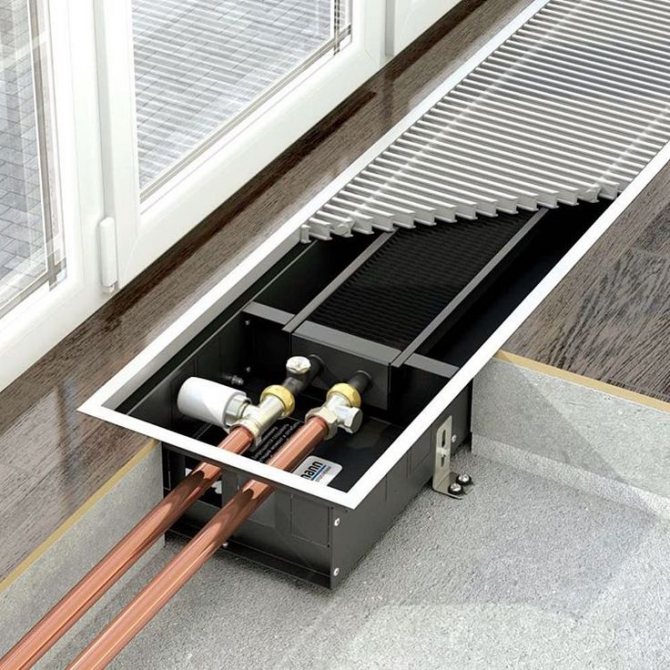
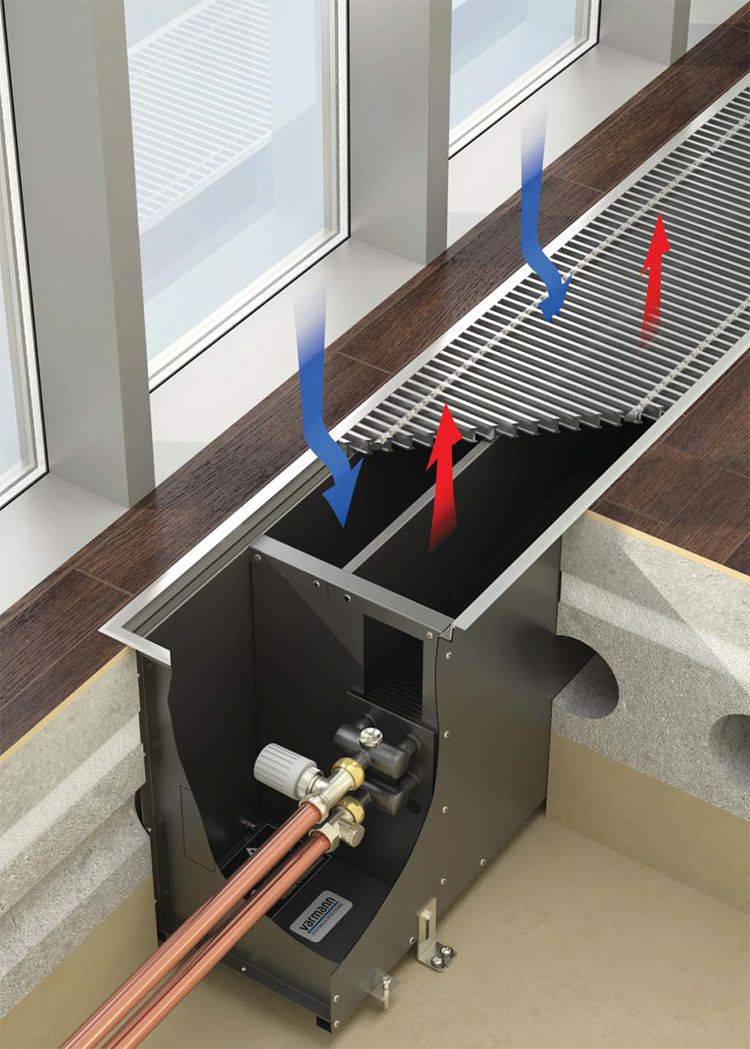
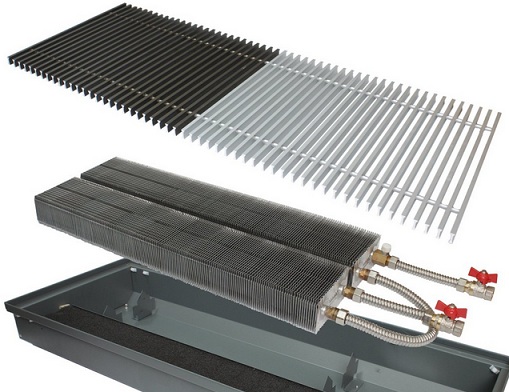
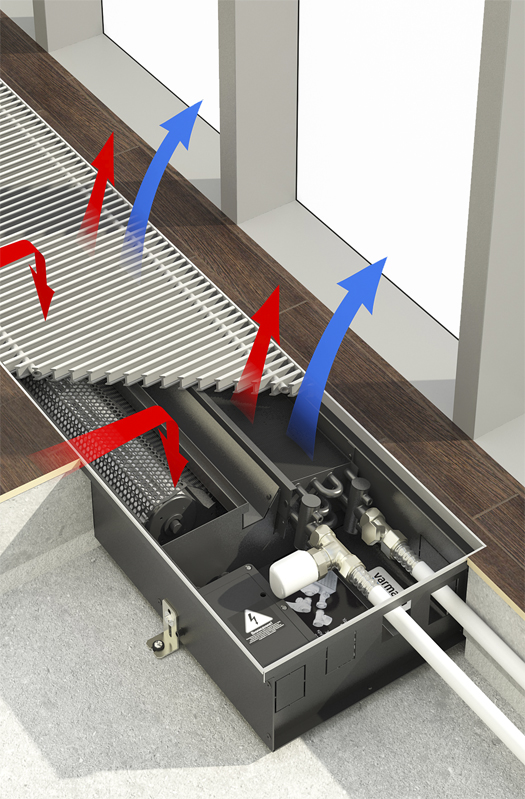
A water heating convector built into the floor is a heat exchanger placed in a special casing. The heat exchanger is a copper-aluminum heating element with high resistance to corrosion, which is connected to a hot water heating system.
The casing of a built-in convector is usually made of thick sheets of galvanized or stainless steel and provides reliable protection of the floor covering in case of possible leakage.
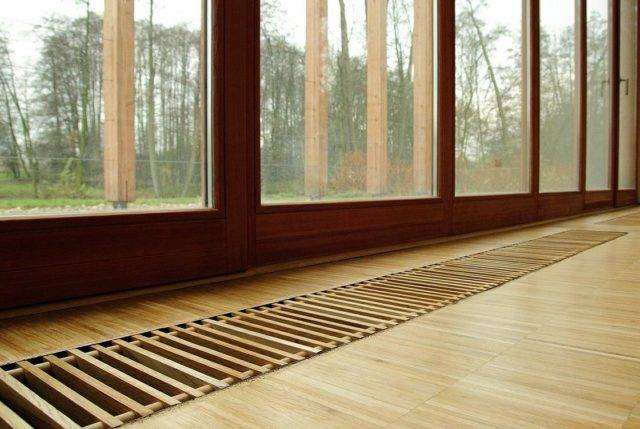
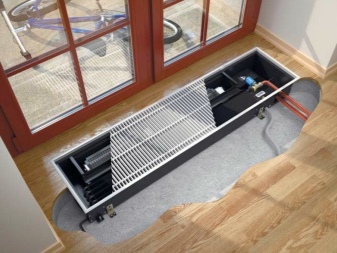
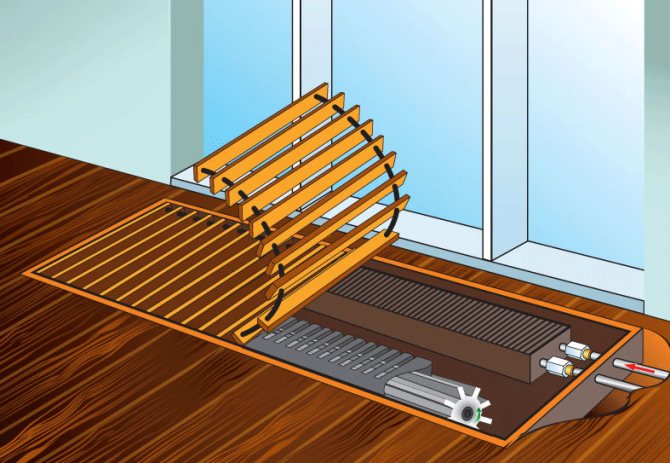
The casing with the heat exchanger is installed in a pre-prepared niche in the floor or directly into the cement screed and is closed with a decorative grille that makes invisible and protects the interior of floor-mounted heating radiators.
In other words, the visible part of the built-in convector is a decorative grille located on the same level with the floor covering, which can be made of various materials with a wide variety of textures, shapes and colors, and additionally painted in the required color, in accordance with the wishes of the client. .
Types of floor convectors
Floor convectors are divided into two types:
- convectors with natural convection;
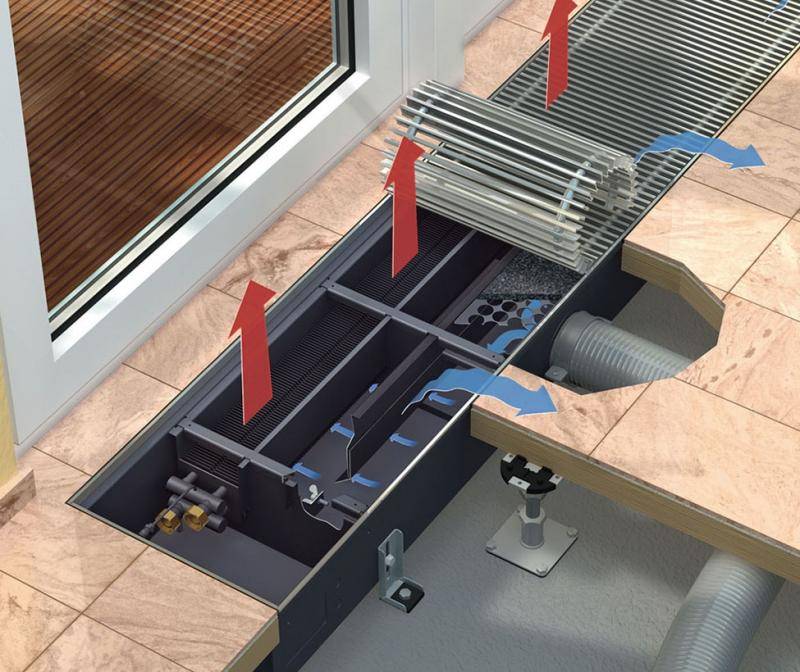
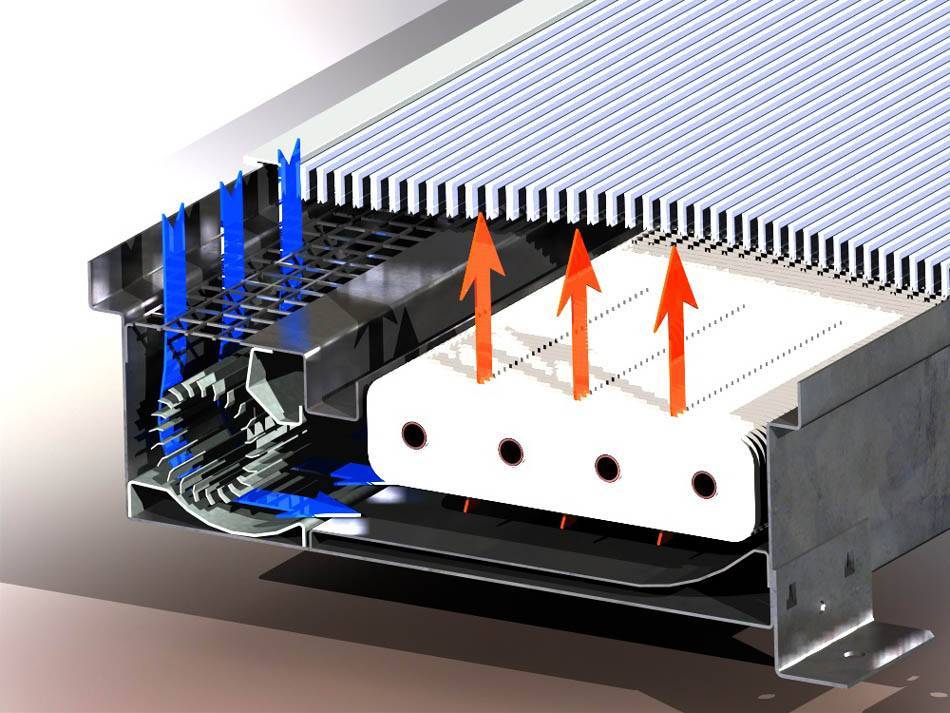
- convectors with forced convection, with a built-in tangential fan, which contributes to a more intensive heat exchange.
As a rule, convectors with a fan are used as the main heating device in the room.
Convectors with natural convection are auxiliary heaters. They are designed to isolate large windows and doorways from cold air and are used with underfloor heating or radiator heating systems.
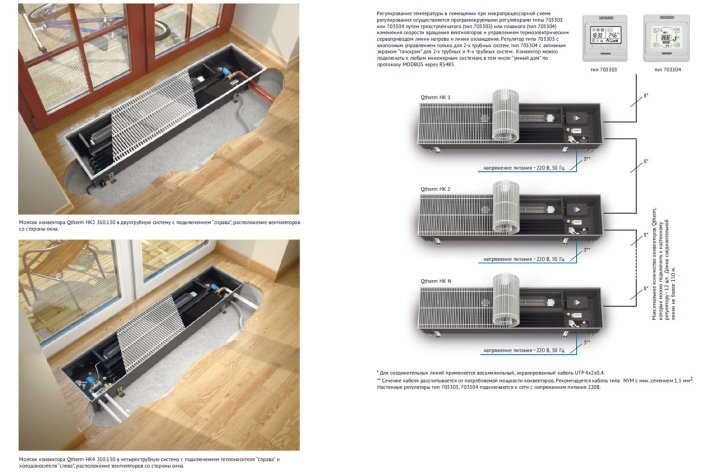
A control system can be connected to floor convectors of any type.
Advantages
Water convectors built into the floor have undoubted advantages compared to conventional heating radiators:
- saving space, due to the fact that heating radiators are located in the floor;
- attractive appearance that does not violate the overall aesthetics of the interior and can fit into the design of any direction;
- a wide variety of standard sizes, allowing you to choose a heating device for the parameters of the room, providing the necessary heat transfer;
- reliability, efficiency and durability of devices, provided by the use of high quality corrosion-resistant materials.
What to look for when choosing floor convectors
Selection of thermal power of underfloor convectors is no different from the same calculations for classic heating radiators. Approximately 40 W of thermal energy is required per 1 cubic meter of room volume. If you count from the area, then for 1 sq.m. should account for 100 W of convector power.





However, the following factors should be taken into account:
- in the absence of wall insulation - 1.1;
- windows with double-glazed windows - 0.9;
- corner room - 1.2;
- ceiling height from 2.8 m - 1.05.
It must be understood that the power of the built-in water convector indicated in the characteristics corresponds to a coolant temperature of + 75 ° C. In electrical versions, the maximum possible power is indicated. The number of convectors depends entirely on the heat loss of the room and is calculated at the design stage of the heating system.
The total number of devices, as well as their dimensions, directly depend on the heat demand and are calculated at the design stage of the heating system, taking into account the expected heat losses. Thermostatic heads are used to control the output or, as a cheaper option, manual valves.
Basic requirements for the body of the device
The appearance of the metal case does not play an important role, since it is located in the floor of the room
Particular attention should be paid to the quality of this element, since the reliability and durability of the heating unit depends on the indicator and its class is determined
The metal from which the case is made plays an important role:
- For installation in wet rooms, a convector with a housing made of stainless material with increased moisture resistance is suitable.
- In dry rooms, a device is selected with a case made of galvanized or black steel, which is coated with an anti-corrosion paint resistant to external influences.
Usually, special powder formulations are used to coat the metal case. They effectively protect the metal from rust and external influences.
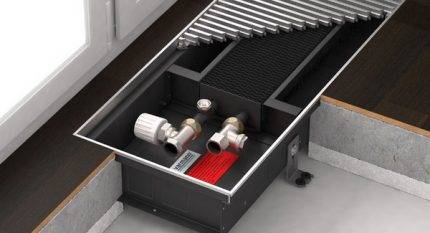
Designers recommend choosing convectors, in which the parts and internal walls of the body are painted in a dark color. They are almost invisible, so they look more aesthetically pleasing.
Positive and negative sides
In addition to water convectors, the market is rich in gas and electric models. The first ones are not widely used, as they need additional arrangement of the chimney. When installing the latter, electricity costs increase significantly.
Water convectors are simpler and more reliable. They are easy to install, simple to operate and have a number of significant advantages:
- High level of safety of use
- Service life - more than 2 decades
- No need for additional specialized equipment
- Ability to automate the operation of heating devices
- High speed heating of a large space
- Maximum efficiency at low coolant temperature
- Warm streams do not allow condensation to form on glazed surfaces
There are few negatives. Among them it is worth noting the following:
- Do not install water convectors in rooms where forced ventilation is provided.
- The constant movement of air currents causes dust formation.
- Air currents can cause drafts
Types of execution of water convectors
By type of execution, water convectors are very diverse, which allows you to install them in any room, as well as hide them in the finishing elements, for example, convectors are:
- wall;
- floor;
- intrafloor;
- plinth;
- basement.
The principle of operation of different types of convectors is practically the same, the difference lies only in the location of the gratings for air intake and outlet.
Types of water convectors
Wall mounted water convectors
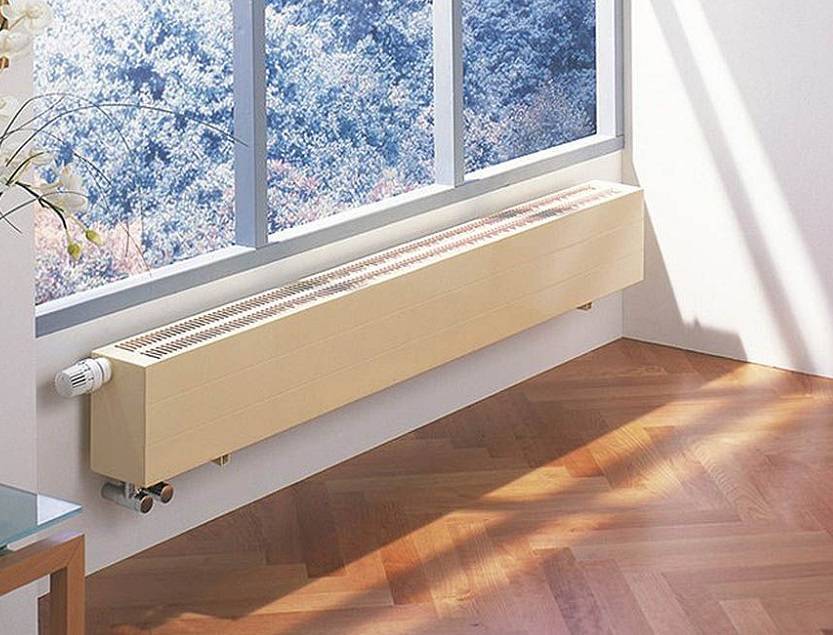
In appearance, wall-mounted models are not much different from conventional radiators. They are attached to the wall with brackets, usually installed under the windowsill or on the outer, coldest wall.
At the same time, it is important to observe the distances to the floor and window sill indicated in the passport in order to ensure the free movement of air flows.
Wall mounted water convector
Wall models of water convectors differ in thermal power and geometric dimensions, the number of heat exchangers and the material from which they are made. Additionally, wall convectors are equipped with a Mayevsky crane, control valves and a thermostat.




Floor water convectors
The convenience of floor convectors is that they can be installed anywhere without being tied to walls. Floor models are often used to heat studio apartments without internal walls. Heating pipes are located in the floor
Air intake in floor convectors is carried out from below, so it is important not to block them with furniture
Floor convector
The original solution is a convector-bench, it is equipped with a comfortable seat made of wood, which does not interfere with the movement of warm air. Such convectors are installed in shopping centers and other public places, as well as in greenhouses and winter gardens. You can also install floor convectors in ordinary apartments, placing them on the floor under windows or at the front door - where they create a thermal curtain.
Floor water convectors
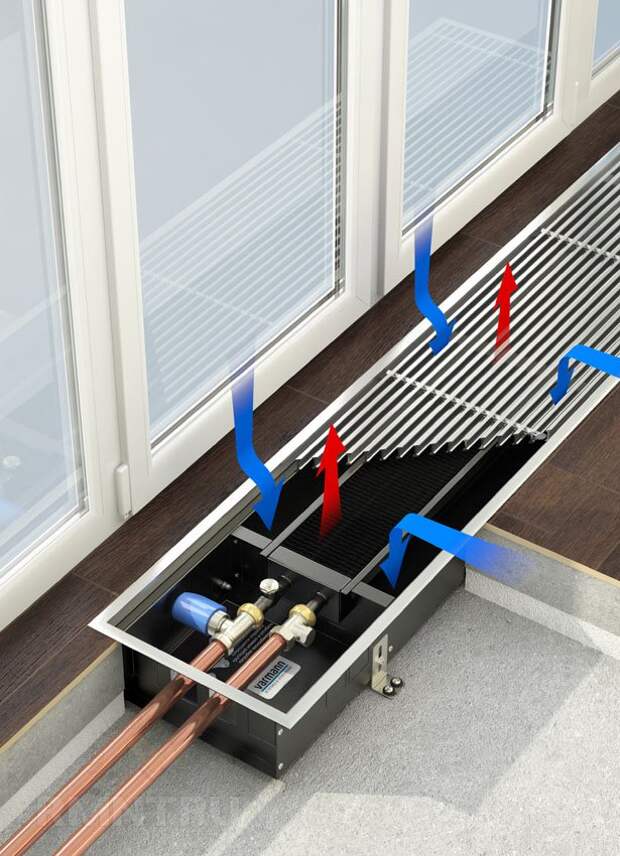
Floor-mounted models are often used to heat rooms with panoramic windows or for rooms made in a minimalist design. Floor convectors do not take up extra space, they can be placed in any convenient place. The body of the convector is built into a special niche in the floor, the pipes are also laid hidden. Pipe laying and a niche are performed at the stage of pouring the floor screed.
Floor convector
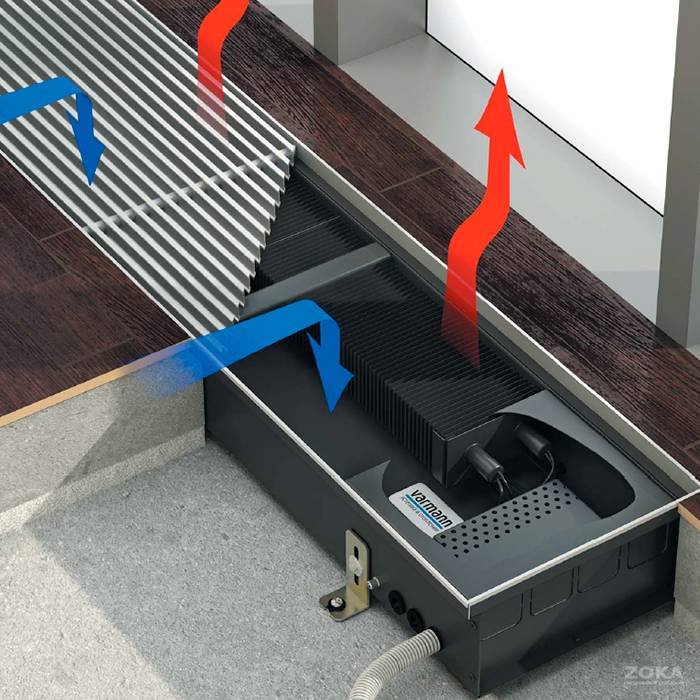
Top convector heater close wood grating, plastic or metal, the choice of material depends on the finish of the floor. The grate is installed flush with the finished floor, which facilitates movement on it. Air intake is carried out through the same grate as its outlet. Floor convectors can be used as an independent source of heating or additional - to create a thermal curtain in front of windows and doors.
Air circulation in floor convector
Skirting water convectors
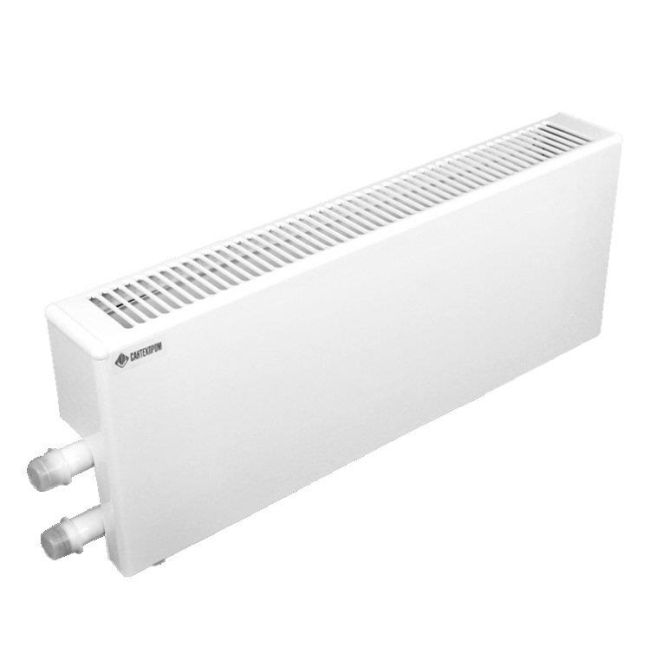
Another way to successfully hide heaters is to install baseboard water convectors around the perimeter of all cold walls. Skirting convectors consist of heat exchangers connected in parallel or in series and connected to heating pipes. The heat exchangers are closed with aluminum or steel casings with an air outlet grille.
Water heating (cottage) allows you to maximally equalize the temperature in the room and normalize the humidity. The closed circuit significantly reduces heat loss. Skirting models are compact and fit well into the design of the room, in addition, they allow you to hide the heating pipes under the body.
Convector heater-baseboard
Basement water convectors
Socle models are also embedded, but the possibilities of their application are much wider. Basement convectors are mounted in wall niches, partitions, steps or interior items, which allows you to make the heating system almost invisible and bring heat to those parts of the room where it is most needed. How to install oven with water circuit for home heating, you can read in our article.
The placement of basement convectors is planned at the stage of rough finishing: niches are prepared, hidden pipelines are laid, wiring and shutoff equipment are installed. At the same time, inspection hatches must be made at the location of the shut-off valves.
Basement convector built into the stairs
Advantages and disadvantages
The advantages of water heating convectors are obvious:
- The accelerated warming up of rooms and the room as a whole.
- Performing the role of thermal curtains.
- Light weight and compact.
- Low cost (2 times cheaper than cast-iron radiators of the same power).
- Possibility of fastening to light walls.
- A wide range of standard sizes and types of execution.
- Embeddability of devices in floors, walls, plinths.
- Various design and finishing of cases.
- Low body temperature, ensuring safety (especially for children).
To the disadvantages of steel water heating convectors a slightly shorter service life can be attributed, compared with cast-iron batteries. In addition, the gaps between the plates are often clogged with dust and require cleaning.





Installation of convectors
Installation of wall, floor convectors on fittings can be done on your own, especially when wiring from metal-plastic pipes.
It is better to entrust the installation of basement and underfloor heating devices to specialists.
Material of manufacture is always important
When choosing, you should pay attention to the material of manufacture - it affects the efficiency, cost, durability and even decorative qualities. And the last point today has become one of the most important
For example, devices can be:
- steel;
- aluminum;
- bimetallic - in this case, two types of metals are used for manufacturing.
Copper is also often used. Bimetallic and aluminum devices are considered the most effective today. But steel devices also have a significant advantage - their cost is the most affordable.

It is worth paying attention to the decorative elements of the equipment, they can be different: metal, wooden. And for painting, powder paints of various colors are used, which makes the offer even more diverse.
Advantages of convector heating at home
The main advantages of convector heating are:
- High degree of safety in the course of operation of devices. Modern models are equipped with a casing that has a significantly lower surface temperature than the device itself, which makes it safe for children and animals. In addition, convectors can be equipped with an automatic shutdown function, eliminating equipment overheating.
- Autonomous temperature control allows you to set the optimal heating mode. You can set the device to reduce work during the day (working) time and increase it in the evening, when everyone comes home.
- The operation of the convector does not change the microclimate in the room, since it does not dry out the air.
- Resistant to corrosion and moisture ingress. Modern models of convectors have a high-quality housing that protects the device itself from the penetration of water and moisture.
- As the reviews show, heating a private house with convectors is not only efficient and practical, but also has a modern compact design that can harmoniously fit into any interior.
- The high quality and practicality of the devices allow them to have a long service life compared to other heating devices.
Among the various ways of heating a house, convector rightfully occupies not the last place. Its main advantages are that when using this method, it is not necessary to create a complex design of the heating system, and pipes and expensive water-heating boilers are not required.
Let's try to figure out what convector heating is. As the name implies, this is a method of heating a room, which is based on air convection in the room itself.
From the laws of physics, it follows that when heated, warm air rises, and cold air goes down.
Thus, there is a natural circulation of air and gradual heating of the room. It is this type of heating that is quite simple, but at the same time an effective way of heating.
The device of electric heating convectors
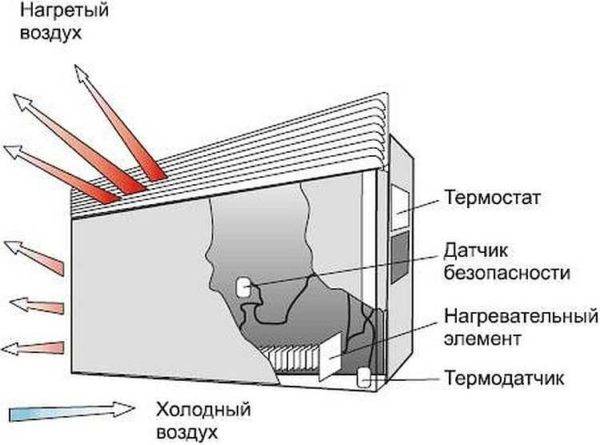
The device of the electric convector is simple:
- a housing in which there are openings for air intake and exhaust;
- heating element;
- sensors and control and monitoring device.
The case is heat-resistant plastic. The shape can be flat or convex, rectangular or square.There are holes in the bottom of the case - cold air is sucked into them. There are also holes in the top of the case. Hot air comes out of them. The movement of air occurs without stopping, and the room warms up.
Convector heater device
The heating element of an electric convector is what you need to pay attention to when choosing. The type of heater determines the service life of the equipment and the air condition.
Types of heating elements for electric convectors
Heating elements in electric heating convectors are of three types:
-
Needle. This is a dielectric tape in which needle loops made of an alloy of chromium and nickel are mounted. The surface of the heater is filled with a layer of protective varnish. The hinges stick out from both sides, heat up very quickly, cool down just as quickly, and this is a plus of such heaters - it is easy to maintain the set temperature. The second positive point is the low cost. Electric convectors with needle-type heaters are a third cheaper. disadvantages - it cannot be used at high humidity, the fragility of the needles leads to the fact that such a heating element quickly fails.
-
TEN. Tubular electric heater. This is a hollow metal tube inside which a spiral is sealed. The distance between the spiral and the body is filled with heat-conducting backfill. Plate-fins are additionally soldered on the heating elements for convectors to increase heat transfer. The disadvantages of this heater are relatively low efficiency, large inertia - due to losses in the transfer of heat from the coil to the body - it takes time to reach the operating mode. Another drawback: during operation, the heating element may crackle.The reason is the different temperature expansions of the materials used. Advantages - the spiral is reliably protected, the convector heater can be used in wet rooms. Also a positive point is a long service life.
-
Monolithic heaters are the quietest, with minimal heat loss. The same thread made of nickel-chromium alloy is soldered in a cast body with fins. Heat loss during transfer from the thread to the body is minimal, the thermal expansion of all parts is the same.
Electric heating convectors with monolithic heaters are considered the best, but they are also the most expensive. With the use of heating elements - a little cheaper.






Types of thermostats and controls
Electric heating convectors can be controlled by a mechanical thermostat or electronics. The cheapest convector electric heaters have a thermostat, which, when the set temperature is reached, breaks the power supply circuit of the heating element. When cooling down, the contact appears again, the heater turns on. Devices of this type cannot maintain a constant temperature in the room - the thermostat is triggered by heating the contact plate, and not by air temperature. But they are simple and quite reliable.
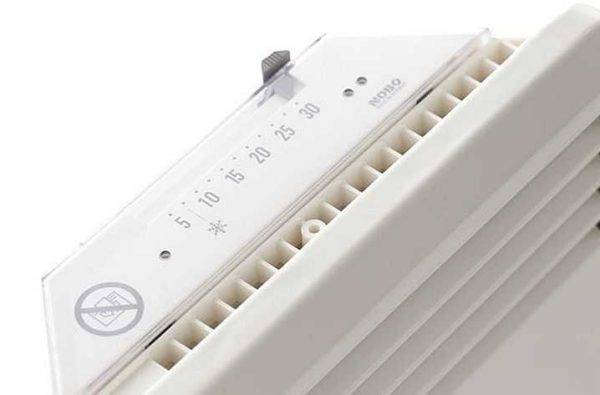
Mechanical thermostat on electric convectors heating Nobo
Electronic control uses several sensors that monitor the state of the air in the room, the degree of heating of the device itself. The data is processed by a microprocessor, which corrects the operation of the heater. The desired mode is set from the control panel located on the case, and there are also models with a control panel.You can find programmable models that allow you to set the heating mode for a whole week - while no one is at home, set it to maintain about + 10 ° C or lower and save on bills, warm up the room to a comfortable temperature by the time people arrive. There are generally “smart” models that can be integrated into the “smart home” system and controlled from a computer.