- What is a convector
- Design
- How to choose an electric convector for a private house: expert advice
- How to calculate the power of the device for the room?
- How to calculate the power needed to warm up the house?
- Tips for choosing convectors
- Electrical appliances with thermostat
- The device of electric heating convectors
- Types of heating elements for electric convectors
- Types of thermostats and controls
- Standard solutions for some rooms
- Tips for choosing an electric convector
- The principle and arrangement of water convectors
- Oil coolers
- Benefits of installing a convector
- Principle of operation
What is a convector
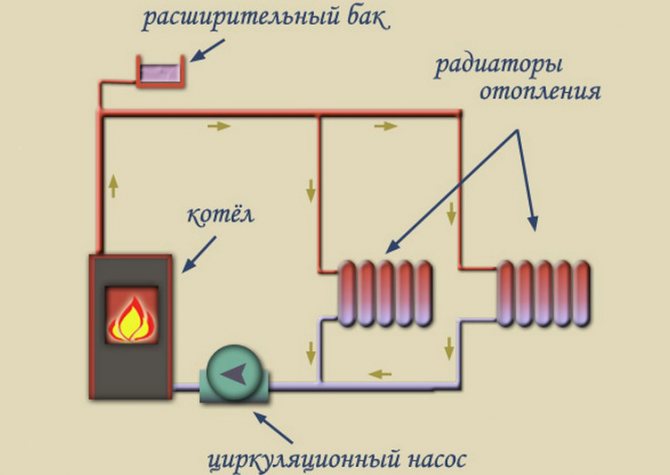
Heating devices can work on two principles - to radiate heat, heating surrounding objects, and to create convection, providing air circulation in heated rooms. Convection allows you to quickly create a comfortable environment in your home by gently taking in cold air and generating warm air instead. Not only conventional radiators for water systems are built on this principle, but also electric convectors.
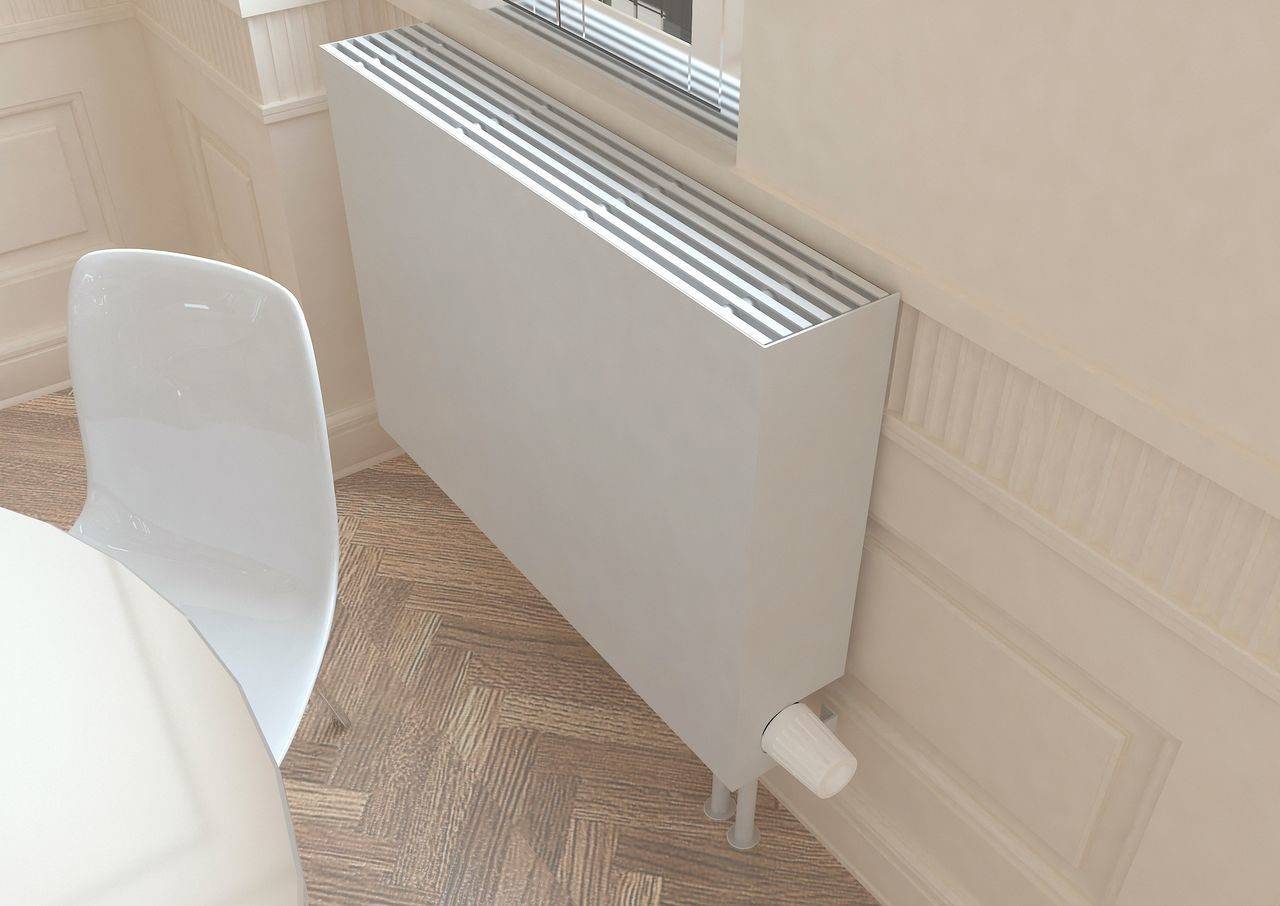
An electric heating convector is a small heater that resembles the most common heating battery in its appearance. It works from the electrical network and does not require a coolant supply. Thus, some energy savings are achieved, heat losses are reduced.In order for the convector to work, you need to connect it to the mains - for this, the most ordinary socket is suitable.
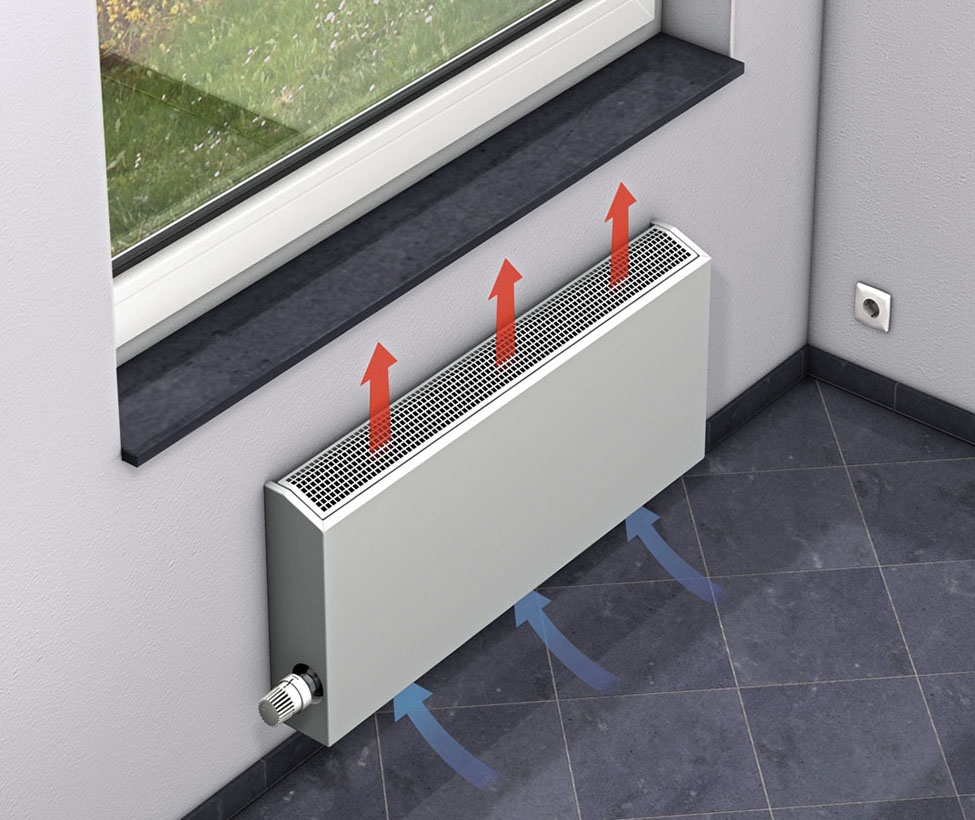
The process of convection is that the air heated by the radiator rises, and cold air comes in its place.
The electric convector works offline. He does not need to lay pipes throughout the house, in an electric boiler, in an expansion tank and other appliances necessary for water heating. The convector is designed to heat the air and ensure its continuous circulation through the heated rooms. The result is high-quality and almost uniform heating of all rooms in a house or apartment.
What are the advantages and disadvantages of electric heating convectors? Why are they better than other heaters? To begin with, we will consider the positive qualities of this equipment:
- effective heating of the room provides comfort at any point in it - natural convection allows you to deliver warm air to any place in the room, displacing cold air from there;
- completely autonomous operation - you do not need to create a whole heating system, just hang the required number of convectors in the rooms;
- almost uniform temperature at all points after full warm-up - this is ensured by natural convection and reduced heating intensity of heating elements in modern convectors, resulting in a more uniform distribution of heat;
- compactness - this is characteristic of many modern heating devices. Thanks to this, electric convectors look good in any room;
- the possibility of using it as the main or auxiliary heating equipment - if your heating is often turned off, you can purchase an additional source of heat in the form of an electric convector;
- no significant effect on air humidity and oxygen content - electric heating convectors do not burn oxygen and do not dry the air, maintaining a healthy and healthy microclimate in the house;
- instant start and complete noiselessness in operation - convectors heat up very quickly, and natural air circulation provides immediate heating of residential premises;
- Extreme ease of installation - just place a wall-mounted model on the wall or install a floor convector. After that, you can start the convector and enjoy the heat.
In addition, electric heating convectors are maintenance-free, do not require permits for installation, are safe for others and are characterized by high efficiency.
If it is possible to connect your house to gas communications, then a heating system with fuel in the form of gas will be much more economical than heating with electric convectors.
There are also disadvantages, which are listed below:
- together with warm air, radiators carry dust, distributing it to all heated rooms;
- despite the high efficiency, heating costs will be high. Electric heating is the most expensive heat source;
- too high heating costs for large households - if you have a large house, it is more profitable to create a water heating system.
There are not very many cons, so electric heating convectors can be considered almost ideal heating equipment.
Electric convector heaters will be an excellent solution for small one-room and two-room households, as well as for small country houses. They are also useful as accessories for apartments.
Design
Electric convectors are endowed with durable housings with outlets. The design of cases can be both simple and more expressive. By releasing electric convectors, manufacturers strive to give their customers the opportunity to purchase equipment of any kind. Thanks to this, the sale appears:
- Electric convectors with a special shape of housings;
- Devices with an unusual color;
- Electric heaters with decoration with decorative materials.
Glass convectors look great in the interior.
Models with front tempered glass look best. The glass itself can be black, white, gray, colored and mirrored. Often some drawings or abstractions are applied here.
Designer electric convectors are the best suited for rooms with a good repair. They can be mounted both under windows and along blank walls, delighting consumers with their excellent appearance. Some models differ significantly in their cost, but this is typical for all non-ordinary equipment.
Glass electric heaters look best indoors. They work at the expense of a heating element made of glass, inside of which there is a conductive gel or a conductive coating. These devices are quite expensive, but they look just great.Some modifications are made on the basis of mirror glass, resulting in combined units - they combine heaters and bathroom mirrors.
How to choose an electric convector for a private house: expert advice
Before purchasing an electric converter, you must remember that this is an effective, convenient, but rather expensive way of heating the air flow in the room. You can read customer reviews. Different converters vary in power. Electric convectors for heating a private house will help create a high-quality and economical heating system.





How to calculate the power of the device for the room?
For the right choice of electric convector power for a private house or apartment, there is a formula: 1 kW of converter power heats up a room of about 10 square meters with a ceiling height of up to 3 meters.
On the market there are electric convectors with a performance of:
- 0.5 kW;
- 1 kW;
- 1.25-1.5 kW;
- 2 kW.
The 2.0 kW electric convector is suitable for a large room.
How to calculate the power needed to warm up the house?
The average private country house consists of: a bedroom, a dining room-kitchen, an entrance hall, a bathroom, a living room, a nursery. Accordingly, the area of each room in a private house in square meters: 10, 12, 5, 5, 20, 12. Summing up these figures, we get 64 sq.m. It is known that a room with an area of 64-70 sq.m. requires the performance of electric convectors - 7 kW, based on the formula described above. Thus, based on these calculations, you can choose the number and power of converters for heating.
The most important selection factor is the heating element. The duration of the operation of the electric convector depends on the quality of this element. It is recommended to choose a device with a ceramic heating element. Modern converters are all safe for installation in the bathroom, kitchen - the internal parts are protected from water.
When choosing a converter for a private house, you should pay attention to:
- Manufacturer - models from Thermia, Electrolux, Zilon, Neurot are distinguished by a wide selection of options;
- Material for the manufacture of structural parts;
- Power, performance of the electric convector;
- Type: universal, wall or floor;
- Price;
- Electric convector dimensions;
- The presence or absence of special modes of operation;
- Design - if necessary, you can buy converters made not only in white, which will better fit into the interior of a private house or apartment.
Tips for choosing convectors
- Premises up to 6 sq.m.
The main indicators of heating with electric convectors will be: dimensions, power, type of installation and customer reviews. Sufficient power - 500 watts. The dimensions of the model should be compact. The type depends on the number of heated rooms in a private house or apartment: you can install a wall-mounted version for heating or choose a mobile, economical floor converter that can be moved from room to room.
Electrolux ECH / L - 500 U - a model of a universal convector with a power of 500 W.
- Room up to 9 sq.m.
Sufficient power - about 750 watts. You can buy light, comfortable, economical electric convectors of small dimensions.Ballu Camino Electronic BEC / E - 1500 is an inexpensive, versatile, electric convector, which is characterized by excellent reviews, two operating modes, and noiselessness. The wall-mounted convector can be used in rooms with a high level of humidity.
Photo of a wall-mounted electric convector
- Room up to 12 sq.m.
This is the standard size of a bedroom, a nursery. Enough 1000 watts. Electrolux ECH / L - 1000 U - a universal type convector with a power of 1000 W. It is characterized by the presence of protection against overheating, ingress of foreign objects into the device, good reviews. For small rooms, electric convectors Thermia, Evub are also recommended.
- Room up to 14 sq.m.
1200-1300 watts will be enough for you. Noirot Spot E-2 7358-4 is an economical model that is suitable for heating such a room. The advantage of the model is a universal type convector that can be installed on the wall or on the floor, inexpensive. It is characterized by accuracy, high quality workmanship, according to reviews - economical.
- The room is more than 15 sq.m.
Requires power of 1500 W or more. A decent economical option is Noirot Melodie Evolution 7381-5. Plinth type convector with a power of 1500 watts. Heating with electric convectors is characterized by automatic protection against overheating, it works silently, and is endowed with many useful functions. Buyers give great reviews.
Photo of a wall-mounted electric convector
Electrical appliances with thermostat
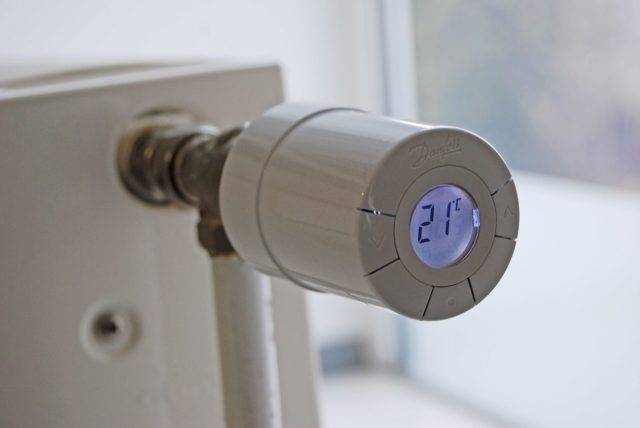
In most convectors, a thermostat is installed, which is designed to regulate the temperature of the heating element and, accordingly, the temperature of the air that leaves the convector.On cheaper models, mechanical thermostats are installed, with which the temperature is roughly adjusted.
Expensive models are equipped with electronic thermostats that allow you to adjust the temperature with high accuracy - up to a tenth of a degree. For domestic use, precise temperature control is not so important.
If the room is cold and you need to warm it up faster, the thermostat is set to the maximum temperature. When the optimum and comfortable temperature is reached, the thermostat can be set to a lower temperature value.




The accuracy of temperature control is relevant when it is necessary to maintain the temperature in those rooms where it is necessary to observe a strict temperature regime. Thanks to the electronic thermostat, automatic room temperature control is possible.
In addition to the thermostat, the electric convector has a switch for supplying voltage to the heating element. In convectors with a power of 1500-2500 W, there can be 2-3 heating elements and, accordingly, a switch for several positions.
For example, when installed in the first position, one heating element is turned on, in the second position, two heating elements are turned on, and in the third position, the convector operates at full power - that is, all three heating elements are turned on.
On some types of electric convectors, independent switches are installed for each of the heating elements.
This option of turning on the heating elements is the most acceptable, since in the event of a burnout of one heating element, it is possible to turn on another one that is in good condition, while when the heating element burns out in a convector with a step switch, there is a high probability that in none of the switch positions the convector will not work.
Existence of the thermostat and switches of heating elements allows to regulate temperature of heating of air in rather wide ranges.
The device of electric heating convectors
The device of the electric convector is simple:
- a housing in which there are openings for air intake and exhaust;
- heating element;
- sensors and control and monitoring device.
The case is heat-resistant plastic. The shape can be flat or convex, rectangular or square. There are holes in the bottom of the case - cold air is sucked into them. There are also holes in the top of the case. Hot air comes out of them. The movement of air occurs without stopping, and the room warms up.
Convector heater device
The heating element of an electric convector is what you need to pay attention to when choosing. The type of heater determines the service life of the equipment and the air condition.
Types of heating elements for electric convectors
Heating elements in electric heating convectors are of three types:
-
Needle. This is a dielectric tape in which needle loops made of an alloy of chromium and nickel are mounted. The surface of the heater is filled with a layer of protective varnish.The hinges stick out from both sides, heat up very quickly, cool down just as quickly, and this is a plus of such heaters - it is easy to maintain the set temperature. The second positive point is the low cost. Electric convectors with needle-type heaters are a third cheaper. disadvantages - it cannot be used at high humidity, the fragility of the needles leads to the fact that such a heating element quickly fails.
-
TEN. Tubular electric heater. This is a hollow metal tube inside which a spiral is sealed. The distance between the spiral and the body is filled with heat-conducting backfill. Plate-fins are additionally soldered on the heating elements for convectors to increase heat transfer. The disadvantages of this heater are relatively low efficiency, large inertia - due to losses in the transfer of heat from the coil to the body - it takes time to reach the operating mode. Another drawback: during operation, the heating element may crackle. The reason is the different temperature expansions of the materials used. Advantages - the spiral is reliably protected, the convector heater can be used in wet rooms. Also a positive point is a long service life.
-
Monolithic heaters are the quietest, with minimal heat loss. The same thread made of nickel-chromium alloy is soldered in a cast body with fins. Heat loss during transfer from the thread to the body is minimal, the thermal expansion of all parts is the same.
Electric heating convectors with monolithic heaters are considered the best, but they are also the most expensive. With the use of heating elements - a little cheaper.
Types of thermostats and controls
Electric heating convectors can be controlled by a mechanical thermostat or electronics. The cheapest convector electric heaters have a thermostat, which, when the set temperature is reached, breaks the power supply circuit of the heating element. When cooling down, the contact appears again, the heater turns on. Devices of this type cannot maintain a constant temperature in the room - the thermostat is triggered by heating the contact plate, and not by air temperature. But they are simple and quite reliable.
Mechanical thermostat on electric heating convectors Nobo
Electronic control uses several sensors that monitor the state of the air in the room, the degree of heating of the device itself. The data is processed by a microprocessor, which corrects the operation of the heater. The desired mode is set from the control panel located on the case, and there are also models with a control panel. You can find programmable models that allow you to set the heating mode for a whole week - while no one is at home, set it to maintain about + 10 ° C or lower and save on bills, warm up the room to a comfortable temperature by the time people arrive. There are generally “smart” models that can be integrated into the “smart home” system and controlled from a computer.




Standard solutions for some rooms
First of all, you should decide on the area of \u200b\u200bthe room that will need to be heated. For large areas of office space or shopping centers, it is necessary to install several heating devices at once, and it is desirable to provide them with forced ventilation. For extremely large areas, there should be several priors.Also, based on the level of required heat transfer, you should decide which heating option is better - water or electric? The first one will be cheaper to operate, but there may be problems with the rapid heating of the room. The second one will cost a lot of money, but will provide uniform and timely heating.
Apartment convectors and models for small offices will be less whimsical to installation conditions. Due to the small heating area, additional fans can be omitted in them, and central water heating can also be used.
Tips for choosing an electric convector
In addition to objective indicators, when choosing, personal preferences and specific requirements must also be taken into account.
If you have a limited budget, pay attention to convectors equipped with mechanical thermostats. Although they have fewer functions than automatic devices, their cost is much lower, and you do not have to deal with programming instructions.
Also, to automatically adjust the temperature, you can use the thermostat, which is inserted into the outlet. You can read more about these devices in this article.
Each panel of the convector must be self-powered, while the cable cross-section is determined by the power consumption (up to 1.5 kW this value is 1.5 kV mm, over - 2.5 kV mm)
In the lines of manufacturers, models of various characteristics and price are presented. In order not to overpay, carefully study them and compare them with your requirements. So, for example, to heat a small room, you should not buy an overly powerful device.
If a model with many settings and high technical specifications is sold at a cheap price, you should find out the reliability of the manufacturer and carefully read the documents so as not to purchase a fake.
The principle and arrangement of water convectors
Classical radiators heat walls and surrounding objects, thereby heating living spaces. In order to increase efficiency, they are made with fins, due to which a convective air flow is created. As a result, the rate of heating of private houses and apartments increases. Heat is delivered to the radiators using a heated coolant - most often it is ordinary tap water. It enters the room through convection fins and in the form of thermal radiation.
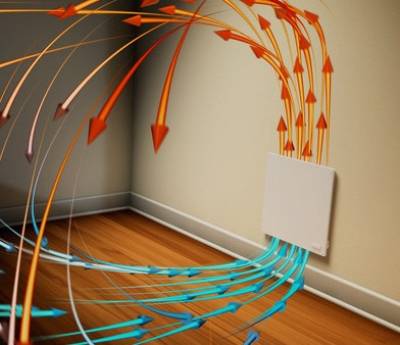
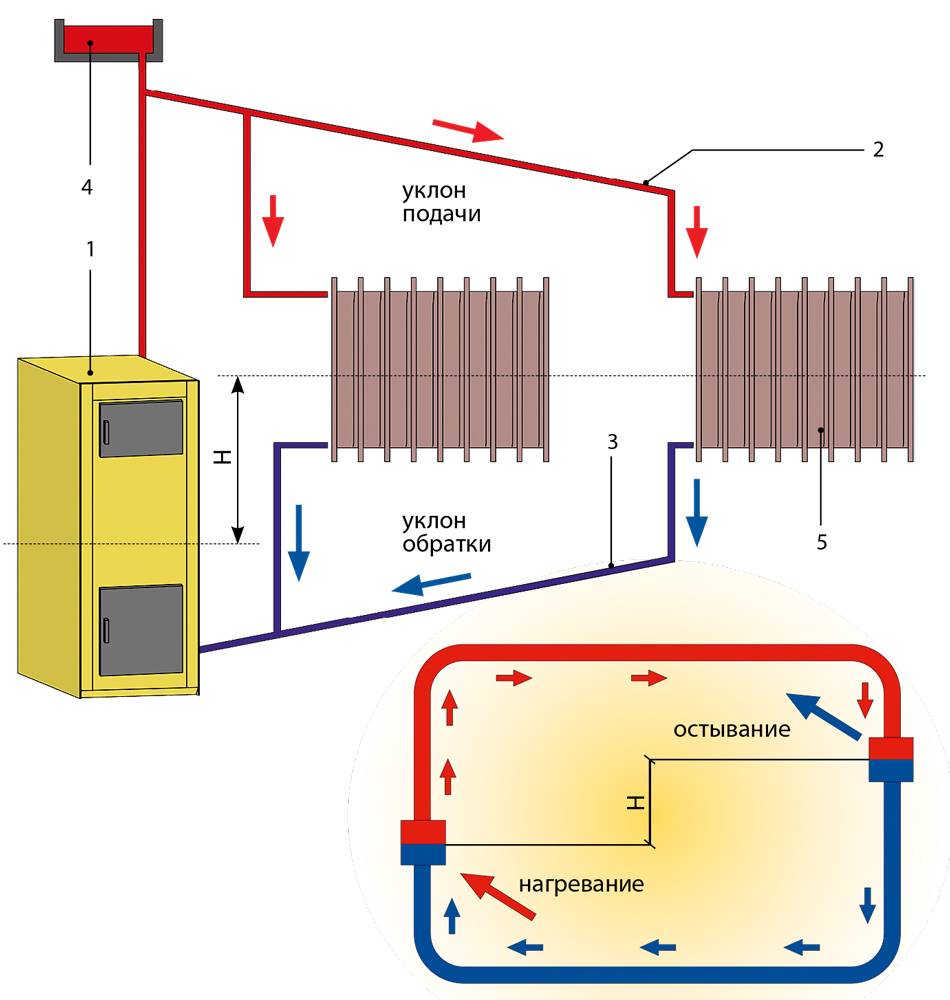
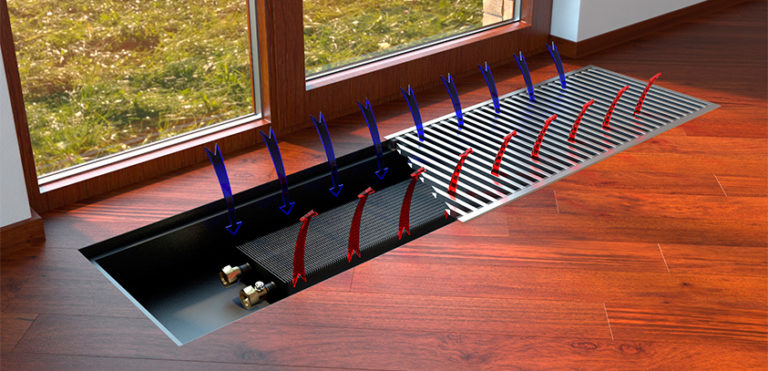
The principle of convection is very simple - heated air rises, and cold air comes in its place.
Convection is good because it provides quick heating of any type of room. Heated air masses, rising to the ceiling, displace cold air from below, forcing it to pass through the convectors. Thanks to this, the results of the heating system become noticeable literally half an hour after turning on the heating. At the same time, a classic heating battery cannot boast of similar results.
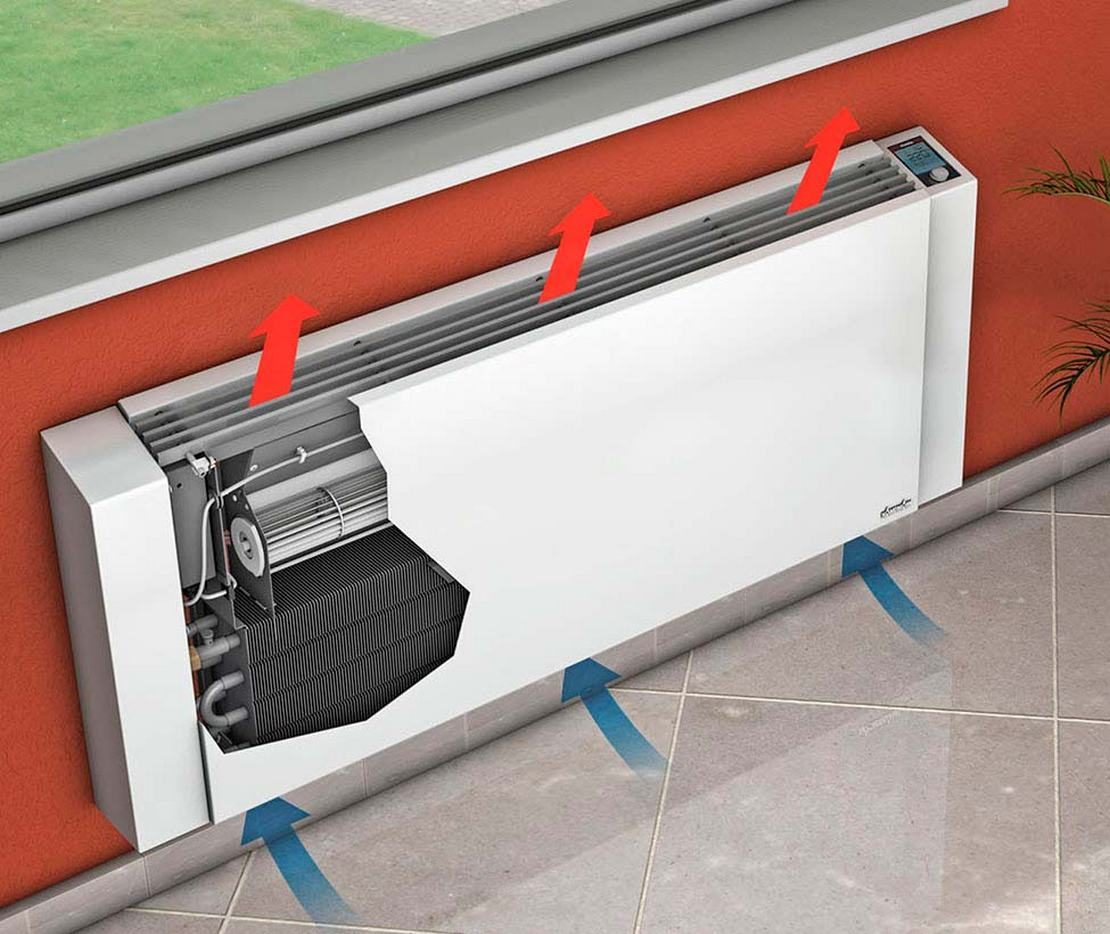
The principle of operation of water heating convectors is very simple. The coolant flowing through them heats the steel finning plates. As it heats up, it tends to rise, and the next portion of air enters in its place. The pure laws of physics work here, providing high-quality heating of residential premises. The heating procedure is carried out absolutely silently, without disturbing the household.
Some water convector heaters have built-in fans that allow you to organize forced convection in order to heat up the premises faster.
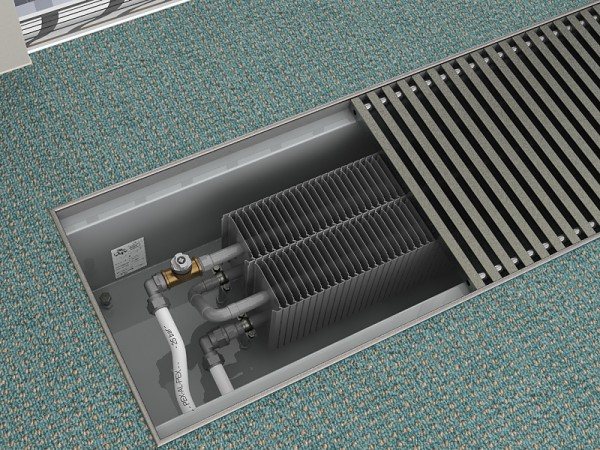
How are water heating convectors arranged? Inside them we will find:
- steel or copper pipe - coolant flows through it;
- finning - it is responsible for heating the air masses;
- connection nodes - with their help, the devices themselves are connected to the water heating system.
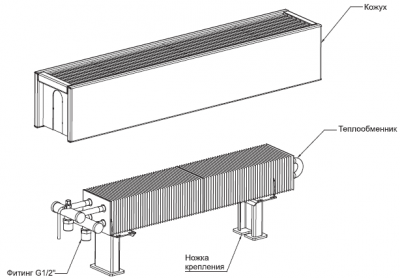
As you can see, there is nothing complicated in the device of this device: a heat exchanger with connection nodes, closed by a housing.
Additionally, thermostats and air vents are installed - the former allow you to adjust the degree of heating, and the latter serve to remove air from the heating system. The device of convectors is very simple, and their diminutiveness will not allow to spoil the interior of living or working premises.


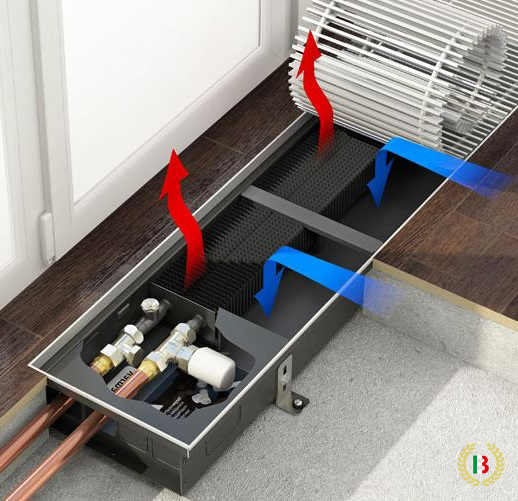
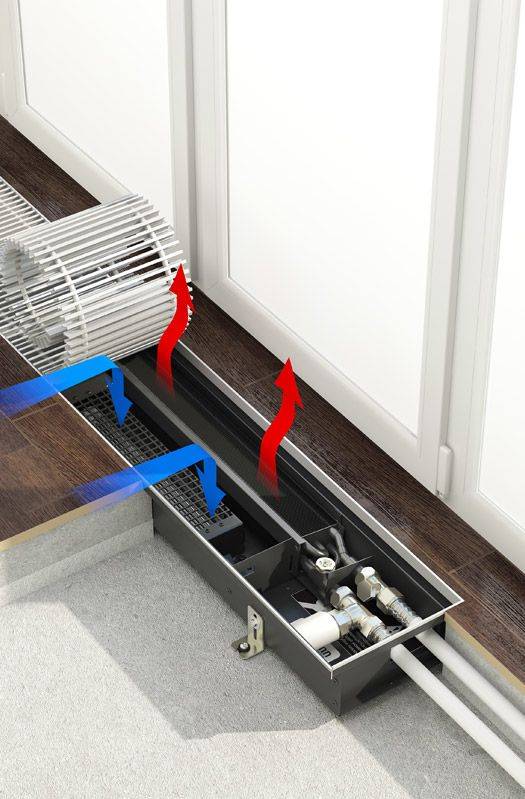
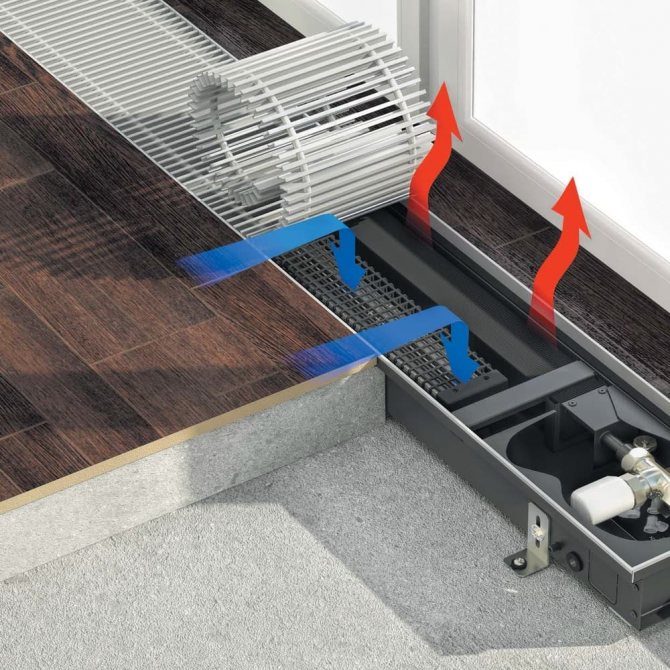

The scope of water convector heaters is extremely wide. They are used for heating private households, apartments in apartment buildings, office, administrative and industrial premises. Here is a list of their benefits:
- such heating devices provide fast warm-up - in terms of warm-up speed, they outperform conventional batteries;
- high efficiency - the heaters themselves give off more than 95% of the incoming heat to the air masses;
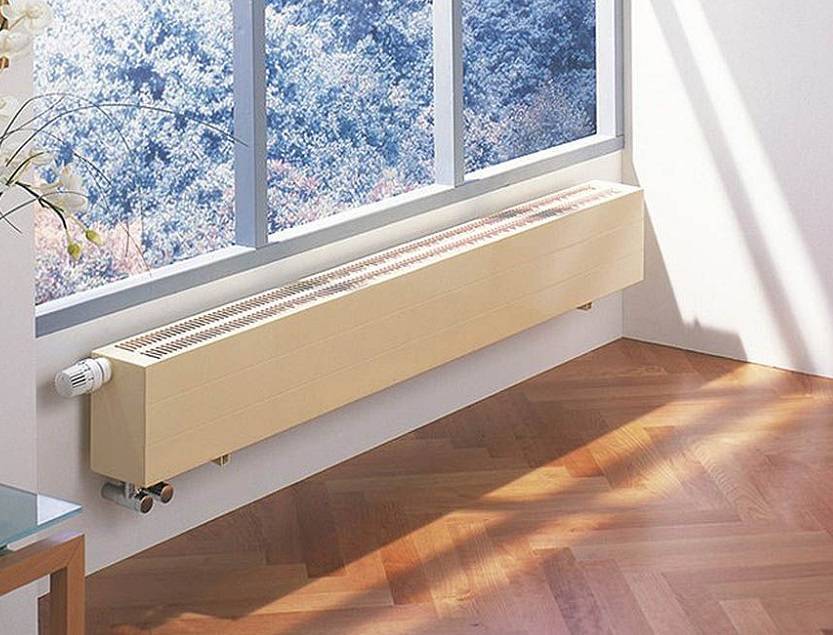
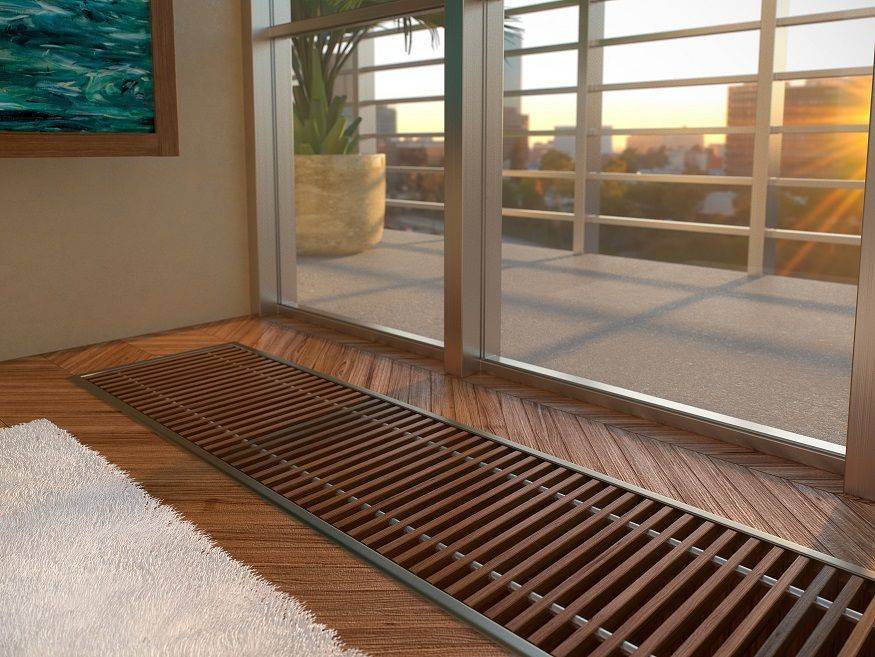
- compactness - due to their small size, these heaters can be used in rooms with panoramic windows without spoiling the appearance.
This is a universal heating equipment for any premises.
Maintenance of heating convectors is very simple - they must be periodically cleaned of dust that accumulates on the finning elements. This is where a vacuum cleaner with good suction comes in handy. Outside care is reduced to a simple removal of dust with a damp cloth. Internal cleaning is carried out at least a couple of times a month, which prevents the accumulation of a large amount of pollution.
Lack of proper care for heating appliances will lead to the accumulation of a large amount of dust - natural convection will spread it throughout the room, which will not add to the health of allergy sufferers.
Oil coolers
In search of a solution to the problem of what is better in an apartment, a convector or a radiator, one should analyze the differences between these devices. Convectors heat the room only with hot air, while radiators have thermal radiation. Practical studies show that near the radiator you can feel the heat emanating from the device and catch the rising flow of hot air.
The main difference between a convector and radiator are their design features and some other options.
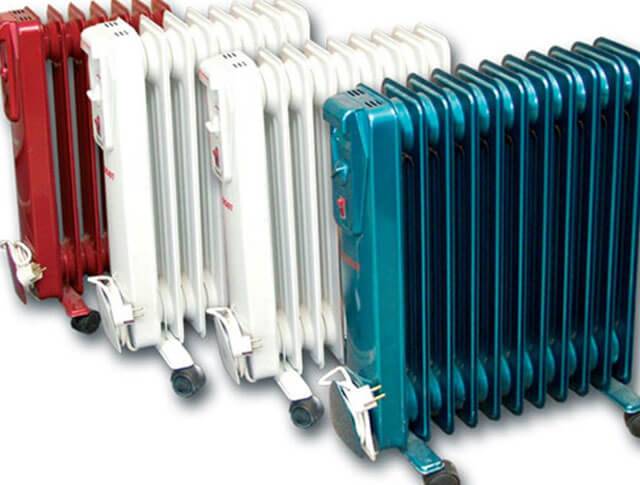
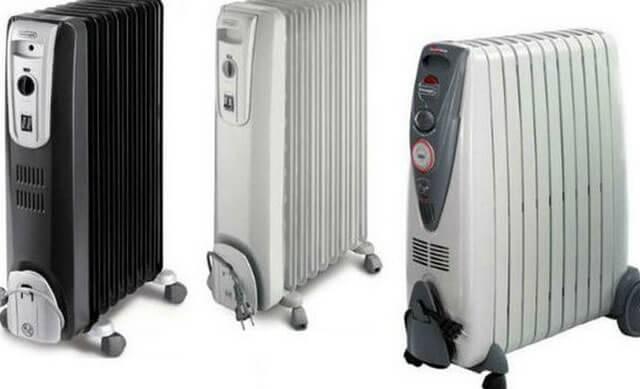
Oil radiators are heating devices that radiate heat in all directions and give an upward flow of warm air. The result of this is the rapid heating of the room. In most cases, oil coolers are used as a device that provides additional heat; in a permanent heating system, such devices are rarely used.
Oil radiators have a large working area - this can be called their main difference from convector equipment. Due to the circulation of heated mineral oil along the circuit, almost the entire surface of the radiator is heated.A device of this type can be placed anywhere in the room, under the desktop or near it, in places of rest and along the walls. There are models designed for wall use only.
Oil coolers have the following advantageous characteristics:
- Fast heating of the room thanks to a big working surface.
- Has built-in thermostats.
- Ability to move quickly and easily.
- Simple care.
- Acceptable price.
Among the shortcomings, the following stand out:
- Strong heat makes the equipment not safe for small children, there is a risk of severe burns.
- Leaked mineral oil can also cause a burn, and leaks may occur in low-quality radiators.
- Equipment that can be used in permanent heating systems is very expensive. Therefore, oil coolers are more efficient at generating additional heat.
Benefits of installing a convector
The main advantages in this matter will be:
- Aesthetic integration into the overall interior;
- Possibility of use in almost any room;
- Variation of shapes and sizes;
- Possibility of installation in rooms located on the upper floors, where the pressure does not rise above 15 bar (applies to water samples);
- Sufficiently light weight, which is not able to heavily load the supporting structures of the building;
- Some savings in comparison with the use of radiator heating (approximate reduction in the cost of heating by 25%);
- Even at an average temperature in the general system of +50 degrees Celsius, comfortable heating of all rooms can be achieved.

And as a separate plus, you can designate the fact that you don’t have to open the flooring to replace / repair individual elements - just remove the crate.
Principle of operation
To understand the reasons for the active growth in the popularity of underfloor convectors for water heating, it is necessary to evaluate the design features and technical characteristics of such devices.
Many owners primarily focus on their functionality. However, there are points to consider
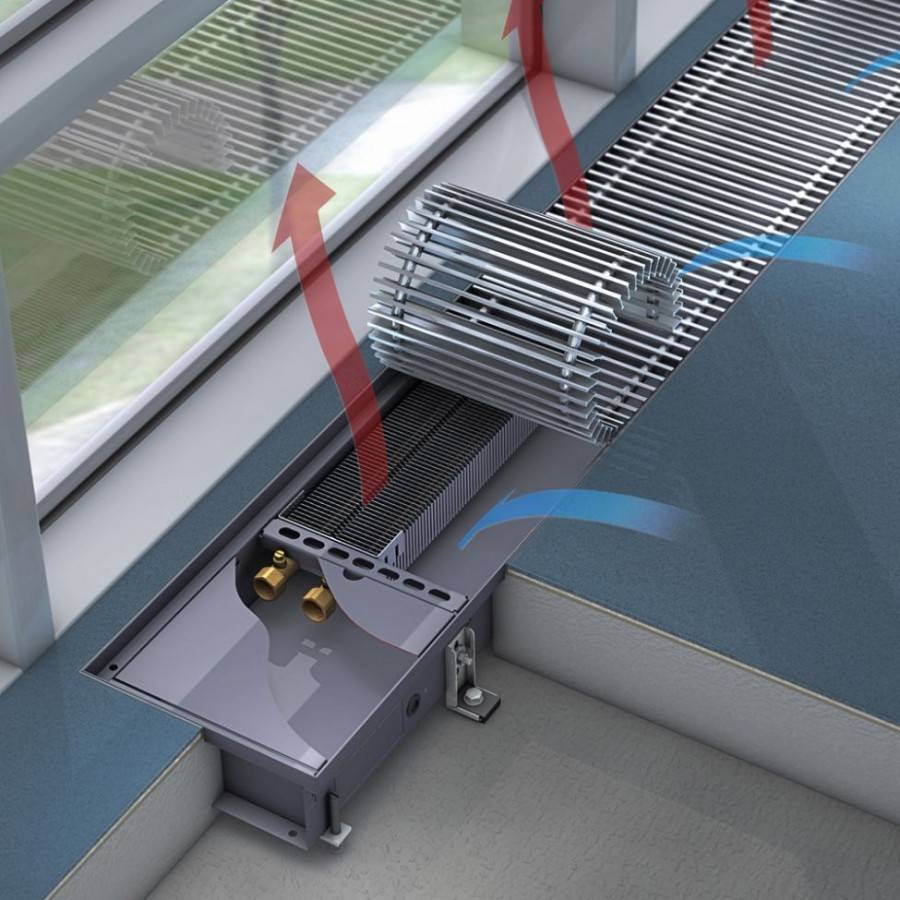
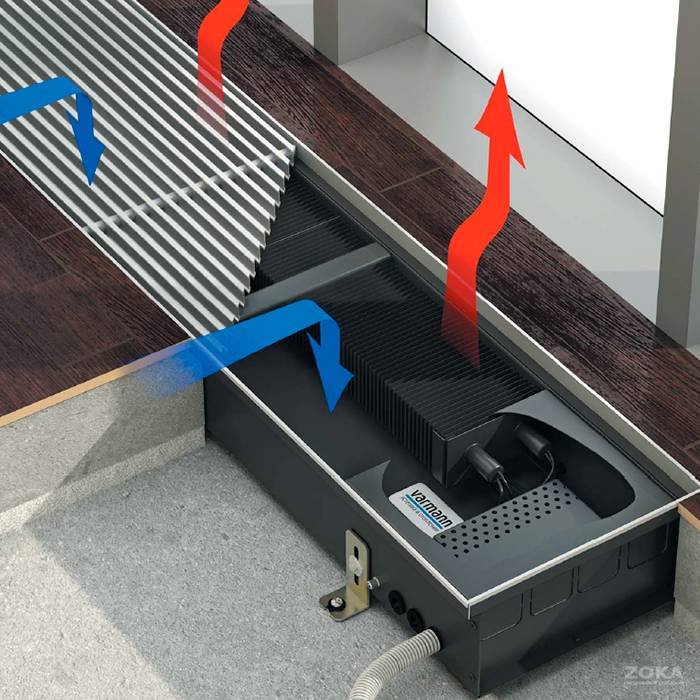
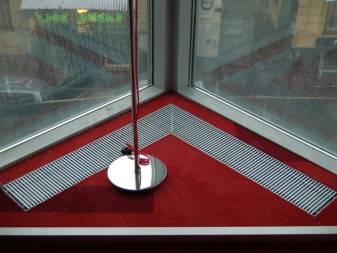
- A convector built into the floor provides effective protection of the living space from cold air currents, while creating a kind of thermal curtain.
- These devices qualitatively and as quickly as possible create a comfortable microclimate even in large areas with high ceilings.
- As practice shows, elements of the heating system built into the floors become the only right solution when it comes to heating spacious buildings. This is primarily due to the uniform distribution of heated air flows. Special fans can speed up the process and increase its efficiency.
- Convectors located along the glazing minimize the risk of condensation, which in turn causes mold and mildew.
- Taking into account all the nuances, technical characteristics and performance indicators, we can conclude that built-in heaters outperform classic radiators in terms of efficiency.
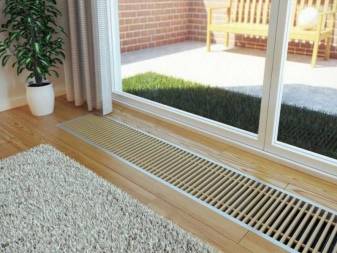
Thanks to the listed opportunities, the demand for the convectors under consideration is steadily growing.Naturally, such an approach to the installation of heating systems has, along with advantages, certain disadvantages, as well as a whole list of nuances. At the same time, many owners consider floor devices to be a vivid example of a new generation of technology that can harmoniously fit into any interior.


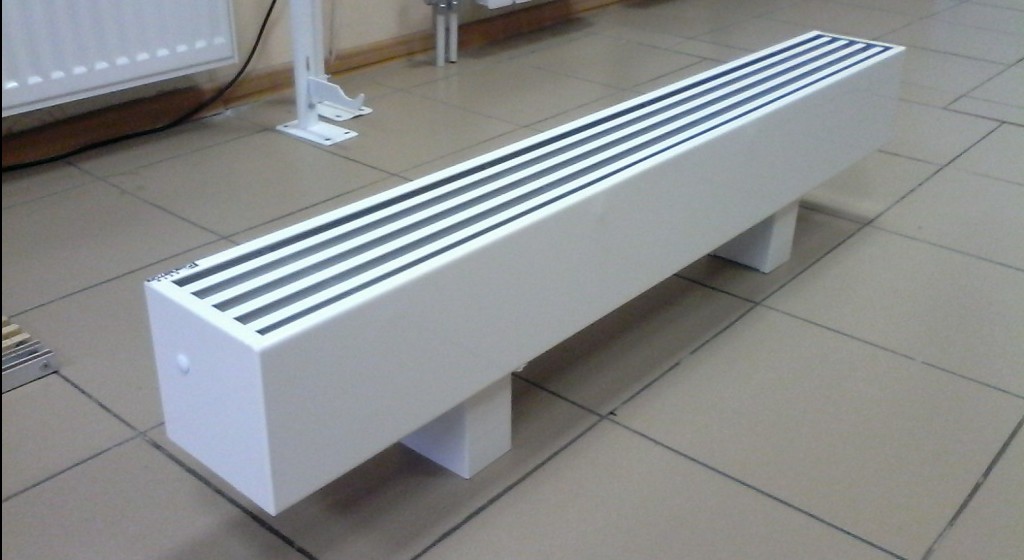


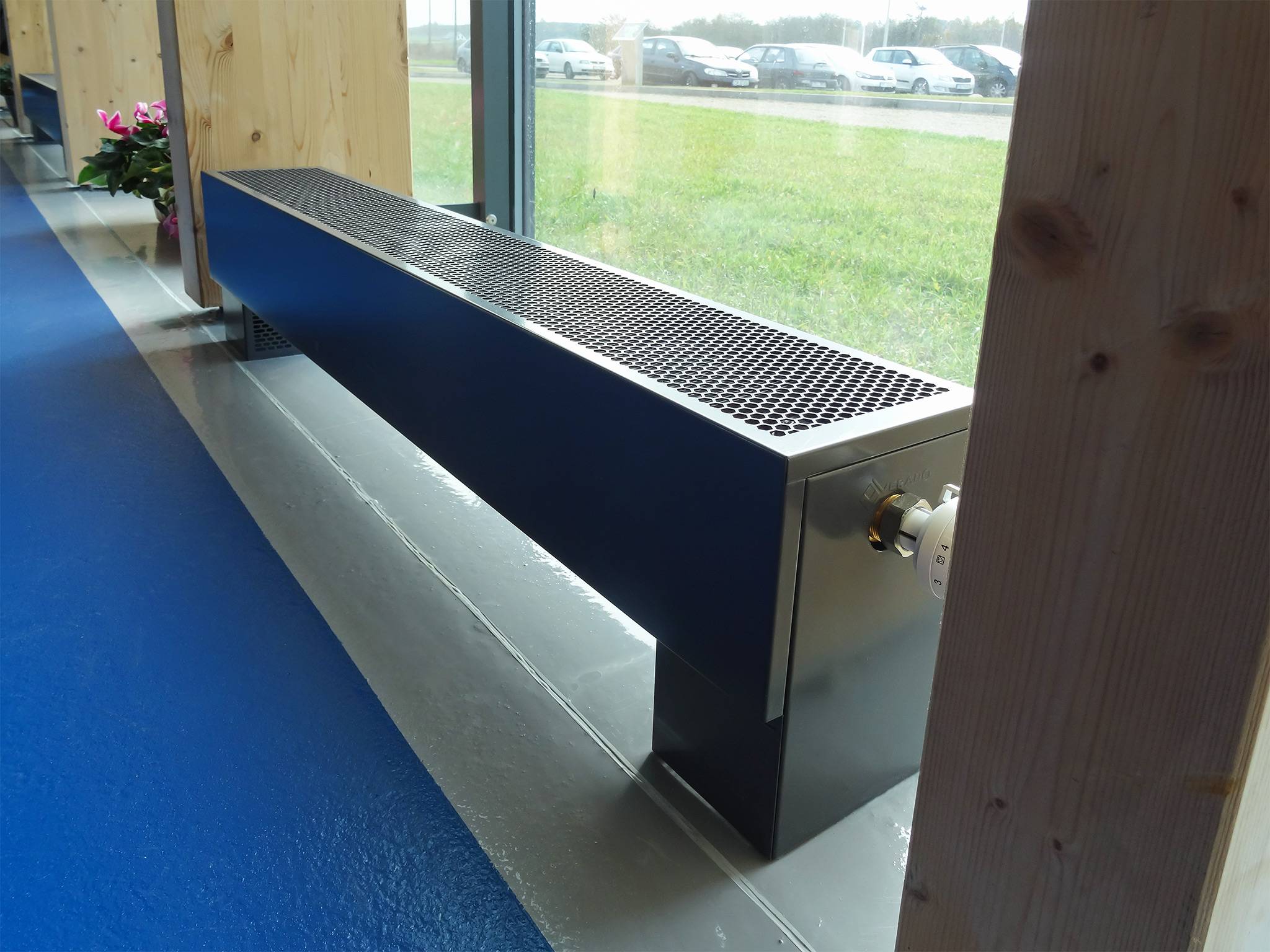

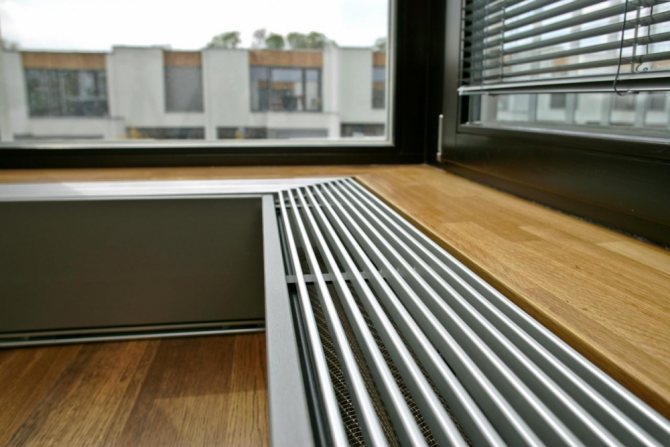
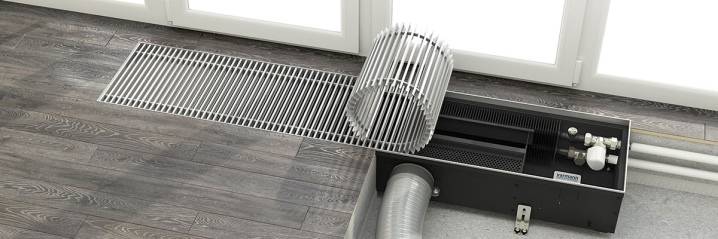
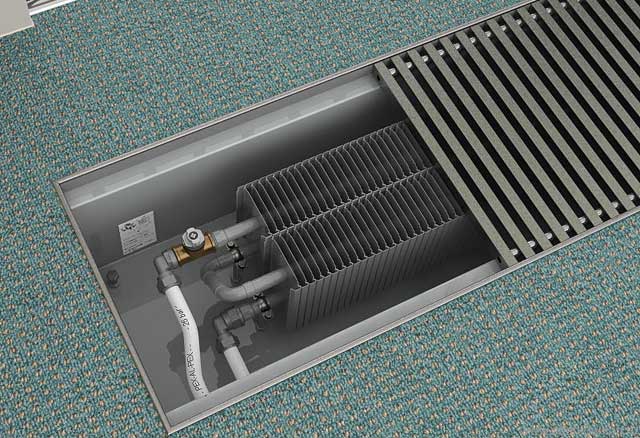
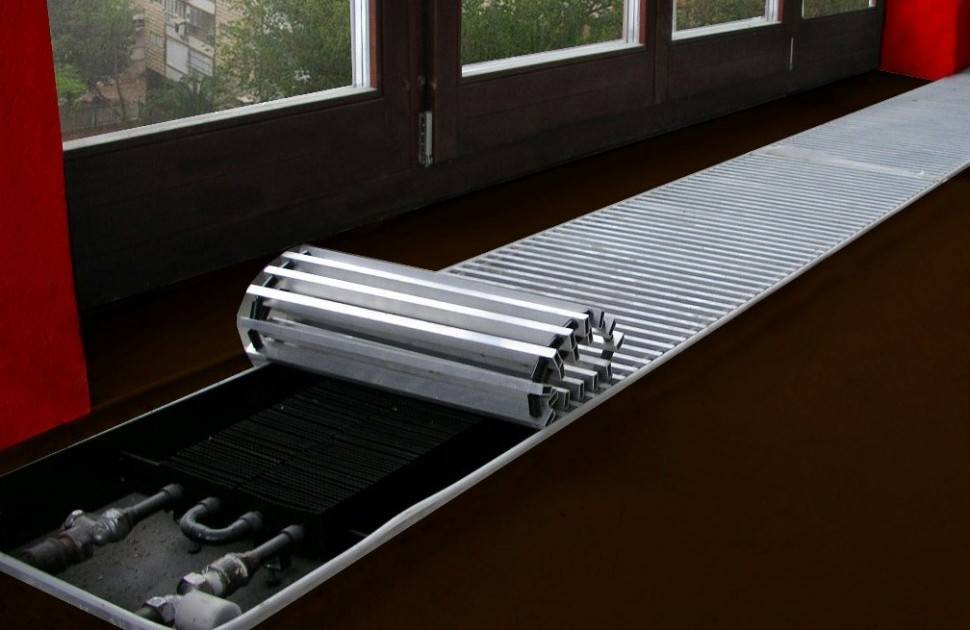
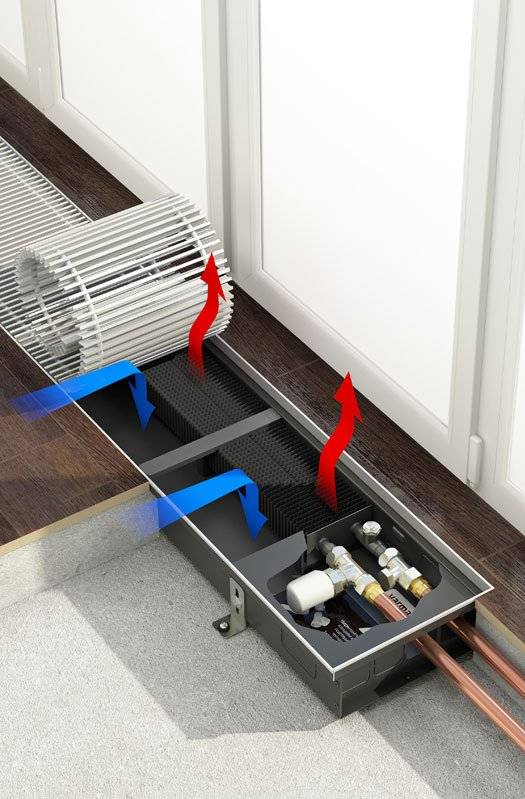
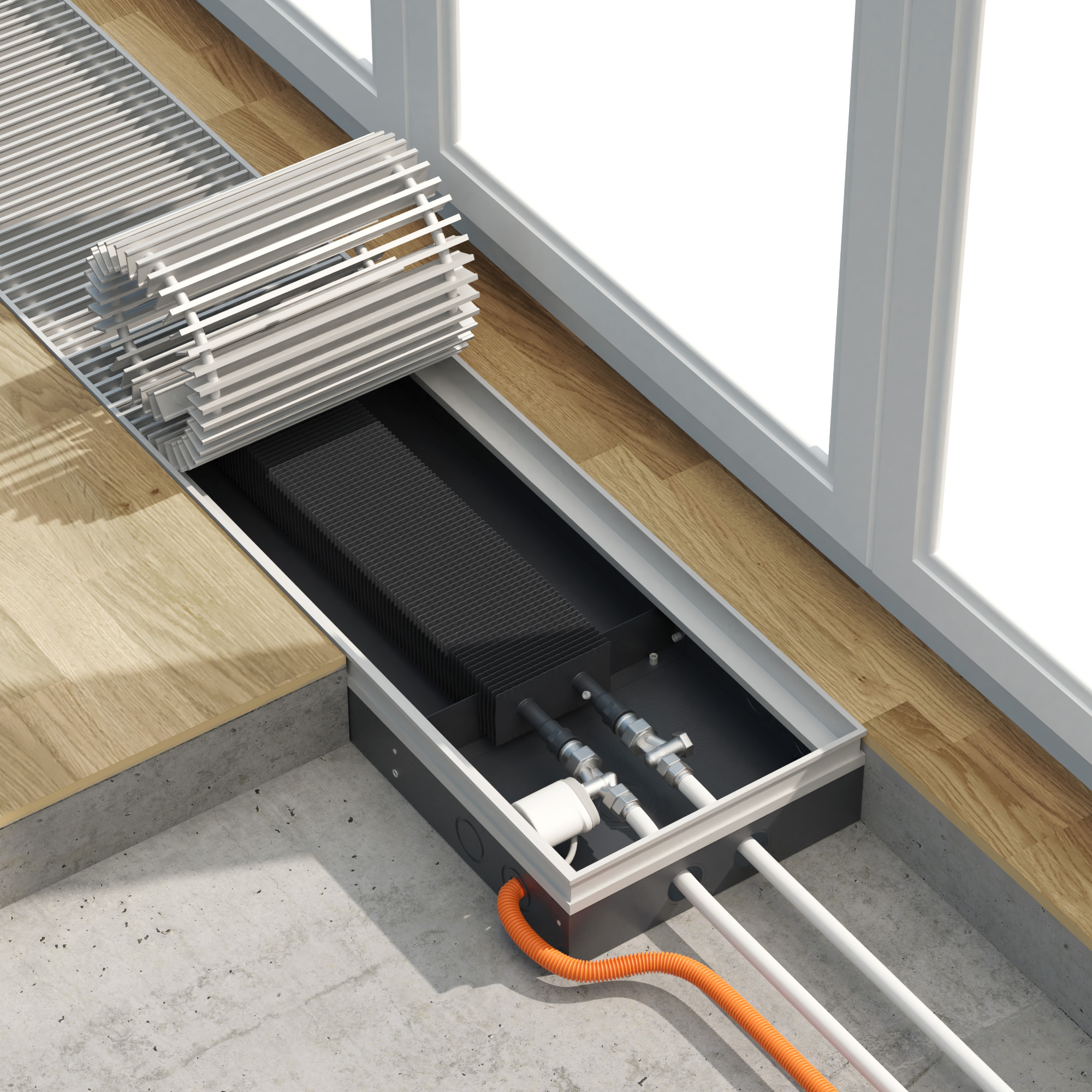
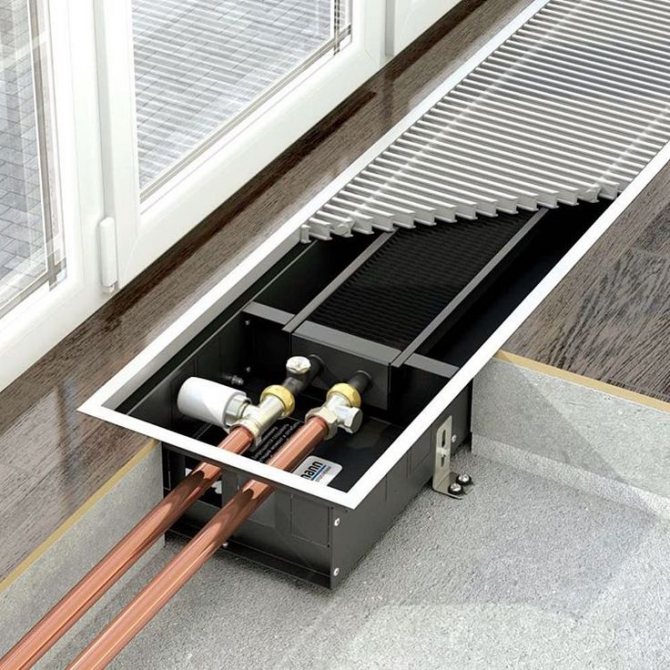
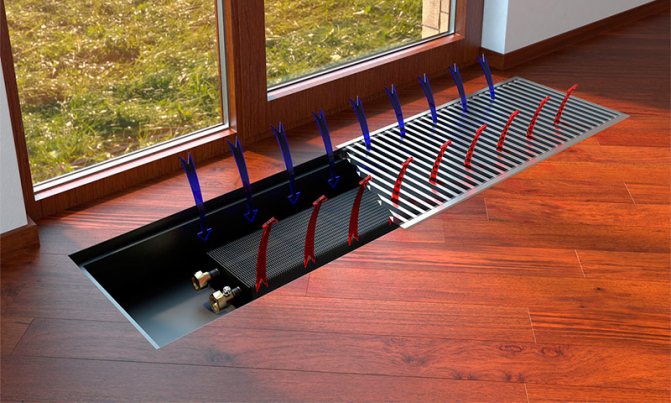
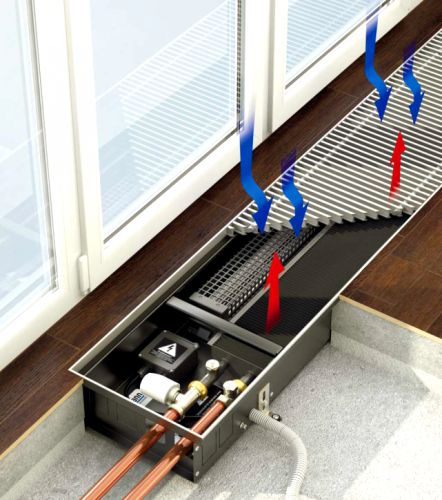
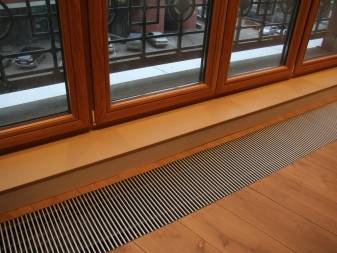
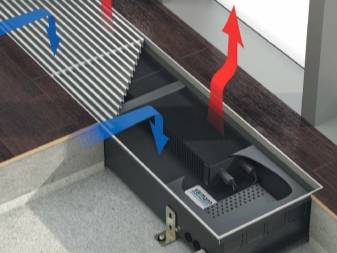
Such devices are almost invisible and do not visually hide the space in the room. The location of the built-in convector is a niche equipped in the floor. Its upper part is closed with a decorative lattice, which turns into one of the elements of the design solution.
Water or electricity are used as heat sources. The first option deserves special attention.
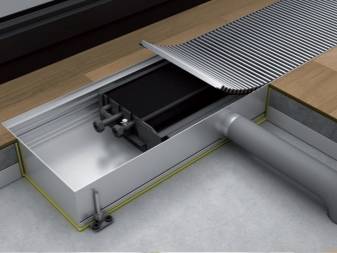
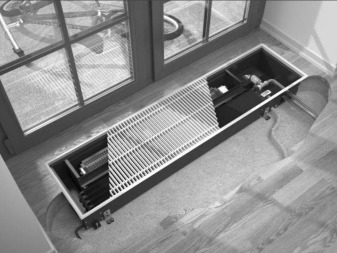
The design of convectors, which are an integral part of the water heating system, is quite simple. The heat exchanger in this case is placed in a durable metal case (most often frame) and connected to the pipeline. The outer part of this housing has special elements designed to install the grate mentioned above. In addition to decorative, it also performs protective functions, since it is able to withstand maximum loads, including the weight of a person.
Taking into account the design features and technical parameters, the floor-mounted convectors for water heating systems currently on the market are divided into the following types:
- devices with natural circulation of heated streams;
- heaters equipped with fans to ensure forced circulation of air masses;
- convectors with the option of supplying air from the street.
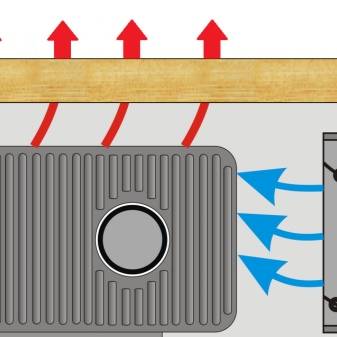
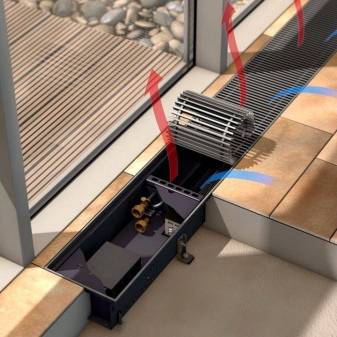
In the first case, the air flows heated by the heat exchanger rise up on their own.As practice shows, devices equipped with fans are more efficient. The third category includes more expensive convectors. Such systems, which can be multi-circuit, provide for the supply of both hot and cold water, as well as a pipe for air flow.