
- Characteristics of the pump Brook
- Principle of operation
- Description of models
- Exploitation
- Features of pumping drainage water
- Specifications and principle of operation
- Brief overview of popular models ↑
- Modifications and similar models
- 1 Device: design features and basic parameters
- 1.1 What is the design of the Brook pump?
- 1.2 Pump parameters and advantages
- 1.3 How the product works
- The principle of operation and advantages of the submersible pump "Brook". Do-it-yourself repair instructions
- Technical characteristics of the pump "Brook"
- Brook pump device
- Principle of operation
- Submersible vibration pump - principle of operation
- Pump Brook - specifications and principle of operation
- Nuances of placement
- Prevention of breakdowns of the pumping unit
- Device Capabilities
- Hydraulic supply
- Pump replacement
- Application in a slowly filling source
- How to successfully restore a clogged well?
- Pumping water from flooded premises
- New heating system
- Characteristics of the pump Brook
- Principle of operation
- Description of models
- Models and analogues
- Conclusions and useful video on the topic
Characteristics of the pump Brook
The technical characteristics and main parameters of the vibration pump Brook are described in several points:
- submersible pump with top or bottom water intake;
- working depth up to 40 m;
- productivity - about 450 liters per hour;
- power supply from household network 220 V;
- power consumption 270 W;
- weight - 4 kg.
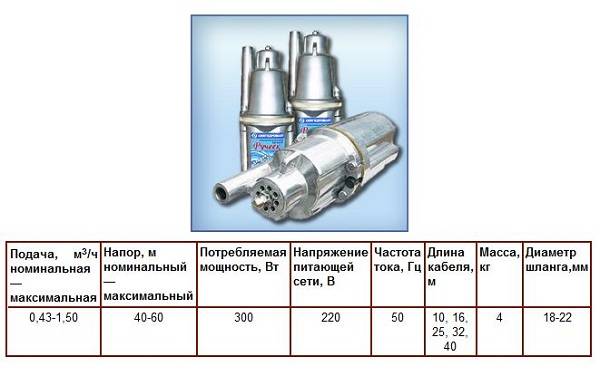
Such characteristics of the Brook pump are not particularly impressive, but they are quite acceptable to meet the water needs of a small farm.
Principle of operation
Vibratory submersible pump Brook has a diaphragm, the vibration of which creates a pressure difference inside the housing. The water flow is generated by an inlet valve, which is alternately in the closed or open position.
Such a vibration pump does not require constant maintenance, since the diaphragm is driven by an electric coil, which creates an electromagnetic field. The absence of rotating parts, bearings, complex kinematic schemes does not allow critical wear of parts, so there is practically no breakdown.
Description of models
Despite the simplicity of design, the Brook water pumps have several modifications:
- B-10, B-15, B-25, B-40;
- H-10, H-15, H-25, H-40.
The difference in the models lies in the location of the operating valve for the upper (B) or lower (H) water intake. The number after the index indicates the technical characteristics that allow the device to operate at various depths from 10 to 40 meters. Any submersible pump works normally, provided that its body is completely in the water.
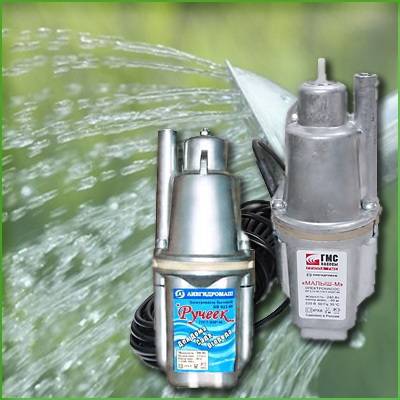
Since some wells have a limited filling with water during intensive pumping, all devices are equipped with a protective relay that turns off the pump in case of dehydration of the source. This avoids overheating when running dry.
Exploitation
The main technical requirements to ensure correct operation are:
- In the use of a protective rubber ring.The pump lowered into the water should not come into contact with the concrete wall structures.
- To prevent engine overheating. If the pump has been continuously operated for twelve hours, it must be stopped regularly and a ten-minute break (approximately every 2 hours) must be taken.
- In application exclusively for pumping drinking and drainage water. The unit must not be used in sewage and faecal drains. Its filters are designed for small impurities of silt and sand up to 2 millimeters in size.
Although the pump is a fairly reliable device, it still sometimes fails. This usually happens after prolonged use. Due to the low cost, the owners usually replace the broken unit with a new one. However, simple problems can be fixed with your own hands without purchasing a new pump.
Features of pumping drainage water
During the spring flood, situations often arise related to the flooding of basements, inspection pits and other structures below the surface. Usually, such groundwater has practically no impurities, so it is quite possible to pump it out with vibration pumps.
If it is necessary to work with contaminated water, it is necessary to use an additional filter, which will prevent possible damage to the pump. Such a filter has the form of a cap, which is put on the receiving part of the device, and the installation must be carried out after the filter has been preheated, this will greatly simplify the installation process.
Specifications and principle of operation
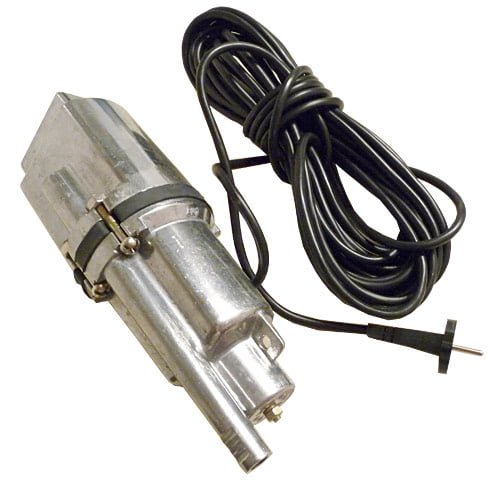
Pump brook for a well
There are a number of nuances that must be taken into account before installing and operating devices for pumping water from a well or well
As you know, a submersible pump (it belongs to such varieties) is used most often in country conditions, so the owner should pay attention to the following characteristics:
- devices are placed in the medium weight category, their mass is 4 kg;
- the water intake mechanism is installed on top of the structure, this prevents debris and sludge from entering the inside of the pump, which prolongs its operation;
- the optimal depth from which the brook pump is able to extract water is 40-45 m, subject to a source diameter of 1 m;
- there is a standard need for energy, the device is connected to a 220-300 watt network, powered by a traditional 220 volt power supply;
- with the correct selection of the depth of the water supply source, the pump capacity is no more than 40 liters of water per hour;
-
continuous operation is about 12 hours.
The manufacturer recommends turning off the rest device after 2 hours of continuous operation - this will extend the life of the pumping equipment and maintain performance.
Brief overview of popular models ↑
There are more than a dozen popular models on the market, but the owner himself must finally decide which vibration pump is best for a particular well. To do this, you should take into account the design features and technical characteristics of each product. Consider five known models.
The compact device has several modifications with the following characteristics:
- voltage - 220 V;
- power - 225-300 W;
- productivity - 400-1500 l / h;
- head - 40-60 m;
- weight - 5 kg;
- cost - 2250-2500 rubles.
About the pump "Rucheyek-1"
This equipment is universal, but not very suitable for pumping dirty water (for example, sewage). It does not have special fastenings to the walls of the well; it is suspended on a cable or a strong rope. Has long service life, replacement of rubber parts is made easily. Operating time - up to 12 hours a day, constant monitoring is not needed.



The household pump "Malysh-M" is intended for use in summer cottages:
- voltage - 220 V;
- power - 240-245 W;
- productivity - 1.3-1.5 m³ / h (up to 1.8 m³ / h without pressure);
- immersion depth - 3 m;
- weight - 4 kg;
- cost - 1400-1800 rubles.
This model is designed for pumping clean drinking water, but there are also drainage modifications that can deliver liquid with a high degree of contamination. Most often used to provide 1-2 points of water intake or for watering the garden (garden). There are options with upper and lower water intake. The main element of thermal protection is an enlarged copper winding that protects against overheating.
Simpler models are suitable for watering the garden, powerful modifications are suitable for providing water to homes, farms, and small businesses.
- voltage - 220 V;
- power - 225-240 W;
- productivity - 24 l / min;
- maximum pressure - 60 m;
- weight - 3.8-5.5 kg;
- cost - 1400-1800 rubles.
The advantage of the brand's products is the duration of continuous operation up to 200 hours (the maximum value of analogues from other manufacturers is up to 100 hours). The easy-to-use vibrating well pump has an upper water intake, which prevents the intake of dirt and debris, however, it allows particles up to 2 mm to pass through, so it can also be used for cleaning purposes.
The minimum diameter and compact dimensions of the equipment allow it to be used both in wells and in wells.
- voltage - 220 V;
- power - 180-280 W;
- productivity - 960-1100 l / h;
- water rise height - 60-80 m;
- weight - 4-5 kg;
- cost - 1700-3000 rubles.
When buying, pay attention to the length of the power cable - from 10 to 40 m. More powerful models are equipped with a more powerful engine and a built-in thermostat that protects against overheating. Inexpensive products are used for pumping only clean drinking liquids
Inexpensive products are used for pumping only clean drinking liquids.
Small lightweight pumps are designed for gardening and farm work in suburban areas.
- voltage - 220 V;
- power - 200 W;
- productivity - 660-1050 l / h;
- water rise height - 40-75 m;
- weight - 4-5 kg;
- cost - 1200-2500 rubles.
Some models have a lower water intake, which is convenient for functioning in deep waters. Sheet steel and copper motor winding ensure a long service life. In addition to a set of cables, the kit includes spare membranes.
Modifications and similar models
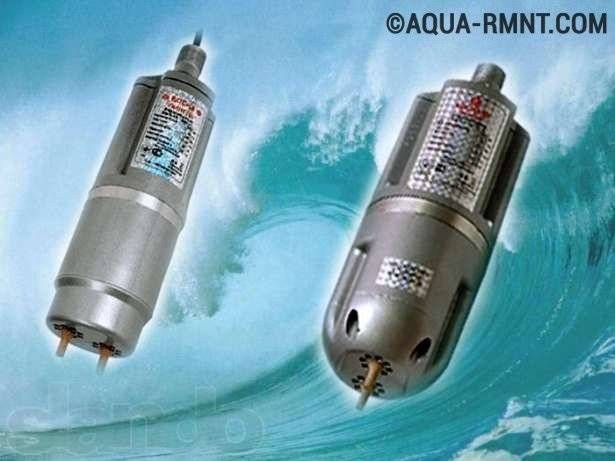
Structurally, the pumping equipment of this manufacturer is distinguished by the principle of intake. A "brook" with a lower water intake will never work "idle". The water intake is located at the bottom of the body. And devices that have it on top will never become clogged with silt, and will always cool naturally.
The catalog of equipment manufactured by OAO Livgidromash (Russia) includes the following modifications:
- "Brook 1". The upper water intake keeps the supplied water clean. The device does not overheat.The cooling system involves the natural washing of the device with liquid.
- "Brook 1M". The system of the lower fence allows you to completely empty the tank, tank, reservoir. The main thing is to make sure that the water intake is not clogged with bottom sediments and debris.
Polish designers managed to create an equally effective device - the Omnigena-Dorota pump. It is an analogue of the "Brook". Among domestic models, similar in characteristics, reliability, simplicity of design and maintainability, one can single out the "Baby", produced by the Bavlensky plant "Electric Motor.
1 Device: design features and basic parameters
Vibration type pumps have served man since Soviet times. Their output today exceeds 1 million pieces per year, while the need for them has not yet been exhausted. Ease of use, affordable price and stable quality - allow you to compete in the market of pumping equipment with foreign-made units.
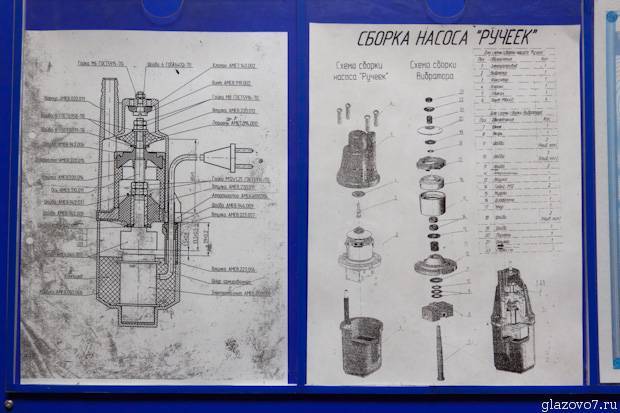
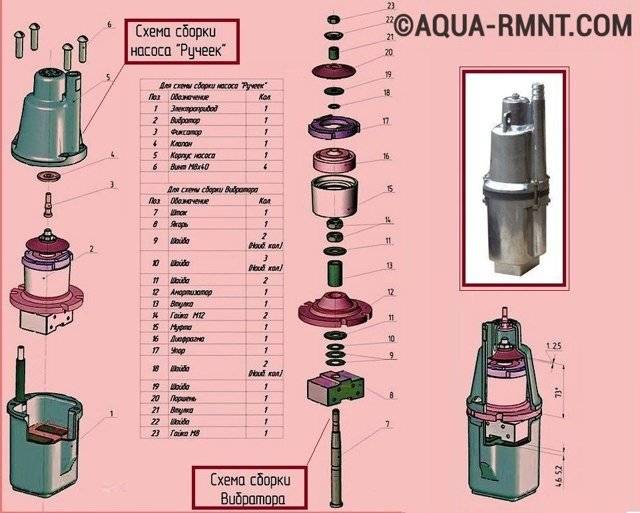
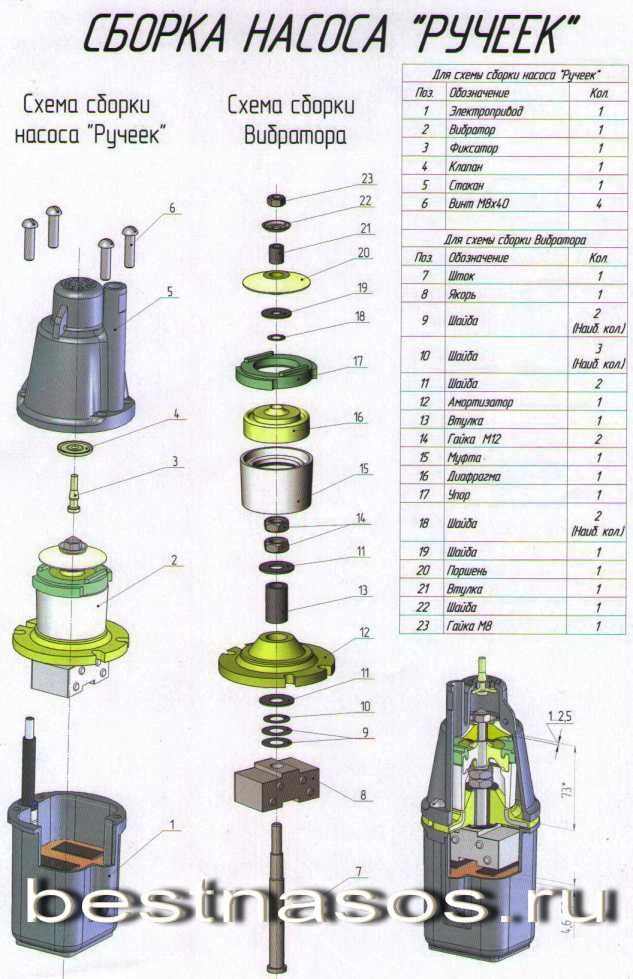
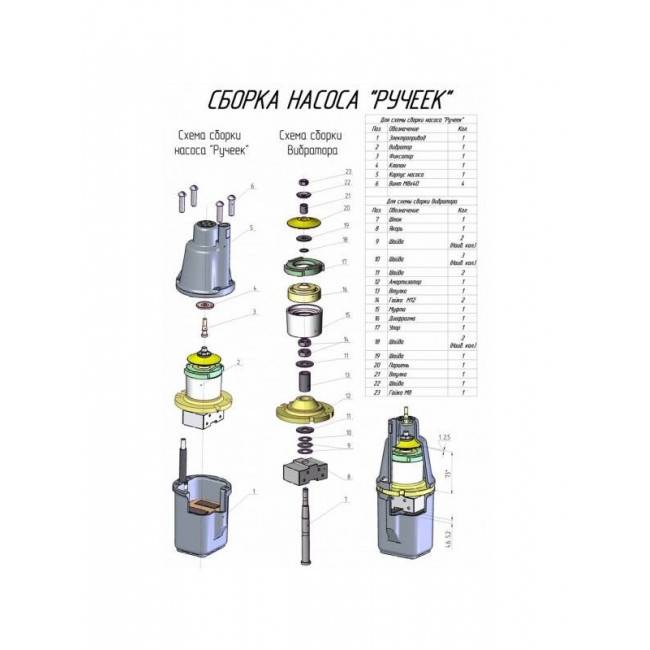
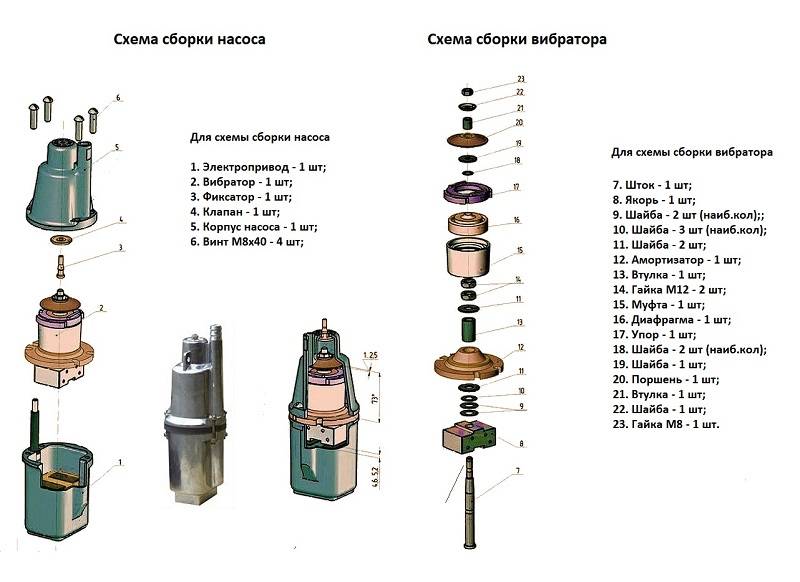
Assembly of the vibration pump Brook
1.1 What is the design of the Brook pump?
The vibration pump consists of the following elements:
- electromagnet;
- frame;
- vibrator;
- electric drive;
- retainer;
- screws, washers, nuts;
- sleeve;
- clutch.
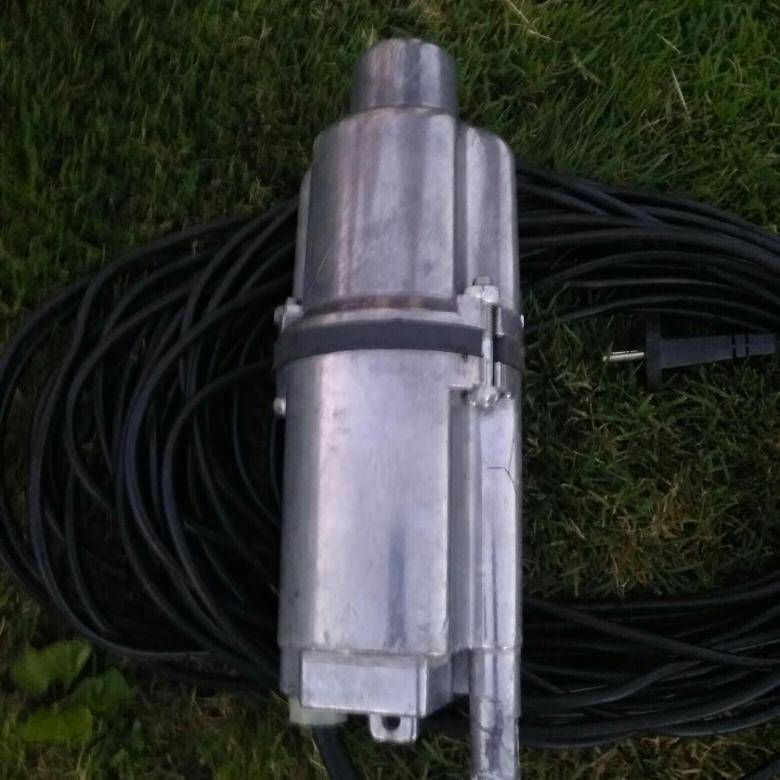
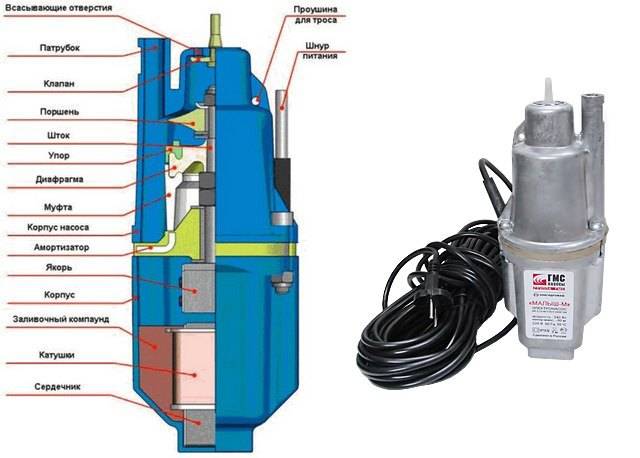
The design of the Creek has a classic layout - the electric drive is located below, and the suction holes are on top. This allows for better cooling, to exclude the intake of impurities from the bottom. The unit works without problems for a long time in the immersed state with the suction holes open to the air.



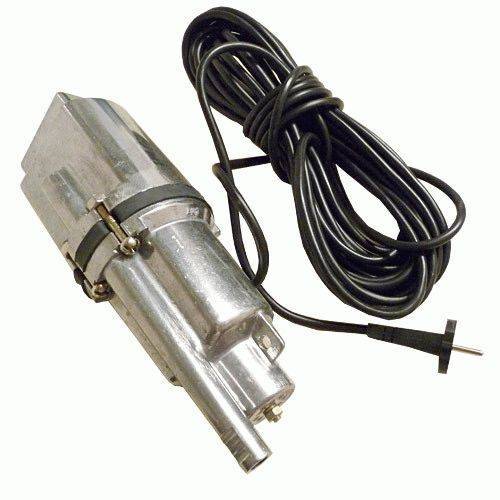
The electromagnet, placed under the body, is formed from a winding and a U-shaped core, the material of which is the steel of an electrical leaflet.The winding consists of 2 coils connected in series. The coil and winding are potted with a compound that provides insulation, heat dissipation from the coils and fixing.
The housing protects the valve installed in it from mechanical damage, the role of which is to close the inlets. When there is no pressure, the liquid flows freely through a special gap with a diameter of 0.6 mm to 0.8.
The anchor and the rod pressed into it form a vibrator. A shock absorber is placed on the rod, a rubber spring rigidly fastened to the shaft with two nuts.
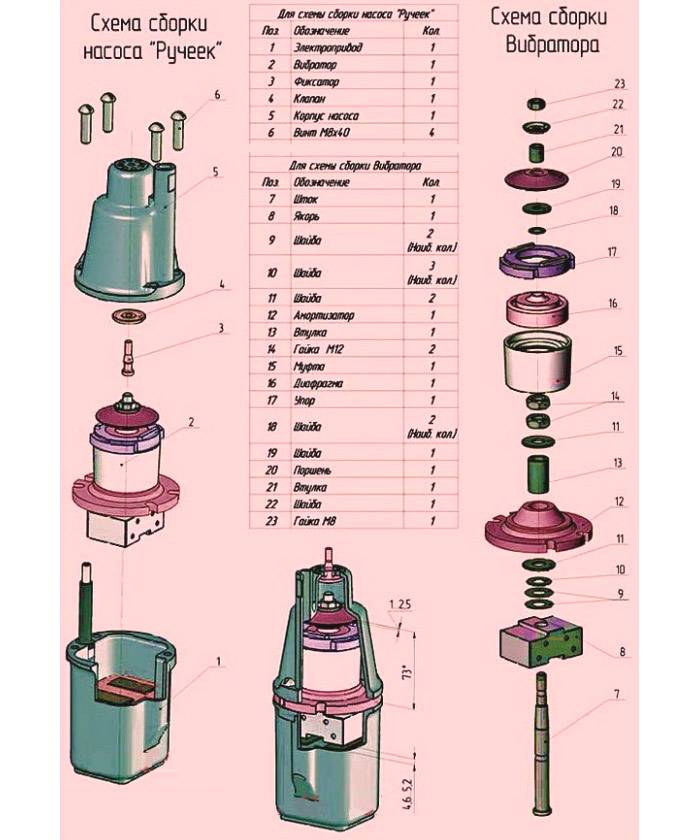
Pump Brook assembly and sectional view
1.2 Pump parameters and advantages
On most models, the nominal flow is 0.12 l / s and the nominal head is 40 m. The horizontal distance that the Brook can transport water is 100 m. 1-1.5 cu. m per hour. The power consumed by the pump varies between 180-300 watts. The maximum current is 3.5 A, while the consumption is practically not exceeded by the starting one.
The temperature of the pumped medium must not exceed 35 degrees Celsius. The pump is designed to operate with non-aggressive water, the permissible contamination is 0.001%. To provide the unit with the required parameters, it is recommended to complete it with hoses with an inner diameter of 19 mm or more. The use of hoses with a smaller section increases the likelihood of overloading during pump operation, loss of performance, and breakdown.
Among the advantages of the pump are:
- Consumer oriented price. The cost of the hydraulic apparatus for a long time remains available to the average buyer.
- Ease of use, portability. The weight of the device, not exceeding 4 kg, contributes to its easy transportation and use in any tank.
- Ease of use. The hydraulic machine does not contain any electric motors, rotating elements, is not picky about maintenance, and does not need preventive measures. Repair of a vibration pump is not difficult to make.
- Profitability. To raise 1 cubic meter from a 10-meter depth, 0.2 kW of electricity is enough.
- Versatility of application. The pump copes with the supply of water to the house, pumping out liquid from flooded basements, sewers, and watering summer cottages. It is used for deepening and cleaning wells. The resource of the device, of course, will decrease.
1.3 How the product works
When the unit is connected to a power supply with a mains voltage of 50 Hz, the armature is attracted to the core. Every half period, it is thrown back by the shock absorber. Thus, for 1 period of the current wave, the attraction of the armature occurs twice. Therefore, in 1 second it is attracted a hundred times. There is also frequent vibration of the piston located on the rod with the anchor.
Stream pump without housing
Due to the volume limited by the valve and piston, a hydraulic chamber is formed. Actions in it are springy due to the elasticity of the pumped medium containing dissolved air, and the vibrations of the piston. While the water is pushed into the pressure pipe, and the spring is unclenched-compressed, the valve ensures the entry of liquid and through the suction holes - its exit.
The Brook pump in the kit has a nylon cable used for its fastening and installation.The cable protects the consumer from electric shock in the event of insulation breakdown, as it does not conduct current.
The principle of operation and advantages of the submersible pump "Brook". Do-it-yourself repair instructions
The Rucheek pump was developed in Soviet times more than forty years ago. It was made at the Mogilev OAO Olsa in Belarus. This device competed with any models of this class. This was due to simple reasons:
- Its size and shape of the cylinder are convenient for use in places unsuitable for other devices, such as a well, the bottom of a deep well, flooded garages and basements, the shore of a reservoir;
- Easy to use: does not require filling with water before operation, does not need lubrication of the mechanism;
- Long service life associated with high quality indicators, long-term developments in process technology;
- Good water pressure;
- The minimum power consumption is about 225 watts per hour.
It was invented for use in summer cottages and today it has a very wide distribution. The pump is of good quality, relatively inexpensive, and its power is quite enough to serve a small family and a plot of six to twelve acres.
Breakdowns are rare, repair work is not difficult, spare parts are readily available and not expensive. On average, the pump can last from five to eight years.
The submersible vibration pump is designed to draw water from a well shaft more than one hundred millimeters wide and up to forty meters deep. The pump weighs about four kilograms.
The "Pen" pump involves taking water from above, which of course is a plus from the ingress of various contaminants into the device.
Technical characteristics of the pump "Brook"
The pump has a small power consumption of two hundred twenty to three hundred watts. This is comparable to an aquarium pump filter for three hundred to five hundred liters. If necessary, it can be easily powered by a battery or generator. The pump is powered from a household network. For wells up to forty meters deep, the capacity will be up to 40 liters per hour. If the fence is superficial and the depth of the fence is not more than one and a half meters, the fence capacity will be up to one and a half cubic meters per hour. A working time of up to twelve hours is provided and often used.
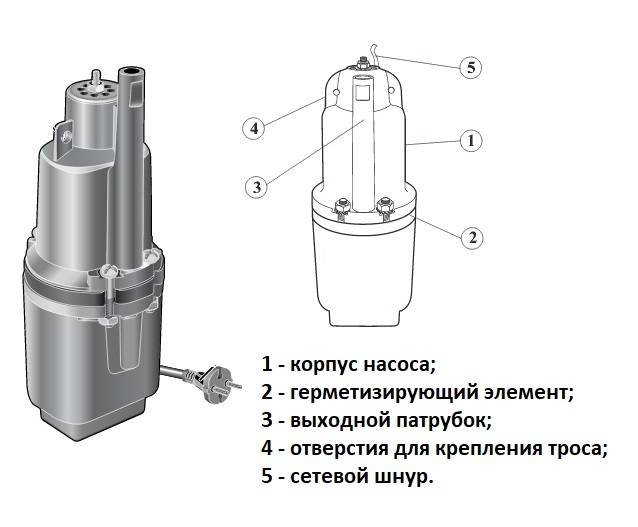
Brook pump device
Attaching the pump is not always necessary. In a vertical position, it weighs on a cable.
The pump has a practical metal housing and is very durable. To prevent collision with the walls of the well shaft, a rubberized cushioning ring is put on it.
Principle of operation
The principle of operation of the pump is based on the vibrational movements of the armature with the membrane, produced by the action of a magnetic coil. Electromagnetic voltage creates magnetic fields that cause a change in the internal pressure of the pump. The pressure oscillation of the diaphragm causes the water to rise.
The membrane sucks water through the check valve into the mechanism and pushes it out through the outer fitting. Water is distributed to users through a hose attached to a fitting. Due to the minimalist design, the vibrating mechanism can be cleaned from clogging by unscrewing four screws.


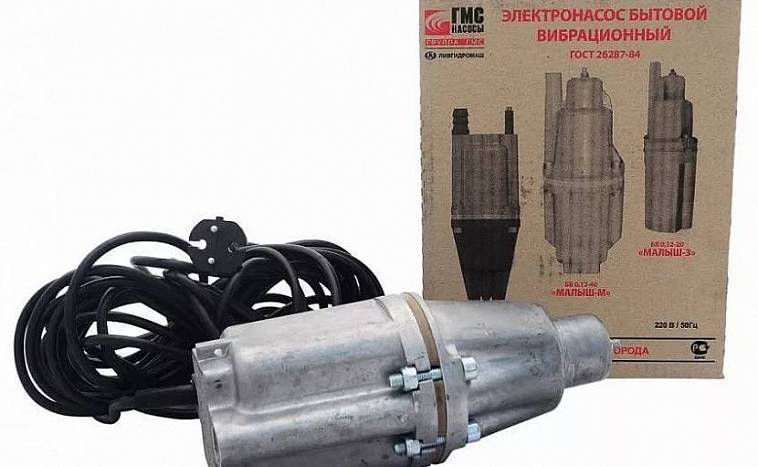
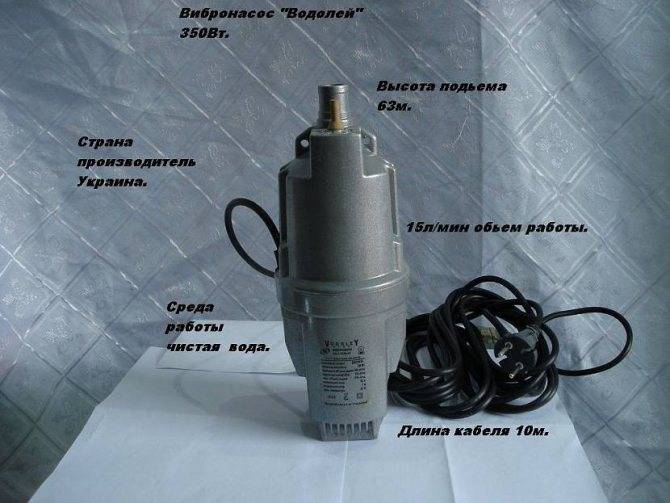

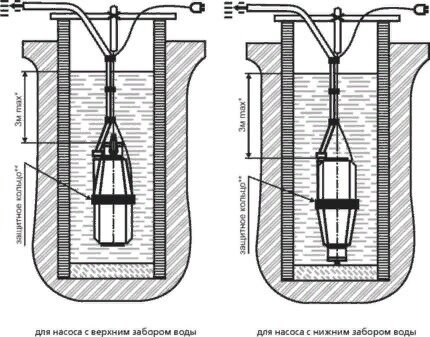
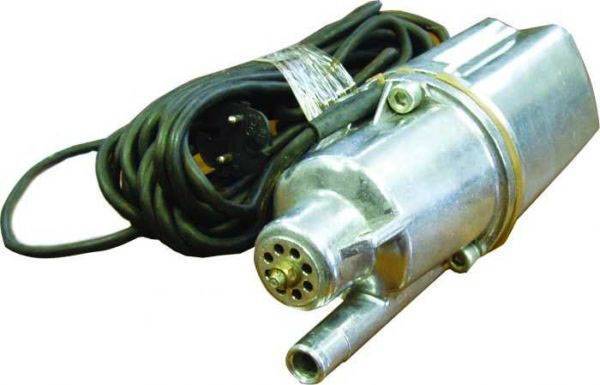


Submersible vibration pump - principle of operation
Uninterrupted long-term operation is ensured by the fact that there are no rubbing and rotating parts. The Brook pump has restrictions in the field of domestic use. It is not used for industrial purposes, as it has little power. In the farm, devices with more power and a storage tank are used.
"Trickle" is convenient for use in a well with low power. Where, when the well is empty, a powerful pump goes to idle or turns off, then the Brook, when the thermal protection is activated, continues pumping the well at a speed of five to seven liters per minute. Often after the work of the Brook, an increase in well capacity by fifty percent is observed.
Applicable:
- for the delivery of water from a well for consumption;
- for the delivery of water for irrigation;
- for filling the heating system;
- when pumping out a pool or reservoir.
"Trickle" is used to clean wells clogged with silt. Also, the pump can be used to pump out drainage water. It is mainly used, of course, for pumping drinking water, but due to various situations that arise in summer cottages, it can be used as a drainage device. Even a special device is commercially available that protects the pump when working with contaminated water.
This is interesting: Do-it-yourself balcony on the roof of the house: we understand in detail
Pump Brook - specifications and principle of operation
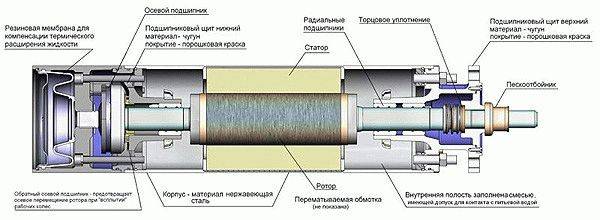
The Brook pump, whose technical characteristics have decent performance, consists of two main parts in its structure - mechanical and electrical.In the center of the structure there is a core in the shape of the letter "P", which has magnetic properties, such an electromagnet includes steel plates on which electromagnetic radiation coils are put on, a copper wire that covers these plates. The core body is made of copper and sealed with epoxy resin.
The mechanics of the pump is represented by three parts - a rod, an anchor and shock-absorbing rubber washers, and the better these washers are installed, the higher the performance of the pump as a whole. A special coupling separates the pump electrics from the water compartment.
The design of the pump has such parts as a rubber piston fixed with a nut and valves through which water circulates and due to debris and soil getting into the pump, the piston and check valve quickly become unusable, and to prevent this from happening, it is recommended to install on hole for water intake filter.
The operation of the pump is based on vibrations that change the pressure in the chamber. Step by step, this process looks like this:
- The pump is connected to the electrical network, as a result of which the coil inside it begins to radiate a magnetic field
- The resulting magnetic field attracts the vibrator
- The piston flexes inwards and gets closer to the injection chamber
- In the suction chamber, the atmosphere is discharged and the pressure indicator drops
- Water starts to fill the pump
- The next current cycle removes the magnetic field, and the piston returns to its original position;
- Water under piston pressure enters the injection compartment
- The next stroke of the electric current repeats the process, due to which the water begins its journey into the pipes with translational movements.
The Brook pump, whose characteristics are better than analog devices in many respects, has the following technical parameters:
- Water can be raised to a height of at least 40 meters using a pump.
- It is allowed to lower the pump into the water to a depth of no more than 7 meters
- The diameter of the well from which water is taken must be at least 10 cm.
- The performance of a pump of this brand varies depending on its modification and may have the following indicators: 360, 750 or 1500 liters per hour
- The power indicator also depends on the model and ranges from 225 to 300 W;
- The operating voltage has a standard indicator - 220 V
- Pump uptime is 12 hours
The Stream pump, the performance of which also largely depends on its proper use, is best purchased with an upper water intake, since it is less susceptible to clogging with soil particles and other debris.
Nuances of placement
Installation is possible provided that the well diameter is at least 120-125 mm, the electric submersible pump can withstand a standardized depth of up to 10 m (and, if necessary, even more, the strength of the casing allows this). There is a relationship: the deeper the pump is placed, the lower its performance, as it lowers, the pressure decreases to 70%. The pump is immersed in the well in the following sequence:
- A protective ring and filters are put on the body.
- The pump is lowered into the water at least 1 m using a lashing cord (string or rope). To prevent winding of the electrical wire and subsequent jamming of the housing, it is advisable to fix the wiring and the pressure hose with clamps.
- The location of the device is checked: the pump must not lie on mud, the recommended distance from the bottom is 1 m.
- The insulation of the supply wire and the control system is checked. It is recommended to operate the pump with an expansion vessel connected.
It is undesirable to use Rodnichok to connect to more than one water intake point (especially if they are located in different buildings), this leads to its overload. This is a deep unit, but the lower it goes, the weaker the pressure will be. When used for cleaning wells, the pump is located at a minimum distance from the bottom filter and vibrates to break up hard layers. In this case, additional insulation of the casing is required, ideally it is completely protected from silt suspensions and solid lumps.
Operation nuance: the pump must never be raised or lowered using a power cord or a pressure hose! Violation of insulation leads to a short circuit of the network and protection operation. To avoid emergency shutdowns, the location of the connections is checked. It is unacceptable to lower them into the water, if the depth of the well exceeds the length of the cord, then it should be increased or the necessary modification should be bought in advance.
- Mechanical impact on the body with its subsequent depressurization.
- Pump operation without water.
- Overheating in case of violation of the recommended mode (more than 12 hours of continuous operation).
- Getting inside the body of stones and particles of silt.
WATCH VIDEO
Preventive measures include the creation of the correct operating conditions: the case is protected by additional filters like a cap or glass (they are bought separately) and a rubberized ring.The last point is very important, the mechanism vibrates at a high frequency, without protection from direct contact with the walls of the well or borehole, it cannot withstand the load. Long-term operation is allowed, but not more than 12 hours a day and subject to shutdowns for 10-20 minutes at least once every 2 hours. Heating leads not only to a violation of the insulation, but also to flaking of the fill. Hot water must not be pumped, permitted liquid temperature ≤ 40 °C.
If the fill is peeled off (most often due to overheating), you can try to repair the Rodnichok yourself. The electric drive is separated from the upper part of the housing, the core is removed and shallow grooves are cut. Then the magnet is lubricated with glass sealant, placed back and fixed until completely dry, after which the pump is assembled. The pump assembly diagram is indicated in the attached instructions. The valve is changed in the same way, but without disassembling the electrical chamber; for such a repair, a dense rubber ring is required.
Prevention of breakdowns of the pumping unit
By following the operating rules recommended by manufacturers, you will minimize the risk of breakdown of pumping equipment, and it will serve you for many years.
Basic rules of operation:
- Do not allow the pump to run without water.
- Do not use the pump in the presence of unstable mains voltage.
- Do not operate the pump with a damaged power cord or casing.
- Do not move the unit by the power cord.
- Do not pinch the hose to increase the pressure.
- Do not pump water with dirt, impurities, debris.
When installing the pump in a well, it is necessary to put on a protective rubber ring on it, which will protect the equipment from hitting the walls.
The unit can only be switched on/off using a mains plug or a two-pole switch embedded in the fixed wiring system.
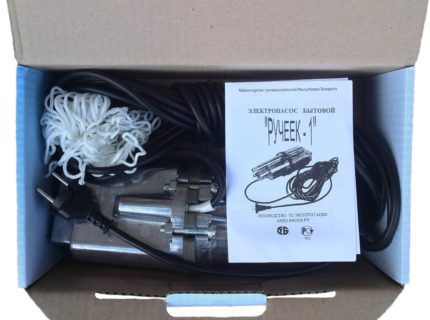
Before using, carefully read the operating instructions and follow the manufacturer's recommendations, this will help to avoid breakdowns.
During the operation of the Vibratory Pump “Rucheyok”, it is necessary to carry out a preventive inspection in a timely manner and monitor the quality of the pumped water. If the water is dirty, then the pump must be turned off and its position relative to the bottom checked.

Device Capabilities
Of course, this pump will not solve your global problems in a fundamental way in the water supply of a large suburban area, since on average it has a power of one hundred and fifty to two hundred and twenty-five watts. But the owner of a country house will effectively help to deal with many processes.
Hydraulic supply
In the house, this unit copes with the necessary supply of natural water. True, at the same time you will not be able to calmly bathe in the bathroom, wash the accumulated dishes and wash, as the pump only produces up to seven liters per minute.
But if you use it skillfully and economically enough, then it will be enough to take a warm summer shower and wash the accumulated things. Water pressure directly depends on the depth of a particular water resource. The larger the number, the smaller the feed, respectively.
It is undesirable to connect the pump to your country house, bathhouse and other important outbuildings at the same time, as an unwanted automatic reboot of this system may be caused.
Pump replacement
Some private owners of country houses, who use more powerful and expensive equipment in their home water supply, buy this budget pump as insurance. After all, absolutely anyone, even the best imported device, can break down, and until you repair it from specialists and get it back, a lot of time will pass.
And in any case, the pump will come in handy on the farm. And then, to meet the vital needs, it is the "Brook" that will come in handy for you. It is a kind of lifesaver for the owners of country houses and will not leave you alone in difficult trouble, which are so many in the daily life of every person who owns a country house.
Application in a slowly filling source
When carefully digging a well or well, it is difficult to guess in advance how quickly the proper water level will be restored with repeated use. One source will do it instantly, and the second will need long days for the long-awaited update.
But when buying a device, few people think about it, and it happens that the unit pumps out water very quickly, rather than being replenished. In such a situation, the system may shut down automatically and require a prompt restart. With a quick intake, the chances of getting muddy water increase.
It is best to take the Brook, as it works more stably and has a low intake intensity.
How to successfully restore a clogged well?
You can develop a system using the "Brook".The quality of water, of course, will not change, but the volume will increase significantly, you will immediately notice this for yourself.
Turn on the pump and lower it as close as possible to the required filter. Thanks to the vibrating mechanism, numerous layers will be knocked out, and then rise to a flat surface. Several such successful attempts, and the well will begin to come into full order.
During operation, it is not necessary to stand right next to your well. In any case, the water pump will not completely pump out the water. So you can take care of your accumulated household chores. For example, you can water a country garden. You will immediately notice if the water quality and volume change.
Pumping water from flooded premises
In the spring, basements and cellars are very often flooded with summer residents. Carrying out water with the help of small buckets is very problematic and takes a lot of precious time. Here you will be perfectly helped by a pump with good quality from a Belarusian domestic manufacturer.
New heating system
When building a new house, the heating system is done first of all, rather than connecting to the water supply. You need to somehow fill all the pipes.
The scheme is as follows: you bring water in a huge barrel, insert this pump into it, and connect the second hose to the drain valve of the battery. Next, the tap gently opens and this unit starts. While the system is carefully filled, look carefully at the special pressure gauge in order to determine when the pressure is at the level you need.
Characteristics of the pump Brook
The technical characteristics and main parameters of the vibration pump Brook are described in several points:
- submersible pump with top or bottom water intake;
- working depth up to 40 m;
- productivity - about 450 liters per hour;
- power supply from household network 220 V;
- power consumption 270 W;
- weight - 4 kg.
Technical characteristics of pumps Rucheek
Such characteristics of the Brook pump are not particularly impressive, but they are quite acceptable to meet the water needs of a small farm.
Principle of operation
Vibratory submersible pump Brook has a diaphragm, the vibration of which creates a pressure difference inside the housing. The water flow is generated by an inlet valve, which is alternately in the closed or open position.
Such a vibration pump does not require constant maintenance, since the diaphragm is driven by an electric coil, which creates an electromagnetic field. The absence of rotating parts, bearings, complex kinematic schemes does not allow critical wear of parts, so there is practically no breakdown.



Description of models
Despite the simplicity of design, the Brook water pumps have several modifications:
- B-10, B-15, B-25, B-40;
- H-10, H-15, H-25, H-40.
The difference in the models lies in the location of the operating valve for the upper (B) or lower (H) water intake. The number after the index indicates the technical characteristics that allow the device to operate at various depths from 10 to 40 meters. Any submersible pump works normally, provided that its body is completely in the water.
Submersible pumps for summer cottages
Since some wells have a limited filling with water during intensive pumping, all devices are equipped with a protective relay that turns off the pump in case of dehydration of the source. This avoids overheating when running dry.
This is interesting: How to make a canopy over a wooden porch
Models and analogues
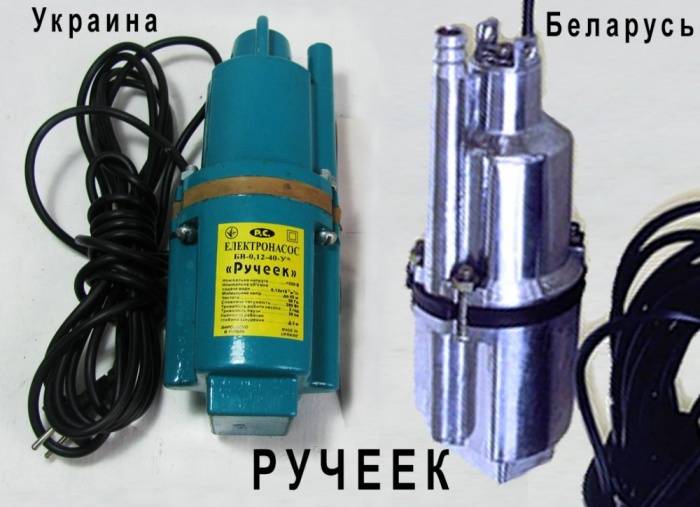
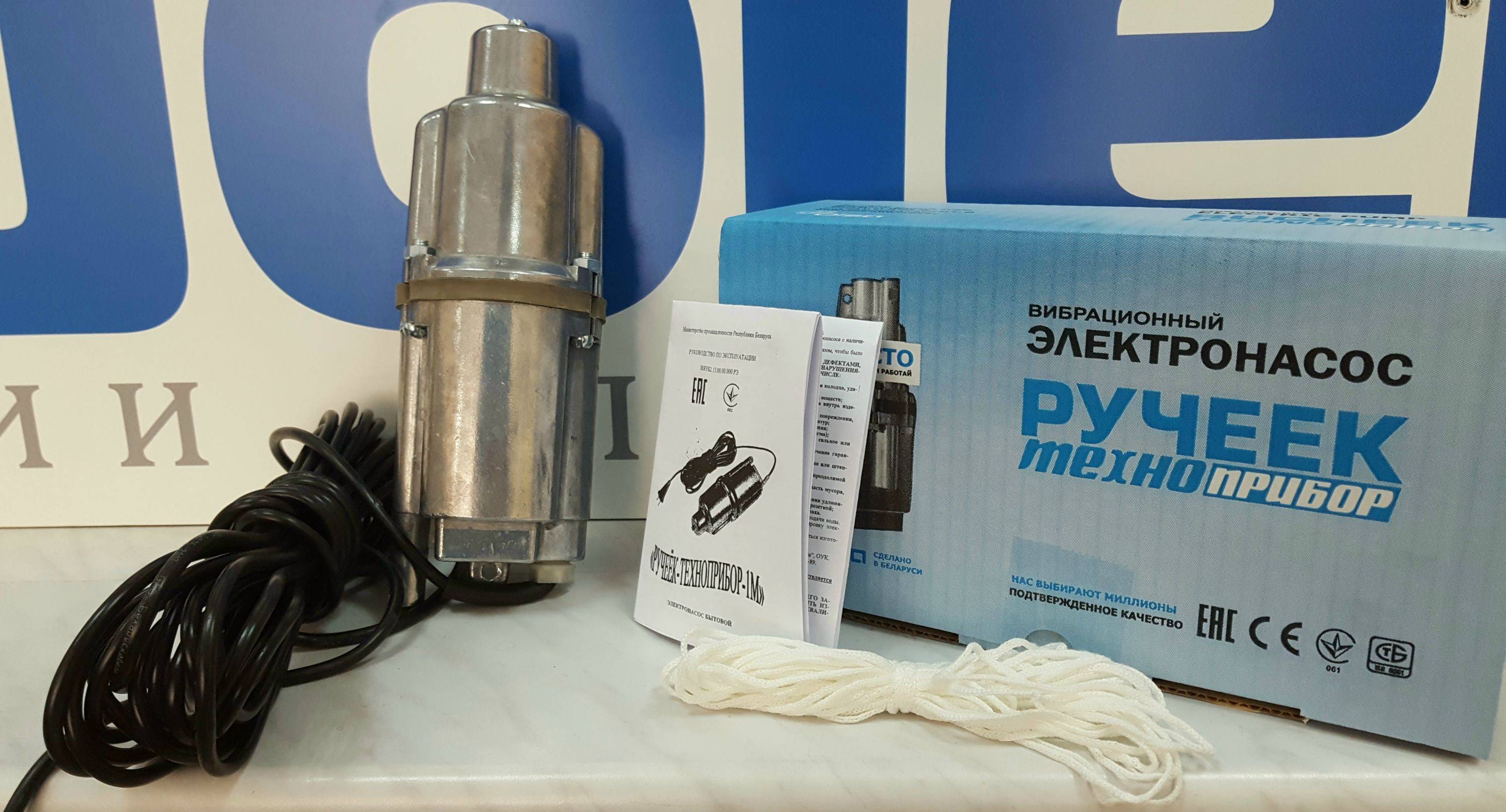
Three models of such a pump can be found on the market: "Rucheyek" (manufactured by JSC "Livgidromash", Russia), "Rucheyek-1" and ""Rucheyek-1M" (manufactured by JSC "Technopribor", Belarus). They are very similar in design, but there are some differences. Thus, the “Rucheyok-1” model is equipped with an upper water intake system, which makes it possible to obtain the purest drinking water.
But at the “Brook-1M” the hole for water intake is located below. With this model, it is more convenient to pump out water from tanks that need to be completely emptied. Since in the models "Rucheyek" and "Rucheyek-1" the water is taken from above, the design itself serves as a reliable protection against overheating.
Water entering the pump housing simultaneously cools the motor. During testing, it was confirmed that devices of this type can withstand dry running for seven hours. In this case, the motor windings do not burn out. Not all pumps, even more expensive and efficient ones, can boast such a level of stability. With a long time of operation of the pump without water, for many other models, the electric motor simply burns out.
Among the pumping equipment similar to the “Brook”, one cannot help but recall the “Kid” pump. It is very close to the "Brook" in terms of technical characteristics, and in terms of workmanship, and in terms of maintainability. This technique is produced by the Bavlensky plant "Electric motor", as well as AEC "Dynamo" (Moscow). Some indicators of “Kid” are slightly better, but the price is also slightly higher than that of “Brook”.
Among the lesser-known analogues, it is worth mentioning UNIPUMP BAVLENETS - a Russian brand that is produced in China. A study of the technical characteristics of the unit shows that it is not much different from the more famous "Brook".The price characteristics of these pumps are also almost the same. The price for the same pump may vary depending on the length of the cable.
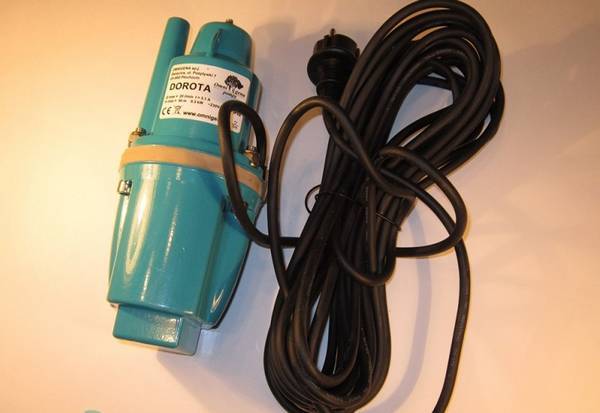
An interesting alternative could be Omnigena-Dorota, a Polish-made submersible vibration pump. The principle of its operation and the device is not much different from the pump "Trickle". Unless the aluminum body is a little shorter, and the weight of the pump is a little less. The power of the model is 300 W, and it can be submerged up to 50 m. Reviews about the quality of the Polish pump are quite satisfactory.
Conclusions and useful video on the topic
Here you can see a practical example of the operation of a pump of this brand:
The video clip shows a diagram of the pump device, its technical parameters, as well as the features of using the “Brook”:
The “Rucheyok” pump is a tireless worker and a faithful assistant for all owners of cottages and private plots.
Of course, its performance is not too great, and it is not designed to solve global cleaning tasks. But where you need to pump water or clean a well, "Brook" can be the best option.
Do you have experience with a submersible pump? Tell us for what purposes you use the unit, share your impressions about the operation of the equipment with our readers. You can ask questions and leave comments on the article in the form below.



