- System device
- Dual circuit system
- Single pipe heating system
- Two-pipe heating system
- Collector system
- How the heating system works and some of its features
- About the types of circulation
- About system types
- About Mounting Types
- About choosing a heating boiler
- Types of structures for heating a house
- Boiler designs
- Oil boilers
- Solid fuel boilers
- Steam heating boiler in a private house
- What can be a heating system for a summer residence
- Other Tips
- materials
- Operating conditions
- Pipes
- Heating appliances
- Making a heating calculation
- Why water heating?
- Radiator network: 4 ways of piping
- One-pipe connection option
- Two-pipe circuits ring and dead end
- Collector system
- Registration and obtaining permits
- What documents are needed for heating with a gas boiler
- What documents are needed for an electric heating system
- Water and air heating
System device
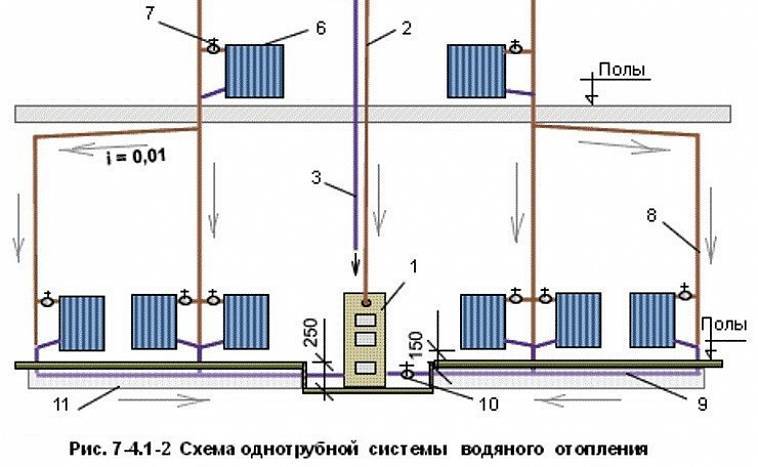
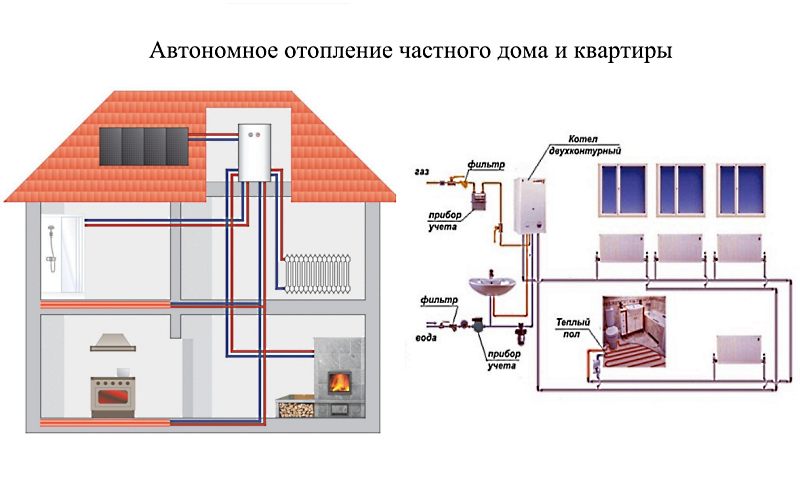
The single-circuit system is intended only for space heating. This heating scheme has a simple principle of operation, is inexpensive and is suitable for houses up to 100 square meters. m.It includes a single-circuit boiler with atmospheric exhaust, single-pipe wiring with pipes made of steel or polymer materials, as well as cast-iron, aluminum or steel radiators.
Scheme of single-circuit heating of the room.
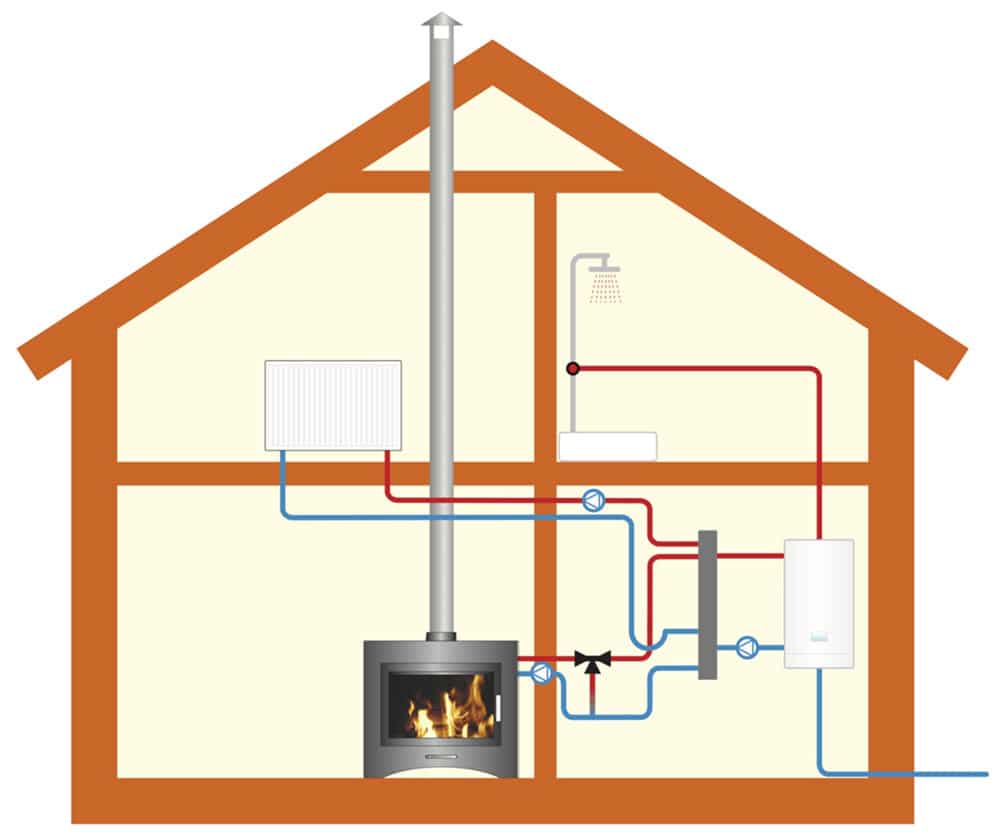
This system can be improved by adding two-pipe wiring, a circulation pump, thermostatic valves on radiators. With a single-circuit boiler for supply hot water for domestic needs, it is necessary to provide for the installation of a gas column or boiler. The double-circuit system is used both for heating housing and for heating water.
Dual circuit system
A double-circuit boiler is convenient when there is a need for hot water for a family of no more than four people, and taking into account that tap or softened water (hard from a well is not suitable). Two single-circuit systems can also be made, one of them will heat the room, the other will heat the water. This will allow using only the water heating system in summer, which consumes 25% of the boiler capacity.
The device of a double-circuit boiler.
The most common system classification water heating takes into account the scheme piping layouts. Water heating can be either two-pipe or one-pipe.
Single pipe heating system
A single-pipe system is called a system in which heated water from the boiler sequentially passes from one battery to the next. As a result, the last battery will be colder than the first, as a rule, such a system is used in apartment buildings. The most significant drawback is that it is difficult to manage single-pipe wiring, because if you block the access of water to one of the radiators, then all the others will be blocked.
Two-pipe heating system
In a two-pipe radiator, a pipe with hot and cold water is connected to each radiator. Water private house heating allows you to comfortably control the temperature in the rooms.
Collector system
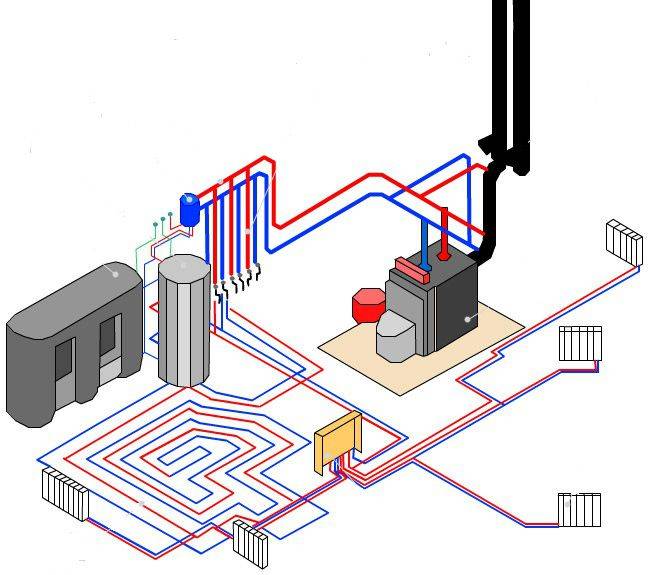
Collector (beam) - from the collector (a device in the heating system that collects the coolant) two pipes are connected to each heater - a straight line and a return line. This makes it easy to install heating systems with hidden piping, and also makes it possible to maintain and regulate the set temperature in a separate room. To do this, on each floor of the house there are collectors in a special cabinet, from which independently connected pipes go to the radiators. The disadvantages are the cost of pipes and installation of manifold cabinets.
How the heating system works and some of its features
If you set yourself the task of creating heating for a country house with your own hands, then you need to have a minimal idea of \u200b\u200bwhat it is and how it works. Heating of the room occurs due to the movement of hot water or other coolant through pipes and through heating radiators.
About the types of circulation
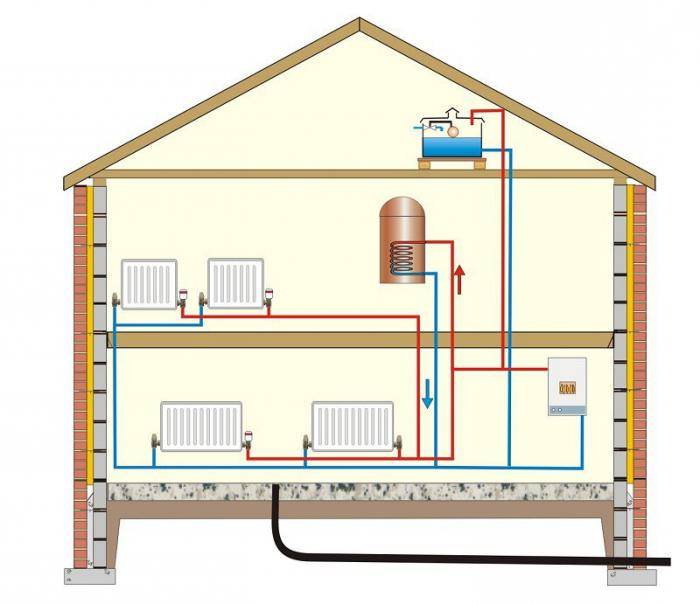
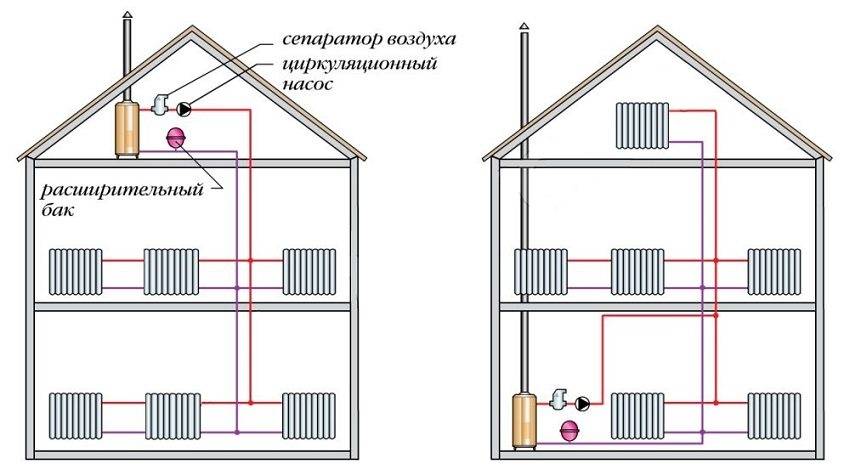
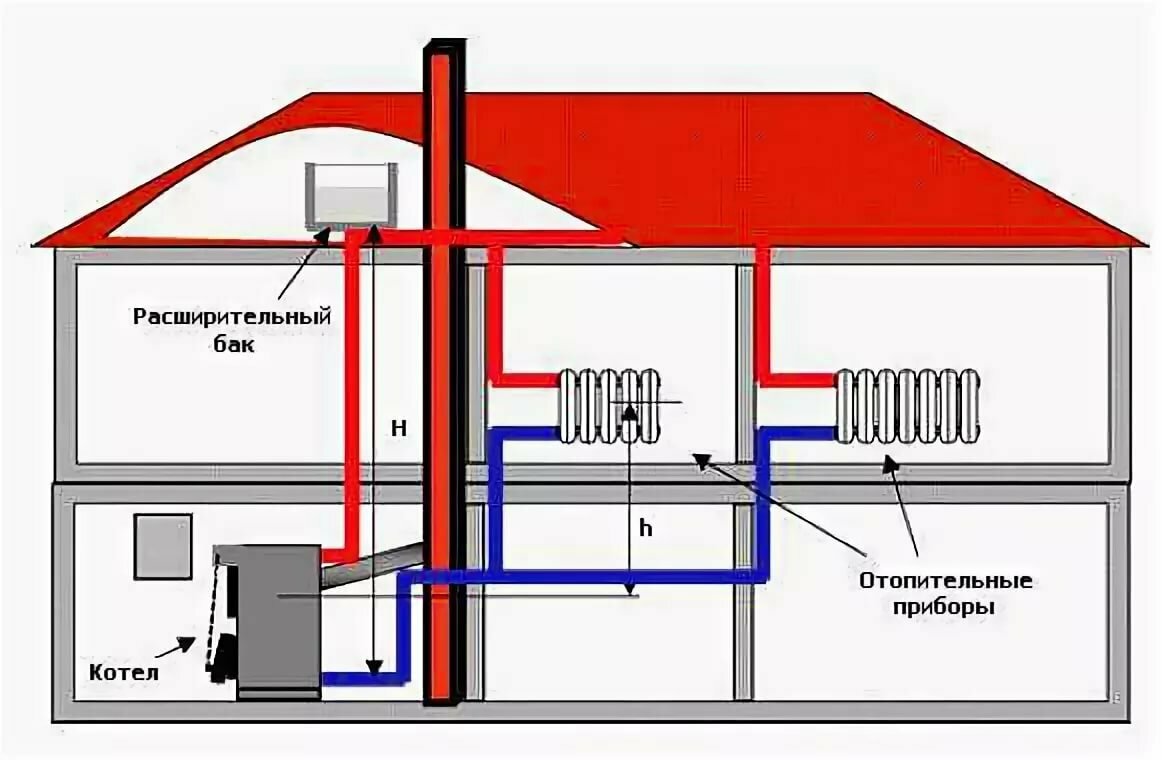
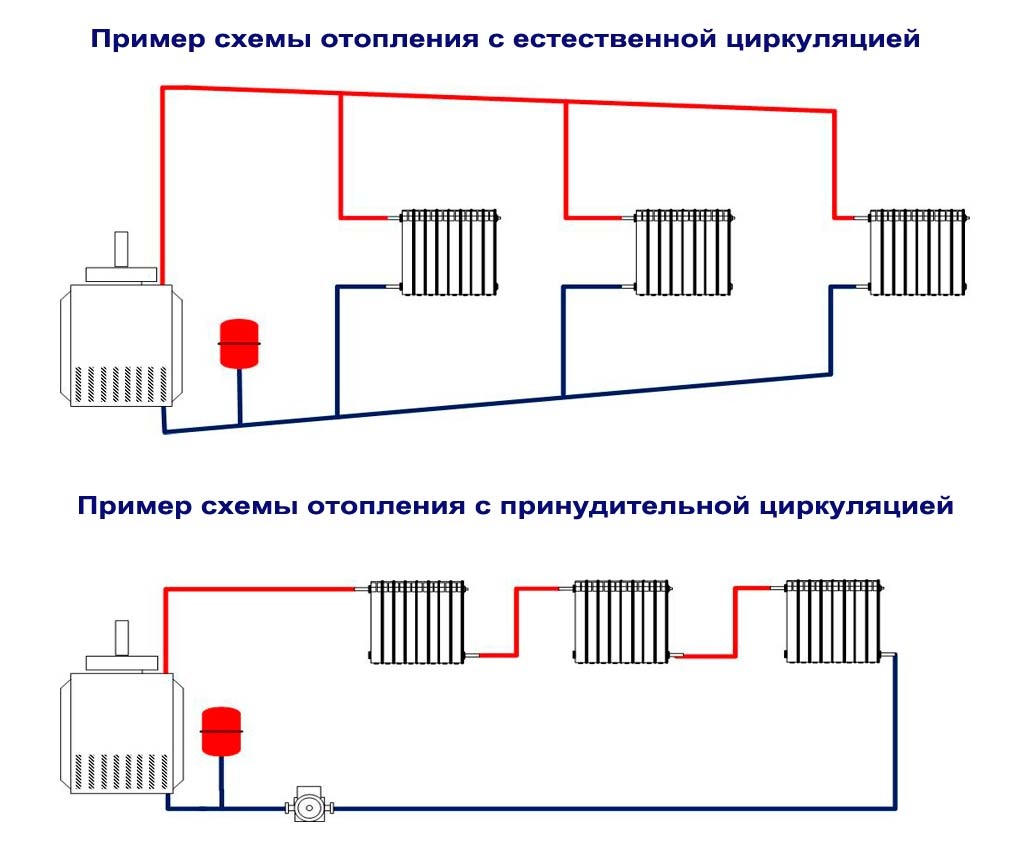
There are systems in which circulation is forced or natural. In the latter case, it occurs due to the laws of nature, and in the former, an additional pump is required. Natural circulation is carried out extremely simply - heated water rises, cold falls. As a result of this, water moves through the radiators, cold leaves, hot comes, and after it cools down, it also leaves, giving off heat to heat the room.
open natural circulation heating system
If you are going, for example, to do the heating of the cottage with your own hands and use forced circulation for this purpose, then you will need to additionally turn on the circulation pump in the return pipe. It is at the end of the pipe through which water returns to the boiler - and nowhere else.
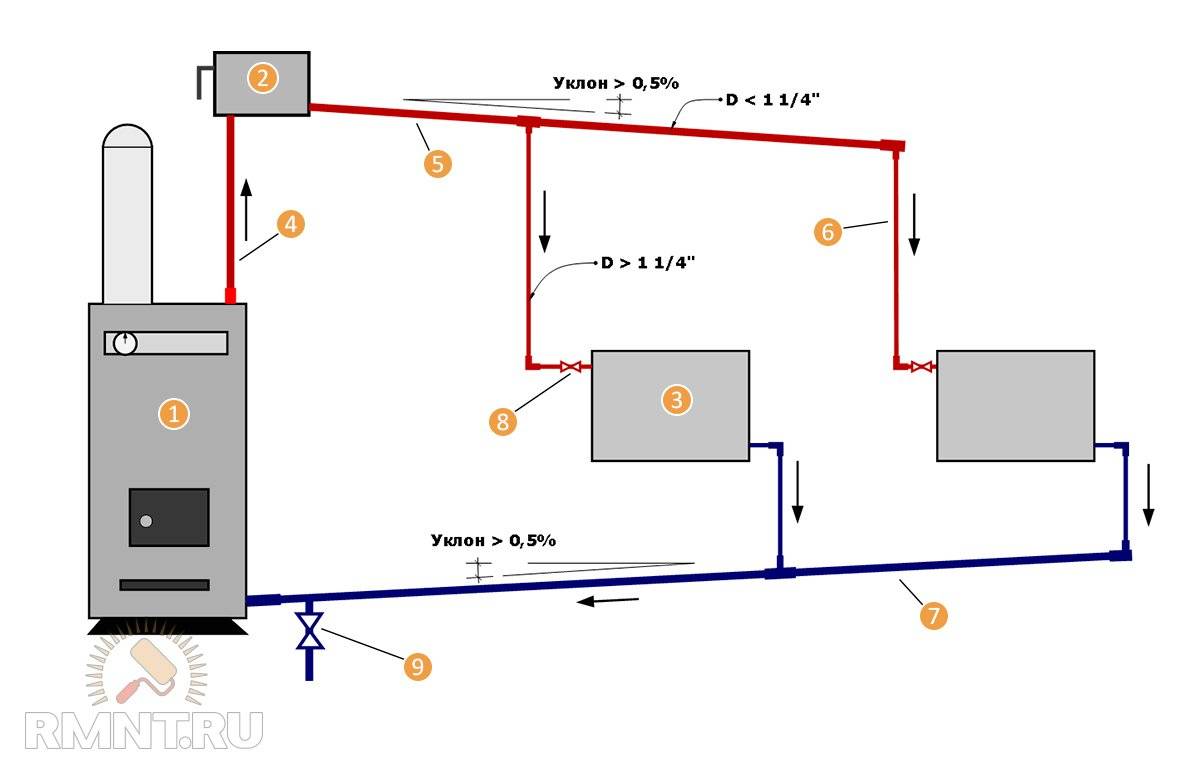
Natural circulation requires the obligatory fulfillment of certain requirements, namely:
- the location of the expansion tank above all other heating devices;
- placement of the lower return point below the heaters;
- providing a large difference between the lower and upper points of the system;
- the use of pipes of different sections for the direct and reverse water supply, the direct line must be of a larger section;
- installation of pipes with a slope, from the expansion tank to the batteries and from them to the boiler.
In addition, it will be cheaper due to the absence of the need to use more expensive equipment designed to withstand the increased pressure that exists with forced circulation, as well as the absence of safety valves.
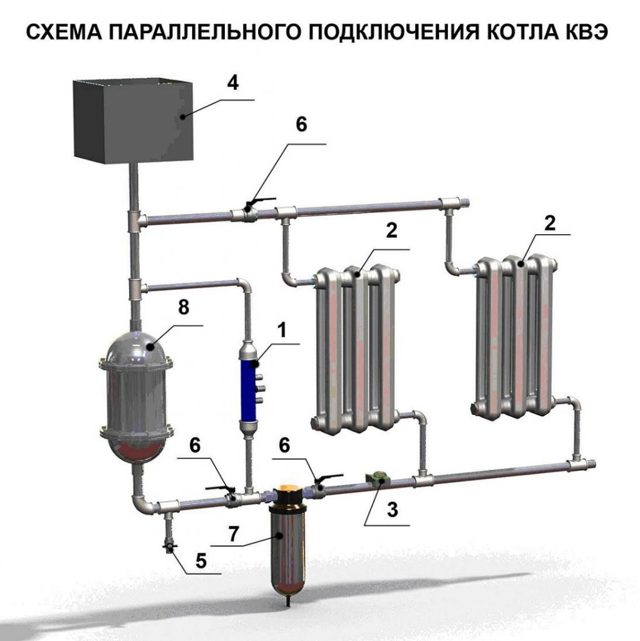
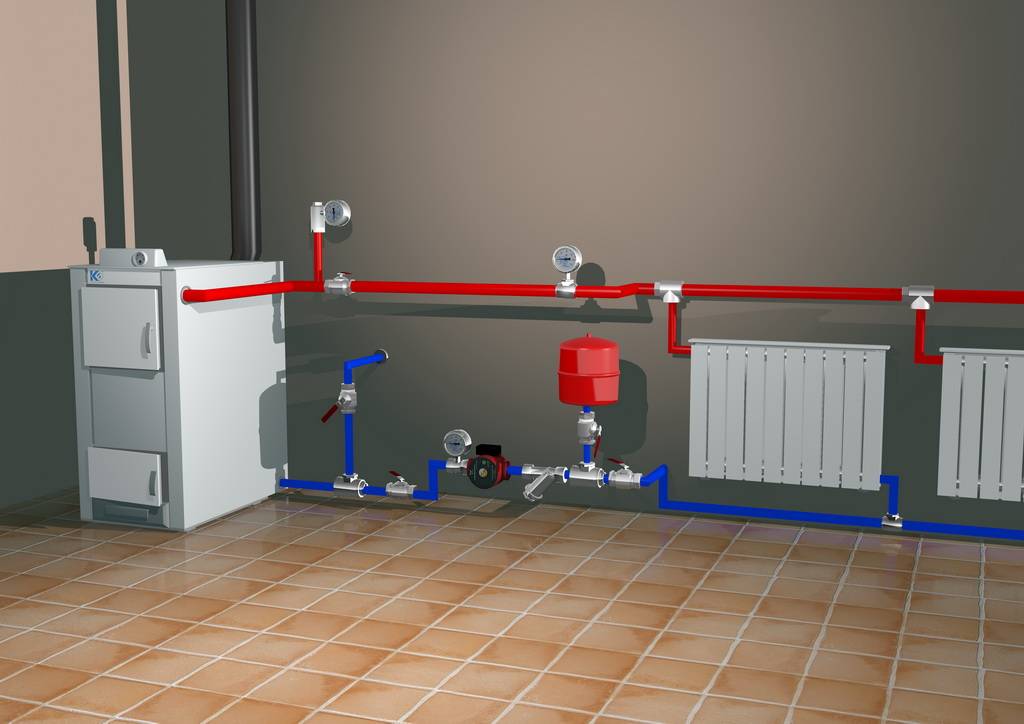
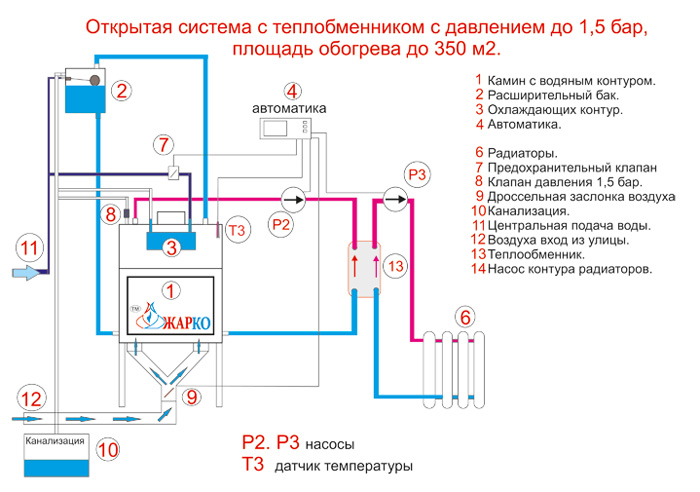 Components of an open heating system
About system types
It should be noted that open and closed systems can be created. In an open one, there is direct contact of the coolant with the atmosphere, while in a closed one this is impossible. This was done to prevent oxygen from entering the coolant from the atmosphere, which should ensure a longer service life of pipes and radiators.
Here we must immediately make a clarification - an open system with natural circulation is the simplest and safest. And to create an autonomous heating of private houses do-it-yourself, especially if this is the first time, this may be the best choice.In the future, it can turn into a closed system with forced circulation, for which it will be necessary to change the expansion tank and install an additional circulation pump.
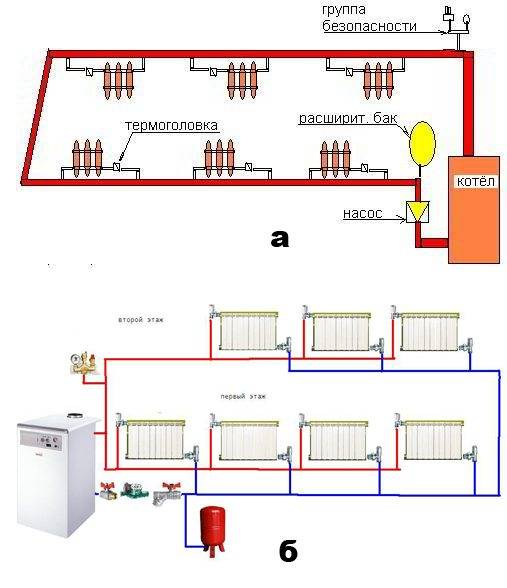
 Scheme of a closed heating system
About Mounting Types
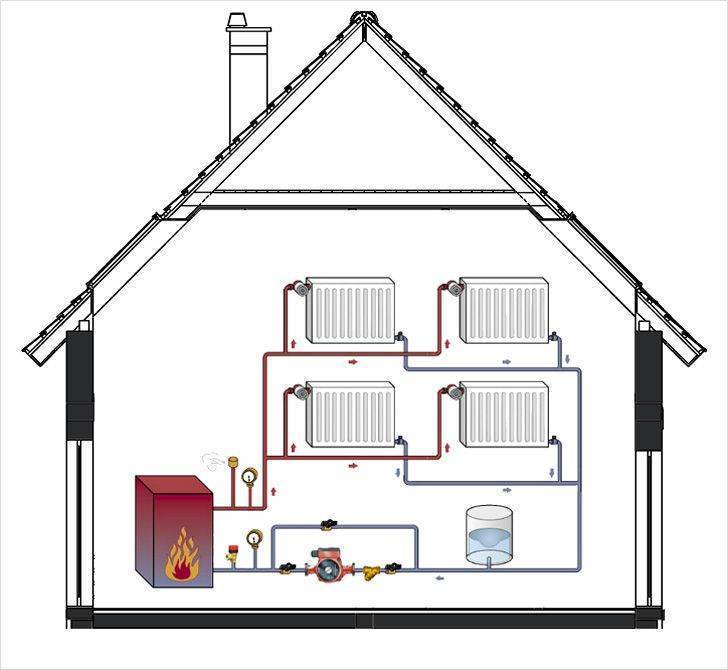
Scheme one-pipe and two-pipe systems heating
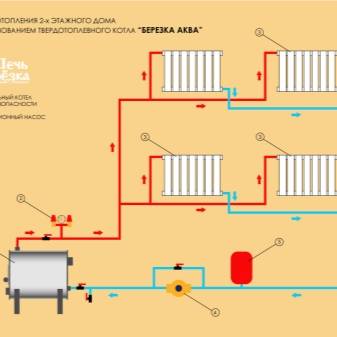
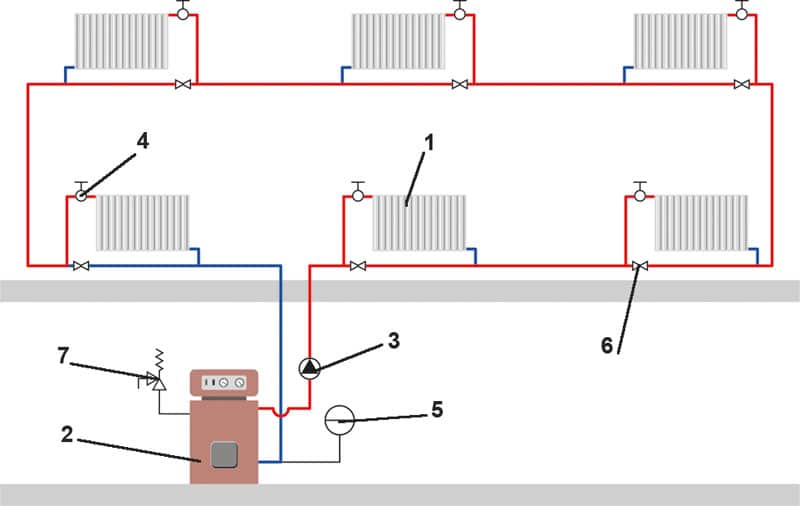
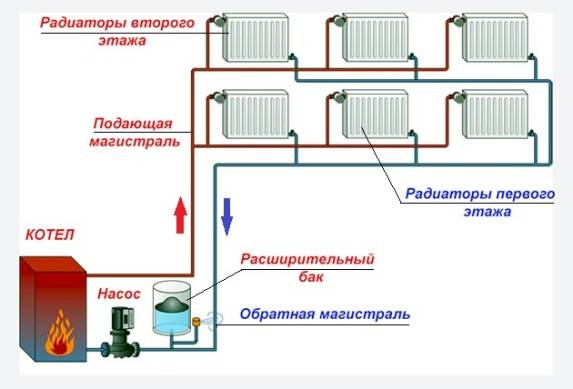
The next choice to be made when considering, for example, the possibility of creating heating own wooden house hands - what installation to use. You can use one-pipe and two-pipe installation scheme. In the first variant, water passes through each radiator in turn, giving off part of the heat along the way. In the second, water is supplied and discharged to each battery separately, independently of other radiators.
The single-pipe system is simpler and cheaper, both in terms of materials used and installation costs. But the two-pipe is considered more versatile, suitable for any conditions and characterized by high heating efficiency.
About choosing a heating boiler
This is one of the defining stages in the creation of autonomous heating. For him, the boiler must be designed for local, cheap fuels, or at least available ones. Otherwise, heating costs will be extremely high. When choosing a boiler, one must also take into account the size of the heated area, the height of the premises, the material from which the house is built, and its geographical location.
Water heating is used to heat any houses, for example, you can do the heating of a frame house with your own hands, the only question is that the elements of such a system must be designed for specific conditions, only then it will allow you to get the maximum heat output from it.
It will also be useful to study - autonomous heating of a private house
Types of structures for heating a house
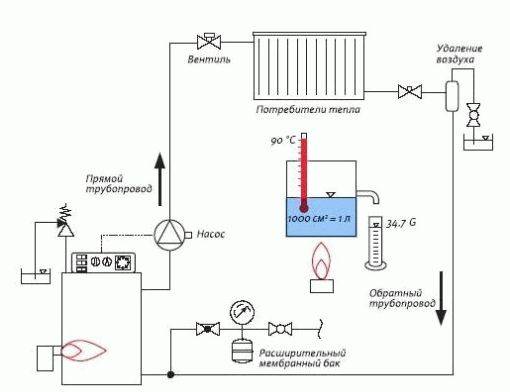
Heating with water as a carrier has a very simple principle of operation, and its design consists of three main components: a heating element (boiler), a pipeline through which the liquid passes, and radiators. The latter heat up and give off heat to the environment. The coolant gradually cools down and, having passed a circle through the system, returns back to the boiler, and the cycle repeats again.
There are two ways to regulate the microclimate. The first is to set the boiler to the desired temperature, the second is to change the coolant flow in a particular radiator using a special tap. They are installed at the input of each battery. In addition, there is an automatic adjustment by means of a thermostat. If a two-pipe system is installed in the house, then a bypass must be installed in front of each faucet or thermostat.

Bypass for heating system
Still systems are divided into natural and forced. In the first case, the heating functions independently of electricity, and the design itself is extremely simple. The liquid flows through the pipes due to the temperature difference without the help of any pump. Hot water has a lower density and weight, so it tends to rise, and when it cools, it compacts and returns to the heater. Minuses:
- a large number of pipes;
- the diameter of the pipeline must ensure natural circulation;
- it is impossible to use modern radiators with a small cross section.
In forced systems, the circulation of the coolant occurs due to the operation of the pump, and all excess liquid enters the expansion tank.A pressure gauge is provided to control the pressure. The advantages include a small coolant consumption. Also here you can install pipes of any diameter, including small ones. The system is highly efficient. There is only one drawback - the dependence of the pump on electricity.



Boiler designs
When choosing a heating device, one should start first of all from the type of energy carrier
When considering this issue, you should pay attention to its cost and the possibility of its delivery.
The second most important factor influencing the choice of a boiler is the power of the equipment. It is generally accepted that for heating 10 sq.m. room area required 1 kW
room area required 1 kW
the area of the room requires 1 kW.
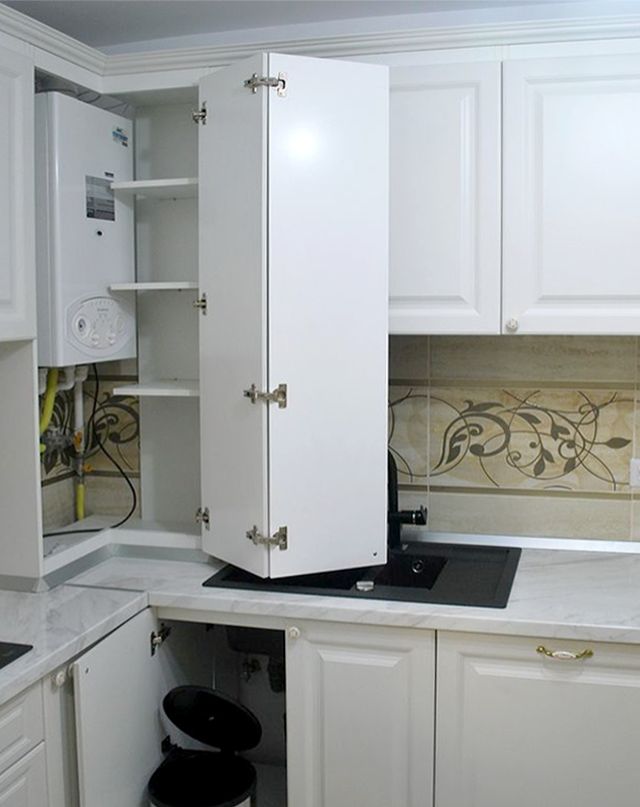
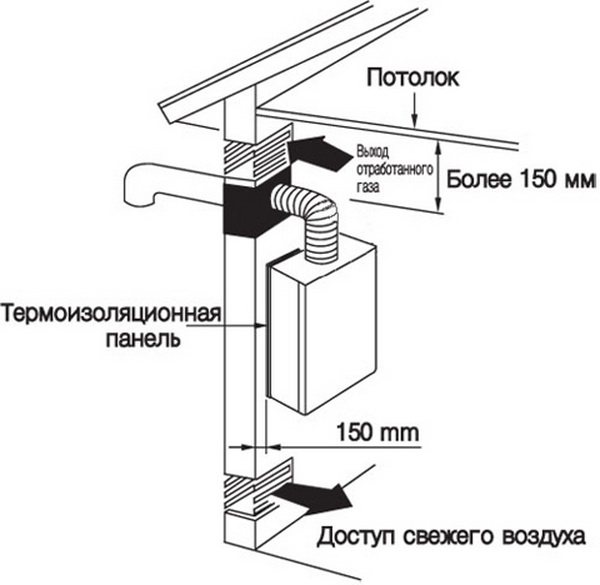
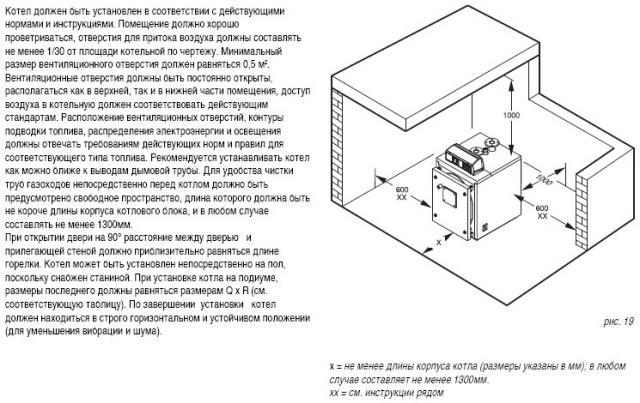
At designing a country heating system it is necessary to take into account the installation location of the boiler equipment. It is recommended to take it outside the house and place it in the annex. In any case, the specific installation conditions determine how the boiler is to be placed.
Consider options for heating equipment for a summer residence.
Oil boilers
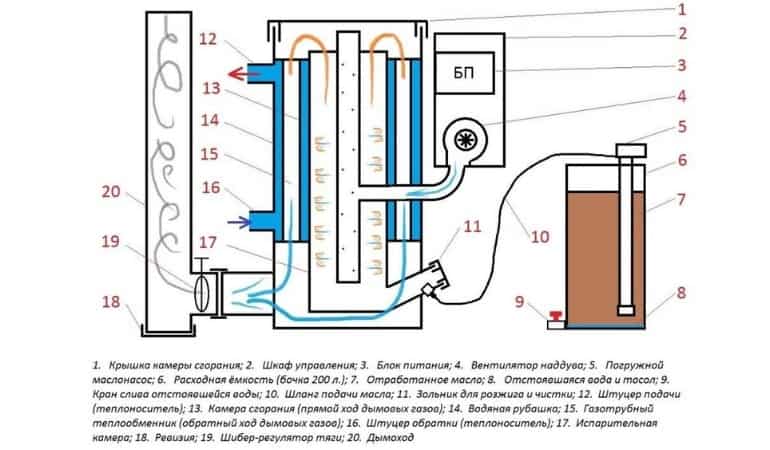
Such units run on diesel fuel or waste oil. The latter option is more preferable, since the cost of fuel is significantly reduced. Liquid-fuel equipment is attracted not so much by its efficiency, but by the possibility of full automation of its operation.
The use of diesel fuel does not provide an opportunity to obtain cost savings. Fuel at low temperatures becomes more viscous, which prevents a stable combustion process. For such a boiler, the construction of a separate room is required, since its operation is accompanied by strong noise.
 Oil boiler
Solid fuel boilers
Despite the fact that it is necessary to constantly replenish firewood, the cost of solid fuel is not comparable with liquid fuel, and even more so with electricity and gas. You can get savings by collecting deadwood in the nearest forest belt.
The disadvantage of this type of fuel is a quick burn-out, one bookmark is enough to operate the boiler for no more than six hours. Installation pyrolysis boilers increases the duration of work equipment on one tab, but it is not advisable to use them for giving a small area.
The combustion temperature in solid fuel boilers cannot be regulated. There is only one way to influence the combustion process: to change the air supply with a damper. In addition, in order to store a supply of fuel, it is required to organize a room in a certain way.
Steam heating boiler in a private house
The steam boiler is an alternative type heating of private houses and dachas. Water heating of buildings is incorrectly called “steam” - such a confusion in the names is associated with the principle of heating apartment buildings, where an external coolant under pressure flows from a CHP to individual houses and transfers its heat to an internal carrier (water), which circulates in a closed system.
Steam heating in a private house is used much less frequently than other methods of space heating. It is economically justified to use the boiler in a country house or a country house, when year-round living is not provided, and the main role in heating is played by space heating rate and ease of preparation for conservation of the system.
The possibility of installing such equipment in addition to the existing one, for example, a furnace, is another advantage of using steam as a heat carrier.
As a result of water boiling in the boiler unit (steam generator), steam is formed, which is supplied to the system of pipelines and radiators. In the process of condensation, it gives off heat, providing rapid heating of the air in the room, and then returns in a liquid state in a vicious circle to the boiler. In a private house, this type of heating can be implemented in the form of a single- or double-circuit scheme (heating and hot water for domestic needs).
According to the wiring method, the system can be single-pipe (serial connection of all radiators, the pipeline runs horizontally and vertically) or two-pipe (parallel connection of radiators). Condensate can be returned to the steam generator by gravity (closed circuit) or forcibly by means of a circulation pump (open circuit).
The scheme of steam heating of the house includes:
- boiler;
- boiler (for a two-circuit system);
- radiators;
- pump;
- expansion tank;
- shut-off and safety fittings.
Description of steam heating boiler
The key element of space heating is the steam generator, the design of which includes:
- furnace (fuel combustion chamber);
- evaporator pipes;
- economizer (heat exchanger for heating water due to exhaust gases);
- drum (separator for separating the steam-water mixture).
Boilers can operate on various types of fuel, but it is better for private houses to use a household steam boiler with the ability to switch from one type to another (combined).
The efficiency and safety of such space heating depends on a competent approach to choosing a steam generator. The power of the boiler unit must be commensurate with its tasks. For example, to create an optimal microclimate in a house with an area of 60-200m 2, you need to buy a boiler with a capacity of 25 kW or more. For domestic purposes, it is effective to use water-tube units, which are more modern and reliable.
Self-installation of equipment
Work is carried out in stages, in a certain order:
1. Drawing up a project taking into account all the details and technical solutions (length and number of pipes, type of steam generator and its installation location, location of radiators, expansion tank and shutoff valves). This document must be agreed with the state control authorities.
2. Installation of the boiler (made below the level of the radiators to ensure steam advances upwards).
3. Piping and installation of radiators. When laying, a slope of about 5 mm should be set for each meter. Installation of radiators is carried out using a threaded connection or welding. In reviews of a steam heating system, experienced users recommend installing taps to eliminate problems when air locks occur and facilitate subsequent operation.
4. Installation of the expansion tank is carried out 3 meters above the level of the steam generator.
5. The piping of the boiler unit must be carried out only with metal pipes of the same diameter with outlets from the boiler (adapters must not be used). The heating circuit is closed in the unit, it is desirable to install a filter and a circulation pump.A drain unit must be installed at the lowest point of the system so that the pipeline can be easily emptied for repair work or conservation of the structure. Necessary sensors that control the process and ensure safety are necessarily mounted on the boiler unit.
6. Testing a steam heating system is best done in the presence of specialists who can not only perform all procedures in accordance with applicable norms and standards, but also eliminate any shortcomings and inaccuracies in the installation scheme with their own hands.






What can be a heating system for a summer residence
As with choosing the type of heating, a wide variety of options for implementing home heating are possible here. As an example, consider how to conduct heating in the country in the case indicated by number two above in the text (water heating). As already mentioned, given local resources, the best choice would be a boiler designed for liquid or solid fuels. What is better - it already needs to be looked at and calculated at specific prices and opportunities for purchase, transportation and storage.
In this case, it may be optimal to stop at a heating system based on natural circulation. A two-story house will allow you to have the necessary height difference between the lower and upper points of the system for its successful operation, and the small size of the cottage fully fits into the characteristics that ensure the efficient functioning of such heating.
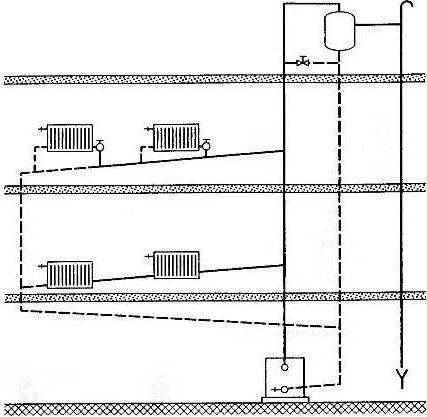 System heating with natural circulation
Of course, forced circulation can also be used, but then it is worthwhile to additionally install a generator to provide power to the pump during interruptions in the supply of electricity.The heating system can be either closed or open, but if you use antifreeze as a coolant, then you need to choose a closed one.
Now we need to define heating boiler power, the number of radiators and the scheme by which country heating will be performed, with your own hands or with the involvement of third-party specialists - this is the second question.
The resulting power value must be increased by a factor related to the location of the house:
- from seven to nine tenths for the southern regions;
- one and a half for the regions of Central Russia;
- from one and a half to two for the Northern regions.
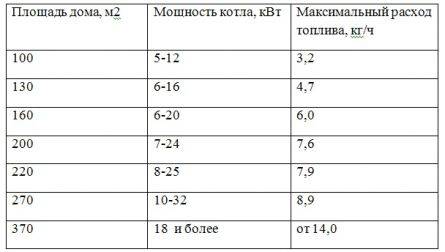 The dependence of the boiler power on the area of the room
The resulting value of the base power must be increased by twenty-five percent if hot water is used for household needs (this requires a double-circuit boiler), and then by another twenty percent to ensure a reserve in case of unforeseen situations.
Due to the fact that it is planned to do the work on your own, it is best to choose a simpler, but quite effective option. This is the single-pipe installation scheme, and the most famous of them is Leningradka. You can learn more about it using the video
In this way, as an example, we determined that we would do one-pipe heating of the Leningradka type with natural circulation with our own hands. The above reasoning should not be considered as a recommendation, but should be taken solely as a possible option for a future heating system.
It is necessary to take into account the size of the house, the seasonality and frequency of living in it, as well as many other various factors. However, you can always find an option that allows you to implement all this on your own.
Other Tips
Living room with kitchen can be combined and decorated with various flaws
It is important to calculate and anticipate everything in advance.
Designers and craftsmen share tips that will help you avoid problems during repairs and arrangements:
The result depends on how detailed the project will be. Oddly enough, it is worth considering the growth of loved ones and relatives. It is also advised to calculate the approximate number of possible guests.
You can get rid of the smell of food if you install a strong hood or ventilation system.
Small models are more suitable for housewives who cook little.
If a sleeping place is planned in the living room, then it is important that the ringing of appliances and other kitchen utensils is not heard. Silent dishwashers and other appliances will come in handy.
In addition, you can install a sliding door and install a soundproof partition. If there is sensitivity to ultraviolet light, the owners hang thick curtains made of opaque fabric.
If household appliances do not fit the direction of the interior, they are hidden behind furniture or put away in kitchen cabinets.
When installing fixtures and lamps are guided by several criteria
It is important that the light falls evenly throughout the space. Particularly bright lighting is preferred in the kitchen area and where the dining table is installed
In the living room, designers create a subdued atmosphere using wall lights and table lamps. Multi-level stretch ceilings with LED strip also look good in this room.
Moisture-resistant finishing materials are more durable and easy to clean.Thus, they retain their appearance for a long time.
The kitchen, combined with the living room, combines:
- personal tastes of the owners;
- reliable finishing materials;
- current design ideas;
- convenience;
- trends. The best photos of living room kitchen design
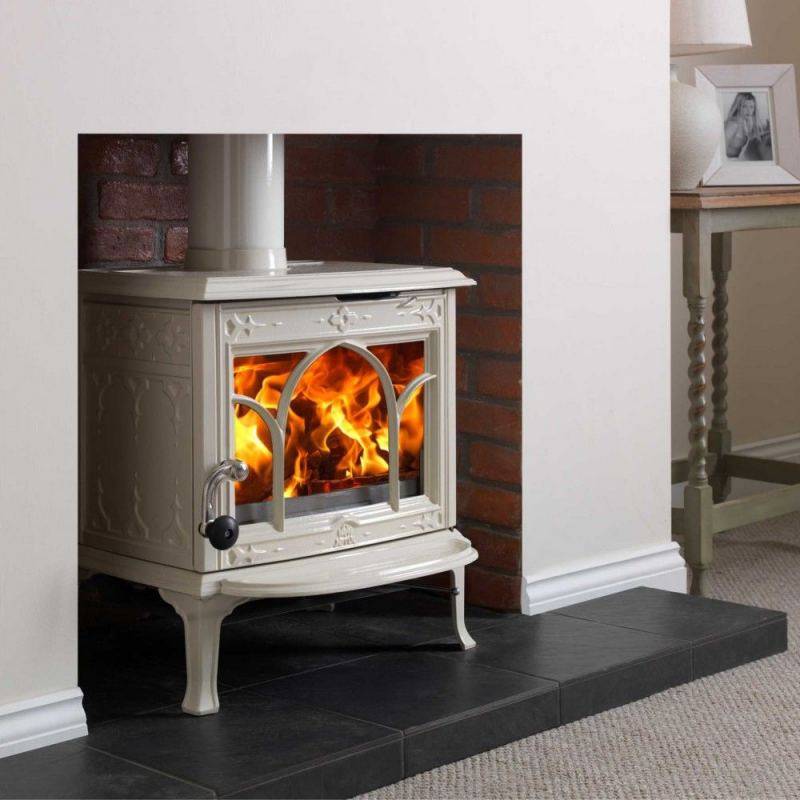
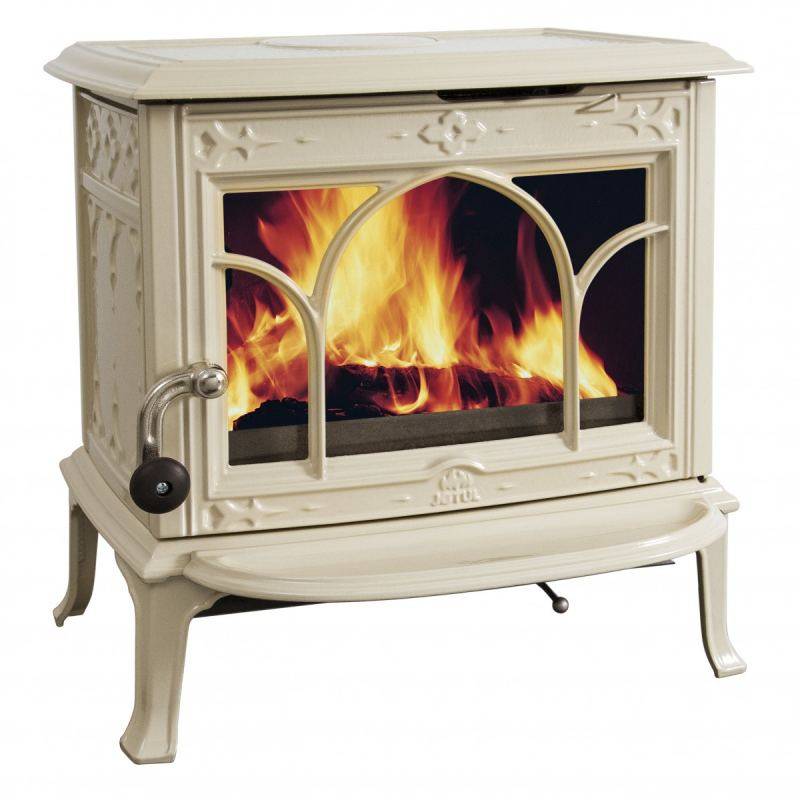
materials
What materials are best for installing heating of a private house, hot water supply and cold water distribution?
Operating conditions
Heating and home water supply with autonomous heated water are operated in greenhouse conditions in terms of loads:
- The pressure in the DHW circuit is equal to the pressure in the cold water supply line and usually varies from 2 to 6-7 kgf / cm2;
- In the heating system, the pressure is even lower - 1.5 - 2.5 atmospheres;
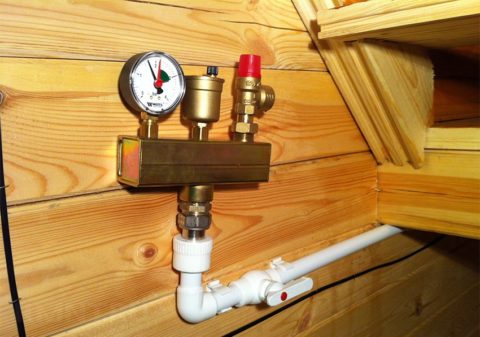
Typical pressure in the autonomous heating circuit
- There are no water hammers, and with the minimum sanity of the owner of the house, there cannot be;
- Like home heating, water supply does not heat up above 75 degrees.
Conclusions? Both pipes and heating devices can be selected without taking into account margin of safety in case of force majeure, focusing only on standard operating parameters.
Pipes
What it is better to mount water supply with pipes - heating at home with your own hands?
From the author's point of view, the best choice is polypropylene. For cold water, pipes without reinforcement with a working pressure of PN 10 and higher are used, for hot water and heating - reinforced with aluminum or fiber with a nominal pressure of PN 20 - PN 25.




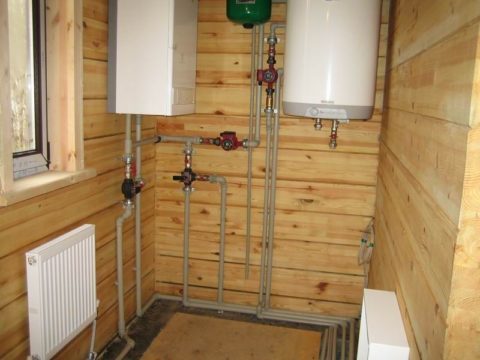
Water supply - heating in timber house mounted with polypropylene pipes
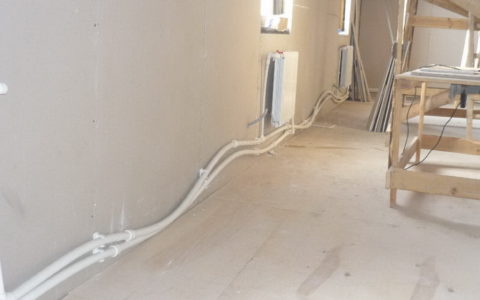
The photo clearly demonstrates the elongation of a polypropylene pipe without reinforcement when heated
How to make water supply and home heating made of polypropylene pipes (seeInstallation of a water supply system from polypropylene pipes)? They are connected by low-temperature soldering using a soldering iron with Teflon nozzles.
The installation instructions for the connection are quite simple:
- Install a nozzle of the appropriate size pipe;
- Preheat the soldering iron to working 260 degrees;
- If you are using an aluminum reinforced pipe, clean the reinforcement in the soldered area with a shaver. Stripping will allow the fitting to weld with the inner polymer shell of the pipe and eliminate its delamination due to aluminum corrosion;
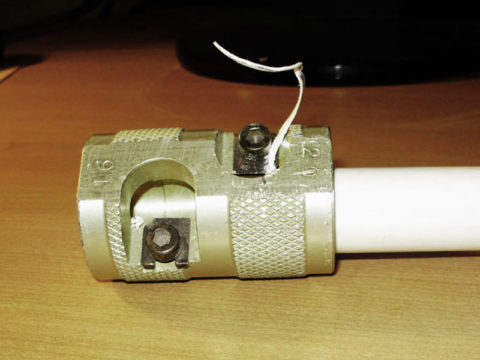
Shaver cleaning of aluminum reinforcement
- Put the fitting on the nozzle and at the same time insert the pipe into it from the other side;
- After 5 seconds (for a diameter of 16-20 mm), remove the parts from the nozzle, connect them with a translational movement and fix;
- As soon as the plastic melt seizes, you can proceed to the next connection.
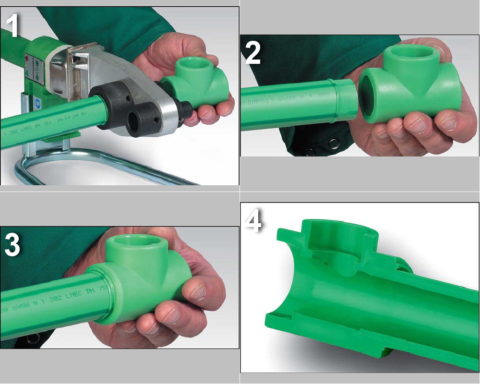
Installation of a fitting connection on polypropylene
Heating appliances
As heating devices, we recommend using aluminum sectional radiators. They combine excellent heat transfer per section (with a standard size of 500 mm along the axes of the collectors - up to 205 watts) with a very affordable cost (from 240 rubles).
These inexpensive heaters have excellent heat dissipation
Making a heating calculation
Before you make water heating at home, you need to carefully calculate everything. Note that the demand for heating directly depends on the heat loss through walls, ceilings and floors, doors and windows. That is why in the process of calculating the power of the boiler, such factors must be taken into account. In this case, special norms are used, which must be studied and calculated in relation to your climate.
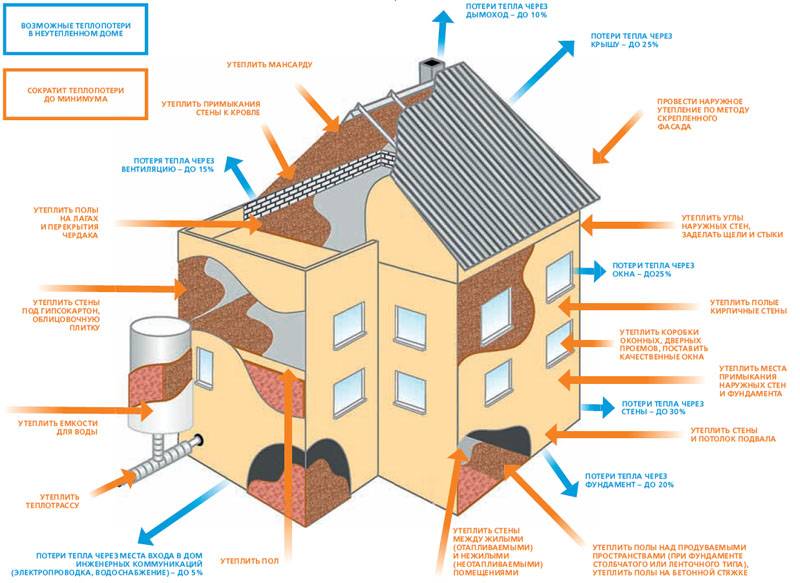 Heat loss of a private house and ways to reduce them
Usually the precious heat goes away through outer walls, and heat losses increase with large temperature differences between internal and external. So, the normal temperature (usually +20 degrees Celsius) indoors is added to the biggest negative temperature of the winter (that is, the cold season) in your area.
For example, we present such calculations. At a temperature of -30 degrees, the heat loss of the walls, depending on the materials, will be as follows:
- Brick (2.5 bricks), with plaster inside - 89 W / sq.m.
- Brick (2 bricks), with plaster inside - 104 W / sq.m.
- Chopped (250 mm), lining inside - 70 W / sq.m.
- Made from timber (180 mm), lining inside - 89 W / sq.m.
- Made from timber (100 mm), lining inside - 101 W / sq.m.
- Frame (200 mm), expanded clay inside - 71 W / sq.m.
- Foam concrete (200 mm), with plaster inside - 105 W / sq.m.
At the same negative temperature, the heat loss of enclosing structures:
- Overlapping of the attic made of wood - 35 W / sq.m.
- Covering the basement with wood - 26 W / sq.m.
- Wooden doors, double (without insulation) - 234 W / sq.m.
- Windows with wooden frame (double) – 135 W/sq.m.
In order to correctly calculate the heat loss, it is necessary to determine the exact area of the outer (end) walls, ceiling, floor, doors and windows, multiply by the heat loss per sq.m. their materials, after which the results are summarized.
Why water heating?
Water acts as a carrier, and its heat capacity is 4000 times greater than that of air, and it belongs to the cheapest and most accessible resources. But there is, and not one, a fly in the ointment.The installation process cannot be classified as simple, and if you plan to install a gas boiler, then you need an appropriate permit, plan, etc. In addition, it is possible to carry out work only at the construction stage. And if you need to organize floor heating, then the scheme becomes even more complicated.
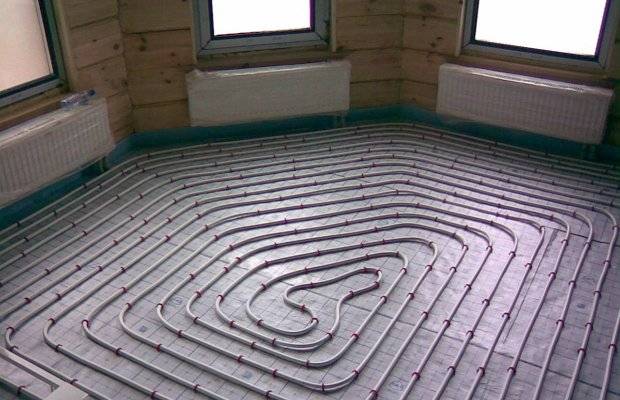
Underfloor heating in a private house
Still such heating demands the constant control. If you are going to leave housing for a long period in winter, then the carrier should be drained. Otherwise, at sub-zero temperatures, it will turn into ice and simply break the pipeline. Everyone knows that water contains various impurities that contribute to the corrosion of metal elements that any system contains. And salt deposits on the inside of the pipes prevent free flow and impair heat transfer. And finally, if you do not install a special release valve, air locks may occur in the system. They also significantly reduce efficiency.
Radiator network: 4 ways of piping
Before you make heating, explore all possible arrangement options to choose the best option. The choice is influenced by the needs of the family and the features of the building. Now the following types of heating distribution for private houses are used:
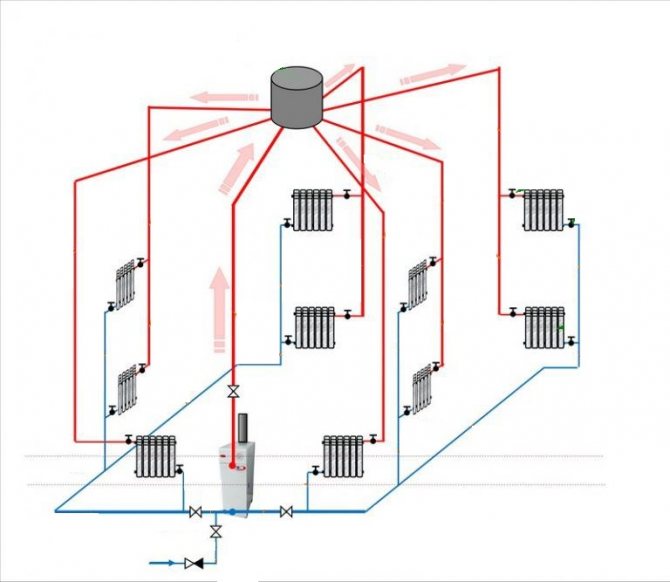
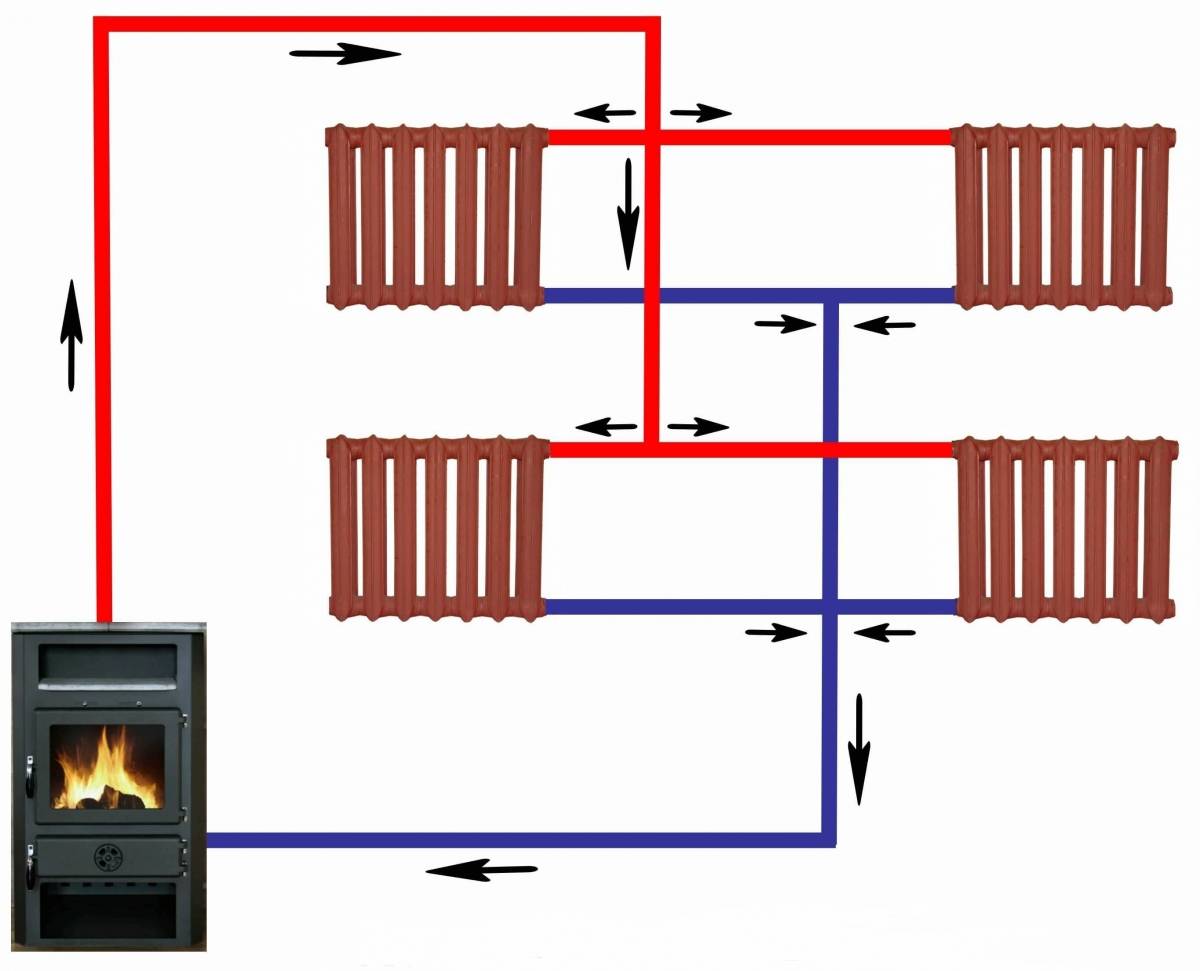
- "Leningrad". It consists of a single pipe into which the batteries are embedded.
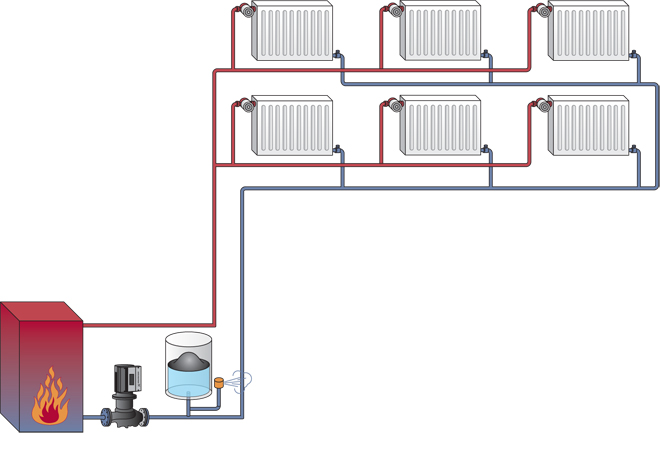
- Two-pipe. It is also called a dead end.
- Two-pipe associated, ringed.
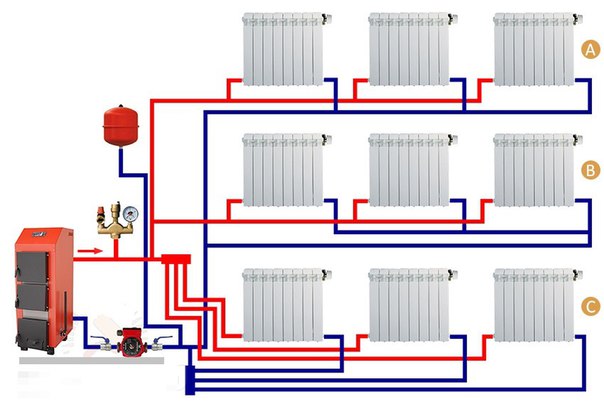
- Collector.
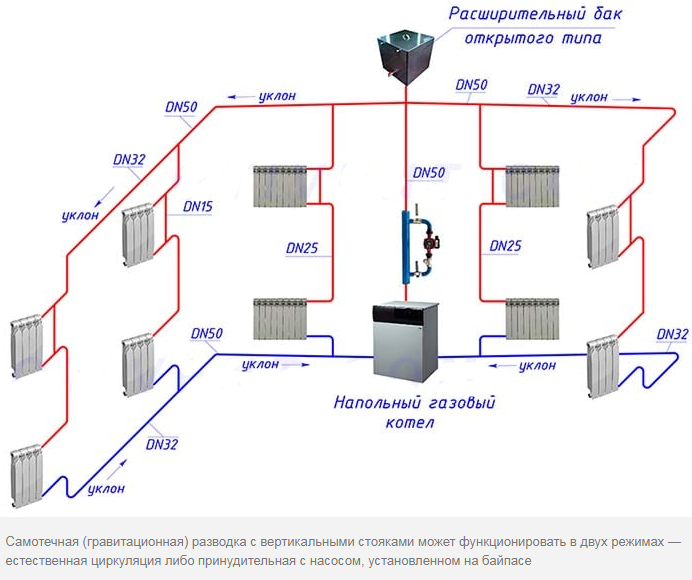
If the building is two-level, it makes sense to use a combined heating scheme for a private house. This is when the system is collector on the lower floor, and associated on the upper floor. Leningradka and two-pipe works autonomously without connecting pumping equipment.The driving force is the convection movement of the liquid through the pipeline, when hot water is squeezed up, and after cooling it goes down.
One-pipe connection option
Along the outer load-bearing wall of each of the rooms, a route is laid along which the coolant from the boiler is launched. Radiators crash from time to time. Most often they are placed under the windowsill.
The peculiarity of such water heating is that the spent coolant from the battery is returned to the general circuit, mixed with hot water and sent to the next one. Therefore, the further the room, the more sections will be required, as the liquid cools down.
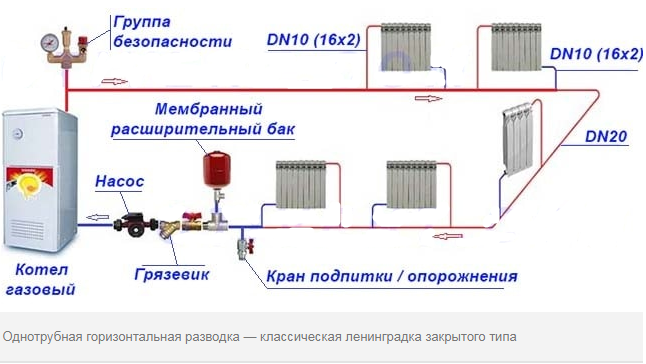
Also, when choosing, keep in mind that:
- The minimum diameter of pipes is 20 mm if they are made of metal. For metal-plastic, the cross section is from 26 mm, and for polyethylene - 32 mm.
- The maximum number of batteries is up to six. Otherwise, it is necessary to increase the cross section of the pipeline, which will increase the cost by 15-20%.
- It is difficult to regulate the temperature in the rooms. Turning the regulator knob on one radiator leads to a change in the temperature regime throughout the circuit.
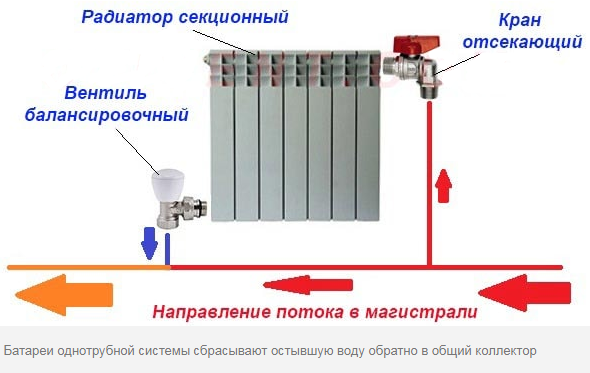
This is an efficient heating of a country house with a total area of 60 to 100 square meters. But this is the most inexpensive way to heat, say, a dacha. Even if the building is two-story, there will be no problems if two circuits are assembled, on a separate branch per floor.


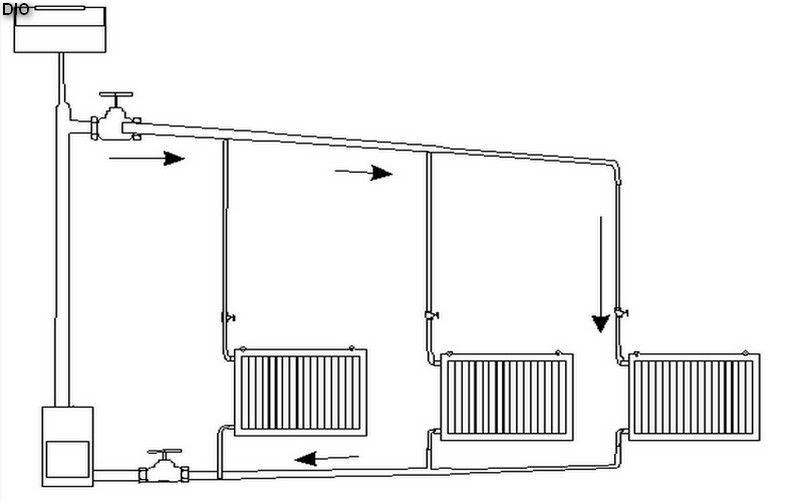
Two-pipe circuits ring and dead end
These two ways of organizing heating are different in that there are two circuits: direct and reverse. The first is designed to supply heated coolant to the batteries. The second is the withdrawal. Through it, water after cooling flows back to the boiler. And these systems differ from each other in the following ways:
- In the case of a dead-end option, the liquid flows to the last consumer through the previous ones, and then it is sent through a separate pipe for heating.
- The Tichelman ring loop assumes the simultaneous flow of supply and discharge in one direction along the radiators in series with a return to the boiler room.
Moreover, in the first case, the shoulder may not be one, but several. The second scheme involves two circuits interacting within a single line.
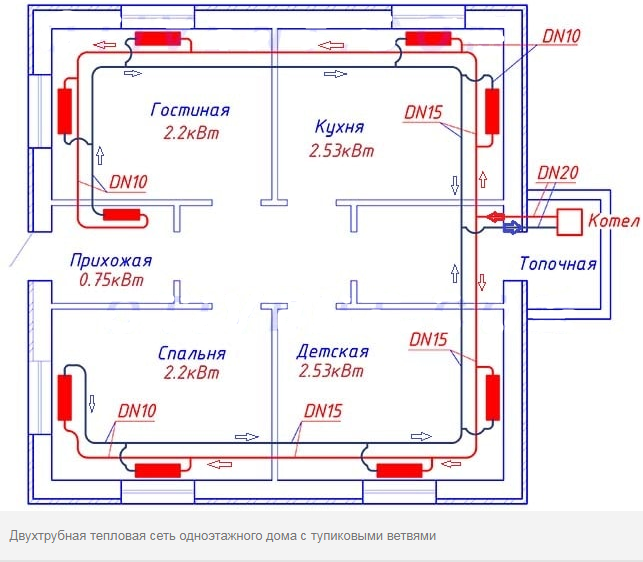
Despite the fact that the cost of such a system is higher than that of a single-pipe system, its popularity is due to a whole list of advantages:
- All batteries warm up the same way.
- The connecting pipes have a small diameter (15-20 mm).
- The number of points of consumption is not limited.
- The temperature regime is set for each room.
Self-assembly of dead-end branches is not difficult even for a novice builder. The ring system is mounted a little more difficult, since you have to “circle” the doorways. The track is mounted in the walls on top or in the floor under the threshold.
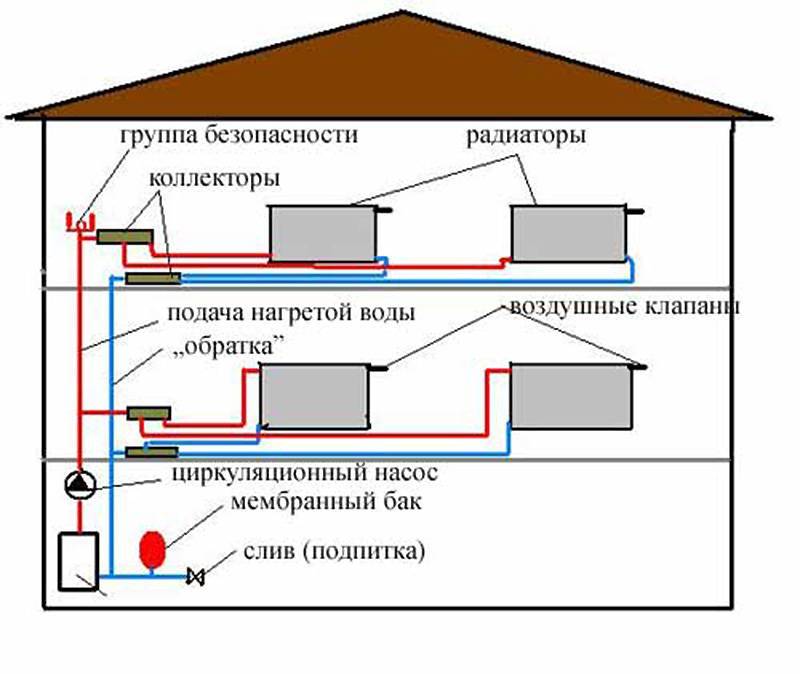
Collector system
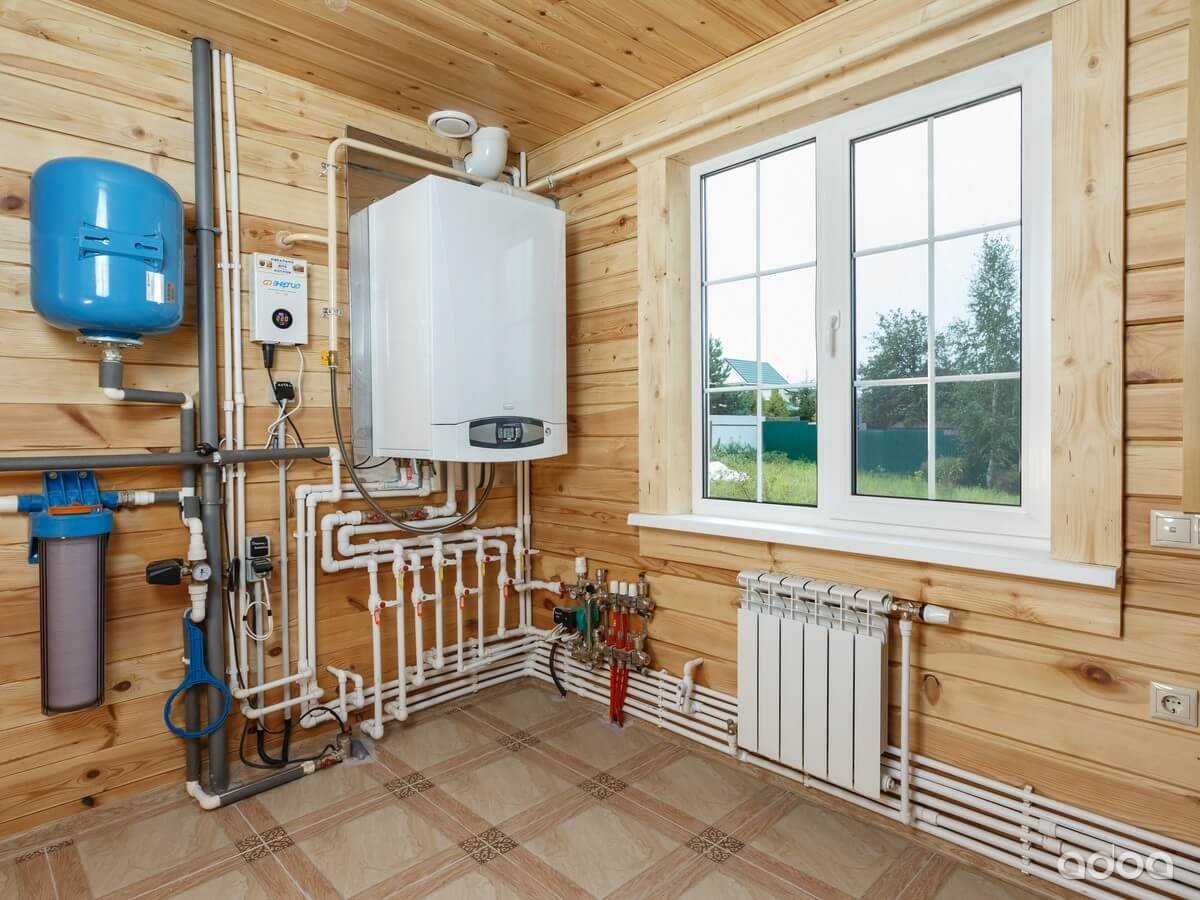
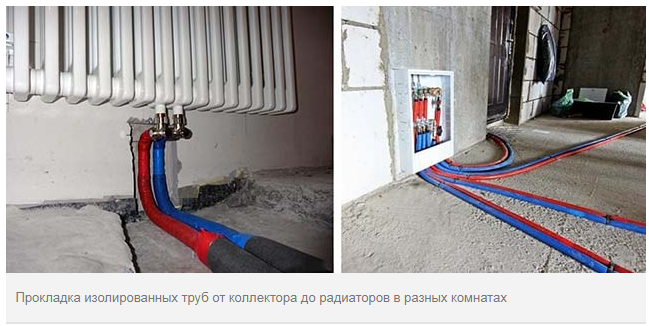
To supply the coolant to consumers, a ray principle and a distribution comb are used. The latter is arranged under the floor in the depths of the building closer to the center. Two pipes are laid from the comb to the boiler. The same amount is carried out to each radiator. You can hide the wiring under a cement screed or between the lags in the ceiling
It is important that the comb is equipped with an air release valve.
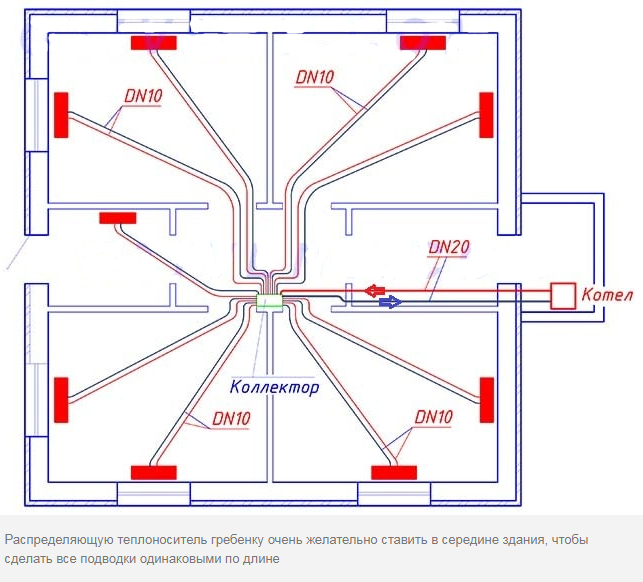
In addition to the main advantages that are inherent in dead-end systems, this heating method has a number of additional advantages:
- Whatever the interior, the pipeline does not spoil it, because everything is hidden in the floor.
- Adjustment is simple and convenient, as the valves are mounted in a common distribution cabinet.
- Installing an electronic control unit fully automates the system, making it completely autonomous.
Registration and obtaining permits
Among the regulations that regulate the device
individual heating system you can note:
The Law on Heat Supply contains provisions that
regulate the installation of heating systems with regulations and restrictions;
Decree of the Government of the Russian Federation No. 307 “On the procedure for connecting
to heat supply systems”, which determines the characteristics of boilers suitable
for installation in an apartment or a private house.
What documents are needed for heating with a gas boiler
obtain technical conditions for gasification in the gas service
area of residence. TU is issued after presentation of a document certifying your
ownership of housing, architectural and planning permits
management, copies of the BTI technical passport, passport, identification code
and applications for gasification of the building.
Specifications may differ depending on the purpose of the premises,
heating intensity, location, etc. The service is paid. Issuance period
TU - up to 30 days;
prepare a topographic survey of the site;
prepare a gas supply project - independently or with
attracting experts. Coordinate the project with the gas service of the district;
obtain written permission from neighbors to gasify your
at home (if the gas pipeline passes through their site);
provide documents for gas equipment and an act
chimney inspections;
receive a document on commissioning the system (issued
after mounting).The term for its receipt is up to 30 days. Based on this document
sealing of meters is carried out, insertion into the central highway and
conclusion of a new supply contracts gas.
What documents are needed for an electric heating system
submit to the RES a package of documents for obtaining permission to
network connection. The package includes: application (which indicates the type of object,
location, applicant's data), a document confirming payment for receipt
Technical specifications for the installation (permit) of the boiler, questionnaire (consent of neighbors), document,
certifying the ownership of the house;
to coordinate the technical solution of the project with the RES;
purchase an electric boiler and install it
(independently or with the involvement of specialists);
conclude an agreement for the use of electricity. Treaty
contains information on new energy tariffs;
seal the new meter.
Advice. Installing a three-mode meter will allow you to pay
energy at different rates, which is more beneficial for the user.
In case of unauthorized installation of the heating system
is subject to a fine, the amount of which is determined by local authorities and shutdown
from the gas and power supply system. To reconnect the boiler, you will need
pay a fine, as well as approve the project, i.e. complete all steps.
Water and air heating
Heating can be water (using water or antifreeze as a coolant) and air (heat is carried around the house by air currents). Which option is more practical?
The author votes with both hands for traditional water heating.The only convincing advantage of air as a heat carrier is that it is not afraid of freezing when the boiler is stopped.
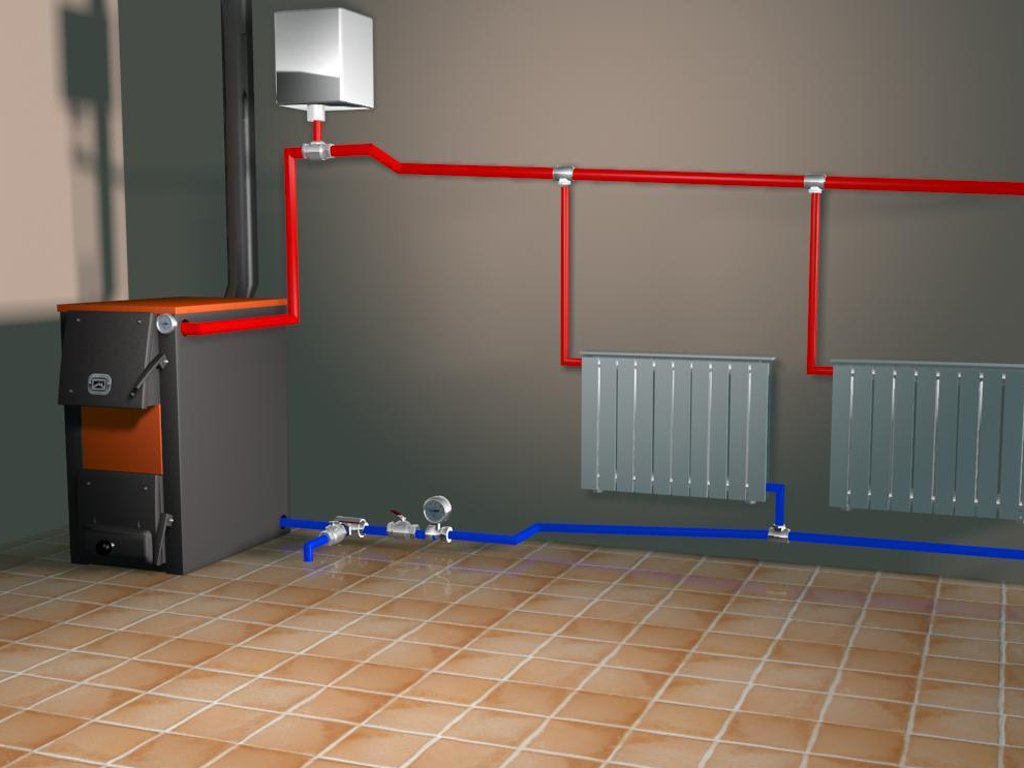




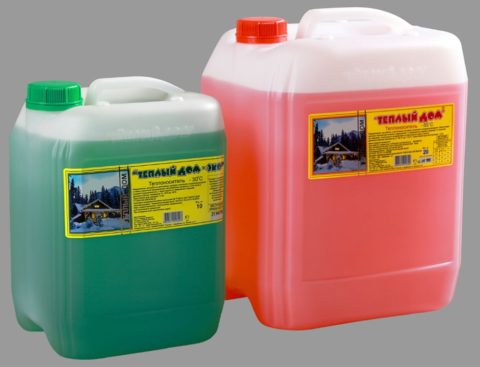
The problem of freezing water heating is eliminated by filling the heating circuit with antifreeze
There are more disadvantages:
- Air heating is noticeably more expensive (it requires laying large-section air ducts throughout the house and installing a heat recuperator in the ventilation);
- It is mounted only at the construction stage: the notorious air ducts are laid in the walls or above suspended ceilings;
- It forces you to sacrifice the useful area of the house, precisely because of the large diameter of the air ducts, which compensate for the low heat capacity of the air.
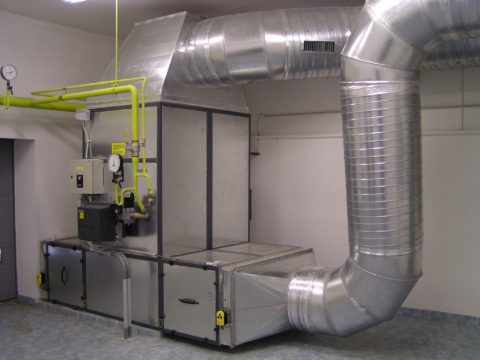
Boiler and air heating lines