- 5 Assembling a heating system with natural circulation
- Calculation of the heating system at home
- How to calculate the heating of a private house?
- Boiler installation instructions
- How and what heating system to choose for a private house
- 4 Two-pipe heating wiring - options for a two-story house, schemes
- Water heating systems
- Water system "Warm floor"
- Skirting heating systems
- Systems with natural circulation of the coolant
- Systems with forced circulation of the coolant
- Rules for the selection of basic equipment
- Features of choosing water heating for a private house
- Air heating of the building
- 2 System with forced fluid movement - optimal by today's standards
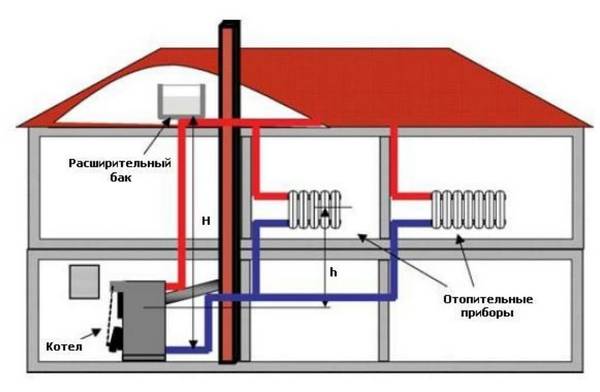
5 Assembling a heating system with natural circulation
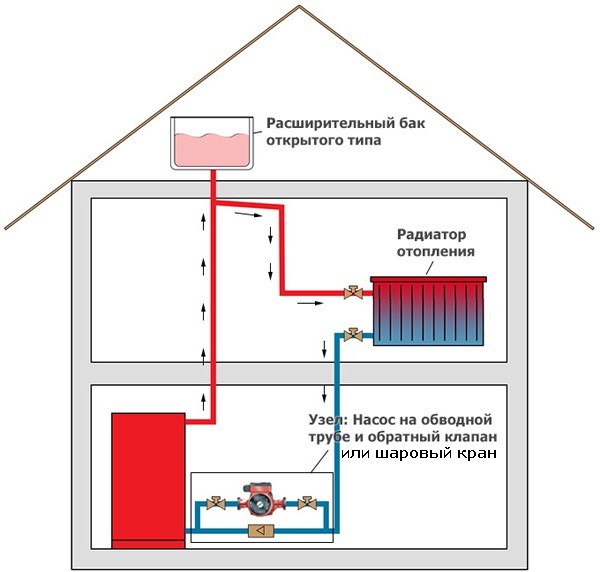
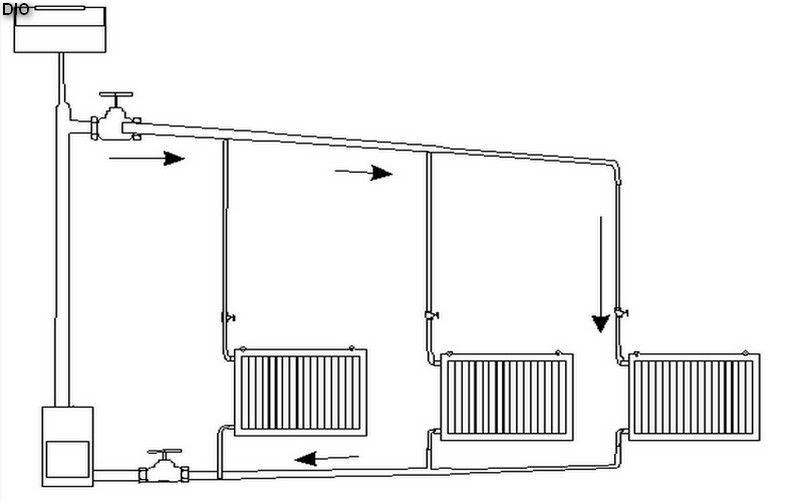
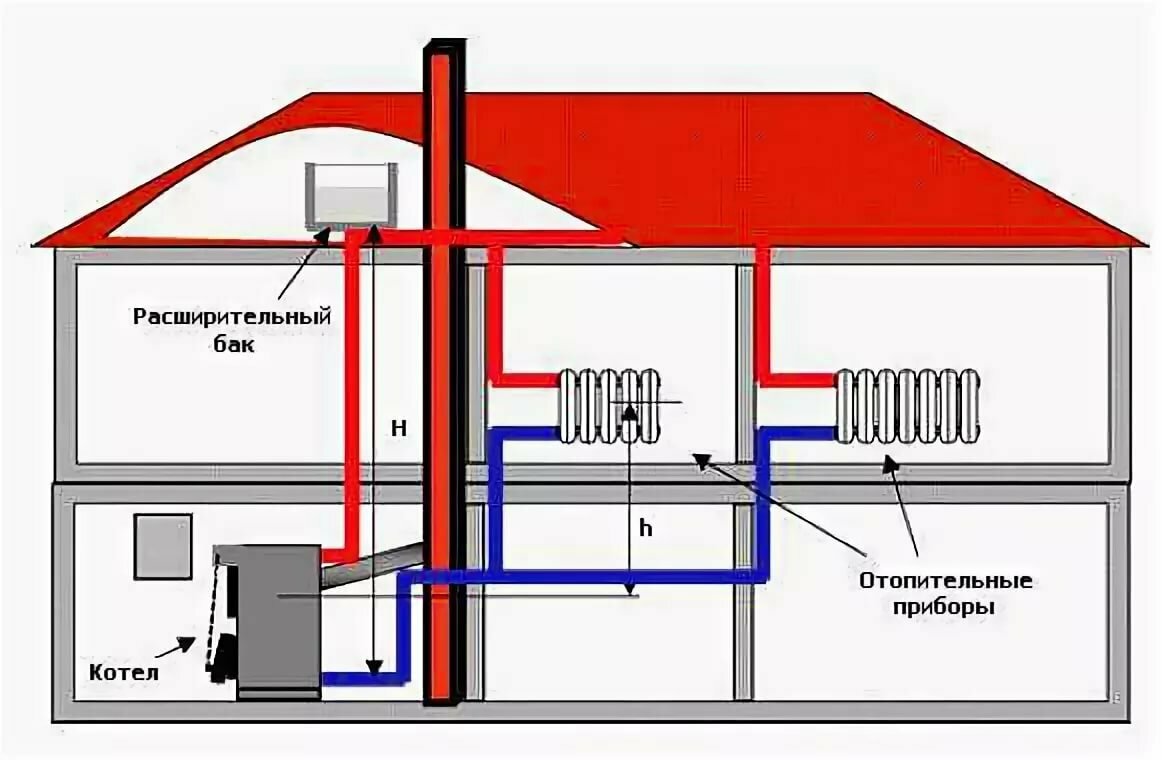
The construction of a natural circulation system begins with the selection of a location for the installation of the boiler. The heat source should be in the corner room, located at the lowest point of the wiring. After all, the batteries will go along the inner perimeter, along the load-bearing walls, and even the last radiator should be located slightly above the boiler. After the location for the boiler is selected, you can proceed with its installation. To do this, the wall in the placement area is tiled, and either a galvanized sheet or a flat slate panel is stuffed on the floor.The next step is the installation of the chimney, after which you can install the boiler itself, connecting it to the exhaust pipe and fuel line (if there is one)
Further installation is carried out in the direction of movement of the coolant and is implemented according to the following scheme. First, batteries are hung under the windows. Moreover, the upper branch pipe of the last radiator should be located above the pressure outlet from the boiler. The magnitude of the elevation is calculated based on the proportion: one linear meter of wiring is equal to two centimeters of elevation. The penultimate radiator is hung 2 cm above the last one, and so on, up to the first battery in the direction of the coolant.
When the required number of batteries already weighs on the walls of the house, you can proceed to the wiring assembly. To do this, you need to connect a 30-cm section of horizontal pipeline to the pressure pipe (or fitting) of the boiler. Further, a vertical pipe, raised to the level of the ceiling, is docked to this section. In this pipe, a tee is wound onto a vertical line, providing a transition to a horizontal slope and arranging the tie-in of the expansion tank.
The principle of operation of the heating system with forced circulation
To mount the tank, a vertical tee fitting is used, and a second horizontal section of the pressure pipe is screwed to the free outlet, which is pulled at an incline (2 cm by 1 m) to the first radiator. There, the horizontal passes into the second vertical section, descending to the radiator pipe, with which the pipe is joined using a collet fitting with a threaded drive.
Next, you need to connect the upper pipe of the first radiator to the corresponding connector of the second radiator. To do this, use a pipe of the appropriate length and two fittings.After that, the lower radiator pipes are connected in the same way. And so on, until the docking of the penultimate and last battery. In the final, you need to mount the Mayevsky faucet into the upper free fitting of the last battery and connect a return pipe to the lower free connector of this radiator, which is led into the lower pipe of the boiler.
Calculation of the heating system at home
| The calculation of heating systems for a private house is the very first thing that begins with the design of such a system. We will talk with you about the air heating system - these are the systems that our company designs and installs both in private homes and in commercial buildings and industrial premises. Air heating has many advantages over traditional water heating systems – you can read more about it here. |
System calculation - online calculator
Why is a preliminary calculation of heating in a private house necessary? This is required to select the correct power of the necessary heating equipment, which allows you to implement a heating system that provides heat in a balanced way to the corresponding rooms of a private house. A competent choice of equipment and the correct calculation of the power of the heating system of a private house will rationally compensate for heat loss from building envelopes and the flow of street air for ventilation needs. The formulas themselves for such a calculation are quite complex - therefore, we suggest you use the online calculation (above), or by filling out the questionnaire (below) - in this case, our chief engineer will calculate, and this service is completely free.
How to calculate the heating of a private house?
Where does such a calculation begin? Firstly, it is required to determine the maximum heat loss of the object (in our case, this is a private country house) under the worst weather conditions (such a calculation is carried out taking into account the coldest five-day period for this region). It will not work to calculate the heating system of a private house on the knee - for this they use specialized calculation formulas and programs that allow you to build a calculation based on the initial data on the construction of the house (walls, windows, roofs, etc.). As a result of the data obtained, equipment is selected whose net power must be greater than or equal to the calculated value. During the calculation of the heating system, the desired model of the duct air heater is selected (usually it is a gas air heater, although we can use other types of heaters - water, electric). Then the maximum air performance of the heater is calculated - in other words, how much air is pumped by the fan of this equipment per unit of time. It should be remembered that the performance of the equipment differs depending on the intended mode of use: for example, when air conditioning, the performance is greater than when heating. Therefore, if in the future it is planned to use an air conditioner, then it is necessary to take the air flow in this mode as the initial value of the desired performance - if not, then only the value in the heating mode is sufficient.
At the next stage, the calculation of air heating systems for a private house is reduced to the correct determination of the configuration of the air distribution system and the calculation of the cross sections of the air ducts.For our systems, we use flangeless rectangular air ducts with a rectangular section - they are easy to assemble, reliable and conveniently located in the space between the structural elements of the house. Since air heating is a low-pressure system, certain requirements must be taken into account when building it, for example, to minimize the number of turns of the air duct - both the main and the terminal branches leading to the grates. The static resistance of the route should not exceed 100 Pa. Based on the performance of the equipment and the configuration of the air distribution system, the required section of the main air duct is calculated. The number of terminal branches is determined based on the number of feed grates required for each specific room of the house. In the air heating system of a house, standard supply grilles with a size of 250x100 mm with a fixed throughput are usually used - it is calculated taking into account the minimum air velocity at the outlet. Thanks to this speed, air movement is not felt in the premises of the house, there are no drafts and extraneous noise.
| The final cost of heating a private house is calculated after the end of the design stage based on the specification with a list of installed equipment and elements of the air distribution system, as well as additional control and automation devices. To make an initial calculation of the cost of heating, you can use the questionnaire for calculating the cost of the heating system below: |
online calculator
Boiler installation instructions
Strict requirements are put forward only for the installation of gas-using heaters. But we recommend following these rules when installing any heat generators:
- Equipment with a power of up to 60 kW is allowed to be located in a kitchen with ceilings of 2.5 m (minimum). More powerful units are taken out to the technical room - internal, attached or freestanding.
- The requirement for furnace ventilation is three times air exchange, that is, the amount of supply and exhaust air is equal to three volumes of the room in 1 hour. The kitchen window is supplied with a window leaf.
- When placing the floor-standing boiler, observe the minimum technological passages - in front 1.25 m, on the side - 60 cm, behind - 250 mm from the nearest building structure, as shown in the photo.
- Indents from the wall-mounted heat generator to walls or cabinets - 20 cm on the side, 45 cm on top, 300 mm on the bottom. Before hanging on a wooden wall, a protective sheet of roofing steel is laid.
- The height of the chimney is 5 m, it is considered from the grate or gas burner, not from the ground. The head of the pipe should not fall into the area of the wind support of the roof.
- The maximum number of chimney turns is 3, the distance from the pipe to combustible structures is 0.5 m.
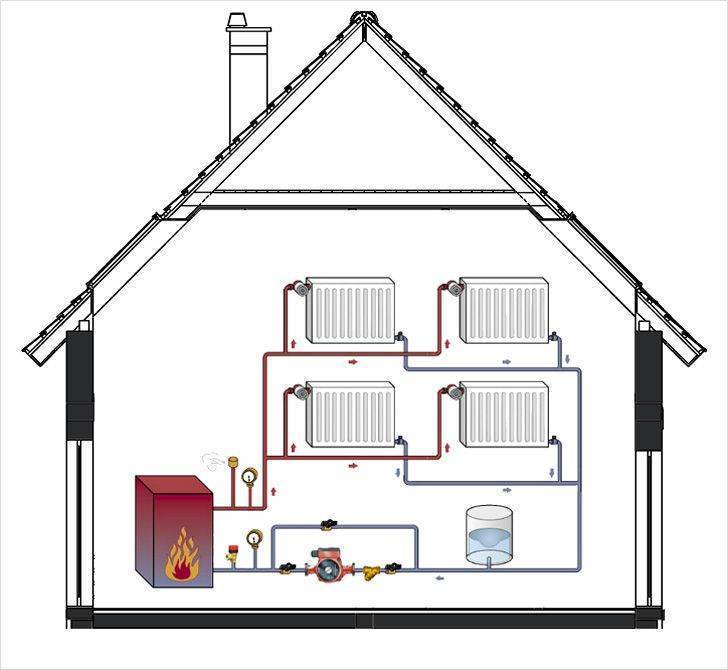
The piping of the heat generator depends on the fuel consumed. Boilers with high efficiency - gas, diesel - are connected to the system directly, through shut-off valves. Floor standing versions are additionally equipped with an external expansion tank and a pump.
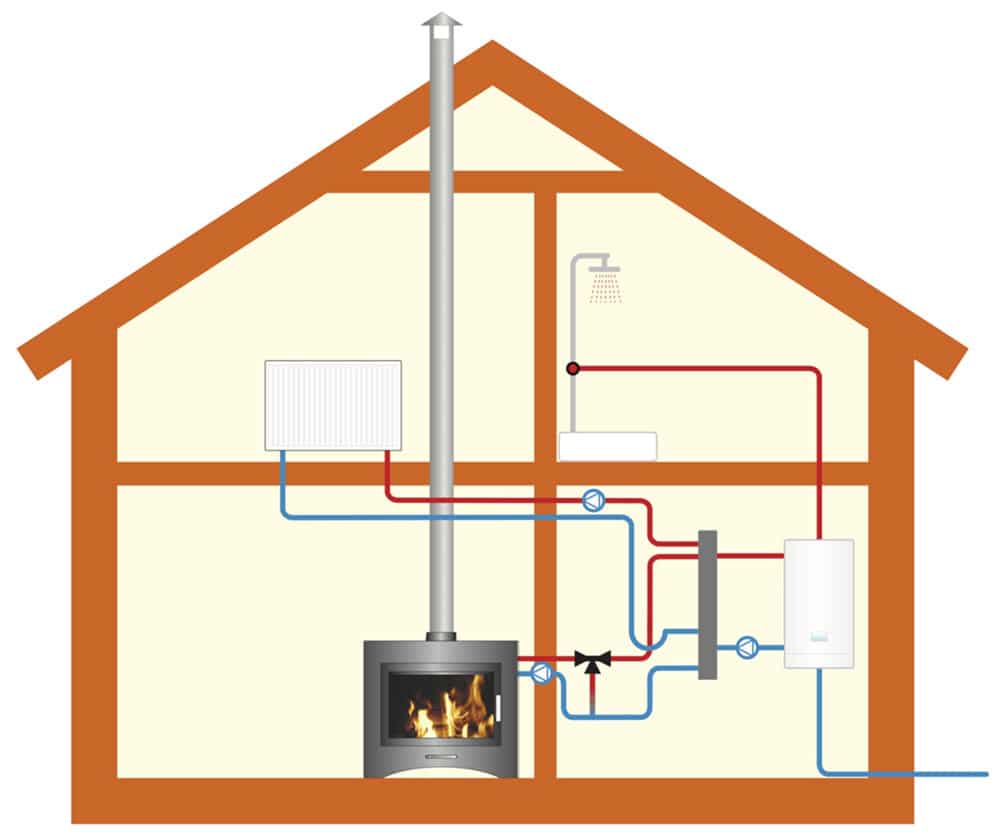
Typical double-circuit piping scheme wall-mounted heat generator
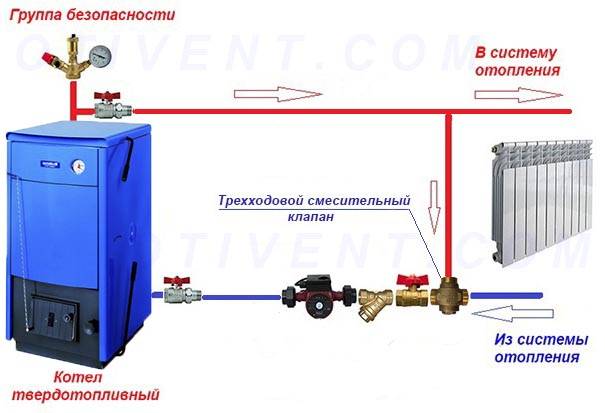
Solid fuel units must be protected from cold return and condensate, respectively, a small boiler circuit with a mixing three-way valve is provided
Please note: the pump is always placed inside the circuit, on the supply or return line - it does not matter. Detailed piping diagrams are shown in the instructions for connecting TT boilers



How and what heating system to choose for a private house
Having information about the principles of operation of different types of heating systems in private houses, you have to choose the most optimal one for your home.
If electric heat supply is quite suitable for a country house, then in a wooden house in which the family will live permanently, it is advisable to use a water system. In this case, heat supply will be provided by the local boiler house. If there are no interruptions in electricity, it is possible to organize electric heating in such a house.
An important condition for which heating system to choose for a private house is to obtain all the necessary information about the source of thermal energy in the area.
In addition, another important point in choosing a heating system for a private house is its cost, which, in turn, depends on the price of the pipeline and fuel, as well as the cost of the necessary equipment, installation work and maintenance.
It is imperative to take into account all the costs (both financial and labor) that will fall on the fuel used - its delivery, storage and procurement (in the event that solid fuel is used in the form of coal or firewood). A careful calculation showing the fuel consumption must be made. Two aspects are important here: the duration of heating (only in the summer or throughout the year) and the volume of the premises.
The main condition when choosing a heating system is its ability to create comfortable conditions for living in a house. This should be taken into account first of all, and only then - the cost of heat supply services.
4 Two-pipe heating wiring - options for a two-story house, schemes
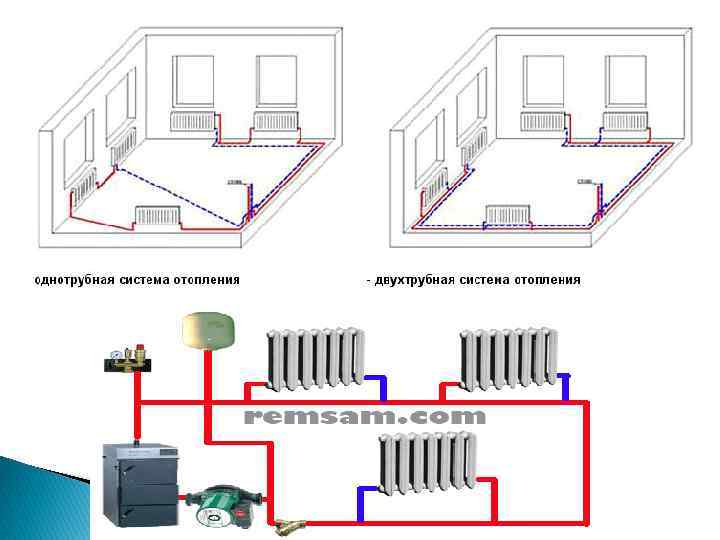
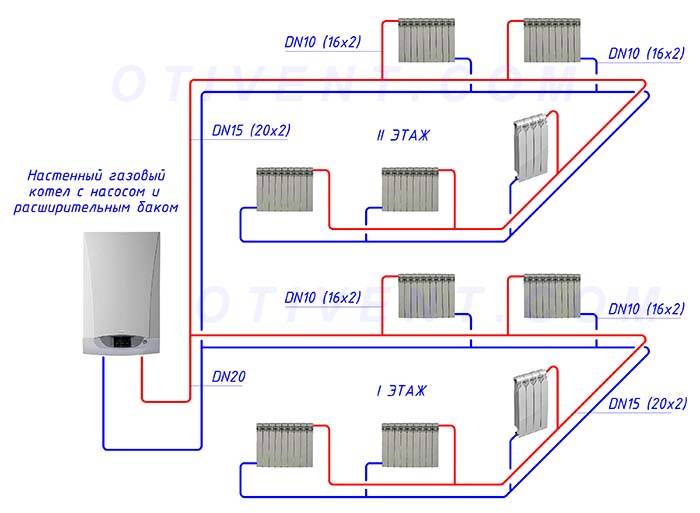
All the advantages of a circuit with forced movement of the coolant are realized during the installation and operation of a two-pipe heating system of a two-story house. With such a wiring, which has several options for working schemes, the coolant is supplied and removed from the batteries through different communications. Radiators are connected to the system in parallel, that is, independently of each other.
A two-pipe heating system is ideal for a circuit with forced movement of the coolant
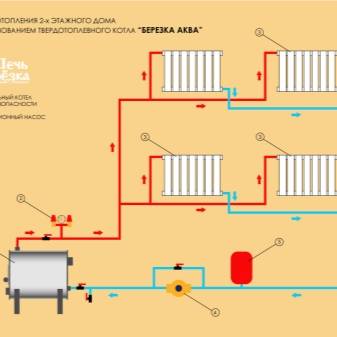
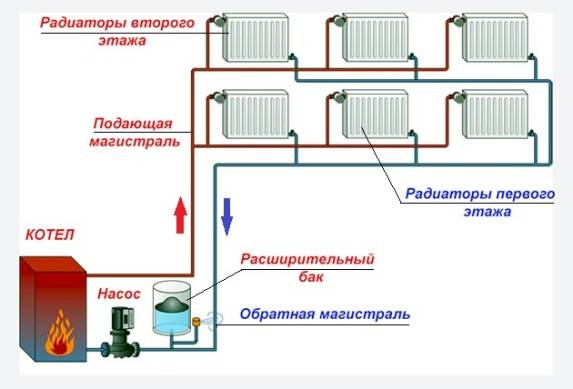
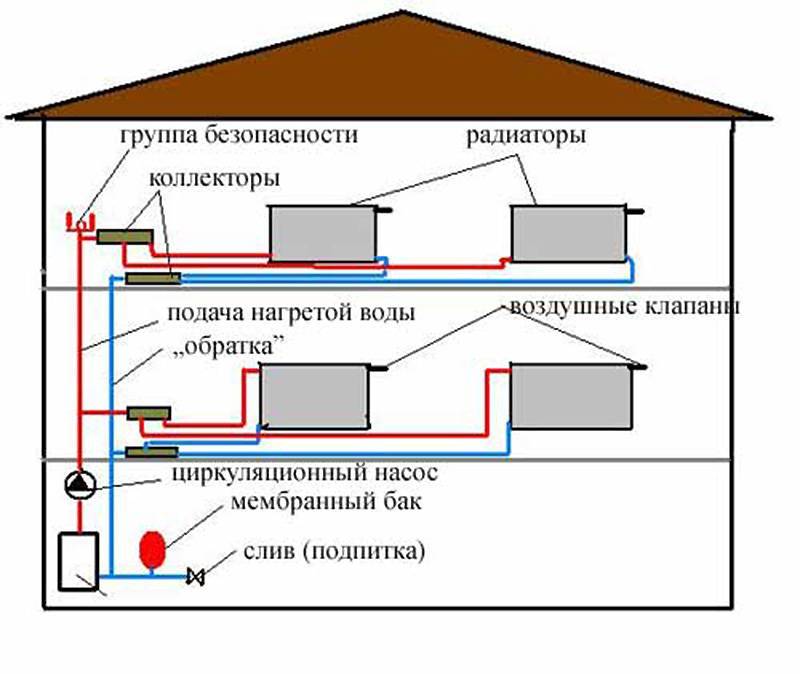
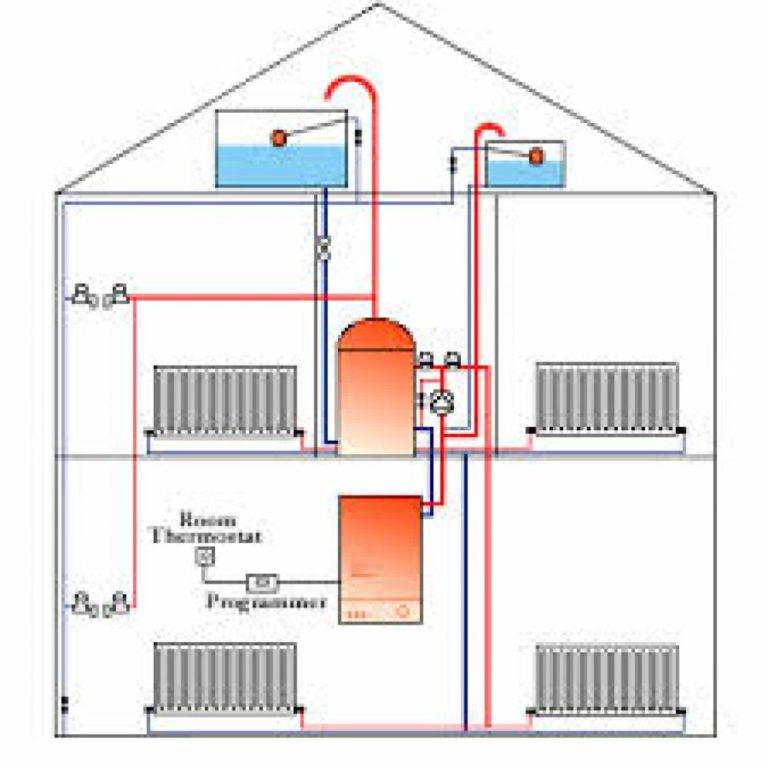
The hot coolant from the boiler enters the riser, from which a supply branch departs on each floor and supplies each heater. From the batteries, the discharge pipes discharge the cooled liquid into the return communication. "Cold" sunbeds flow into the discharge riser, which passes into the return pipe on the ground floor. On the return before entering the boiler, the following are installed in sequence:
- membrane expansion tank;
- circulation pump in the bypass system with a set of shut-off valves;
- safety valve that relieves excess pressure in the heating pipe circuit.
Independent supply of coolant to each battery in a two-pipe heating circuit makes it possible to regulate (including automatically) the rate of fluid flow through the radiator and thereby change the temperature of the heater.This is done manually using a shut-off valve at the heating medium supply inlet or with a thermostatic valve that automatically adjusts the clearance of the inlet opening in accordance with the set room temperature. Balancing valves are often installed at the outlet of radiators, with the help of which pressure is equalized in each section of the system and in the entire circuit.
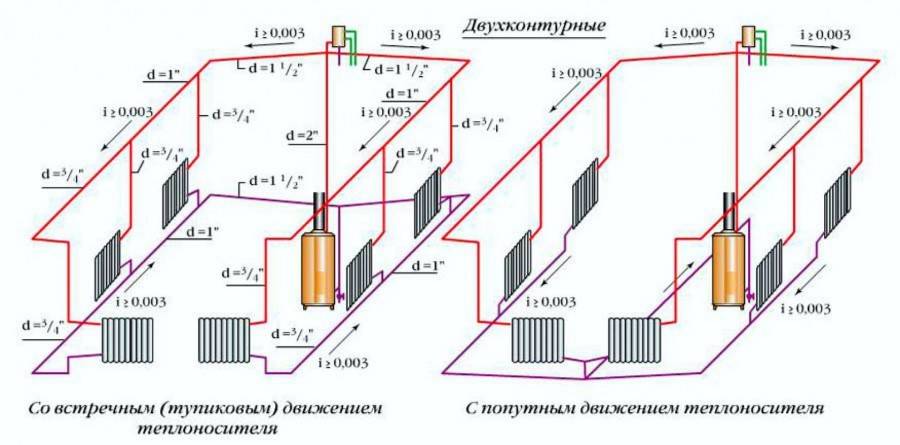
A two-pipe heating system can be implemented in several versions, and a different scheme can be applied on different floors. The simplest wiring with two pipes is called a dead end. It lies in the fact that both pipes (inlet and outlet) are laid in parallel, connecting in turn along the way to the batteries, and eventually close on the last heater. The cross section of the pipes (both) decreases as you approach the last radiator. Such wiring requires careful adjustment of pressure using balancing cocks (valves) in order to achieve a uniform flow of coolant to the batteries.
The following scheme for wiring and connecting pipes is called the "Tichelman loop" or the oncoming one. Its essence is that the supply pipe and the return pipe, having the same diameter throughout, are brought to the radiators and connected from opposite sides. This wiring is more optimal and does not require system balancing.
The most perfect, but also the most material-intensive, is the collector heating system of a two-story house. The supply of each heater on the floor is carried out individually, separate supply and return pipes are connected from the collector to the radiators. In addition to batteries, floor convectors, underfloor heating, fan coil units can be connected to the collector.The advantage is that each heating device or system is supplied with a coolant with the necessary pressure, temperature and circulation rate. All these parameters are controlled by devices (servo drives, liquid mixers, thermostats, valve systems) installed on the distribution manifolds.
Water heating systems
Water heating systems are an integral part of the interior of a private house. There are several possible options for choosing direct heating radiators. Can be:
- Classic cast iron;
- steel;
- Aluminum.
The type of water heating system and heating devices should be chosen, both depending on the climate conditions, and on the interior and on the possibilities of material costs.
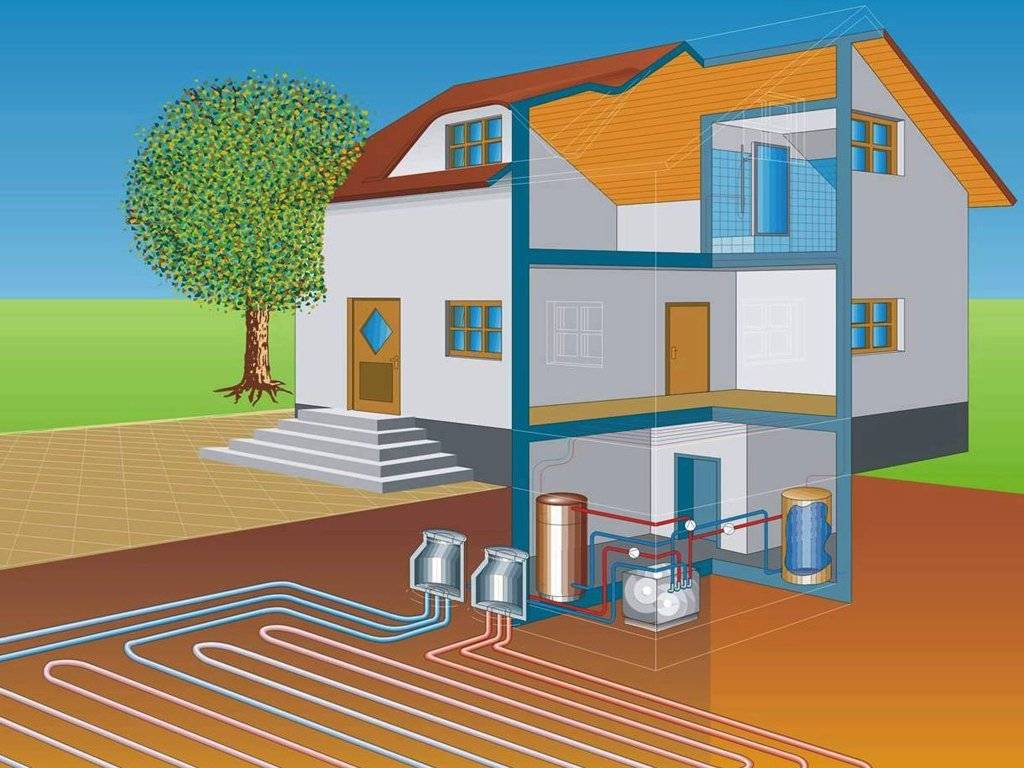
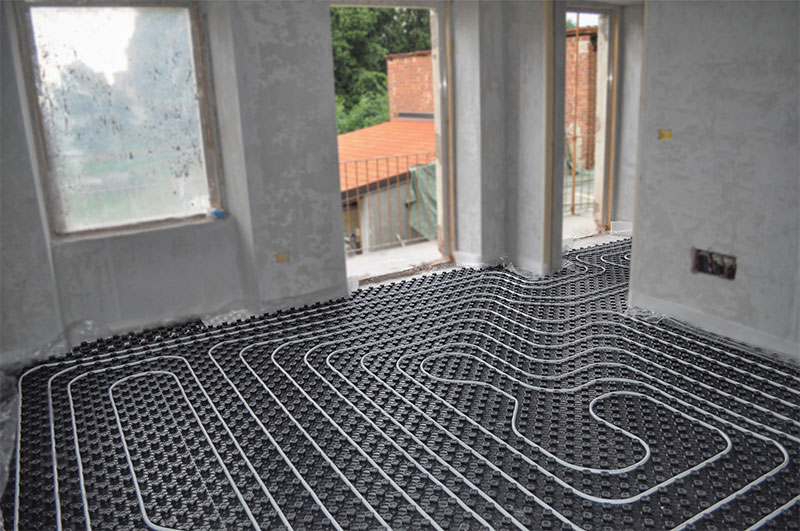
Water system "Warm floor"
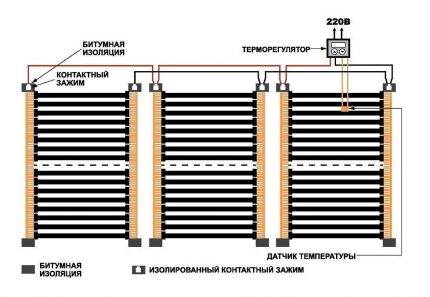
 The system is a good addition to the already long-used heating system using a radiator, and can also serve as an independent system in a low-rise building.
A big plus of this system is the ability to provide different temperatures along the height of the room, as it should be according to sanitary and hygienic standards - the air is colder from above, warmer from below. It also allows the temperature of the system to be reduced to 55 ˚C in accordance with design standards.





In this case, the pipes are mounted over the entire surface of the floor, thanks to which it is possible to simultaneously ensure both the microclimate conditions in the building and a comfortable warm floor. The disadvantage is the complexity with the installation of the system and the possibility of performing only at the initial stages of the construction of the building. The downside is that it is difficult to use.
Skirting heating systems
 Skirting systems are an excellent alternative to both underfloor heating and conventional radiators. Sometimes it is impossible to install a floor heating system, and radiators do not fit into the interior.
Then the choice of skirting systems is the best solution, because in this case the heating pipes are installed at the height of the skirting board (that is, almost at floor level), while heating the room in the right sequence and heating the floor to a sufficiently comfortable temperature in any period of the year.
The extensive color range of heating systems "under the plinth" will allow you to save any interior in your room and even help to diversify it even more.
Systems with natural circulation of the coolant
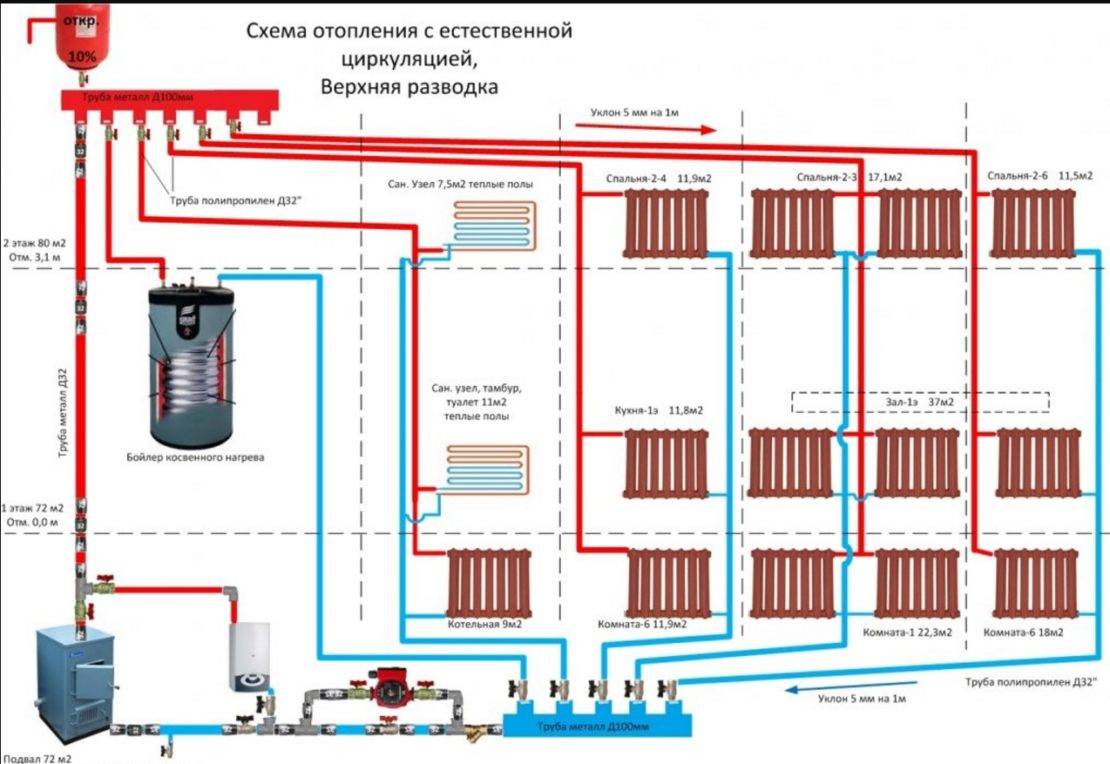
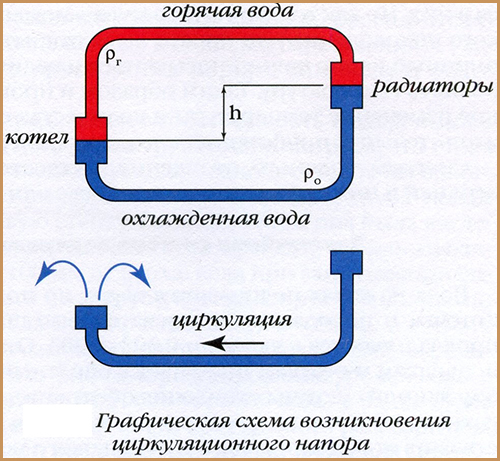 The heating system with natural movement of the coolant is different in that the liquid circulates through the pipes due to the difference in its densities when the temperature rises and falls.
Heated water, as a rule, becomes lighter than cold and rises higher in the system, while cold water, in turn, cools more and more, falls lower. The circulation of water from the source of heat and before returning to the source circulates without interruption.
The advantage of such a system is the relative accessibility and ease of installation. Using it does not imply any additional costs for the device and equipment. The disadvantage of the system is the need to install pipes at a slight slope, which complicates installation.
A prerequisite for the use of such a system is the device of an expansion tank.It is installed, as a rule, on the roof of a low-rise building - the best option for its device is the attic of a cottage (if it is provided for by the project).
Systems with forced circulation of the coolant
 Another option for designing heating systems in a low-rise residential building is the installation of a system with artificial water circulation. In this case, water moves through the system not due to its main physical property to change density, but by installing a circulation pump, the operation of which is to distill the coolant from the boiler throughout the system, followed by return to the heat source.
This system is considered more efficient than natural induction, due to the fact that it makes it possible for the coolant to enter the most extreme points of the heated building. This is especially important in the construction of cottages consisting of two or more floors.
This type of heating increases efficiency by about 30% compared to other types. Its advantage is the possibility of arranging pipes without a slope, respectively, installation is simplified. Instead of expansion tanks customary in natural systems, hydroaccumulating tanks are installed here.
It is also important to provide special protective fittings on pipes in order to avoid accidents, since the pressure in the systems is increased. Special safety valves are installed on both sides of the circulation pump.
Rules for the selection of basic equipment
When calculating the performance of heating systems, the following factors are taken into account:
- the area of the building and the height of its ceilings;
- type of materials used for the construction and decoration of the house;
- the number and dimensions of windows and doors;
- the duration of the heating season in this particular area;
- preferences of residents in terms of indoor air temperature.
When assembling a heating system in large country houses, project development is usually entrusted to specialists. Indeed, in this case, there are a lot of different factors to take into account. Accordingly, it is unlikely that it will be possible to make the correct calculations on your own.

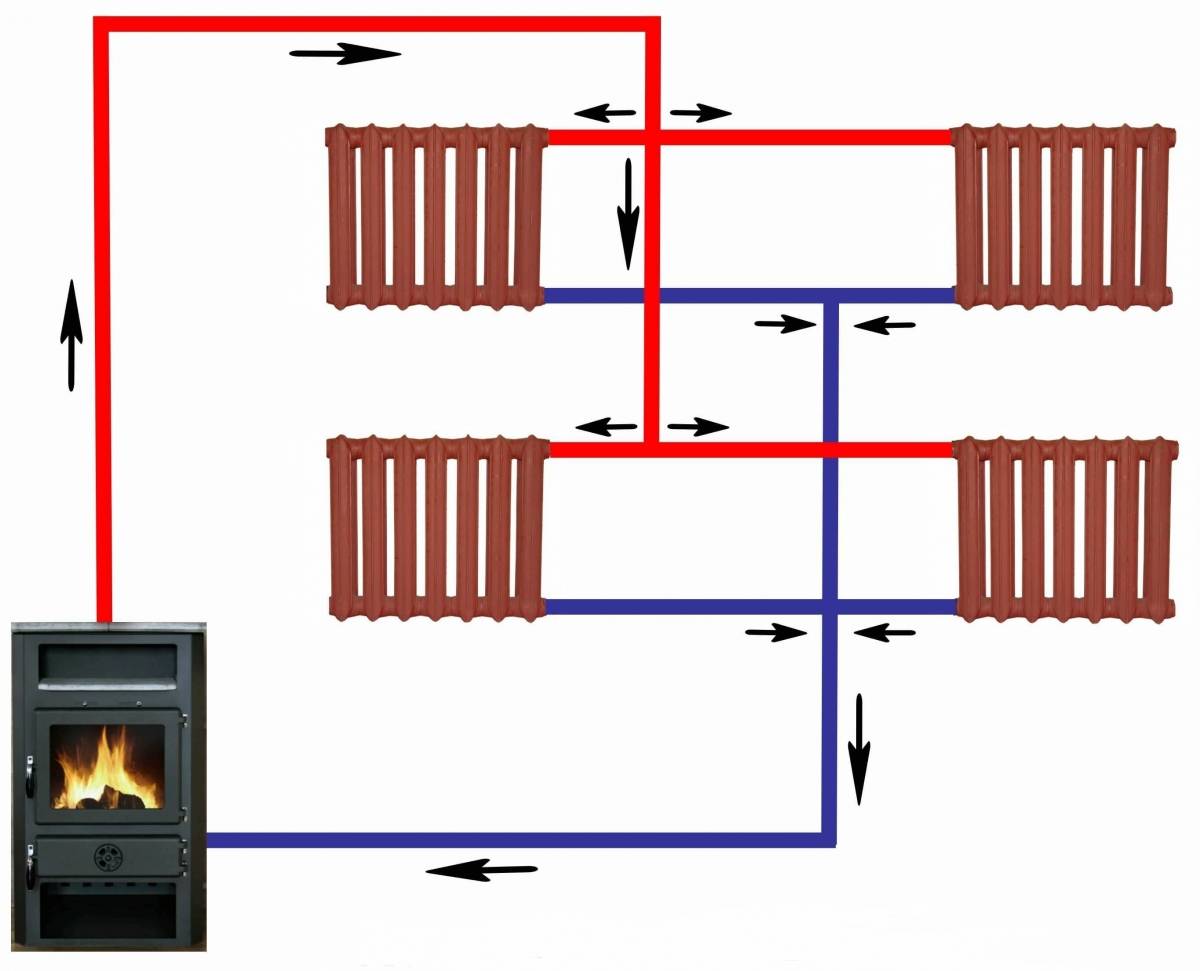


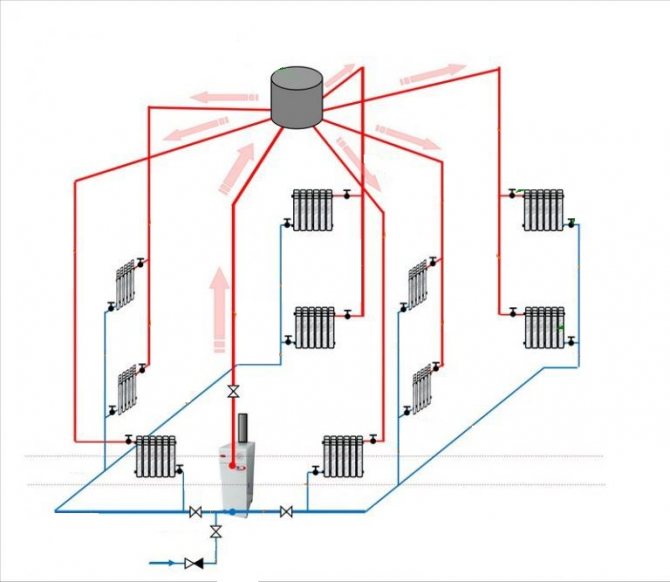


Projects of heating systems of small residential buildings or cottages are often drawn up without the help of an engineer. The fact is that in such cases it is allowed to use a simplified system for calculating the required power of the equipment.
Radiators and a boiler for small residential buildings are selected based on the fact that 1 kW of their power is needed per 10 m² of space. That is, for a house of 50 m², you will need a 5 kW boiler. The total power of all radiators installed in the building should be the same.
Features of choosing water heating for a private house
The design of the device assumes the presence of a boiler or an installation for heating the coolant.
The choice of a specific model of the unit depends on several factors: the total area of heated premises, the climate of your region, as well as the type of fuel chosen.
The water heating system can operate on gas, electricity, solid and liquid fuels. But the most popular are solid fuel and gas installations. This is due not only to the availability of fuel, but also to the low cost of acquiring the equipment itself.

In regions where there is no connection to the gas main, solid fuels are often used.In extreme cases, it is possible to use gas cylinders, but the cost of fuel is unreasonably high.
The main part of the water system is the boiler, which provides heating of the coolant, but one should not forget about other important components of the system, namely: registers, built-in elements, coils and others. In general, a whole complex of heating equipment is being formed, which has a high level of efficiency.
Regardless of the specific model of the device, you can install water heating with your own hands, while the installation principle is preserved.
The design scheme is quite versatile and can be easily supplemented with other equipment, for example, several heat generators. This will create an efficient autonomous heating system for the whole house.
If you decide to install the structure yourself, then you need to take care of high-quality automation, which will ensure the uninterrupted operation of the device, even when one of the boilers is turned off.

Air heating of the building
This is another type of heating a private house. Its main distinguishing feature is the absence of a coolant. The air system is designed so that air flows pass through the heat generator, where they are heated to the desired temperature.
Further, through special air ducts, which can have a wide variety of shapes and sizes, the air masses are sent to heated rooms.
Air heating can be used to heat a private house of a large area, while it is possible to create a comfortable microclimate in each room
According to the laws of convection, heated flows rise, cooled ones move down, where holes are mounted through which air is collected and discharged to the heat generator. The cycle is repeated.
Such systems can work with forced and natural air supply. In the first case, a pump is additionally mounted, which pumps the flow inside the air ducts. In the second - the movement of air is carried out due to the temperature difference. It is clear that forced circulation systems are more efficient and powerful. We talked about the arrangement of air heating with our own hands in the next article.


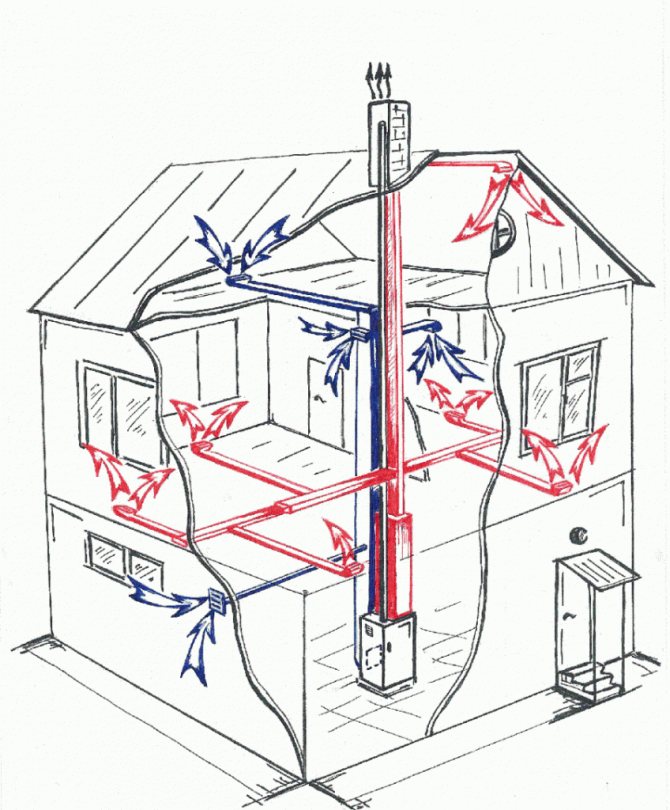
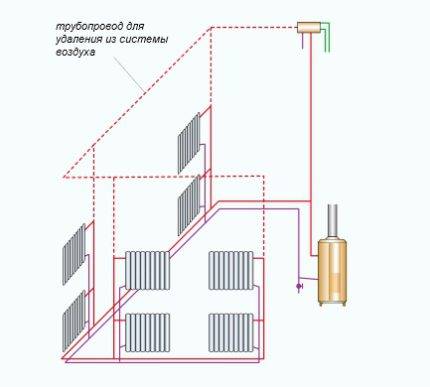


Heat generators are also different. They can operate on a variety of fuels, which determines their performance. Most of all, gas, electric and solid fuel appliances are in demand. Their disadvantages and advantages are close to similar water heating boilers.
The circulation of air masses inside the building can be carried out in different ways. It can be a closed cycle without adding outside air. In this case, indoor air quality is poor.
The best option is circulation with the addition of air masses from the outside. The indisputable advantage of air heating is the absence of a coolant. Thanks to this, it is possible to save the energy required for its heating.
In addition, installation of a complex system of pipes and radiators is not required, which, of course, also increases the efficiency of the system. The system does not have the risk of leaks and freezing, like its water counterpart. It is ready to work at any temperature. The living space heats up extremely quickly: literally, about half an hour passes from starting the heat generator to raising the temperature in the premises.
A gas heat generator is one of the possible solutions for the implementation of an air heating project for a private house. However, such systems are rarely used in practice.
Another significant plus is the possibility of combining air heating with ventilation and air conditioning. This opens up the widest possibilities for realizing the most comfortable microclimate in the building.
The air duct system in the summer can be successfully used for air conditioning. Installing additional equipment will make it possible to humidify, purify and even disinfect the air.
Air heating equipment lends itself well to automation. "Smart" control allows you to remove burdensome control over the operation of appliances from the homeowner. In addition, the system will independently select the most economical mode of operation. Air heating is very easy to install and durable. The average life of its operation is about 25 years.
Air ducts can be installed at the construction stage of the building and hidden under the ceiling covering. These systems require high ceilings.
The advantages include the absence of pipes and radiators, which gives room for the imagination of designers decorating the interior. The cost of such a system is quite affordable for most homeowners. Moreover, it pays off quickly enough, so its demand is growing.
Air heating also has disadvantages. These include a significant difference between the temperatures in the lower and upper parts of the room. On average, it is 10 ° C, but in rooms with high ceilings it can reach up to 20 ° C. Thus, in the cold season, it will be necessary to increase the power of the heat generator.
Another disadvantage is the rather noisy operation of the equipment. True, this can be leveled by the selection of special "quiet" devices. In the absence of a filtration system at the outlets, a large amount of dust in the air may occur.
2 System with forced fluid movement - optimal by today's standards
When developing a modern heating project for a two-story house, the authors of the document will most likely include a heating circuit with a circulation pump in it. Systems with natural movement of fluid through pipes do not fit into the concept of a modern interior, in addition, forced circulation provides better performance for water heating, especially in private houses with a large area.
Forced circulation makes it much easier to relate to the location of the elements of the heating system relative to each other, but there are still general rules for piping the boiler, preferentially connecting radiators, and laying pipe communications. Despite the presence of a circulation pump in the circuit, when installing the wiring, they try to minimize the resistance of pipes, their connections and transitions in order to reduce the load on the liquid pumping device and avoid fluid turbulence in difficult places.
The use of forced circulation in the pipe circuit allows you to achieve the following operational advantages:
- the high speed of the liquid movement ensures uniform heating of all heat exchangers (batteries), due to which better heating of various rooms is achieved;
- forced injection of the coolant removes the restriction from the total heating area, allowing you to make communications of any length;
- a circuit with a circulation pump works effectively at low liquid temperatures (less than 60 degrees), making it easier to maintain the optimum temperature in the rooms of a private house;
- low liquid temperature and low pressure (within 3 bar) allows the use of inexpensive plastic pipes for the installation of a heating system;
- the diameter of thermal communications is much smaller than in a system with natural circulation, and their hidden laying is possible without observing natural slopes;
- the possibility of operating heating radiators of any type (preference is given to aluminum batteries);
- low heating inertia (no more than half an hour passes from starting the boiler to reaching the maximum temperature by the radiators);
- the ability to make the circuit closed using a membrane expansion tank (although the installation of an open system is also not excluded);
- thermoregulation can be carried out both in the whole system, and zonal or pointwise (to regulate the temperature on each heater separately).
Another advantage of the forced heating system of a two-story private house is the arbitrary choice of a place to install the boiler. Usually it is mounted on the ground floor or in the basement, if there is a basement, but the heat generator does not have to be specially deepened and the level of its location relative to the return pipe must be calculated. Both floor and wall installation of the boiler is allowed, which provides a wide choice of suitable equipment model according to the personal preferences of the homeowner.
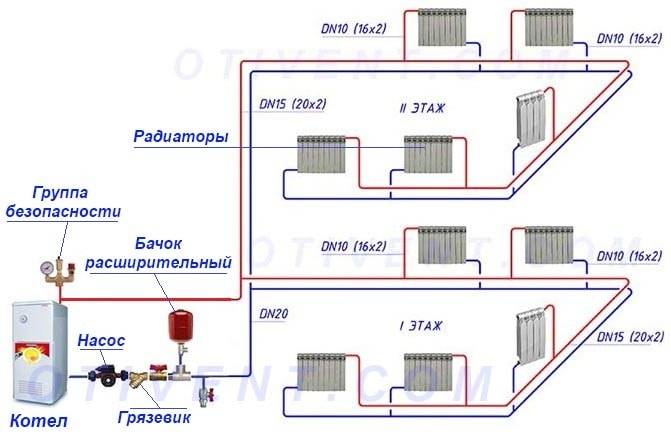
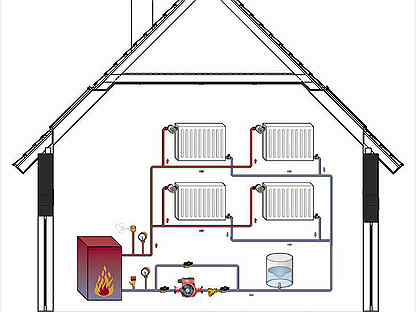


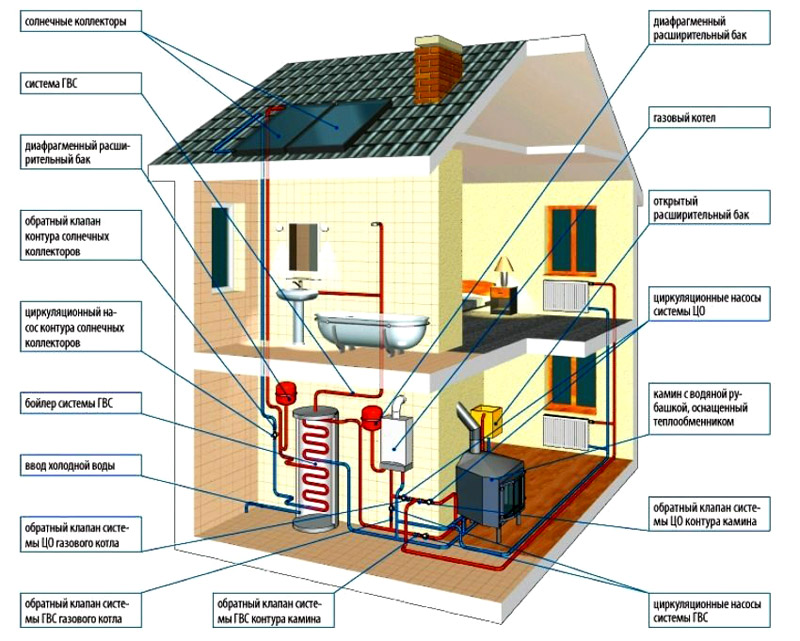
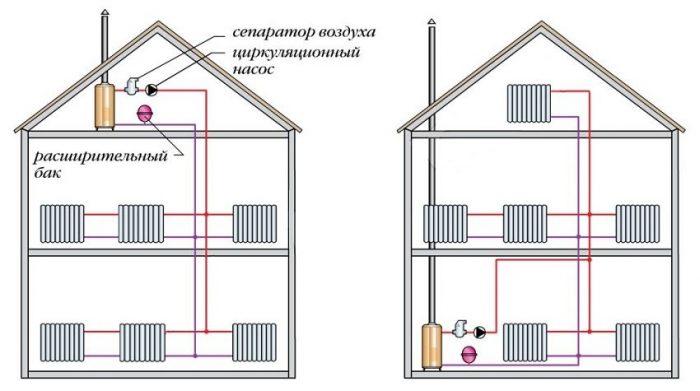
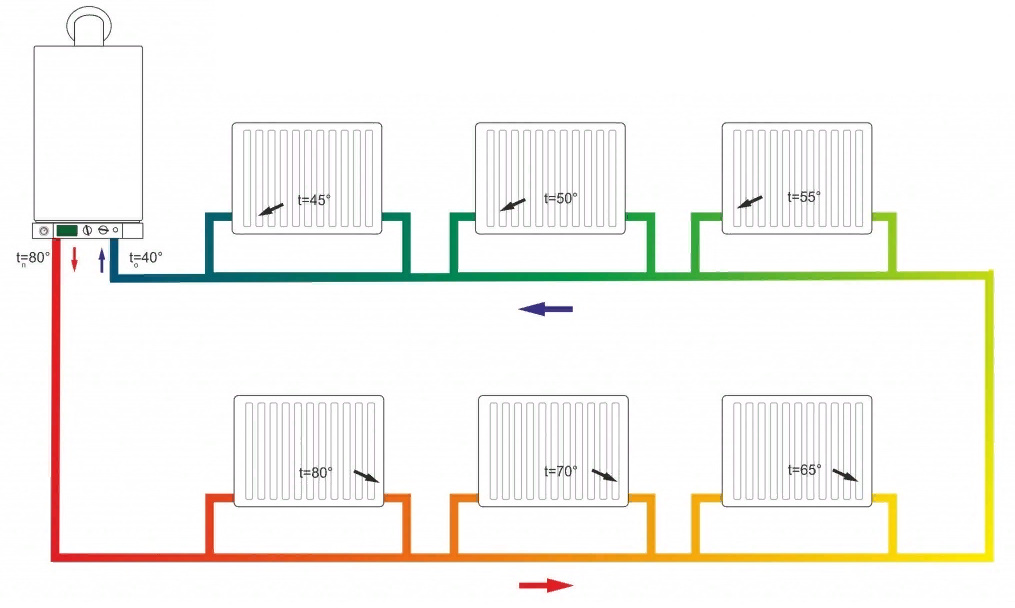
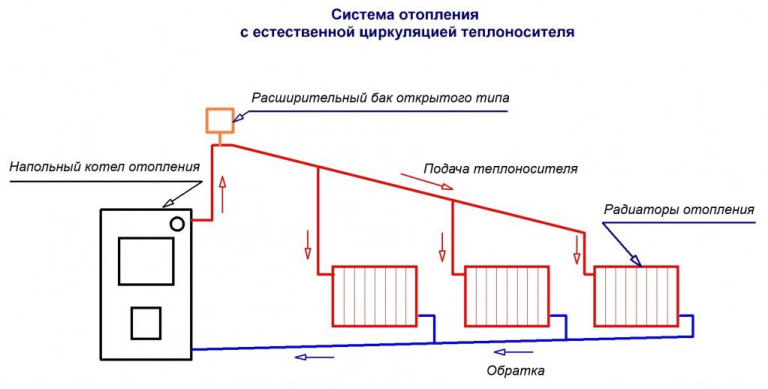

A heating system with a circulation pump is most often found in modern projects.
Despite the technical perfection of heating with forced fluid movement, such a system has drawbacks. Firstly, this is the noise that is formed during the rapid circulation of the coolant through the pipes, especially intensifying in places of narrowing, sharp turns in the pipeline. Often the noise of a moving liquid is a sign of excessive power (performance) of the circulation pump applicable to a given heating circuit.
Secondly, the operation of water heating depends on electricity, which is necessary for the constant pumping of the coolant by the circulation pump. The circuit layout usually does not contribute to the natural movement of the liquid, therefore, during long power outages (if there is no uninterruptible power supply), the housing is left without heating.
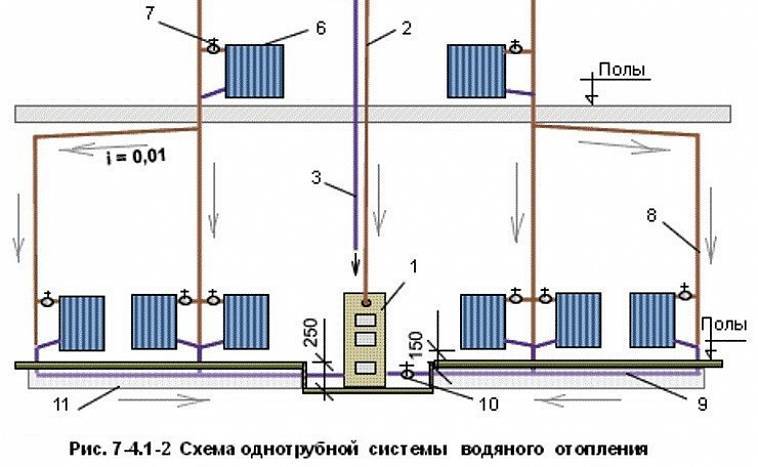
Like a circuit with natural circulation, the heating of a two-story house with forced pumping of the coolant is done with one-pipe and two-pipe wiring. How these schemes look right will be discussed later.