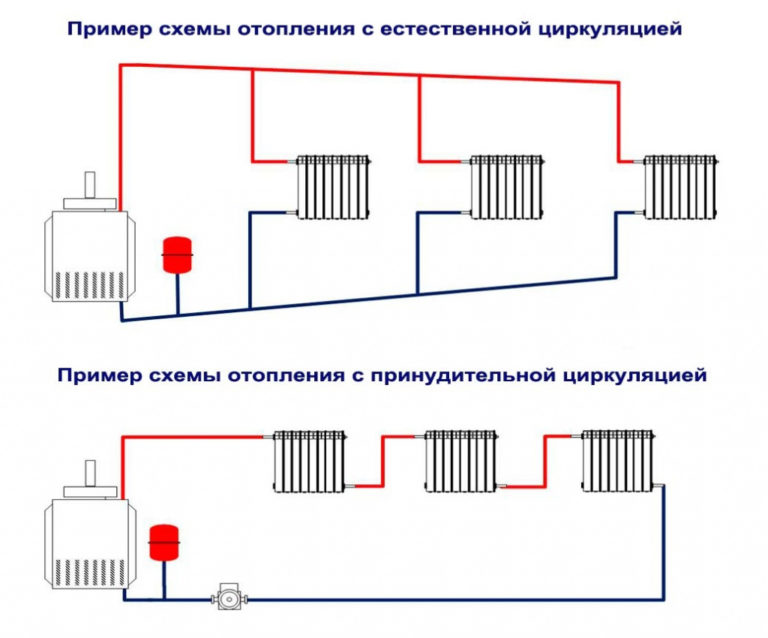
- Tips for installing a house heating system
- Two-pipe heating systems
- With bottom wiring
- With top wiring
- Basic heating schemes
- Types of heating systems for a private house
- Water heating and schemes
- Air heating and circuits
- Electric heating
- Stove heating
- How to arrange water heating of a private house with your own hands, installation diagrams
- Features of the device of a single-pipe system
- How a two-pipe system works
- The most popular types of water heating
- Residential heating options
- Boiler designs
- Oil boilers
- Solid fuel boilers
- What you need to know to install water heating in the house?
- Single pipe systems
- Wiring options for the water heating scheme of a private house
Tips for installing a house heating system
The heating device begins with the installation of batteries in pre-prepared places under the windows or on the corner outer walls. Devices are hung on special hooks attached to the structure itself or plasterboard finish. The unused lower outlet of the radiator is closed with a cork, a Mayevsky tap is screwed in from above.
The pipeline network is mounted according to the assembly technology of certain plastic pipes. To save you from mistakes, we will give some general recommendations:
- When installing polypropylene, consider the thermal elongation of the pipes.When turning, the knee should not rest against the wall, otherwise, after starting the heating, the line will bend like a saber.
- It is better to lay the wiring in an open way (excluding collector circuits). Try not to hide the joints behind the sheathing or embed them in the screed, use the factory "clips" to fasten the pipes.
- Lines and connections inside the cement screed must be protected with a layer of thermal insulation.
- If for any reason an upward loop has formed on the piping, install an automatic air vent on it.
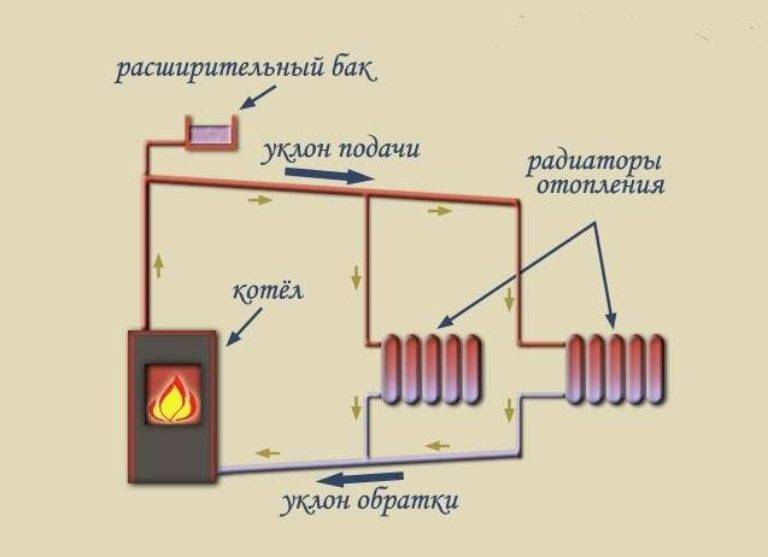
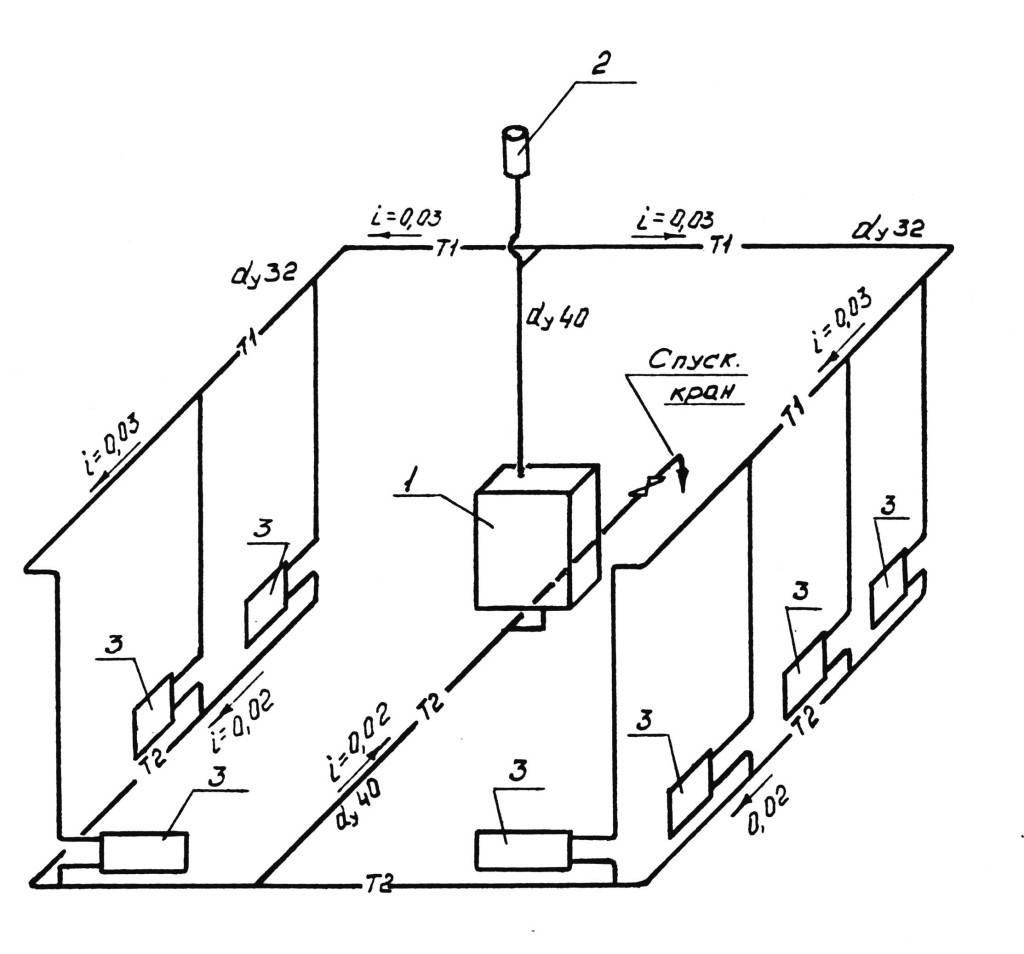
- It is desirable to mount horizontal sections with a slight slope (1-2 mm per linear meter) for better emptying and removal of air bubbles. Gravity schemes provide slopes from 3 to 10 mm per 1 meter.
- Place the diaphragm expansion tank on the return line near the boiler. Provide a valve to cut off the tank in case of malfunction.
Two-pipe heating systems
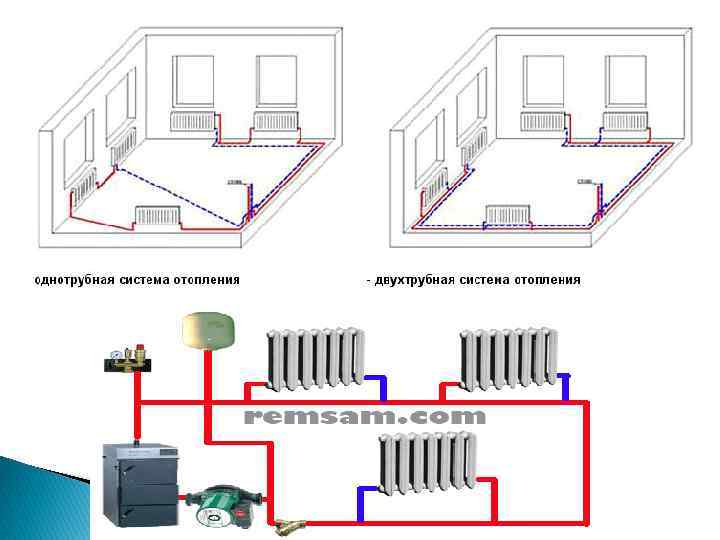
In a two-pipe heating system, the batteries are no longer connected to one common line, but to two - supply and return. So the distribution of heat throughout the building is more even. Water comes to each heat exchanger approximately equally heated. It is not for nothing that such a scheme is usually used in high-rise buildings with a large number of heated rooms. But it is also often installed in cottages, especially if they are large and have several floors.
Two-pipe scheme heating for private houses It has only one serious disadvantage - the price. Often, in comparison with a single-pipe counterpart, its high cost is mentioned. However, pipes in this case require a smaller diameter. Their length doubles here.At the same time, due to the reduction in the cross section, the final estimate is not as overestimated as it might seem at first glance.
This, analyzing the types of foundations, we can immediately unequivocally say that the monolith will come out more expensive than the tape base. With the arrangement of heating of private houses, everything is not so simple and easy. During its installation, pipes of different diameters, various fittings and thermostats are used. The total cost of each variety must be calculated individually for the real structure and for the specific parameters of the required temperature regime.
With bottom wiring
With the lower scheme, both pipes are laid above or in the floor. And a couple of taps are connected to the batteries from below. Such a connection is often used to hide heating pipelines behind the finish. This is more of a design decision, it does not give any special advantages in terms of heat transfer.
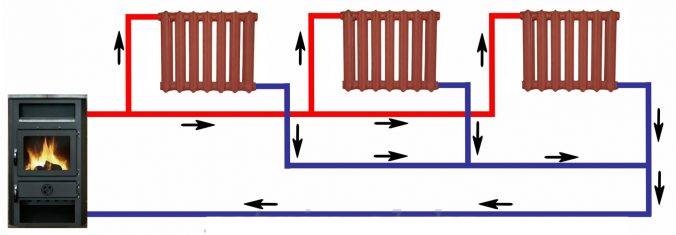
Two-pipe with bottom wiring
On the contrary, the lower method of connecting radiators implies the highest heat loss. It is generally not recommended for use in heating systems with natural (gravitational) circulation. If this wiring is chosen, then you will have to take care of the availability of special equipment for pumping the coolant, and choose a battery with more power. A boiler without a circulation pump alone cannot cope with the supply of heat around the house.
With top wiring
At the top heating distribution, the connection of radiators to the pipes can be diagonal or lateral
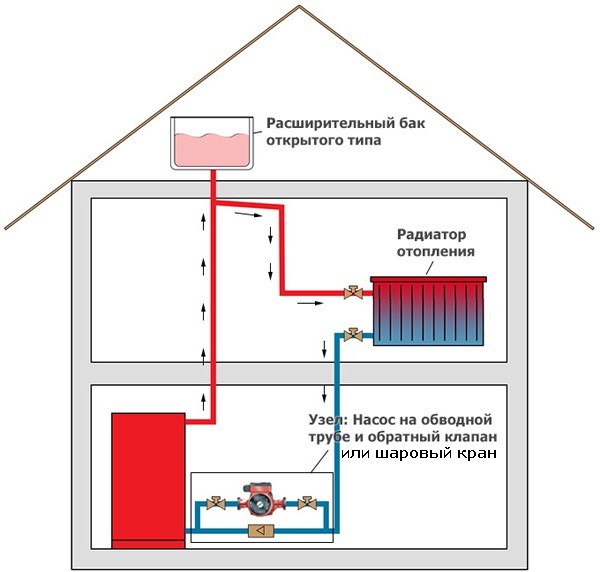
This is not the most important thing here. The main distinguishing feature of this type of water heating is the presence of an expansion tank
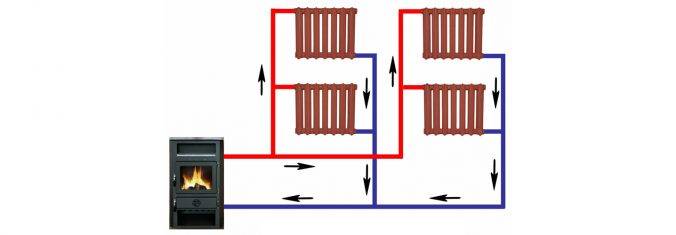
Two-pipe with top wiring
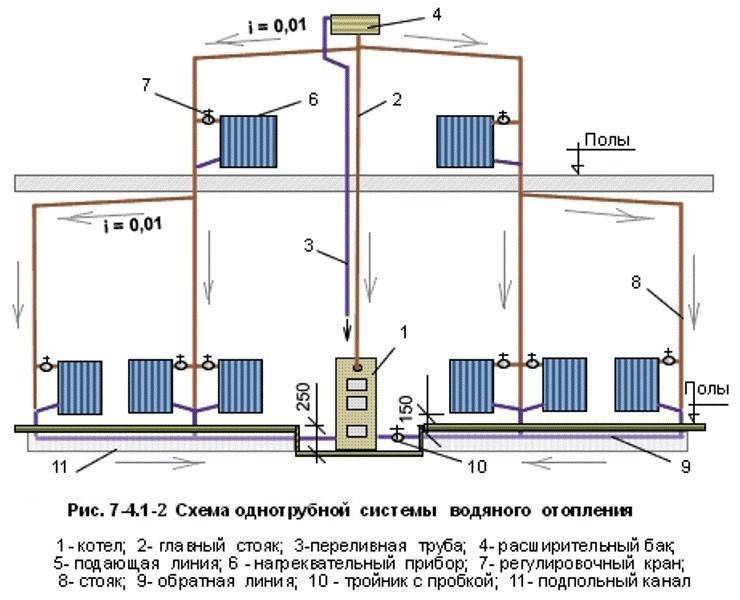
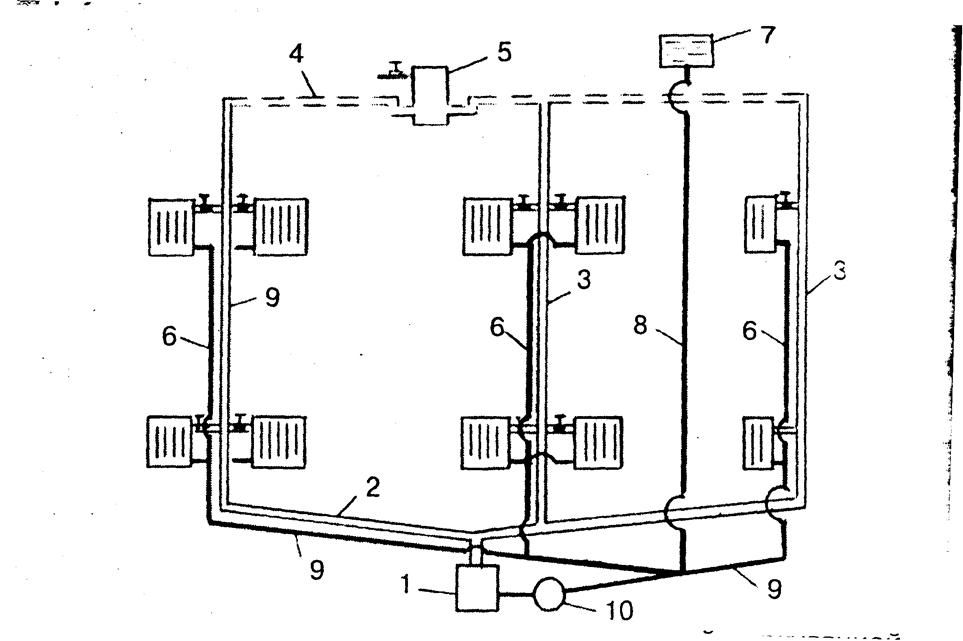
The expansion tank is placed in the attic.The water heated in the boiler actually enters this accumulator first. The coolant flows into the supply pipe in a natural way from top to bottom. And then the water after heat transfer in the radiator is sent back to the heater.
Basic heating schemes
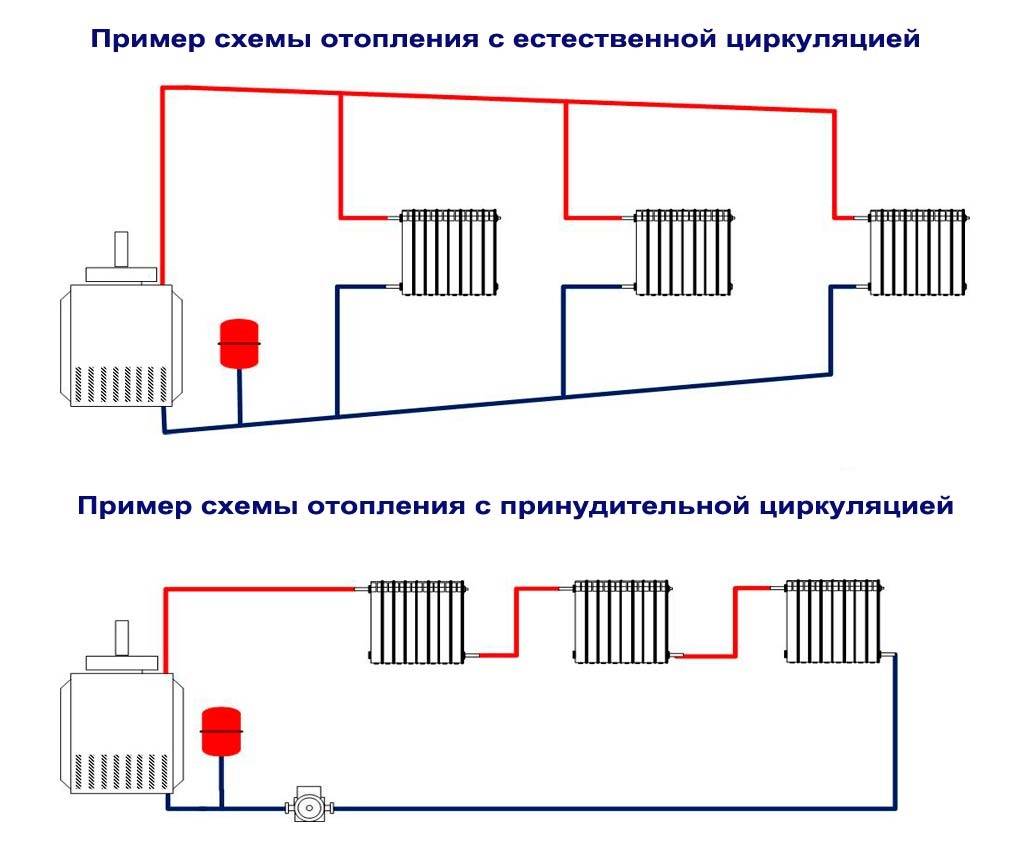
Heating systems, where forced circulation of the coolant is provided, can be organized according to a variety of schemes. Below are the most common. You should start with single-pipe water heating schemes:
Figure 2: Single-pipe horizontal system with end sections.
Flowing (Fig. 1). For small houses, a single-pipe horizontal flow-through water heating system is perfect. It provides for the following operation scheme: the coolant enters the main riser, and then is distributed between all horizontal risers and begins to flow sequentially through the batteries, cooling, it immediately returns along the return line.
With closing sections (Fig. 2). There is another horizontal one-pipe system, which provides for the creation of sections that are subsequently closed. In the course of its organization, a valve designed to remove air is necessarily mounted on each radiator. To control the temperature of the heating elements, shut-off valves are provided, which are installed at the beginning of the heating system with forced circulation on each floor of a country house.
Single pipe (Fig. 3). The water heating system, which provides for the organization of forced circulation, can be vertical.In this case, the coolant immediately enters the uppermost floor of the house, then it enters the installed radiators through the risers, then the liquid goes into the heating elements located on the previous floor, and so on, until it drops to the very bottom. Such a water heating system can be organized both according to the flow scheme, and according to the one where there are closing sections.
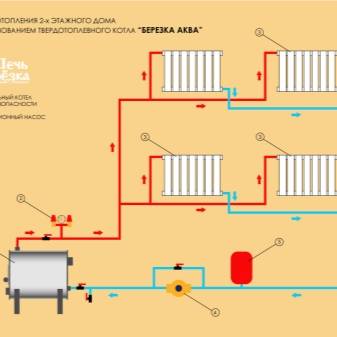


At the same time, it is important to consider that it has one significant drawback: the heating of the batteries in the house on the floors occurs unevenly.
Figure 3: Single pipe vertical heating system.
There are also two-pipe water heating systems, which provide for forced circulation of the coolant (Fig. 4). They can be organized in 3 ways:
- Dead end. Here, each subsequent element of the heating system in the direction of movement of the coolant is located at the farthest distance from the heating element. Such a scheme leads to an increase in the circulation circuit, which makes it difficult to control the operation of heating equipment. However, this system provides for a short pipeline length, which minimizes the costs associated with organizing heating for the home.
- Passing. There is an equality of circulation circuits. This factor facilitates the adjustment of the operation of the heating system, where forced circulation is provided. However, here the length of the pipeline, compared with the dead-end scheme, increases significantly, which leads to additional costs during the installation of heating.
- Collector. It provides for the connection to the heating system of each heating element individually.Due to this, the coolant enters the radiators at the same temperature. However, this also implies a large consumption of pipes during the installation of the system.
Figure 4: two-pipe horizontal system.
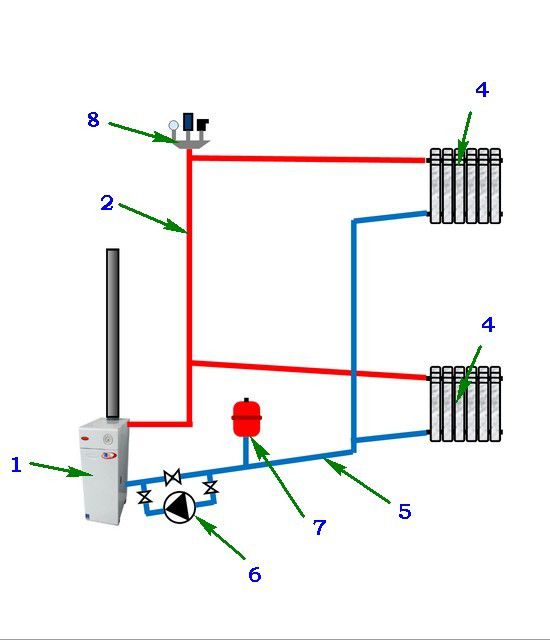
In addition, there is another scheme for the vertical organization of forced heating (Fig. 5). It implies the presence of a lower wiring. Here, the coolant enters the boiler with the help of a pump, then it enters the pipeline and is distributed throughout the system, and then passes into the heating elements, having given up its heat, the liquid returns through the return pipeline through the pump and expansion tank to the heating element. A vertical heating system can also be organized with an upper wiring (Fig. 6). This implies the location of the main pipelines above the heating elements (in the attic or under the ceiling of the upper floor). The water that circulates with the help of a pump enters the boiler, then it is distributed through the risers to the heating elements, the liquid, having given up its heat, goes into the return line, which is located in the basement or under the floor of the lower floor.
Types of heating systems for a private house
When it comes to home heating, there are many factors to consider. Systems differ according to the type of carrier, heat source. The choice of one or another design depends on the material of manufacture of the building, the frequency of residence, remoteness from centralized highways, ease of fuel delivery and ease of operation of the equipment.
For example, if a gas main is laid nearby, then a gas boiler will be the best way, and if there are problems with the passage of vehicles, then you will have to choose a system in which fuel can be stored in the season and in the right amount. Consider all possible options for obtaining heat in more detail.
Water heating and schemes
Representing a structure in which a heated liquid acts as a coolant, water heating in a private house is the most convenient option. When arranging a properly selected heat source, such as a stove, the system becomes independent of any interruptions in the supply of electricity, gas.
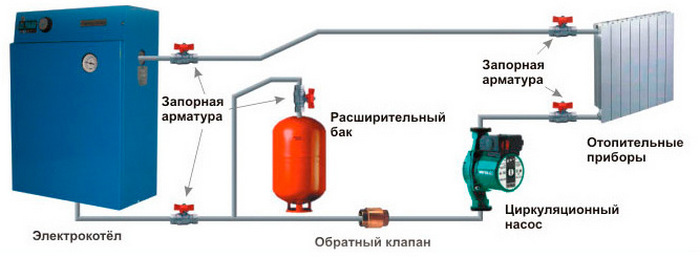
Structurally, water heating is a boiler, from which pipelines connected to radiators are laid. The coolant is transported and warms the air in the room. This type also includes a water heated floor, in which you can do without wall radiators. With horizontal placement of pipes, the design should be supplemented with a circulation pump to facilitate the movement of water.
The heating scheme can be one-, two-pipe - with this placement, water is supplied in series, which reduces efficiency. Collector scheme - an option with the placement of one heat source and the connection of each radiator, which ensures efficient heating of rooms. Scheme examples.
The advantages of water systems include the ability to operate the device on any type of fuel and the formation of a gravity system, ease of installation and the availability of doing all the work yourself. In addition, the coolant is incredibly cheap, available even for private houses located far from engineering networks.
Air heating and circuits
In these designs, the coolant is heated air. There are suspended and floor options, on which the location of the air ducts depends.
The system is classified according to the installation area of the equipment, the type of air circulation, heat exchange and scale. For air heating, air ducts with a large pipe diameter are needed, which is not always beneficial for a private house. To ensure high-quality heat transfer, it will be necessary to install a forced ventilation device, which means that costs will increase.
Arrangement scheme.

Electric heating
It is considered the optimal, but expensive type of heat generation in a private house, it completely depends on the availability of a network and the uninterrupted supply of electric current. The pluses include many location options, for example, you can equip underfloor heating or lay out a contour along the ceiling, taking into account the finishing sheathing of the plane. It is also possible to install mobile electric heaters that are easily deployed in the system and have the ability to heat only a local area.
The advantages are the regulation of the heat supply, the efficiency of heating the room. High-quality electric boilers can be connected and disconnected, the intensity of heat supply can be changed depending on the requirements of the owner.
Stove heating
A time-tested heating option in which the heat source is a stove. It can be supplemented with a hob, a connected water heating circuit. For energy production, solid fuels are used - firewood, coal, pellets from recycled waste. The main requirement for the arrangement of the furnace is the presence of a chimney.




The benefits include:
- autonomy;
- the possibility of choosing an energy carrier;
- low cost of maintenance and service.
The disadvantages are the need for human participation, it will be necessary to lay down new portions of fuel, clean the ashes. Also a minus is the obligatory appeal to a specialist - only a professional will correctly lay out a Russian brick oven. The massiveness of the structure should be taken into account; a strong floor is needed for the furnace. But if the equipment is a kind of "potbelly stove" - a home master will cope with this if he has experience in constructing a structure.

To reduce human participation in the heating process, experts advise choosing long-burning boilers. They allow you to lay large amounts of fuel, provide a long burning time, which means that the heat in the house will last much longer.
How to arrange water heating of a private house with your own hands, installation diagrams
In order to make water heating of a private house with your own hands, you need to study the installation diagrams in detail. However, first of all, you need to stock up on all the necessary materials and equipment, the need for which is calculated in advance depending on the type of battery connection.
Modern gas boilers are a good solution for a reliable heating system
Useful advice! Buy boilers, batteries and other equipment only from trusted manufacturers. Cheap analogues do not always meet the requirements and can be dangerous.
Features of the device of a single-pipe system
The easiest way to connect radiators to the boiler is to install a single-pipe heating system. The scheme of this design assumes the presence of only one pipe laid around the entire perimeter of the house. It comes out of the supply pipe of the boiler, and enters the return pipe.Branches exit from this pipe near each radiator, to which it is connected through shut-off valves or directly.
The principle of a one-pipe heating system with natural water recirculation
Such a device is not only the simplest, but also the cheapest, both in terms of materials and installation. The use of one pipe eliminates the need to make many pipe bends, and much less various small things are consumed. It's no secret that these fittings cost a significant part of the cost of all home heating. The use of a single-pipe heating system, the scheme of which is simple, is justified in small houses with a simple layout of rooms, since the water passes through the entire ring and has time to cool significantly. In this regard, the last radiators along its path heat up much less than the first ones. Therefore, if the building is large, then by the end of its route, the coolant will lose all its energy and will not be able to heat the last rooms. This is especially true of the natural type of water circulation.
Boiler room of a private house with modern heating equipment
When constructing a single-pipe heating system, the design scheme should assume a slight slope, of the order of 3 - 5 degrees. This will ensure more efficient operation of the entire structure. In addition, all radiators must be equipped with air valves, which are needed to maintain a stable pressure in the system by bleeding air. Such taps have small holes and are unscrewed with an ordinary screwdriver.
Scheme for connecting radiators to a two-pipe heating system
Useful advice! When it becomes necessary to clean or replace the battery, you can not drain the water and stop the entire system, for this you need to use Mayevsky taps. They connect the radiator to the pipe outlets. If the battery needs to be removed, the taps can simply be closed.




How a two-pipe system works
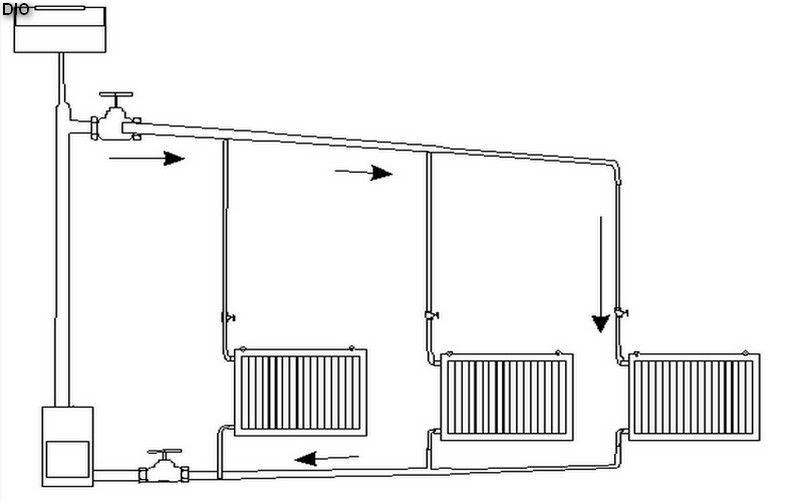
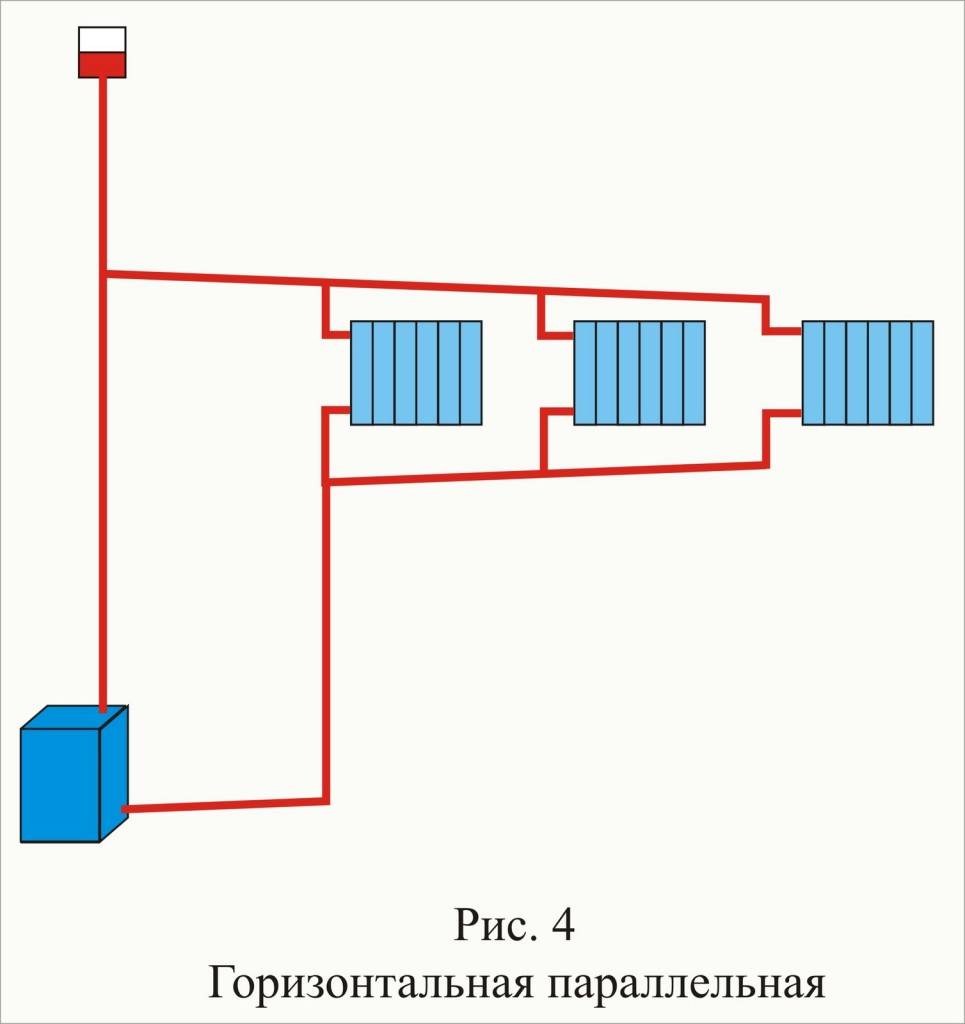
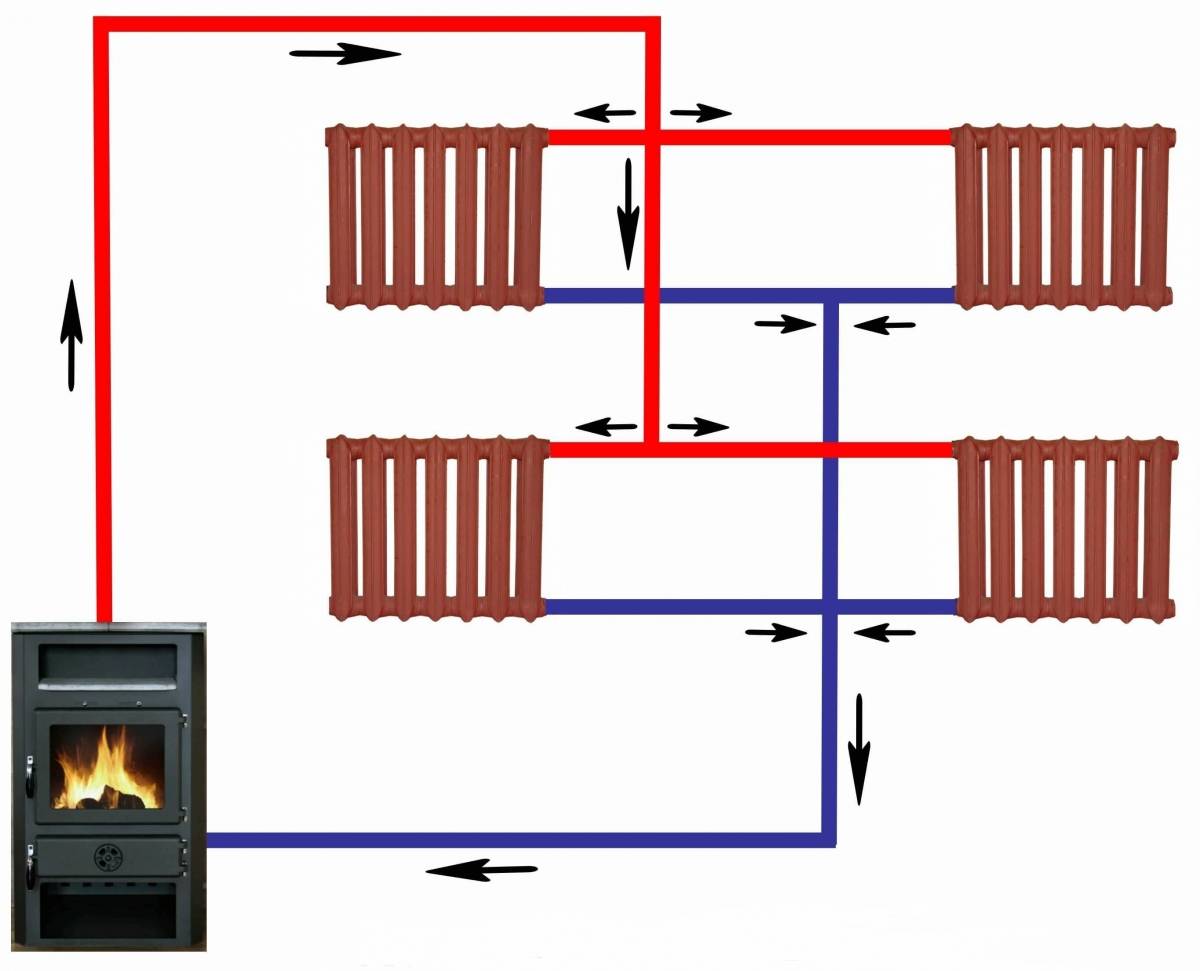
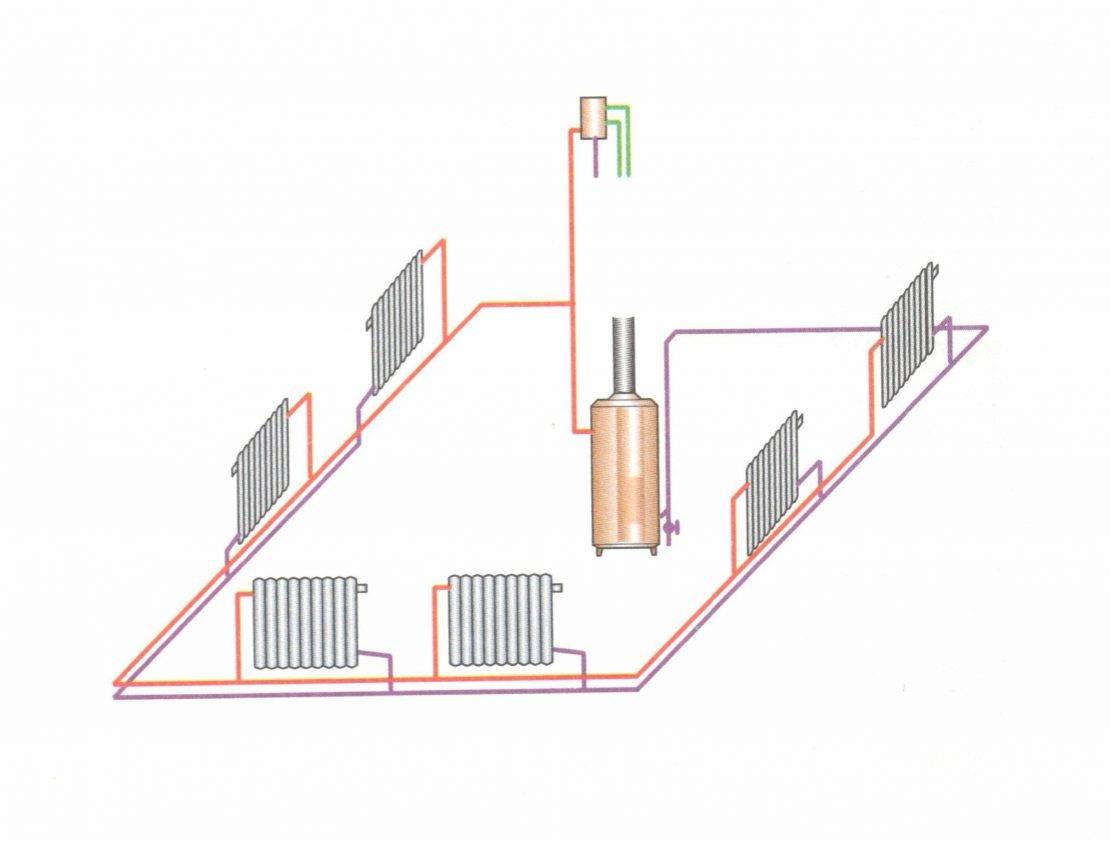
Unlike the previous one, a two-pipe heating system, the scheme of which assumes the presence of two pipes: supply and return, is more complex in design. It is designed in such a way that the supply pipe enters directly into each battery. and the reverse comes out of it. This is also called a parallel device, since all radiators are connected to the boiler with pipes not in order, but in parallel.
A two-pipe heating system, the scheme of which is more complex, requires more pipes and fittings. Therefore, it costs a little more. At the same time, it is more efficient, since all batteries heat up equally, regardless of their location, near the boiler or in the farthest room. Such wiring is most often used in two-story houses and cottages.
Connection diagrams for a two-pipe heating system in a two-story cottage
An important advantage of such a device is that each battery functions almost independently of the others, as it has its own circuit. Therefore, it can be easily replaced or repaired without affecting the rest of the structure. Due to the fact that the two-pipe heating system has a parallel radiator connection scheme, it is very easy to regulate the temperature and pressure in them, which will provide additional savings in fuel resources.
Useful advice! When using a heating system with two pipes, it is advisable to use a circulation pump.It will greatly increase the efficiency and heating rate of the batteries.
Scheme of an open heating system with a circulation pump
The most popular types of water heating
Most often, when self-installing a heating system, homeowners are guided by the principles of economy. And here there can be no universal solutions. In each case, you can find the most cost-effective and practically feasible option. But there is one little "secret" that can be useful to everyone. Consider using different heat sources in your home. Combining them depending on the time of year or the required mode of operation will help to save significant funds. So, for example, electric-water heating, even installed with your own hands, is not the cheapest option. However, if you need to heat rooms very quickly or want to automate the process while you are away, then there is no better way. Remember that there are pros and cons to every heating system. Proper and rational use of the specific properties of each of them will help you achieve maximum effect at minimal cost.
A video about installing water heating with your own hands will help you understand the intricacies of this process and give answers to many questions.
Residential heating options
The well-known and most common way to heat your own house or apartment is to make a water system. Principle of operation: the coolant is heated by a boiler or other source, then it is transferred through pipes to heating devices - radiators, underfloor heating (abbreviated as TP) or baseboard heaters.
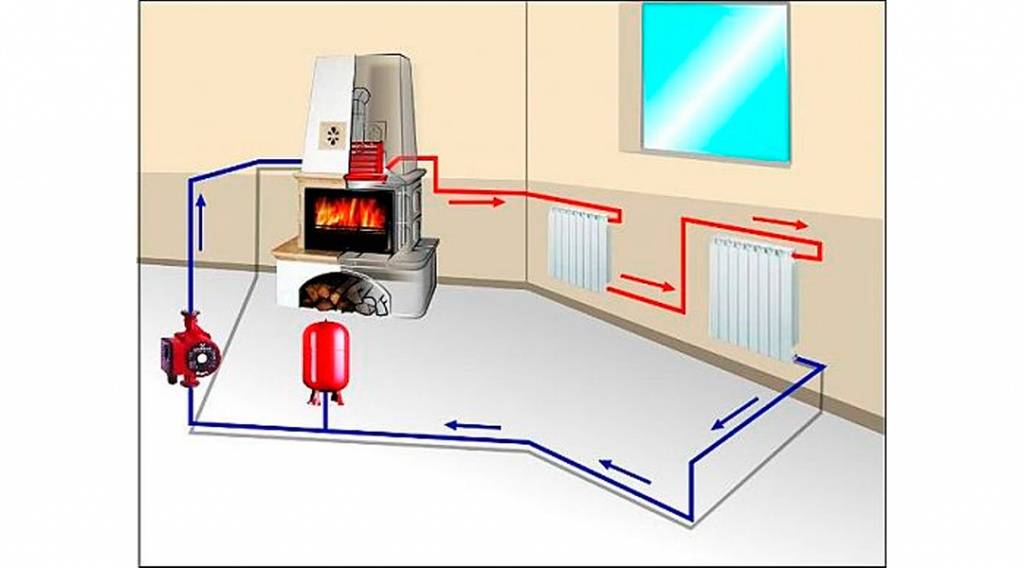
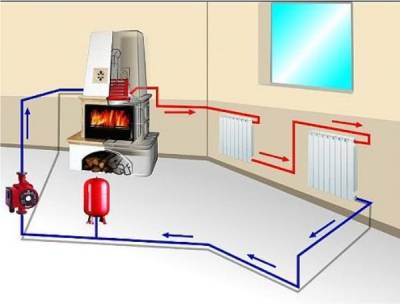
A heat exchanger placed inside the stove heats the water sent by the pump to the batteries
Now we list alternative heating options:
- Furnace. A metal potbelly stove is being installed or a full-fledged brick oven is being built. If desired, a water circuit is built into the furnace or smoke channels of the stove (shown above in the photo).
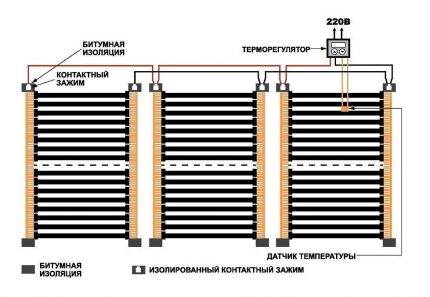
- Purely electric - convectors, infrared and oil heaters, spiral fan heaters. A more modern way is the installation of heating floors using resistive cables or a polymer film. The latter is called infrared, carbon.
- Air. The heat source warms up the filtered outdoor air, which is forced into the rooms by a powerful fan. A simpler and cheaper option is the installation of gas convectors in residential premises.
- Combined - wood-burning stove + electric heaters of any type.
Bathroom heating scheme with electric underfloor heating
To move on, you need to decide which type of heating is better - more profitable, more efficient, more convenient. We definitely recommend choosing a water system. The reasons:
- to heat water, you can use any energy carrier or combine several types of fuel by installing 2-3 boilers;
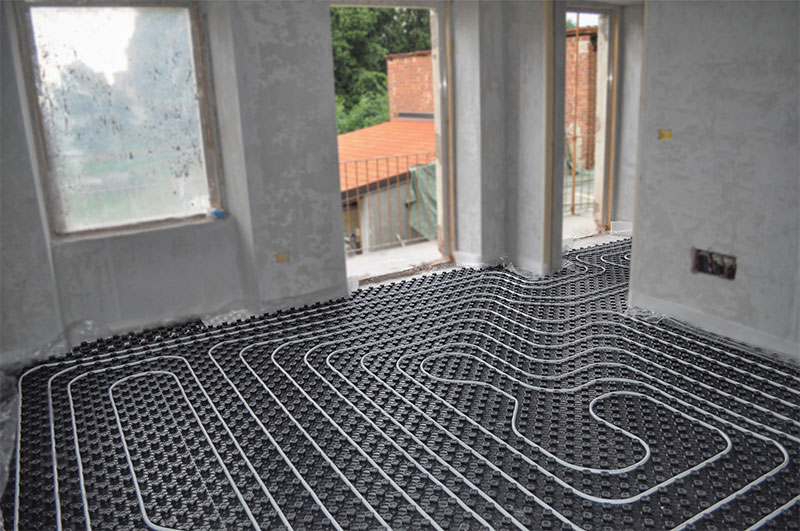
- with high requirements for interior design, piping is mounted in a hidden way, baseboard heaters or TP circuits are used instead of batteries;
- the ability to organize hot water supply (DHW) - install a double-circuit boiler or an indirect heating boiler (depending on the amount of water consumed);
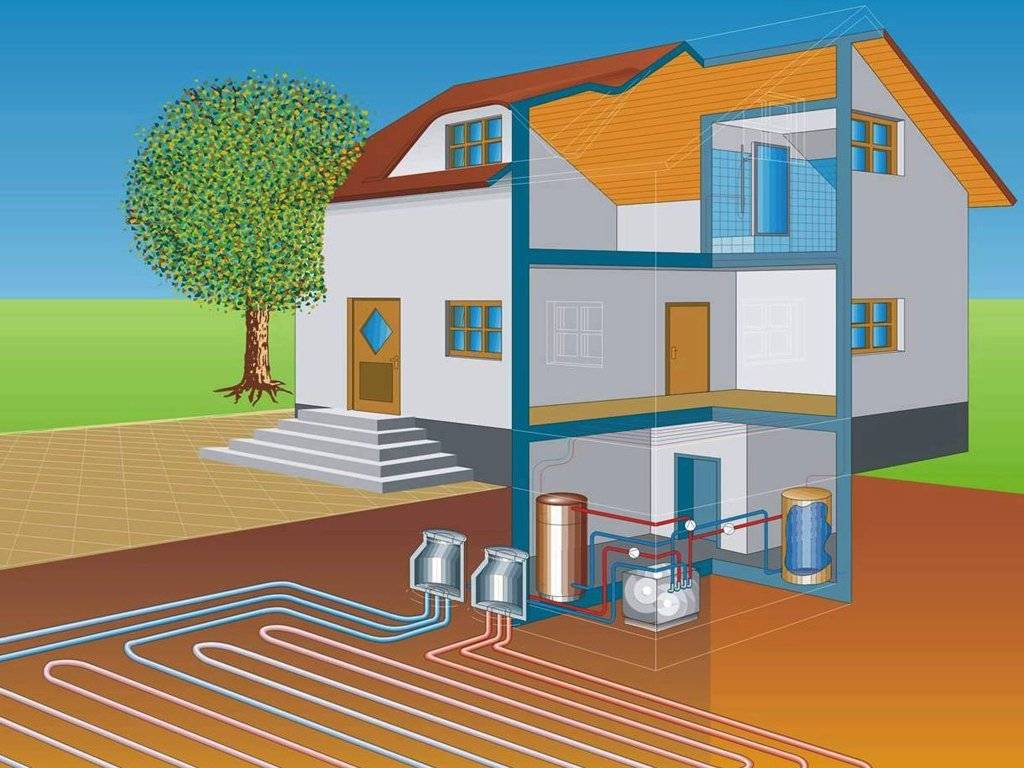
- alternative energy sources can be connected to the system - solar collectors, heat pump;
- if necessary, heating in a private house is made completely autonomous - pipes are laid according to a gravity (gravitational) scheme, plus a boiler unit is installed that does not require connection to the mains;
- the system lends itself well to adjustment, automation and remote control via cellular communication or the Internet.
The only drawback of water networks is the cost of installation, equipment and valves. Purchase and connection of electric heaters will cost less, but the restriction in terms of fuel choice will increase operating costs.

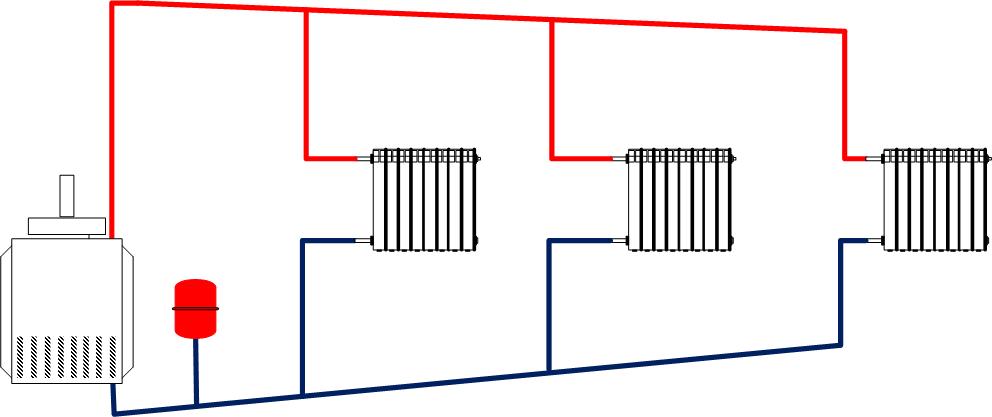
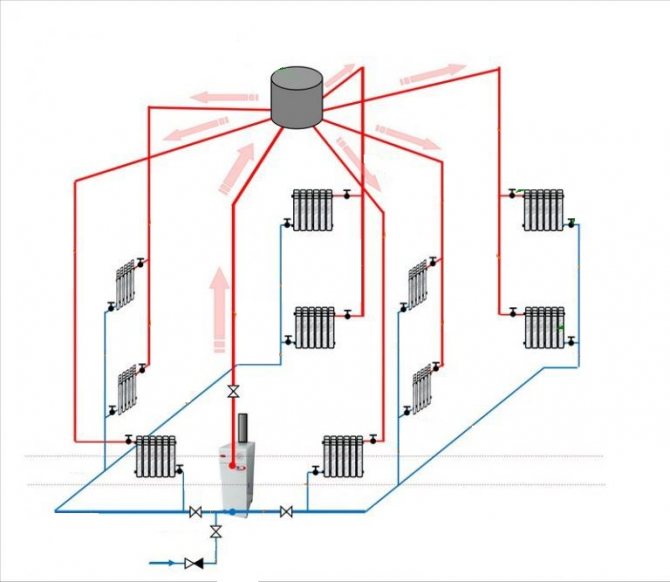


The device in a country cottage of full-fledged air heating will cost even more than building a stove. It is necessary to purchase a ventilation unit with a heat exchanger, which plays the role of a blower, purifier and air heater. Then organize the supply and exhaust - to conduct air ducts to all rooms. The expert will tell about the pitfalls of air heating in the video:
Boiler designs
When choosing a heating device, one should start first of all from the type of energy carrier
When considering this issue, you should pay attention to its cost and the possibility of its delivery.
The second most important factor influencing the choice of a boiler is the power of the equipment. It is generally accepted that for heating 10 sq.m. room area required 1 kW
room area required 1 kW
the area of the room requires 1 kW.
When designing a country heating system, it is necessary to take into account the installation location of the boiler equipment. It is recommended to take it outside the house and place it in the annex.In any case, the specific installation conditions determine how the boiler is to be placed.
Consider options for heating equipment for a summer residence.
Oil boilers
Such units run on diesel fuel or waste oil. The latter option is more preferable, since the cost of fuel is significantly reduced. Liquid-fuel equipment is attracted not so much by its efficiency, but by the possibility of full automation of its operation.
The use of diesel fuel does not provide an opportunity to obtain cost savings. Fuel at low temperatures becomes more viscous, which prevents a stable combustion process. For such a boiler, the construction of a separate room is required, since its operation is accompanied by strong noise.
Oil boiler
Solid fuel boilers
Despite the fact that it is necessary to constantly replenish firewood, the cost of solid fuel is not comparable with liquid fuel, and even more so with electricity and gas. You can get savings by collecting deadwood in the nearest forest belt.
The disadvantage of this type of fuel is a quick burn-out, one bookmark is enough to operate the boiler for no more than six hours. The installation of pyrolysis boilers increases the duration of the equipment on one tab, but it is not advisable to use them for giving a small area.
The combustion temperature in solid fuel boilers cannot be regulated. There is only one way to influence the combustion process: to change the air supply with a damper. In addition, in order to store a supply of fuel, it is required to organize a room in a certain way.
What you need to know to install water heating in the house?
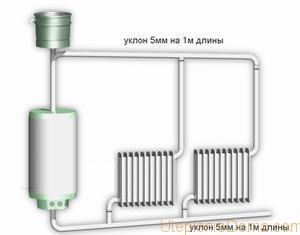
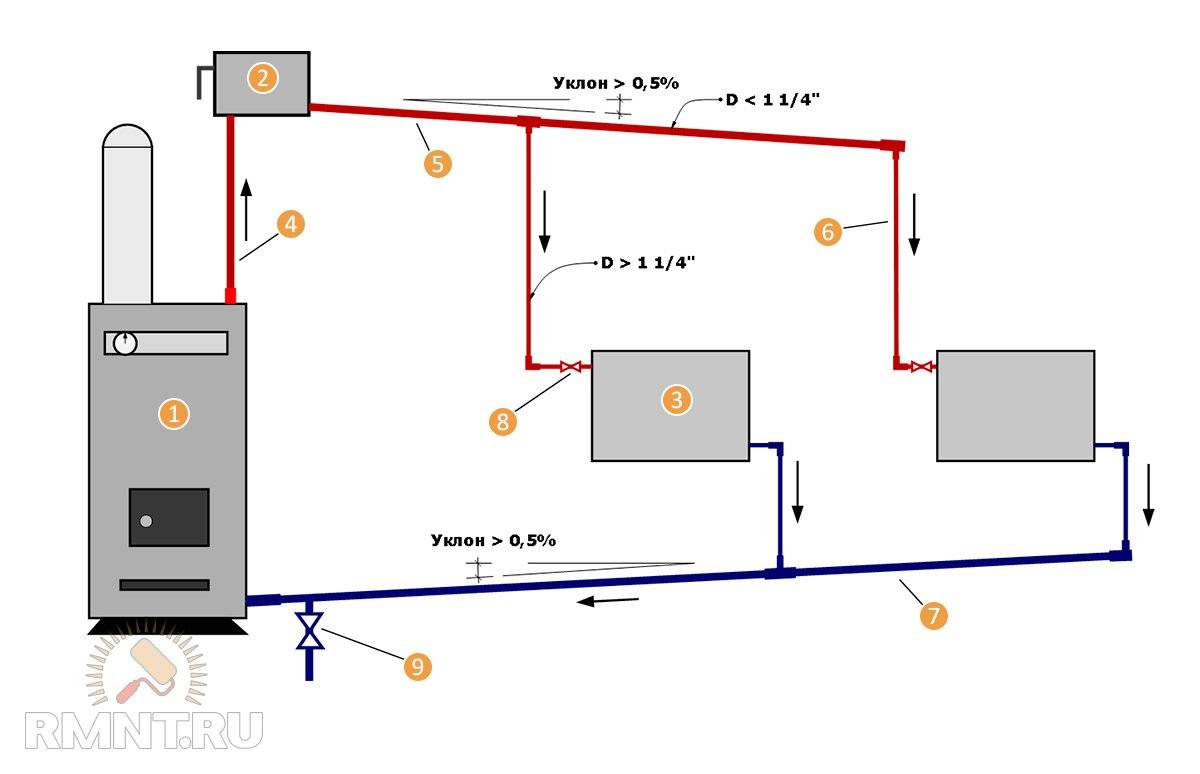
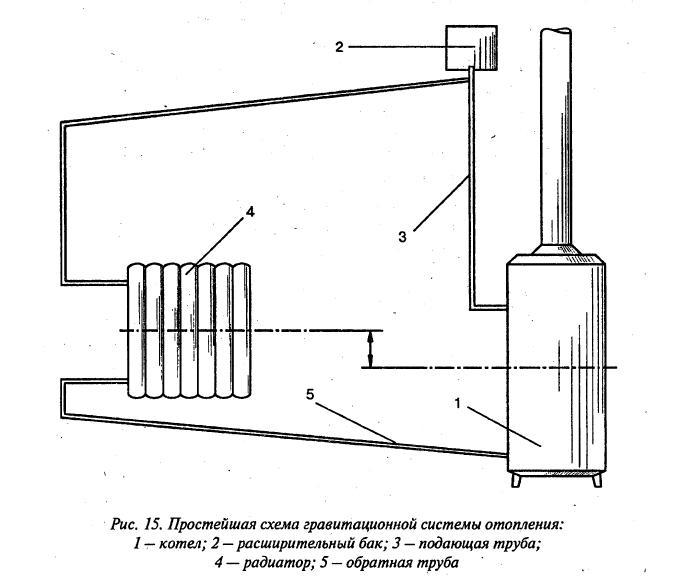
Pipes of the water heating system are mounted with a slight slope in the direction of hot water flow
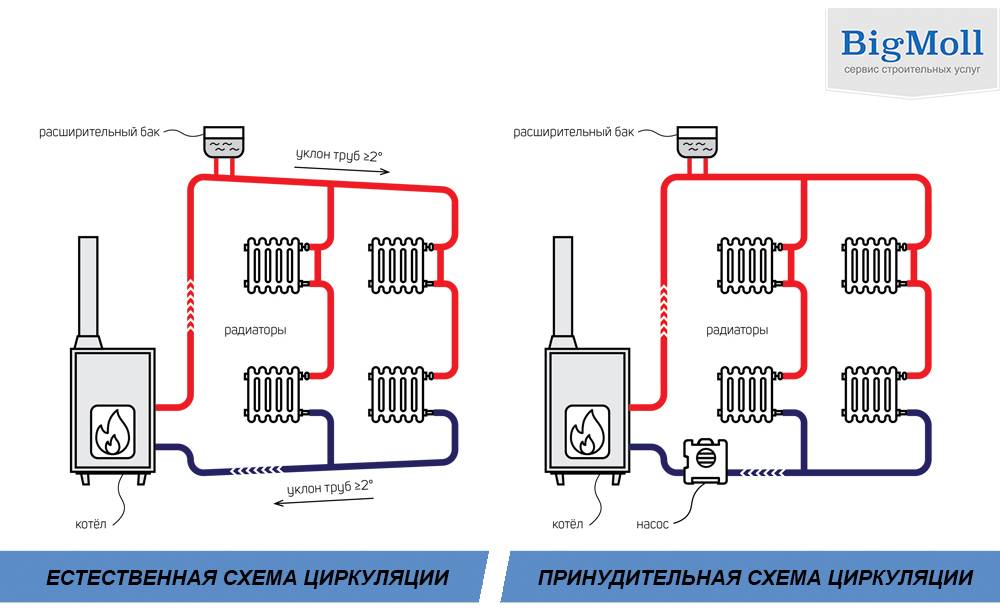
First of all, it should be remembered that the system is based on a simple physical principle - hot water rises, and cold water, as it is heavier, falls down. That is, the circulation is the more intense, the greater the temperature difference between the water leaving the boiler into the system and the water leaving the return. A temperature difference of 25 degrees is considered a good indicator. In order to enhance this contrast, the following techniques are used:

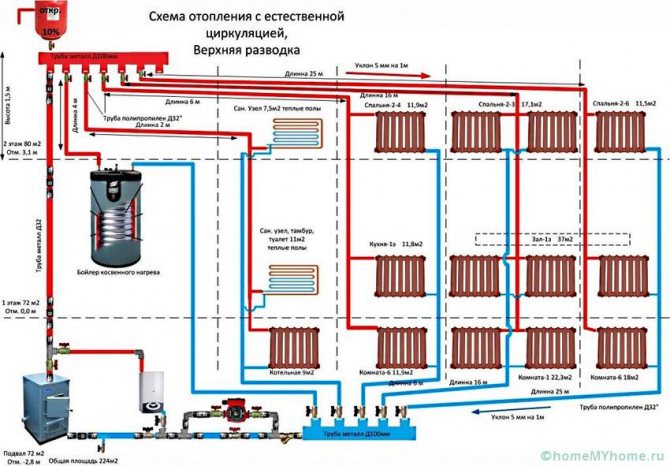


- the boiler is installed at the lowest point of the system, ideally it should be placed 2-3 m below the heating appliances (usually a basement or semi-basement);
- the riser through which hot water flows is carefully insulated;
- the length of the pipes, at which water heating with natural circulation is effective - 20-30m;
- when using natural circulation in the water heating circuit of a one-story house, the pipe system is laid at a slight slope away from the boiler;
- the diameter of the pipes is selected depending on the total length of the pipeline: the longer the system, the larger the diameter;
- the water heating scheme of a two-story house needs to install a circulation pump, otherwise it will be problematic to heat the premises of the second floor.
After reading special literature or advice from experienced craftsmen, you can start designing.
Single pipe systems
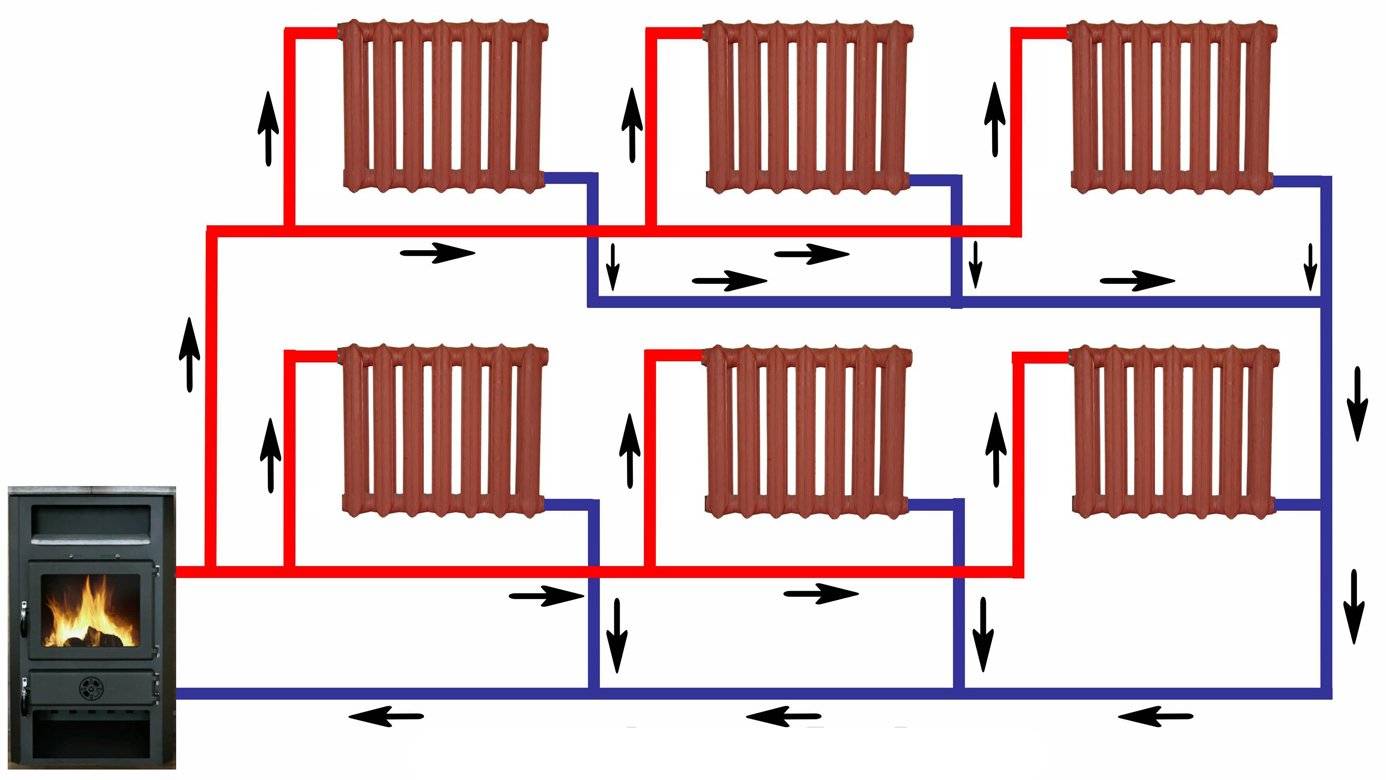
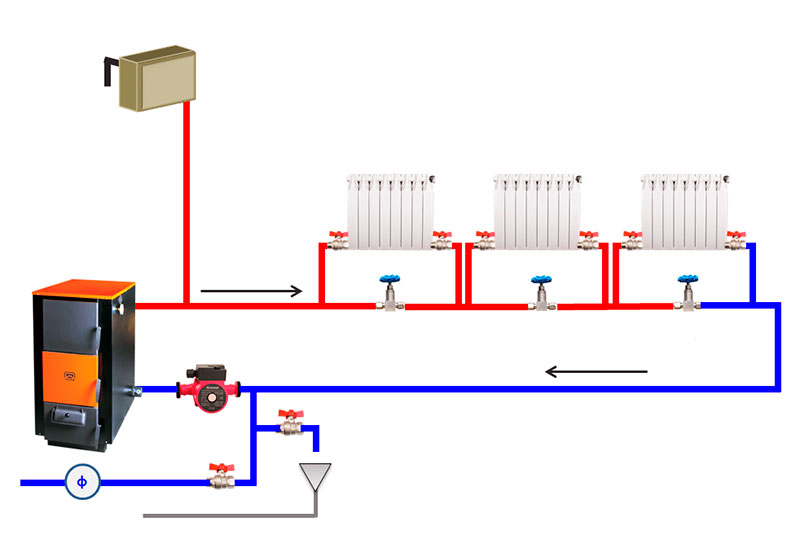
In single-pipe heating systems, the coolant passes through all radiators in series.
Creating the heating of a private house with your own hands, the easiest way is to equip a single-pipe heating system. It has many advantages, such as the economic use of materials.Here we can save a lot on pipes and achieve heat delivery to each room. A single-pipe heating system provides for the sequential delivery of coolant to each battery. That is, the coolant leaves the boiler, enters one battery, then another, then a third, and so on.
What happens in the last battery? Having reached the end of the heating system, the coolant turns around and goes back to the boiler through a solid pipe. What are the main advantages of such a scheme?
- Ease of installation - you need to sequentially conduct the coolant through the batteries and return it back.
- The minimum consumption of materials is the simplest and cheapest scheme.
- The low location of the heating pipes - they can be mounted on the floor level or even lowered under the floors (this can increase the hydraulic resistance and require the use of a circulation pump).
There are also some disadvantages that you have to put up with:
- limited length of the horizontal section - no more than 30 meters;
- the farther from the boiler, the colder the radiators.
However, there are some technical tricks that allow leveling these shortcomings. For example, the length of horizontal sections can be handled by installing a circulation pump. It will also help make the last radiators warmer. Jumpers-bypasses on each of the radiators will also help to compensate for the temperature drop. Let's now discuss the individual varieties of one-pipe systems.
Wiring options for the water heating scheme of a private house
There are such types of water heating of a private house:
- single pipe:
- two-pipe;
- collector.
Each of these wiring options has its own characteristics.
Single pipe heating also called "Leningrad". In this case, one pipe unites all the heaters in the house, located in the direction of the coolant. Such a wiring diagram for heating a private house is simple, has low financial costs and is quick to install. However, such a system has a significant drawback: the radiators heat up unevenly, and it is impossible to regulate the temperature of each battery.
Two-pipe scheme connection of radiators provides for the laying of two pipes parallel to the movement of water (for more details: “Two-pipe heating system of a private house, do it yourself”). The advantages of this option are uniform and fast heating of the house, the ability to adjust the temperature.
Collector the location of the pipes provides for the presence of a supply and return pipeline connected using special distribution manifolds. This wiring allows you to fully control all the batteries in the house from the distribution cabinet.
For heating to be effective, it is necessary to make water heating calculation private house.