- Device
- Calculation of the angle of inclination
- The procedure for the construction of sewerage
- Stage # 1 - installation of the yard network
- Stage # 2 - construction of the entrance node to the house
- Stage # 3 - installation of risers and bends
- Stage # 4 - connecting plumbing
- General installation rules
- Pipe selection
- prefabricated well
- Well types
- How to calculate the volume for a septic tank and a collector?
- Do-it-yourself sewerage in the country: schemes and modifications
- The principle of operation of urban sewerage
- Purpose and types of storm system
- How to remove the pipe directly from the house
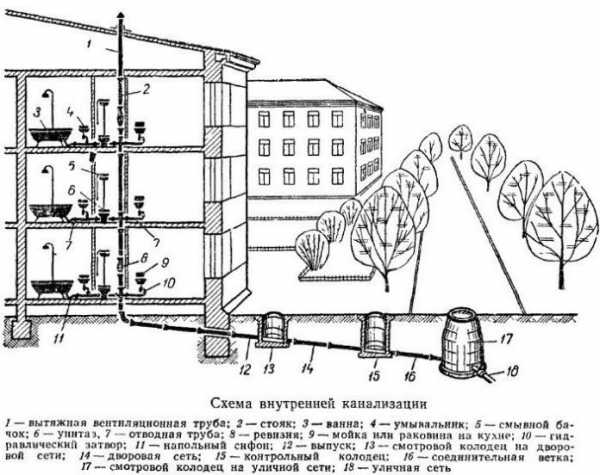
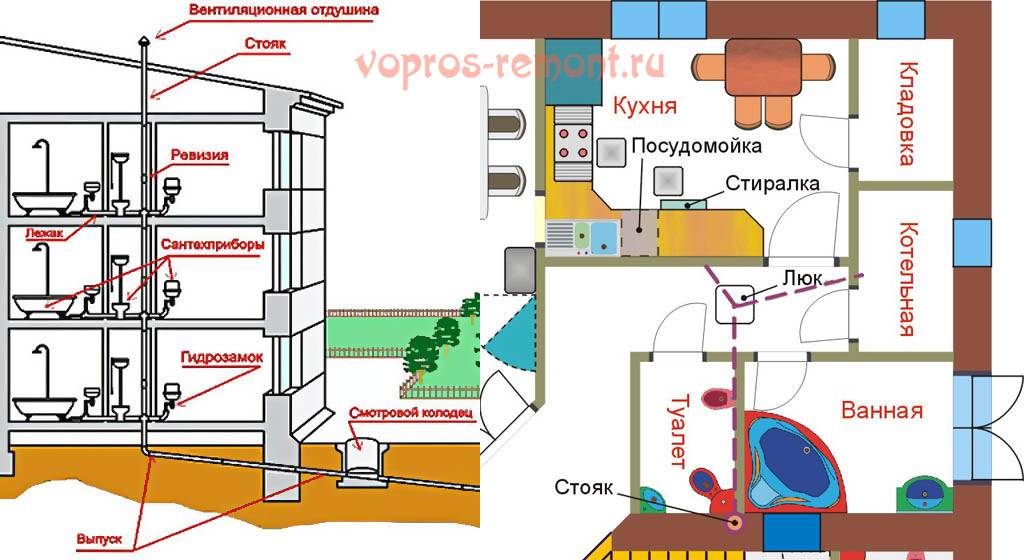
- Circuit Components
- How to choose a place for a septic tank
- Exhaust pipe outlet
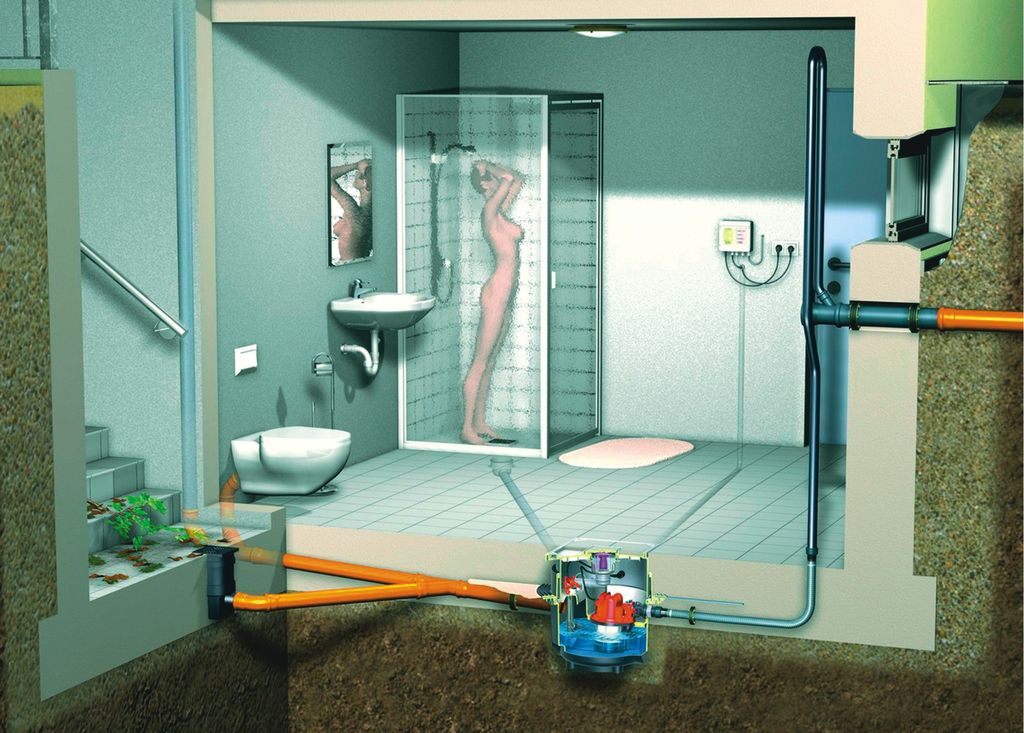
Device
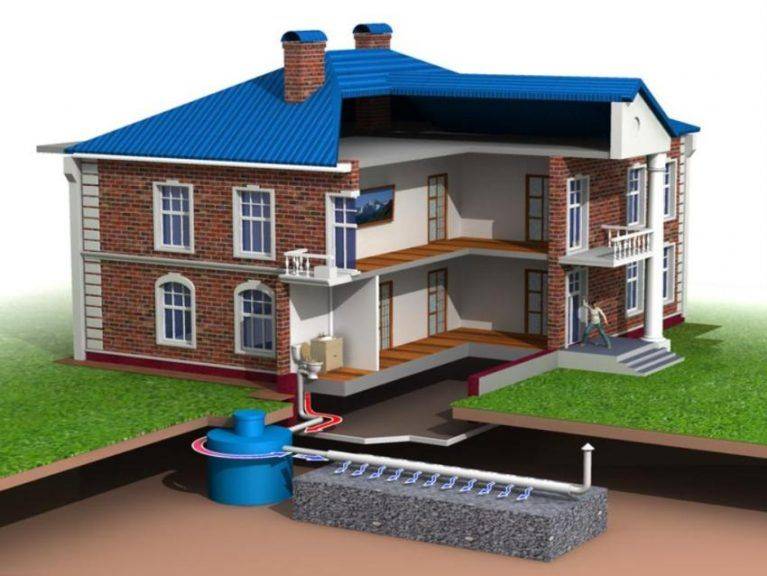
The entire sewage disposal system of a private house is divided into
two main parts:
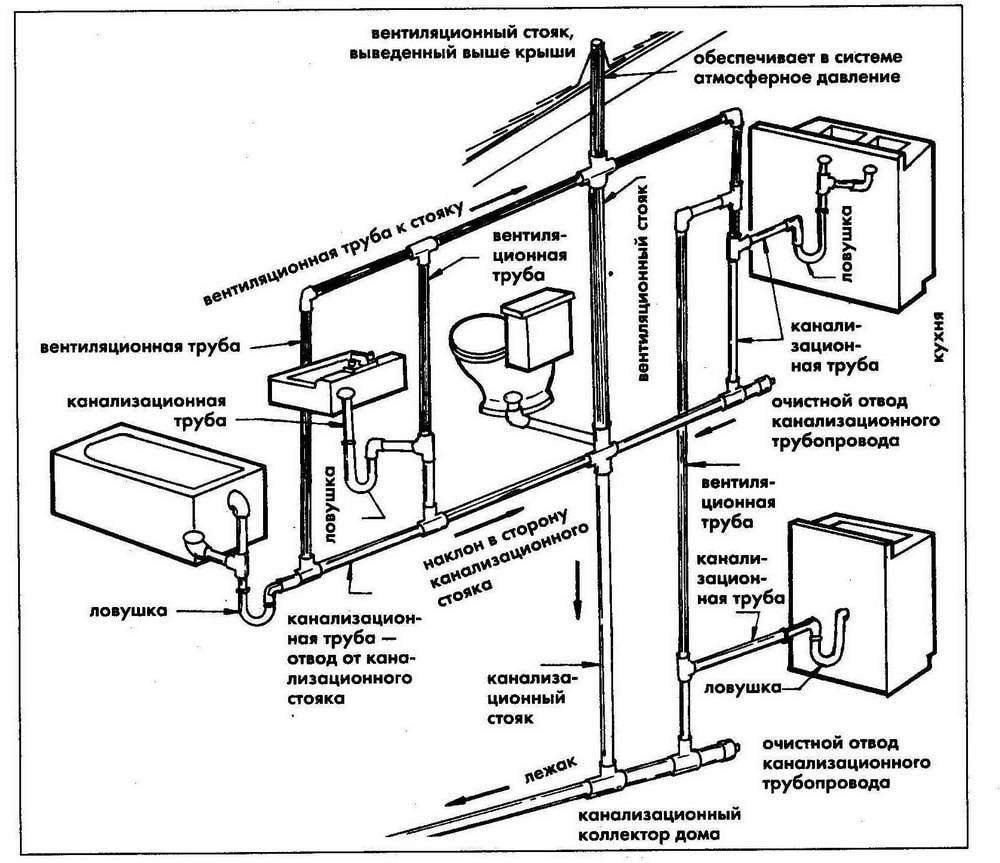
- The internal network includes plumbing and pipes that drain fluid from all appliances in the house.
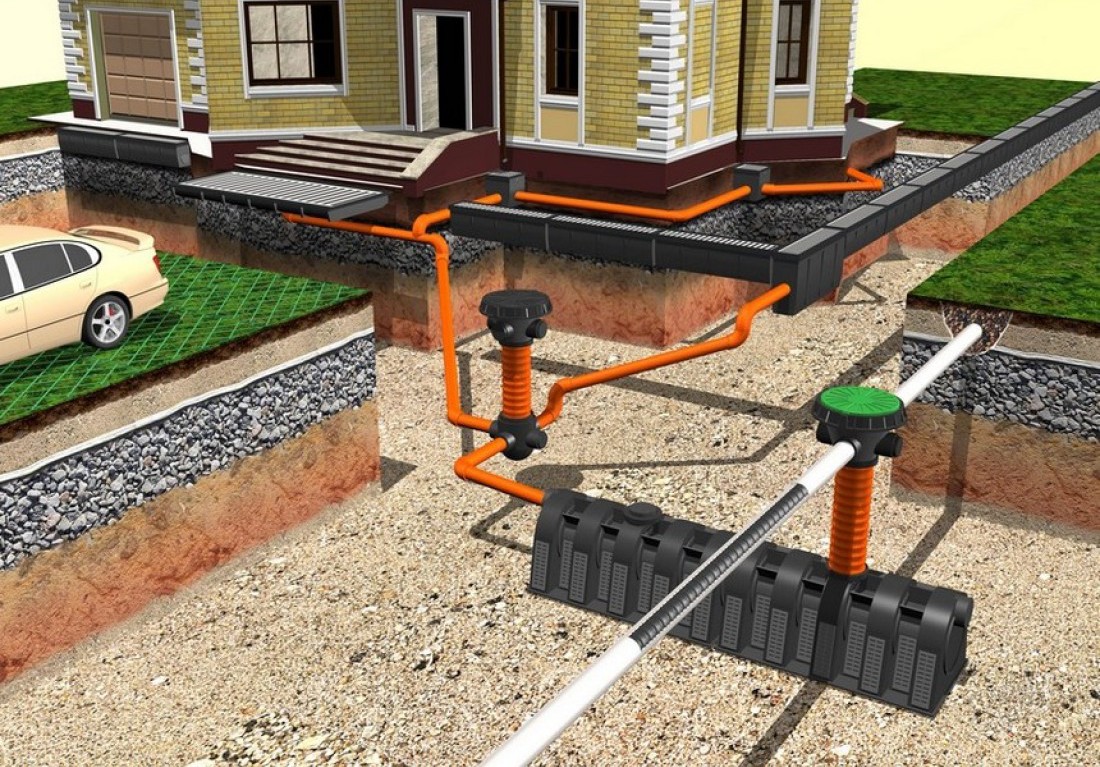
- The components of the external system are a pipeline, a tank for the accumulation or treatment of waste liquid, and treatment facilities.
Depending on the design features, there are two
types of containers:
- Cesspool - a structure made of concrete or bricks, without a bottom. Requires regular cleaning from debris.
- Caisson - a container in which sewage is accumulated before pumping. Installation of a caisson does not require large expenses. However, constant pumping entails additional costs.
- A single-chamber drainage septic tank has walls made of polypropylene, reinforced concrete rings, brick or concrete. Wastewater treatment is carried out when passing into the ground through a layer of sand and gravel.
- Multi-chamber septic tank - several containers in which the liquid passes through several stages of purification. The construction of a septic tank will cost more, but it does not need to be constantly emptied.
Pipe sections of the sewer can be made of different materials. Most often, the individual sewerage of a private house is assembled from PVC or HDPE pipes with a diameter of 110 mm. Older systems used cast iron or asbestos pipes.
Calculation of the angle of inclination
A feature of the internal sewage system is that both insufficient and excessive slope of the pipes leads to clogging. With a slight inclination, solid particles settle to the bottom without being washed away by a weak stream of water.
With a large percentage of slope, the clean liquid quickly leaves, and food particles remain and harden on the walls, which eventually narrow the lumen of the pipe. The maximum allowable slope should not exceed 150 mm per meter of pipe.
Compliance with the norms of horizontal installation of pipes leads to the effect of "self-cleaning", in which solid particles are washed away by the flow of water into the riser, and they do not settle on the inner wall of the sewer.
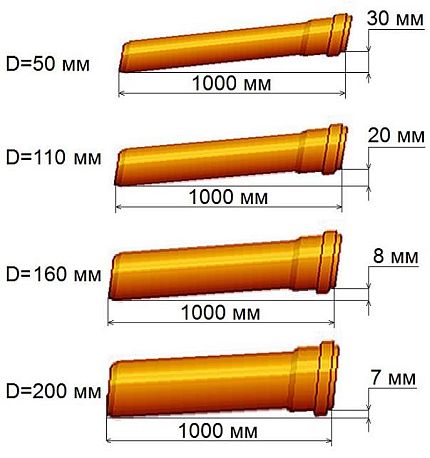
The dimensions of the slopes indicated in the diagram can be increased by 25% without the risk of negative consequences, and it is not recommended to make the slope smaller than these values
The indicated slope values \u200b\u200bare calculated for one meter of pipe, so if a three-meter pipe with a diameter of 50 mm goes from the sink in the house, then the difference in its levels at the sewer riser and at the junction with the siphon should be at least 9 cm.
Read more about calculating the slope angle of sewer pipes in this material.
The procedure for the construction of sewerage
Let's take a quick look main stages of construction sewer pipeline in a private house. Even if you do not decide to do the work on your own, you can control the hired specialists.
Stage # 1 - installation of the yard network
The creation of a sewer system begins with the construction of an external (yard) network. If the length of the yard network to the existing manhole is more than 12 meters, an additional manhole is arranged. At the same time, the minimum allowable distance from the wall of the house to the manhole is 3-5 m.
The following article will acquaint you with the methods of constructing the outer part of the pipeline and the rules for laying sewer pipes in the ground, which we highly recommend reading.
In the laying of external sewer lines, now mainly polymer pipes are used, which are attracted by their light weight, excellent performance and affordable price. When laying the route above the level of seasonal freezing, heaters are used to protect the lines from the formation of ice plugs.
Often, owners of private buildings have to deal with the lack of a centralized sewerage network. In this case, an autonomous system for collecting and filtering wastewater (septic tank) is arranged. However, the principle of connecting "external internal network" remains the same.
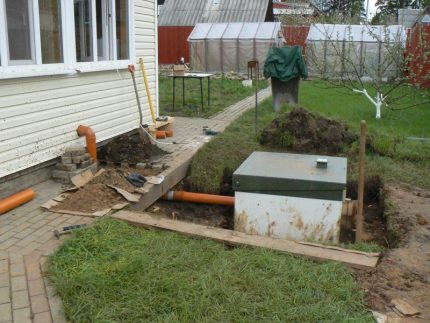 One of the simple and convenient solutions for private households is a sealed septic tank. True, its significant drawback lies in a rather big price, so not every homeowner decides to pay for its purchase.
Stage # 2 - construction of the entrance node to the house
Next, you need to build an input node directly in the structure of a private house (foundation, basement wall). The construction of the node is carried out taking into account possible deformations, for example, due to subsidence of the structure.



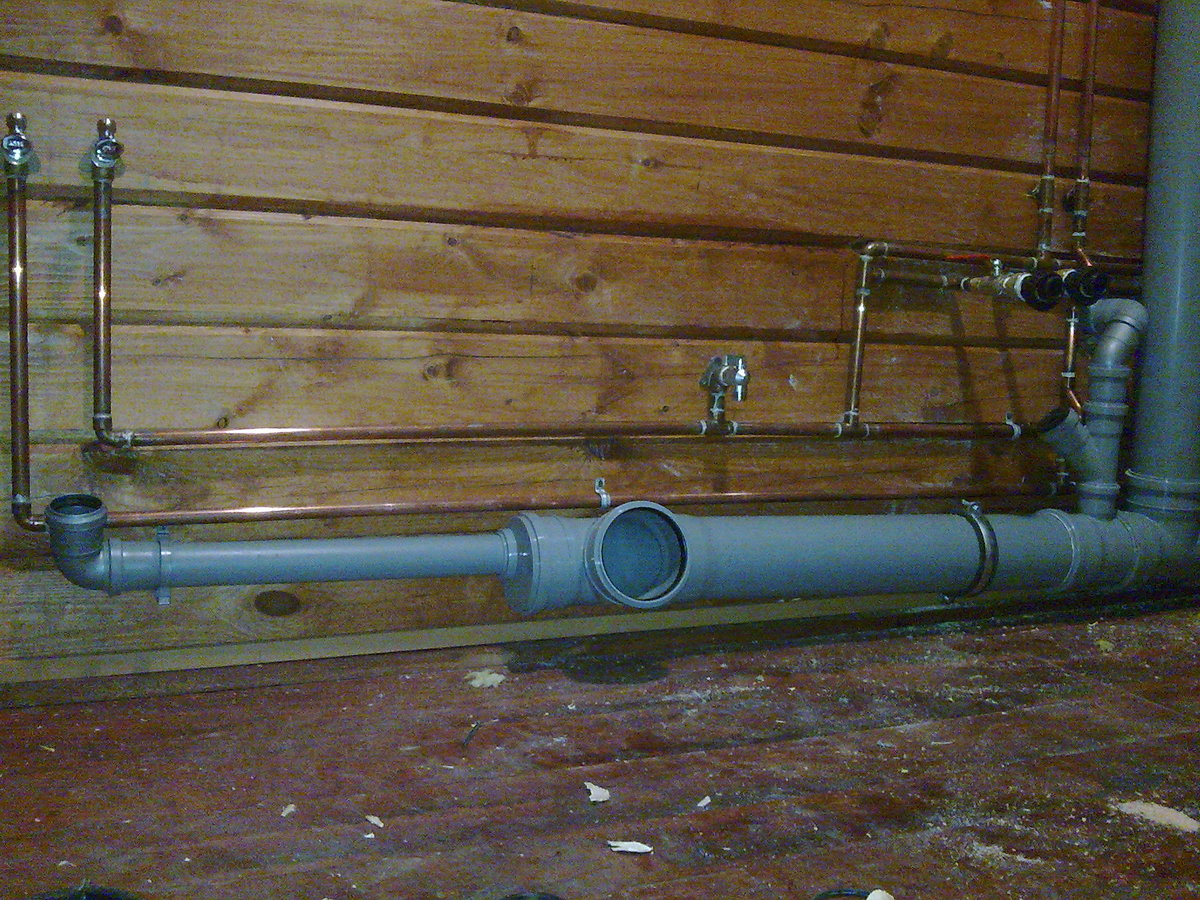

The input node and the external pipeline are reliably isolated.
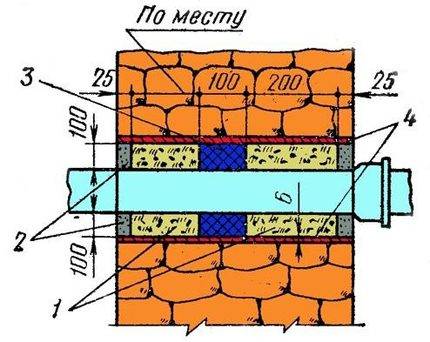
Scheme of the input device (one of the possible): 1 - crumpled clay; 2 - mortar based on cement; 3 - resinous strand; 4 - a sleeve based on a steel pipe
Stage # 3 - installation of risers and bends
At the next stage, the pipes-risers of the internal network are installed. These components of the circuit are recommended to be assembled and pre-installed in the assembled form without fastening or with partial fastening.
Full fastening is carried out after the final assembly of the entire system. Having completed the installation of riser pipes, they build horizontal sewer outlet lines, taking into account the required slopes.
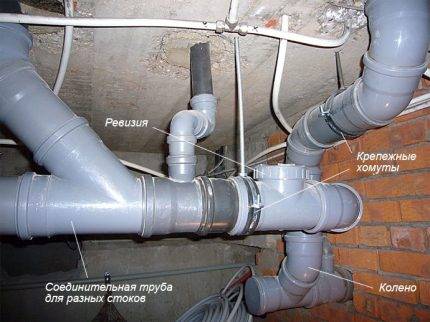 The process of building horizontal internal branch lines provides for the laying of sockets and fittings in the direction against the flow of wastewater
Stage # 4 - connecting plumbing
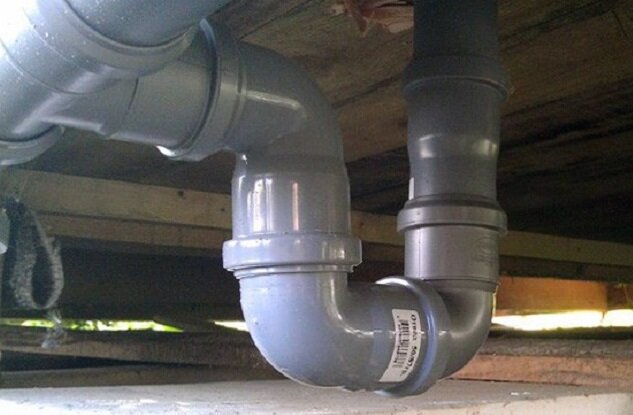
At the final stage, plumbing fixtures are installed and each fixture is connected to the corresponding outlet through a siphon pipe.
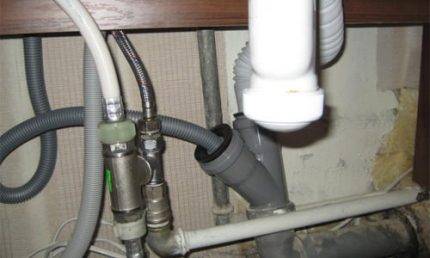 It is advisable to provide in advance taps for connecting the drain of such important assistants as a washing machine, dishwasher
Additionally, it is worth noting: provided that the height of the building is less than 10 meters, the internal sewer system can be built on the basis of non-pressure pipes. At higher heights, pressure pipes are used.
General installation rules
Internal sewerage in a private house is equipped with a number of rules:
- The riser elements with a 90° turn are assembled from two plastic elbows rotated by 45°.If a cast-iron pipeline is installed, two 135 ° bends are used.
- In order to be able to eliminate possible blockages in pipeline sections, an oblique plastic or cast-iron tee is installed at 45 ° with a plug and one elbow or a cast-iron branch. Cast-iron fitting differs from plastic in names and gradations. For example, a 45° plastic elbow will fully match a 135° cast iron elbow.
- Branch pipelines, which are located in the basements, under the ceiling of the premises, are connected to the risers using crosses or oblique tees.
- The height from the lower section of the horizontal socket of the tee or straight cross to the floor should be no more than 20 mm.
- The length of the pipeline from the toilet to the riser should not be more than 1 m. For other plumbing fixtures - no more than 3.5 m.
- 90° crosses or straight tees can be used to make turns on risers or transitions to horizontal runs.
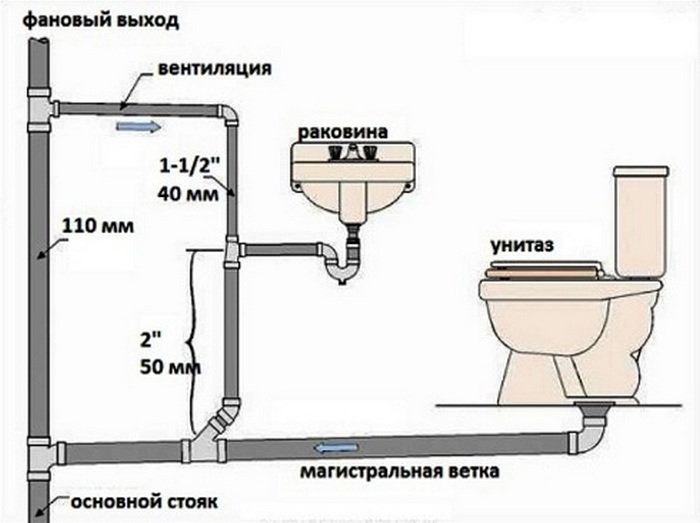
- To prevent the appearance of odors from the sewer in the room, an exhaust hood must be equipped. The so-called fan pipe is brought out through the roof to a height of about 0.7 m. It is unacceptable to connect it to a chimney or ventilation.
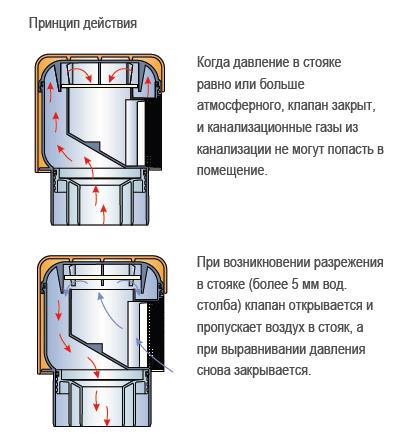
- If the installation of a fan pipe is not possible, a special air valve for sewerage is installed.
- The diameter of the riser must be equal to the diameter of the exhaust part. With one hood, you can combine two or even more risers on the top floor or in the attic. The horizontal sections of such a pipeline are fixed with hanging brackets or simply wire to the rafters.
- On risers that do not have indents in the upper and lower floors, revisions for the sewer are installed.The standard height of the revision arrangement is 1000 mm from the floor level. If the part has to be installed in the corner of the room, it should be turned at an angle of 45 ° relative to the walls.
- When installing the internal sewage system, all plastic pipes passing through the floors are installed in special metal sleeves. The height of the element depends on the width of the overlap. The top of the part should protrude 20 mm from the floor level, and the bottom should be flush with the ceiling.
- The riser is installed with a sleeve on. In order for it not to fall from the pipe, it is tied with a thin wire to the superior socket of the cross or tee, or bursting with pieces of foam.
- If it is assumed that a toilet bowl and other plumbing fixtures will be connected in series on a horizontal section, a sewer adapter must be installed between them. Plastic parts must not be turned high. This threatens with problems with the subsequent connection of equipment, especially with a shower or bath. On average, the turn should be carried out at half the socket of the tee in height with a direction towards the wall.
- Clamps are used to secure the sewer. Plastic pipes are fixed in horizontal sections as necessary, so that no fractures occur. On average, one clamp is installed per half meter - a meter of the length of the line.
- Cast iron pipes are mounted on steel brackets with a bend at the end, which prevent the pipeline from moving. Fasteners are installed under each pipe near the socket.
- The risers are fixed to the side walls with 1-2 clamps per floor. Fasteners are installed under the sockets.
It is important to note that at the end of the installation work, tests for tightness are mandatory.
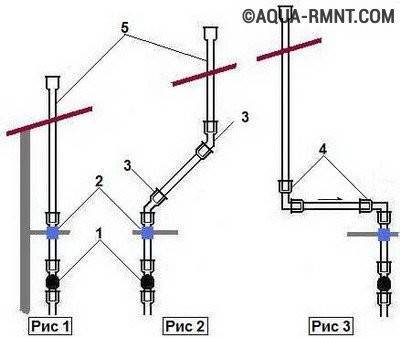
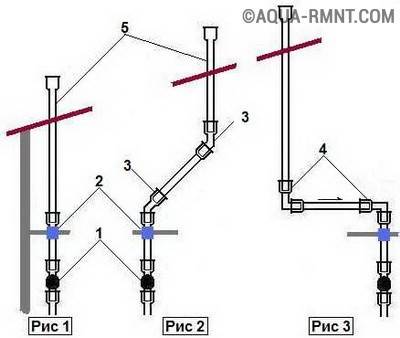
The fan pipe can be brought to the roof in different ways. The diagram shows three possible design options.
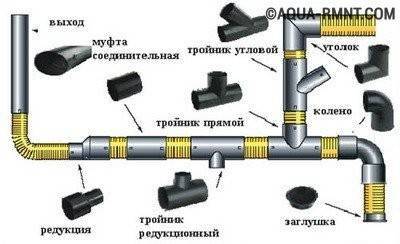
For the arrangement of internal sewage, various connecting elements are used. It should be borne in mind that the same cast-iron and plastic elements may differ in names and markings.
Sewerage is a necessary element of any comfortable home. Its arrangement does not require special special knowledge, but, at the same time, it cannot be called a simple matter. There are many nuances and features of the arrangement of the system. You should start with the development of a pipeline laying scheme, which will become the basis for subsequent work and help to correctly calculate the amount of materials needed. Already at this stage, you can evaluate your strengths and understand whether you will be able to cope with the work on your own or you will need to look for assistants. Many companies specialize in providing plumbing services. Professionals will quickly and competently carry out the installation of a sewer system of any complexity.





Pipe selection
current
stores offer a wide selection of sewer pipes. Unlike
Soviet times, when there were no options other than cast-iron pipelines
was, today there is a wide choice of material:
- PVC (polyvinyl chloride);
- PPRC (polypropylene);
- HDPE (polyethylene).
Pipe selection
Plastic pipes are much more convenient
in installation. They are lighter, equipped with connecting sockets with sealing
rings, look
much more accurate and do not need to apply a protective layer of paint. Lay horizontal
a system of such pipes is much simpler and faster. There are all necessary
connections, tees, crosses, etc. In addition, under the plastic pipeline
of any diameter, mounting clamps are sold that provide a secure fit
systems. This makes the montage
sewerage in the apartment is a quick and high-quality event.
Untrained people are often not
can determine the size (diameter) of sewer pipes. Exists
the generally accepted method of installing 110 mm pipelines in the toilet. Sewerage in the kitchen or
in the bathroom does not require such dimensions, 50 mm is enough. If none
there are no specific requirements, you can be guided by this rule.
prefabricated well
The last in the order of wastewater, but not in terms of its role in the sewerage system, is a collector or septic tank - a well into which sewage enters from the pipeline. Position the well in such a way that it is at the lowest point of the drainage system.
The distance between the well and other objects located on the site and nearby:
| An object | Distance not less than, m |
|---|---|
| non-residential outbuildings | 1 |
| residential buildings | 5-7 |
| water well | 50 |
| fence between plots | 2 |
| open reservoirs | 15 |
Well types
For a private house, you can equip a well of one of three types:
- storage well or collector - a sealed container into which sewage enters, when the collector is filled, sewage is pumped out;
- a well with post-treatment, a septic tank - a container of several series-connected chambers in which wastewater gradually settles, bacteria process the sediment, and partially purified water enters the last of the chambers and from there goes into the soil;
- deep cleaning station - a well with filters and a bioreactor (a set of substances and bacteria), in which wastewater is purified from dangerous microorganisms and safe organic matter is separated, the purified water goes into the soil, and the isolated organic matter can be used as fertilizer.

The well of the first two types can be equipped with your own hands. For these purposes, ready-made plastic containers or reinforced concrete rings are used. Septic tanks are also built of brick and concrete.
It is difficult to equip a deep cleaning station with your own hands, as this requires special knowledge. A well of this type is easier to buy and install ready-made in a prepared pit.
How to calculate the volume for a septic tank and a collector?
The dimensions of the well are calculated based on the number of inhabitants of the house, the presence of various household and plumbing fixtures connected to the sewer, the activity of water consumption and the planned frequency of pumping wastewater from the septic tank, if it is storage.
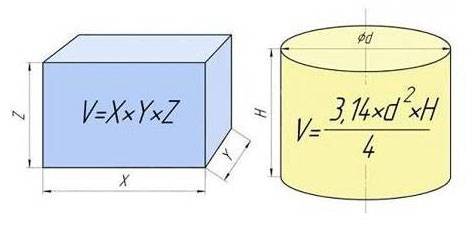
The volume of the treatment septic tank is calculated based on the maximum daily water consumption by a person. In the presence of plumbing and household equipment, one person consumes no more than 0.25 cubic meters per day. m. In the septic tank, wastewater settles for about 3 days. Therefore, to obtain the volume of the collector, you need to multiply the number of family members by 0.25x3, that is, by 0.75 cubic meters. m.
You can use the online calculator for calculating the minimum volume of a septic tank. This calculator takes into account the number of residents, the availability of plumbing and household appliances and the frequency of their use.
The volume of a sealed collector can be calculated by knowing the average monthly water consumption in the house. If cleaning is planned to be carried out 2 times a month, then the well should have a volume of about half the average monthly water consumption.
When calculating the volume of the collector, it is worth considering the capabilities of the sewers, which will periodically have to be accessed to clean the tank. Usually the volume of the tank of a sewage truck is 3 cubic meters, therefore it is better to make a well a multiple of the volume. This will make it possible to spend money more efficiently: not to overpay for calling an extra car that will leave incomplete, and not to leave unpumped sewage in the sewer due to the fact that there was not enough space in the sewage tank.
Do-it-yourself sewerage in the country: schemes and modifications
In a private house, there is rarely only one water connection point, usually there are three or more of them: toilet bowls, sinks (wash basins), bathtubs, sinks, washing machines and dishwashers, as well as outdoor watering taps. The distribution of supply pipes is carried out in accordance with the rules of SP 30.13330.2012 (updated version of SNiP 2-04-01-85).


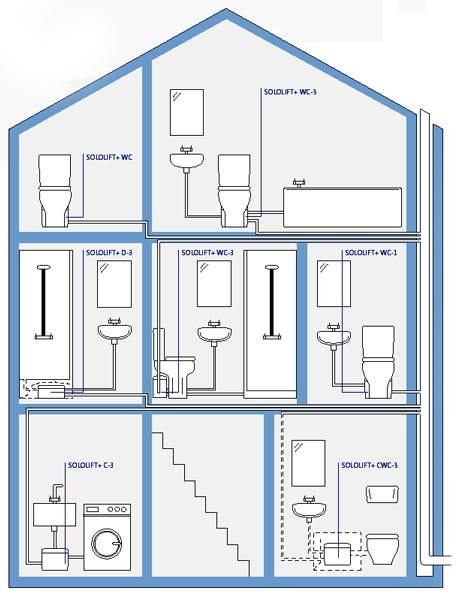
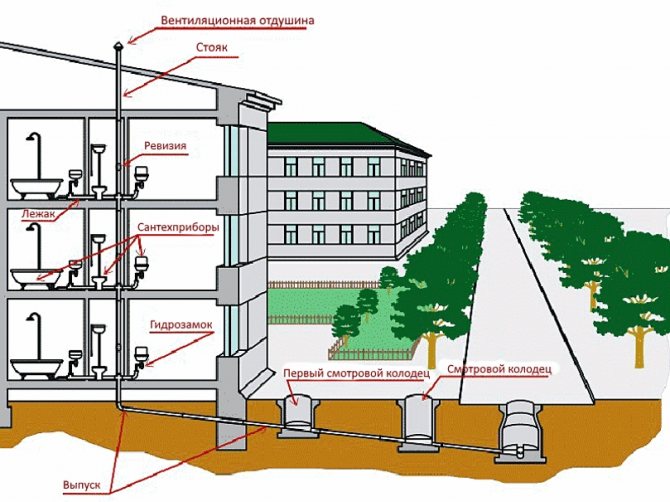
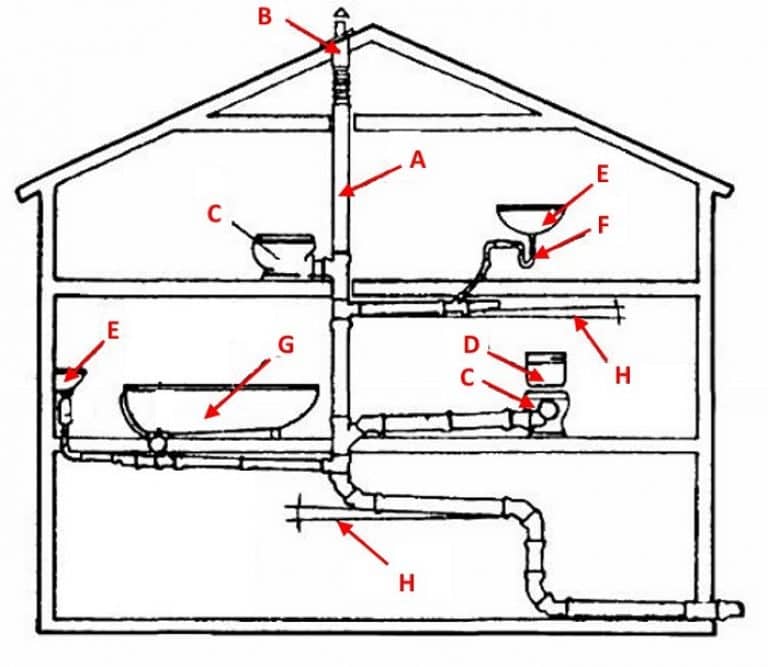
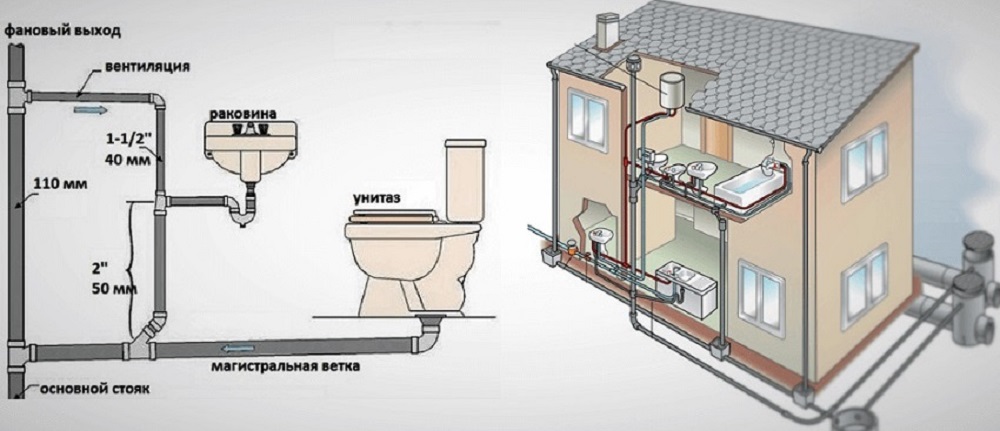
At the same time, it is necessary to divert used water from each of the "consumers", which is done with their subsequent connection into a single pipe of external sewerage.
The norm (according to SNiP 31-02-2001) for a sewerage system in a private house is considered necessary for the diameter of the exhaust pipes to be at least 100 mm, and the pipes must be plastic and laid on compacted and leveled soil (for marshy soils, an artificial base is possible, for rocky soils - a pillow from sand). It is considered necessary that the slope of the pipe from the house is at least 0.015 - that is, the height difference per meter should be 1.5 ... 3 cm. In this case, the wastewater to the treatment plant flows by gravity, no pressure pumps are required.
Thus, the arrangement of the first part of the sewer system - wiring around the house and output outside the building - practically does not differ for different schemes. The next part (the sewer pipe) is also almost always arranged in the same way. Basic requirements for her:
when laying above ground, high-quality insulation is required. You can do without it only if the sewage system is used exclusively in the warm season
The device of an above-ground pipe is real if the house is built on a high base (on piles), only then it turns out to organize the necessary slope of the pipe;
when laying underground above the freezing level (for the Russian Federation, on average 1.5 ... 2 m), thorough thermal insulation is required, and it is necessary to protect the insulating material from the accumulation of water in it;
when installing a pipe below the freezing level, serious insulation is not so important.
With any installation method, high-quality protection is required. from sewage penetration water into the ground! Otherwise, there is a high risk of contamination of groundwater, including aquifers.
The choice of "terminal point" of drains depends on the estimated water consumption, operating conditions and the financial capabilities of the homeowner.
The principle of operation of urban sewerage
City household sewerage is an external sewage system for drainage systems in private and multi-storey buildings. It is a complex engineering system designed not only for the removal, but also for the disposal of domestic wastewater. Such a system is quite simple and works according to the non-pressure principle of natural drainage.
The central sewer consists of:
- sewer wells;
- pipeline networks;
- Street, district and city collectors with pumping stations;
- Treatment facilities.
Sewer wells are located at any building. They are the protective mechanisms that protect the system from blockages. Collectors are engineering structures that collect wastewater from two or more lines. Wastewater can move through the collectors both by gravity and with the help of pumping equipment. It depends on the features of the terrain.
They perform mechanical, biological and chemical wastewater treatment. After that, the effluent is diverted to the nearest reservoirs or rivers. At the same time, the workers of the facilities always control the quality of treated water. Most treatment facilities have their own laboratories.
Purpose and types of storm system
Storm sewers in any building are designed to remove precipitation. It is an engineering system consisting of many elements to avoid flooding the roof of the building and undermining the foundation. Installation of such a system begins with the roof.At the same time, it is installed both on flat structures and with slopes.
Sewerage in multi-storey buildings often has a long service life
Depending on the type of installation, storm sewers are divided into:
- External. It consists of gutters, funnels and trays and is attached along the lower edges of the roof slopes.
- Internal. Such a system allows you to collect moisture directly on the roof and remove it through a pipeline hidden in the outer wall of the house.
External storm sewers are usually installed only in houses with pitched roofs. In some cases, such sewerage can be seen on houses built in the 60-80s. last century. Modern multi-storey buildings are designed with internal stormwater drainage. This solution is more durable and does not spoil the appearance of the building.


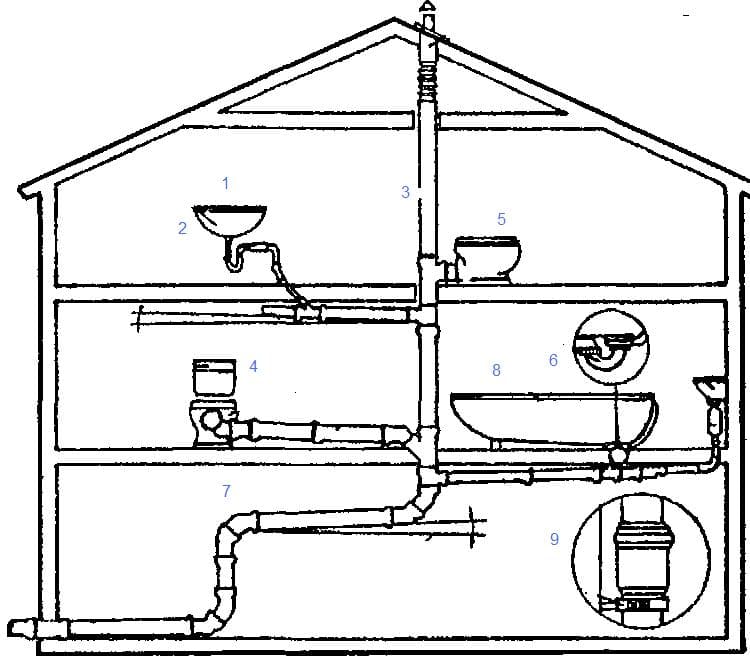
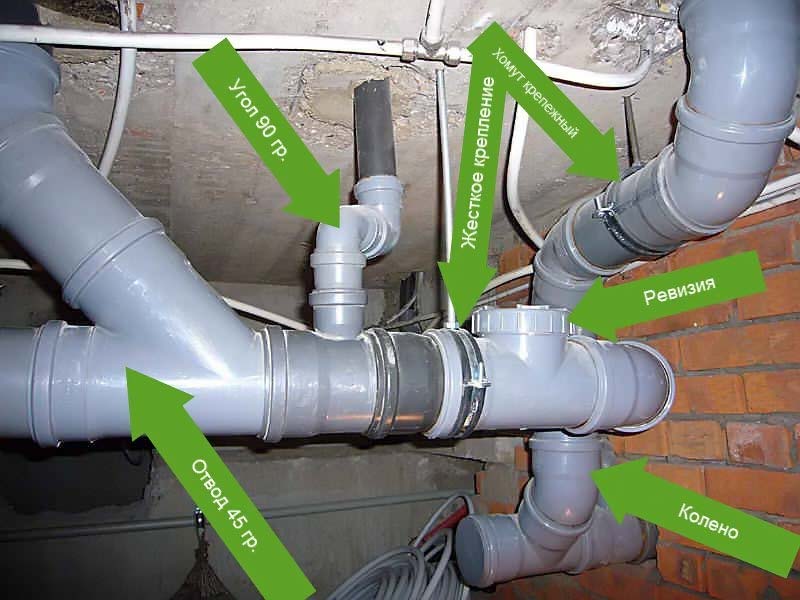
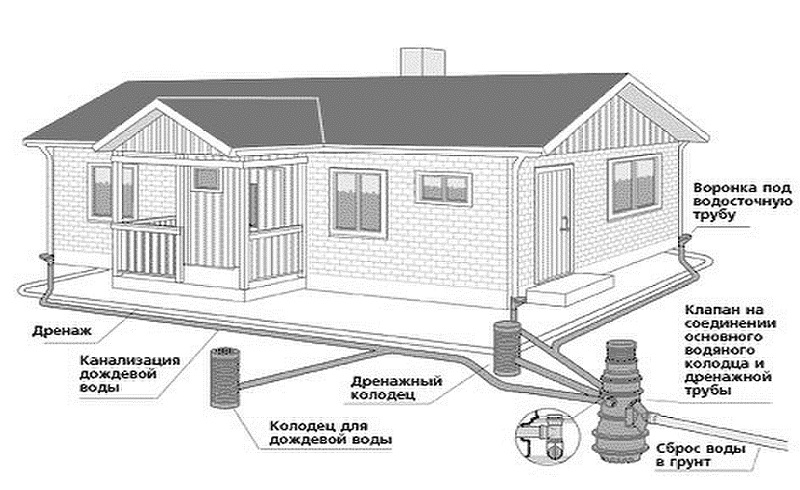


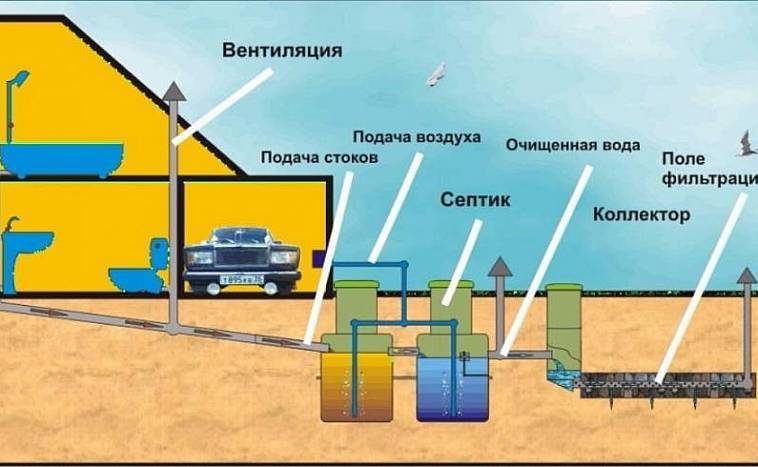

The sewage disposal system in apartment buildings is rather complicated. This is due to the increased load on communications. Due to the large number of serviced objects, serious requirements are put forward for the installation of such a system. After all, improper organization of communications can lead to constant blockages and flooding in the house. The device of sewerage systems in multi-storey buildings is regulated by the requirements of SNiP and state standards. It is for them that contractors install the system.
How to remove the pipe directly from the house
Having a finished house, the question immediately arises: how to bring the sewer through the foundation? To bring the sewer pipeline out of your own home, you need to install a border system that connects the septic tank to the outgoing pipes.
The outlet of the pipe passes through the foundation. Moreover, the depth of installation should exceed the amount of soil freezing. The work is carried out in the following sequence.
Stage 1. A trench is being dug, in which the external and internal systems will dock.
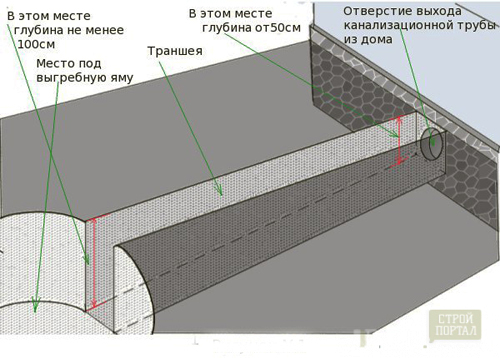
Stage 2. A hole is made in the foundation for the sewer. For work you will need:
- Perforator;
- Metal punch;
- Electric drill;
- Set of drills.
If it is not possible to make a hole with such tools, a special diamond installation is used.
The drilling process is always quite complicated, because you have to drill a concrete base. If a reinforcing mesh was made, you will have to use a grinder. It is easy to deal with fittings. Sometimes it takes several days to get the right hole.
First, on the surface of the foundation, the place where the pipeline will be displayed is determined. A circle is drawn in this place, and its diameter must exceed the size of the sewer pipe, together with the sleeve.
The hammer drills concrete to the maximum depth. The occurring bars of the reinforcement are cut off by the grinder.
To make a hole in a concrete foundation, builders use several methods:
- Diamond drilling. It is considered the best option. The foundation material during such work does not receive damage. This technology is one of the most expensive, even if you rent such a machine;
- Perforator. Percussive drilling in progress. The negative side is slotting, which causes the appearance of microcracks. Concrete begins to flake off the reinforcing mesh;
- Hammerless drilling. One of the safest and time consuming methods.A large number of smaller holes are drilled around the entire perimeter of the desired large hole. A concrete cork is knocked out with a sledgehammer, the reinforcement is cut with scissors for metal.
Stage 3. A sleeve is first laid in the channel made, then a pipeline is laid. The resulting gaps are closed with mounting foam. It also becomes a good heat insulator.
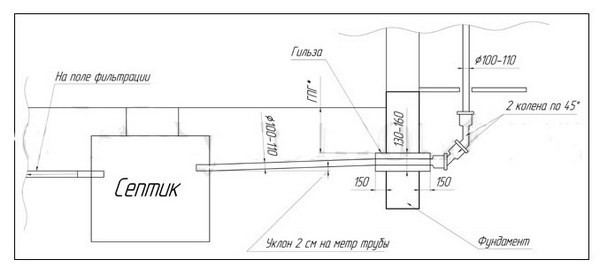
Circuit Components
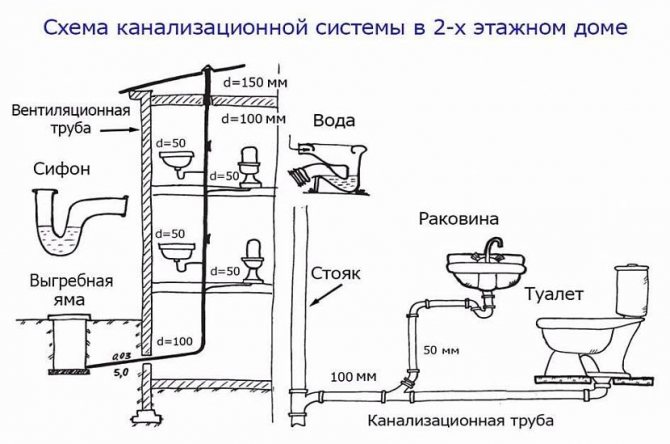
Any sewer system can be divided into three main parts:
- Drains and collectors inside the house or intra-house communications.
- External networks. Pipes and units through which wastewater enters the latrine.
- Actually, a septic tank, a cesspool or a centralized manhole.
Recently, more and more often a septic tank or a container is installed on the plots, into which sewage enters in an uncleaned form.
Its task is to carry out intermediate cleaning, no matter where the waste water goes afterwards.
How to choose a place for a septic tank
Home cleaning septic tank
The place of installation of a septic tank on the site is strictly regulated. The figure above shows the minimum distances from the septic tank to other communications and buildings.



The second option for a septic tank is sedimentation tanks with soil aftertreatment or local treatment plants.
Sump with soil aftertreatment
In tanks with soil aftertreatment, wastewater first enters the tanks, in which feces settle to the bottom and decompose under the action of anaerobic bacteria.
The rest enters the forced filtration system and only then seeps into the ground. Typically, such septic tanks are supplemented by systems of filter wells or special filtration fields, which we will discuss below.Local treatment plants operate by analogy with industrial treatment facilities. This is the most expensive type of septic tank. Most often, it is he who is used for the sewerage device in a private house with his own hands. In appearance, these are large polypropylene containers with technical compartments and special filtering equipment:
- pre-cleaning section. At this stage, the pollutants are divided into fractions, heavier sewage and feces sink to the bottom. This compartment requires regular cleaning;
- arotenk. In this tank, the process of saturation of wastewater with oxygen takes place. Further, special bacteria enter the “battle”, which process salts and toxic substances, thereby purifying the water;
- sump. Here the very bacteria that have done their work settle, in addition, the liquid is cleared of silt, sand;
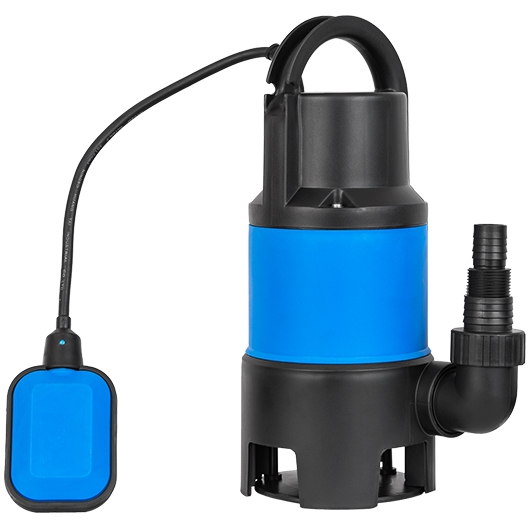
- water is discharged through the drainage pump from the treatment device.
Exhaust pipe outlet
Fan pipe functions:
- maintains atmospheric pressure inside the system;
- increases the durability of the sewer system;
- ventilates the entire sewerage system.
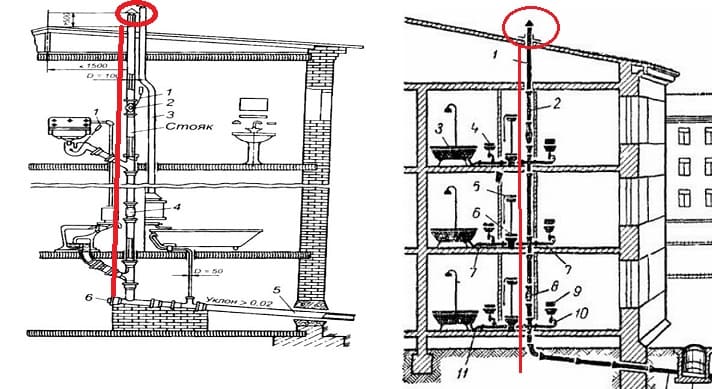
A fan pipe is called a continuation of the riser. This is a pipe leading to the roof
Before connecting the fan pipe and riser, it is important to install a revision. After that, the pipe is brought out at a convenient angle to the attic
Do not combine a fan pipe with a chimney or ventilation at home. The outlet of the fan pipe must be located at a distance of 4 meters from windows and balconies. The height of the retreat from the roof should be 70 cm
It is also important to place sewer ventilation, houses and a chimney at different levels.