
- Device and purpose
- Criterias of choice
- Common parameters
- Do-it-yourself standard heat gun: its device and types
- The design of heat guns
- The principle of operation of a gas heat gun
- Device Specifications
- Types of heat guns
- infrared
- Maintenance and repair of heaters
- What to look for when choosing a heat gun
- Purposes of application
- Mobility
- Type of energy carrier
- Diesel heat guns
- Basic device and principle of operation
- Features of the design of the radiator
- Sectional Radiator
- Evaluation of the capabilities of the best heat generators
- The choice of liquid fuel heat generator
- The main advantages of infrared heat guns
- Gas models of various capacities
- Features of infrared "fan heaters"
Device and purpose
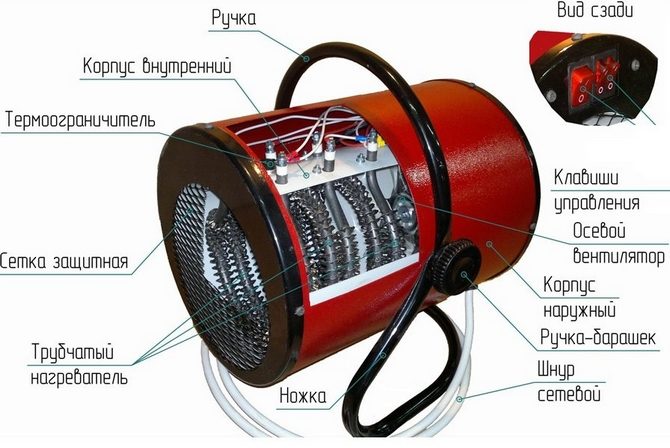
The heat gun is a metal cylinder with a heating element and a powerful fan inside. When switched on, the heating element heats up, and the heat from it spreads throughout the room with the help of a fan.
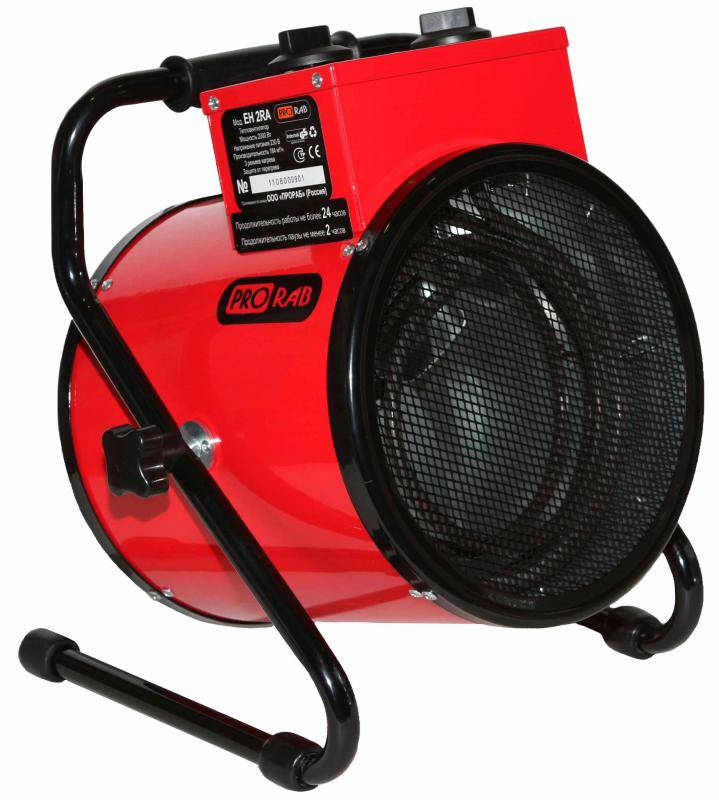
The body of the gun has a cylindrical shape, but there are also rectangular options.
The overall design of the device is simple, but the internal elements are presented in various ways. For example, a heating part can be of the following types:
- a spiral made of refractory metals, for example, nichrome.Such parts heat up quickly, but reduce the amount of oxygen in the room;
- TEN, made of sealed tubes, inside of which there is sand. Devices with such an element have a low cost;
- ceramic part, which consists of plates with a large number of small cells that serve to pass air. Such a heating component is the safest of all options.
As additional units are a thermostat and a thermostat. The first element serves to protect the device from overheating during prolonged operation, and the second activates the operation of the unit if the room temperature drops below the specified rate.
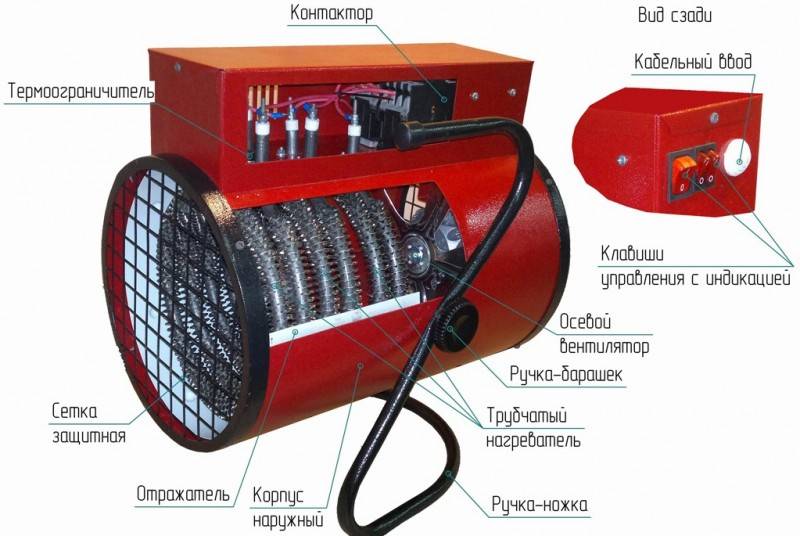
Cylindrical housing includes important parts that are securely fixed inside
All heating and distribution components are contained in a metal housing, which is often cylindrical. Outside there are adjustment buttons, sensors, a stand, a protective grill and a wire for connecting to the mains. This makes operation convenient, and the guns serve to heat and dry the premises after repair, as an additional source of heat.
Criterias of choice
The complex of parts turns into a functional device designed for quick heating of rooms of different sizes. When choosing, it is worth considering that the larger the space, the more powerful the electric heat gun should be. And also the choice is based on the following criteria:
- for long-term work, they purchase professional-type heaters that can withstand intensive use. If short-term heating of the room is necessary, then simpler devices will do;
- the body and the protective grille must be made of metal.If plastic was used for this purpose, then such a gun can be a fire hazard;
- a 50 kW gun or other voltage must be equipped with a heating level regulator and switches that control the air flow;
- power must correspond to the heated area. For the calculation, you need to take into account the formula: for every 10 m2 of area, 1 kW of power is needed;
- The optimal operating time of the device is indicated on the packaging. For example, the wording 24/2 means that the gun can work around the clock, but needs a break of 2 hours.
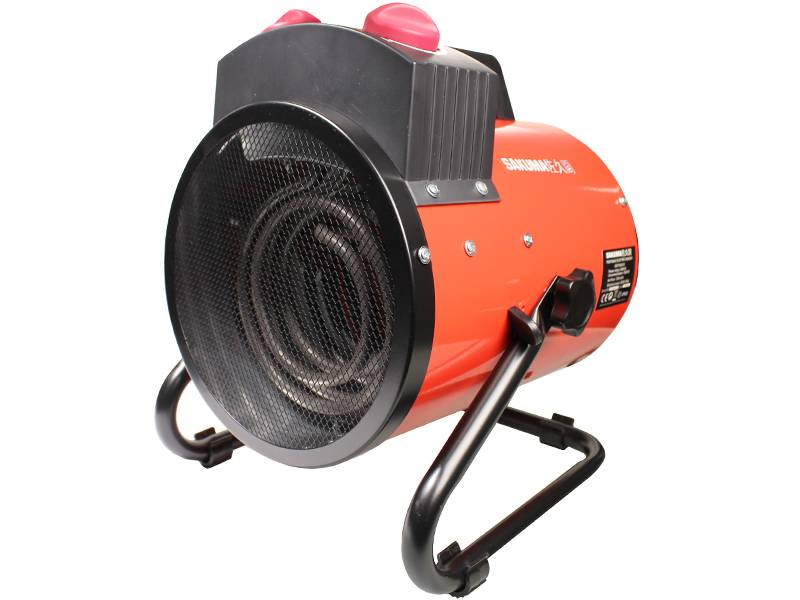
Sensors in the form of light bulbs notify about the process that is activated at the moment the device is working
The size of the electric heat gun should be considered if it is to be installed in a small space. Small models have low power, and therefore they are often chosen for short-term heating of a space of 10-25 m2
It is important to remember that flammable materials and flammable liquids should not be located near the device.
Common parameters
Speaking in a dry language, heaters of this type are devices for quickly heating any premises when there is no other way to maintain a comfortable temperature. Why cannon? The name of the device was due to the shape of the case. It is a cylinder that looks like a cannon. The design of the device is quite simple. The body is made of metal. It has holes through which air is drawn in. Inside there are main nodes. This is a heating element, a fan that creates an air flow, a control system.
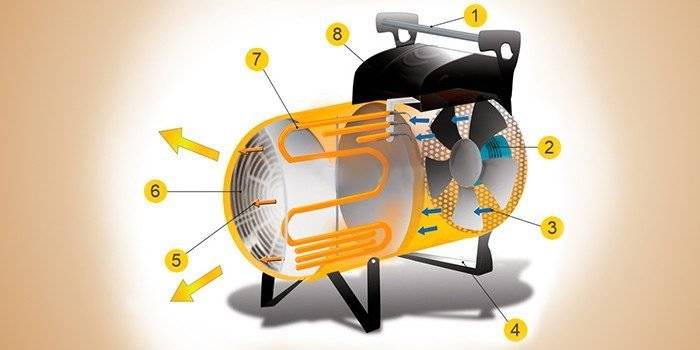
In simple terms, the fan rotates and draws air into the device.There, the latter is heated thanks to the heater, and after that it returns back. Either a burner or a heating element acts as a heater. Such a heater can be easily moved to the right place.
Do-it-yourself standard heat gun: its device and types
Before you create a heating gun yourself, you need to understand its principle of operation and device. The device got its name because of its cylindrical shape, which strongly resembles a cannon. And in its essence, it is very similar to a fan heater, capable of heating a room in a short time.
As for the device, it is quite simple: a case, a fan, a control unit and a heating element. All guns operating on different fuels differ only in the type of heating element. In all other respects they are similar.
Additionally, the heat gun can be equipped with a thermostat that protects the device from overheating and a thermostat that automatically turns on the device when the temperature drops below the specified one.

The principle of operation of the heat gun:
- Cool airflow is directed by a fan through a hole in the case;
- The received heat from the heating element is blown away under the influence of an air jet;
- Warm air is sent to where it is needed to heat the room.
As for the types of guns, they differ depending on what kind of fuel is used.
So, the main types of thermal devices:
- Electric - can be used for heating both residential and non-residential premises. Depending on the power, they can be connected to electrical systems with two or three phases.
- Diesel - diesel is used as fuel. Typically, such a device is used for heating auxiliary rooms.
- Gas - one of the most efficient types, the efficiency of which reaches almost 100%. Gas is used as fuel. It is necessary to use such a gun only in non-residential premises.
- Water - the least common type, the heating element of which is made in the form of a heat exchanger containing hot water.
If you want to use the gun in a residential area, it is better to choose an electric unit, and if you need to heat a garage or workshop - diesel or gas.
The design of heat guns
The unit is a cylindrical base, which is fixed on an axle with wheels and a stand. The angle of inclination of the pipe is set using the regulator, which makes it possible to direct the warm flow to the desired zone.
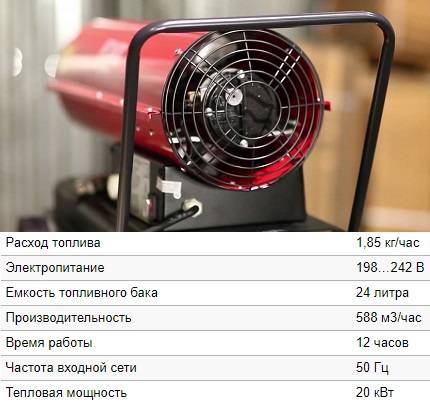

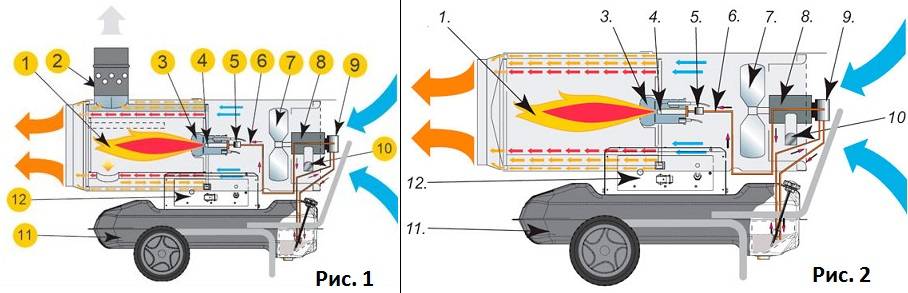
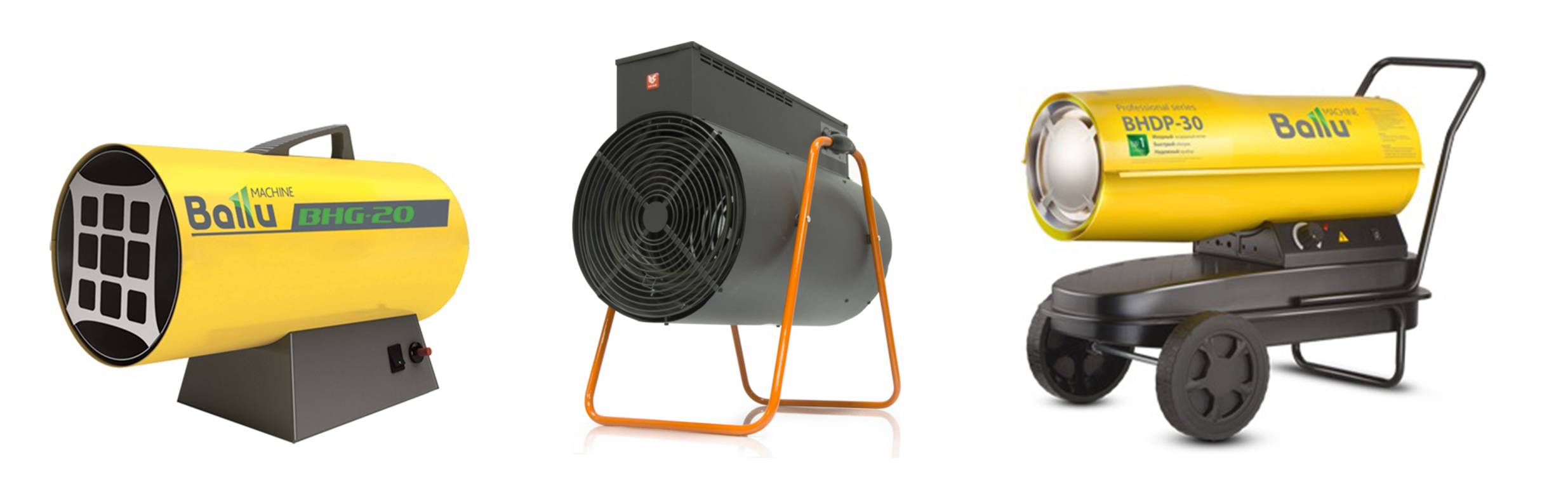




The housing made of high-quality metal is equipped with gratings through which air is taken from the room. The heating element located inside brings the air masses to the set temperature, and the fan system pushes them out. Thus, air is circulated with its transformation through the cylindrical part of the heat gun.
The principle of operation of the mechanism resembles the operation of a fan, with the only difference being that heating elements are connected in parallel to produce a heated stream.

The principle of operation of a gas heat gun
The structure of a heat gun is very similar to a simple heater. It consists of a heating element, ventilation blades and a housing. An important part of the device is the fan. It must be very powerful in order to heat the entire room in a short time.
Cold air enters the gun due to the operation of the fan and enters the heating element. An already heated air stream is supplied from the device.
Device Specifications
One of the main advantages of most heat guns is mobility. You can take them with you to the workshop or garage. The average weight of installations is 3-7 kg.
Most often, gas installations have a cylindrical shape and fasteners. The body of the device can be directed at the desired angle, thereby heating certain areas of the room.
Cannons use propane, natural gas or butane as fuel. Gas is supplied through the slots of the burner to the combustion chamber. It has a piezo ignition function, which makes the device safe to use.
But the gun consumes a little energy (from 10 to 200 watts).
The advantage of gas guns is that they have high power with low fuel consumption. However, they have a significant drawback - a high level of danger. In the process of heating the room, oxygen burns out. This negatively affects the condition of people.
Therefore, guns with gas fuel cannot be used in rooms with faulty ventilation. Because of this feature, the device is not recommended for installation in living rooms.
They are optimal for large technical premises such as warehouses, construction sites or large garages.
Types of heat guns
All guns consist of a body, a heater and a fan. Only the materials of the device itself and the type of power supply differ. The housing of the unit has special openings for the entry of cold air. There are both rectangular and cylindrical guns.Powerful devices with a lot of weight are equipped with a stand (bed) and wheels for more convenient transportation and movement.
The heating element of the device is a heating element, a spiral or a combustion chamber. Thanks to them, the room is heated. The heater is powered by different types of energy carriers, depending on their type, the guns are:
- gas;
- electric;
- diesel;
- solid fuel.
There are also efficient infrared installations, but they consume a lot of energy.
infrared
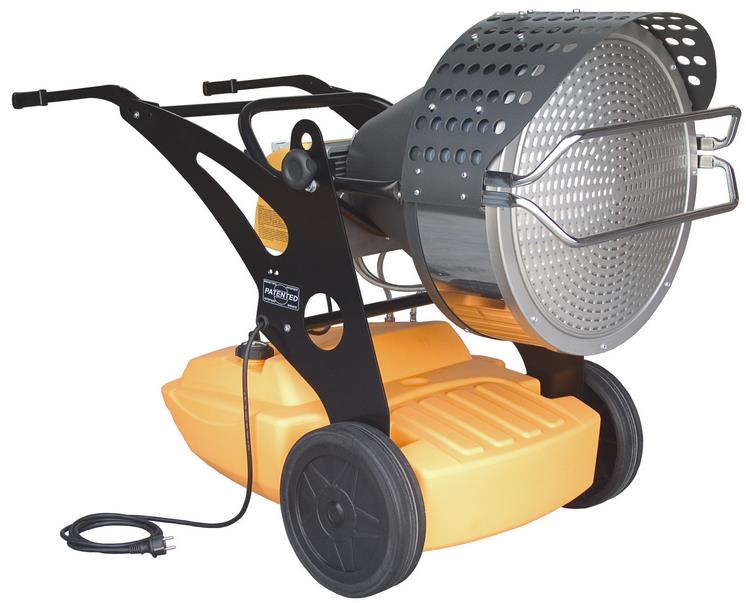
Thermal IR gun
The infrared gun differs from others in that there is no fan system that usually heats the air.
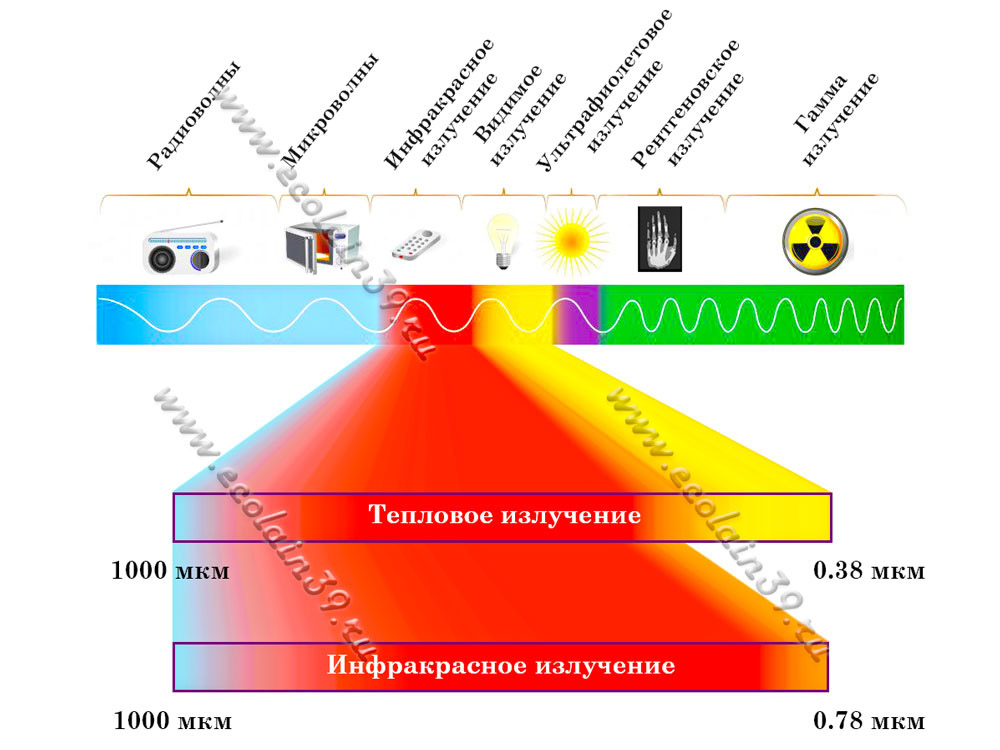
A special mechanism makes it work using infrared radiation, due to which the air is heated and the entire room is heated.
The air is heated in the process of heat transfer.
An infrared gun can not immediately heat the entire room, but only a certain part of it.



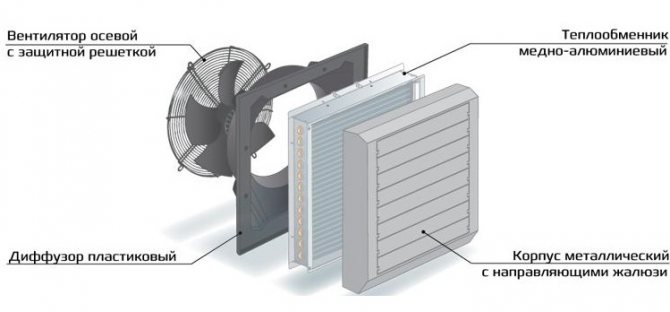
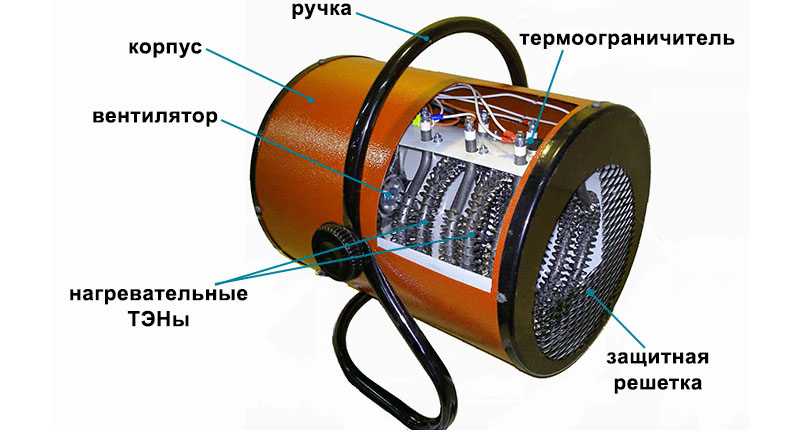
This quality is especially necessary during construction and repair work, when, for example, it is necessary to dry walls or floors after they have been plastered.
Maintenance and repair of heaters
During long-term operation of the gun, minor malfunctions occur, which the user can fix with his own hands. Signs of problems and how to fix:
- After turning on the device starts, but quickly goes out. Remove the flame photo sensor from the socket and remove the soot from the working lens.
- If the intensity of heating has decreased, clean the air and fuel filters. The manufacturer recommends changing the filter elements every 500 hours.
- Difficult or no ignition of the air-fuel mixture.Turn out the glow plug, remove the soot and adjust the gap between the electrodes (usually set to 1.4 ... 1.5 mm).
- A decrease in efficiency and the appearance of black smoke indicates a clogged nozzle. In most models, the part is easily removed and cleaned, if you can’t handle it, call the master.
- Another reason for difficult starting is problems with the compressor. The unit must be cleaned and the operating pressure adjusted, if necessary, the motor must be lubricated.
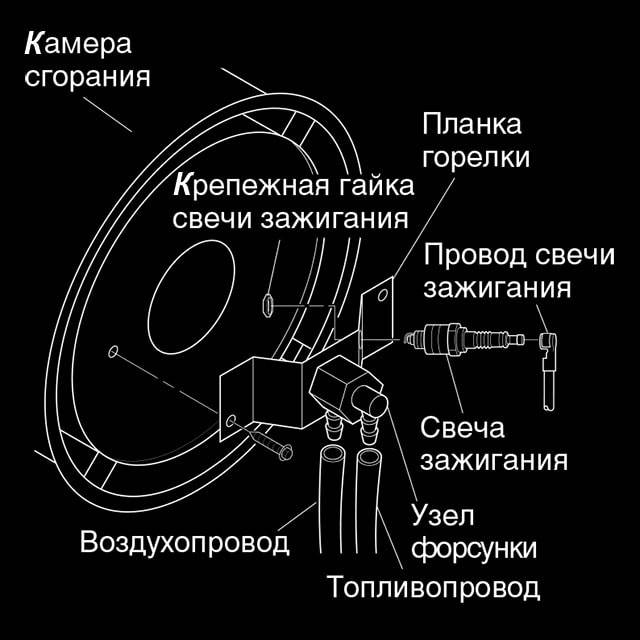
The glow plug and nozzle are located on the rear plane of the burner head. 2 tubes are connected to the atomizer (air from the compressor and fuel supply), a high-voltage cable is connected to the igniter. The latter often breaks through to ground, which causes the spark to disappear on the candle.
The fuel strainer is located inside the supply tube lowered into the tank. By the way, the container must also be washed at intervals of 500 hours of operation. The air purification elements are located on the rear panel of the compressor and are unscrewed with a screwdriver. How to clean the nozzle of a heat gun, see the video:
What to look for when choosing a heat gun
First of all, it is necessary to find out the power that is appropriate for a particular object, taking into account the volume of the heated room. There are several main selection parameters: purpose of use, mobility and type of energy carrier.
Purposes of application
Household devices - small loads from 2 to 5 kW, are used in small areas: shops, offices, garages, private houses. Industrial stand out for their power - up to 200 kilowatts and more, their functional purpose is diverse: large-scale construction projects, industrial facilities, large shopping centers, airports.
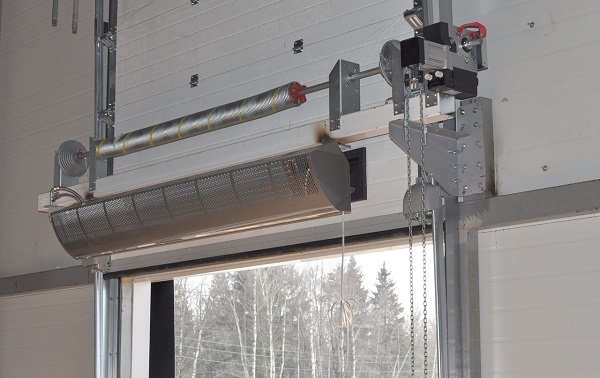
Industrial thermal curtain
Mobility
Mobile heat guns are used when there is a need to heat certain places, specific segments. They are practical sizes for transportation. Most are cylindrical. Fixed appliances provide permanent heating. The difference from mobile guns in productivity and impressive size. Most often rectangular in shape.
Type of energy carrier
Electrical appliances are most convenient and safe to use in places where people can stay for a long time. It is not difficult to get an idea of their work: air passes through the heating element and is distributed by a hot stream with the help of a fan. Heating elements are represented by spirals, heating elements, ceramic plates. In order to prevent corrosion and overheating, damage during transportation, the body is made of stainless steel. High-quality devices have several modes of operation, are equipped with a bimetallic thermostat, a heating element that does not burn oxygen, as well as an emergency shutdown system. The main disadvantage is the high cost of electricity.
Liquid fuel can operate on waste oils, kerosene and diesel, have a load of 10 kW to 220 kW.
At the same time, they are the most productive and highly efficient, as well as low-cost (in comparison with electric ones). Endowed with many functions, for example, the presence of a rheostat system. The principle of operation is very simple: we enter the necessary parameters, turn on the device, when the set value is reached, it automatically turns off and turns on if the air temperature drops below the desired threshold.
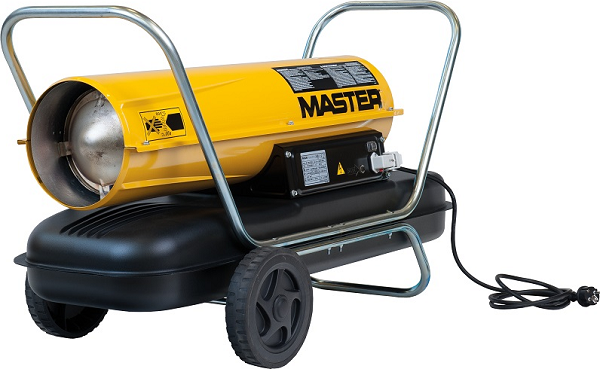
Heat gun on diesel fuel B 150CED
For gas guns, the main food product is natural gas, they also work on butane or propane, the predominant return is from 1.5 to 580 kW. There are also combined devices that have the ability to switch from one type of gas to another. The devices are quite popular due to their high efficiency, economy and safety. Equipped with a flame control system and a protective relay to prevent overheating. In addition, they have almost 100% efficiency. Cons: Can only be used in well ventilated areas.
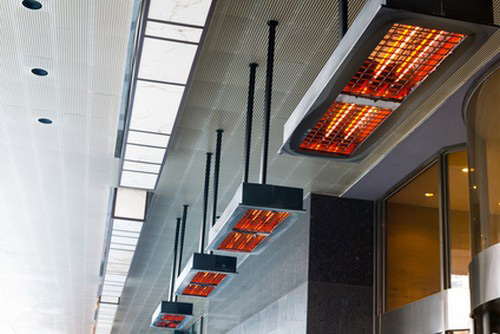
Infrared heat guns are fundamentally different from the previous ones: the design does not provide for the use of a fan, only infrared rays, which allows you to specifically heat certain areas. Power ranges from 1.5 to 45 kilowatts. Originally used for construction and maintenance work in large open areas, today the purpose has expanded.

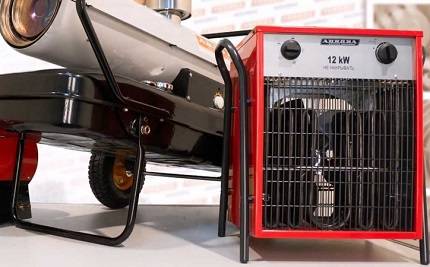
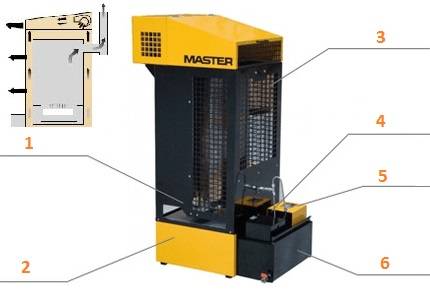



Diesel heat guns
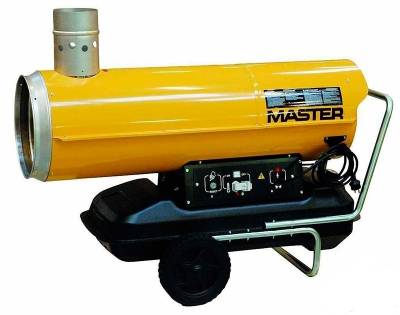
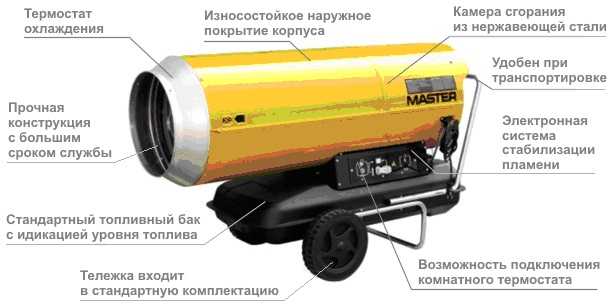
A special fuel tank is provided in the design of the diesel heat gun.
If you buy a powerful gun, you should stop at the diesel model. A diesel heater will be an excellent alternative to gas equipment - it is safer. Let's see how diesel heat guns are arranged and how they work.
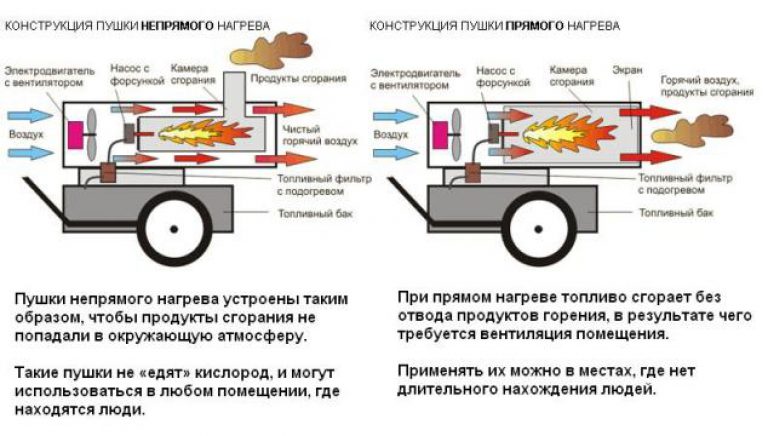
Diesel units are divided into two categories:
- Direct heating - not the best option, but cheaper;
- Indirect heating - differ in a more complex design.
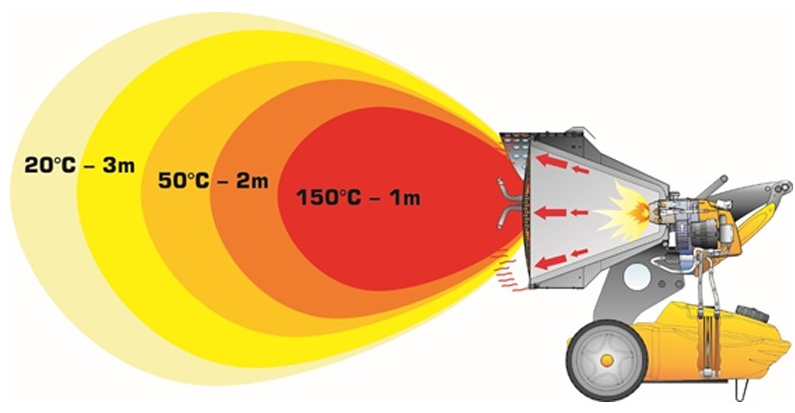
Direct heating heat guns are similar in design to gas modifications. Only instead of gas, atomized diesel fuel burns here.Hot air enters the heated room through a built-in electric fan, and together with the products of combustion. Therefore, such devices cannot be used in enclosed spaces and where people work.
Diesel heat guns of indirect heating are equipped with a combustion chamber in which the flame rages. The chamber is blown by a powerful fan, and the combustion products of diesel fuel are removed outside the unit through a chimney. At the exit, we get clean hot air, safe for all living things. The main thing is to provide for the possibility of discharging diesel fuel combustion products outside the premises.
Diesel units require connection to a 220 V network - electricity is needed here for the operation of fans and nozzles. But the power consumption is low, it does not exceed a few hundred watts, since the heat source is a diesel fuel burner. Prices for diesel heat guns are high. For example, the Ballu BHDP 10000 W model, designed for heating a volume of 590 m³, costs about 16-17 thousand rubles.
Almost all diesel models are equipped with capacious fuel tanks. For ease of movement, units are often endowed with wheels and carrying handles.
Basic device and principle of operation
The heat gun is a mobile air heater for rooms for various purposes. The unit is mainly used for two purposes. The first task is the organization of local heating of exhibition halls, trading floors, warehouses, garages and pavilions.
The second purpose is the quick drying of individual elements in technological operations, for example, fixing French ceilings or interior decoration in winter.
The fan heater has a simple device.The main structural details of the device: a fan, a heating element, a thermostat for offline operation and a thermostat to prevent overheating of the gun
All components are housed in a rugged metal housing equipped with grilles for cold air intake and hot air exhaust. A heating element, an open coil or a fuel tank with a heat exchanger is used as a heat generating unit.
The principle of operation of the fan heater:
- The "gun" captures the air currents and passes them through the heater.
- Hot masses are pushed out through a nozzle, being distributed on the room.
The operation of the mechanism is similar to a conventional fan. The only difference is the parallel connection of heating elements that supply warm air.
Features of the design of the radiator
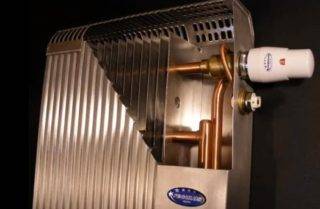
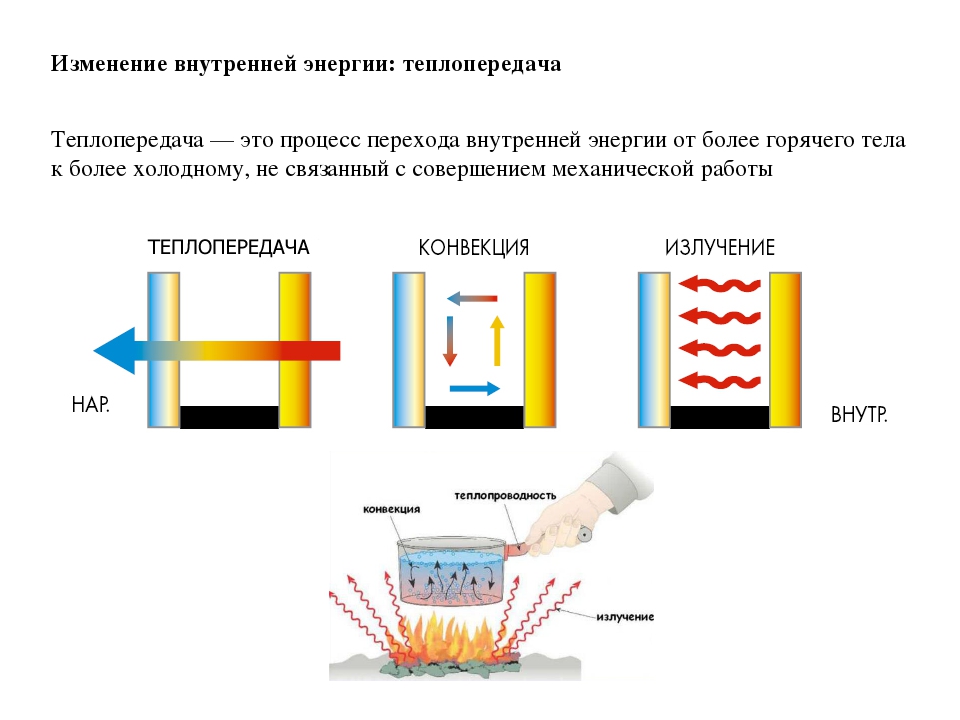
The battery is a separate heating device, which includes elements with internal channels for the movement of the energy carrier. Heat is removed by convection, radiation and heat transfer.
Section views allow you to increase the heating area by adding elements. Panel installations cannot be changed in shape, which is taken into account when calculating and installing the system. The accompanying passport indicates the temperature criteria for the operation of the device, the operating pressure parameters, and heat transfer.
Sectional Radiator
The sectional view of the heating battery device consists of a metal pipeline in the form of combined horizontal collectors through which water passes. The channels are connected using vertical tubes of small diameter, and the entire system is located in a cast iron, steel or aluminum housing. Separate sections are twisted on the thread.
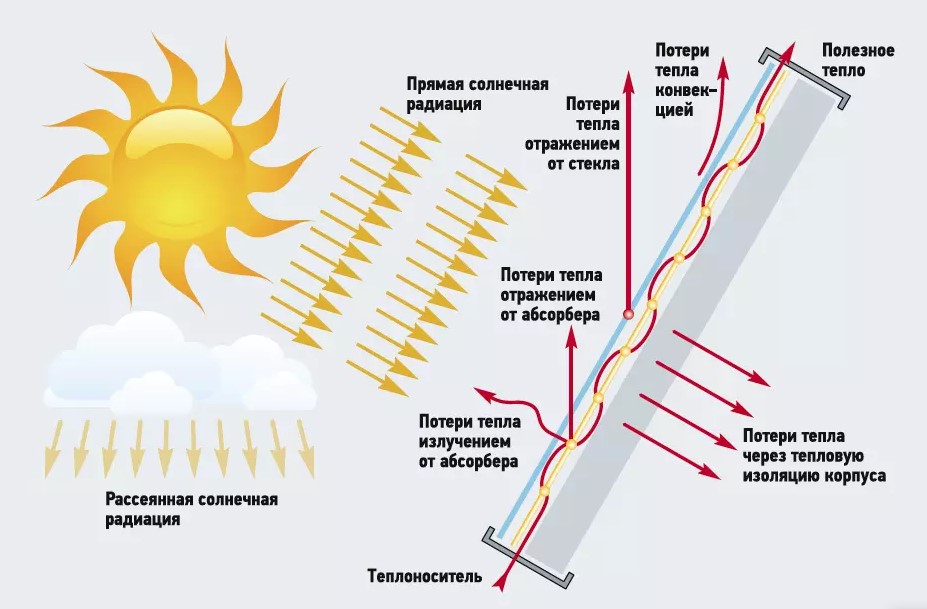

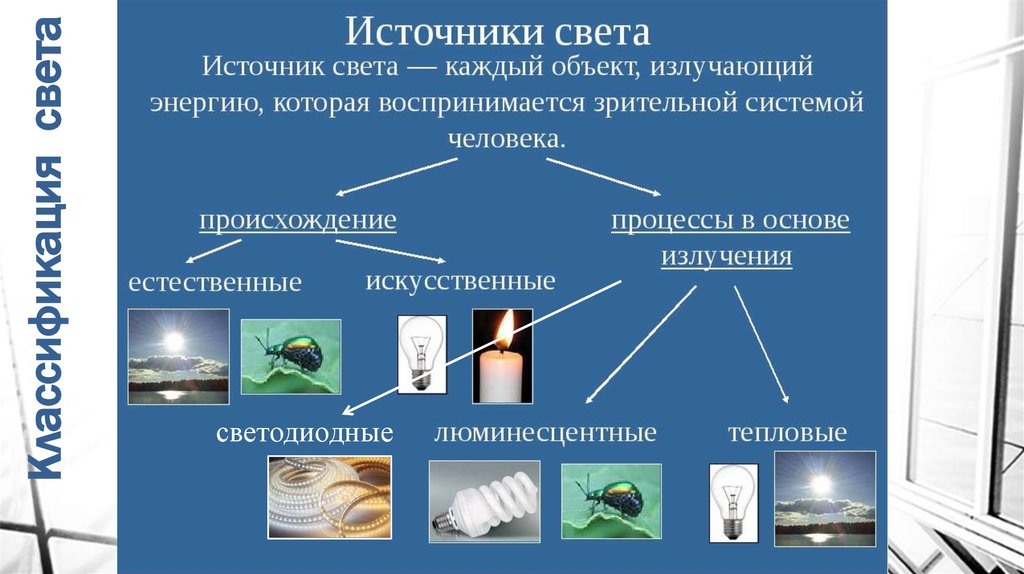

Radiators are used to heat the room, so the device design affects the quality of heat exchange. The material of the heat exchanger and housing plays a role, so bimetallic options are used, including 2 types of materials.
Evaluation of the capabilities of the best heat generators
The market for heat guns is stable. The leaders in the segment of electrical modifications are the products of the companies Ballu, Sturm, Quattro Elementi, Novel. Among diesel and gas guns, the Master, Elitech and Prorab brands have proven themselves well.
To adjust the fan speed and heating intensity, three- or two-way valves are mounted on the supply line. The heat transfer of the device depends on the number of fins on the outer grill - the more there are, the better the heat transfer.
When buying, special attention should be paid to the power, degree of safety, conditions of use and cost of the unit.
The choice of liquid fuel heat generator
The first step is to determine the thermal power of the device. There are nuances here: the gun cannot be calculated using traditional methods, since the unit is often used to heat large volumes and rooms without proper insulation. The following methodology is proposed:
- Measure and calculate the volume of the heated room V, m³;
- Find out the temperature difference between outdoors and indoors during the coldest period Δt, °С;
- Determine the dimensionless heat loss coefficient k of the building and calculate the heater power Q using the formula below.

Example. Let us calculate the heat output of a solar cannon for an uninsulated iron box 10 x 5 m with a ceiling height of 3 meters, the volume of the room is V = 10 x 5 x 3 = 150 m³. Let's take the outdoor temperature as minus 25 degrees, the indoor temperature as plus 10 °С, the difference Δt = 35 °С.How much heat is needed: Q \u003d 150 x 35 x 4 / 860 \u003d 24.4 kW.
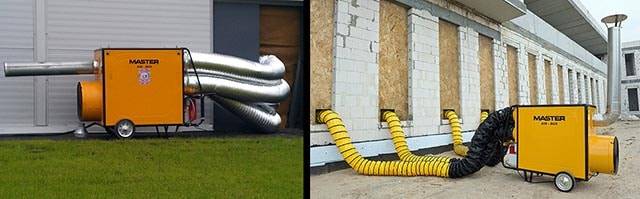
When heated by powerful guns, air is supplied through several hoses and evenly distributed throughout the workshop
How to choose the right gun for operating conditions:
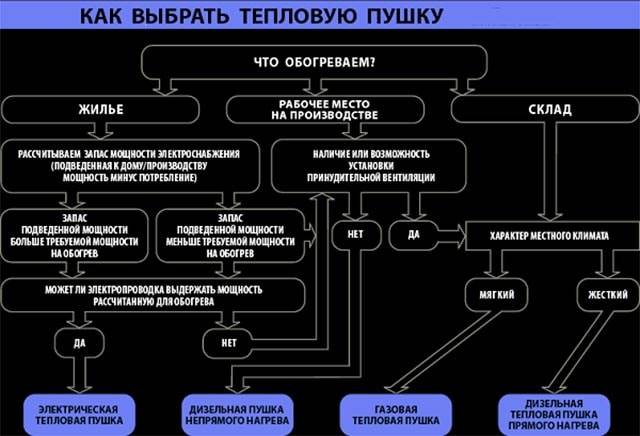
- For heating industrial premises, closed construction sites, hangars and warehouses, a direct heating device is suitable. If people are constantly working in the building, forced ventilation is a must!
- In private garages, car service stations, greenhouses, stables and other outbuildings, it is better to buy and install chimney thermal guns.
- Infrared heating devices are great for any local heating. Example: a production workshop with high ceilings or an open area where it will not be possible to warm up the entire volume of air, and a limited area is quite possible.
- Use the heating installation selection algorithm presented in the table:
If you need to heat a small industrial facility as a whole, pay attention to high-power outdoor versions of guns. The unit is placed outside the building, and several air ducts are laid inside for the best distribution of flows, as shown above in the photo.
The main advantages of infrared heat guns
The advantages of heating objects using infrared heat guns include:
- the ability to work outdoors in bad weather;
- no heat loss;
- high efficiency (more than 95% of heat is transferred to surrounding objects and people, which, after turning off, performs its functions for some time);
- significant energy savings;
- the ability to set a heating schedule and maintain a given temperature;
- space saving - the device can be installed under the ceiling;
- minimum costs for installation and dismantling;
- fire resistance of materials and components;
- uniform heating;
- compliance with quality certificates;
- environmental safety (devices do not emit harmful combustion products without burning oxygen);
- noiselessness of work;
- mobility and practicality;
- rapid heating of the room.
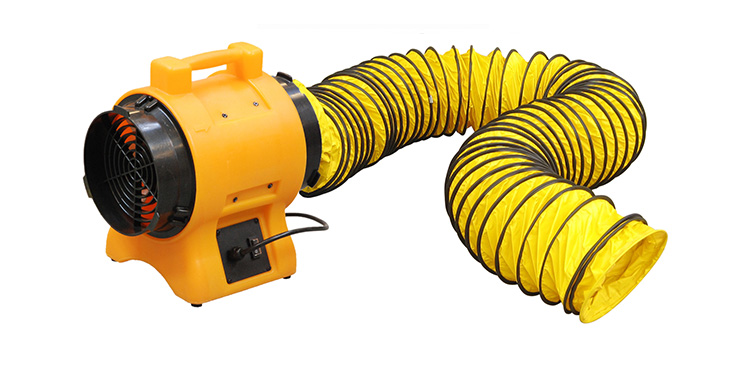
Gas models of various capacities
Popular gas guns: Elitech TP/30GB and Master BLP/53M.
- TP/30GB from Elitech. An advantageous option for heating large areas within 200 sq.m. The unit is applicable only in well-ventilated buildings. Operating conditions: floor installation, supervised operation. The gun is equipped with electronic ignition and a grate on the nozzle to protect the internal mechanism.
- Master BLP. Premium device for industrial applications. Housing with increased thermal insulation and anti-corrosion coating. A high degree of protection allows the gun to be operated in a humid environment. If there is no fire or overheating, the electronic system will cut off the fuel supply.
Features of infrared "fan heaters"
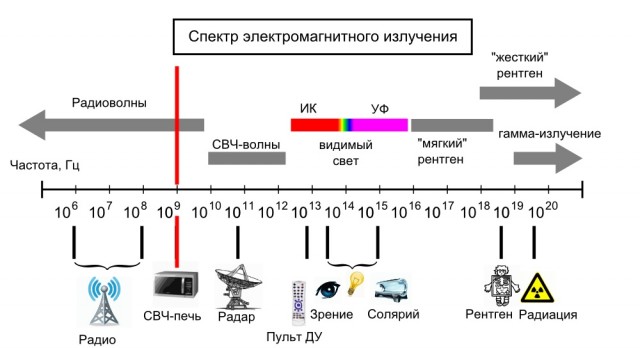
IR guns differ from their predecessors in the principle of operation. The generated heat reaches the surrounding objects not through directed air flows, but through radiation. For operation, the equipment is connected either to an electrical circuit or to a gas cylinder.

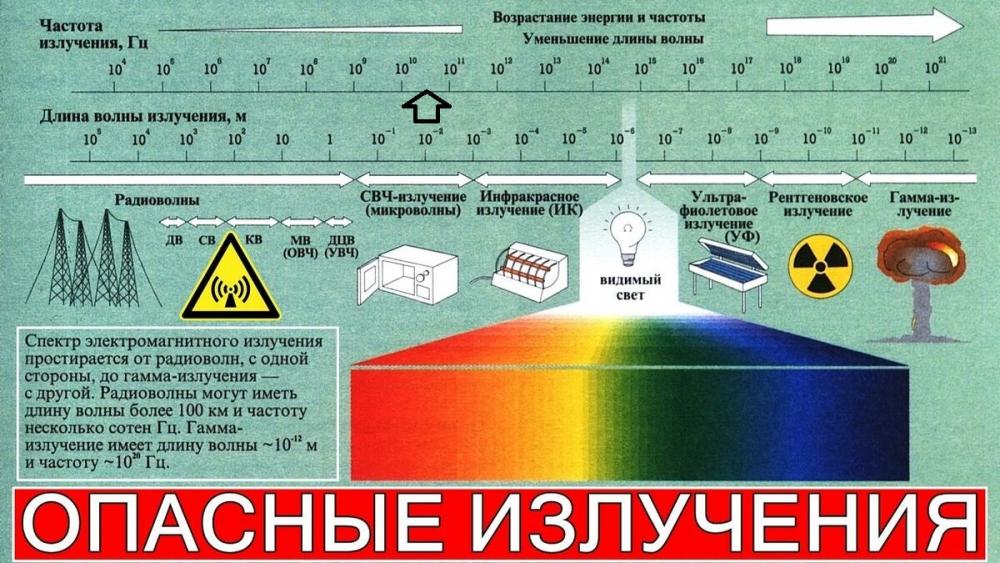


Heat rays are distributed in a rectilinear plane and are not absorbed by air masses. Heated objects gradually give off thermal energy to the air and people - spot heating reduces the cost of electricity and fuel (+)
There is no fan in the design, heat transfer occurs due to the emitter - flametin.The heating element is a spiral made of an alloy of different metals, enclosed in a tube of quartz glass. When heated, tubular heating elements generate infrared radiation.
Behind the heating element is a reflector - a mirror reflector focuses infrared rays in the right direction and prevents heating of the internal mechanisms and body of the gun.
Due to the ability of radiation to heat surfaces in the affected area, the IR gun is used for effective drying of painted products, plastered walls, rapid defrosting of objects and heating of the workplace
The pros and cons of the device largely depend on the type of thermal energy generator - an electric heating element or a liquid fuel burner. Each model has distinctive features of an electric or diesel gun, respectively.
Compared to "fan" models, IR heaters do not provoke drafts and are very quiet. The disadvantage is the low heating rate of the entire room.



