
- Case protection degree
- Way of fastening the wire in the switch
- Case protection degree
- Switch: what is it for?
- Types of modern electrical networks
- Voltage classification
- Types of wires and permissible loads
- Designation of switches on building diagrams
- Types of electrical switches
- Modern devices
- Which is better to choose: tips
- closed round
- Built-in small (recessed type)
- Various types of switches
- Innovative touch switches
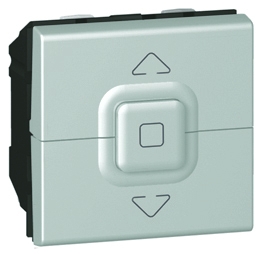
- Remote switches
- Switches with built-in sensors
- Pass-through or toggle switches
- The best manufacturers of premium sockets and switches
- ABB (Asea Brown Boveri)
- Makel
- DKC
- Materials used in switches
Case protection degree
Household switches are operated in various conditions, so their housings can be made in different versions according to the degree of protection. There is a GOST that regulates this degree. In electrics, the IP marking system has been adopted, which characterizes the protection of the housing from the ingress of water and solid particles to current-carrying elements. It is applied to the switch and indicated in the accompanying documentation.
All electrical installation devices have a certain degree of protection against dust and water.There is an international marking that clearly shows this degree. It can be applied directly to the body of the product
The marking itself is an alphanumeric record. The letters IP are applied first, indicating the type of marking. Next is a number that indicates the degree of protection against pollution.
The lowest is marked with a zero, the highest with a six. Devices from the "zero" group do not have any protection against dust ingress, devices with the number 6 on the case are completely protected from it. They work great even in rooms where there is a high level of dust.
The second digit of the marking indicates the current level of protection against moisture. There are numbers from zero to nine. The first group of switches is equipped with a housing that is not protected from moisture. The latter indicates the highest degree of protection.
Such devices can function normally if completely immersed in water, including hot water. After these two numbers, there may also be letters that give additional information. But for switches, they are practically not used.
Given this marking, you should choose switches for non-residential and residential rooms of different purposes. For example, for bedrooms and living rooms, IP20 enclosure protection will be enough; in damp rooms and bathrooms, devices with IP44 should be installed, or higher.
For saunas, baths or showers, devices with IP54 are suitable. Similar ones are installed on the streets, in unheated and dusty rooms. In the latter case, the degree of protection may be higher.
Way of fastening the wire in the switch
Types of switches are also divided according to the method of fastening the cores. When fastening the cores, the switches are also divided into two types.The connection can be of the following types:
- Screwless. Here the wires must be fastened with special clamps.
- Screw. The wires are attached with screws.
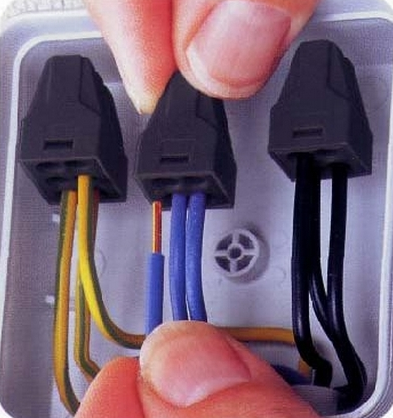
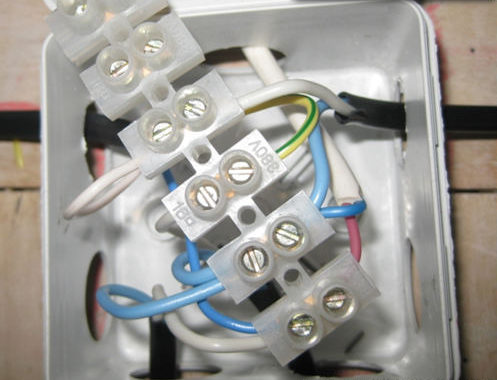
In the first case, you will need to use special clamps. A plate will act as a clamp, which is able to securely fix your wires. This method of fastening has a small disadvantage, which includes the fact that over time the fastening may loosen and it will need to be tightened.
The screw connection of the wires in the switch must be used when the conductors in the wire are aluminum. For copper wires, it is best to use a screwless connection.
Case protection degree
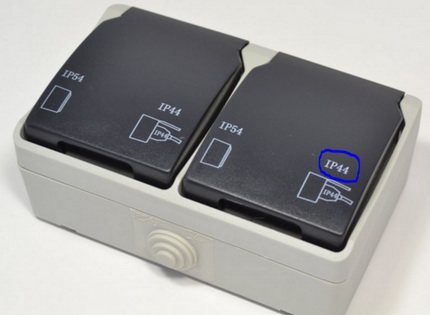
The degree of protection can be applied directly to the body of the product
The housing should be selected in accordance with the operating conditions of the light switches and switches. Cases are produced with different degrees of protection. For example, for installation outdoors and in a dry room, the indicator will differ significantly. A special GOST has been developed, in accordance with which the characteristics of the production of external panels are determined.
You can determine the degree of protection of the switch by marking. On the case it is marked with Latin letters IP and numbers. The value indicates the resistance of the device to moisture, dust and dirt. Also, the corresponding mark is in the technical documents for the device.
The lowest level is indicated by IP00, the highest is IP68. The first number indicates the degree of protection from dust, the second - from moisture. Devices of the first importance are not protected from external conditions. The latter can work at high humidity, for example, in baths and bathrooms, as well as outdoors.
Switch: what is it for?
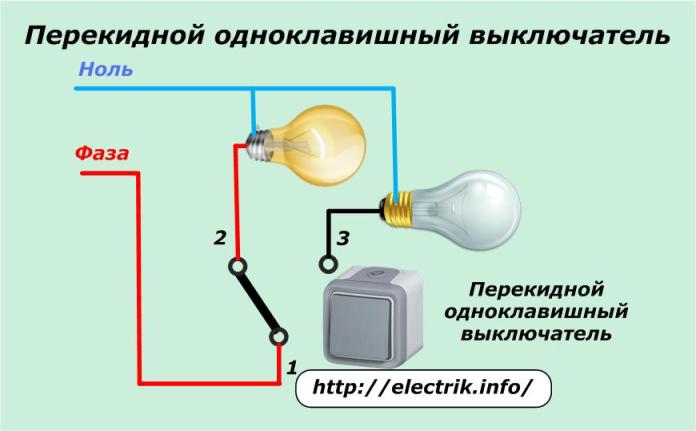
A switch is a switching device responsible for closing / opening the electrical circuit that feeds the lighting fixture. It is always installed in the section of the phase wire break. You cannot trust the illiterate "electricians" who claim that the neutral and phase wires must be connected to the switch. This will cause a short circuit and wiring problems.
Household models of switches are designed to work with wiring that uses the standard load. You cannot connect them to a network with other parameters. Each of the switches can only work with a certain operating voltage and current strength. These parameters are always indicated in the technical documentation and on the device case.
The main task of the device is to provide power to the electrical device and stop it when there is no need to use the lamp. Switches are available in a variety of designs. They differ significantly from each other in a number of ways. Let's take a closer look at these differences.
A standard circuit breaker is connected at the break of the phase wire. The task of the device is to close or open the electrical circuit, thereby including the lighting device
Types of modern electrical networks
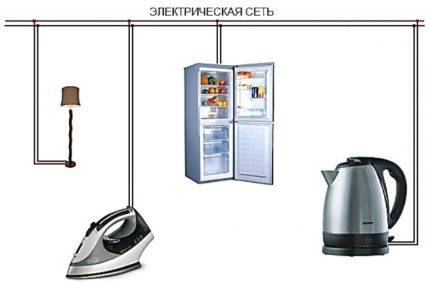
Before starting the review, it must be clearly understood that the socket is just the end point of a rather complex mechanism for “transporting” energy from a power plant to an industrial or household electrical appliance.
On the other hand, a switch is a simple key to breaking an electrical circuit. What unites them is that both of these devices interact with the same type of electrical network.



Voltage classification
In order not to go into the “wilds” of electrical engineering, it should be noted that often in the countries of Eastern Europe, conventional appliances can consume electricity at a variety of voltage levels:
- 220V, 50Hz;
- 380V, 50Hz;
- 120V, 60Hz.
The first category of the electrical network “gives out” voltages of 220 V (single phase) in the sockets of apartments.
This is enough for the operation of modern household appliances of domestic and foreign production: from kettles and curling irons to refrigerators and washing machines.
The second category of electrical network provides voltages at the level of 380 V (three phases) for industrial and agricultural appliances: from crushers and compressors to factory machines and electric speakers.
With the third category of the electrical network, it is a little more difficult: we do not have it, but there are electrical appliances. For example, after an order from "" or another foreign Internet resource, a trimmer ("cool" clipper) arrives by mail.
 The power supply network is a single-phase alternating current with a voltage of 220V with a frequency of 50Hz. It is transmitted to an ordinary consumer from the switchboard via two wires "phase" and "zero"
The user understands that it is impossible to charge a trimmer that is designed for a 110 V network and a type A plug connector using our 220 V and type F socket. A device dear to the heart and wallet will instantly fail.
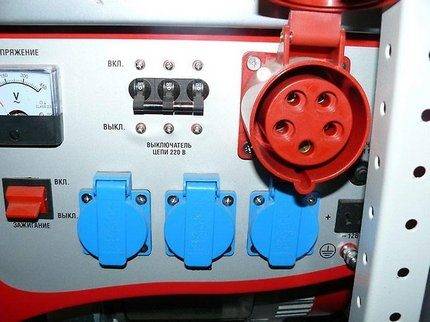
The power supply network is a three-phase alternating current with a voltage of 380 with a frequency of 50 Hz. It is transmitted to the end consumer via 4 wires of the ABC-phase and "zero"
Therefore, most prefer adapters, but there is an option to install an outlet for the above type of plug with a preliminary voltage drop on the electrical panel. To do this, you can use a special socket for the type A connector.
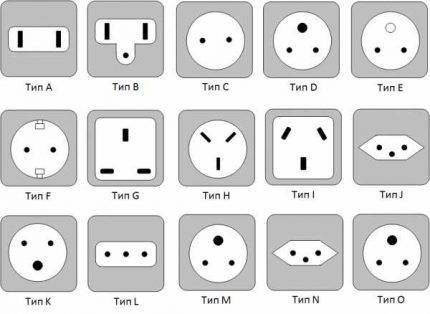 There are more than 10 different plugs and sockets in the world. Within Eastern Europe, plug types C, E and F are usually used.
Types of wires and permissible loads
Another important point that you need to pay attention to when choosing electrical switches and sockets is the quality of the wiring. Wires are different: cheap and high-quality
When cutting an aluminum two-wire wire from a reinforced concrete wall, every electrician and fireman remembers the person who suggested doing electrical wiring in Khrushchev and sockets from aluminum cables.
The power cable of the electrical wiring must be safe, of high quality, non-flammable and, at a minimum, copper. It is necessary to look towards such abbreviations as PRTO, VVGng and NYM.
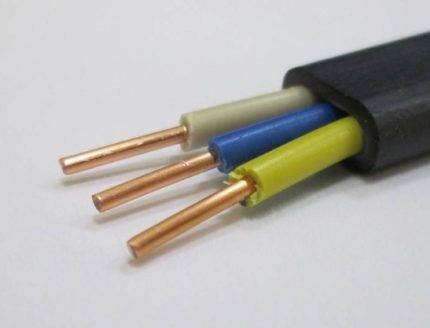 Copper wiring, although it will be more expensive, is much more reliable than aluminum. Copper does not have the effect of "air" oxidation, unlike aluminum
In addition, you should understand the type and power of the load connected to the outlet. We recall school physics: under the load of the electrical network, we mean every device and device that is connected to this network.
There are two main classes of loads:
- reactive;
- active.
active loads. These are electrical appliances that consume energy and transform it into heat: light bulbs, tiles, convectors, irons, etc.
reactive loads.This group includes any electrical device that is equipped, for example, with an electric motor or other mechanism for converting electricity into motion mechanics.
Such devices have a high switching current, which can cause thermal processes in the wiring, the outlet itself and on their connections. This can affect the process of ignition of insulation in various parts of the circuit: directly in the wire, at their connection, or at the point where the device is connected to the network.
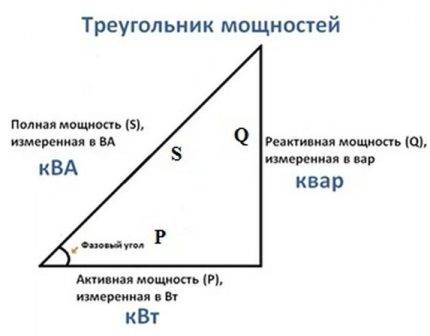 When calculating total power input networks, you need to take into account active power (measured in Watts) and reactive power (calculated in Volt * Amperes)
Sockets and switches must be selected in such a way as to ensure safety in the apartment, office and house, even when connecting almost all electrical appliances that are available. Therefore, it is imperative to select only high-quality products with a maximum service life.






Designation of switches on building diagrams
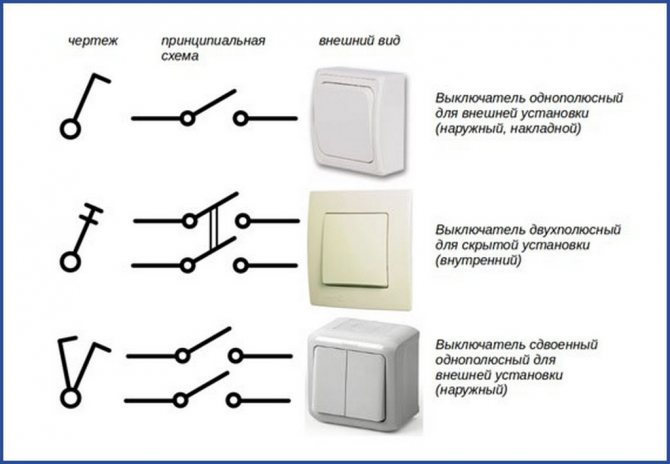
One of the schemes used by electrical builders is not a fundamental electrical one. This is the layout plan. It is carried out according to its own rules and has designations different from the circuit diagrams.
Sometimes consumers need to agree on a project, as customers they have every right to do so. They are shown a scheme that is difficult for them to understand and they often accept it as it is, and then fiddle with alterations. The designation of sockets and switches in the drawings is shown below.
The designation of the switches in the drawings is indicated by a small circle, from which a segment proceeds at an angle of approximately 60 ° to the horizontal. An open-mounted switch is indicated by a short dash to the right, set aside from the end of the segment.The number of such dashes shows the number of poles. The number of independent switches in a group is shown by repeating vertical segments shifted at an angle of 30°: a four-gang switch will be represented by four segments, a triple switch by three, etc.
Rosettes are indicated by a semicircle convex upwards (usually a segment of a circle). As many segments are laid off from the circle as the socket has poles. If the socket has a terminal for protective earth, then a horizontal tangent is displayed at the top of the arc.
The pictures showed overhead sockets and switches. Hidden ones differ from them only in a vertical line in the circle segment (sockets) and a T-shaped dash instead of an L-shaped one at the switches. Outdoor sockets and switches designed for outdoor (outdoor) operation are marked similarly to those shown, but they have a higher protection class: from IP44 to IP55, which respectively means: “no gaps of 1 mm or more and protection against splashes from any direction ” and “partial protection against dust and short-term protection against jets from any direction”.
To distinguish between such sockets in the drawings, as well as switches, they are filled with black solid color. All other rules for notation remain the same. For more information about electrical designations on construction drawings, refer to GOST 21.614–88.
Types of electrical switches
As noted earlier, an electrical switch is nothing more than an electrical circuit breaker. This is a very simple mechanism, and yet every master electrician needs to know its technical features.Knowing them, you can be sure that the device will work safely in normal mode for a long time.
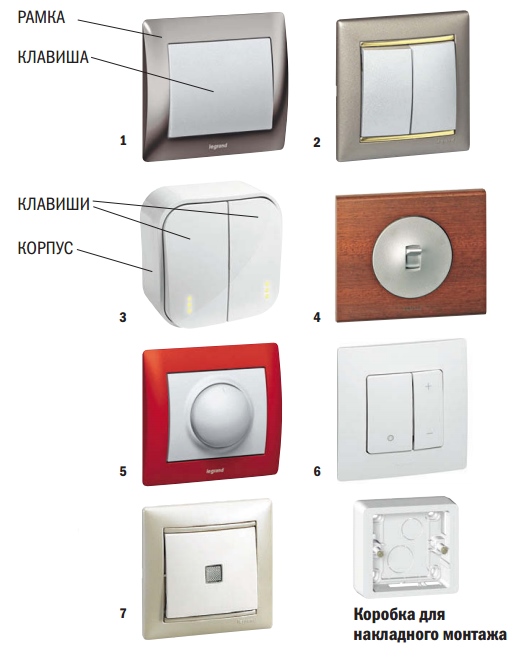
In domestic conditions, voltage switches up to 250 V with a maximum current of up to 10 A are used. A standard switch consists of a key, a frame and a base mechanism
Given the current pace of development of electrical engineering, current engineers, specialists and building repair masters distinguish a significant number of types of electrical switches, which can be easily divided into several groups.
Image gallery
Photo from
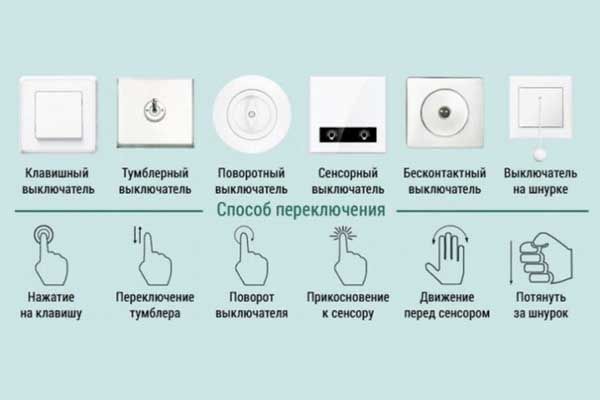
Switches used in the arrangement of household power lines differ in the number of controlled branches and the method of switching
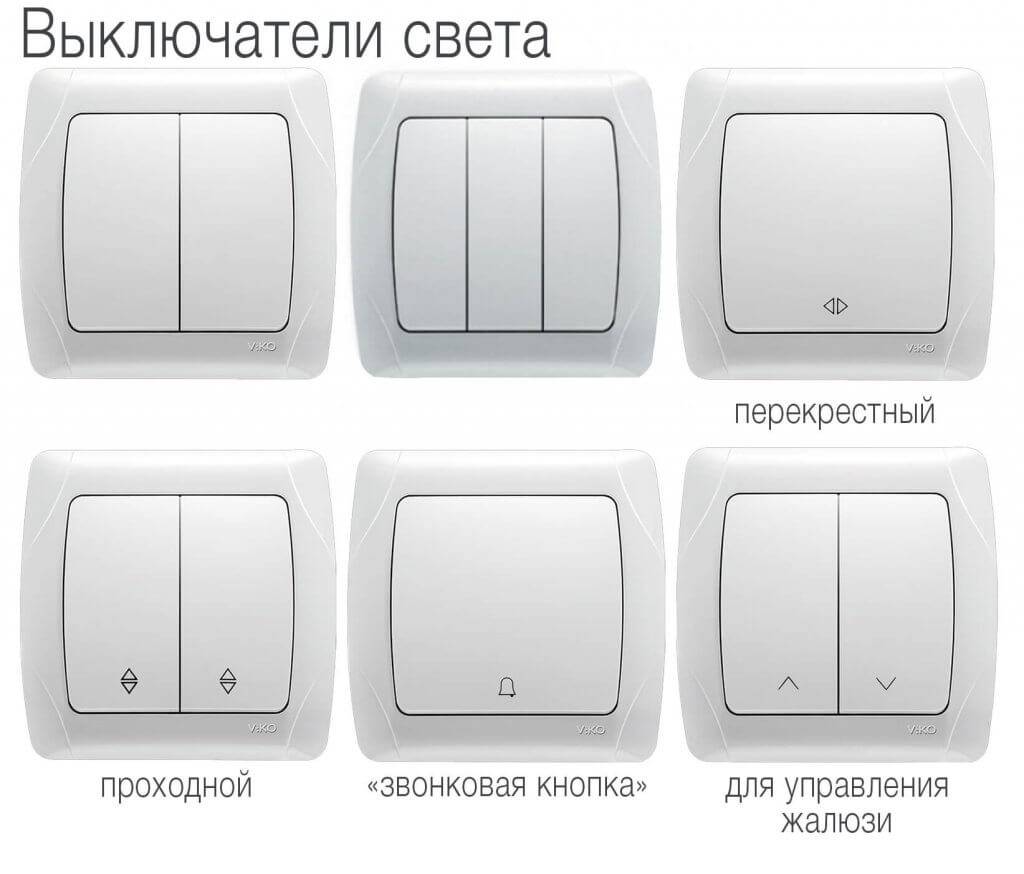
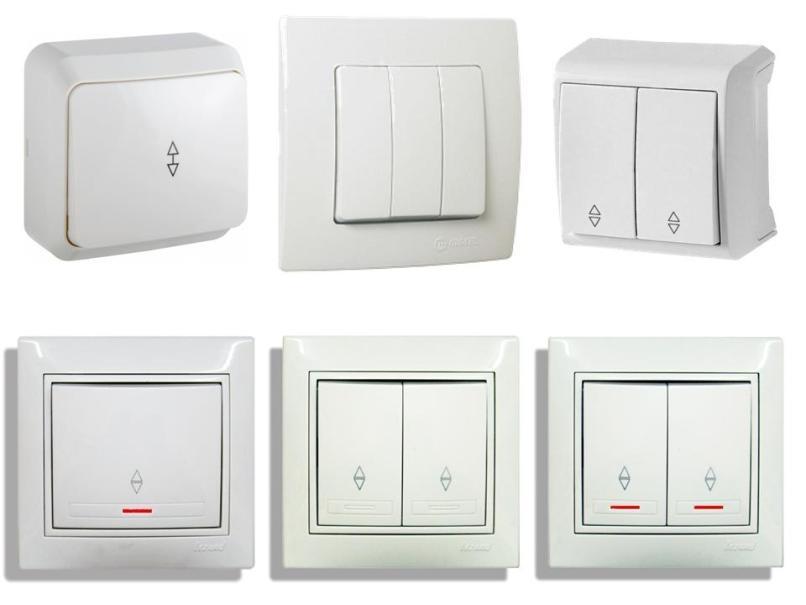
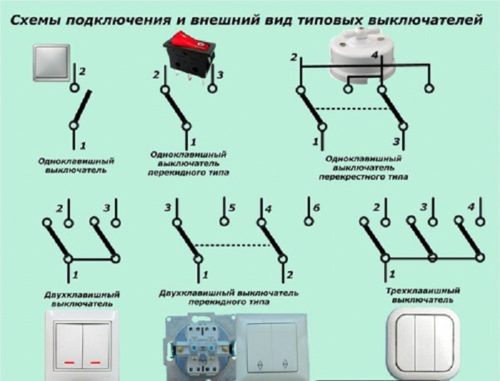
In standard models of household switches, there are 1 - 3 keys. If it is necessary to increase the number of branches, a group of switches is most often mounted
According to the type of switching, sockets are divided into devices with screw and screwless terminals. In the screw version, the wiring core is clamped between metal plates when screwing the screw
In the screwless version, the current-carrying conductors are clamped with spring devices, which speed up the wiring process and provide a stronger connection.
Single key switch
Traditional number of keys
Screw terminal mechanism
View with screwless terminals
It is enough to decide on the following list of answers to such questions:
- mains voltage (for Eastern Europe, 220V / 380V is typical);
- degree of dust and moisture protection (dust IP20, moisture protection IP44, IP54, IP64);
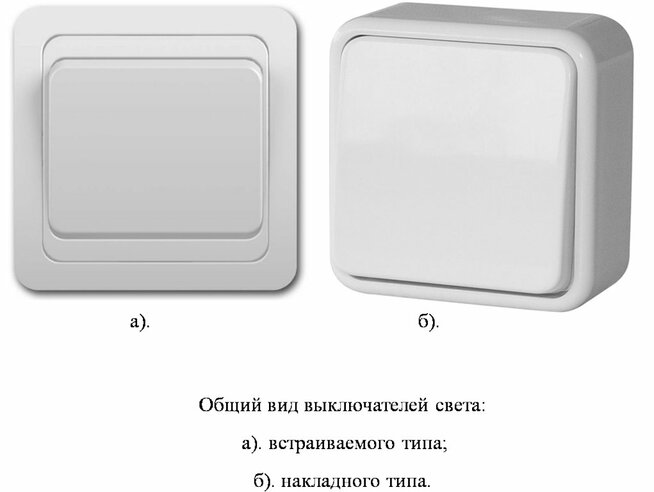
- installation method (hidden, outdoor);
- switching method (screw, clip).
Additionally, switches can also be classified according to the type of off / on, for this, keys, buttons, rotary keys, rope, touch, wireless switches, motion sensors, dimmers, etc. are used.
The latter should be discussed separately, since these mechanisms produce a “transfer” of the power grid from one circuit to another. As a result, it is possible, for example, in an office to have several separate lighting systems on one multi-key switch: full lighting, partial, duty, etc.
In domestic conditions, switches are used for voltages up to 250 V with a maximum current of up to 15 A. The switch is a combination of several switches
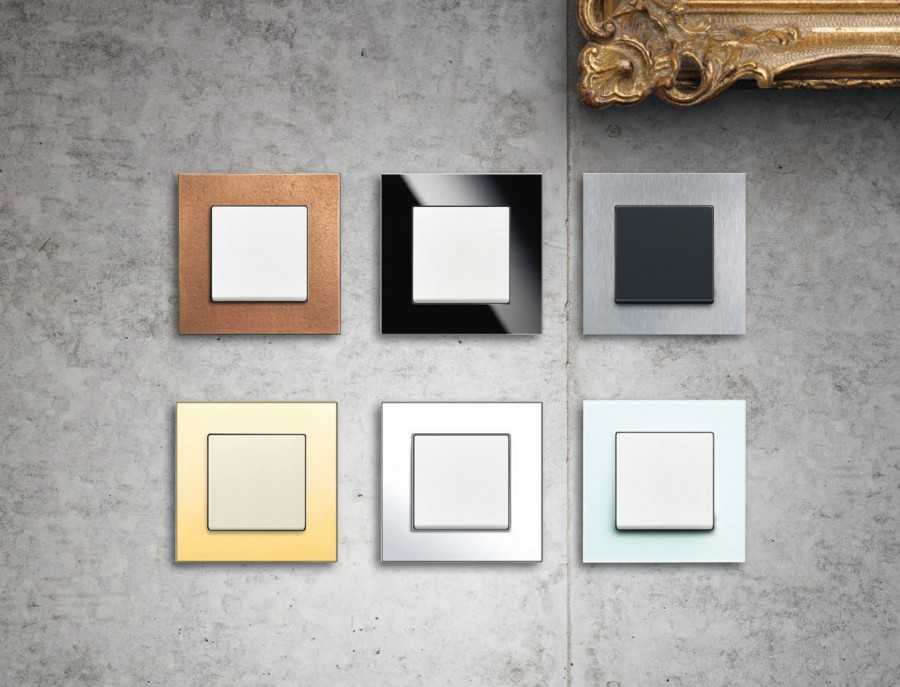
Probably everyone can cope with the choice of the color palette of the switch lining! Overlays with a matte surface in soft pastel colors look very elegant and stylish.
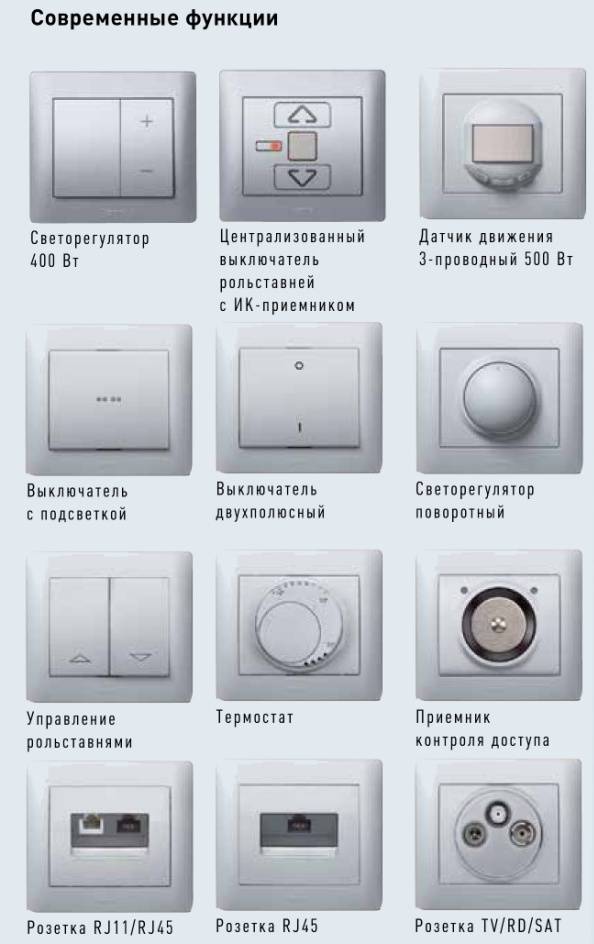
Modern devices
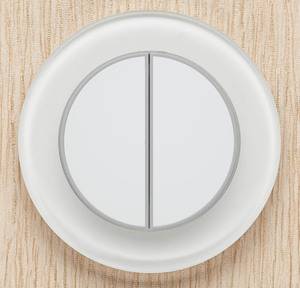
They practically do not differ from simple devices, except for the way they are turned on. Together with them, cross or reversible devices are often used. Such a complex of switches is used to control the light from three or more places. Its design includes 4 contacts - 2 each at the input and output.
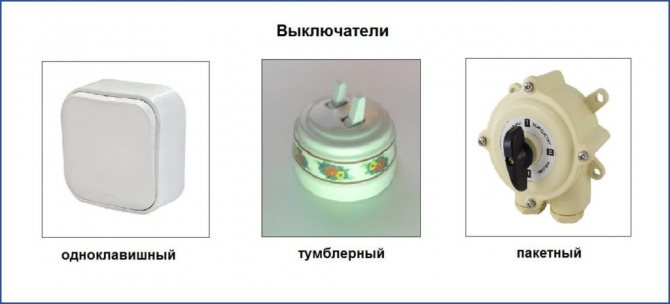




In some cases, these devices can be used as simple switches. Dimmers (dimmers) have become popular. They are distinguished by the ability to regulate the power of lighting, except for complete shutdown, and are an adjustable resistance, which is controlled by a round knob and installed in the network in series to the consumer. Such switches are especially convenient in houses with a large number of rooms and utility rooms.
No less popular are acoustic switches that are triggered by clapping your palms.The only drawback is the abnormal operation from extraneous noise.
Remote switches are considered more popular, allowing you to control the light from the remote control. They have great software capabilities not only to turn the light on and off, but also to set a certain lighting power.
Which is better to choose: tips
Criterias of choice:
- The material from which the product is made. Soft cheap plastic quickly breaks, scratches during the first installation. It is better to use durable plastic.
- Marking and manufacturer. Before choosing a device, you need to know in what conditions it will be used, and with this in mind, look at the marking. If there are no labels on the packaging, the product is a fake, which is better not to buy.
- It is advisable to look at the internal structure, check the clamps, screws, plates, the absence of scratches and breakages.
- A good product won't stink of cheap plastic.
- Number of components, method of attachment. A low-quality device will be almost monolithic without additional clamps.
- Availability of instructions for installation and assembly.
- The rated values of current and voltage must be specified. It is better not to purchase goods without marking.
closed round
A closed switch is used where the wiring runs in the wall and the mounting area is prepared.
When choosing a round switch, it is important to pay attention to the degree of moisture and dust protection.
Built-in small (recessed type)
Used for hidden wiring. The main type of switches in offices, residential premises. Before buying, it is advisable to check the mobility of the keys.
Various types of switches
Next, we will look at the different types of switches.In addition to the usual switches familiar to all of us, there are other types of switches that are not so popular, but at the same time have their own characteristics and advantages. Let's look at some of them.
Innovative touch switches
These switches are activated by lightly touching a special sensitive touch panel located on the outside of the device. Thus, the panel works in a button or key system. Its design includes an electronic circuit operating on the semiconductors of the sensing element and its own switch. By touching the panel. Tactile contact occurs and the sensor element sends a signal to the electronic circuit. Touch switches can also be equipped with additional sensors and respond to their signals or work remotely.
Touch switches
Remote switches
These switches can control the luminaire from a distance. With the help of a special remote control, a command is transmitted to the lighting device via a radio channel. The switch in this case is a receiver equipped with switching contacts that cut into the supply wire of the lamp.
Remote switches
A remote control is attached to this type of switch. Often it looks like a regular keychain. The range of its action largely depends on the material from which the remote control is made, but usually this distance is 20-25 m. The remote control runs on power, which depends on batteries. This scheme involves microprocessor controllers. They allow for additional functions: setting the timer, adjusting the light intensity, etc.
Switches with built-in sensors
These special sensors have detectors that can determine the level of movement of the environment. More precisely, the absence or presence of a fairly large object in the affected area, as well as the intensity of illumination.
Switches with built-in sensors
The signals from the sensor are sent to the controller, which analyzes them. When the predetermined parameters are fixed, a signal is sent to the executive body. After that, the closing-opening of the contacts of the circuit occurs. So the switch works only after it detects the movement of an object in the reach zone. The device saves a lot of energy and is quite easy to operate.
Pass-through or toggle switches
This is a kind of keyboard models. Unlike pass-through switches, they do not open / close contacts, but simply switch them. That is, one of the lamps connected to this switch lights up or goes out. Toggle switches are needed in order to use them to control the connection of light in several rooms at the same time. They can be removed from each other, the main thing is that not only one, but also several lighting fixtures can be connected to such devices.


The best manufacturers of premium sockets and switches
The high price of switches and sockets is justified by the excellent quality of such products. It has an extended service life, a wide range of classic and original products, a variety of designs and high performance.
Top manufacturers produce both standard switches and sockets, as well as models with improved characteristics.
ABB (Asea Brown Boveri)
5.0
★★★★★
editorial score
97%
buyers recommend this product
Asea Brown Boveri was born from the merger between the Swedish manufacturer ASEA and the Swiss Air Force.
The combination of the precision of the Swiss and the pedantry of the Swedes allowed them to produce high-quality products of various configurations.
Sockets and switches ABB combines stylish design and high quality raw materials used for production.
The main material of switches and sockets is traditionally plastic in white, beige, silver, black and other colors.
The brand also produces various decorative overlays for metal and glass. The materials used are impact-resistant and UV-resistant.
Advantages:
- Variety of designs;
- Decorative overlays;
- Presence of blind switches;
- Devices for vertical and horizontal mounting;
- Quality manufacturing materials.
Flaws:
There are no dimmers.
ABB brand products are in demand both among ordinary users and in large enterprises. Stylish sockets and original switches emphasize the status of home owners and are a good addition to a modern interior.
Makel
4.8
★★★★★
editorial score
90%
buyers recommend this product
The Turkish company Makel uses German technology in the manufacture of its products, ensuring the durability and reliability of sockets and switches.
The product line is represented by products made in a classic design. Products are made in light shades, which makes them versatile and quite suitable for classic and modern interiors.The design is dominated by soft, rounded shapes.
A small selection of designs compensates for the high quality of goods. Impact-resistant plastic does not attract dust and is easy to clean - dirt does not eat into the structure of the material.
The body is made of fire-resistant plastic, and the contact group is characterized by good response and durability.
Advantages:
- Universal design;
- The presence of interchangeable decorative frames;
- The presence of dimmers in the range;
- Multi-module sockets;
- The presence of sockets for TV, PC and phones.
Flaws:
- A small assortment of each type of product;
- No color patterns.
Makel has long been known in the Russian market and has a reputation as a reliable manufacturer.
DKC
4.8
★★★★★
editorial score
90%
buyers recommend this product
The Russian company DKC is known for its products not only in Russia, but also far beyond its borders. There are more than 1000 positions in the product catalog of this brand, among which switches and sockets take pride of place. And although they are not the main field of activity of the company, they are still in demand among buyers.


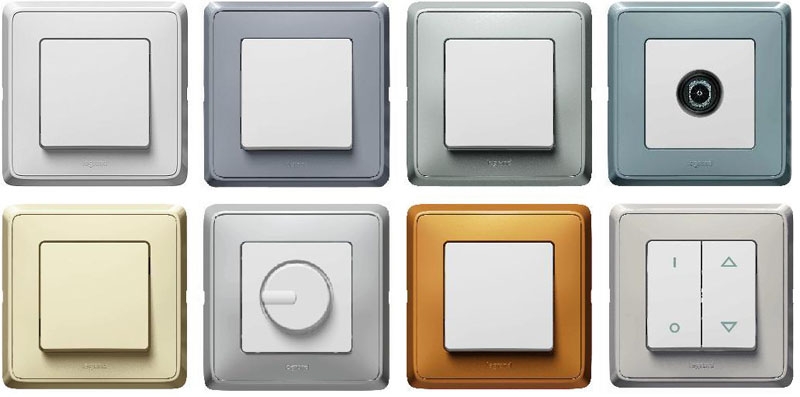

The brand produces plug, telephone and computer sockets, switches and additional accessories: covers, plugs, decorative panels. The main advantage of the products is the high quality of materials, characterized by a long service life.
Advantages:
- Brand popularity in Russia and abroad;
- Variety of types of sockets;
- Availability of additional accessories;
- Excellent quality of materials;
- Relatively low price.
Flaws:
No unusual designs.
Although the DKC brand is not a narrowly focused manufacturer of switches or sockets, its products deserve the attention of buyers who are looking for special electrics.
Materials used in switches
Two types of materials are used to make switches. The first is conductors, which must meet the requirements of high corrosion resistance and low electrical resistance, and the second is insulation. Here, on the contrary, the resistance should be as high as possible, and the resistance to heat and chemical resistance should also be at a height. Mechanical strength is also very important, since sometimes increased forces are applied to the switches.
For current-carrying parts in the composition of switches, brass, copper, bronze are used. These materials are corrosion resistant and have low resistance. Contact surfaces are very often supplied with soldering from alloys containing precious metals: silver, gold, platinum, rhodium. This increases the service life (time between failures) of the circuit breaker. Cheap models use simple copper soldering with alloying additives.
The base and movable insulating parts are made of heat-resistant and low-flammable plastics with mineral fillers. The fact is that with the passage of significant currents and increased contact resistance in the contacts, the switch begins to heat up and this heat should not damage its design. Powerful switches use ceramic materials and asbestos. Switch housings are made of various materials, depending on the version.



