- Classification by type of wire/cable connection
- Design features
- Classification by contact type:
- 1.1 With bronze contacts
- 1.2 With brass contacts
- 1.3 With tinned brass contacts
- Classification by tightness and degree of security
- Which smart socket to buy
- Types of socket connectors
- Classification by type of installation
- Varieties of electrical sockets
- How to distinguish high-quality devices from low-quality ones
- Choice by manufacturer
- Choice by mounting type
- Standard norms for placing sockets, switches in diverse residential areas
- In the kitchen
- In the living room
- In the bedroom
- In the bathroom
- In the hall
- What are the types of sockets and switches?
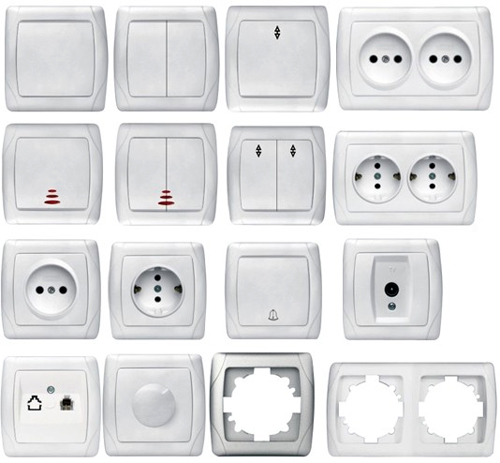
- socket types
- Types of switches
Classification by type of wire/cable connection
The wire connection can be through a straight end or a twisted end in a loop. In the latter case, the contact is more reliable, since the conductor has a large contact area. When joining a direct wire, it is necessary to carefully clean its mounting area, since the area of \u200b\u200bcontact with the socket contacts is much smaller.
In addition, the wire can be fixed in two ways - with screws and with special clamps. Clamps are good because they allow you to install sockets faster.High-quality clamping sockets ensure good contact for a long time. As for traditional screw connections, they are also reliable. Their disadvantage is that they require periodic tightening - due to the loosening of the screws due to regular heating / cooling.
Sockets are often combined into modules. On sale there are products of this type with holes for parallel connection to the electrical network.
Design features
- tinned brass - for conditions with high humidity;
- brass - use in buildings with normal humidity;
- bronzes are universal options.
 The most capricious are white brass contacts, devoid of sputtering. With regular exposure to moisture, their oxidation occurs, which leads to a deterioration in quality. This drawback is eliminated with the help of special springy petals that support the contact plates.
Tinned brass has a matte white tint, retains its shape longer, has good springiness, and has a protective coating. Similar contacts are present in sockets, which are often mounted on the street.
Sockets, supplemented with bronze elements, are used the least often, a distinctive feature is their high cost. Such products have a matte yellow color. The main characteristic of bronze products is to create high-quality contact for a long time, they spring well.
Classification by contact type:
1.1 With bronze contacts
These products belong to the high price category. Contacts have a dark yellow matte tint. Very good spring, characterized by increased strength and resistance to oxidation. Such sockets are suitable for any operating conditions.
1.2 With brass contacts
 Socket with brass contacts
Such contacts are completed with sockets of a low price category. Brass is not tinned. It is easy to identify by its bright sheen and light yellow tint. The metal is soft and therefore quickly unbends with frequent use of the outlet. This leads to deterioration of the contact connection.
More expensive sockets equipped with special clamping springs are deprived of this drawback. Plain brass quickly oxidizes when subjected to constant/regular exposure to high humidity.
1.3 With tinned brass contacts
Tinned brass contacts are most often used in sockets from the middle price category. They have a specific whitish matte shade. They keep their shape for a long time and spring well. Due to the presence of a protective layer, they oxidize more slowly than simple brass. This type of sockets can be used when installing electrical wiring at sites with a humid microclimate and for outdoor installation.
Classification by tightness and degree of security
This parameter allows you to select an outlet for rooms with high humidity, dust. In the living room, the installation of a conventional device is suitable, and for the corridor - with a dust protection mechanism.
Typically, sockets contain two types of markings:
- IP;
- NEMA/UL.
The first shows the level of protection from dust, moisture, large particles. The second tells you in what conditions this or that device is used.
There are 9 levels of moisture protection, indicated by numbers:
- 0 - no protection.
- 1 - vertical drops will not damage the device.
- 2 - protected from vertical water particles and falling at a slight angle.
- 3 - short circuit is prevented even if drops fall at an angle of 60°.
- 4 - the socket is not afraid of any splashes.
- 5 - the structure is protected from water jets from different directions.
- 6 - there is protection even from sea waves.
- 7 - for a short period of time, the socket works under water at a maximum depth of 1 m.
- 8 - the device can be immersed to a depth of more than 1 m.
- 9 - the socket will work during any dive.
If we talk about the second type of marking, NEMA, there are 11 types:
- Suitable for use at home or in office buildings. Protected from dust and touch.
- Usually used as household. Withstands conditions with a low level of humidity, dustiness.
- Recommended for use outside the home. Not afraid of icing, precipitation, dust.
- Like the previous view, it works great at low temperatures.
- Copes even with the sticking of ice, wet snow. Weather conditions do not affect the functionality of the device.
- It is used in dusty places located near highways. Sockets of this type are protected from dirt and water flying from under the wheels.
- Can be installed outside the building even in heavy rain or snow, wind, dust.
- The completely closed case allows you to use the device even under water, however, for a short period of time.
- This type of outlet is not used in domestic conditions. Only suitable for aggressive environments.
- Used indoors. Protected from dust, dirt and liquids.
- Designed for installation inside a building. They have almost all types of protection: from dirt, oily liquids, water, coolants.
There are other classification systems and, as a result, labeling. For example, in terms of the strength of the hull.


Which smart socket to buy
The variety of commercially available smart sockets can be divided into two main types according to the installation method:
- Recessed sockets - are placed inside the wall, so their body does not protrude above the surface.
- Overhead - mounted on the surface itself. They are more prone to damage, but are often used for decorative purposes or in high humidity areas.
Since sockets are used constantly and quite intensively, they require a high degree of reliability. Poor-quality models or fakes are distinguished by mediocre assembly, cheap manufacturing materials with a pungent odor and poor appearance of contacts. It is better to refrain from buying such devices - no matter how cheap they are.
For the bathroom, you should choose sockets with good protection against moisture. A reasonable option is built-in sockets with protection according to the IP44 standard or higher. For safety, bathroom models must be grounded.
Before buying sockets for the kitchen, you should consider their future location so that you do not have to buy extension cords. They also require protection from dust and dirt.
Sockets for a washing machine, electric stove or other powerful equipment should have a thick copper cable.
Bedrooms will be a great place for smart plugs, which are characterized by maximum usability. They can be turned off or on at a user-specified time.
An overhead socket can be placed on the balcony to avoid unnecessary manipulation of electrical wiring. It is desirable that the model has protection from dust and a light indicator for the dark time of the day.
If there is a TV or computer in the room, you can install sockets specifically for an Internet connection or a display connection. The selection of an outlet for the Internet is made taking into account the type of cable used by the provider.
Types of socket connectors
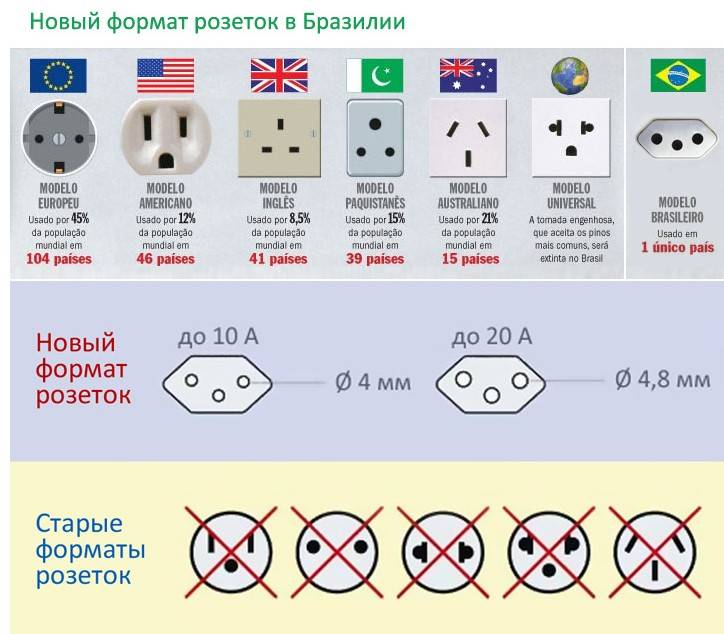
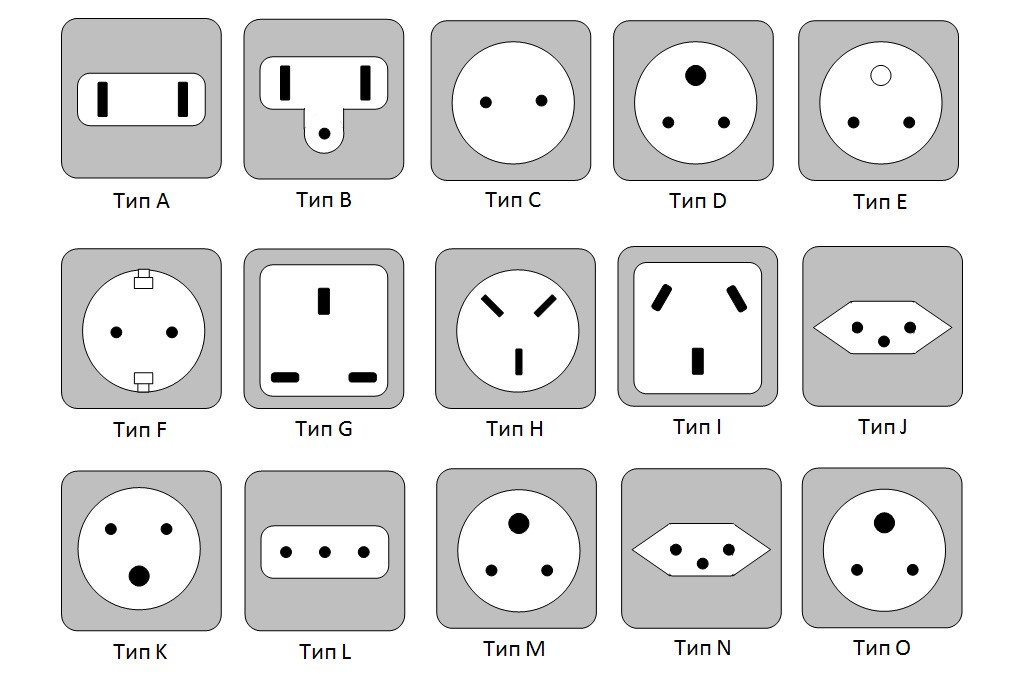
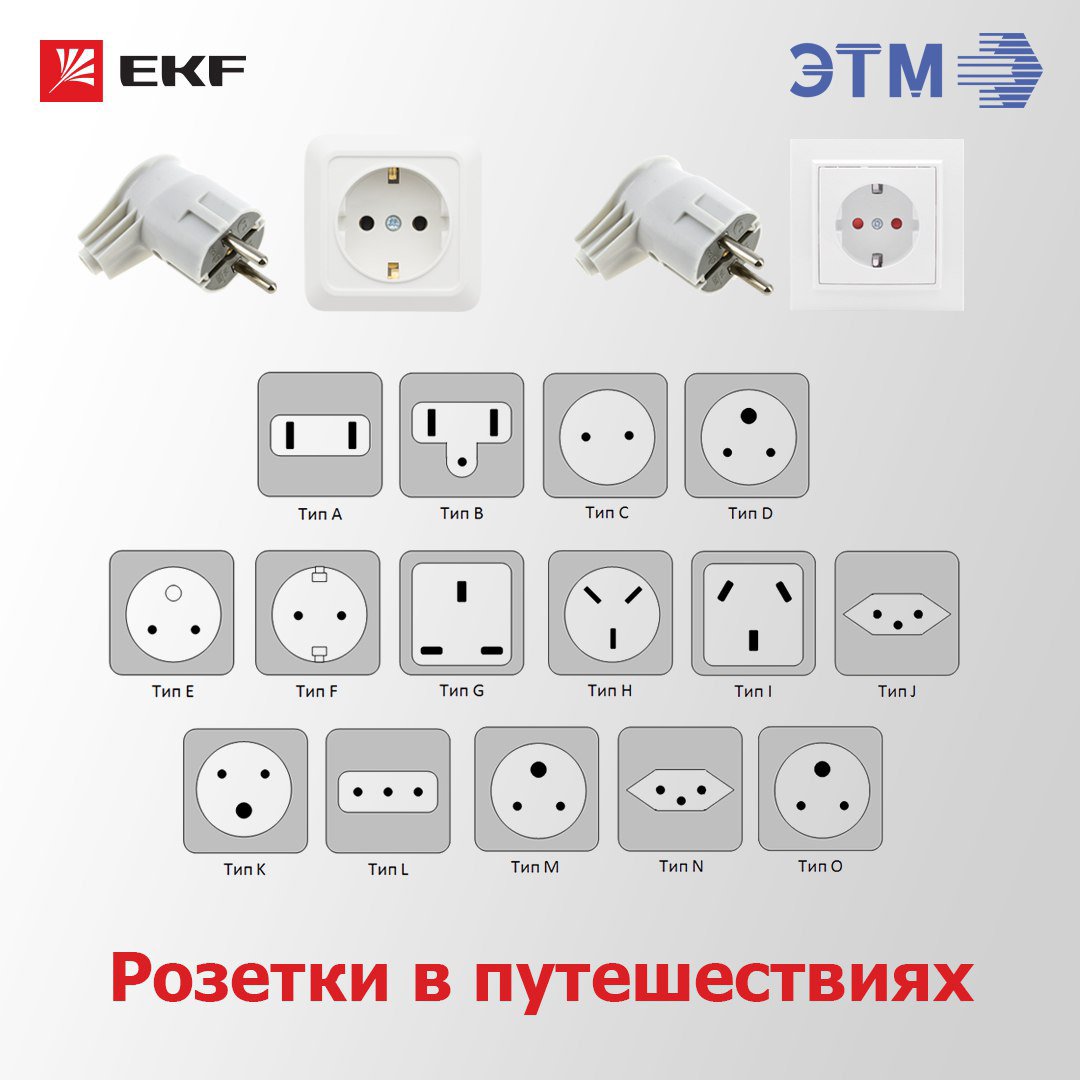
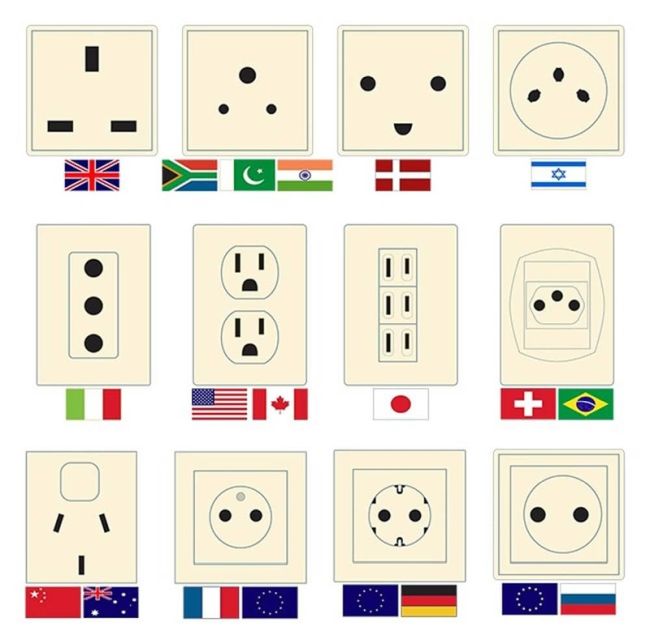
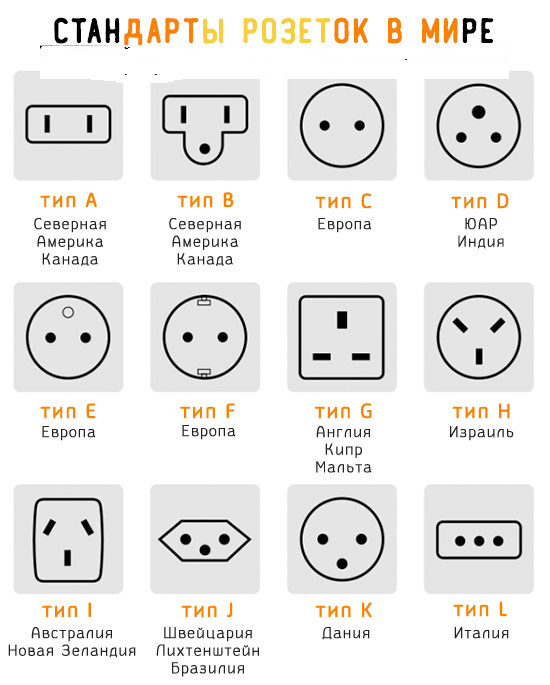
Depending on the country in which certain standards are legally fixed, sockets differ in the number of contact elements, as well as their shapes and sizes. Moreover, each device has a letter designation approved at the end of the last century by the US Department of Commerce. The classification proposed by the Americans was approved by other countries, and is currently valid worldwide:
Type A
A is a standard that was once ubiquitous in North America. Following the United States, it began to be used in 38 countries. This type consists of two ungrounded flat contacts arranged in parallel. A grounding element is not provided in this case. Today, such devices can still be seen in many old buildings, since they are all compatible with the modern type of plug. The Japanese standard has certain differences, which provides for additional requirements for the parameters of product cases.
Type B
B - an improved version of the American standard, supplemented at the bottom of the design with a long round contact that provides grounding. In addition to the United States, these types of electrical outlets are used in Canada and Mexico. In addition, they are found in a number of countries in South America, including Colombia, Ecuador and Venezuela.
Type C
C is the most common standard in Europe.The so-called euro socket, consisting of two round contacts, is used, among other things, in the CIS, as well as in the Middle East and in most countries of the African continent. There is no grounding in this design. In the Russian Federation, the dimensions and safety requirements for such products are determined by GOST 7396.
Type D
D is an obsolete standard previously used by the British in the territories that belonged to the British Empire. At the moment, sockets with three round contacts located at the vertices of a triangle are mainly used in India, and are also found in old houses in other countries, where the British once had a hand in arranging power lines.
Type E
E is a modern French standard, which differs from type C by the presence of a grounding contact, which is located at the top of the device. Similar power grid elements are also used in Belgium and Poland. At one time they were introduced on the territory of the former Czechoslovakia.


Type F
F - European standard in the form of a design of two round contacts, supplemented at the top and bottom with grounding brackets. Initially, such devices appeared in Germany and began to be used for alternating current. These types of sockets and plugs are also called "Schuko", which is an abbreviation for the German Schutzkontakt, which literally means "protective contact". Products are fully compatible with plugs of Russian and Soviet production.
Type G
G - British standard, which provides for a fuse located inside the plug. The device consists of three flat contacts, two of which are located at the bottom and one at the top.It is allowed to connect euro plugs using a special adapter, which must also have a built-in fuse. This type of power grid elements is supported in Ireland, as well as in the territories of some states that were once British colonies.
Type H
H is an Israeli standard, which consists of three round contacts (until 1989 flat elements were used), forming the Latin letter Y with their location. This type of connection to the electrical network is unique, since it is used exclusively in Israel. Other types of sockets and plugs are absolutely incompatible with it.
Type I
I is the standard used in Australia and New Zealand. Two flat contacts are set at an angle. The third is vertically located below and is a grounding element. Similar types of electrical outlets are used in Papua New Guinea and also in the Republic of the Fiji Islands.
Type J
J is a Swiss standard that has a certain similarity with type C, but at the same time differs in the presence of a grounding contact set aside. When connecting europlugs, there is no need to use adapters.
Type K
K - Danish standard, the only difference from the French type is the location of the grounding contact installed directly in the plug, and not in the socket design.
Type L
L - Italian standard, assuming compatibility with Euro plugs type C. The design consists of three round contacts forming a horizontal row.
In some cases, older British designs still in use in South Africa may be marked with the letter M.
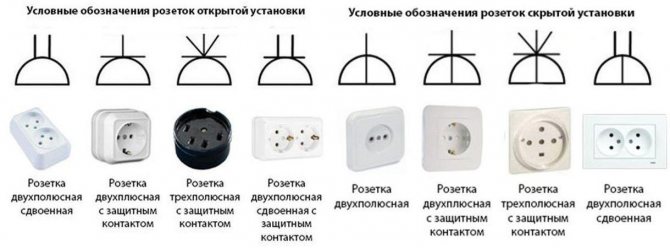
Classification by type of installation
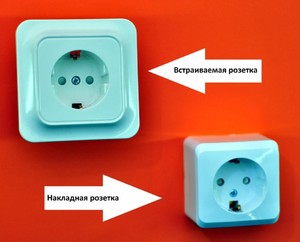
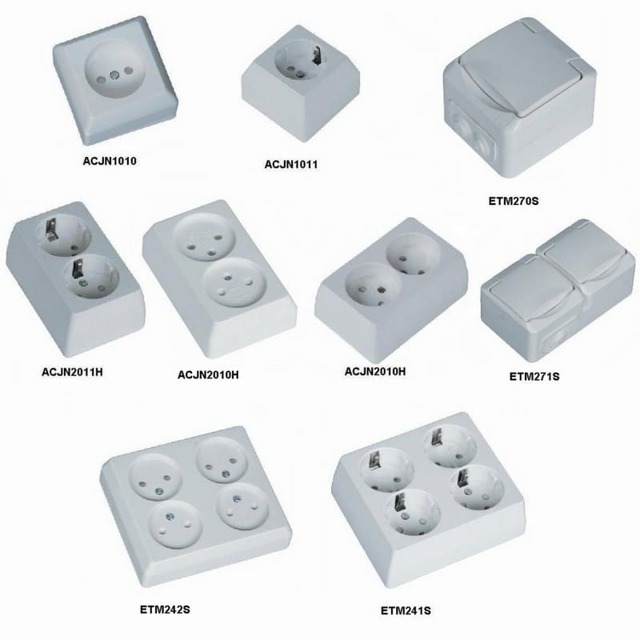
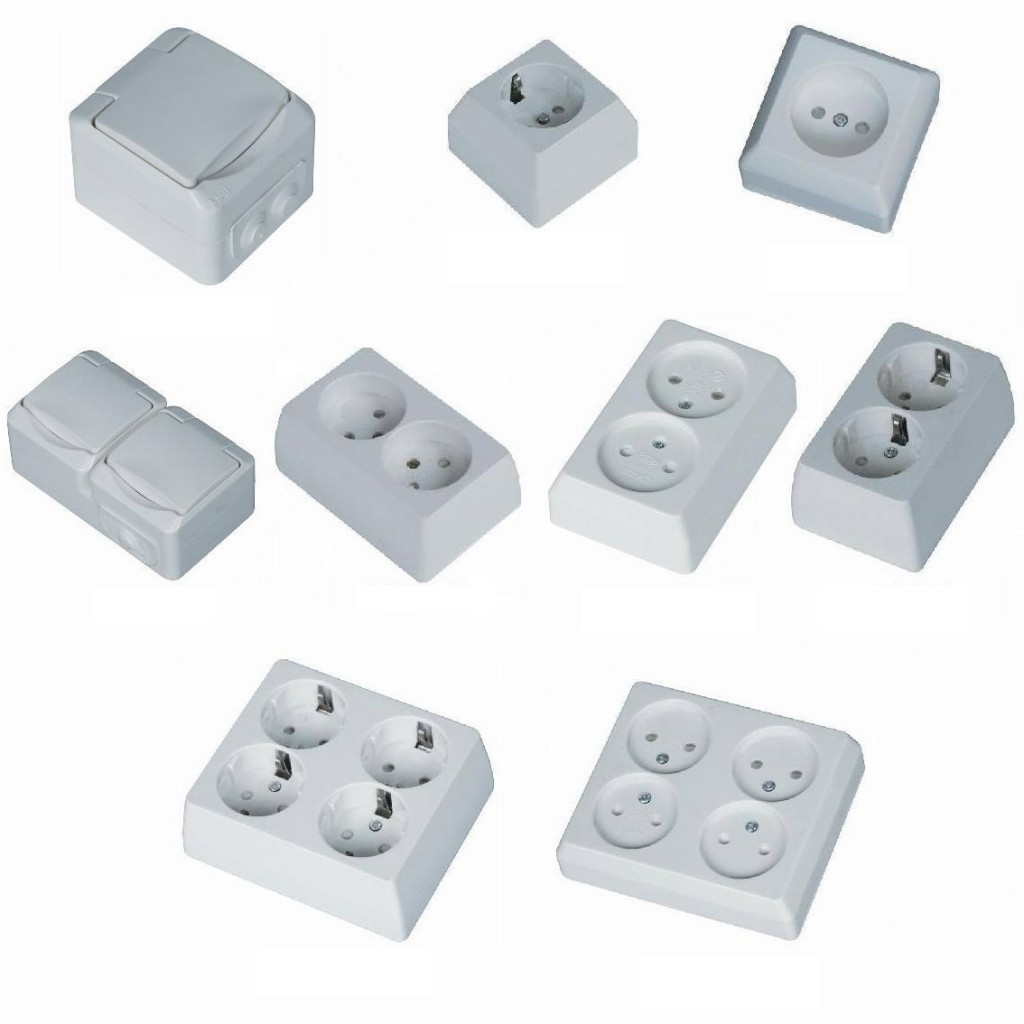
According to the type of installation, there are three types of sockets: external (external), internal (hidden) and retractable. External models are fixed immediately to the plane of the wall. When installing on fire hazardous surfaces, it is recommended to additionally use dielectric plates. They are sold in stores, but it is easy to make them with your own hands - just cut a square or circle of the right size from textolite, asbestos-cement slab, etc.
External devices have two advantages. This is a quick installation and easy replacement (if necessary). Their disadvantage is that they look unaesthetic and often "spoil" the interior. In addition, protruding overhead products can be "hooked" or accidentally hit with a heavy object, which often leads to breakage of such sockets.
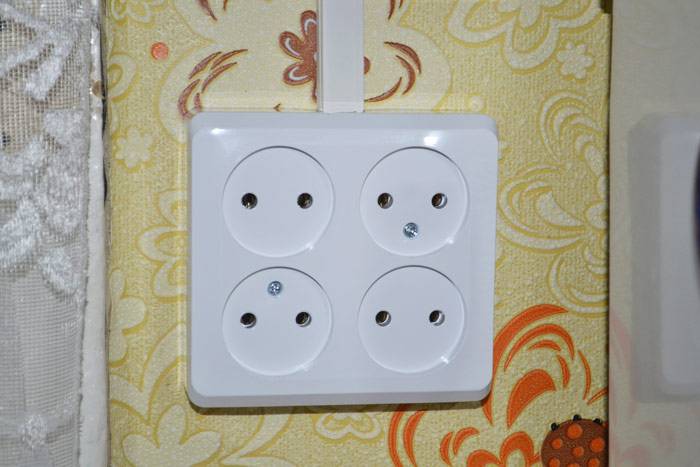 Example of an external socket with four sockets
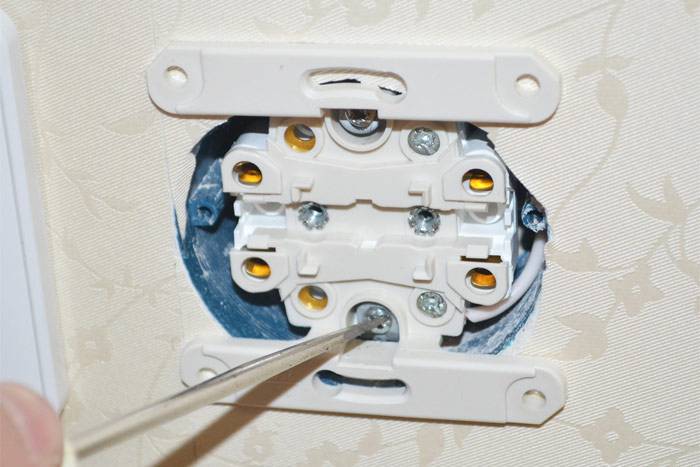
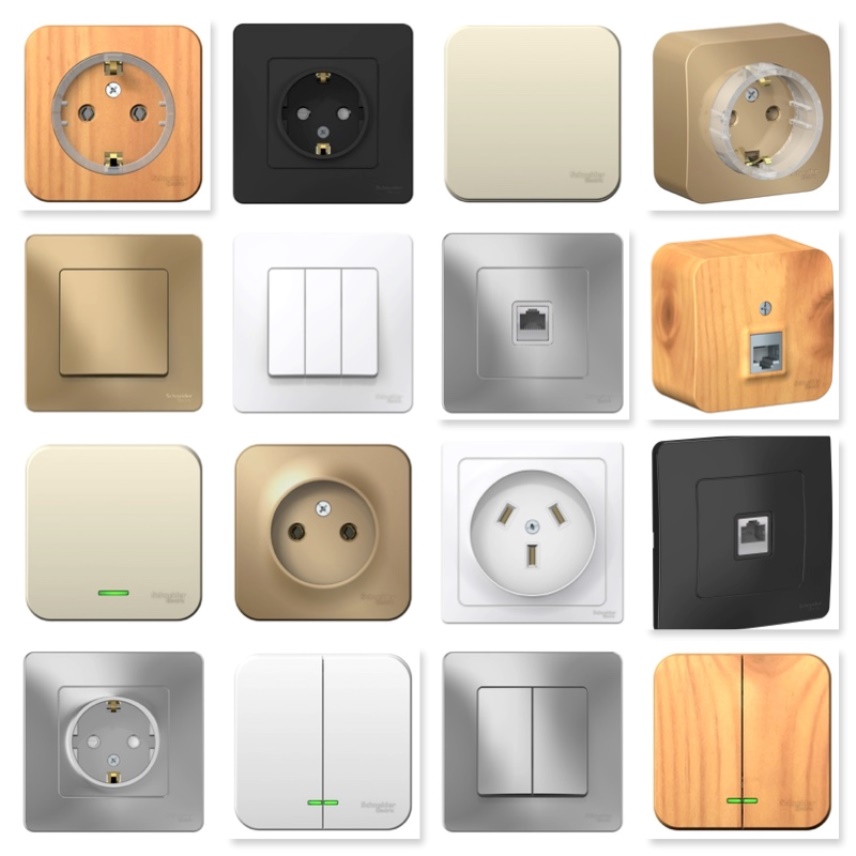
Internal models are more difficult to install. They are inserted into the so-called "glasses" (sockets), which must be mounted in the wall. In the case of concrete and brick surfaces, you will need a puncher for these purposes. But hidden sockets look aesthetically pleasing. Their front panel is completely recessed into the wall, or protrudes only a few millimeters.





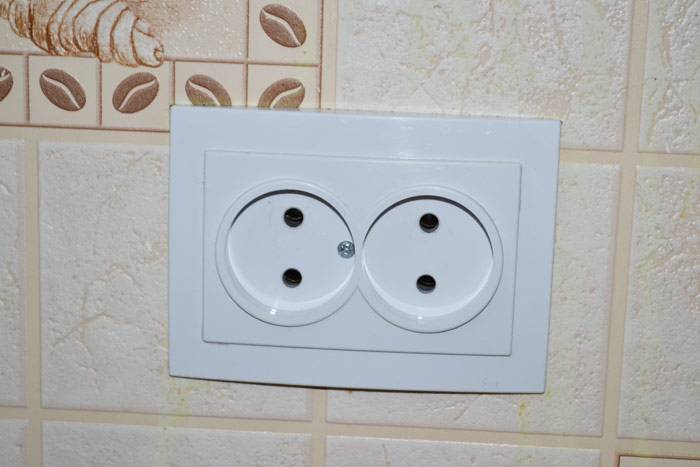 Example of an internal (recessed) outlet
Retractable models are expensive. They are practical and functional. Most often used in the arrangement of kitchen premises. Such sockets are built into countertops, side panels of cabinets, etc. They are even mounted inside the floors. All that reminds you of the presence of an outlet is a neat cover, under which socket blocks are “hidden” for convenient connection of any equipment.
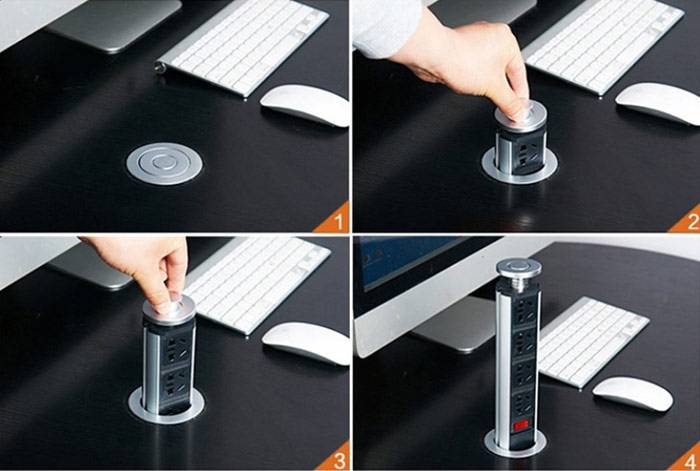
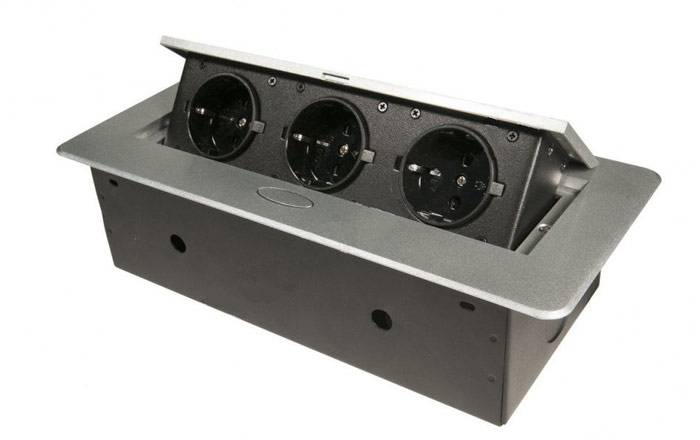 In the photos above, an example of retractable sockets
Varieties of electrical sockets
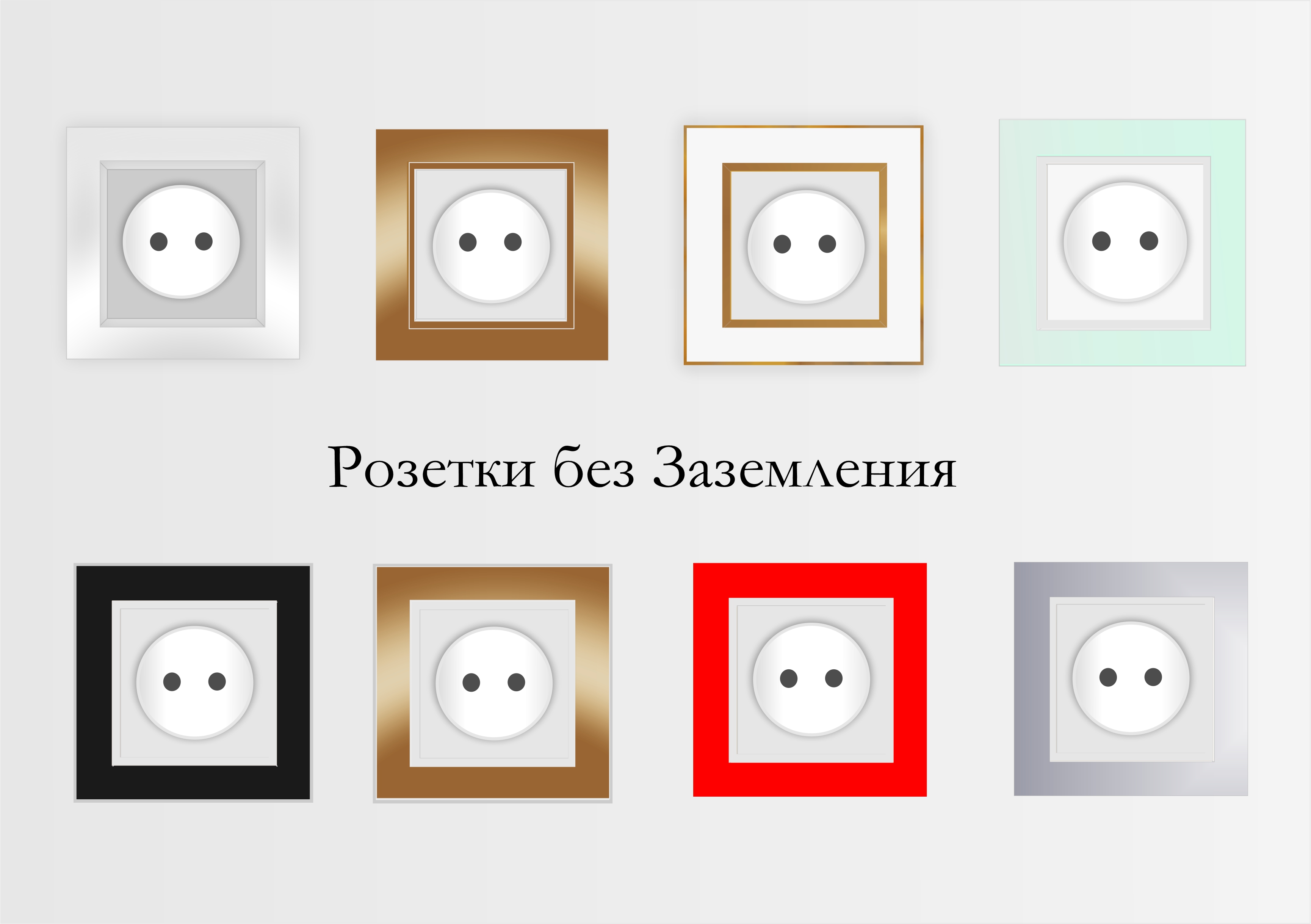
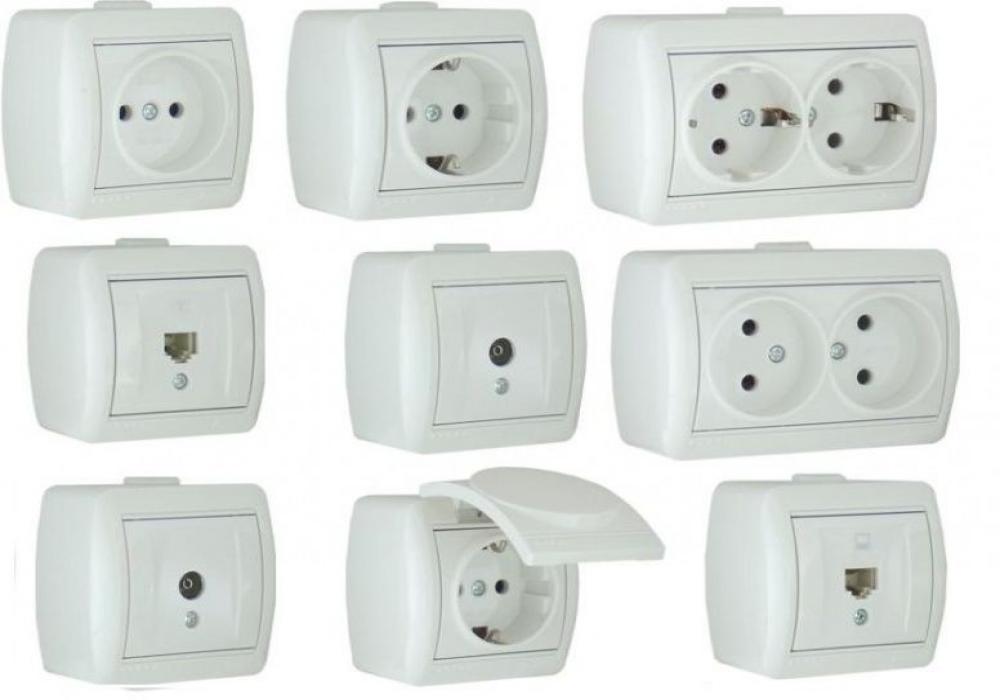
How to choose an outlet? Typically, sockets are available with or without grounding (Fig. 1), which are selected in accordance with the technical conditions. For example, in kitchens or bathrooms where powerful equipment is installed, sockets are subject to mandatory grounding, including those used for the hob.
For rooms with high humidity, it is better to choose sockets equipped with covers (Fig. 2). They are installed in swimming pools, bathrooms or outdoors, as is often the case in private homes. The protective cover covers the socket and is an effective barrier to moisture. In addition, such products have an additional degree of protection.
In many cases, it is much more convenient to use dual sockets (Fig. 3) installed in a common mounting box
When buying, you should pay attention to the quality of the internal elements, since such products are often subjected to double loads.
In children's rooms, sockets equipped with a special valve or protective shutters are installed (Fig. 4). Thus, the device is protected from childish pranks and opens only under the action of an electric plug. Another type of socket has an ejection function (fig. 5) that allows you to easily remove the plug. The wire is additionally protected from damage, which is especially important with frequent changes in household appliances.
The so-called smart sockets (Fig. 6) are equipped with a timer that turns off at a set time. In this case, the plug remains connected to the device, but it turns out to be de-energized.
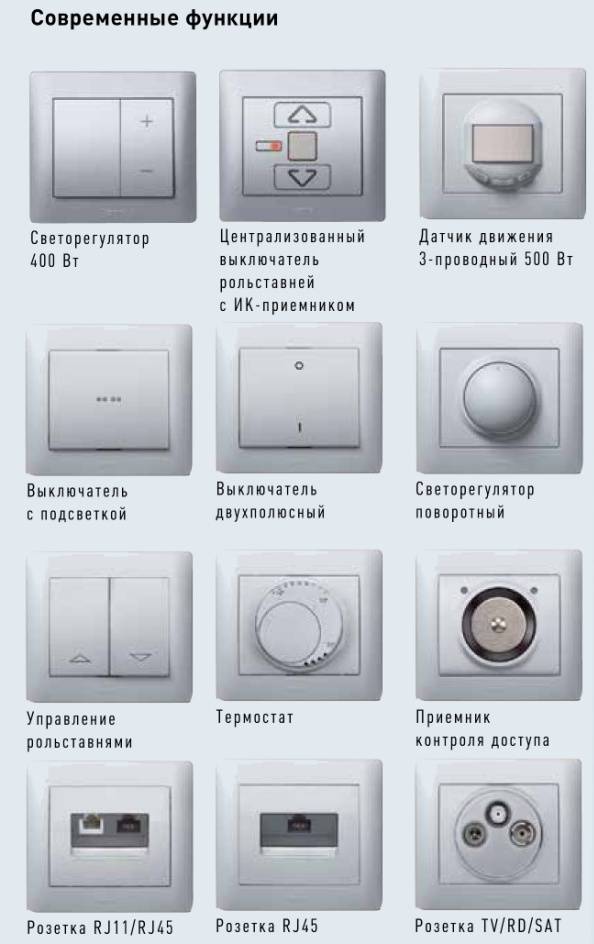
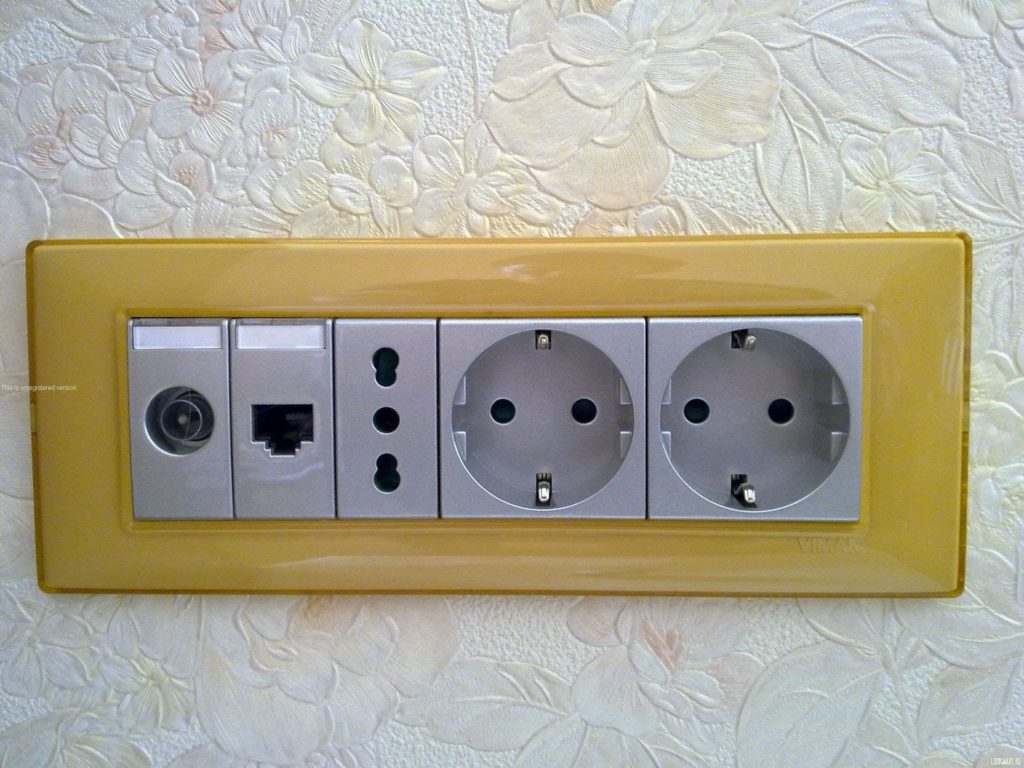
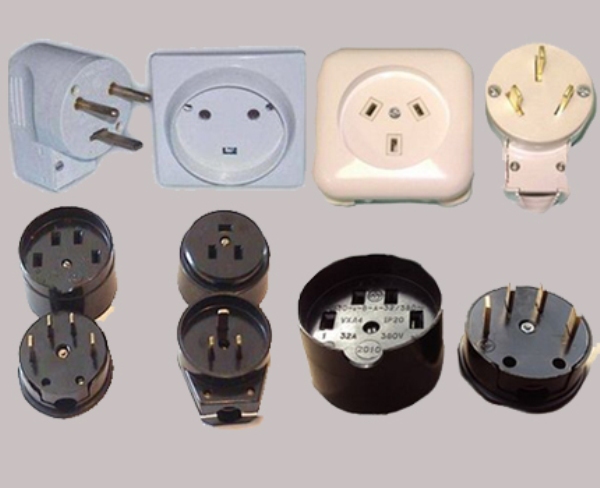
There are other types of sockets used in low-voltage networks. Computers, telephones, antennas, radio points, etc. are connected to them.Some designs are equipped with several connectors at once. In private homes, power sockets can be installed, designed to connect electric motors, welding and other powerful equipment.
How to distinguish high-quality devices from low-quality ones
First of all, you should pay attention to the build quality of the product. Contact connections must be made with high quality and look reliable.
Housings of sockets and switches should not be deformed, without chips or cracks. The color of the cases should be uniform, without traces of heating and darkening. Fasteners must be included.
All products must be accompanied by a certificate of quality and the corresponding marking according to the IP protection system.
Do not try to choose the cheapest option for the product. The safety of people who are in close proximity to the electrical appliance largely depends on the quality of the electrical product.
The electrical goods market is filled with many offers of electrical products. Switches and sockets are one of the most sought after products in this category. In order not to get confused and make the right decision when choosing them, you must always follow the above recommendations and objectively evaluate the functional features of the required product.





Choice by manufacturer
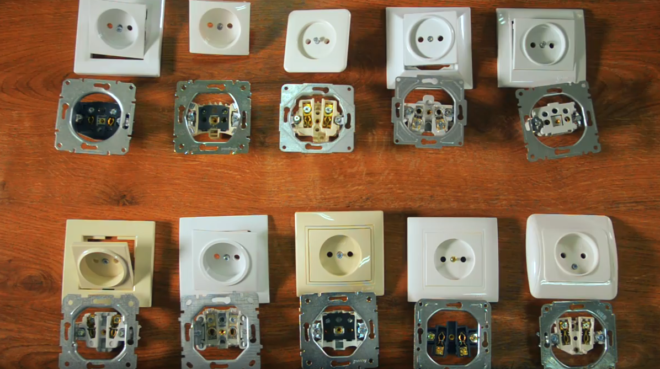
Basically, the quality of devices is determined by the service life, reliability and ease of installation. According to these criteria, each company was selected for the following rating. The top ten were the most popular manufacturers. They, in turn, can be divided into two subgroups, including budget and high-end:
- The first subgroup included: Anam, GUSI, Makel, Lezard, Wessen, Belarusian sockets.These manufacturers know exactly which sockets would be best placed in an apartment and solve this issue at the expense of quality and moderate cost. The design of the products is quite simple and discreet, however, in terms of functional characteristics, they are standard high-quality models that can be safely installed in an apartment.
- The second group is made up of premium class products that amaze not only with their quality, but also with elegance and style. These include French Legrand, Italian Bticino and German Scneider-electric. Each of these firms demonstrates an original approach to the production of manufactured models. They have no fundamental differences in functionality, there are only individual preferences of the client, who is ready to overpay not only for a well-known brand, but also to get excellent quality. The collections of these manufacturers are so diverse that it is quite difficult to choose the right option. There are also standard models that are not inferior in reliability and in a relatively similar price range.
The first place can still be given to the French for their reasonable prices. At the same time, the colors and model range are one of the most diverse. The next is a German manufacturer that takes into account the most popular needs and implements solutions in various directions, producing high-quality sockets and switches. The Italian manufacturer, in addition to the quality of the components themselves, focuses on the originality of the appearance of the sockets, which invariably causes a feeling of admiration among the consumer.
Unfortunately, there is no way to include domestic manufacturers in the list of the best, as the indicators of their products do not reach world standards. However, this does not mean that domestic sockets are of poor quality - they simply are not in the TOP ratings.
Choice by mounting type
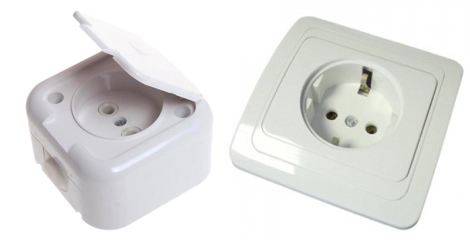
The most acceptable option for the best household outlet for an apartment is built-in. These sockets are arranged in such a way that the electrical part is recessed into the wall. Such a structure saves space, but it is advisable to choose the installation site in advance, even at the time of wiring. This is due to the fact that such devices are used together with wiring laid inside the wall. Such connections are the safest and highest quality in operation.
Surface-mounted sockets are screwed on the surface - this is a good option when using open wiring over the wall. They are more often used as a temporary device and are somewhat inferior in safety.
Standard norms for placing sockets, switches in diverse residential areas
The plans for sockets and switches in a standard apartment are as follows.
In the kitchen
It is worthwhile to clearly plan how many household appliances will be located in the kitchen. Of course, it is not easy to answer such a question, because more and more new electrical appliances are often purchased: a kettle, a coffee grinder. Typical equipment is: refrigerator, stove, microwave, etc.

The easiest way to determine the position of the sockets above the countertop is to simply step back up 10-30 cm.
- sockets for built-in appliances - must be placed behind the cabinet;
- for the hood - 0.6 meters from the kitchen cabinet;
- for small units - 20 centimeters from the countertop.
Switches are most often placed at the entrance to the room.
For the electric stove, we install special three-phase sockets 20-25 amperes.
In the living room
There are several options for placing electric points in each individual zone:
- sofa area;
- doorway;
- TV zone;
- Desktop.
In modern design, remote switches are often organically combined.

For audio and video equipment in the living room, you will need several special sockets - television in the first place.
In the bedroom
Switches, as a rule, are installed behind a furniture wall (“Soviet layout”). The most practical way is near the bedside tables.



The classic option for lighting the sleeping area is a block of two sockets above the bedside tables at a distance of 15 cm from their surface.
In the bathroom
All instruments must be kept away from liquids.

The number of outlets depends on how many electrical appliances (washing machine, hair dryer, shaver) you plan to connect in the bathroom.
In the hall
Light switches are required at the entrance. Several "nests" for portable household devices.

One or two sockets are enough in the corner above the plinth, at a height of 30 cm from the floor.
What are the types of sockets and switches?
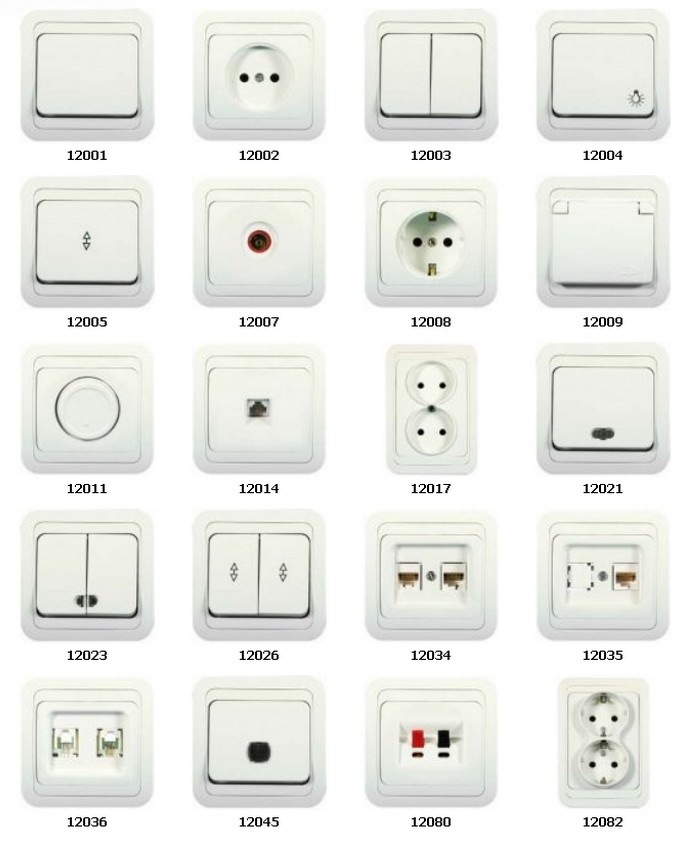
Both sockets and switches have many different functions depending on the product types.
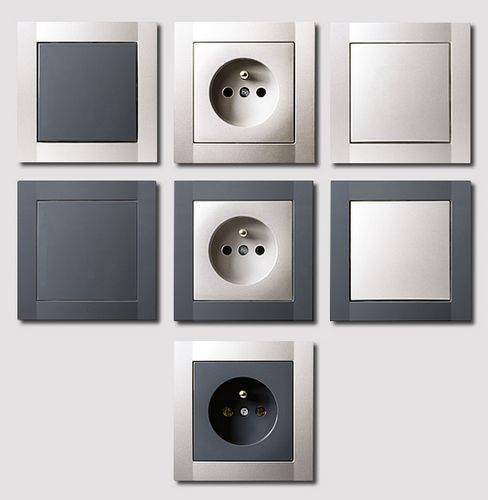
socket types
Before choosing an outlet, first of all determine the appropriate type of product, taking into account that they are of the following types:
Sockets without grounding. They are used in cases where grounding is not provided or not required, for example, in residential premises.
Grounded sockets
Installed in places where it is important to have grounding.Most often, these are the kitchen or a socket for connecting a computer.
They are also used in private homes.
Cover sockets. The use of such an outlet is relevant in rooms with high humidity, such as a bathroom, boiler room, swimming pool, an external outlet on the house. Such products have a special cover that covers the entire area of the outlet and actively prevents the ingress of water or moisture. In addition, it is important to know that sockets for use in wet areas must have a special degree of protection in IP.
Dual sockets. They are mounted in a socket, allowing you to use two electrical connections at once. Not very reliable mechanics of such an outlet may be unsafe.
Sockets with protective shutter or valve. Children's rooms are equipped with such sockets to prevent the possibility of sticking something thin there. The openings of such an outlet are closed with a kind of curtain that opens only when an electrical plug is inserted into it.
Plug-in sockets. They are equipped with a special button, by pressing which a person can easily remove the plug from the socket. Protects the wire from damage, relevant in places where equipment is frequently changed, for example, in the kitchen or in a hairdresser.
Sockets with off timer. The timer function allows you to independently set the operating time of the outlet. It is relevant, if necessary, to turn off the network at night or in production at the end of the working day. It is also used in combination with appliances equipped with a timer, such as air conditioning, electric oven, multicooker or TV.
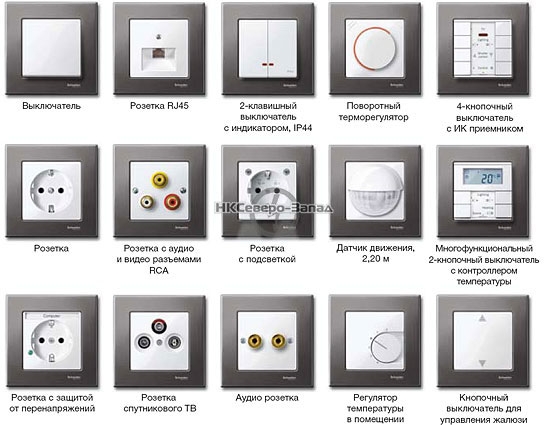
Special sockets. Designed for antennas, telephones, radio points, computers, etc. There are both built-in and overhead options.There are also types that combine several connectors at the same time.
Power connectors. Special plug-in connectors, which are mainly used on construction sites to connect devices with particularly high power, such as a welding machine.
Types of switches
To more clearly imagine how to choose a circuit breaker or manual, also initially familiarize yourself with the existing varieties provided by modern manufacturers:
- Illuminated switches. Convenient in dark rooms where you need to look for a switch in pitch darkness. Ideal for installation in corridors, kitchens and hallways. In the bedroom, this light can interfere.
- Light switches. Versatile in application.
- Lighting regulators. Used in combination with incandescent lamps to smoothly change the level of illumination. There are sensory and mechanical. Not suitable for use with halogen, fluorescent and LED lamps.
- Walk-through switches. They are used where it is necessary to control different groups of lighting. May have multiple keys. Examples of such rooms are rooms with chandeliers, in which there are several groups of lamps or in large auditoriums.
- outdoor wiring;
- hidden wiring.