- We design a wind generator ourselves
- How to choose a wind farm
- Types of wind turbines
- What does the law say?
- Taxation
- The device and features of using a windmill
- Manufacturers
- Types of wind farms
- Which voltage converter to buy: manufacturers and prices
- How does a wind generator work?
- 3 Wind power - pros and cons
- Types of wind turbines
- Vertical generator
- Orthogonal wind turbines
- Wind turbines based on the Savonius rotor
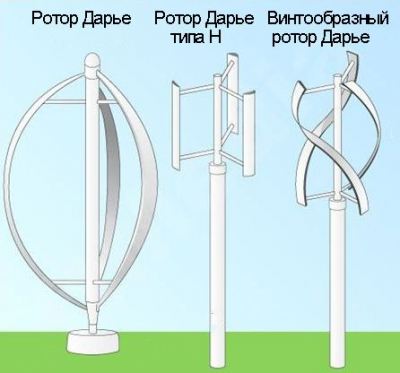
- Wind turbines with Darrieus rotor
- Sailing wind generator
- Wind generator horizontal
- Basic recommendations for calculation
- Engines
- Screw making
- What blade shape is optimal
- Is there any benefit to use?
We design a wind generator ourselves
just needed, device diagram,
A description of the work with all the diagrams, drawings and step-by-step instructions (sometimes even with a photo) will be given to you by any search engine. However, do not rush to get to work on the first instructions that come across. It is better to first study in detail the principle of operation and the assembly process of several structures, choose the one that suits you in terms of power, availability of parts and manufacturing complexity, and only then get to work.
So, in every homemade windmill should be:
- blades;
- generator;
- mast;
- as well as an installation that converts electric current.
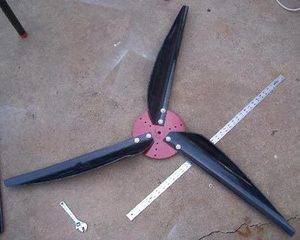
Each of these parts can be made independently or redone from an existing one. So, for example, to make blades fit pvc pipe or aluminium. There are also schemes for making them from wood or fiberglass. All these methods of manufacturing blades are suitable for horizontal windmills, which are recommended by experts for a home-made home or country windmill. The blades of the vertical device are easy to make from a plastic or metal barrel.
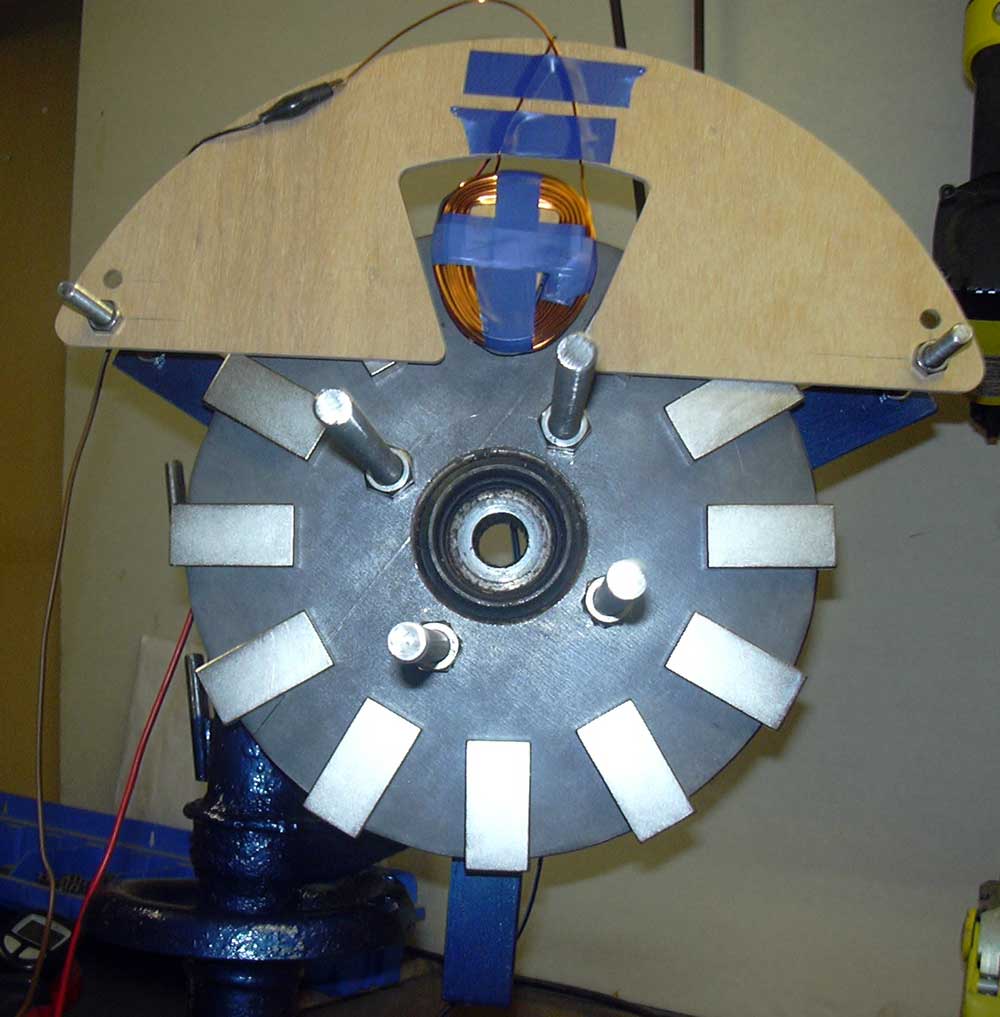
There are also many ways to make a generator. One of the most common is a disk generator self-assembled on the basis of neodymium magnets. Its disadvantage is the high price of magnets and their large number, while the advantage is ease of assembly.
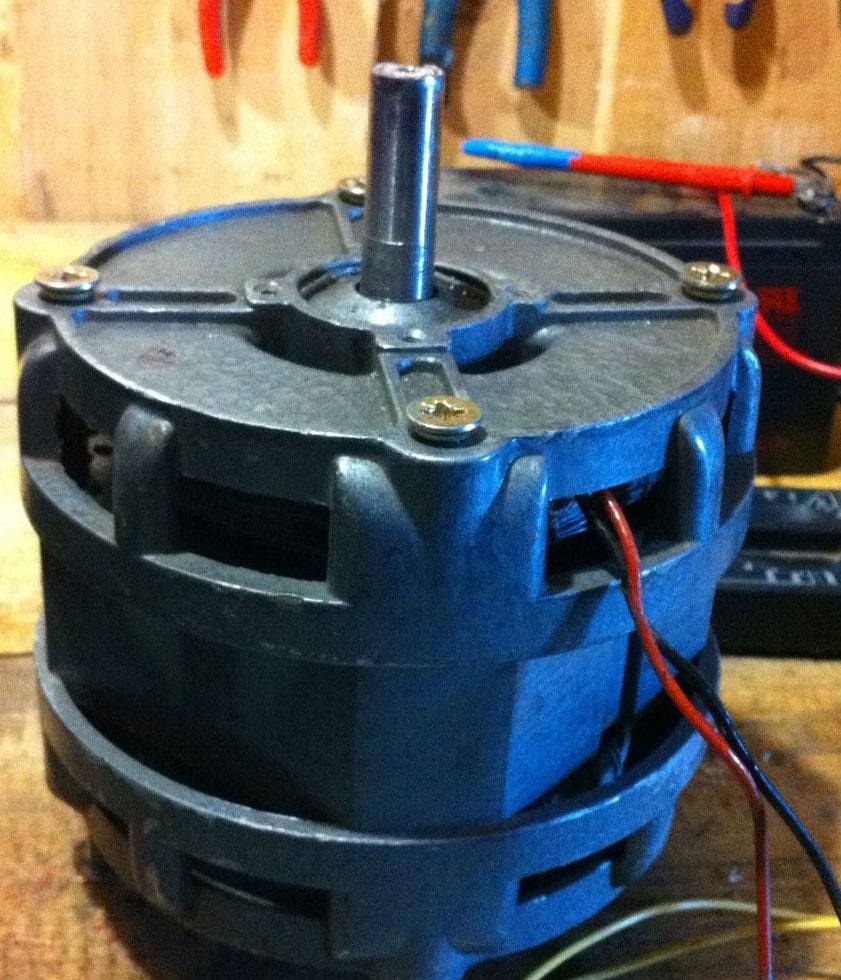
Another way is to remake a ready-made induction motor generator. In this case, it is enough to sharpen the rotor and rewind the stator coils. The last one is the hardest part of the process. However, it is quite feasible at home.
A steel pipe with a length of at least five and a half meters will serve as a mast.
The assembly of parts into a single structure is carried out according to the scheme, which is easy to find with the help of search engines. The main thing is to be able to understand it.
Of course, assembling a wind turbine with your own hands is a task that not everyone can do. It is much easier for someone to buy it than to understand the process of gluing neodymium magnets or rewinding stator coils.
How to choose a wind farm
The main parameter of a wind farm is its power.It must be remembered that it reaches its peak value only at maximum rotation speed. And in order to achieve maximum speed, it is necessary to provide a suitable installation height for the windmill and choose a model with the optimal number of blades. In most cases, consumers stop at three-blade models. If you choose a model with a capacity of 3 kW, then this is quite enough for most needs.
For a family of four, monthly electricity consumption is about 350-400 kW - be guided by this figure and the consumption of household electrical appliances.

In addition to windmills, we advise you to also take a closer look at solar panels. Depending on climatic and geographical conditions, this type of energy production may be even more profitable.
If the energy from the wind farm will be spent not only on lighting and the operation of low-power household appliances, a more powerful model will be required. This is relevant when use of microwave ovens, many freezers, electric ovens and other electrical appliances. However, for cooking it is better to use gas equipment that runs on liquefied gas.
Let's talk about manufacturers - wind turbines from Europe are in the greatest demand, in particular from Germany and Austria. Owner reviews say that it is here that the most reliable and durable units are made that can last up to 30-40 years. Russian-made windmills are also in demand - they are affordable. As for Chinese products, they are not only cheap, but also not the most reliable.
Types of wind turbines
The generator itself is driven by blades.Due to these blades, wind farms are divided into two broad categories:
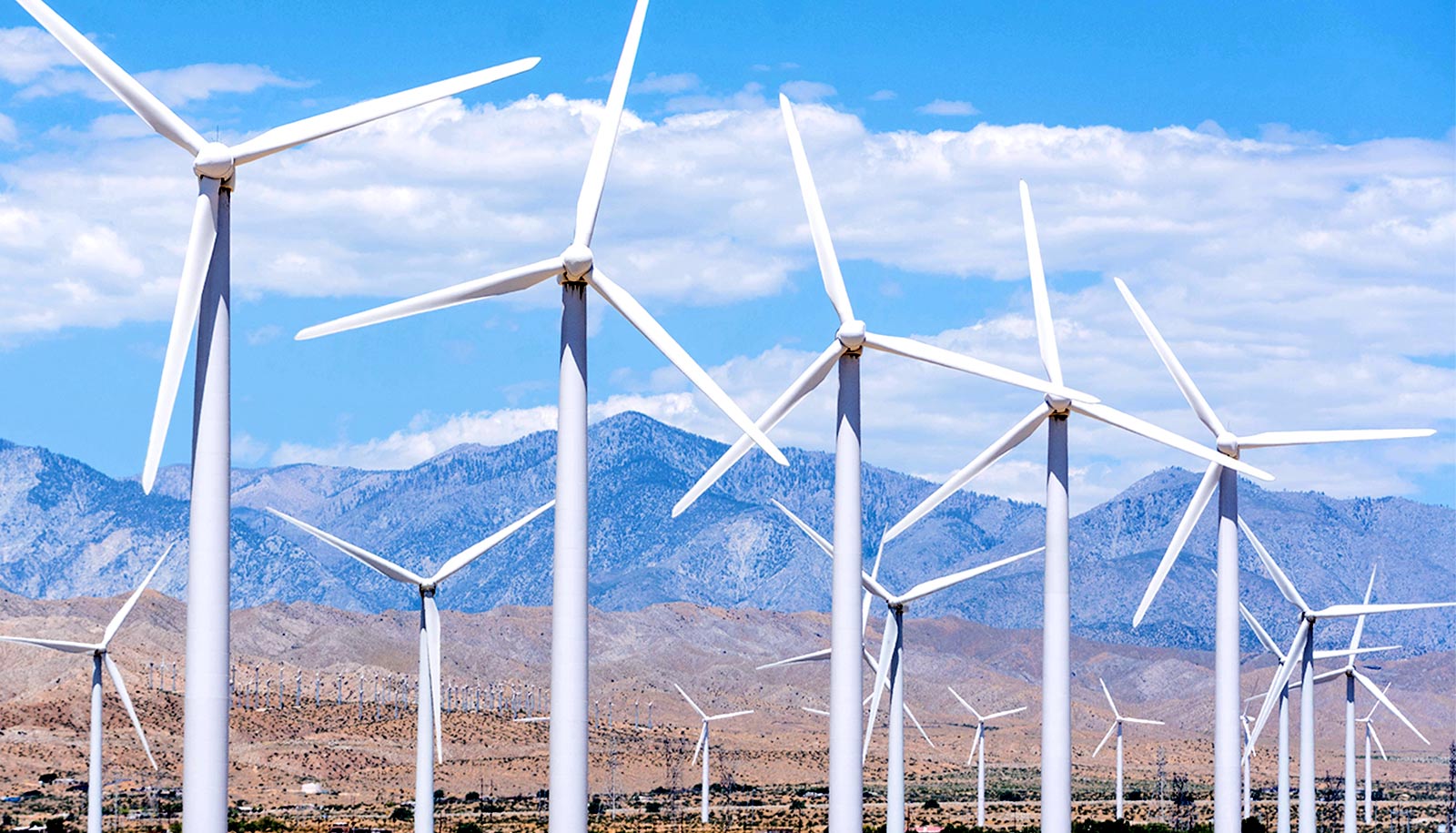
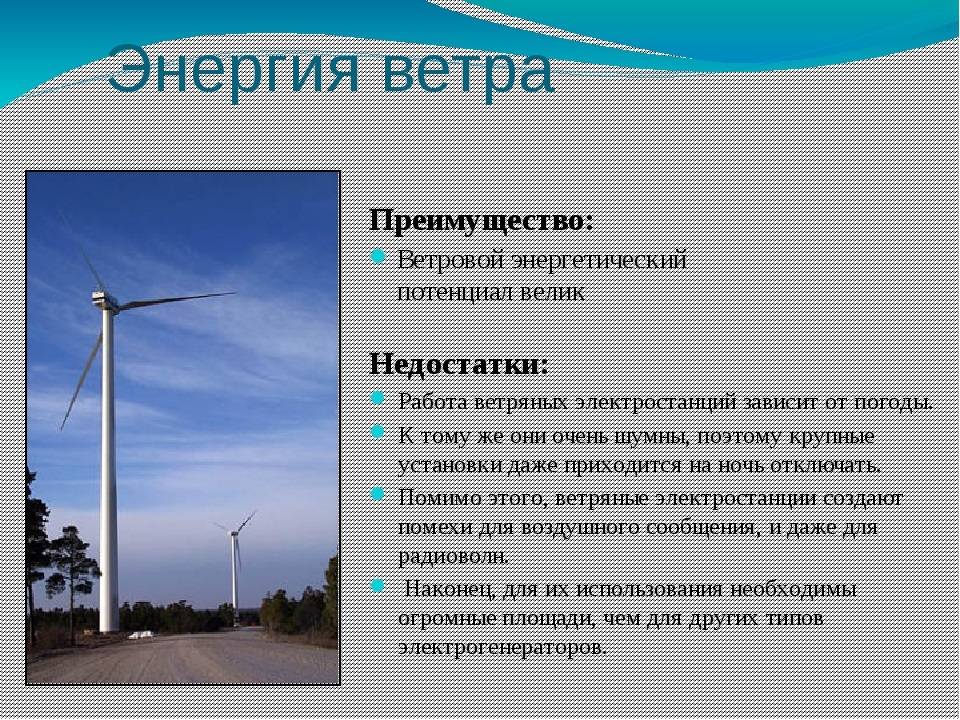
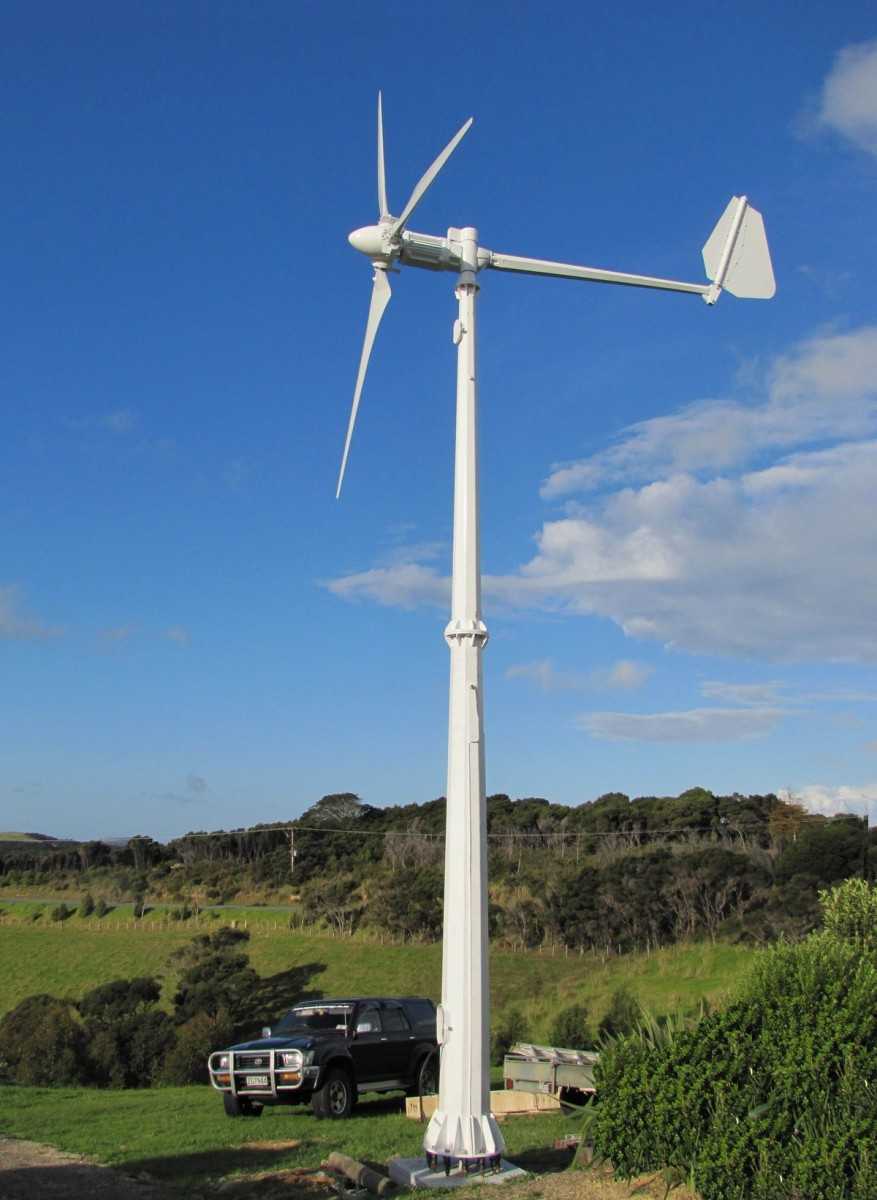
- With a horizontal axis - the generator here is located horizontally, and the blades are directed along the main direction of the wind. In order to get the maximum energy from the wind, windmills are equipped with a keel, which makes the generator with blades turn in the direction of the most powerful stream;
- With a vertical axis - such wind farms do not care which way the wind blows.
There are a great many designs of windmills of the most bizarre shape. This is primarily due to a large number of external factors that significantly affect the efficiency of the entire system.
Horizontal axis wind generators are suitable for use where the wind blows predominantly in one direction. They are distinguished by their low cost, simplicity of design and increased power. With regard to models with a vertical axis, they can work in the most difficult conditions, for example, with constantly changing wind direction. They are more expensive, but their efficiency is less than that of horizontal models.
When choosing a windmill for a private house, you need to focus on the local wind rose. If observations show the presence of wind currents constantly blowing in the same direction, it is advisable to purchase a wind farm with a horizontal axis. If the wind blows in different directions every day, you should spend money and buy a vertical windmill.


What does the law say?
There are no legal regulations prohibiting the use of wind turbines. In any case, with a power of up to 75 kW. Such devices are equated to household electrical installations, for which no permits are required.Installations with a capacity of more than 75 kW are considered industrial and must be certified, which greatly complicates their use.
Problems of a different nature are possible. For example, a region may have a restriction on the allowable mast height for a wind turbine. There are similar standards for the installation of masts near airfields, power lines, radiating antennas of radio stations, etc. Violation of regional rules may result in a court decision prohibiting the use of a windmill completely or ordering to bring the condition of the structure to the established norm.
Taxation
An equally frequent issue is the taxation of wind turbines. Here it is necessary to clearly distinguish the purpose for which electricity is generated. If there are sales, then the tax will have to be paid, but if the installation is used for own needs, then no taxation is provided, since wind charges have not yet been introduced.
In such cases, the correct solution would be to ignore such claims. Let them sue, where they prove their case, if possible
It is important for the windmill user to understand that he does not violate any regulations, the use of resources in this case does not require licensing, since the resource is inexhaustible. If there are no complaints from the neighbors, then everything is in order, the use of a wind turbine is completely legal
The device and features of using a windmill
Wind turbines are rarely used as the main sources of electricity, but as an additional or alternative they are ideal.
This is a good solution for cottages, private houses located in areas where there are often problems with electricity.
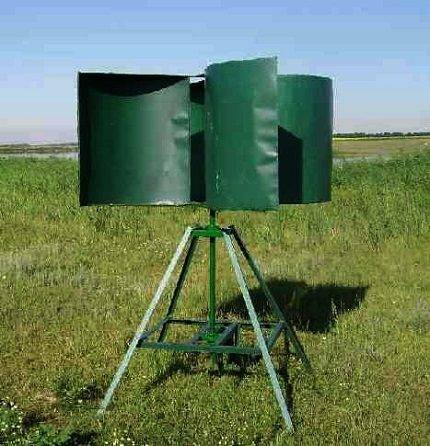
Assembling a windmill from old household appliances and scrap metal is a real action to protect the planet. Garbage is just as urgent an environmental problem as environmental pollution by hydrocarbon combustion products.
A homemade wind generator from a screwdriver, a car generator or a washing machine engine will cost literally a penny, but it will help save decent amounts on energy bills.
This is a good option for zealous hosts who do not want to overpay and are willing to make some efforts to reduce costs.
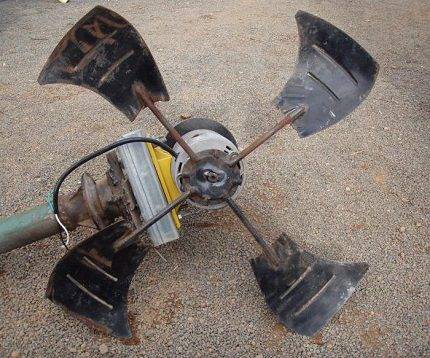
Often, car generators are used to make windmills with their own hands. They do not look as attractive as industrial production structures, but they are quite functional and cover part of the electricity needs.
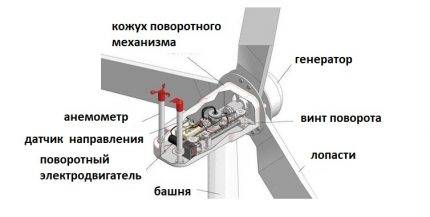
A standard wind generator consists of several mechanical devices, the function of which is to convert wind kinetic energy into mechanical energy, and then into electrical energy. We recommend that you look at the article about the device of the wind generator and its principle of operation.
For the most part, modern models are equipped with three blades to increase efficiency and start working when the wind speed reaches at least 2-3 m / s.
Wind speed is a fundamentally important indicator on which the power of the installation directly depends.
The technical documentation for industrial wind turbines always indicates the nominal wind speed parameters at which the installation operates with maximum efficiency. Most often, this figure is 9-10 m / s.
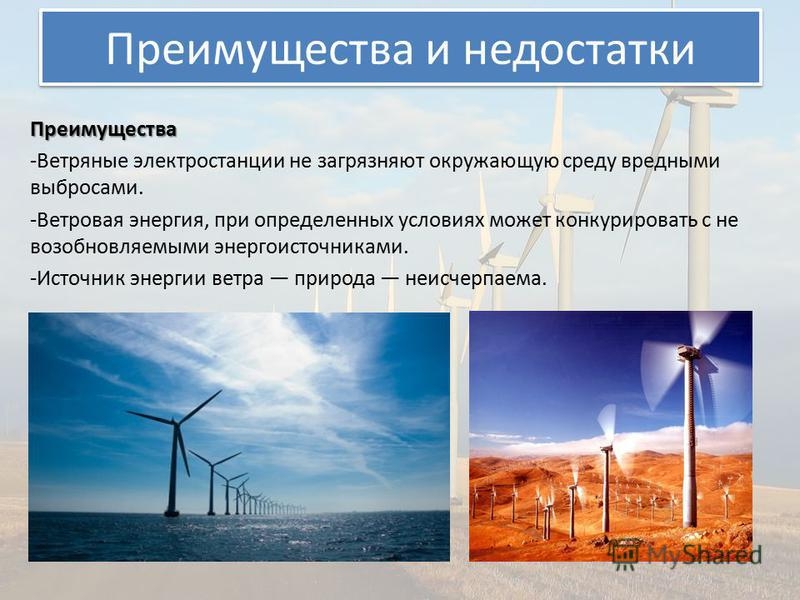
 The main advantages of wind as an energy source are renewability and inexhaustibility. People have long been inventing various devices that allow rational use of the power of the elements, and the wind generator is one of the successful attempts to curb the wind
There are also parameters for the maximum permissible wind speed - 25 m / s. With such indicators, the efficiency of the windmill is already significantly reduced, because. the blades of the installation change position. When it comes to a homemade design, it is difficult to determine its technical characteristics.




It makes sense to focus on average indicators and calculate the amount of energy needed for basic needs.
If you need to make a homemade 220V windmill, we recommend that you read the detailed assembly instructions.
Manufacturers
Today, the production of wind turbines has been established in many countries of the world. On the market you can find Russian-made models and units from China. Of the domestic manufacturers, the following firms are considered the most popular:
- "Wind Light";
- Rkraft;
- "SKB Iskra";
- "Sapsan-Energy";
- "Wind energy".
Foreign manufacturers of electric power generators are also very popular:
- Goldwind - China;
- Vestas - Denmark;
- Gamesa - Spain;
- Suzion - India;
- GE Energy - USA;
- Siemens, Enercon - Germany.
However, it is worth remembering that the use of such wind turbines involves the use of expensive repairs, as well as spare parts, which are almost impossible to find in domestic stores. The cost of units for the production of electricity usually depends on the design features, capacity and manufacturer.
Types of wind farms
There are the following criteria for classifying wind farms:
- Number of blades. Wind turbines with up to 4 blades are called low-blade and high-speed. With the number of blades from 4 or more, multi-bladed and slow-moving. The division according to this criterion is due to the fact that the smaller the number of blades, the, ceteris paribus, the wind turbine has a greater number of revolutions.
- Rated power. The criterion is rather arbitrary, but the following gradation is applied: up to 15 kW household (for private houses, portable), 15-100 kW semi-industrial (for small farms, shops, pumping stations), 100 kW - units of MW industrial - designed to generate energy used a large number of consumers.
- The direction of the axis of rotation. This criterion is the most basic, as it affects the main characteristics of the windmill:
- With a horizontal axis of rotation. Most often two or three-blade, high-speed. The advantages of such devices include: speed, which means a simpler generator; high utilization of wind energy and, as a result, higher efficiency; simplicity of design. The disadvantages include: high noise level, the need for a high mast for installation.
- With vertical axis of rotation. There are many varieties of design - Savonius wind turbines, Darrieus rotors, helicoid rotor, multi-blade wind turbines. According to the author of the article, the merits of all such structures are highly doubtful. These devices have a complex design, require a complex generator, and have a low wind energy utilization factor (0.18-0.2 versus 0.42 for horizontal ones). The advantages include low noise level, the ability to install at a low height.
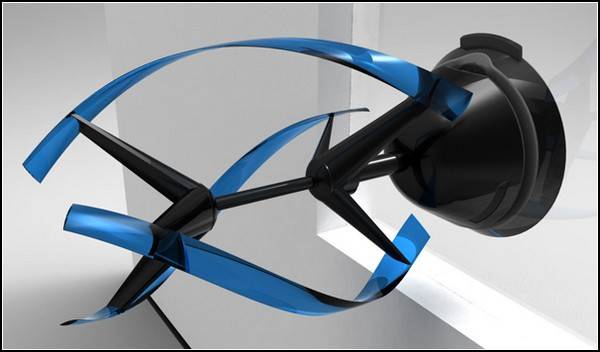
Home wind farm AERO E
Which voltage converter to buy: manufacturers and prices
The inverter market is quite saturated. You can choose a device for any task and purpose. In the domestic market, both Russian and foreign analogues are popular.
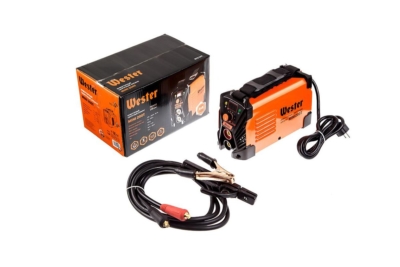 Consider the cost of inverters from different manufacturers:
- Switzerland. Xtender XTH/XTM/XTS. Price: from 75,000 to 90,000 rubles.
- Germany. Sunny Island 5048. Price: 240,000 rubles.
- Germany. "Schnieder Electric Conext XW+ Series". The price is from 240,000 to 500,000 rubles.
- China. Prosolar PV Hybrid. Price from 80 000 rubles.
- Russia. MAP Energia SIN. Price from 35 000 rubles.
The cost of the inverter depends on its type, power, as well as protection systems and the country of manufacture.
If you want to receive green energy without equipment failures and breakdowns, be sure to pay due attention to choosing an inverter. It is able not only to protect devices from unstable network operation, but also to act as a battery
Carefully calculate the consumption of appliances, as well as the peak load of consumption. Give preference to models with a modified sinusoid. This way you will protect all electrical appliances in your home.
How does a wind generator work?
To answer this question, first consider its device.
Any wind turbine must have:
- blades that rotate under the influence of wind and set the rotor in motion;
- alternating current generator;
- a controller that controls the blades and converts the electricity coming from the generator into direct current needed to charge the battery;
- rechargeable batteries capable of accumulating electricity and leveling it;
- inverter - a device that converts direct current coming from the battery into alternating current, from which light bulbs glow, refrigerators, televisions and other electrical appliances work;
- a mast that raises the blades as high as possible above the ground.
The scheme of operation of the device in the most simplified form can be represented as follows: the wind rotates the blades, which, in turn, set the rotor in motion. Next, the mechanical energy is converted into electrical energy.
Rotating, the generator rotor generates a three-phase alternating current, from which electrical appliances cannot work, so it must be converted.
For this purpose, a controller is provided in the design of the windmill. It will turn the current coming from the generator into direct current. From the latter, batteries are charged. Passing through them, the current enters the inverter, where it acquires characteristics acceptable for the operation of our electrical appliances. From constant, it again becomes variable, but with indicators already familiar to us: single-phase, with a voltage of 220 V and a frequency of 50 Hz.



3 Wind power - pros and cons
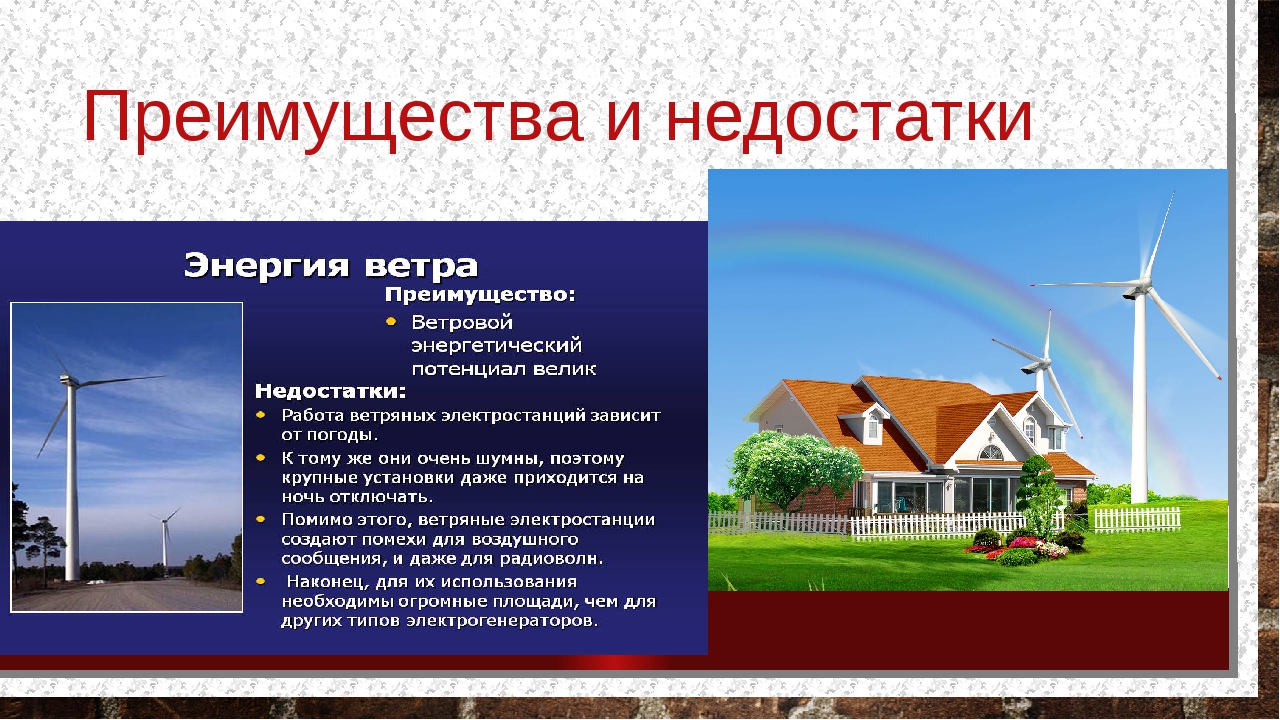
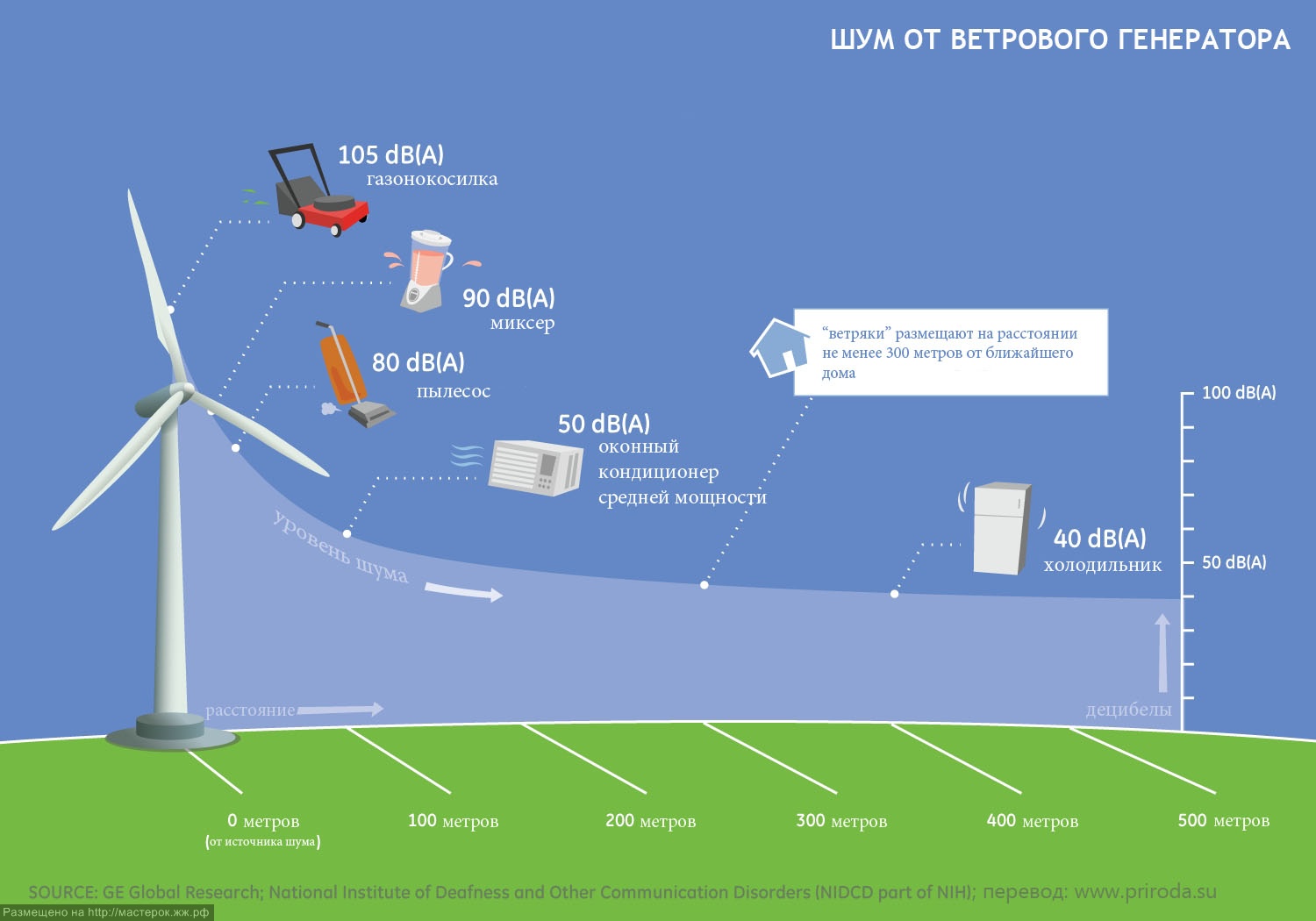
At first glance, the use of wind turbines to supply a private house with electricity has no drawbacks. Unfortunately, it is not. During operation, the unit makes loud noises that cause discomfort to the residents of the house and neighbors. In Europe, the permissible noise level of wind turbines is fixed by law. In addition, Europeans stop the operation of wind turbines during the seasonal flight of birds (another requirement of the law).
In Russia, wind turbines are still rare and their operation is not limited by regulatory legal acts.True, taking into account the opinion of neighbors and the comfort of loved ones, the owners of wind turbines install them away from residential buildings. However, most of the restrictions apply to older models. A modern wind generator for a private house works almost silently.
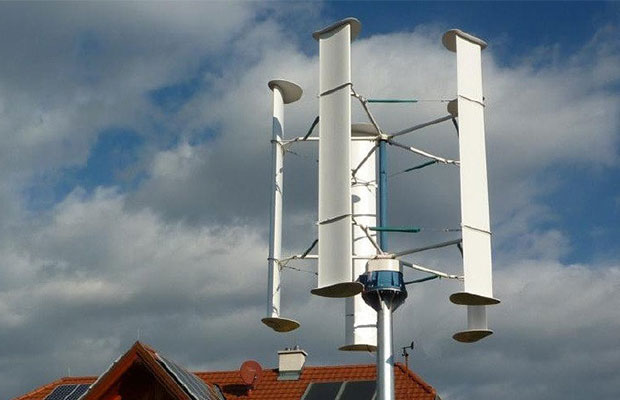
The main disadvantage of wind turbines is a lot of noise during operation.
The disadvantages more than outweigh the advantages of wind turbines. For the operation of wind turbines, no fuel is required, and wind energy will be on the planet as long as there is an atmosphere and the sun is shining. Of course, it is easier to start using a gasoline or diesel generator than a wind turbine. But the windmill does not have to be fueled regularly.
There is one circumstance that imposes a restriction on the use of a wind turbine as the main source of electricity. In many regions of the Russian Federation, it is impossible to guarantee the constant movement of air masses (winds). Therefore, wind turbines, as a rule, act as an additional source of energy.
Types of wind turbines
Windmills can be distinguished by: - the number of blades; – type of blade materials; – vertical or horizontal arrangement of the installation axis; - stepping version of the blades.
By design, wind turbines are divided by the number of blades, one, two-blade, three-blade and multi-blade. The presence of a large number of blades allows them to be rotated by a very small wind. The design of the blades can be divided into rigid and sail. Sailing windmills are cheaper than others, but need frequent repairs.
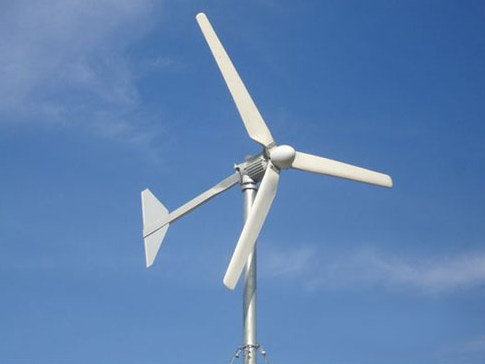
One of the types of wind turbines is horizontal
The wind generator of vertical execution starts to rotate at a small wind. They don't need a weather vane. However, in terms of power, they are inferior to windmills with a horizontal axis.Wind turbine blade pitch can be fixed or variable. The variable pitch of the blades makes it possible to increase the rotation speed. These windmills are more expensive. Fixed-pitch wind turbine designs are reliable and simple.
Vertical generator
These windmills are less expensive to maintain, as they are installed at a low height. They also have fewer moving parts and are easier to repair and manufacture. This installation option is easy to do with your own hands.
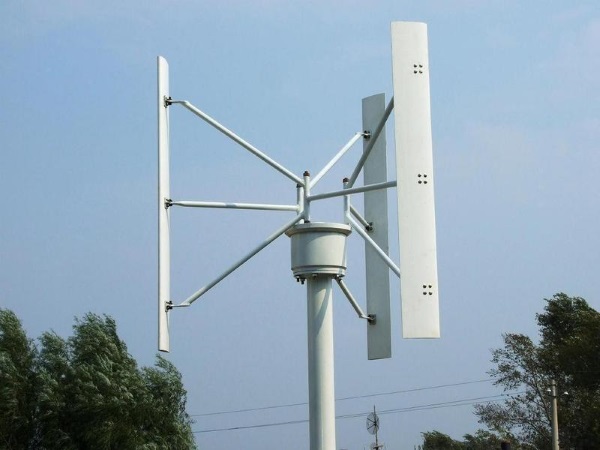
Vertical wind generator
The design of the wind generator with optimal blades and a kind of rotor gives high efficiency and does not depend on the direction of the wind. Wind generators of vertical design are silent. The vertical wind generator has several types of execution.
Orthogonal wind turbines
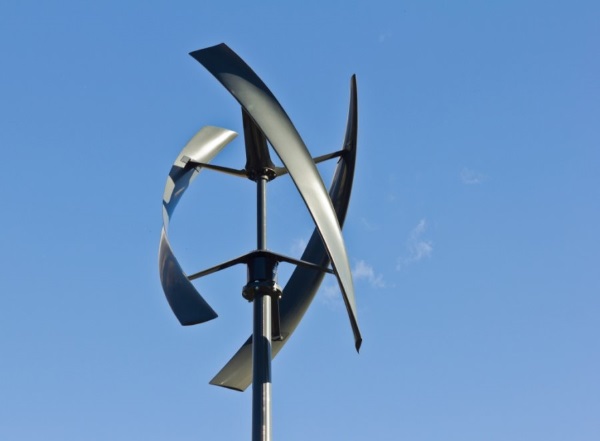
Orthogonal wind generator
Such windmills have several parallel blades, which are installed at a distance from the vertical axis. The operation of orthogonal windmills is not affected by the direction of the wind. They are installed at ground level, which facilitates installation and operation of the unit.
Wind turbines based on the Savonius rotor
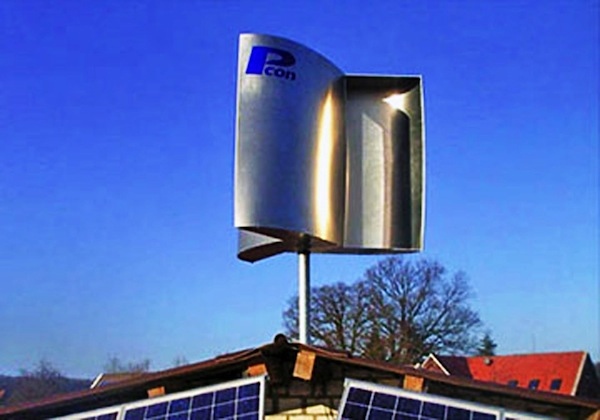
Wind turbines based on the Savonius rotor
The blades of this installation are special semi-cylinders that create a high torque. Among the shortcomings of these windmills, one can single out a large material consumption and not high efficiency. To obtain high torque with the Savonius rotor, a Darier rotor is also installed.
Wind turbines with Darrieus rotor
Along with the Darrieus rotor, these units have a number of pairs of blades with an original design to improve aerodynamics. The advantage of these units is the possibility of their installation at ground level.
Helicoid wind generators.
They are a modification of orthogonal rotors with a special configuration of the blades, which gives a uniform rotation of the rotor. By reducing the load on the rotor elements, their service life is increased.


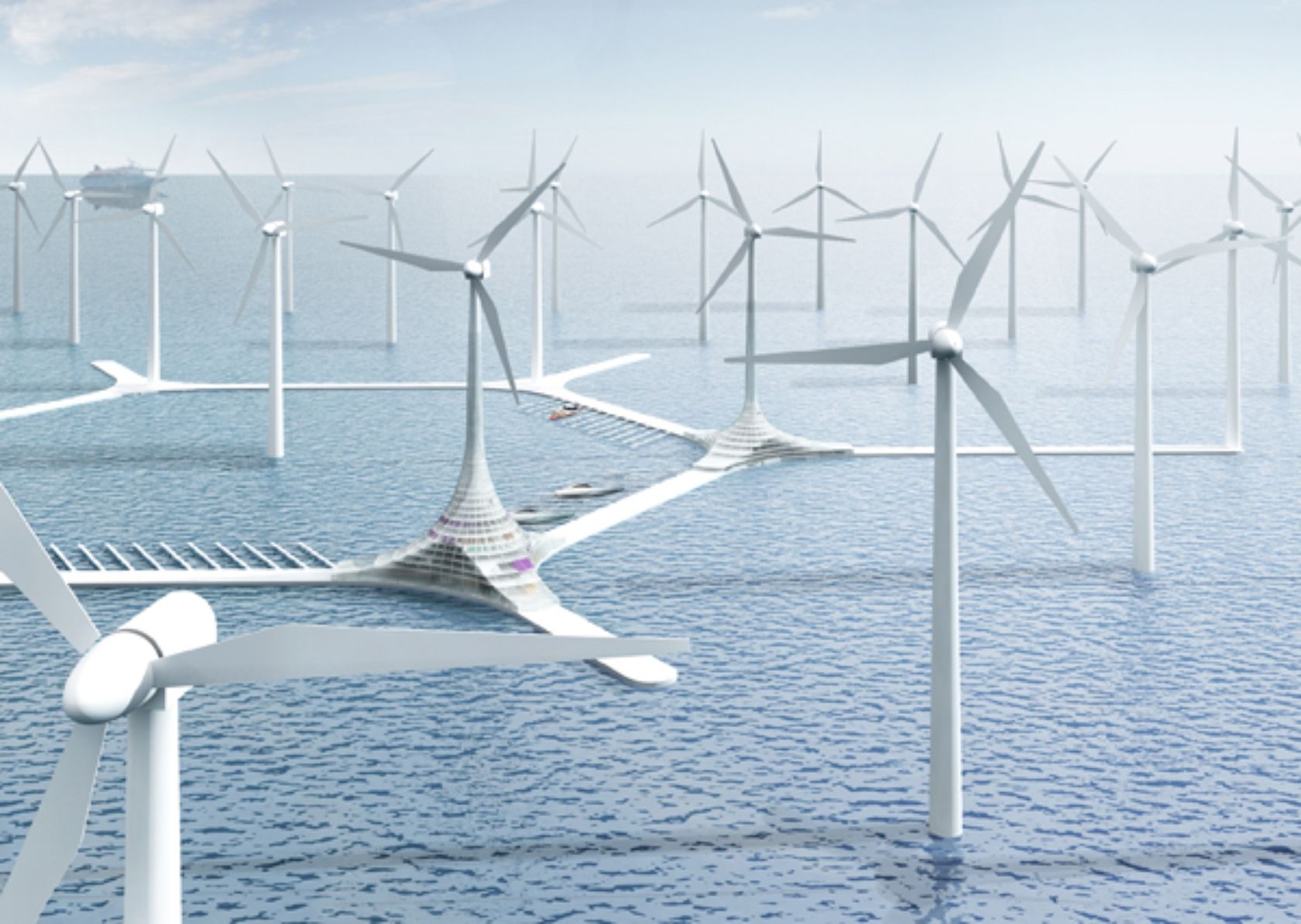

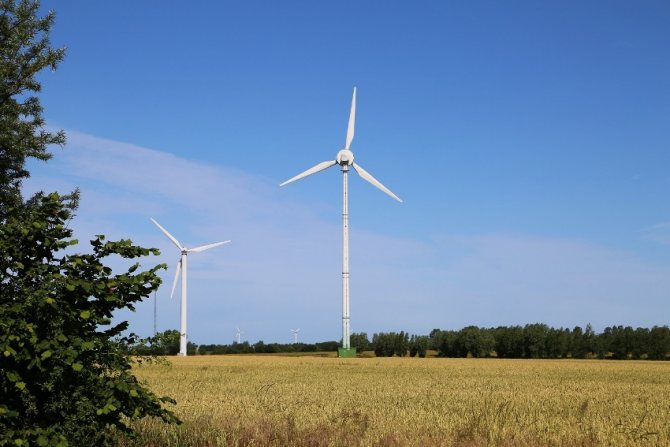
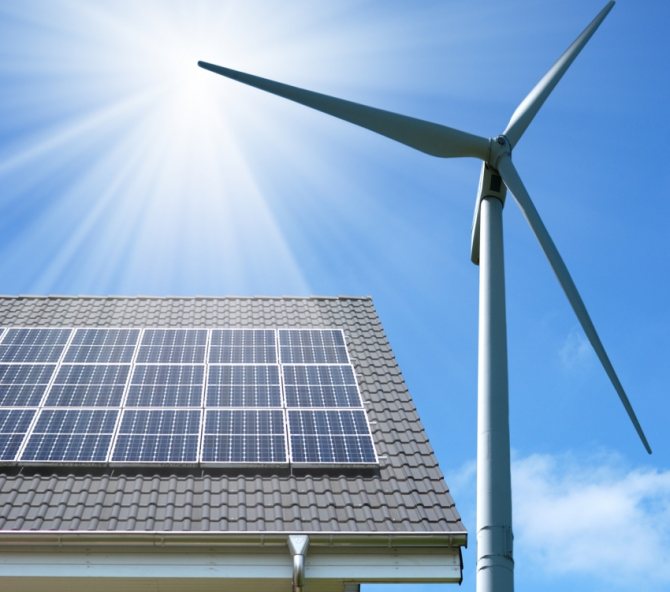
Wind turbines based on the Darrieus rotor
Multiblade wind turbines
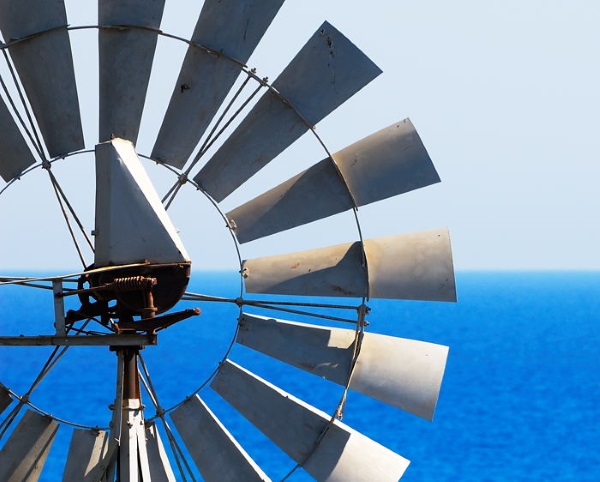
Multiblade wind generators
Windmills of this type are a modified version of orthogonal rotors. The blades on these installations are installed in several rows. Directs the wind flow to the blades of the first row of fixed blades.
Sailing wind generator
The main advantage of such an installation is the ability to work with a small wind of 0.5 m/s. Sailing wind generator is installed anywhere, at any height.
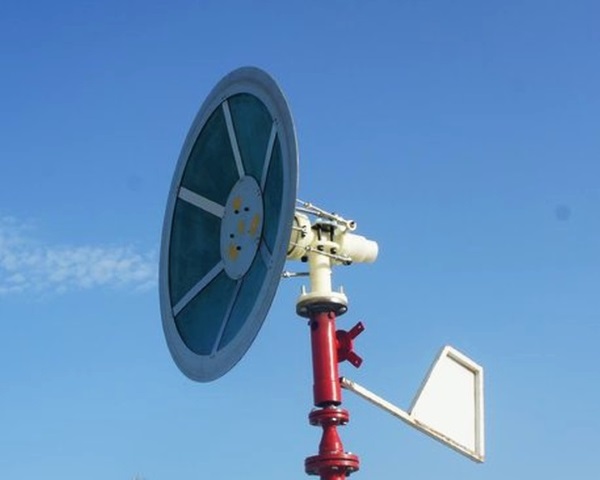
Sailing wind generator
Among the advantages are: low wind speed, fast response to the wind, ease of construction, availability of material, maintainability, the ability to make a windmill with your own hands. The disadvantage is the possibility of breakage in strong winds.
Wind generator horizontal
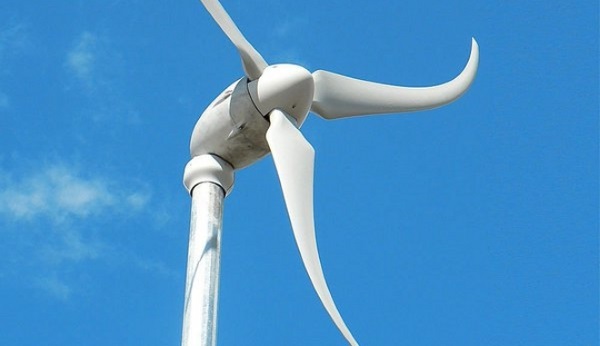
Wind generator horizontal
These installations may have a different number of blades.
For the operation of a wind turbine, it is important to choose the correct wind direction. The efficiency of the installation is achieved by a small angle of attack of the blades and the possibility of their adjustment
Such wind generators have small dimensions and weight.
Basic recommendations for calculation
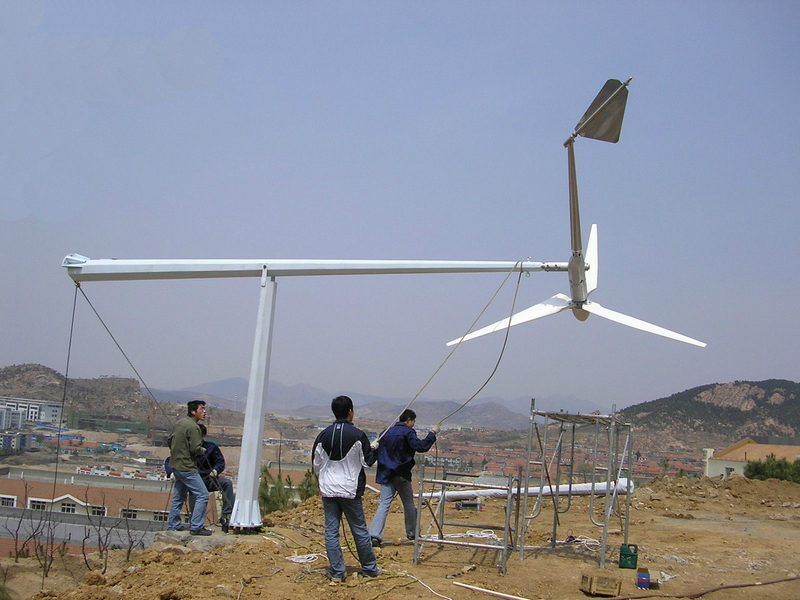
Engines
The former have ferrite magnets, and more productive neodymium ones are required. For the efficient operation of the latter, large revolutions are required, which the windmill cannot develop.

Self-assembly and winding of windings from the manufacturer require great precision and patience. The power of such a home-made device does not exceed 2-W.
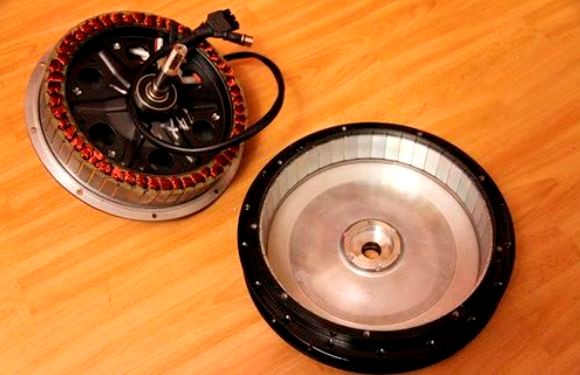
They optimally meet the requirements for devices that work with a vertical wind wheel and charge the battery. The output power in this case can reach 1 kW.
Screw making
The second consists of curved light tubes attached to the central plate. The blades, which have a large windage, are hinged. This eliminates their deformation and folding in strong gusts of wind.

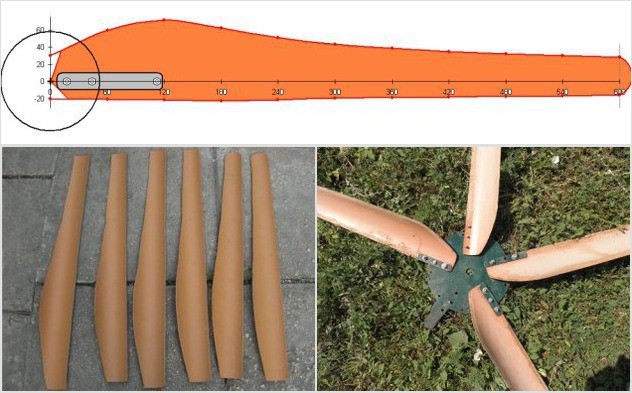
What blade shape is optimal
One of the main elements of a wind turbine is a set of blades. There are a number of factors associated with these details that affect the efficiency of a windmill:
- the weight;
- the size;
- the form;
- material;
- amount.
If you decide to design blades for a homemade windmill, be sure to consider all these parameters. Some believe that the more wings on the generator propeller, the more wind power can be obtained. In other words, the more the better.



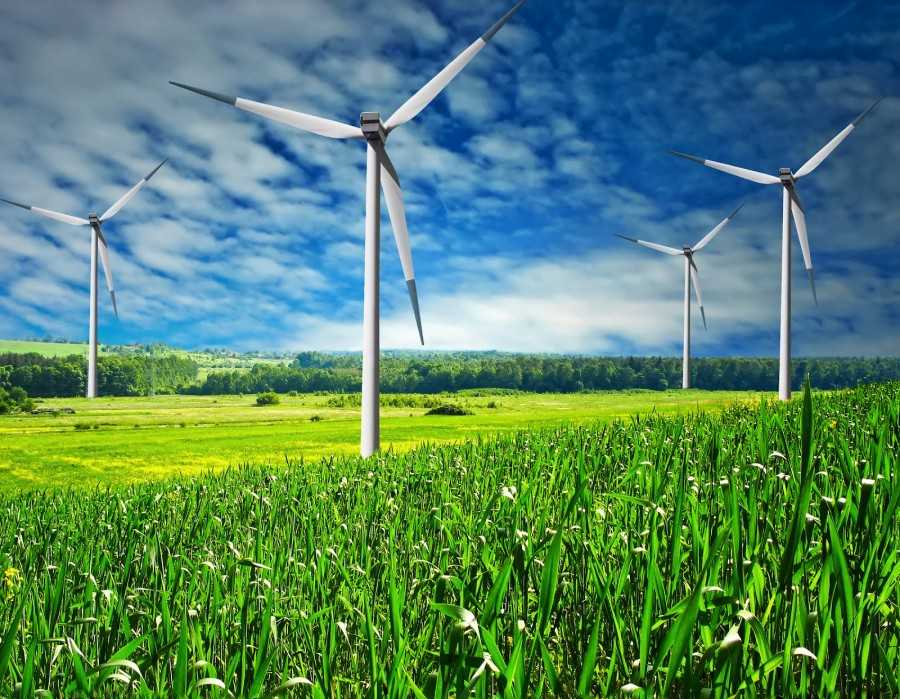

However, this is not the case. Each individual part moves against air resistance. Thus, a large number of blades on a propeller requires more wind force to complete one revolution. In addition, too many wide wings can cause the formation of the so-called "air cap" in front of the propeller, when the air flow does not pass through the windmill, but goes around it.
Form matters a lot. It depends on the speed of the screw. Poor flow causes vortices that slow down the wind wheel
The most efficient is a single-blade wind turbine.But building and balancing it with your own hands is very difficult. The design is unreliable, albeit with a high efficiency. According to the experience of many users and manufacturers of windmills, the most optimal model is a three-bladed one.
The weight of the blade depends on its size and the material from which it will be made. The size must be selected carefully, guided by the formulas for calculations. The edges are best processed so that there is a rounding on one side, and the opposite side is sharp
Properly selected blade shape for a wind turbine is the foundation of its good work. For home-made, the following options are suitable:
- sail type;
- wing type.
Sailing-type blades are simple wide strips, like on a windmill. This model is the most obvious and easy to manufacture. However, its efficiency is so low that this form is practically not used in modern wind turbines. The efficiency in this case is about 10-12%.
A much more efficient form is vane profile blades. The principles of aerodynamics are involved here, which lift huge planes into the air. A screw of this shape is easier to set in motion and rotates faster. The flow of air significantly reduces the resistance that the windmill encounters on its way.
The correct profile should resemble an airplane wing. On the one hand, the blade has a thickening, and on the other - a gentle descent. Air masses flow around a part of this shape very smoothly
The efficiency of this model reaches 30-35%. The good news is that you can build a winged blade with your own hands using a minimum of tools.All basic calculations and drawings can be easily adapted to your windmill and you can enjoy free and clean wind energy without restrictions.
Is there any benefit to use?
Many people are wary of buying a wind generator, believing that their area has a low wind potential. After reading the reviews of people who bought and installed this system 5 years ago, most people are afraid to spend a lot of money in vain, while not getting the desired return. But then these units in an affordable price category were of less quality and reliable than they are now.
Thanks to modern technologies, the development of alternative energy by domestic producers has achieved good results. It is safe to say that they have become more powerful, reliable, have a relatively low cost. If a person who installed a 1.5 kW Chinese wind turbine 4 years ago were provided with a 3 kW product from a domestic manufacturer, he would not be disappointed.
There are two obstacles to the widespread use of wind energy: the variability of its direction and strength, as well as the need to accumulate energy in the absence of wind or its low power. First of all, apparently, it is necessary to consider the wind generator as one of the ways to obtain additional energy, which makes it possible to reduce the consumption of fossil fuel.
It is profitable or not to use a wind generator in many respects, of course, depends on the efficiency of the equipment. The cost of funds, time, effort for connection should be calculated for each individual.