- Choosing a location for a wind turbine
- How does a wind generator work?
- How to make a rotary wind turbine with your own hands
- Tools and materials
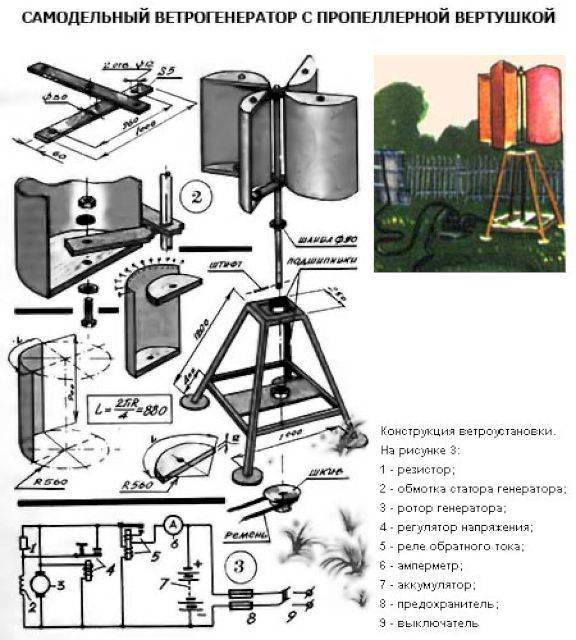
- Drawings and diagrams
- Manufacturing instructions
- Device testing
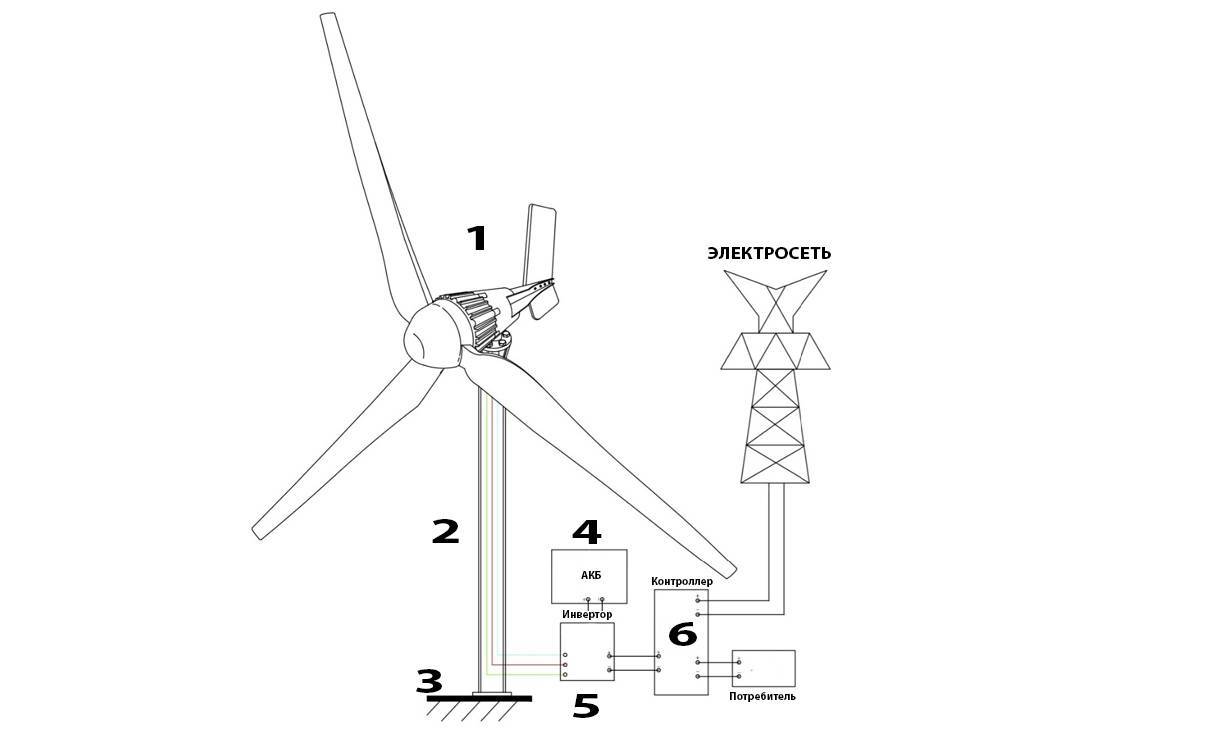
- Wiring diagram
- Classification of wind power generators
- According to the location of the generator: horizontal or vertical
- By nominal generated voltage
- Installation feasibility assessment
- Types of wind turbines
- vertical
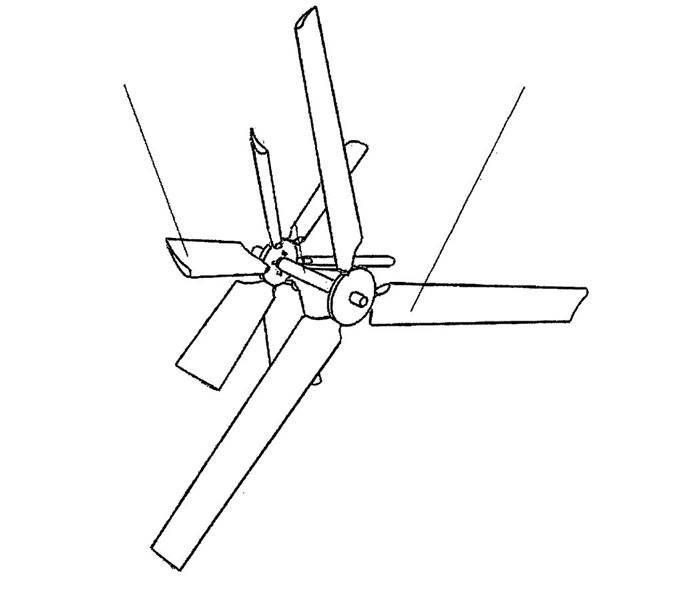
- Horizontal
- Varieties and modifications of vertical windmills
- Manufacturing options
- Schemes and drawings
- Wind Turbine Storm Protection
- The legality of installing a wind turbine
- Advantages and principle of operation of windmills
- Legal Aspects of Installing a Wind Turbine
- We wind the coil
- Instructions for making a wind generator with your own hands
- The legal side of the issue
Choosing a location for a wind turbine
Choosing the right place to install a wind turbine is an important step. It is best to place the device on an open, as high point as possible and carefully ensure that it does not fall below the level of adjacent residential and commercial buildings. Otherwise, the buildings will become an obstacle to the air flow and the efficiency of the unit will be greatly reduced.
If the site goes to a river or lake, the windmill is placed on the shore, where the winds blow especially often.Ideally suited for the location of the generator are hills available on the territory, or large empty spaces where there are no artificial or natural airflow obstructions.
When residential real estate (house, cottage, apartment, etc.) is located within the city or is located outside the city, but in densely built-up areas, the wind energy complex is placed on the roof.
To place a generator on the roof of an apartment building, they take the written consent of the neighbors and obtain official permission from the relevant authorities.
When installing a vertical generator on the roof of an apartment building, it should be remembered that the unit is quite noisy and can cause inconvenience to both the owners and the rest of the residents. Therefore, it is necessary to place the device closer to the center of the roof, so that the owners of apartments on the upper floors do not suffer from the loud hum emitted by the windmill during operation.
In a private house with a large garden plot, choosing a suitable place is much easier. The main thing to consider is that the structure is at a distance of 15-25 meters from the living quarters. Then the sound effects from the rotating blades will not disturb anyone.
How does a wind generator work?
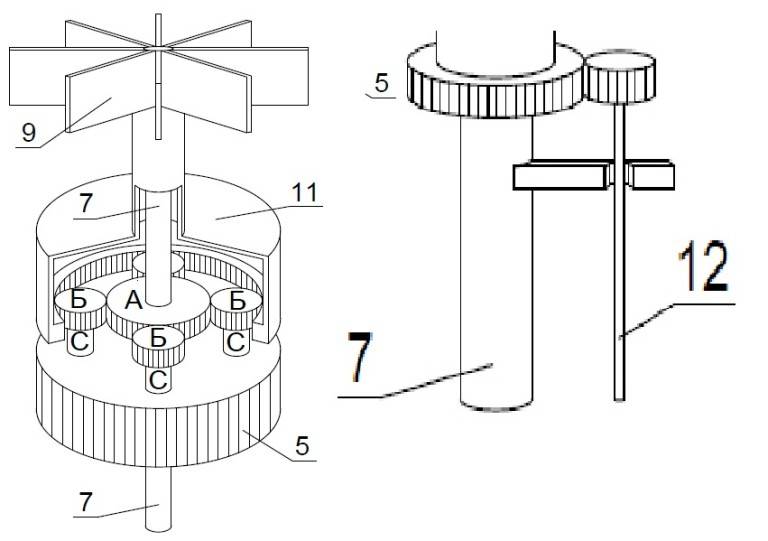
The design of the wind generator includes several blades that rotate under the influence of wind currents. As a result of such an impact, rotational energy is created. The resulting energy is fed through the rotor to the multiplier, which in turn transfers energy to the generator.
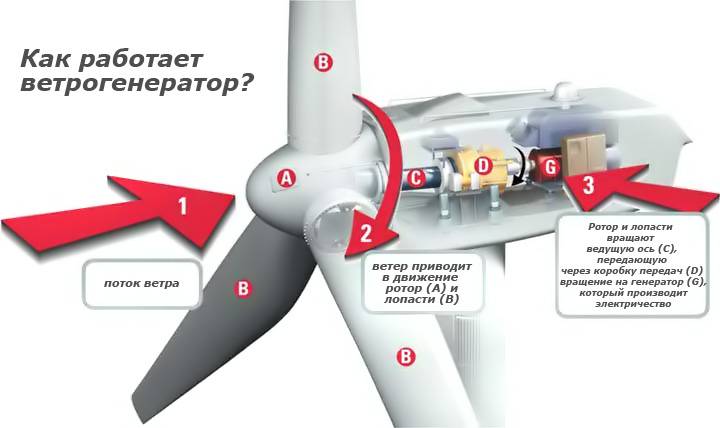
How does a wind generator work
There are also designs of wind turbines without multipliers. The absence of a multiplier makes it possible to significantly increase the productivity of the plant.
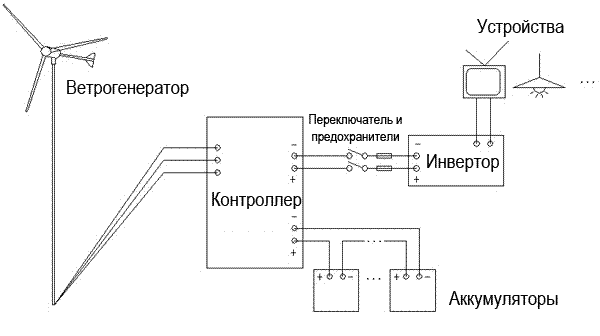
The principle of operation of the wind generator
Wind generators can be installed both individually and in groups combined into a wind farm. Also, wind turbines can be combined with diesel generators, which will save fuel and ensure the most efficient operation of the electrical supply system at home.
Such systems are called inverter (or battery) uninterruptible power systems.
How to make a rotary wind turbine with your own hands
Homemade manufacturing of any wind turbine is quite a difficult job. Many parts and assemblies require the use of machines and special equipment and the ability to work on them. Therefore, it is much more reasonable to pick up ready-made parts and assemblies, and with your own hands, if necessary, modify them and complete the assembly.
One of the serious advantages of a rotary type wind turbine is that it is of small height. During its manufacture and maintenance, high-altitude work is not required.
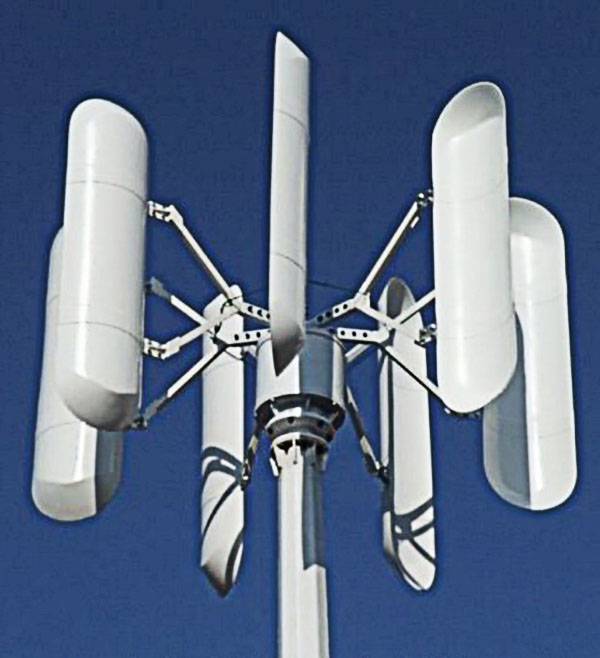 Rotary wind turbine
Tools and materials
If you decide to make a rotary-type wind power plant with your own hands, then the first steps towards the result should be as follows:
- Select the type of rotor.
- Explore the different designs of this type.
- Select materials and ready-made components for its manufacture.
- Prepare a tool appropriate for future work.
As an example, the manufacture of the simplest low-power windmill from finished parts with a vertical rotor for charging a telephone battery is given. It is done in the order indicated in the table.
| Illustration | Action Description |
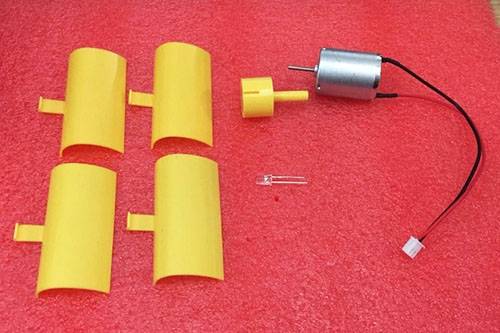 | Preparation of components |
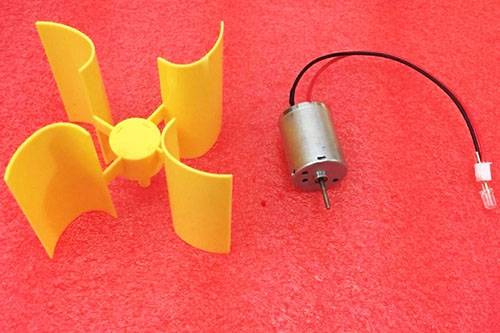 | Rotor Assembly |
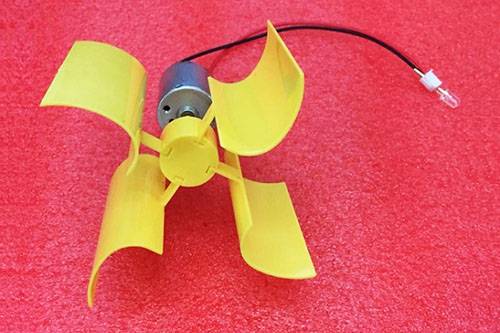 | Assembly of the whole device |
Drawings and diagrams
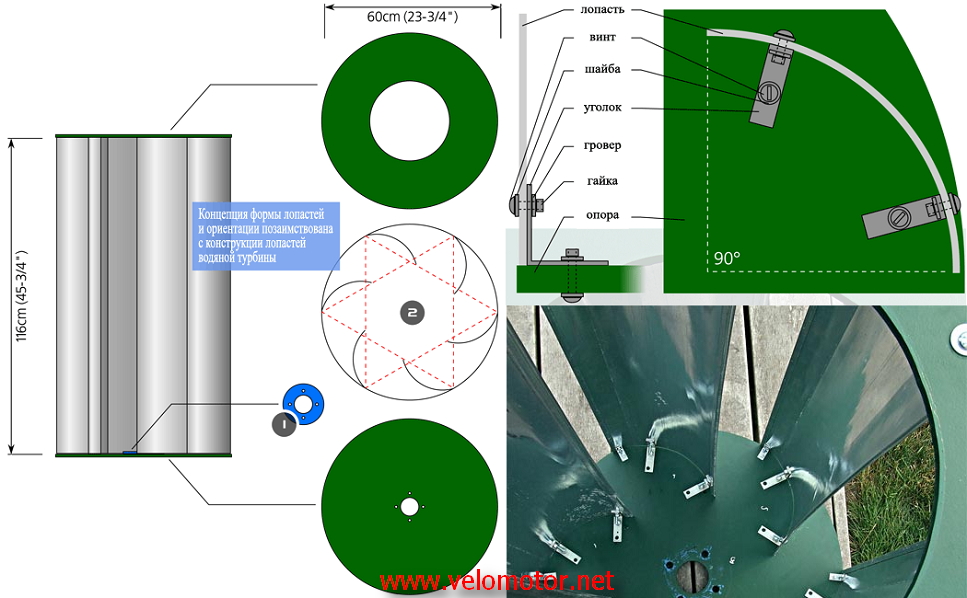
For a more powerful and complex wind turbine, ready-made parts and devices are required. The blades can be made from a standard 200 liter metal drum. The generator rotor is made from a brake disc hub from a decommissioned car and neodymium magnets. Drawings and diagrams should be selected ready-made.
Manufacturing instructions
| Illustration | Action Description |
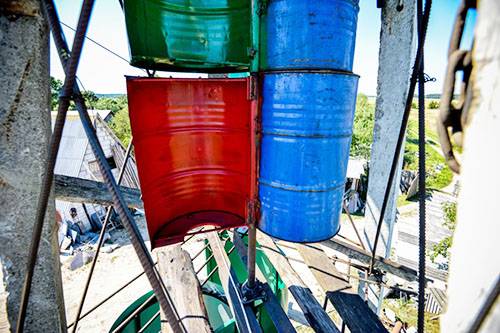 | Blade manufacturing |
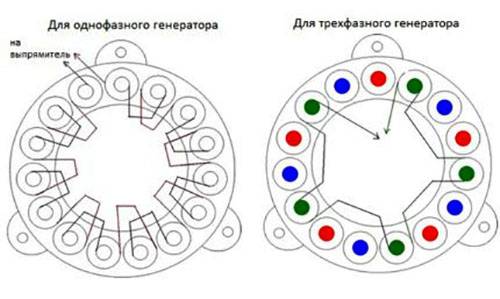 | Schemes of single-phase and three-phase generators |
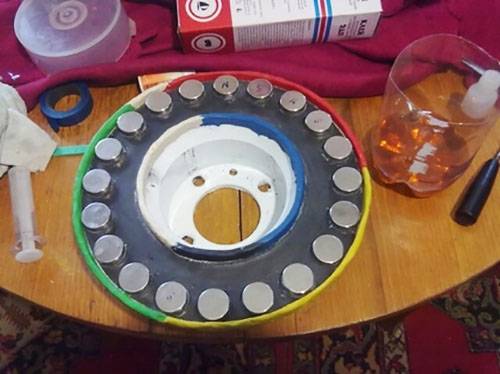 | Making a generator rotor from a car wheel hub |
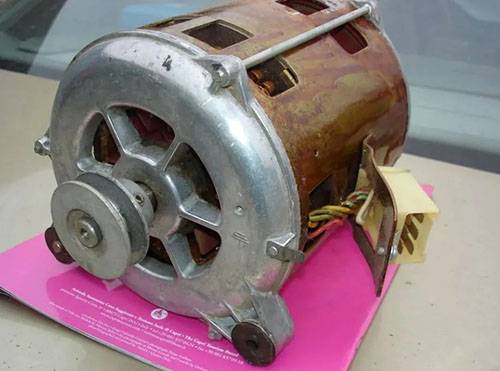 | Washing machine engine generator |
Device testing
Testing the generator is to check its operation under load. An electric lamp must be connected to its output, a voltmeter must be connected to the output terminals, and an ammeter must be connected to the break in any section of the circuit.


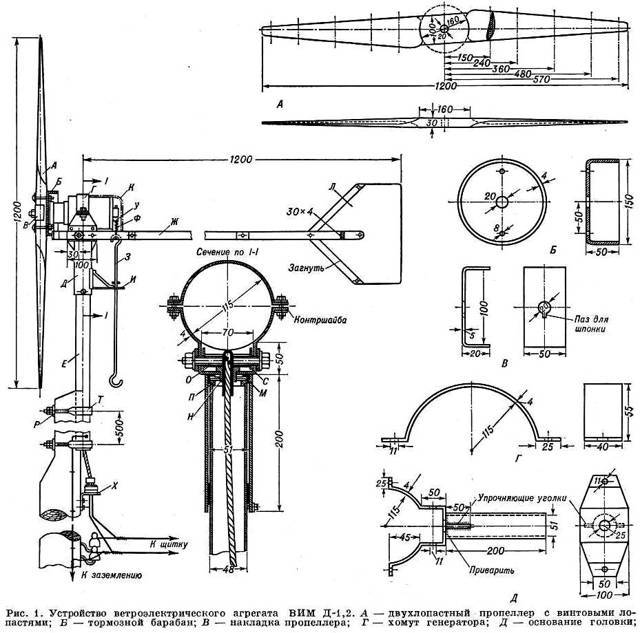
Wiring diagram
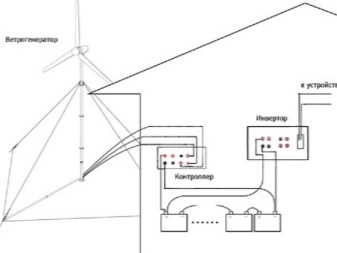
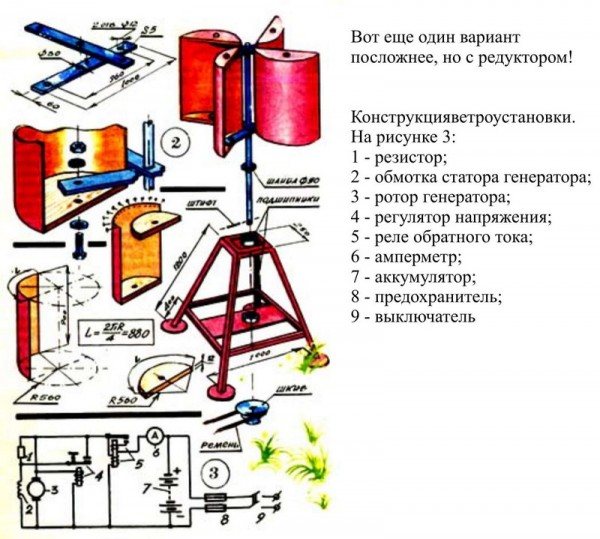
Let's take a closer look at the electrical circuit. It is clear that the wind can stop at any moment. Therefore, wind turbines are not connected directly to household appliances, but first they charge batteries from them, to ensure the safety of which, a charge controller is used. Further, given that batteries provide low voltage direct current, while almost all household appliances consume 220 volt alternating current, a voltage converter or, as it is also called, an inverter is installed and only then all consumers are connected.
In order for the wind generator to provide the operation of a personal computer, TV, alarm and several energy-saving lamps, it is enough to install a battery with a capacity of 75 amperes / hour, a voltage converter (inverter) with a power of 1.0 kW, plus a generator of the appropriate power. What else do you need when you are relaxing in the country?
Classification of wind power generators
Of the entire fleet of self-designed wind turbines, 2 main types with different axis of rotation are operated:
- horizontal (winged);
- vertical (carousel).
Each has its own characteristics, among which there are differences in:
- the number of blades (two-, three-, multi-bladed);
- characteristics of the material of the blades (metal, fiberglass, sail);
- screw pitch (fixed, variable).
At home, it is preferable to make a vertical-axis wind generator with your own hands. Its main advantage is insensitivity to wind. In addition, the design simplicity does not require the creation of a wind-orientation mechanism, so the need for rotary devices is eliminated.
According to the location of the generator: horizontal or vertical
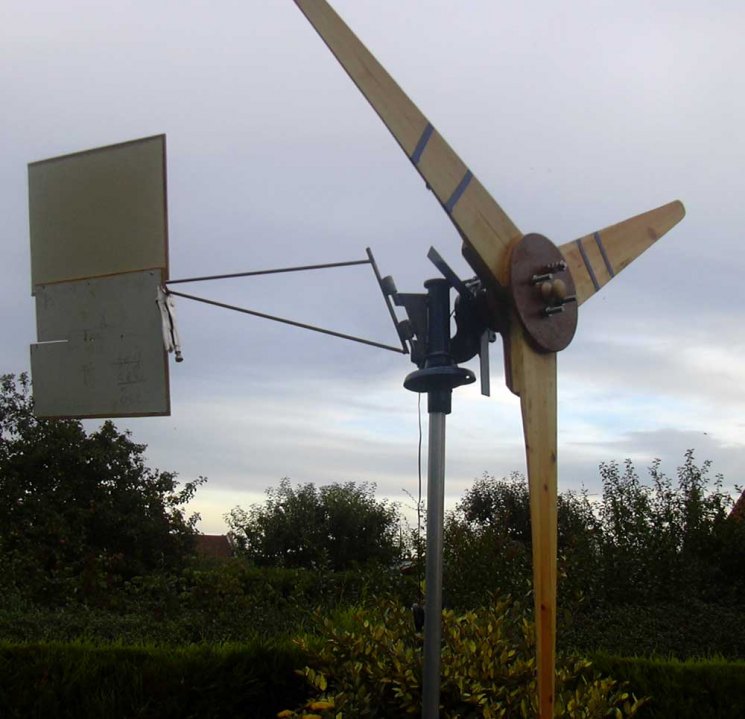
Many people associate with a wind power plant (APU) a classic-looking layout—horizontal. In this type, the axis of rotation is parallel to the ground, and the blades are arranged perpendicularly. In such a design, a weather vane is required, working on the principle of the tail unit. This contributes to the advantageous position of the plane of rotation perpendicular to the wind flow.
The horizontal position of the axis corresponds to the wind direction. There is a difficulty with the electrical connection. Without the electronic directional control, the body wraps around the axle, causing the wires to break. To prevent the situation, a full-turn limiter is installed.
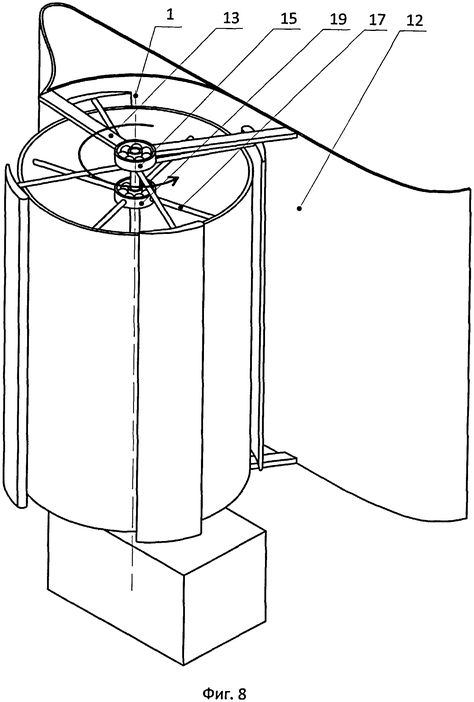
Making a vertical wind generator with your own hands is much easier. The positioned axis of rotation is independent of the direction of air flow.An additional advantage of the rotor propeller is that the maintenance units are at the bottom and it is not necessary to climb up.
By nominal generated voltage
To get the maximum savings, craftsmen install homemade wind turbines for the home with the highest power. A design made at 12-14 volts is more popular. An old car alternator works best for this. After changing it, the voltage converter will output 12-14 volts.
A 220 volt do-it-yourself wind generator is considered a direct application installation. It does not require a voltage converter. But since the work of the windmill is subject to the force of the air flow, a stabilizer is required at the outlet. Depending on the speed, it performs the functions of a regulator.
Installation feasibility assessment
Before proceeding with the manufacture of a vertical-type wind generator, they study the weather situation in their region and try to determine whether the unit can provide the required amount of resource.
Experts recommend evaluating the following parameters:
- the number of windy days - take the average value for the year when the gust exceeds 3 m / s;
- the amount of electricity consumed per day by households;
- a suitable place on your own plot for wind equipment.
The first indicator is learned from the data obtained at the nearest weather station or found on the Internet on the relevant portals. Additionally, they check with printed geographical publications and make up a complete picture of the situation with the wind in their region.
Statistics are taken not for one year, but for 15-20 years, only then the average figures will be as correct as possible and will show whether the generator can fully satisfy the household's need for electricity or whether its power is only enough to supply individual household needs.
If the owner has a large plot of land located on a slope, near the river bank or in an open area, there will be no problems with installation.
When the house is located in the depths of the settlement, and the yard is compact in size and closely adjacent to neighboring buildings, it will not be easy to install a vertical model of a windmill with your own hands. The structure will have to be raised 3-5 m above the ground and additionally strengthened so that it does not fall with a strong gust.
It is necessary to take into account all this information at the planning stage, so that it becomes clear whether the wind generator will be able to take over the full energy supply or its role will remain within the framework of an auxiliary energy source. Preliminary it is desirable to carry out the calculation of the windmill.
Types of wind turbines
They are classified according to the features of technical performance, which affects the functionality and capabilities.
vertical
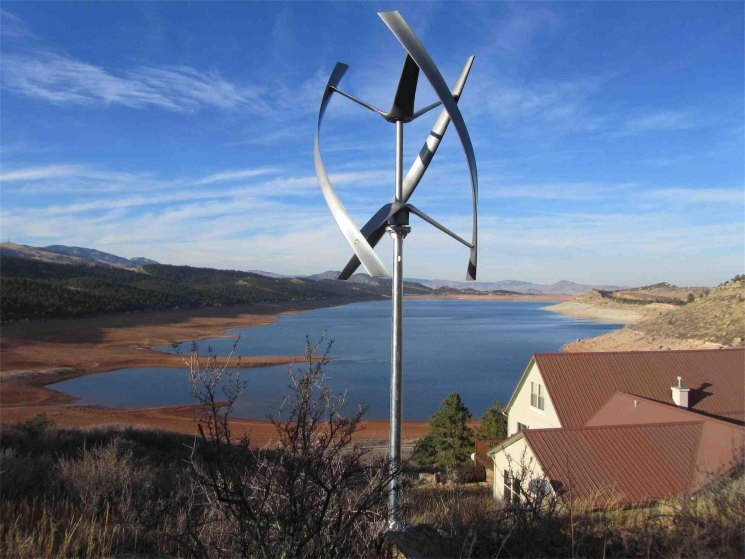
Depending on what type of rotor and blades are used, vertical wind turbines can be orthogonal, a subspecies of savonius, multi-bladed (there is a guide mechanism here), darya, helicoid. The main advantage of the devices is the fact that they do not need to be corrected for the wind, they work well in any direction. Therefore, they are not equipped with devices that capture air currents.
Due to the simplicity, the units can be placed on the ground, compared to horizontal options, it will be much easier to make blades for such a wind generator with your own hands. The downside is the low productivity of vertical models, the scope is limited due to their insufficient efficiency.
Horizontal
Here the number of blades varies. Single-bladed specimens show the highest speed, when compared with three-bladed ones, with identical wind strength, they spin about 2 times faster. The efficiency of horizontal models significantly exceeds the performance of vertical ones.
 Horizontal axis wind turbines
Horizontal-axial orientation has a vulnerability - its performance is tied to the direction of the wind, so the device is equipped with additional mechanisms that capture the movement of air flows.
Varieties and modifications of vertical windmills
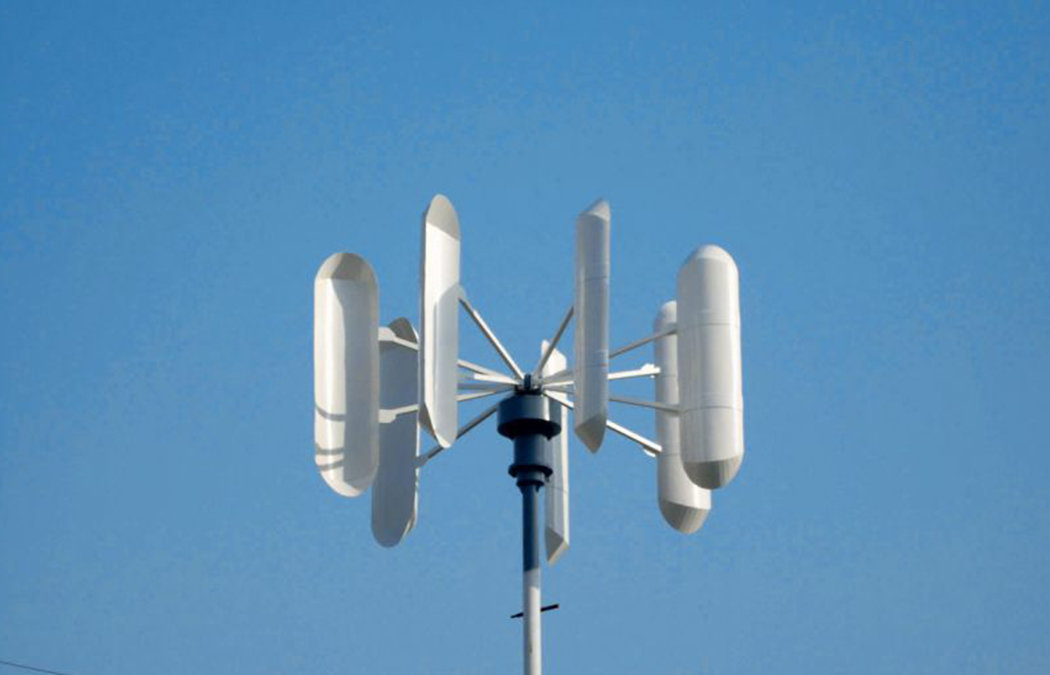
An orthogonal wind generator is equipped with several blades located at a certain distance parallel to the axis of rotation. These windmills are also known as the Darrieus rotor. These units have proven to be the most efficient and functional.
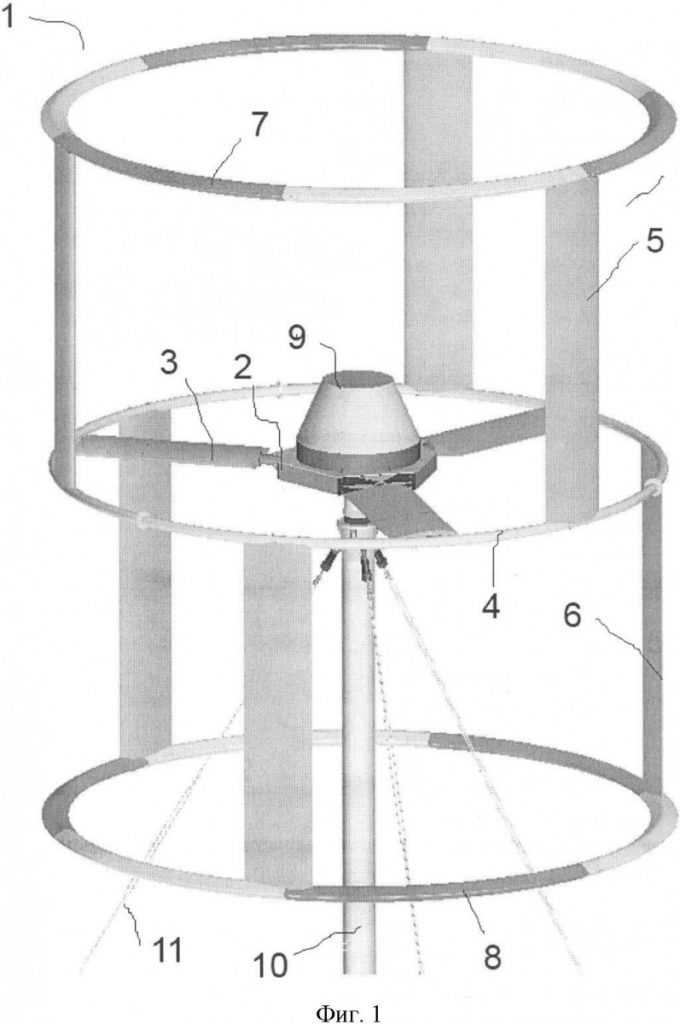


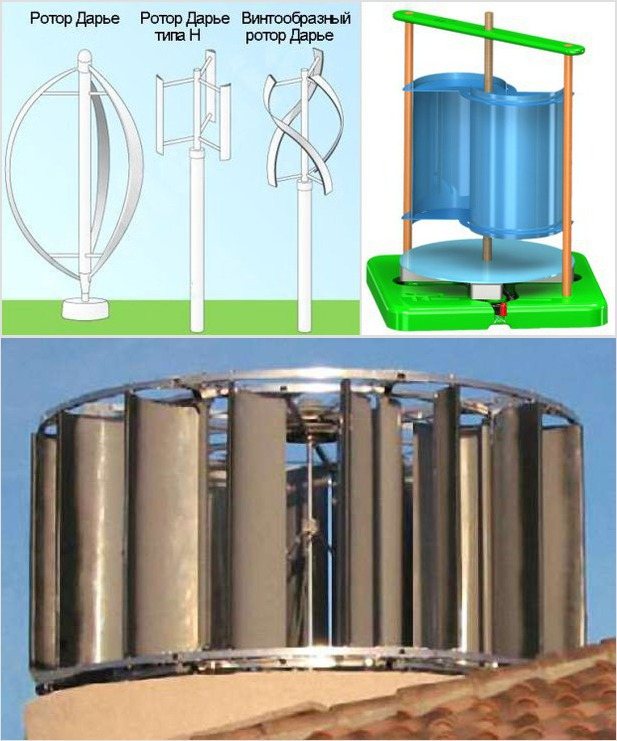


The rotation of the blades is provided by their wing-like shape, which creates the necessary lifting force. However, the normal operation of the device requires considerable effort, so the performance of the generator can be increased by installing additional static screens. As disadvantages, it should be noted excessive noise, high dynamic loads (vibration), which often lead to premature wear of the support units and failure of the bearings.
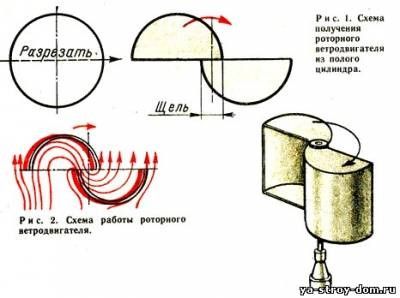
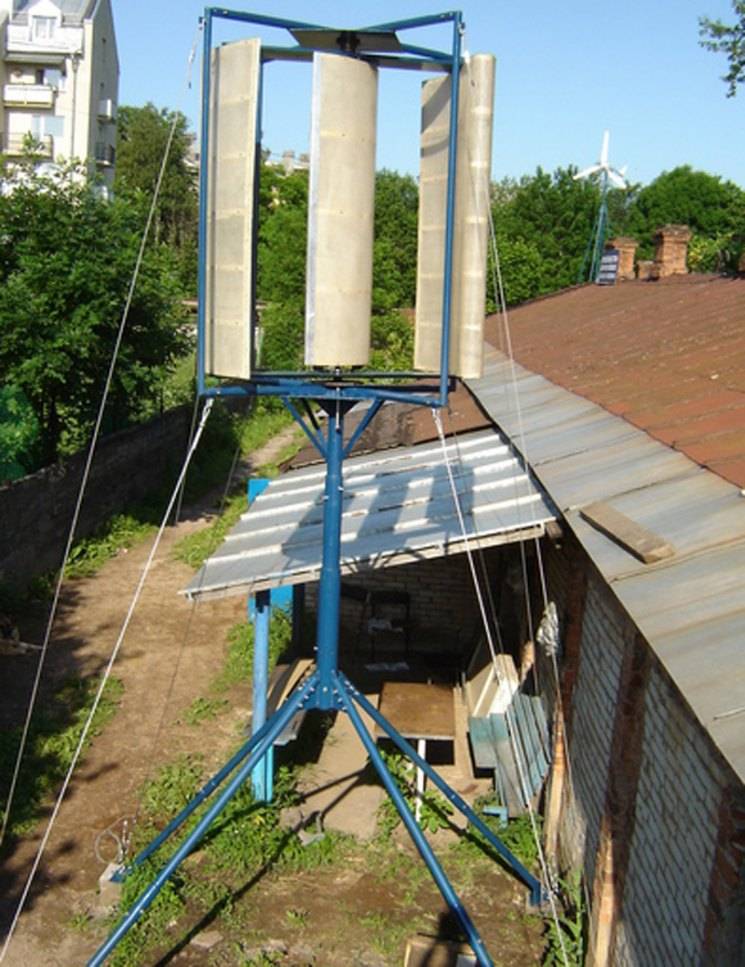
There are wind turbines with a Savonius rotor that are most suitable for domestic conditions. The wind wheel consists of several semi-cylinders that rotate continuously around their axis. Rotation is always carried out in the same direction and does not depend on the direction of the wind.
The disadvantage of such installations is the rocking of the structure under the action of the wind. Due to this, tension is created in the axis and the rotor rotation bearing fails. In addition, the rotation cannot start on its own if only two or three blades are installed in the wind generator. In this regard, it is recommended to fix two rotors on the axis at an angle of 90 degrees relative to each other.
The vertical multiblade wind generator is one of the most functional devices of this model range. It has high performance with little load on the load-bearing elements.
The internal part of the structure consists of additional static blades placed in one row. They compress the air flow and regulate its direction, thereby increasing the efficiency of the rotor. The main disadvantage is the high price due to the large number of parts and elements.
Manufacturing options
For a long time of the existence of alternative energy, electric generators of various designs have been created. They can be made by hand. Most people think that this is difficult, because it requires a certain amount of knowledge, various expensive materials, etc. In this case, the generators will be of very low performance due to the large number of miscalculations. It is these thoughts that make those who want to abandon the idea of making a windmill with their own hands.But all statements are absolutely wrong, and now we will show it.
Craftsmen most often create electric generators for a windmill in two ways:
- From the hub;
- The finished engine is converted into a generator.
Let's consider these options in more detail.
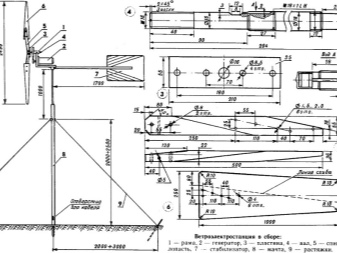
Schemes and drawings
The generator as a device generates alternating current, which must be converted to direct current, brought to the required voltage value. If the motor-generator is putting out, say, 40 volts, then this is unlikely to be a suitable value for most consumer electronics that consume 5 or 12 volts DC or 127/220 volts AC.
Proven by time and millions of users, the scheme of the entire installation includes a rectifier, controller, battery and inverter. A car battery with a capacity of 55-300 ampere-hours is used as a buffer storage of stored energy. Its operating voltage is 10.9-14.4 V with a cyclic charge (full charge-discharge cycle) and 12.6-13.65 with a buffer (portioned, dosed, when you need to recharge a partially discharged battery).
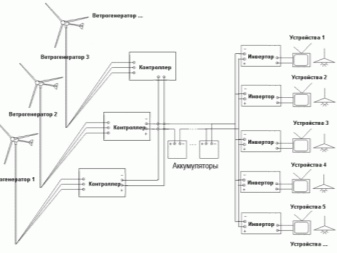
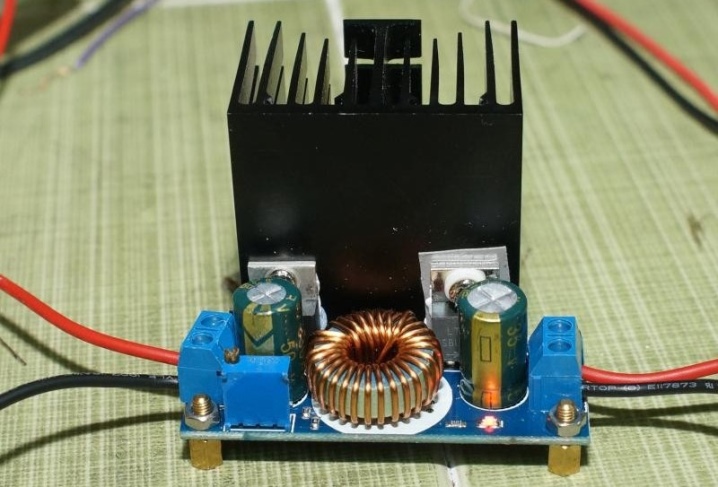
The controller converts, for example, the same 40 volts into 15. Its efficiency in terms of volt-ampere ranges from 80-95% - without taking into account losses in the rectifier.
A three-phase generator has the highest efficiency - its output is 50% greater than that of a single-phase generator, it does not vibrate during operation (vibration loosens the structure, making it short-lived).
The coils in the winding of each of the phases alternate with each other and are connected in series - like the poles of the magnets, facing one of the sides to the coils.
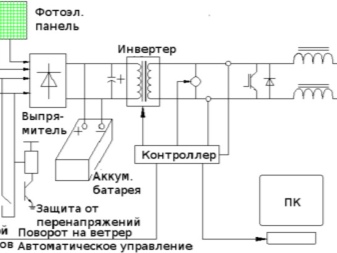
Modern household appliances and electronics are capable of operating from 110 volts (the American standard for household networks) up to 250 - it is not recommended to give more to network appliances and devices. All converters are pulse, in comparison with linear ones, their heat losses are much less.
Wind Turbine Storm Protection
It is about protecting the device from hurricanes and strong gusts of wind. In practice, it is implemented in two ways:
- By limiting the speed of the wind wheel with the help of an electromagnetic brake.
- The removal of the plane of rotation of the screw from the direct impact of the wind flow.
The first method is based on connecting a ballast electrical load to a wind generator. We have already talked about it in one of the previous articles.
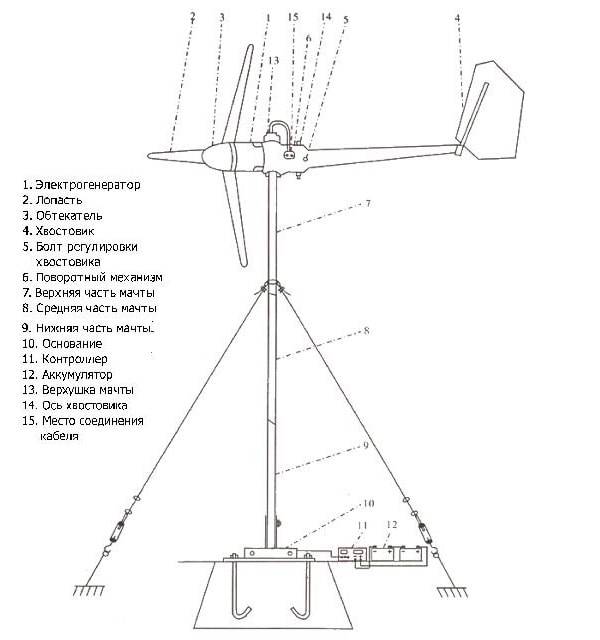
The second method involves the installation of a folding tail, which allows, at nominal wind strength, to direct the propeller towards the wind flow, and during a storm, on the contrary, to take the propeller out of the wind.
Tail folding protection occurs according to the following scheme.
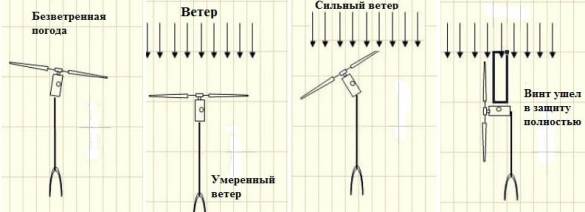
- In calm weather, the tail is slightly inclined (down and to the side).
- At nominal wind speed, the tail straightens out and the propeller becomes parallel to the airflow.
- When the wind speed exceeds the nominal values (for example, 10 m/s), the wind pressure on the propeller becomes greater than the force created by the weight of the tail. At this point, the tail begins to fold, and the propeller moves out of the wind.
- When the wind speed reaches critical values, the propeller rotation plane becomes perpendicular to the wind flow.
When the wind weakens, the tail under its own weight returns to its original position and turns the screw towards the wind.In order for the tail to return to its original position without additional springs, a swivel mechanism with an inclined pivot (hinge) is used, which is installed on the axis of rotation of the tail.



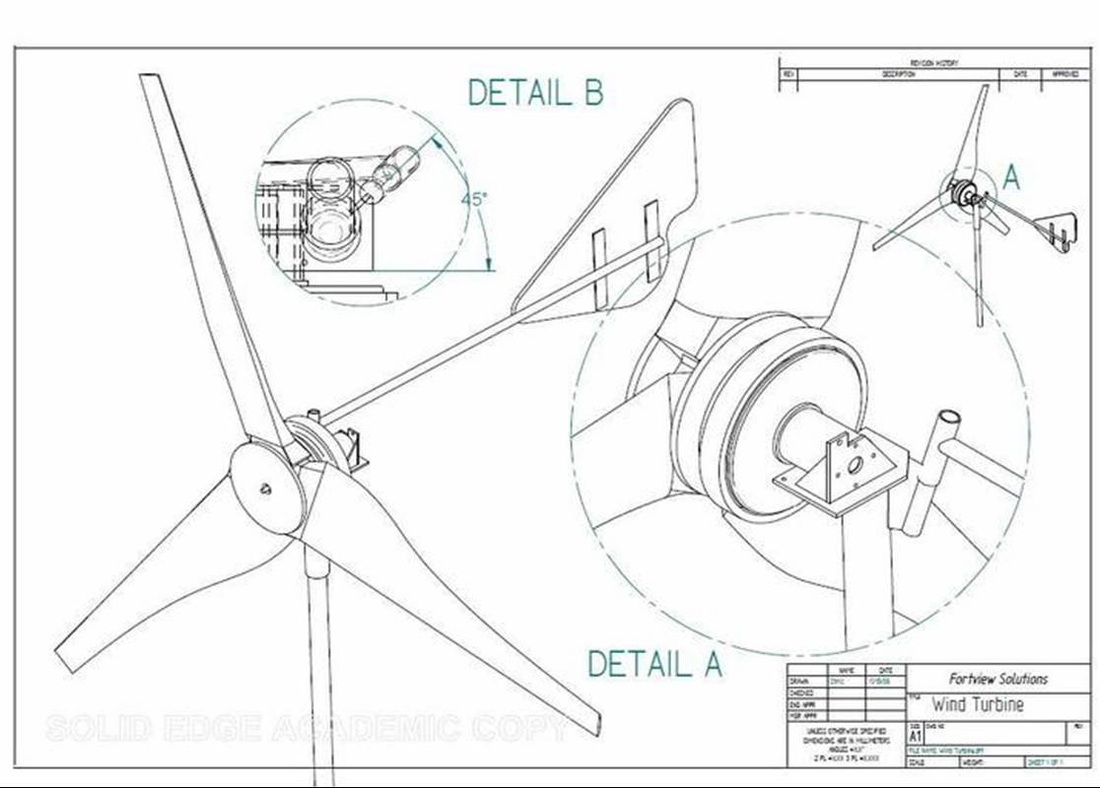

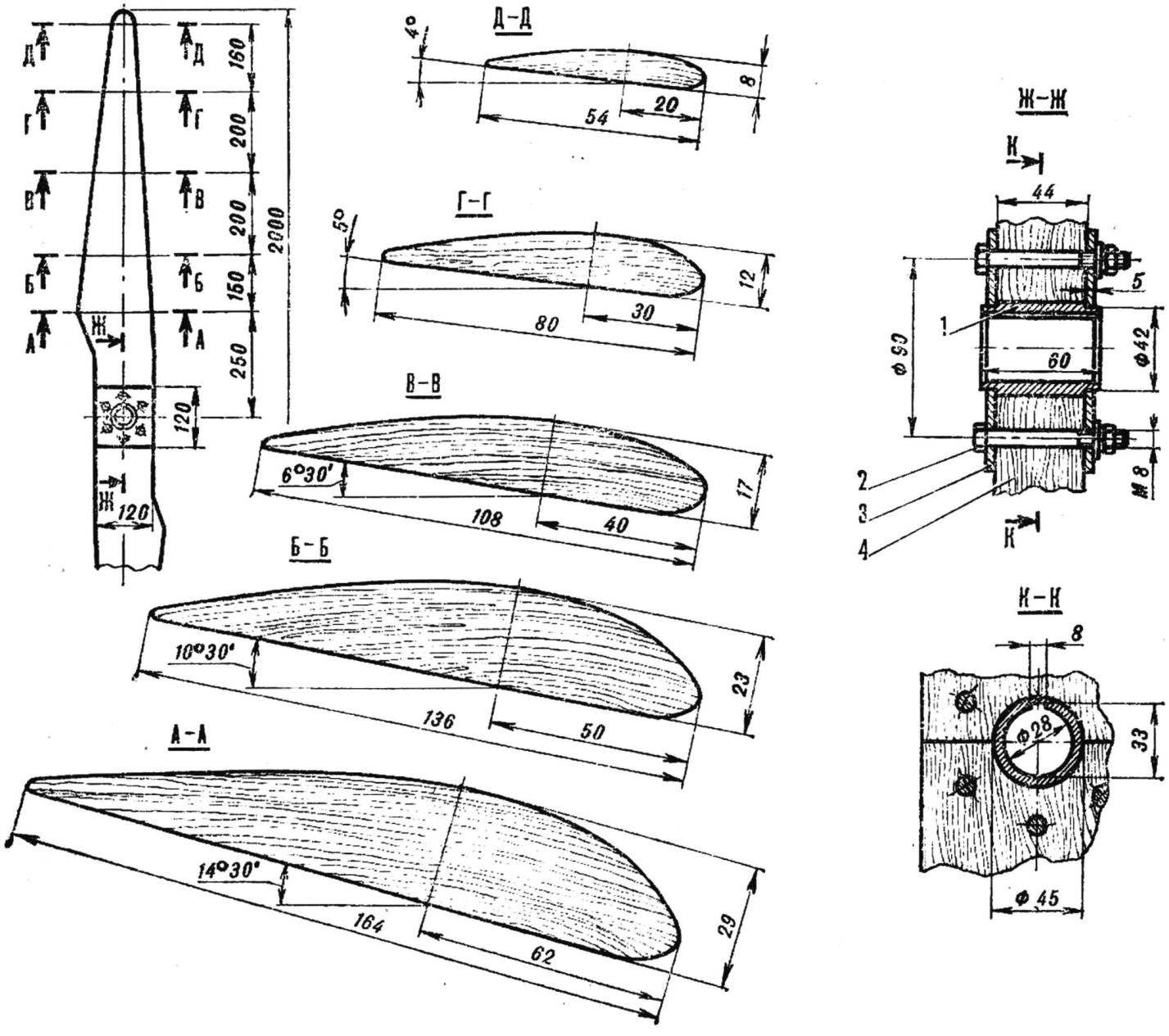
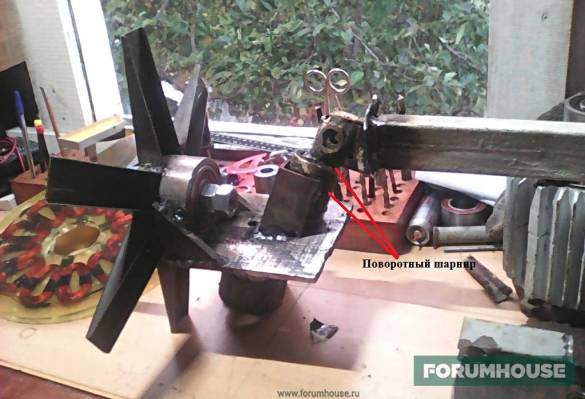
The axis of rotation of the tail is tilted: 20° relative to the vertical axis and 45° relative to the horizontal axis.
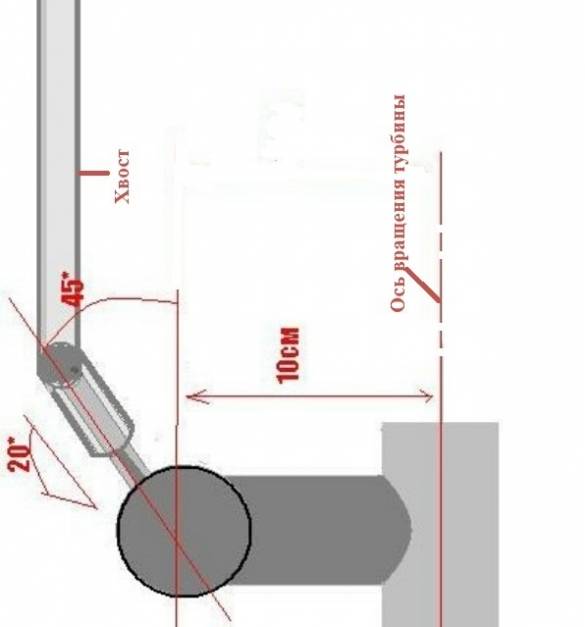
In order for the mechanism to perform its main function, the axis of the mast must be at a certain distance from the axis of rotation of the turbine (optimally - 10 cm).
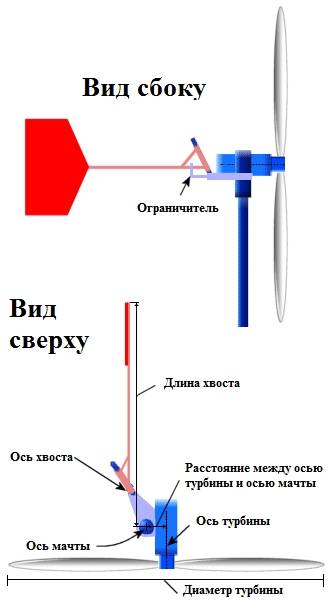
So that during sharp gusts of wind the tail does not develop and does not fall under the propeller, limiters must be welded on both sides of the mechanism.
An Excel table with ready-made formulas will help you calculate the tail dimensions and their dependence on other wind turbine parameters. In it, the area of variable values is marked in yellow.
The optimal area of the tail unit is 15% ... 20% of the area of the wind turbine.
The most common variant of the mechanical protection of a wind generator is presented to your attention. In one form or another, it is successfully used in practice by users of our portal.
WatchCat User
In a storm, it is necessary to slow down the propeller by pulling it out from under the wind. For example, when the wind is too strong, the windmill capsizes with the screw up. Not the best option, because the return to the working position is accompanied by a noticeable blow. But for ten years the windmill did not break.
The legality of installing a wind turbine
Alternative energy sources are the dream of any summer resident or homeowner whose site is located far from the central networks.However, when we receive bills for electricity consumed in a city apartment, and looking at the increased tariffs, we realize that a wind generator created for domestic needs would not hurt us.
After reading this article, perhaps you will make your dream come true.

A wind generator is an excellent solution for providing a suburban facility with electricity. Moreover, in some cases, its installation is the only possible way out.
In order not to waste money, effort and time, let's decide: are there any external circumstances that will create obstacles for us in the process of operating a wind turbine?
To provide electricity to a dacha or a small cottage, a small wind power plant is sufficient, the power of which will not exceed 1 kW. Such devices in Russia are equated to household products. Their installation does not require certificates, permits or any additional approvals.
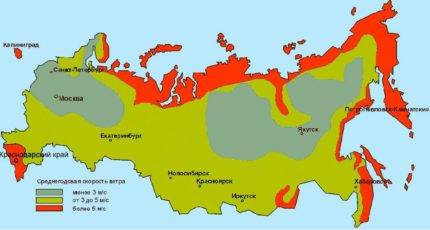 In order to determine the feasibility of installing a wind generator, it is necessary to find out the wind energy potential of a particular area (click to enlarge)
No taxation is provided for the production of electricity, which is spent to meet their own domestic needs. Therefore, a low-power windmill can be safely installed, it can be used to generate free electricity without paying any taxes to the state.
However, just in case, you should ask if there are any local regulations regarding individual power supply that could create obstacles in the installation and operation of this device.
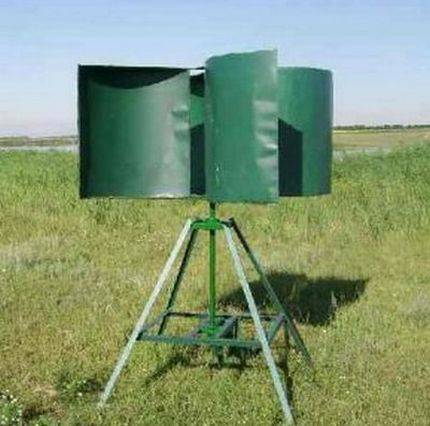
Wind turbines that can meet most of the needs of the average farm can not cause complaints even from the neighbors
Claims may arise from your neighbors if they experience inconvenience associated with the operation of the windmill. Remember that our rights end where other people's rights begin.
Therefore, when buying or self-manufacturing a wind turbine for a home, you need to pay serious attention to the following parameters:
Mast height. When assembling a wind turbine, it is necessary to take into account the restrictions on the height of individual buildings that exist in a number of countries of the world, as well as the location of your own site. Be aware that near bridges, airports and tunnels, buildings that are more than 15 meters high are prohibited.
Noise from gearbox and blades. The parameters of the generated noise can be set using a special device, after which the measurement results can be documented


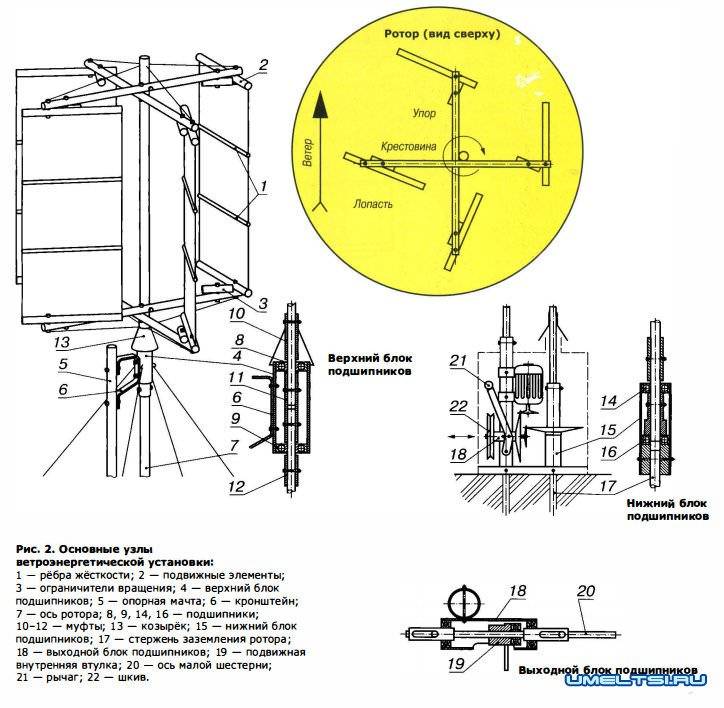
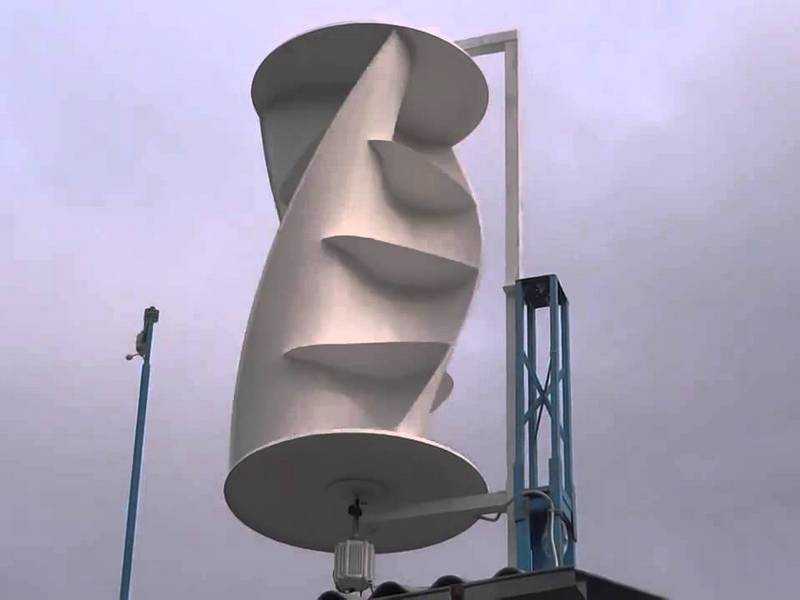



It is important that they do not exceed the established noise standards.
Ether interference. Ideally, when creating a windmill, protection against tele-interference should be provided where your device can provide such trouble.
Environmental claims
This organization can prevent you from operating the facility only if it interferes with the migration of migratory birds. But this is unlikely.
When creating and installing the device yourself, learn these points, and when buying a finished product, pay attention to the parameters that are in its passport. It is better to protect yourself in advance than to be upset later.
Advantages and principle of operation of windmills
A modern vertical generator is one of the options for alternative energy for the home. The unit is able to convert gusts of wind into an energy resource. For correct operation, it does not need additional devices that determine the direction of the wind.
A rotary wind generator is very easy to make with your own hands. Of course, he will not be able to fully take over the provision of a private large-sized cottage with energy, but he will cope with the lighting of outbuildings, garden paths and the local area perfectly
The vertical type device operates at low altitude. For its maintenance, various devices are not needed to ensure the safe carrying out of high-altitude repair and maintenance work.
A minimum of moving parts makes the wind turbine more reliable and operationally stable. The optimal profile of the blades and the original shape of the rotor provide the unit with a high level of efficiency, regardless of which direction the wind is blowing at any given moment.
Small household models consist of three or more light blades, instantly catch the weakest gust and begin to rotate as soon as the wind strength exceeds 1.5 m / s. Due to this ability, their efficiency often exceeds the efficiency of large installations that need stronger wind.
The generator works absolutely silently, does not interfere with the owners and neighbors, does not create harmful emissions into the atmosphere and reliably serves for many years, accurately supplying energy to residential premises.
The vertical wind-type generator works on the principle of magnetic levitation.During the rotation of the turbines, impulse and lift forces are generated, as well as the actual braking force. The first two make the blades of the unit spin. This action activates the rotor and it creates a magnetic field that generates electricity.
A windmill with a vertical axis of rotation is not inferior in efficiency to its horizontal counterparts. In addition, it does not make any claims to the territorial location and fully works in almost any place convenient for homeowners.
The device functions completely independently and does not require the intervention of the owners in the process.
Legal Aspects of Installing a Wind Turbine
A wind generator is an unusual property, the possession of this device is associated with compliance with certain rules and laws. If the device is installed near bridges, airports and tunnels, then the height of the mast should not exceed 15 m. The level of generated noise should not exceed 70 dB during the day and 60 dB at night. Requires protection from tele-interference. Environmental services should not make claims regarding the creation of obstacles to the migration of migratory birds. It is advisable to conduct a legal consultation on each parameter and have official documents before starting construction. There is no taxation for the production of electricity for own domestic needs by laws.
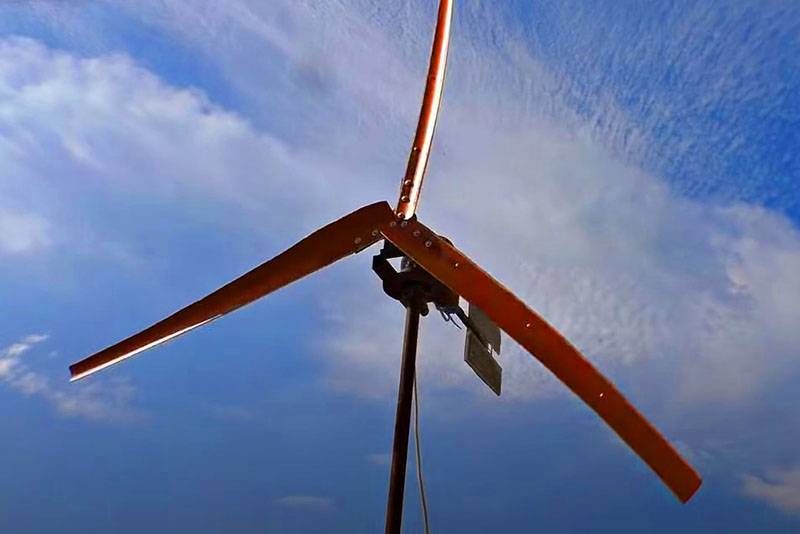 Windmill
We wind the coil
Choosing a not very high-speed option, charging a 12V battery starts at 100-150 rpm. The number of turns for this should correspond to 1000-1200. By dividing the turns on all coils, we get their number for one.
If a large wire is used for turns, the resistance decreases and the current strength increases.
The characteristics of hand-assembled wind turbines are affected by the thickness of the magnets on the disk and their number.
Coils are usually made in a round shape, but by slightly stretching them, it will be possible to straighten the turns. Finished, the coils should be equal to or slightly larger than the magnets. The thickness of the stator must also be related to the magnets.
If the latter is larger due to more turns, the space between the disks increases and the magnetic flux decreases.
But more resistance coils will lead to a decrease in current. Plywood is suitable for the shape of the stator. To increase the strength of the product, fiberglass is placed on top of the coils (at the bottom of the mold). Before applying the epoxy resin, the mold is treated with petroleum jelly or wax, or tape is used.


The generator is tested by turning it by hand. For a voltage of 40V, the current reaches 10 A.
Instructions for making a wind generator with your own hands
- Mount the magnets in specially made recesses on the rotor. Use superglue to be sure.
- Wrap the magnets with paper, and fill the remaining free space with epoxy.
- Turn the axis on turning equipment. Attach a steel rod holder to it.
- Make blades from the pipe.
- Attach the generator, blades, rotor and tail to the carrier rail.
- Install the power unit using the swivel mount.
- Mount the mast in the concrete base and fix with 4 bolts.
- Connect the wire to the shield.
- Connect everything and test for performance.
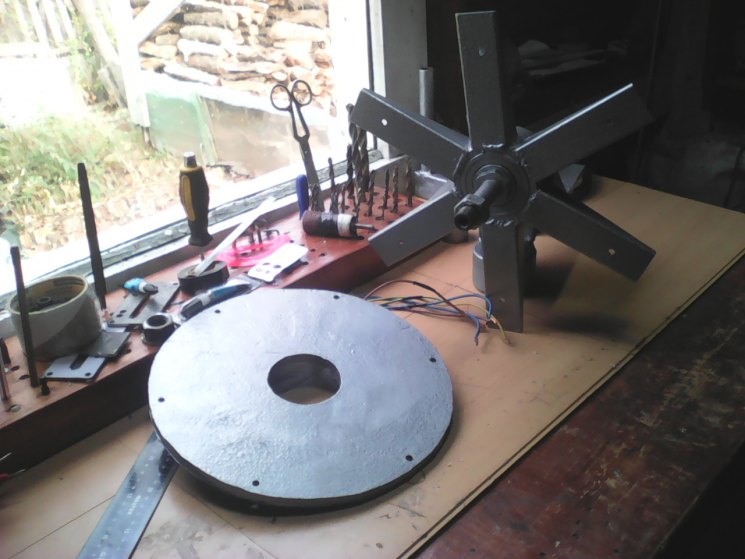
You feel insecure in your own abilities - get a household unit. This will also be beneficial.In general, select a model, focusing on your financial capabilities, and build it in your summer cottage.
Do it right now and tomorrow you will stop flinching when you receive electricity bills.
The legal side of the issue
A home-made wind generator for a home does not fall under prohibitions, its manufacture and use does not entail administrative or criminal punishment. If the power of the wind generator does not exceed 5 kW, it belongs to household appliances, and does not require any coordination with the local energy company. Moreover, you do not need to pay any taxes if you do not make a profit from the sale of electricity. In addition, a home-made generating windmill, even with such a performance, requires complex engineering solutions: it is easy to make it. Therefore, homemade power rarely exceeds 2 kW. Actually, this power is usually enough to power a private house (of course, if you do not have a boiler and a powerful air conditioner).
In this case, we are talking about federal law. Therefore, before deciding to make a windmill with your own hands, it would not be superfluous to check the presence (absence) of subject and municipal regulatory legal acts that may impose some restrictions and prohibitions. For example, if your home is located in a specially protected natural area, the use of wind energy (and this is a natural resource) may require additional approvals.
Problems with the law can arise in the presence of restless neighbors. Windmills for the home are individual buildings, so they are also subject to some restrictions:
- The height of the mast (even if the wind turbine is without blades) cannot exceed the norms established in your region. In addition, there may be restrictions related to the location of your site. For example, a landing glide path to the nearest airfield may pass over you. Or in the immediate vicinity of your site there is a power line. If dropped, the structure may damage poles or wires. General limits under normal wind load are 15 meters in height (some makeshift windmills soar up to 30 meters). If the mast and body of the device have a large cross-sectional area, neighbors may make claims against you, on whose plot the shadow falls. It is clear that such complaints usually arise “out of harm”, but there is a legal basis.
- Blade noise. The main source of problems with neighbors. When operating a classic horizontal design, the windmill emits infrasound. This is not just an unpleasant noise, when a certain level is reached, the wave vibrations of the air have an adverse effect on the human body and domestic animals. A homemade windmill generator is usually not a "masterpiece" of engineering, and by itself can make a lot of noise. It is highly desirable to officially test your device in the supervisory authorities (for example, in the SES), and obtain a written opinion that the established noise standards are not exceeded.
- Electromagnetic radiation. Any electrical device emits radio interference. Take, for example, a windmill from a car generator. To reduce the interference level of the car receiver, capacitor filters are installed in the car. When developing a project, be sure to consider this point.
Claims can be made not only from neighbors who have problems with receiving TV and radio signals. If there are industrial or military reception centers nearby, it is not superfluous to check the level of interference in the electronic interference control (EW) unit.
- Ecology. It sounds paradoxical: it would seem that you are using an environmentally friendly unit, what problems can there be? A propeller located at a height of 15 meters and above can become an obstacle to the migration of birds. The rotating blades are invisible to birds and they are easily hit.