- How to do?
- If this is a kitchen
- If this is a room that borders the street through at least 1 wall
- If this is a room that does not border the street
- If the room is below ground level
- Filling layout
- Forced ventilation
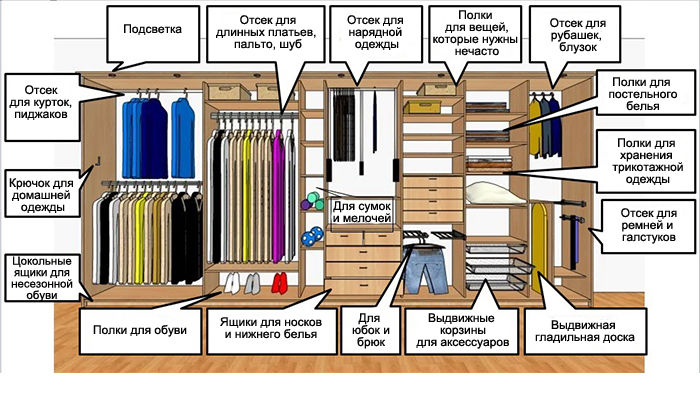
- The main filling of wardrobes
- Dressing room ventilation and how to implement it
- Variants of ready-made layouts for the dressing room
- Dressing room - layout with dimensions 2x2
- Dressing room layout 3 sq m
- Dressing room layout 4 sq m
- Ventilation in the dressing room
- If there is a window
- With no window
- Arrangement of air exchange
- The optimal solution for ventilation in a dressing room without a window
- Combined premises
- Ready solutions for your home
- Airgivers
- Air conditioner
- Stages of altering the pantry into a dressing room
- Air exchange device for rooms without windows
- Ventilation in the dressing room
- Ventilation in the bedroom without a window
How to do?
In many ways, the solution to this problem depends on whether this room borders on the street or not. If it borders, then it will be much easier to equip the ventilation system, and this will not require the installation of air ducts. If it does not border, then the task becomes more complicated, and will depend on how far the room is from the street.
Another main rule: in "dirty" rooms there is always an exhaust hood, and in "clean" rooms there is an inflow. The “dirty” include the kitchen, bathrooms, as well as rooms in which harmful substances are released into the air.
Below we consider some of the simplest situations and methods for solving them.
If this is a kitchen
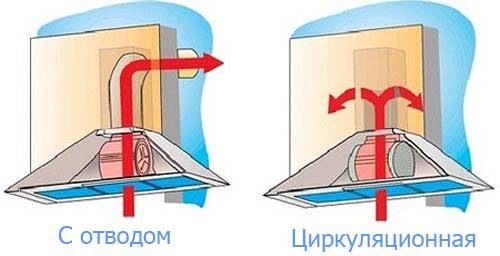
A prerequisite for organizing a ventilation system is the presence of a ventilation shaft in it. It will act as an exhaust system and stagnant air will be removed through it. The second option is to remove air through a kitchen hood (which is either vented to the ventilation shaft or directly to the street, through a wall or through an air duct).
The air flow will be carried out from other rooms: either through the slots under the doors, or through the overflow grilles (if there are no slots).
In this case, it is necessary to check the draft of the ventilation shaft. To do this, you need to take a strip of thin paper and bring it to the ventilation grill.
If the paper is attracted, the ventilation shaft is working normally. If not, or it is attracted very weakly, the ventilation shaft either does not work at all, or it does not work well (perhaps due to the fact that it is clogged and needs to be cleaned). If for some reason cleaning is not possible now, it makes sense to put a forced exhaust fan in the wall, with direct access to the street.
The fan power must fully ensure the removal of air in a volume equal to the number of people living multiplied by 30. For example, if 3 people live in an apartment, then the fan must remove at least 90 cubic meters of air per hour.
If this is a room that borders the street through at least 1 wall
If this is a “dirty” room, then a hole is made in the street wall, and a fan is inserted into it. It will draw air out, and the inflow will be carried out from other rooms (through the overflow grilles or through the slots under the doors).
Arrangement of supply ventilation in the apartment
If this is a “clean” room, then an inflow is made through the street wall, using any of the methods below:
- through the supply wall valve;
- through the supply unit;
- through the hole with the installed fan.
Air removal will be carried out through another room from which the hood is made.
If this is a room that does not border the street
Often in such cases we are talking about a pantry (if it is an apartment or a house), which is often located in the "depth" of the dwelling.
In this case, you can equip the ventilation system in one of the following ways:
- If a room without windows stands between another room with an inflow and another room with an exhaust hood. Holes can be made in the walls between them by covering them with bars (or by installing a fan in one or both holes). This option is suitable if you need little air (if the room is small), and if clean air will come from the room where the inflow will come from.
- If the building (apartment, house) has an air duct system (either both supply and exhaust, or one of them). In this case, a separate line of air ducts is laid to the room without windows. If the ventilation duct serves only one purpose (for example, it only removes air), then the inflow must also be arranged separately. This can be done, for example, from the next room, through the hole.
- If the room is too large, or the exhaust / ventilation shaft opening is far away, it would be better to lay an air duct for both supply and exhaust. And in this case, it is necessary to install a fan on both systems.
If the room is below ground level
It's about the basement. If at least a small part of the room is above ground level, it will be possible to make an inflow through the wall in this place. The hood is made through the exhaust system of the building (ventilation shaft or just a hood). If there is no ventilation shaft, then air removal is organized through an opening (with or without a fan) in the wall opposite the inflow point.
If the room is located completely below ground level - in this case, both the supply and exhaust are organized through air ducts with fans. Pipes are laid from the surface, through walls, opposite each other (inflow on one wall, exhaust on the other). Fans are inserted into the pipes: one supplies air inside, the second blows it out.
Filling layout
Sections, drawers, modules and blocks are arranged in the space allocated for the wardrobe as intended. The main thing for which storage places are created:
- clothes for hanging;
- clothing for storage;
- shoes;
- hats - caps, hats, caps;
- umbrellas;
- bags;
- suitcases;
- accessories - gloves, scarves, ties;
- small items - cufflinks, brooches, hairpins, jewelry.
Those clothes that need to be stored hung and straightened are grouped according to seasonality. Winter is placed in a separate box. Autumn and spring - in a separate. And summer from light, but wrinkled fabrics - in a separate one.In the built-in wardrobe, you can place large sections with rods, on which coat hangers with jackets, fur coats, raincoats or coats will hang.

Wall-mounted wardrobe with corner placement and chest of drawers-island in the middle
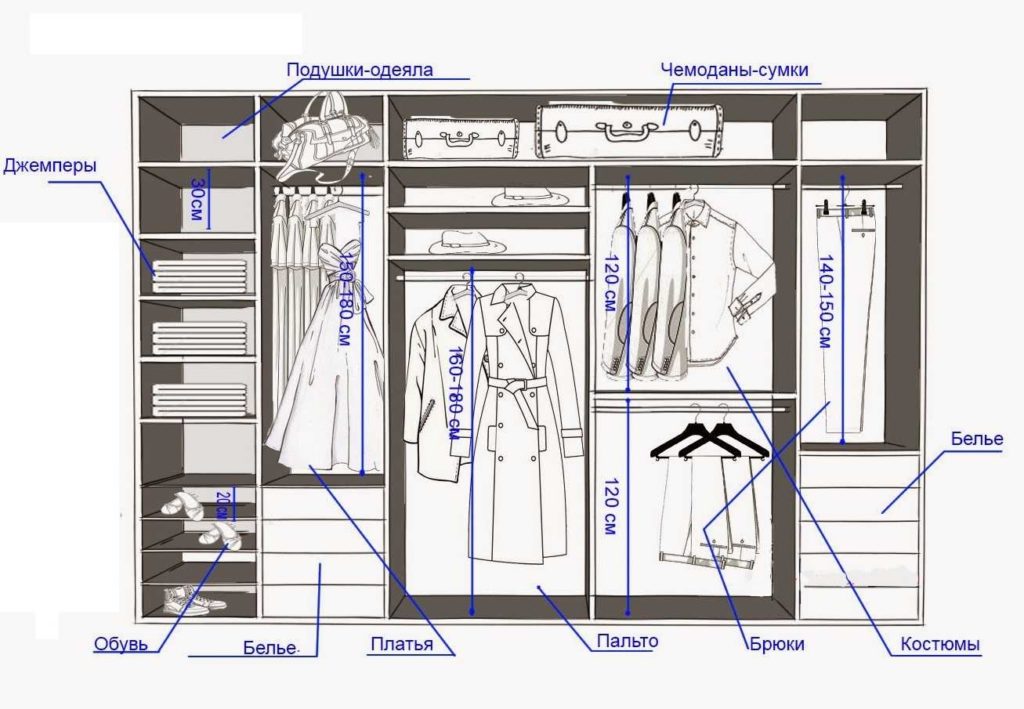
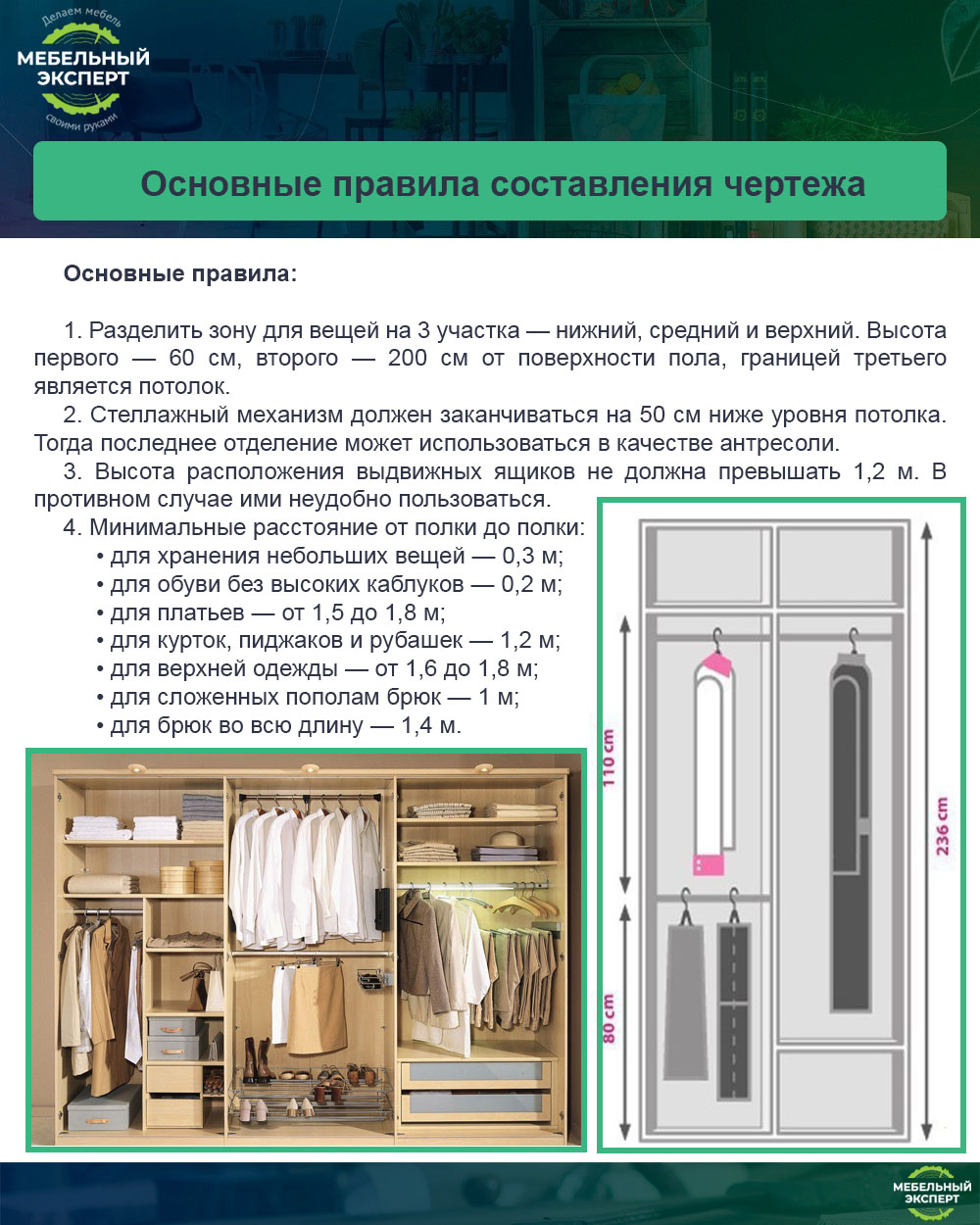
Typical sizes for load balancing and creating optimal storage systems:
- maximum shelf depth - from 70 cm to 1 m;
- hanger rod length - from 1 m to 1.2 m;
- installation height of the rod for hanging outerwear, long dresses, cardigans, bathrobes - 160-200 cm from the bottom of the cabinet, rack or from the floor;
- the height of the rod for hanging trousers, skirts, sweaters, blouses, shirts - 100-150 cm from the floor or the bottom of the structure;
- the space between the bar and the top shelf or "roof" should not exceed 5 cm;
- width of standard hangers - 34-51 cm;
- drawer width - no more than 90 cm;
- width of shelves for shoes, bags and accessories - 40-70 cm;
- the height of the shelves for storing things in piles is from 32 to 40 cm;
- the maximum height of drawers is 40 cm;
- depth of a separate drawer for trousers - 60-70 cm;
- the depth of the shelves for shoes - from 35 cm;
- the walkway between the racks should not be narrower than 60-80 cm, and for structures with drawers or shelves - at least 1-1.3 m.
All shelves that have a depth of more than 1 m or 10 cm are usually made retractable. Sometimes you need to equip a cascade-tiered filler on a shelf. These can be arranged for shoes or hats. Hanger rods longer than 1.2 m will sag. There is a risk that they will crack under the weight of clothing. So that the bottom of the drawers does not sag under the weight of things, you should not make its width more than 90 cm.






Pull-out trouser rack made of natural wood, with compartments for storing belts
If necessary and there is sufficient space, additional space is allocated for the following things:
- ironing board, iron, steamer;
- oversized sports equipment;
- vacuum cleaner, steam mop;
- shelving for home textiles;
- seating areas;
- a small ladder or portable pedestal-steps.
From sports equipment in the dressing room, you can store something small in size - balls, hula hoops, skates, roller skates, a skateboard. From textiles - bathrobes, slippers, towels, bedding. Separate corners or boxes are allocated for sports equipment, upper tiers for hats and textiles, and lower tiers for shoes.

Tiers - at the top of the box, in the middle of the necessary, at the bottom - shoes, bags, shirts
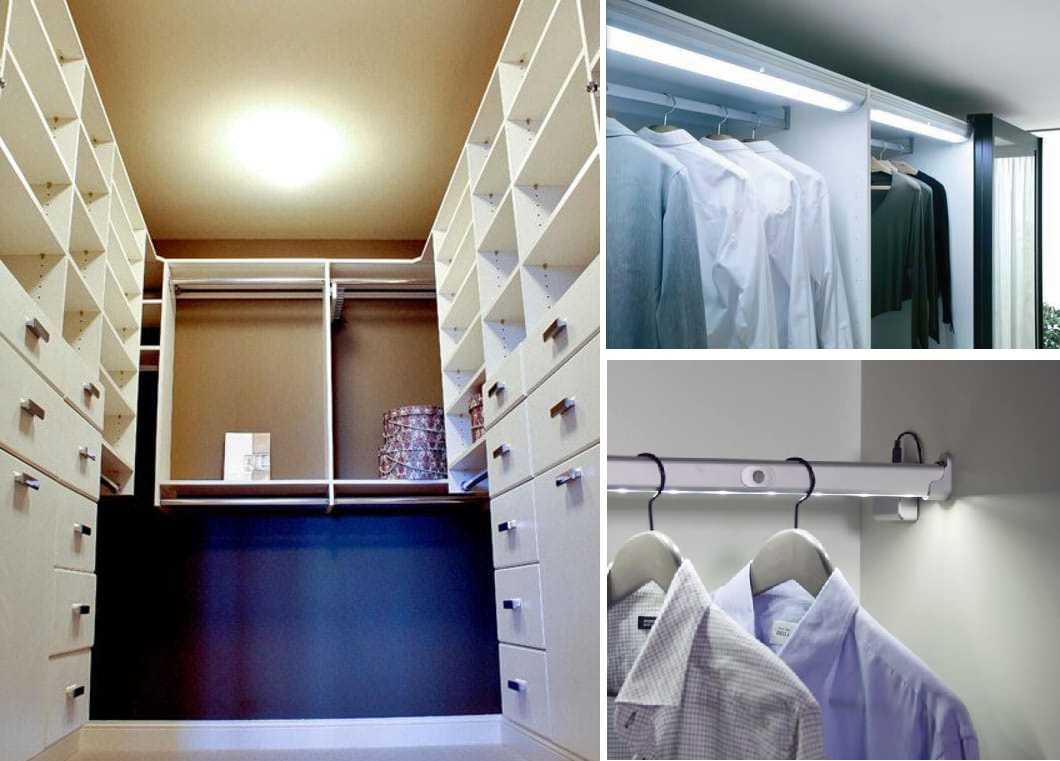
Be sure to think about comfortable lighting - whether all the shelves will be illuminated, or only some, how it is better to make a central source of artificial light and other solutions. Volumetric chandeliers or lamps hanging from the ceiling are not suitable for a room with such high functionality. The best option is small projector lamps or spotlights placed on the ceiling, shelf cornice. Illumination of shelves for jewelry and other small items will be convenient.

In the dressing room, in addition to ceiling lighting, each shelf is illuminated
Forced ventilation
Many people ask how to make ventilation in the dressing room if the natural circulation of air masses is not effective in creating optimal temperature and humidity characteristics of the air mixture?
If the architecture does not allow you to equip the storage room with an effective natural vein.system, then for the safety of things it is necessary to resolve the issue of its forced air exchange. It is best to deal with the arrangement of forced ventilation even at the stage of designing a house. If this is not possible, then you need to make a forced system yourself, taking into account some nuances.
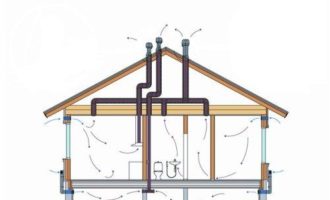
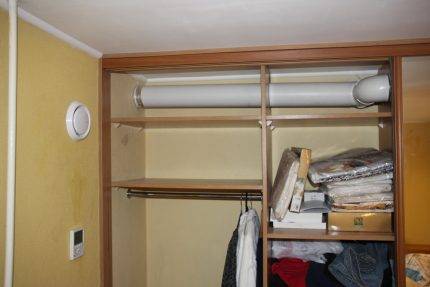
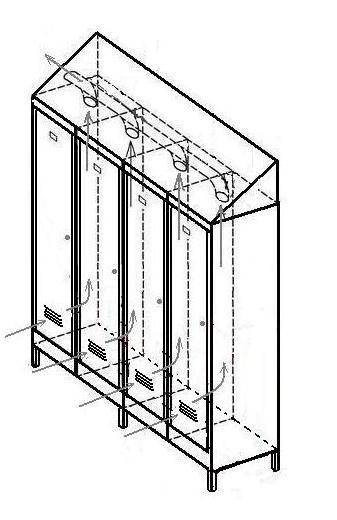
- The easiest option is to bring an exhaust duct from the general exhaust system of the house to the room by installing a fan of the required performance at its entrance. The influx of air masses can be organized using wall valves.
- If at least one wall of the dressing room borders on the street, then it is necessary to make a through hole in its upper part and install a piece of plastic pipe into it. Inside this so-called sleeve, install an exhaust duct fan of the required capacity. On the outside of the wall, a decorative grille should be installed on the pipe. The air supply can be from residential premises with installed window ventilators.
Budget option for ventilation of the shoe cabinet:
When selecting the performance of the exhaust fan, one should be guided by the fact that the air exchange in the dressing room must be at least one and a half times. In order to make a calculation, calculate the volume of the room (length x width x height) and multiply by 1.5. The resulting value will be the required fan performance per hour.
After reading this publication, you will now find out if ventilation is necessary in the dressing room and some of the simplest and most common ways to implement them.
The main filling of wardrobes
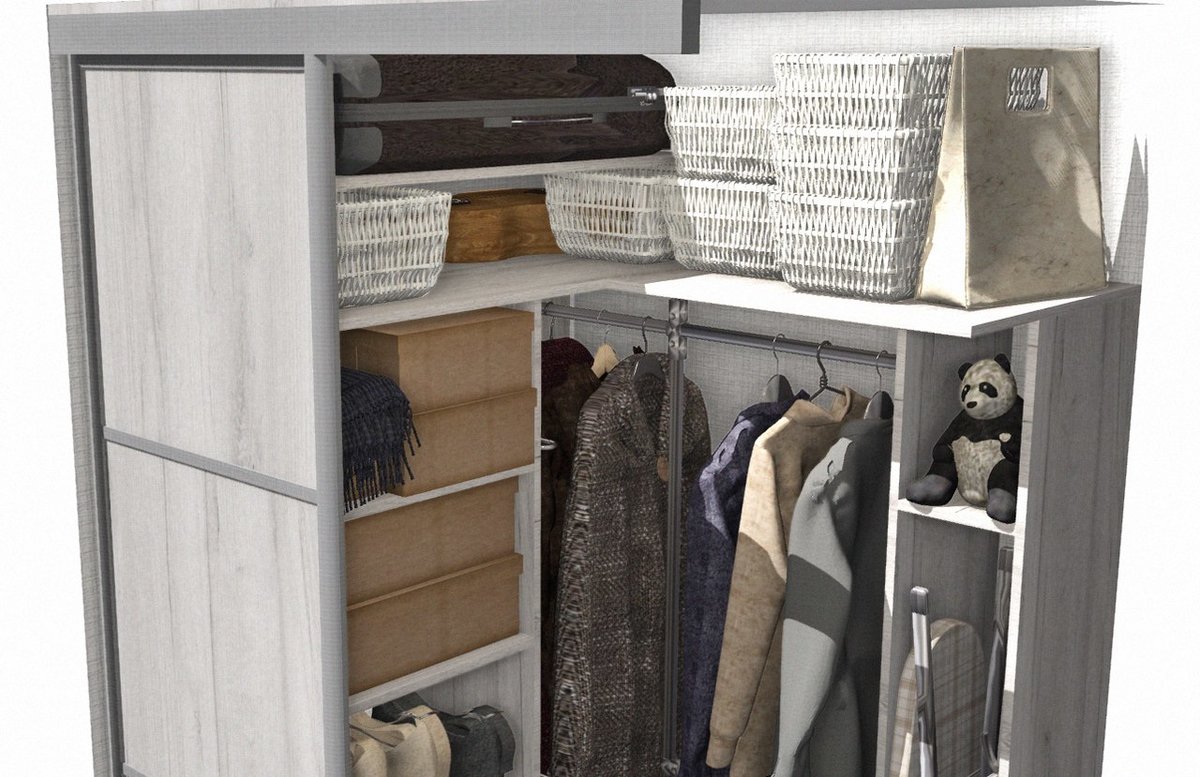
The wardrobe consists of many shelves, drawers and different storage systems, which together form a single large rack.It can be of any shape and consist of a single block or different modules installed at a distance or next to each other.
Materials for the manufacture of cabinets, racks for filling dressing rooms:
- LDSP - laminated chipboard;
- MDF - modified medium density fibreboard;
- solid wood;
- metal, superalloys;
- plastic, glass - for shelves and side walls;
- thick profiled plastic - for small racks;
- combined options.
The selection of the right material often depends not only on the size of the budget allocated for the project, but also on the functionality of the object being created, its size and interior style. For example, if the room or its area is small in order to accommodate a spacious wardrobe, then it is better to use a minimalist loft style and install metal through racks equipped with only open shelves.

Loft system for an open wardrobe - frame-profile racks, shelf holders
Additional important elements are accessories, a mirror, rods, crossbars, special hangers for ties, belts, trousers, scarves, scarves. Of the accessories, the main ones are - fasteners, guides for drawers, supports, furniture handles
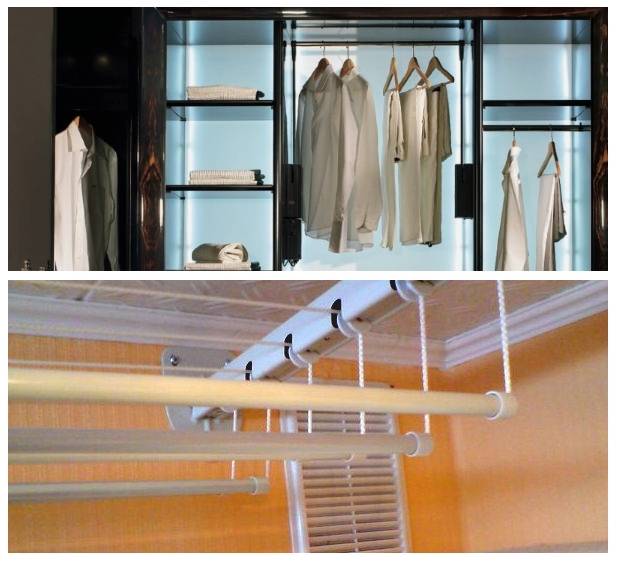
It is important to choose a mirror that can reflect a person in full growth. Rods or pantographs are needed for hanging trempels with clothes on them

Pantograph for shirts allows you to quickly get and place things on the coat hanger
To store small items (socks, handkerchiefs, shoelaces, etc.), use mesh, wicker baskets, boxes. They may also contain various household appliances and accessories.The design of the baskets depends on the overall style of the interior of the room. This is especially true for open wardrobes, where baskets or boxes are clearly visible.






The dressing room is filled with retractable baskets, lattice shelves, whatnot
For accurate storage of shoes, special modules are developed and manufactured. They can be in the form of ordinary sliding shelves, or they can be in the form of a moving metal structure - a frame on which there are many pins or recesses for placing shoes on them. At the same time, seasonality must be taken into account - for autumn, winter boots, boots, one section with expanded sizes, for summer or demi-season shoes - another with reduced sizes.

Rigid pull-out shelves especially for heeled shoes
Dressing room ventilation and how to implement it
The dressing room has long been an integral part of many apartments. It is very convenient when all wearable things have their own “permanent registration”, and the home is not cluttered up with bulky wardrobes.
Many mistakenly believe that by fencing off a certain part of the living space and installing special furniture there, the resulting space can be considered a dressing room. You can count, but in order for things to retain their original appearance for a long time, do not dampen, and colonies of fungi and mold foci do not appear on them, competent ventilation is necessary.
As you know, fungi "love" places where it is warm and humid. They will be happy to settle on the wooden furniture of the dressing room, if, as a result of the lack of air circulation, a microclimate favorable for their reproduction and life activity is created. As a result, wood affected by a fungal colony becomes porous and brittle.Infection can gradually spread to all organic materials used in the interior of the house.
In a word: the ventilation of the dressing room is necessary and there is no doubt about it. About the design of ventilation in the dressing room and will be discussed in this publication.
The simplest option for ventilating a dressing room is to ensure the necessary inflow and removal of air masses due to natural draft. The technical implementation of this procedure depends on the presence in this room of fresh air from outside. The most natural opening for fresh air is a window.
Variants of ready-made layouts for the dressing room
When choosing the layout of the dressing room, after you decide on its dimensions, you need to decide what their placement will be and think through all the details in detail. Even in a small room, the size of which is no more than two square meters, you can equip a spacious and comfortable dressing room.
Regardless of the size of this room, ventilation must be done in it, otherwise there will be an unpleasant smell and humidity may increase.
Dressing room - layout with dimensions 2x2
Even in the layout of a small dressing room with dimensions of 2x2, each family member must be allocated a separate storage space to avoid confusion. What is rarely used is placed in the far corners; buy covers for storing suits and dresses. Even if there is a window and natural light, you still need to provide artificial light, since you will use this room not only during the day.It is better to install not a switch, but a motion sensor, then in the dark you will not have to look for where the light turns on.
area of 2 sq m
Even in such a small room, you can fit all the clothes that you have at home. One of the layout options is to install a cabinet with shelves in the center, and rods for hangers with clothes are installed on both sides.
If the size of the room is small, then shelves can be placed under the ceiling, on which various things will lie. For greater practicality of such a dressing room, on the one hand it is recommended to place many small shelves, and on the opposite wall a cabinet with drawers.
Dressing room layout 3 sq m
This is the most common size of dressing rooms that can be arranged in most of our apartments. In this case, shelves of different sizes, drawers, hangers, rods, which can be both stationary and retractable, are used for storing things. It is convenient when there are niches for small clothes.
For three squares
If the room is 3 m2 in size, then it is recommended to use a hanger bar built into the shelf. This will save space, as you will place clothes on the shelf, and store things on hangers on the bar. You can also equip the wardrobe with drawers and regular shelves. And a niche for hangers with clothes is done on the side.
Dressing room layout 4 sq m
With a room size of 4 m2, besides the fact that things will be stored in it, there is already enough free space to organize a changing place in the center. In addition, in such a dressing room you can separately put a cabinet for storing shoes.


For four squares
Although the 4 m2 room is not very large, it can store a lot of different clothes, shoes and other things. When choosing the layout of such a dressing room, you must immediately decide what kind of things you will save in it and, depending on this, make more shelves for small clothes or more hangers for suit dresses.
Ventilation in the dressing room
The first thing to understand is that ventilation is the movement of air. It can be natural or forced. In this case, the air must be removed from the room at a certain speed, which is called air exchange. This parameter for dressing rooms is equal to 1-1.5 of the volume of the room. For example, if the area of the room is 9 m² (and this is 3x3), the ceiling height is 3 m, then the volume is 9x3 \u003d 27 m³. That is, in one hour at least 27 m³ of air mass should be weathered from it.
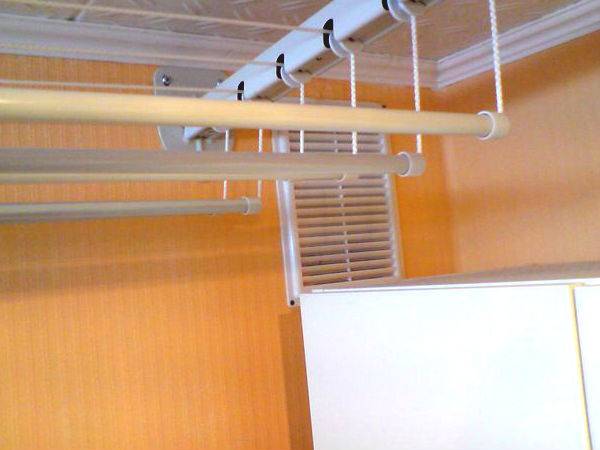
Now about the movement of air. For him, there must be an entrance and exit outside the premises (more often to the street). Entrance can be provided from neighboring rooms or from the street. The first option is simpler, because even the gap left between the door leaf and the floor, equal to 3-5 cm, will provide sufficient air flow. Today, this is more often the case. As options:
- holes in the door near the floor,
- in the floor, if the dressing room is not located on the first floor (the air will come from the lower rooms),
- in the wall near the door.
As for the exit, it is more difficult. First, it should be noted that the exit should be located on the opposite wall from the location of the inlets. Secondly, it must be done under the ceiling.
There are two options for organizing the exit opening:
- Ventilation duct that connects to the ventilation shaft of the house.
- A hole in the wall facing the street.
But, organizing ventilation, one more thing must be taken into account - whether there is a window in this room or not.
If there is a window
Many people think that if there is a window in the dressing room, then it is not necessary to organize the outflow of air. But everything will depend on which window is installed. If this is a modern plastic or wooden product, in which rubber gaskets are provided to ensure complete sealing of the structure, then ventilation must be done.
If this is an old wooden window that does not meet modern requirements, that is, it has cracks and gaps through which air masses will enter the room, then we can talk about some kind of natural outflow of air. Although there are simply no such situations in houses where a dressing room is organized. Therefore, this situation can be ruled out.
As for modern windows, today manufacturers offer to install special ventilation slots in them, through which air from the street will enter the room or be removed from it. A good option at first glance. But sometimes the area of such a gap is not enough to provide the necessary air exchange.
You can offer a cardinal way - to ventilate the room once or twice a day by opening the window.
With no window
If there is no window in the dressing room, then the two options indicated above are accepted for holding. This is the installation of a ventilation duct or the organization of a hole in the wall.
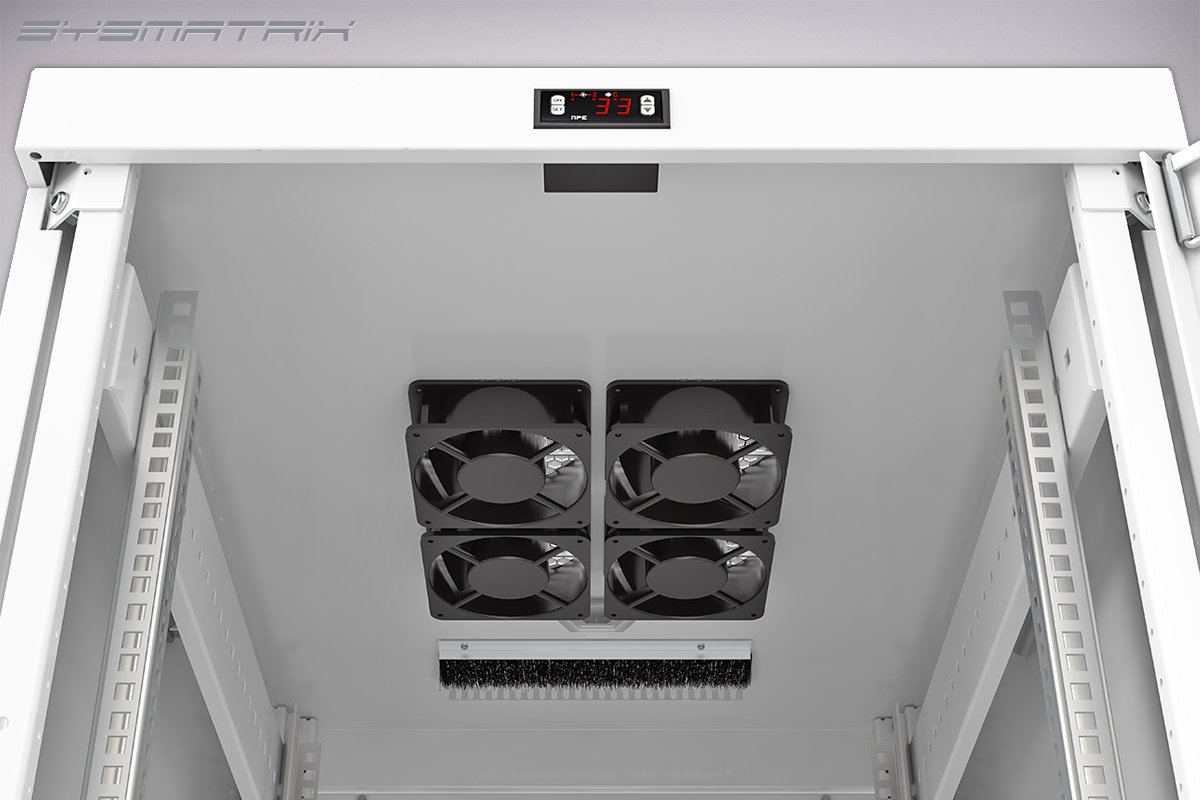
Both options showed themselves well in practice, but here you have to take into account the cross-sectional area of \u200b\u200bthe channels, on which the volume of exhaust air depends. And the larger the room, the larger the cross-sectional area should be. Sometimes this cannot be achieved, so a fan will need to be installed at the beginning of the channel.True, this is already a forced ventilation system. But it is guaranteed to provide the necessary air exchange, if you choose the right fan for performance. This parameter should be at least equal to the volume of the room.
Arrangement of air exchange
If ventilation already exists in your dressing room without windows nominal, you need to check it for efficiency. Bring a small sheet of paper to the grate of the mine, preferably a strip about 3 cm wide. It should be easily attracted by the air flow. If the air inlets do not cope with this task, you will have to reconsider the design of your ventilation.
To increase the efficiency of existing ventilation, it is enough to equip additional supply openings at the bottom of the walls. You can close them with decorative bars. In this case, the air exchange will be quite intense.
Remember that the supply and exhaust openings must be located in opposite walls. Otherwise, the air exchange will not be effective enough, it will affect only part of the room.
A dressing room without windows often appears in cases where redevelopment of premises in a house or apartment is carried out. In such cases, it is necessary to correctly design natural supply and exhaust ventilation. This is the simplest solution.





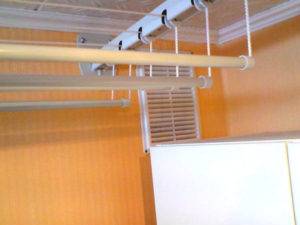
Be sure to check the final indicators of humidity and temperature with the help of special devices. If they do not meet the standards, equip forced ventilation throughout the apartment. Fortunately, today there are systems that do not consume a lot of electricity and at the same time do not create noise.
The optimal solution for ventilation in a dressing room without a window
Initially, it is necessary to find out whether the air exchange in adjacent rooms is well established. This can be done using the same simple sheet of paper test. If problems are found, you first need to resolve them and only then proceed with the arrangement of ventilation in the dressing room without windows.
After that, place the supply holes in the wall on the border with the room where ventilation is established. The exhaust opening must be placed in the opposite wall at the top. Calculate the area of the room. For 10 square meters, the diameter of the holes should be at least 15 cm. Based on these indicators, you can calculate the area of \u200b\u200bthe hole.
If you are redevelopment of premises, instead of the upper exhaust vent, you can simply not bring the wall to the ceiling. It is almost imperceptible, and you get an effective natural ventilation system.
Combined premises
In modern small apartments, the dressing room is often combined with other, full-fledged living quarters, for example, with a bedroom, this is convenient. In such rooms, ventilation should be much more powerful. Forced ventilation options are not excluded. It will include the following components:
- several fans, the calculation is based on the area of \u200b\u200bthe room;
- heating and cooling elements that will bring the incoming air to a comfortable temperature;
- filters for cleaning the incoming air from debris and dust;
- ventilation grilles to protect shafts and electronic elements;
- ventilation shafts.
You can perform ventilation in the form of a separate split system.This is an expensive, but always winning option that will keep you healthy by providing efficient air exchange.
Ready solutions for your home
To simplify the ventilation of rooms without windows, forced ventilation devices were invented. Such devices are called aerogivers, they are easily mounted on the wall inside the room. Although they are expensive and can only supply fresh air to the room they are installed in, they are an excellent turnkey solution for air exchange.
A good ready-made solution for apartments and houses with deaf rooms is split systems with climate control.
Airgivers
Airgivers consist of devices that allow for the flow of clean air into the room; filters for air purification from dust, harmful impurities, and allergens; recuperators and dehumidifiers.
It is easy to install the airgiver in the apartment on your own, for this you will need to carefully study the instructions and prepare the device for making a hole in the wall.
The main advantage of such devices is that the room is ventilated around the clock, but there are no unpleasant odors from the street in the room. Clean air enters the room already heated, because. most of these devices are equipped with a recuperator.
Airgivers, when properly installed, do not create additional noise in the room, so they can be installed even in a nursery.
Air conditioner
Almost all modern air conditioners are made in such a way that they provide fresh air to the apartment from the street, and not just dry the air inside the room. Therefore, split systems with the possibility of climate control are a complete replacement for natural ventilation in rooms without windows.
But split systems with the possibility of climate control are installed pointwise, and are not able to ensure the correct movement of air masses throughout the apartment. Therefore, to ensure a comfortable microclimate throughout the apartment will need air conditioning in each room.
Stages of altering the pantry into a dressing room
For the successful implementation of reconstruction work, it is necessary to carry out alteration in a certain sequence. So the course of action
includes the following steps:
- project development. It is recommended to make a sketch on a scale, which will show all the necessary shelves, rods and drawers. At the design stage, it should also be decided whether there will be a need to strengthen the walls, repair the ceiling or rework the floor;
- bringing the premises into an appropriate condition. At this stage, all previous structures are removed from the pantry, after which the surfaces of the walls and ceiling are given a presentation. Next, the floor surface is planned and the coating is laid - linoleum, laminate or other;
- installation of a ventilation system and connection of lighting sources, taking into account the location of built-in cabinets, racks and shelves. Upon completion of work, the efficiency of ventilation and the quality of lighting are checked.
After the completion of the cosmetic repairs, it remains to assemble the frame structure for arranging the racks, fix the shelves, rods and everything necessary that was provided for in the project.

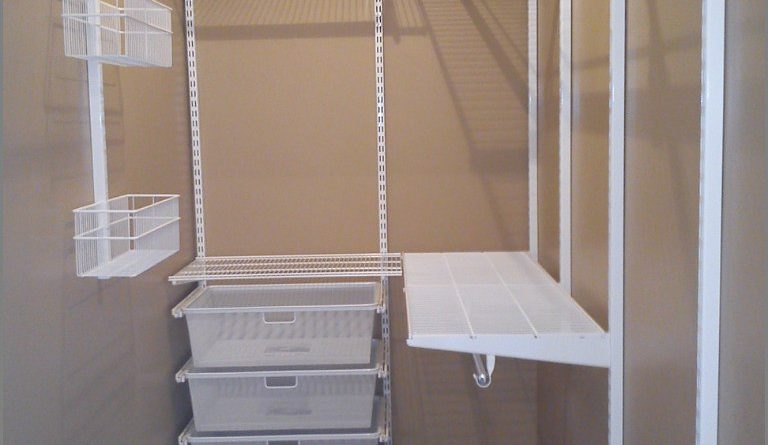
There are many options for planning a dressing room.
It is important to ensure the convenience of using the wardrobe so that you can always find the right thing or the required accessory.

Air exchange device for rooms without windows
If ventilation already exists in a room without windows, then its effectiveness should be checked. A paper strip with a width of about two centimeters is brought to the grate of the exhaust channel. When the ventilation in a room without a window is properly arranged, the strip will be pressed against the entrance to the exhaust shaft.


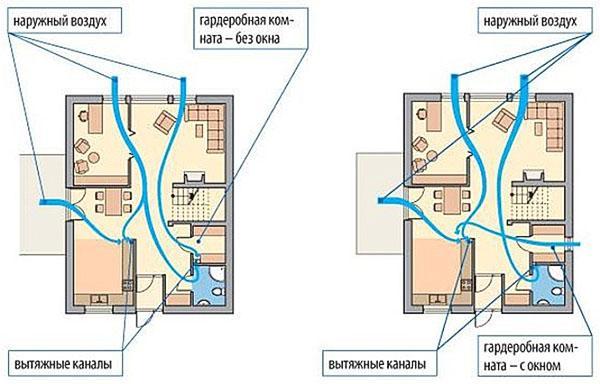



Usually air access to the room is through the gap between the door and the floor. To improve air exchange, ventilation grilles can be installed in the door, or supply holes are made in the wall. Such holes are usually made at the bottom of the wall. To strengthen the hood, exhaust fans mounted on the inlet of the channel are used. The operation of such fans in the toilet or bathroom can be controlled from a light switch using timer or motion sensor.
Often a room without windows appears in the process of redevelopment of premises. In this case, it is required to design and fully equip the ventilation system. The simplest solution includes the arrangement of supply and exhaust ducts to rooms with an established highly efficient natural air exchange system.
Ventilation in the dressing room
Consider how ventilation is arranged in a dressing room without a window at the lowest cost. Inlet openings are made in the lower part of the wall facing the room with established air exchange. Exhaust openings are placed at the top of another wall.
It is advisable to place supply and exhaust openings on opposite walls to create air exchange in the room. For one square meter of the room, the diameter of the air exchange hole should be 15 mm. From this ratio, the area and dimensions of the holes should be calculated.In some cases, instead of outlets, the wall is not brought up to 100 mm to the ceiling, which is quite unnoticeable.
Ventilation in the bedroom without a window
A bedroom without a window will require special attention - ventilation here must be extremely efficient. In this and a number of other cases, it is worth resorting to a forced air exchange system. Such a system for a bedroom or dressing room should include:
- a pair or more fans;
- a heater that provides heating to an acceptable temperature of the incoming air;
- air purifying filters;
- ventilation grilles;
-
air ducts.