- Basic installation rules
- 2 Air exchange rates
- How to calculate ventilation in a private house
- Ways to upgrade home ventilation
- How is the ventilation in the apartment
- How to determine if the ventilation in the apartment is working effectively
- Requirements for ventilation in the apartment
- Principles on which ventilation works
- Features of installation of exhaust ventilation
- Supply structure
- Important Points
- What is ventilation?
- Other Solutions
- Checking ventilation before starting work
- How to do it yourself: description, diagram, photo
- System device
- In a private house
- In a wooden house
- Supply and exhaust ventilation system in a private house
- Installation of wall-mounted ventilation
- Requirements for ventilation in the apartment
- Types of forced ventilation
- Conclusions and useful video on the topic
Basic installation rules
Installation work can be done independently or with the involvement of contractors, but in any case, you need to start by agreeing on the project and compiling a list of necessary manipulations. At the preparatory stage, the contractor is selected, who must agree and approve the developed terms of reference.Further, together with the customer, a work schedule is drawn up, which describes in detail the terms, the supply of components and consumables, the type of equipment and its installation.
Before starting work, check that the following factors are met:
- that the terms of reference have been developed;
- the project is approved and agreed with the contractor, which is in the state register of SROS;
- all main and interior walls, interfloor ceilings are installed;
- the readiness of sites for the installation of indoor and outdoor ventilation equipment is ensured;
- waterproofing is installed if the scheme provides for wet filters;
- all air holes and channels laid down in the project have been completed;
- there is a main ventilation shaft for natural air circulation;
- in the presence of supports for roof fans provided in the scheme;
- the walls of the air ducts are covered with plaster.
The basic rules for the installation of ventilation systems include the following requirements:
- longitudinal seams should be located upwards;
- bolt fastenings must be tightened to the maximum limit;
- ventilation units are installed on prepared mounts only after installation;
- fasteners must take into account the mass of the duct itself so that it is not transferred to the mechanisms;
- fasteners must have vibration isolation;
- rigid supports are provided for radial fans, with anchor bolts;
- filters are stretched evenly, excluding sagging;
- electric motors should be adjusted to the fans as accurately as possible;
- the rotation of the wings must be free;
- ventilation openings are closed with special gratings, the size of the cells of which should not exceed 7 cm;
- when installing a ventilation system, the number of bends must be minimized.

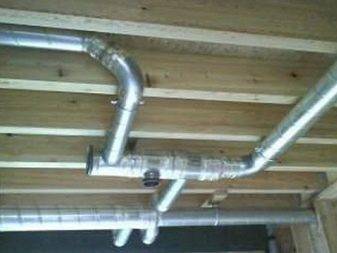
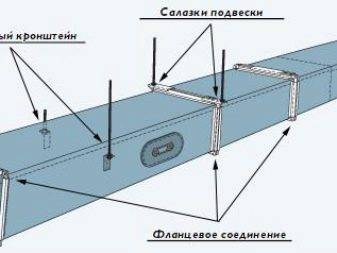
The main stages of installation of ventilation ducts are as follows:
- mark the places where the fasteners will be installed;
- assembly of fasteners;
- delivery of air ducts and accessories to them;
- assembly of individual ventilation sections;
- installation of assembled blocks in one system, fixing them in the established places.
As a rule, in residential premises and public buildings, ventilation is hidden behind the finish, but in production workshops it is left open to facilitate access to it.
2 Air exchange rates
Referring to current sanitary standards, that ventilation for an apartment is considered optimal, the power of which is sufficient to completely renew oxygen in each room with a frequency of 1 time per half hour. It is easy to calculate the optimal volume of supply air on your own by comparing 3 values: the number of residents in the house, the area of \u200b\u200bthe apartment and the sanitary standards adopted at the state level. The easiest way is to use the dependency below.
Table of air exchange rates
Given these standards, it is easy to determine the level of air exchange and prepare an appropriate apartment ventilation project.
How to calculate ventilation in a private house
In the calculation of ventilation, an indicator such as the frequency of air exchange is used. It was already mentioned at the beginning of the article. This parameter was fixed by SNiP under the number 2.08.01-89 * under the name "Residential buildings". So, in Appendix No. 4, a table is given in which the air exchange rate is shown depending on the purpose of the room. We will not rewrite the entire table, we will indicate the main premises:
| room | Air exchange rate |
| Residential | 3 m³/h for each square meter of area with a ceiling height of 3 m |
| Kitchen with electric stove | 60 m³/hour |
Kitchen with gas stove:
|
|
| Bathroom | 25 |
| Toilet | 25 |
| Combined bathroom | 50 |
Now, as for the calculation. For this, the formula is used:
N = V x L, where
- N - ventilation performance,
- V is the volume of the room,
- L is the air exchange rate.
Pay attention to the multiplicity in living quarters. Basically, it turns out that it is equal to "1"
That is, in one hour the volume of air in them should change completely. From this it turns out that the ventilation performance should be equal to the volume of the room.
But this is just a calculation, which is based on standards. The ventilation system itself is air ducts, which should provide the necessary permeability of air masses. Therefore, there are rules here as well. For example, a round pipe with a diameter of 150 mm, and this section, equal to 0.016 m³, provides a throughput of 30 m³ / h. The same parameter supports 100×100 mm rectangular duct. At the same time, such a volume maintains a riser height of 3 m. That is, if this value is less, the performance will decrease accordingly.
Scheme for calculation example
Calculation example. Input data:
- total area of residential premises - 60 m²;
- the kitchen has a 4-burner gas stove;
- toilet and bathroom are separate;
- ceiling height - 3 m;
- inflow from the living quarters, extract from the kitchen, bathroom and toilet.
First of all, the volume of supply air is calculated. It is equal to the volume of residential premises: 60 × 3 = 180 m³ / h. Now we need to calculate the volume of air removed. Here you have to refer to the table:





- in the kitchen, this figure is 90 m³ / h,
- in the toilet and bathroom for 25.
In general, it turns out: 90 + 25 + 25 = 140 m³ / h. Now the two values obtained must be compared. It is clear that 180 is greater than 140. This means that the performance of the ventilation system in this particular case will be 180 m³ / h.
This calculation is valid for both natural ventilation and mechanical ventilation.
Ways to upgrade home ventilation
An experienced master who repairs apartments knows what to do in a situation where natural supply ventilation does not work. It is necessary to convert the supply ventilation system to forced ventilation. For this, fans and valves are used. Such structures are best installed in the walls where there are windows, or in those places where there are central heating radiators. For better air circulation in the apartment, it is necessary to install a similar system in each room. The home master must perform drilling in the wall with a specialized tool. After the hole is mounted, a piece of pipe of a suitable diameter is placed in it, and a valve is installed on the pipe. Additionally, you can install a heater or humidifier, or add a filter to the system.
If the owner of the apartment wants to improve the natural ventilation that is already present in the apartment, then you can do it yourself without calling the master. You will need to install additional fans that will ensure the correct outflow of air from the room.
How is the ventilation in the apartment
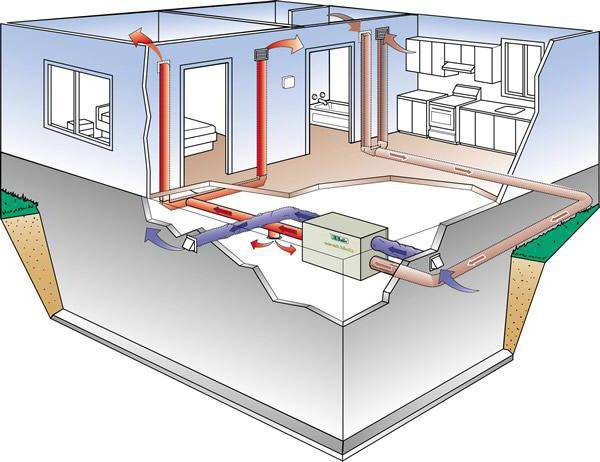
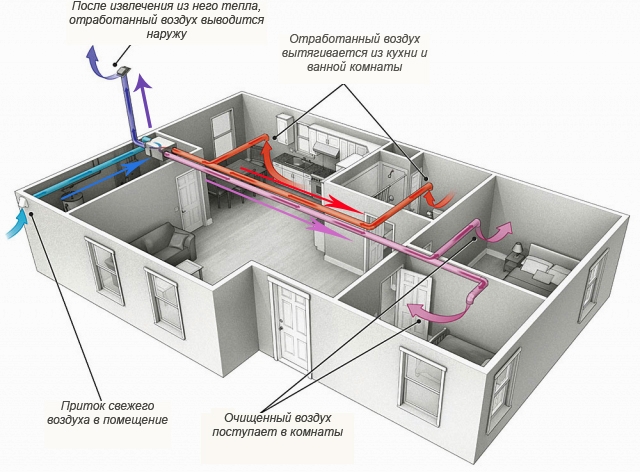
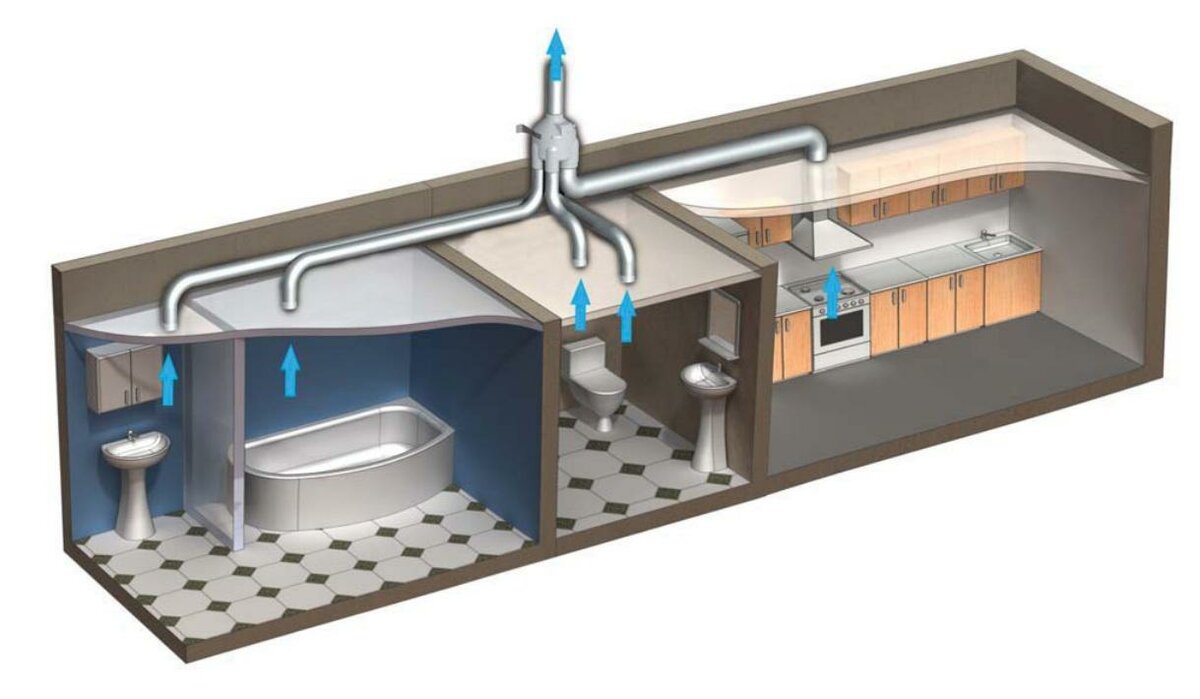
The very scheme of the ventilation system in the apartment is very simple. This is just a ventilation shaft, penetrating all floors of the building from the basement to the roof.Horizontal channels are connected to it from each apartment, which are closed with decorative grilles in the rooms. Channel outlets are located under the ceiling in the kitchen, bathroom and toilet.
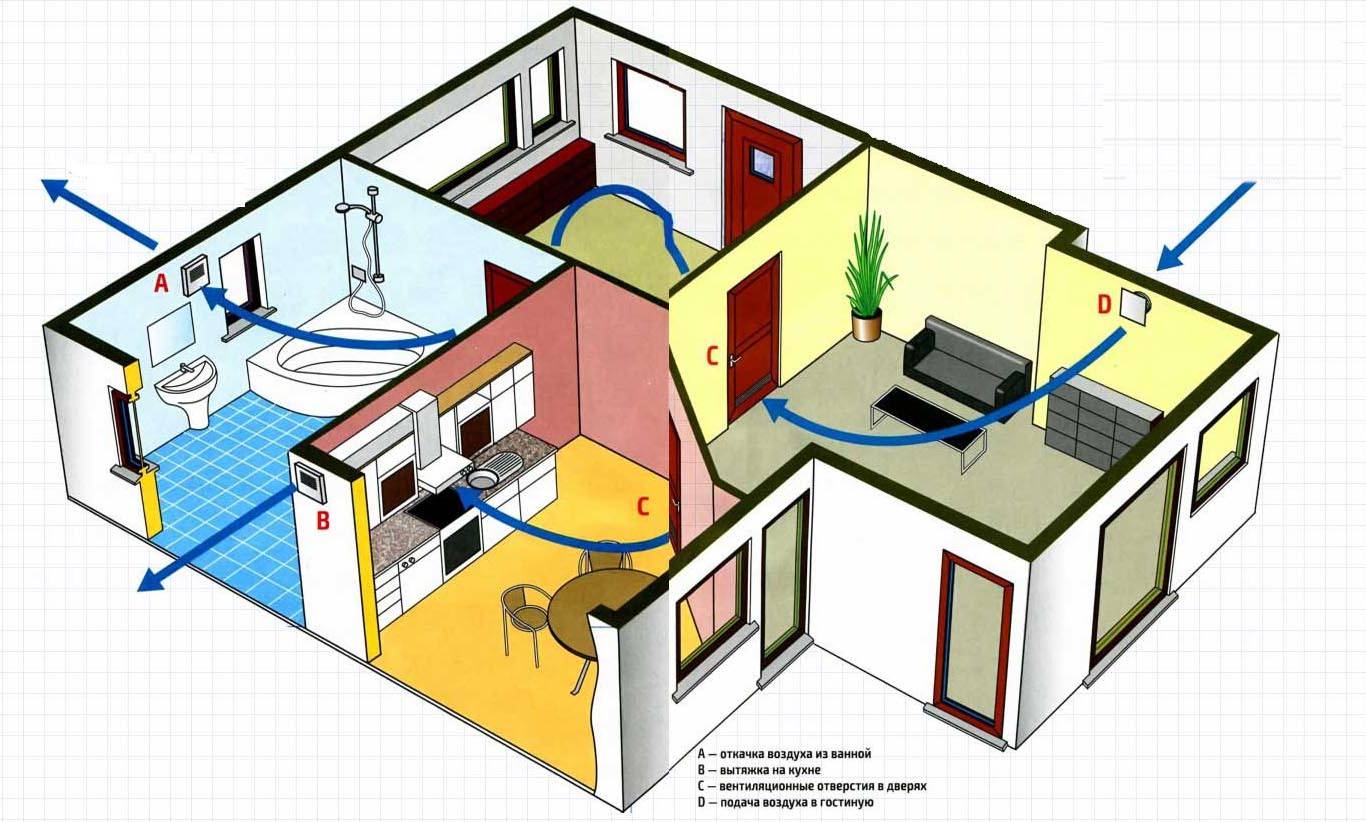
At the same time, the movement of air masses inside the apartment occurs from the living rooms to the openings of the ventilation ducts. Such a scheme is called overflow, because the air flows from one room to another, being cleaned and renewed.
This ventilation system for the apartment was effective for the time being, because fresh air was supplied through leaks in the front door and windows. This is exactly what the ventilation parameters were designed for. With the advent of plastic windows, things have changed, not for the better. There was no air flow, which means that all ventilation stopped working. And it was a big problem for residents of city apartments. The first sign that the system is not working is misted windows. But there are other options to check whether the outflow of exhaust air is efficiently performed.
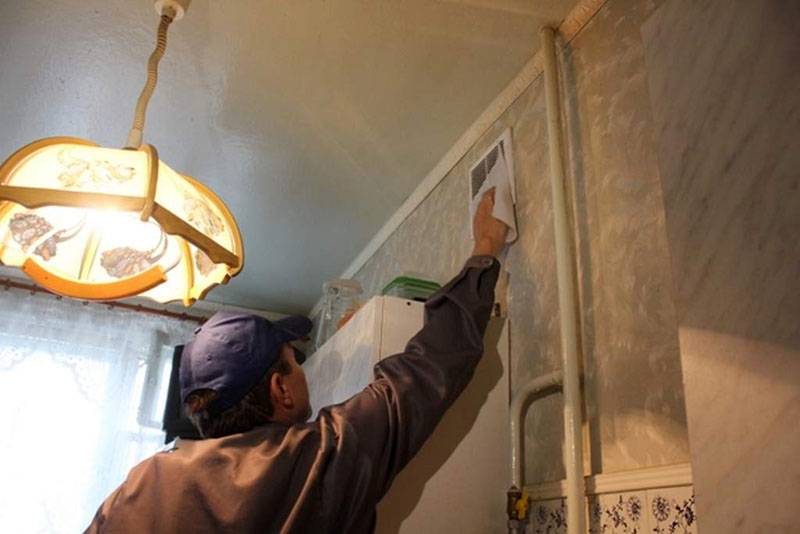 Ventilation grill in the apartment in the kitchen under the ceiling
Related article:
How to determine if the ventilation in the apartment is working effectively
The easiest way is to attach a paper napkin to the decorative grille of the ventilation duct. If she fell, then the hood is zero.
Side problems:
- humidity inside the bathroom decreases slowly;
- in the toilet, unpleasant odors last a long time;
- smells from cooking spread throughout the apartment;
- heavy air in the rooms;
- mold appears on the windows;
- microparticles of dust, pet hair, carpet pile are collected in the air, which negatively affects people's health.
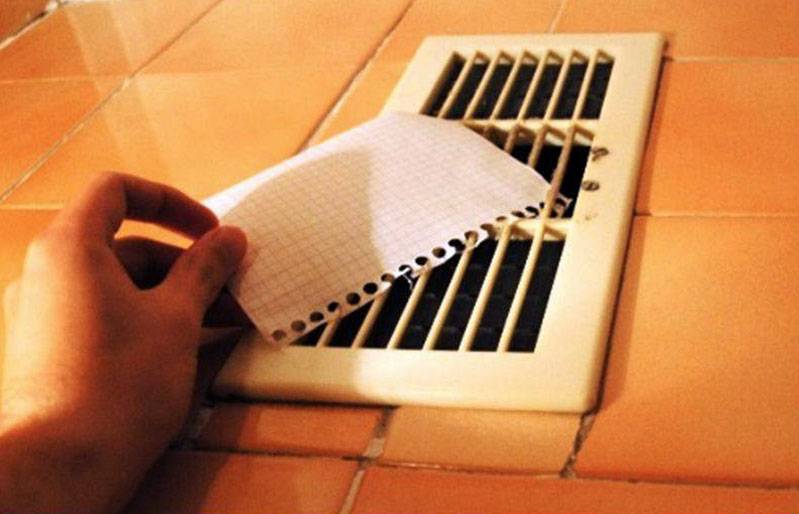 If the sheet of paper has not fallen, then the ventilation is working well.
Requirements for ventilation in the apartment
Consider in detail ventilation requirements in the apartment.
_
room - a unit of a complex of real estate (a part of a residential building, another real estate object associated with a residential building), allocated in kind, intended for independent use for residential, non-residential or other purposes, owned by citizens or legal entities, as well as the Russian Federation, subjects of the Russian Federation and municipalities. ; - the space inside the building, which has a certain functional purpose and is limited by building structures. (SNiP 10-01-94); - the space inside the house, which has a certain functional purpose and is limited by building structures. (SNiP 31-02-2001)
Conformity — Conformity of the product, process or service to specified requirements. (RDS 10-231-93)
According to the current sanitary standards, it is considered sufficient to be such that in each room the exhaust air is completely replaced with fresh air at least twice an hour.
Initially, it was connected to each apartment from a common ventilation duct. However, in certain situations, the power of such a system is not sufficient to provide the required level of air exchange.
To check the performance ventilation systems it is not necessary to call specialists. You can use elementary tricks and draw conclusions about the quality of air exchange on your own.
Principles on which ventilation works
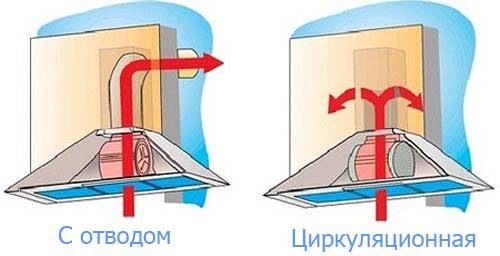
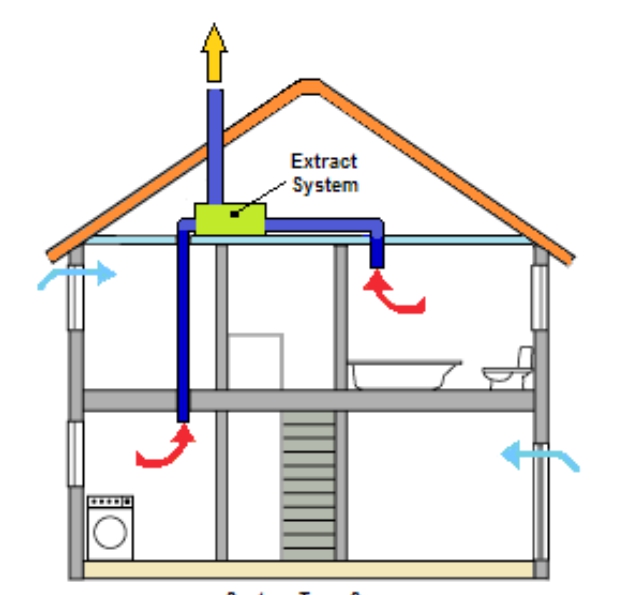
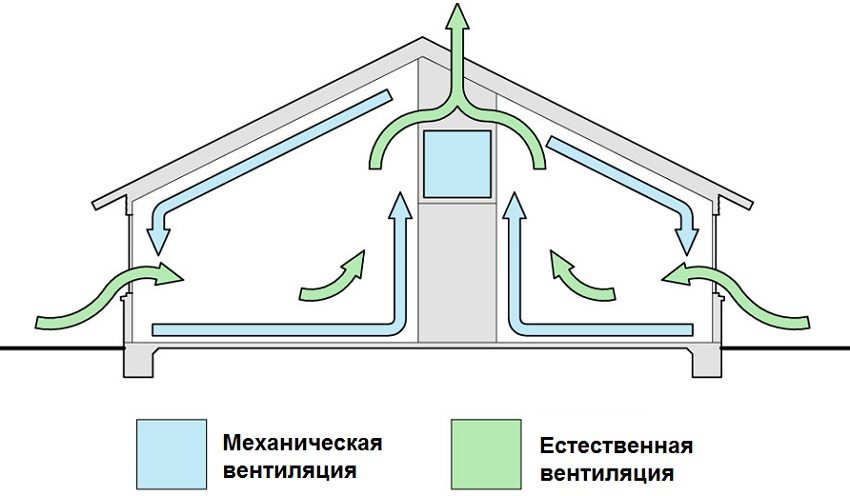
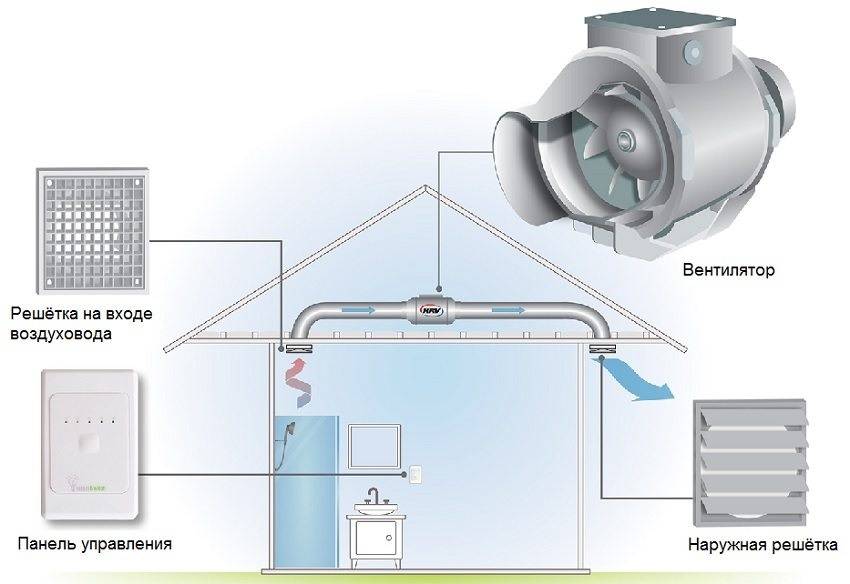
There are two types of ventilation: natural and forced. It is always necessary to strive for the creation of natural ventilation, since it does not create additional noise and does not depend on the availability of electricity. Forced ventilation with the help of electromechanical fans is used in cases where it is not possible to organize natural ventilation. Basically, the fan is installed at the air outlet, for example, in the exhaust ventilation duct. In this way, it is possible to enhance the ventilation of a particular room, for example, a toilet or bathroom. As a second option, you can install a supply valve with an air injection function. In this case, excess air pressure will be created in the room with closed windows and doors, and it will evenly leave through all exhaust ventilation ducts.
There are three main points with which it is possible to organize natural ventilation inside an apartment or house.
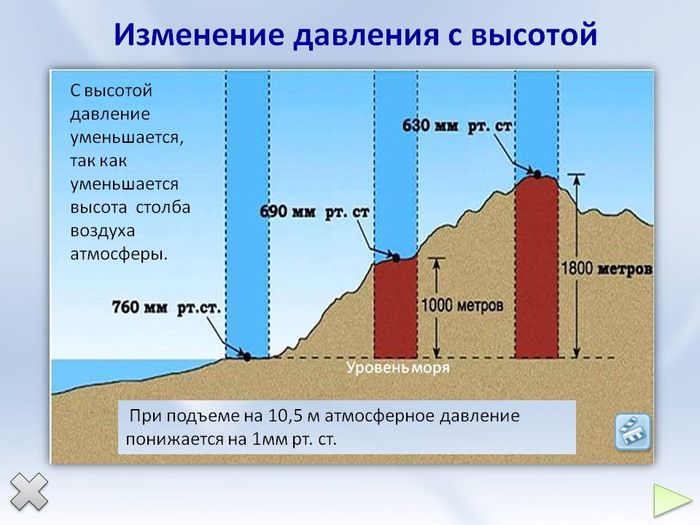
Pressure difference between indoors and outdoors. The pressure difference is achieved by the fact that the air intake point and the air outlet point are at different heights. Therefore, the atmospheric pressure at these points will be different. At a higher point, the pressure will be less. And air always tends to move from an area of high pressure to an area of low pressure.
If the building is not airtight, then due to this pressure difference, a flow of cold air is directed inward, and warm air is displaced (floats up) and exits (special exhaust ventilation ducts can be provided). The driving force of thrust is determined by the difference in the average heights of air inlet and outlet.This ensures the operation of exhaust ventilation with a natural impulse. Wikipedia
Thus, the greater the height difference between the air inlet and outlet points, the stronger the thrust will be.
Temperature difference between indoors and outdoors. Warm air is less dense than cold air. Accordingly, warm air is lighter and therefore tends to rise. Therefore, natural ventilation is more efficient in winter, when the temperature is below zero and indoors is positive. In summer, on the contrary, natural ventilation does not work efficiently enough or does not work at all. But this does not create problems, since windows are often open in summer and the room is ventilated through them.


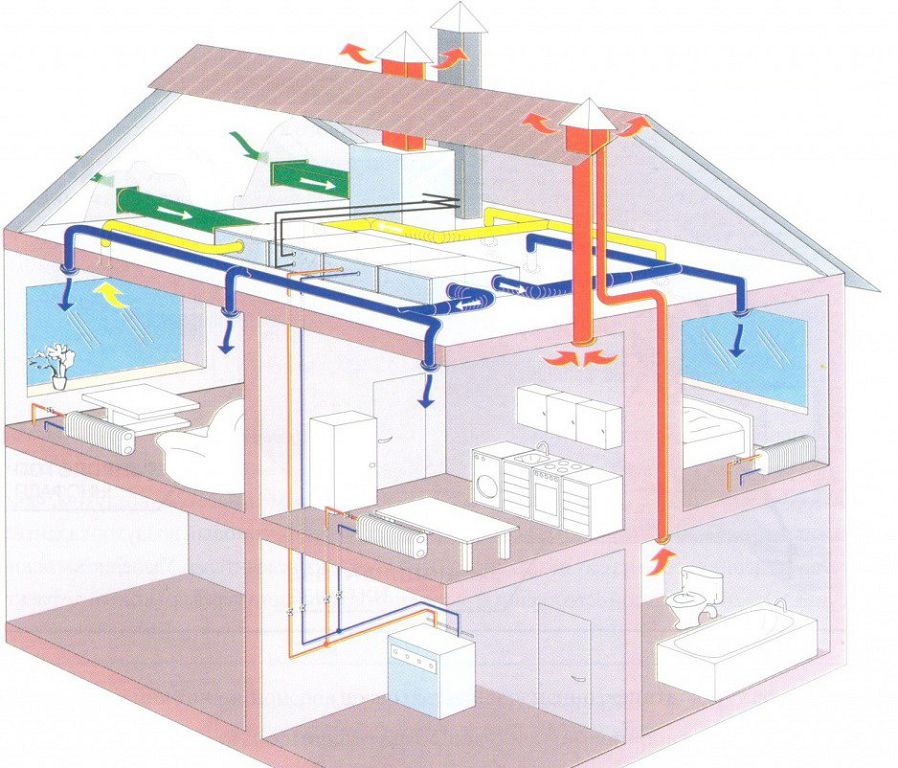


It is also necessary to understand that cooling the indoor air with the help of air conditioners greatly impairs natural ventilation. Therefore, when using air conditioners, it is necessary to ventilate the room more often through windows or use forced ventilation.
Lack of tightness of the ventilated room. If the room is practically airtight, then ventilation will not work, even forced. In this case, when the hood is turned on, a rarefaction of air will be created in the room and air will be sucked into the room from other exhaust ventilation ducts. For example, they turned on the hood in the kitchen, and the air flow will come from the ventilation duct in the toilet with all the accompanying odors.
Ventilation requires an inlet and an outlet for proper operation. If a certain volume of air leaves the room, then exactly the same volume of air must enter the room.Basically, during the construction of houses, ventilation shafts are made, but special supply openings are not made. It is understood that air will enter the room through various leaks in windows and doors.
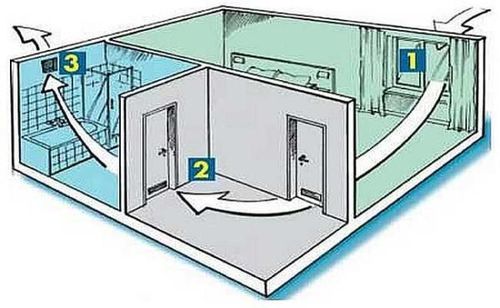
In some cases, poor operation of the hood in an apartment or house may not be due to the fact that the ventilation duct is clogged or that there is not enough fan power, but to the fact that there is no fresh air supply to the room.
Therefore, to improve the operation of the hood, supply holes are organized in the outer walls of the room and special valves are installed in them.
Features of installation of exhaust ventilation
In this case, the work is usually done as follows:
- a decorative grill is removed from the opening of the ventilation shaft in the kitchen;
- polymer glue is applied along the perimeter of the cover from its reverse side of the exhaust fan;
- the fan pipe is inserted into the hole in the shaft, and the lid is pressed tightly against the kitchen wall.
Exhaust fans equipped with various sensors are usually connected to the nearest junction box at the final stage. Cheaper and simpler models are most often installed in bathroom shafts and connected to a light switch circuit.
Supply channels with this method of improving natural ventilation in apartments do this:
- holes are made under the heating radiators or under the ceiling in the outer walls of the dwelling;
- valves of a special design are embedded in the holes, which can be purchased at almost any specialized store.
Most often, supply valves are mounted under central heating batteries.In this case, the air entering the apartment from the street will subsequently be preheated. Also, if desired, you can purchase special supply valves, already initially equipped with an electric heating system for the air flow.
Supply structure
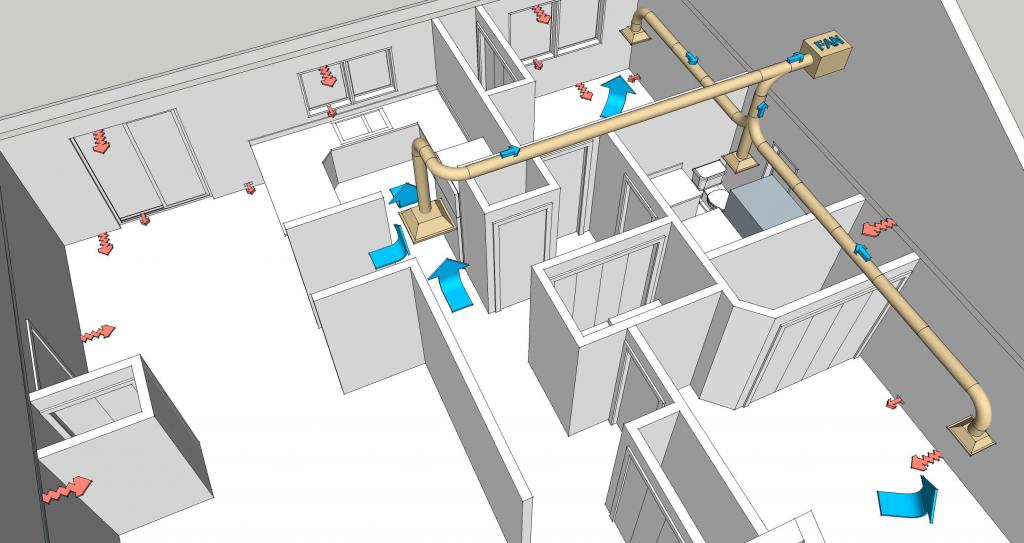
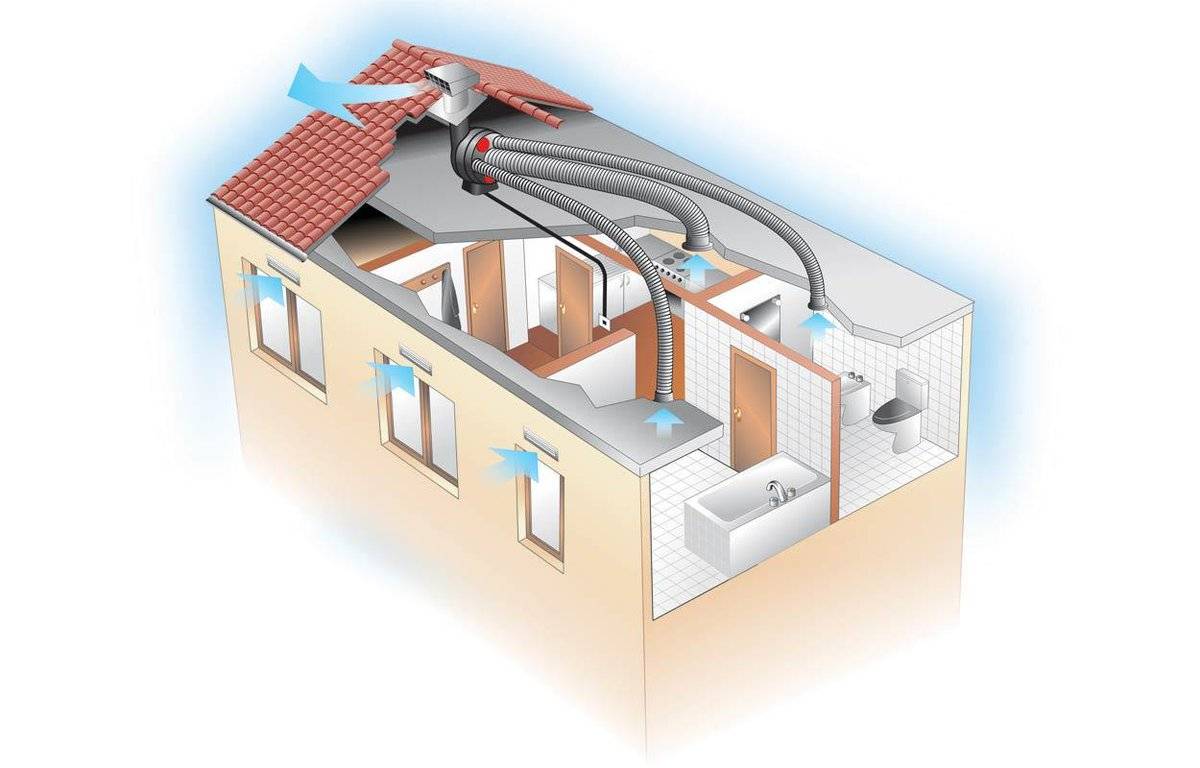
Scheme of air movement in the apartment.
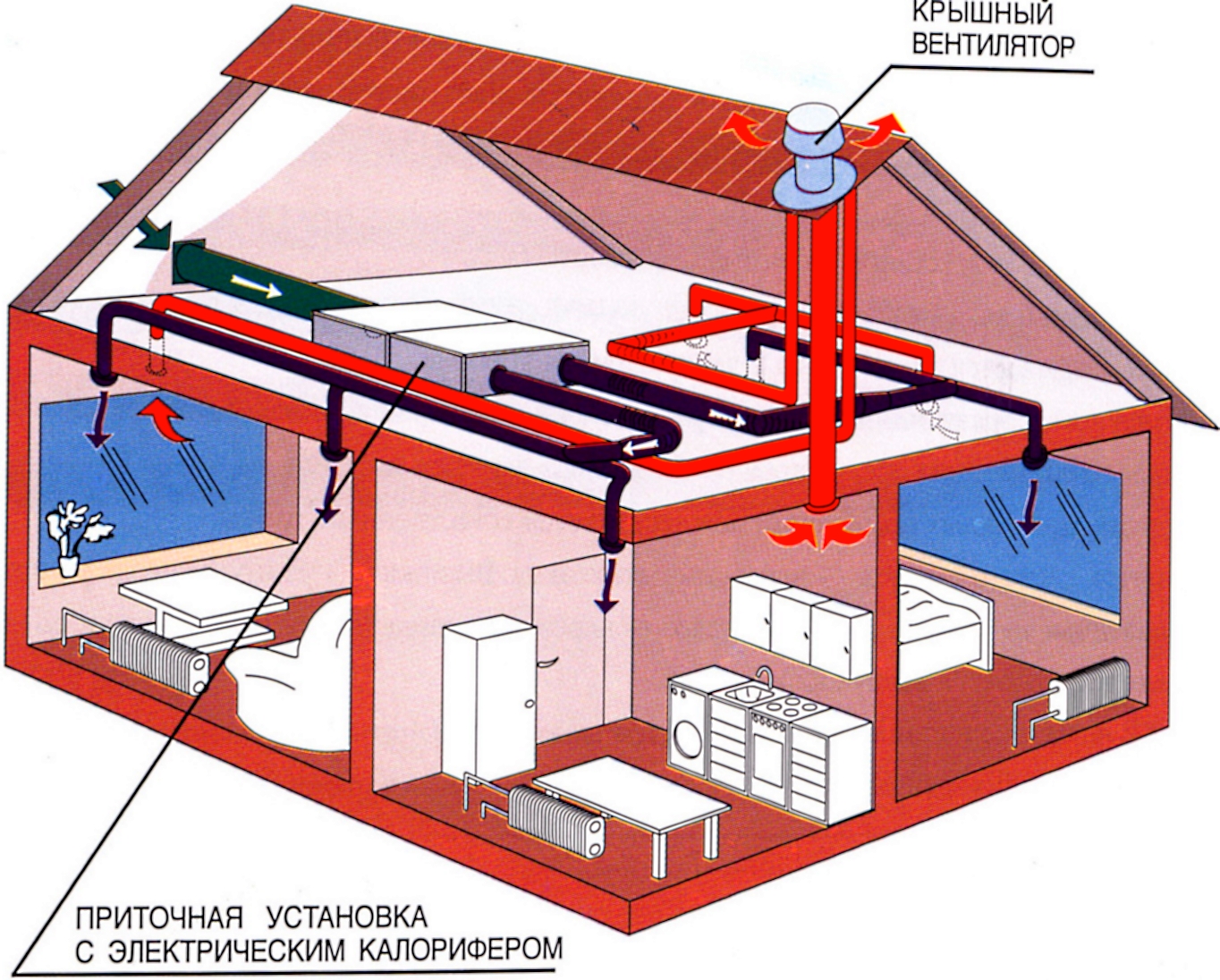
The arrangement of the considered ventilation is carried out with the help of 2 fans, a filter, a heater, a perforator. This design is designed to remove excess moisture from a room without a window. Pre-calculate the diameter of the hole.
For 1 sq.m of room, you will need to make a hole with a diameter of 15 mm. It is located above the floor level. From the outside, an air duct is installed at a height of 30-40 cm. The upper opening of the unit must be protected from debris.
To do this, install a grid and a canopy. Inside the room, a vertical or horizontal duct with holes is mounted. This is necessary to distribute fresh air throughout the room without windows.
The exhaust hole is made at the level of the ceiling on the opposite side (in relation to the supply analogue). The air duct is brought out 30-50 cm above the roof level (in a private house). If supply ventilation is installed in an apartment, then the last unit is brought to the outer wall of a multi-storey building (a similar distance up).
If air ducts are installed, a fan is mounted in the inlet. Its tasks include directing the flow of external air masses into the filter - heater - through the internal air ducts.The heater is used to heat the outdoor air masses to the desired temperature in the winter season. During warm months, this device is not connected. Filters will need to be periodically replaced with new units. To make the exhaust hole work more efficiently, a second fan is mounted in it.
Important Points
Scheme of ventilation of premises in a private house.
The arrangement of ventilation in a room without a window provides for the installation of a separate exhaust duct. In the process of finishing work, it is forbidden to block the inlet to the channel.
The movement of air masses in a room without windows occurs in a different direction (when compared with the movement of air in a room with a window opening).
The duct in the first case should be indirect. As practice has shown, air masses move from rooms with windows in the direction of exhaust structures. Air enters the room through a ventilator or old windows. In order for the air flow to move freely around the house, it is recommended to leave gaps in the doors of the closed space. Do the same with the door panels of the remaining rooms.
The absence of an exhaust duct prevents air from circulating, while it will flow into other areas of the house (except for closed spaces). To correct this situation, it will be necessary to provide a gap between the floor and the door leaf of 3-4 cm. If the room without windows is presented in the form of a bedroom, restroom or bathroom, the hole is drilled with an inclination from outside to inside. The method under consideration involves the use of steel, fine mesh or stainless steel mesh. It is laid in 2-4 layers with an interval of 2-3 mm. In this case, sound insulation is improved.




What is ventilation?
How often do we air the room? The answer should be as honest as possible: 1-2 times a day, if you do not forget to open the window. And how many times at night? Rhetorical question.
According to sanitary and hygienic standards, the total mass of air in a room where people are constantly located should be completely updated every 2 hours.
Conventional ventilation is understood as the process of exchange of air masses between a closed space and the environment. This molecular kinetic process provides the ability to remove excess heat and moisture using a filtration system.
Ventilation also ensures that indoor air meets hygienic requirements, which imposes its own technological limitations on the equipment that will generate this process.
Ventilation subsystem - a set of technological devices and mechanisms for air intake, removal, movement and purification. It is part of an integrated communication system for rooms and buildings.
We recommend not to compare the concepts of ventilation and air conditioning - very similar categories that have a number of differences.
- Main idea. Air conditioning provides support for certain parameters of air in a confined space, namely temperature, humidity, degree of ionization of particles, and the like. Ventilation, on the other hand, produces a controlled replacement of the entire volume of air through the inflow and outlet.
- Main feature. The air conditioning system works with the air that is in the room and the inflow of fresh air itself may be completely absent. The ventilation system always works on the border of the enclosed space and the environment through exchange.
- Means and methods.Unlike ventilation in a simplified form, air conditioning is a modular scheme of several blocks that processes a small part of the air and thus maintains the sanitary and hygienic parameters of the air within the specified range.
The ventilation system in the house can be expanded to any required scale and provides, in the event of an emergency in the room, a fairly quick replacement of the entire volume of air mass. What happens with the help of powerful fans, heaters, filters and an extensive piping system.
You may be interested in information on the arrangement of a ventilation duct made of plastic air ducts, discussed in our other article.

In addition to the main function, ventilation systems can be part of the industrial style interior, which is used for office and retail premises, entertainment facilities.
There are several classes of ventilation, which can be divided according to the method of pressure generation, distribution, architecture and purpose.
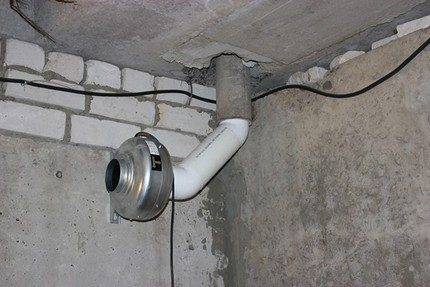
Artificial air injection in the system is carried out with the help of injection units - fans, blowers. By increasing the pressure in the pipeline system, it is possible to move the gas-air mixture over long distances and in a significant volume.
This is typical for industrial facilities, production facilities and public facilities with a central ventilation system.
The generation of air pressure in the system can be of several types: artificial, natural or combined. The combined method is often used
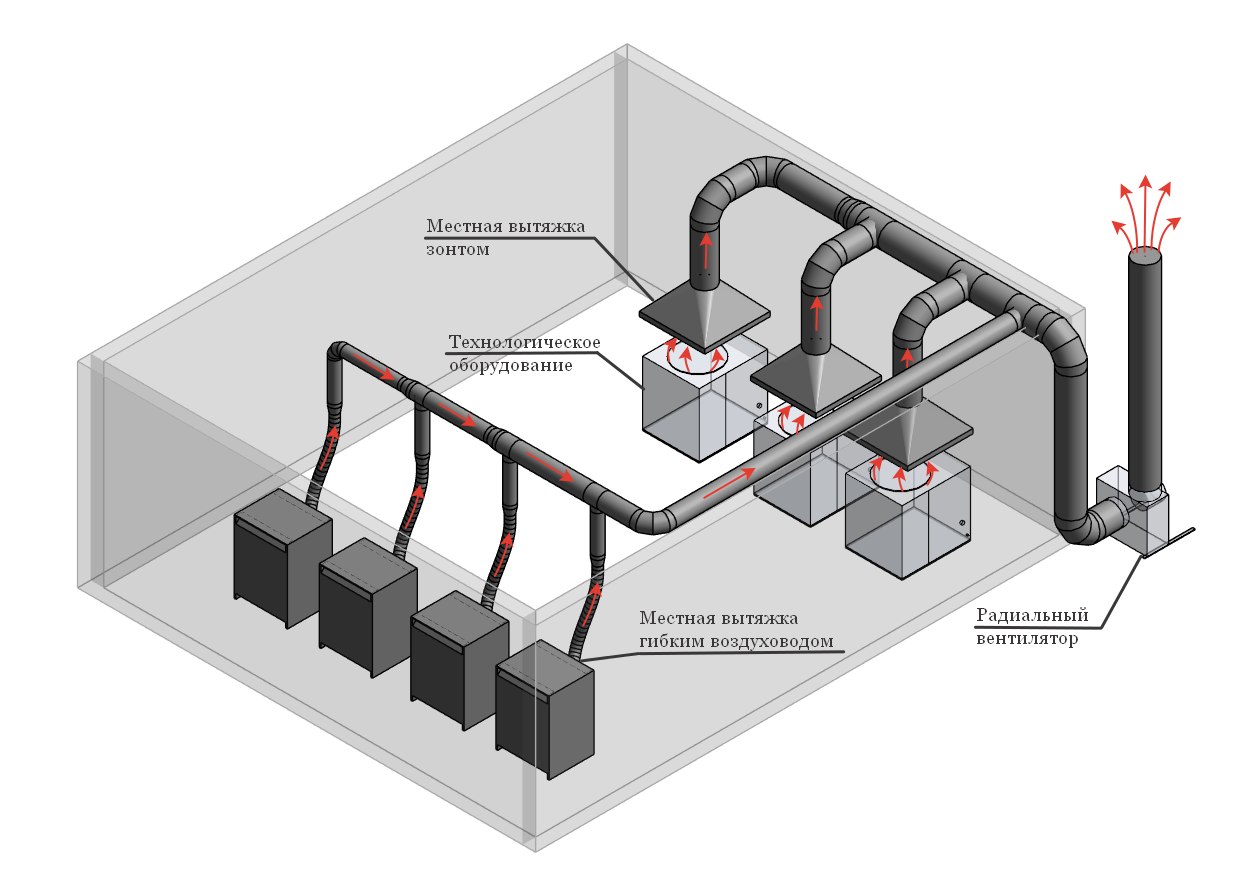
Local (local) and central ventilation systems are considered.Local ventilation systems are "point" narrowly focused solutions for specific premises where strict compliance with standards is required.
Central ventilation provides an opportunity to create a regular air exchange for a significant number of rooms of the same purpose.
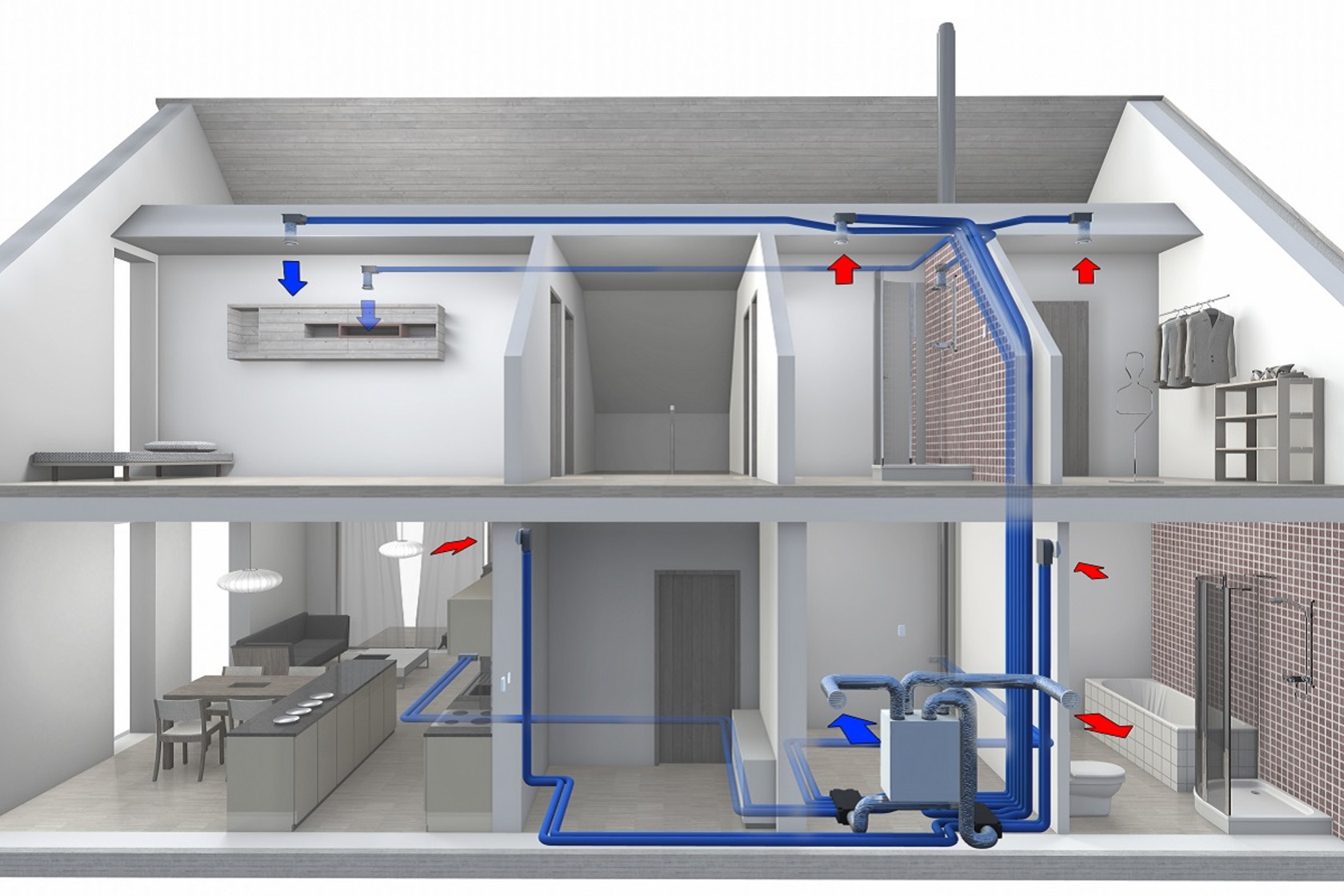
And the last class of systems: supply, exhaust and combined. Supply and exhaust ventilation systems provide simultaneous supply and exhaust air in the space. This is the most common subgroup of ventilation systems.
Such designs provide easy scaling and maintenance for a wide variety of industrial, office and residential types.
Other Solutions
The market does not stand still, and new solutions are being offered today. For example, there are recuperator systems that immediately, through one hole in the wall, remove the exhaust air and supply fresh air. This is an ideal solution if ventilation is taken care of after renovation or if it is necessary to solve the problem only in some rooms. The main thing is that these rooms have at least one wall facing the street.
There is a device that removes exhaust air through one hole, takes fresh air. It also heats up/cools it down.
The disadvantage of this method of organizing ventilation in a house or apartment is one - the price of such equipment. The cost of one such device is more than $400.
Checking ventilation before starting work
Proceed to check the existing ventilation system. As a result, you will determine why ventilation is not working as it should.
Start with an elementary check of the hood with paper.To do this, take a strip of newsprint about 3 cm wide and about 15 cm long, bring it at a distance of 5-6 cm to the ventilation outlet and observe the behavior of the paper.



Checking ventilation
Under normal circumstances, the paper will tilt towards the exhaust port.
If the paper does not deflect or moves slightly, something is wrong with the ventilation.
Next, you need to establish what exactly the problem is. Open windows and doors, and then repeat the test using the paper strip. If the paper began to noticeably deviate into the ventilation outlet, everything is in order with the moves. In the absence of any changes, you can conclude that the blockage is in the channel.
Checking ventilation with a piece of paper
You need to get rid of blockages. Canal cleaning can also be done on your own. The following guide will help you with this.
How to do it yourself: description, diagram, photo
here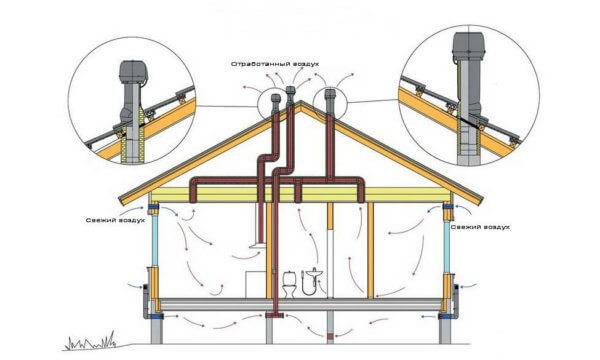
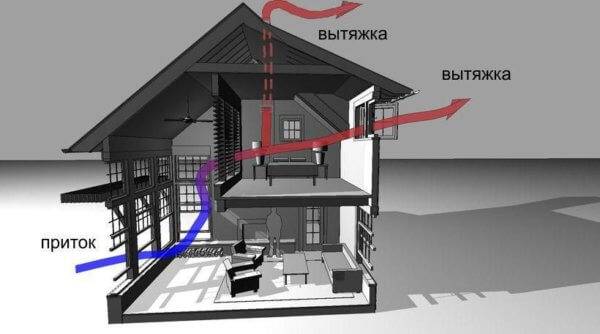
System device
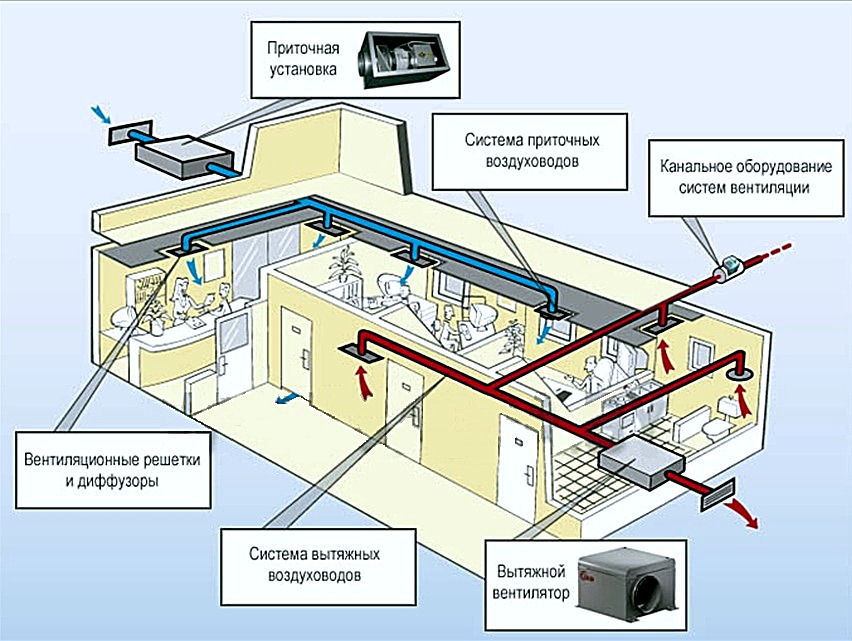
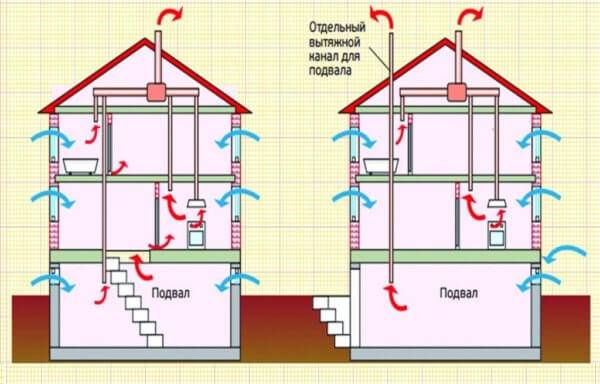
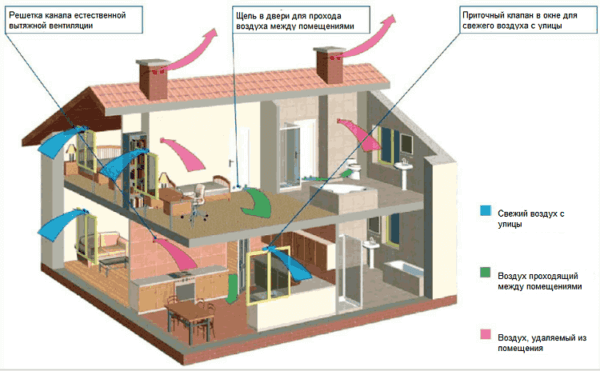
The device of the ventilation system is as follows
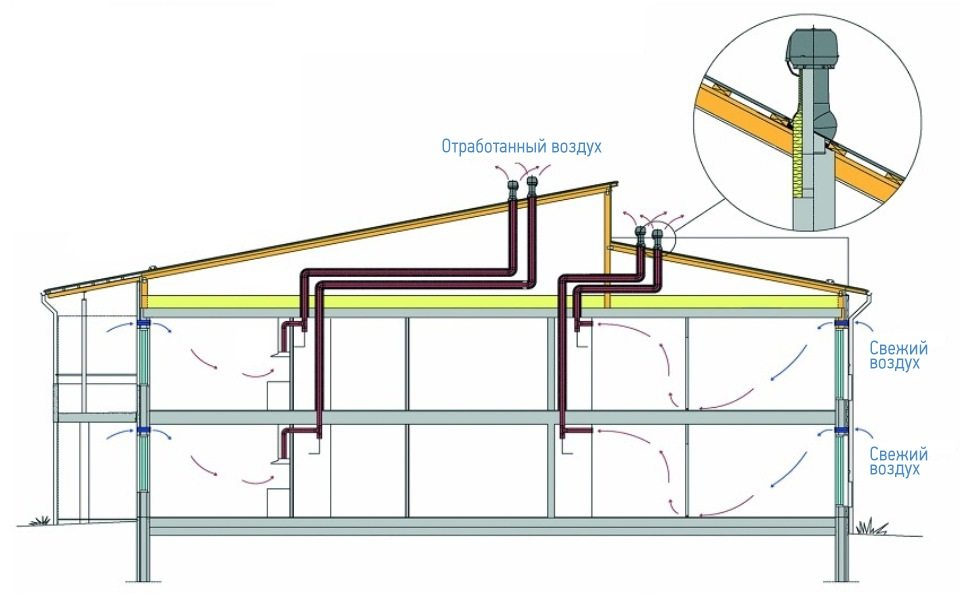
- Inside the apartment of an apartment building, air enters through ajar windows or by penetrating through the supply valve (read about what supply ventilation is, how to make an exhaust hood with a supply valve, read here). Its removal is carried out through a ventilation shaft, which necessarily has outlets in the bathrooms and in the kitchen. The air flow that enters through the vents moves freely in the room through the doors if they are open. If the doors are locked, his path lies through the cracks under them, or through specially installed gratings for overflow.
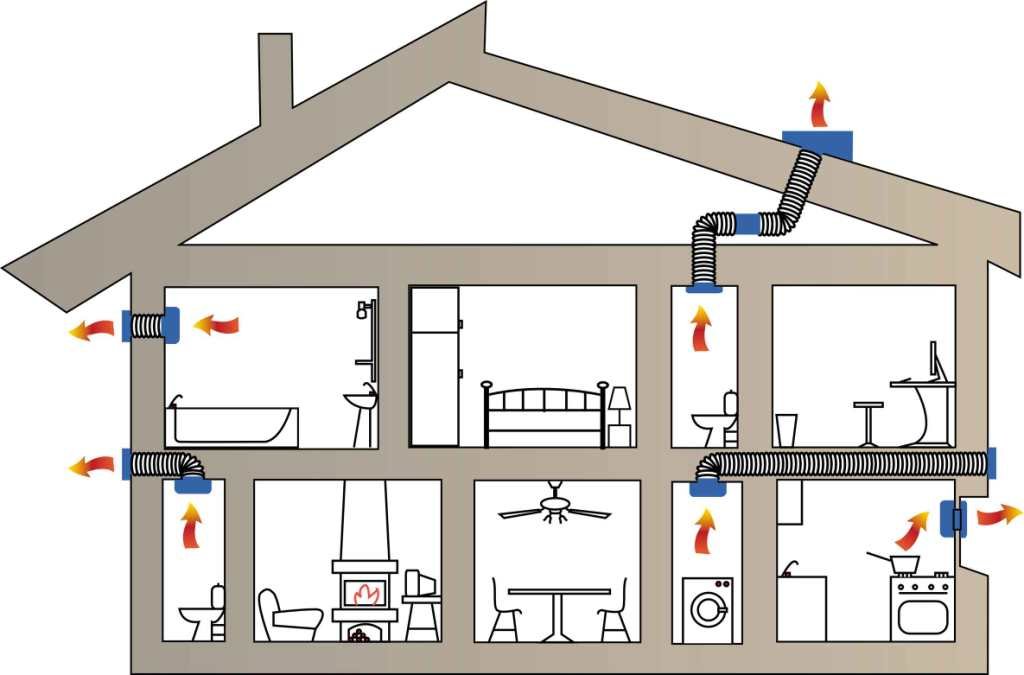
- In a private house, the natural type ventilation system has a slightly different device.The organization of air flow is similar to that described above. The differences relate to the methods of removing air into the external environment, since ventilation shafts are rarely installed during the construction of cottages. Withdrawal can be made via:
- Chimney - if there is a fireplace or stove in the building.
- An exhaust pipe, equipped in the bathroom and the kitchen (how to equip the ventilation in the kitchen and in the bathroom?). Often it is brought out horizontally through the wall of the house and then vertically to the roof (how to make ventilation in the wall of the house?).
In a private house
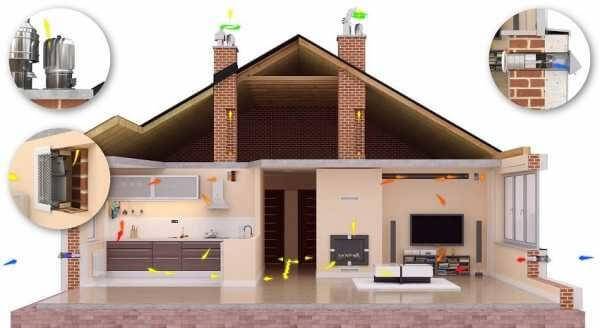 When installing the ventilation system yourself, you should adhere to the following recommendations
It is better to lay the ventilation shaft between the walls of the building. This will minimize the temperature difference in winter, which will have a beneficial effect on traction.
If the duct for the hood is equipped from the side of the street, it is necessary to insulate it with high quality.
The interior space of the ventilation shaft should be as smooth as possible so as not to interfere with the movement of air masses.
Significant differences in pipe diameter should be avoided or smooth transitions should be installed between them at a slight angle.
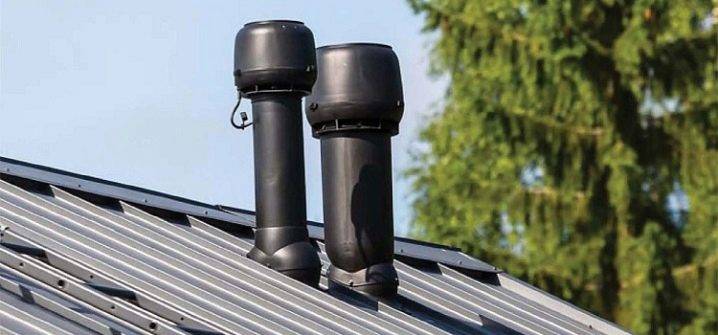
It is recommended to install a deflector over the exhaust pipes. The device protects the air channel from precipitation, debris and slightly increases the level of traction
If there are sealed plastic windows in the premises, it is important not to forget about periodic ventilation, which is necessary for the normal circulation of air masses. If for some reason this is unacceptable, special supply valves should be installed.
The exhaust point of the ventilation duct should be located as high as possible, closer to the ceiling.
another article
In a wooden house
For wooden buildings, proper ventilation is very important.
Important
In rooms, it is necessary to ensure that there are gaps under the doors through which air will circulate inside the dwelling. Exhaust gases exit through the exhaust holes located in the ceiling area of the rooms
The outlets of the channels for the hood must be equipped above the roof.
Supply and exhaust ventilation system in a private house
Despite the fact that the do-it-yourself ventilation scheme in a private house may seem too simple, with the proper approach to organizing it, it will provide comfortable conditions in the house.
 Installation of ventilation ducts.
The most suitable ventilation system for a private house is supply and exhaust ventilation, where air is supplied and exhausted by force. To install a ventilation system with your own hands, it is necessary to calculate the required air exchange, determine the installation location of the equipment (usually a dry utility room is used) and outline the location of the openings for air inlet and outlet. Openings for air inflow and exhaust are arranged in opposite corners of the room. A pipe is inserted inside the hole and covered with bars from the outside. A non-return valve is installed from the inside. In the selected place, the air handling unit is fixed, ventilation ducts are attached to it using metal clamps. Flexible pipes are used for air ducts.
 Elements of the ventilation system in the kitchen.
Pipes for ventilation in private homes can be used plastic or aluminum. With the help of fasteners, the channels are bred through the rooms of the whole house.Typically, air ducts are located above suspended ceilings. The outlet of the duct pipes is closed with ventilation grilles.
On a note! Using a fan in the supply and exhaust unit, it is possible to achieve an increase in the rate of removal of polluted exhaust air.
The supply and exhaust system can be equipped with a heat recuperator that heats the air coming from the street. Another option for supply and exhaust ventilation is a supply and exhaust system with air conditioning. With the help of such a supply and exhaust unit, warm air is cooled.
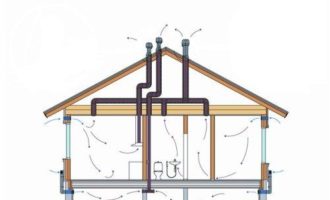
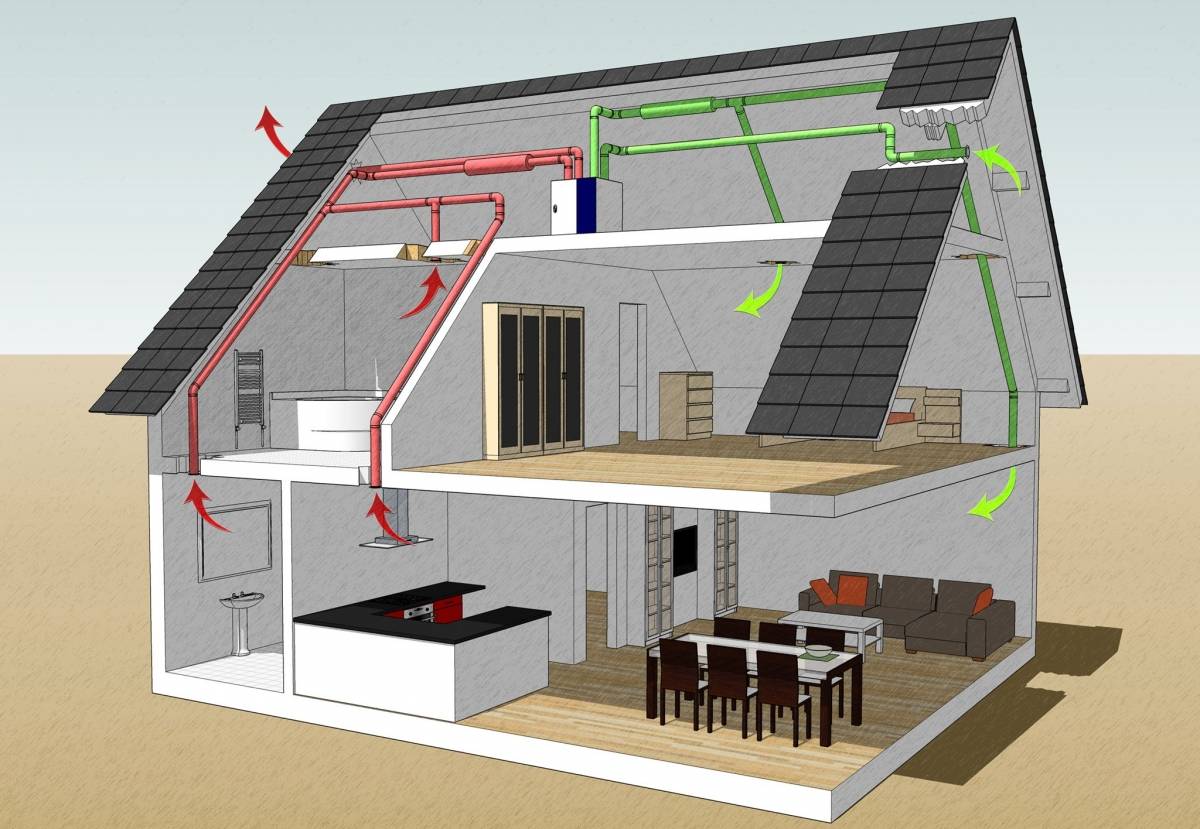
 The arrows indicate the direction of air movement inside the house during natural ventilation.
Installation of wall-mounted ventilation
In houses with brick walls, it is worth using a fairly simple and effective scheme for air flow through a special module. The principle of operation of such a system is simple and convenient. As a rule, controlled fan devices are used, which make it possible to make the exact amount of forced air depending on weather conditions and the volume of the room. Thus, you get rid of the need to calculate and select the performance of the ventilation system of the apartment.
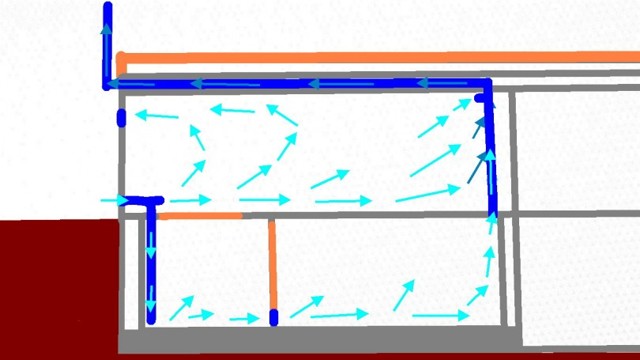



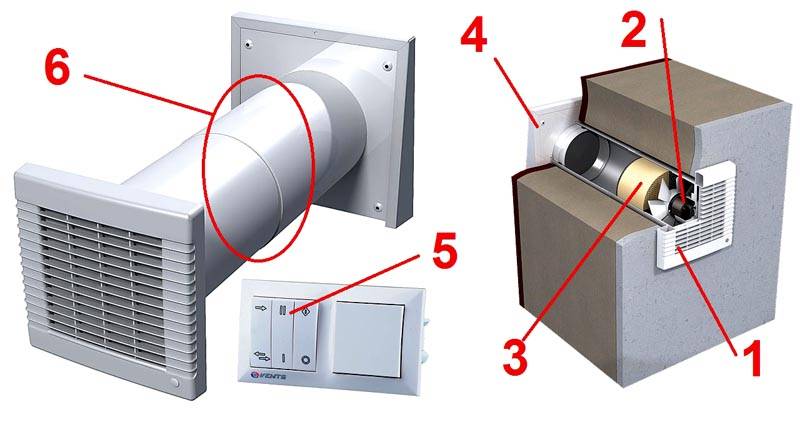
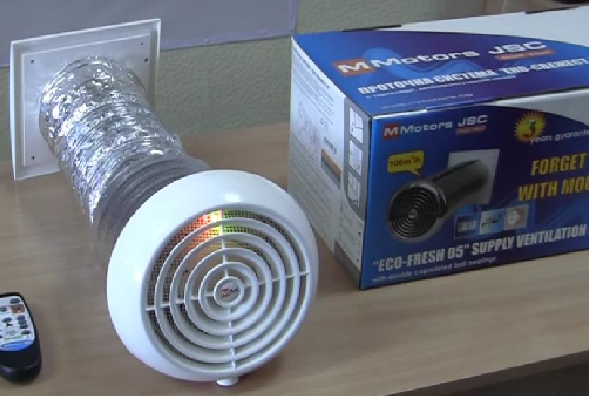
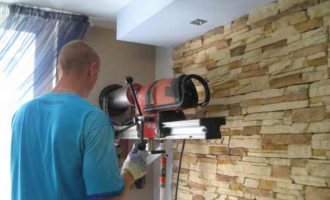
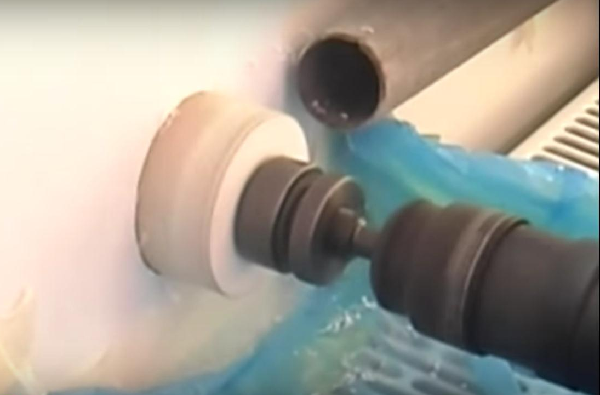
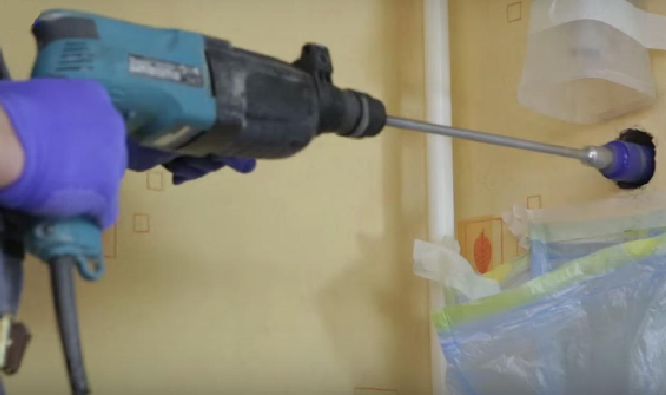
For installation, we need two hole drills, an extension nozzle the size of the wall thickness and an electric hammer drill or drill.
Mounting and configuration come down to making a hole in the wall and wiring to the module:
- We will mark the place for the hole at a height of about two meters from the floor, preferably at least half a meter from the window opening or structures on the outer surface of the wall.
- Drill a hole in the wall with a hole drill and extension nozzle.The channel of the hole should have a slight negative angle of inclination, the inlet on the outer surface of the wall should be lower than the outlet in the room by 2-3 cm by 50 cm of length.
- We mark on the wall the line for laying the wiring from the outlet to the installation site of the supply ventilation module. Using a perforator along the wiring line, you need to make a channel in the wall. We lay the wiring, leaving the necessary stock of wire at the ends to connect the switching contacts. We close the channel with a plaster solution.
- Using a vacuum cleaner, we remove dust and dirt, apply an adhesive solution to the inner surface of the punched ventilation channel.
- We lay the thermal insulation and mount the module input device on the outer wall. We install the internal module of the device, carefully close the gaps.
- We connect the supply ventilation to the laid electrical wiring and set up the operation of the supply ventilation.
Despite the higher price and the need for power supply, such a supply ventilation device is an order of magnitude more efficient, does not make noise, does not freeze, retains dust and consumes electricity an order of magnitude less than a conventional electric lamp.
Requirements for ventilation in the apartment
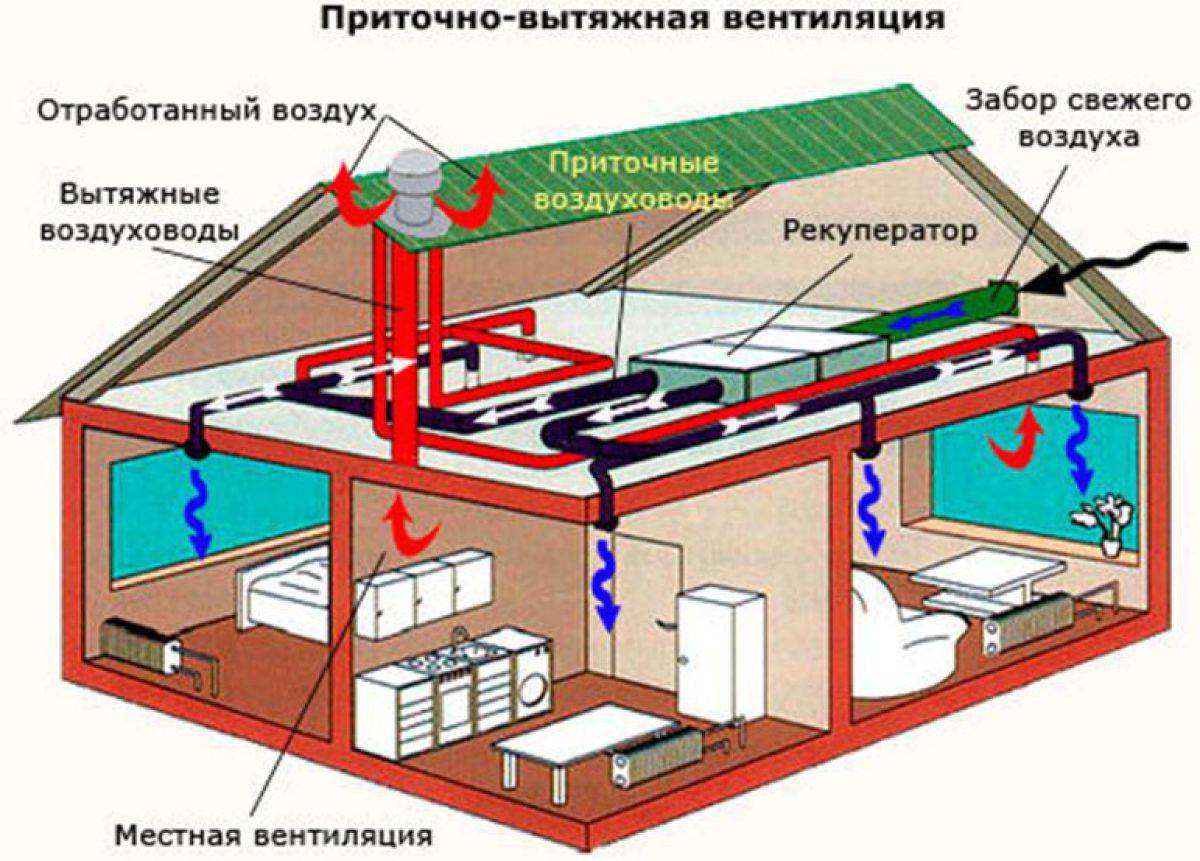
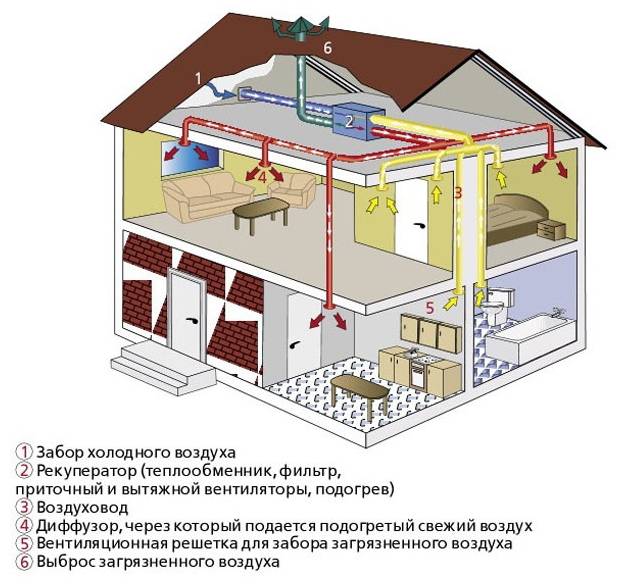
Scheme of supply and exhaust ventilation in the apartment
In accordance with the current sanitary standards, such ventilation is considered sufficient, in which the exhaust air in each room is completely replaced with fresh air at least twice an hour.
Initially, ventilation was supplied to each apartment from a common ventilation duct. However, in some situations, the power of such a system is not enough to provide the required level of air exchange.
To check the efficiency of the ventilation system, it is not at all necessary to call specialists. You can use elementary tricks and draw conclusions about the quality of air exchange yourself.
Typical apartment ventilation scheme
Types of forced ventilation
Forced ventilation of the apartment is of two types:
- supply system, the task of which is to supply clean air to the apartment;
- exhaust system, the main function of which is to remove used air from the room.
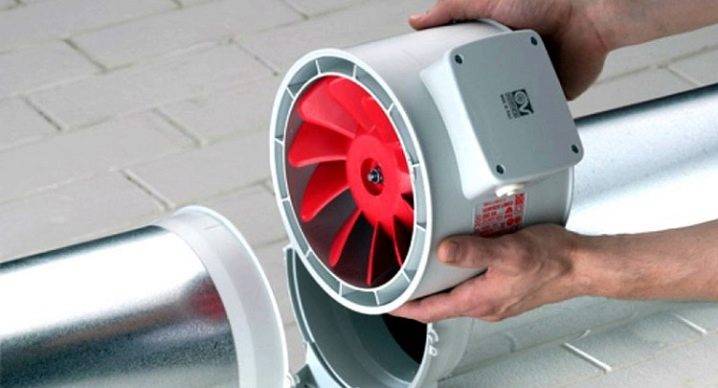
The exhaust system includes such simple devices as fans. They can be installed on the window or on the exhaust hole. The installation process of such a device is quite simple, it takes a few minutes of time. However, the low price corresponds to the quality of such an installation. Due to the small size and power of the fans, they cannot provide the apartment with the necessary fresh air parameters.
Conclusions and useful video on the topic
All stages of installation of the simplest wall-mounted inlet valve:
The procedure for ensuring ventilation through interior doors:
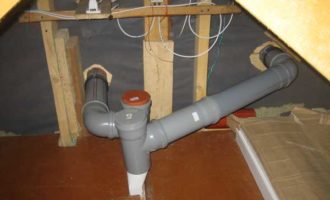
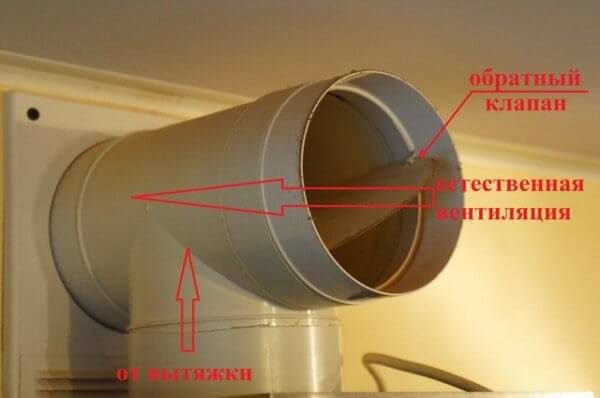
Combination of natural and forced ventilation using a tee and a check valve:
Checking the quality of air exchange in the apartment and most of the work related to ensuring normal air circulation can be done on your own. However, for the installation of complex equipment or work involving risk, it is better to invite specialists.
Or do you have any difficulties in arranging the ventilation system and want to clarify certain points? Ask for advice from our engineer - we will try to help you.