- When is ventilation needed?
- Ventilation in a frame house on your own: step by step instructions
- Price
- Ventilation systems from a third-party contractor: turnkey delivery
- Types of ventilation
- Ventilation in the building
- natural ventilation
- Forced ventilation
- Warming
- Interior decoration
- Features of the ventilation gap
- Features of installation of forced ventilation
- What is it for
- Ventilation examples
- The project of the ventilation system in the bathroom "framework"
- Sauna ventilation project
- Extractor through the wall in the kitchen
- Additional features
- Ventilation scheme
When is ventilation needed?
Of course, if it is planned to build a frame house, which will be used exclusively in the summer as a summer residence, then the organization of ventilation is not at all necessary. During the summer period, the windows and doors of the house are always open anyway, and to ventilate the bathroom, it will be enough to organize a small window.
If the cottage is planned to be used in the autumn, as well as in the winter, then air exchange will be required, at least in the kitchen and bathroom.
Well, for houses that are being built for the whole family to live all year round, it is necessary to plan a high-quality ventilation system.
Ventilation in a frame house on your own: step by step instructions
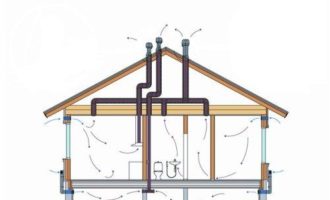
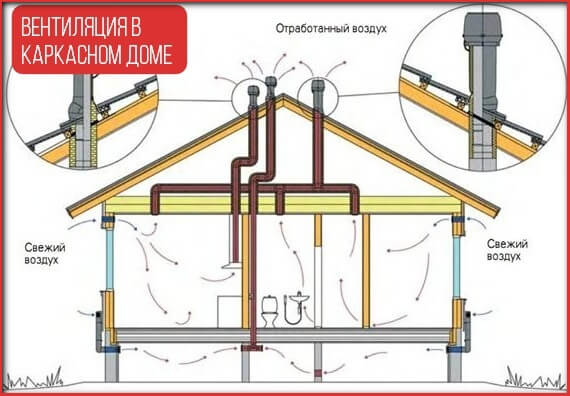
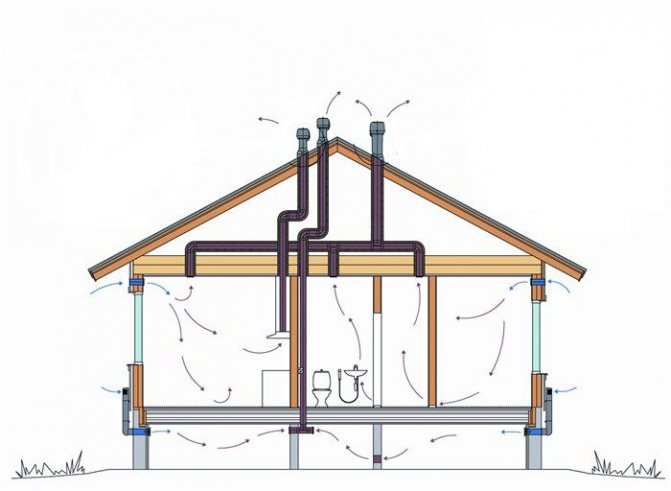
How to install a ventilation system in a frame house yourself? In fact, there is nothing complicated in solving this problem, and absolutely everyone can cope with it with the right approach. The scheme of natural air exchange of premises is developed during the design of the building. It is necessary to provide steel or brick channels in the walls with an exit through the roof. The diameter of shafts and chimneys can be different: 140x140 mm, 270x140 mm and more.
The device of a mechanical ventilation system includes the following steps:
- Performing calculations of air exchange at home, referring to the current sanitary and hygienic standards;
- The choice of ventilation system - supply, exhaust, supply and exhaust;
- Development of a scheme on the building plan, with the location of equipment and duct routing on it;
- Acquisition of the necessary equipment and installation;
- System Setup.
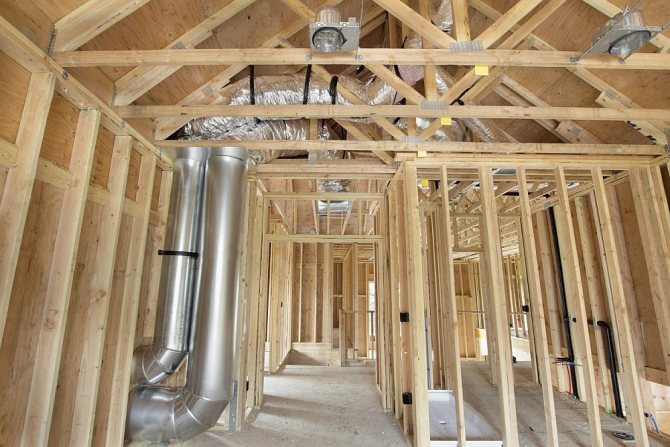
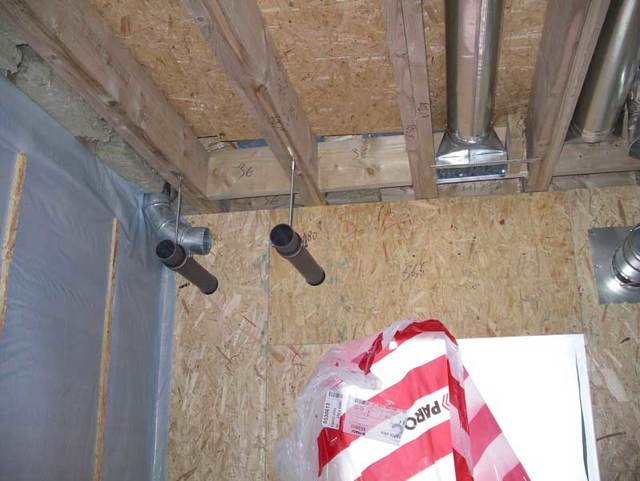
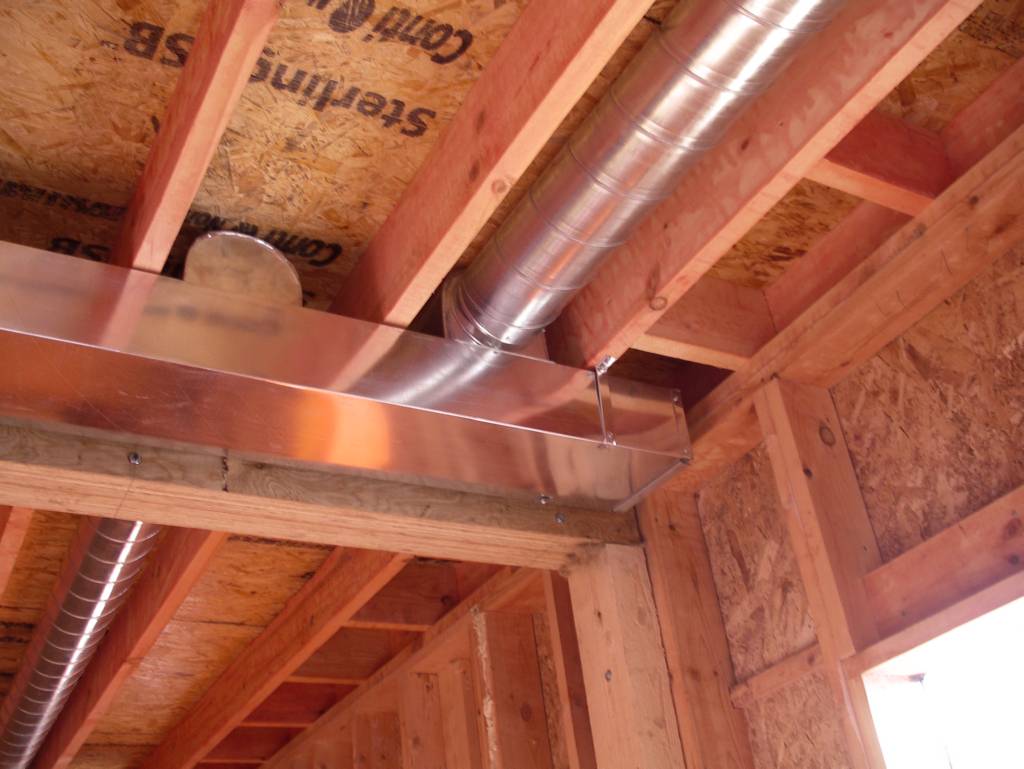
Installation work begins after the frame is ready and the exterior decoration of the building is completed. Pipes are installed in special holes in the box, a duct fan is mounted. Without fail, all joints must be processed and sealed with mounting foam.
Before the mounting foam hardens, the system must be at rest. After the insulation has acquired the desired strength, the installation of air filters, controls, noise absorbers and other equipment is carried out.
step by step device manual ventilation in a frame house for dummies provides for the following recommendations:
- To reduce the level of vibration and noise, air ducts are fixed to the wall and ceiling in a rigid way;
- Ventilation grilles should not be placed in places of permanent residence of the residents of the house;
- Exhaust systems must be equipped with non-return valves, and supply units must be equipped with automatic valves that block the movement of air in the off state.
After completion of the installation work, the operability and efficiency of the ventilation system are checked. The easiest way for these purposes is to use special measuring instruments that analyze the speed of air flow and the composition of the air in the room.
Price
The answer to the question of how much a ventilation system in a frame house costs depends on a number of factors:
- equipment used;
- The area of the house and the number of rooms;
- Presence of a fireplace, swimming pool, etc. in the building;
- Features of the placement of equipment and equipment, the operation of which adversely affects the air quality in the rooms.
Practice shows that the range of prices for ventilation in a frame house is quite large. With the most conservative estimates and independent performance of all work, the cost of the system starts at 25-30 thousand rubles.
Ventilation systems from a third-party contractor: turnkey delivery
With independent calculation, design and installation of the ventilation system, there is a high risk of eventually obtaining ventilation that is not necessary in terms of functionality and power, or vice versa, as a result, its power is insufficient to ensure a comfortable microclimate.
In order not to get into a similar situation, experts recommend seeking help from professionals.
Experienced specialists will be able to draw up a ventilation scheme taking into account the characteristics of each room in the house, select the necessary equipment, perform installation and commissioning. The cost of ventilation in a turnkey frame house is affected by the complexity and richness of the work. For example, complexity is understood as the need to invite an industrial climber.
Prices for ventilation for a turnkey frame house may vary depending on the region and the contractor. The average cost of work in Russia is in the range of 50-70 thousand rubles for houses with an area of 100 sq.m.
Types of ventilation
To date, a fairly simple typology of ventilation has developed for private houses in general and frame houses in particular - it is divided into natural and forced. But even this simple classification is not as simple as it seems at first glance, and has its own characteristics.
The basic principle of natural ventilation is very simple and understandable to everyone. It lies in the fact that air circulation is provided without the use of any mechanical devices. Maximum - organized special channels for air.
But natural air circulation can also be:
- unorganized;
- Organized.
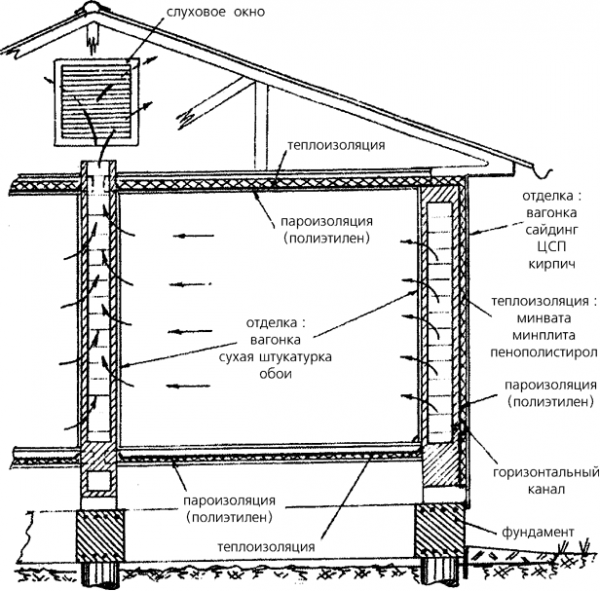
In the first case, natural cracks, gaps and openings in the floor, walls and ceiling, door and window openings are used. They act as supply channels. As an extract, for example, a chimney or other chimneys are used. This type of ventilation is sometimes referred to as natural breathing at home. Although you should not think that gases penetrate through the very surface of the wood. Without the above channels, the house would not "breathe".

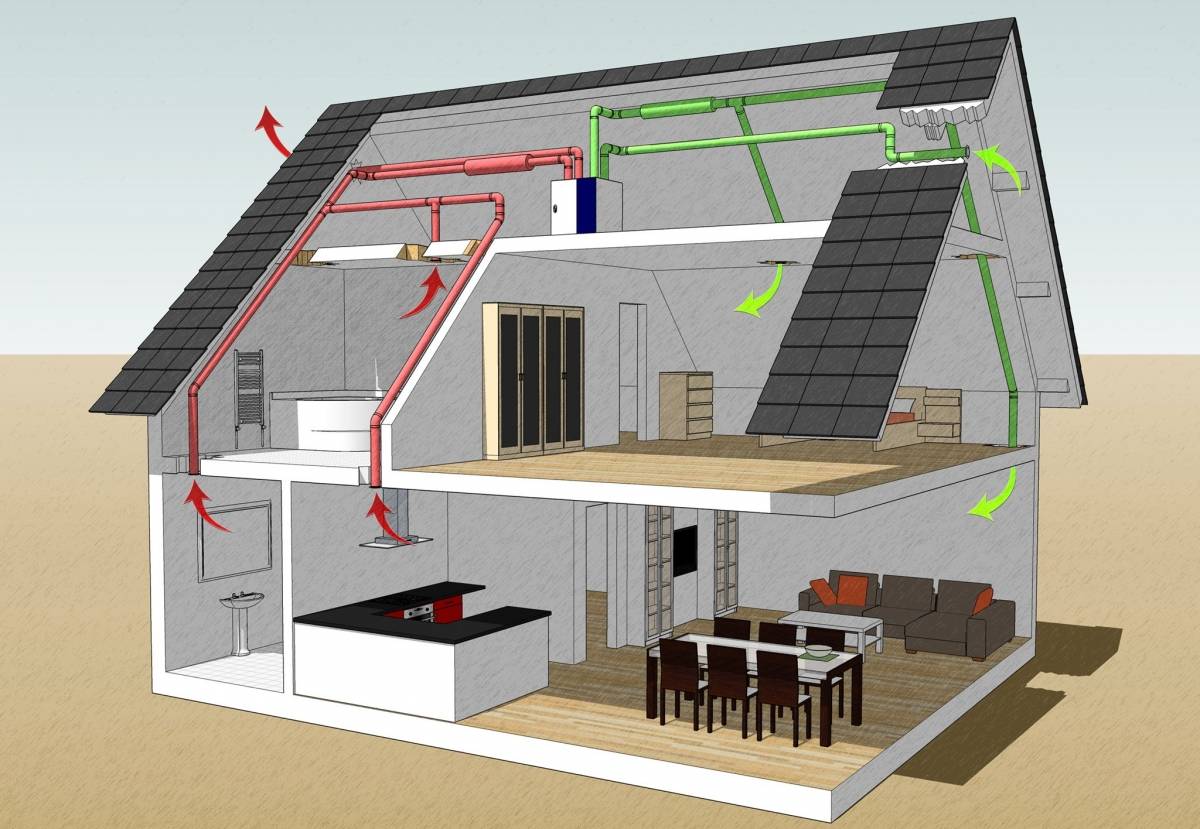
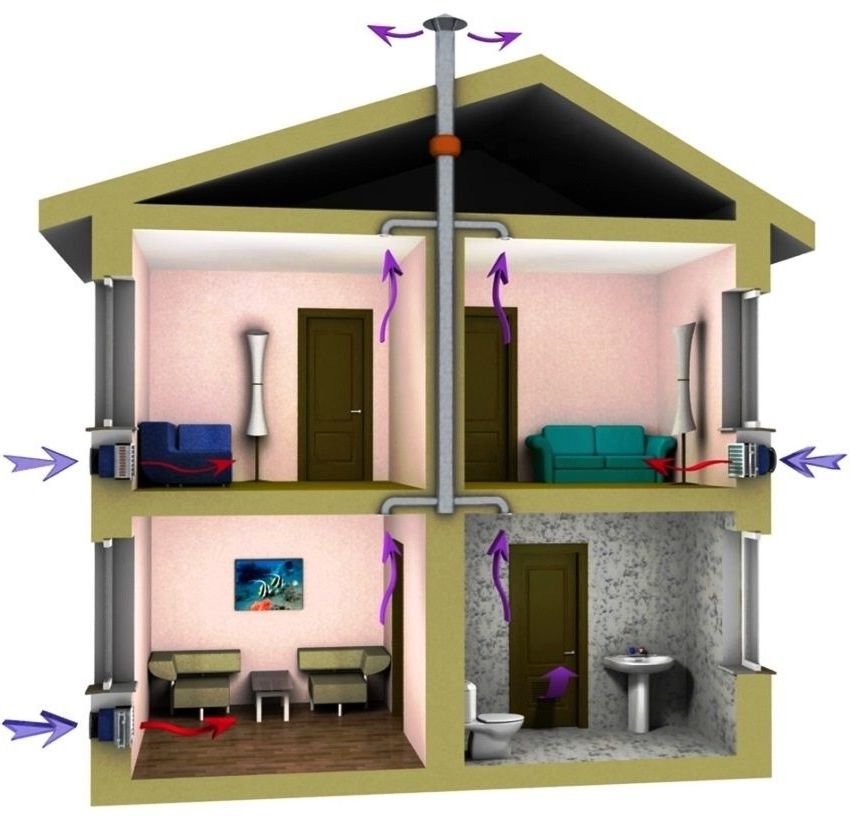
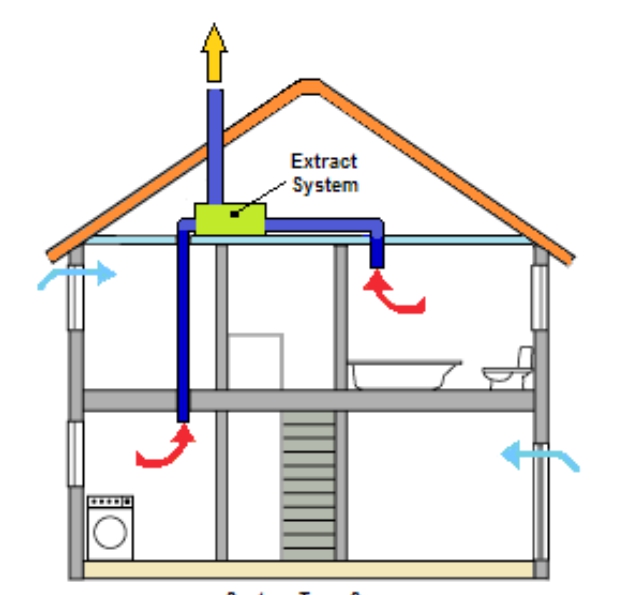
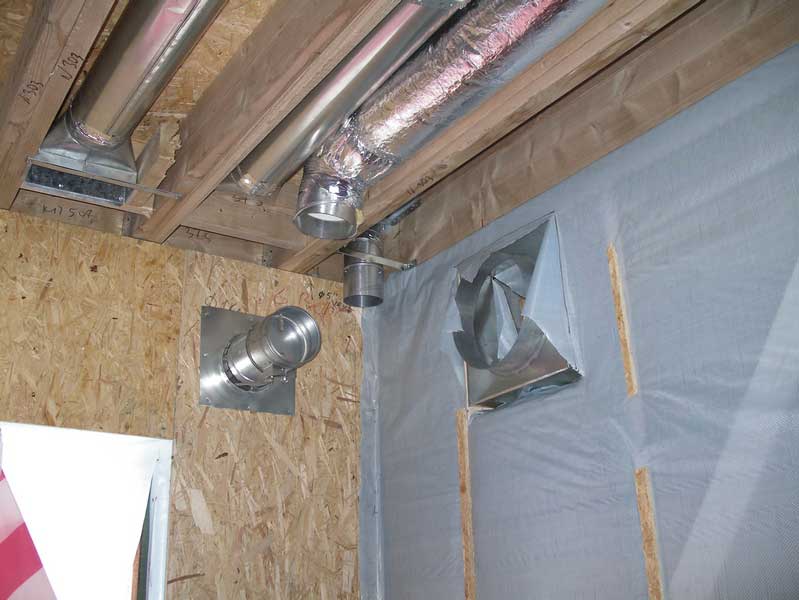
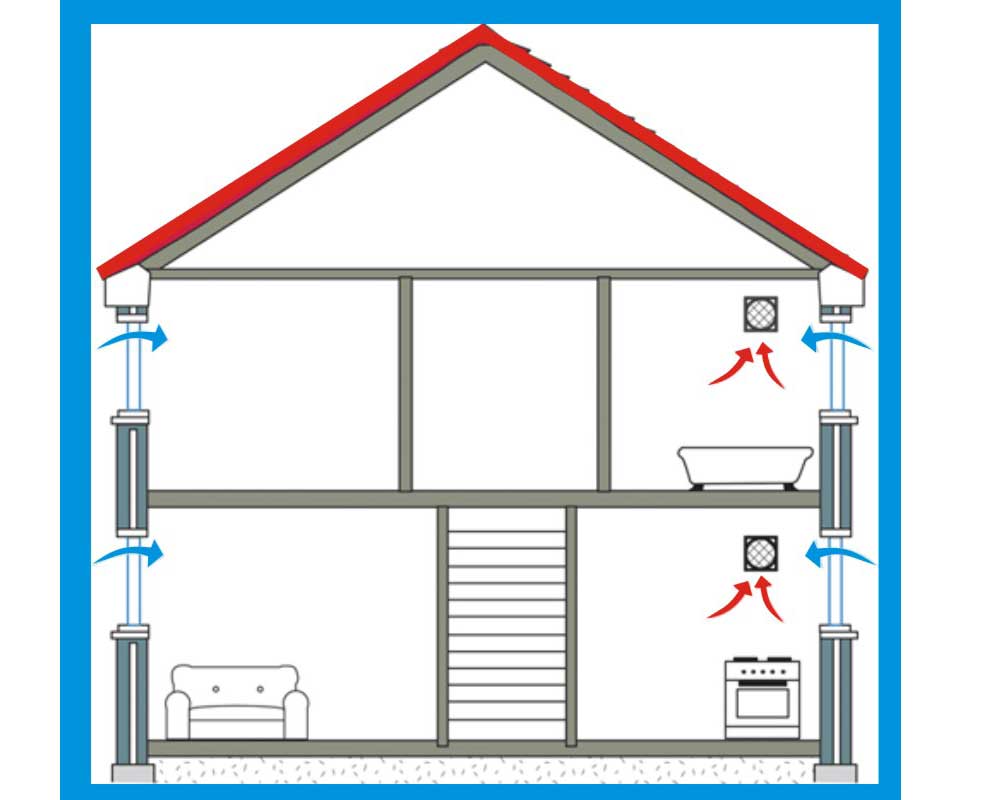


To create unorganized ventilation, frame houses with a coating imitating timber or with plank walls are suitable. But the main problem with this method will be insulation.
Of course, even with well-organized thermal insulation, it is impossible to close all the cracks hermetically, and the natural unorganized air flow is preserved. But it is rather uncontrollable and may not be enough to provide the amount of gases necessary for the well-being of all residents of the house.
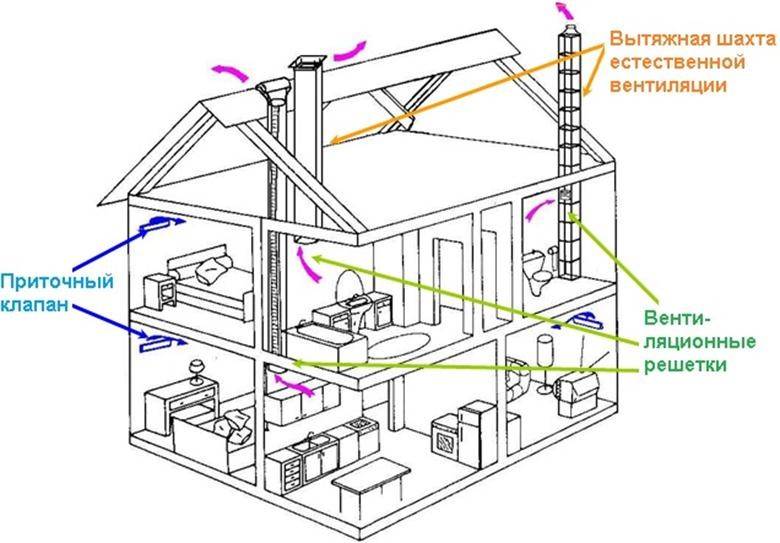
The second option, although it assumes that ventilation is carried out naturally, without the use of additional devices, but at the same time it is thought out. This type of air supply to buildings can be found in old high-rise buildings, where a window is used as a supply channel. And it is removed through specially equipped mines.
According to the same principle, natural organized ventilation is arranged in a private frame house.
The main problem is that this type of ventilation relies on pressure differences. Its efficiency strongly depends on the length of the ventilation shaft. Therefore, if the house does not have a stove, it should be planned only for buildings above two floors.
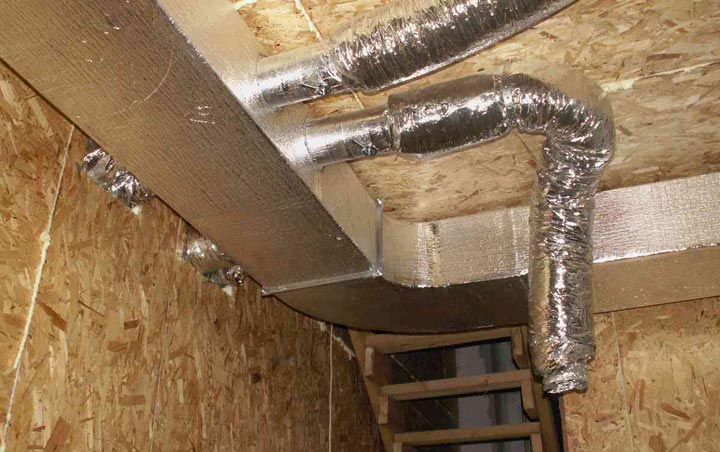
The modern method of ventilation in the house is forced mechanical. It involves the use of special devices that provide exhaust or air flow. Unlike natural, it requires money, but is better suited in terms of energy saving.
Forced ventilation is divided into three main types:
- exhaust;
- supply;
- Exhaust-supply.
By their names, you can easily determine the basic principle of work.
With forced exhaust ventilation, which is considered the simplest and most common, air flow is provided due to natural causes. These can be open windows, vents or special ventilation valves. The latter are placed either on the window or cut into the wall.
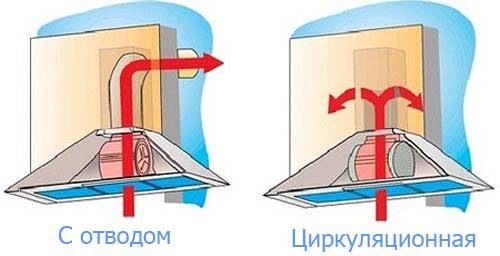
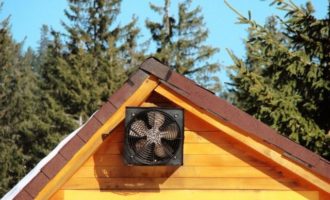
Air is discharged through pipes installed in the kitchen, in the bathroom and in the technical room, to the roof. There is a special roof fan. A cheaper option is to install a wall fan in each of the above rooms.
Forced ventilation works on the opposite principle - a fan on the ceiling or in the walls drives air from the street into the room. And he leaves the building through open windows or special channels.
The consumer receives a regular controlled flow of fresh air and does not experience discomfort from drafts. Supply ventilation is considered the best option for the winter season, as it saves on heating.
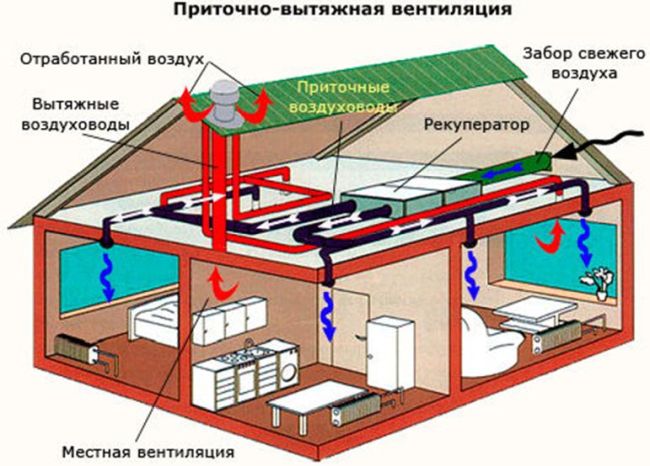
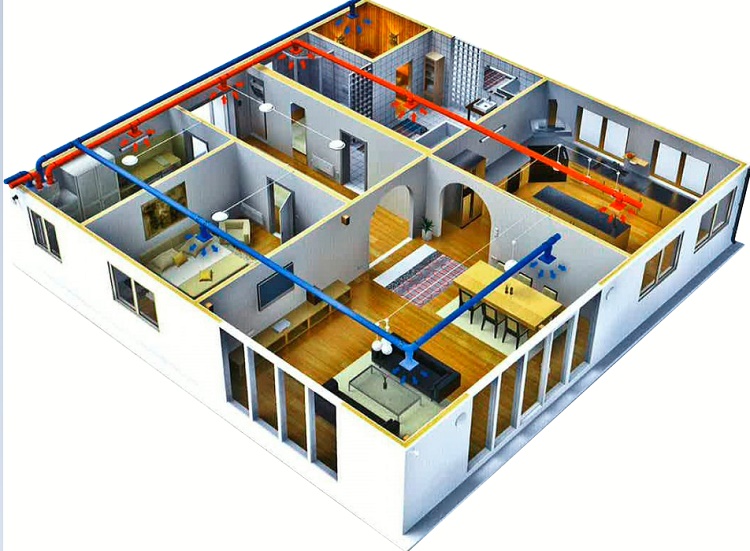
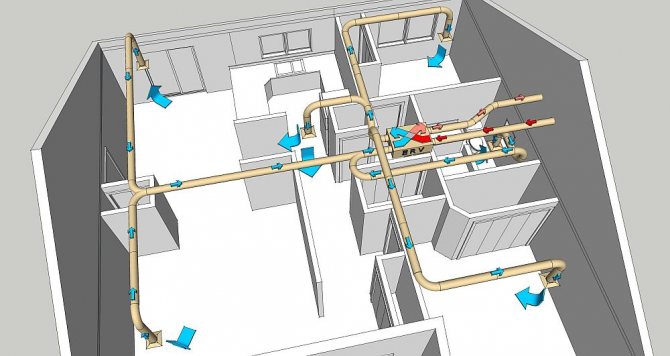
The supply and exhaust ventilation system is good because it allows air access not only to technical rooms, but also directly to residential ones. As the name implies, it is a system of forced exhaust and inflow, forming a block.
Heat exchangers can be used to improve energy efficiency in forced ventilation. In the heat exchanger, heated exhaust air passes through adjacent channels with cold supply air. As a result, the latter is heated from contact with the former through the walls.
Thanks to this unit, there is no need to waste energy on special heating of the incoming air in the cold season.
Ventilation in the building
Frame houses are considered to be practically hermetic structures, especially in cases where plastic windows and doors are installed. If you do not organize proper ventilation, the room will constantly have high humidity. Moisture is released by a person when breathing, when cooking, during bath procedures. It should be noted that the organization of ventilation in a frame house is a rather expensive undertaking.
natural ventilation
Natural ventilation occurs indoors on its own due to the penetration of street air through cracks due to loose fitting of doors and windows. If the structure is built without disturbance, the natural circulation stops. To organize ventilation in a natural way, special air valves are installed, they are small in size and therefore practically invisible in the design.
Modern valves for natural ventilation are equipped with special filters, they clean the outside air before it enters the room. Also gratings to protect against rodents in a frame house, tiles and noise absorbers. Indoors, a special damper is installed on the valve, which allows you to control the strength of the air.





Forced ventilation
The stages of construction of a residential building may include the construction of not only natural ventilation, but also a forced structure, which allows you to achieve an optimal microclimate in the room. Most often, forced ventilation first warms the outside air and filters it, and only then they let it into the room.
Ventilation system in a frame house.
On the building materials market, forced ventilation is presented in a wide variety, so you can choose a system according to your needs and financial capabilities.
The stages of building a house with your own hands when building walls are quite simple, do not require special skills and a specific tool, assembling the whole house is very similar to assembling a designer
When organizing ventilation in the house, pay attention to one important point - it is better to calculate the fan power by a professional
Warming
To insulate a frame house, the construction stages begin with the laying of a windproof layer, regardless of the insulation used.
For floor insulation insulation is laid on the vapor barrier membrane, mineral wool is most often used
When working with cotton wool, it is extremely important to prevent the formation of voids and cracks. The thickness of the insulation for the floor is selected individually depending on the region of construction, while the layer should not be less than 150 millimeters. Each new layer of mineral wool must cover the junction of the material
A waterproofing material is hermetically laid on top of the insulation, plywood on top, only then fine finishing begins
Each new layer of mineral wool must cover the junction of the material. A waterproofing material is hermetically laid on top of the insulation, plywood on top, only then does the fine finish begin.
We lay mineral wool in the frame of the house.
The technology for insulating the walls of a frame house is similar. A vapor barrier membrane is laid between the outer panels and the outer finish, two or three layers of insulation and waterproofing material are laid between the panels.
The roof insulation procedure is carried out until the completion of the complete assembly of the structure. A vapor barrier material is hermetically stretched onto the ceiling beams, which is clogged with ordinary plywood up to 25 mm thick. Mineral wool is laid on top according to the rules described above. If the ceiling cannot be insulated from above, all work is carried out from the inside of the room. In the case of using the attic, the roof vaults are insulated in a similar way.
Interior decoration
Rules for the interior decoration of a frame house:
- It is better to carry out work on finishing the premises progressively; you should not start repairs at once in all rooms.
- If there are several rooms in the house, then the decoration starts from the furthest from the front door.
- Work begins only after the completion of construction and the laying of all communications;
- Finishing is carried out according to the principle "from top to bottom".
Internal finishing with plasterboard.
The rough finish is made using drywall or OSB, they are not only a cheap material, but also allow you to hide all the imperfections of the walls. As a fine finish, you can use any materials that are presented on the modern construction market. You can finish the frame house with your own hands, you can find photos of the stages of construction on our website.




Features of the ventilation gap
Unlike wooden houses, where the walls "breathe", for frame buildings it is necessary to foresee the arrangement of ventilation in advance
It is important that the house maintains a comfortable temperature in both hot summers and frosty winters, so that cool, refreshing air enters inside, and heat does not go out too quickly.
The ventilation gap helps to cope with this task. It is already laid during the construction of a frame house under the exterior finish on top of the film that provides wall insulation. Non-woven material, which is used as insulation, is applied around the entire perimeter of the building.
At the next stage, fixing profiles and bars are installed as a base for the exterior finish, due to which a gap is formed for ventilation of the building. The wall of the frame house in the final version forms a kind of “layer cake”, which is made up of sequentially located interior trim, vapor barrier material, insulation, frame, windproof film, ventilation gap, timber and trim on top of it. This option has successfully established itself over the years of construction practice as the most optimal.
Features of installation of forced ventilation
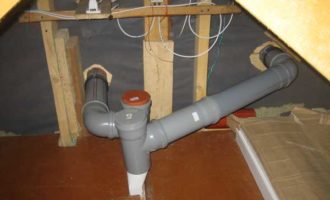
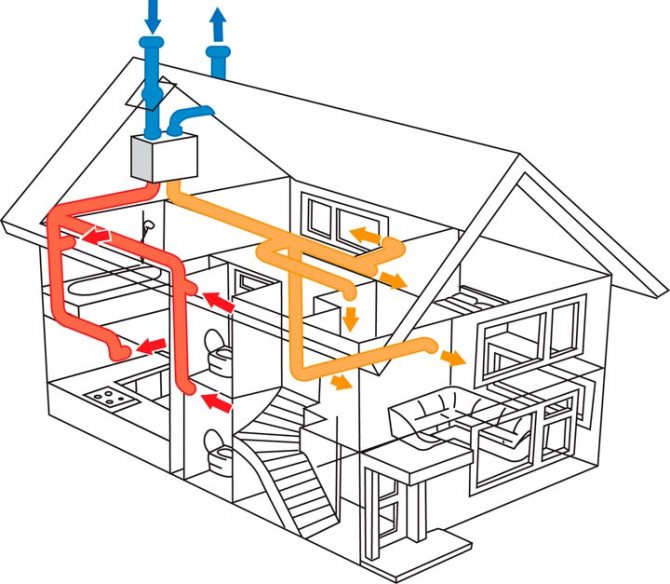
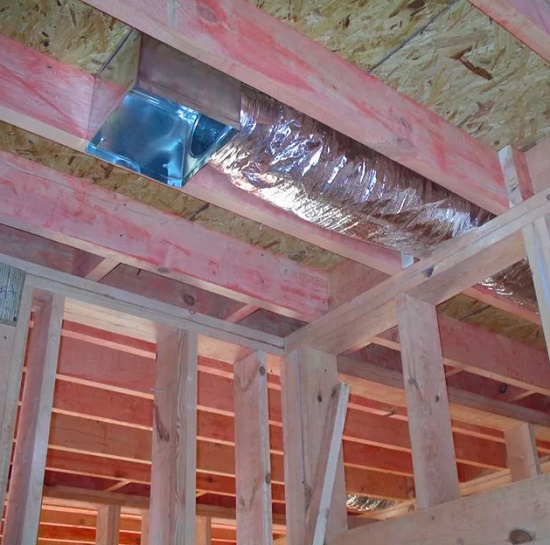
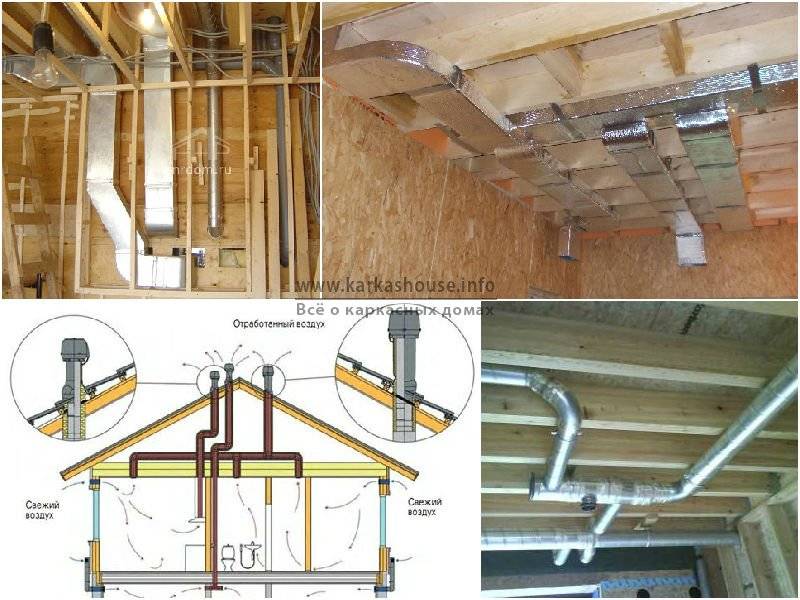
- Assembly of collectors of supply, exhaust systems. This is called the central node. It will be located in the attic and equipped with mechanical devices (fans).
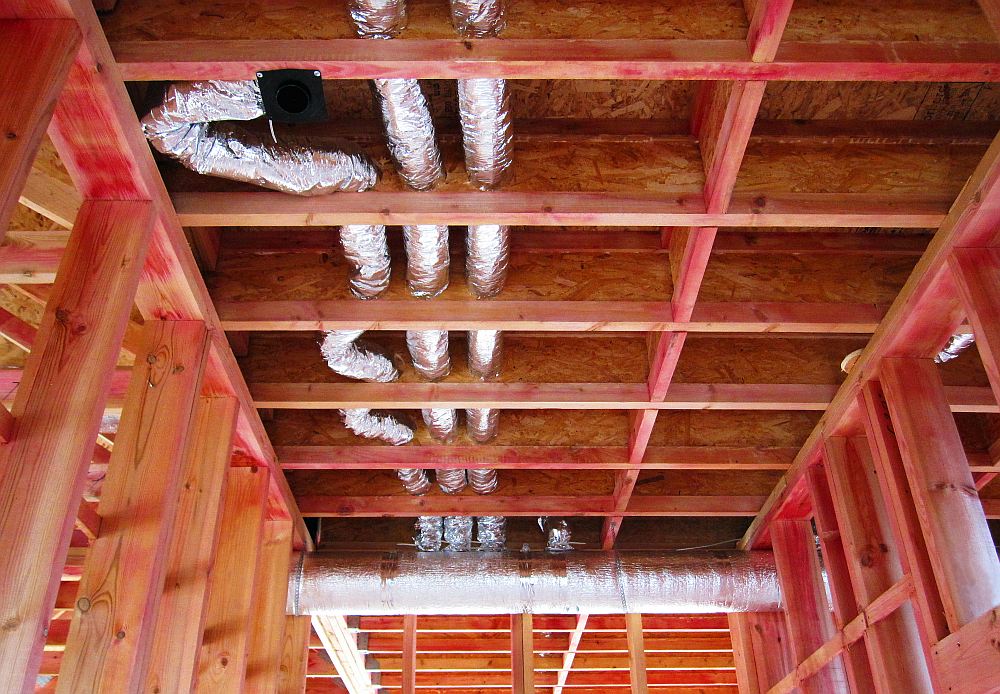
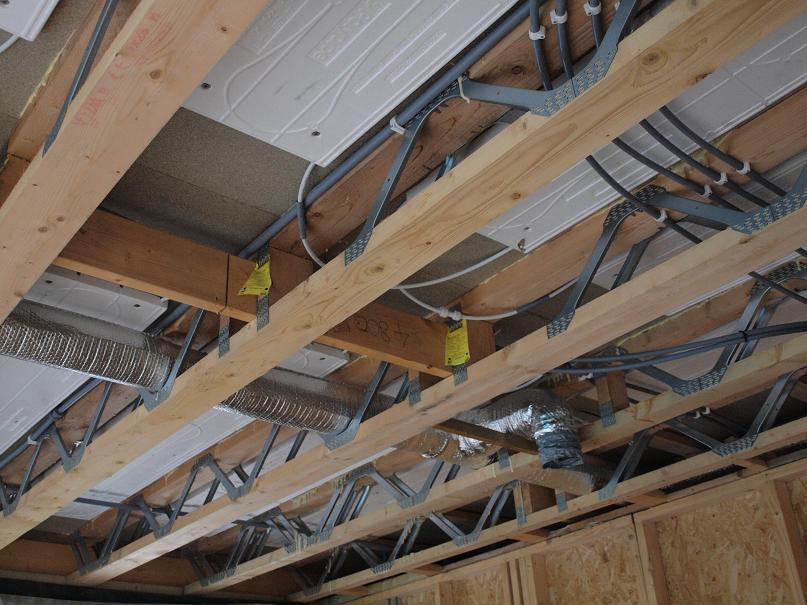
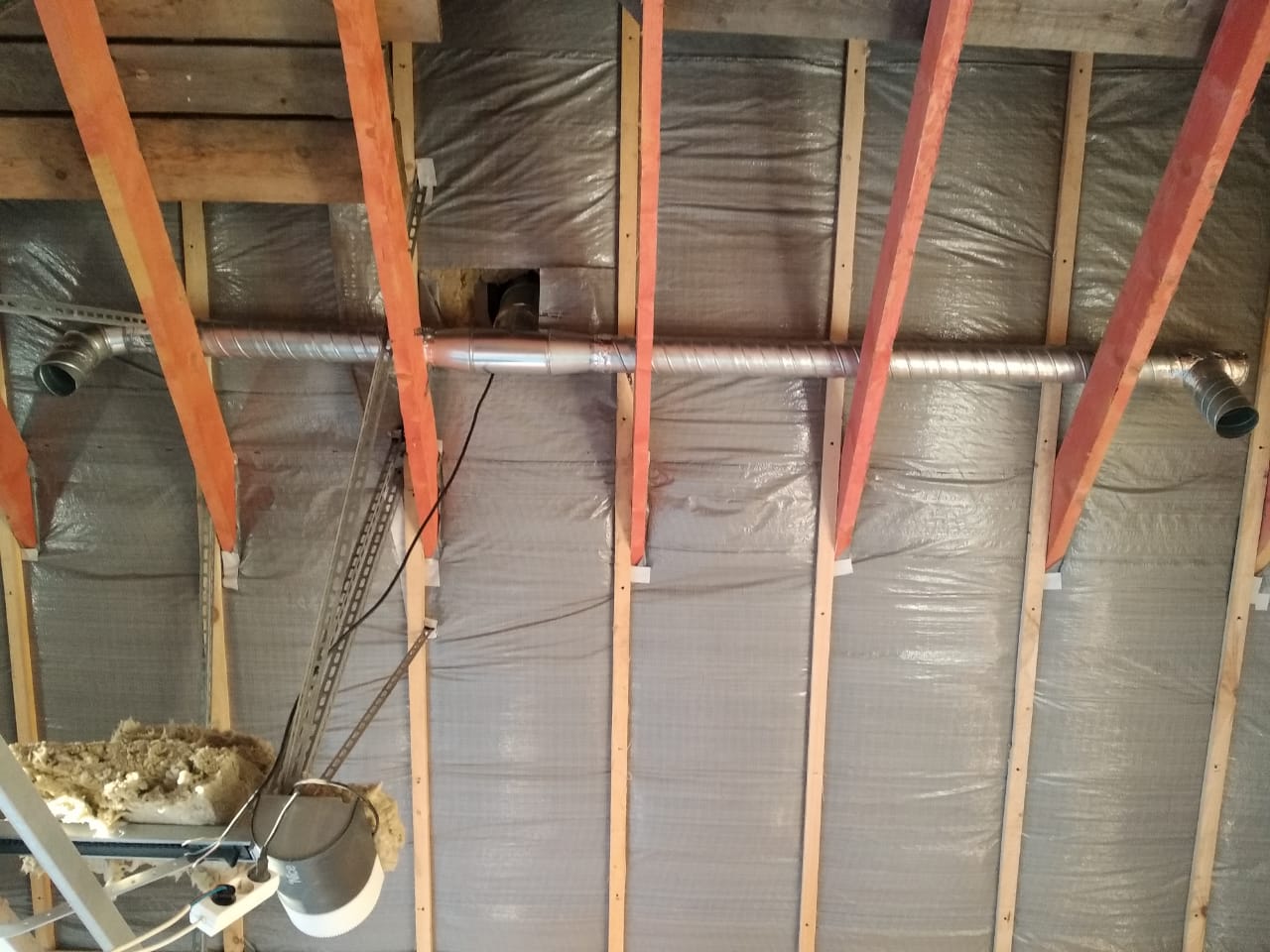
- A pressure pipe is connected to the intake manifold. It is laid in the ceiling between floors. The collector can be installed in the attic. Branches are laid in the pressure air duct, which connect the supply ventilation duct to the ventilation grids in the ceiling.
- From the collector of the exhaust channel, a second channel is laid into the house. It is also mounted in ceilings or under suspended ceilings.Branches are mounted from the exhaust duct, which are connected to the exhaust air outlet grilles.
Ventilation grilles designed for air supply are equipped with special curtains. Thanks to this, you can follow the direction of the air flow. Thanks to the curtains, it is easy to adjust the volume of supply air.
What is it for
To understand the importance of ventilation in a frame house, it is necessary to clarify the design of a frame house. This type of building is a wooden frame, the walls of which are wrapped with waterproofing films, a membrane, foam boards, other insulation, and all this is covered with material for external and internal decoration.
As a result, we get walls that practically do not let air through. This has significant advantages - low energy consumption for space heating, long-term comfortable air temperature.
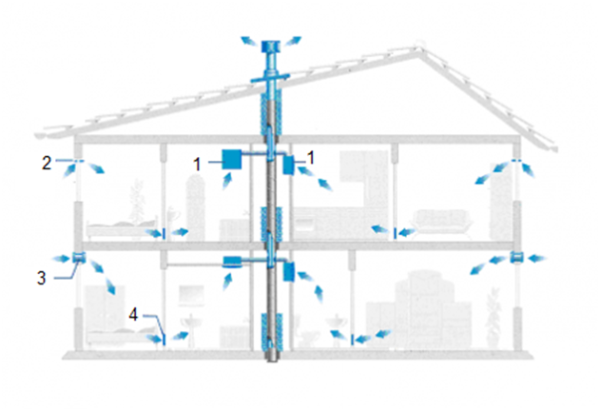
Scheme ventilation for a two-story house
At the same time, people live, work and rest in the house. Over time, the rooms become stuffy, the oxygen content drops, unpleasant odors appear, and condensation forms on the walls. If the walls were completely impenetrable, people in the building could die from lack of oxygen. However, periodically opened windows, doors break the tightness, and you can live in a frame house.
Previously, before the need to save energy came into our lives, natural ventilation brought fresh air into the room - through the cracks of windows, for example. But the wooden ventilated windows that were inserted during the Soviet era were replaced by modern ones - plastic windows that are airtight and retain heat.Houses have become like plastic greenhouses, which are hot and stuffy, especially in summer.
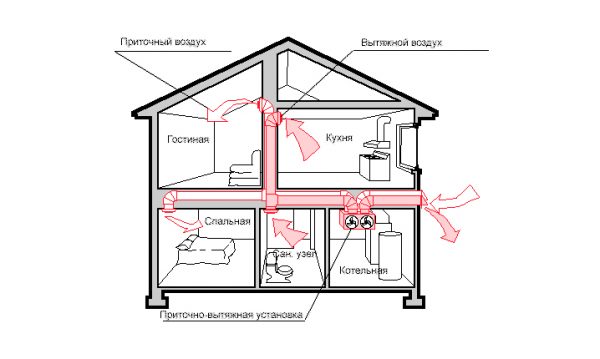
Air movement in ventilation
However, ventilation of a frame house is needed not only to maintain comfort, but also to extend the life of the building. Due to poor ventilation, condensation settles on the walls in the form of water droplets. Therefore, after several years of operation, fungus and mold often appear on the walls of frame houses.
Condensate settles not only on the surface of the walls, but also inside - it is known that the dew point is located approximately in the middle of the insulation in the frame wall. Constantly wet insulation loses its properties, the house becomes cold and collapses from the inside.
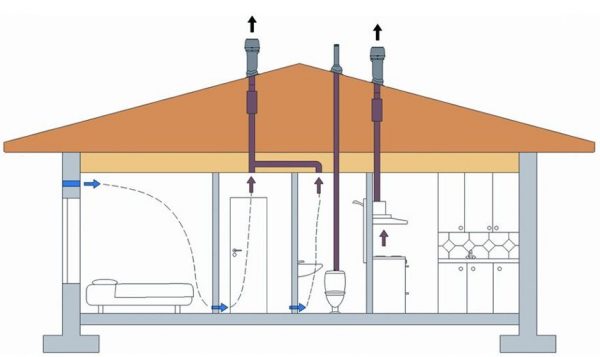
Roof vents
That is why in real Canadian houses and houses built using Finnish technologies, installation of a ventilation system is of great importance. Unfortunately, in our reality, it is too expensive to install it, so most often the need for ventilation is hushed up by developers. They give advice such as leaving the window for micro-ventilation or opening windows regularly. However, all this will not solve the problem of difficult air supply to the premises where people live, but will require additional costs for heating or cooling rooms.

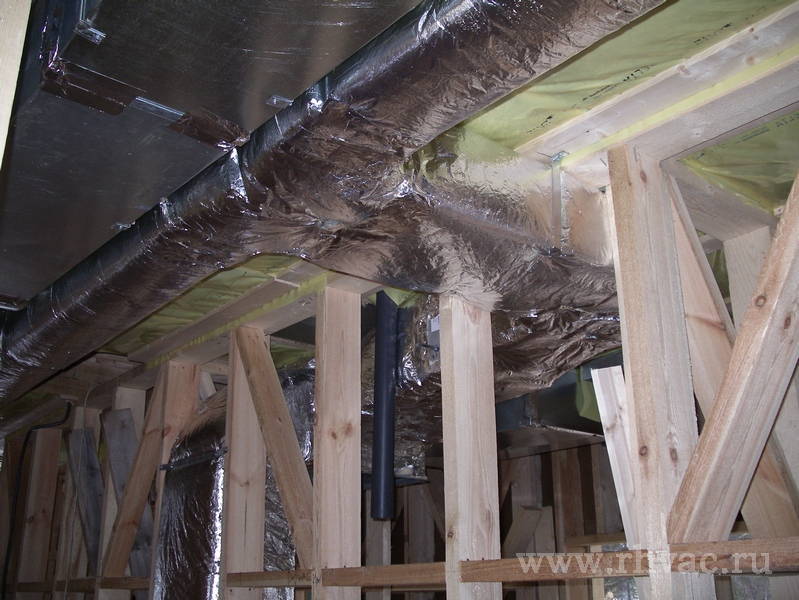




Ventilation of a private house
Ventilation examples
If the rules for protecting the pipe and safety precautions are written in blood, then the requirements of SNiP for ventilation in a room for various purposes are written in black mold. As practice shows, the device of the air exchange system can be done by hand, however, its calculation and design is best entrusted to professionals.
Of course, you can look for examples of frame house ventilation on the Internet or watch video clips on the installation of ventilation systems in frame houses. However, this will not protect against possible errors and shortcomings, the causes of which are the architectural features of a particular building.
We offer you to get acquainted with several projects of the device of the ventilation system in premises for various purposes.
The project of the ventilation system in the bathroom "framework"
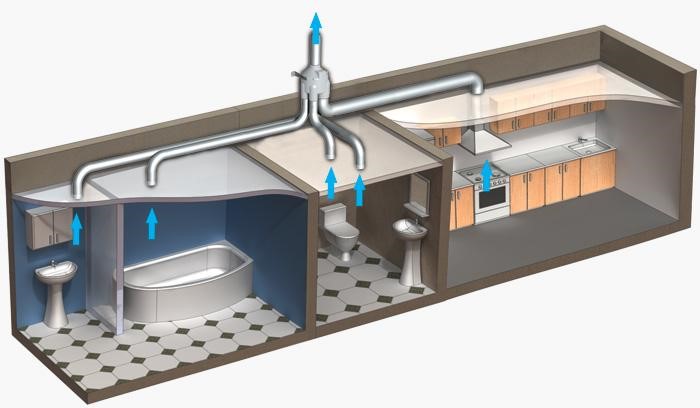
A bathroom is a room whose characteristic feature is high humidity, which provokes the appearance of mold. To eliminate this problem, the bathrooms of a frame house must be equipped with natural and forced ventilation systems.
The natural air exchange system in the bathroom includes a ventilation duct, which is connected to the common house shaft, and a ventilation grill. Additionally, it is possible to install cleaning filters. Forced ventilation is provided by the installation of a fan in the duct and automatic equipment for turning it on and off.
When installing reliable, supply and exhaust ventilation, it will be necessary to equip two air ducts. One - for the intake of outside air into the bathroom, the second - will ensure the removal of polluted air from the room.
Sauna ventilation project
Maintaining a constant, high temperature and ensuring the access of outside air to the frame Finnish sauna is ensured by a well-planned and implemented ventilation system. It must necessarily include an exhaust and inflow.
Exhaust in the sauna - removes all carbon dioxide from it. The inflow, on the contrary, ensures that clean air enters the room. A steam room “with a heater” needs several types of ventilation at once for:
- Kamenka stoves;
- Steam rooms;
- Auxiliary premises - shower room, dressing room, living room for relaxation, dressing rooms;
Good air exchange in the sauna can be achieved by natural, mixed or forced ventilation. However, for the natural influx of outside air into the room, behind the stove, at a height of 20-30 centimeters, a supply valve or flexible duct.
As a rule, exhaust vents are mounted on the opposite wall from the stove. One hole is located at the bottom of the wall, and the other at the top. They are interconnected by means of a ventilation duct, in which an exhaust fan is installed.
Finishing the steam room
Extractor through the wall in the kitchen
Strong odors are constantly present in the kitchen, which can significantly impair the quality of life. In addition, an increased level of humidity in the air negatively affects the health and general well-being of a person. To solve these and many other problems will allow the hood in the frame house through the wall in the kitchen.
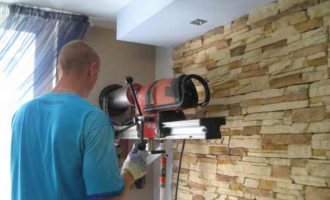
Installation of such a ventilation system may well be done, including with your own hands. To do this, you need to create a hole for the exhaust valve in the upper part of the wall. A suitable size hole in the frame can be made with a drill and a drill. The size and shape of the hole must match the parameters of the fan. To fix the device on the wall, dowels-spacers are used.
All cracks must be filled with foam. After preparing the ventilation hole on the inner wall of the house, you need to install an exhaust valve, on the outside - a decorative grille.To prevent freezing during the cold season, heat-insulating material can be laid around the coupling.
Exhaust through the wall to the street
Additional features
The sealed walls of the frame structure also need to be ventilated. For this, a "ventilation gap" is made. This is a small gap between the outer skin and the layer of insulation (or wind protection, film is often used).


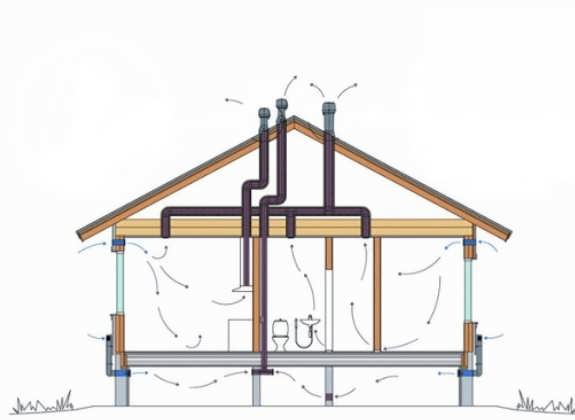


To leave the necessary clearance, a bar is nailed to the top of the insulating layer. Vertical slats or outer skin can be attached to it.
Supply holes are made along the lower perimeter of the house, and an exit is arranged under the roof canopy. This ensures a constant movement of flows under the skin, which is beneficial for building materials.
Ventilation scheme
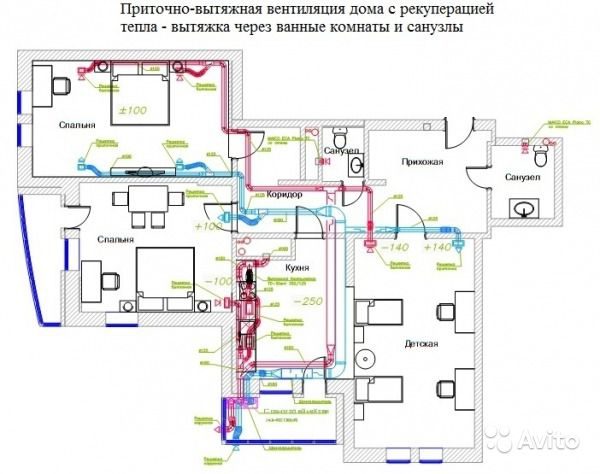
I plan to mount a ventilation system in a frame house with my own hands, a natural air exchange scheme is being developed at the construction stage. To do this, design brick or steel channels in the wall with access through the roof. The cross section of mines and chimneys is taken 270 mm by 140 mm, or 140 mm by 140 mm, depending on the room. If the mines are not made of brick, then the size can be changed while maintaining the cross-sectional area.
For the device of a mechanical ventilation system, the following stages of design and installation are carried out:
- calculation of air exchange for the house (according to the given standards);
- choice of system (supply and exhaust separately, supply and exhaust, through holes in the enclosing structures);
- drawing a diagram, where the location of equipment and the routing of air ducts are determined on the building plan;
- purchase of equipment and installation;
- System Setup.
An example building plan.
A feature of a frame house is that the free space between the columns and the crossbars of the frame allows you to place some of the elements (lattices) there. We will design a ventilation scheme for a frame building for one family of three. From the equipment we will lay the supply unit and the exhaust fan in the attic.
We consider the air exchange at home (according to large values \u200b\u200bfrom the table):
- bedroom 1 - 40.0 m3 / h;
- bedroom 2 - 40.0 m3 / h;
- bathroom - 50.0 m3 / h;
- kitchen - 90.0 m3 / h;
- children - 30.0 m3 / h.
We carry out the extraction of the hood from the bathrooms and kitchens, and the supply to the living quarters.
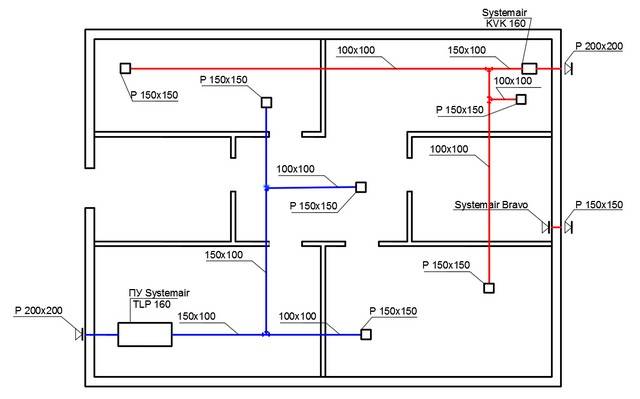
Scheme of laying air ducts.