- Ventilation system test
- The main reasons for the deterioration of draft in the ventilation system
- System Performance Calculation
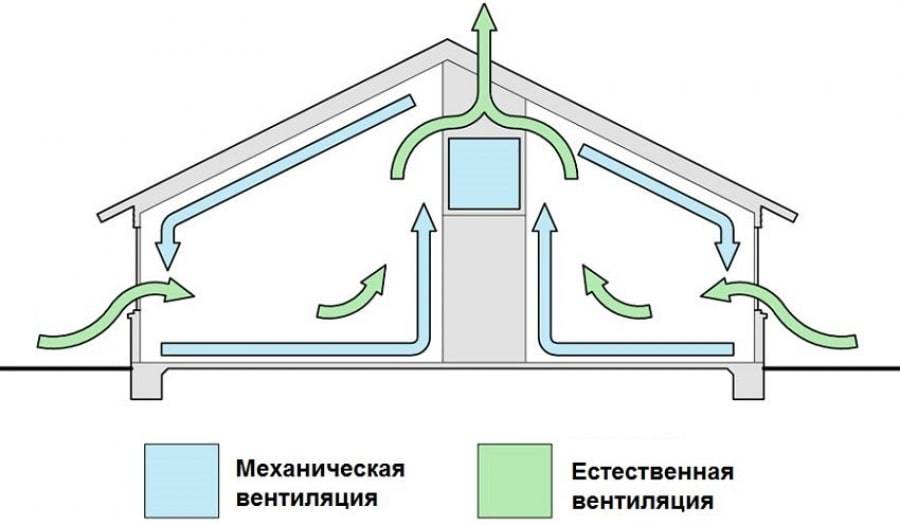
- Warm attic ventilation
- How to create a ventilation scheme in a private house with your own hands
- Devices for arranging forced ventilation
- The main and cheapest is natural ventilation.
- Types of cottage ventilation
- Do-it-yourself ventilation device in a private house
- Step #1 Calculations
- Step #2 Natural Ventilation: Improving Parameters
- Step number 3 Supply and exhaust ventilation systems
- Step number 4 Do-it-yourself ventilation in a private house scheme
- Ventilation system in the boiler room of a private house
- Arrangement of a mechanical ventilation system
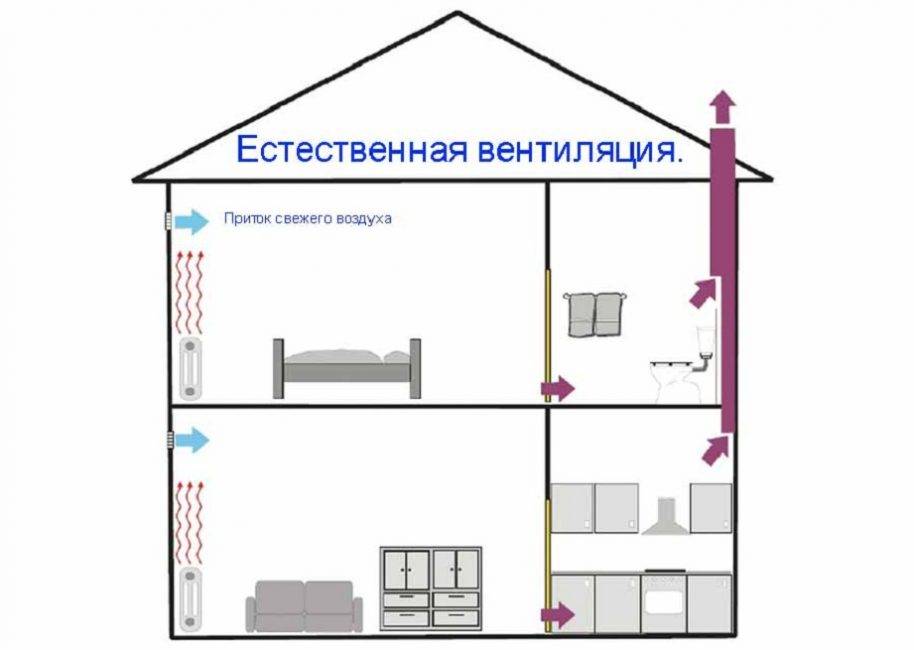
- Natural ventilation of a two-story house
- Calculation of the main parameters of the ventilation system
- Types of natural ventilation
- Conclusions and useful video on the topic
Ventilation system test
The measurement of the quantitative characteristics of thrust is carried out using a device for measuring wind force. Its impeller must be placed inside the ventilation duct and this indicator must be determined on a scale.Knowing the size of the pipeline cross section, it is easy to calculate the performance of the system, that is, its sufficiency to provide the required amount of air in the room for normal combustion in the boiler.
Boilers of closed combustion with coaxial chimneys stand apart. In them, air is supplied to the furnace directly from the atmosphere through pipes of a special design, and the room air does not participate in combustion.
The ventilation duct of the boiler room must not be connected to the general exhaust air lines. This will prevent the spread of gas throughout the house.
The main reasons for the deterioration of draft in the ventilation system
Among these should be noted:
- difficulties encountered with the flow of outside air into the boiler room after replacing traditional window blocks with double-glazed windows. Their tightness significantly reduces the possibility of air penetration;
- the same consequences after replacing the doors, if the gap between the floor and the lower edge is minimal or absent;
- a decrease in natural draft in the hot season due to a decrease in the temperature difference outside and inside the house;
- the appearance of stagnant zones or zones with low pressure during strong winds in the atmosphere, which also negatively affects the operation of ventilation systems, therefore, in such conditions, additional traction control is needed.
When operating the forced ventilation of the boiler room, it is necessary to select fans with an impeller that does not spark from impacts. For this, products made of aluminum alloys, copper or plastic are suitable.
The insufficiency of the ventilation system of a gas boiler house is dangerous not only for health, but also for human life. In addition, it reduces the efficiency of heating.Excessive ventilation leads to a violation of the thermal regime, worsening living conditions in the house. When starting to install ventilation with your own hands, try to get qualified advice from a specialist and take into account his comments.
System Performance Calculation
Calculation of the duct area
It is easier to calculate the diameter and length of air ducts using an online calculator. But you still need to know the principle of calculations in order to avoid errors.
All rooms in the house are conditionally divided into "dirty", requiring more intensive ventilation (kitchen, toilet, bathroom, laundry, etc.) and residential "clean". According to SNiP, the air in "dirty" rooms must be renewed at a rate of 60 cubic meters. m per hour. If there is a gas stove in the kitchen, the renewal rate is increased to 100 cubic meters. For bathrooms, this figure is slightly lower - 25 cubic meters. m, and for laundries it is 90 cubic meters. m per hour.
Forced ventilation is used in "dirty" rooms. To do this, the kitchen provides a separate channel made of galvanized steel, running vertically, without elbows. It is allowed to combine it only with the bathroom ventilation duct.
For "clean" rooms (living rooms and corridors), ventilation is reduced to 3 cubic meters. m per hour. For pantries, 0.5 cubic meters is enough. It remains to calculate how much air per hour is required to be removed from these rooms.
There is another way in which air exchange is calculated depending on the number of people living in the house. In this case, an influx of fresh air of about 30 cubic meters is considered the norm. m per hour per person. In the southern regions, it is better to increase this figure to 40. For the northern regions, where the air density is lower, 20 cubic meters will be enough. m. To the amount received (according to the number of residents), it is necessary to add another 30 cubic meters.m for the kitchen.
How to make flower pots with your own hands: outdoor, indoor, hanging | Step by Step Charts (120+ Original Photo Ideas & Videos)
Warm attic ventilation
In modern heating systems, natural circulation is practically not used. Attic ventilation above the attic is simply necessary for a comfortable stay indoors. Thus, rebuilding the attic into an attic, you need to make the roof ventilated. For flexible tiles and sheet metal, a ventilated area is created - a counter-rail is sewn onto the rafters. For metal roofs, it is better to use windproof films. Counter-battens for slate roofing are optional, as air must circulate freely from top to bottom.
The entrance is created in the binder, and the exit is in the ridge. The attic will be ventilated in the same way as other rooms. Air will enter through the windows (VTK valves can be installed), and exit through the ventilation openings. When they are absent in the walls, aerator fungi are installed in place of the hood on the roof (read: “Under-roof ventilation and its significance”).
How to create a ventilation scheme in a private house with your own hands
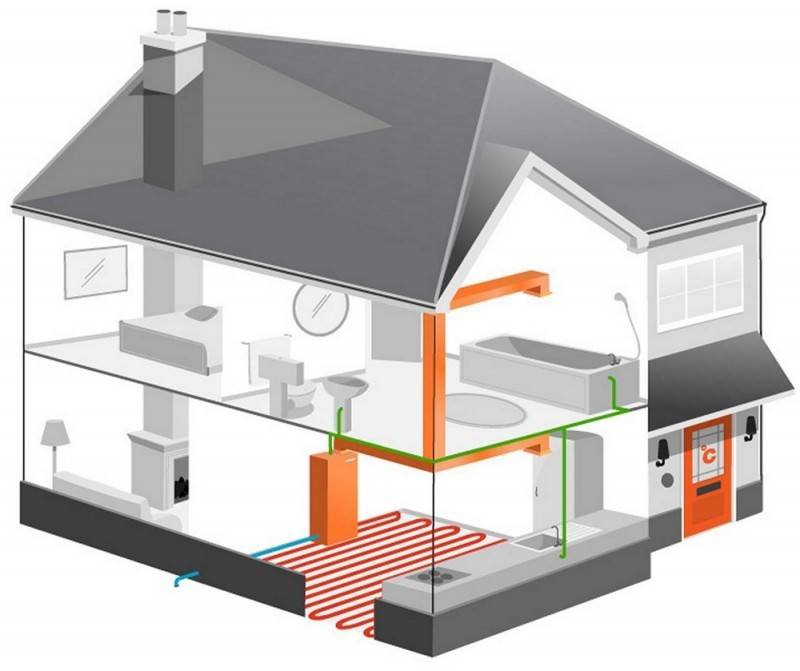
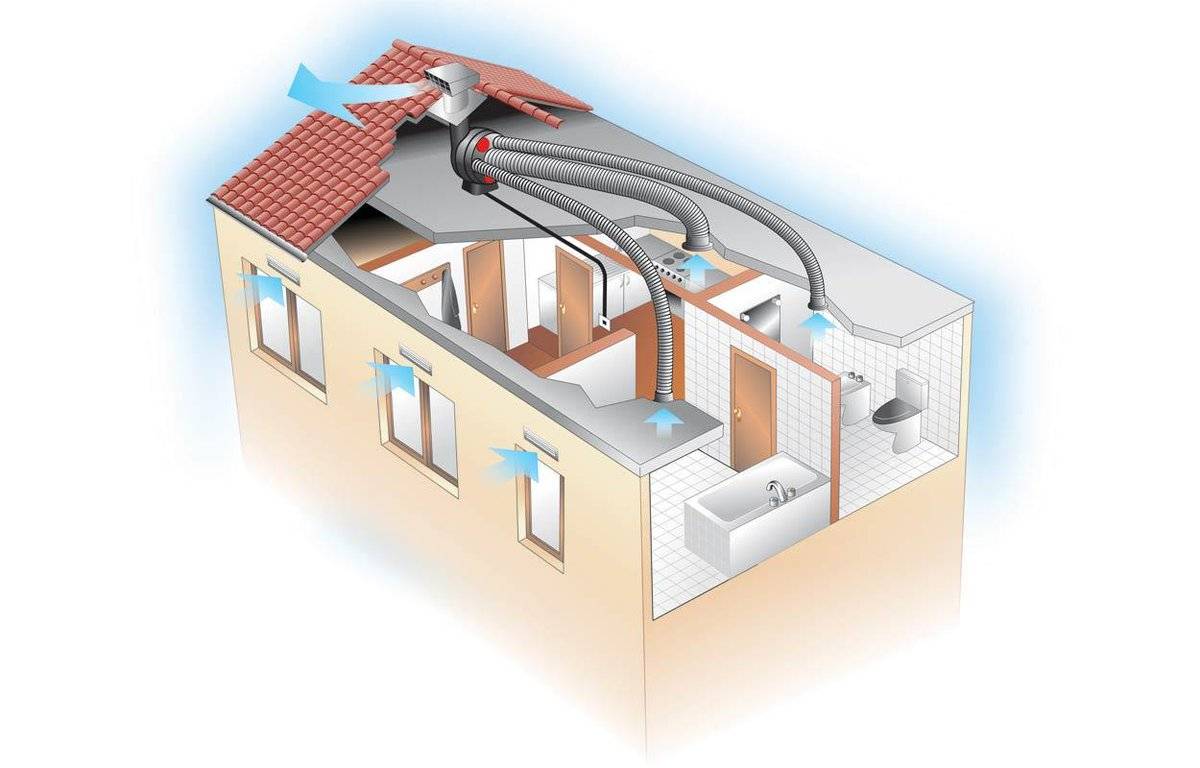
Modern houses, thanks to plastic windows, external and internal insulation, become quite airtight. On the one hand, this is good, but on the other hand, it makes it difficult for fresh air to enter the house, its ventilation is partially stopped or completely absent. To remedy the situation, the owner of the housing construction needs to draw up a ventilation scheme in a private house with his own hands, or contact specialists to organize a ventilation system in a private house, the scheme of which will be provided for by the project.
Ventilation deflector: types and characteristics of deflectors on the pipe (read more)
 The ventilation pipes of a private house can look very stylish.
Proper ventilation in a private house prevents the formation of condensation, the spread of mold and mildew, and creates a favorable microclimate for residents. Ventilation should be provided not only for living rooms, but also for utility rooms: bathrooms, kitchens, bathrooms, basements, boiler rooms. There are natural and forced ventilation in a private house. Some systems can be installed manually.
Devices for arranging forced ventilation
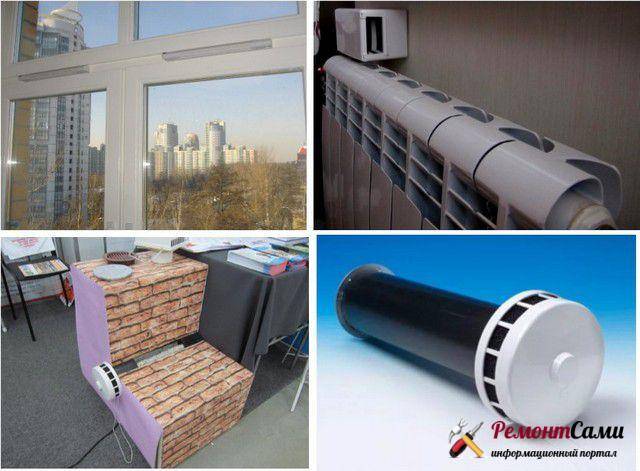
Standard supply natural ventilation valves do not always cope with air exchange
Additional supply valves are designed, they are introduced into the natural ventilation system. Valves are mounted:
- into through channels made in the walls;
- on plastic windows that have double-glazed windows in their design.
Among the advantages of ventilation devices that create natural ventilation, the following can be indicated:
- simplicity of design;
- hassle-free and fast installation;
- moderate price;
- autonomy from any source of energy supply.
However, during the summer period, especially often, certain conditions are created when natural ventilation ceases to fully function. But forced air pumping makes it possible to use high-quality filters that clean the incoming air flow. But in the winter, heating devices are used.
You can purchase any kind of ventilation device. They differ:
- by performance;
- by size;
- according to the additional systems available in the design.
Air handling units are offered even with such a design feature as the organization of centralized ventilation with the possibility of laying channels through the premises.
- Ventilators. These units do not have an automatic climate control function. As the user initially determined the mode of their operation, so they work.
- Airgivers. This type of ventilator is equipped with a system for automatically maintaining the initially set temperature for the air that is supplied.
- Breathers. The automation of this compact air handling unit is able to sensitively respond to temperature fluctuations in external conditions. Subsequent changes to the mode of operation of the device are made automatically. The breathers certainly have systems for both primary air filtration and more thorough cleaning.
Video: Do-it-yourself installation of supply ventilation valves in a private house:
The main and cheapest is natural ventilation.
The natural ventilation system in a country house has a number of advantages and significant disadvantages. The benefits include:
- Its cheapness. For its arrangement, you will need air ducts of the required length, in the right place.
- It practically does not require maintenance, that is, it was installed once and inspected once a quarter. If necessary, removed fat deposits and accumulated dust from the inner walls of the air ducts.
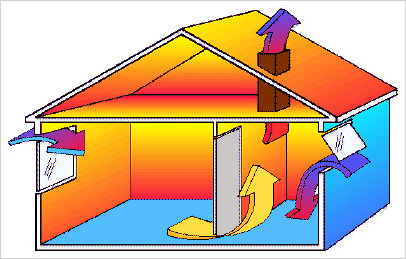
- For high-quality operation of the hood, air ducts of the appropriate length are needed, and if a country house has one floor, this is quite difficult to implement.
- In order for natural ventilation to work effectively, air masses must also enter the dwelling, and it is almost impossible to do this under conditions of complete sealing with plastic windows, insulation and various seals.
For owners of one-story, “hermetic” houses who decide to equip, it is best to pay attention to a combined ventilation system for the house, which involves the installation of supply or exhaust fans. How can this be done in practice?
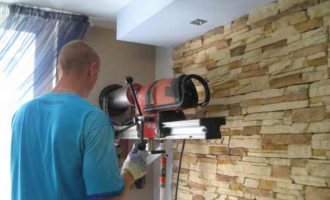
If the house is only in the process of construction, then the air ducts are laid simultaneously with the construction of the house. If during construction, the ventilation system was forgotten, then you will have to take and punch holes in the ceiling of the kitchen, toilet and bathroom, and then install air ducts in them
Important! They must be the correct height.
The simplest solution is to make exhaust ventilation in a private house, for this you need to install exhaust fans in the ventilation holes.
Important! They must be of the appropriate height. The simplest solution is to make exhaust ventilation in a private house, for this you need to install exhaust fans in the ventilation holes. They will effectively extract air from the premises, even with weak draft due to the low height of the air ducts.
For air ducts, pipes of rectangular or round section, made of PVC or galvanized, are used. The incoming air flow will enter through natural openings in windows and doors.
They will effectively draw air from the premises, even with weak draft due to the low height of the air ducts.For air ducts, pipes of rectangular or round section, made of PVC or galvanized, are used. The incoming air flow will enter through natural openings in windows and doors.
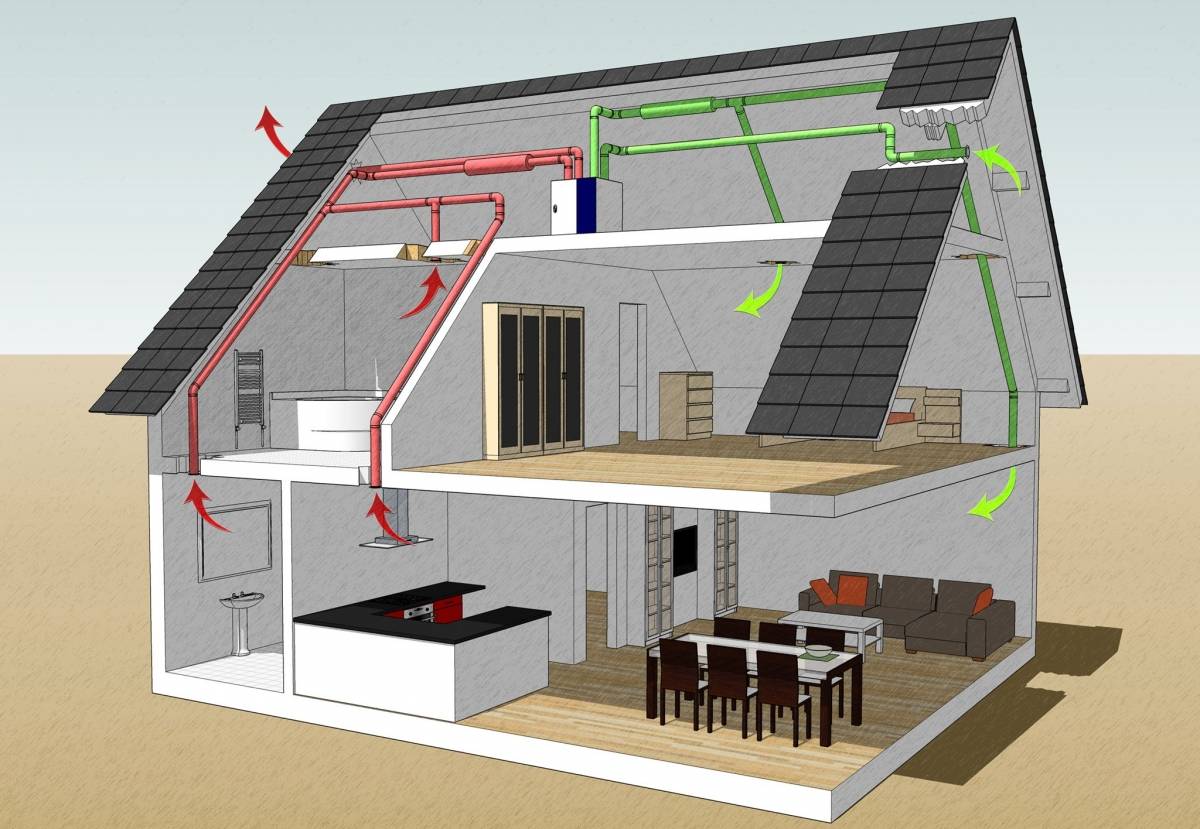
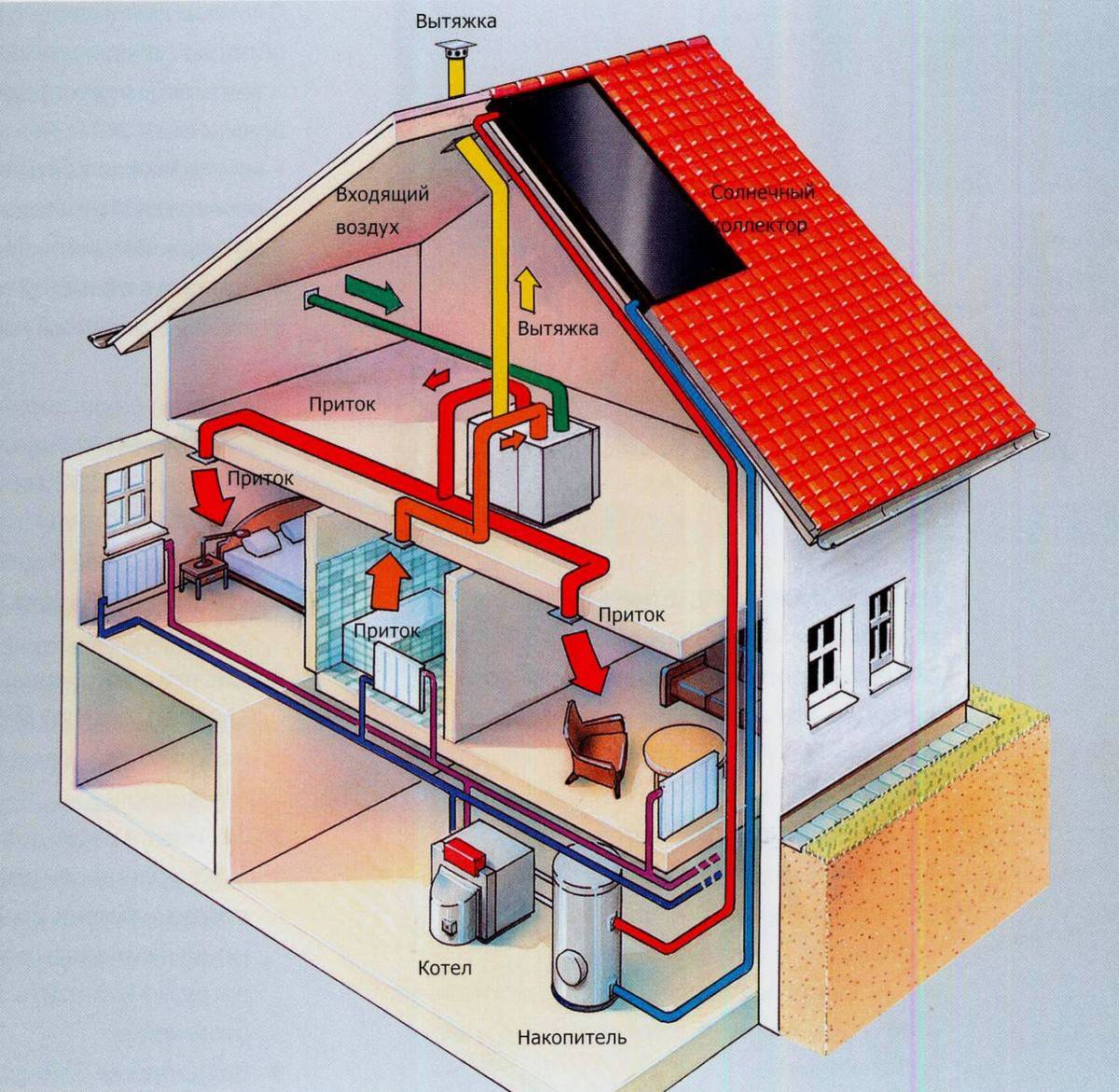
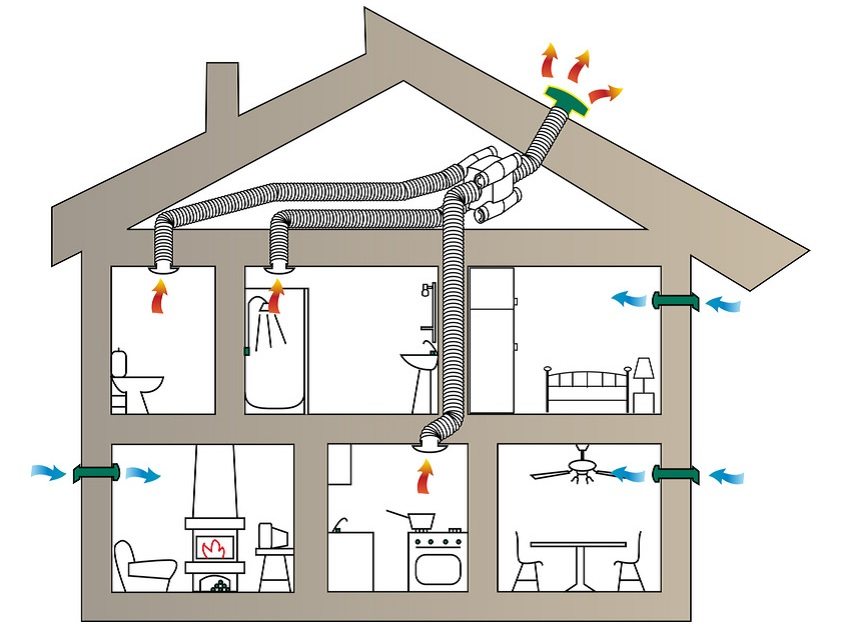
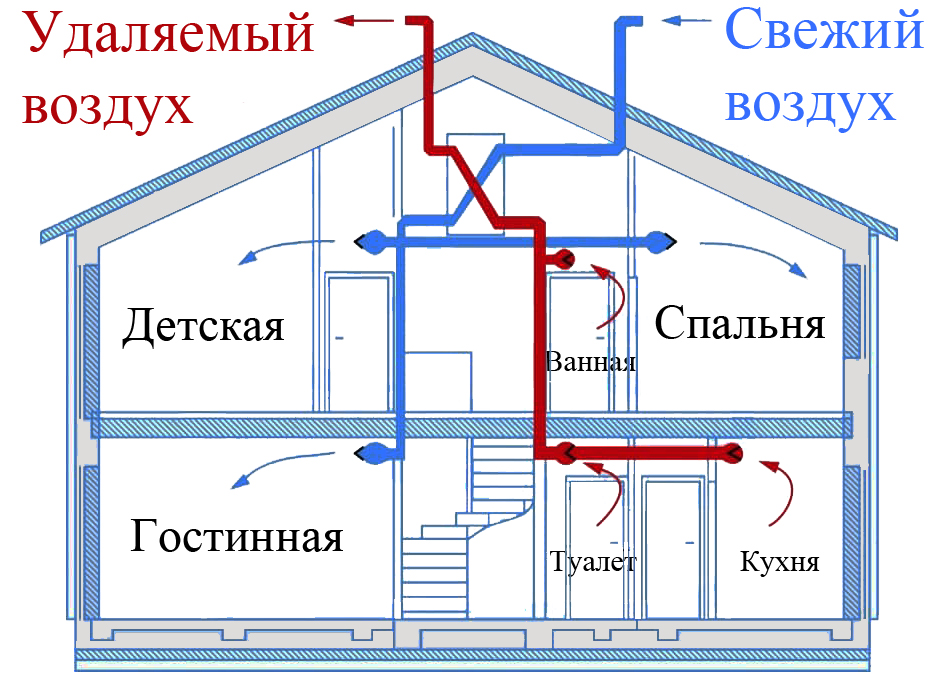
The simplest solution is to make exhaust ventilation in a private house, for this you need to install exhaust fans in the ventilation holes. They will effectively draw air from the premises, even with weak draft due to the low height of the air ducts. For air ducts, pipes of rectangular or round section, made of PVC or galvanized, are used. The incoming air flow will enter through natural openings in windows and doors.
Types of cottage ventilation
The natural type of ventilation saves electricity, but has some disadvantages. To ensure proper air exchange, it is necessary to prepare an outflow system in the form of ventilation ducts. The draft level is achieved only by the appropriate length of these channels, so the option is suitable for two-story buildings and more.
For one-story houses, it is recommended to choose a combined type of ventilation. In this case, fans are mounted at the entrance of the shafts - the air flow remains natural, and the exhaust fan works.
For uniform inflow and outflow of air masses, it is important to choose the right fan power relative to the area of the premises.
Forced ventilation is used if the previous options are ineffective. Filters, fans, valves, coolers and heaters are used to equip the duct network system. The system can work automatically according to pre-set parameters.

Ventilation duct outlets
Do-it-yourself ventilation device in a private house
Step #1 Calculations
To find out the power of the system, a parameter such as air exchange is calculated. It is calculated for each room separately according to the formula:
P \u003d VxK, where
V - the volume of the room (cubic meters), is calculated by multiplying the width, length and height of the room;
K - approved by SNiP 41-01-2003 norms for the minimum air exchange in the premises (cubic m / h). For residential areas - 30, separate sanitary rooms - 25, combined - 50, kitchens - 60-90.
Also, in the calculations of the ventilation system of a private house, other indicators are taken into account:
- The number of people permanently in the house. One requires 30 cubic meters. m/h of air.
- The thickness of the walls of the premises.
- Number of household and computer equipment.
- Glazing area.
- The location of the building relative to the cardinal points.
- The presence (absence) of the prevailing wind in the area.
- The presence in the building of the pool. For him, it is recommended to carry out a separate system.
Step #2 Natural Ventilation: Improving Parameters
Natural ventilation in a private house does not always cope with its task of maintaining the specified temperature and humidity parameters. Then, it is desirable to “finish” the system.
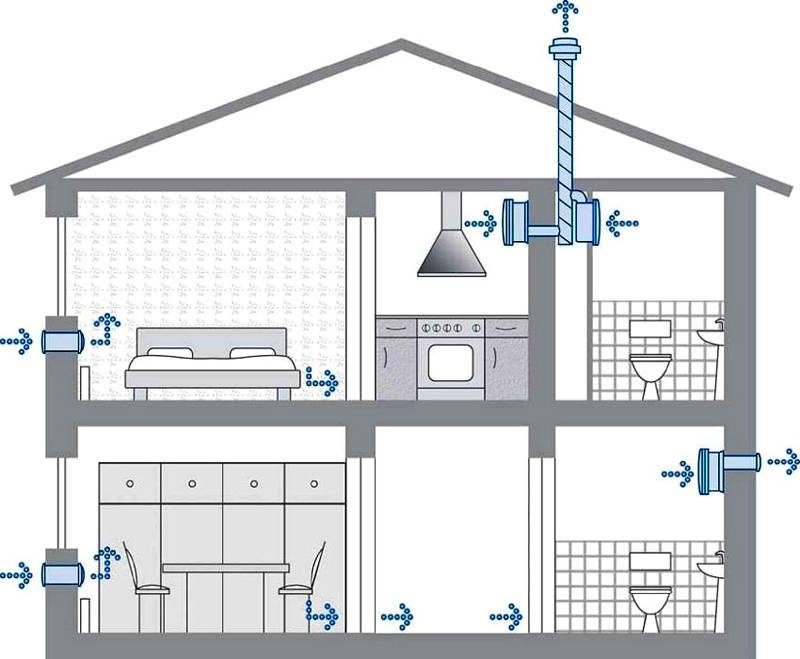
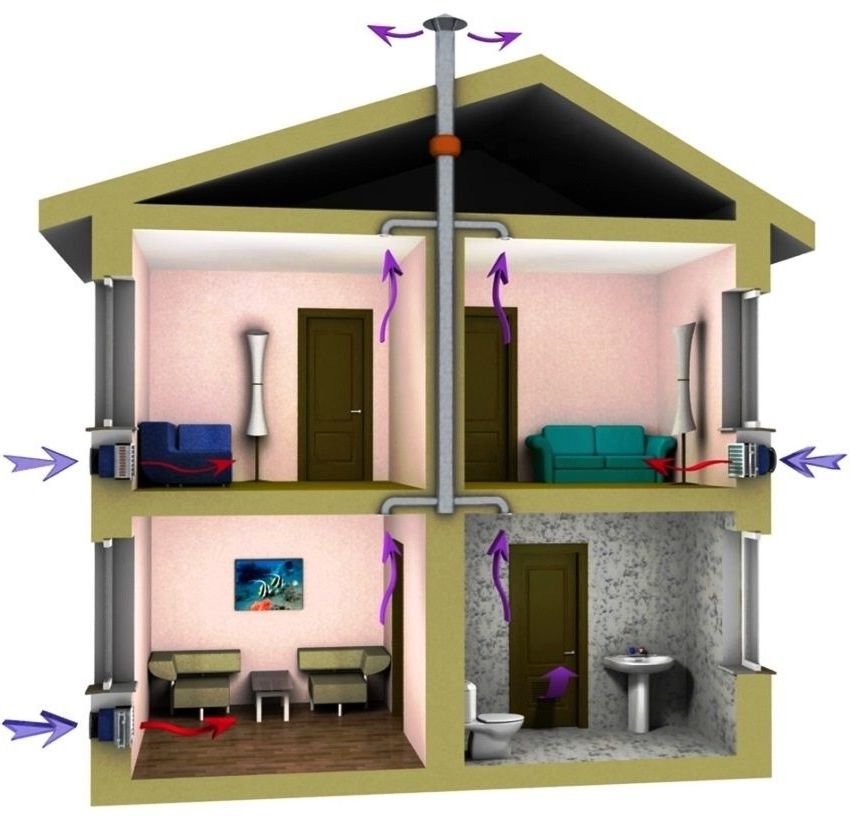
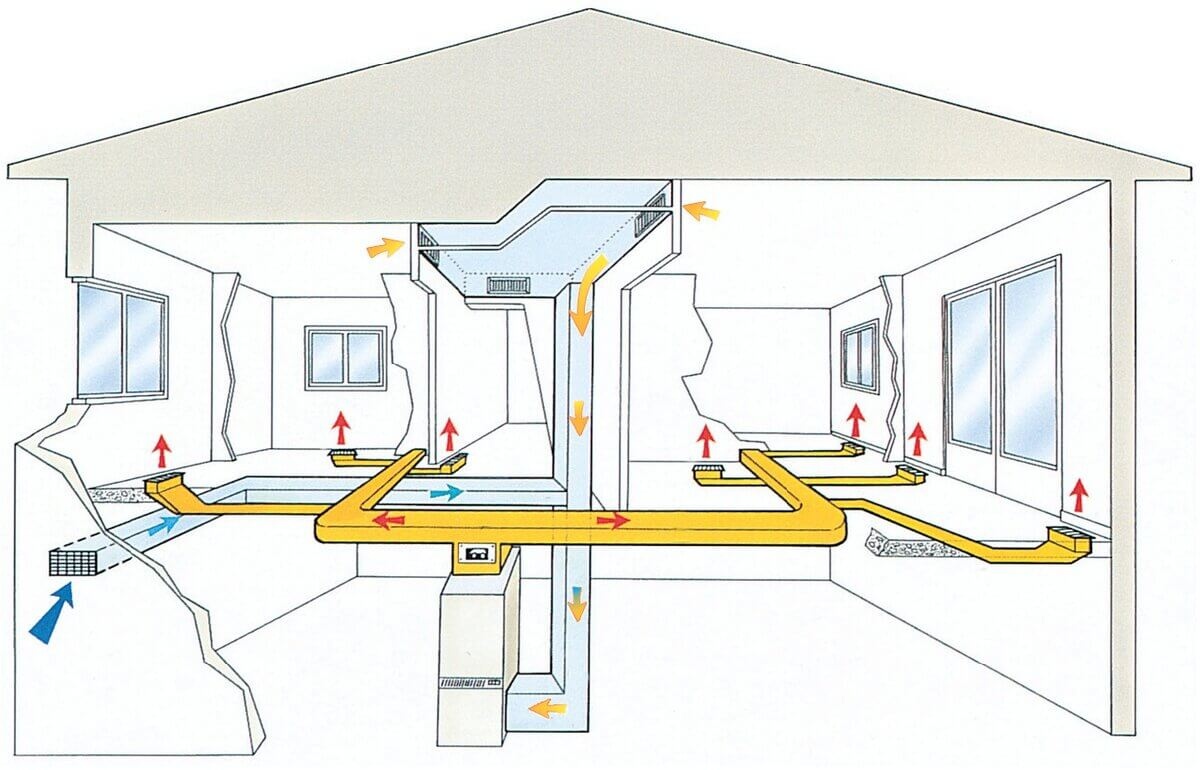
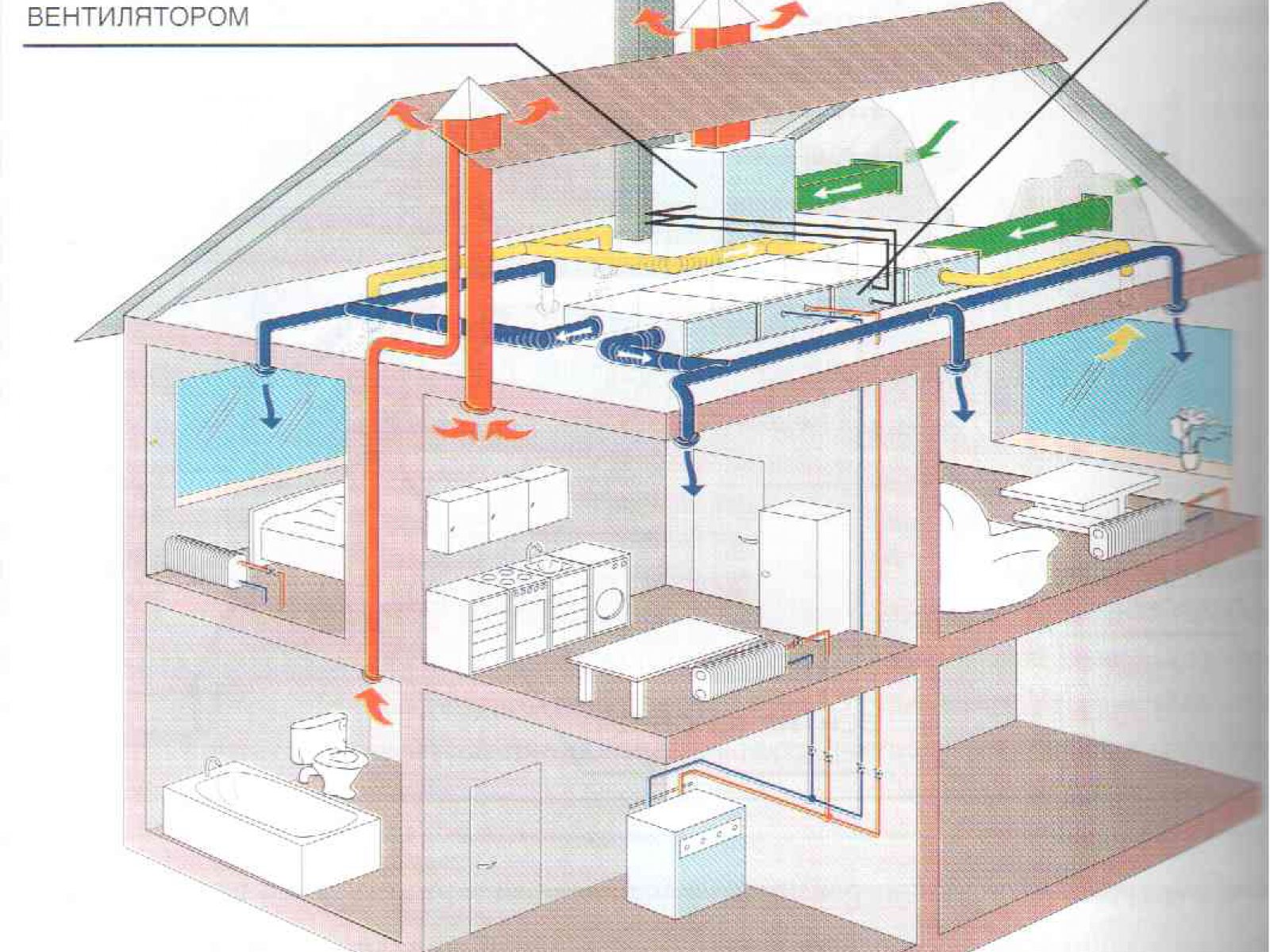
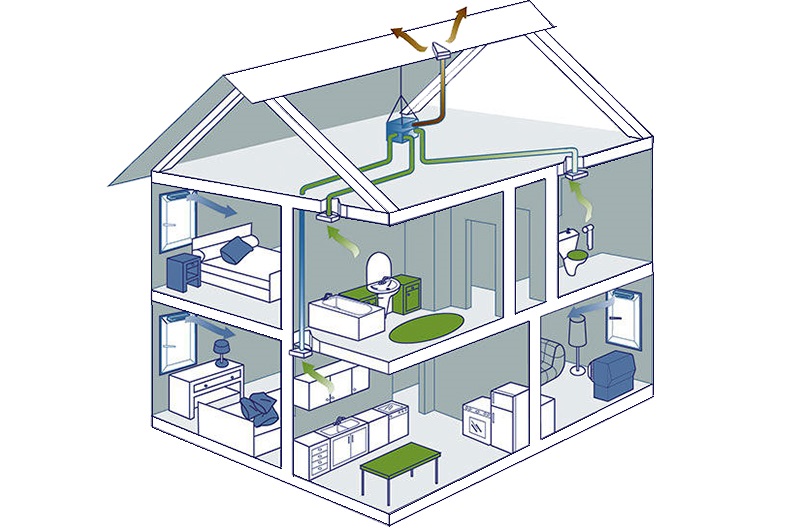
The principle of the ventilation system in a two-story private house
Window inlet valves will help with this. They will not depressurize the window, but will create an influx of fresh air. Their installation is elementary, following the instructions, even a completely ignorant person can handle it. The principle is that an elongated device (350 mm) is mounted on the upper part of the sash. From this place, a regular seal is cut off and installed from the delivery set (narrower).
A few more devices that improve air circulation. In order not to block the flow of air, ventilation grilles are installed on all interior doors. It is impossible to “block” with a window sill that is too wide the process of mixing the cold air of the window and the warm radiator.
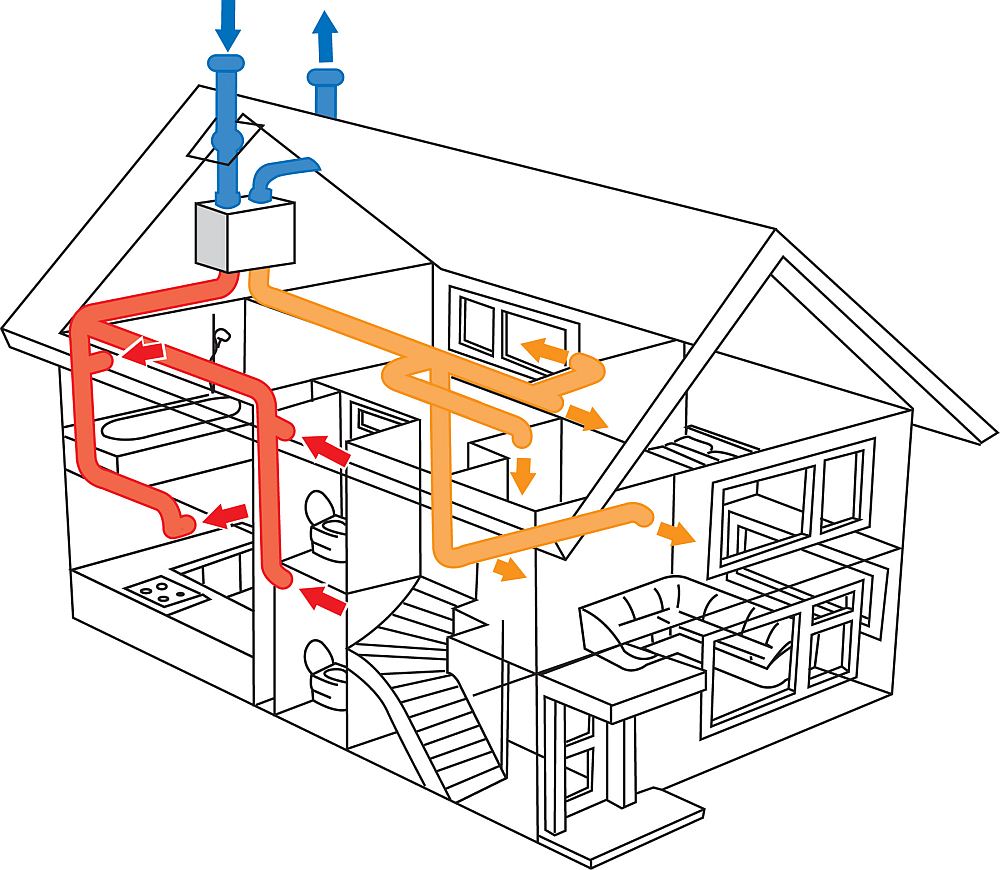
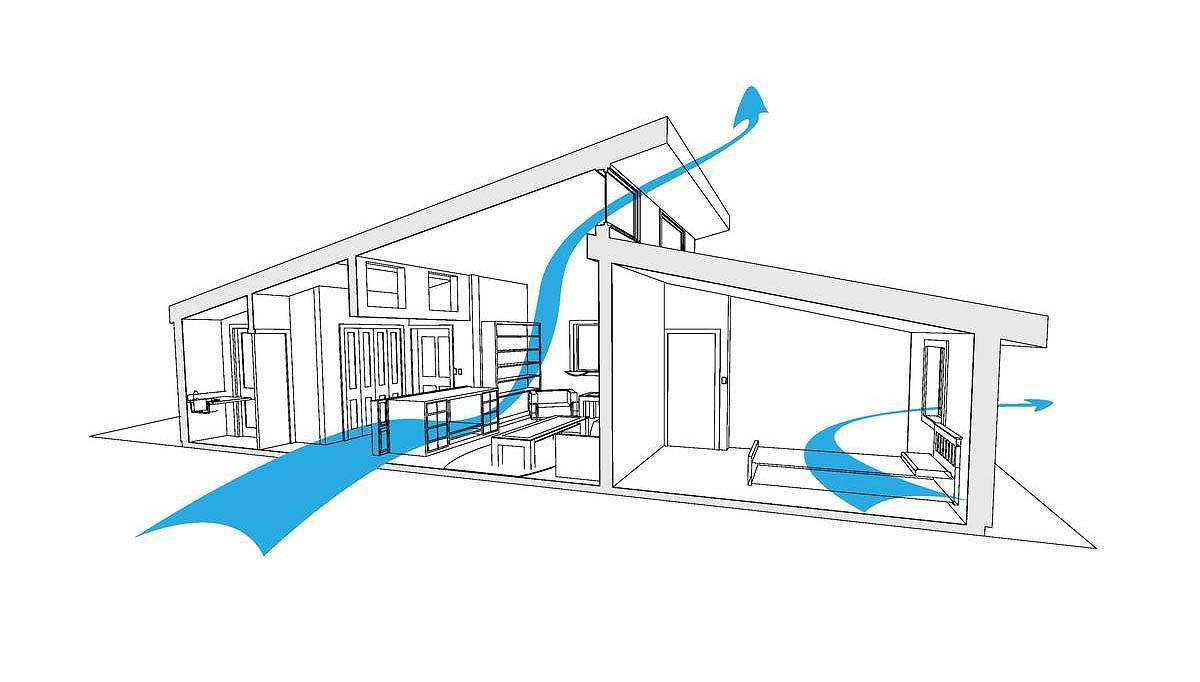

If during the construction of the house a natural ventilation system is designed, then the following nuances should be taken into account: the house should not have rooms without windows; a guarantee of good ventilation - the windows overlook all sides of the building (deaf walls are excluded).
Step number 3 Supply and exhaust ventilation systems
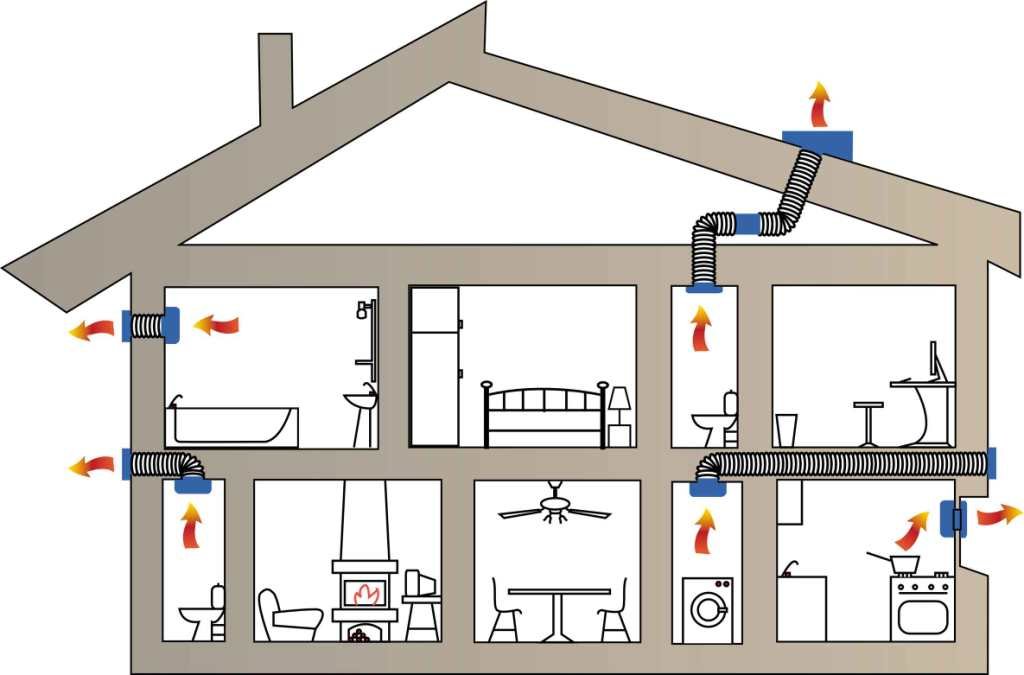
The supply ventilation device in a private house is solved using a wall ventilator. It is a telescopic or flexible tube, on one side (outer) of which there is a decorative grill with a mosquito net (from midges and mosquitoes), on the other (inner) - a fan, a filter.
Recuperator for ventilation system
Supply ventilation in a private house, mounted in the wall in this way:
- Using the appropriate equipment, a hole of the required diameter is punched.
- A pipe with a heater is inserted into it.
- The device itself is mounted on the adhesive solution, consisting of a fan, a filter, some models are equipped with an ionizer.
- Connection to the electrical network.
- From the side of the street, a decorative cover is installed that protects against rain and snow from getting inside, from the inside - a decorative grille.
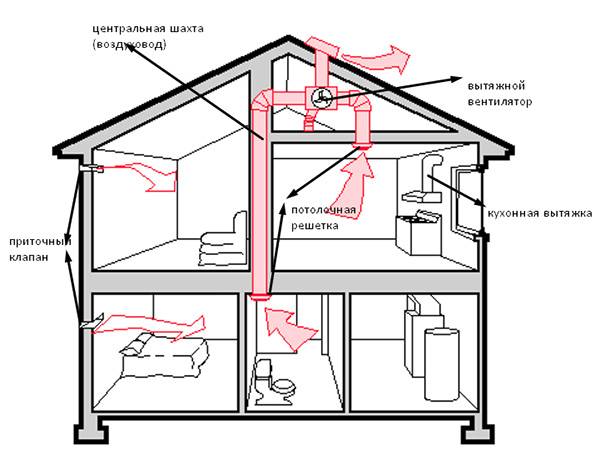
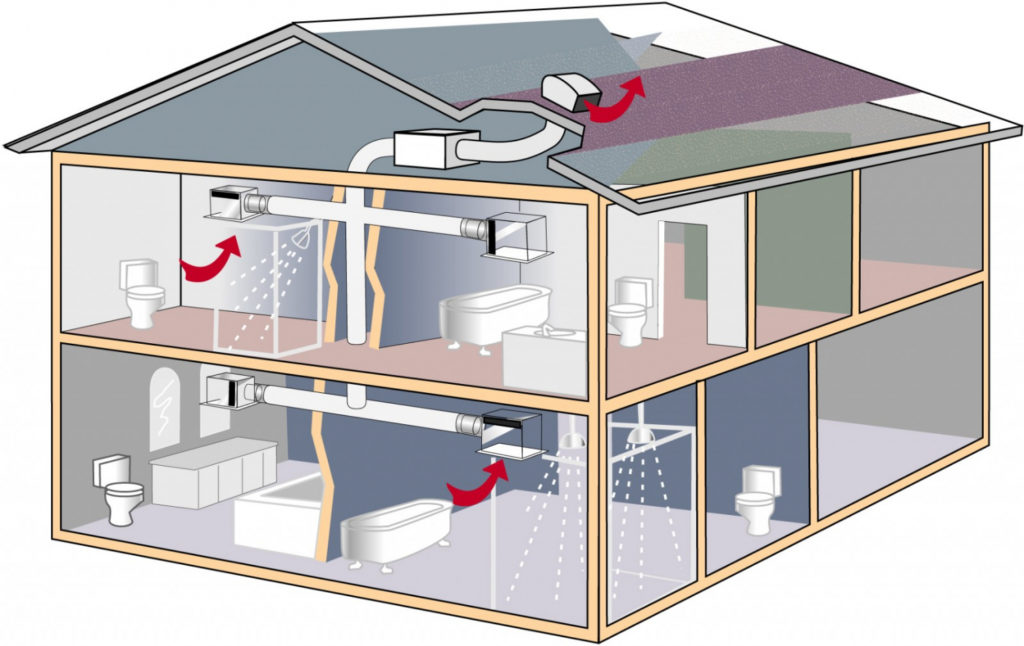
The exhaust ventilation scheme in a private house, with a good natural inflow, may consist of fans mounted in the sanitary rooms, in the kitchen. The wall exhaust fan in the kitchen is installed similarly to the supply fan.In the sanitary room, either axial or channel is mounted in the ventilation duct.
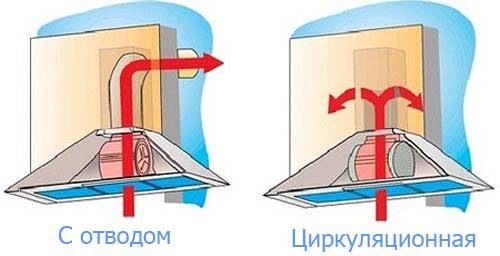
The hood in the kitchen above the stove will also be an additional exhaust duct. If the exhaust ventilation works more intensively than the supply, then the house will suffocate.
Step number 4 Do-it-yourself ventilation in a private house scheme
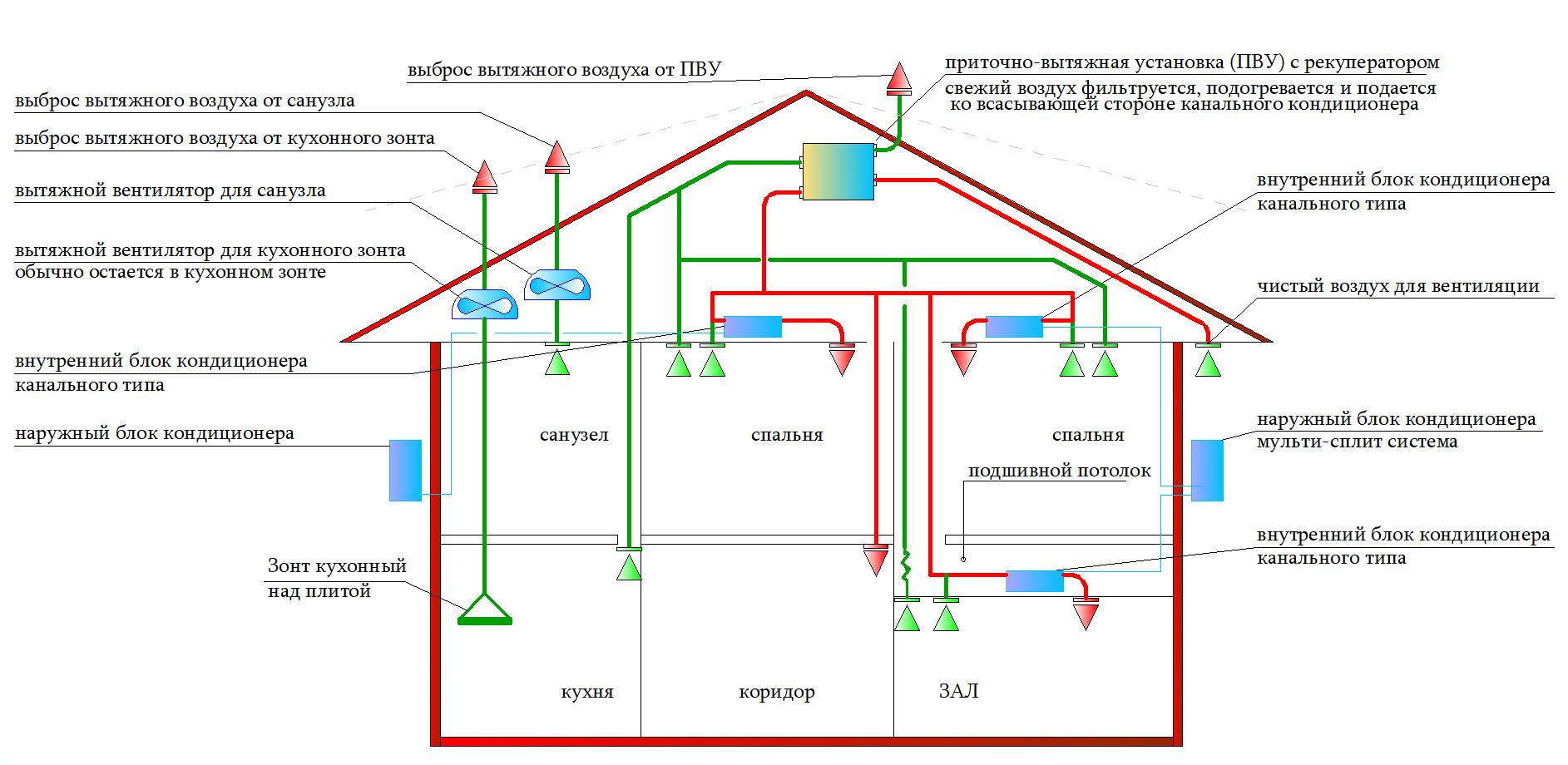
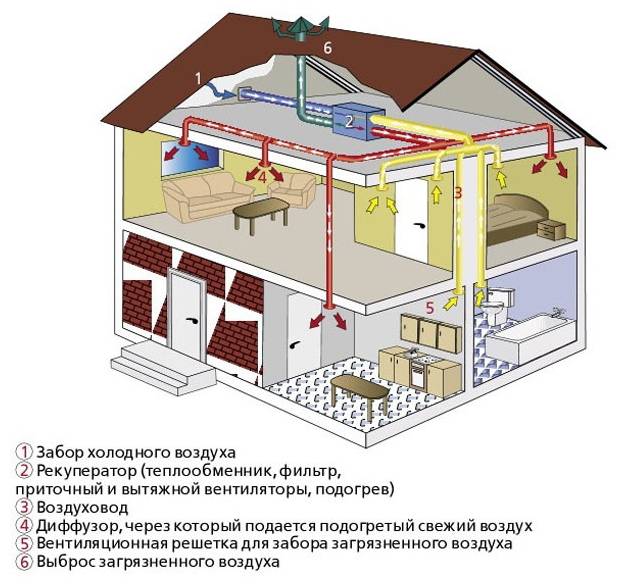
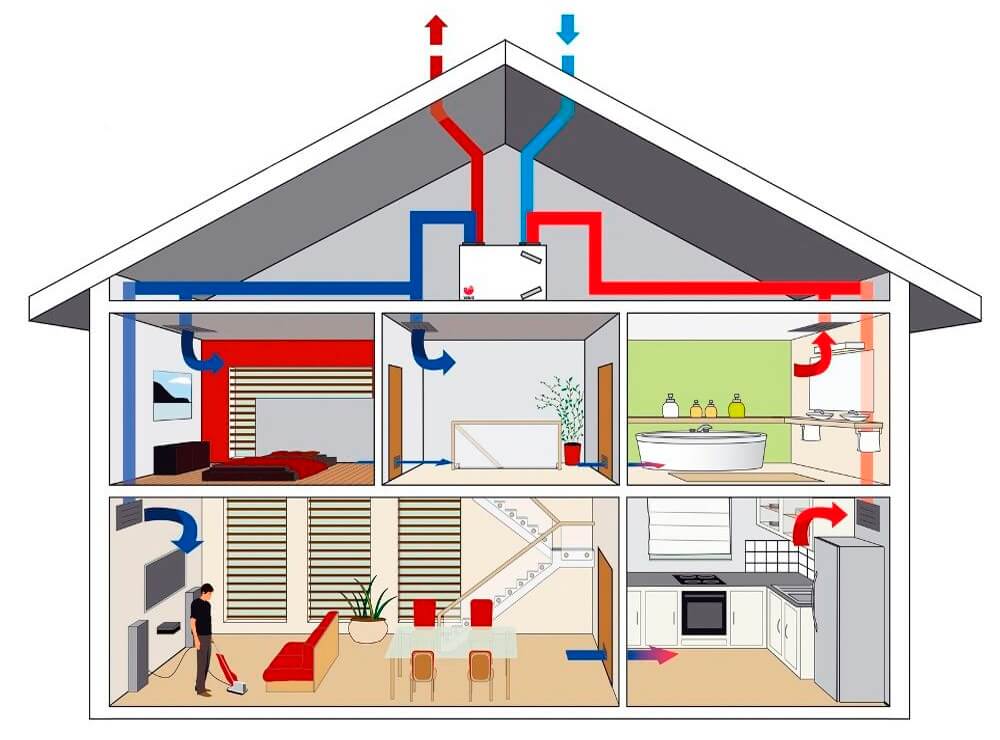
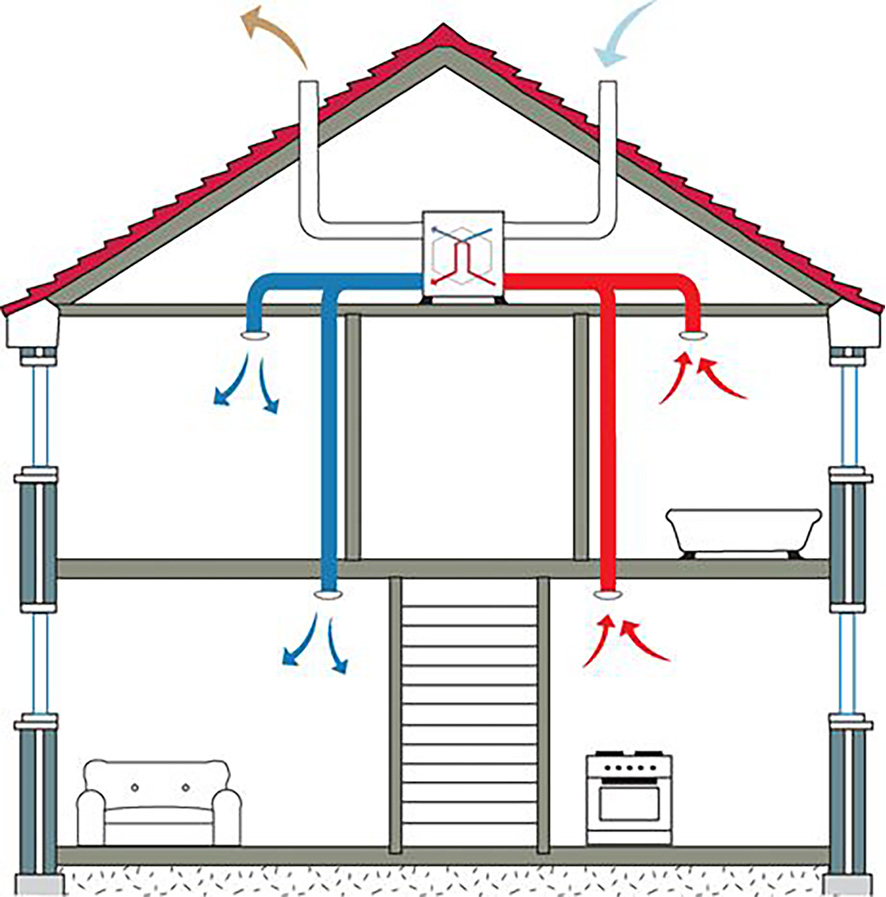
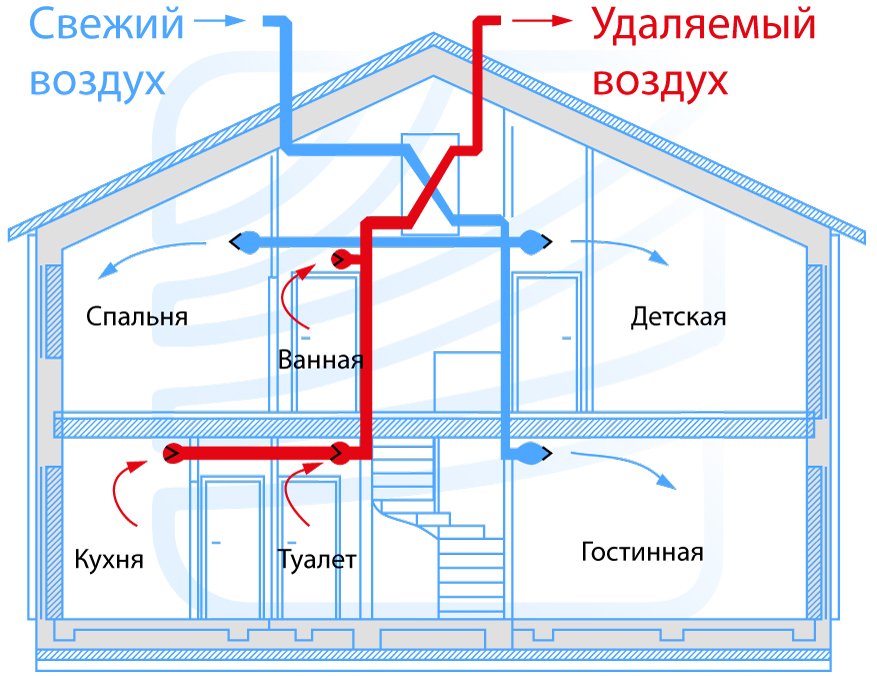
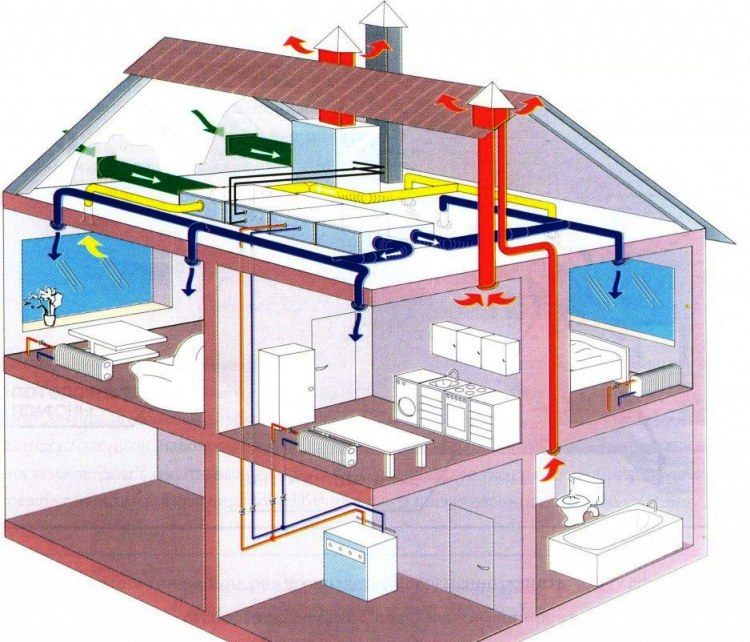
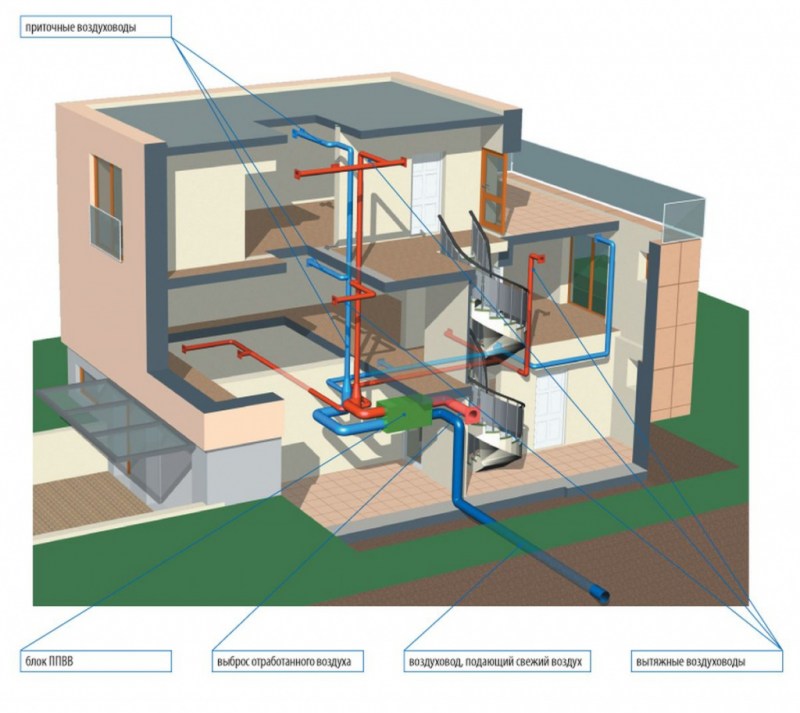
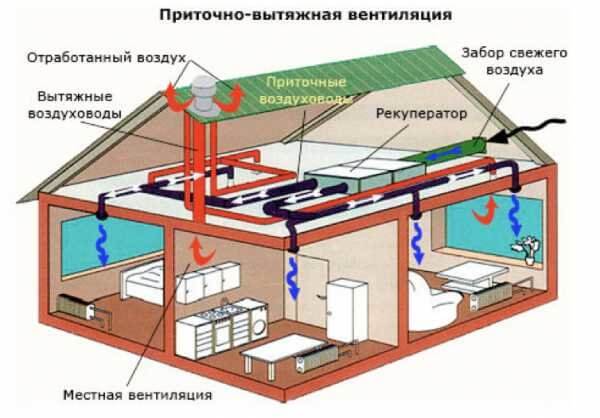
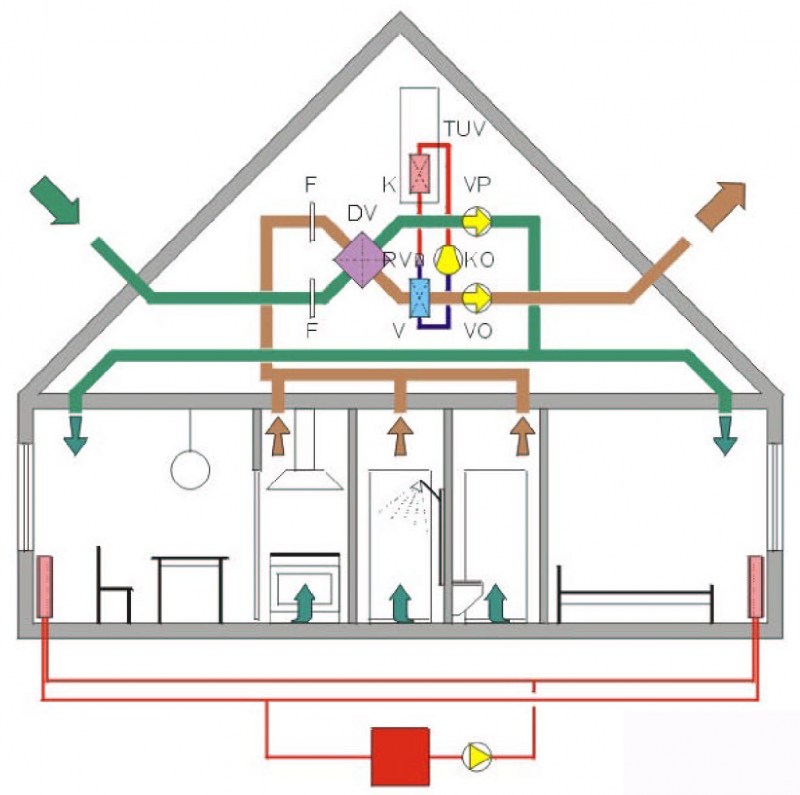
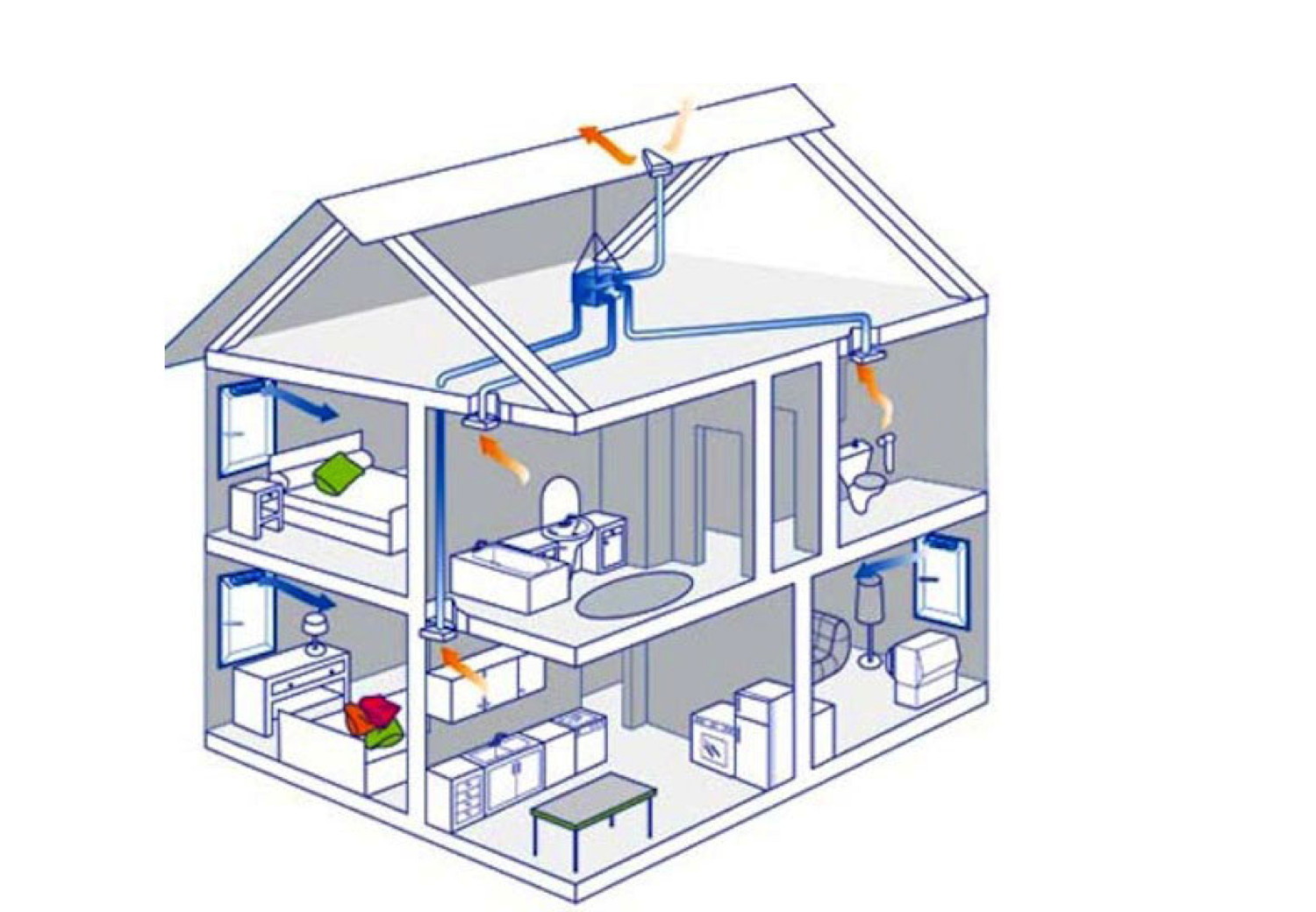
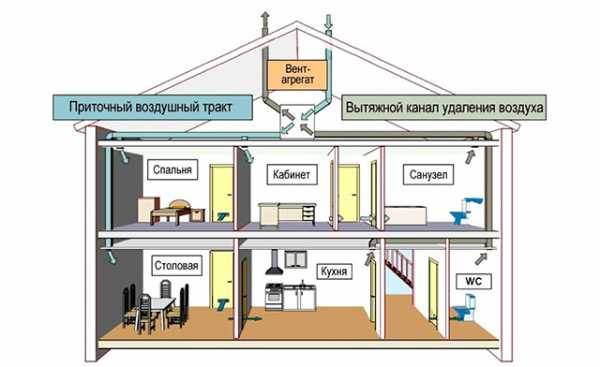
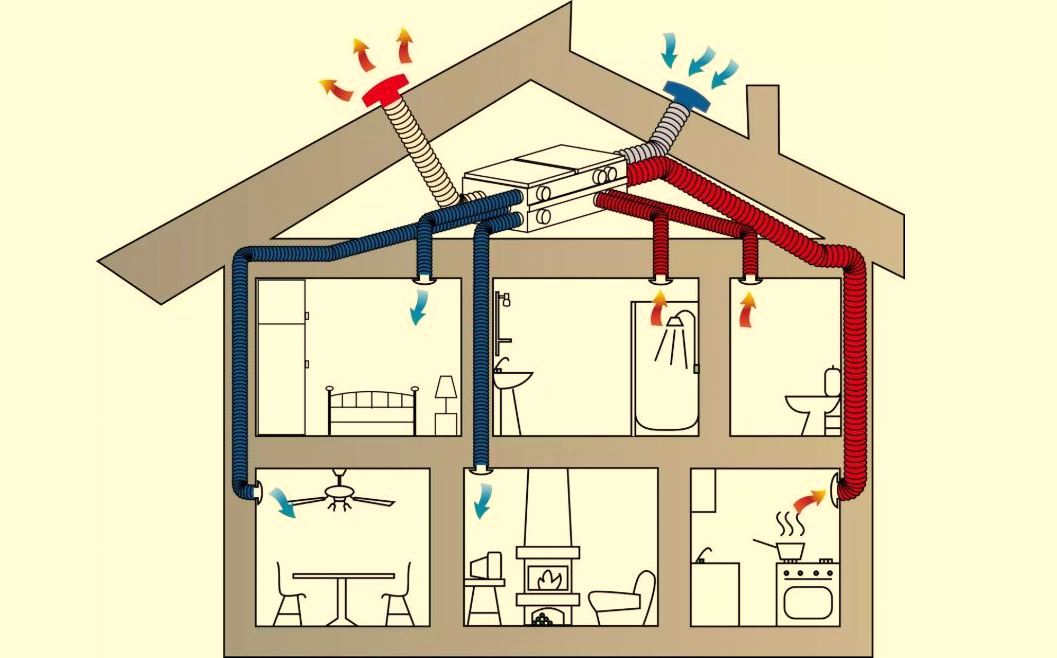
The most optimal ventilation option for a private house is supply and exhaust with mechanical stimulation. Two types of its designs are used: type-setting and monoblock.
Energy saving ventilation duct
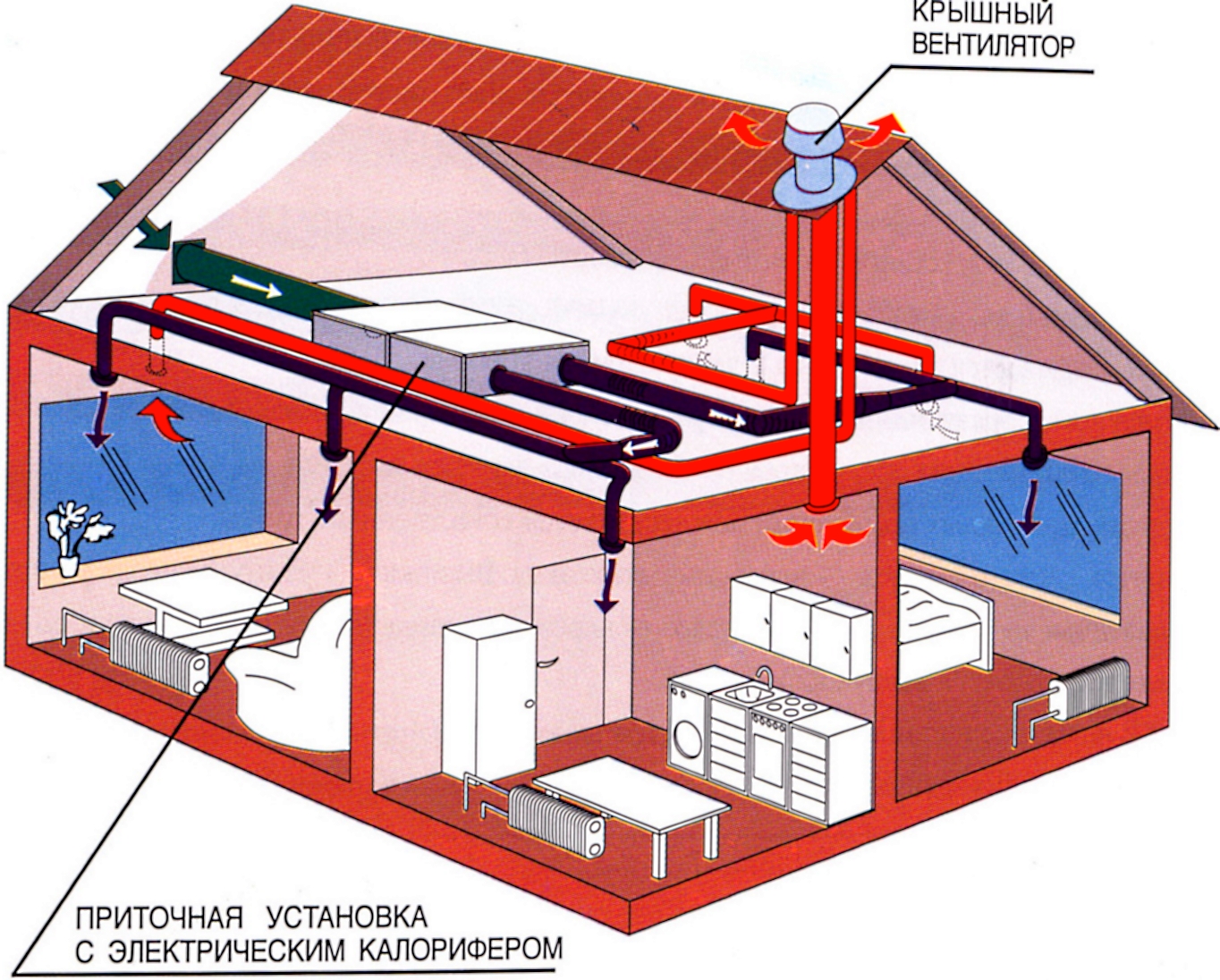
The ventilation scheme in a private house of a monoblock system looks something like this:
- air from the street, through the supply air duct, enters the heat exchanger;
- it is cleared of harmful impurities of the atmosphere;
- heated to the required temperature;
- further, through the air duct, it enters all the premises of the house;
- exhaust air through the exhaust pipeline enters the heat exchanger;
- gives off its heat to the incoming cold air;
- from the heat exchanger, through the exhaust pipe - to the atmosphere.
Ventilation system in the boiler room of a private house
When installing ventilation do it yourself in the boiler room, it is necessary to take into account the binding of ventilation elements to the location of the heating equipment. For the boiler room, it is possible to use natural or forced ventilation.
On a note! If a solid fuel boiler is installed in the boiler room of your house, it is recommended to install forced ventilation.
The location of the duct pipes in the boiler room can be vertical or horizontal. But at the same time, horizontal air ducts in the boiler room should not contain turning sections and be installed only in case of forced ventilation.For natural ventilation of the boiler room, the air duct pipe can be vertical and at least three meters long.
 Ventilation is the simplest way to naturally ventilate a room.
The optimal ventilation system in the boiler room is combined ventilation. If forced ventilation ceases to function in the boiler room, natural ventilation will partially replace it.
By providing your home with an efficient ventilation system, you will ensure long-term operation of the house structure and maintain your health.
Arrangement of a mechanical ventilation system
Mechanical ventilation is divided into:
- inlet;
- exhaust;
- supply and exhaust.
Forced ventilation involves the forced supply of air masses from the street into the room.
Such a ventilation system is installed in order to ensure the supply of fresh air to replace the exhaust air and includes:
- ventilation air intake;
- devices for bringing air masses to a comfortable temperature;
- filtration system;
— noise absorber;
- devices for supplying air to rooms.
The principle of operation of this system is that clean air brought to a certain temperature, entering the room with the help of a fan, displaces the exhaust air.
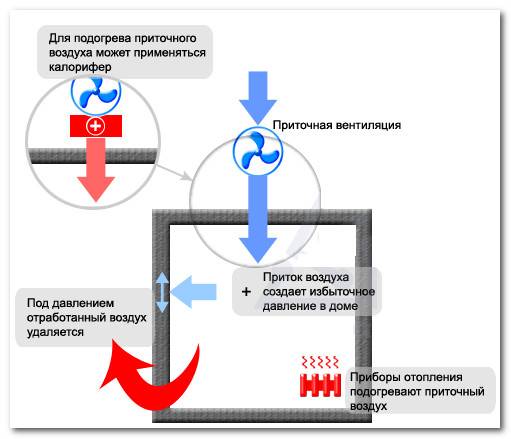
There are many schemes and ways to place forced ventilation. The most affordable is the organization of a ventilation system with an inflow in the hallway. This is due to the fact that the entrance hall is adjacent to almost all rooms. Due to this, the air coming from the street will be evenly distributed throughout the house.
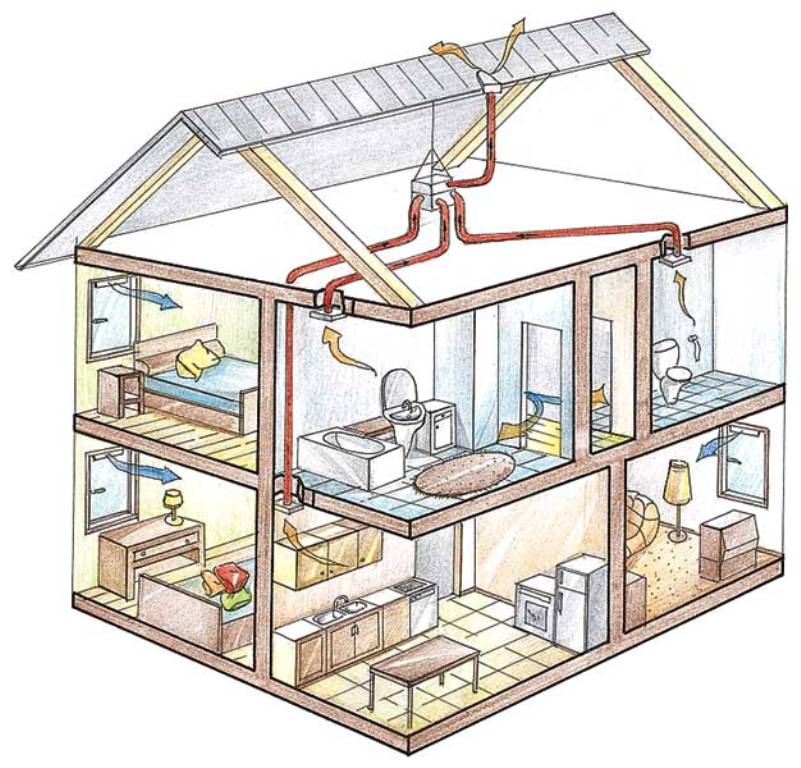
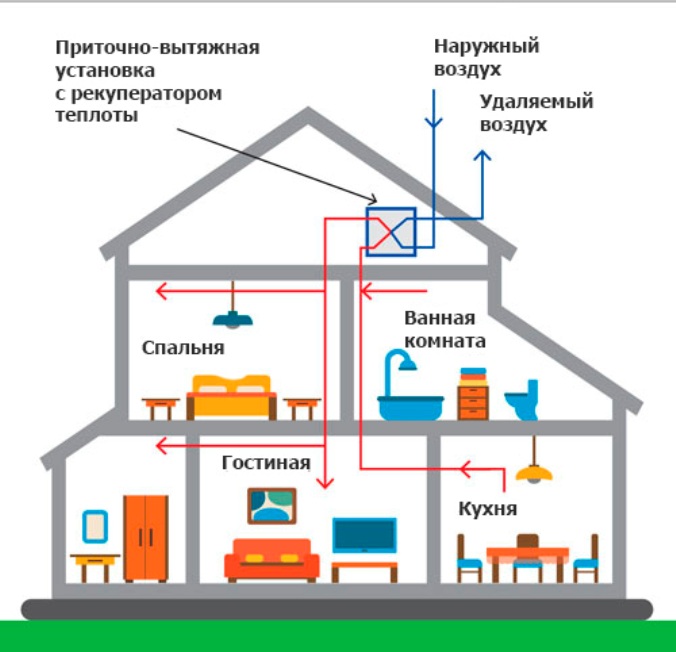
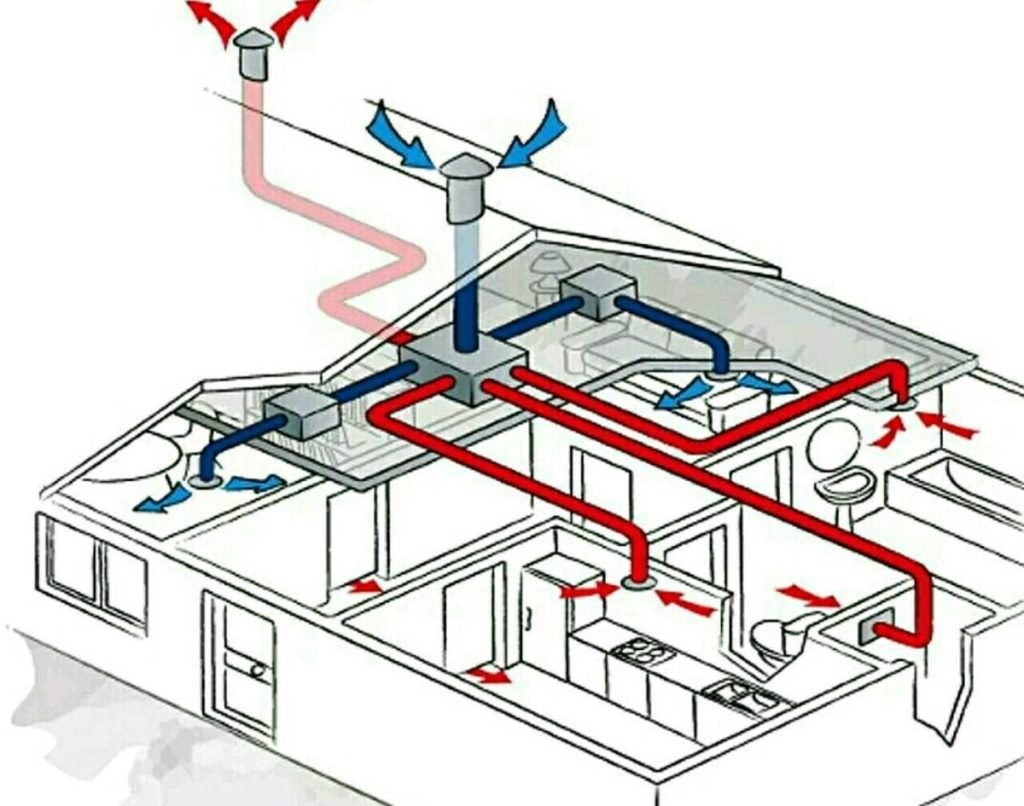
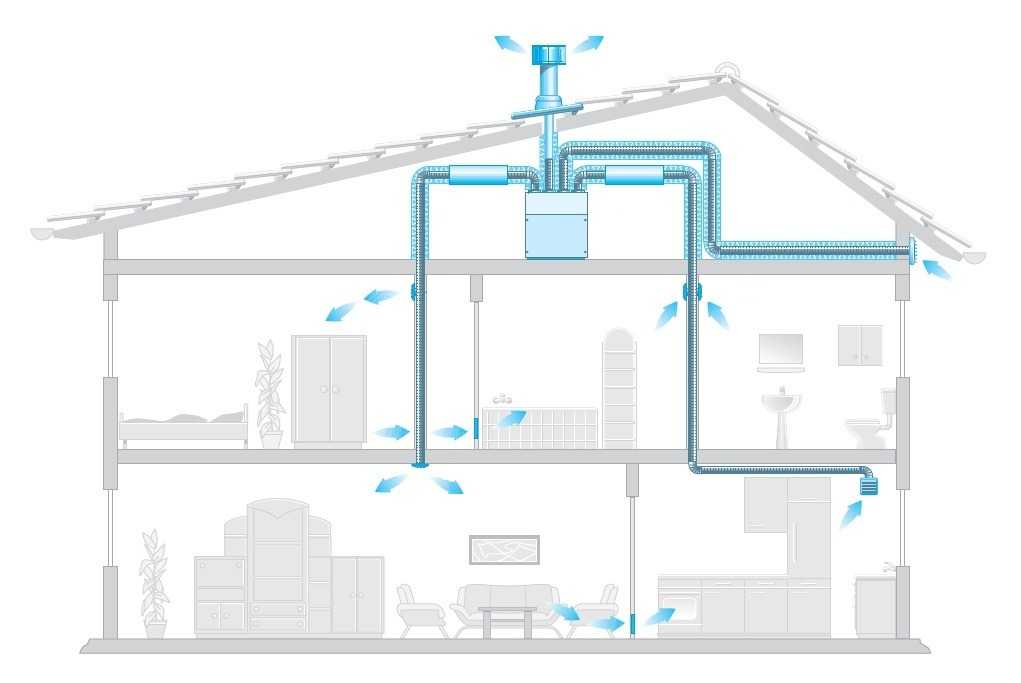
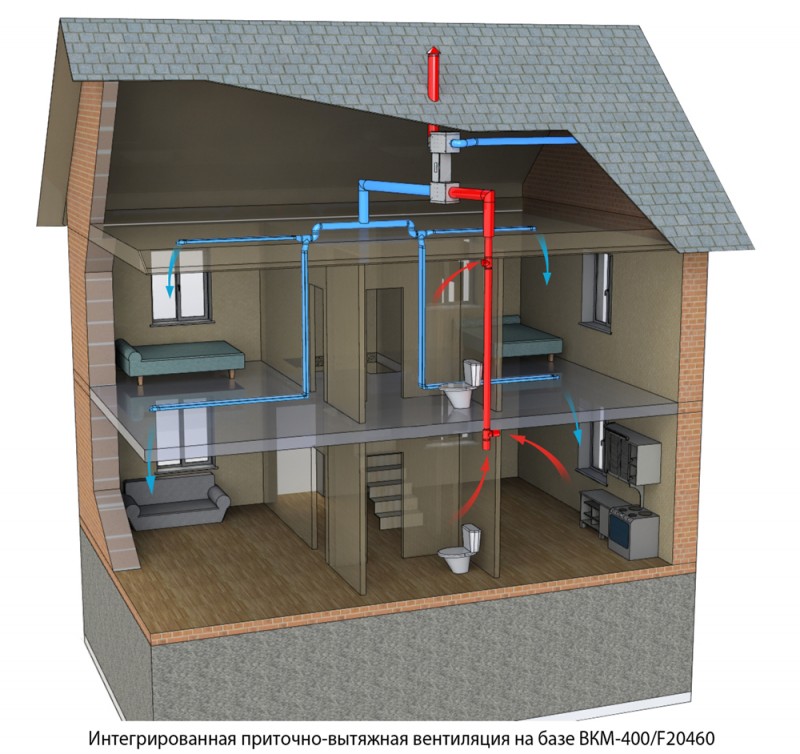
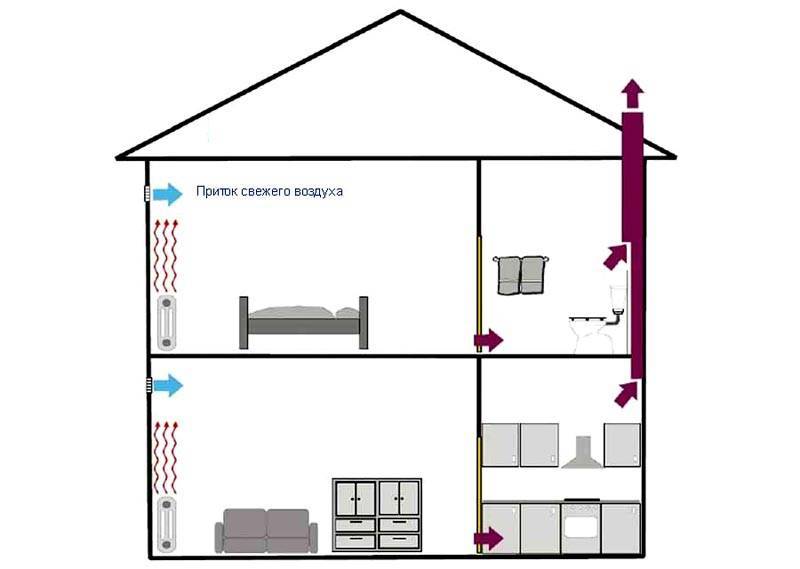
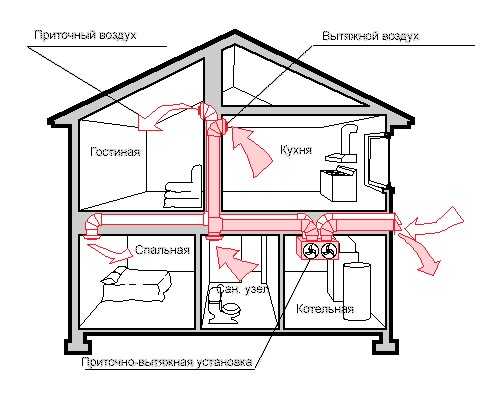
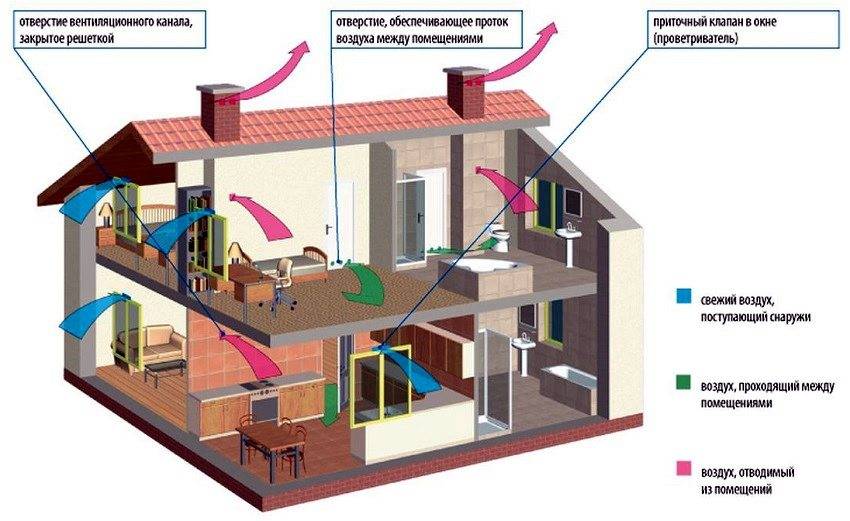
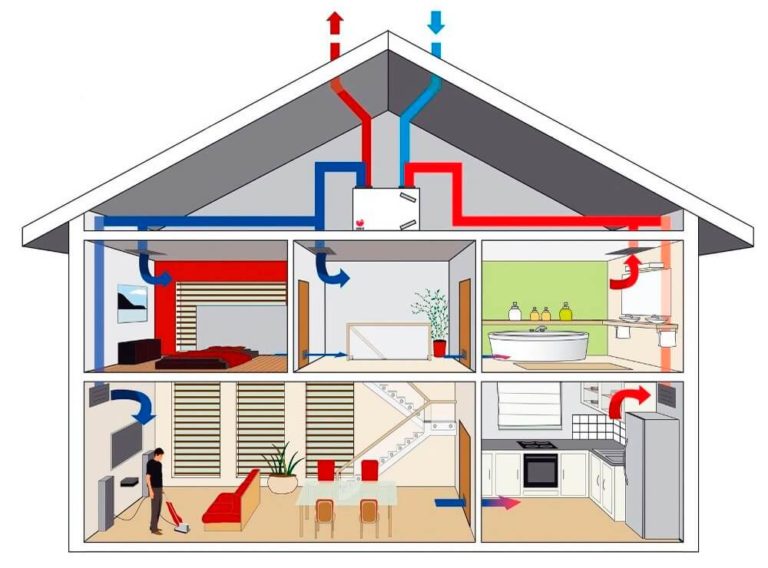
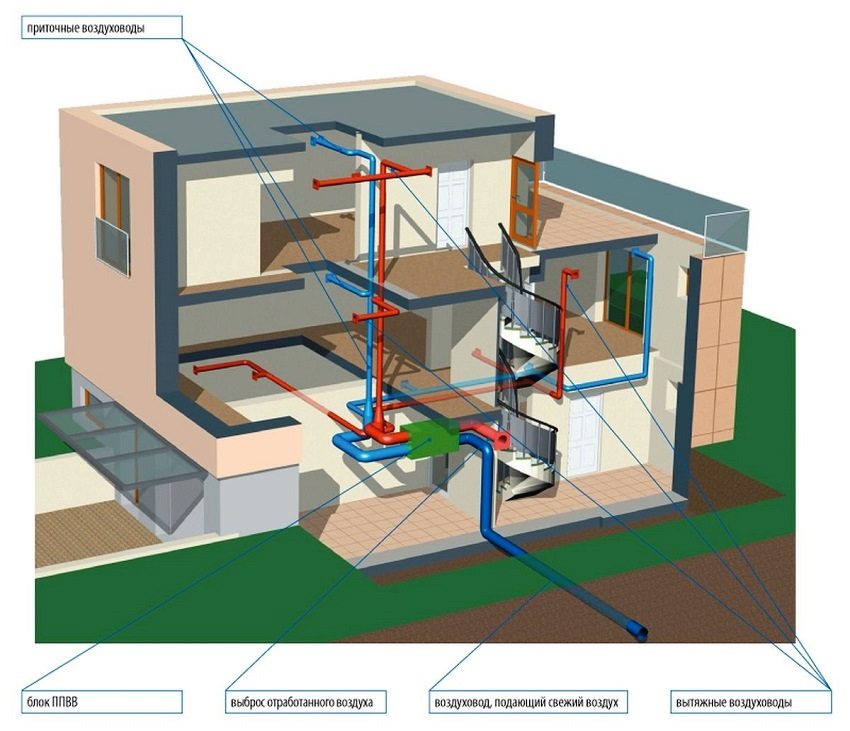
After determining the location of the device, it is necessary to calculate the amount of air required for the inflow.It is performed in the same way as for natural ventilation. Next, you need to select and install equipment. You can buy all elements of the system separately or purchase a ready-made installation that does not require assembly. Ready supply ventilation is a set of equipment for air treatment, located in an insulated monoblock. This device can be mounted to the ceiling or placed outside the building. Then the connection to the air ducts and electricity is made.
In order for the air to move freely through all rooms from the place of inflow to the exhaust, it is necessary to make overflow grilles in the interior doors. You can also leave a gap of about 2 cm when installing the door.
More and more homeowners are installing do-it-yourself supply and exhaust ventilation, equipped with a recovery function. The recuperator is an energy-saving heat exchanger in which the exhaust and supply masses exchange thermal energy without mixing. The movement of air in the installation occurs due to the fan. This device is beneficial to use in the winter. It allows you to save about 50% of heat in a private house.
The incoming cold air masses from the street are partially heated by the warm exhaust air. In severe frosts, this method of heating the air is useless; it would be more expedient to turn on the heater built into the recovery system. To accommodate large equipment, choose an attic or basement.
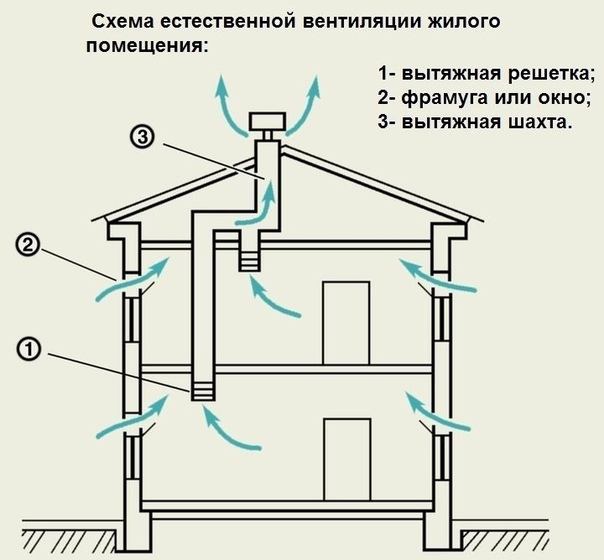
Natural ventilation of a two-story house
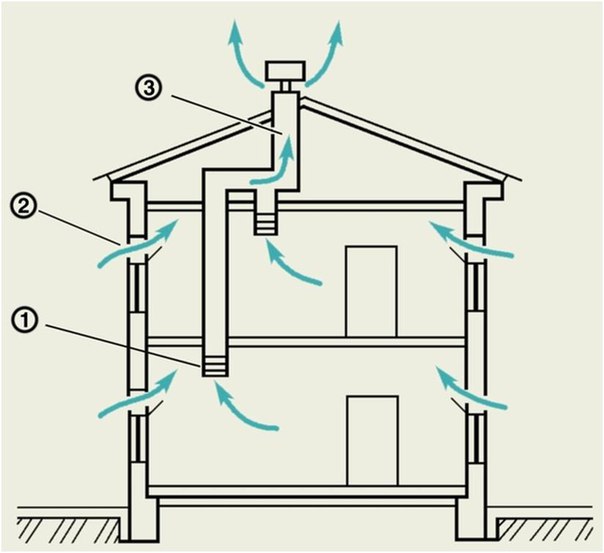
In order to create all the conditions under which uninterrupted operation of the system will be achieved, several requirements must be observed, in which case the natural ventilation of a two-story house will have good performance.
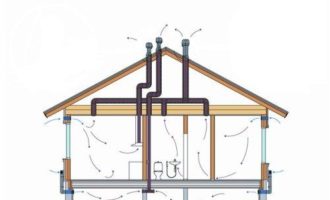
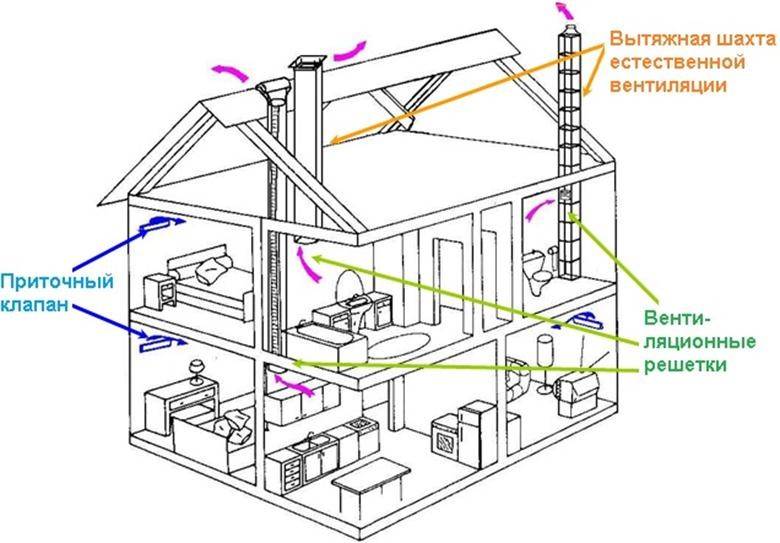
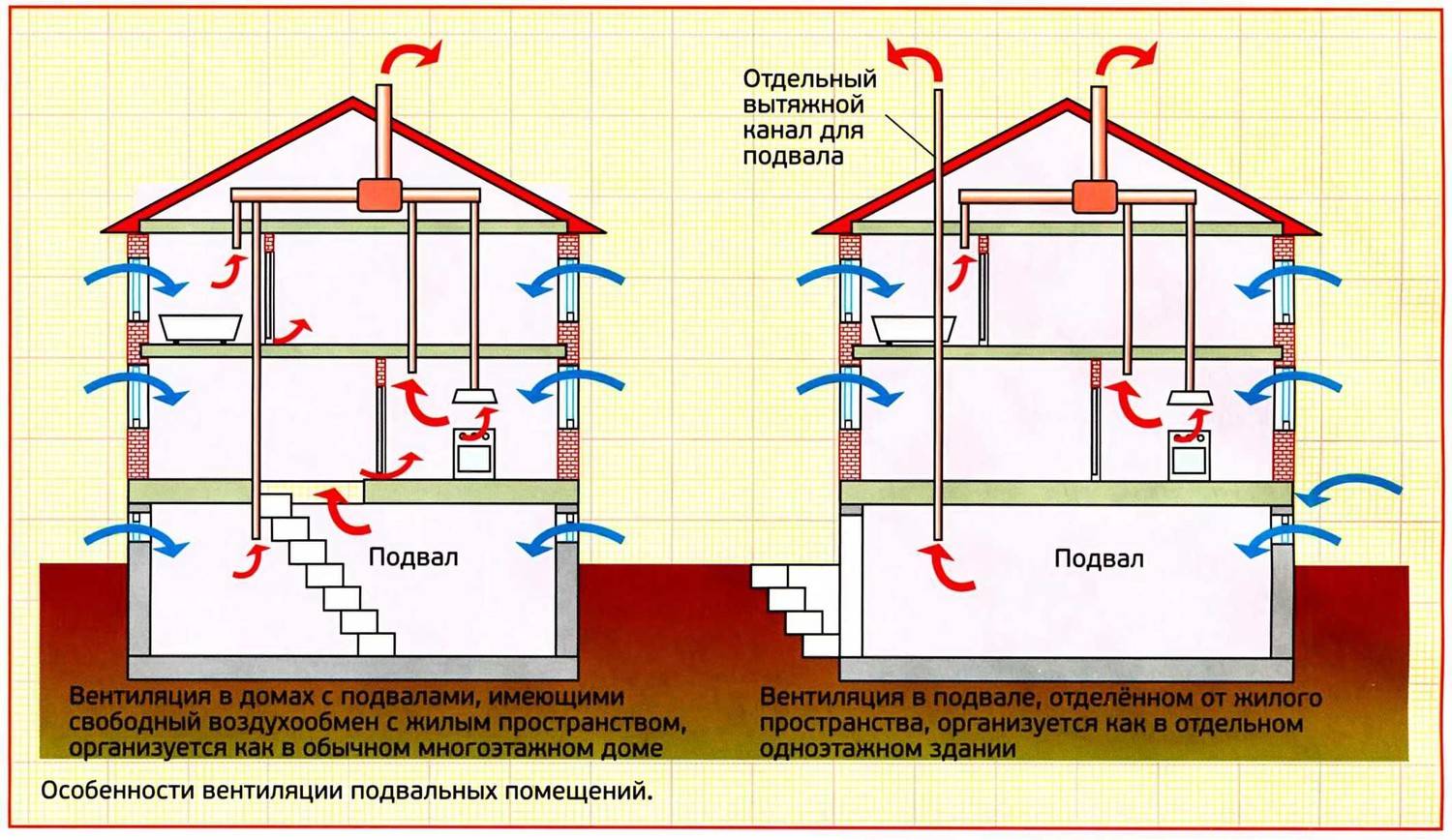
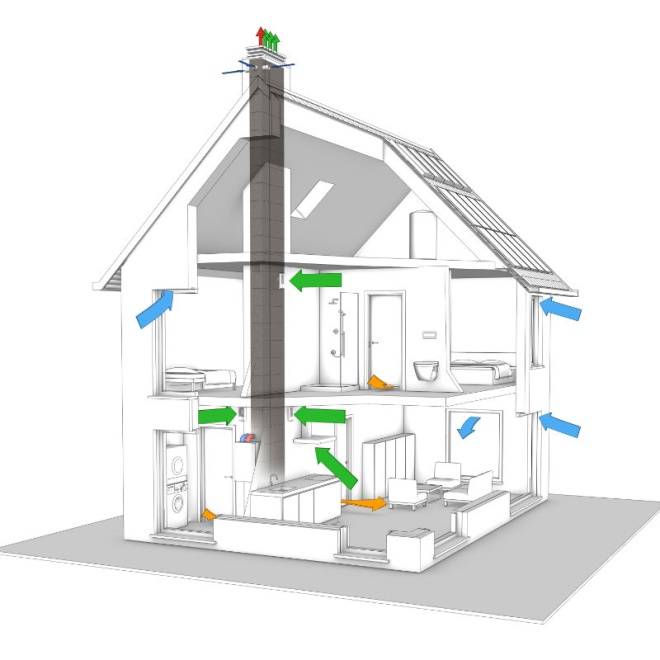
When designing ventilation ducts, vertical shafts are used. One side of the system is installed indoors, while the other is mounted just above the roof ridge. The movement of air is provided by traction, the performance of which depends on:
- Temperature differences between room and street, i.e. at the exit and at the entrance to the mine.
- Wind that can improve or degrade traction.
- The geometric section of the channel and its height.
- Thermal insulation characteristics of the mine channel.
- From the spatial location of the mine (absence or presence of bends and turns).
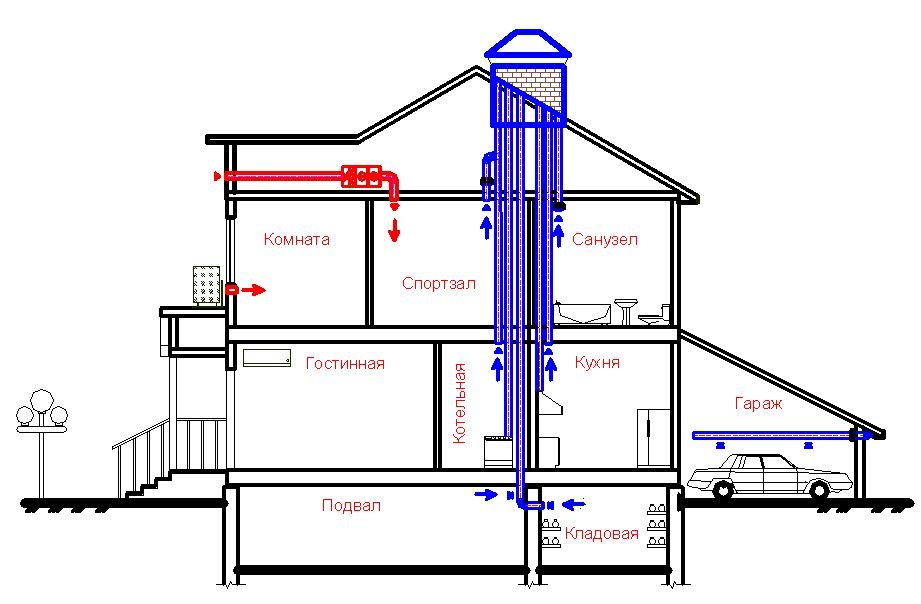
At the initial stages of designing a house, the architect chooses the type of ventilation and its spatial arrangement inside the building, and at the time of approval of the standard graphic plan, the customer is provided with a ventilation diagram in a two-story house that clearly shows all the features and nuances.
 ventilation in a two-story house scheme
Calculation of the main parameters of the ventilation system
For effective ventilation in a two-story house, a preliminary calculation is required, based on the air exchange standards specified in SP 55.13330.2011. The main purpose of the calculation is to determine the dimensions of the channels in accordance with the volume of air removed.

In the construction of a ventilation system for a two-story house, equipment of greater power is required than for a single-level construction. Usually, a ventilation unit with a capacity of at least 400 mᶾ / hour is included in the project
The calculation is made for each floor, observing the following sequence:
- According to Table 1 of the Building Regulations, the total minimum volume of air (Qp) supplied from the street is found in the amount necessary for ventilation of rooms equipped with supply valves.
- From the relevant section of the standards, the total minimum volume of air masses to be removed (Qv) from all rooms equipped with an exhaust duct is selected.
- The obtained minimum parameters (Qp and Qv) are compared. The larger value will be the lowest design air capacity (Qp) of all exhaust shafts on the floor.
- Based on the value of the height of the house, choose the size of the shaft on the floor vertically.
According to the height of the ventilation shaft and the minimum productivity of the channels located on the second floor, the number of shafts is selected according to a special table.
The table shows the performance of a single exhaust ventilation duct made of concrete blocks in relation to its height and room temperature. Channel section 204 cm²
The selected standard channels must have a total capacity in mᶾ/hour not less than the calculated Qp. The shafts are distributed between the premises so that the standard air exchange in each of them is ensured.
If it turns out that the speed of air movement and the performance of the duct is insufficient, then increase the length of the shaft or the section. To ensure equal draft in each duct, all ducts on a floor must have the same length.
It should be noted that the above calculation scheme is a simplified version. Professional calculation is much more complicated and only a specialist can perform it.
Types of natural ventilation

Roof ventilation outlet
To ensure normal air exchange in large areas, a single duct will not be enough.
There should be several ventilation systems:
- The device of natural ventilation in a private house is impossible without air flow. The intake of air masses should begin with the cleanest (residential) premises - the living room or bedroom. In order for the supply air to warm up better, the openings for it should be located near a heating radiator or other heating device.
- Fresh air must pass throughout the house. Its output must be provided in the kitchen, bathroom or toilet
- Exhaust pipes should rise at least 1.5 m above the roof. This will provide stronger draft
- In the kitchen, a separate forced hood is installed, connected to a vertical channel. She will take on some of the burden. Forced exhaust is also desirable to equip in the shower or bathroom
- You can replace the supply ventilation openings equipped in the walls with window valves
How to make a children's house with your own hands: from wood and other materials. Dimensional drawings | (80 Photo Ideas & Videos)
Conclusions and useful video on the topic
You can learn how to independently equip forced ventilation in a new apartment from this video:

When self-installing forced ventilation in a private house or apartment, you must first decide on the type of system. Depending on the size of the room, the number of people living in the house, as well as the degree of functioning of natural ventilation, you can install a supply or supply and exhaust system.
Some systems can combine a cooler, heater and air purifier, which saves on the purchase of additional devices.