- Pro Tips
- What kind of ventilation to choose for a private house?
- General rules for arranging ventilation in a private house
- Ways to ventilate the attic
- ventilation window
- Dormer windows
- Ventilation products
- Aerators
- The role of air distribution in the efficiency of the ventilation system
- Rules for the placement of ventilation outlets
- Rules for ensuring air exchange
- Classification and types of ventilation systems
- Making a grate with your own hands
- Ways to organize ventilation through the pediment
- Installation of ventilation valves
- Installation of grilles and dormer windows
- Arrangement of ventilated gables
Pro Tips
For the installation of gable partitions and battens, well-dried, planed and even beams or boards should be taken. Masters recommend primarily pine as the highest quality and easiest to process material.
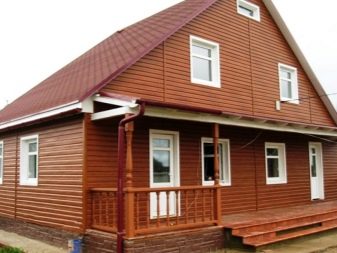
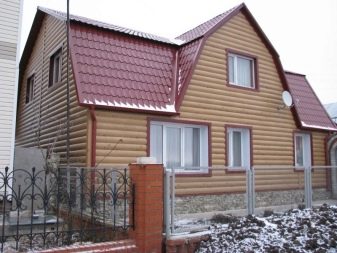
For decorative cladding, it is best to use horizontal siding. It is easier to install and looks very impressive on any facade.
The direction of the wind plays an important role in the construction of a country house. No matter how well the roof gable is insulated, it is optimal that it be located along the direction of the prevailing gusts, and not perpendicular to it. In this case, both the attic and the first floor are better protected from the weather.
The canopy at the base of the pediment plays an important role, it will protect the wall of the first floor from precipitation. It should be made of metal, profiled sheet, galvanized sheet and mounted to a decorative finish.
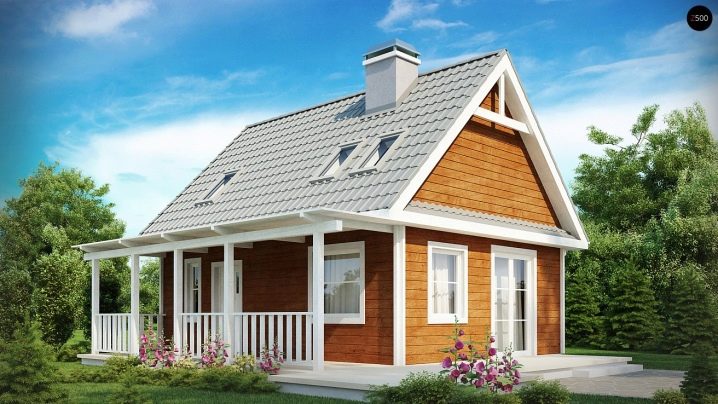
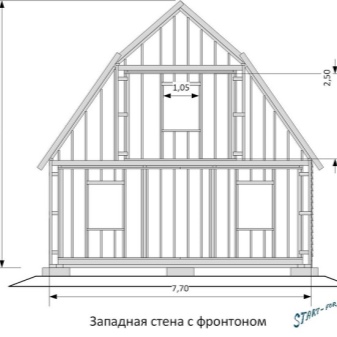
No matter how simple the shape of the pediment is, before installation it is worth creating a drawing of it with dimensions, window openings and other details.
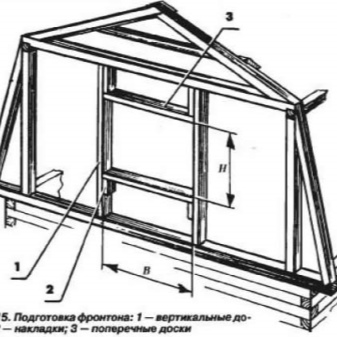
For information on how to lay out a perfectly flat gable, see the following video.
What kind of ventilation to choose for a private house?
Scheme of natural ventilation.
In a private house, natural supply ventilation shows itself best. Channels are mounted in window sills. It is also possible to make such an option when adjustable gaps are built into the design of plastic windows. Thanks to them, it will be possible to regulate the intensity of air exchange without losing the original characteristics of the window.
Outdoor air can hardly be called perfectly clean. Together with him, dust and other small debris will be brought into a private house. Heavy particles settle on the floor and window sills. To eliminate them, it is enough to periodically carry out wet cleaning. No special measures to combat pollution usually need to be taken.
You can, of course, install filters, but in this case, the owner will have to take responsibility for their periodic cleaning of dirt and dust. If this is not done, the air will not be purified, but only more polluted. This is fraught with the spread of harmful microorganisms that are dangerous both for the premises and everything that is in them, and for people living in a private house.
General scheme of the device of the ventilation system.
Before you start doing ventilation in a private house, prepare a set of necessary tools and materials.You will need the following:
- Corrugated pipes.
- Lumber.
- Lattices, valves and latches.
- Screwdriver.
- Roulette for measurements.
- Self-tapping screws.
- Corner.
- Drill.
- A hammer.
- Saw.
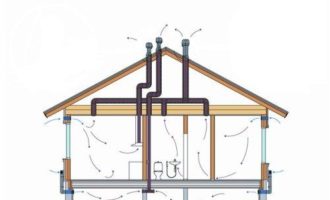
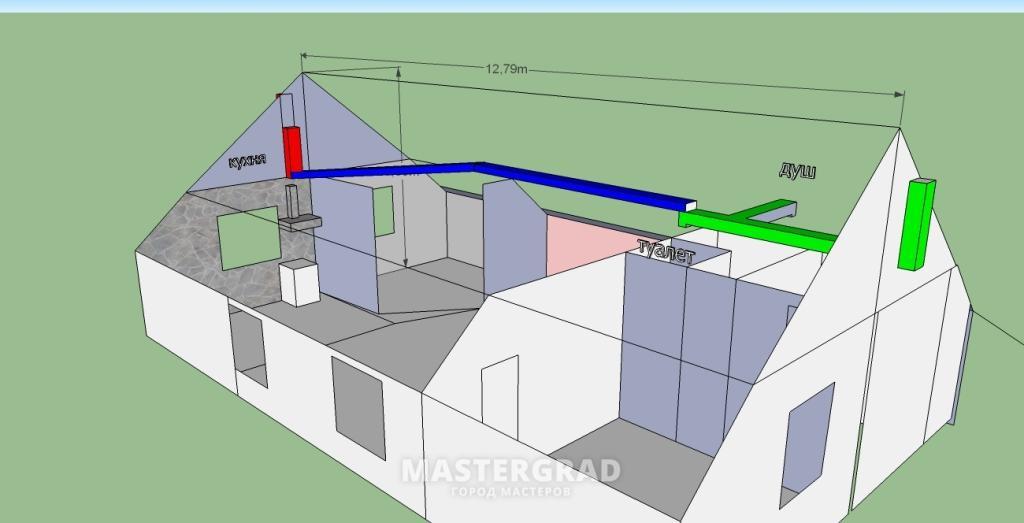
When doing such work, you will need various design schemes. On fig. 1 you can get acquainted with the principle of natural ventilation. An example is shown for the kitchen, but in other rooms everything can be done according to a similar principle.
General rules for arranging ventilation in a private house
Before you begin to independently equip the ventilation system of any room, you must first find out such parameters as air purity and the general state of the environment at the construction site. An important role in choosing the appropriate ventilation scheme is played by building and finishing materials.
Regardless of whether expensive and exclusive materials or the most budgetary options are used, it is impossible to save on ventilation in a private house, because this is saving on your own comfort, health and safety.
Figure 1. Exhaust ventilation in the kitchen.
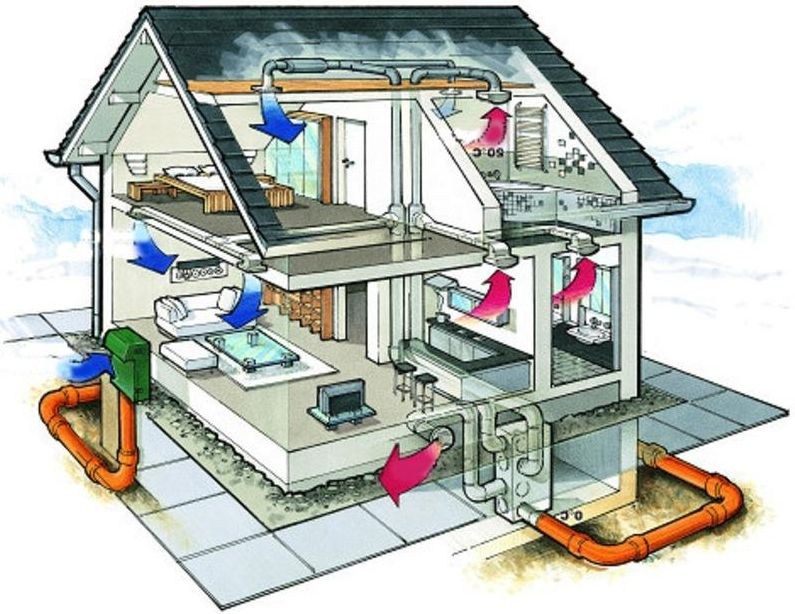
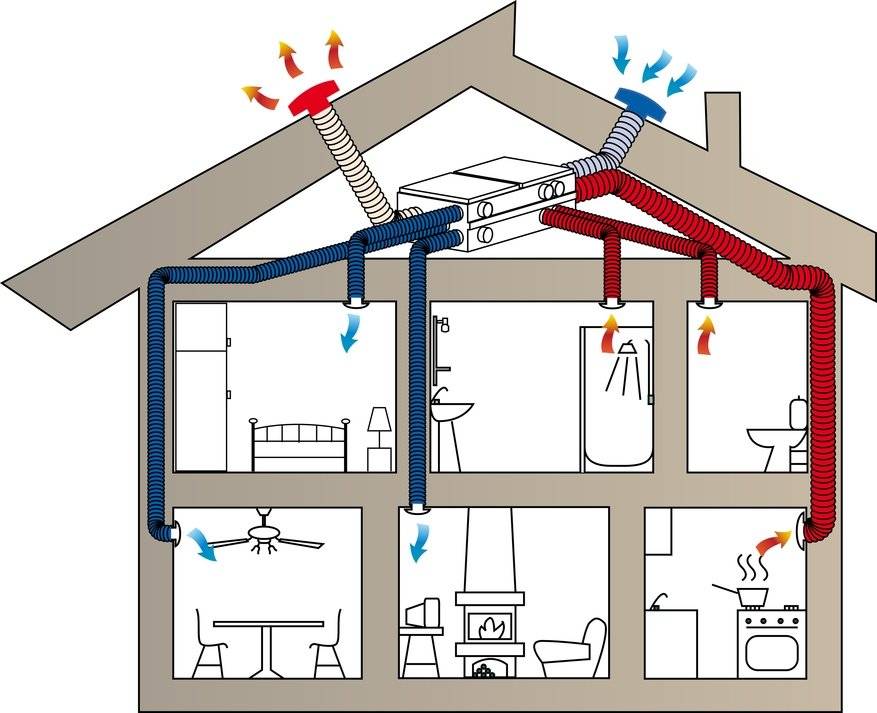
The process of ventilation in a private house is based on the creation of special technological holes. Through one of the premises, exhaust air will be removed, and through others, fresh air from the street will enter them.
The supply hole, in accordance with the approved standards, must be made on the outside of the house at a distance of at least 2 m from its foundation. The same outlet through which the polluted air will leave is made on the roof. The chimney pipe, in which all ventilation ducts converge, must be removed at least 50 cm above the roof level.
Particular attention must be paid.In this room, we make a ventilation system with the obligatory arrangement of a built-in ventilation duct. Air will enter it through a special vent hole.
Air will enter it through a special vent.
In the case of proper design, calculation and installation of ventilation in a private house, the bulk of the air will come from all rooms to the kitchen and be brought out there
Therefore, special attention is usually paid to kitchen air ducts.
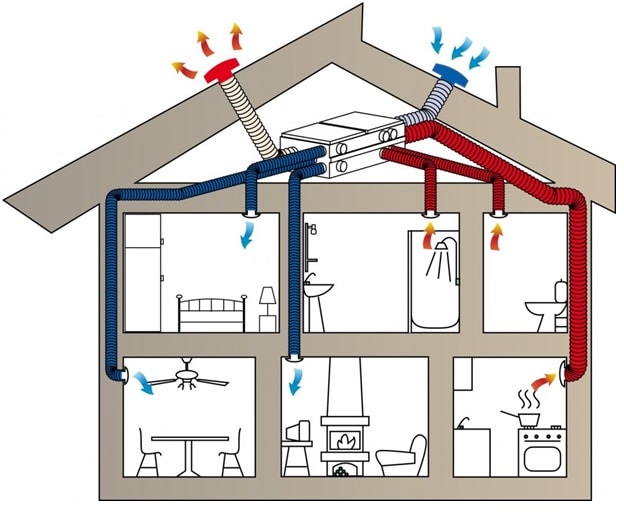
Figure 2. Supply and exhaust ventilation in the house.



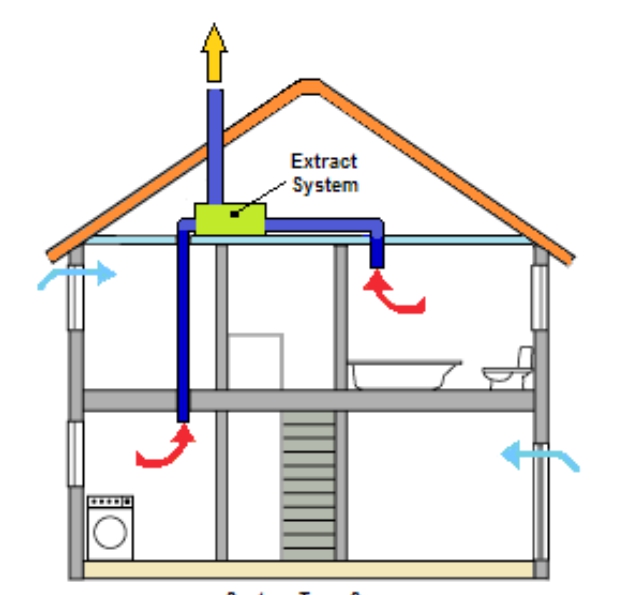

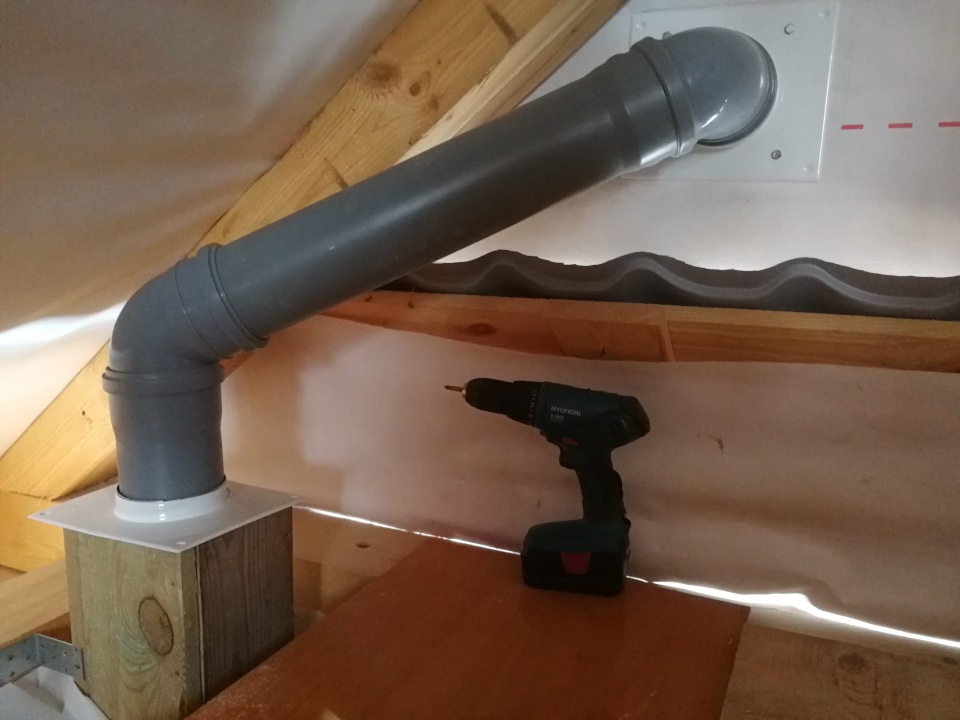
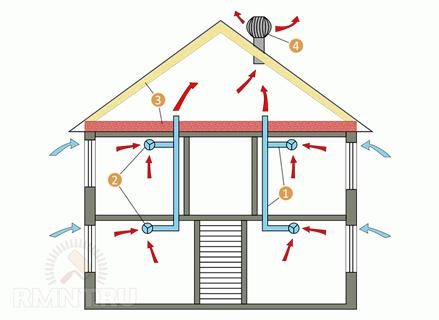
One of the most important stages of the calculation is the determination of the cross-sectional area of the ventilation duct. It should be such that all waste is promptly removed to the street. After all calculations are completed, one or more channels are embedded inside the walls. From the side of the kitchen, inlets are made, from the side of the street - weekends.
Stainless steel products are used as ventilation ducts. The surface of the channel must be smooth so that less soot, grease and other waste settle on it. To protect the holes from dirt and various third-party objects, special gratings are put on them. In cold weather, an air heater should be installed next to the supply opening.
In a private house, you can make natural and forced ventilation. Study the features of both types and choose the most suitable option.
Ways to ventilate the attic
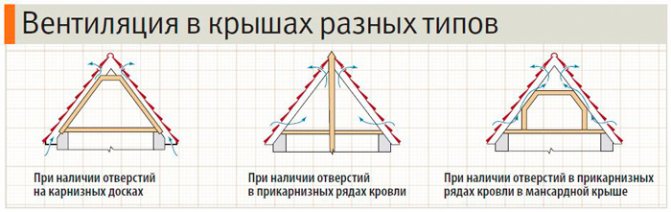
The best option for natural ventilation for a cold attic is a device on the eaves of air and holes. They are interconnected by channels through which the air flow moves.
In a house with an attic, you can arrange deflectors that create forced mechanical draft.This measure will ensure the normal functioning of the system in all weather conditions, regardless of the season.
Attic ventilation directly depends on its features:
- area of the premises;
- roof shapes;
- roof type;
- type of building materials.
For example, if ondulin or slate, metal tile is used, then a skate is arranged, which is a classic option. With a soft or ceramic roof, a special valve is used.
ventilation window
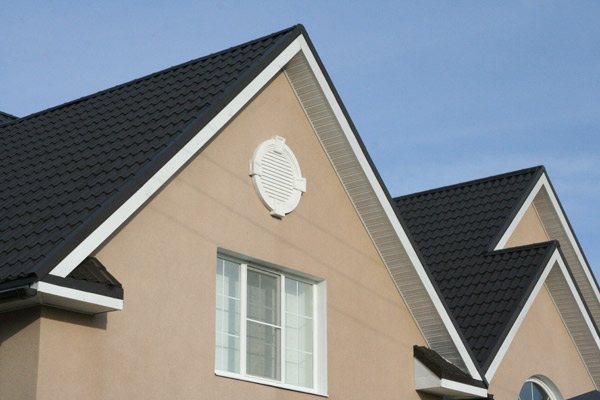
The most common way of ventilation, arranged in the attic of a private house, is to install a window. In addition to ensuring the movement of air, it is used to inspect the elements of the ventilation system and the chimney.
With a gable roof, windows are placed on the gable on both sides for better entry of cold air masses and removal of stagnant ones.
General installation rules:
- location of windows at a distance of at least 1 m from each other;
- maintaining an equal distance between the windows and the cornice, the ends of the house, the ridge;
- the general concept of the appearance of the house should be combined with the design of the window.
Dormer windows
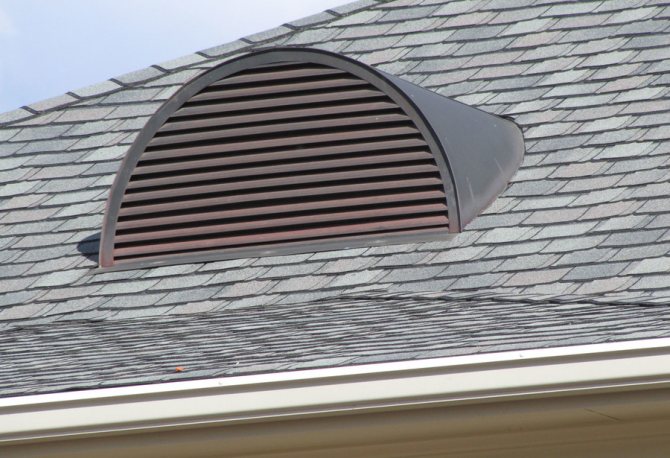
As a rule, dormer windows are used as ventilation in the attic in private houses with medium-sized rooms.
Their minimum size should be 60 × 80 cm, which helps to prevent stagnation of air in the room.
The wooden frame is attached to the rafters with the help of racks, after which the roof sheathing is carried out. The double-glazed window is inserted into it last.
There should be no gaps at the junction of the roof and the dormer window. It can not be placed near the ridge and the eaves of the roof.
Dormer windows are made in the form of a rectangle, triangle and semicircle. Windows are installed at a distance of one meter or more from each other.
The lower mark should be at a height of no more than one meter from the floor level, and the upper one - at a mark of 1.9 m.
Ventilation products
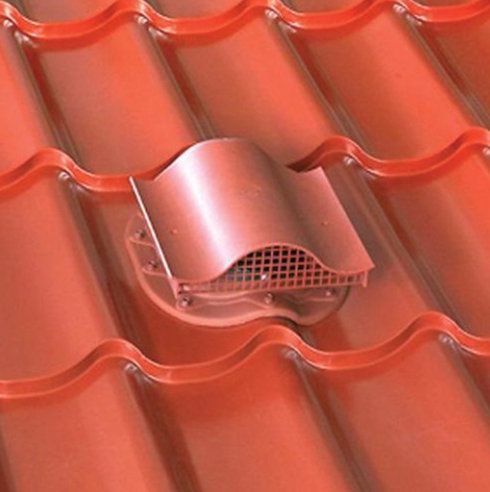
If it is not possible to install dormer windows, then, regardless of the type of attic, the ventilation method is used by means of vents closed with a mesh.
They are located on the roof of the house to ensure the normal exchange of cold and warm air.
The main types of these elements:
- slotted - located on both sides of the eaves. The gap width should be 2 cm;
- point - presented in the form of holes, the size of which in width or diameter is not more than 2.5 cm;
- ridge vents - used on roofs made of tiles. Their width should not exceed 5 cm. They are installed by retreating one row from the ridge of the house.
Aerators
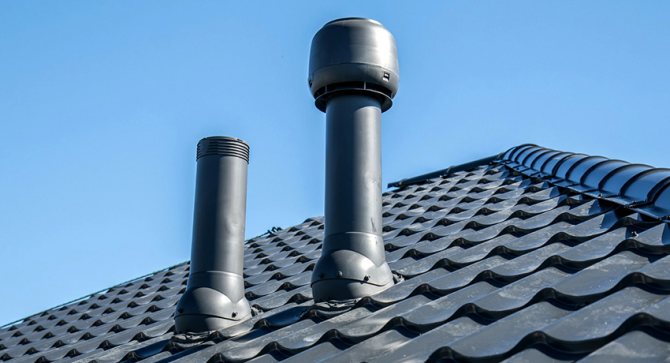
When installing ventilation in a cold attic, you can use aerators. Devices are made in the form of a pipe covered with a hat, or a plate with holes.


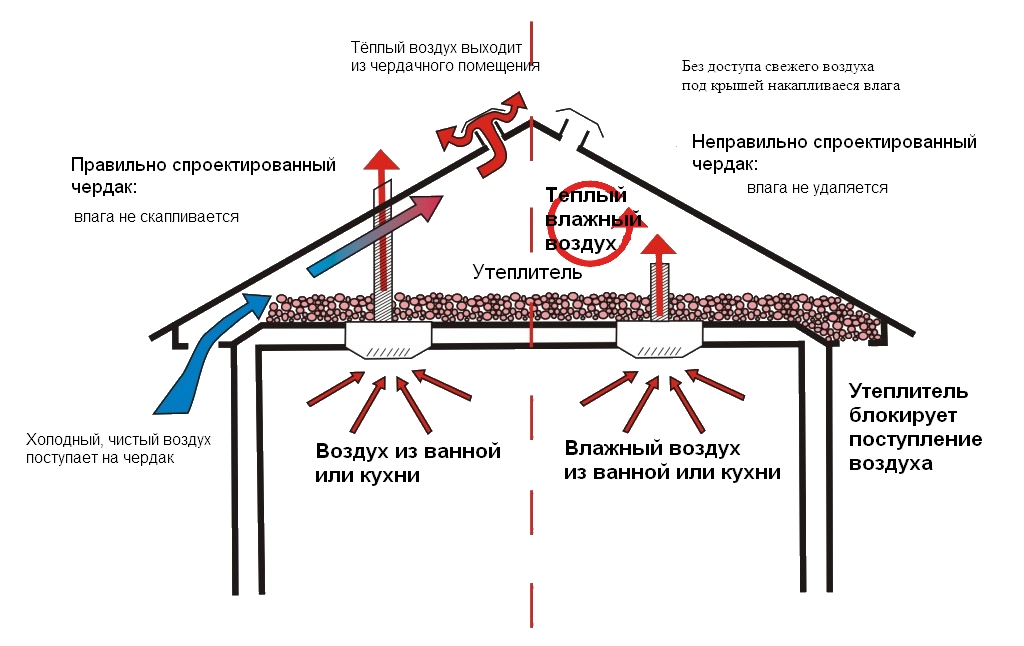


Their installation is carried out on the slope of the roof in the area of \u200b\u200bthe ridge. It is in this place that intensive air movement occurs due to the difference in temperature and atmospheric pressure.
Aerators are great for:
- with condensate that appears when the air is too humid. Thus, the appearance of dampness in the attic is prevented;
- with stagnant air, preventing it from overheating;
- with frost and icicles that form in the winter season.
This prevents premature wear of the truss structure.
The choice of the type of fixture is determined by the type of roof of the house.For example, for bituminous pavement, the best option is to install ridge aerators. For the manufacture of used plastic and galvanized metal, resistant to corrosion.
The role of air distribution in the efficiency of the ventilation system
In the design of supply and exhaust ventilation, the process of proper distribution of air flows plays an important role. If these data are not taken into account in the calculations, then the ventilation system, even with high air exchange rates, may turn out to be inefficient in the process of removing polluted air from an apartment or cottage. One of the main tasks in the design of ventilation is the correct location of supply and exhaust distribution devices to achieve maximum effect.
- Grilles, adjustable and non-adjustable, of various geometric shapes and with air direction both in one direction and in all directions. Such air distributors can be used for supply, exhaust and overflow ventilation systems and be located on the ceiling, walls or on the floor.
- perforated panels. These devices are panels with perforation, located both in one and in several rows. They remove air currents from the top of the room.
- Diffusers or shades. Such devices are used for supply and exhaust ventilation, they can be with an air flow regulator.
- Nozzle and slotted. They are both supply and exhaust and can create a large jet of air at high speed, up to 30-40m/s.
It is their correct location that allows you to effectively distribute the supply and exhaust air throughout the room.
A scheme for the correct distribution of air masses in a building is ordered separately from the project, to companies that specialize in this, and you can independently make calculations using reference books or various computer programs. One such program is called Swegon.
Rules for the placement of ventilation outlets
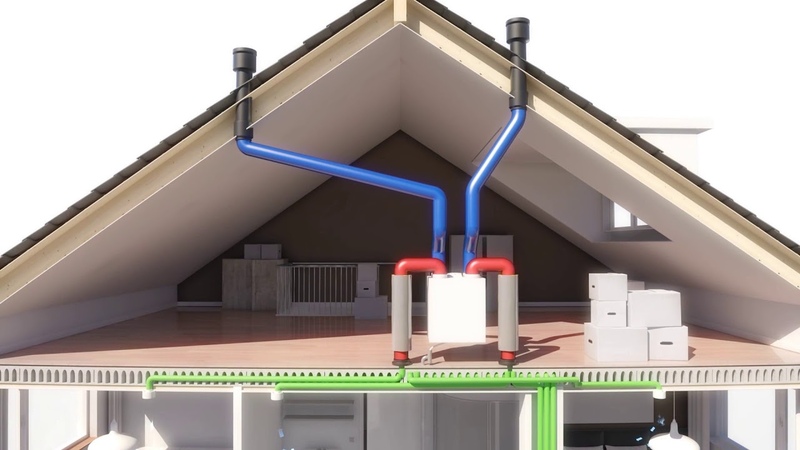
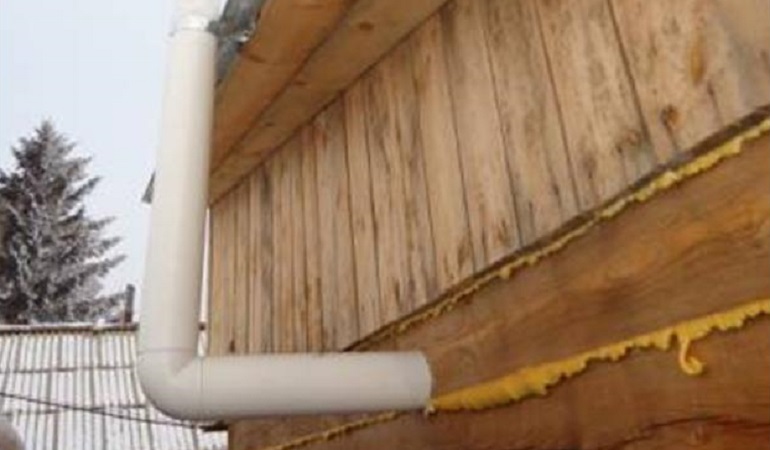
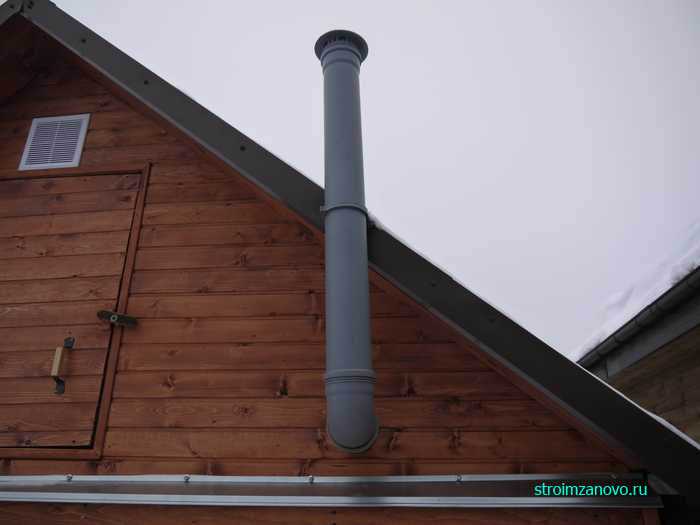
There are two standard ways to bring ventilation pipes outside the house: through the wall and through the roof. In the second case, pipe fragments located above the roof level are often placed inside a special box.
The ventilation duct has two functions:
- Warming. Condensation forms when the air leaving the room is cooled. It begins to seep back through the ventilation system, and can also narrow or completely close the cross section of the channel.
- Waterproofing. Violation of the integrity of the roof can lead to water ingress into the attic space. It is also necessary to ensure that the ventilation duct is protected from direct precipitation in the form of rain or snow.
And also the box will serve as an excellent supporting structure for fixing the facing material and for providing an indent from unstable building structures made of lumber.
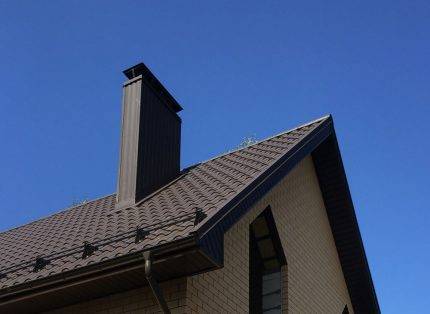
The box on the roof of the house should look harmonious. Therefore, you need to think over its design in advance: colors and decorative elements.
If several ventilation outlets to the attic are planned or have already been implemented in the house, then there are 3 options for how to bring them to the roof:
- For each channel, you can make your own box. This is the most costly method, however, in this case, pipes can be removed without bends, which, with natural ventilation, increases traction.
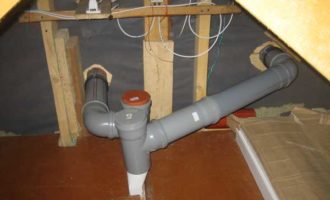
- Bring all the pipes side by side and bring them to the roof in one box.This reduces the amount of work on the roof, but increases the workload of the attic space.
- Make a single system of ventilation ducts with one outlet. This minimizes the size of the duct, which greatly simplifies work on the roof, but can lead to problems associated with branched air exchange systems.
The use of a duct system with several air inlets and one point of air removal must be well calculated in advance. It is necessary to properly build the supply ventilation and install check valves, otherwise the air flow may be reversed.
The hole in the roof must not damage the rafters, otherwise this will lead to the danger of redistributing the load of the supporting structures
The crate does not play such an important role, since it only holds the coating

Since there can be a lot of ventilation pipes, you need to place them in the attic so that they take up little space.
You also need to carefully approach the issue of determining the location of the ventilation outlet so that it does not end up in the zone of wind backwater.
Failure to comply with the rule for the position of pipes relative to the roof elements, prescribed in clause 6.6.12 of SNiP 41-01-2003 “Heating, ventilation and air conditioning” can lead to a decrease in thrust or its tipping over, which will immediately negatively affect air exchange.
According to this scheme, it is possible to determine the sufficient height of the ventilation outlets on the sloping roof of the house. If there are tall objects nearby, then the calculations will be more complicated.
Therefore, for a pitched roof, it is better to plan a place for the box closer to the ridge.This will allow to reduce the height of the structure, which will simplify the work on its construction.
Rules for ensuring air exchange
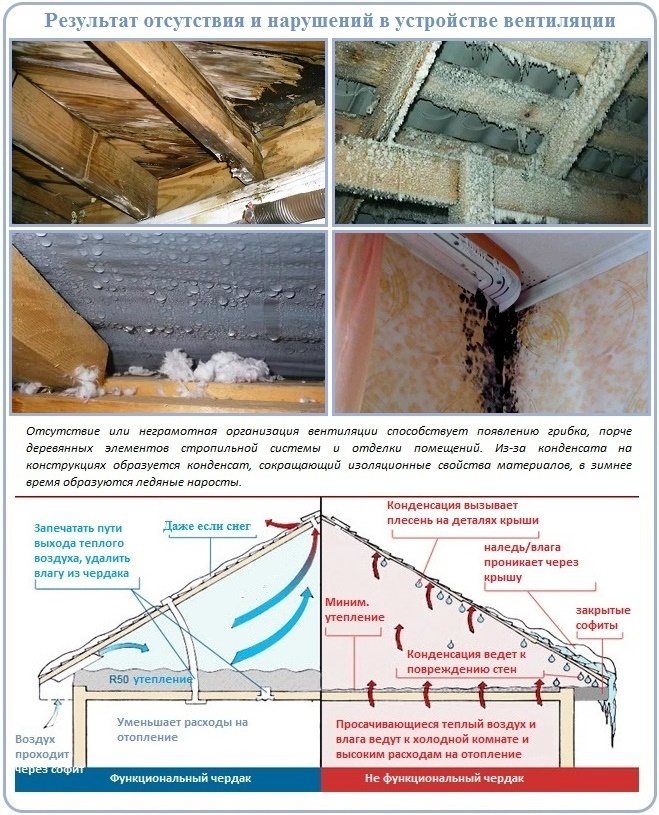
To effectively change the air, remove household vapors and prevent the formation of condensate, it is necessary to correctly calculate the total cross-sectional area of \u200b\u200ball ventilation openings. According to the rules, it should be at least 1/500 of the overlap area.
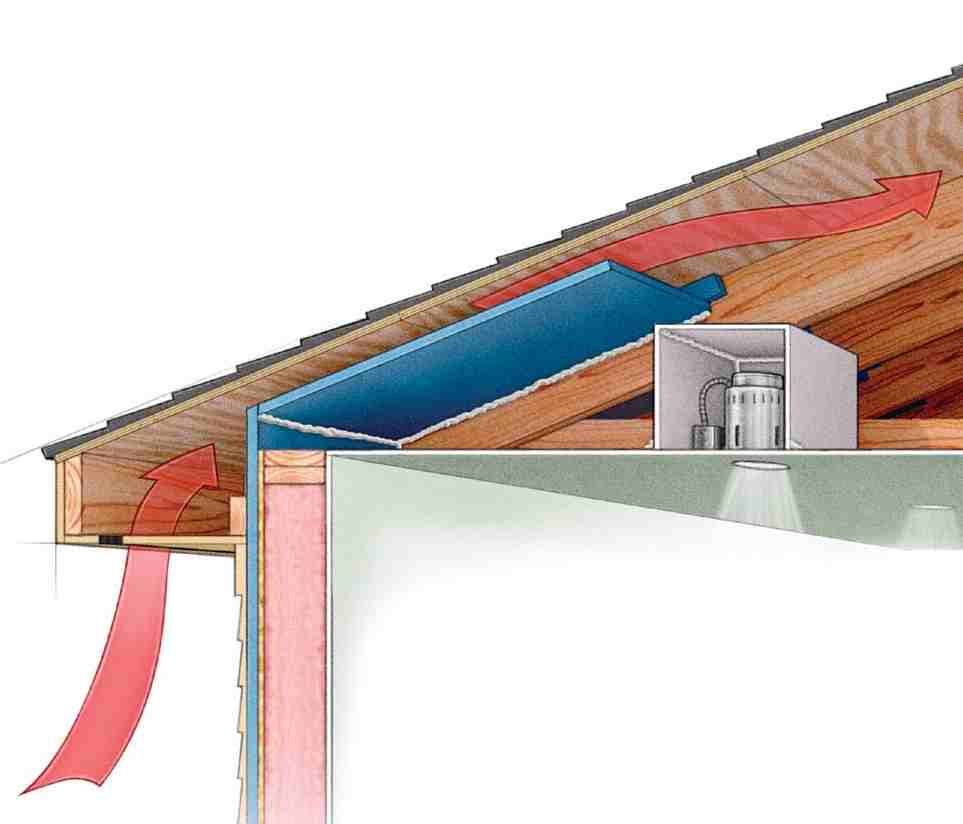




In addition, it is important to consider the properties of building materials. Modern versions of insulation and waterproof films let in less air than their predecessors.
Therefore, more efficient ventilation is required.
Therefore, when using materials with a high degree of tightness, it is worth increasing the cross-sectional area to 1/400 and even up to 1/300 of the total overlap area.
Classification and types of ventilation systems
The creation of ventilation in the cottage is due to the fact that a continuous exchange of air masses must occur in it. Old, used air with a large amount of carbon dioxide must be removed from the premises, replacing the constantly oxygenated air with fresh air from the street.
If you stop this air exchange, then the microclimate inside will quickly become far from favorable for human health.
According to the norms for living rooms, the optimal atmosphere is a temperature in the region of 20–25 degrees and a relative humidity of 30–60%, depending on the season and the readings on the thermometer outside the window
In order to maintain the air exchange parameters established by GOSTs, the ventilation system in the house, made by oneself or with the involvement of third-party installers, must continuously change the air in the premises.
For example, for living rooms in a cottage, the air exchange rate per hour is set to "1".That is, in an hour, the entire volume of air must be completely replaced in them.
The purpose of ventilation is to combat the following factors:
- excess heat;
- constantly appearing dust;
- excessive air humidity;
- harmful gases and vapours.
Every person in the house exhales carbon dioxide around the clock. Also in the residential building there are fireplaces, gas and electric stoves, numerous household appliances, that is, there are a lot of sources of heat, moisture, dust and gases in the cottage. And all this must be removed from the premises so that the microclimate in them is suitable for living.
According to the method of moving air, ventilation systems are:
- With natural traction.
- With a mechanical drive.
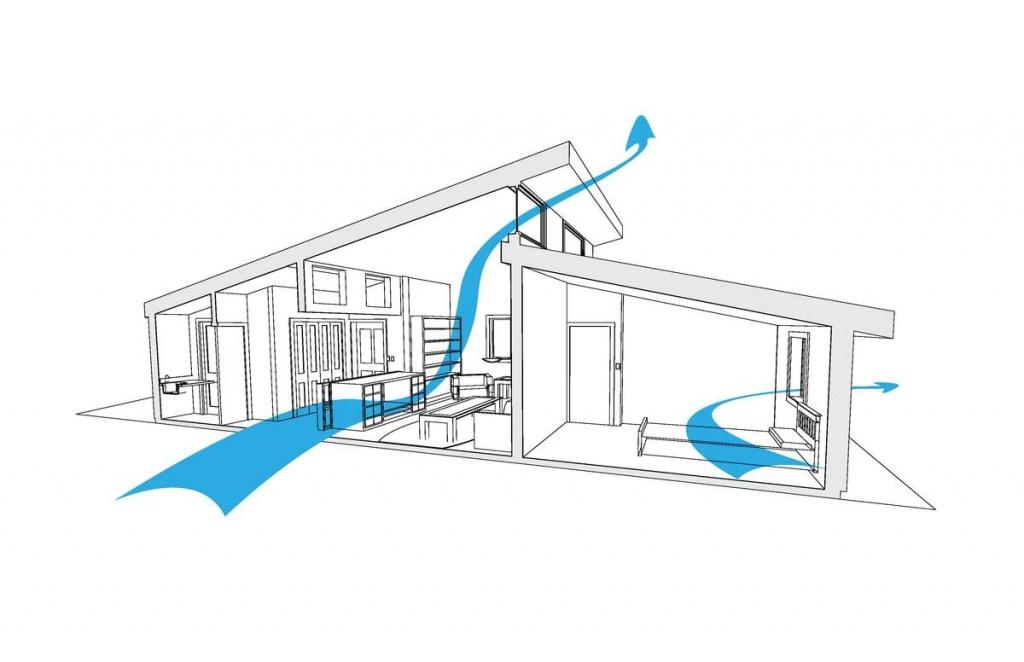
The first option involves the movement of air masses due to the existence of a pressure difference outside and inside the ventilated building. At the same time, it can be organized - using adjustable valves, and unorganized - exclusively through windows, doors and vents in the foundation.
In the second case, the air is forced to move through the premises and ventilation ducts using mechanical devices. This option is volatile, but more efficient.
The main disadvantage of a mechanical ventilation system is its dependence on the power supply. Without power from the mains, the fans will stop spinning, and the air exchange efficiency will immediately drop sharply
By purpose, ventilation systems are divided into:
- supply;
- exhaust;
- combined.
Making a grate with your own hands
Consider the option of constructing a ventilation grill for a low-pitched roof.The device for supplying a fresh portion of air will be located at the very top, which is not very effective for structures with steep slopes, because. will not be able to completely wash the room with air flow.
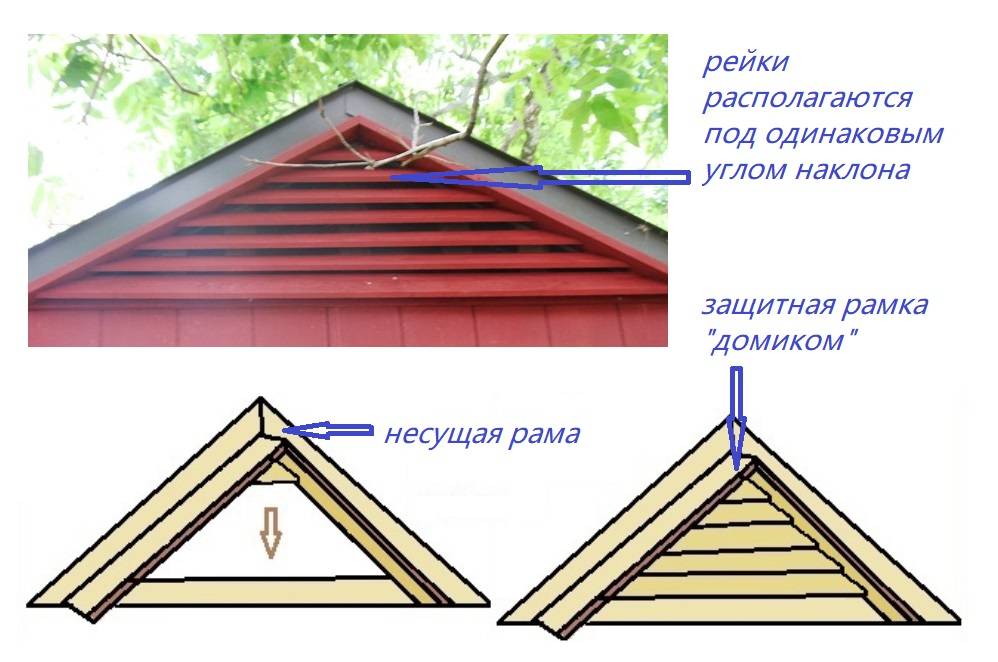
The structure will have an external frame that repeats the shape of the slopes of the roof being equipped, and its internal “help”, which is entrusted with the function of fixing in the opening and holding louver-type slats. For the device of the first board, they are arranged parallel to the slopes, for the second, they are installed flat - parallel to the gable wall.
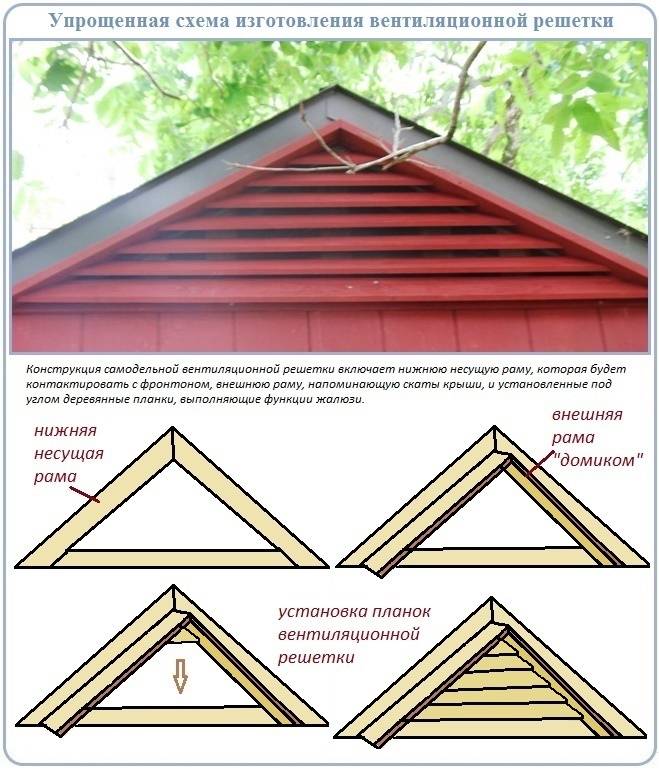
For manufacturing, you will need lumber from wood that is as resistant to atmospheric attacks as possible. The author of the design advises to stock up on roughly processed cedar. If there are funds, then you can buy bog oak. Oddly enough, larch does not work very well in such conditions. Conifers in ventilation grilles serve better, besides, they please with a more acceptable cost.
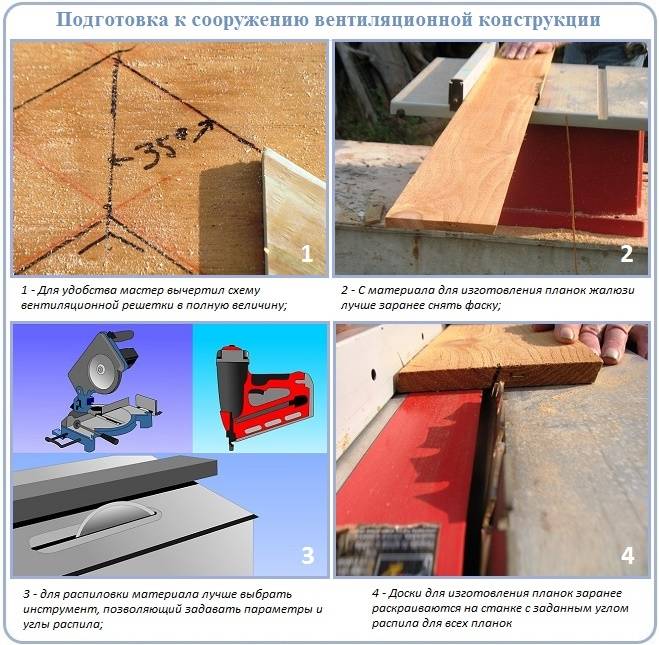
Any enterprise, regardless of its scope and real scale, requires careful preparation and design. In the example we have proposed, a diagram on a scale was not created, although no one forbids those who are used to working with it to make a drawing with reduced dimensions of the product. The master immediately drew a lattice on a sheet of plywood in real size, so as not to get confused with the transfer and transfer of distances.
On such an original drawing, it is easier to calculate the actual consumption of material, and subsequently control the connection of the planks with the carrier and outer frame.
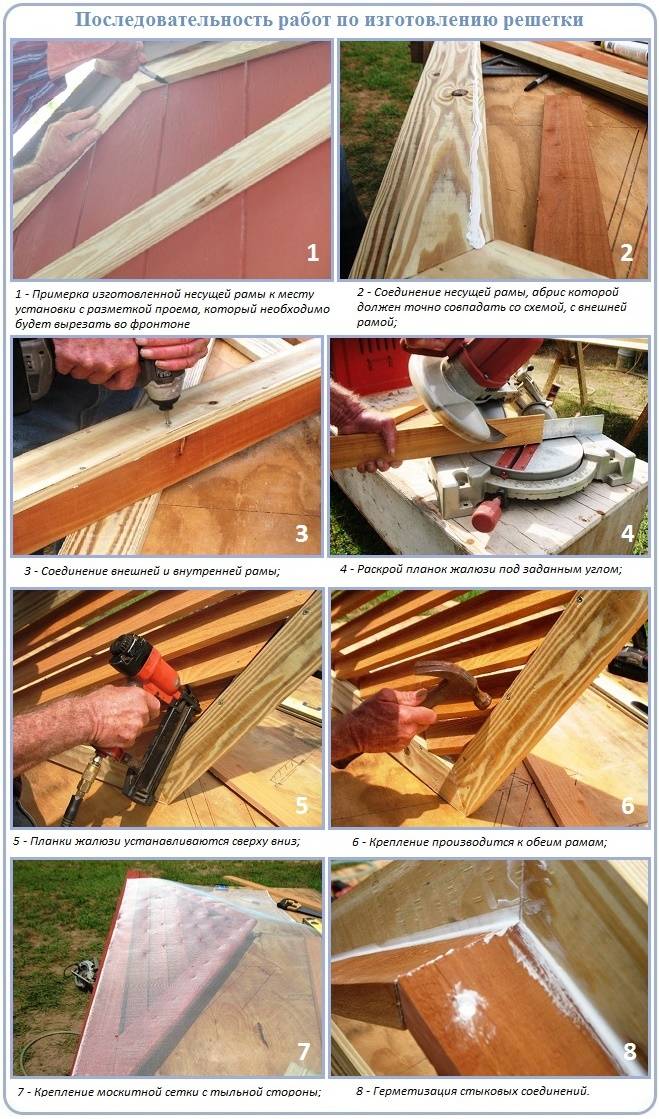
Further work on the manufacture of the ventilation device is carried out in the following order:
- According to the outline drawn on plywood, we cut the boards for the manufacture of the internal load-bearing frame, precisely fitting the parts for perfect fit.
- We assemble the supporting frame with screws or nails using galvanized hardware.
- We will attach the finished frame to the installation site for marking and fitting. Let's outline the inner outline of the frame in order to cut an opening in the pediment according to this markup.
- According to the dimensions of the inner outline of the supporting frame, we make the outer part of the frame from two boards connected by a “house”. Under it will be located at an angled strips of the ventilation grill.
- We connect the two frames with galvanized screws. To begin with, we will install the boards with a “house” on the glue applied along the edge to the supporting frame. After tightening, it is advisable to cover the caps of the fasteners with a water-repellent sealant.
- We cut the blanks for the slats of the blinds, focusing on the size of their longest side. We check with the drawing when cutting. If there is no experience, it is better to make blanks with a margin of 2 - 3 cm in length so that you can customize after the fact.
- We chamfer all blanks at a single angle, which is allowed to be in the range from 22 to 45º.
- For fidelity, we mark the cut corners of the slats, applying them to the drawing, and remove the excess.
- We mount the planks in the space formed by both frames. We install the blinds at an angle, fix them with nails to the outer frame with a “house”.
- We start filling the lattice from above, from the shortest bar, from it we move down. We arrange the slats so that they do not protrude beyond the supporting frame from the inside.
- We flip the design. Additionally, we attach the blinds to the supporting frame.
Let's leave the structure in the same position in order to cut and attach a mosquito net made of thin aluminum wire to it. We fix the mesh not only on the supporting frame, but also on several slats for a snug fit.






The installation of this homemade lattice is carried out outside the building, fastening is carried out through the supporting frame to the gable wall. Upon completion of installation, the external fixing points should be coated with sealant and applied to the upper lines of the joining frames. If there is a desire to improve the decorative qualities and protect the wood, it makes sense to paint the structure.
Another option for sealing joints in order to protect them from atmospheric water is to use a device similar to ebbs from thin sheet metal. Having bent the strip at an angle, it is first installed on one side with an overlap through the top of the structure. Then they do the same with the other.
Ways to organize ventilation through the pediment
The main ways to bring ventilation through the pediment include: installing ventilation valves, installing grilles and dormer windows, as well as building a ventilated pediment.
All three methods are considered interchangeable and complementary. Moreover, each of them can exist separately or be part of a system containing aerators, turbo deflectors and air vents.
Installation of ventilation valves
Vent valves are not the cheapest, but a very good option. Especially when it comes to the most modern models.
In addition to air renewal, they are capable of:
- regulate the volume of incoming air;
- reduce the noise level;
- direct the air flow to the heating radiator;
- perform filtering.
The principle of operation of the device is simple: capturing the required amount of air from the outside, it filters it, sends it to the noise absorber, and then to the radiator. So a warm fresh stream enters the house.
In this case, the air movement can be initiated by the difference between external and internal pressure or mechanically started using a fan.
The installation of the ventilation valve is carried out in several stages:
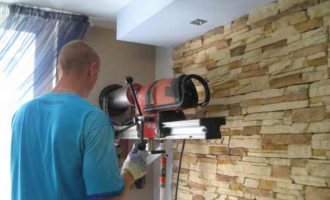
- Drilling a through hole at a downward angle of 5 degrees - this is necessary to remove moisture that accidentally got in from the outside.
- Installation of pipes and insulation.
- Fastening the body to the pediment.
- Cover installation.
To implement the air heating function, the valve body must be placed directly above the heating radiator. The required distance is indicated in the instructions for the device.
Installation of grilles and dormer windows
Grilles and dormer windows are commonly used to organize air exchange in cold attics.
For the attic, this method is not suitable, since in the cold season it violates the comfortable temperature regime.
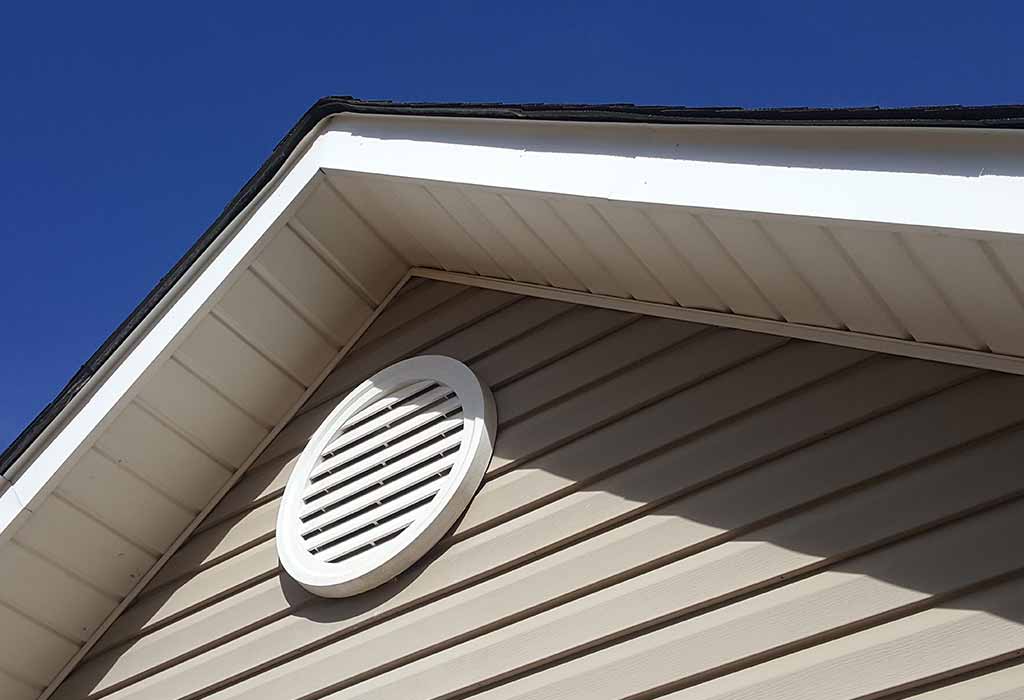
The shape of both lattices and dormers can be very different: from traditional circles and ovals to curved triangles and polygons. Their main purpose is to lay a natural duct through the gable. Therefore, their design is the simplest. It includes a box and a casing.
Even novice builders can install such a structure. For this you need:
- Make a hole in the wall of the pediment, suitable in size and shape to the acquired lattice.
- Install the product in the resulting opening.
- Attach trim on the outside.
According to the regulations, the lower point of the lattice or dormer window should be located at around 80-100 cm from the upper point of overlap. This is the only way to ensure efficient and regular air exchange.
Another rule for installing grilles and dormer windows concerns the location of blinds on them.
They must always point downwards during installation. Even if the design of the product allows you to change the angle of their opening.
Arrangement of ventilated gables
The principle of creating ventilated gables is to arrange gaps between materials with different thermal properties.
There are two ways:
- In one level, when the gap is established between the exterior trim and the windproof film.
- In two levels, when it is necessary to leave small distances between the exterior finish and the film, as well as between the film and the insulation.
The first method can only be used when using a membrane sheet instead of a classic polyethylene film. Unlike the film, the membrane provides an unhindered exit of condensate from the insulation. Therefore, there is no need for a gap between them.



It is customary to equip the gap itself with the help of wooden bars 2-3 cm thick. With their vertical arrangement, continuous installation is allowed when the bars fit snugly against each other along the entire height of the pediment.
With a horizontal arrangement, it is necessary to mount them at a distance sufficient for mounting the finish. Otherwise, the natural movement of air masses will be obstructed.