- Air device in the pediment
- Suggested set of tools
- Main works
- Ventilation installation options
- 2
- How to equip attic ventilation?
- For a cold attic
- For a warm attic
- How to avoid mistakes when creating ventilation?
- Roof ventilation methods
- Air supply
- Advantages of natural air exchange
- Natural ventilation in the attic
- Installation of exhaust ventilation
- Tips, tricks and possible mistakes
- Metal roof ventilation
- The nuances of arranging ventilation systems for cold and warm attics
- Ventilation system without attic insulation
- Ventilation system for a warm attic
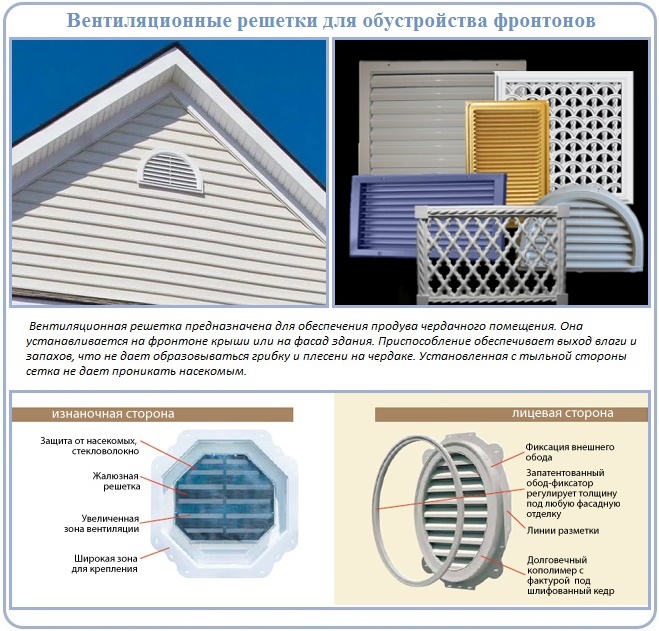
Air device in the pediment
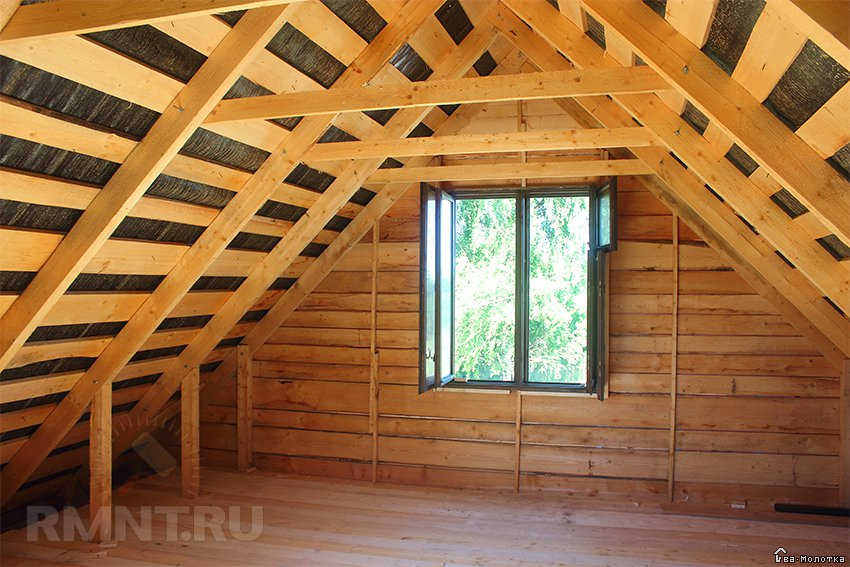
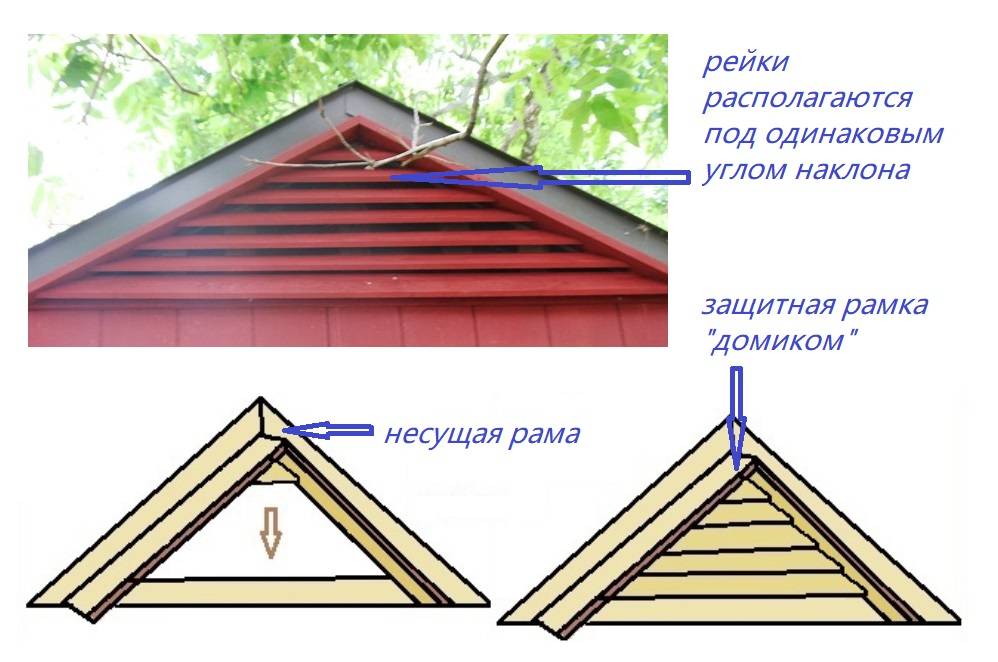
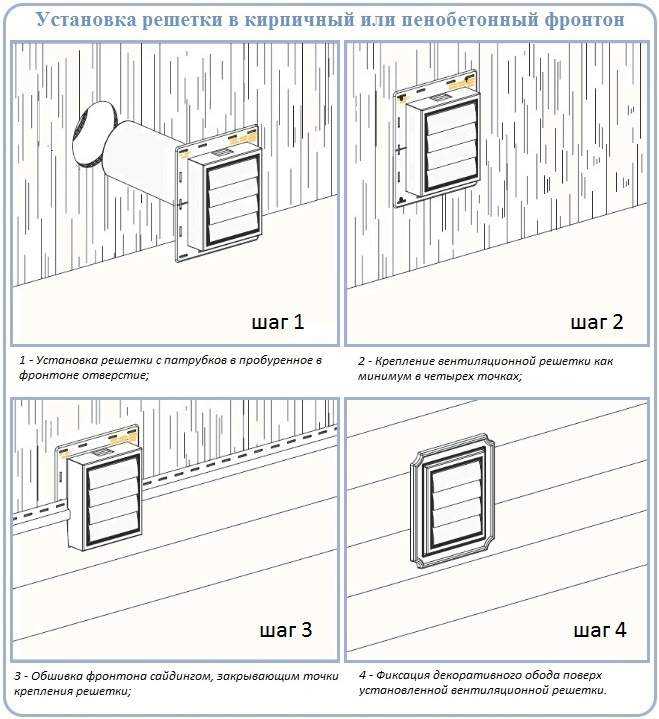
If attic ventilation is done above the attic, then small openings are usually cut to allow fresh air to pass through on each side. This option is only used for gable and sloping roofs, as they have a gable on each side. It is quite possible to cope with the arrangement of holes for air exchange with the external environment without the involvement of specialists, especially if the structure is framed.
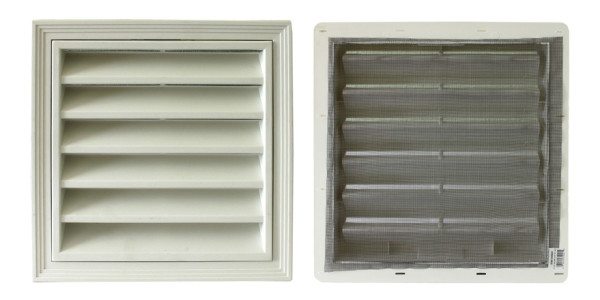
An example of a square-shaped ventilation grille.
Suggested set of tools
- A tape measure and a pencil are needed for marking.
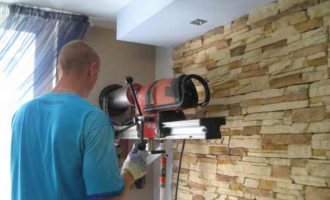
- The drill makes the first hole for the cutting tool.
- An electric jigsaw is used to separate the unwanted part.
- The fasteners of the decorative grille are twisted with a screwdriver.
Main works
Before it's done attic ventilation a private house with your own hands, simple calculations should be made taking into account the information above. After determining the dimensions of the channels for air exchange, basic work can be carried out.
The tutorial will help you make a square hole in the frame structure:
- Initially, places for openings are selected. Usually this is the central part of the attic space. If the air exchange channels are strongly shifted to the side, then the aesthetic appeal of the building can be violated.
- A preliminary marking is applied to the surface of the pediment. With the help of a tape measure and a pencil, lines are drawn along the perimeter of the future opening. The diagonals must match in size.
- Next, work begins on cutting the side of the pediment. First, a hole is made with a drill into which the jigsaw blade can fall. After that, a cut is made around the perimeter.
- At the finishing stage, a special grate is installed, corresponding to the size of the opening. Fastening is carried out with self-tapping screws, which, after screwing in, are closed with a decorative panel.

Lots of color variation.
Ventilation installation options
To this end, it is possible to provide exhaust outlets on the ridge or near it. Such outlets are called roof aerators. They can be placed pointwise or made into a continuous gutter. The greatest efficiency will be ensured if they are located along the entire edge of the roof.Roof aerators can be combined with the general ventilation system of the house.
Roof aerators will not spoil the appearance of the house, as the main coating is laid on them. When constructing this type of ventilation, it is impossible to seal using mounting foam or special tapes. This will block the access of air, due to which the natural ventilation of the roof will become impossible. To make a roof with 2 gaps, you will need to cut holes in the film, as it will also block the access of air from the outside.
Practically for any roofing there are functional elements with which you can make ventilation. These elements include:
- plates with air channels;
- air elements;
- ventilation rolls.
With the help of these roofing elements, ventilation of the roof of the house can be ensured. The ventilated ridge system created using these elements, rather than installing them separately, gives the greatest efficiency.
The arrangement of a ventilated cornice is an opportunity to provide an area for air penetration sufficient for effective ventilation of the roof. Cornice ventilation can be of several types:
- soffit, which is the gap between the wall of the building and the cornice board;
- in the form of ventilation grilles embedded in spotlights;
- using a special material in which air vents are provided, laid slightly above the level of the cornice overhang.
In order not to block access to air, it is necessary to abandon the laying of heat-insulating material in the eaves or placing plantings on it. It is possible to provide effective protection of ventilation ducts located on the cornice overhang:
- special grilles and air elements;
- location under the roofing of the elements of the drainage system;
- installation of snow guards.
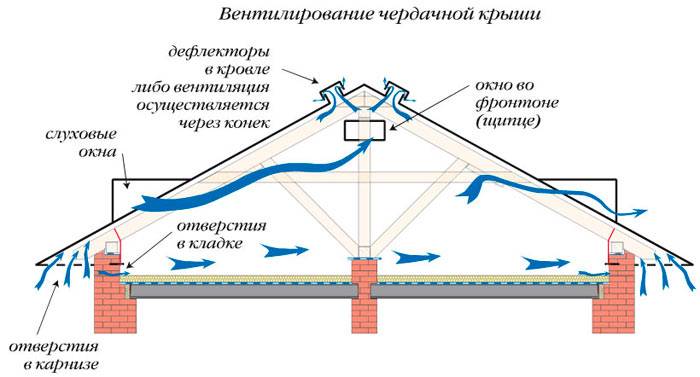
Attic ventilation scheme through dormer windows.
Roof valley or gutter is a more complex option for ventilation output. If the cornice overhang is too short and there are 2 ventilation gaps (or long grooves) on the roof, then certain difficulties may arise with the withdrawal of ventilation.
It is possible to ensure ventilation of the roof if ventilation openings are made in the film in each span of the truss system. Instead of an opening, you can make a solid channel for ventilation along the gutter.
In such difficult cases, aerator elements can be placed along the valley. This is very useful on roofs with a slope of 45°. If the roof is flat, then such ventilation will not be effective. In this case, the best option is roof fans powered by electricity, high ventilation nozzles, inertial turbines, etc. However, the cost of such ventilation is much higher than with the arrangement of ventilation in a natural way.
The most common way to create ventilation is to make a dormer window. This element carries not only a functional, but also a decorative load. The roof with a dormer window looks very attractive. You can make a hole for a dormer window of various shapes.
A single pitched dormer can be installed on any roof. The base of the gable should be a roof made of metal or soft coating. But if you wish, you can equip windows with a more complex design.



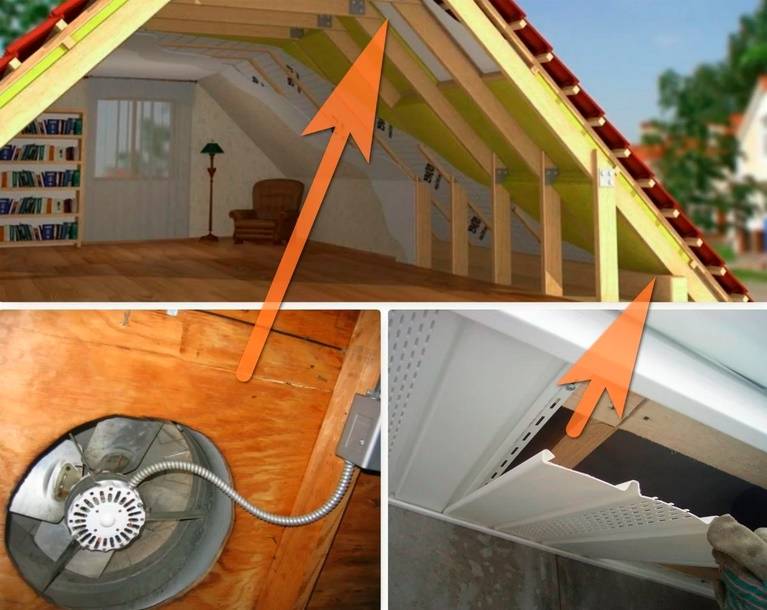



Thus, roof ventilation is an indispensable element that serves to remove warm and humid air from the house.With the help of a ventilation system, rotting and mold can be prevented on floor beams and roof supports. There are several ways to arrange ventilation on the roof. One method or another may be more or less effective depending on the design of the roof. In some cases, it may be necessary to include special devices in the ventilation system that operate from the mains. This will make ventilation more efficient, but will increase energy consumption. It is recommended to resort to this method of arranging ventilation only in cases where the roof structure prevents natural ventilation.
2
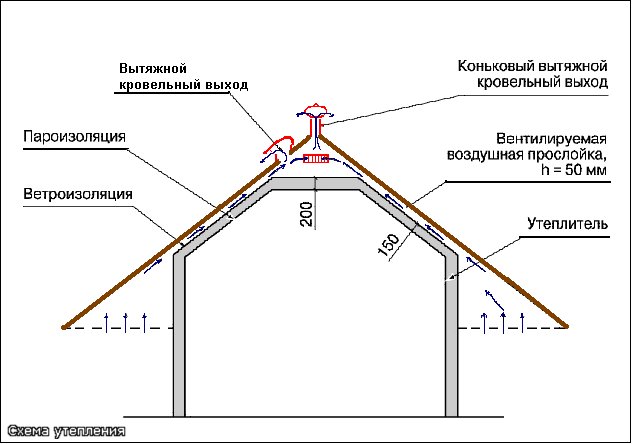
The width of the ventilated under-roof space depends on the roofing material you have used. The under-roofing space is called the air gap between the bottom of the roofing material and the waterproofing film or membrane, behind which there is a layer of insulation. For example, if the roof of your house is covered with metal tiles or any other metal-based material, the ventilated gap should be at least 2.5 centimeters.
When using soft (bituminous) tiles or other rolled materials, the thickness of the air gap must be at least 5 centimeters. The specified norms must be observed when attic ventilation is done. The main elements of the under-roof ventilation system are aerators and spotlights. The former play the role of exhaust openings, while the latter provide an influx of fresh air, and, therefore, prevent the formation of condensate and dripping moisture.
Aerators are ordinary, mounted on an inclined plane of the roof slope, and ridge aerators, which are installed at the highest point of the roof, that is, on the ridge. The number of aerators depends on the type of roofing material and the manufacturer's recommendations, but there is a general rule. It says that for every 500 sq.m. ventilated area should be 1 sq.m. ventilation holes. This ratio allows you to efficiently ventilate the room, avoiding tangible heat leaks.
Ridge aerators are considered the most effective, as they have a large outlet area. Ventilation of the attic floor with the help of ridge aerators is quite simple and does not cause difficulties even for beginners. The main thing is to follow the instructions, use high-quality fasteners and ensure good waterproofing at the junction of the roofing material.
As mentioned earlier, soffits are an important part of roof air exchange systems. Soffits are perforated siding panels designed for sheathing cornice overhangs of the roof around the entire perimeter of the building. In addition to the assigned functional load, they give the roof a complete look.
Soffits are not only perforated, but also non-perforated. The required number of perforated soffits is determined taking into account the area of the roof slopes. The use of these elements is possible only if a special gap between the materials was provided during the installation of the "pie"
In addition to the assigned functional load, they give the roof a complete look. Soffits are not only perforated, but also non-perforated.The required number of perforated soffits is determined taking into account the area of the roof slopes. The use of these elements is possible only if a special gap between the materials was provided during the installation of the "pie".
To achieve the maximum effect, it is better to use one type of aerator: either ridge or inclined, to ensure better air exchange. Proper installation of spotlights and aerators negates the formation of condensate and dripping moisture. When forced ventilation is used, supply fans are installed in the under-roof space.
Particular attention should be paid here to connecting the fan or fans to the mains. At the same time, it is necessary to ensure fire safety and more or less free access for their maintenance, replacement or repair.
How to equip attic ventilation?
During construction, roofers, as a rule, lay 50-60 mm of free gap under the deck when installing the roof. The optimal distance is equal to the width of the laths of the crate. If the roofing materials are solid, such as corrugated board or metal tiles, air can freely enter the building and under the roof
Air currents cool the roof, which is important for bituminous formulations
For soft roof another method is effective - small gaps are left in the crate. Penetrating the entire roof, they serve as channels for the passage of air into the room. In difficult parts of the roof, spot ventilation is done or additional turbines are installed for aeration.




For a cold attic
Attic equipment requires considerable investment and labor, so most pitched roofs have a cold attic type.The air temperature in it is much lower than in the residential parts of the building. Therefore, a spacious intermediate zone makes it easy to solve the issue of ventilation.
the roof in this case consists of the following elements:
- cover layer;
- External walls (in the case of pitched roofs with gables);
- Insulation in the form of an overlap between the walls and the attic space.
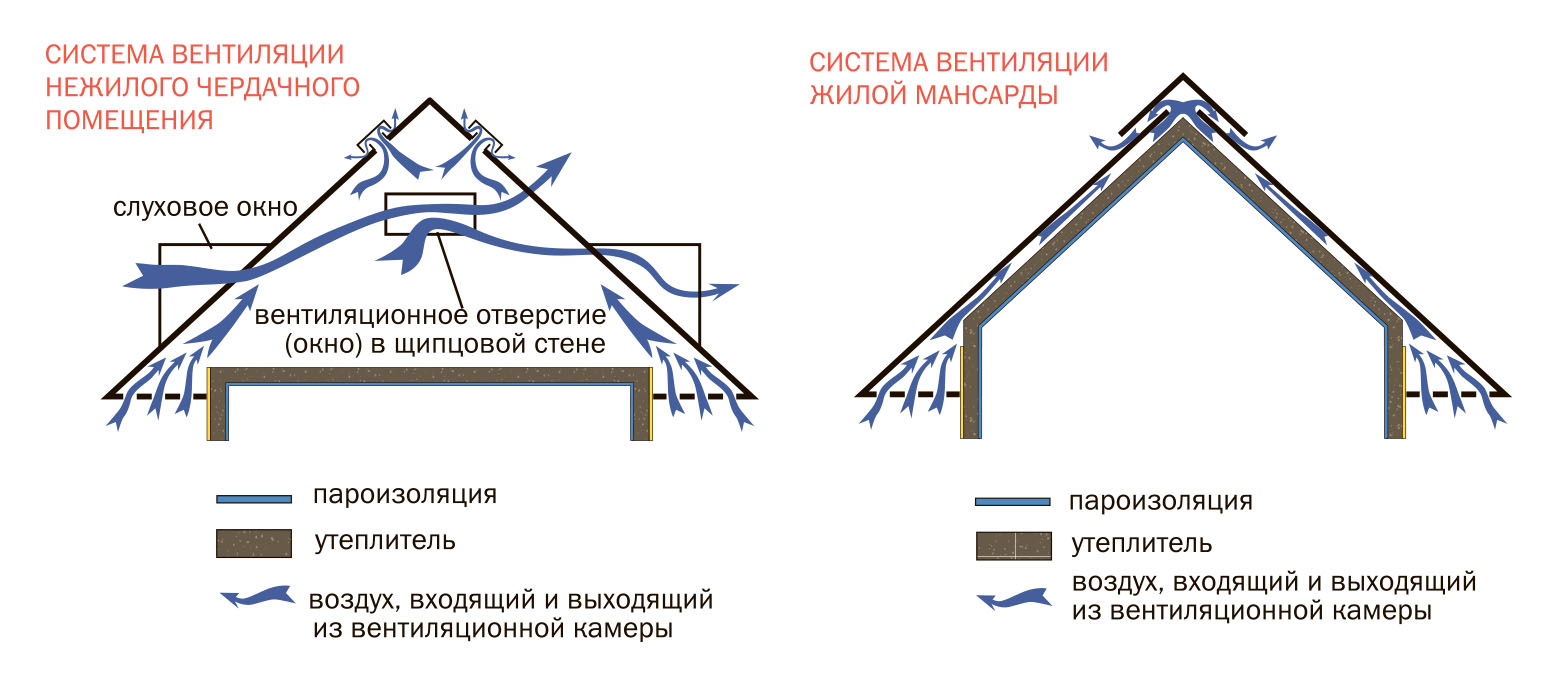
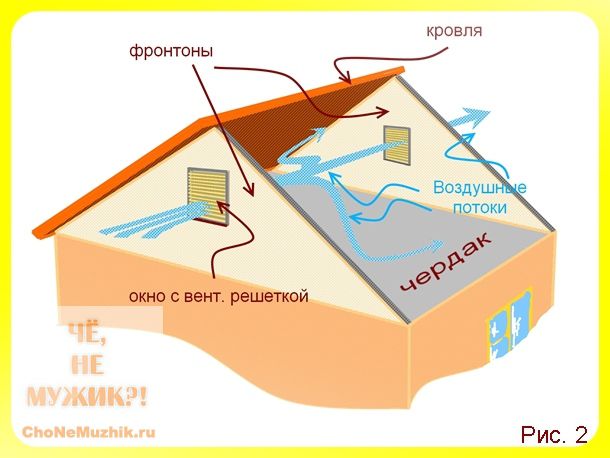
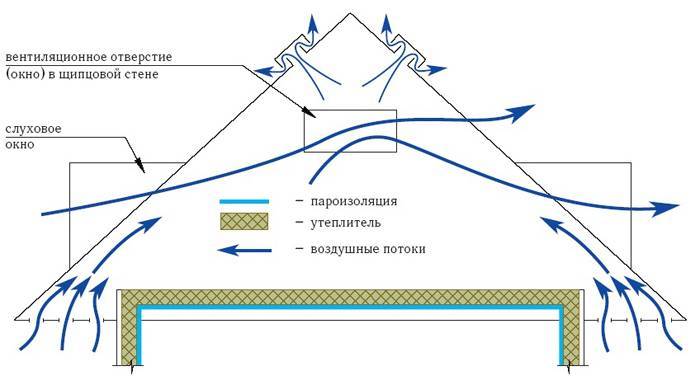
Cold attic ventilation provided by holes in the eaves and ridge of the roof. Through the cornice there is an influx of air, through the ridge - an extract. Dormer ventilation windows can be located on opposite slopes or stone gables of the roof. Thus, all areas are ventilated equally. Regulate the strength of ventilation with built-in blinds.
The ventilation window in the attic prevents condensation from accumulating on the roofing pie. It can also be used as access to the roof to inspect the elements of the system and the chimney. A popular solution is to install perforated soffits on the eaves of the roof. Soffits perform two functions - they allow air to flow freely under the roof, while preventing insects from flying into the building.
For a warm attic
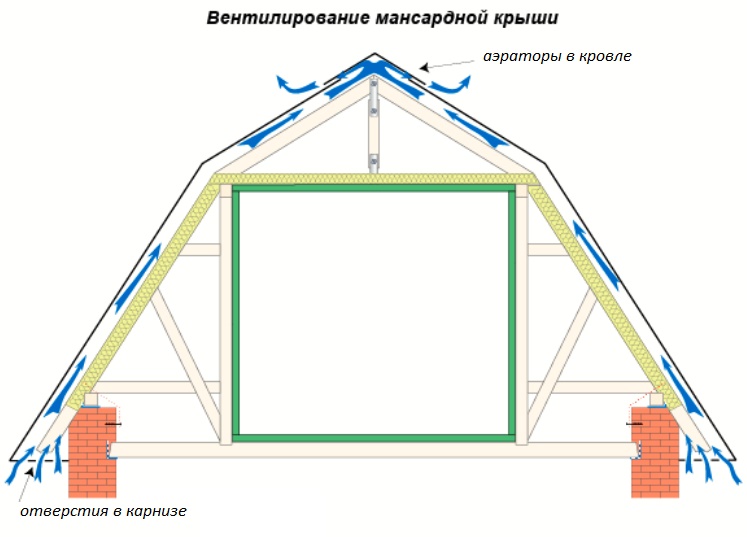
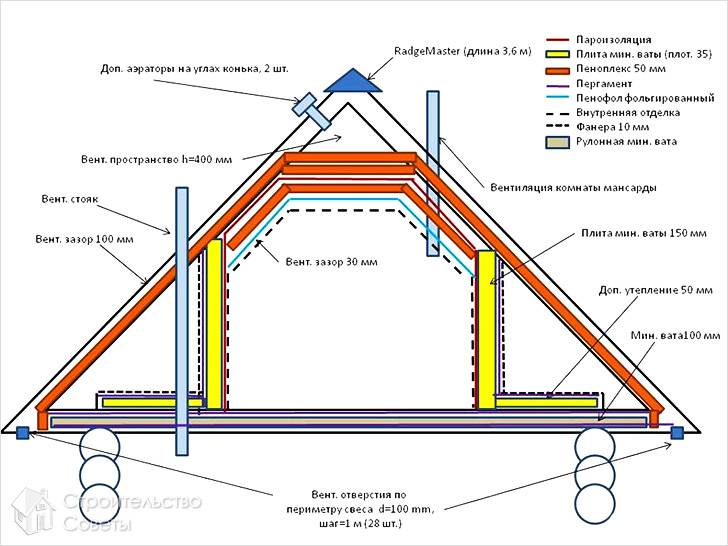
Traditionally, the attic is made cold, warm is mounted if they plan to use it in the future as a residential attic. The main task is to remove vapors and excess moisture, leading to the loss of the properties of the internal insulation. Her solution lies in the arrangement of a ventilated roof.
A warm attic in a building structure is usually designed for the entire upper floor above the living space. Unlike a cold counterpart, the room is sealed, has fences from the outside.Stagnant air from the building is drawn out into the street through channels on the roof ridge. Fresh air is blown through the windows. For the winter they are insulated, protecting them from ice and icicles.
As an element of the ventilation system, a warm attic appeared in the late 70s. The use of the attic has become relevant, mainly for multi-storey buildings. A warm attic has the following advantages over a cold attic:
- Provides the proper temperature level on the ceiling of the upper residential floor of the building. At the same time, the rafter space of the roof is also insulated;
- Reduces aerodynamic resistance when air is released from the ventilation system in a natural way;
- Reduces heat loss and the risk of water leakage.
How to avoid mistakes when creating ventilation?
There are a number of misconceptions about attic ventilation. It is usually assumed that:
- It is necessary to ventilate the attic in the summer, in the heat, to avoid overheating of the roof. In fact, in winter, the ventilation system is needed no less, since water and snow cause fungus and mold to form, and ice to freeze.
- An air-blown attic interferes with the preservation of heat in the house. In fact, it does not interfere, it all depends on the thermal insulation. At the same time, a high-quality ventilation system does not allow cold and humid air to linger in the attic.
- The dimensions of the air vents in the attic can be chosen arbitrarily. On the contrary, dimensions are important, since the efficiency of the process depends entirely on maintaining the correct proportion. There should be one meter of ventilation holes per 500 square meters of roof.
According to the recommendations of experts, the owner of the house chooses in advance what type of attic space will be in the building - warm or cold. For construction, it is important to properly design the ventilation system in order to achieve effective ventilation of the room.
Roof ventilation methods
In a private house roof ventilation is organized by one of methods:
- dormer attic windows;
- ventilation gaps when installing the roof;
- specially designed skates;
- different elements with ventilation holes;
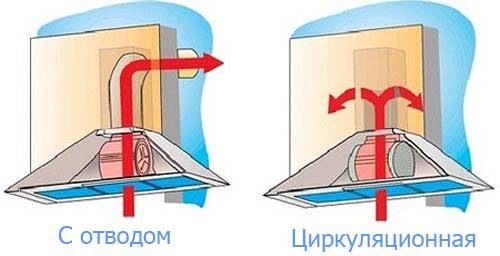
- an exhaust fan for the roof (you can see tips for installing a do-it-yourself hood with and without a vent to the ventilation here);
- ventilation of the chimney, cornices;
- ventilation on gable roofs of skates.
- Hip - with air outlet due to natural ventilation from under the ridge. When filing cornices, perforated plastic plates or slot-mounted boards are used, where ventilation grilles of supply-type systems are also equipped (how to arrange supply ventilation with your own hands?). The frequency of installation of such gratings should not exceed 80 cm with a diameter of one to 5 cm.
- Attic - with systems for removing air from the room to the outside of a natural type. The main components of such a ventilation system are: roofing material, wooden counter-lattice, base lathing, insulation with fixation between the rafters, vapor barrier membrane or film.
- Shed - does not require the arrangement of separate skates or aerators, even if located above living areas, and not just above a terrace or veranda.Empty openings are left for the natural movement of air masses (how to make natural ventilation with your own hands?).
- Soft-tiled - it is required to create a ventilation gap when covering the roof with this material. The thickness of the beam between the base of the roof and the roofing material is from 5 cm, to bring fresh air into this cavity, gaps are required from the bottom of the ramp, aerators or ridge vents are installed on the hood, a crate with gaps is mounted.
- Metal-tiled - a gap is created between the thermal insulation layer and the metal profile 5 cm wide with the obligatory laying of a seal under the ridge. The total area of all products should not differ greatly from 1% of the total roof area. Ventilation outlets and PVC pipes act as the basis of the ventilation system with a step for every 60 m2 of area and a diameter of 0.5 m (how to make ventilation from plastic pipes with your own hands?). To divide the roof into two slopes, a ridge board is used to ventilate the ridge.
- Seam - more airtight than other types of roofing. Requires a powerful design of the ventilation system. A layer of vapor barrier is laid on the rafter legs, a crate with gaps is installed. The coating is completed with a waterproofing membrane or film.
- Profiled - requires the arrangement of a natural type of ventilation. The tent ridge removes air up to 10 m long, otherwise the flow exits through the end. It requires the arrangement of waterproofing and the installation of a batten with a thickness of the lower slats 50% more than the upper ones. For the free exit of vapors from under the roof, waterproofing is required not up to the ridge itself.
Attention
With the correct calculation of ventilation, depending on the material of the roof and the type of roof, effective roof ventilation is ensured.
Air supply
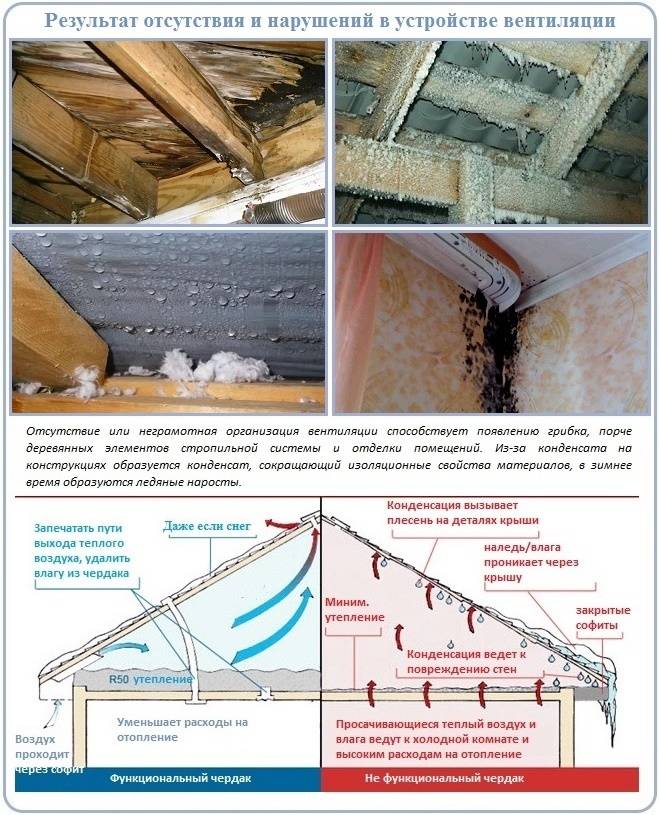
And if there is no good ventilation in the attic room or it does not work well enough, this will certainly entail unpleasant consequences.

Among them are the following:
- 1. Development of sustainable stale air.
- 2. The appearance of putrefactive formations.
- 3. The appearance of mold under the ceiling and on wall structures.
- 4. Rotting of the roof structure.
- 5. The appearance of condensate on the heat-insulating layer.
- 6. The formation of icicles that hang over the roof in the cold season.
However, these are not the worst consequences of the lack of ventilation. Prolonged exposure to dampness and fungus on the roofing cake will cause deformation of wooden surfaces, wetting of the insulation and other unpleasant problems. If putrefactive processes begin to develop in the wood, this will lead to its complete destruction and the collapse of the entire roof.



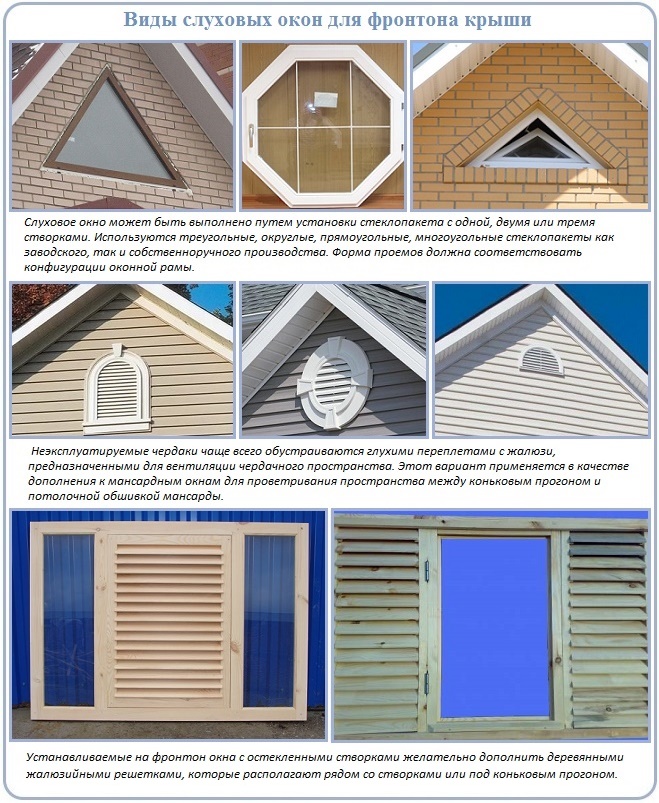

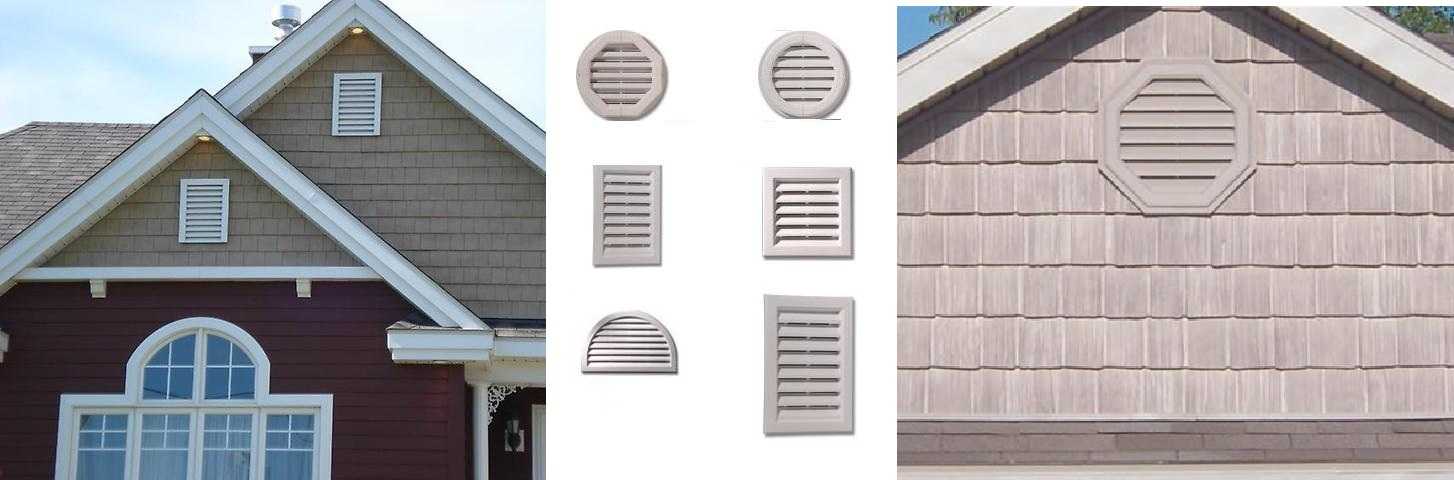

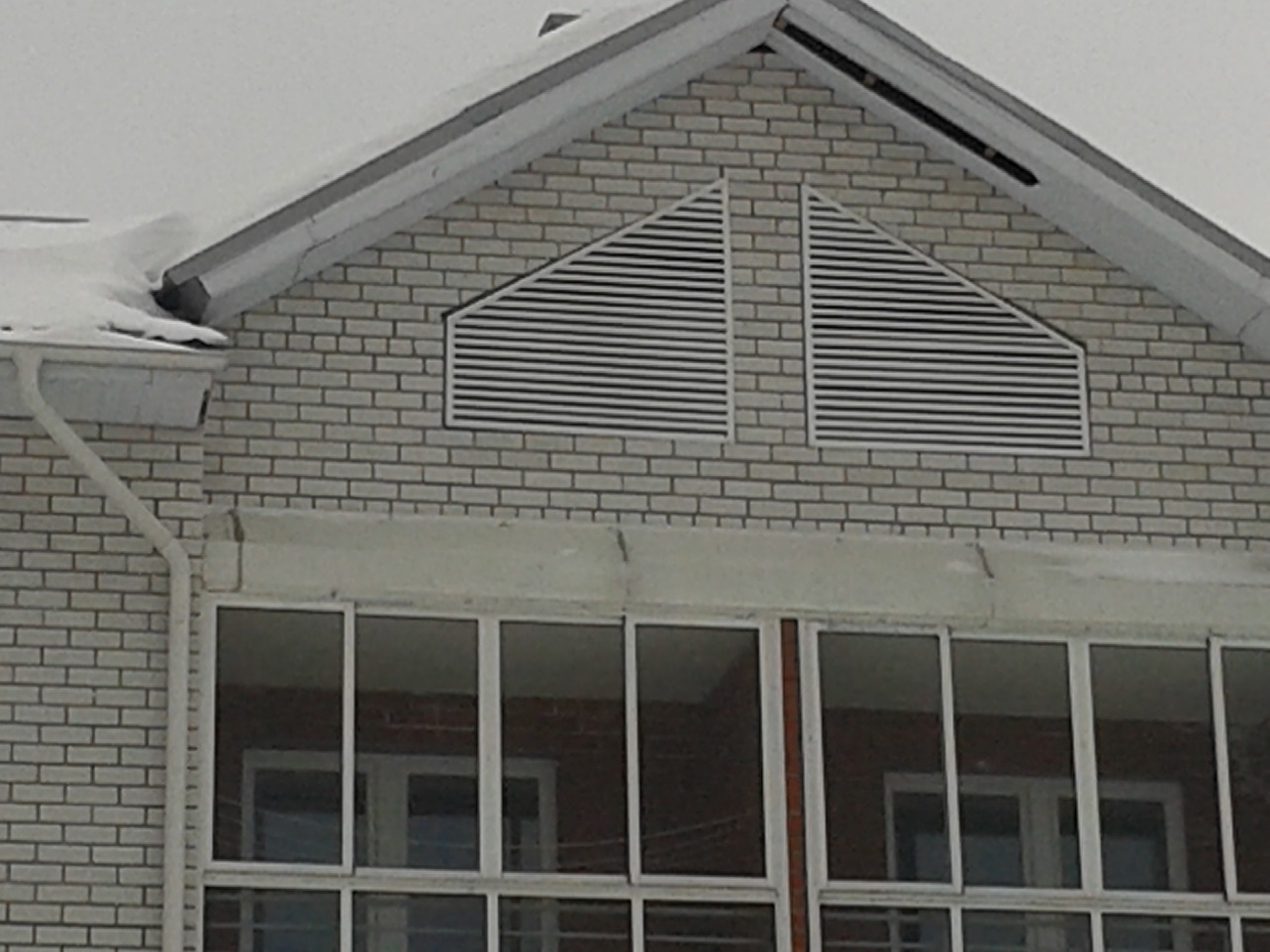
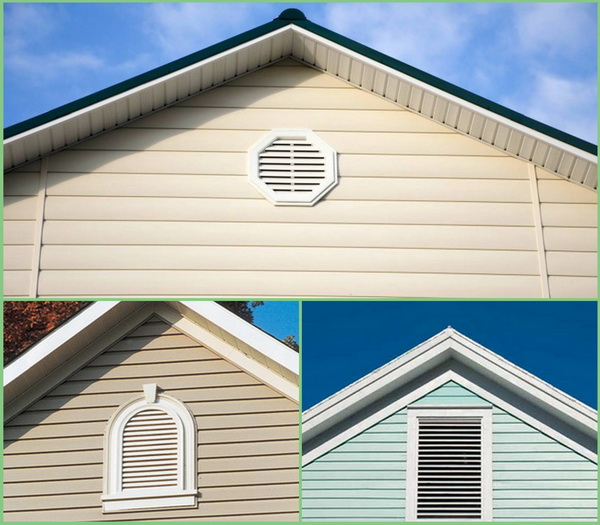
To remove air from the attic, a ventilated grate in the gable is used. It is used for non-exploited cold attics. Suitable for hip, broken and gable roofs. Such grilles are open all year round, which ensures constant exhaust and air removal from the attic.
A special roof ridge is the most versatile method that is used for both warm and cold roofs.
In this case, a special lattice is created on the metal tile or corrugated board under the ridge bar. Thanks to this design, the condensate that will form in the cool season will not enter the room, but will flow down the slope to the roof.
Special skate
Special aerators are additional elements that are installed directly on the roof and serve to remove exhaust air from the under-roof space.
Attention: special aerators allow not only to effectively remove the exhaust air, but also prevent the penetration and formation of condensate. Aerators on the roof Advice: an aerator can be installed when a private house has been in operation for a long time, and ventilation for the attic has not been provided or is not efficient enough
Aerators on the roof Advice: an aerator can be installed when a private house has been in operation for a long time, and ventilation for the attic has not been provided or is not effective enough.
Elements such as special eaves vents provide fresh air under the roof. The installation of the air vents is carried out vertically, as shown in the photo below, and a cornice strip with small gaps is installed on top of them.
Products for cornices
Ventilation spotlights - special barrier grilles that provide fresh air.
Soffits are installed at the lower end of the overhang with the help of special barrier gratings.
Soffits for ventilation
The more often ventilation holes are installed in the spotlights, the more effective will be the flow of cold air into the attic and under-roof space.
Advantages of natural air exchange
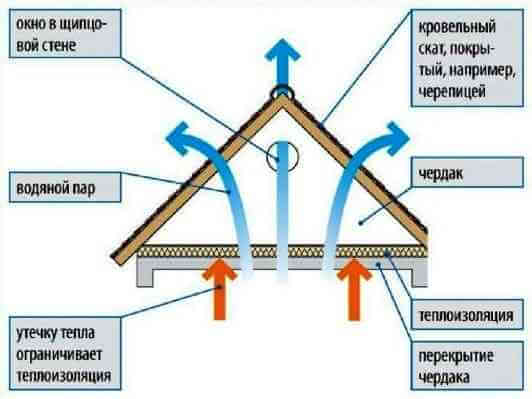
When installing air vents and dormer windows, it is possible to ensure air circulation, which will be carried out due to the pressure difference between external and internal masses, as well as gusts of wind.However, such ventilation of the attic space depends on various factors: temperature differences, wind direction and strength, the quality of the work performed, and so on.
And yet for such premises it is quite suitable:
- No costs for energy resources and the purchase of equipment, the price of which is quite high.
- During operation, any emergency situations are excluded, since complex devices are not used in the process of air exchange.
- Thanks to a simple device, work can be done independently.
- Sufficient efficiency for non-residential premises avoids excessive moisture, which leads to the formation of mold.
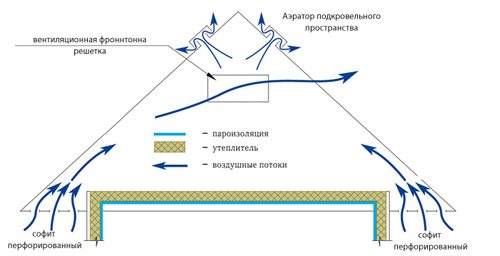
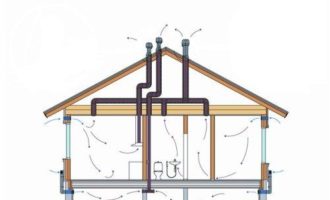
One of the schemes for the circulation of air masses.
Natural ventilation in the attic
The effectiveness of natural ventilation in the attic depends entirely on how well the insulating materials are laid.
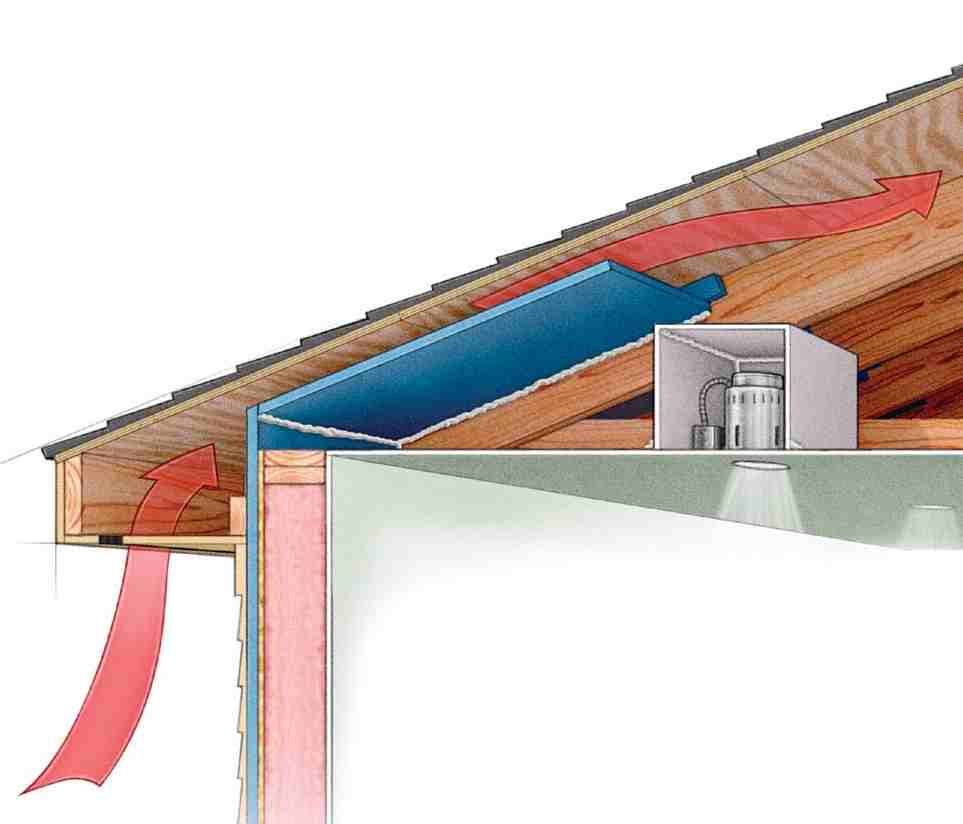
When installing insulation, it is important to ensure the presence of special holes located between its layers and the roof. With properly located supply and exhaust openings, a natural draft is created, which ensures the supply of fresh air and the removal of exhaust air. With correctly located supply and exhaust openings, a natural draft is created, which ensures the supply of fresh air and the removal of exhaust air.
With properly located supply and exhaust openings, a natural draft is created, which ensures the supply of fresh air and the removal of exhaust air.
The total area of such a system is calculated based on the fact that the area of the holes should not exceed 0.2% of the total area of the room.
The simplest, but at the same time very an effective way is the organization of air exchange through the gables. However, this method is not applicable to stone buildings.


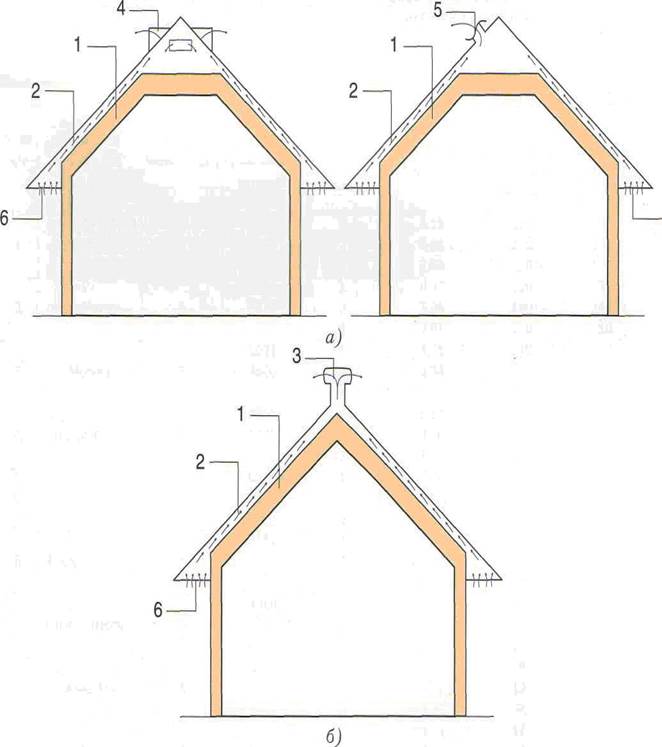


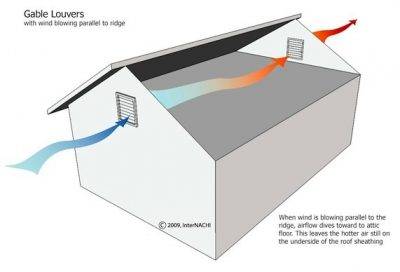
The dimensions of the gap that must be left for unobstructed air transmission depend on the material from which the roof is made:
- If the roof is made of metal profiles, metal tiles or tiles, the gap should be made no more than 2.5 cm.
- If soft materials or a flat covering are used, the allowable gap is no more than 5 cm.
- If, in addition to insulation, waterproofing is also installed, the distance between these layers should be from 2 to 3 cm.
In order for natural air exchange to be effective, it is necessary to ensure the tightness of the ventilation cavities. It is thanks to this that you can achieve good traction and the absence of "dead zones".
It functions best in the cold season, when the delta between the air temperature in the room and outside the building is maximum.
Another constructive solution is the installation of dormer windows on the roof. The shape of such windows can be any, it all depends on the taste of the owner of the building.
It should be noted that the installation of such structures not only improves the appearance of the house, but also increases the efficiency of natural ventilation.
The advantages of natural air exchange include ease of installation and relative cheapness.
Of the minuses, it is important to note that the efficiency of work directly depends on the ambient temperature.
In very hot weather, the attic can generally be left without ventilation.
Installation of exhaust ventilation
The hood in a wooden house is absolutely opposite to the supply ventilation according to the principle of operation. If in the first case there is a mechanical effect on the air inflow, then in the second - on its outflow from the house.
For the installation of this ventilation, exhaust pipes are carried through the wall. In the exhaust openings in the rooms, fans are installed that draw in air masses. The effective functioning of this system requires the following conditions:
- supply channels are below the exhaust ones;
- heated air masses rise under the pressure of cold air masses to the ceiling.
The hood in a wooden house is especially necessary in some rooms, for example, in the kitchen. It purifies the air and regulates humidity.
The main disadvantages of exhaust ventilation are:
- low efficiency;
- the possibility of insufficient inflow of fresh air (the rate of its intake in a natural way is lower than the rate of removal);
- large heat losses.
Tips, tricks and possible mistakes
Often the ventilation system is installed during the construction process, if it becomes possible to plan the exit, calculate the perimeter, choose the optimal place on the roof, etc. It is more difficult to equip ventilation in a built house. An external change inside the room can adversely affect the elements of the roof: rafters, crates, etc.
Incorrect installation can lead to the following consequences:
- weak traction;
- the penetration of smell from one room to another;
- penetration of moisture into the dwelling;
- high humidity;
- lack of oxygen;
- the occurrence of fungal bacteria on the wall, ceiling, floor;
- unpleasant smell in the room;
- the appearance of soot in the kitchen;
- penetration deep into the building of smoke from other pipes;
- increase in the intensity of illnesses of residents;
- freezing of parts of the structure.
Proper installation of ventilation pipes on the roof is the key to a comfortable home and a healthy state of residents.
Having made a competent choice of the location of the outlet of the ventilation duct on the roof, observing the technology of its installation and using auxiliary devices, it is quite easy to create a favorable air movement inside the system and create a cozy atmosphere inside the home.
Metal roof ventilation
The metal roof is beautiful, modern, durable and reliable, but it has one big drawback - limited air exchange, that is, it does not pass air well. To ensure normal circulation, ventilation is established according to the following algorithm:
- Holes are made in the cover sheet for the exit of ventilation ducts, adhering to the norms - one hole per 60 m² and placing them at least 0.6 m from the ridge. On a roof with a complex structure, the number of exits is increased.
- The front metal part near the hole is treated with an antiseptic to prevent corrosion.
- The rubber seal is coated with silicone and reinforced with screws.
- After the sealant dries, install the penetration and fix it with special screws included in the delivery.
- From the inside, they provide a reliable connection with vapor and water insulators (films).
-
To prevent moisture from penetrating into the insulation, a sealant is additionally applied at the junction of the insulation.
The nuances of arranging ventilation systems for cold and warm attics
To ventilate a room under a roof, it is not at all necessary to create complex engineering systems or install exhaust fans.As a rule, in such cases, they make ordinary air ducts in the attic, which are able to provide natural circulation of air currents.



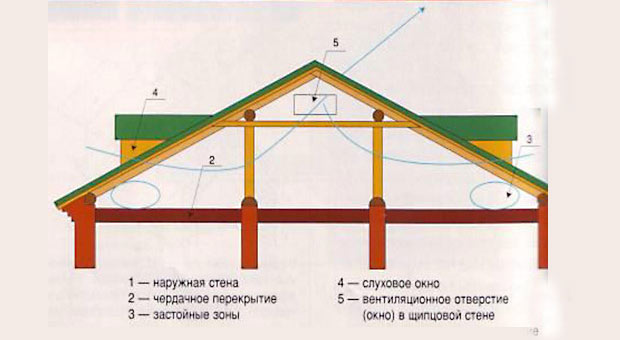

Ventilation system without attic insulation
Natural air circulation through the vents Adjusting the air flow according to the need at any given moment is very important, so you should leave free access to the gratings, not covering it with rafters. Also on ventilation ducts you need to make dampers that will allow you to increase, decrease or even block the air flow.
Such an adjustment system is necessary for tight roofing, for example, corrugated board or metal tiles, where the sheets are tightly closed at the joints. In the event that the overlap is made with materials such as wave slate or ondulin (in the absence of a waterproofing film), air should not be made - there are enough gaps between the waves for air circulation.
Ventilation on the gable through the dormer window
All gable and mansard roofs have gables, where it is installed grille for ventilation attic space, and on the one hand it is placed with holes down, and on the other, adjustments are made. In cases where the structures are hip, semi-hip or multi-gabled gables, as a rule, there are no, but, nevertheless, a dormer window can be made there, where a lattice can be placed.
Pipe device (aerators) for ventilation of roofs
If there is no entrance from the street to the cold attic, and there are no dormer windows, which is often found in modern architecture of private housing construction, then roof fans - aerators are installed.Such a device is a pipe in the form of a glass, protected from above from precipitation by a head. In some cases, a non-return valve is also added there.
Calculation of the ventilation system
Ventilation system for a warm attic
The situation with air circulation in a heated attic, that is, an attic, looks somewhat different. In the room itself, the process of air exchange occurs, as in living rooms - through doors, windows, vents and grilles specially provided for this (possibly with forced exhaust). But here it is separately necessary to provide a ventilation gap under the roofing material in view of its insulation from the underside.
Scheme of air circulation in the attic with heating
If the roofing material on your house is ondulin or slate, then to ensure good circulation, it is enough to maintain a distance of 20-30 mm between the roof and the insulation (waterproofing) - the air will pass through the wave joint. But in cases where corrugated board, metal tiles, seam or soft coatings are used, the roof will turn out to be airtight, which will contribute to the formation of condensate and, as a result, fungal mold.
In addition, condensate will destroy the metal coating, and moisture can also penetrate through the loose connection of the waterproofing. In such cases, gaps for air circulation are left on the filing of the overhangs (below) and under the ridge (above). For metal, additional waterproofing is also used during its installation.