- Calculation of natural ventilation of residential premises
- Calculation of the ventilation system: example
- Regulatory framework of the Russian Federation
- Legislative acts and GOSTs
- Certification of ventilation equipment
- How is the ventilation system in apartment buildings
- Features of arrangement and functioning in panel houses
- 9.2. Calculation of mechanical exhaust ventilation with natural inflow.
- Who should clean the ventilation in an apartment building
- State control
- Varieties of ventilation systems
- Natural ventilation of boiler rooms
- Forced ventilation system
- Flow hole diameter in ventilation systems
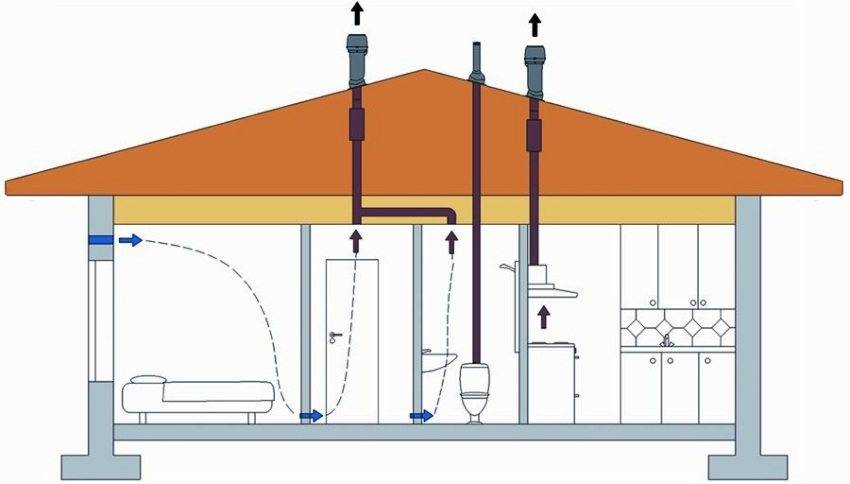
- Methods for organizing air exchange in the house
- Calculation of the amount of air
- Features of arrangement and functioning in panel houses
- Possible options for arranging ventilation in high-rise buildings
- We provide circulation
- Conclusions and useful video on the topic
Calculation of natural ventilation of residential premises
The calculation consists in determining the supply air flow rate L in the cold and warm periods of the year. Knowing this value, one can choose sectional area of air ducts.
A house or apartment is considered as a single air volume, where gases circulate through open doors or a canvas cut 2 cm from the floor.
The inflow occurs through leaky windows, external fences and by ventilation, removal - through exhaust ventilation ducts.
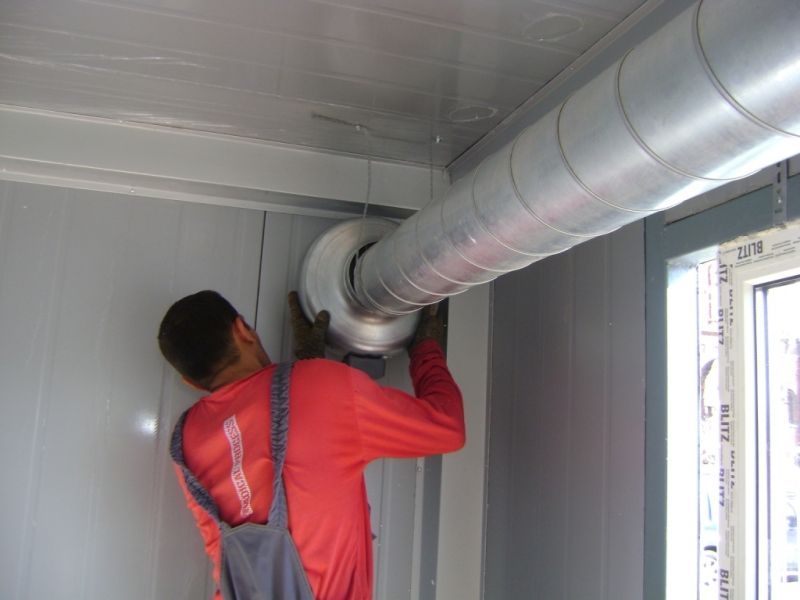
Installation of ventilation
The volume is found by three methods - multiplicity, sanitary standards and area. From the obtained values, choose the largest. Before calculating ventilation, determine the purpose and characteristics of all rooms.
Basic formula for the first calculation:
L=nхV, m³/h, where
- V is the volume of the room (the product of the height and the area),
- n - multiplicity, determined according to SNiP 2.08.01-89, depending on the design temperature in the room in winter.
According to the second method, the volume is calculated based on the specific norm per person, regulated by SNiP 41-01-2003. The number of permanent residents, the presence of a gas stove and a bathroom are taken into account. According to tab. M1, the consumption is 60 m³ / person per hour.
The third way is by area.
L=Axk, where
- A is the area of the room, m²,
- k - standard consumption per m².
Calculation of the ventilation system: example
Three-room house with a total area of 80 m². The height of the premises is 2.7 m. Three people live.
- Living room 25 m²,
- bedroom 15 m²,
- bedroom 17 m²,
- bathroom - 1.4² m²,
- bath - 2.6 m²,
- kitchen 14 m² with four-burner stove,
- corridor 5 m².
It is required to calculate the air balance.
Separately, they find the flow rate for the inflow and exhaust, so that the volume of incoming air is equal to the amount removed.
Inflow:
- living room L=25x3=75m³/h, multiplicity according to SNiP.
- bedrooms L=32х1=32 m³/h.
Total consumption by inflow:
L total \u003d Lguest. + Lsleep \u003d 75 + 32 \u003d 107 m³ / h.
Hood:
- bathroom L= 50 m³/hour (tab. SNiP 41-01-2003),
- bath L= 25 m³/h.
- kitchen L=90 m³/hour.
The inflow corridor is not regulated.
By extract:
L=Lkitchen+Lbathroom+L bath=90+50+25=165 m³/h.
The supply flow is less than the exhaust.For further calculations, the largest value L=165 m³/h is taken.
According to sanitary standards, the calculation is carried out based on the number of residents. Specific consumption per person is 60 m³.
L total \u003d 60x3 \u003d 180m / h.
Taking into account temporary visitors, for whom the set air flow is 20 m3/h, we can assume L=200 m³/h.
By area, the flow rate is determined taking into account the standard air exchange rate of 3 m² / hour per 1 m² of living space.
L=57х3=171 m³/h.
According to the results of calculations, the consumption according to sanitary standards is 200 m³ / h, the multiplicity is 165 m³ / h, over the area 171 m³ / h. Although all options are correct, the first option will make living conditions more comfortable.



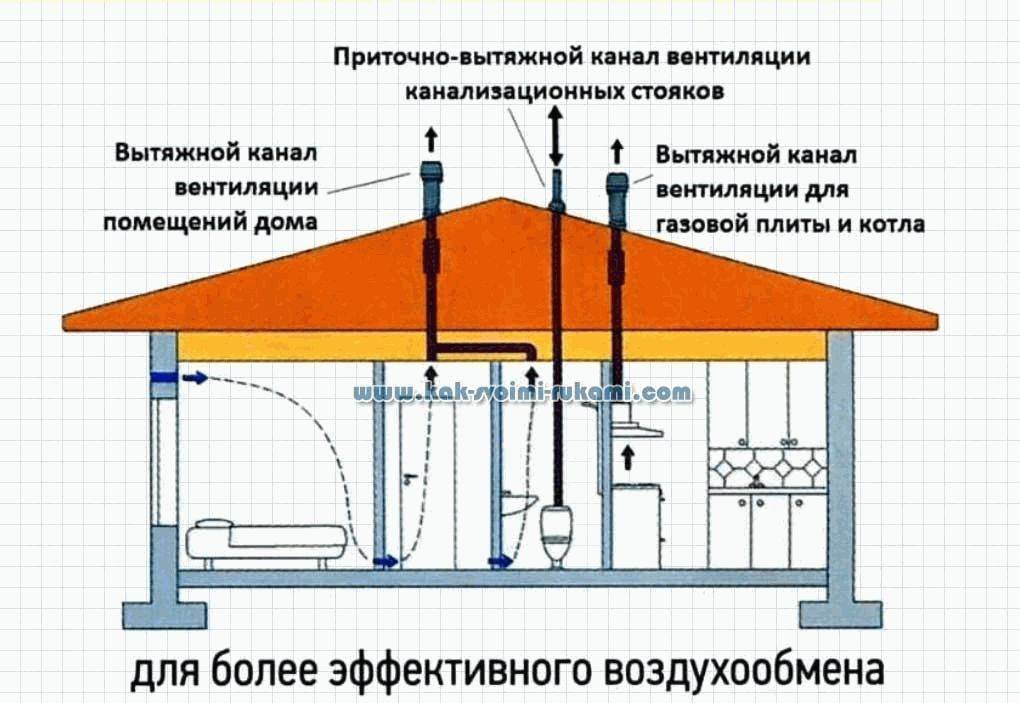
Regulatory framework of the Russian Federation
Installation of ventilation systems is mandatory regardless of the type of heating equipment used (p. 9.38 of SNB 4.03.01-98). Installation of heating and ventilation equipment is carried out under the supervision of representatives of gas services.
If, during the commissioning tests, defects in the ventilation system and technical inconsistencies with the design documentation are revealed, the commissioning of the heating system will be refused.
The tasks of the gas service inspector include visual inspection of the equipment, checking the safety functions, control and making control measurements of carbon monoxide. If necessary, the owner of the premises may require the inspector to provide certificates of permission to work with an anemometer or SRO
Ventilation provides a constant intensive supply of fresh air. The functioning of exhaust systems is regulated by a number of regulations.
Legislative acts and GOSTs
The regulatory framework relating to ventilation and air conditioning of gas equipment is quite extensive. These NPAs include:
- Federal Law No. 384;
- Government Decree No. 1521 on mandatory enforcement of 384-FZ;
- Government Decree No. 87;
- Government Decree No. 410 on security measures for the maintenance of gas equipment;
- SNiP (II-35-76, 2.04-05);
- SanPiN 2.2.4.548-96. 2.2.4;
- ABOK standards and recommendations in the field of ventilation, etc.
But legislative acts may change, therefore, when installing ventilation equipment for arranging a gas boiler house, one should follow their latest revisions in official sources.
All standards and regulations that will be applied when checking ventilation equipment can be clarified at the gas service of your locality
Also, all ventilated systems in rooms with boiler equipment must comply with the following GOSTs and SPs:
- GOST 30434-96;
- GOST 30528-97;
- GOST R EN 12238-2012;
- GOST R EN 13779-2007 on air conditioning and ventilation in non-residential buildings;
- GOST 30494-2011 on the microclimate in residential and public buildings;
- SP 7.13130.2013 on requirements for ensuring fire safety;
- GOST 32548-2013 (interstate standard);
- SP 60.13330.2012 (refers to SNiP 41-01-2003), etc.
Based on these regulations, design documentation should be drawn up. So that it does not contradict official requirements and standards, it is necessary to carry out thermal calculations and calculate the main parameters of the exhaust system at the stage of project development.
Certification of ventilation equipment
When buying exhaust devices and fresh air supplies should check their paperwork. For ventilation equipment sold on the territory of the Russian Federation, a declaration of conformity is mandatory.
This document confirms that the devices comply with all current requirements of the Customs Union, as set out in the following technical regulations:
- TR TS 004/2011 on the low-voltage equipment used and the safety of its operation;
- TR TS 020/2011 on the electromagnetic compatibility of the equipment used;
- TR TS 010/2012 on the safety of machinery and equipment.
This product declaration is mandatory, but in addition to it, the manufacturer or importer of ventilation equipment can undergo an official voluntary certification procedure for compliance with GOST standards. The presence of such a certificate, obtained on a voluntary basis, indicates the high quality of products and the reliability of the manufacturer.
A voluntary certificate of conformity for air ducts can be requested when purchasing ventilation equipment for a gas boiler house. It contains all technical specifications of the product.
But voluntary certification requires additional investment, so it is often saved on it. In accordance with Federal Law No. 313 and Government Decrees No. 982 and No. 148, mandatory certification of ventilation equipment has been abolished.
How is the ventilation system in apartment buildings
Comfortable housing is not only nicely decorated rooms with comfortable furniture and original finishes. First of all, it is a properly working plumbing, electricity, heating and ventilation of the apartment. On these "whales" the concept of comfort is based, imperceptible to most. The ventilation system is a multifaceted and complexly organized installation
Before its organization, it is important to understand how it works and on what principles it functions.
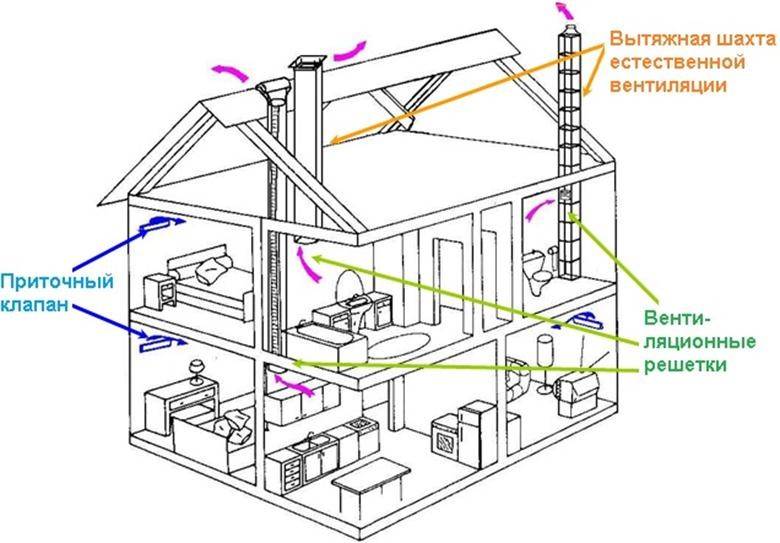
Their work is often based on natural ventilation - the effect of "draft" through ajar windows, doors and vents.
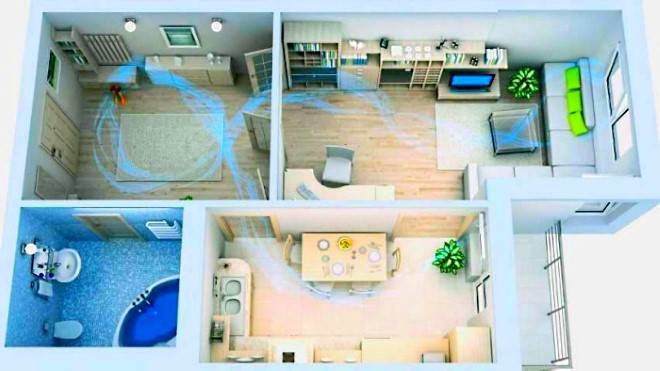
The flow of air masses during natural ventilation
It is easy to distinguish a number of obvious “pluses” from such an air exchange implementation scheme:
- the equipment is publicly available, even a beginner can handle its installation, the prices are low;
- independence from the power supply, the operation of ventilation in the apartment is “not tied” to other systems, it is autonomous;
- comfortable conditions for the life of households are created in the living space.
This principle is characterized not only by obvious advantages, but also by a number of obvious disadvantages.
For effective air exchange, it is important that the temperature regime inside the room is higher than in the external environment.
Due to the effect of reverse thrust, there is a possibility of small debris entering the housing.
Natural air exchange is morally obsolete and is practically not used in modern homes. Forced supply and exhaust ventilation systems are much more preferable.
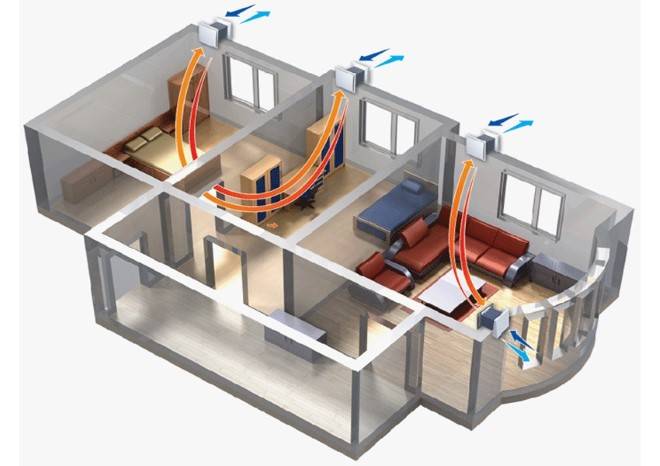
Forced air exchange
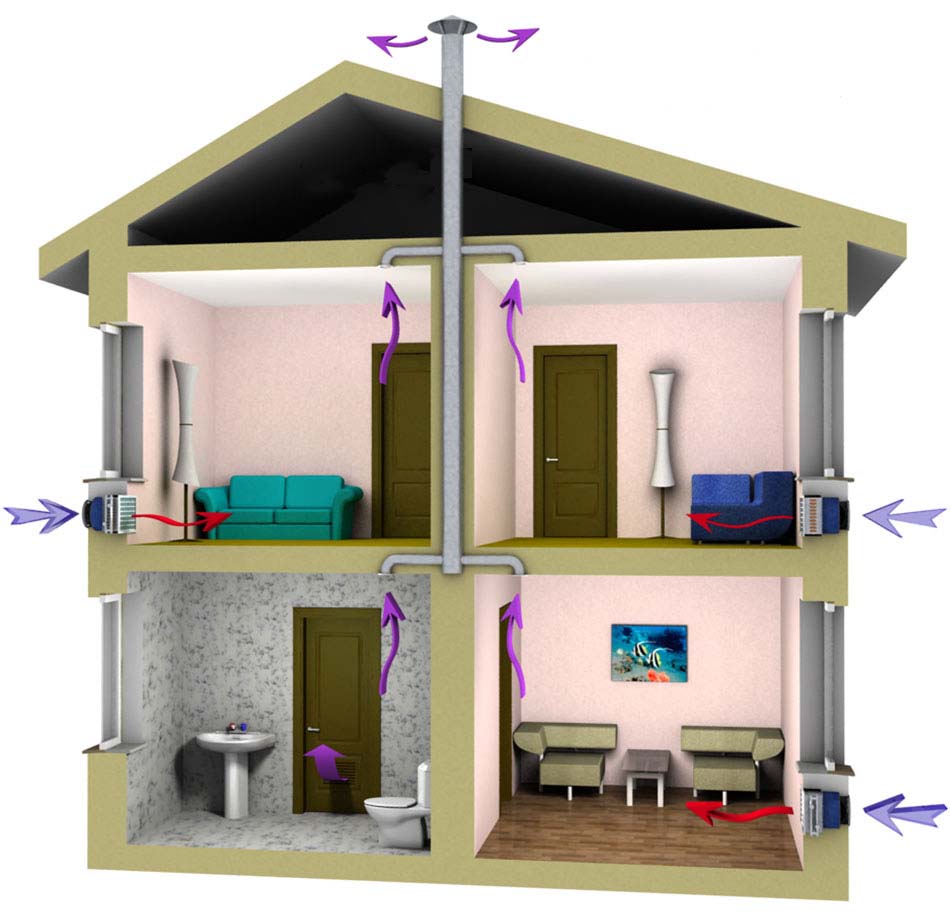
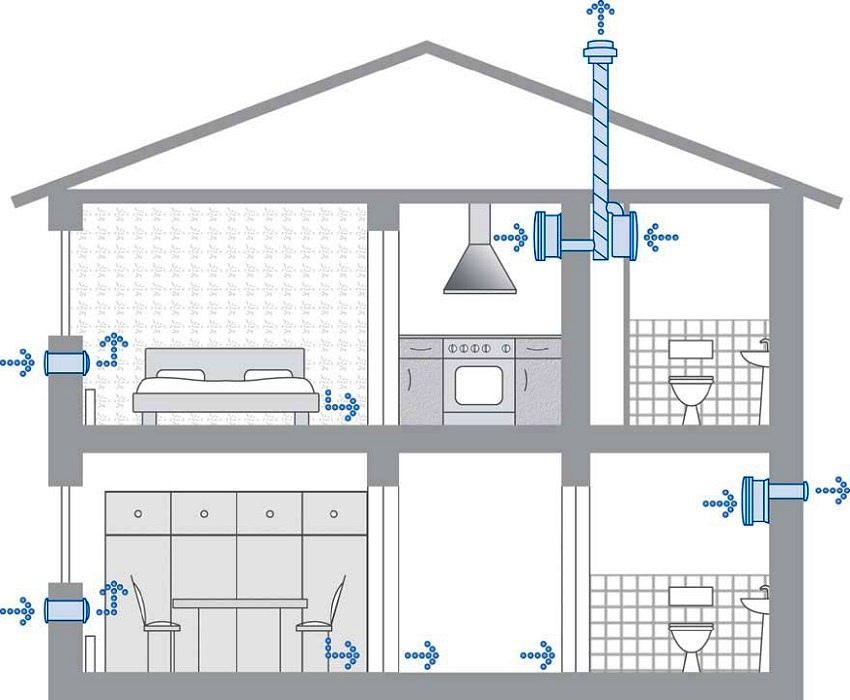
Air exchange of a multi-storey building is provided by specially installed fans. In cases where there is no draft in the apartment, the installation is activated and the exhaust air masses are removed from the living quarters. As a rule, the ventilation of apartments involves the presence of a supply valve for the intake of fresh oxygen. Removal is carried out due to natural air exchange.
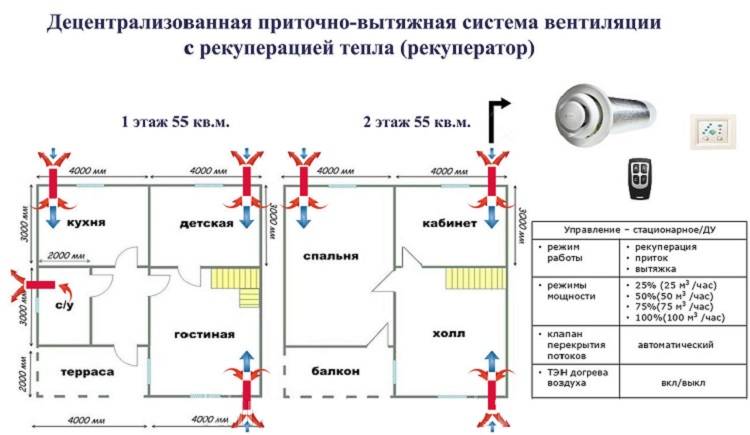


Features of arrangement and functioning in panel houses
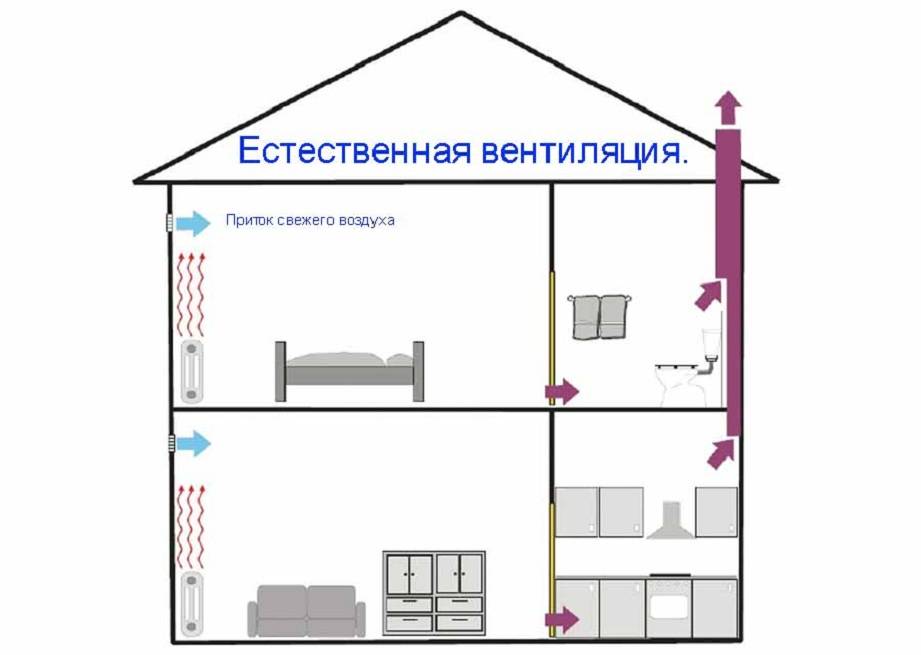
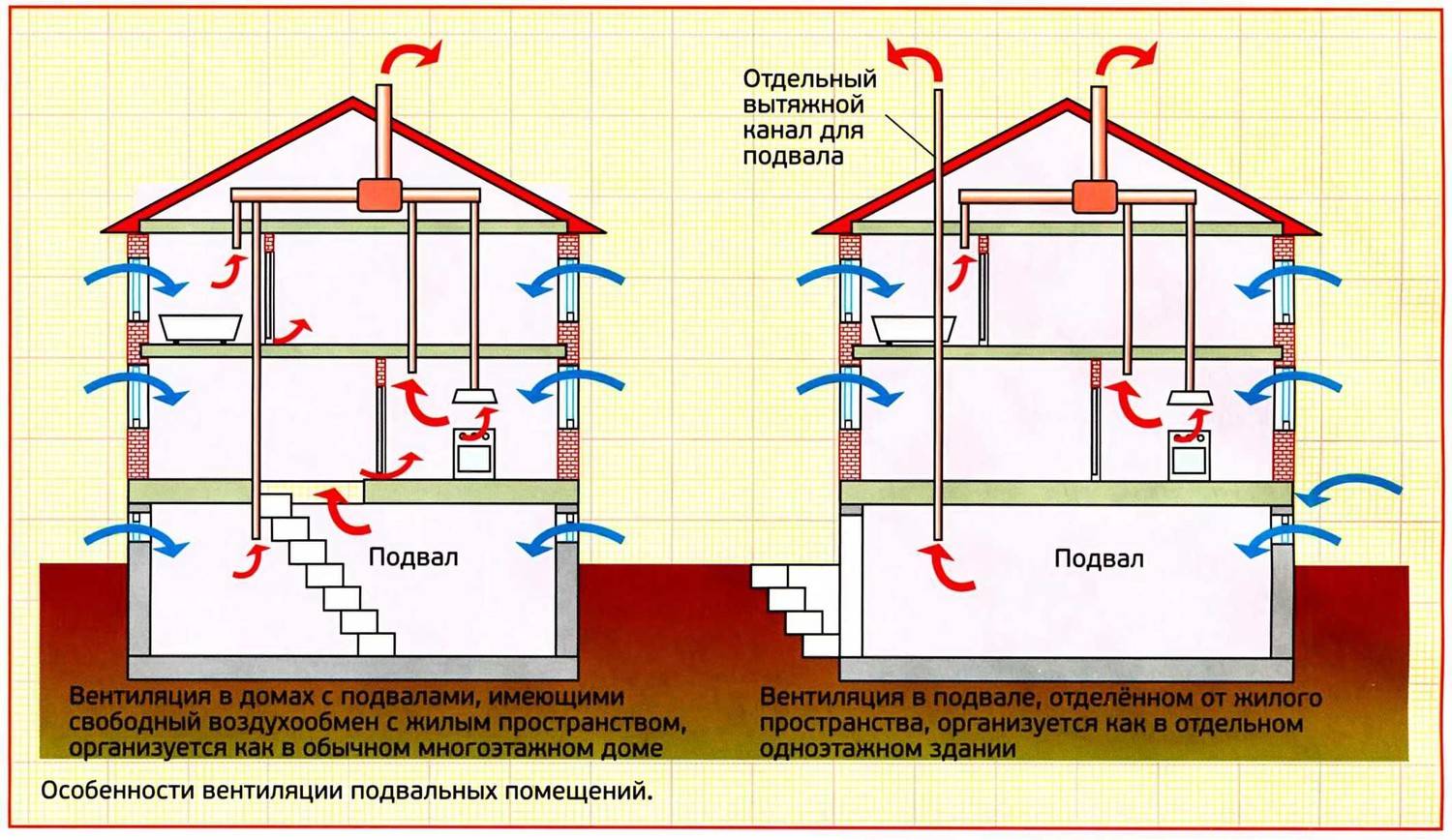
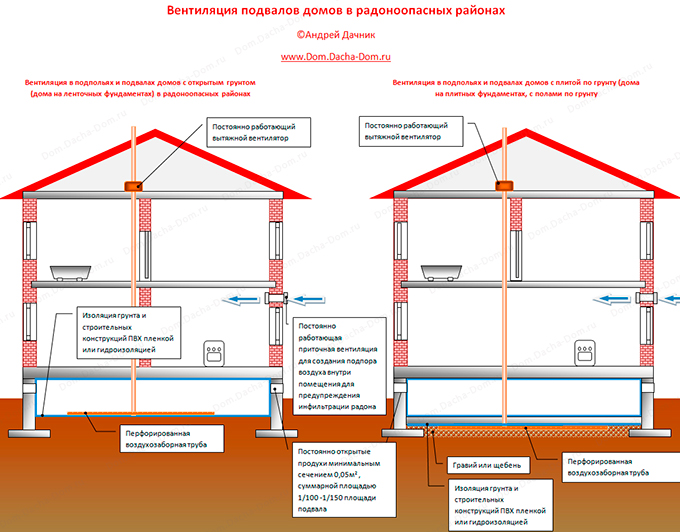
If we talk about such a common type of houses, then there the air exchange is arranged according to a natural principle.The system works in the same way in old brick houses, as well as in low-budget new buildings. Street air is sucked in through cracks and leaks in old frames or through special holes provided in modern plastic ones.
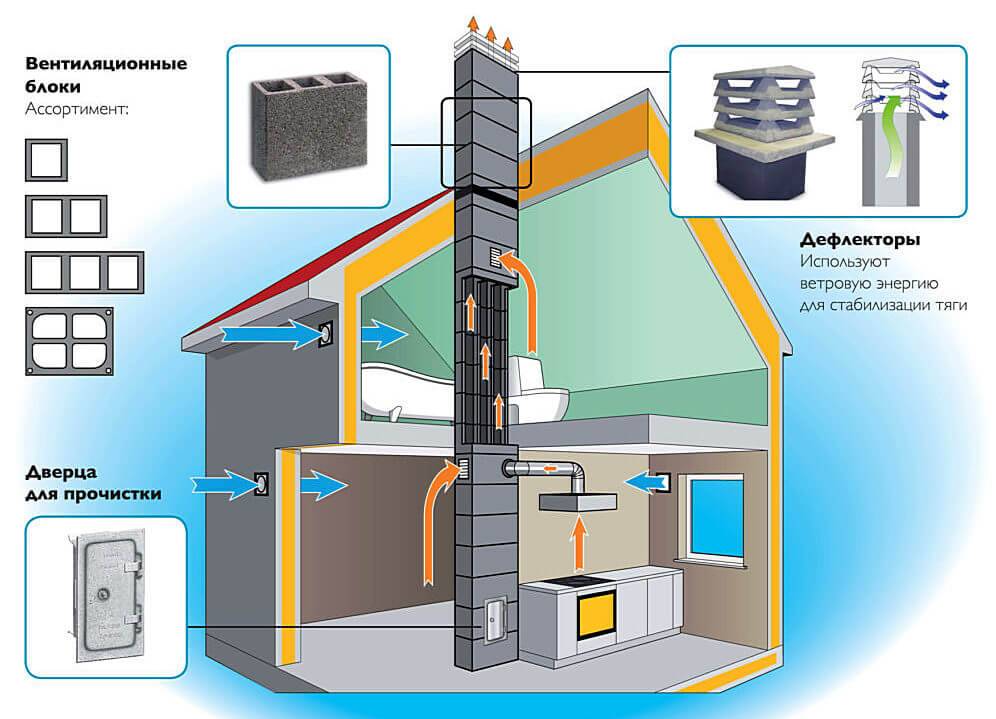
Removal in them occurs due to the presence of a constant draft present inside the ventilation shaft-duct, which rises above the roof ridge or goes into the attic. Outdoor air, getting into the living quarters through the windows, due to the draft in the channel, tends to the exhaust vent in the bathroom or the hood in the kitchen. It turns out that the air, passing through all the premises of the apartment, gradually displaces the polluted into the street.
9.2. Calculation of mechanical exhaust ventilation with natural inflow.
9.2.1. Calculation
carried out for the conditions Vwind = 0.
9.2.2.
The air velocity in the ducts and exhaust devices should be taken according to
Qvent
= FROMpnLvent (tn —
acoustic requirements. Before and after the fan, if necessary,
provide for the installation of silencers.
Size of supply channels, supply valves and
exhaust gratings are selected according to acoustic requirements.
9.2.3.
Exhaust fan, central or individual, selected as standard
way. In systems with central exhaust, install
backup fan.
9.2.4.
Estimated heat consumption for ventilation are determined by the formula ().
Who should clean the ventilation in an apartment building
Examination ventilation in an apartment building done like this: attach a sheet of paper or a paper napkin to the exhaust grill. If the sheet or napkin does not hold on to the grate, then there is a problem with ventilation.
Possible reasons for the lack of traction:
- The mine simply doesn't work. If the house is old and the shaft is made of concrete blocks, then cracks may appear at their joints.
- Blockage in the mine. Dust, small debris, insects get into the air ducts. Grease deposits may form on the cooker hood.
- There is no inflow. If fresh air does not enter the apartment, there is nothing to displace the exhaust air. At the same time, the performance of the inflow and exhaust should be approximately equal: the air passing through a small window slit will not be enough for proper ventilation.
You can only clean the grate on your exhaust outlet yourself; ventilation shafts are cleaned by specialists. If the ventilation does not work, diagnostics are carried out: a video camera descends into the mine, which detects the cause of the blockage. Then all the dirt is removed with a pneumatic brush machine.
Ventilation must undergo not only cleaning, but also disinfection. A sprayer with a flexible pipe is carried to the middle of the shaft and cleans its walls with an antibacterial solution. For better treatment, you can contact the sanitary and epidemiological service: specialists will analyze the bacterial environment in the ventilation and select an individual disinfectant.
State control
The construction of any building or structure, as well as its arrangement with engineering communication systems, takes place in accordance with SNiP. This document is a set of rules that must be taken into account at every stage of the construction process, from the development of a technical project to finishing.In fact, "Building Norms and Rules" is a construction instruction, a regulatory framework in the fields of technology, law and economics.
When choosing a contractor that will install the ventilation system, it is necessary to contact trusted counterparties in order to avoid problems in the future. In order to make life easier for customers, self-regulatory organizations (SROs) have been created on the territory of the Russian Federation for the construction industry SROs, which issue permits for construction. Rostekhnadzor controls them at the state level.
Varieties of ventilation systems
Ventilation for rooms with gas heating equipment, as well as for other objects, can be of two types: natural and forced. The device of natural and installation of forced ventilation is allowed and regulated by the current regulations.
Natural ventilation of boiler rooms
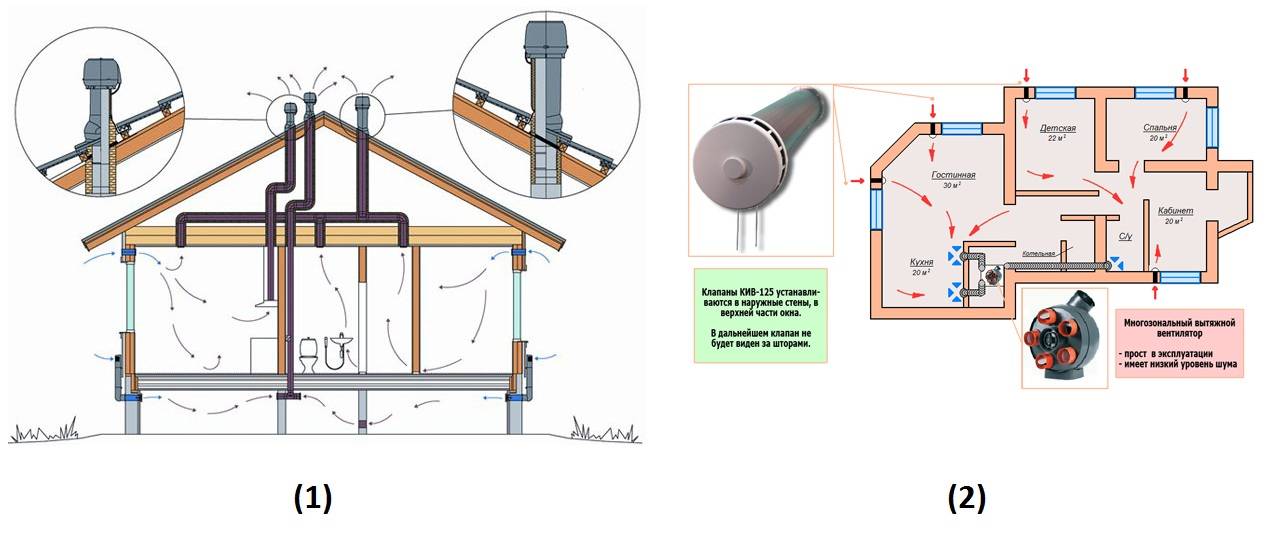
Natural ventilation provides ventilation of the room with the help of pipes of various sizes and pre-made holes in the walls, ceiling or on the floor. In fact, natural ventilation works due to pressure differences.
It allows the construction of vertical and horizontal elbows. In accordance with the requirements of SNiPs, the system can have horizontal sections up to 8 m long, but it is better to make them no more than 2 m long. At the same time, designing no more than three is allowed.
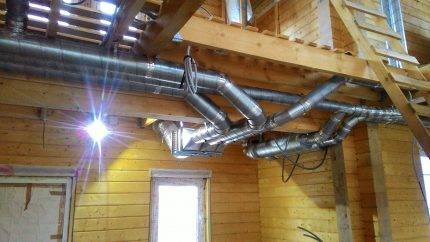 The design of large horizontal sections of the exhaust system is not a gross violation, but the speed of air flow through them is quite small, which makes normal ventilation difficult
Most often, exhaust openings are placed above the boiler.Natural ventilation does not involve the use of special supply and exhaust equipment.
The calculation of air exchange for natural ventilation in a boiler room with a gas boiler is quite simple: you need to add 5 degrees for outside air temperatures and 18 degrees for inside. Checking the operation of ventilation is carried out under the condition that the specified temperature difference exists.
When accepting a natural exhaust system, calculations are made to determine whether it will work in the summer. If not, then forced ventilation will have to be designed, because. according to the standards, the hood should operate year-round.
Forced ventilation system
Forced (artificial) ventilation is a whole automated system with an exhaust duct and installation of fans and air conditioners.
The power of this engineering design can be adjusted using programs or mechanisms (depending on the characteristics of the equipment). Moreover, it is better to design an automatic control system that will start when the boiler is turned on and turn off when the fuel is completely burned out.
However, it is completely dependent on the power supply. When installing an artificial hood, it is recommended to install an additional generator. If possible, it is better to use a combined exhaust system in which automated devices are only started when natural ventilation cannot cope with air exchange.
Flow hole diameter in ventilation systems
According to the standards, natural and artificial ventilation differ in the diameter of the vent (in other words, it is called an inlet) to ensure normal draft and standard air speed in the ventilation ducts. Although the diameter can also be calculated based on the cubic capacity of the room.




When choosing pipes of a certain diameter for ventilation systems, it is necessary to take into account the effect of the gratings and information on gas consumption, which is indicated in the passport of gas equipment
For natural ventilation, the value should be as follows: 30 cm2 of the cross-sectional area of the inlet opening per 1 kW of gas boiler power. For forced ventilation of a gas boiler room, according to the norms, the cross-sectional area may be less - 8 cm2.
Methods for organizing air exchange in the house
There are various ways to ensure air exchange in a residential building - from periodically opening doors and windows for a short time to installing multifunctional systems for preparing and delivering clean air to each room.
From the point of view of ventilation, a healthy and comfortable atmosphere in the house is formed not only due to the composition of the air. An important role is played by its temperature, uniformity of distribution and mobility.
The influx of cool air can create a powerful convection current, which a person will perceive as an unpleasant draft. As a result, even at normal temperatures in the room it will be uncomfortable.
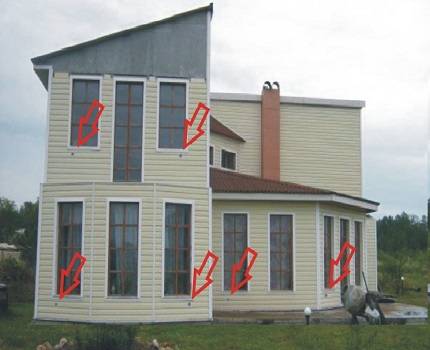
In old brick buildings, ventilation and ventilation were provided by special vents left during the construction of a residential facility.
The ventilation system in the kitchen of the cottage made of wooden beams also seemed as simple as possible.Leaky doorways and window blocks contributed to the continuous circulation of air currents in the house.
All these methods are still used today in small one-story buildings. There is enough natural air ventilation there. But if we talk about large and spacious private houses, then you can’t do without additionally installed central air conditioners and fans.
Calculation of the amount of air
- Number of supply valves.
- The capacity of the inlet valves (because it may vary depending on the model).
Below are the established norms from various regulatory documents:
- ABOK - standards for technical materials for heating, ventilation, air conditioning, heat and cold supply, microclimate of buildings.
- SNiP (short for “building norms and rules”) is a system of regulatory documents adopted back in the USSR that standardizes the requirements for various buildings.
Air exchange rates for residential buildings are given in ABOK-1-2002. This document contains the following requirements:
| room | Amount of air, m³/h for 1 person |
| Living room | 3 for every 1 m² (if the room area is less than 20 m²) |
| 30 (average standard for 1 adult resident) | |
| bathroom | 50 if the bathroom is combined |
| 25 - separately for bath and toilet | |
| Storage room, wardrobe | Multiplicity - 1 volume per hour |
| Kitchen | 90 - if the stove is gas |
| 60 - if the stove is electric |
Now we give an excerpt from the norms from SNiP. Documents used:
- SP 55.13330.2011, to SNiP 31-02-2001 "Single-apartment residential buildings";
- SP 60.13330.2012 to SNiP 41-01-2003 "Heating, ventilation and air conditioning";
- SP 54.13330.2011 to SNiP 31-01-2003 "Multi-apartment residential buildings".
The rules are:
| room | Minimum inflow | Minimum extract |
| Residential, with permanent presence of people | Not less than 1 volume per hour | — (not standardized, must provide the specified inflow) |
| Residential area less than 20 m² | 3 m³/h for every 1 m², for 1 person | — |
| Living space that is not in use | 0.2 volumes per hour | — |
| Kitchen with electric stove | — | 60 m³/h |
| Single exchange + 100 m³/h | — | |
| A room with a solid fuel boiler / furnace | Single exchange + 100 m³/h | — |
| Bathroom (bathroom, toilet) | — | 25 m³/h |
| home gym | 80 m³/h | — |
| home sauna | 10 m³/h |
As you can see, some rules are partially different from each other. Therefore, when designing a system, it is better to choose a larger indicator, and in general - to plan performance with a margin.
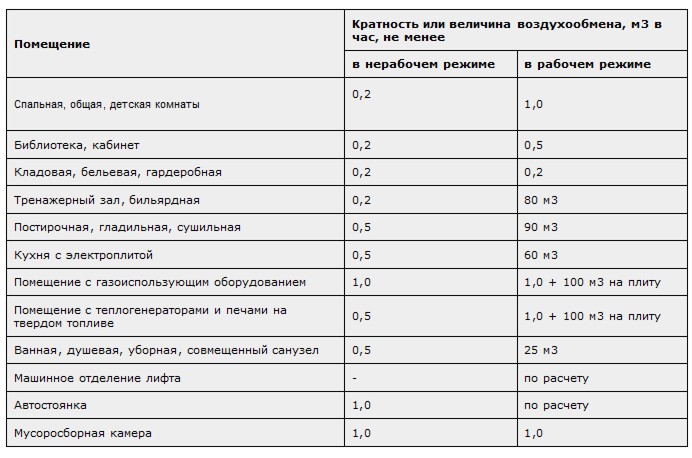


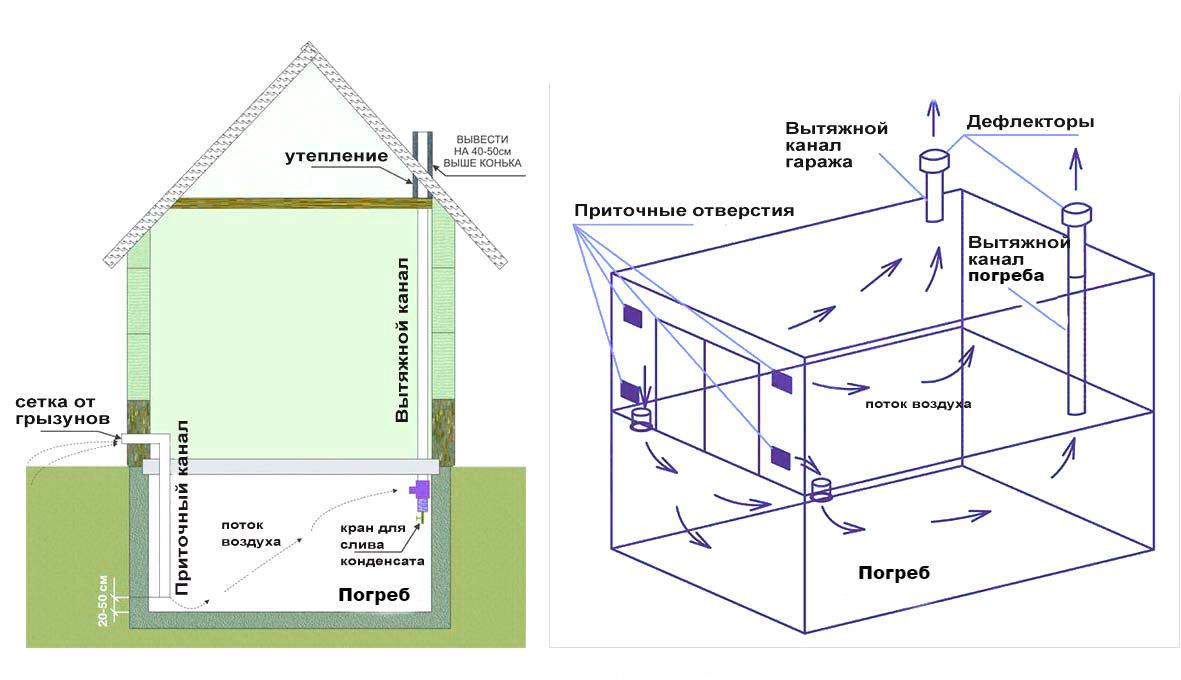

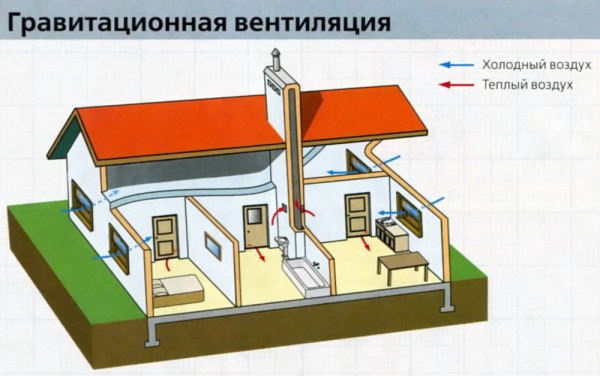


In fact, these same requirements apply not only to natural systems - they are the same for forced ventilation.
Features of arrangement and functioning in panel houses
If we talk about such a common type of houses, then there the air exchange is arranged according to a natural principle. The system works in the same way in old brick houses, as well as in low-budget new buildings. Street air is sucked in through cracks and leaks in old frames or through special holes provided in modern plastic ones.
Removal in them occurs due to the presence of a constant draft present inside the ventilation shaft-duct, which rises above the roof ridge or goes into the attic.Outdoor air, getting into the living quarters through the windows, due to the draft in the channel, tends to the exhaust vent in the bathroom or the hood in the kitchen. It turns out that the air, passing through all the premises of the apartment, gradually displaces the polluted into the street.
Possible options for arranging ventilation in high-rise buildings
Modern ventilation in a panel house is equipped with single exhaust pipes. From the bathrooms, from each floor to the roof there is a pipe. In this embodiment, there is no possibility of penetration of foreign odors and the entire system functions evenly and reliably.
Another good option is when all vertical channels go to a common horizontal prefabricated manifold, which is located in the attic. The air from it goes outside through one common pipe.
The most unstable way can be called the option when a small satellite channel from each apartment is included in a common ventilation shaft. Such a ventilation scheme in a panel house is much cheaper in arrangement and increases the living space, but constantly brings a lot of problems to residents. The most common is the flow of various odors from one apartment to another.
Vent. mine with satellite channel
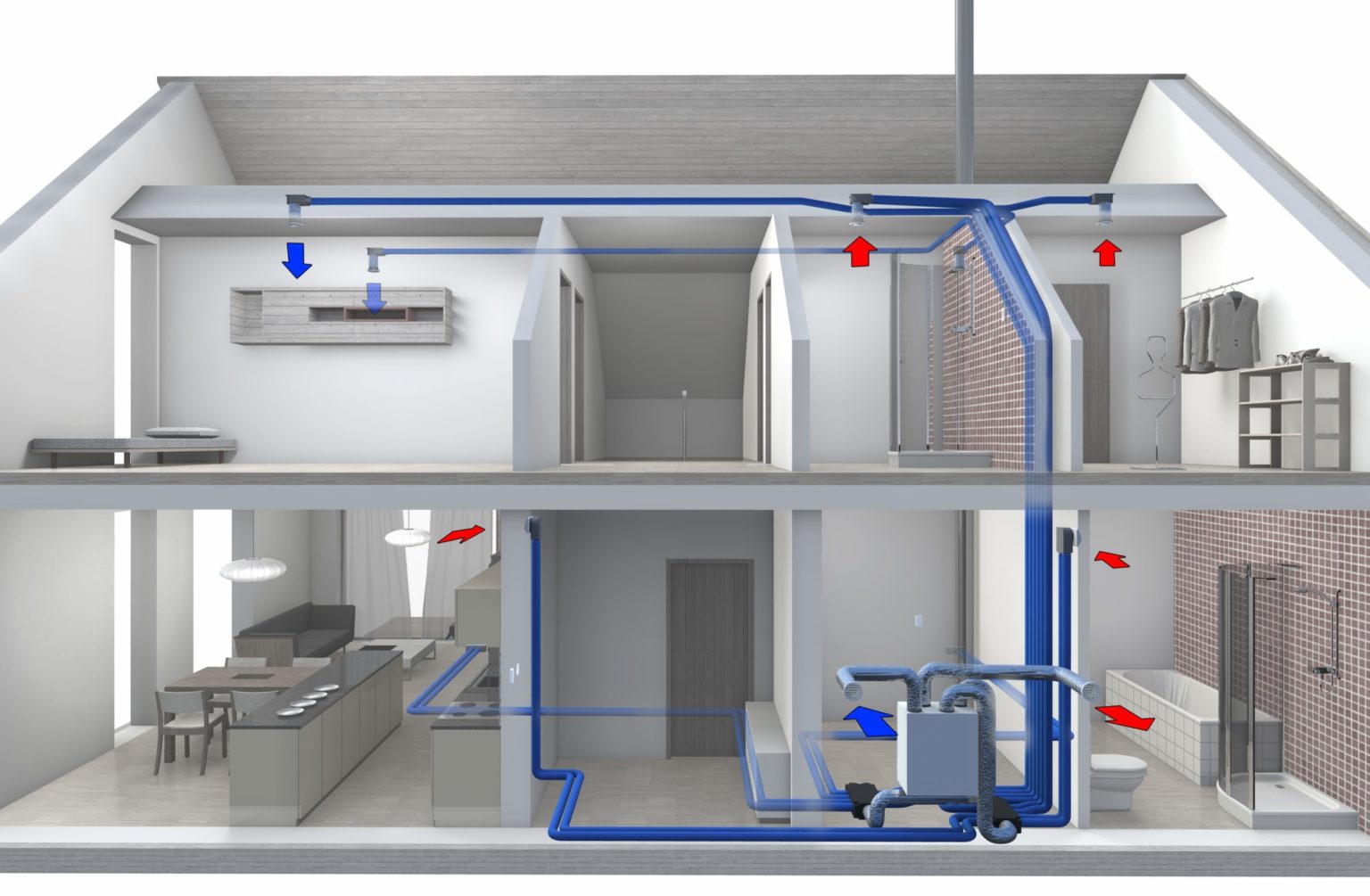
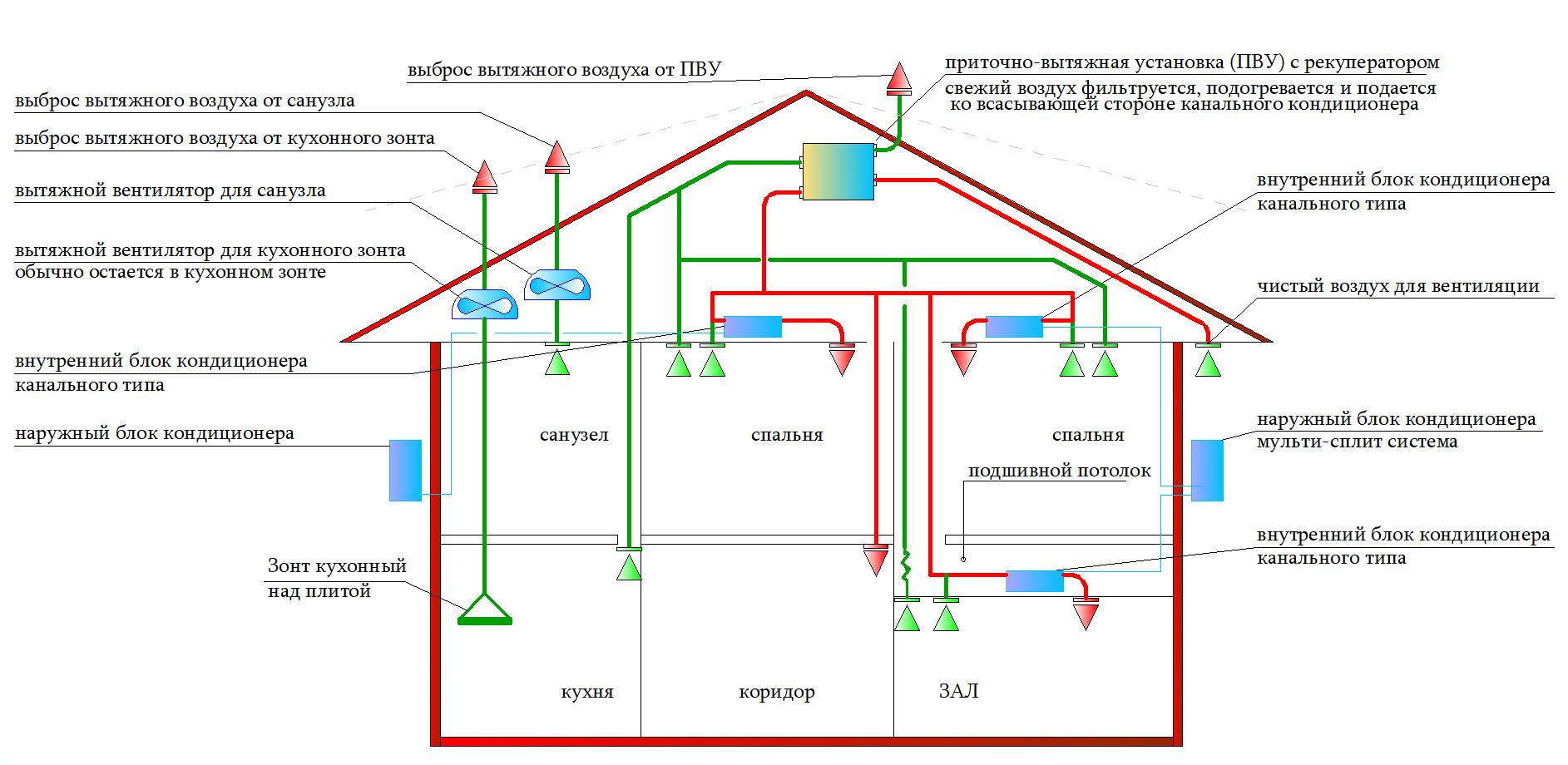
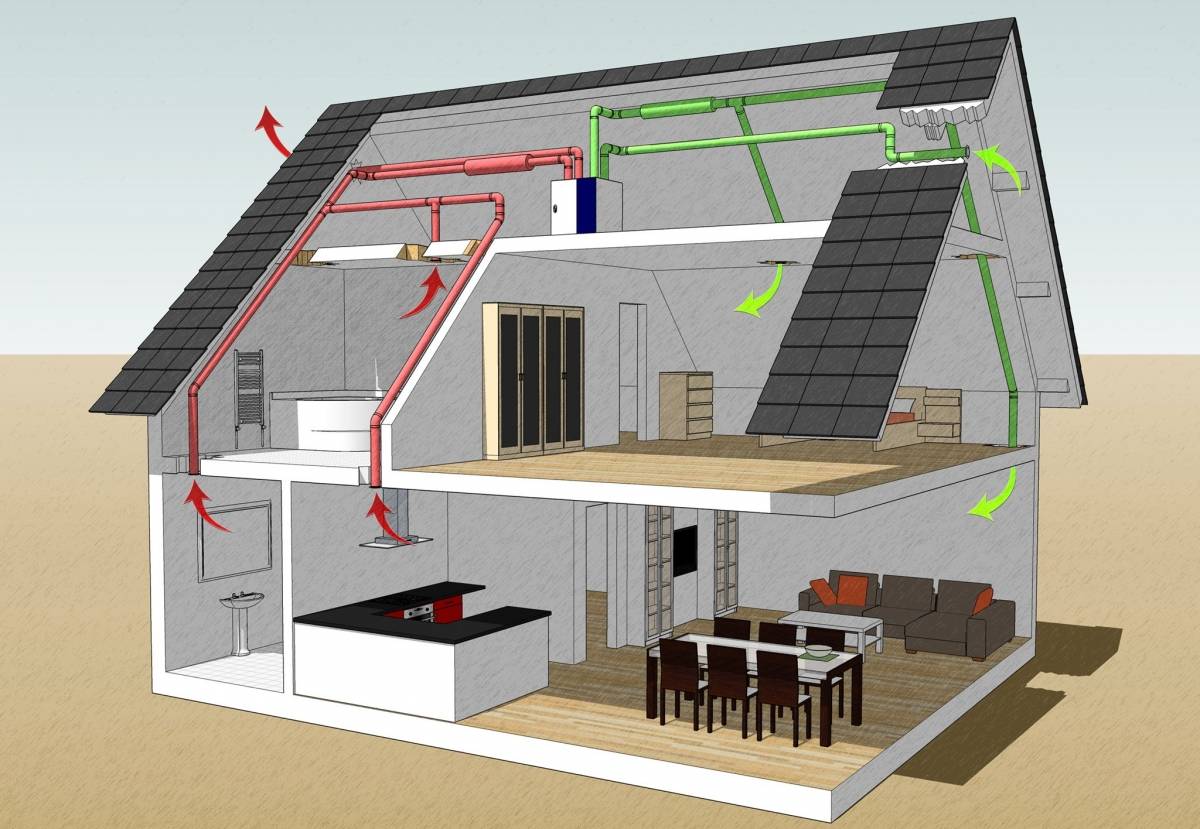
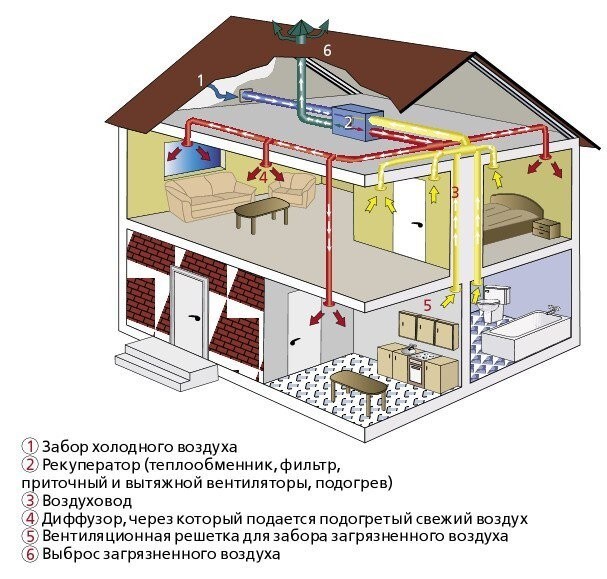
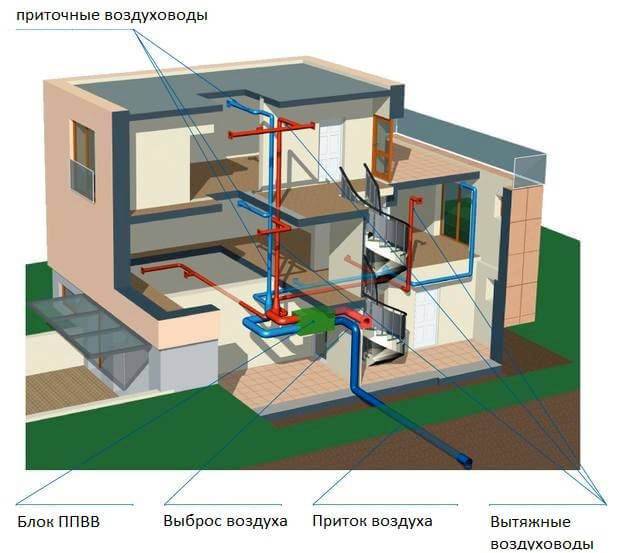
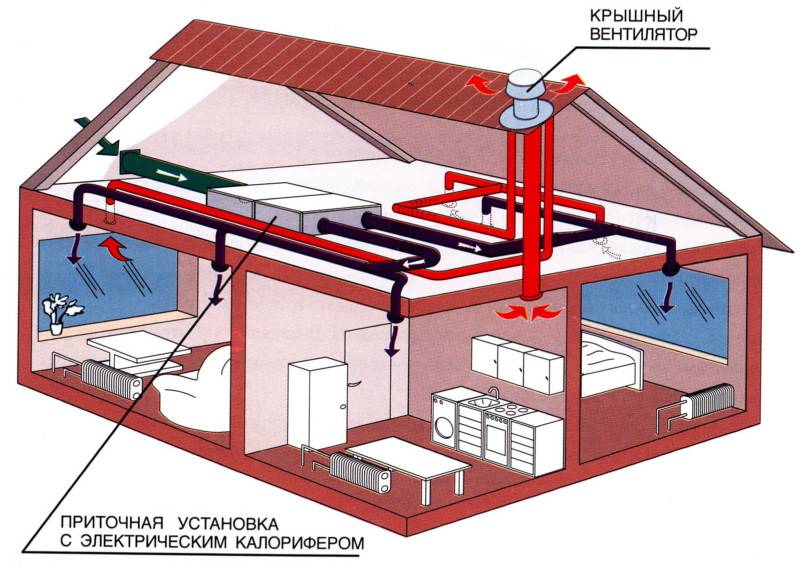
The best option for ventilation are electromechanical forced air supply and exhaust systems. They are used in modern new buildings, except for low-budget ones. The supply unit of such a system is located in the basement or on the side of the main building. It supplies filtered and heated or cooled air to all rooms and premises. On the roof, in turn, an exhaust electric fan is installed with exactly the same rated power as the supply one.It is designed to remove the contaminated mixture from the apartments through the hoods.
This is one of the primitive schemes of the device. A more complex one, which can be equipped with a modern high-rise building, is being equipped using new energy-saving technologies. For example, recuperators are devices that allow you to take heat or cold from the exhaust air and give it to the supply air.
We provide circulation
Implementing ventilation in an apartment with your own hands is extremely simple - it is enough to ensure the flow of clean air, and then check the quality of air exchange in each room. If the system is organized properly, no intervention is required. Otherwise, make 3-4 cm holes between the floor and the door.
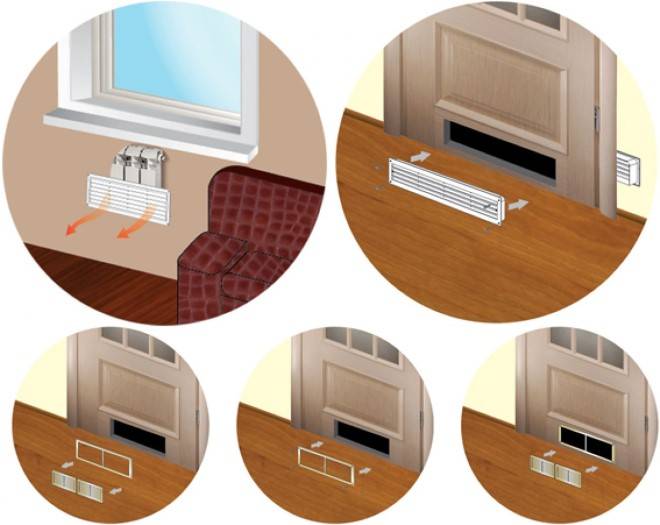
Ventilation grilles in the door leafs - the easiest way to normalize the ventilation in the apartment
The hosts select the decoration on an individual basis. It is enough to insert a metal mesh in 3 layers to provide better sound insulation.
Conclusions and useful video on the topic
The video explains why ventilation is needed in every private house and why mixing of supply and exhaust air flows should not be allowed:
This video clearly shows how to properly organize the inflow and evacuation of air with a natural ventilation scheme in a country house:
Video on how the supply and exhaust ventilation of sufficient power with heat energy recovery operates using the profi-air system of the German manufacturer FRANKISCHE as an example:
Having studied the principles of operation of ventilation systems, it is quite possible to properly organize air exchange in a small one-story building on your own.However, it is better to entrust the design and installation of ventilation in spacious country houses to professionals. After all, the installed system should not only work, but also cope with planned tasks.
Properly equipped ventilation will solve the problems of stagnant air and the unpleasant feeling of mustiness in a private house.
Still have questions, found shortcomings or want to share useful information on arranging ventilation in a private house? Please leave your comments, ask questions and share your experience in the block under the article.