- Features of forced air exchange
- Description of mechanical ventilation option
- Mechanical ventilation with heat recovery
- System without heat recovery
- Other Methods for Eliminating Condensation
- Option 1
- Example
- Option #2
- The nuances of the equipment of the air exchange system
- Ventilation of the under-roof space of the attic
- Ventilation methods
- Doors and hatches to the upper attic floor
- Recommendations for individual rooms
- Reasons for installation
Features of forced air exchange
If natural ventilation does not provide full air renewal, a powerful supply and exhaust system is installed in a private house.
It helps to balance the air currents that circulate between rooms and the outside environment continuously. Such ventilation guarantees a stable supply of purified fresh air and the removal of polluted air to the outside.
Description of mechanical ventilation option
Modern multifunctional supply and exhaust ventilation units make the most of the energy of the supplied air flows and convert it into heat.
Such systems produce deep cleaning of the supply air, completely filtering from dust, various allergens, bacteria and other harmful microorganisms.
Additional processing is created using filtration equipment, highly efficient noise absorbers, ionization and humidification devices, and sometimes flavoring devices are used.
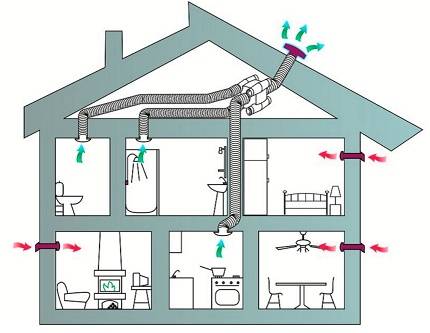
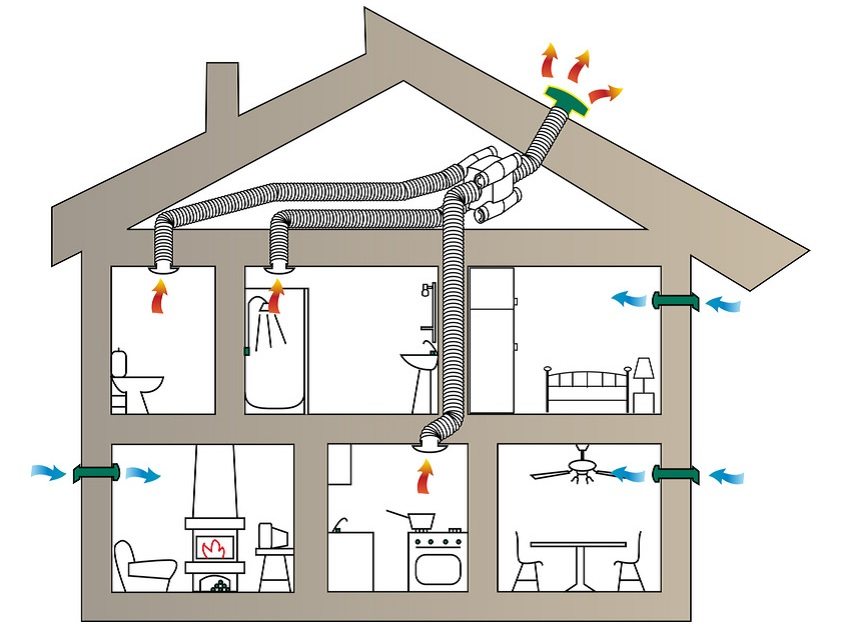
The air flows that have been processed are distributed throughout the house through special ventilation ducts. Prepared clean air enters the bedroom and children's room, study, living room, kitchen and bathrooms, auxiliary rooms, and is removed from there by the exhaust system
The functional elements of a system with forced air exchange are filters and recuperators, fans, hoods, control devices and, directly, the ventilation unit.
The built-in electronics makes it possible to selectively set the optimal user operating modes of the system in terms of temperature and humidity, and in time. Remote controls and smart controllers greatly simplify operation.
Mechanical ventilation helps prevent the formation of unpleasant odors in the kitchen, prevents the appearance of dampness and the spread of multi-colored mold, solves the problem of constant humidity in the bathroom and condensation on the surface of the heated floor, double-glazed windows, door blocks.
Powerful units with integrated filters, special noise absorbers and heaters take up a lot of space. To arrange them, you need to free up space in the attic or in the basement of a private house
Modern multifunctional forced ventilation systems are often combined with intelligent control and monitoring systems.Such measures optimize the operation of the equipment of all installed engineering systems in the house, allow you to organize user-friendly remote control of equipment via the Internet.
Mechanical ventilation with heat recovery
In schemes with heat recovery, a fixed supply and exhaust unit is responsible for the air exchange in the building. The air from the environment enters the system, after which it is cleaned from dust and contaminants by the filter and is sent to the heat exchanger for the main heating.
The air masses are heated to the required temperature in an electric / water heater and are distributed throughout the house through durable galvanized steel ventilation ducts.
A heat recovery system will ensure high air quality in a residential building all year round. At low speeds of working fans, stationary air handling units operate almost silently.
Automation makes it possible to flexibly control the operation of the equipment: regulate the air supply, set a comfortable temperature, change the speed of air flows.
Recuperation is the rational use of the thermal energy of the exhaust air for the subsequent heating of the supply air. This allows you to reduce up to 85% of heat costs for heating the air flow from the external environment in winter
Maintenance of such an installation consists of regular filter changes. It is recommended to replace new elements for air purification from dust once a quarter.



System without heat recovery
To organize functional supply and exhaust ventilation without an air heat exchanger, several exhaust systems and a central supply unit are used at once.Outdoor air is heated or cooled, then it is cleaned in a filter, after which it is distributed through a network of channels to living rooms.
Removal of spent heavy air masses is carried out by hoods in the premises for economic and technical purposes. Such systems are made partly natural and partly forced. They function due to natural draft and due to duct fans.
Supply and exhaust circuits without heat recovery provide heating and purification of the air entering the house, but consume a large amount of energy for the constant processing of air flows.
Other Methods for Eliminating Condensation
Option 1
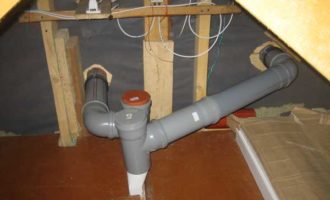
Perhaps the option with warming will not work for someone, so you can do it differently. The ventilation pipe that runs through the attic is disconnected. A tee with a conical plug is inserted at the separation point. It is in the place of the cone that the condensate will drain. The disconnected part of the ventilation pipe that goes outside should be installed in a tee. This method is called the removal of condensate from the exhaust ventilation ducts. It is not expensive and does not require much effort, the main thing is to correctly install the tee in the duct. Next, you need to insulate this structure, and instead of draining the condensate, you can mount a tube through which the condensate will flow out.
Example
The private house has 2 bathrooms, each of them equipped with exhaust fans in the ventilation ducts. For ventilation, metal pipes with a cross section of 125 mm were chosen.Ventilation pipes in a horizontal position pass through an unheated attic (the length of one pipe is 7.5 meters, the length of the other pipe is 9 meters), then they go outside. The pipes are insulated with mineral wool. In winter there is condensation, what should I do? Moreover, its quantity is very large, water flows out even through fans.
There are several options for solving the problem, the insulation of the pipe must be carried out completely, up to the last section facing the street. It is possible to mount the ventilation pipe outlet directly on the roof without horizontal sections, equipping it not with a duct fan, but with a turbo deflector. The last best option is to install a drain in a place where ventilation in a private house drips condensate, through which water will quietly drip, for example, into a sewer drain.
Option #2
A plug is made on the old ventilation and a new forced-type ventilation system is mounted. An exhaust fan is installed in the room where the most evaporation occurs. Often a mechanical device is mounted in a window pane. The supply of fresh air can be provided by a supply valve, which is installed near the battery or behind the gas boiler. Installing air inlets near heating equipment will warm the winter air and heat loss in the house will be minimal. Such an expensive option allows you to permanently remove condensate from the ventilation.
The correct approach to the insulation of ventilation pipes solves such problems - increasing the operation of ventilation ducts. Noise isolation during the passage of air masses. Reducing heat loss in winter. Condensate does not drip from the ventilation in a private house. Prevents the spread of fire when ignited.
To date, heaters in stores are presented in the form of cylinders, cords, half-cylinders. The diameter must also be selected individually. The thickness of the insulation is also different. It is advisable to approach the issue of warming ventilation ducts even at the stage of building a house.
The nuances of the equipment of the air exchange system
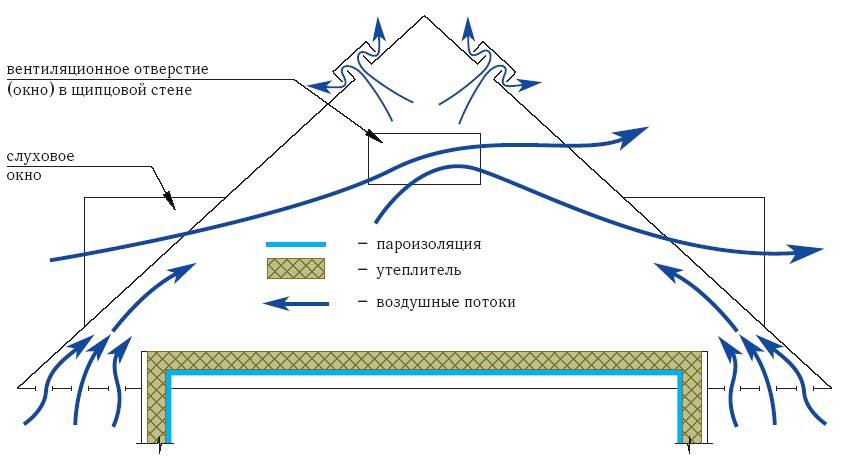
In the organization of roof ventilation, one or more methods of organization are used. Air exchange directly depends on the characteristics of the attic, its area, shape, type of roof and building materials used.
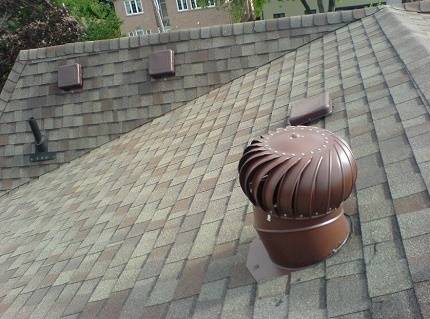
When installing the system, it is necessary to take into account the amount of precipitation characteristic of the region. If there is a risk of ridge and hip ridges falling asleep with snow, it is better to supplement ordinary air ducts with turbine aerators that exceed the height of snow drifts
The specificity of the roof ventilation device is that it is necessary to provide two directions indirectly related to each other, these are:
- Ventilation of the roofing pie. It is needed to dry the system under the roofing: insulation laid along the slopes, rafters, battens. Provided with air and aerators.
- Removal of excess moisture from the attic space. It is required to drain the attic or attic, to form a microclimate in it, favorable for extending the life of the structure and the stay of the owners. Provided with ventilation gable windows, openings, hatches.
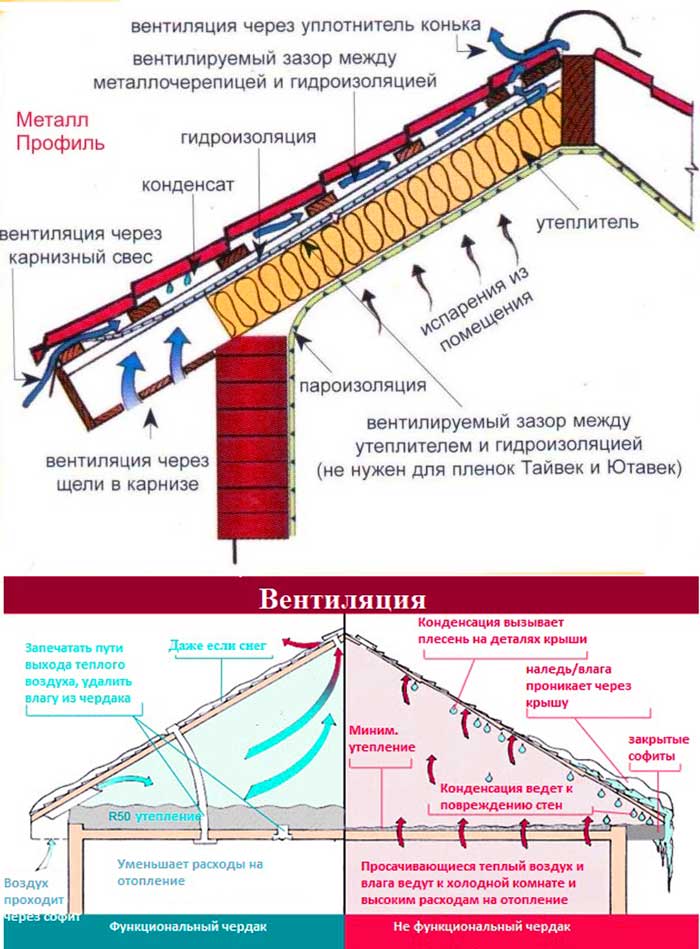
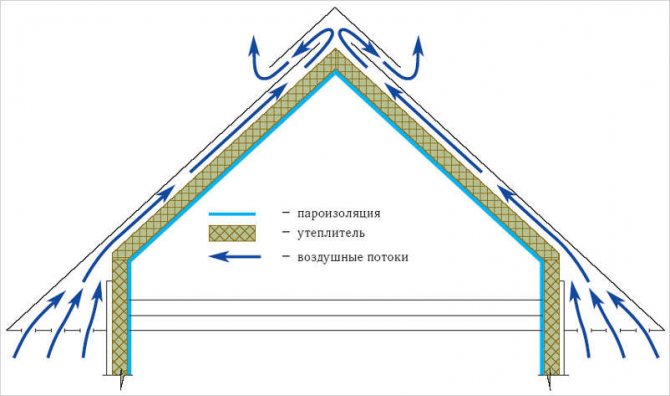
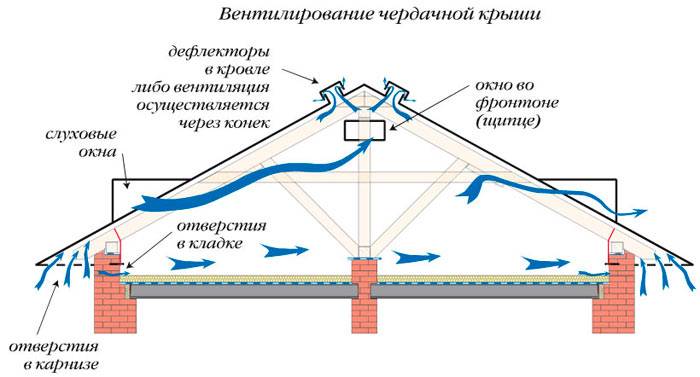
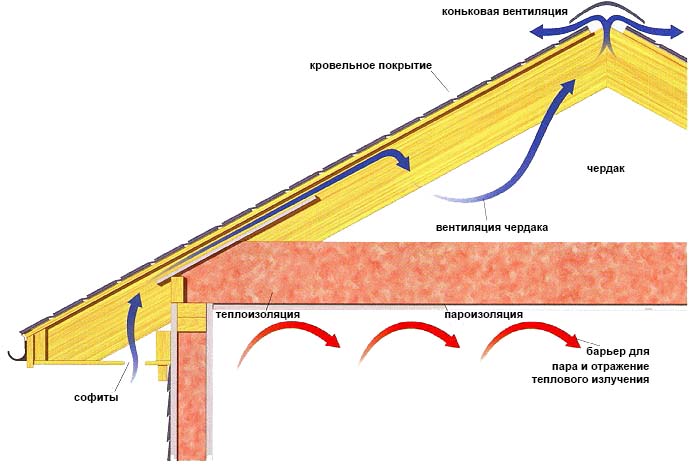
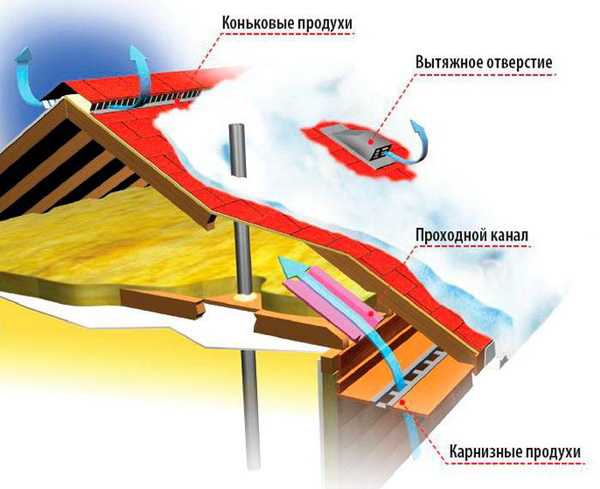
The roofing pie is ventilated with air ducts - longitudinal channels laid from the cornice overhang to the ridge ridge. Air ducts are formed during the laying of the battens and counter battens on the rafter legs.

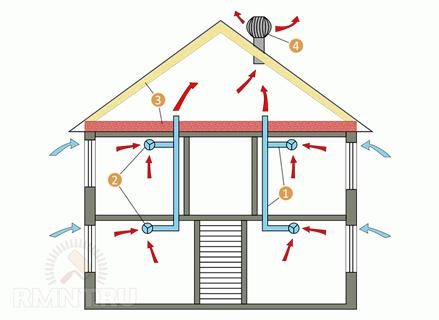


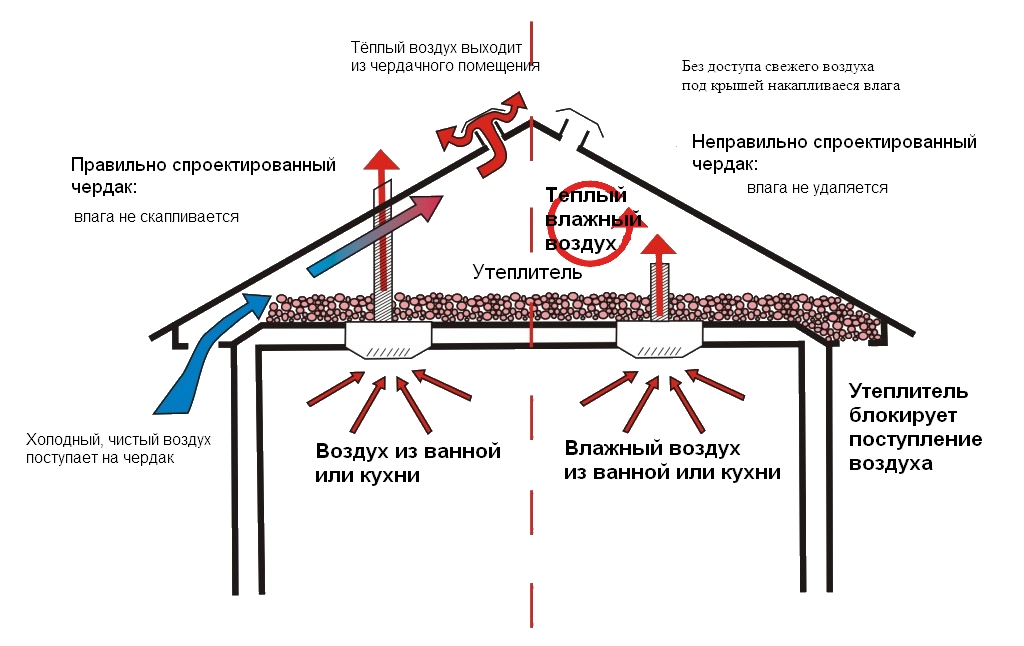


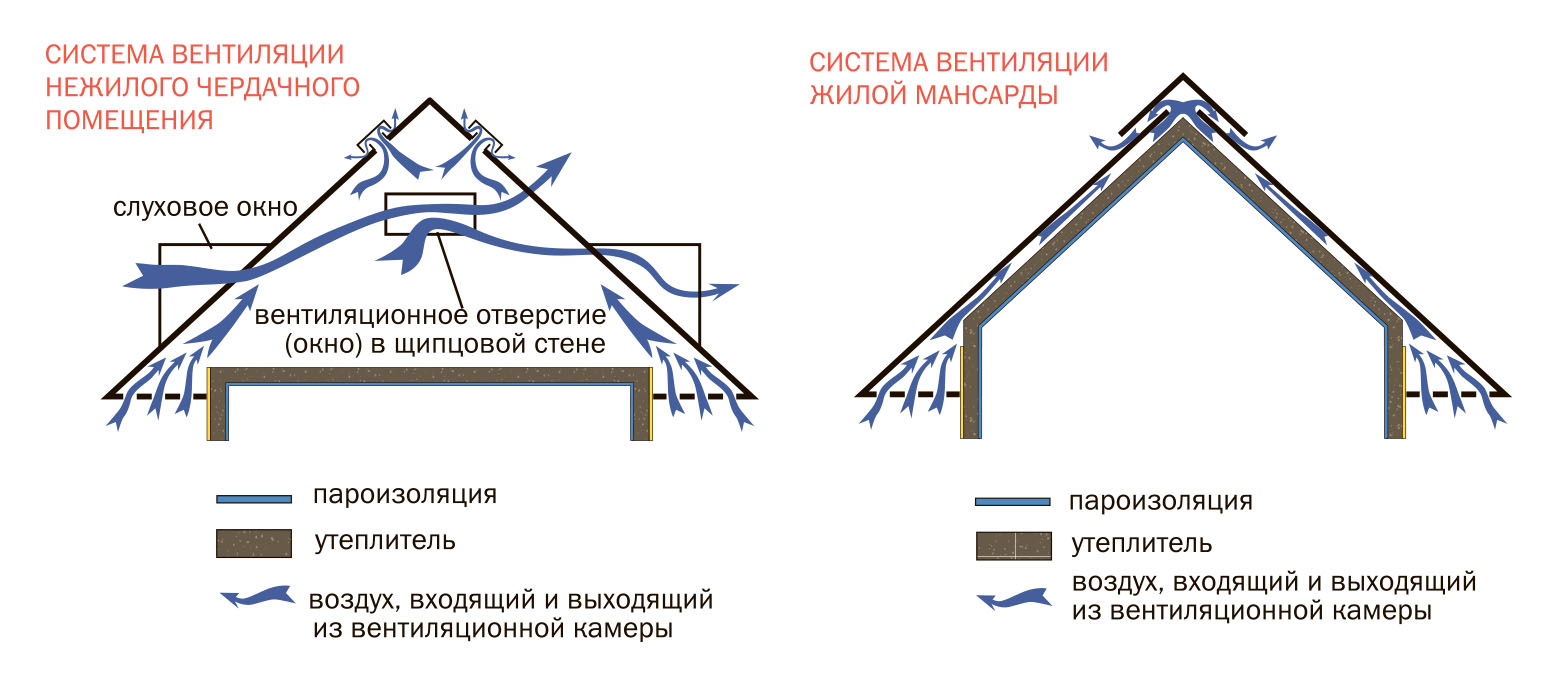
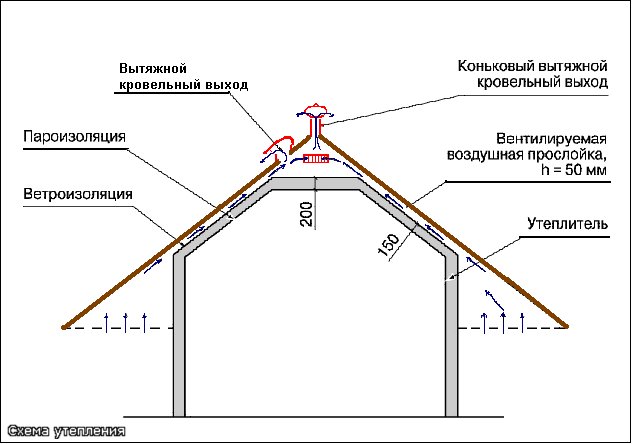
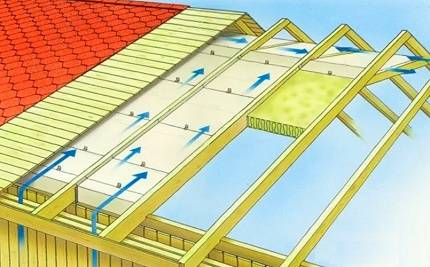
In the ventilation ducts formed by the crate - the vents - the air moves from the bottom up.It is tightened in the area of the cornices and brought out in the ridge area from the side or from above
The distance created by this method allows the air flow to enter in the eaves area and exit in the ridge area, taking with it the condensate and moisture that has settled under the roof.
For roofs made of ondulin, bituminous, polymer-sand and natural tiles, aerators are additionally used, repeating the shape of the roofing material. If they do not differ in color, then they literally merge with the roof. The grate built into them allows air to move freely in the direction necessary for drying.
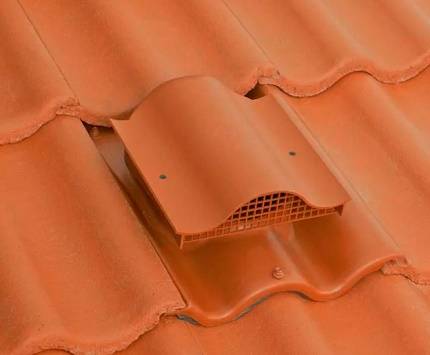
Aerators for tiled roofs can practically "merge" with the coating. They are used mainly on hip, semi-hip and hipped roofs, in which the ridge rib is shortened or does not exist at all.
In the case of a roof roof with corrugated steel, metal tiles and corrugated board, when installing a ventilation system for a roofing pie, it is somewhat complicated. The installation of the crate should be carried out with breaks, i.e. with additional cross channels.
If the gap in the crate is not initially observed, then side holes are drilled in the laths under the steel profiled roof. They are placed after about 30 cm. As a result, the area of \u200b\u200bthe air flow draining the insulation increases due to the movement of air not only upwards, but also sideways.
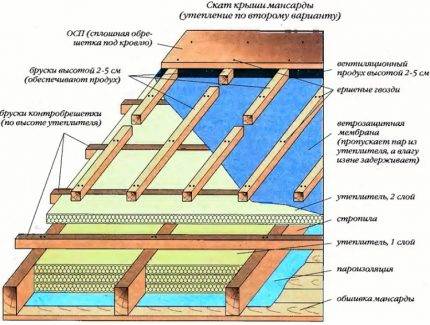 A purlin with a gap in the laying or with drilled transverse holes increases the area covered by the air flow. So the insulation of the roofing cake is washed by air currents moving both along the slopes and across
Air exchange in houses with a flat roof is distinguished by the absence of gables in which attic windows can be installed.And although there is still an attic in well-arranged flat and low-pitched roofs, they ventilate them through the ventilation holes.
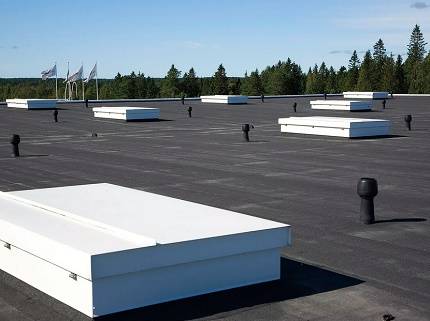
The roofing pie of a flat roof is ventilated by a system of aerators, the installation step of which depends on the thickness of the insulation and the cultivated area
The space in large hip roofs is ventilated through dormer ventilation windows, in small ones through ventilation vents.
Despite the fact that the inclined ribs of the hips are equipped according to the ridge principle, they cannot provide sufficient outflow. To remove and eliminate possible stress, put aerators.
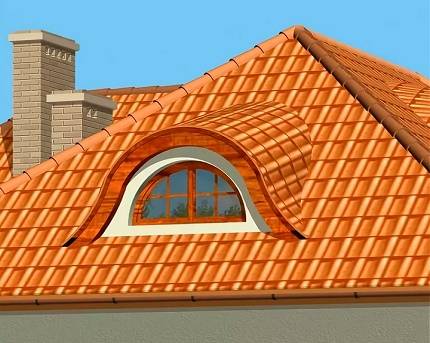
For ventilation of attic spaces and attic spaces of hip and hipped roofs, dormer windows are arranged. They can be with drop-down doors or with a fixed grid.
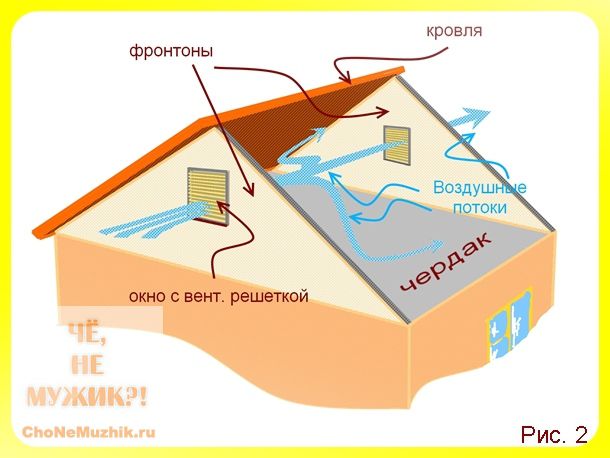
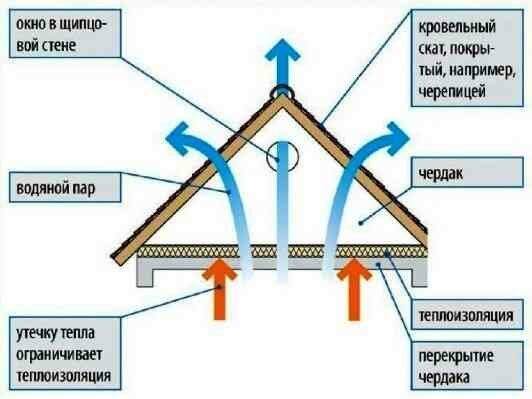
Air exchange in the attic space of a gable roof is often organized by installing ventilation holes with grilles, as well as through ventilation or dormer windows. For natural circulation of the air flow, both openings and window openings should be located on both sides.
Ventilation of the under-roof space of the attic
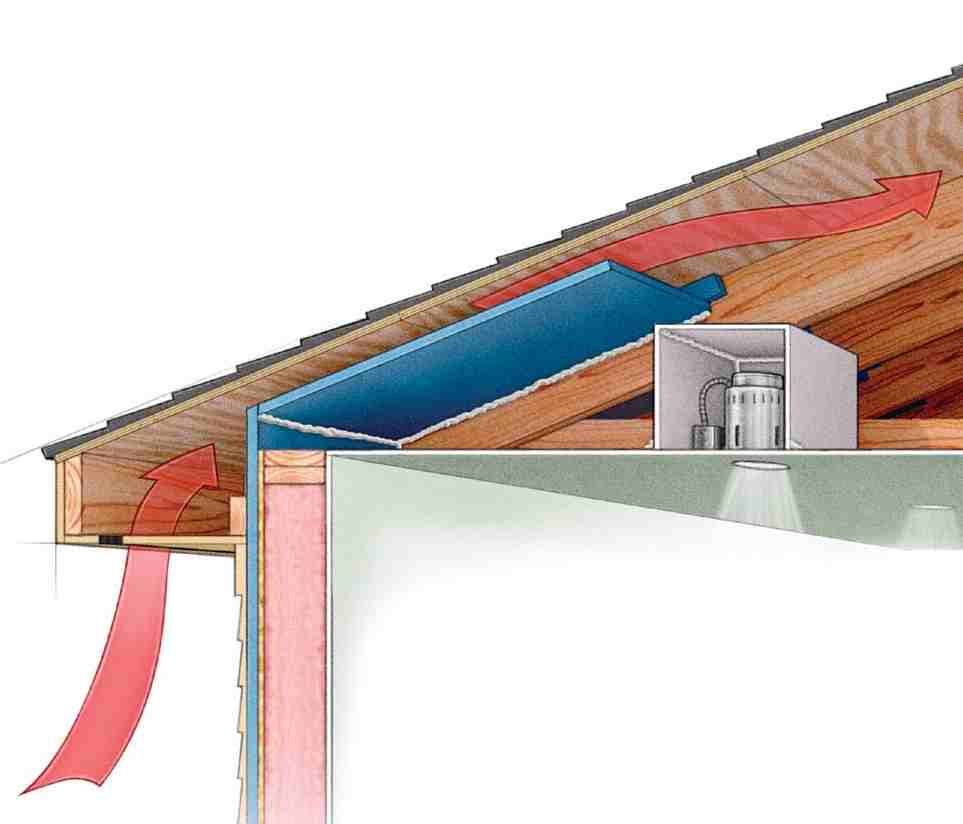
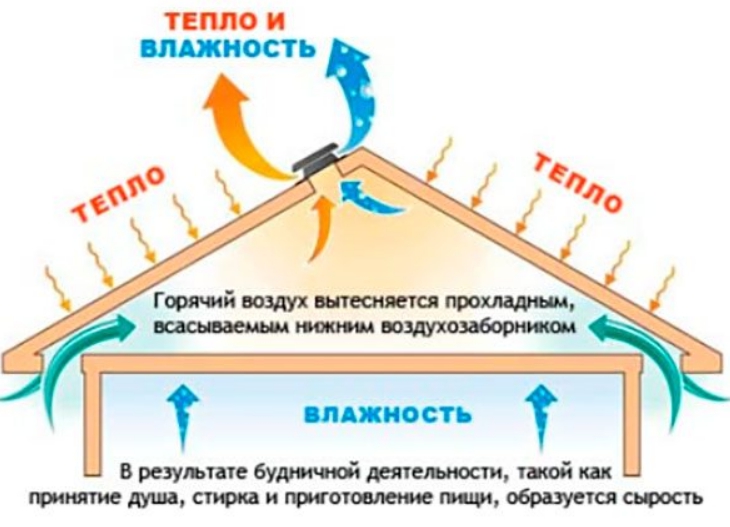
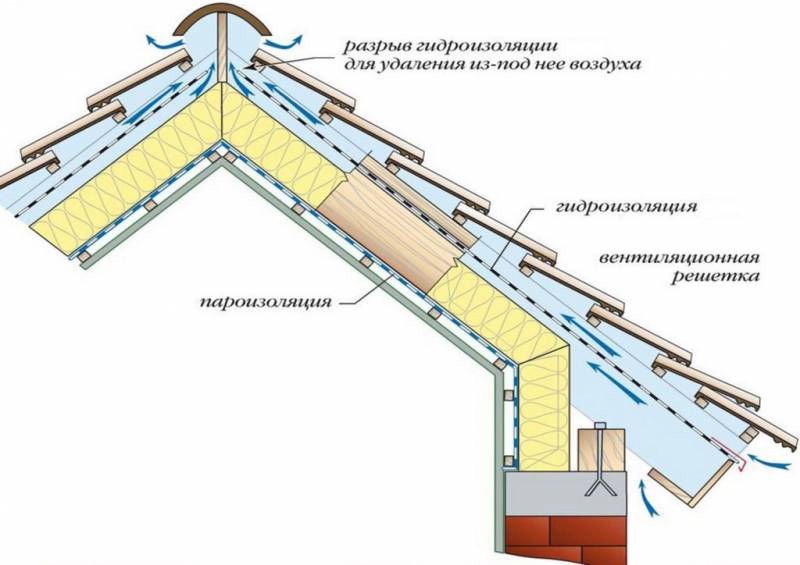
Ventilation roof space of the attic arranged according to the principle of natural air circulation. It enters special cavities between waterproofing and thermal insulation in the area of the eaves. Removal is carried out on the upper part of the roof in the area of \u200b\u200bthe ridge.
If a metal roofing, it is convenient to use special ventilation valves. They are located in the places of inflow and exhaust. The design of the valve allows you to effectively solve several problems:
- pass air;
- provide protection against direct contact with precipitation, dust, dirt, insects, etc.
Another advantage of using valves for roof ventilation is ease of installation and reliability. The main thing is to make accurate calculations by quantity and complete detailed drawings of a competent location.



In addition to the valve system for air exchange of the under-roof space, an alternative option is used that does not require the use of special elements (valves):
- On the lower inner walls of the eaves, holes (cornice vents) are made with access to the cavity between the insulation and the waterproofing layer. This is the ventilation part. Its location will provide protection from rain and wind.
- The exhaust part is equipped with a special design of the ridge, on the sides of which ventilation slots are left.
- Air enters through the eaves, rises up and exits in the ridge area, providing ventilation.
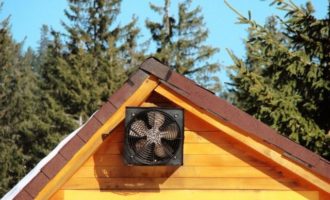
To remove air in the area of \u200b\u200bthe ridge, a ridge aerator is equipped. This detail provides high-quality air circulation while maintaining effective protection against precipitation. The ridge aerator is equipped with a grid that protects the interior of the roof from dust, dirt, leaves and insects.

A ridge aerator is needed to remove air from the ridge area
Under-roof space ventilation can be of two types:
- two-layer;
- single layer.
The single layer view is described above. The two-layer look allows for better ventilation. Such ventilation conditionally combines valve and cornice types of air exchange. Valves in the roofing material provide ventilation of the space between the roof and the waterproofing layer.Eaves (internal) type provides ventilation of the space between the waterproofing and vapor barrier.
The productivity of the under-roof space ventilation system depends not only on structural elements, but also on compliance with quantitative and dimensional parameters. The number of valves and vents is determined by the design features and the area of the roof.
Be sure to have ventilation holes in each cavity between the rafters. The dimensions and number of ventilation openings increase if the roof has a complex architecture with parapets, attics, and skylights. All these structural elements significantly impair air circulation.
Ventilation methods
The most rational way to ensure uniform air exchange is the location of the vents along the perimeter of the building, as well as along the entire length of the roof ridge.
A division of the ventilated volume into a zone of positive and negative pressures is formed. In the first zone there are supply openings, and in the second - exhaust. To protect the products from birds, they are covered with nets, barred.
There are several ways to ventilate the under-roof space:
- making dormer windows in the attic;
- creation of ventilation of the gable roof ridge, which is also good for the attic;
- eaves type of ventilation;
- skates of a special shape;
- the use of individual elements with holes for ventilation;
- roof fans;
- the presence of ventilation gaps, available initially or made during the reconstruction of the roof.
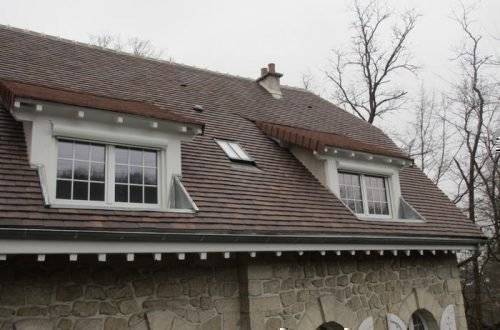
Dormer windows are one of the ventilation options.
The type of organization of the ventilation system of a cold attic space depends on the type of roof, its area, the concentration of humidity in the indoor air, the state of isolation from steam of the roof structure. But it also affects the choice of method and the material from which the roof is made.
There is an approximate division of the material into hard and soft. Clay and metal tiles are hard materials, but each of them has its own characteristics. The first is a very fragile material, and the second is of the sheet type, subject to corrosion in places where the protective coating is destroyed.
Doors and hatches to the upper attic floor
At the entrance from the stairs to the attic and to all upper floors, it is advantageous to install an entrance door that blocks the flow of air from the lower floors and separates and isolates the air space of the floors into independent blocks.
Floor ventilation will work best if you choose a door with a good seal and install a door closer that constantly returns the door to the closed position.
The topmost rung of the stairs, directly in front of the door, must have a tread width of at least 60 cm.
For the purpose of dividing the air space of the floors, doors can also be installed on the lower floor, at the entrance to the stairs up.
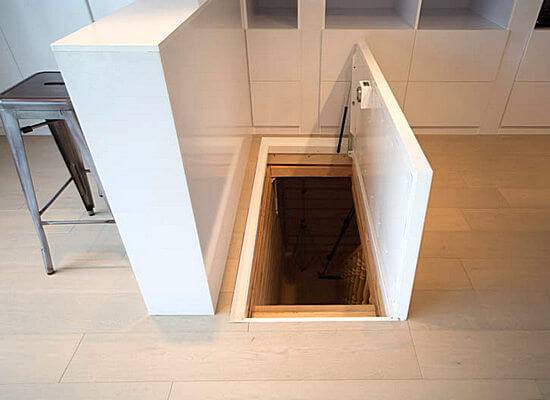
The hatch opens easily and smoothly thanks to gas springs (gas lifts) or an electric drive. In addition, the hatch must have a locking device in the open position. The hatch can be ordered from a manufacturer of hatches, or made by hand.



When making it yourself, experts recommend reducing the weight of the hatch cover, installing two gas elevators (you can pick up car ones). Gas lifts must be installed with the rod down, the cylinders must be attached to the hatch leaf.
Gas springs - elevators are selected in place on the finished cover. Measure the force in kg. to lift the finished sash, convert to Newtons (kg x 10 = N), add 30% to the resulting value and determine the total power of the gas springs. Next, purchase a set (2 pcs.) of gas lifts in the store with a capacity within the calculated values.
Recommendations for individual rooms
When arranging any ventilation in a private house, air flows are arranged in such a way that clean outdoor air first enters the living room, bedrooms, office and library.
And then, along the corridors, he should go to the kitchen, to the bathroom and to the pantry with access to the exhaust ventilation shaft.
To ensure unhindered natural air flow through the cottage, all interior doors must have a gap of 2–3 cm between the door leaf and the threshold.
If the cottage is wooden, then an additional hood should also be provided in the bathroom. The humidity in this room is high, it will be difficult to do without an exhaust fan
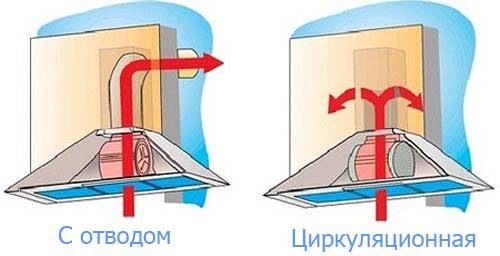
In the kitchen, in addition to the ventilation hole, it is recommended to additionally install an extractor fan above the stove in the ventilation duct. It will allow you to quickly remove the smells of cooking, preventing them from spreading to the rest of the rooms in the house.
Separate moment - boiler room and kitchen with gas equipment. They must be equipped with a separate channel for air flow directly from the street. Plus, don't forget the chimney.
This way, oxygen for combustion will enter the furnace in the right amount, and carbon monoxide will immediately leave the room.
Reasons for installation
The attic in a private house must be equipped with a ventilation system. This fact is important for the premises at any time of the year.
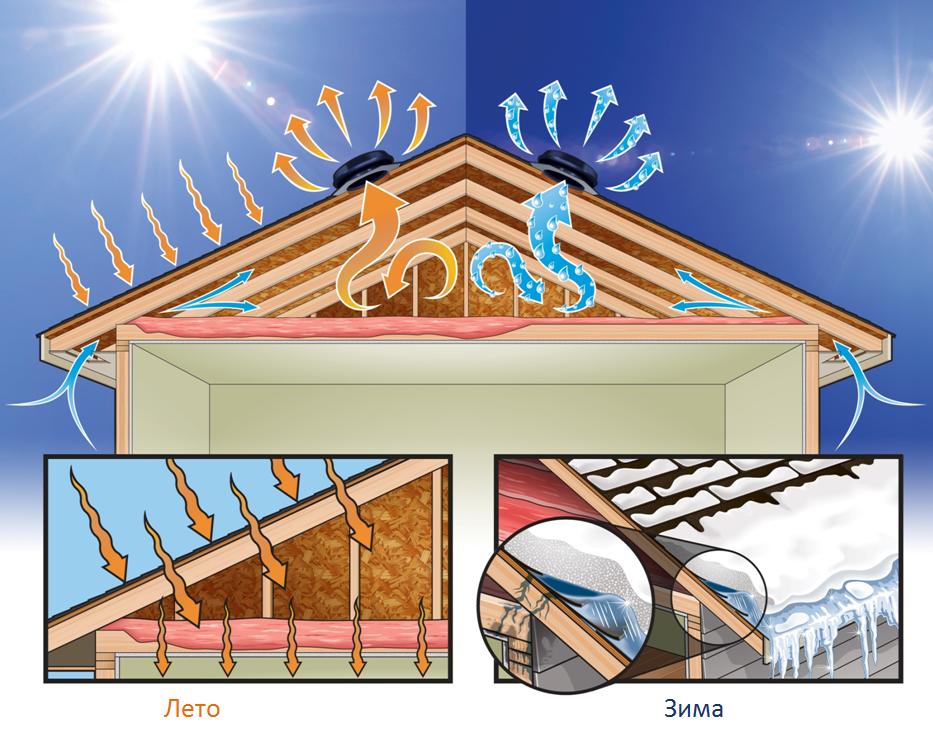
In summer, the heat from the hot roof passes into the room and sometimes heats it up to 150 degrees. The main share of heat is distributed at the top, and the air conditioner operates in enhanced mode. And in his absence, the owners of the house are forced to suffer from stuffiness and heat.
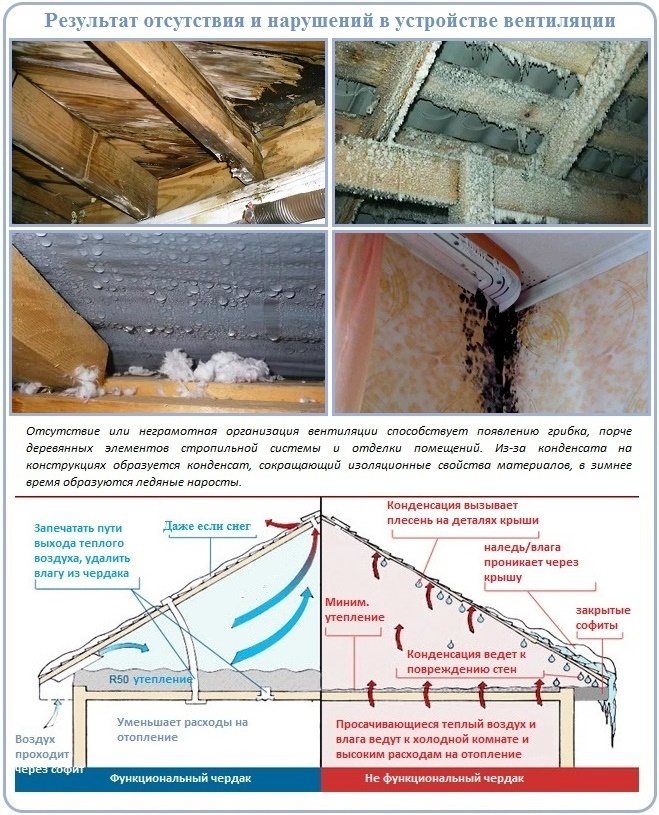
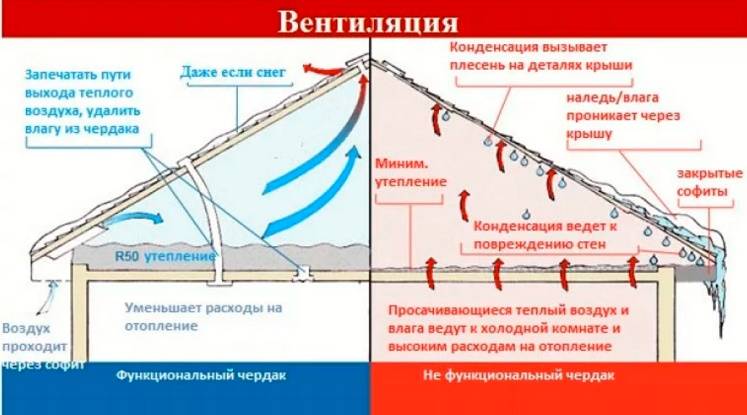
In winter, ventilation helps to remove accumulated moisture. According to technical safety requirements, the temperature in the attic and the street should differ by no more than 4 degrees, since sharp temperature drops create favorable conditions for the accumulation of condensate, which subsequently forms icicles. With the onset of a thaw, they melt, and moisture gets on the floor, which leads to deformation and destruction of the ceiling structure and roof, dangerous mold appears on the rafters.
Despite the importance of ventilation, many owners are afraid to install it, because they think that warm air escapes through the attic grilles and the room cools faster. In fact, the reason lies in poor-quality thermal insulation of the ceiling and walls, in addition, moisture penetrates into the attic through poorly insulated ceilings.
Important: ventilation of a cold attic of a hip or hip roof is needed, most often, only in the summer. Ventilation grilles in the attic of a private house play an important role in thermoregulation
With proper installation, they will save on heating, provide the desired degree of cooling and protect the room from negative external influences.In addition to all the above advantages, attic ventilation does not allow winter precipitation to accumulate on the roof of the building.
Ventilation grilles in the attic of a private house play an important role in thermoregulation. With proper installation, they will save on heating, provide the desired degree of cooling and protect the room from negative external influences. In addition to all the above advantages, attic ventilation does not allow winter precipitation to accumulate on the roof of the building.