It is better to stop on general-purpose types. There is a concrete drainage tray, and there are collapsible parts that can be used to fix the drain in any situation. The size of the shanks can be changed depending on your needs. This is the main advantage of this product.
When arranging a residential building, you can use different types of drainage systems for the roof. The complexes are classified according to the material of manufacture, type of construction, mounting and installation options.
Drains of an organized type: description and norms
One of the options for organizing a drainage system is organized drains, which are a collection of gutters, pipes and other elements. They are connected into a whole system, which is mounted on the outside of the building on the walls using brackets. Water, passing through gutters and pipes, enters the storm sewer or well, designed to further remove moisture outside the site.
 Organized drains in private homes are usually arranged outside the building.
SNiP allows the installation of organized drains on flat or pitched roofs of any type. The code of norms and rules also implies the following features of the arrangement of organized systems:
- for each section of the roof where expansion joints or walls are present, at least two funnels must be installed to ensure prompt water drainage;
- drain risers cannot be mounted in the thickness of the outer walls. Heating of drainage elements is carried out taking into account safety requirements;
- funnel bowls should be firmly fixed on the wall with metal clamps;
- the distance between the outer pipes of the drainage complex must be at least 24 m, and the cross-sectional area is determined at the rate of 1.5 cm2 per square meter of roof area.
An organized version of water drainage systems can be of several types. The most popular way to organize drains is to install drain gutters. Products are semicircular elements that are connected together to form a line of the required length. You can connect the gutters with a special glue or coupling. In the first case, the parts are fastened securely, but the design is non-separable. Couplings are more practical and provide the necessary rigidity of the drainage channel.
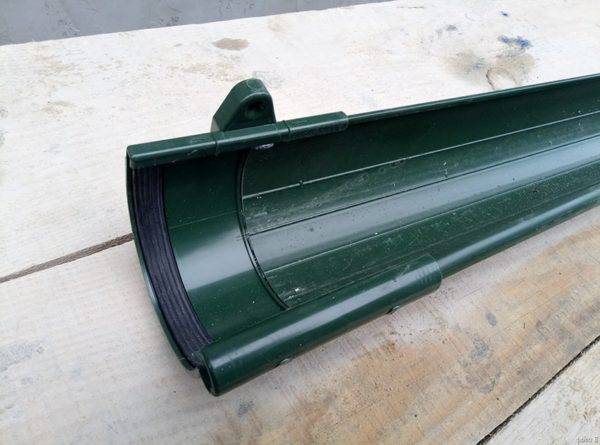 The gutters have a smooth inner surface, through which the water flows as quickly as possible, without encountering any obstacles on the way.
For flat roofs, a storm funnel is often used, which has a round shape. Water enters the opening of the funnel, passes through the pipes and flows into the sewer. Depending on the area of the roof, the amount of precipitation in the region and other factors, the number of funnels to be installed on the roof is determined. In this case, you can organize two options for the drainage system. The traditional method involves the gravity flow of water through pipes, and with gravity-vacuum precipitation passes through a system with a siphon.At the same time, a small number of funnels are installed on the roof.