- How does a vacuum radiator work
- A step-by-step scheme for the operation of vacuum radiators will occur as follows:
- 1.Very fast room heating
- 2. There are no air pockets in the vacuum radiator
- 3.Vacuum radiator is not susceptible to rust and corrosion inside
- 4.Vacuum radiators do not clog
- 5. In vacuum radiators, the pressure is lower than in others
- What are vacuum heating radiators, their characteristics and installation
- Positive traits
- Aluminum battery device
- Technical characteristics of aluminum heating radiators
- Advantages and disadvantages of aluminum radiators
- Whether to believe, touting vacuum heating appliances
- Care of radiators in the absence of heating (off-season)
- We recommend reading:
- Operating recommendations
- Helpful Hints
- Do-it-yourself installation subtleties
- Hardware Benefits
- Self-installation of heating radiators: preparation
How does a vacuum radiator work
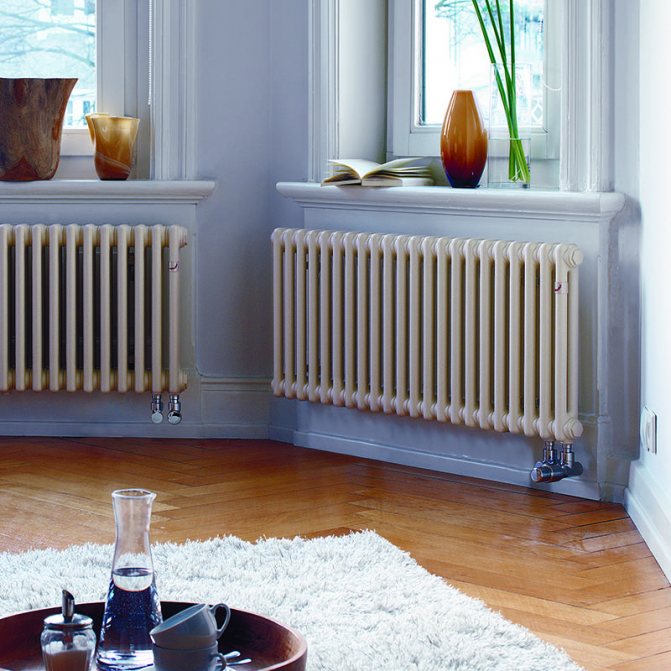
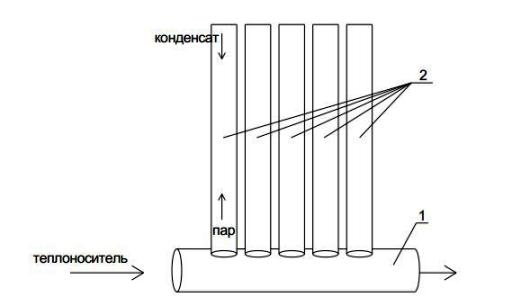
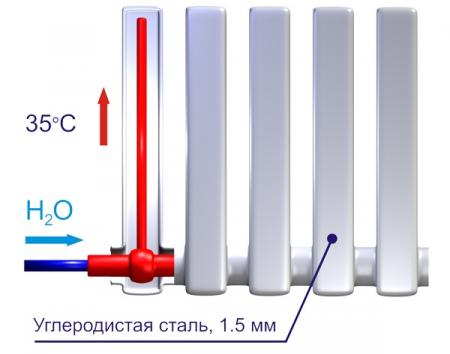
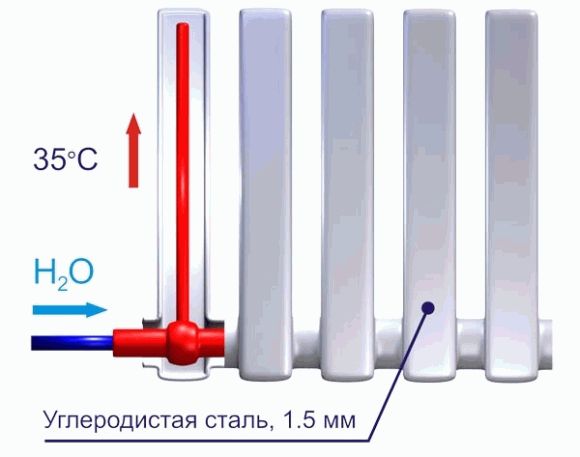
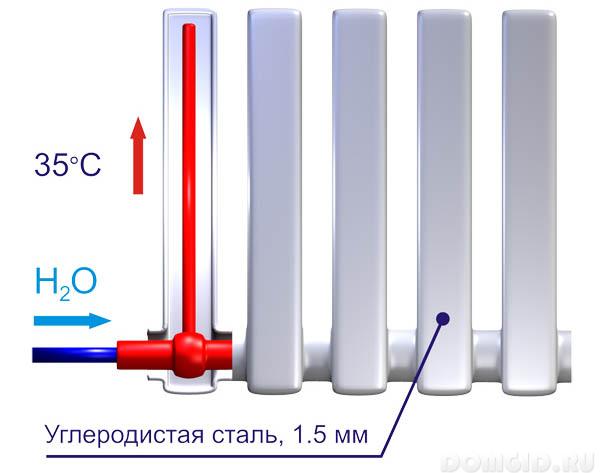
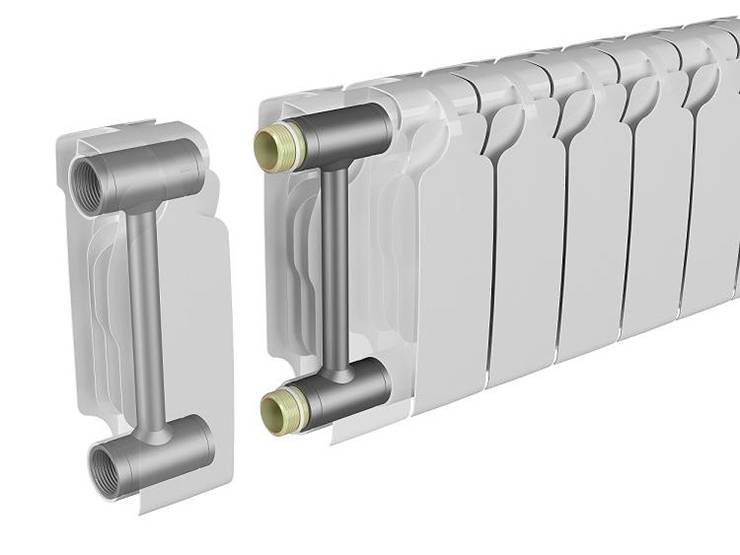
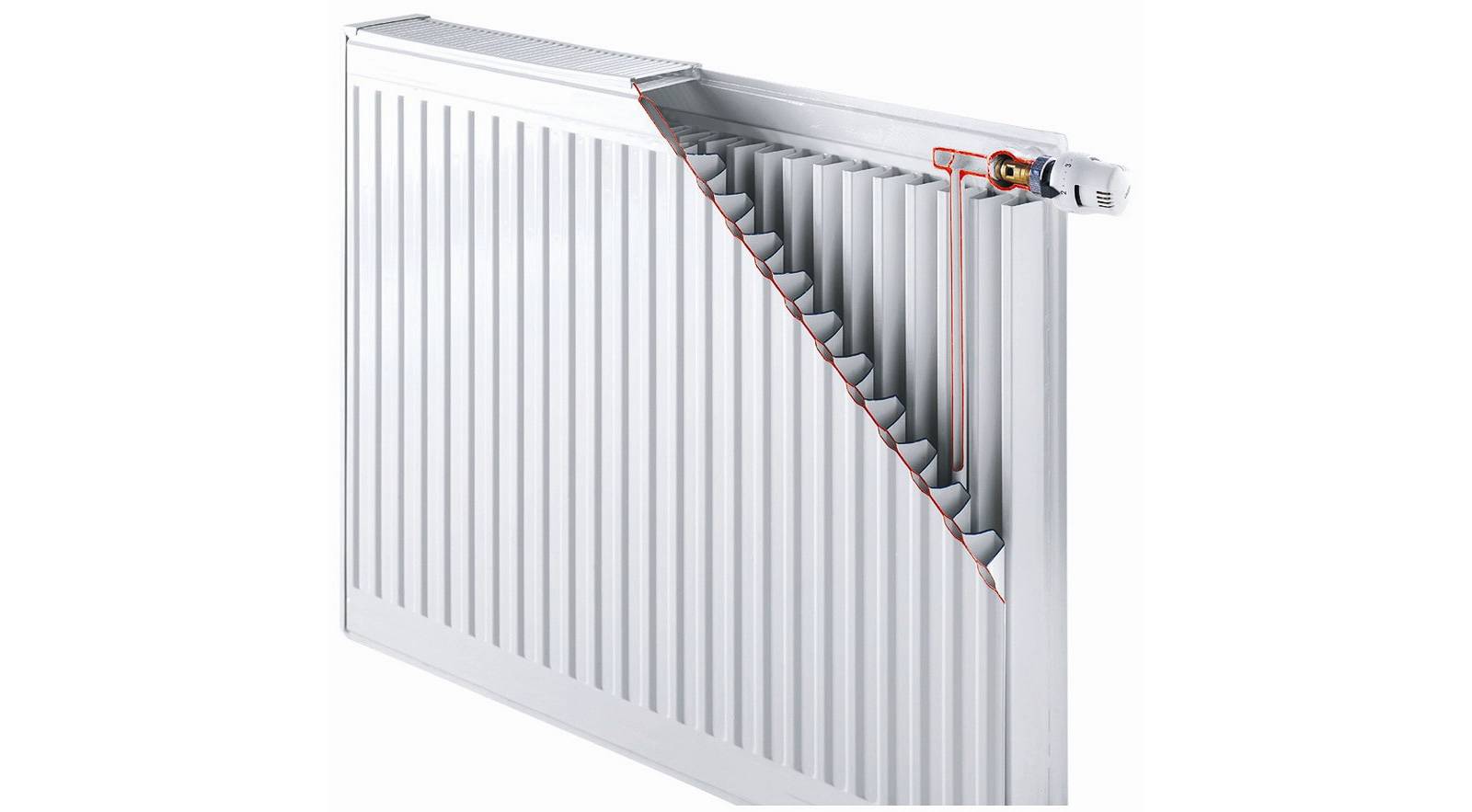
In appearance, this device is not particularly different from conventional modern batteries, consisting of sections. Only the principle of fluid circulation is different here. Each section of the vacuum cooler contains a small amount of lithium bromide liquid. Since this liquid is in a vacuum, it can boil already at a temperature of 35 degrees.The lower horizontal pipe is connected to a source of hot water, and it, circulating, begins to heat sections in which the lithium-bromide mixture approaches the boiling point very quickly. At the same time, the circulating water can be just over 30 degrees, this will be enough to heat the sections of the vacuum radiator. The contact of the pipe with the coolant and sections occurs through the metal.
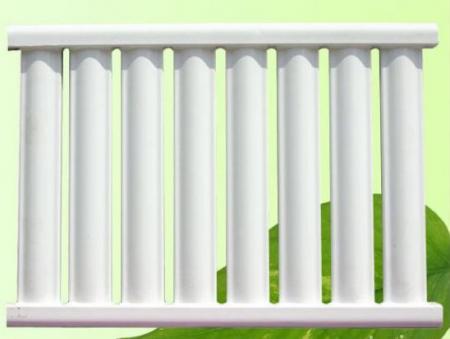
A step-by-step scheme for the operation of vacuum radiators will occur as follows:
- Hot water is supplied to the lower pipe of the radiator;
- When heated, the pipe transfers heat to the vertical sections;
- The special composition of the liquid inside the sections boils and turns into a vapor state;
- Intensive evaporation heats the entire battery, heat is transferred to the air, the room is heated;
- The condensate formed from evaporation falls again down the inner walls of the device, and then boils again, and so on without end.
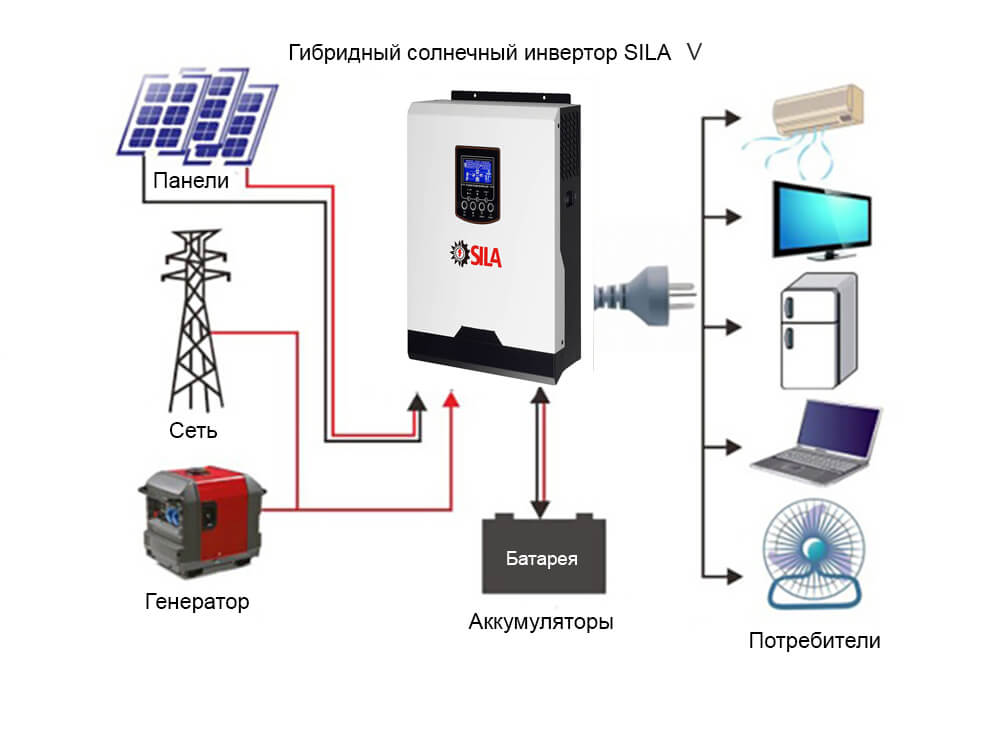
This is the whole principle of operation of a vacuum radiator. Such a radiator can operate both from a central heating system and from an autonomous one (gas and electric boilers, solar panels). Undoubtedly, the new development has advantages - a sufficiently low consumption of heat energy for maximum heating. But sellers, in order to sell goods at a heavily inflated price, begin to compose non-existent qualities of vacuum radiators, let's consider these myths so as not to fall for the bait.
1.Very fast room heating
It is with this phrase that sellers try to attract buyers. Of course, it catches, and many completely forget about logic.But in vain, because the logic is that almost all of us start heating with the onset of cold weather (central heating is supplied according to the same principles) and do not turn it off until the spring heat comes. That is, a vacuum heating radiator will not endlessly heat up and cool down, and then heat up again. There is no point in the advantage of quickly heating the room, because heating occurs once a year and lasts for several months. This phrase can be considered an important criterion only in relation to mobile heaters.
2. There are no air pockets in the vacuum radiator
Every specialist knows that there will be no air pockets in any other radiator if it is assembled correctly. Accordingly, the argument is no longer valid.
3.Vacuum radiator is not susceptible to rust and corrosion inside
In fact, all radiators are made from materials that are resistant to rust and corrosion inside the sections. Sometimes such processes inside the batteries begin to occur because water is drained from them for a warm period and the metal becomes rusty from contact with air. If you keep the radiators constantly filled, then there will be no corrosion in any other type of battery.
4.Vacuum radiators do not clog
Any radiator can become clogged only if dirty water is supplied to it. If you put a filter, then blockage will never happen in any radiator.
5. In vacuum radiators, the pressure is lower than in others
In fact, the level of pressure does not affect absolutely anything, therefore it cannot be considered some important or significant indicator.

Considering vacuum heating radiators as a choice for your home, consider these myths and don't be fooled. The novelty undoubtedly has advantages, but often sellers greatly exaggerate the set of beneficial qualities of radiators.
What are vacuum heating radiators, their characteristics and installation
The basic principle of operation of any heating system is the efficient transfer of energy from the coolant to the surrounding space. To increase the temperature in the room, two methods are used:
- Increasing the power of the heating element - boiler.
- Reduction of heat losses during the passage of a heated substance (water, steam) through pipelines and radiators.
Taking into account the constant growth in the cost of energy carriers, the implementation of the first paragraph entails an increase in the expenditure side of the budget. Therefore, the use of new technology is the best way to optimize the entire heating system. Vacuum heating radiators are one of the clearest examples of a complex combination of the physical properties of a substance and an improved design.
What are vacuum heating radiators
The efficiency of the heating element is determined by its efficiency (coefficient of performance). Ideally, its heating should occur without intermediate losses, and the efficiency will be 100%. In practice, for modern radiator models, this figure ranges from 60 to 85%. This is due to uneven heating (passage of water) and low thermal conductivity.
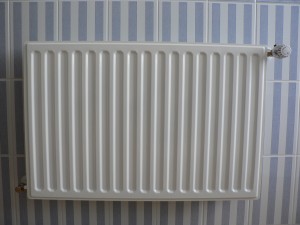
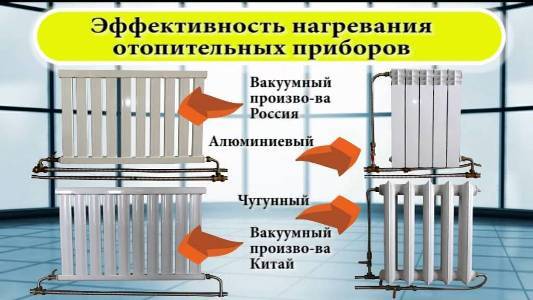
Vacuum heating radiators outwardly do not differ from standard sectional systems. The difference is in the internal structure. For fast and uniform heating of the radiator, a liquid with a low boiling point is used.Often this is a lithium bromide composition with an evaporation temperature of 35 ° C. It is enclosed in vacuum tubes, which are located in the sections of the radiator. Heating occurs from the main coolant passing in the lower part of the heating element.
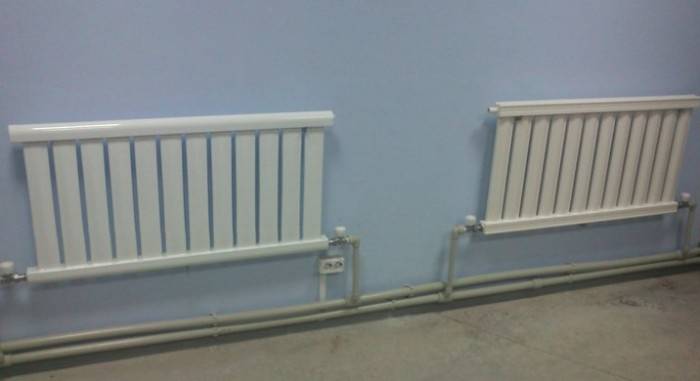
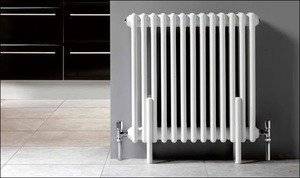


General diagram of a vacuum radiator
Upon reaching a temperature of 35 ° C, the liquid evaporates and the heat is evenly distributed over the entire surface of the radiator. This increases the heating rate of the sections and reduces heat losses.
Installation of vacuum radiators
One of the main advantages of using this type of radiators is an alternative choice of heating sources for a rapidly evaporating liquid (FL). You can use the following connection types:
- Autonomous heating system using water as a heat carrier. The connection method is similar to the standard one - with the help of couplings, the hot water inlet and outlet are connected to the radiator. At the same time, the required volume of water from the heating system will be significantly lower than for classic batteries. On average, it is 300-350 ml. depending on the inner diameter of the pipes and the number of sections in the radiator. For cast iron batteries, this figure is 3.5-5 liters.
- Electric heating BZ. In this case, instead of water, an electric heating element is used. Equipped with a thermostat, it can be both stationary and portable.
- Central heating. Often, to improve the efficiency of central heating in apartments, vacuum radiators replace old batteries. The relevance of such a replacement is due to the traditionally low temperature of the coolant
Selection of vacuum radiators
Before purchasing vacuum radiators, it is necessary to check their reliability and compliance with technical standards. The lithium-bromide composition in them is poisonous, so handicraft work can lead not only to a low temperature in the room, but also to poor health.
Radiator reliability indicators:
- Certificate. Heating equipment from a serious manufacturer is always certified.
- The radiator must not be overfilled with liquid. When shaken, a characteristic rustle will be heard. If the sounds are similar to plain water, then the product is of poor quality.
- Welding in the factory has even seams, unlike manual work.
- Painting of a steel surface is made by a powder method. It is almost impossible to remove with simple cleaning products.
Among domestic manufacturers, it is worth noting the products of the EnergyEco company. Currently, 2 types of vacuum radiators are produced with the following technical characteristics:
Despite the clearly high performance indicators, they have one drawback - the cost. Their average cost is 300 USD. for 800 W and 550 USD for 2000 watts.
This production technology and economical approach to the issue of minimizing the cost of space heating is still new to our country. But the ever-increasing demand for vacuum radiators speaks of their effective use not only in everyday life, but also for the thermal supply of office and industrial premises.
Positive traits
Manufacturers of a new type of heater point to a number of advantages over traditional products:
- The need for the main coolant is reduced - it circulates only in the boiler and pipeline (it is not in the sections). On average, the heat carrier saving is 80%.
- Ease of installation combined with low consumption of pipes.
- Duration of operation - up to 30 years (however, the warranty for the product is not more than 5 years).
- There is no need to carry out antiseptics of radiators.
- Safety - if the product meets the requirements of p.p. 5.2 and 5.9 GOST 31311 - 2005).
Sellers go even further: they claim that their heat dissipation is higher than conventional batteries
They focus on the rapid heating of the radiator surface.
Aluminum battery device
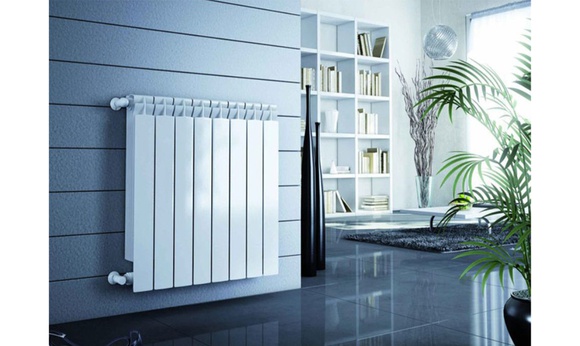
Sectional aluminum heater consists of 3-4 separate sections. As a rule, titanium, silicon, zinc are added to aluminum. These metals make the product more durable and resistant to tearing and corrosion. All sections are connected to each other with a threaded connector. Silicone gaskets are used to seal the connection. Inside, the radiators are polymer-coated to prevent the possibility of battery rupture.




Whole aluminum radiators consist of profiles. Profiles are produced by extrusion.
No additional metals are added to aluminum radiators.
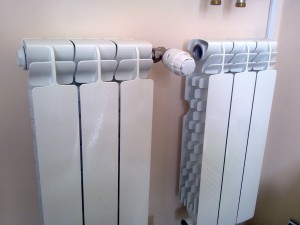
Depending on the production method, radiators are made by casting, extrusion and anodized products (made from aluminum of a higher degree of purification).
Technical characteristics of aluminum heating radiators
In view of the high technical characteristics, many decide to buy an aluminum radiator for heating an apartment. The main technical parameters include:
- operating pressure. It is in the range from 10 to 15 atmospheres. In residential apartments, the working pressure can exceed the norm by 3-4 times.In this regard, such radiators are rarely installed in city houses. But for private houses - such a heater would be an ideal solution;
- pressing pressure. It is in the range from 20 to 50 atmospheres;
- heat transfer coefficient. For a standard section, it is 82-212 W;
- the maximum temperature of the coolant can reach +120 degrees;
- one section can weigh from 1 to 1.5 kg;
- the capacity of each section is from 0.25 to 0.46 l;
- the distance between the axles can be 20, 35, 50 cm. There are models in which this parameter can reach 80 cm.
The manufacturer indicates the parameters for each radiator model in the device passport. Given the technical characteristics of aluminum heating radiators, their price is quite justified and depends on the type of battery, the number of sections and the manufacturer.
Advantages and disadvantages of aluminum radiators
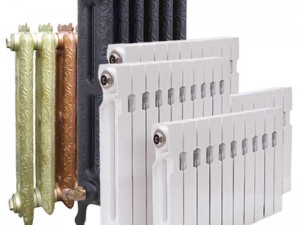
The main advantage of aluminum batteries can be called compactness and much less weight than cast iron systems. You can read more about cast iron radiators here. The equipment warms up very quickly and perfectly transfers heat to the room. The service life is long enough. Another advantage is the division into sections - it is possible to choose the desired length of the battery. It should be noted that the price for aluminum radiators is indicated per section. This makes it easy to calculate the approximate cost of a sectional device.
Because the equipment is small and light, it is easy to install. Installation can be carried out even on a plasterboard wall. Modern models look aesthetically pleasing and stylish. Aluminum is easy to work with. This allows manufacturers to experiment with battery design.You can choose an option for any interior. Most of all, aluminum radiators are suitable for autonomous heating systems. Despite the high technical characteristics and a lot of advantages, the price of aluminum heating batteries is quite affordable.
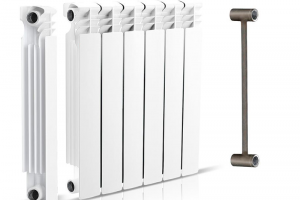
Today, aluminum batteries occupy a leading position in sales of heating equipment.
Many people prefer to buy this type of heater and because of the relatively low cost. For aluminum heating radiators, the average price per section is about 230-300 rubles.
Whether to believe, touting vacuum heating appliances
We will try to approach this issue as scrupulously and objectively as possible, taking as a basis only proven facts. At the same time, we will consider each of the advantages of these radiators indicated by the manufacturer. So, we started.
1. The lightning-fast warm-up time characteristic of vacuum radiators is constantly advertised. Okay, let's say. However, the whole house does not warm up so quickly. After all, it contains not only air, but also walls, internal partitions with furniture, a ceiling with a floor. They take a certain amount of time to heat up.
And therefore it is not at all so important whether the radiator itself will warm up for a minute or five.
2. Now about a small amount of coolant, which is supposedly very economical. The only question is where exactly this savings manifests itself.




If in the central heating system, then this is a real bluff - it is not so important here, more hot water will flow through the pipes or less.If you take a country cottage, then the savings in it are also in question, given that the same modern panel radiators also require not so much coolant. 3
Air locks cannot appear in vacuum-type radiators. He talks about it with enthusiasm. But after all, radiators are not the entire heating system, but only part of it. By the way, traffic jams appear only when this system is assembled illiterately. Otherwise, they will not be with any radiators
3. Air pockets cannot appear in vacuum-type radiators. He talks about it with enthusiasm. But after all, radiators are not the entire heating system, but only part of it. By the way, traffic jams appear only when this system is assembled illiterately. Otherwise, they will not be with any radiators.
4. Two more fat pluses that manufacturers trump. This is the impossibility of clogging radiators and the absence of corrosion. Perhaps, for autonomous heating systems, these advantages are unlikely to be so fat. If the hot water in the heating is clean, its acidity level meets the standards, and it does not drain from the system, then there will be no corrosion. And there is no place for blockages to come from.
5. As for the low hydraulic resistance, which supposedly sharply reduces the cost of heating, let's say so. For centralized heating, it is not at all clear whose costs are meant. Unless the owners of boiler houses, hundreds of kilometers distilling tons of hot water. It turns out that there can be a benefit only when used in an autonomous heating system, and it is still a question whether it can be. And for an autonomous system in their home, many use the natural circulation of the coolant, so this issue is irrelevant.
6.The next point will be to save energy by half, or even four times. With this, the error came out, since the law of conservation of energy is still valid. Radiators, even the most innovative ones, cannot generate energy. They only pass it on, and there is no need to talk about savings. How much heat is spent, so much must be replenished - the only way.
7. Now let's touch on the heat transfer of vacuum tubes, which, according to manufacturer's certificates, is not stable. This indicator can have deviations of up to 5 percent up and down. It turns out that this depends on the speed of the water in the heating system, and on its temperature. So it is hardly possible to adapt automation to such a radiator. And two radiators with an equal number of sections can have different parameters.
8. Separately, let's talk about heating systems in private homes, where water circulates naturally. Here the hydraulic pressure is important, which is created due to the difference in the height of hot water in the boiler and radiator. So, for vacuum-type devices, this height is much less, so they work with problems in such a system.
9. Now imagine that a crack has appeared in the radiator case. Even if it is tiny, you can forget about the vacuum. He will leave forever, and normal atmospheric pressure will be restored. And it, in turn, will lead to an increase in the boiling point of the coolant. The result will be disastrous - either the liquid will hardly evaporate, or steam will not appear at all. In short, the radiator will stop heating.
10. By the way, this wonderful (according to sellers and advertisers) lithium-bromide liquid is also poisonous, it turns out. Therefore, the fact that the radiators become cold when the coolant leaks is only half the trouble.It is worse if the battery leaks, for example, at night, poisoning the sleeping residents of the apartment.
So, perhaps, it is not always worth believing, so convincing at first glance.
Care of radiators in the absence of heating (off-season)
To carry out work on their equipment, heat supply organizations usually drain water in the off-season. Without a coolant, the corrosion process intensifies in almost all types of radiators (to a lesser extent - in cast-iron radiators).
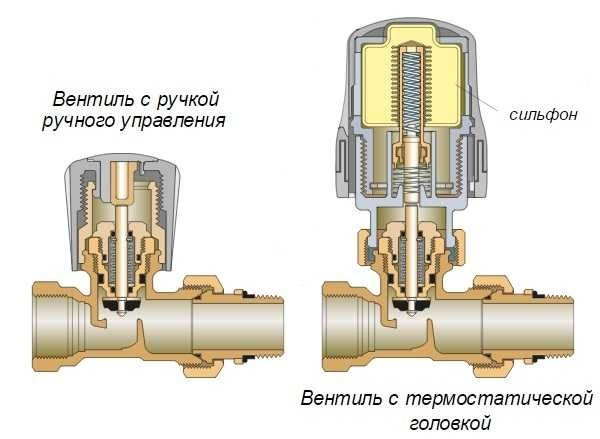
According to manufacturers' recommendations, empty radiators can be kept for no more than 15 days. Therefore, measures should be taken to conserve water in heating appliances. Usually, for this, the lower shut-off valve is closed - when the radiator is connected to the side.
At the same time, the upper valve is left open - pressure and corrosion products (hydrogen during the oxidation of aluminum) are vented through it. When the aluminum radiator is completely turned off, the Mayevsky valve should be opened - the accumulation of hydrogen can lead to an increase in pressure and depressurization of the product.
To maintain the efficiency of heating devices, especially radiators, it is recommended to flush them. Radiators are flushed once every 2 to 5 years, the frequency of flushing is determined by the decrease in heat transfer from the device. The simplest cleaning method is to hose down the faucet.
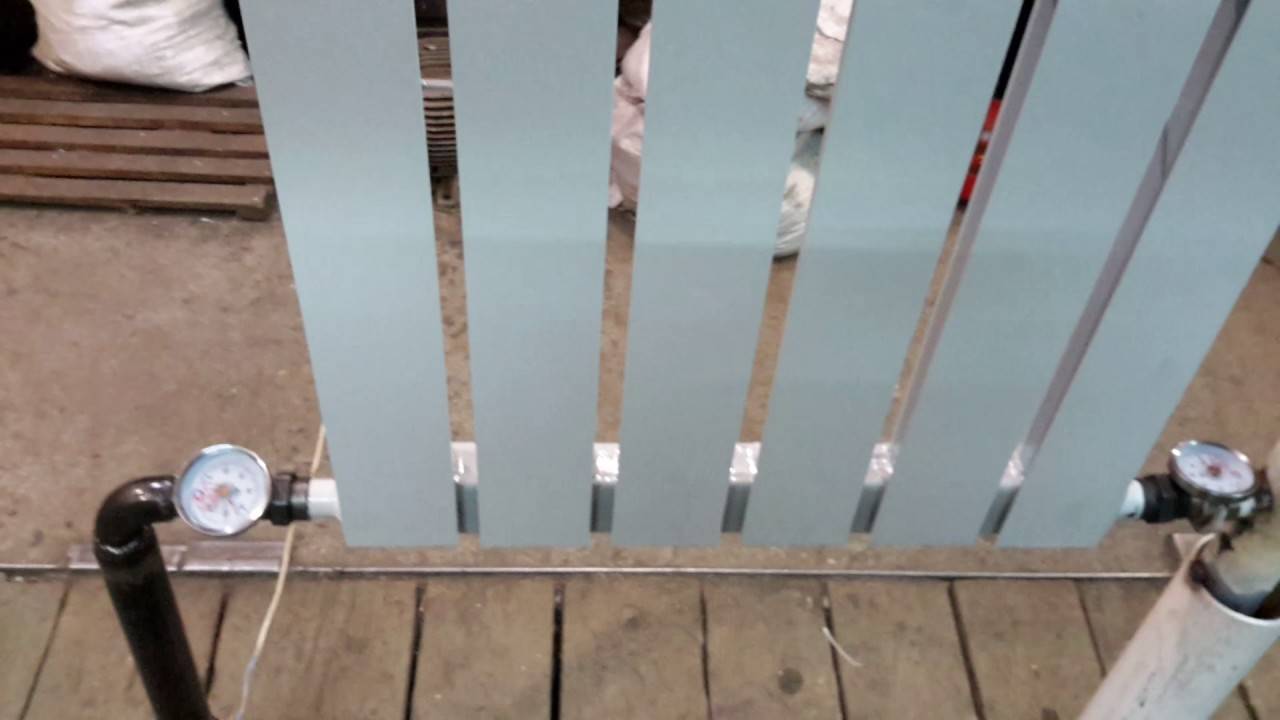




To do this, the radiator is freed from water through an impassable bottom plug, disconnected from the connections. The hose is connected to the upper hole, flushing water flows out of the lower one.
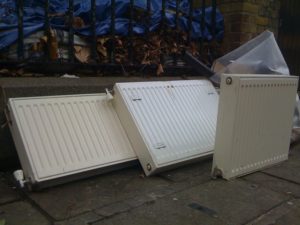 Heating appliances removed for washing
Flushing is carried out until the discharged water is completely clarified. Then the radiator is installed in its place.For ease of removal and maintenance of heaters, they should be installed on collapsible connections of the American type - you can read more about this here.
Cast iron radiators should be painted after 5-6 years, and special heat-resistant types of paints and enamels should be used. Painting is carried out after preliminary preparation of the surface of the devices in several layers. Painting is also relevant for steel products - if the coating is broken at the site of damage, the process of metal corrosion is significantly accelerated.
All the recommendations given in this article must definitely be followed in apartments with central heating. In autonomous heating systems, the chemical composition of the coolant practically does not change, the pressure in the equipment is much less. But still, it is not recommended to drain the water there in the off-season - this will slow down the corrosion process.
Timely care, proper operation of heating radiators significantly extend the service life of products, maintain the quality of their work at a high level. Maintenance activities take little time, but the result will show itself - the radiators will last a long time, they will not need to be replaced for a long time (and, accordingly, financial costs).
(Views 669 , 2 today)
We recommend reading:
What is water heating
Types of heating boilers
Do-it-yourself storage water heater connection
Induction boiler for heating a private house
Sewer system design
Types of sewer pipes
Operating recommendations
The equipment in question has proven to be an economical and highly efficient way of heating summer cottages used seasonally and large private houses intended for year-round use. The heating system is activated within a few minutes and does not need to be bled first.
Experts advise at the installation stage to take care of creating certain conditions that contribute to the rationalization of the use of vacuum equipment:
- the building, the apartment needs to be insulated as much as possible in order to reduce the level of heat loss. A reasonable solution would be to install modern types of double-glazed windows on windows, sealing cracks, supplying the roof and floor with high-quality thermal insulation. In this case, the devices will function with greater efficiency;
- the number of sections, respectively, and their overall performance must fit the parameters of the sections served. Even at the stage of choosing devices, you need to take into account the height of the ceilings, the footage of the rooms;
- the heat transfer of the equipment is always determined by the temperature of the working environment, the conditions are optimal when the water is heated to at least 60 ° C.
In the core market, there is a systematic increase in demand for batteries using a lithium-bromide mixture, due to which manufacturers have significantly expanded the possibilities of their application. In addition to heating cottages and private houses, vacuum systems are in demand at production and storage facilities, in the arrangement of garages and public buildings, greenhouses and farms.
Helpful Hints
Vacuum batteries have proven themselves best in private houses or seasonally used premises: in a country house or a country house. When choosing a device, you should consider the footage of the rooms and the height of the ceilings.
Manufacturers recommend installing vacuum radiators in a centralized heating system only if there are heat meters. This makes it possible to somehow regulate the temperature of the primary working fluid. The ideal range is 40-60°C. At higher temperatures (and they are always much higher in a central system), the liquid will completely evaporate, turn into vapor, and will not be able to circulate.
Do-it-yourself installation subtleties
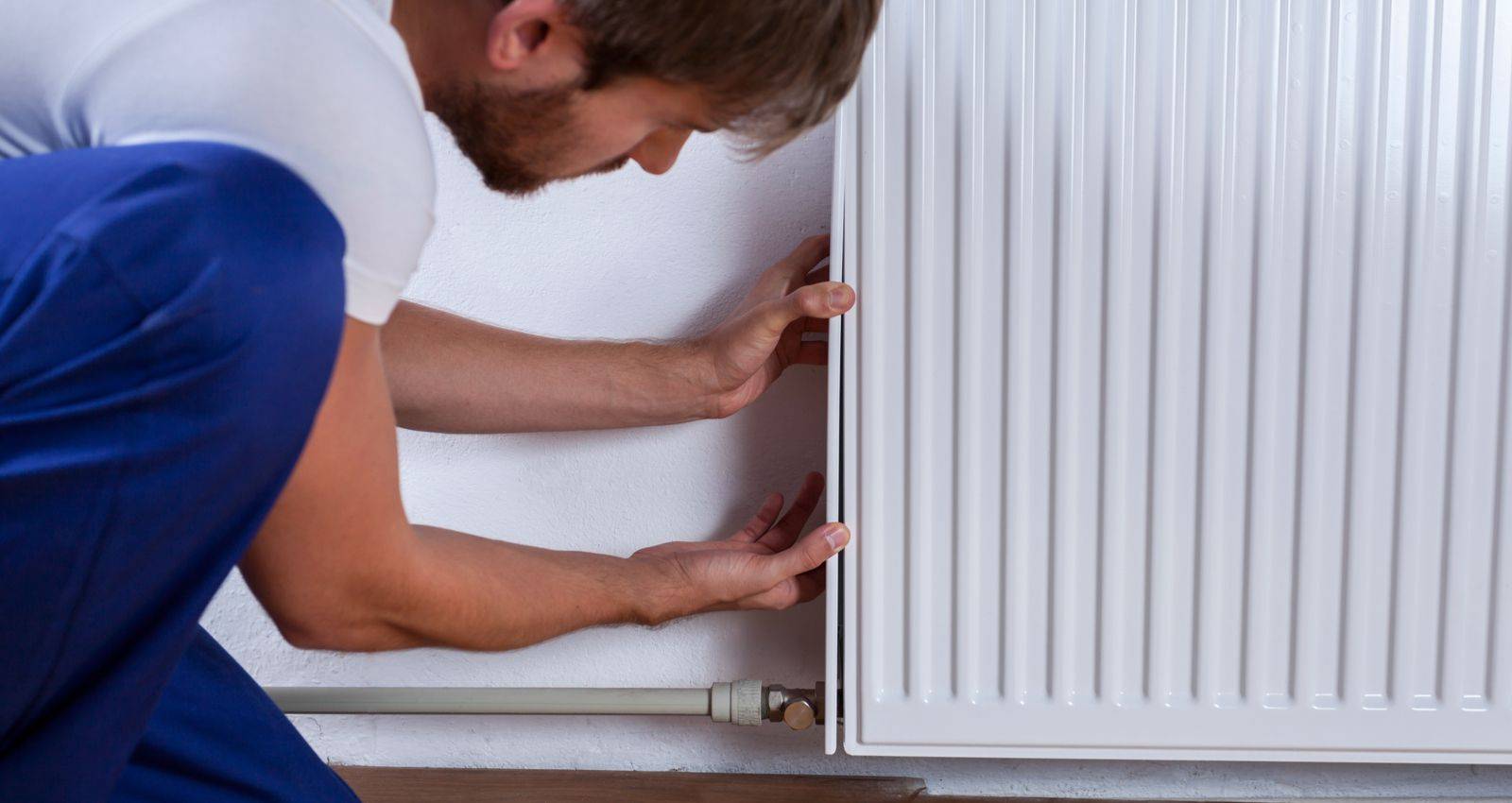
Mounting a vacuum radiator is not difficult, but in order to do without alterations, you need to learn a few rules. It is necessary to follow the recommendations regarding the placement of the unit relative to the wall, floor, window sill.
At the same time, the distance between the radiator and the wall is at least 50 mm, between the device and the floor - from 20 to 50 mm, the optimal distance to the back of the window sill is 50-100 mm.
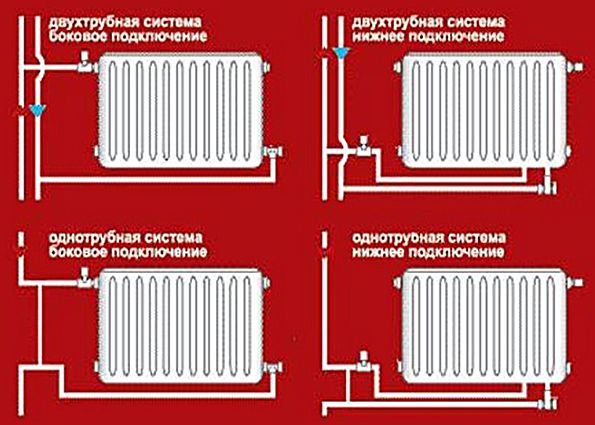
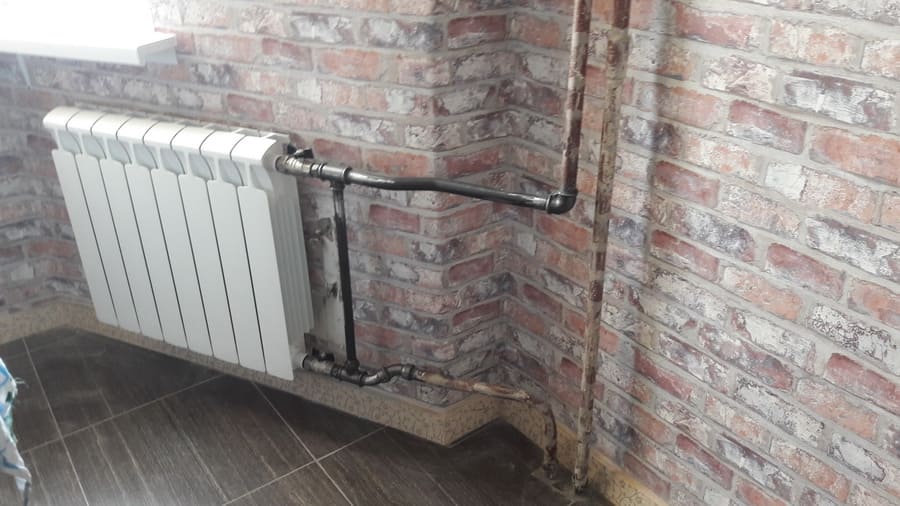
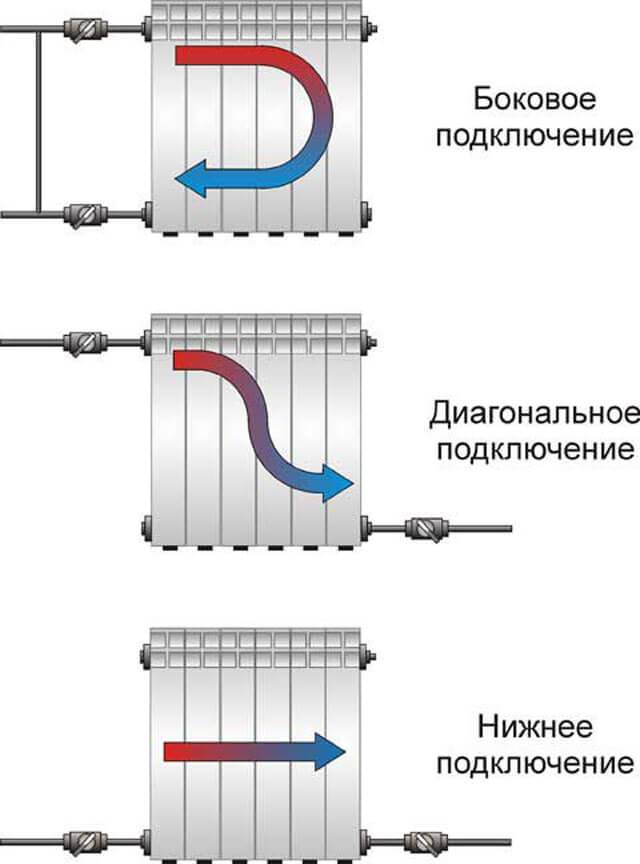
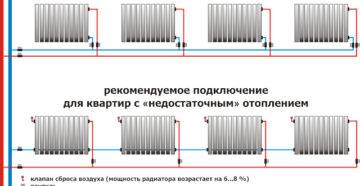
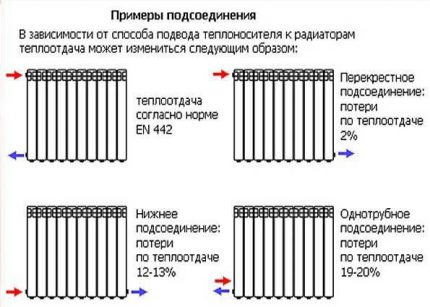 The photo shows the options for connecting radiators. You should be aware that the inclusion of other heating devices in the heating circuit, along with vacuum ones, reduces its efficiency.
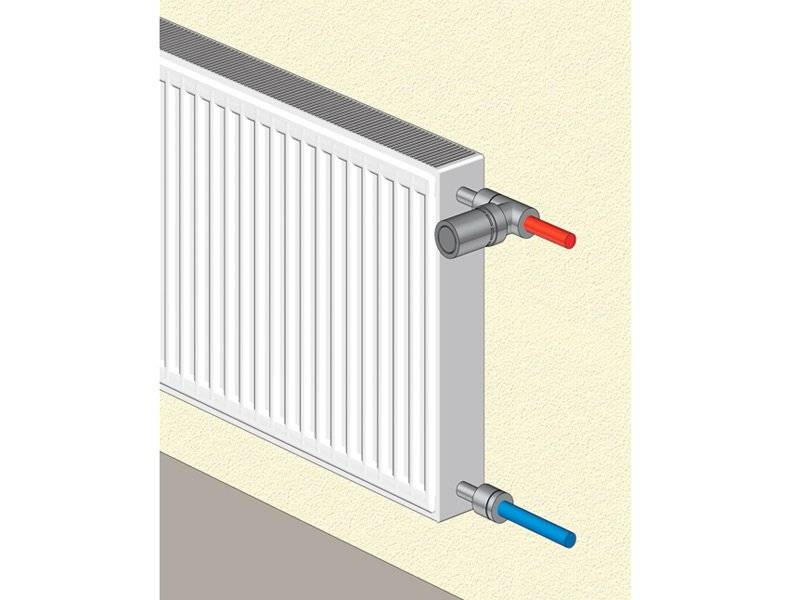
The installation itself is not much different from inserting other types of radiators into the system. The only difference is that the entrance and exit are at the bottom.


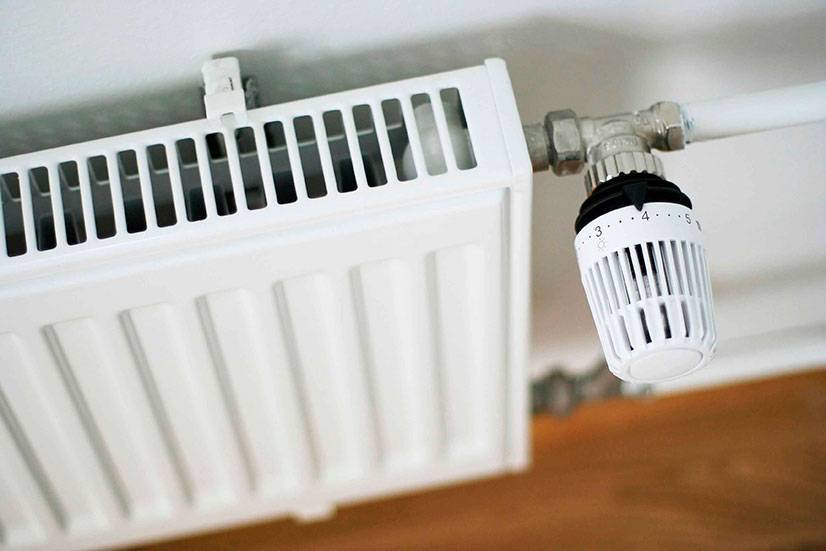
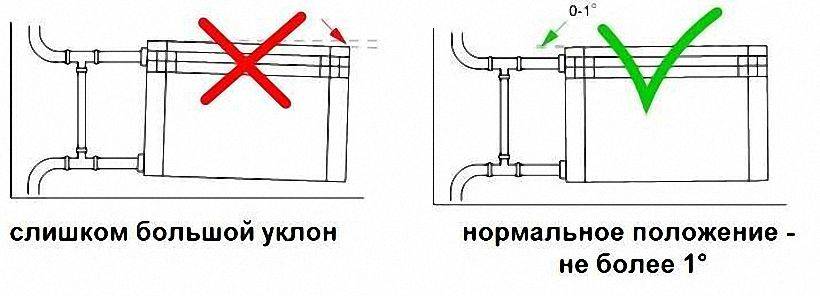




The installation of a vacuum unit provides for a chain of actions following one after another:
- The coolant is drained, the old heater is dismantled.
- Perform marking of installation sites.
- Attach brackets. Test them for stability and strength.
- Install ball valves. Through them, the device is connected to the highway. Joints must be sealed with tow or sealant.
- Check the system for leaks.
To improve heat transfer, a sheet of foil can be placed on the wall behind the radiator.In the presence of previously performed thermal insulation, it will be necessary to increase the length of the brackets by an amount equal to the thickness of the thermal insulation layer. If the house is insulated, the efficiency of the heating system will increase.
Hardware Benefits
Excellent heat transfer characteristics explain the fact that a vacuum heating radiator can be operated from a boiler, furnace, boiler or solar collector. Boilers of smaller capacity can be used to heat large rooms. After all, now there is no need to heat a huge amount of coolant. However, do not expect that the volume of energy consumption will be reduced significantly.
However, homeowners receive a number of significant benefits from installing a heating system with vacuum radiators:
Lithium bromide radiators
- The volume of coolant needed to heat the house is reduced by almost 80%.
- The amount of heat consumed from centralized systems is significantly reduced. Sometimes this figure reaches 50%. The benefit is obvious if the consumed heat is taken into account by the meters.
- When using induction heating boilers, electricity consumption is reduced by 30-40%.
- The installation of an innovative radiator is no different from the installation of traditional heating batteries.
- Sections of the equipment are not subject to corrosion. There are no problems associated with airing sections of the heating system.
- The circulation of a small amount of coolant is facilitated due to a decrease in the resistance of the liquid mass.
- A high level of heat transfer is provided by a boiling boron-lithium mixture.
Self-installation of heating radiators: preparation
The first thing you should pay attention to is the type of wiring. It can be single pipe or double pipe.
The number of parts used and, of course, the complexity of the work depends on what kind of wiring in the house.
Differences between a single-pipe heating system and a two-pipe one
To distinguish a single-pipe heating system from a two-pipe one, it is necessary to be guided by the following criteria:
- if the pipeline leaving one battery is simultaneously supplying for the subsequent heating radiator, such wiring is called single-pipe;
- if separate supply and return pipelines are equipped for each battery, such wiring is called two-pipe.