
- How to choose a bipolar?
- We proceed to the connection of the circuit breaker
- By connecting the circuit breaker with our own hands, we saved:
- How to choose according to the characteristics and functions of the device
- Determining the polarity of the machine
- Current selection
- Operating or rated current
- Short circuit current
- Selectivity
- Number of poles
- Cable section
- Manufacturer
- Case protection degree
- Marking
- On what principle does a single-pole machine work
- Applications
- Device characteristic
- Characteristics of the machine
- Buying Tips
- Marking
- Power
- Manufacturer and price
- Major buying mistakes
- Time-current characteristics: two-pole circuit breaker
- How to connect the machine correctly: security measures
- Wiring diagrams
- Advantages and disadvantages
- Characteristics of the machine
- Machine device
- What is the difference between an RCD and an automatic
- Circuit breaker
- Residual current device and its operation
How to choose a bipolar?
In order for the circuit breaker to fully provide the necessary protection, it is necessary to carefully consider its choice. The main thing is not to make a mistake with the face value. To do this, you need to know the rated load that you plan to connect to the device.
The current in the circuit protected by the machine is calculated by the formula: I = P / U, where P is the rated load, and U is the mains voltage.
For example: if a 400 W refrigerator, a 1500 W electric kettle and two 100 W light bulbs are connected to the appliance, then P = 400 W + 1500 W + 2 × 100 = 2100 W. At a voltage of 220 V, the maximum current in the circuit will be: I \u003d 2100/220 \u003d 9.55 A. The closest machine rating to this current is 10 A. But in the calculations, we did not take into account the resistance of the wiring, which depends on the type of wires and their cross section. Therefore, we buy a switch with a trip current of 16 amperes.
Here is a table that helps determine the power of the network to be taken into account when calculating the current strength.
| Current strength | 1 | 2 | 3 | 4 | 5 | 6 | 8 | 10 | 16 | 20 | 25 | 32 | 40 | 50 | 63 | 80 | 100 | |
| Power of a single-phase network | 02 | 04 | 07 | 09 | 1,1 | 1,3 | 1,7 | 2,2 | 3,5 | 4,4 | 5,5 | 7 | 8,8 | 11 | 13,9 | 17,6 | 22 | |
| Wire cross-sections | copper | 1 | 1 | 1 | 1 | 1 | 1 | 1,5 | 1,5 | 1,5 | 2,5 | 4 | 6 | 10 | 10 | 16 | 25 | 35 |
| aluminum | 2,5 | 2,5 | 2,5 | 2,5 | 2,5 | 2,5 | 2,5 | 2,5 | 2,5 | 4 | 6 | 10 | 16 | 16 | 25 | 35 | 50 |
Using the table, you can calculate with great accuracy the necessary parameters of a two-pole machine.
As for the stores where you can buy them, be guided by prices and the range of products. From the list of manufacturers we can recommend, for example, the Legrand brand.
We proceed to the connection of the circuit breaker
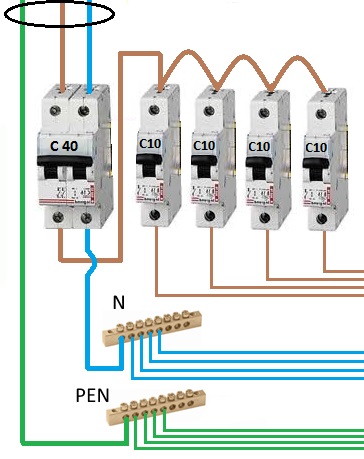
If there is voltage on your supply wire, it must be disconnected before work begins. Then make sure that there is no voltage on the connected wire using a voltage indicator. For connection, we use a wire VVGngP 3 * 2.5 three-core, with a cross section of 2.5 mm.
We prepare suitable wires for connection. Our wire is double insulated, with a common outer and multi-colored inner. Decide on connection colors:
- blue wire - always zero
- yellow with a green stripe - earth
- the remaining color, in our case black, will be the phase
Phase and zero are connected to the terminals of the machine, the ground is connected separately to the through terminal. We remove the first layer of insulation, measure the desired length, bite off the excess. Remove the second layer of insulation from phase and neutral wire, about 1 cm.
We unscrew the contact screws and insert the wires into the contacts of the machine. We connect the phase wire on the left, and the zero wire on the right. Outgoing wires must be connected in the same way. Be sure to check again after connecting. Care must be taken to ensure that the wire insulation does not accidentally get into the clamping contact, because of this the copper core will have poor pressure on the contact of the machine, from which the wire will heat up, the contact will burn, and the result will be the failure of the machine.
We inserted the wires, tightened the screws with a screwdriver, now you need to make sure that the wire is securely fixed in the terminal clamp. We check each wire separately, swing it a little to the left, to the right, pull it up from the contact, if the wire remains motionless, the contact is good.
In our case, a three-wire wire is used, in addition to phase and zero, there is a ground wire. In no case is it connected through a circuit breaker; a through contact is provided for it. Inside, it is connected by a metal bus so that the wire passes without a break to its final destination, usually sockets.
If there is no pass-through contact at hand, you can simply twist the incoming and outgoing core with a regular twist, but in this case it must be pulled well with pliers. An example is shown in the picture.
The through contact is installed just as easily as the machine, it snaps onto the rail with a slight movement of the hand. We measure the required amount of ground wire, bite off the excess, remove the insulation (1 centimeter) and connect the wire to the contact.
Do not forget to make sure that the wire is well fixed in the terminal clamp.
Suitable wires are connected.
In the event that the machine trips, the voltage remains only on the upper contacts, this is completely safe and is provided for by the circuit breaker connection diagram. The lower contacts in this case will be completely disconnected from the electric current.
We connect the outgoing wires. By the way, these wires can go anywhere to a light, an outlet, or directly to equipment, such as an electric water heater or an electric stove.
We remove the outer insulation, measure the amount of wire required for connection.
We remove the insulation from the copper wires and connect the wires to the machine.
We prepare the ground wire. We measure the right amount, clean, connect. We check the reliability of fixation in contact.

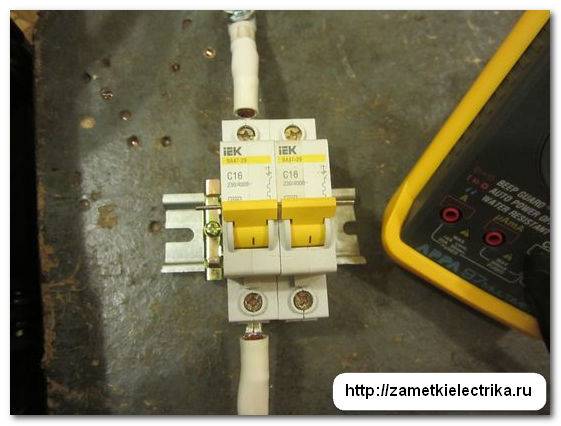



The connection of the circuit breaker has come to its logical conclusion, all the wires are connected, you can apply voltage. At the moment, the machine is in the disabled down (disabled) position, we can safely apply voltage to it and turn it on, for this we move the lever to the up (on) position.
By connecting the circuit breaker with our own hands, we saved:
- calling a specialist electrician - 200 rubles
- installation and connection of a two-pole automatic switch - 300 rubles
- DIN rail installation - 100 rubles
- installation and connection of a through ground contact 150 rubles
TOTAL: 750 rubles
*The cost of electrical installation services is given from the pricing table
How to choose according to the characteristics and functions of the device
The main parameter by which the circuit breaker is selected is the total current load from all connected electrical appliances
You also need to pay attention to other factors - the mains voltage, the number of poles, the security of the case, the cross section of the wires, the condition of the electrical wiring.
Determining the polarity of the machine
Depending on the type of wiring, the pole of the machine is selected. For single-phase networks, one- and two-terminal networks are used; for a three-phase electrical network, devices with three and four poles are used.
Current selection
Current is the most important characteristic that affects the choice of the machine. It depends on this indicator whether the protection will work in an emergency. For electrical panels located near electrical substations, a 6 kA protective device should be purchased. In residential premises, this value increases to 10 kA.
Operating or rated current
Operating currents are determined by the total load of all household appliances that the machine protects. The cross-section of electrical wires and their material should also be taken into account.
For the lighting group, 10 Amp machines are usually used. Sockets can be connected to 16 amps. Powerful household equipment such as electric stoves and water heaters require 32 A from the protective circuit breaker.
The exact value is calculated as the total power of all household appliances divided by 220 V.
It is undesirable to greatly overestimate the operating current - the machine may not work in case of an accident.
Short circuit current
To select the machine for the short circuit current, you should use the rules of the PUE. Forbidden to use breaking capacity circuit breakers below 6 kA. In homes, 6 and 10 kA devices are most often used.
Selectivity
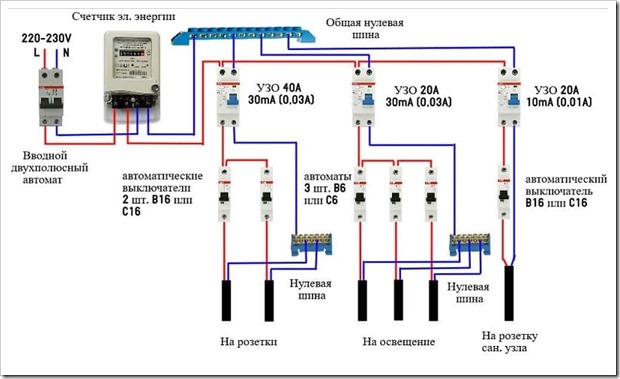
This term refers to the shutdown in an emergency of only the problematic section of the power grid, and not all the energy in the house. You should select machines for each group of devices separately. The introductory machine is selected at 40 A, then devices with a lower current are placed for each type of household device.
Number of poles
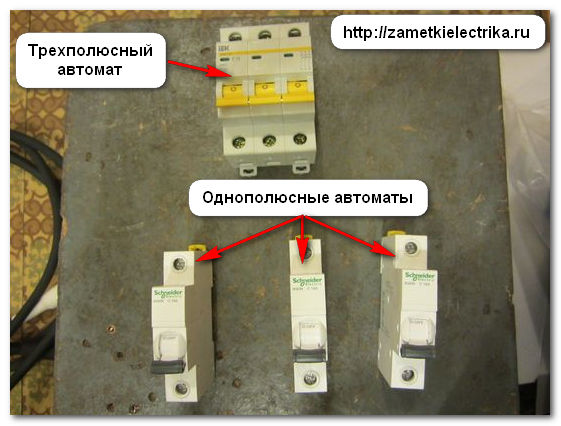
There are several types of machines: single-pole, two-pole, three-pole and four-pole. Single terminals are used in a single-phase network (one phase, two, three wires). The neutral in this case is not protected. Used for socket group or for lighting. The double pole switch is used for electrical wiring with one phase and two wires. It can be used as an introductory fuse for the entire network and for protecting individual electrical appliances. Devices with two poles are the most common.
Replacing one two-pole device with two single-pole devices is prohibited by the rules of the PUE.
Three-pole and four-pole are used in a three-phase network of 380 volts. They are spilled by the presence of a neutral wire in a device with four poles.
Cable section
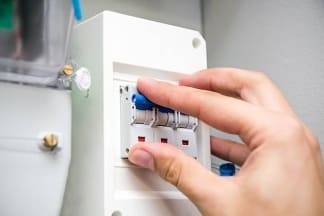 The cross-section and material of the cables have a huge influence on the choice. Houses built before 2003 used aluminum wiring. It is weaker and needs to be replaced. It is impossible to install a new switch, selected only by the total power.
Copper cables carry more current than aluminum
Here it is important to take into account the cross section - copper products with an area of \u200b\u200b2.5 sq. Mm. work safely with currents up to 30 A
To determine the desired value, use the tables for calculating the cable section.
Manufacturer
Be sure to pay attention to the manufacturer of the machine.It is better to purchase the device from a well-known trusted company in a specialized store
This will reduce the risk of buying a fake, and the purchased product will meet the stated criteria. Also, company stores give a guarantee for the switch.



Case protection degree
Each circuit breaker has its own degree of enclosure protection. It is written as IP and 2 digits. Sometimes 2 Latin letters can additionally be used to describe auxiliary characteristics. The first digit indicates the degree of protection against dust, the second - against moisture. The higher the number, the higher the security of the body of the machine.
Marking
The switch is marked with letters and numbers. It is decoded as follows:
- letter A, B, C, etc. - the class of the machine, means the limit of the current of instantaneous operation;
- the figure indicates the rated current at which the device operates in normal mode;
- a number in thousands of amperes is also indicated next to it, indicating the maximum current at which the switch will respond.
The marking is indicated on the body of the device and in the relevant documentation.
On what principle does a single-pole machine work
Circuit breakers, as switching devices, perform the functions of conducting the permissible electric current and turning off the power if the rating is exceeded, which protects the electrical network from overload.
The task of a single-pole device is to protect the circuit in one wire. The operation of the device is concentrated on 2 switchgears - thermal and electromagnetic. When the increased load acts for a long time, the circuit is switched off by the first mechanism. If a short circuit occurs, the second distributor immediately cuts off the power supply.
Thermal protection is performed by a plate made of composite material according to the following principle:
- A current exceeding the allowable level is received.
- The bimetal heats up.
- Curves.
- Pushes the lever.
- Turns off the device.
- The plate is cooling down.
When the state of the bimetal returns to normal, it returns to its original state and the device can be reconnected. The composition of the electromagnetic device includes a coil, in the middle of which a core was placed.
Here is the picture:
- A short circuit current occurs.
- Enters the winding.
- The force generated by the electromagnetic field moves the core.
- Turns off the device.
In the course of interactions of physical processes, the opening of power contacts occurs, which de-energize the conductor.
An electric arc is created with a high current strength, it is directed into a chamber with parallel metal plates for crushing and complete disintegration. The machine can be turned off by simply turning the knob. Such switches are used in ordinary apartments, if only 2 wires are connected to the house. In a shed, a small private house, single-pole automata open the circuit. In apartment buildings there are grounding conductors, which means that only a two-pole is suitable.
This is interesting: Is it necessary to insulate the chimney from a sandwich pipe in metal profile box: consider the essence
Applications
3-phase circuit breakers are used wherever there is a three-phase power supply. Connecting consumers without these protective devices is a gross violation of the rules for electrical installations. It is pointless to list all examples of the use of three-phase machines. Too many of them.Therefore, below are electrical devices that are protected by three-phase automata, but to some extent are found in the life of every person:
- street lighting networks;
- three-phase asynchronous motors for elevator equipment;
- introductory switchgears of residential buildings;
- protection of engines for children's attractions;
- engines of pumping stations pumping water to residential buildings;
- pumps pumping out sewage water are protected by three-phase automatic machines.
Three-pole circuit breakers are used everywhere. Their use is mandatory wherever there is power from 3 phases. Three-pole protection devices are almost no different from single-pole ones. The differences lie only in the number of protected phases, maximum operating currents and overall dimensions.
When connecting a three-terminal network, it is necessary to take into account its time characteristic and rated current. These parameters are indicated on the body of the protective device.
You should also pay attention to the series of the machine. It is determined based on the conditions of future operation, that is, how often the device will be triggered by a short circuit, how many times a day it will be switched by hand
Device characteristic
The design of the two-pole device is made taking into account the observation and comparison of the functioning of two electrical circuits. They are usually installed in a single electrical line to control its two sections. There are 2 types of these devices:
- With single pole interlock and standard neutral conductor connection.
- With protection of both lines and their simultaneous switching.
The first type is installed at the input to the electrical main, and it controls the functioning of the phase and neutral conductors.In addition, a ground wire can be used with this device. The second type works in the circuits of one circuit and controls the operation of two sections under different current loads.
Characteristics of the machine
Cutaway circuit breaker
In fact, this is a triple version of a single-pole device for an electrical circuit with three phases. The design feature is the presence of protective functions on each individual pole. The main characteristics are the permissible short-circuit current at which the circuit breaker operates and the cut-off speed.

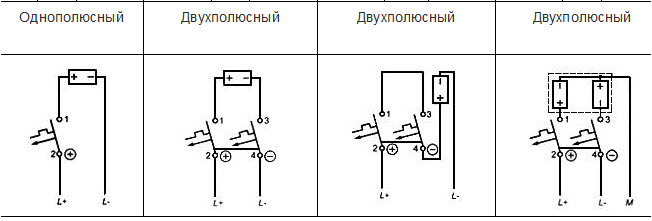


There are two mechanisms for shutting down - electromagnetic and thermal. In the event of a short circuit, the electromagnet opens the circuit. The thermal one is triggered with a continuous load exceeding the nominal one. Also, the device is a switching device. If necessary, the machine can be used to turn the current on or off.
By design, the device has the following elements:
- control mechanism;
- power contacts;
- electric arc extinguishing unit;
- release;
- terminals of poles for connecting wires.
Buying Tips
When buying, it is important to purchase equipment that can ensure safety. One- and two-pole AB are used in single-phase networks, and devices with a large number of poles are used in three-phase networks. One- and two-pole AB are used in single-phase networks, and devices with a large number of poles - in three-phase
One- and two-pole AB are used in single-phase networks, and devices with a large number of poles are used in three-phase networks.
Marking
Understanding the AB marking, at first glance, is not easy.Manufacturers often indicate the serial numbers of their products in the name. Sometimes the information is “scattered” on the front side, but the parameters necessary for the correct choice are always present.
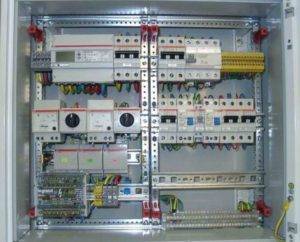
Having AB in front of you, it is easier to consider the quantities of interest:
- The rated voltage must correspond to the parameters of the mains. In a single-phase circuit, there is an alternating voltage of 220 V with a frequency of 50 Hz.
- The time-current characteristic indicates the permissible limits for exceeding the rated current necessary for the operation of the protection. It is designated by the letters A, B, C, D, Z, K. For an apartment, automatic switches for lighting are chosen - with the letter B, for sockets - C, for powerful motors and transformers - D. Series A devices are too sensitive and are designed to protect circuits with increased requirements. You will have to turn on the load after small voltage fluctuations in the network. K and Z are devices for production needs.
- The rated current is indicated in amperes, and the AB is able to pass such a value continuously, without heating up and without turning off.
- The current breaking capacity of the machine (limiting breaking current) shows the permissible current, after passing which the device will remain operational. A huge short-term load is possible with a short circuit. For AB installed in an apartment (house), choose an indicator of 4500 or 6000 A.
- The current limiting class speaks of the “speed” of operation of the machine. There are 3 classes. The first one is not indicated on the front panel, and the response time is more than 10 ms, the second class of devices disconnects the load in 6 to 10 ms, the third - the fastest will de-energize the network in 2.5-6 ms.
- The electrical circuit of the device, indicated on AB, is described below.
Power
There are two ways to calculate when choosing AB:
- Sum up the maximum currents flowing through all electrical appliances connected through one machine. Having provided a margin of 15-20%, the device is protected by rated current.
- Compare the total power of all devices and the rated power of the AB, choosing "protection with a margin" of 10-15%.
It is important to understand that ABs can withstand currents that exceed the rated current by 40% for about an hour of operation. During this period of time, excessive heating of the wiring, its melting and, ultimately, a short circuit can occur.
| Rated current AB, A | Current in a single-phase network, A | Estimated load power, kW | Required cross-section of conductors, mm2 |
| 16 | 0-15 | 3,0 | 1,5 |
| 25 | 15-24 | 5,0 | 2,5 |
| 32 | 24-31 | 6,5 | 4,0 |
| 40 | 33-40 | 8,0 | 6,0 |
| 50 | 40-49 | 9,5 | 10,0 |
Manufacturer and price
Automatic single-pole switches are present in the line of all manufacturers of electrical products. It should be understood that the European or American brand does not indicate the place where the plant is located. There is a high risk of finding a fake on sale. The table contains manufacturers and average prices for a sought-after 25-amp machine. Companies are sorted in descending order of user popularity (based on reviews on forums and reviews). Prices are taken from Yandex Market.
| Manufacturer | Average price, rub. |
| ABB | 180-400 |
| Legrand | 140-190 |
| Schneider Electric | 160-320 |
| General Electric | 200-350 |
| Siemens | 190-350 |
| Moeller | 160-290 |
| DEKraft | 80-140 |
| IEK | 100-150 |
| TDM | 90-120 |
Major buying mistakes
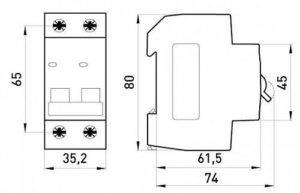
- Do not install an AB that can withstand more current than that for which the wiring is designed.
- The nominal value of the machine must take into account the power of the devices connected to the line.
- It is necessary to choose products of trusted companies, requiring a product certificate from the seller.
- For individual sections of the circuit, where powerful consumers (welding, heater) can be connected, the wiring is laid separately and the machine is installed.
Time-current characteristics: two-pole circuit breaker
In the event that uneven power consumption takes place, which will cause a load at the time of switching on or off the networks, the machine may turn off without signs of an accident, that is, it will falsely work. Such operation is characterized by an increase in the rated current on one of the circuits.
This parameter shows the trip delay time at a certain ratio of the current strength to the rated mains voltage.
 Before installation, it is better to first carefully familiarize yourself with the characteristics of a two-pole machine
Time current characteristics such:
- An electromagnetic circuit breaker that operates after 0.015 seconds with a threefold increase in current, when compared with the rated current, is designated - V;
- One of the most common characteristics is C, which is triggered when the current reaches 5 times the rated current, such an automatic machine is suitable for lighting and electrical appliances, but the appliances must be with a moderate starting current;
- Characteristic D is basically an automaton with this characteristic is used for increased starting voltage.
For example, to turn on an electric boiler, an electric motor and other equipment that operate on 3-phase voltage, the use of such an automatic machine is optimal for industrial purposes.
How to connect the machine correctly: security measures
The 2-pole circuit breaker must be connected to a break in the voltage source and electrical wiring, which must be protected in emergency situations. The three-pole circuit breaker contains 3 contact groups, which are connected in series with an electromagnetic and thermal circuit breaker.


For apartments or houses, class C machines are mainly used, which is designed for moderate loads. The power of such a machine is selected based on the power of the connected devices, where the threshold value is the maximum rating of 2 circuits, and this is necessary to avoid false shutdown of the machine and excess amperes.
 When connecting a two-pole machine, it is imperative to observe safety measures
During installation work in the field of electrical use, the rules of electrical safety must be observed, regardless of the work being carried out. In any case, even a single-phase switch needs the correct sequence of actions, so you need a diagram.
The electrical safety rules are as follows:
- All installation work on electrical wiring must be carried out by at least 2 people, since in the event of an electric shock of one of the participants, the second must provide timely assistance to the victim;
- To protect against electric shock, during installation work, it is necessary to use a dielectric mat, as well as special rubber gloves;
And yet, before carrying out manipulations with electrical networks, you must obtain a special permit that may allow you to perform work. Not everyone can correctly connect an automatic single-pole and two-pole unit for a meter on a shield.Even if you know how it is connected from above and below, this does not give you permission to replace it.
Wiring diagrams
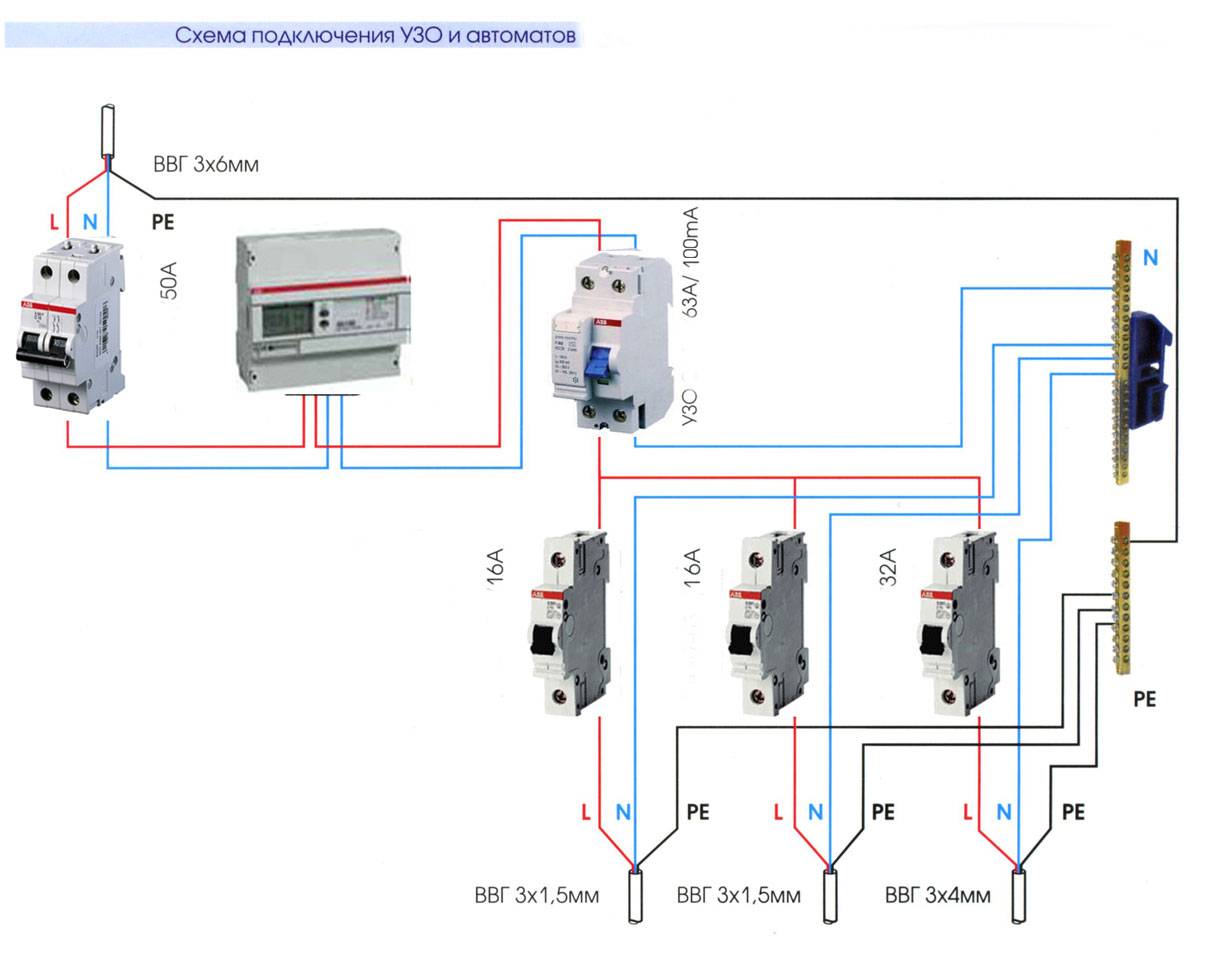
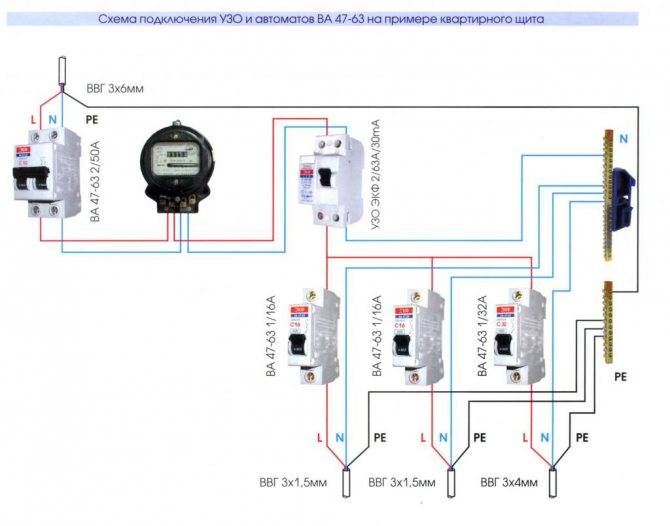
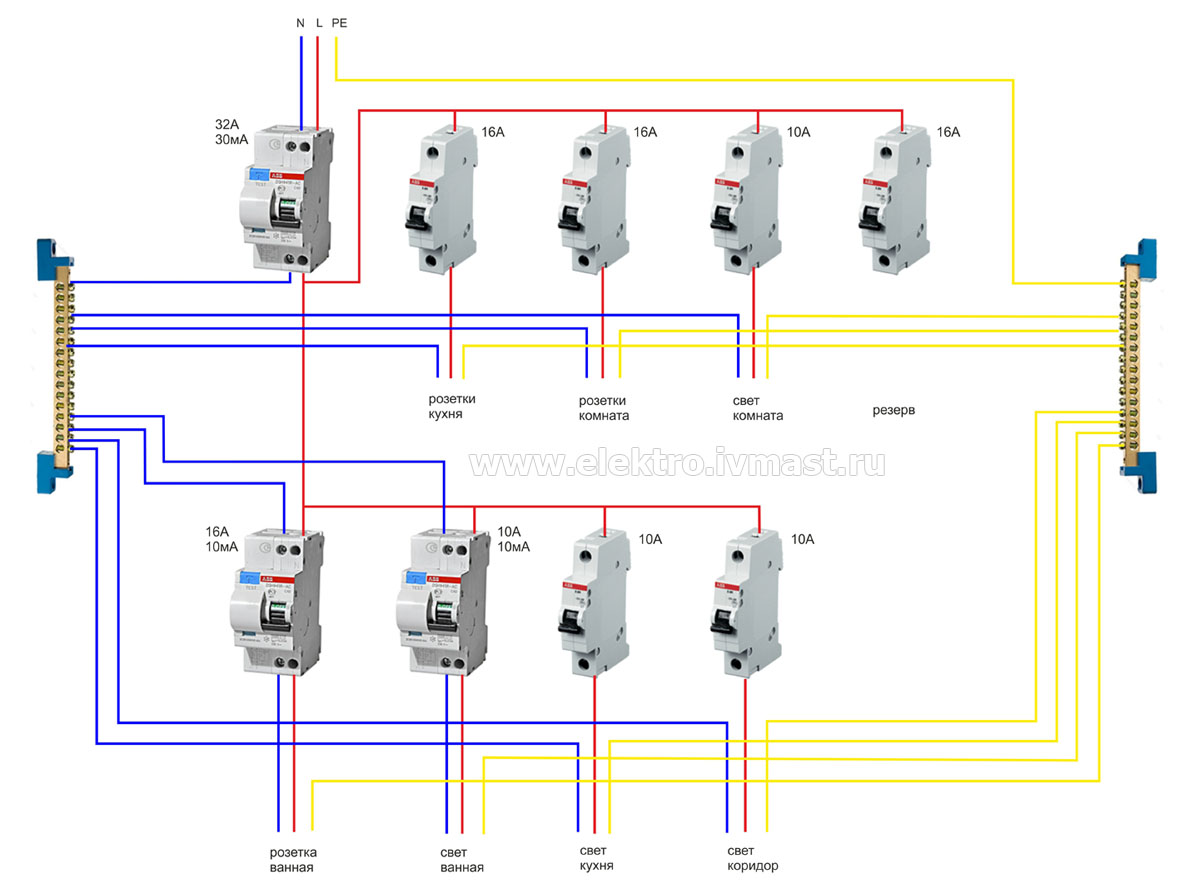
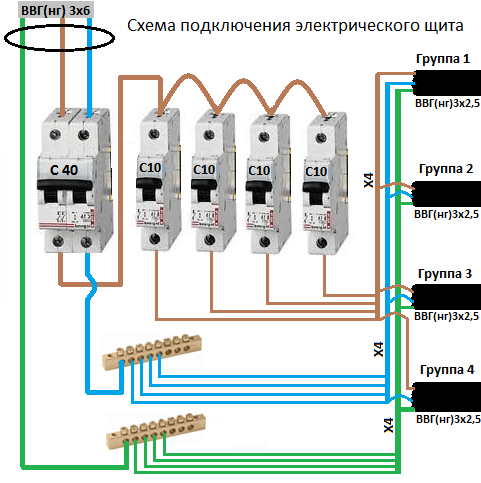
The circuit and installation of the device directly depends on the presence of a ground loop. If only two wires (zero and phase) with a voltage of 220 V enter the house, then single-pole circuit breakers can be installed in the main shield. In this case, the phase is connected to the machine itself.
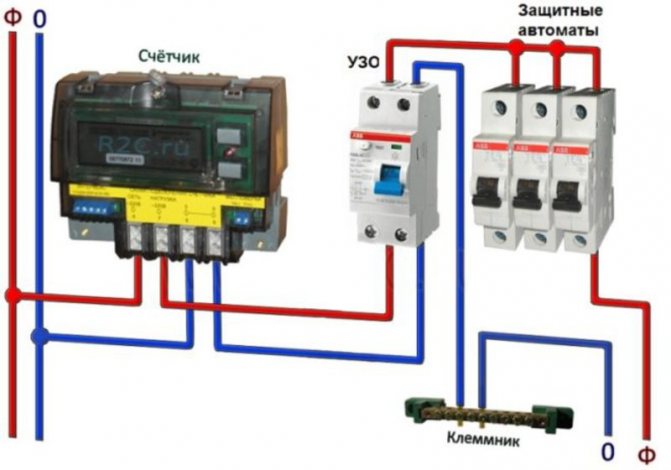
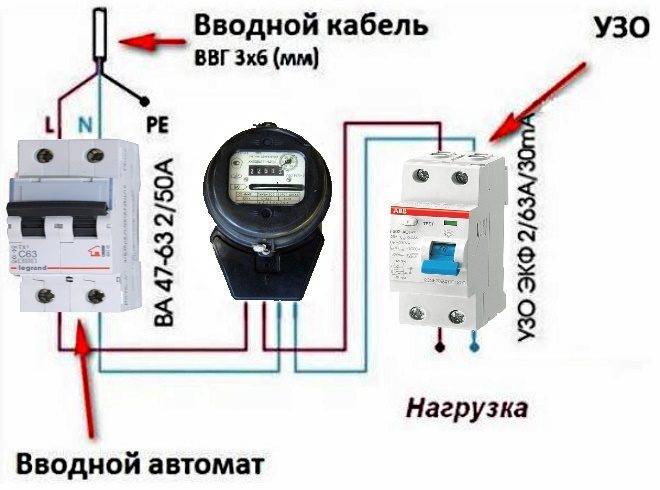
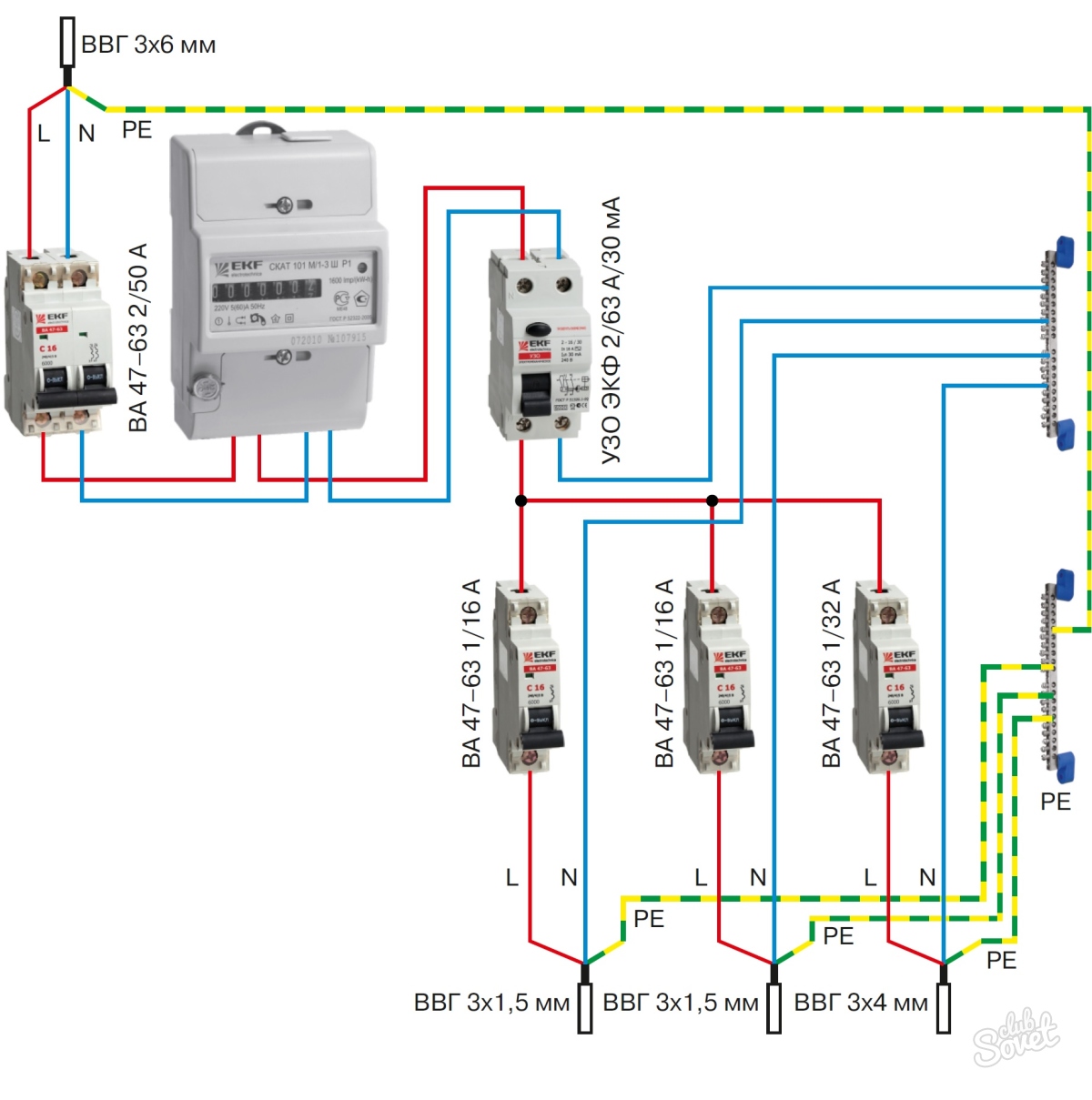
If there is also a third incoming wire (ground), then a two-pole device must be installed. Zero and phase are directly connected to the switch, and the ground wire is routed through the terminal box through the apartments. Then both wires from the machine are connected to an electric meter and single-pole machines, which are distributed among control groups.
In the case of arranging a three-phase network, if there is no grounding, a three-pole switch is installed. At the same time, wires of three phases are connected to the protective device, and zero is bred to consumers by a separate circuit.
If a ground wire is present in the circuit, then a four-pole device is installed at the input, to which three phases and zero are connected, and the ground is bred with a separate instrument line.
Advantages and disadvantages
Two-pole circuit breakers provide control of lines with single-phase power, as well as protection of equipment operating in three-phase circuits.
The advantages of these devices include:
- reliable protection of houses, offices and industrial premises from network surges;
- the ability to control the power of individual electrical appliances and installations;
- ease of installation and maintenance. Two-pole AB are ideal for branching and structuring wiring in the power supply of premises.
Of course, the main advantage is that a two-pole machine de-energizes two conductors at the same time, regardless of which of them had an accident. This guarantees the complete absence of voltage in the protective conductors.
Among the shortcomings can be noted:
- the existence of a cable breakdown probability when two loaded lines are switched on simultaneously;
- in rare cases, when the thermal release fails, it is possible to randomly turn off the power even in the rated voltage mode;
- the need to select bipolar automata in accordance with the design parameters of the network. If the sensitivity of the switch is too high, it will often work without good reason, and if the response rate to an unusual situation is too low, the machine will not notice network overload.
Due to the unique advantages, the use of bipolar circuit breakers is justified even taking into account the existing probabilities of these disadvantages.
This is interesting: The best circuit breakers - we study carefully
Characteristics of the machine
In fact, this is a triple version of a single-pole device for an electrical circuit with three phases. The design feature is the presence of protective functions on each individual pole. The main characteristics are the permissible short-circuit current at which the circuit breaker operates and the cut-off speed.
There are two mechanisms for shutting down - electromagnetic and thermal. In the event of a short circuit, the electromagnet opens the circuit. The thermal one is triggered with a continuous load exceeding the nominal one. Also, the device is a switching device. If necessary, the machine can be used to turn the current on or off.
By design, the device has the following elements:
- control mechanism;
- power contacts;
- electric arc extinguishing unit;
- release;
- terminals of poles for connecting wires.
Machine device
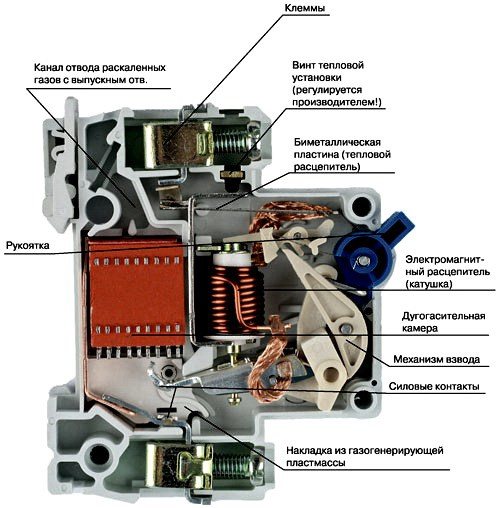
The automatic switch represents the plastic case with contacts and the handle of inclusion/switching off. Inside is the working part. A stripped wire is inserted into the terminals and clamped with a screw. When cocked, the power contacts are closed - the position of the handle is "On". The handle is connected to the cocking mechanism, which, in turn, moves the power contacts. Electromagnetic and thermal splitters provide shutdown of the machine in case of abnormal circuit conditions. The arc chute prevents burning and extinguishes the arc quickly. The exhaust channel removes combustion gases from the housing.



What is the difference between an RCD and an automatic
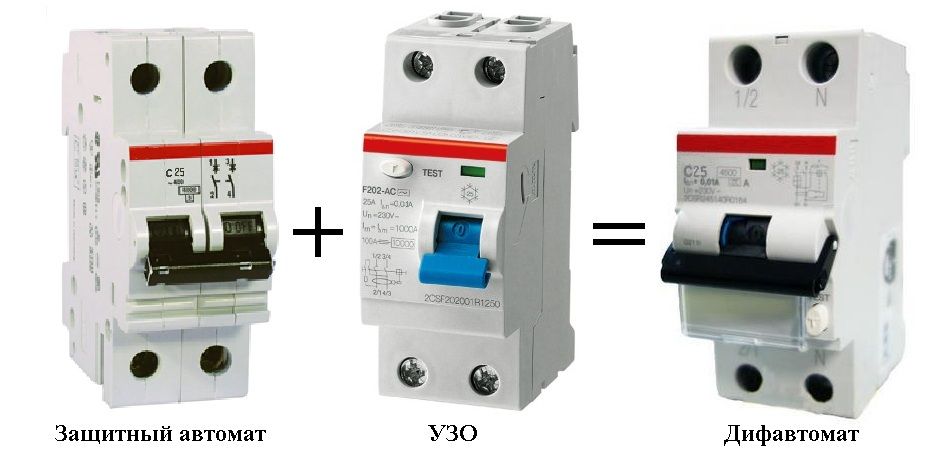
As mentioned above, these devices have different functions, they are similar only in the type of attachment and in appearance.
What is the difference between an RCD and an automatic
Circuit breaker
The basis of the operation of the circuit breaker is the creation of protection for electrical wiring from damage during short circuits and prolonged overcurrent. Without an automatic machine, the wiring would have to be changed very often, because short-circuit currents would melt the wires, and overload currents would burn all the insulation of the wires.
The machine has electromagnetic protection against high short-circuit currents. It is an electromagnetic coil with a core.
At the moment of a short circuit, the coil creates an electromagnetic field and magnetizes the core, which causes it to push the trigger latch and the machine turns off.If overload currents occur, then heating and bending, the bimetallic plates move the levers and cause the trigger to work.
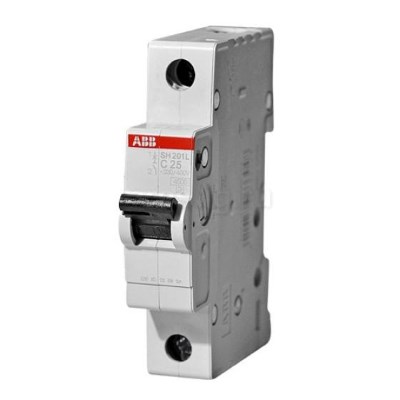
ABB circuit breaker
Overload protection cut-off time is directly related to the overload current strength. In the body of the machine there is also an arc chute, which is designed to extinguish the spark and extends contact life.
Residual current device and its operation
The difference between an RCD and a circuit breaker is that it has the function of protecting against leakage current, the machine does not have such protection. The RCD in its composition contains a differential transformer, which determines the difference in current between the phase and neutral wires in the event of a current leakage.
These currents, amplified by the secondary winding of the differential transformer, are fed to a polarized relay connected to the release mechanism, which disables the protection. Thus, the RCD device has protection against leakage currents.
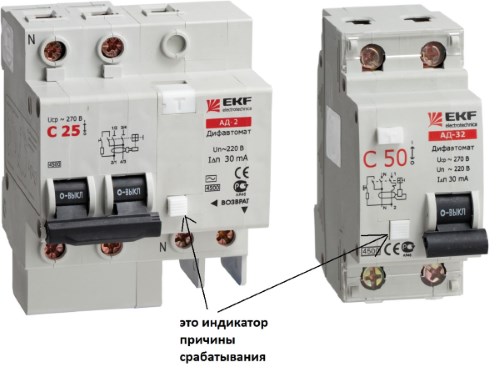
Residual current devices
Leakage currents can occur when the wire insulation breaks down on the body of electrical appliances and a person touches it. In this case, this type of protection saves a person's life. The operation of the RCD is based on determining the difference between the phase and zero current, therefore it has two terminals for phase connection and zero, two more phase and zero output terminals for connecting the load.
That is, this device is two-pole for a single-phase network, and for a three-phase network - four-pole. Also, the RCD differs from a simple machine in that it has a test button to check the performance. The machine for a single-phase network has a single-pole module, and for a three-phase network it has a four-pole module.



