- Planning the ventilation system of the bath: subtleties and nuances
- Vent sizes
- The position of the ventilation openings
- How to make ventilation in the bath with your own hands
- Frame bath
- wooden bath
- Brick and stone bath
- General principles of steam room ventilation
- Natural ventilation of the bath
- What are the types of ventilation and the method of their calculation
- Tasks performed by the ventilation system in the bath
- Do I need ventilation in the sauna
- Ventilation calculation
Planning the ventilation system of the bath: subtleties and nuances
Before proceeding with the choice of the ventilation scheme in the bath and the device of its design with your own hands, you need to understand the intricacies and nuances of design.
During the construction of any bath - the ventilation of the bath and its schematic diagram is laid in the process of construction. The question "how to make ventilation in the bath" should be decided at the design stage.
The ventilation ducts of the dressing room, washing room, steam room, rest rooms and openings for the inflow of fresh air and the removal of a mixture of carbon monoxide with exhausted moist and hot air masses must be laid at the appropriate stages of construction. Gate valves and gratings to control the size of supply and exhaust openings and sections of ventilation ducts are already installed at the stage of finishing the premises.

The planning of the ventilation system must be carried out at the stage of development of the design project of the bath room
Basically, the functioning of the ventilation of the bath depends on two factors:
- the dimensions of the ventilation openings - both supply and exhaust - which are determined by the volume of the room, whether it is a dressing room, a washing room, a steam room or a rest room;
- position of ventilation holes.
Vent sizes
The dimensions of the ventilation openings depend on the volume of a particular room: dressing room, steam room, washing room or rest room. It is very important both to accurately calculate the size of these openings, and to ensure that it can be changed. To adjust the gaps in the openings, doors-latches and gratings are installed.

Air vent with slider for adjusting the amount of fresh air inflow
It should be noted that with large ventilation windows it will be difficult to heat the room to the correct temperature. There will either be a danger of a constant waste of fuel and electricity, or difficulties in adjusting the cross section of the ventilation ducts, that is, the distance at which each opening will need to be opened with one's own hands.
If the area of the ventilation openings is insufficient, the temperature, air humidity and concentration of carbon monoxide in the room can rise to critical values.

The optimal size of the ventilation opening is calculated at the rate of 24 sq. cm per 1 cubic meter of room volume
The position of the ventilation openings
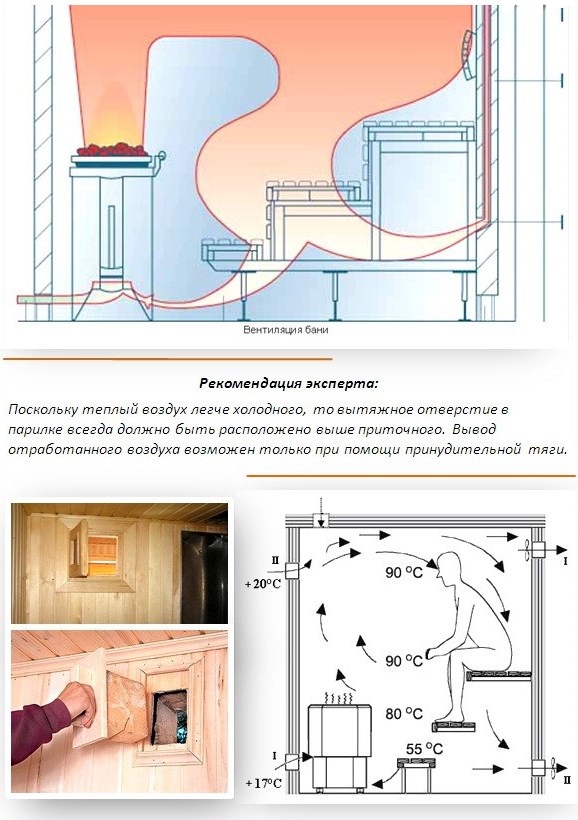
The action of any ventilation system is based on the replacement of masses of heated air set in motion under the pressure of air coming from outside - colder and heavier.
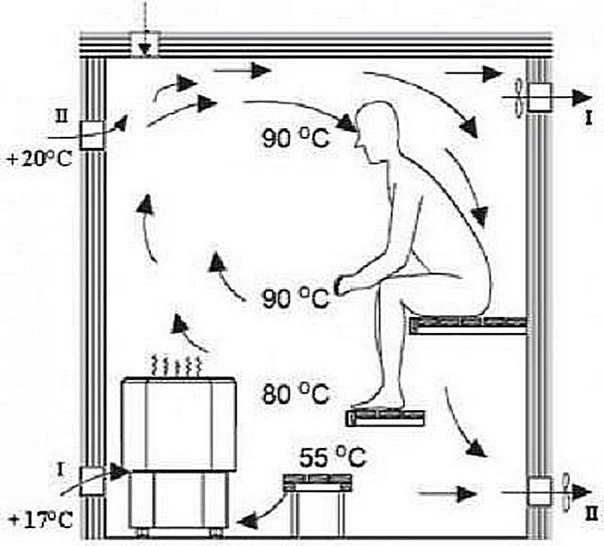
It is important to be able to regulate the direction of the heat flow coming from the stove installed in the bath. The ventilation in the steam room is often equipped with not one inlet, but two for this very reason.
To localize heat flows, it is enough to create a gap of a certain width in one or both of them with the help of valves.

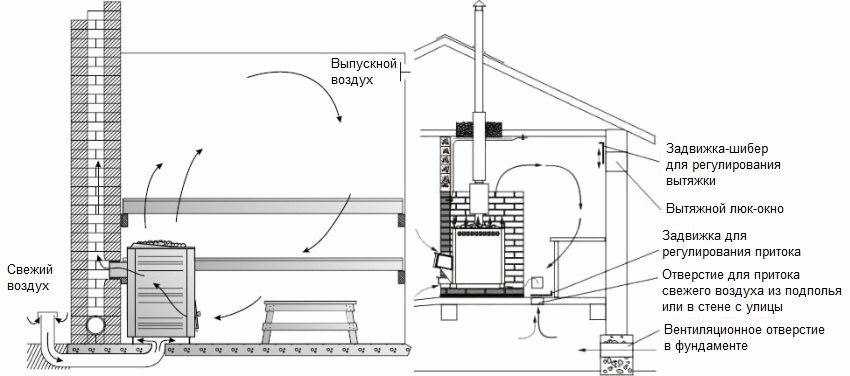
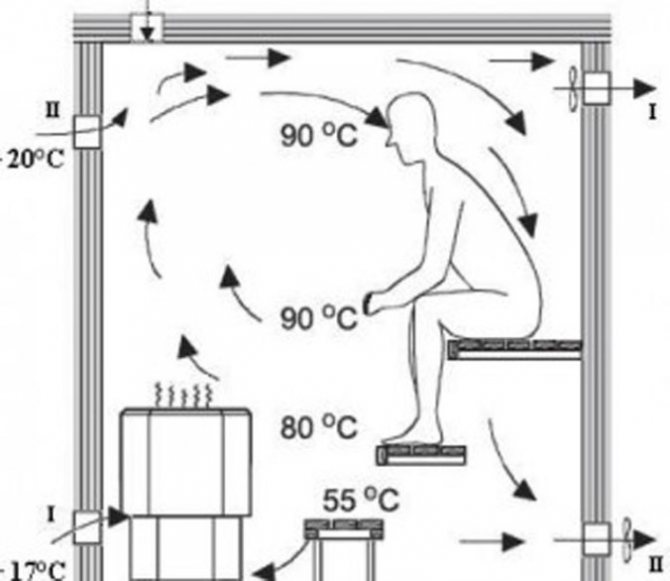
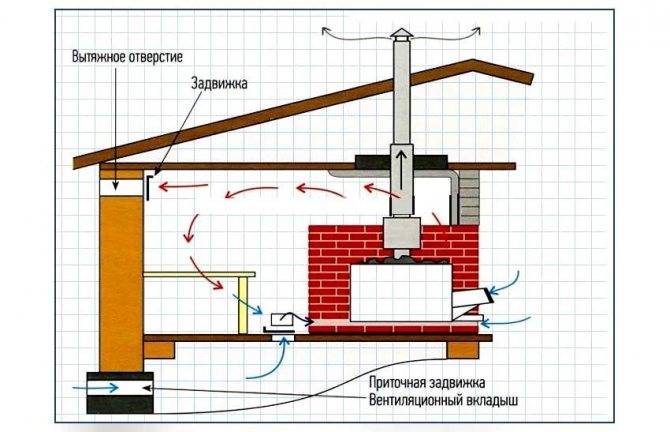
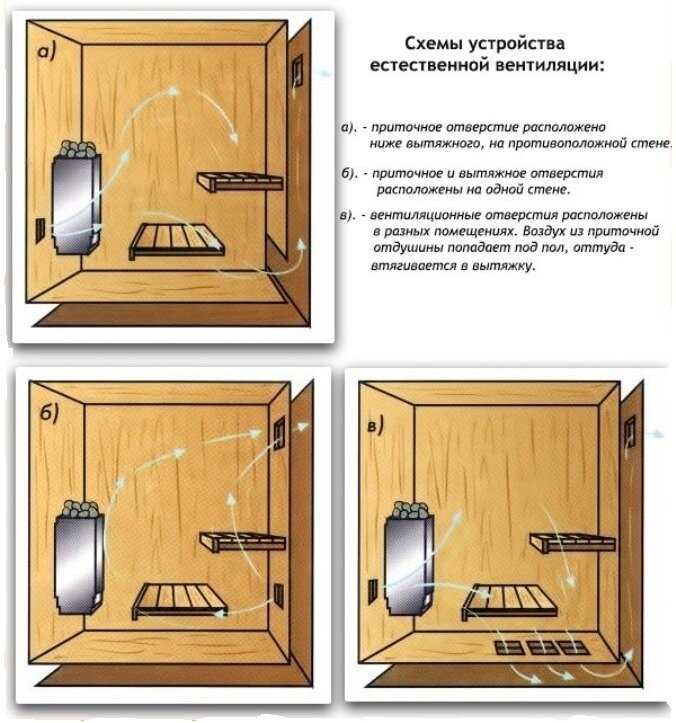
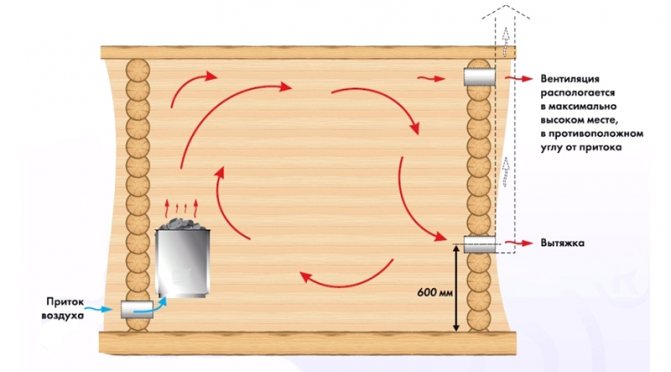
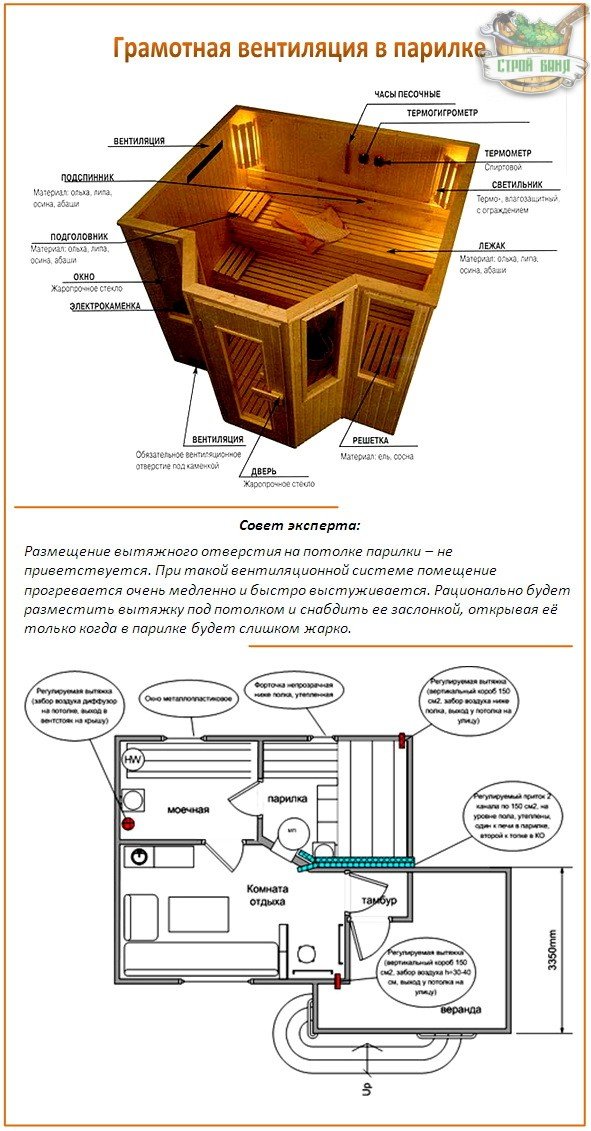
Scheme of placement inside the steam room of ventilation openings for the inflow of fresh and removal of polluted air
How to make ventilation in the bath with your own hands
Modern manufacturers offer a wide range of ready-made kits for ventilation. You can use these suggestions or make a system yourself. There are three options for organizing air exchange:





Option
Description
Natural
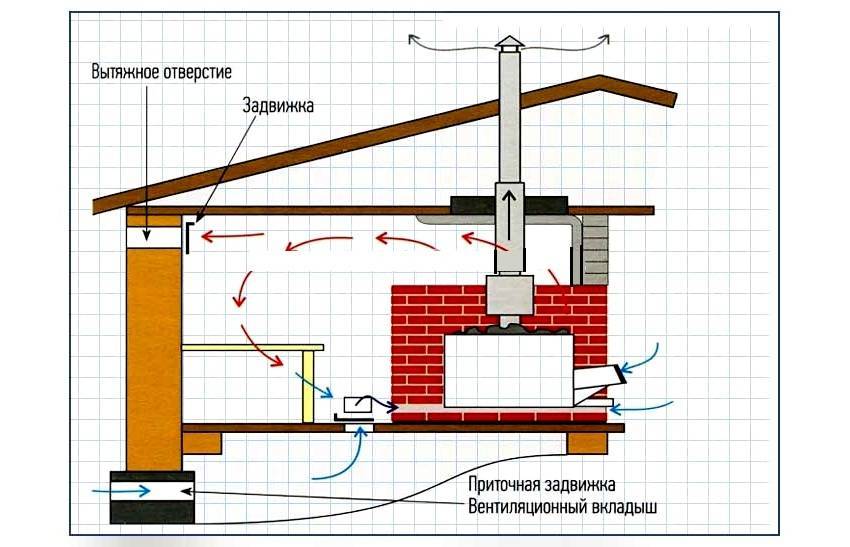
It works thanks to the difference in pressure inside and outside the room. The supply duct is located near the floor, the exhaust duct is located near the ceiling. Does not require any special equipment, but can cause drafts
With such a system, it is important to carefully seal and insulate the room.
Combined
Fans are used to speed up air exchange. Such systems have shown themselves especially well in the steam room.
For installation, you will need to buy special equipment and connect it to a power source.
Mechanical
Highly productive systems, sensors and controllers are used for control. They need regular maintenance and are more expensive than everyone else.
The choice between these three types of air exchange depends not only on the financial capabilities of the owner of the bath, but also on the type of building.Proper ventilation in the bath takes into account the materials of the walls and floor, the location of the heaters, the placement of the bath relative to other buildings on the site.
Frame bath
Ventilation in the frame bath should be equipped in such a way as not to disturb the multilayer structure of the walls
Frame buildings are completely sealed, so it is important to organize a full-fledged air exchange in order to avoid the appearance of mustiness and dampness. In this case, the installation of combined or mechanical ventilation is justified.
Frame baths are quickly erected and have good heat retention
Important! Places for installation of air ducts should be laid at the design stage. The location of the ventilation ducts in the frame bath is traditional - at the bottom - the supply flow, in the opposite corner - the exhaust
The location of the ventilation ducts in the frame bath is traditionally - at the bottom - the supply flow, in the opposite corner - the exhaust.
wooden bath
Wood is an eco-friendly material that “breathes” by itself. The gaps between the logs also contribute to natural ventilation in the log cabin. But it should be borne in mind that the bath is a room with special operating conditions, therefore, one should not be limited to the natural conditions of air exchange.
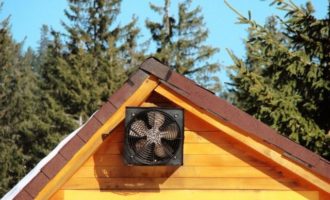
 For good circulation of the atmosphere in the log house, hoods are installed.
Expert opinion
Andrey Pavlenkov
HVAC design engineer (heating, ventilation and air conditioning) ASP North-West LLC
Ask a specialist
“The opinion that it is necessary to install windows of non-standard, small size in wooden baths is erroneous. Double-glazed windows must be of high quality and save heat - this is the only requirement.”

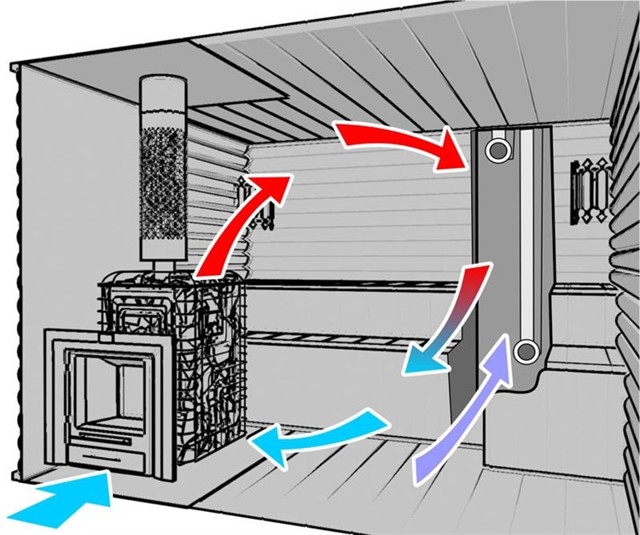

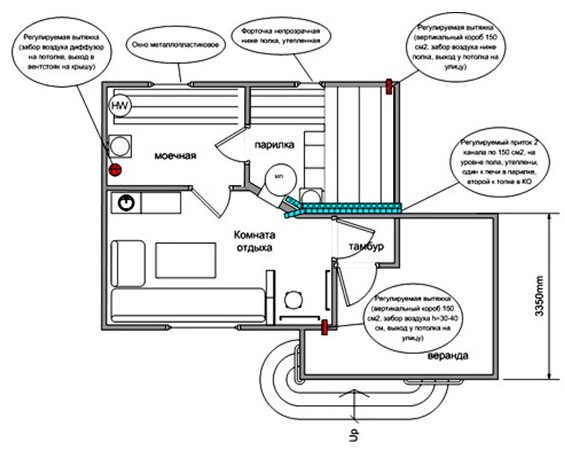


Natural ventilation in wooden the bath can be slightly improved by using forced air supply to the steam room. The rest of the log house itself will cope well with the task.
Brick and stone bath
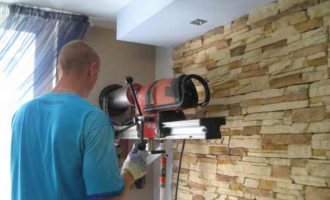
Brick and stone buildings are durable. The walls themselves are resistant to moisture, but usually they are sheathed from the inside with natural clapboard, and this material needs protection. If there is no good ventilation in a brick bath, the sheathing material will inevitably become moldy and deformed. To avoid this, it is necessary to distribute the air flows in such a way that they penetrate under the skin material. For this purpose, the finishing material is fixed on the crate and holes are left for air flow. Small fans are used to draw air into the ventilation slots. This technique guarantees the absence of mustiness and dampness.
 Ventilation ducts should be laid at the stage of wall construction
Important! The tightness of the brickwork forces the use of ventilation ducts of a larger diameter, approximately 20 centimeters
General principles of steam room ventilation
A well-made ventilation system in the steam room is the key not only to a pleasant and relaxing atmosphere of a Russian bath, but also to your safety. Improperly arranged ventilation leads to numerous unpleasant consequences:
- the wood in the bath, even with an ideal ventilation device, is subjected to a huge load and does not last longer than 20 years, and poor ventilation will shorten this period by several times;
- the smell of stagnant air and rotting wood is not the most pleasant addition to the bath;
- if stale air is not removed from the steam room in time, using such a bath is more of a harm than a health benefit.The steam room accumulates gases exhaled by people, emitted by a working stove, as well as fungi and mold, which quickly capture a poorly ventilated room.
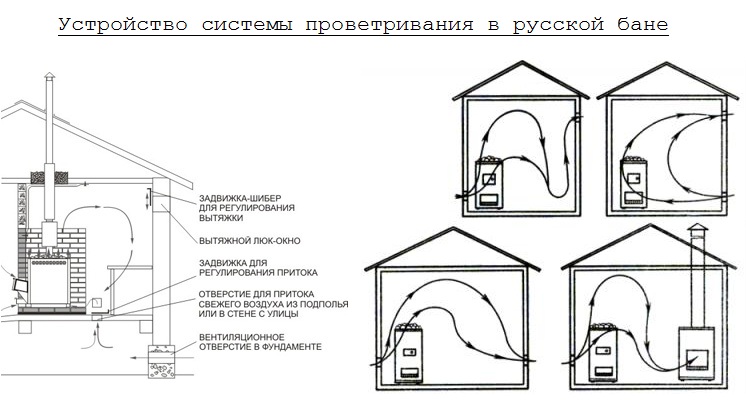
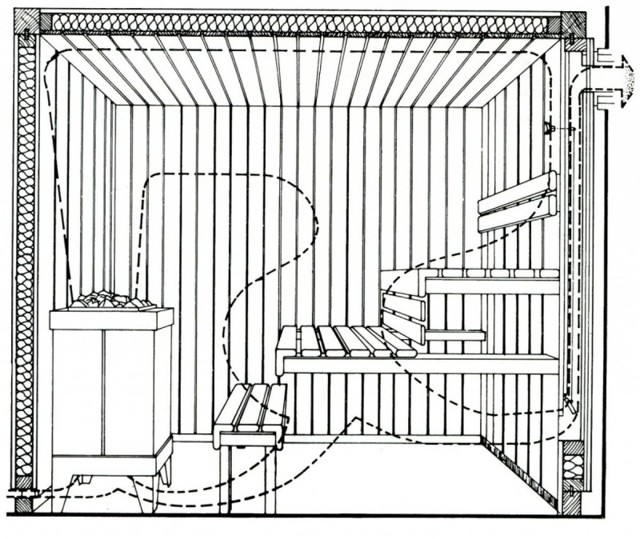
The outlet is located on the opposite wall and at the opposite level with the inlet. It is a very common mistake to place the vents on the same level: they form a closed flow that does not affect most of the room, so it is always cold below, and too hot and stuffy in the upper part of the steam room.
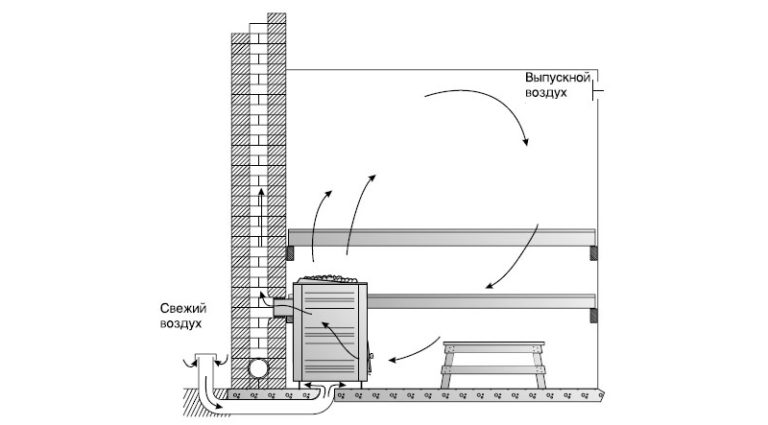
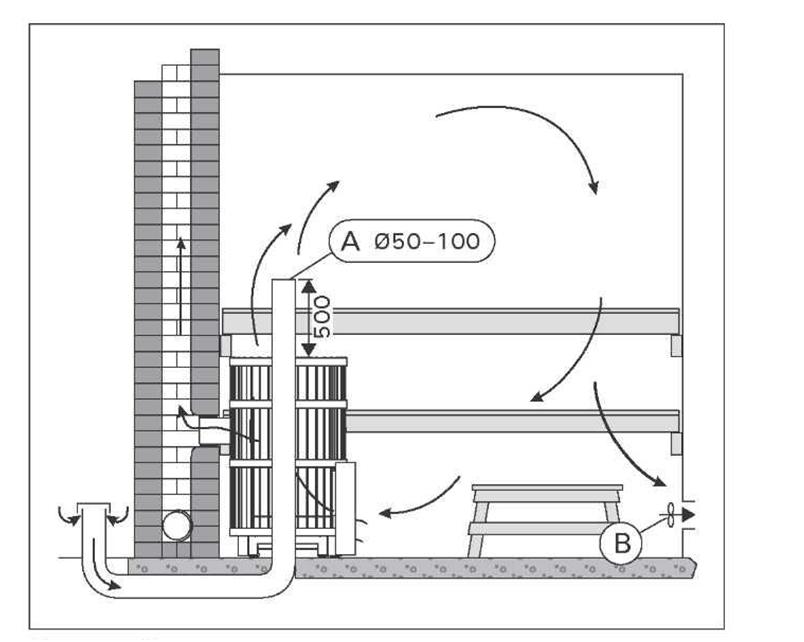
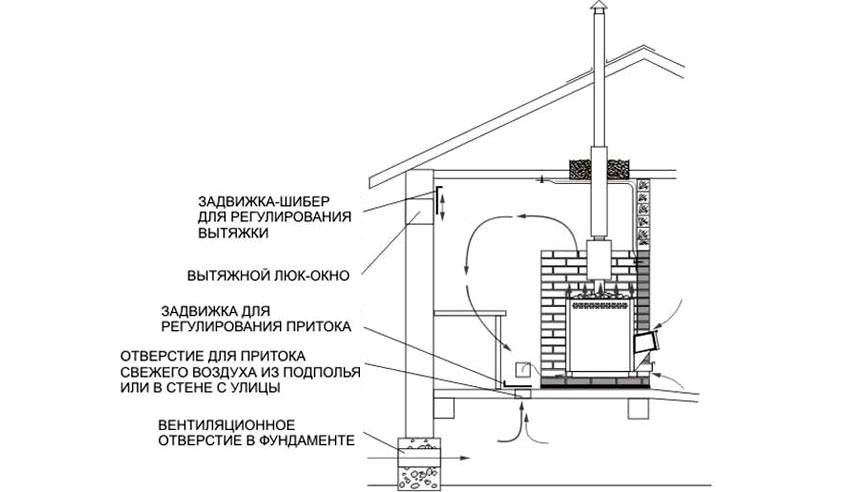
Ventilation scheme in the bath (steam room)
It is also worth considering that the same as the correct choice of scheme, the value is the correctly selected diameter of the ventilation holes. For each cubic meter of the room, the diameter must be 24 cm, otherwise the air will not circulate.
Another important part of the ventilation system is the plugs or valves on the vents. They allow you to regulate the intensity of air circulation and quickly heat up and cool the room.
It is necessary to lay ventilation shafts even at the stage of construction of the bath itself, then it will be possible to change the ventilation scheme in only one way - by turning on the fan in it. Otherwise, disturbed ventilation will make the bath not very comfortable.
Bath ventilation scheme
Natural ventilation of the bath
The most accepted option for most baths, minimal in cost and safety, and quite effective. The specific locations of the ventilation openings should be taken into account, taking into account the size of the premises, the location of the shelves, the stove and the material of the building.The general rule is that the holes should be located at different heights, as a rule, the inlet (supply) 20 cm from the floor and the outlet (exhaust) 20÷30 cm from the ceiling. When choosing holes, you need to consider where the holes will be located on the outer walls. It is desirable that they do not stand out too much on the facade walls.


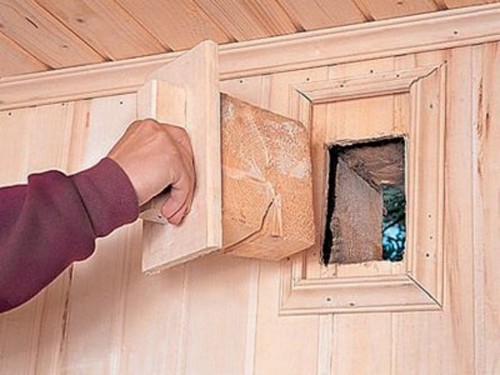
Air vent
The dimensions of the holes are approximately 300÷400 cm2, it is better to make them larger than smaller. In the case of too rapid air exchange, leading to a decrease in the temperature in the steam room, the channels should be covered with control dampers. To improve the appearance, it is better to use decorative grilles, they can be purchased at specialized stores or made independently.
This is interesting: Sauna device on the balcony - tips for installation and design
What are the types of ventilation and the method of their calculation
Ventilation can only exist when there is an inflow of fresh air and an outflow of used air into the room. Often you can find the concept of "supply" or "exhaust" ventilation. These are not entirely correct concepts, there cannot be only supply or only exhaust ventilation, it is always only flow-exhaust. Why are these concepts used? Thus, it is emphasized that the supply or exhaust of exhaust air is carried out in a forced way, and, accordingly, the removal or supply of fresh air occurs in a natural way.
Supply and exhaust ventilation
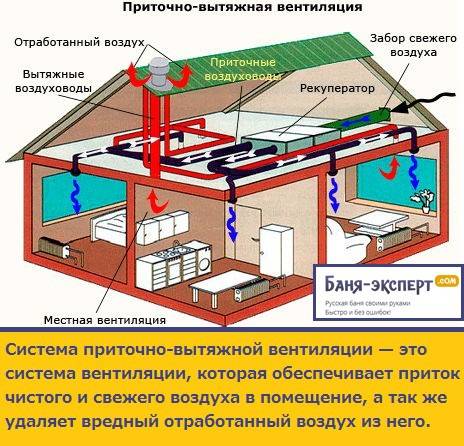
Supply and exhaust ventilation in the bath
When calculating the parameters of ventilation systems, the initial data take into account the volume and purpose of the premises, the presence of special conditions in them in terms of air indicators, the presence or likelihood of the presence of carbon monoxide or other chemical compounds harmful to health. Based on these data, state regulations establish the frequency of air replacement within an hour, it can vary from 1 ÷ 2 to ten or more.
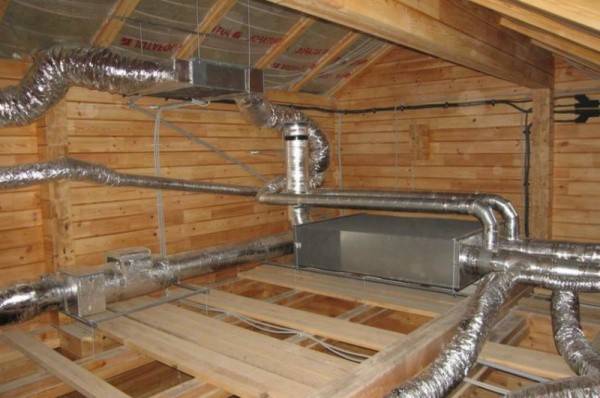
How to equip ventilation in the bath in accordance with SNiP
Next, engineers determine the parameters and location of the channels to ensure the necessary intake and removal of air, taking into account weather conditions and the climatic zone. If natural ventilation cannot provide the required frequency of air changes, then forced systems are used that supply / exhaust air with electric fans. Baths have their own characteristics of each type of ventilation, consider them in more detail.
This is interesting: What is better to build a bath from - the pros and cons of materials
Tasks performed by the ventilation system in the bath
Providing those steaming in the bath with oxygen, which, at high humidity and temperature, the human body needs more than usual.
Temperature regulation: like any other room, the steam room has a temperature limit, natural ventilation will help maintain it
Sometimes you need to sharply reduce the temperature, for example, when children come in for a steam bath.
Removing excess moisture: it is important not only for the washroom, but also for the steam room. Moisture causes wood to rot
The lining of the bath with clapboard inside the steam room or the crowns of the log house in the steam room without ventilation can be exposed to mold.
Ensuring the combustion in the stove with oxygen: Oxygen-free combustion will result in the formation of deadly carbon monoxide.
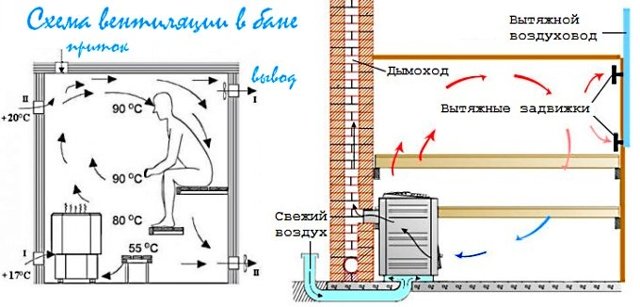




Do I need ventilation in the sauna
 Ventilation in a sauna with a conventional wood-burning stove - diagram
In a steam room where people sweat, the air becomes super humid in a few minutes. It is extremely difficult to breathe in such an environment. Much easier if dry air masses circulate. Therefore, ventilation is essential in the sauna in order to regulate the level of humidity and the supply of fresh oxygen. In the absence of ventilation during the procedure, warm air will rise up, and cold air will accumulate at the bottom, which will definitely not benefit health. And yet, if there are no ventilation ducts, unpleasant odors accumulate in the sauna and there is a risk of poisoning with accumulated carbon monoxide.
Often, a shower room and a relaxation room are also adjacent to the sauna room. If they are not equipped with air outlets, the level of moisture rises. The result is hard to dry or wipe off. Over time, mold and fungus will appear on the walls and ceiling, wood structures will rot. The sauna will last not 15-20 years, but only 4-5.
Ventilation calculation
We take into account that when using an electric heater, the ventilation openings are selected smaller, but for a sauna with wood or gas heating, they should be selected 10–15% larger than the calculated one.
Based on the specified document on air exchange, we will calculate the conditional (!) Bath. With main supply and exhaust air ducts.
Table 1
| Name | Length Width Height | Volume, m3 | Air exchange, multiplicity | Air exchange, m3/hour | Note | ||
| tributary | Hood | tributary, Group 3 x group 4 | Hood, gr.3 x gr.5 | ||||
| 1 | 2 | 3 | 4 | 5 | 6 | 7 | 8 |
| dressing room | 2 x 3 x 2.4 | 14,4 | 3 | 43,2 | Add an inflow in the amount of 158 - 43 = 115 m3 | ||
| Washing, shower | 2 x 2.5 x 2.4 | 12,0 | Not less than 50 m3/hour | 50 | |||
| bathroom | 2 x 1.2 x 2.4 | 5,8 | Not less than 50 m3/hour | 50 | |||
| steam room | 2.3 x 2.3 x 2.2 | 11,6 | 5 | 58 | |||
| Total | 43,8 | Σp = 43 | Σv = 158 |
There must be a balance between supply and exhaust. Therefore, the volume of inflow should be 158 m3/h.
The speed of air flows is also normalized in the above recommendations. For natural ventilation of all rooms, this is at least 1 m / s, for a steam room - 2 m / s. With mechanical (forced) - no more than 5 m / s.
In table 2 we find the required diameter for a round duct, in table 3 - square or rectangular. In the column with the required speed, we are looking for the closest value to the air exchange obtained by us (158 m3 / h). For 5 m/s it is 125 mm. For a steam room (58 m3/hour) at a speed of 2m/s - 125 mm.
table 2
Table 3
Similarly, we find the required values for non-circular ducts.
In the bath with the indicated rooms, the inflow comes from the dressing room and exits in the bathroom. These rooms and the soap room are equipped with forced ventilation. Ventilation in the bath in the steam room is provided by air supply from the dressing room or (if possible) from the street.