
- Features of the cesspool device in a private house
- Location selection
- Size calculation
- DIY drive
- Optimum drive cleaning
- Norms and their meaning
- How to clean a cesspool
- Pit design with overflow
- Cesspool device
- How to arrange an airtight cesspool
- Cesspool cleaning
- Fecal pump
- Container for waste that will later need to be removed
- How to pump out silt from a drain hole
- Pump out a cesspool without a pump
- Well placement requirements
- Project preparation
- Material calculation
- Drawing
- Required Tools
- The design and purpose of the cesspool
Features of the cesspool device in a private house
Location selection
A cesspool is such a container into which domestic wastewater is drained and accumulated in it. To determine the optimal location for its location, you will need to analyze the land and find the most suitable site.
A schematic plan of a private plot can help in this case, in which the locations of the following important elements are necessarily indicated:
- residential building
- Household The buildings
- Water wells
- gas pipeline
- Water supply pipes
Also, on this scheme, the elements of the landscape available on the site should be indicated.For an easier location of the cesspool, it is necessary to put on the plan neighboring buildings and other structures located in neighboring areas, including wells and all communications.
When planning the location of the pit, you need to consider the direction of movement of groundwater. This information can be obtained from the relevant authorities.
At the moment, some sanitary standards have been agreed on the remoteness of this building from other structures:
- The neighboring building and adjacent buildings - 10-12 m.
- From the boundaries of your site - 1.5 meters
- Own house - 8-10 m.
- Wells for water intake - at least 20 m.
- Water supply networks - at 25 m.
- Ground water - at least 25 m.
- Gas pipes - about 5 meters
When arranging a cesspool, it will be necessary to take into account the condition of the soil in which this structure will be placed. In clay soil, water wells should be at least 20 meters from the pit. With loamy soil, this distance increases by 10 m and will be 30 meters from the cesspool. With sandy or super sandy soil - at least 50 meters.
Also, it is necessary to take into account another extremely important point. Cesspools are strictly forbidden to build along the flow of groundwater, as in this case they may become contaminated.
Size calculation
The first value that needs to be calculated before building a cesspool is its volume, since the efficiency of the entire sewer system and the frequency with which it will be necessary to clean the drain will depend on it. This value can be calculated based on the number of people living on the site. For example, only 4 people live in a private house, 3 of which are adults, and the last is a child.
As a rule, one adult produces at least 0.5 cubic meters of waste, and for a child, this value is reduced by exactly half - 0.25. In the case of connecting water-consuming devices to the drain in the cesspool, they are also taken into account. In this example, they are not involved.
As a result, 1.75 m3 of waste goes to the cesspool (0.5+0.5+0.5+0.25). The resulting number should always be rounded up, which will help to avoid overfilling the waste tanks. In this example, the number will be 2 cubic meters.
The total volume of the cesspool tank should be 3 times the volume of sewage. That is, 3*2=6 m3. This is the optimal pit sump volume for a family of 3 adults and 1 child.
For the construction of a similar structure for a summer cottage, it is necessary to use a different construction scheme. For such a case, you can take 1-2 cubic meters as the optimal value, since such areas are visited not so often and not by very large groups of people. But, in the presence of other circumstances, it is possible to increase the volume of the reservoir for the summer cottage.
Having the required volume of the tank, it will be necessary to determine its structural dimensions. The depth of the structure is determined by determining the level of groundwater and the features of further maintenance of the cesspool. To periodically clean the tank from accumulated liquid and solid growths on the walls and bottom, you will need to use the services of vacuum trucks.
The hose of the sewer truck rarely exceeds a length of 3 meters, so you should not make the depth of the tank exceeding this value. Otherwise, this may affect the quality of cleaning the cesspool.The most popular pit depths are 2.5 and 2.7 m. The maximum depth of 3 m is used extremely infrequently, but this depth can be compensated with a sand and gravel cushion. This is most relevant for leaky drains.
Also, it is worth remembering that when underground groundwater is above 2 meters, there is no point in arranging a cesspool, as this can lead to filling the reservoir with groundwater. This will mean a drop in the efficiency of the entire sewer.
In this case, septic tanks or barrels of the required size will be the most suitable options, but it will be necessary to protect them with a casing of cement or metal solution.
DIY drive
Construction of a cesspool
Many owners of private houses sooner or later face the problem of getting rid of wastewater.
There are many solutions to this problem. One of them is a do-it-yourself cesspool in the country.
The best version of this building is a concrete well.
The advantage of round sewer structures is that the ground loads will be distributed evenly tangentially.
Although rectangular or square pits are applicable.
When starting to build a cesspool in a private house with your own hands, it is necessary to take into account the requirements of SNIP, which allow the construction of cesspools at a distance of 1 meter from the site boundary and 12 m from residential buildings.
Before you start building a pit, you need to determine its size. It should be assumed that a family of three people approximately fills the volume of 12 cubic meters, of 4 - 18 cubic meters.


Therefore, for such a number of people living in the house, a 3x2 meter storage tank should be built.
No less important than choosing the location and size of the cesspool is the calculation of the need for the amount of building materials.
Proceed from the fact that it is necessary to concrete the bottom, cast or build walls, concrete the ceiling and build a hatch.
As with any construction, you should prepare the construction site, clear the area of plantings, make markings, dig a hole.
The bottom is carefully compacted and poured with concrete. After it acquires 80% strength, you can start laying out the walls.
The seams of the connection of concrete wells or brickwork during the construction of the walls of the pit must be properly sealed to prevent sewage from entering the groundwater.
Only a sealed cesspool can become a guarantee of the reliability of this sewer facility in operational and environmental terms.
The construction stage should always be preceded by the stage of geodetic work, which helps to determine the proximity of groundwater and, directly, the possibility of placing a cesspool on a specific site.
Designing a cesspool on a personal plot makes it possible to equip a house adjoining toilet without a central sewage system.
To do this, you need to install a toilet for a cesspool. It is preferable to choose a type of toilet bowl with an inclined visor.
Before installing it, a drain is arranged in the ceiling: the outlet pipe is lowered into the accumulator by 40 cm at an angle of more than 40 degrees.
For this, ceramic, steel and cast iron pipes with a diameter of 15 cm are used. All seams are insulated.
Combining a toilet bowl and a cesspool is a more rational solution in arranging a toilet near a private house.
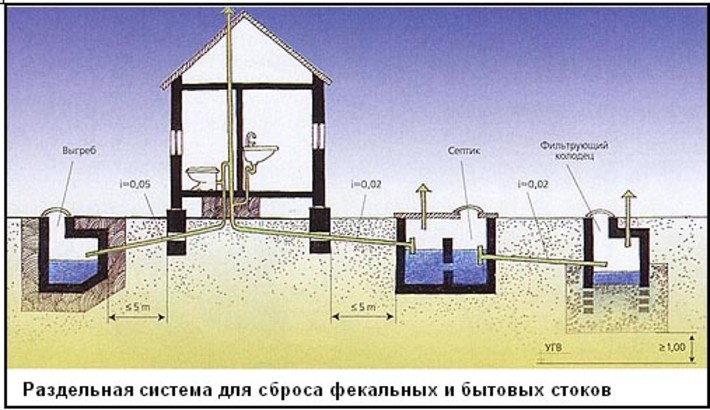
Connecting pipes from the internal sewerage system of the house is carried out according to the rules of the external sewerage device:
- it is necessary to observe the depth and inclination of the outlet pipes;
- take into account the presence of a manhole.
At the time of excavation of a trench for laying outlet pipes, pipes for other purposes can be found. In this case, their actions for the further arrangement of the cesspool should be coordinated with the relevant authorities.
Optimum drive cleaning
The cesspool is quite easily and quickly equipped, without the use of costly methods. Its disadvantages include the impossibility of self-cleaning.
Optimal wastewater treatment is carried out with the help of a sewage truck by immersion in a pit through a special intake hose hatch
Therefore, it is important to design the bottom of the reservoir with a slope relative to the pit
It should be noted that according to SNIP, the cesspool should be located below the water intake wells at a distance of 30 meters from them.
The same distance is observed when planting fruit plantations. Failure to comply with these rules can lead to the appearance of pathogens in the water and fruits and, in the future, to the development of an epidemic.
Previous Post Step-by-step instructions on how to make a cesspool
The next entry Pump out a cesspool with your own hands
Norms and their meaning
Sanitary areas for water source
Sometimes even the construction of a water intake structure in compliance with the technology and rules will not insure you from source pollution. The thing is that potential contaminants can appear already during the operation of the well.One of these pollutants can be a cesspool. At the same time, such a structure can be built not by you, but by your neighbors who do not adhere to the standards for sanitary protection gaps.



In this case, the minimum distance from the well should be observed to the following sources:
- drain sewerage;
- sewage treatment plant for wastewater, the volume of which does not exceed 25 m³ per day - a septic tank;
- cesspool.
The distance between the well and the sewage pit is essential, since this structure can cause dangerous pollution of the environment and sources of drinking water due to a significant accumulation of sewage.
Despite the fact that modern materials guarantee a high degree of tightness and durability of the cesspool, you cannot be completely sure of safety, because the risk of leakage is not excluded. That is why a standard distance must be observed between such a pit and a well or well. This is the only way to be completely sure of the safety of drinking water.
Usually, all sanitary protection zones are specified in the regulatory documents SNiPs and SanPiNs. Moreover, the gap between the source of drinking water and the cesspool depends on the performance of the latter structure. Usually this distance is at least 50 m. In this case, the gap between them can be increased depending on the volume of filtration of the cesspool:
- if the water consumption per day is 1-2 m³, then the zone is 8-10 m;
- at a flow rate of 4-8 m³, the zone increases to 15-20 m;
- if the flow rate is 15 m³ or more, then the gap increases to 25 m or more.
Attention: in the sanitary protection zone there should not be open sources of drinking water (wells, reservoirs) and closed sources - wells
How to clean a cesspool
The most efficient and fastest option is a sewage truck. True, he does not reach all the dachas, so the owners of suburban real estate organize the pumping themselves. There are two options here:
- By hand, using a bucket and rope. The method is unpleasant, dirty and long.
- With the help of a fecal pump, since such equipment is now sold in all hardware stores. Plus, the range of pumping equipment is very wide both in terms of price and performance.
Both options for cleaning cesspools require the presence of another element, namely a barrel or any other container where sewer waste will be drained. After that, they are taken out of the village to places for special disposal. That is, you can’t just take the dirt into the forest and bury it there.
Cleaning the cesspool by hand with buckets
Pit design with overflow
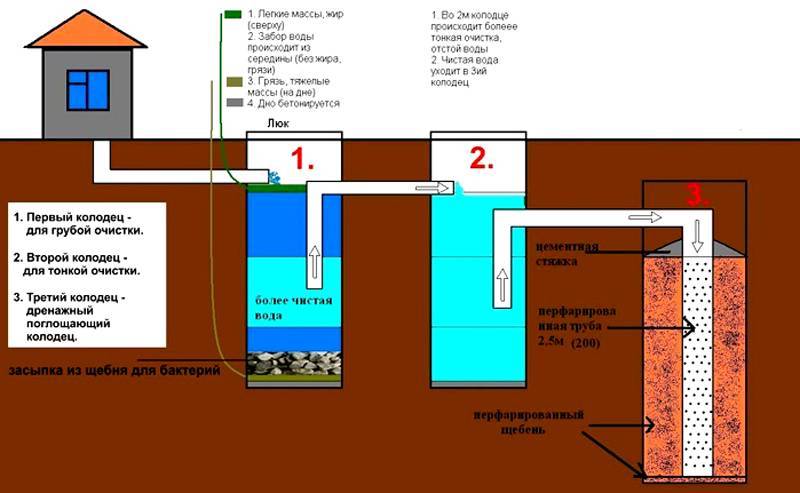
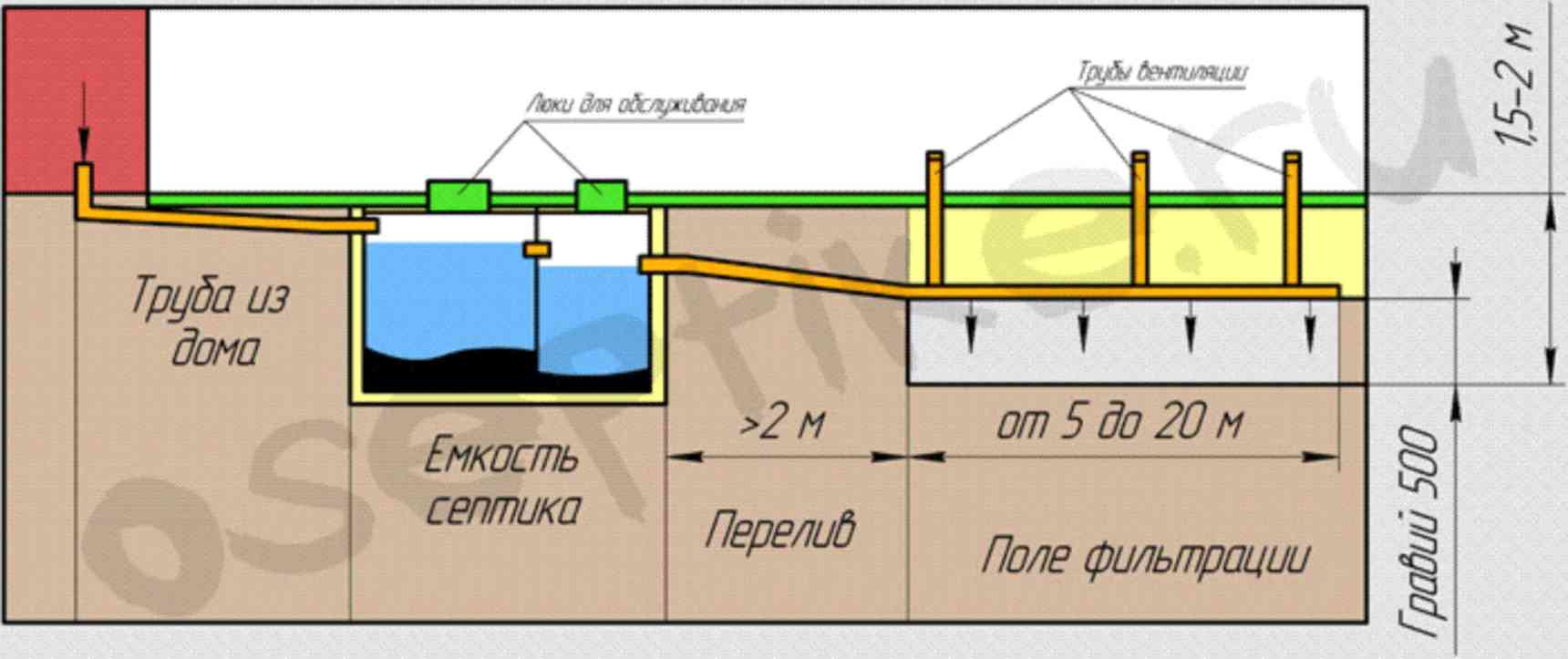
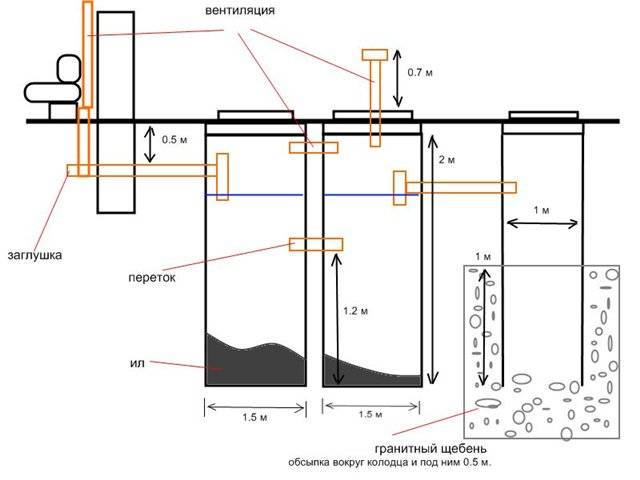
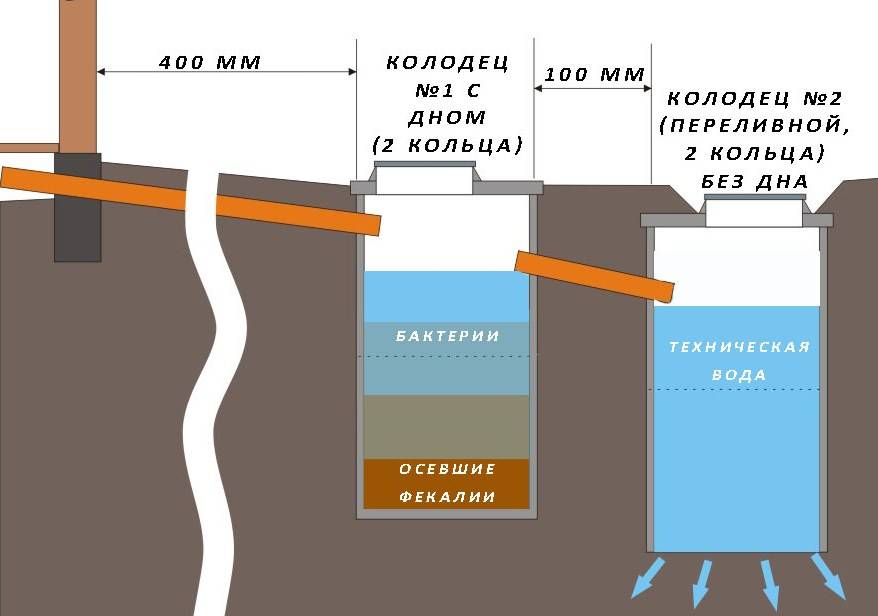
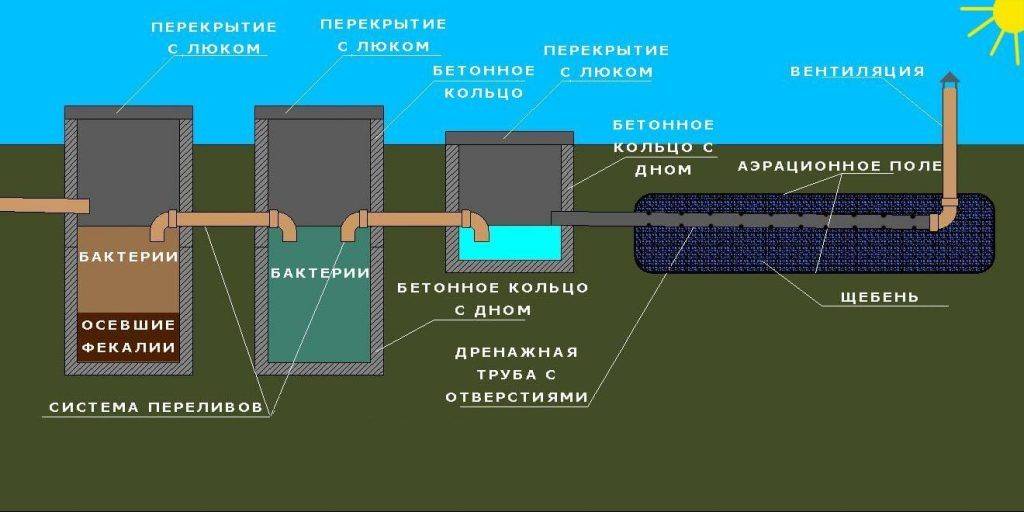
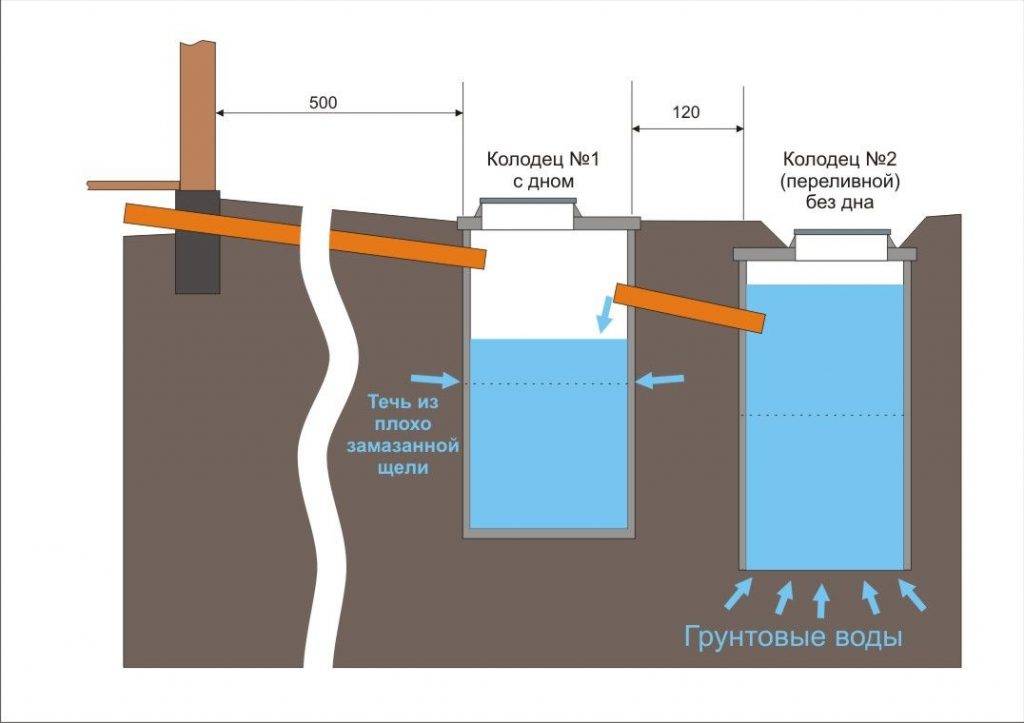
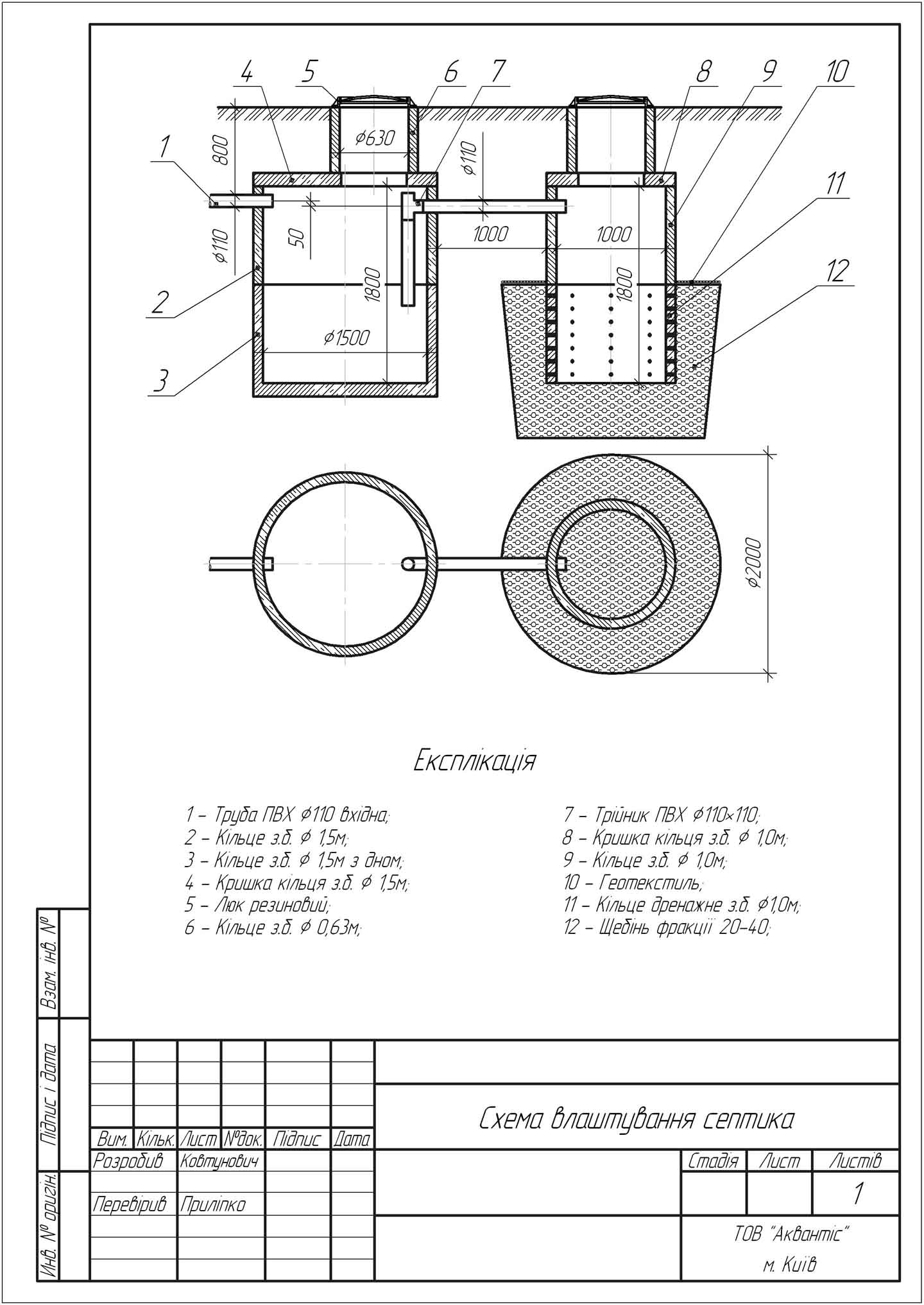
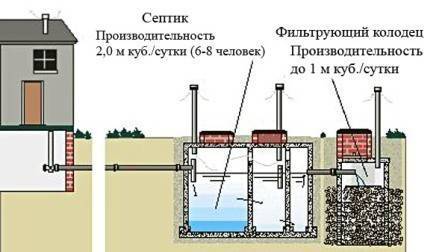
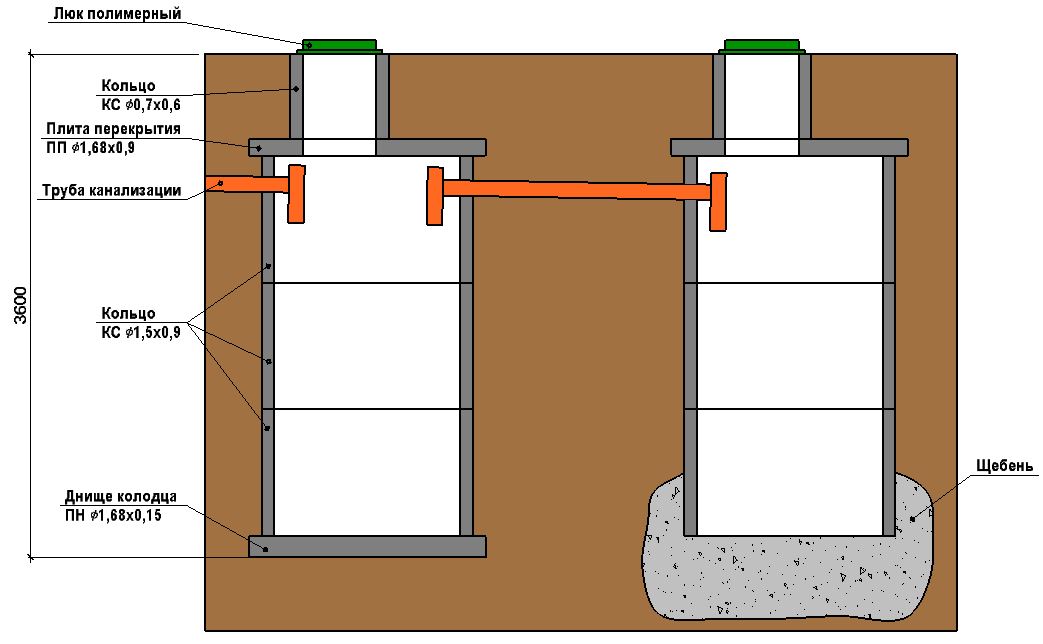
The device of a dual autonomous sewage system is convenient in that pumping will be required much less frequently. Liquid effluents will be filtered and go into the ground, only the solid waste tank will have to be pumped out periodically.
The scheme provides for the presence of two wells:
- Conventional drain well with a blind bottom and a sealed design. All waste will be collected in it, solid ones will remain at the bottom, and an overflow in the form of a pipe will supply the liquid part to the second container.
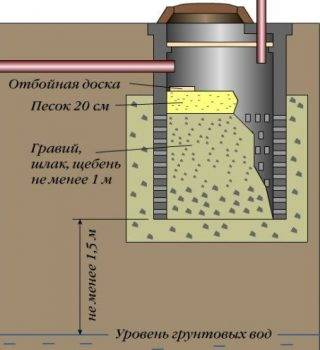
- Filter well. When the level of effluent reaches the pipe, the liquid filling of the tank passes into the second well. A sealed bottom is not installed in it, but only a filter is placed. So you can pour some of the waste, and a smaller volume will remain for pumping.
Crushed stone, gravel, sand or other similar materials are used to equip the filter.To speed up the process of absorption of liquid into the ground, additional holes are made in the rings of the second well.
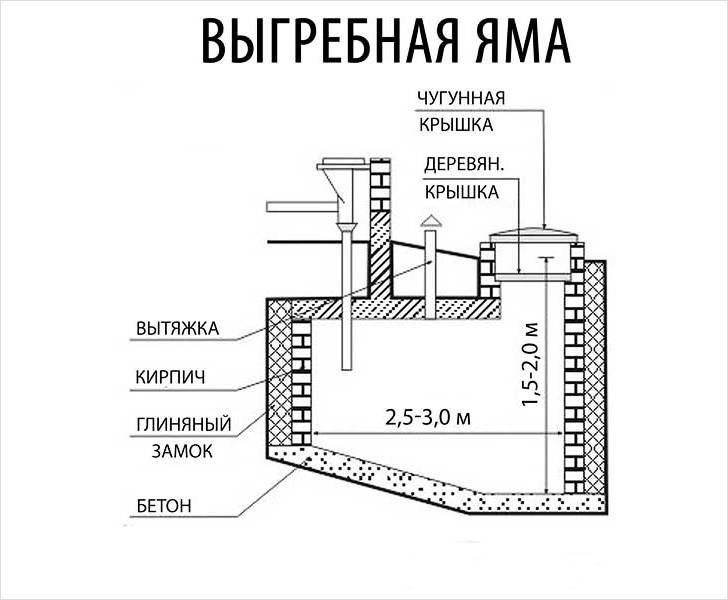
Cesspool device
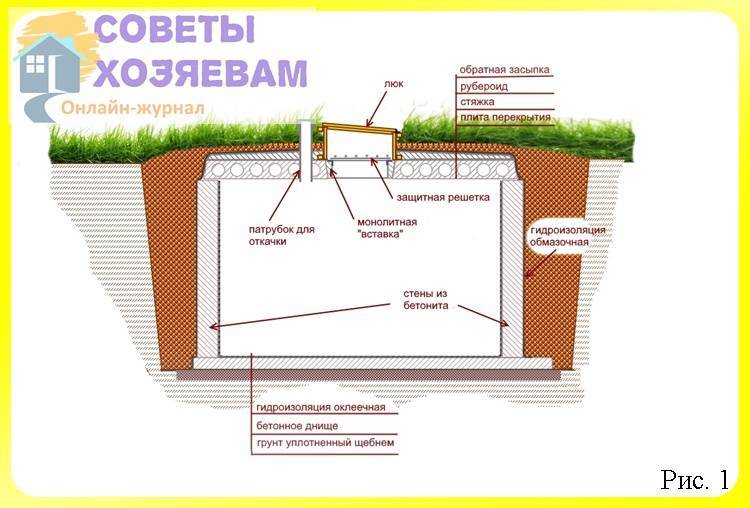
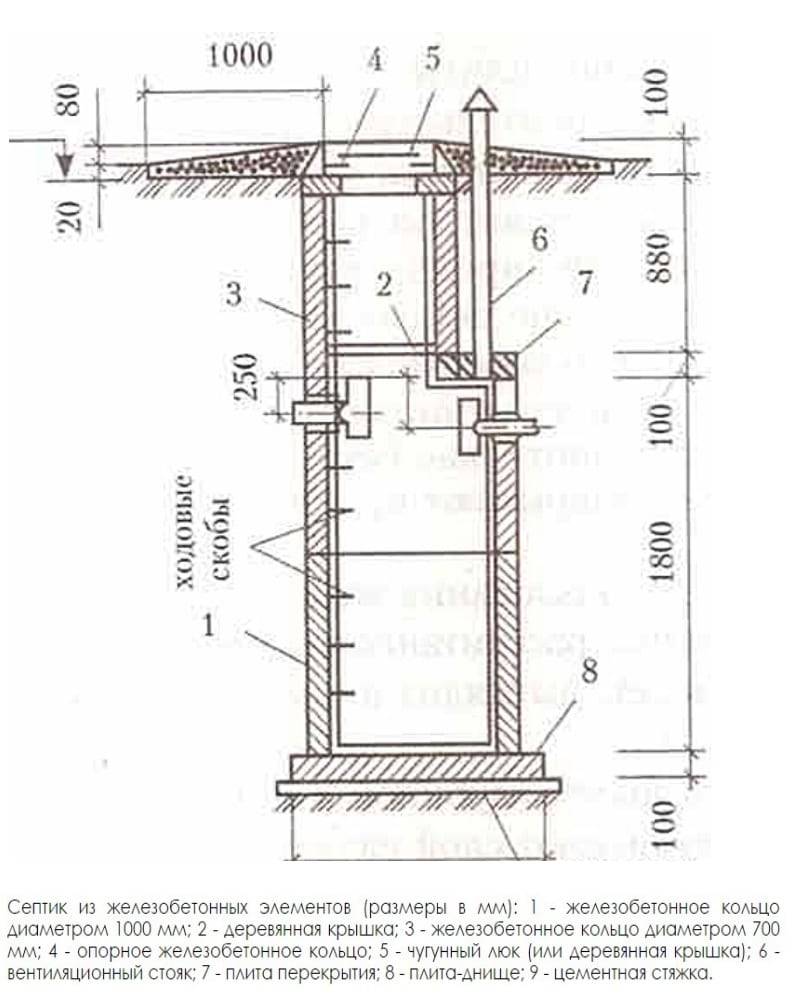
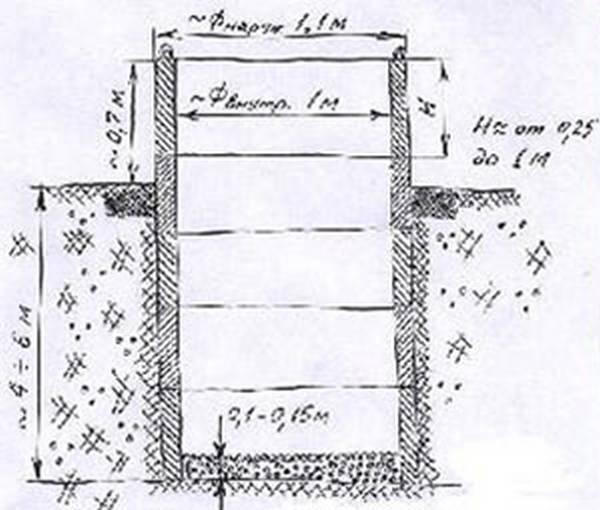
Having decided on the volume and location of the cesspool, you can begin to build it. First, they dig a pit. This can be done manually or with a rented excavator. The bottom of the dug pit must be prepared depending on the type of cesspool chosen. If a decision is made on how to make a cesspool of concrete rings without a bottom, then it is necessary to arrange a crushed stone pillow. If a sealed design is chosen, then the bottom of the well must be concreted or a special ready-made ring with a bottom should be used.
The dimensions and geometry of the hole dug by the excavator will be much larger than required, which will entail the consumption of crushed stone for backfilling voids
After the concrete at the bottom of the pit hardens, you can begin to lay the rings. Since concrete rings are quite heavy, a winch or a crane is used for their installation. Rings must be installed exactly butt to butt. After installing the rings, the sewer pipe is taken out of the house into the drain pit.
From above, the entire structure is covered with a concrete slab with a maintenance hole. A cast-iron manhole with polymer insulation is installed in the hole for tightness
Particular attention should be paid to the waterproofing of the sewer well. To do this, perform penetrating and coating (with liquid glass and mastics) waterproofing of the rings
The joints between the rings are filled with cement mortar with the addition of liquid glass. The construction of the cesspool is completed by backfilling the pit with layer-by-layer compaction.
In the case when a cesspool is made in a private house, the scheme of which provides for two chambers, then the first container of concrete rings is waterproofed and the bottom is made, and during the construction of the second ring they are laid either on the ground or on a pillow of gravel and sand without sealing joints.
Sewerage arrangement for a private house can be done independently or you can order a team of builders to install a cesspool from concrete rings. The installation price in the latter case will depend on the scheme and dimensions of the structure. For example, a drain pit of three KS-10-9 rings will cost about 25,000 rubles. The same pit, but complete with a drainage well of two rings, will cost 35,000 rubles.
Experts believe that cesspools made of concrete rings can last 100 years. Their arguments are based on the fact that concrete is a very durable building material and remarkably withstands the processes of decay and fermentation that take place in wastewater.
How a do-it-yourself drain pit is made of concrete rings is shown in the video:





How to arrange an airtight cesspool
Many believe that a sealed cesspool is an extra problem in the form of a more complex arrangement process and the need to regularly pump out accumulated liquid waste. But if the site is located in a region with high groundwater, then such a design is the only option for arranging sewage.
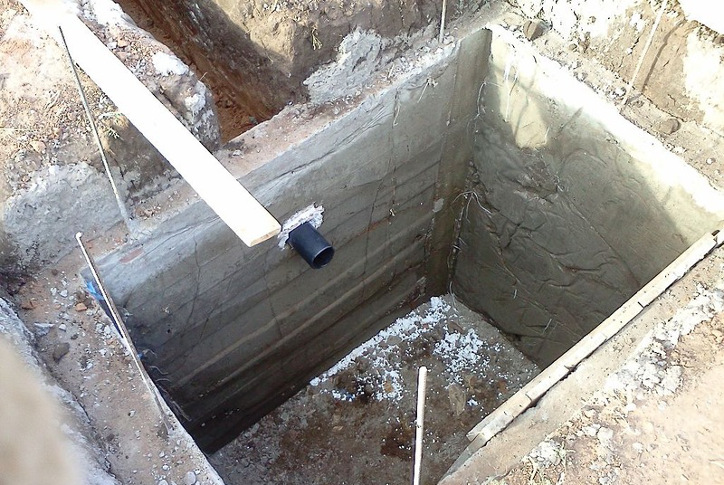
What you need to consider when working with a cesspool of an airtight type:
- The walls of the pit must be laid out with bricks without leaving gaps, as is the case with an absorbent structure.
- It is desirable to plaster the walls lined with bricks with cement mortar.
- The bottom of the cesspool must be cemented, and before that, waterproofing "procedures" must be carried out. For sealing, you can use liquid glass.
- The lower concrete platform needs to be reinforced - you will need to lay a special concrete mesh on the bottom so that it does not “drown” in the solution, it is installed on pegs.
- You can completely seal the cesspool with bitumen or cement mortar.
- When laying bricks or sealing the pit with bitumen, you need to make a hole for installing / connecting a sewer pipe.
It should be noted that the arrangement of a cesspool in a private house is not a quick matter. At a minimum, you will need to wait for the concrete pad to dry completely. But the absorbing structure is made much faster, because when sealing, it will also be necessary to wait for the mortar to solidify for laying bricks.
If you plan to make a cesspool of concrete rings, then you can take advantage of special offers on the market - manufacturers offer to purchase a "Lego constructor" - concrete rings, the bottom and cover of the pit. In this case, the time of work is significantly reduced - there is no need to independently pour the concrete pad at the bottom of the pit and make a cover.
Cesspool cleaning
Fecal pump
A fecal pump is better to use a surface one. Only the hose is immersed in the pit, the installation itself is located on the ground or in a separate room.
There are submersible type fecal pumps with grinders on the market.
The submersible pump is lowered into the cesspool. This unit is impractical to use for periodic pumping. Since for the most part he is constantly in the septic tank. Every time it is just inconvenient to get it and clean it.
Submersible pumps with a grinder operate autonomously, which is very practical when the septic tank is often overfilled. As soon as the level of drains rises to a certain level, the unit turns on automatically.
Container for waste that will later need to be removed
The tank for storage and transportation of effluents must be airtight with a tight-fitting lid. It is great if it is of a large volume, in which case several pumpings can be made into it. Removal and disposal will need to be done less frequently.
For storage of drains, in most cases, black plastic tanks are purchased.
Black barrels are designed to store liquids outdoors. They are of high strength. Withstand temperatures from -40 to +50. Resistant to aggressive environments, and have high tightness.
How to pump out silt from a drain hole
Before you start cleaning the septic tank, it will not be superfluous, 2-3 days before pumping out, add a special bioactivator to the pit. The tool is not expensive, but the benefits of it are huge.
Leading drugs: Dr. Robik 109, Dr. Robik 409 (dissolve even fossilized sediment), BIOSEPT, DEO TURAL (can be used at any temperature and for any septic tank).
After all the preparations, you can start pumping.
If a submersible pump is used, then the outlet hose is inserted into the container and pumped out.
If the pump is a surface pump, then a suction hose is lowered into the pit to the bottom, the pipe to the outlet is lowered into the prepared container.
Periodically, the amount of content in the septic tank should be checked.
Pump out a cesspool without a pump
The process is laborious and unpleasant. You can't clean up alone.
Need
- sealed suit
- Respirator
- Gloves
- Bucket
- Staircase, if the septic tank is large.
- Rope
- shovel
The stairs descend into the pit. With a shovel, sludge is collected in a bucket. With the help of a rope, the contents rise to the surface, pour out into a compost pit or container.
And so on until the septic tank is completely empty.
The procedure is not only unpleasant, but also dangerous.
Toxic fumes from sediment can cause unconsciousness.
If you fall into the mud, you may drown.
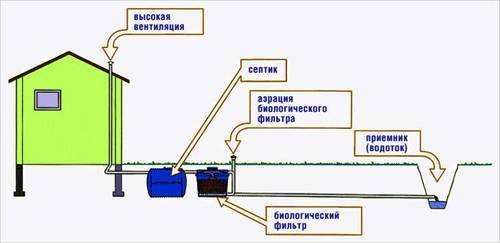
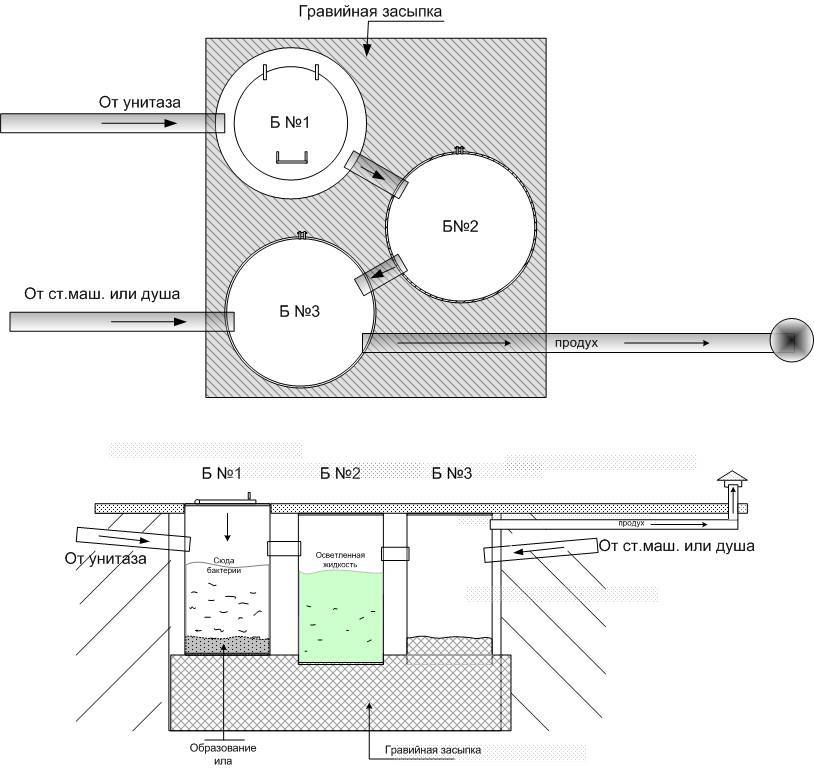
You can pump out on your own not only a single-chamber septic tank, but also consisting of two and three tanks.
Do it better with a pump
- The first tank is pumped out, in which the effluent settles and the primary sediment settles.
- Second camera. If a biofilter is present, then it must also be cleaned. It is not necessary to empty the second tank completely, it is enough to remove the sediment.
- Further, the third chamber is freed from silt.
It is worth noting that due to the use of bacteria, the amount of sludge in septic tanks is significantly reduced. The precipitate becomes liquid, without large particles.





Well placement requirements
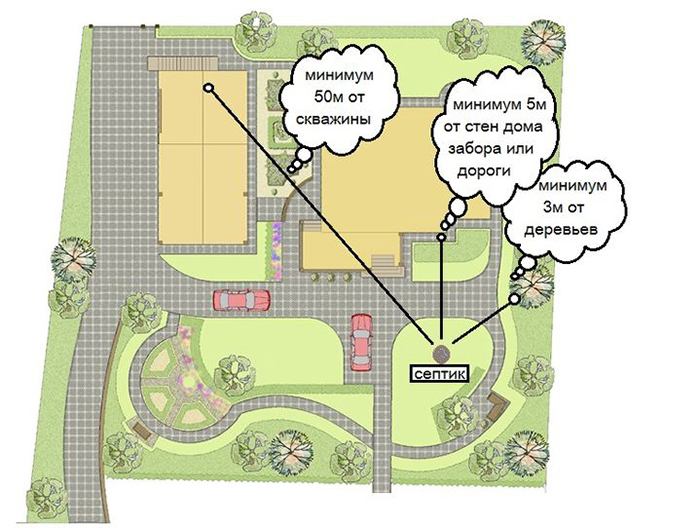
The location of the septic tank on the site
The distance from the well to the waste pit depends on various factors. When determining this gap, it is worth considering such indicators as:
- hydraulic connection between the rock and the aquifer, because it is the soil that performs the filtration functions for water entering the water layer;
- the composition and quality of the soil, since sewage can seep through it into the source (water seeps through the sandy rock most easily);
- the depth of the passage of groundwater (a cesspool structure without a bottom cannot be buried below the aquifer);
- direction of fluid flow in the underground aquifer (for wells located downstream of the sewage pit, the risk of contamination is high).
Depending on the indicators of the rock, the gap between these structures can be as follows:
- impermeable rock (impermeable clay is considered the most impermeable, in this case the gap from the pit to the source can be reduced to 30 m);
- permeable rock (sand) - in this case it is better to make a maximum gap of 50 m.
Project preparation
Even the simplest design of a septic tank or cesspool requires calculations, because the size of the structure depends on the daily amount of wastewater and other conditions. Only correct design will give confidence in the efficiency and reliability of the structure, and pre-drawn drawings will help to avoid errors in work.
Material calculation
The calculation of the number of rings is based on the volume of effluents, which, in turn, is determined on the basis of the amount of water consumed by the family. In your research, you can use the average data on water consumption per person in the amount of 200 liters per day, or resort to the help of special tables.
The dependence of the volume of the septic tank on the number of family members
To calculate the size of the receiving tank, the amount of wastewater per day is multiplied by three. Based on this value, the number of concrete rings and their size are determined. For example, a family of 3 would require a 1.8cc primary chamber. m. (600 liters per day times 3). For this, two standard rings with a diameter of 1 m and a height of 0.9 m will suffice.If 8 people live in the country house, then you will need a 4.8 cubic meter tank. m, which is about seven reinforced concrete products. Of course, no one will build a seven-meter-deep septic tank. In this case, take three rings with a diameter of 1.5 meters.
When calculating, you can use tables of dimensions of standard reinforced concrete structures and formulas for determining the volume of a cylinder. For the most common rings with a diameter of 1000, 1500 and 2000 cm and a height of 0.9 m, the internal volume is:
- KS-10.9 - 0.7 cu. m;
- KS-15.9 - 1.6 cu. m;
- KS-20.9 - 2.8 cubic meters. m.
In the marking, the letters denote the “wall ring”, the first two digits are the diameter in decimeters, and the third is the height in tenths of a meter.
The minimum size of the post-treatment chamber should be at least 1/3 of the total volume of the septic tank
The size of the post-treatment chamber is calculated based on the fact that the first chamber occupies 2/3 of the volume of the septic tank, and the second - the remaining third. If we apply these ratios to our example of a treatment system for 8 people, then the second tank should have a volume of 2.4 cubic meters. m. This means that you can install 3 - 4 concrete elements KS-10.9 with a diameter of 100 cm.
When calculating the amount of materials, it is necessary to take into account the depth of the drain line, taking the entry point of the pipe into the septic tank as the upper level of the receiving chamber. The size of the structure is increased by an amount sufficient to ensure that the floor slab is 5–10 cm above the surface of the site. To do this, use one or two standard rings, and if necessary, supplement them with additional elements. If this is not possible, or after the construction of the cottage there is a red brick left, then the upper part of the septic tank chambers is built from it.
Drawing
Before starting earthworks, a detailed drawing of the structure is drawn up, indicating the depth, points of entry and exit of pipelines, levels of the overflow system. Since the distance from the surface of the site to the lowest point of the sewer line depends on the degree of freezing of the soil, these values differ depending on the region and soil composition. In addition, it is imperative to consult with local experts about the groundwater level in the area, to which there should be a gap of at least 1 m from the bottom of the septic tank. Depending on this, a decision is made to increase the diameter of the chambers, which will lead to a decrease in the height of the tanks. Drawings and diagrams can help in the process of work, you can be guided by them when drawing up your own design of treatment facilities.
Required Tools
The upcoming earthwork, installation and waterproofing works require the preparation of the following tools and materials:
- bayonet and shovel shovels;
- construction stretcher or wheelbarrow;
- solution containers;
- concrete mixer;
- perforator or impact drill with a nozzle for concrete;
- level and plumb;
- roulette;
- concrete rings, floor slabs and bottoms, hatches;
- pieces of pipes for the overflow system;
- bituminous waterproofing;
- sand and cement;
- rubble.
If it is not possible to use lower rings with a bottom (glass rings) or floor slabs and bases, then you will have to make these concrete products yourself. To do this, you will additionally need steel bars and reinforcement to reinforce the structure, as well as long corners or channels as supports for the upper plates. In addition, you need to take care of the formwork boards and the plastic film used for waterproofing.
The design and purpose of the cesspool
Cesspools, like septic tanks, serve to collect sewage. But these are primitive structures that are not able to purify the liquid.
In storage tanks, waste only partially decomposes, unlike VOC, where effluents are divided into solid waste and liquid, which is further clarified and reaches a purity of 60-98%.
All types of drain pits can be divided into two categories:
- sealed storage containers;
- drain pits with filter bottom.
For users, 2 differences are important - the device of the bottom of the tank and the frequency of waste removal. The first type retains the entire volume of sewage, so it is emptied quite often, once every 1-2 weeks.
For the second type of pits, vacuum trucks are called less often, since the tank fills up a little more slowly. Part of the liquid seeps through a kind of filter that replaces the bottom, and enters the ground.
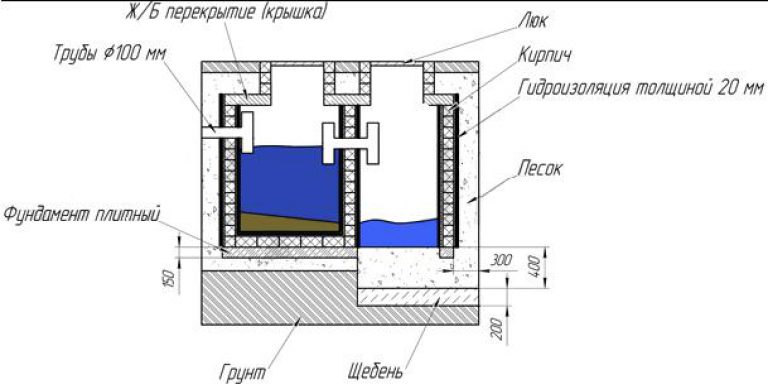
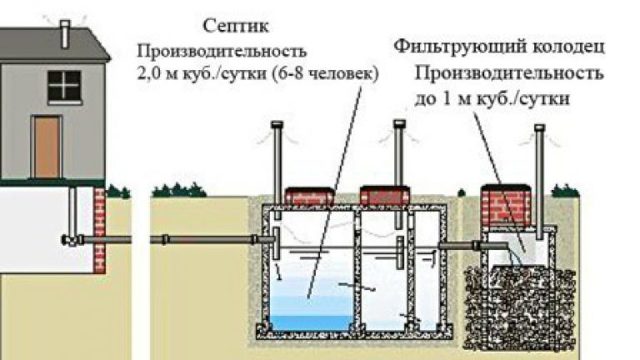
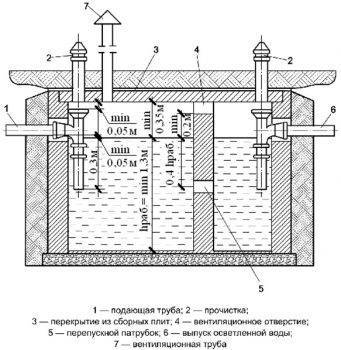
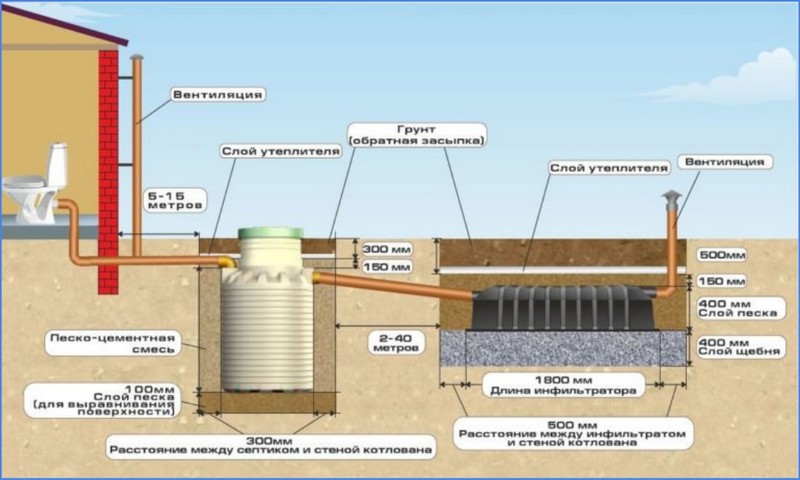


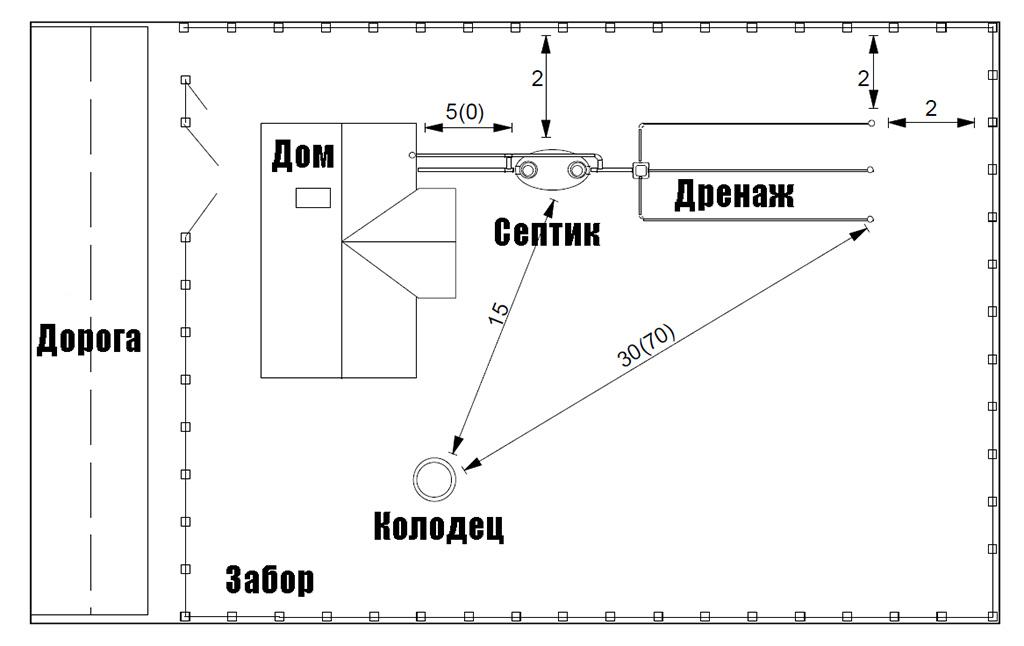

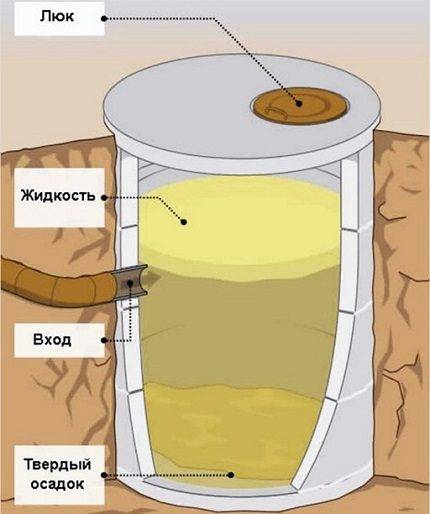
Scheme of the simplest cesspool. Usually it is designed in such a way that the volume of the tank is sufficient, and the drain masses do not rise above the sewer pipe.
At first glance, the second option is more acceptable, but it can only be used to process gray waste.
When constructing a pit without a bottom, a number of factors must be taken into account:
- sanitary requirements;
- soil type;
- presence and location of aquifers.
If the soil in the selected area is clayey, unable to quickly absorb water, there is no point in making a filter bottom. The same with aquifers - there is a risk of contamination and violation of the ecological situation.
There are many solutions for cesspools: they build structures of brick, concrete or car tires. Concrete structures and ready-made plastic containers are considered the most reliable.
Concrete tanks, created by erecting formwork and pouring, are more difficult to build than analogues from ready-made rings, which we will dwell on in more detail.
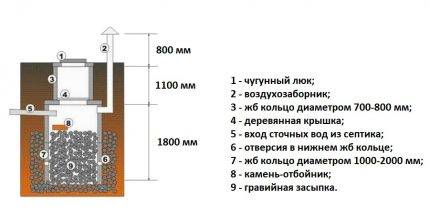 Scheme of a drain pit with a filter bottom. The air intake is removed as high as possible so that the unpleasant smell characteristic of sewer storage tanks does not disturb comfortable living
A cesspool made of cylindrical concrete blanks in finished form is a well from 2 m to 4 m deep. Rings in the amount of 2-4 pieces are placed one on top of the other, sealing the seams.
The lower element, depending on the type of pit, may be closed or completely absent. Sometimes, instead of a finished factory blank, a concrete slab is placed on the bottom.
The upper part is made in the form of a neck with a technical hatch and a tightly closed lid.
The main storage part of the tank is buried by about 1 m, since the inlet sewer pipe must be below the freezing level of the soil. The volume of the container is selected, taking into account the number of daily drains.



