
- Cleaning order
- Washing the strainer
- Blade cleaning
- Seal processing
- How to clean a drain hole
- Cleaning the heating element
- Clearing the Recycle Bin and Dead Zone
- Checking the condition and cleaning of sprinklers
- How is the "dishwasher" arranged?
- Why does the “dishwasher” wash even very dirty dishes?
- Benefits of using a dishwasher
- How does a dishwasher work. The principle of operation of the dishwasher
- How does a dishwasher work
- Dishwasher safety
- Dishwasher Diagram
- Embedded technology
Cleaning order
To prevent dirt from accumulating on the doors, they are regularly washed with a wet cloth or a napkin dipped in soapy water.
Wipe the machine, the body of which is made of stainless steel, with a special tool, the control panel with a dry cloth. Drops of liquid should not fall on the buttons.
Washing the strainer
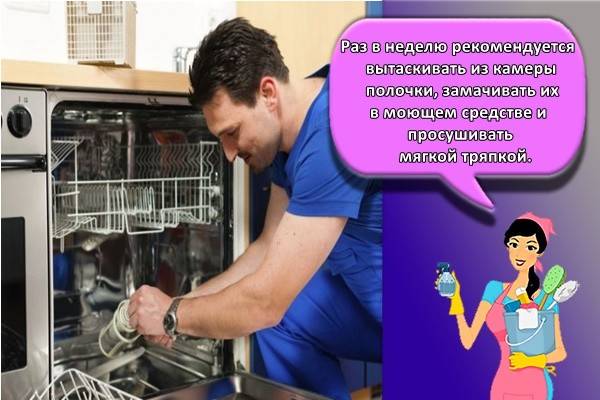
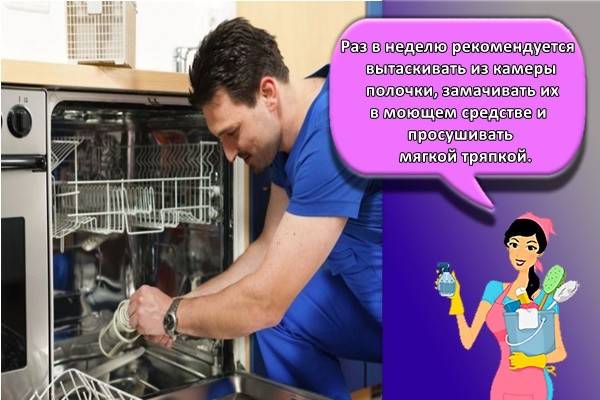
Once a week, it is recommended to take the shelves out of the chamber, soak them in detergent and dry them with a soft cloth. Every 7 or 8 days, remove the mesh filter from the lower basket, soak this part in soapy water, rinse with cool water, and return to its place.
Blade cleaning
Food residues, hard liquid clog the holes through which the soap solution enters the dishwasher. Clogged blades that supply water must be removed and cleaned with wire, rinsed under a tap.
Seal processing
In order for household appliances to perform their functions for a long time and with high quality, it is worth purchasing a special chemical composition in the store, which is applied with a sponge to the seal that is installed on the dishwasher door.
How to clean a drain hole
If the equipment has stopped, and there is water inside, the equipment must be disconnected from the electrical network. After that, carefully remove the drain hose. The detected blockage in the hole must be pierced with wire or the Mole preparation. If the water does not go away, it is necessary to disconnect the other end of the hose from the dishwasher and rinse under powerful pressure.
Cleaning the heating element
The scale that forms on various parts of household appliances contributes to the disruption of the device. The water stays cold if there is a deposit on the heating element. You can clean it with citric acid, vinegar. The product is poured into a cup, placed on the top shelf and the machine is turned on.
Clearing the Recycle Bin and Dead Zone
Debris constantly accumulates inside the bottom of the door, because the liquid does not get there. Remove dirt with a cloth soaked in soapy water. The “dead zone” is disinfected from microbes with vinegar.


To clean grease and scale:
- The baskets are removed and placed in the tub.
- Pour boiling water, put detergent.
- After half an hour, garbage is removed with a sponge.
After rinsing with water, all parts are wiped dry. Baskets are installed in the car.

Checking the condition and cleaning of sprinklers
Sometimes, after washing the drain holes, blades and filter, the dishes come out of the machine in a dirty state. Such a problem occurs when the detergent is unevenly distributed. To eliminate it, the upper sprinkler is removed and cleaned of fat by stretching the wire or wiping it with soda or vinegar. They check how the part functions by substituting it under a powerful jet.
How is the "dishwasher" arranged?
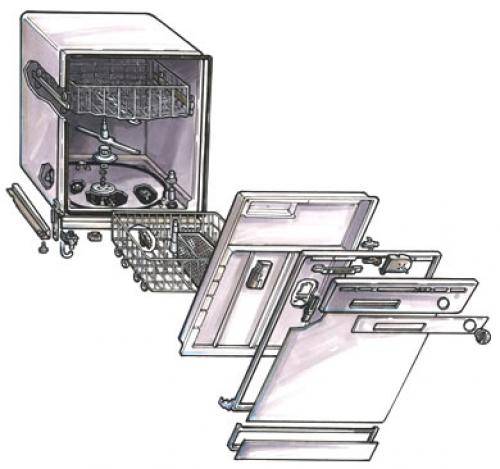
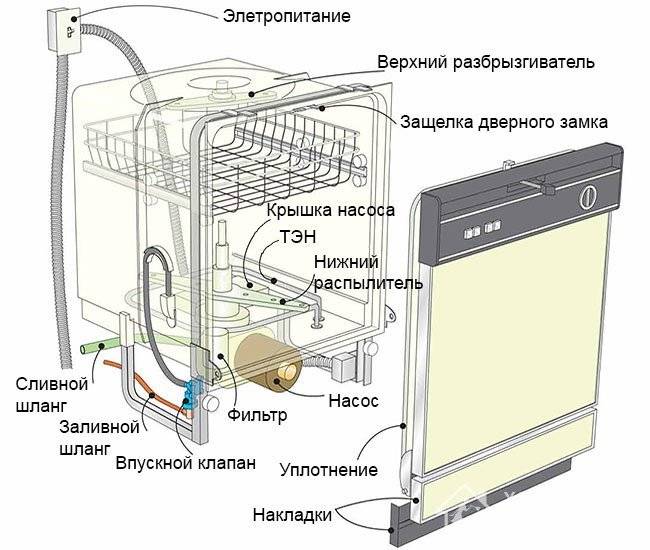
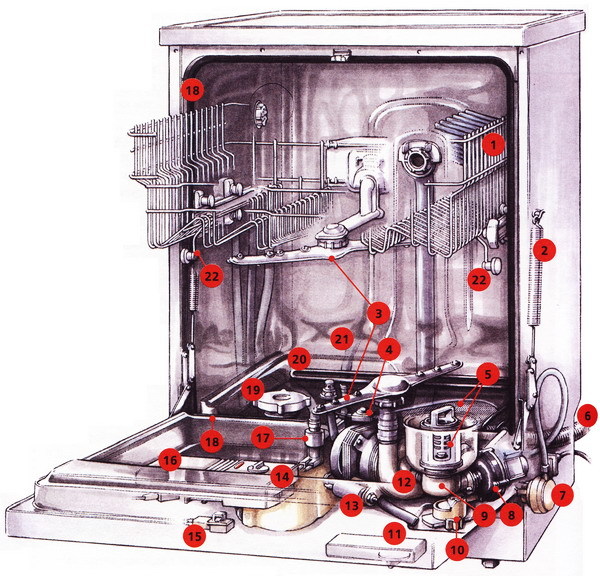
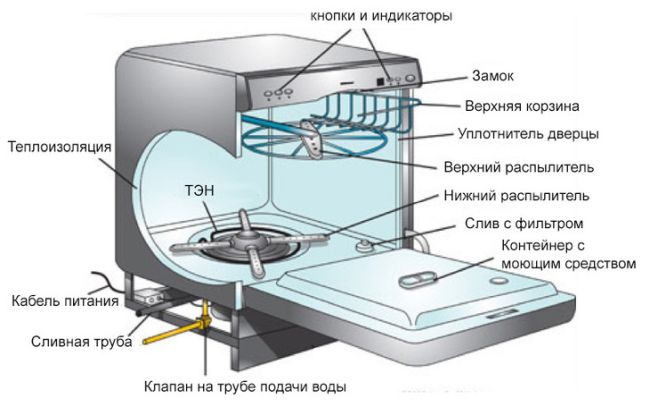
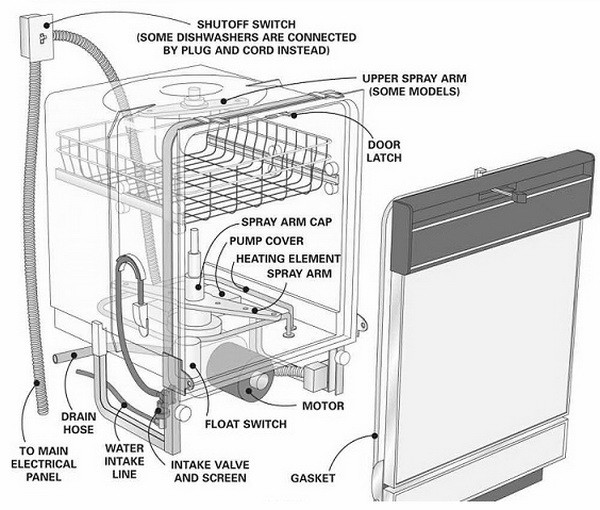
To better understand what happens inside the dishwasher during operation, you need to study its device. If we disassemble the dishwasher and take a look at its structure from the inside, we will see a system of aggregates and sensors interacting with each other. Although the machine is arranged and is not difficult, if you are going to disassemble it for the first time in your life, record your actions on video. The video will then help to correctly put all the details in place, after the repair work has been carried out.
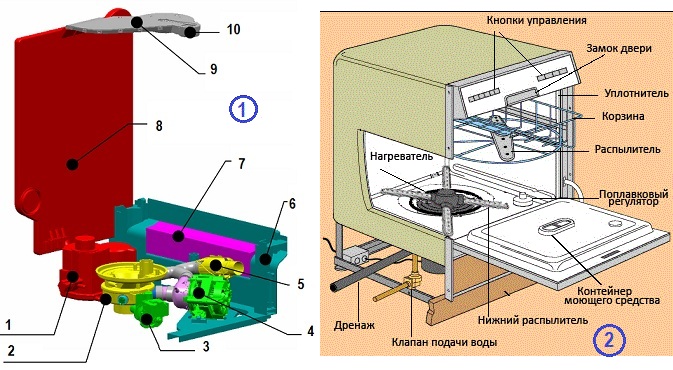
The main parts of the dishwasher are located at the bottom of the case, from the inside it looks quite interesting. In the bowels of the hull is located:
- Tray in which to place dirty dishes.
- A door closer that allows you to smoothly open and close the door.
- Sprinkler bar (there may be two or even three).
- A sensor that measures the temperature of the water.
- Mesh filter and coarse water filter.
- Hose for draining waste water into the sewer.
- Pressure limiting valve.
- A pump that drains waste water.
- Water tank.
- Element of a leak protection system.
- Control module.
- Main pump (circulation).
- condensing element.
- Container for rinse aid.
- blocking element.
- Detergent container.
- Fill valve.
- Rubber seal located on the edge of the door.
- Salt compartment.
- Flowing water heating element.
- Inlet hose.
- Guides for dish trays.
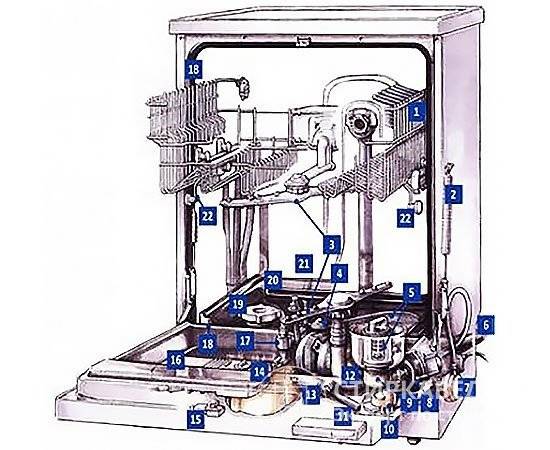
Here is a general list of items installed in the dishwasher. Where and how they are installed, you can see in the picture above. If this is not enough to understand the big picture, you can find a video on the Internet showing the details of the dishwasher.
Why does the “dishwasher” wash even very dirty dishes?
Now let's dispel the myth about the inefficiency of the dishwasher. Numerous tests, both in laboratory conditions and in the conditions of an ordinary average apartment, confirm that the “dishwasher” is quite capable of caring for a whole mountain of dishes. Why does she succeed? There are at least three good reasons:
- dishes are washed using a special salt solution and detergents that dissolve food residues and grease;
- washing takes place in water heated to the optimum temperature;
- the dishes are sprayed with water, which is fed under high pressure in a fan-like manner, which allows you to spray all washed items from all sides.
Of course, if you stuff a pot with a centimeter layer of burnt into the dish tray, the dishwasher is unlikely to cope with such pollution. However, it is reliably known that after a washing cycle, even such dirt is greatly softened from the inside and can then be removed manually, using a small amount of abrasive cleaner.In general, it is no exaggeration to say that a dishwasher is one of the most necessary household appliances in the kitchen, and if this story did not convince you, read the reviews about Bosch dishwashers, perhaps consumer opinion will be more significant for you.
In conclusion, we note that if you do not go into technical details, the principle of operation of the dishwasher is very simple.
However, understanding this principle is important for the user, both during the daily operation of the “home helper”, and if it needs to be repaired later.
Thank you for your attention and good luck!
Benefits of using a dishwasher
Safety. Since a person does not touch the dishes during washing, very strong detergents can be used for them, which are dangerous for the skin when washed by hand.
Efficiency. You probably know that grease is best washed off with hot water, but it is fair to say that it is impossible to wash dishes with bare hands at this temperature. But this is possible with a dishwasher, which washes and rinses dishes at high water temperatures (≈55-65°C). In addition, at this temperature, detergents are also well washed off dishes, which cannot be said about manual washing.




Saving. Water consumption is much lower compared to manual washing (9 - 20 liters versus 60 liters for 12 sets of dishes). Savings of 3-6 times, which is achieved through the repeated use of the same water at each stage of washing.
Also, savings are achieved due to the uselessness of costs, with constant purchases of a wide range of detergents and abrasives, sponges, brushes and the like, which, although they cost a little, but if you count the costs for these products purchased per year ....For a dishwasher, special salt is enough to soften the water and one type of detergent.
Versatility. Hot water supply is not required. In fact, the dishwasher can be used at any time, as long as there is water and light. In addition, it also saves you money, because. manual washing uses both cold and hot water, which is more expensive.
Saving your time. The role of a person in washing dishes is reduced to loading dirty dishes into the machine and unloading clean ones. The process itself does not require participation or supervision and can take place at any time, even when you are not at home.
How does a dishwasher work. The principle of operation of the dishwasher
Unfortunately, many do not understand what is the principle of operation of the dishwasher (hereinafter also - dishwashers, PMM). That is why there is a common misconception that household appliances are not able to wash dirty dishes better than human hands.
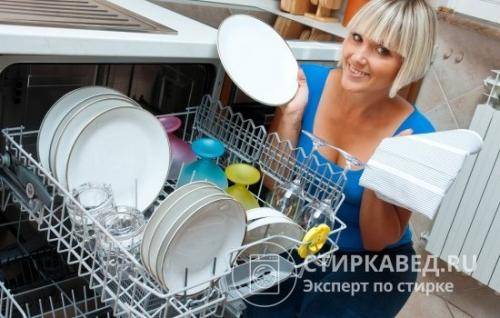 Anyone who has ever tried to wash dishes in a dishwasher will no longer want to do it with their hands.
Users are confused by the fact that the dishes are only sprayed with water with detergent dissolved in it and are not subjected to mechanical stress. Many housewives do not believe that it is possible to wash spoons, forks and plates with dried food residues in this way. In fact, things are not at all like that. We will try to dissuade the skeptics and tell you how the dishwasher works.
How does a dishwasher work
Before readers get acquainted with the principle of operation of the PMM, its device should be described.
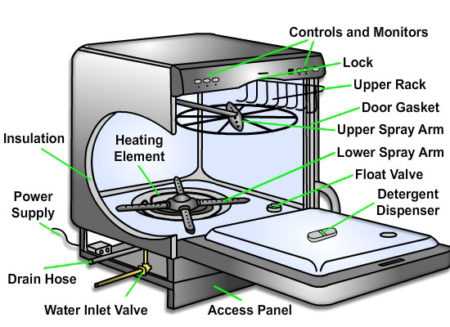
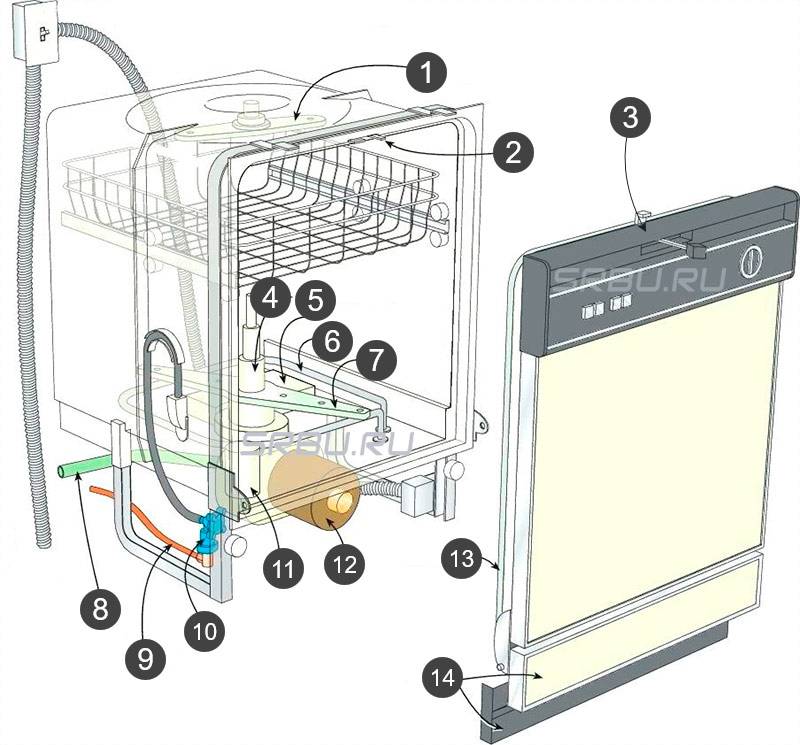
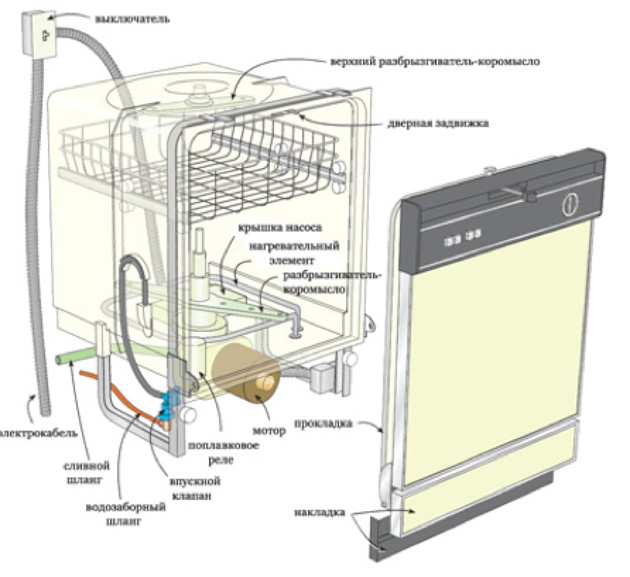
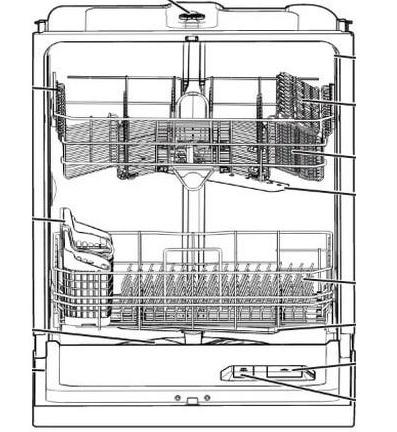
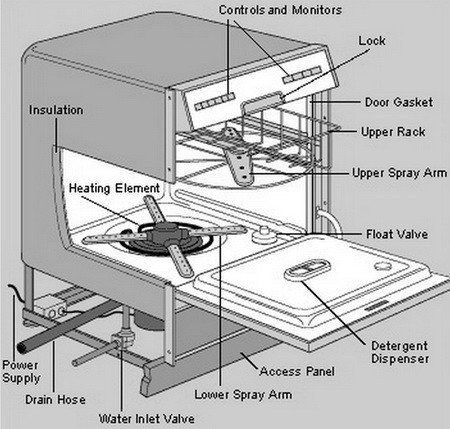
Many people think that dishwashers are complex and capricious devices. In fact, they don't have that many details. Before proceeding to their consideration, familiarize yourself with what you will see when you open the dishwasher door for the first time (see picture).
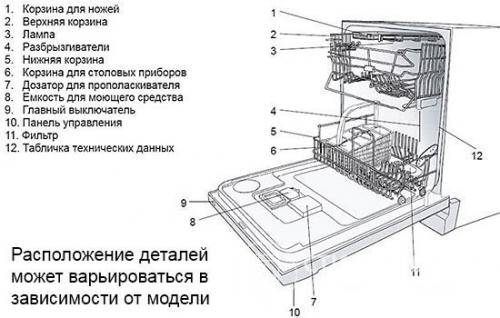 Scheme of the approximate location of parts in the basket and the front door of the PMM
The main parts are located inside the bottom of the dishwasher and are invisible to the human eye. They can be divided into three main groups:
- electronic control module - the brain of the entire device;
- sensors that supply the necessary information to the control module for analysis;
- executive mechanisms.
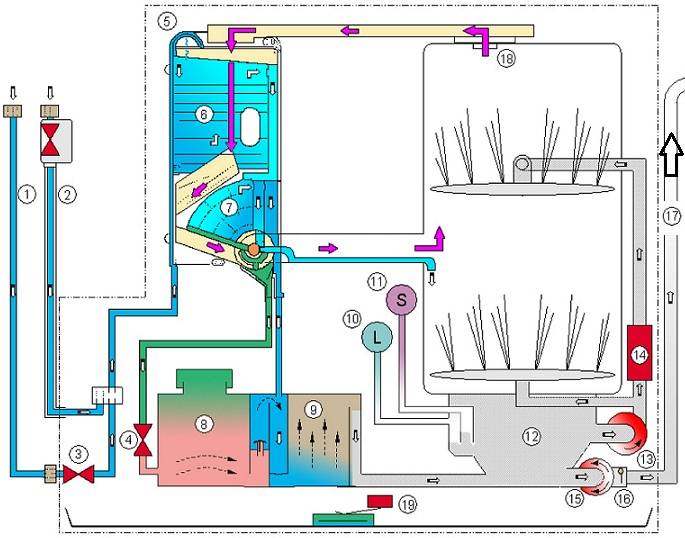
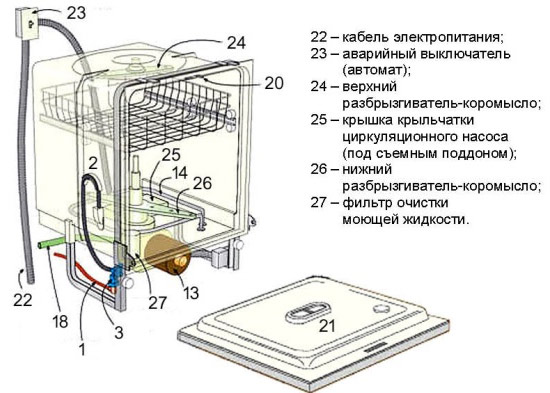
Based on the schematic diagram below, the dishwasher consists of the following components and parts:
- The upper basket in which the dishes are placed.
- A return spring that closes the door.
- Upper and lower sprinklers.
- Thermal relay with water temperature sensor.
- Coarse and fine filters.
- Drain hose leading to the sewer.
- The safety valve which works at excess of pressure.
- Drain pump that removes dirty water into the sewer.
- A reservoir that holds water.
- One of the details of the Aquastop protective system, which prevents flooding in emergency situations.
- control module.
- A circulation pump that pumps liquid into the nozzles and further along the circuit during dishwashing.
- Capacitor.
- The dispenser in which the rinse aid is poured.
- Lock blocking the door.
- A dispenser into which detergent is poured or poured.
- An inlet valve that controls the water supply to the dishwasher.
- Door seal.
- The lid of the container where the sodium salt is poured.
- An electric heater that brings water to the desired temperature.
- Inlet hose through which water enters the PMM.
- Rollers with guides on which baskets with dishes move.
Dishwasher safety
— During installation, the dishwasher must not be connected to the mains.
- Dishwashers are manufactured according to the first class of protection with grounding and a three-pole plug. Therefore, the electrical wiring in the apartment must be grounded, and the power supply must comply with the data given in the instructions for the dishwasher.



— To protect against electric shock, there is a device that automatically de-energizes the machine if the door is opened during operation. The blocking lock on a door serves as reliable protection against curious children.
- Dishwashers have stable protection against voltage surges, which is typical of our network.
- The Aqua Stop security system prevents water leakage, regardless of the nature of the leak: depressurization, damage to the hose or drain. This system protects the machine from backflow of water. It protects the apartment from flooding.
- Dishwashers have a built-in pump that pumps water out of the chamber if the water reaches a dangerous level and threatens to leak out.
- The machine has a sensor that regulates the water level and turns off the heating of the heat element if there is not enough water in the machine. High quality pipes also protect against leaks. The bottom plate is waterproofed, drain pump with anti-blocking system.
- Many dishwashers have an integrated control panel.If the machine detects a malfunction that occurred during operation, then a signal is immediately given, the signal lamps light up and the user himself can determine the type of malfunction.
— If the dishwasher is not built-in and access to the side door is possible, close the side hinge with a special cover.
- Special baskets and holders protect against mechanical injury when using sharp objects.
Dishwasher Diagram
Modern man has simplified his life as much as possible - all kinds of electrical devices guard our comfort and convenience - washing machines, food processors, microwaves, vacuum cleaners ..
. All this is in the house (especially in the kitchen) of every person. And now it's time to get acquainted with another household appliance that greatly facilitates household chores - a dishwasher.
Dishwasher operation
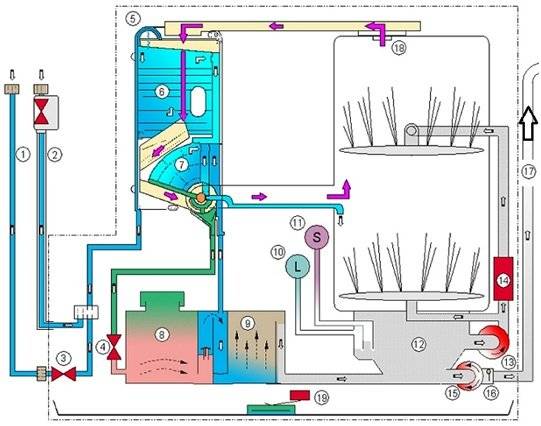
1. Before supplying hot water to the tank, you need to make sure that there is no water left in the tank after the last rinse. Therefore, in most models of machines, a new wash cycle begins with the drain pump running for some time.2.
The electric water inlet valve opens the hot water supply to the tank. The timer controls how long the solenoid valve remains open, providing water level control. Flow control washers built into the valve compensate for differences in water pressure.


Most models use anti-leakage float switches to prevent accidental overflow during the fill cycle.3. After that, the pump starts in the "wash" mode.The water is sent to the sprinklers which spray hot water onto the dishes.
Most dishwasher models are also equipped with a water heater in the tank to keep the water at the right temperature during washing. In some designs, the heater also dries the dishes at the end of the wash.
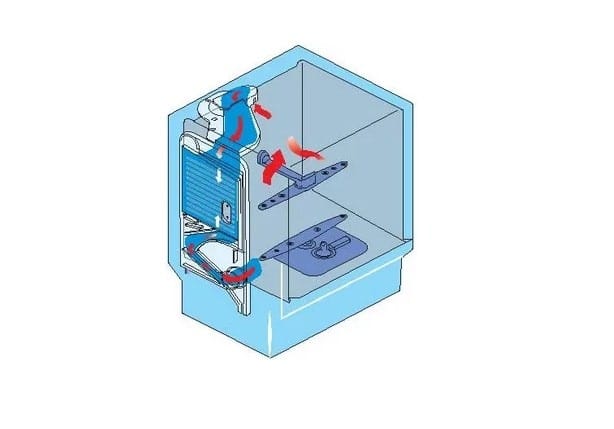
5. At the end of the "wash" and "rinse" cycles, the pump goes into "drain" mode. Water can be pumped out of the tank in one of two ways. In some "reverse direction" designs, the motor, when rotated in the reverse direction, engages the pump impeller to drain the water.
6. The "drying" cycle makes the heater. In other models for drying dishes, the fan drives the air inside the case, the steam condenses in the cooling circuit, the condensate drains out of the machine.
Designation of circuit elements:
X1-2 - clamp pads; SO1-4 - switches; SL - relay RU-ZSM; EV - single-section valve KEN-1; EK - NSMA water heater; H1, NZ - indicator IMS-31; H2, H4 - indicator IMS-34; MT - electric motor DSM-2-P; M - electric motor DAV 71-2; C1-2 - capacitors (4 uF); KL1 - clamp for ground connection; FV - fuse socket;
SK - relay-sensor DRT-B-60.
Either more complex, with a built-in controller that controls the dishwasher modes according to a built-in or manually compiled program. Manual programming can be useful when it is necessary to reduce water consumption, or vice versa - to increase the duration of washing too dirty dishes. You can download the circuit diagrams of such models (manufactured by LG) along with their description in the archive for free.
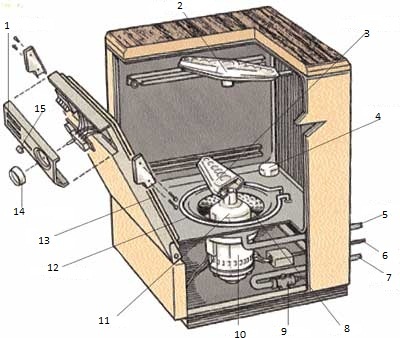
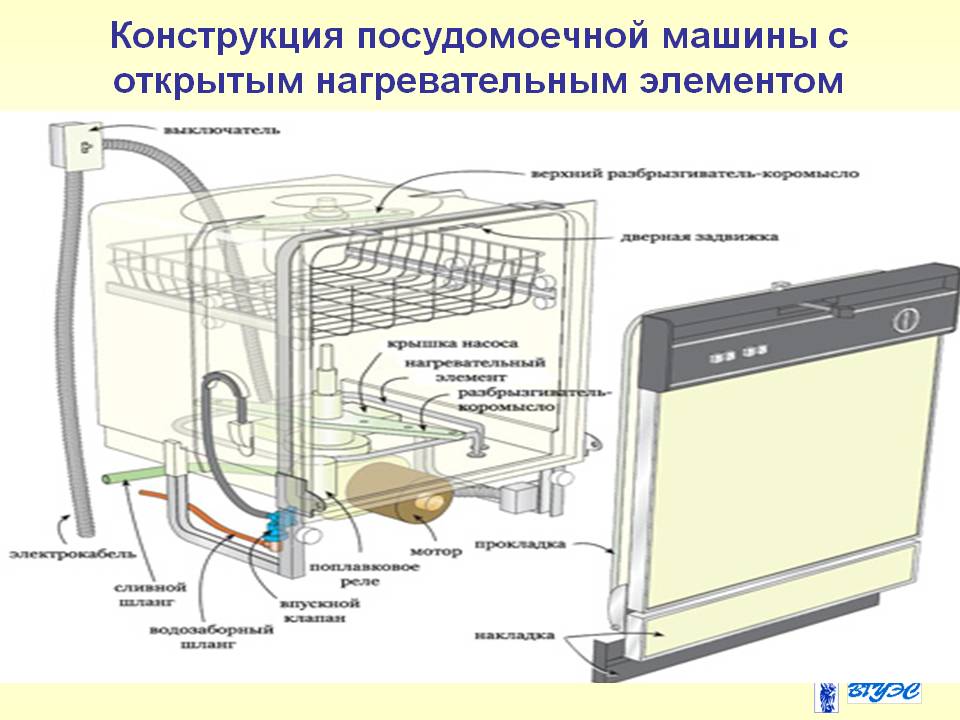
1 Control panel2 Upper spray unit3 Lower spray unit4 Float valve5 Drain hose6 Power cable7 Hot water hose8 Filter9 Inlet valve10 Motor11 Pump12 Heating element13 Gasket14 Timer control button15 Door latch.
The second version of the description of the PM device
Modern dishwashers with digital control are equipped with the function of displaying error codes when malfunctions and malfunctions occur during operation. If the malfunction is simple, then understanding what the error code means, you are able to eliminate it yourself without calling the service departments. Below is a table of error codes for Bosch dishwashers. Click to enlarge the picture.
If your dishwasher is not working, do not rush to send it in for repair. Here are a few verification operations that you should do yourself:
– Make sure that the dishwasher is connected to the power supply, check the wires, plug, socket, make sure they are not damaged.
– Check the fuses in the switchboard. Make sure the switch that controls the dishwasher is turned on.




– Make sure the door is tightly closed. The machine will not turn on until the door is closed, most likely there is a problem in the latch mechanism of the lock, check this.
– Check if there are any problems with the water supply, perhaps somewhere the taps are not open and water does not enter the dishwasher.
– Make sure the controls are set up correctly, such as the anti-tamper feature is enabled.
– Look around and under the car for small smudges. Gaskets may be worn out or hoses and pipes may be damaged.
Embedded technology
The first built-in appliances were produced by the German brand Siemens in 1980. Today, built-in devices are the leaders in the PMM market. The principle of embedding attracts consumers by economical use of space and maintaining the harmony of the interior.




