- Sewerage device from concrete rings
- Which one to choose?
- Outer contour
- Mounting
- How to bring the sewer to the septic tank
- How deep to dig the tuba
- Warming
- Do-it-yourself sewerage arrangement in the bath: a step-by-step guide
- A step-by-step guide to building a sewer in a bath with your own hands
- Sewerage construction in a private house: ventilation scheme in the bath
- Rules for calculating sewer networks
- The right choice of pipes for sewerage is the key to successful operation for many years.
- Materials from which sewer pipes are made
- Planning the sewer system and choosing a location for a septic tank
- Materials for use in a private house
- Depth
- Norms according to SNiP
- Factors to choose
- Reduction Options
- Primary requirements
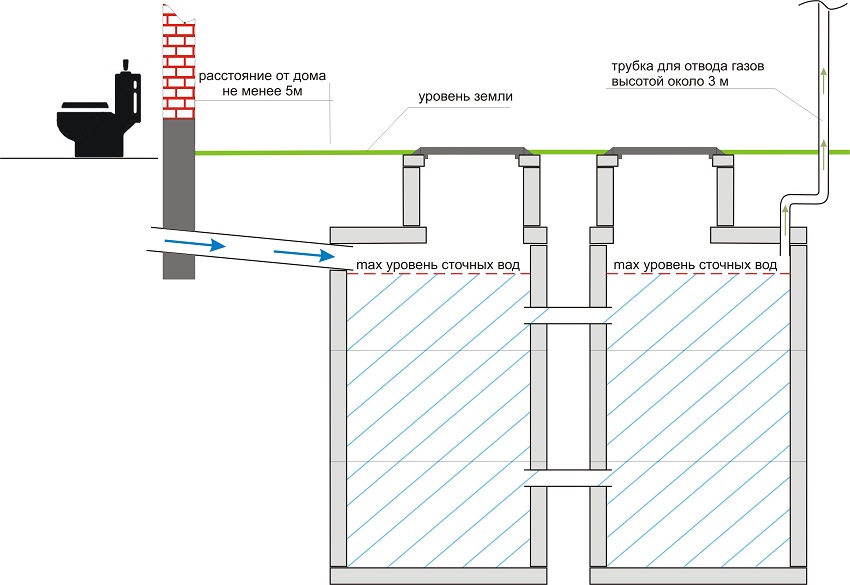
Sewerage device from concrete rings
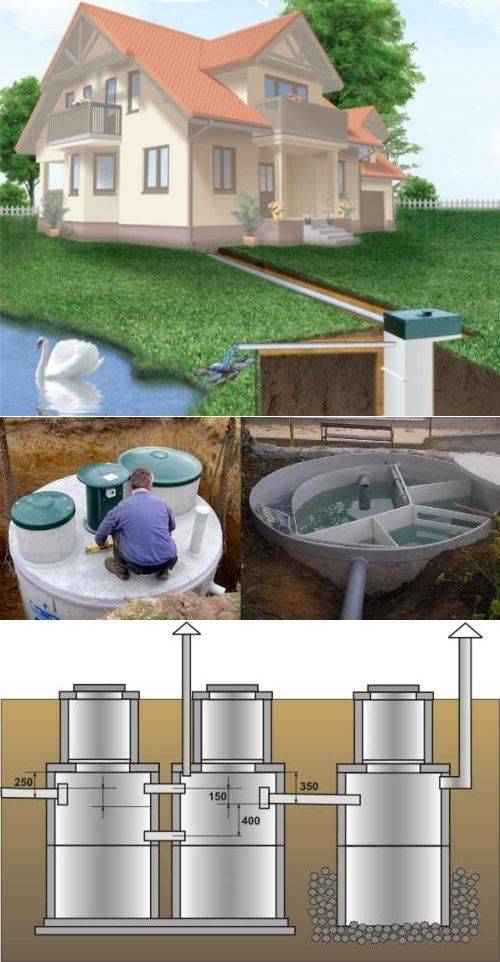
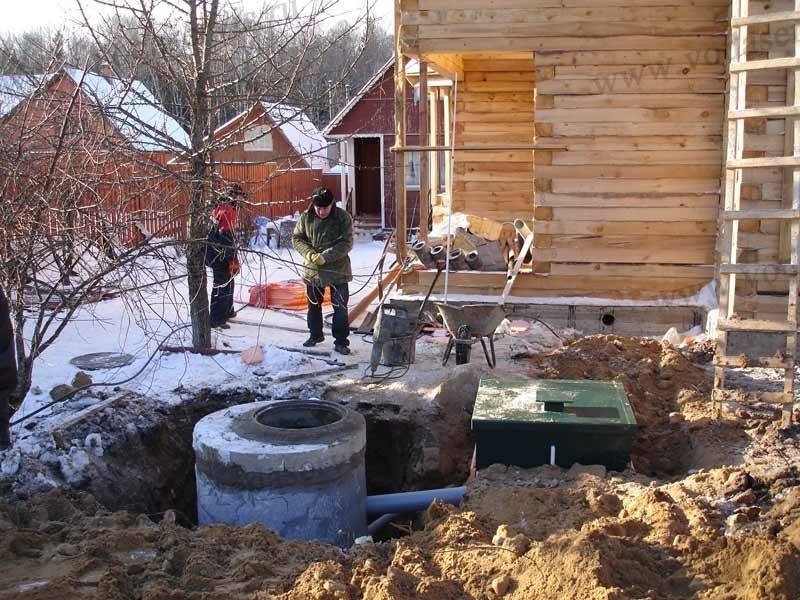
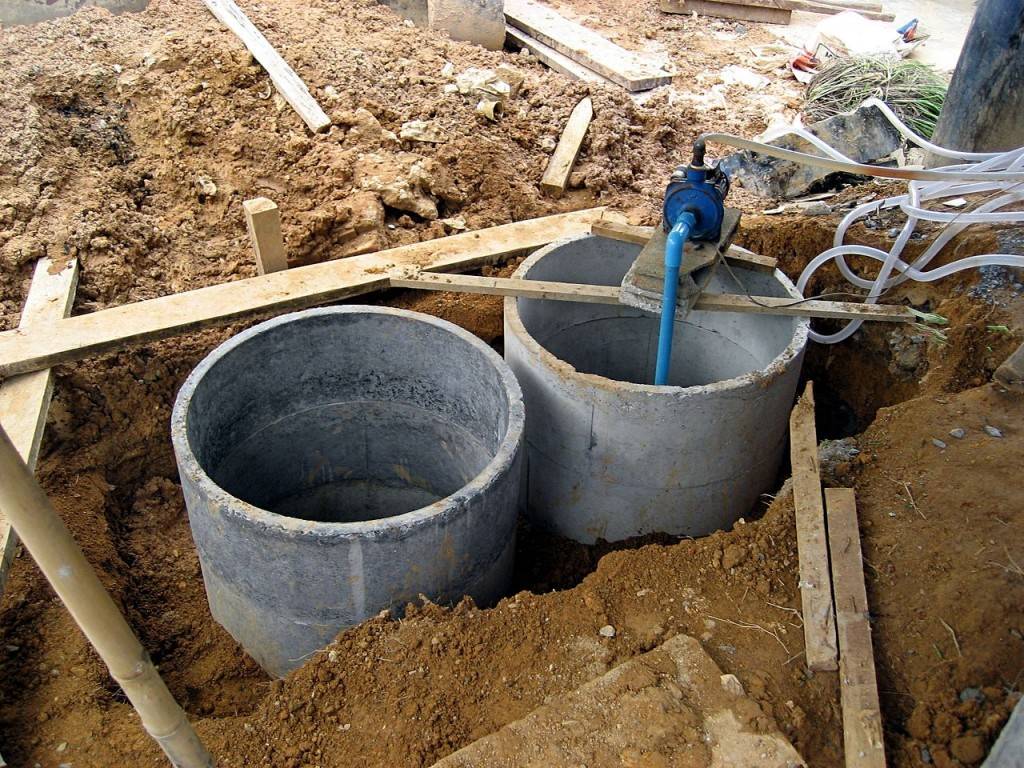
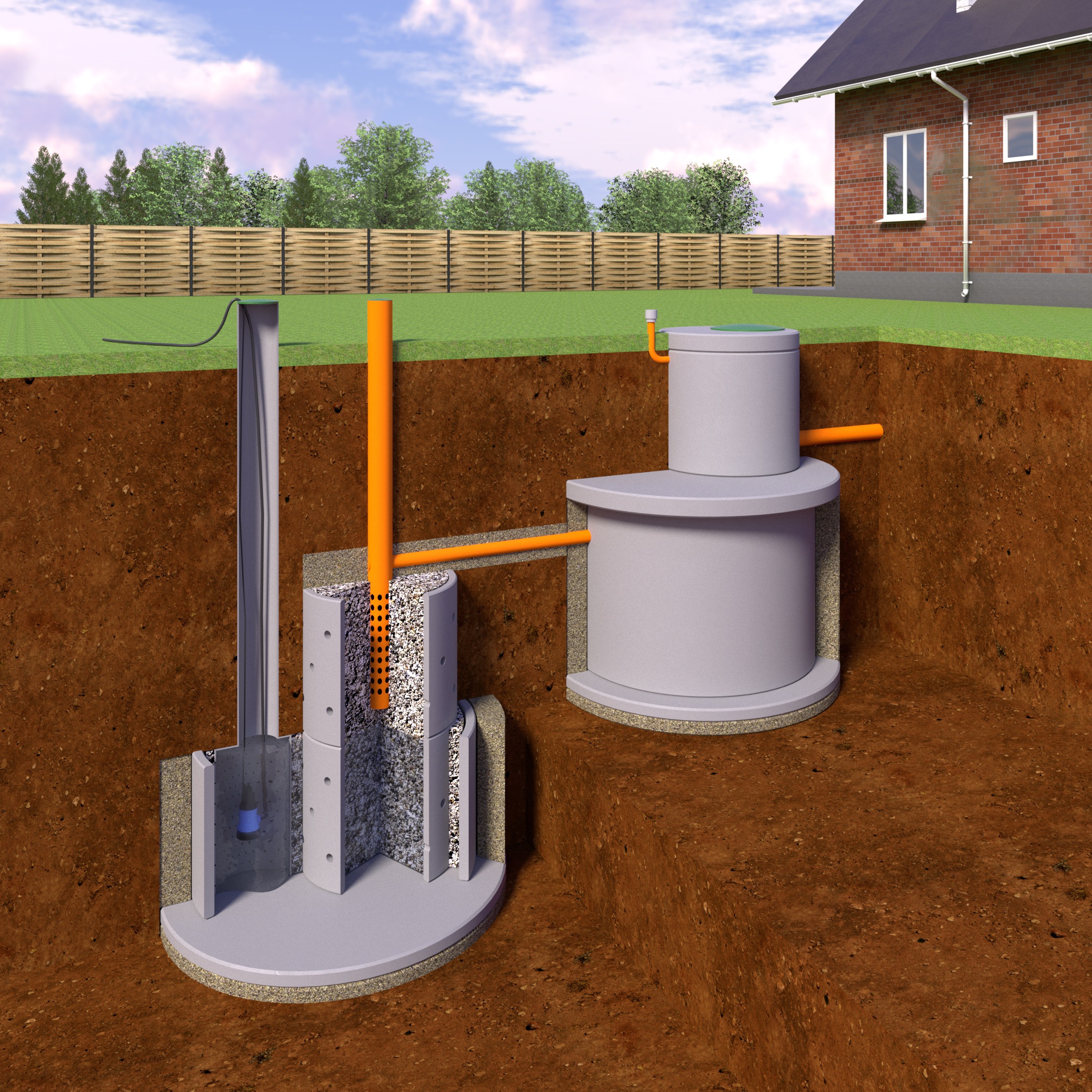
The simplest compartments can be made from concrete rings used in gravity-flowing street or storm sewers. Their diameter can be from 1 to 1.5 meters, height 1 meter. You can install 2 rings, one on top of the other, to increase the volume of the septic tank. The first compartment may be of larger diameter rings.
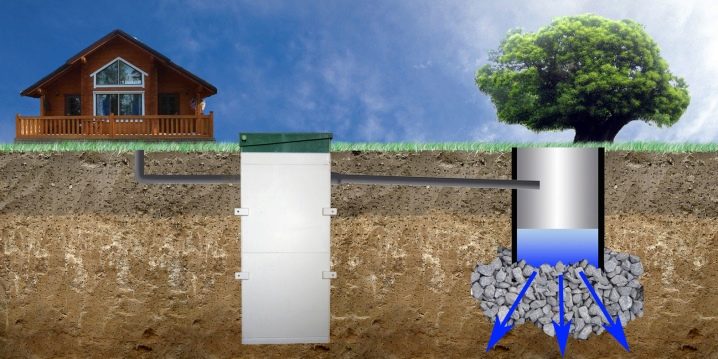
The bottom of the pits for all compartments is covered with rubble before installing the rings. And after installation, the bottom of the first two is concreted.At the third compartment of the concrete ring, the bottom is only covered with rubble, but not concreted. In the walls of the third ring, holes are drilled with a crown, with a diameter of 7 to 12 cm, for additional drainage. From the outside, the wall of the ring is covered with crushed stone to prevent the soil from being washed away into the ring.
Which one to choose?
As you can see, there are quite a few options for arranging a sewer system for a summer cottage, so most homeowners ask a reasonable question, which design is better choose.
When choosing a suitable autonomous sewer for a country house, you should not only pay attention to the reviews of other users, but also rely on other important criteria
- The main purpose of the building. As a rule, a dacha is a structure for temporary residence, so for it you need to choose systems that can operate with long downtime. For example, it can be a cesspool of a storage type with a calculated volume.
- Site dimensions, as well as geology. In small areas, it will not be possible to use septic tanks with underground filters. Options with a well filter are also not suitable if there is groundwater at a high level on the site.
- The volume of effluents and their discharge. This parameter must be calculated based on the number of residents and guests in the house. Having found out these indicators, you can choose the appropriate level of performance of the structure, which is usually indicated in technical documents.
- Budget. If you are not ready to spend large amounts, then high-tech systems will not suit you. You can turn to budget options, but you should always take into account their weaknesses.
Outer contour
 Effluent path
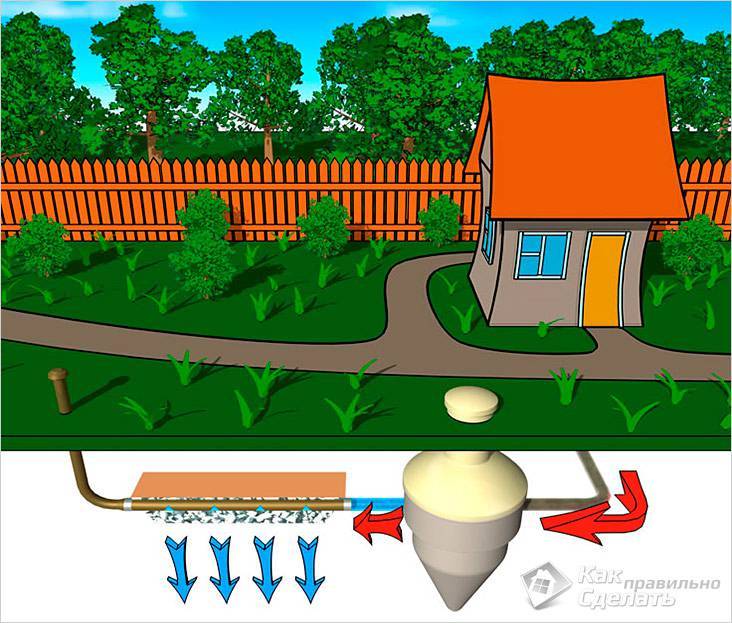
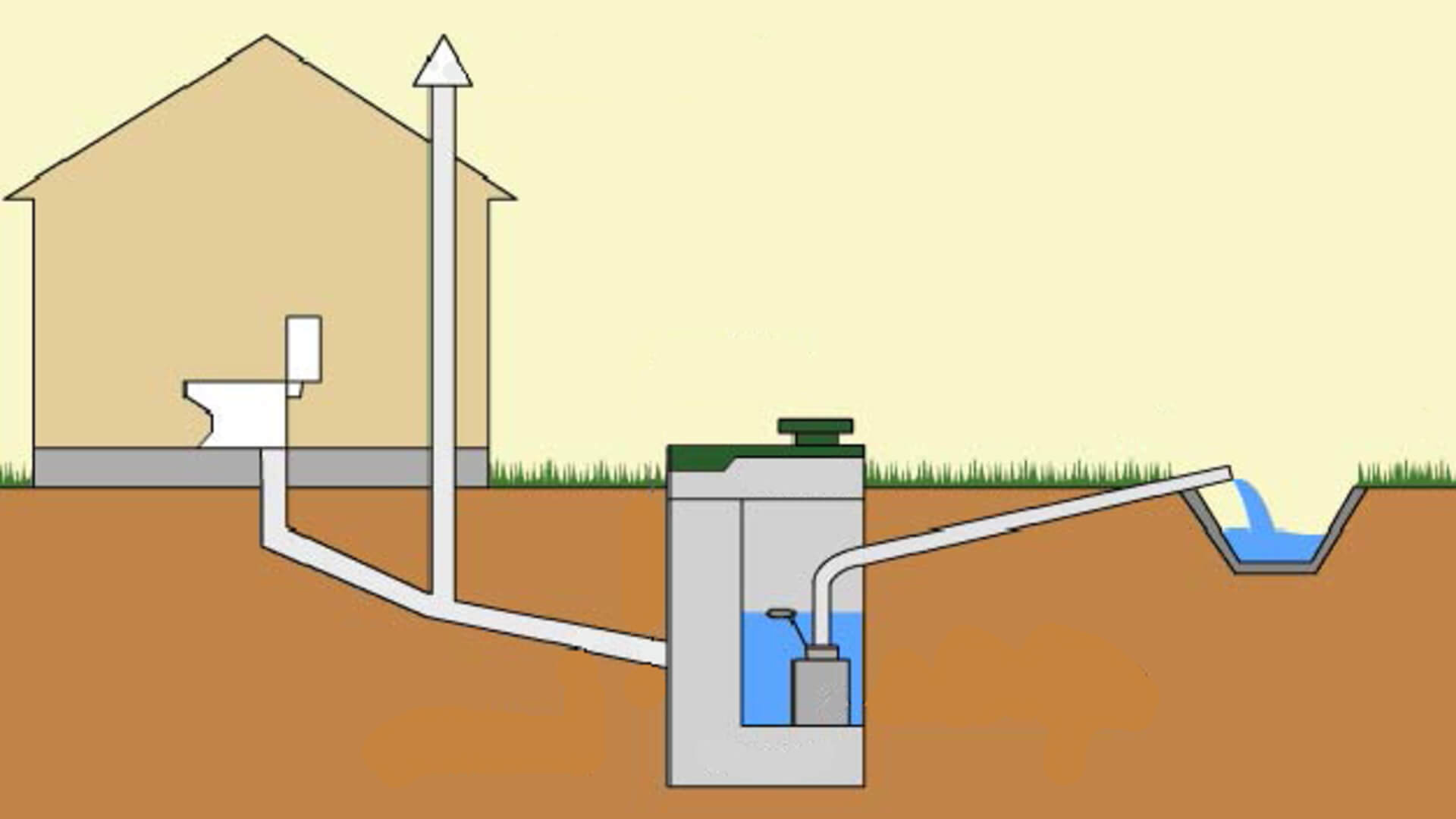
The so-called external sewerage circuit includes a system of pipelines that ensure the natural movement of waste from the point of collection (tray) towards the cesspool or septic tank. This method of organizing the collection of sewage is called drainage. In some cases, the transportation of waste through pipes is carried out under pressure (pressure) created using special pumping equipment that is part of the system.
Based on the foregoing, even at the design stage, it will be necessary to clearly determine how the waste will be delivered to the sump (natural flow or under pressure). The choice of the location of the sump (drainage well), as well as its depth, will depend on this circumstance.
 Slope of sewer pipes
It goes without saying that when using the first of these options, the level of the cesspool (septic tank) is chosen below the level of the pipeline route, which provides the required slope towards the prefabricated device. In the second option for the delivery of effluents to the sump, carried out by means of a pump, the level of sewage installation (including its individual components) is not critical.
The location of the pipe laying route in this case is practically unlimited, so that the latter can be selected based on the convenience of organizing earthworks. The only technological requirement for laying pipes is that their bending angle always exceeds 90 degrees. Fulfillment of this requirement significantly reduces the likelihood of blockages. When choosing the optimal location for the waste collector, the previously noted requirement must be met (no closer than 5–7 m from a residential building).
Mounting
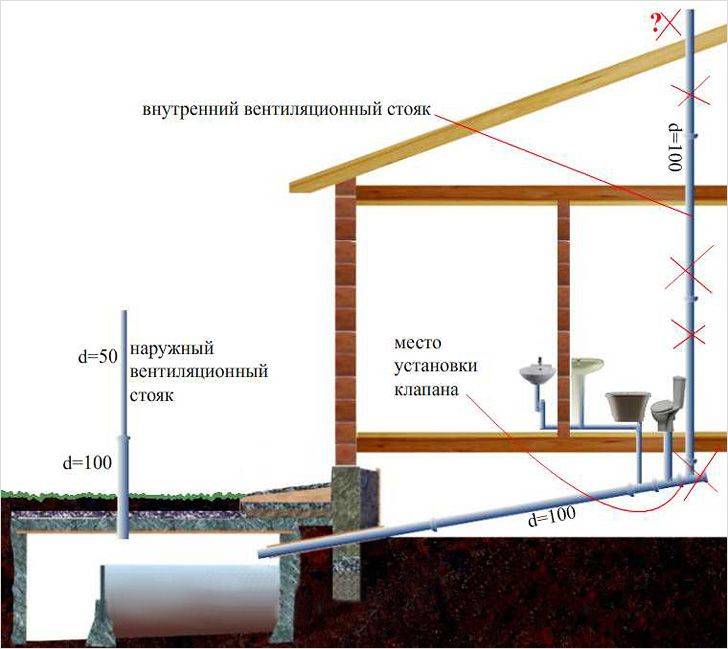
Before starting work, a plan is developed. The level of the ventilation riser must be above the outlets of consumers in the sewer. In addition, the location of the valve and the slope of the branches are calculated separately.
The principle of installation of the riser
Let's see how to do it yourself:
The ventilation pipe is connected to the sewer. A welded joint is installed at the coupling point
If a thread is used, then special attention should be paid to sealing communications;
Several consumers can be connected to the fan pipe at the same time. This is convenient if the house is small, and there are a lot of taps.
Then you need to seal each pipe separately. It should be noted that a large number of welds can violate the rigidity of the branch;
During installation, the riser is fixed to the wall with metal clamps. There are various options: plastic, rubber, but steel are the most reliable and tough;
It is necessary to sew up the fan pipe on the roof only using hydro and thermal insulation. Also, the height of the outlet on the roof must be higher than 50 cm.
This is very important to ensure there are no odors in the attic;
Experts say that the installation of various additional exhaust devices on the surface of the pipe can interfere with the operation of the entire ventilation system. But protective grilles still have to be mounted
This will protect the pipe from clogging;
During operation, the fan pipe can make an unpleasant noise - often an echo is heard throughout a private house. To avoid this, communication is wrapped with a soundproof film. It is made of a layer of foil and soft membrane fabric. When the sewer works, it absorbs noise. At the same time, this coating acts as a heat insulator.





Video: Features of installing a fan riser.
Periodically, the ventilation fan outlet will have to be cleaned. To do this, you can call specialists, or do all the work yourself. For cleaning, you will need a flexible rubber brush or a regular plumbing cable with a brush at the end. This procedure must be carried out every year.
How to bring the sewer to the septic tank
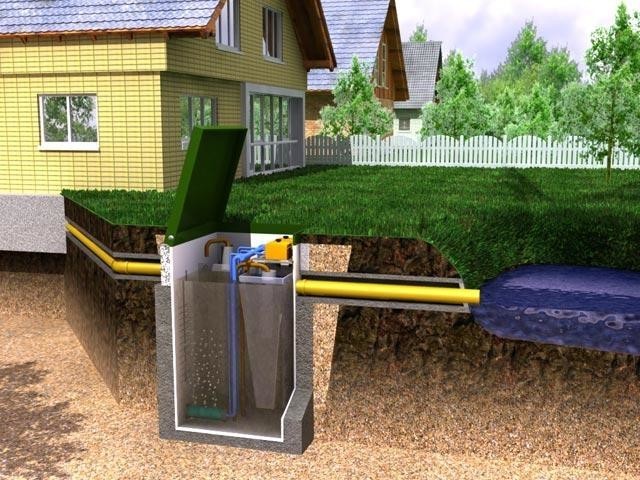
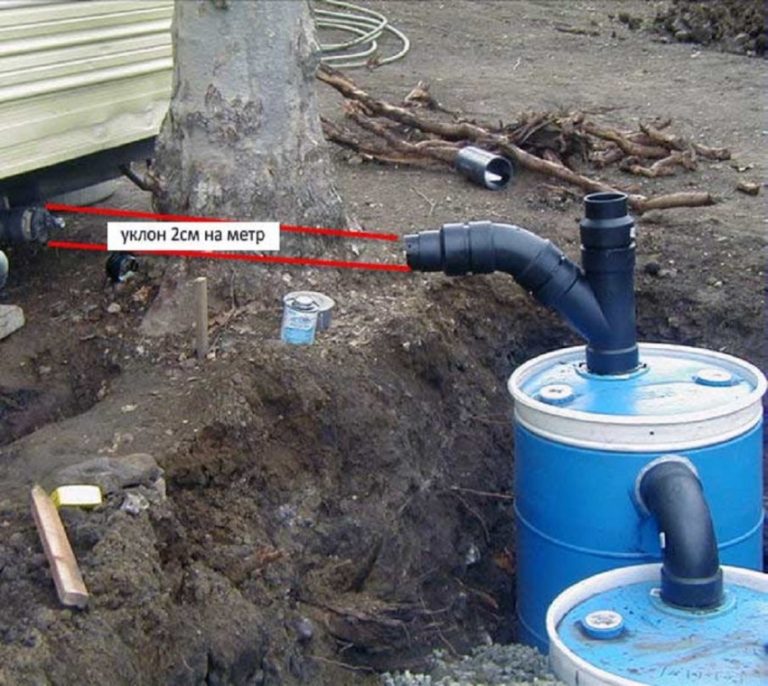
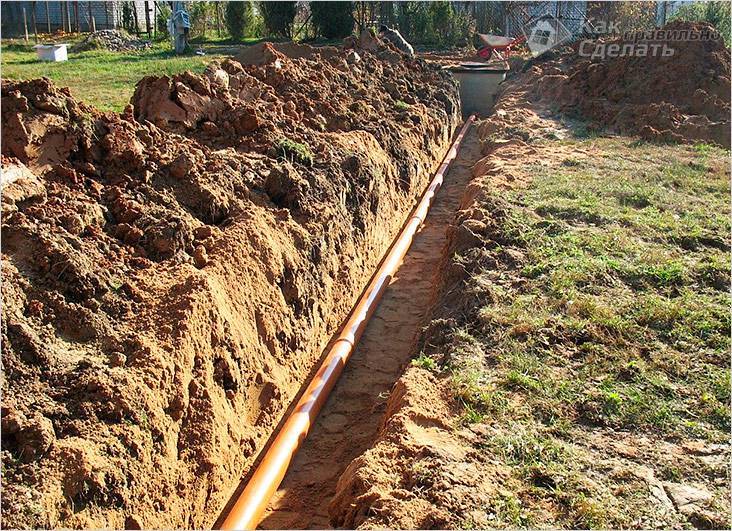
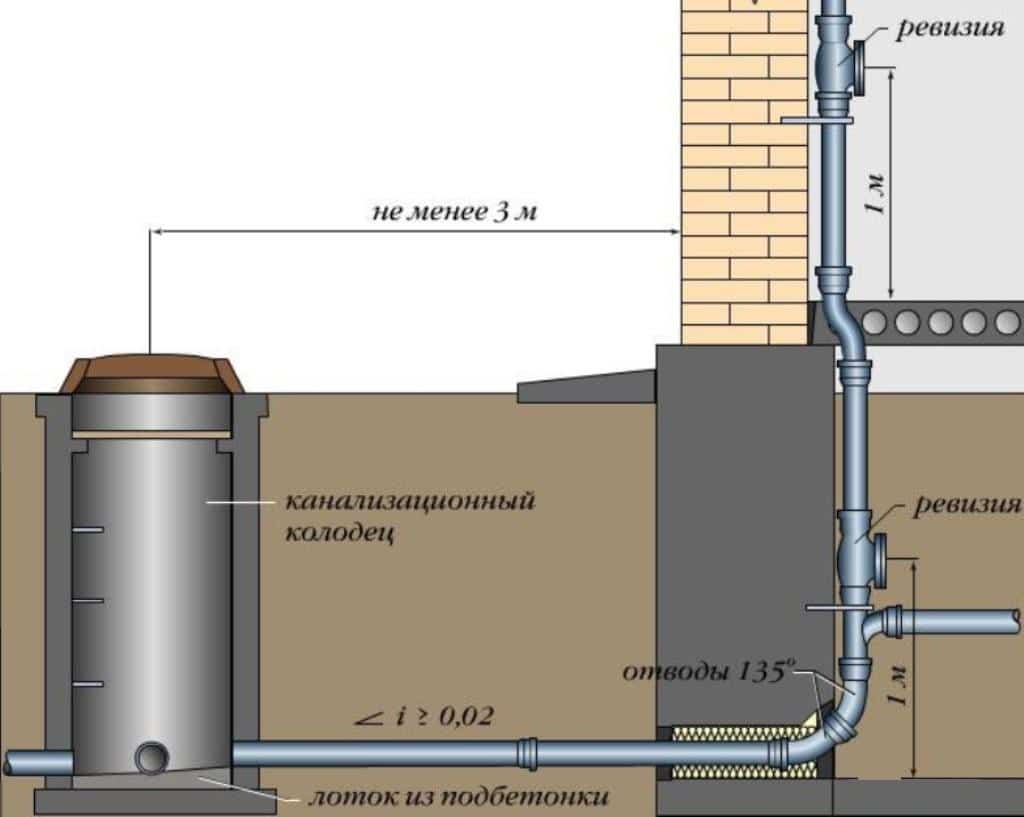
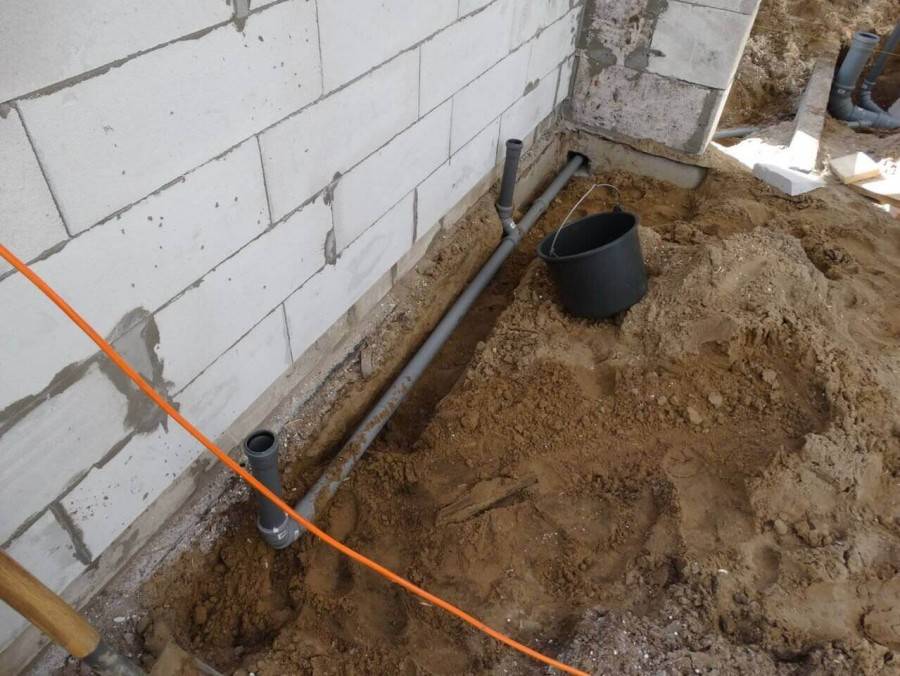
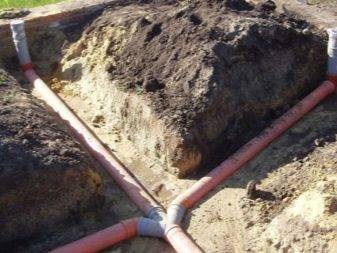
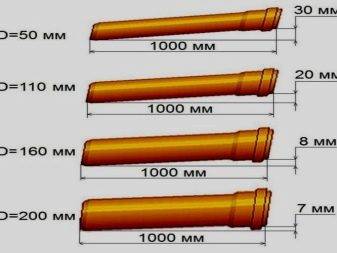
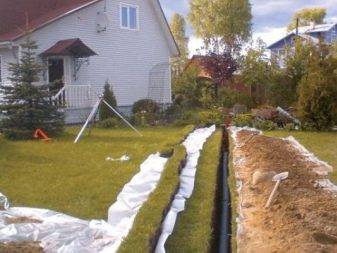
Judging by the standards, the sewer pipe to the septic tank will have to be at least 7-8 meters. So the trench will be long. It should go with a bias:
- pipe diameter 100-110 mm, slope 20 mm per linear meter;
- 50 mm in diameter - slope 30 mm/m.
Please note that it is undesirable to change the level of inclination in either direction. In the direction of increase can be a maximum of 5-6 mm
Why not more? With a large slope, the water will run off very quickly, and heavy inclusions will move much less. As a result, the water will leave, and the solid particles will remain in the pipe. You can imagine the consequences.
The second important condition is that the pipe should not freeze through. Solutions two
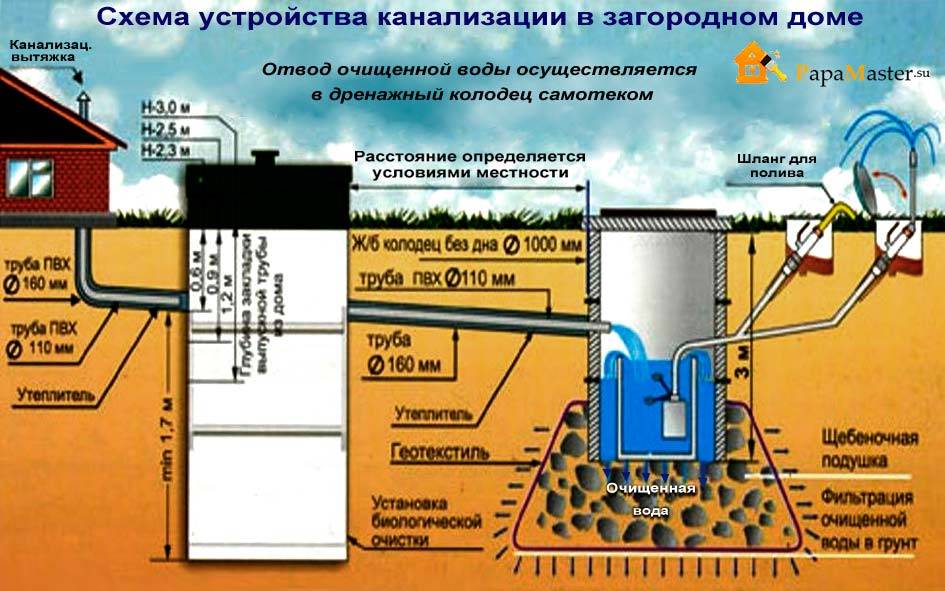
The first is to dig below the freezing depth, which, taking into account the slope, gives a solid depth. The second is to bury about 60-80 cm, and insulate from above.
How deep to dig the tuba
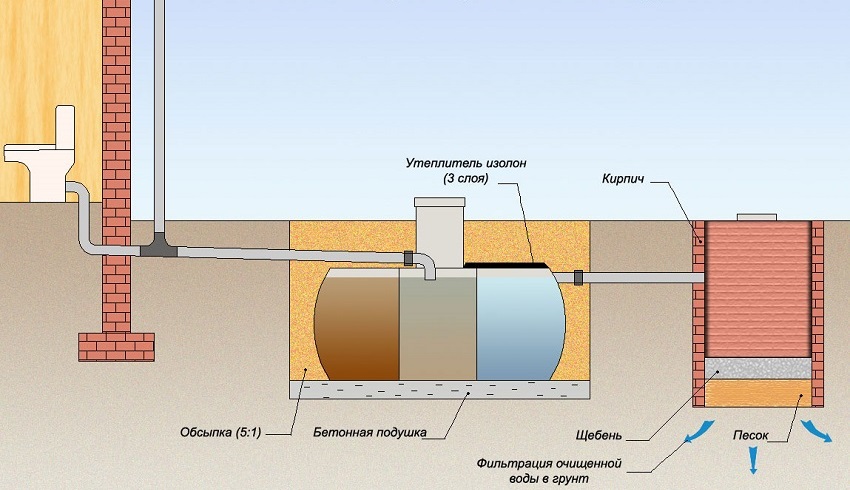
In reality, the depth to which you will bury the sewer pipe coming from the house depends on the location of the septic tank, or rather, its inlet. The septic tank itself must be arranged so that there is only a lid on the surface of the soil, and the entire “body”, including the neck, is in the ground.Having buried a septic tank (or having decided on its type and model), you will know where to bring the pipe, the required slope is also known. Based on these data, you can calculate at what depth you need to make an exit from the house.
This area of work also has its own nuances. So it is better to dig a trench immediately to the desired depth. If you have to add soil, it must be very well tamped - not just throw in the earth, walk with a rammer to a high density. This is necessary, because just the laid soil will settle, and the pipe will sag with it. In the place of subsidence, a traffic jam forms over time. Even if it manages to break through, periodically it will appear there again.

Warming
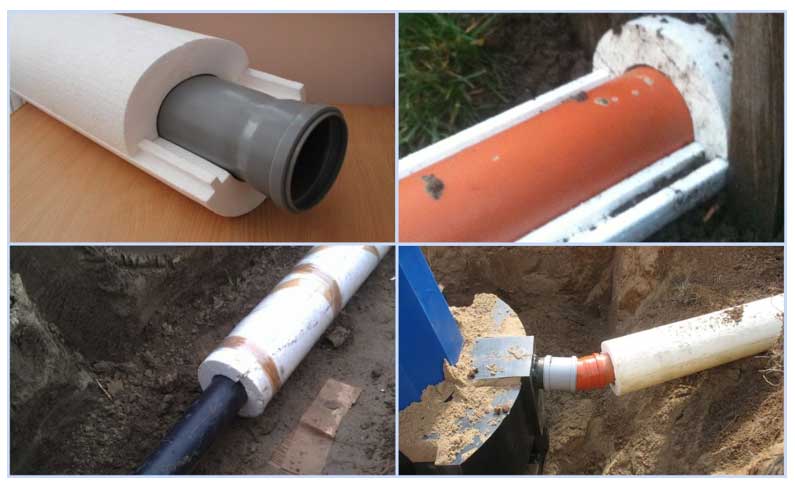
One more thing: the laid and hermetically connected pipe is covered with a layer of sand about 15 cm thick (so much should be above the pipe), the sand is shed, lightly rammed. An EPPS with a thickness of at least 5 cm is laid on the sand, on both sides of the pipe it must go to a distance of at least 30 cm. The second option for insulating the sewer pipe is the same EPPS, but in the form of a shell of a suitable size.
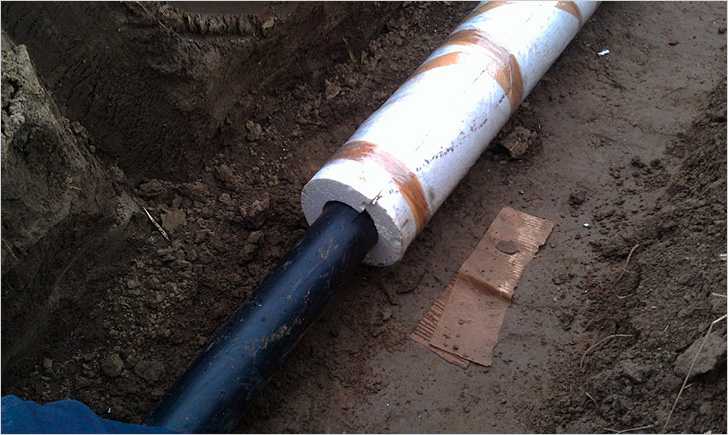
Other heaters are not recommended. Mineral wool, when wet, loses its properties - it simply stops working. Styrofoam collapses under pressure. If you build a full-fledged sewer trench with walls and a lid, then you can do it. But if the sewer pipe is laid in the ground, the foam may crumple. The second point is that mice like to gnaw on it (EPPS - they don’t like it).
Do-it-yourself sewerage arrangement in the bath: a step-by-step guide
As in the case of a residential building, the sewerage of a bath includes an internal and external system. Even if the building has a dry steam room, it will be necessary to drain the liquid from the shower.The water collection system depends on how the floors are installed. The sewerage scheme is entered into the bath project at the development stage and is laid at the initial stage of construction even before the floors are equipped.


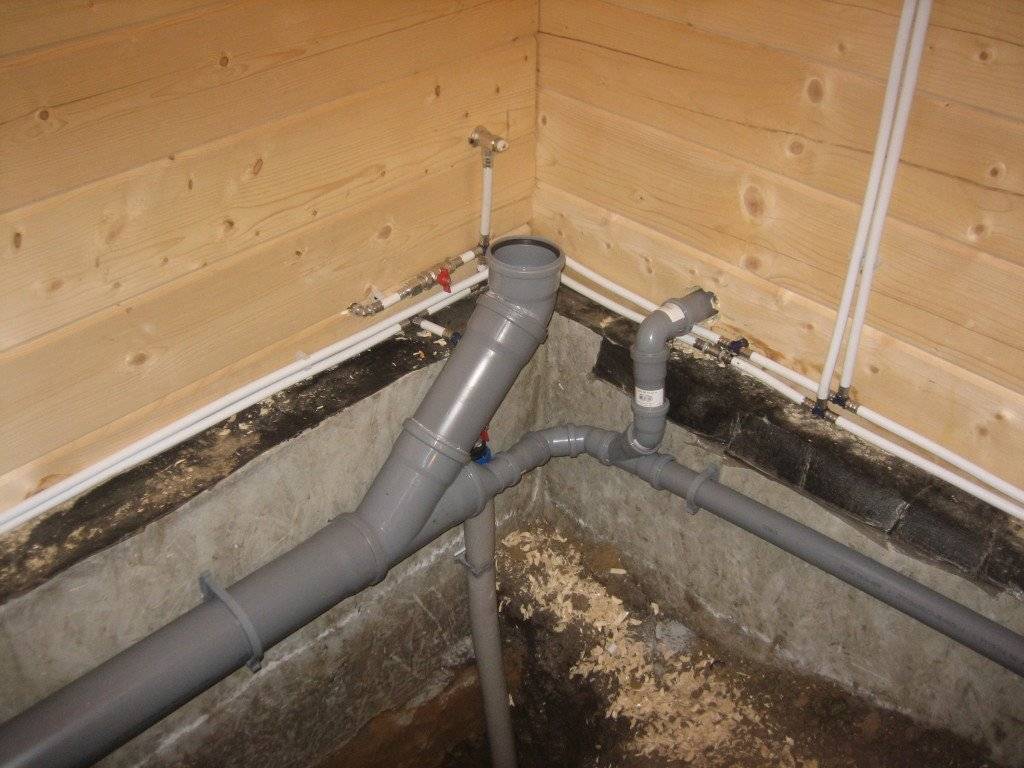


If it is planned to install wooden floors from boards, then the elements can be laid closely or with small gaps. If the coating is installed tightly, the floors are formed with a slope from one wall to another. Next, you should find the lowest point near the wall and leave a gap in this place, where the gutter will be subsequently installed (also with a slope). At the lowest point of its placement, a connection is made to the sewer outlet pipe.
If the wooden flooring will be made with slots, small gaps (5 mm) should be left between the boards. A concrete base is made under the floor with a slope towards the central part of the room. A gutter and a sewer pipe will be installed in this area. Instead of a concrete base, metal pallets can be laid on top of the insulated floor under a wooden deck. If the floors are self-leveling or tiled, a water intake ladder is installed at the lower point of the slope, which drains the drains into the pipe.
Using septic tanks for drains from the bath
A step-by-step guide to building a sewer in a bath with your own hands
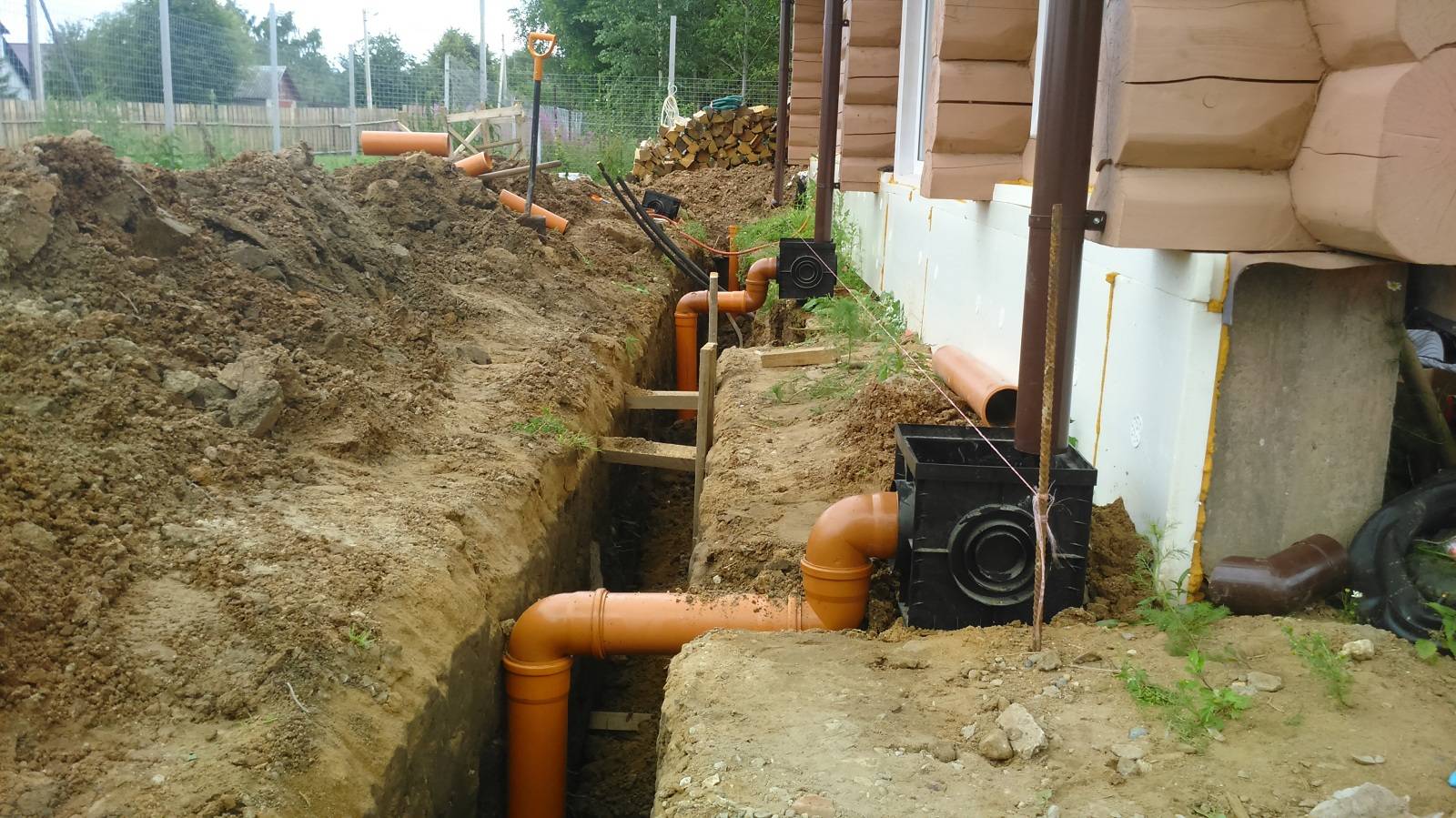
For the installation of sewer pipes, it is necessary to form ditches with a slope of 2 cm per 1 m. Their depth is 50-60 cm. A pillow should be made at the bottom of these trenches. To do this, a layer of sand 15 cm thick is poured and carefully compacted. In this case, do not forget about the slope.
Next, the installation of the sewer line is carried out. Polypropylene pipes with a diameter of 100 mm are laid in trenches. If necessary, a sewer riser is equipped.It must be fixed to the wall with clamps. Be sure to organize ventilation. When the system is ready, the flooring is installed using one of the previously discussed methods.
Upon completion of all work, the ladders and gratings provided for by the project are connected to the system at the designated locations. In the area where the water intake is connected to the outlet pipe, it is desirable to install a siphon. It will prevent the penetration of odors from the sewer back into the room. Most often, ladders are equipped with built-in water seals.
Sewer pipes in the bath
On sale you can find gutters made of asbestos cement, plastic or cast iron. It is not recommended to use products made of wood and steel, because. they quickly break down under the influence of moisture. The minimum allowable diameter of the gutter is 5 cm. If the project provides for the presence of a toilet bowl or other sanitary equipment, it is installed and connected. This completes the work on the organization of internal sewage. The external system is carried out in the manner described earlier, and may be a septic tank or a drainage well.
Sewerage construction in a private house: ventilation scheme in the bath
Air exchange in the bath can be organized in various ways. Each of them has its own characteristics and advantages. Having studied the specifics of each method, you can choose the best option for a bath.
The first method involves creating an opening designed to supply fresh air. It should be placed behind the stove-heater at a height of 0.5 m from the floor level. The exhaust air will be discharged through the opening on the opposite side. It must be placed at a height of 0.3 m from the floor.To increase the movement of air flow at the outlet, you need to install an exhaust fan. All openings are closed with gratings.
Sewerage scheme for a toilet in a bath with a septic tank and ventilation
The second method involves placing both holes in the same plane. In this case, the work will affect the wall opposite to the one where the furnace is located. The inlet duct is placed at a height of 0.3 m from the floor level, at a similar distance from the ceiling, an exhaust hole must be made and a fan installed in it. Channels are closed with gratings.
The third method is suitable for flooring where the boards are laid with gaps to drain liquid. The inlet is made at a height of 0.3 m from the floor on the wall behind the stove. In this case, installation of an outlet duct is not required, since the exhaust air will exit through the gaps between the boards.
Rules for calculating sewer networks
In order for the sewerage system in a private house to work for a long time and trouble-free, it is important to correctly calculate all the necessary parameters, namely:
Study the load on internal networks: The average is about 200 liters per person. So for a septic tank, these data are multiplied by three. Such a volume of a septic tank, at the rate of 600 liters for each family member, should be taken into account when choosing equipment.


- storage tank - the required volume is determined, as in the calculation of internal networks, i.e. average daily values;
- septic tank - the average daily value must be multiplied by three, which is due to the three-day settling of wastewater in a similar design;
- biological treatment plants - the performance of a particular model is reflected in its technical characteristics.
And the last point. Calculation of external networks. The diameter of the external sewage pipes must have a capacity that can ensure the passage of wastewater. As a rule, pipes with a diameter of 110–200 mm are used for external networks. It is necessary to take into account the depth of soil freezing at the installation site, and if it is impossible to lay pipes below this mark, then measures should be taken to heat such areas (heating electric cable, heaters and other measures).
The right choice of pipes for sewerage is the key to successful operation for many years.
When choosing materials used for installing sewers in a private house, you need to pay attention to the following requirements regarding pipes used for these purposes:
- the strength of the products should ensure long-term operation without carrying out preventive maintenance;
- resistance to various types of external influences (mechanical, chemical, etc.) must be high in order to ensure safe use for the entire period of operation;
- simplicity and ease of installation work;
- smooth inner surface.
These requirements are met by pipes made of cast iron and various types of durable plastic.
Materials from which sewer pipes are made
Cast iron is the material that until recently was indispensable in the manufacture of sewer pipes. Its main advantages are strength and long service life, and among the disadvantages can be noted significant weight, uneven inner surface and the difficulty of performing installation work, especially on your own.Polyvinyl chloride (PVC) is a modern durable plastic that can withstand heavy loads, in addition, this material does not allow sewage to seep into the ground.
Other benefits include:
- strength and durability;
- resistance to chemically active substances (reagents) and ultraviolet rays;
- ease of installation;
- affordable cost.
Of the shortcomings, it should be noted:
- when the temperature rises above 70˚С, it melts;
- when the temperature drops below 0˚С, it becomes brittle;
- when burned, it releases gas harmful to human health.
Polypropylene (PP) is the best material used for the manufacture of pipes for various purposes. It has all the advantages inherent in PVC analogues, and it does not have the disadvantages inherent in them. In addition, when installing sewers, pipes made of steel and ceramics, as well as asbestos cement, can be used. The main range of pipes required for the installation of an autonomous sewage system for a country house, made of different materials, is shown in the following table.
| Material | Dimensions, mm (diameter×wall thickness×length) | Sewer type | Cost, rubles |
| PVC | 160×3,6×500 | outdoor | 359 |
| 160×4,0×3000 | 1 000 | ||
| 110×3,2×3000 | 550 | ||
| PP | 160×3,6×500 | 290 | |
| 160/139×6000 | 2 300 | ||
| PVC | 32×1,8×3000 | Internal | 77 |
| 50×1,8×3000 | 125 | ||
| 110×2,2×3000 | 385 |
The table does not show the entire range of pipes manufactured by the industry, but the order of prices for these products is clear. For complete information, please contact the trading organizations specializing in the sale of sanitary equipment.
Planning the sewer system and choosing a location for a septic tank
To choose a place for a waste receiver, you need to consider a number of conditions. The closer it is to the house, the less likely it is to clog pipes and it is easier to clean them. Fewer turns, just as good.On the other hand, if the septic tank provides for drainage of wastewater, then the distance from the house should be at least 2 - 3 meters in order to prevent flooding and softening of the soil under the foundation.
Also, the septic tank should be placed as far as possible from the source of water: a well or a well. It would be nice to provide an access to the pit of a sewage truck for pumping out accumulated sediments and effluents. Sooner or later, the septic tank will silt up and fill up. However, modern installations are capable of pumping out pits even at a distance of up to 20 meters.
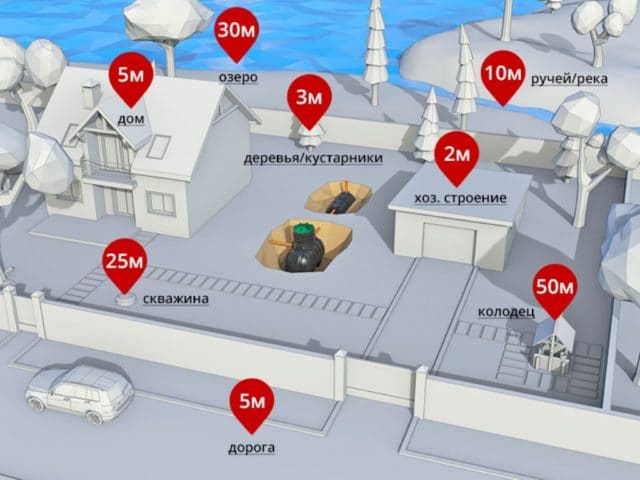
Tip: When planning the rooms in the house, take into account the places for laying sewer pipes and the slope. The shorter the pipe arm, the smaller the drop and the easier it is to mask such a pipe. Therefore, it is desirable to have a kitchen, a shower room, a bathroom next to and from the side of the septic tank. And the septic tank itself is in front of the house, or on the side of the house, but from the side of the street.



Materials for use in a private house
PVC pipes are used for the internal sewerage network. A wide range and abundant availability of manufacturers of these products allow you to make the right choice of goods necessary for the accepted project.
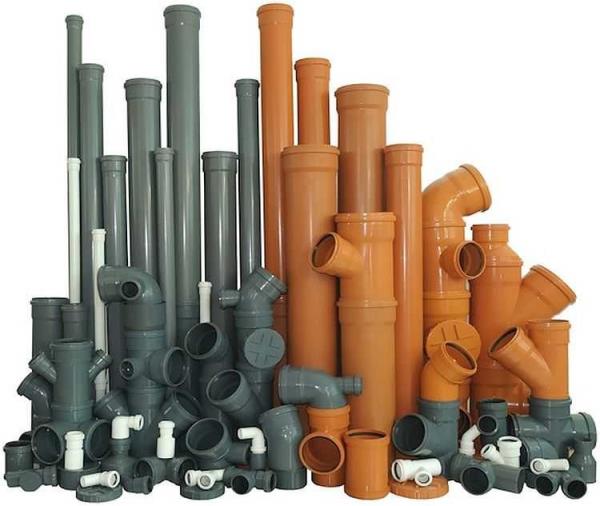
In addition to using the main pipe, a mass of connecting and guiding auxiliary elements will be required.
The choice of a pipe to a greater extent depends on the area of its application. That is, when used as a drain from the sink, a pipe with a diameter of 50 mm is enough, which will easily cope with the task and will not require additional cleaning. To drain from the toilet and as the main line for draining, a pipe with a diameter of 110 mm is used. This is due to the fact that the volume of water passing through will be much larger than when removed from a conventional sink.
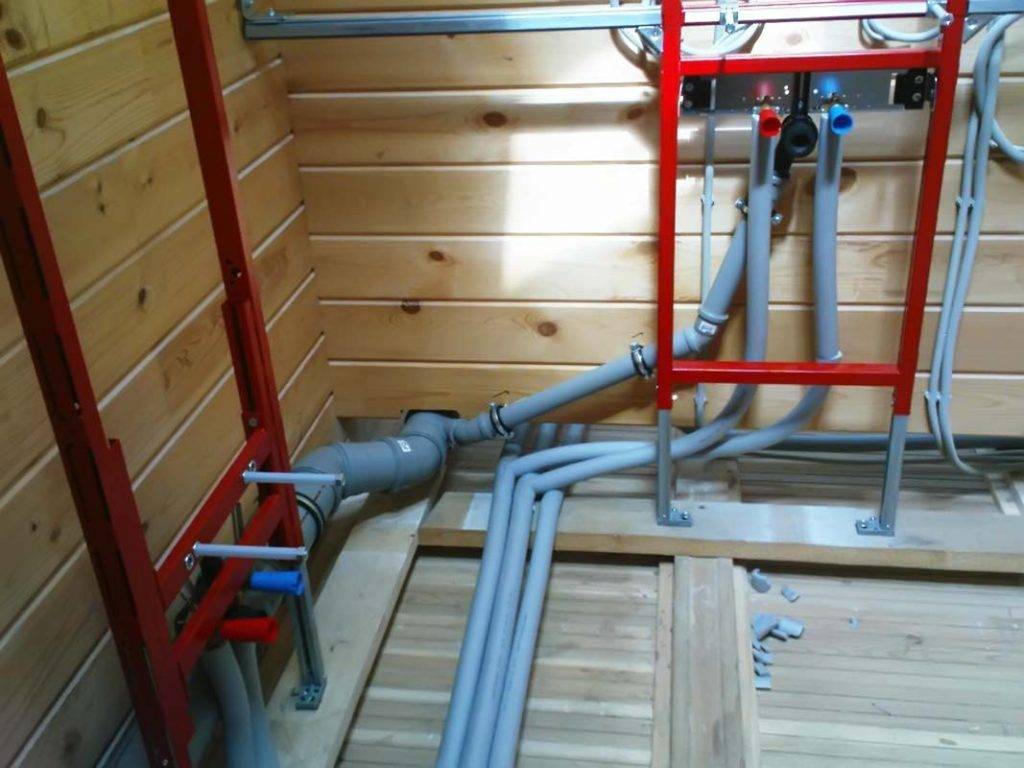
The connection of different diameters is carried out with the help of adapters, which can be easily installed if necessary. The main system also uses angles and combination adapters with different leads.
All materials can also be divided according to the place of use. For internal sewage, gray plastic is used, which will not be subjected to temperature effects, as well as physical stress. For external sewerage, a pipe and components made of denser brown plastic are used. They have stronger walls, which allows them to be dug into the ground.
To use outdoor sewage, it is necessary to use pipe insulation that will prevent freezing even in the coldest months.
Auxiliary elements include fasteners and consumables. Metal clamps are used to securely fasten the pipe and maintain the required angle of inclination.
Important! At the stage of calculating the project and the necessary materials, you need to remember the need for ventilation. The same plastic pipe is used as the material
Depth
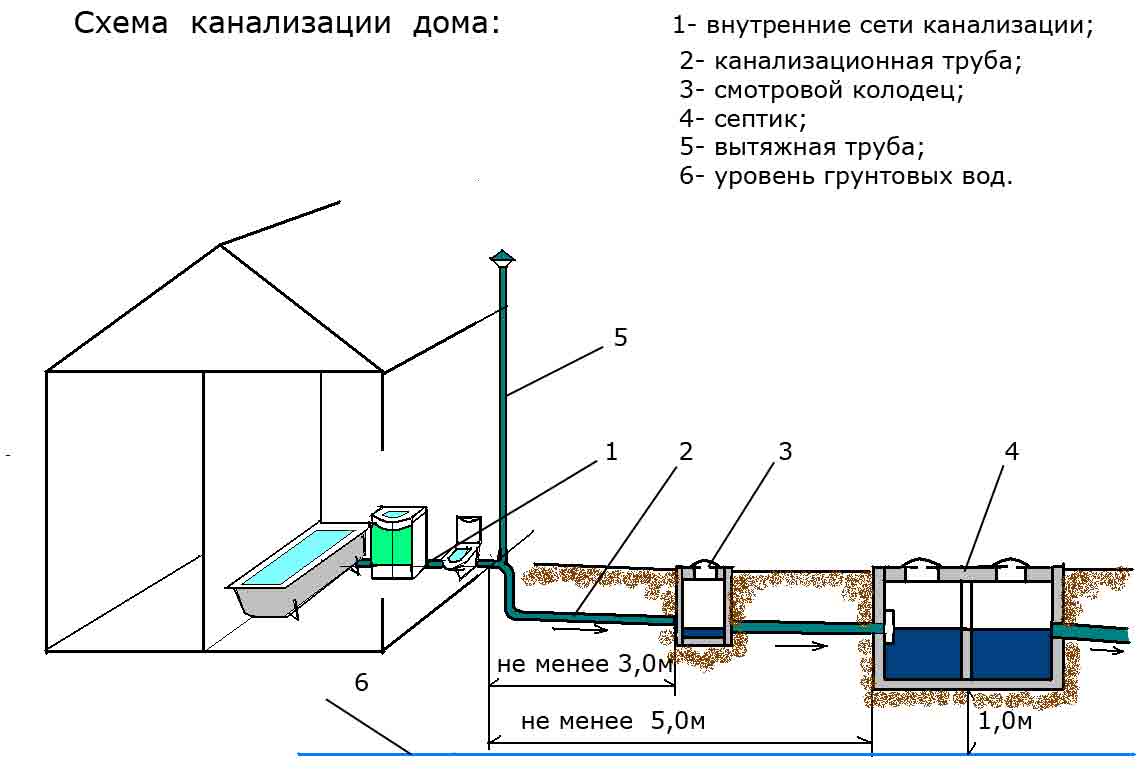
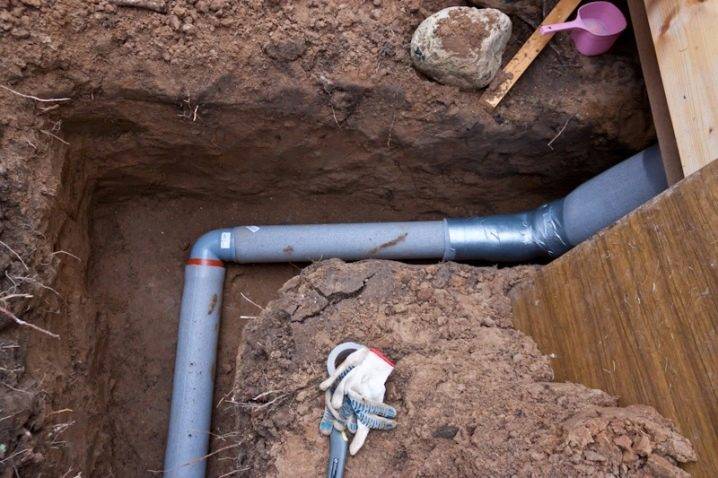
The process of installing sewerage in a country house is simple, but it is best to trust it to specialists. If the work is carried out independently by the owners, then it is necessary to carefully consider the arrangement of the system and select a high-quality basis for collecting wastewater: most often a septic tank is used for this. In addition, the depth of the well and trench should be correctly calculated, it should be minimal.When installing a drain pit near the house, it is recommended to keep a distance of 5 meters, and the septic tank must be deepened into the ground by 1.5 m. Thanks to these parameters, it is possible to protect the septic tank from the negative effects of groundwater and avoid damage.
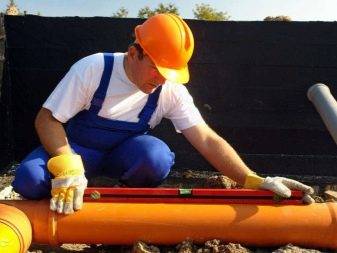
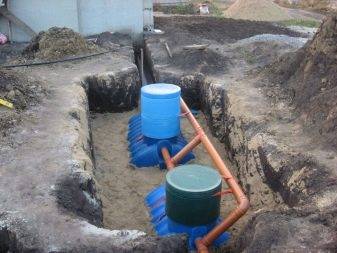
To know at what depth to lay communications, it is necessary to determine the level of the location of the building. When laying the pipeline from the building to the septic tank, it is desirable to make the system absolutely straight, avoiding bends and turns. Pipes are best laid at a depth that is slightly above the freezing point of the soil. At the same time, one should not forget that under the sites or roads where the pipeline is located, they may freeze in winter, as the snow will be cleared. In such situations, the depth is increased.
Norms according to SNiP
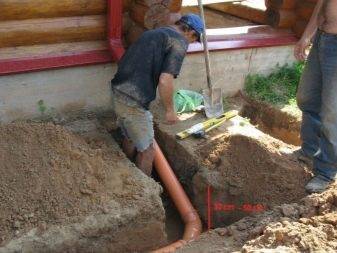
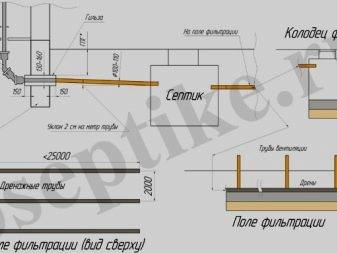
Installation of external sewerage is carried out in accordance with the norms of SNiP, which stipulate the maximum and minimum allowable depth indicators, but they may vary depending on the characteristics of the system and pipe laying methods. For structural elements that are used to drain dirty drains, a recess of 30 cm from the surface of the earth is allowed, their cross section is chosen no more than 50 cm. Pipes with a diameter of more than 500 mm must be laid to a depth of at least 50 cm.
In addition, it is worth remembering that the sewage waste at the outlet, even in winter, has a high temperature, which on average can reach + 18C. Therefore, they never freeze when passing to the collector. Using this property, it is possible to reduce the depth of the pipeline, but this is most often done when the distance between the outlet of the system from the building and the collector is insignificant.It is also worth noting that the minimum laying of sewerage according to SNiP standards also depends on the type of loads that affect the soil surface in the areas of the system arrangement. If they are high, then the pipes must be closed.
Factors to choose
The choice of trench depth is important for many reasons. For example, if pipes are laid at the ground freezing level, then liquid waste can cool down, as a result of which a congestion will appear, and the sewage system will not be used until the weather warms up. Clogging can also be avoided by setting the minimum number of connections. In those cases when it is impossible to do without turns during the installation of the pipeline, then a well is installed at the junction points. Access to it should be free.

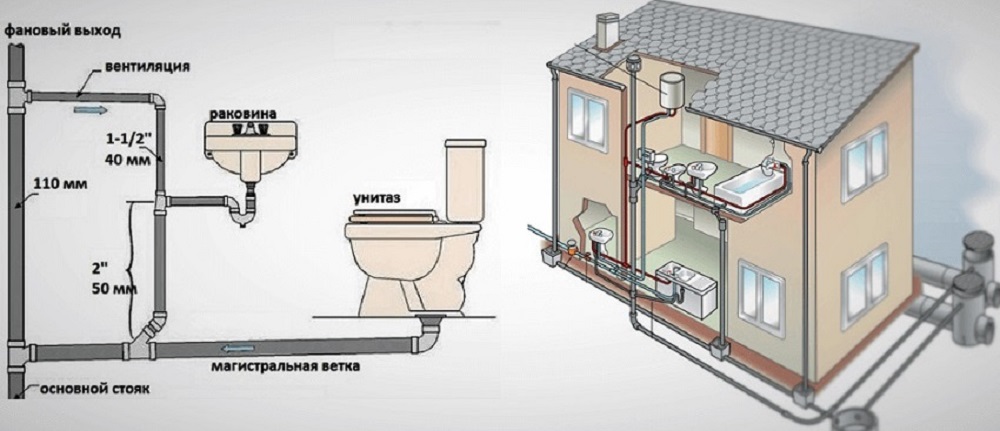



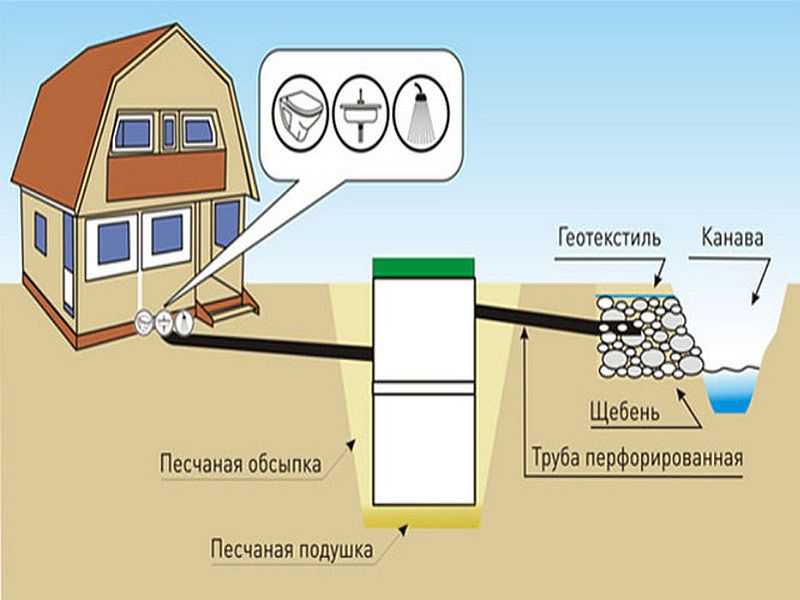

To calculate the optimal laying depth of external communications, the diameter of the pipes, the material from which they are made, and the angle of inclination of 0.03 m for each linear meter of the system must be taken into account. A huge role is also played by the exit point of the sewer from the house and the location of the cesspool.
Reduction Options
In some cases, it is possible to reduce the depth of the outer pipes. Most often, this is available if pumping stations are connected to the system, they provide quick cleaning of the channels and thereby clean the pipes, whether they are cast iron or steel, from freezing. Such systems are considered not gravity, but semi-pressure. Deepening is also reduced when the pipes used are made of durable material and have thick walls. It is also possible to lower the depth level by insulating the route, for this a piece of land is covered with a special bedding, and decorative mounds or flower beds are placed on top.
Primary requirements
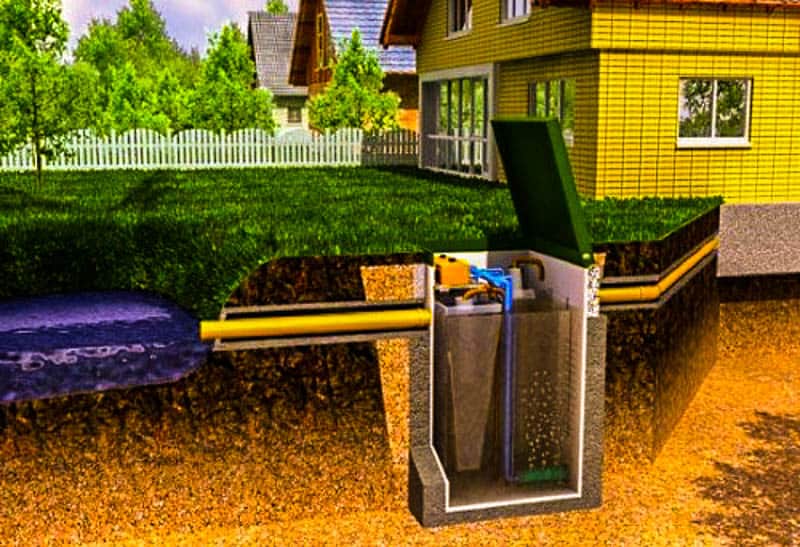
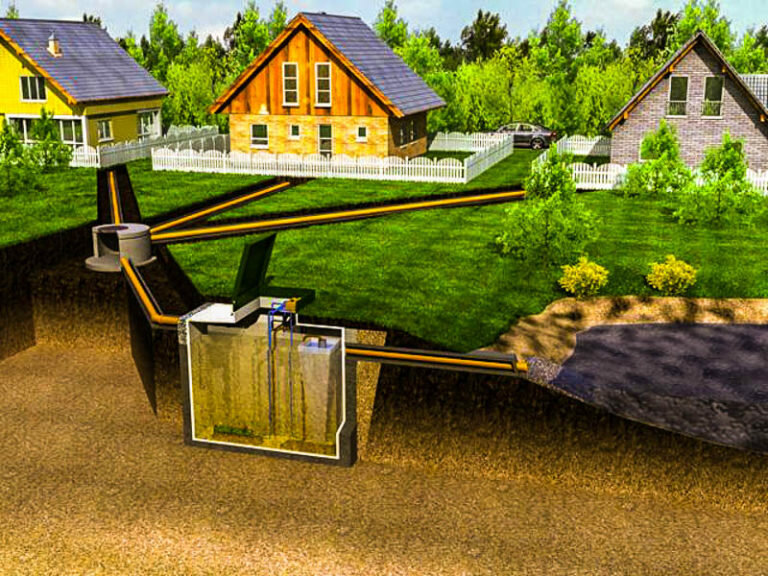
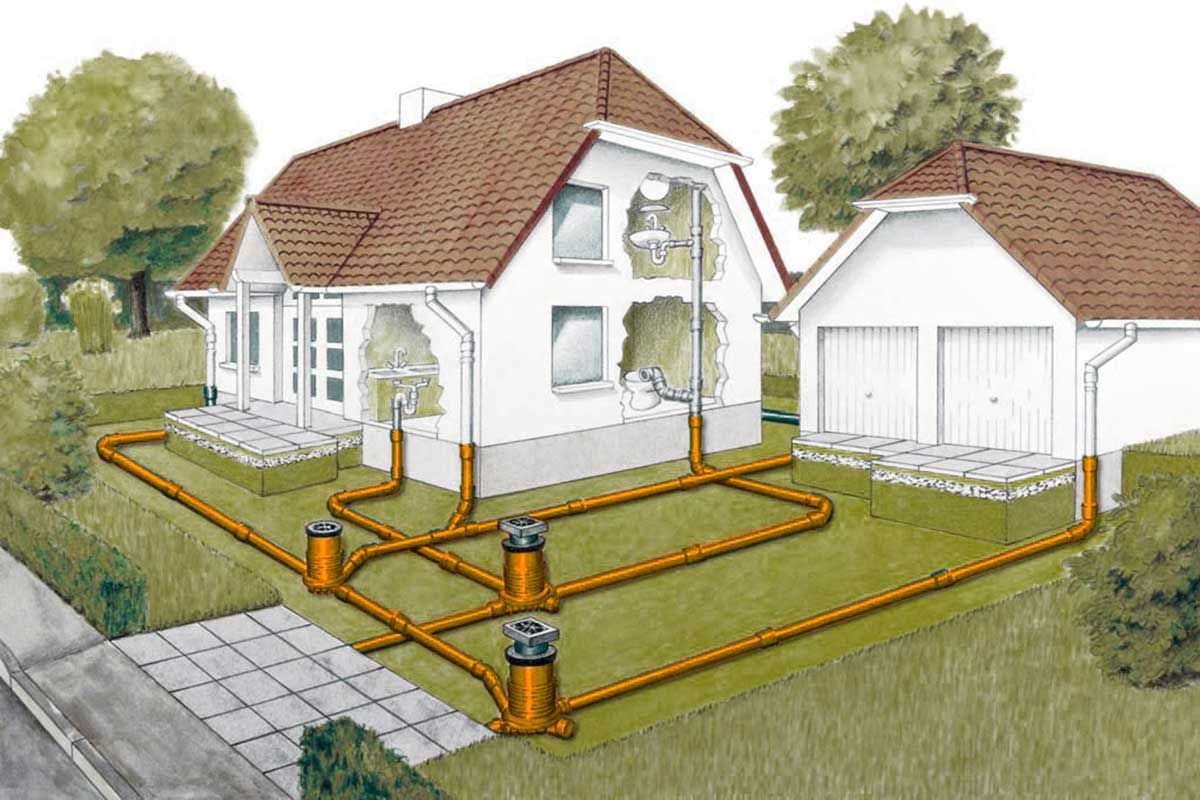
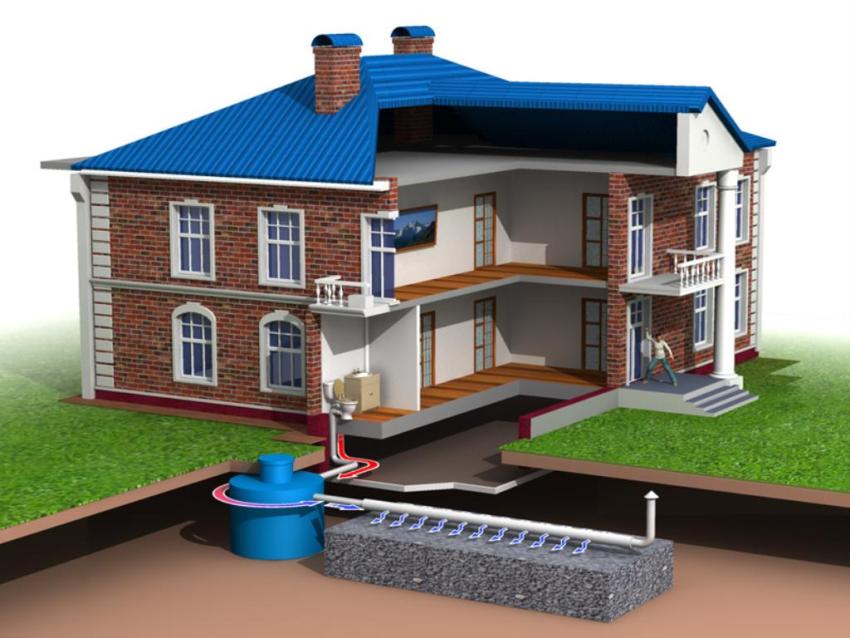
As a rule, it has an internal (or home) and an external system. The inside includes a riser, a fan pipe and piping to the kitchen, toilet, bathroom or shower, etc. The external system includes a septic tank (accumulative or with a filtration field) or a deep cleaning station, a pipeline from the house to the septic tank. If there is a centralized system, the home one is connected to it. But more often there is no such system, so they make it autonomous using a sewer water pump.
If you do not have experience in arranging sewers, it is better to entrust the work to professionals.
There are 3 types of sewerage in a private house:
- Cesspool;
- filter well;
- Septic.
The most budget option is a cesspool, which you can organize with your own hands. Based on one person, a pit is made with a volume of 0.6-0.7 m3. The walls of the pit must be sealed by covering with a layer of bitumen, filling the bottom with concrete and overlaying with bricks to protect groundwater from feces. You can close the pit with a wooden lid and cover it with earth by 30-40 cm. The depth of the pipeline must be at least 1 m to protect the entire system or its parts from freezing.
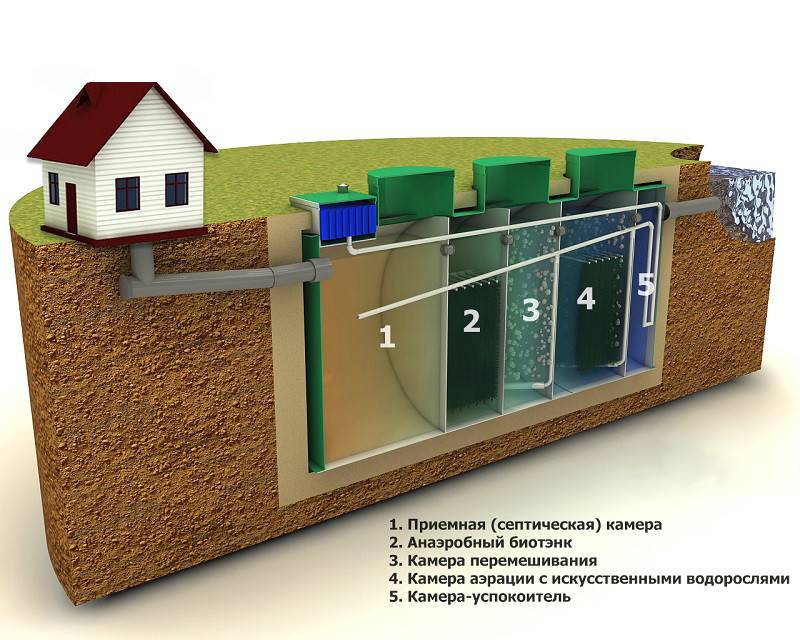
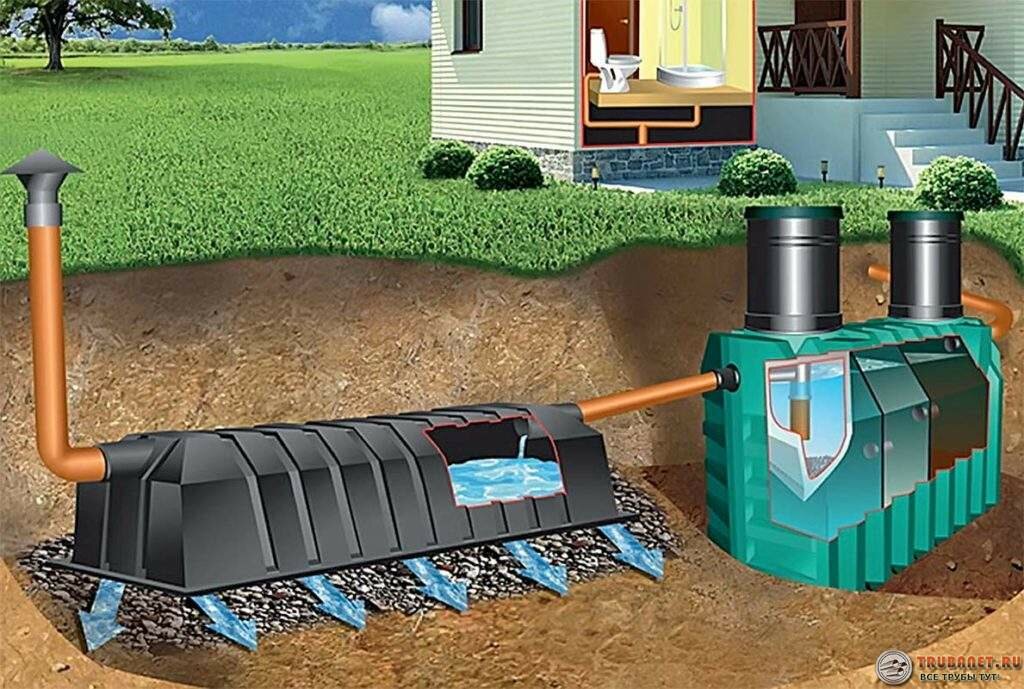
A filtering well can be installed in a house with a low water consumption, which, with this type of sewerage, should not exceed 1 m3 per day. The dimensions of such a well are 8-10 m3, the depth is about 2.5 m, the diameter is about 2 m in the case of a round shape, if it is square, then the side is 2 m. The well also needs to be sealed. Walls are brick or concrete. The plastered walls are covered with bitumen. Gravel, crushed stone or something similar is laid at the bottom to create a filter. The location of the well should be away from the water intake, and the bottom should be about 1 m above groundwater.The most common sewer is a septic tank. It clarifies sewer water, after which it is possible to drain into the ground. The septic tank is convenient because it has a long service life, in addition, the device does not require frequent cleaning.
The fundamental difference between a septic tank and other types of sewer systems lies in its advantages:
- Safe for the environment;
- Wastewater treatment up to 97%;
- Does not require the services of sewage trucks;
- Compact;
- Can be installed in any soil;
- Not afraid of low temperatures;
- Quick installation;
- Long-term operation;
- Corrosion resistant;
- Silent;
- Does not spread odors.
The design of a septic tank depends on the amount of daily water consumption. For a one-story house with a flow rate of up to 1 m3, one section of a septic tank is enough, for houses with more than one floor - 2 or more sections. The volume of all sections should be 3 times the daily water consumption in the house. The drainage system must not be damaged due to erosion of the soil by water.