
- Installation of a brick structure
- Basic rules for the construction of a fireplace
- Chimney installation features
- Preparing to install a fireplace stove
- Factory "consumables"
- fireplace stove
- Fuel options
- Instructions for laying a fireplace with a cast-iron firebox and a metal chimney
- Installing a fireplace in a wooden house
- Self-installation of a Russian stove
- Varieties and types of fireplaces
- Choosing a place for installing a furnace heating system
- How to choose a place for the oven
- Calculation of the main parameters
- Calculation of bricks
- Calculation of the foundation and mortar for masonry
- What to look out for
- Types of fireplaces
Installation of a brick structure
If a choice was made in favor of a classic stove, then it should be remembered that the construction must not only comply with safety requirements, but also with some technical requirements. Even before the development of informatization of society, it was believed that such work was inaccessible to people who did not have special training. Therefore, the profession of a stove-maker was considered one of the rarest and most sought after.
Today it is easy to find step-by-step instructions that will help you get a functional device with your own hands. However, compared to the installation of finished devices, the construction of a brick stove will take longer. We list only the main stages, since detailed instructions are available in sections called "finished projects".
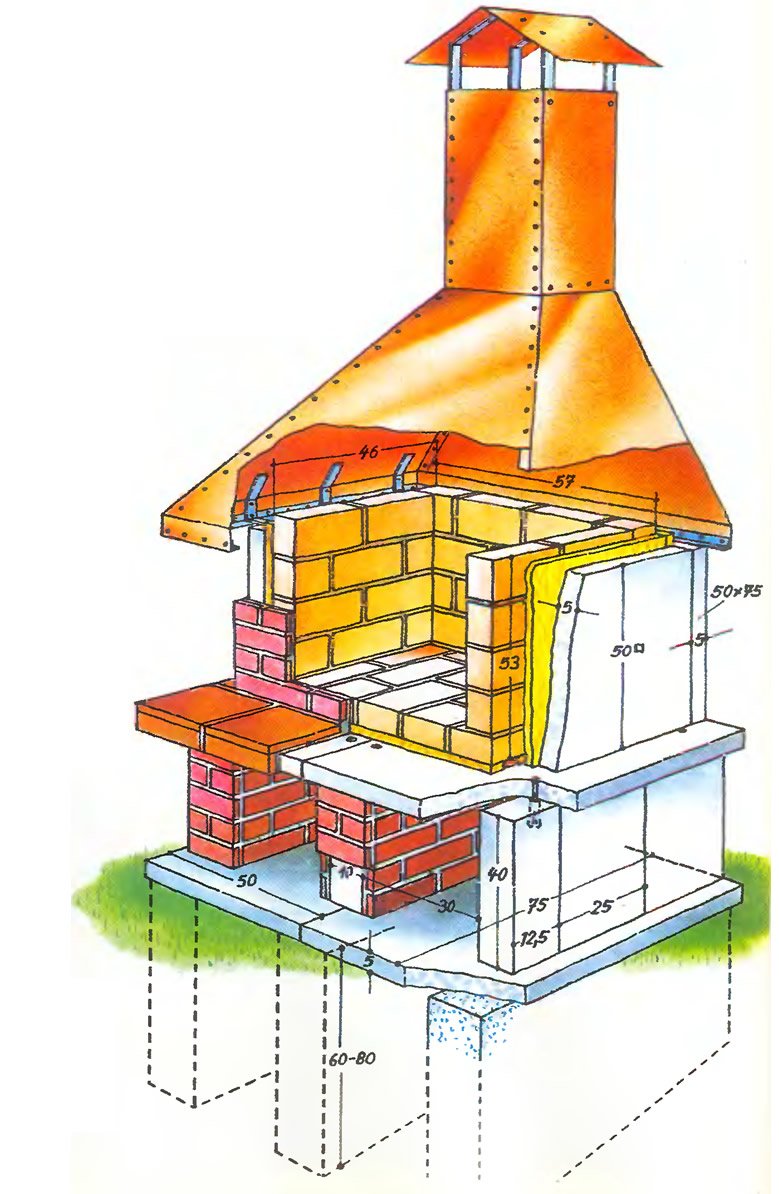
Work begins with determining the dimensions of the structure.The area of the foundation will depend on them. After pouring the base, using a special ordering scheme, the furnace body with its main components is laid out. To appreciate the work of professionals who shared all the information, you need to know that, depending on the area of \u200b\u200bthe room, each furnace has its own dimensions. The calculation of such parameters as the height, width and depth of the furnace, the dimensions of the body, the height of the chimney, the area of the smoky channel is carried out.
Today, few of the novice masters are engaged in complex calculations, since all the data is presented in a ready-made tabular form. Laying out each row, we get a formed ash pan, a firebox, a smoke tooth and a smoke box. This is just a simple fireplace diagram, but the stove has a chimney channel system. In these channels, hot air gives the maximum possible share of energy to the body of the stove. It is almost impossible to complete the construction of this part without a scheme.
Basic rules for the construction of a fireplace
In order for the fireplace to serve for a long time and please with its warmth, it is necessary to strictly follow the basic rules during its construction:
- A brick fireplace is built on a separate foundation.
- For laying the firebox, it is necessary to use only fireclay (heat-resistant) bricks, which should not be tied with the main one.
- In the places where the door and ash pan are installed, it is necessary to lay an asbestos cord and leave a gap for the expansion of the metal.
- The inside of the combustion chamber should not be plastered.
- The rear wall of the fuel chamber should be slightly inclined.
Do not forget about fire safety, because any design that runs on solid fuel presents an additional risk.
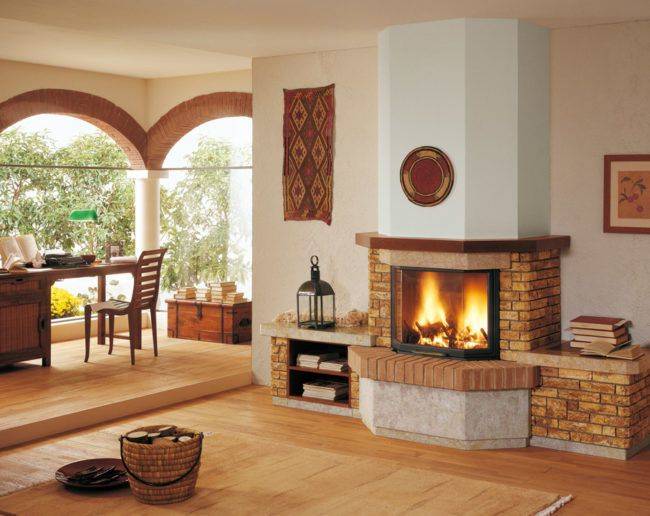
Fireplace in the house
The main point of fire safety in arranging a fireplace in a country house or in a country house is the installation of cuttings in the path of smoke.
If the wall is adjacent to the fireplace, then heat-resistant material (basalt fiber, asbestos, felt, etc.) must be laid between it and the heating unit. The thickness of such an overlap should be at least 20-25 mm.
If the fireplace is installed on a wooden floor, then a metal sheet must be laid around the perimeter or covered with ceramic tiles with an indent of 30-35 mm on each side.
Within a radius of 150 mm from the chimney, where it passes through the ceiling, it is necessary to organize reliable thermal insulation with a double layer of clay-impregnated felt or asbestos fiber.
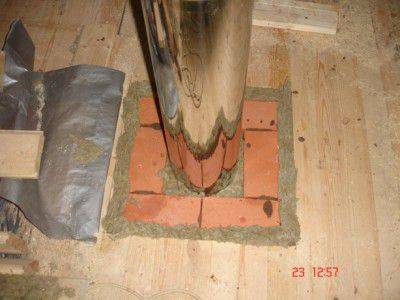
Felt layer between pipe and roof
The chimney must work autonomously with only one fireplace.
There are also certain fire safety rules for the operation of the fireplace:
- Do not bring the fireplace to the maximum temperature.
- Carry out a systematic cleaning of the fireplace from ash and soot.
- The safe distance between the fireplace and nearby flammable objects must be at least 70 cm.
- Use only suitable fuel for your outdoor fireplace.
Chimney installation features
The inner surface of the chimney is a straight channel, but its outer part has design features.
Design features keep you warm
At the intersection of the floor beam, the chimney has an extension. This design element is important because it reduces the temperature of the outlet streams. As a result, there is no need to make additional thermal insulation in this place.
At the level of the intersection of the roof, the chimney has an extension.This feature protects the brickwork from the harmful effects of precipitation.
The smoke channel also has protection in the form of a metal cap. It is recommended to equip the chimney with a spark arrester.
Preparing to install a fireplace stove
Installing a fireplace stove in a wooden house increases the chance of a fire. To ensure the safety of your home and life, you need to know and use the rules for installing a heating device.


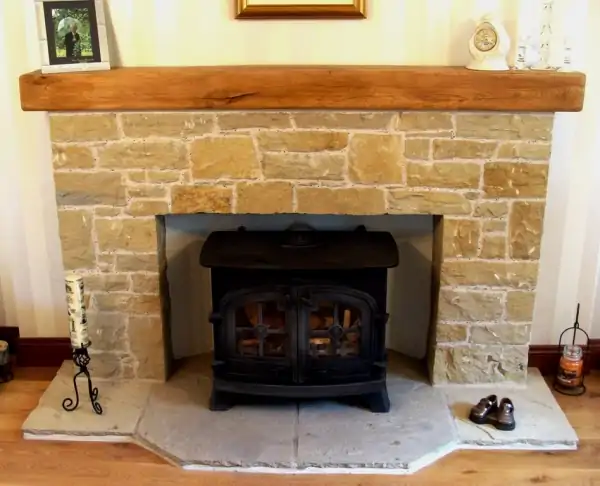
Photo 1. An example of the correct installation of the stove: the risk of accidental ignition of walls, floors or furniture is reduced to zero.
Before installing the stove, it is necessary to protect wooden structures from infrared heating with a fireproof layer:
- For the floor, a fire-retardant sheet with ceramic tiles glued to it is used.
- Walls are fixed to metal drywall profiles as guides. Foiled mineral wool is laid, and a non-combustible sheet of dry plaster is fixed on top. Magnesium glass sheet, minerite or other fibrous-filled mineral sheet will do. They must be sufficiently rigid and heat resistant.
- The chimney must be mostly indoors. In this case, it will ensure the safety of heat and stability of traction.
When installing a fireplace, the main thing is to ensure complete removal of gases so that smoke does not pass into the room and takes care of the safety of things from fire.
Factory "consumables"
To make a fireplace stove with your own hands, you need to purchase a grate and cast-iron doors for the ash pan and firebox. If the fireplace insert is closed, take a door with refractory glass. Most often it is mounted using a stainless steel box.The fireplace insert is assembled on a wedge and additionally reinforced with a steel corner or a shaped rectangular pipe. These rules apply to both fully brick structures and cast-iron fireboxes.
From time to time, the chimney will need to be cleaned of soot accumulated inside. To have access to it, special cleaning doors are built in (sometimes so-called “knock-out” bricks are installed in these places).
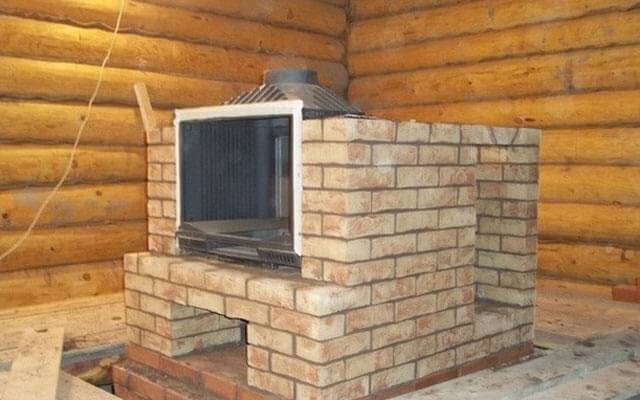
These doors for cleaning smoke channels are located both on the front side of the furnace and on the back.
To control flue gases, several valves are installed. For example, in a heating and cooking stove with a fireplace, one valve is placed above the fireplace insert, the other above the heating channels of the stove. Another valve is provided in the "summer" chimney.
fireplace stove
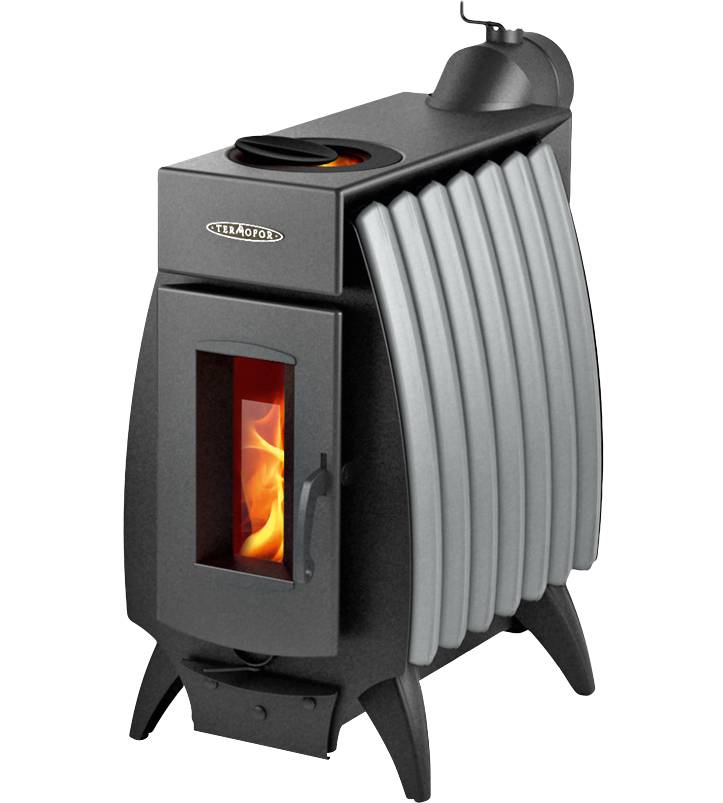
Steel "Fire-battery" (from 14 thousand rubles).
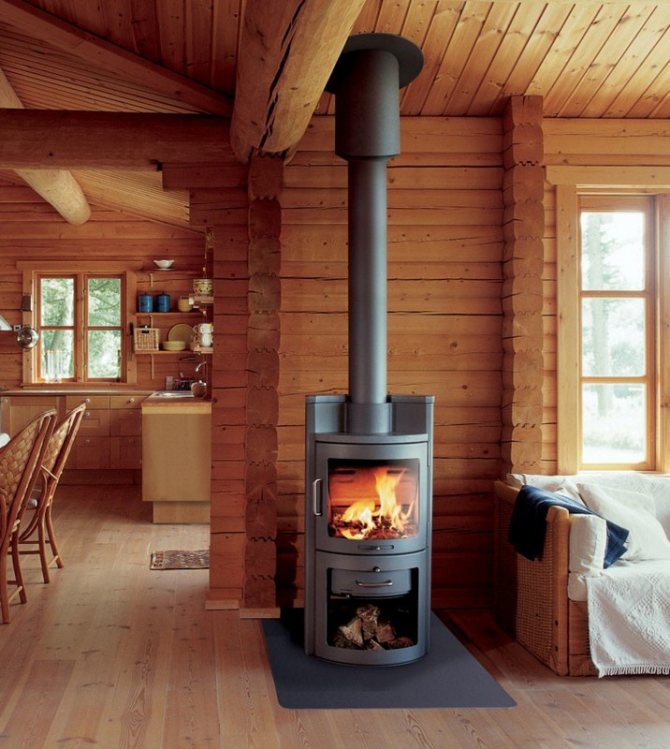
Fireplace stoves (as well as fireplace stoves) are devices equipped with a door with glass and completely ready for installation, that is, they do not require cladding. Our market includes products of Russian companies Vesuvius, Meta, EcoKamin, etc.; foreign Invicta, Supra, Tim Sistem, Vermont Castings, Jotul, ABX, etc. The fireplace stove weighs 60–100 kg, which means that the device can be installed even on the second floor of a house with beamed ceilings.
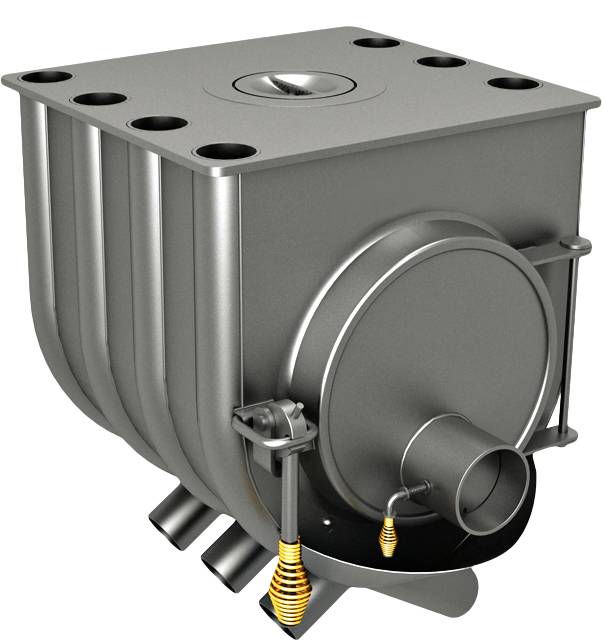
Oven AOT-06 (from 17 thousand rubles) (d), can be used for cooking.
The cost of furnaces starts from 13 thousand rubles. rub. and depends on the name of the manufacturer, dimensions, material and design complexity. Cast iron appliances are more expensive than steel ones (from 22 thousand rubles), they are considered more resistant to high temperatures and, moreover, due to the significant (up to 10 mm) wall thickness, they are able to accumulate heat.However, the vast majority of high-quality steel models (from 16 thousand rubles) are lined (finished from the inside) with fireclay blocks or plates made of vermiculite (refractory mineral), therefore they also have thermal inertia and are durable: their actual service life reaches 25 years.
Most modern fireplace stoves have a secondary afterburning function; air is supplied to the flue gas combustion zone through the rear wall of the furnace (Emdip) or through injectors (Edil Kamin, La Nordica, Jotul). But in order to prevent additional heat from the combustion of flue gas from leaving the house through the chimney, special heat-removing and heat-accumulating elements (made of cast iron, ceramic, stone) must be provided in the lower part of the latter.
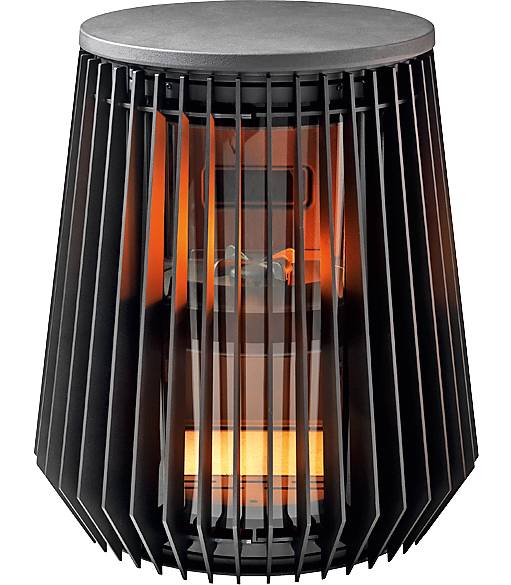
small dimensions, the Ilot fireplace stove has a heat output of 8 kW. The main features of the unit are a two-chamber firebox and a detachable decorative casing-radiator.
On the market, you can also find steel fireplace stoves without lining, which cost no more than 12 thousand rubles. and weigh 40-60 kg, which facilitates their transportation and installation, however, the walls made of thin (less than 3 mm) steel can be deformed during intensive use, which leads to the destruction of the welds.
Some stoves are lined with thin-walled ceramic or natural stone such as talcomagnesite. The price of this option is palpable (from 10 thousand rubles), but the stove looks more elegant and does not emit unbearable heat from it, like from a potbelly stove, since ceramics and potted stone absorb and dissipate part of the heat radiation from the steel case.

Furnace with ceramic finish ENBRA Pegas.
Fuel options
On the heating equipment market, consumers are offered a variety of fireboxes operating on alternative fuels - they can be installed without a chimney structure in rooms for any purpose.
According to the type of fuel used, a fireplace in a house made of timber or logs can be:
- Solid fuel, classic. The furnaces of such units are intended for firewood or coal. They are equipped with standard smoke exhaust structures. In this case, the installation of a fireplace in a wooden house provides for the obligatory laying of a foundation separate from the building, the insulation of surfaces and ceilings adjacent to the unit.
- Electric. Such devices in terms of fire safety are the most reliable. They do not have an open fire, and the air warms up due to the consumption of electrical energy. An imitation of a burning hearth is created by lighting the scenery located inside the fireplace. Electrical appliances are easy to install because they do not require a foundation and do not include a chimney. Such units are an ideal solution for location on the upper floors of buildings and in attics. The main thing that is required for their installation is serviceable electrical wiring and its reliable insulation that can withstand the loads exerted.
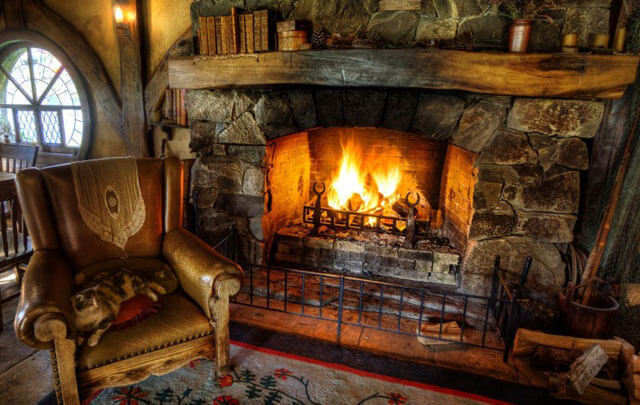
- Biofireplace. This heating equipment is a relatively new type. Such a fireplace in a log house is powered by ethanol. Inside its combustion chamber there is a ceramic burner and a container designed for fuel. The advantage of the device is the absence of soot, ash and other substances harmful to health.To fully provide heat to the room, such a hearth will not be enough, since its main function is decorative. Biofireplaces are available in wall, floor, hanging and table versions. A feature of the devices is the release of steam during combustion, which humidifies the air in the room. A chimney is not required.
- Gas. In such a unit, there is a burner inside the chamber. The fuel is natural or liquefied gas. In this case, the installation of a fireplace in a wooden house requires certain measures, as is the case with classic equipment models. A chimney is required.
Instructions for laying a fireplace with a cast-iron firebox and a metal chimney
The advantage of installing a steel chimney pipe (in our case from sandwich pipes), is that you can bring it out through the wall. This greatly expands your options for placing a fireplace in the house.
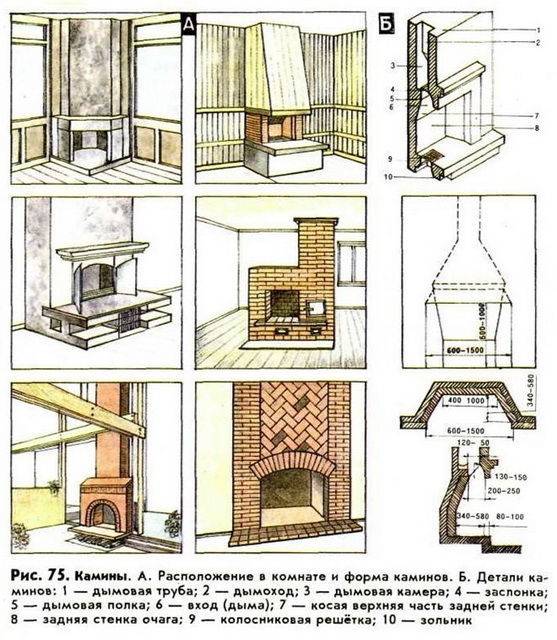
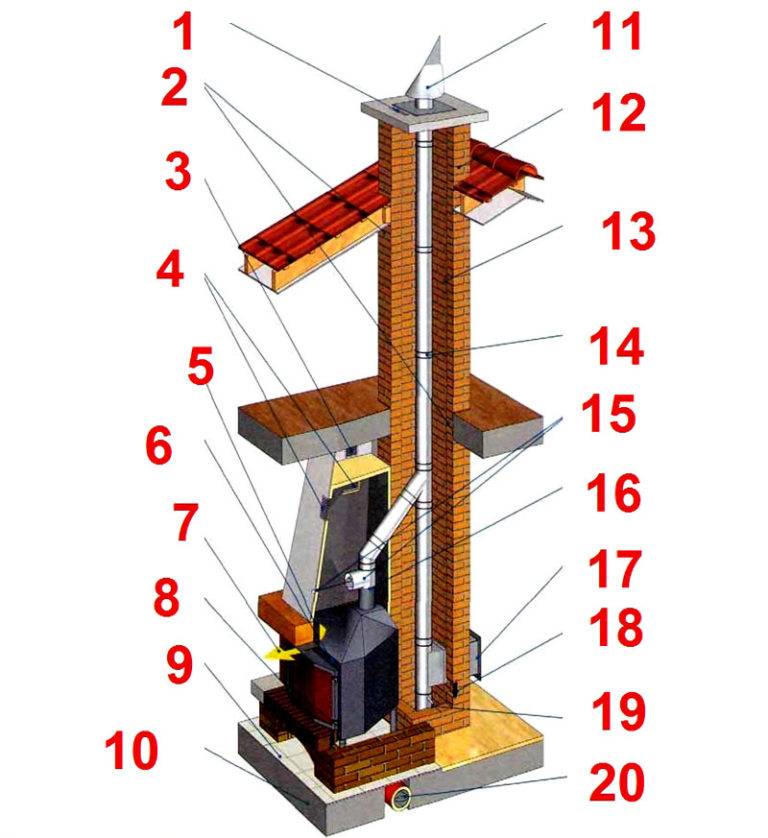


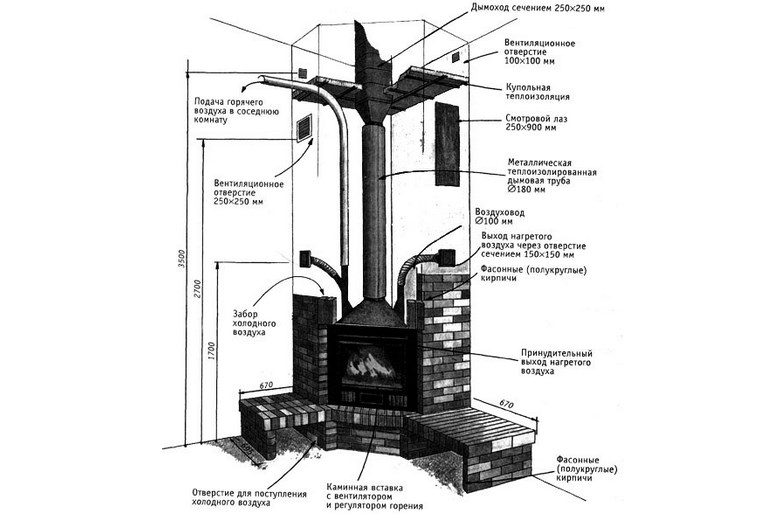
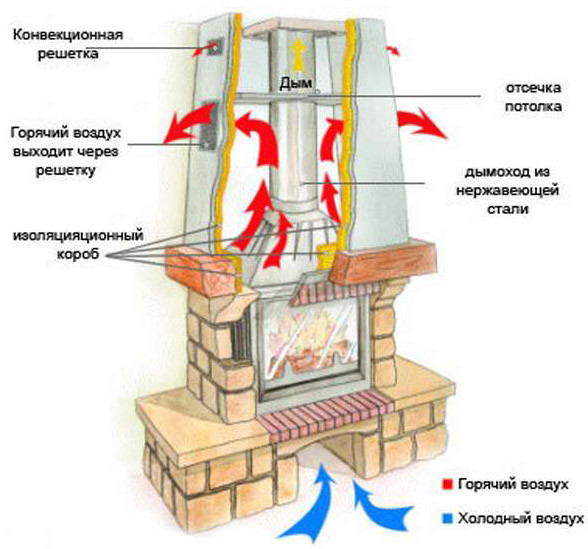

To build such a fireplace, you will need the same tools as in the previous instructions, and from the materials you need to prepare:
- Cast iron firebox with glass.
- Sandwich pipe kit.
- Silicone sealant.
- Clamps, tee.
- Elbow 45 or 90 (depending on the location of the chimney structure).
- Bracket for supporting the chimney pipe.
- Mineral wool (to isolate the passage of the pipe through the ceiling).
- Protective umbrella on the pipe (from precipitation and debris).
The arrangement of a separate foundation is carried out as standard with deepening of the soil, erection of formwork and cementing.
Fireplace insulation. It is impossible to mount a fireplace close to the wall. Therefore, between the wooden wall, which will have a fireplace, it is necessary to lay out superisol.If space allows, you can build an additional thin wall of sand-lime brick. Please note that the wall in this case must be built on the same foundation as the fireplace. Please take this into account when designing. The size of the wall should exceed the size of the fireplace by 50-70 cm on each side.
Base laying (2 rows are laid with solid bricks).
The erection of the pedestal - lay out 4 rows of red brick in the form of the letter P. If you have chosen a wide firebox, then the width of the pedestal should also be increased. Use cement-clay mortar when laying bricks. The pedestal will increase the heat transfer of the fireplace, because cold air will climb from below and, passing through the firebox, rise up.
Ash pan installation.
On the 4th row of bricks, we make grooves using a file, and insert metal corners into them with the ribs up.
We put the 5th row of bricks, which will go under the base of the firebox. We apply a layer of refractory mastic on it.
Installing a cast iron stove.
For this work, you will need an assistant due to the heavy weight of the structure. It is necessary to carefully lower the fuel chamber from the bottom up, while indenting from the back of the wall by 5 cm. While the mastic or refractory glue has not hardened, check the degree of horizontal inclination with a building level. At this stage, errors can still be corrected.
Installation of a chimney from a sandwich pipe.
Furnace lining with bricks
After the firebox is connected to the chimney, it is necessary to overlay it with bricks using heat-resistant glue or cement mortar.
When lining the firebox, it is very important to take into account a thermal gap of 5 mm between the cast-iron wall and the outer casing.Ordering in this case is not important, since, in fact, you are building a brick box according to the size of the finished firebox
At the stage of finishing the chimney, it is very important to ensure that the lining does not rest on the pipe.
Chimney lining with plasterboard. Immediately according to the scheme, a frame is erected from a metal profile, onto which drywall is screwed with self-tapping screws.
From the inside, it must be insulated with heat-insulating mats made of non-combustible material. In this case, they should be attached to the firebox and chimney with the foil side.
The outer part is sheathed with drywall.
Facing works. You can beautifully decorate the fireplace with any facing material: clinker bricks, decorative stone, plaster, etc. After the cladding work is done, the flooring can be done. Keep in mind that parquet or laminate cannot be laid close to the fireplace. The distance must be at least 80 cm.
Fireplace drying and heating.
When all work is completed, you can decorate the fireplace with a stylish do-it-yourself firewood rack.
It is unlikely that anyone will argue that you can look at the flickering fire in the fireplace for an infinitely long time.
Fireplace with firebox
And if everything is clearly done according to our instructions, then such a fireplace will delight not only with the creation of a special aura of home comfort, but also give warmth, heating the house.
To make it easier for you to deal with the construction of a fireplace with your own hands, we suggest that you familiarize yourself with the detailed video instructions.
Installing a fireplace in a wooden house
Do-it-yourself installation without the appropriate skills and the help of professionals fireplace in a wooden house only valid if they are factory finished units.
If you want to build a real brick structure, you need to use the services of a master. The fireplace should be accurately calculated. First of all, they build a foundation - it is made isolated from the foundation of home ownership. Therefore, a brick fireplace in a wooden house is equipped on a separate basis.
It is considered optimal to choose the installation site before the construction of the building begins. In this case, along with pouring the foundation of the house, they lay the foundation for the fireplace. If installation is planned in a residential household, then the ceiling is partially dismantled at the installation site, and the floor covering is removed.
Next, dig a pit for the foundation to the level of soil freezing. Crushed stone, broken brick or small stones are poured onto its bottom. Formwork is assembled over the entire height of the base with an elevation above the floor of up to 10 centimeters. Be sure to use reinforcement in the form of a grid made of steel rods.
The solution is poured into the formwork. The very last, top layer is carefully leveled - it must be horizontal. While the base acquires the required hardness, proceed to the sheathing of the walls with insulating materials.
When a brick fireplace is being built in a log house, it is necessary to make multilayer protection. At the site where the insulation is to be installed, markings are made. It is required to close the surface from the floor to the ceiling.
From the edge of the fireplace you need to retreat in all directions by 50-100 centimeters. This area should be insulated. A metal profile is fixed on the wall and the first layer of insulation is mounted.
From above, the mineral wool is sheathed with sheets of drywall. Profiles for insulating material are mounted on top of them.Then foil plates are fixed on them, while the gaps between adjacent elements are glued with a narrow electrical tape with foil having an adhesive base.
Another option for fire insulation is brickwork. Using a solid brick right next to a wall of wood, lay out a wall.
To build a brick fireplace, you will need:
- row and refractory bricks;
- grate;
- flaps;
- glass door.
Laying is carried out in accordance with the scheme. A solid brick is used, and the inner surface of the precise chamber is made using a refractory one. To build a fireplace, a special heat-resistant solution is used.
Each laid out row is certainly checked by a level. To make an arch, use templates. In the process of laying an insulated, straight wall or corner fireplace in a wooden house, elements such as a firebox door and a grate are installed. A gap of at least 20 centimeters should be left between the insulation material and the brick wall.
Self-installation of a Russian stove
For the construction of a classic Russian stove, you will need about 1650 bricks, a valve with a size of 260 by 240 mm and a certain amount of clay and sand, which is enough for 80 buckets of mortar.
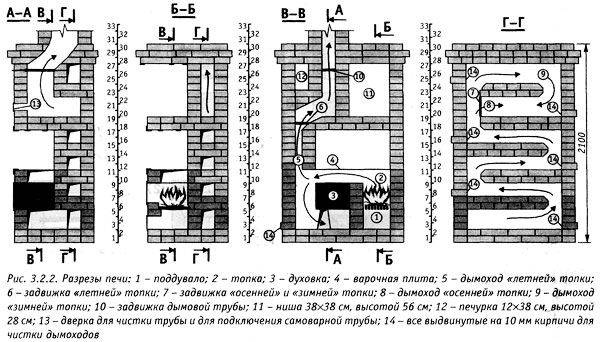 Self-installation of a Russian stove
To perform work, it is necessary to use red bricks; refractory (fireclay) bricks are used to lay out the firebox. When performing masonry, it must be remembered that the seams that form during masonry should be small. no more than 5 - 7 millimeters.


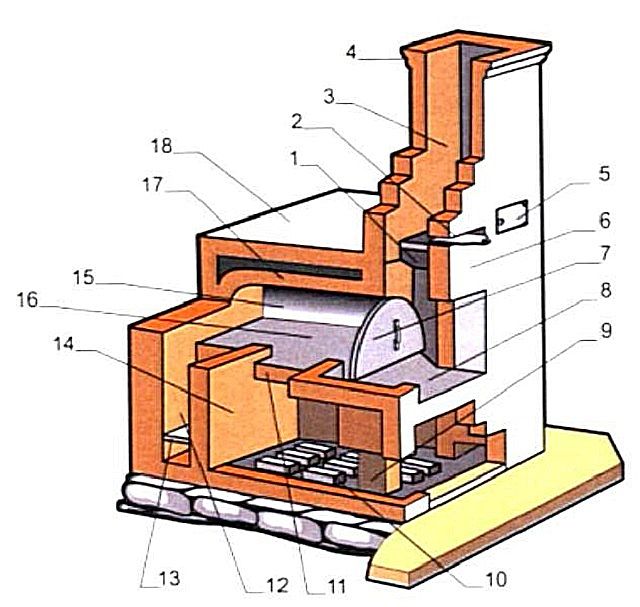


Each level must be laid using a building level and a plumb line. It depends on how well the furnace as a whole will be laid.
The construction of the stove must be carried out, guided by the requirements of the order. This is the name of the scheme, which indicates the placement of bricks in each individual row. Such orders exist for almost all types of Russian stoves.
It should be noted that laying a stove is a rather complicated construction process and requires a highly qualified bricklayer. No wonder there is a separate specialty stove-maker. And for the construction of a furnace at home, it is better to invite just such a specialist.
Varieties and types of fireplaces
Depending on the material of manufacture, fireplaces are:
- steel or cast iron;
- stone;
- brick.
Steel or cast iron. Fireplaces with a metal fire chamber consist of a glass door. As a result, outwardly they look like both a stove and a fireplace. Such equipment is in demand due to its availability, compactness and speed of installation.
Steel or cast-iron fireboxes are introduced into decorative fireplaces made of wood, stone and brick. To mask the chimney, drywall is used.
Stone is rarely found in residential premises, since the installation process is quite complicated and lengthy. In addition, a stone fireplace needs a special foundation. For this reason, it is recommended to install it in larger rooms.
Brick fireplaces also have large dimensions and require the construction of a foundation, which is isolated from the base of the walls. Due to the unique properties and characteristics of the material, uniform and pleasant heating of the entire room is ensured.
Despite the high heat capacity of the stove brick, the fireplace must be isolated from the wall. To do this, the thickness of the masonry, which is closest to the wall, must be at least 25 cm.In addition, the outer masonry is isolated from the walls of a wooden house with the help of vermiculite, basalt wool and perlite.
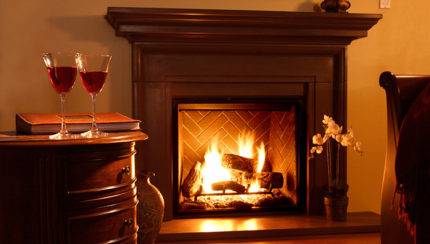 Fireplaces of all sizes and types perfectly complement the interior of any living space with their sophistication, atmosphere, warmth and comfort.
Depending on the fuel used, fireplaces are:
- Wood. For their work, real logs are used. Fuel needs to be prepared, storage space provided. Clean the fireplace after every use.
- Gas. They can operate on main or bottled gas. A permit is required for the installation of gas-using equipment, and a representative of the gas service is required for connection. Maintenance is extremely simple.
- Electrical. Easy to operate and move. They are powered from the outlet, but with daily use, the consumption of electricity per month is considerable.
- Ecofireplaces are easy to maintain and operate. Safe, but their cost is quite high.
In a wooden house, there are many options for placing a fireplace. Basically, it depends on the location and its shape.
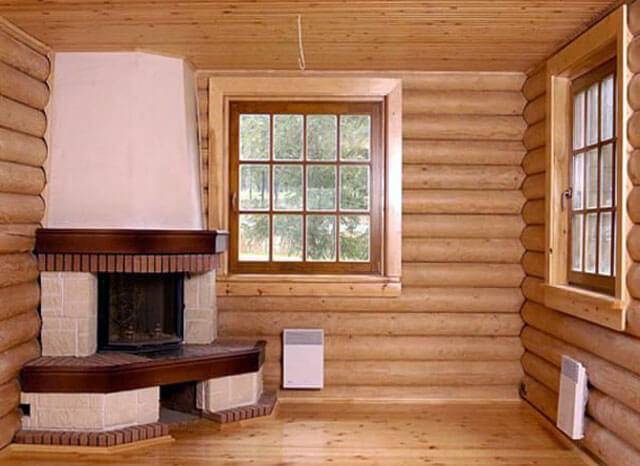
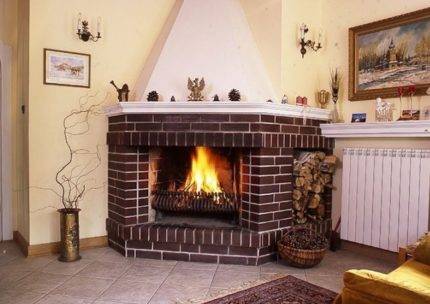 Corner fireplaces fit perfectly into the free space in the corner of the room, helping to make the most of every square meter.
According to the type of location, fireplaces are divided into:
- Isolated. Most often they are installed as a separate part of the interior. Insulated fireplaces come in all shapes and sizes and are often placed right in the center of the living room because they require a lot of space.
- Direct. Quite popular at the moment. Can be built-in type or attached to the wall.
- Corner. Fireplaces of this type are very compact and harmoniously fit into the interior design. They are small in size, so it is recommended to use them in small wooden houses.
Direct fireplaces are divided into built-in and wall-mounted. Recessed are often installed between two rooms. Their power allows you to warm both rooms. As for wall-mounted ones, they are placed against the wall and do not require much space.
Choosing a place for installing a furnace heating system
When designing a stove or fireplace, it is necessary to take into account the features of the functioning of this heating system and the convenience of its operation, the option for installing a chimney, recommendations from SNiP (building codes and rules) and other regulatory documents. In addition, it is necessary to take into account the fire-prevention distances between the walls and the heating surfaces of the furnace.
Criteria for choosing a place for installing a stove in a wooden house:
Features of the heating system. Air-heating metal furnaces, for example, "Buleryan" or "Burzhuyka" must be placed indoors, taking into account constant access to air flows. If it is necessary to heat several rooms, some modernization of the partitions between the rooms will be required so that a stove can be built into them. Another effective option is the installation of additional air ducts in heated rooms.
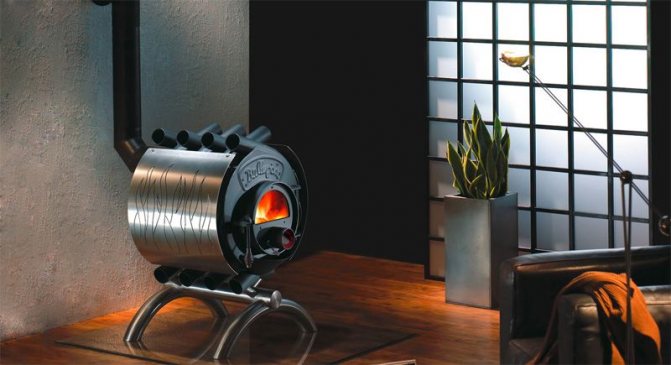
The Buleryan stove can look very stylish in a modern living room. If a stove with a water heat exchanger is used as the main heating system, its location in the room does not play a special role. The main thing in this is to ensure ease of use and comply with all fire regulations. During installation, it is necessary to place the heating circuit so that its heat exchanger is located at the lowest point.
- Chimney connection
to the stove is perhaps the most basic criterion for choosing the location of the heating system in the room.As a rule, a stove or fireplace in a wooden house is located in the most convenient place for connecting a chimney. At the same time, all fire prevention measures must be observed.
- Ease of use
. For efficient maintenance of the oven (cleaning, heating, cooking, etc.), you will need free space directly in the working area. This feature should be taken into account when choosing the location of the furnace.
- Fire distances
directly from the heated sections of the furnace to wooden partitions and walls should be at least 110 cm. The distance from the furnace to the wall is 120-150 cm.
Proper location of the furnace heating system minimizes the process of maintaining a comfortable temperature inside the room and facilitates the operation process.
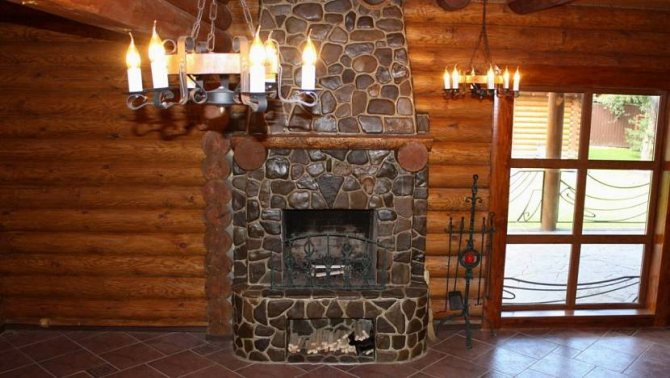
Coals falling out of the furnace should not fall on flammable objects, they should be at a safe distance
How to choose a place for the oven
The stove can be installed in different places in the room, but its most optimal location would be to build it into the walls between adjacent rooms. In this case, with a small area of \u200b\u200bthe house, one heating structure can be dispensed with if the heat-releasing surface is proportional to the size of the rooms into which they go.
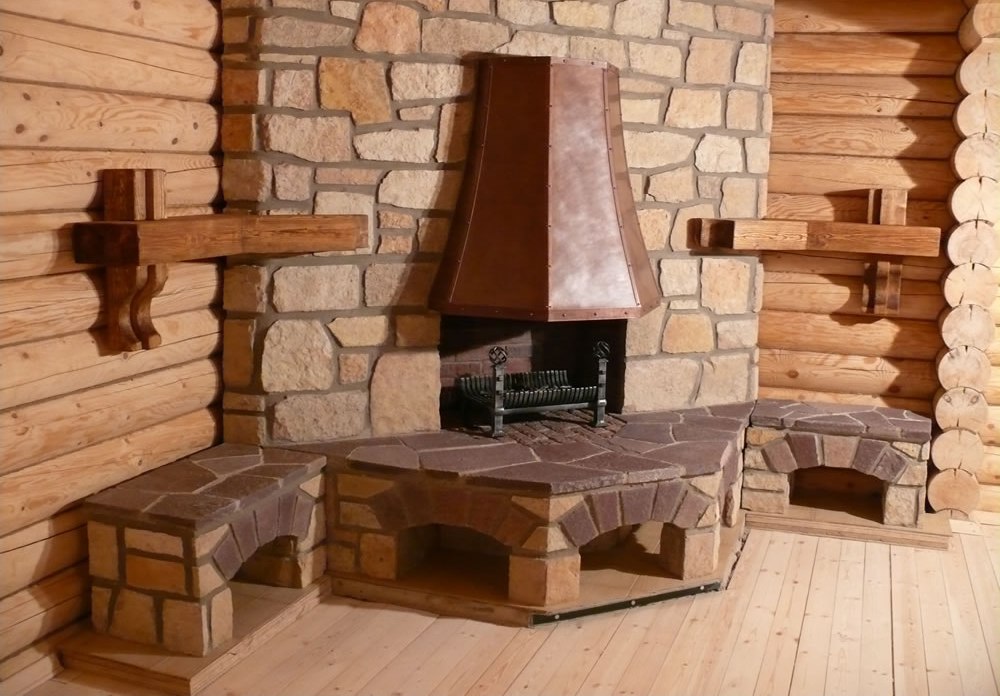

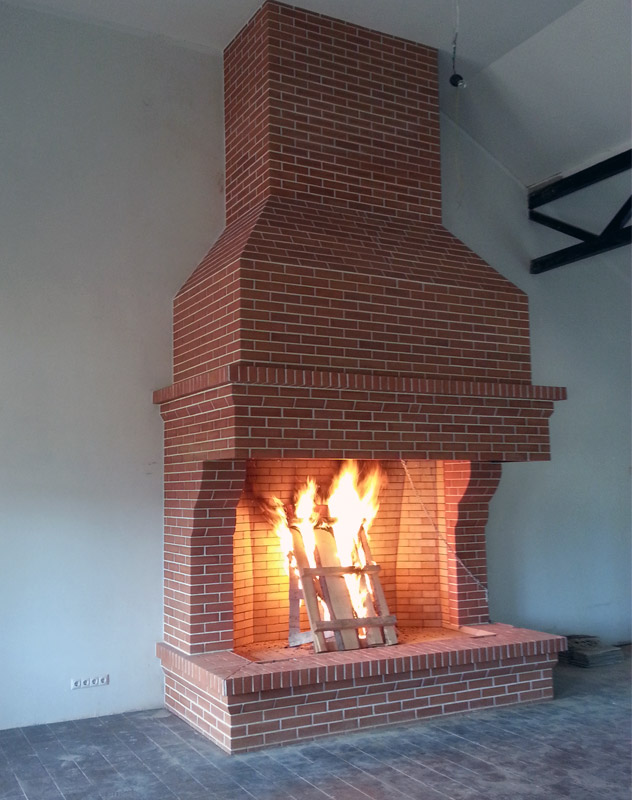


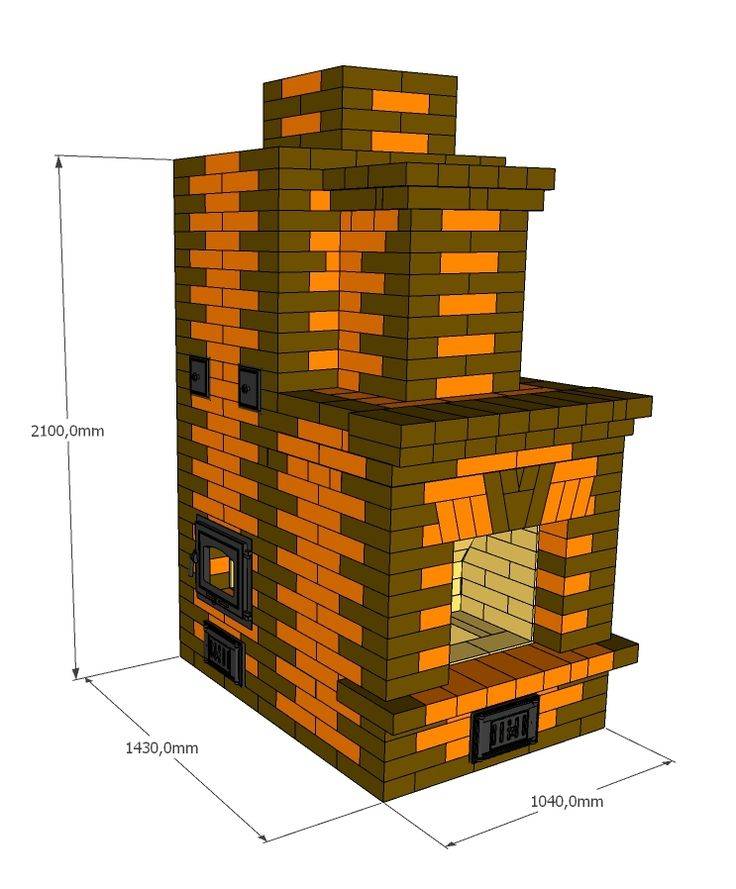

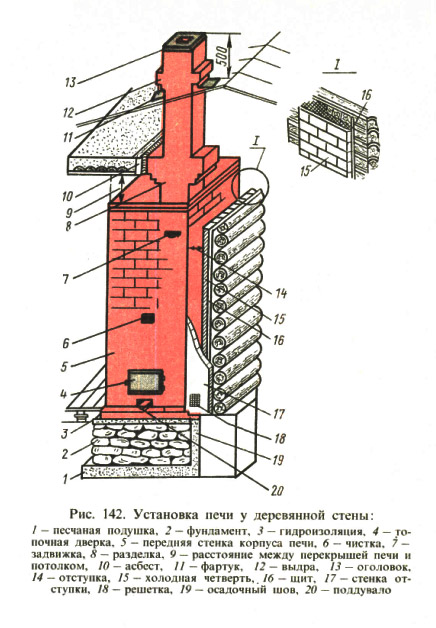

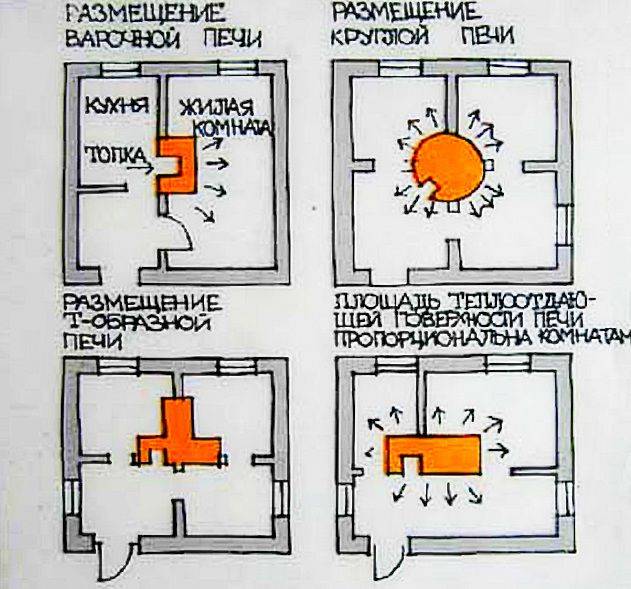
It is very important to correctly determine the place of construction of a brick oven
It is not recommended to install the stove near the outer wall of the house, as it will dry out much faster, and, in fact, it is useless to “heat the street”.
The place chosen for the construction must be well measured and take into account some points:
The height of the ceiling of the room is important, since the brick oven must fit well into the space in its height.
The foundation for the furnace must be 110 ÷ 120 mm larger than its base, and for it it is also necessary to provide a suitable size area.
The chimney pipe, when laid up, should not stumble on the floor beams and on rafter legs roof structure.
Calculation of the main parameters
The efficiency of the fireplace stove operation depends on the correct calculation of the parameters of all its elements. A discrepancy in the calculations will lead to a significant decrease in heat transfer or part of the smoke from the combustion chamber will go into the room. Therefore, for the construction of the correct design of the fireplace stove, the following rules must be observed:
- The size of the combustion chamber window should not be more than 2–3% of the area of the heated room.
- To determine the area of the hearth surface, it is necessary to multiply the square of the furnace chamber window by 0.7.
- The width of the combustion chamber is recommended to be made in the range from 20 to 40% more than its height.
- To calculate the depth of the combustion chamber, you need to multiply the parameter of its height by 0.7.
- The diameter or section of the chimney pipe is recommended to be at least 10% of the square of the furnace window. At the same time, it is not recommended to make its channel smaller: 150x280 mm for a brick structure, 160 mm in diameter for a pipe.
- The chimney must be laid out in such a way that it is conical in shape.
In order not to make mistakes in the calculations, you can use ready-made tables and projects of such structures.
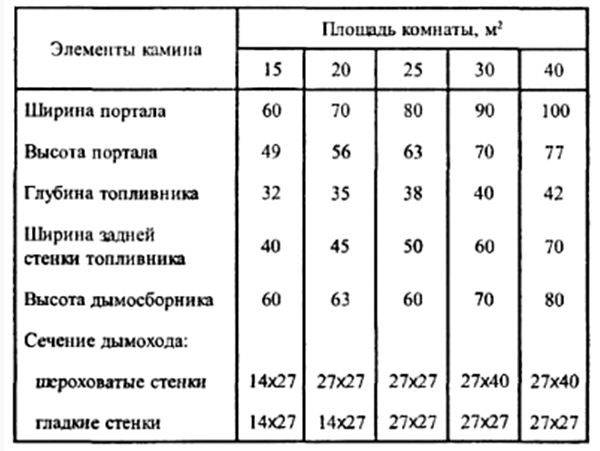
Optimal dimensions
Calculation of bricks
To obtain an accurate calculation of bricks, it is necessary to use ready-made ordering schemes. The amount of building material depends on the specific design of the fireplace stove.In the proposed schemes, half or smaller fractions of the material should be considered as whole bricks. In this case, their total number must be multiplied by 1.2.
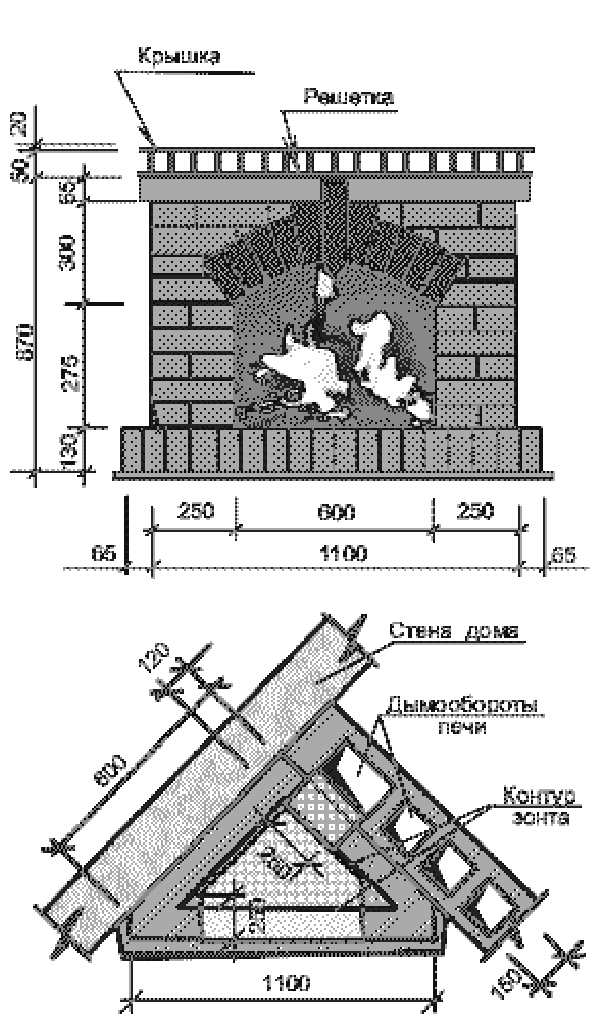
corner option
The resulting value will make it possible to purchase material with a small margin. This is necessary because the bricks may be damaged during transportation or unloading, and some of them may be defective.
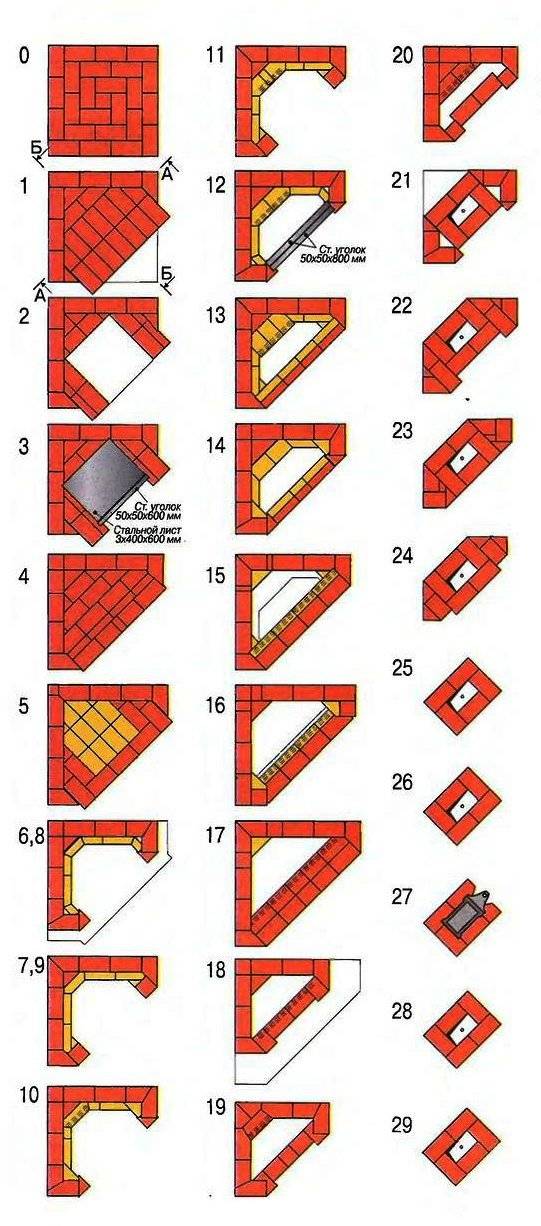
Fireclay brick is highlighted in yellow
Calculation of the foundation and mortar for masonry
When calculating the mortar for masonry, one should be guided by the fact that with a layer thickness of 3 mm, one bucket of the mixture for 50 bricks is required.
Knowing the parameters of the material used, it is easy to calculate how much concrete and sand will be required to install the slab base.
The figure is highlighted in blue - the sector of the cylinder
To calculate the volume of concrete of this form, it is necessary to recall the school geometry course, namely the formula for finding the volume of a cylinder, which looks like this: V = πR²h, where π is a mathematical constant expressing the ratio of the circumference to the diameter, equal to 3.14, R is the radius, h is the height of the figure.
The length of each of the sides of the right angle of the figure can be easily calculated, knowing the parameters of the brick.

The construction names of the sides of the material are indicated
According to the masonry scheme of the rows of the fireplace stove, it can be seen that these sides have 3 lengths of the bed side of the brick and one - the bond side. For example, it looks like this: 0.25 + 0.25 + 0.25 + 0.12 = 0.87 m. The foundation for the fireplace stove must be made on each side 10 cm more than the structure itself: 0.87 + 0 ,1=0.97 m.




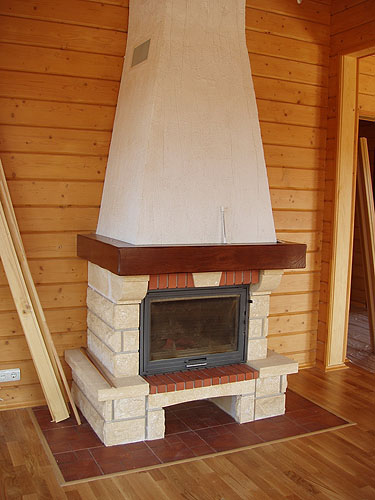
For example, the height of the foundation will be 10 cm.
Now you need to substitute the values \u200b\u200binto the formula to find the volume of the cylinder.The result obtained must be divided by 4, since the sector of the cylinder has its fourth part. The formula will be: V=(π R² h):4. Substitute the values: 3.14 0.97² 0.1 \u003d 3.14 0.94 0.1 \u003d 0.295: 4 \u003d 0.073 m³ of concrete mixture will be required to pour the foundation of this form.
What to look out for
In order to make a stove with your own hands, you will need to familiarize yourself with the following main points:
- For brick, massive units, it becomes necessary to build an additional foundation. It is necessary to give the fireplace stability, greater reliability;
- Be sure to draw up a diagram that will display all the characteristic features of the chimney system;
- Ordering or drawing will help you determine as accurately as possible how many materials you will need for assembly;
- Choose the type of cladding, style design (it must be combined, in harmony with the interior of the living room, kitchen, bedroom or any other room chosen for installation);
- The design must comply with all fire safety standards and requirements.
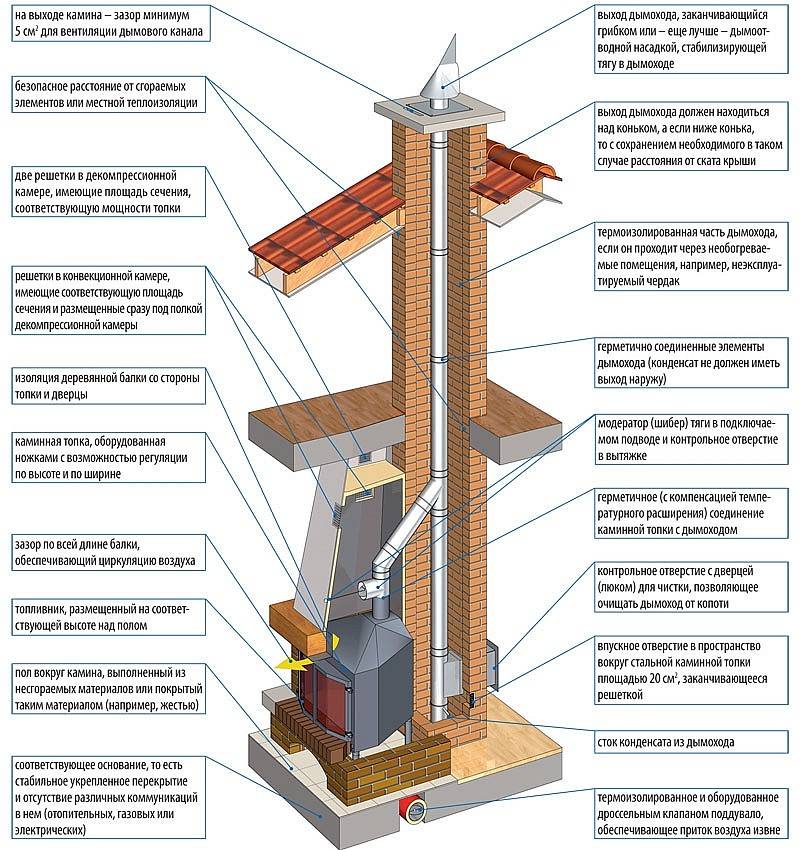
A detailed description of all the main and secondary components of a solid fuel stove

Separation of installations according to the method of heating and distribution of thermal energy
Types of fireplaces
The device of a fireplace in a wooden house gives its interior coziness, in addition, it is warm and comfortable to be in the room where it is installed. But there are serious requirements for its installation.
The domestic market offers a wide selection of various models. The degree of complexity of installing a fireplace in a wooden house depends on the materials from which the combustion chamber is made, the type of solid fuel and the layout of the building.
These heating units are classified according to the shape of the body into:
- Corner. Such devices are located in the corners of the rooms.
- Direct wall. They, in turn, are built-in and wall-mounted. In the first case, fireplaces are installed inside the walls, they are most often mounted to heat adjacent rooms. Wall-mounted, as the name implies, are located near the walls.
- Isolated. Round, square, rectangular, with a closed or open firebox, a fireplace in a wooden house in a country house is placed in a free area, at a certain distance from the walls, most often this is done in the living room.
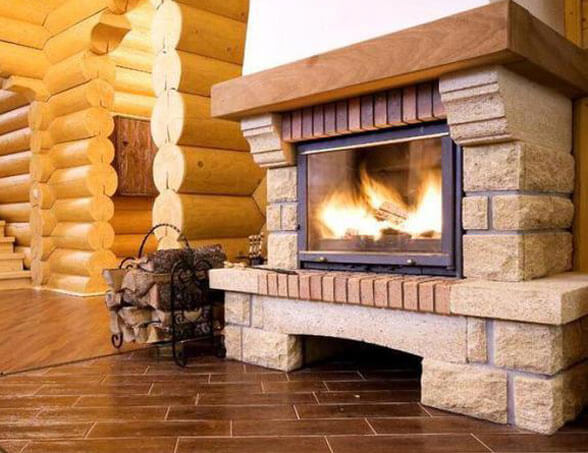
When the walls and ceilings are made of natural wood, the installation of a fireplace stove in a wooden house and the choice of its type must be approached especially carefully. There are units that have an open hearth, which are prohibited for use in such buildings.



